



Abstract
There is a growing emphasis on research across disciplines, and higher educational institutions’ research productivity (RP) is a matter of serious consideration. However, a knowledge gap exists in RP in social science disciplines in India. In this context, the present study aimed to (1) understand the RP of social work and psychology schools at publicly funded central universities (CU) in India, (2) evaluate the RP and research impacts of faculty members in these schools, and (3) identify the publishing trends and patterns in social work and psychology disciplines. Using the Scopus database, we collected bibliometric information on publications of 19 social work and 16 psychology schools and their faculty members. The results indicate that schools’ research productivity remained unpromising, constituting many faculty members (Social work 51.08%; Psychology 43.4%) with no publications. Although the average RP of social work (M = 16.0, SD = 17.40) and psychology (M = 45.63, SSD = 61.08) schools differed, the difference was not statistically significant (t = 1.88, p = .078). An increase in the publication was evident after 2016, indicating positive-policy impacts. A difference in RP across professional ranks was evident for social work (p < .05) but not for psychology (p > .05). For research impact, a difference existed based on ranks for academicians from psychology only (p < .05). Publications in high-impact journals and an output of international collaborations remained low in both disciplines. Implications point to developing appropriate workshops and training to provide hands-on experience to improve quality research among academicians. Further policy changes are also essential to enhance research culture and productivity.
Plain language summary
Given the importance of research practice, to the best of our knowledge, the current study has been the first attempt to assess research productivity and publishing trends by social work and psychology schools and disciplines across the central universities in India. Additionally, we measured individual faculty productivity and the impact of their scholarly publications.
Introduction
Scientific research and innovation are vital to any nation’s growth and essential to academic disciplines (Mezrich & Nagy, 2007). Research is regarded as one of the important indicators of efficiency in any production system (Abramo & D’Angelo, 2014), which in our study is knowledge production. Successful research initiatives are pivotal in advancing disciplines and may enhance human life. Research facilitates identifying factors that promote well-being and aims at finding solutions to real-life problems (Kuruvilla et al., 2006). Faculty members, scientists, and researchers at universities and higher educational institutions are largely involved in research activities. Therefore, universities are considered to be the hub of research and innovation. Various types of higher educational institutions exist in India with varied priorities for teaching and research. Central universities (CU) are funded by the central government of India and have multifold mandates of teaching, research, and innovations. Therefore, CUs are funded better than state and private universities to achieve these institutional goals (Marisha et al., 2017). In this context, it is critical to evaluate the research contributions of CUs. Hence, evaluating productivity in terms of RP across the CUs and their faculty members is a critical assessment to understand their contributions.
A lack of agreement exists on the criteria for measuring research productivity (Arriola-Quiroz et al., 2010; Zhuo, 2008). However, several authors define research productivity as the number of scientific contributions made by individual researchers in terms of publications (Alghanim & Alhamali, 2011; Hadjinicola & Soteriou, 2006). Assessing the vitality of research among faculty members has increasingly gained attention from scholarly disciplines (Agrawal et al., 2013; Gilstrap et al., 2011). Several metrics, such as the number of citations, h-index, and i-10 index, seek to measure RP and research impact of individuals and disciplines (Barner et al., 2015). Universities often consider their faculty members’“publication count” to assess their research productivity (Alghanim & Alhamali, 2011; Dakik et al., 2006; Jauch & Glueck, 1975). The publications yield a researcher with significant prestige and other benefits such as job prospects, salary increases, promotions, and/or tenure (National Research Council (US) Committee on Responsibilities of Authorship in the Biological Sciences, 2003). Institutions’ intellectual credit scores increase with every quality publication by their faculty members, and prestige and recognition are disclosed to the scientific community (Kashif et al., 2022). They further improve publicity and value, heighten the scientific reputation of the institution, and attract potential national and international collaborators (Hadjinicola & Soteriou, 2006; National Research Council (US) Committee on Responsibilities of Authorship in the Biological Sciences, 2003). Moreover, the research productivity of the faculty members of any academic institution is most important to meet the national and international university rankings.
In this study, researchers considered the research productivity of two major disciplines from social sciences: social work and psychology. The contributions by various academic disciplines vary, in which disciplines from social sciences, including social work and psychology, are minimal compared to disciplines in the pure, natural, and engineering sciences (Vakkari et al., 2022). Research from social science is argued to be primarily important as it promotes institutional change (Smith, 1998). It guides the government in devising policies and in their effective implementation using new knowledge and methods. Social work and psychology, being largely practice-based disciplines, rely on research evidence. Moreover, the research in these disciplines will have direct implications for the community and people. Therefore, conducting research in these disciplines is crucial and understanding the current research trends in terms of RP is a need of the hour.
Earlier research, specifically from the Western world, attempted to understand the productivity of social work and psychology disciplines, showing mixed results on productivity and research impact (Barner et al., 2014, 2015; Lacasse et al., 2011). A study that examined scholarly productivity also showed that professors from psychology received three to four times more citations compared to social work professors (Thyer & Polk, 1997). However, to our knowledge, no research is evident on the productivity of these disciplines in India. It is critical to understand the productivity of these disciplines because there has recently been a mushrooming of social science schools in the public and private sectors, especially social work schools (Bhatt & Phukan, 2016). Besides, social work and psychology disciplines are closely related (Holosko, 2006) and are primarily practice-based helping professions that rely on evidence-based practice. Hence, comparing the research productivity between these two disciplines is justifiable.
Many achievements in scientific research exist in India, accounting for concerted efforts toward building institutions with credible research infrastructure (Reddy, 2015). India is a significant contributor to publications in terms of number (Pandita et al., 2022). However, the impact of such publications is unexplored, especially in social science disciplines. Drawing from these understandings toward the importance of research, its potential utility, and the gap in the literature on research productivity, impact, and publishing trends in the Indian context, we aimed to (1) understand the RP of social work and psychology schools at publicly funded central universities in India; (2) evaluate the RP and research impacts of faculty members in these schools in terms of the number of publications and citations; (3) identify the publishing trends and patterns in social work and psychology.
Methods
In the present study, we undertook on-desk research to accumulate data from the Scopus database to understand the research productivity of publicly funded social work and psychology schools and their faculty members in India. We preferred Scopus over others because it is a well-known database for peer-reviewed journals, and the quality of the indexed papers can be relied upon to a great extent. The data required for this study was gathered during March and April 2023. The data available in Scopus till April 25, 2023, were only considered.
Data and Process
In India, there are four main types of universities: central, state, private and deemed. The Central Government of India exclusively funds the central universities. These universities are considered research and teaching-intensive universities. In a broader sense, faculty members at these universities are expected to be involved in high-quality research and publication alongside teaching. In this study, we considered the case of central universities alone. The list of publicly funded central universities offering social work and psychology programs was obtained from the University Grants Commission’s (UGC) website, the university regulatory body in India. Figure 1 represents the process of selection of universities. Subsequently, the list of faculty members was obtained through the individual university website search. The criteria for data inclusion were (1) only publicly funded central universities in India and (2) articles/research papers and book chapters published from 2010 onward to delimit the scope of the study. Measures considered for the study include school-wise productivity, faculty productivity, impacts (identified by the total number of citations received per faculty member excluding self-citation), and trends. The data for these measures were collected by employing different strategies.
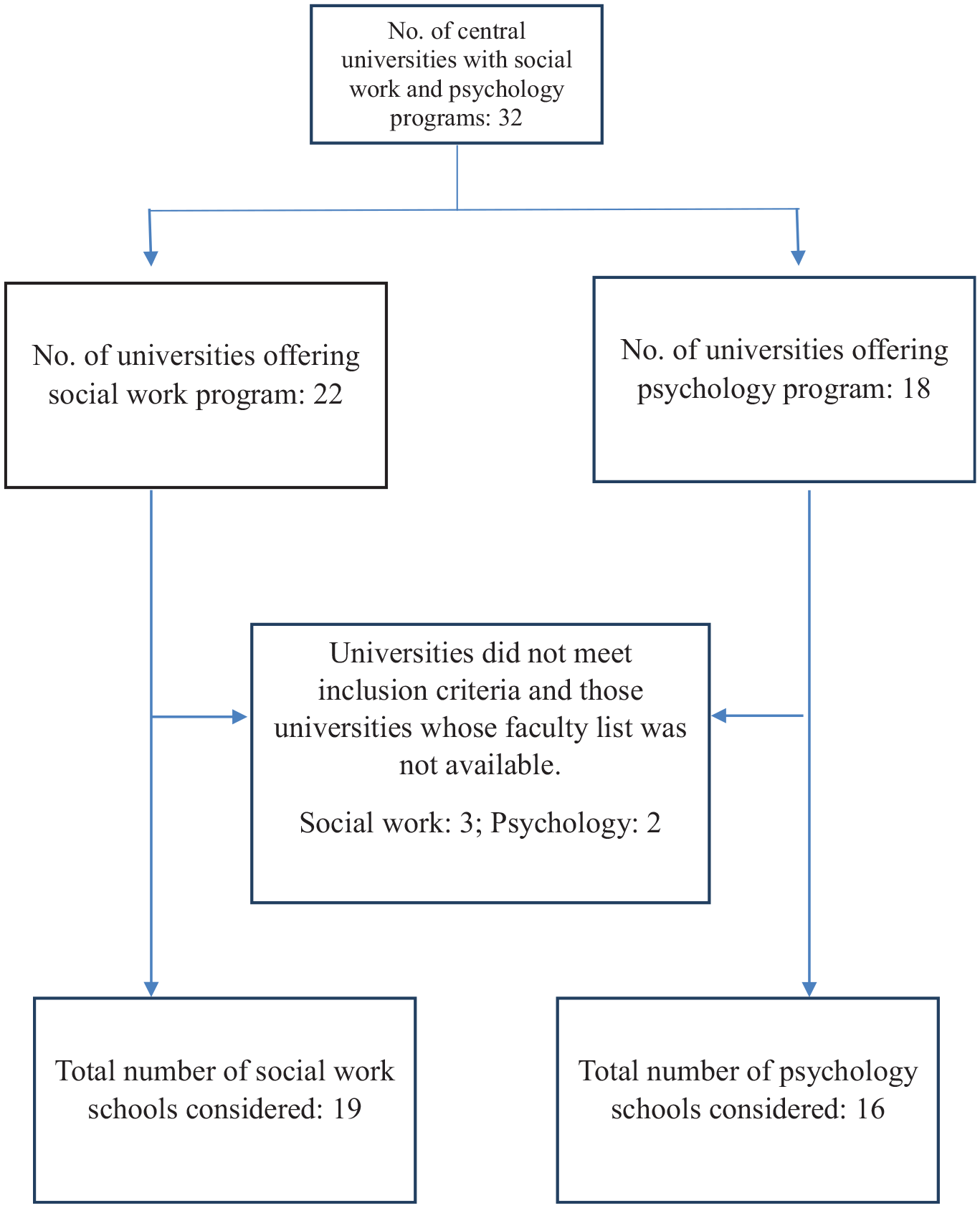
Selection process of central universities with social work and psychology schools.
School-Wise Productivity
We first extracted the faculty members’ details and ranks from the school websites. Later, a Scopus search was undertaken with the names of currently employed faculty members to obtain the list of publications, including name(s) of the author(s), year of publication, title, journal published in, and the number of citations received. All these details are captured on a checklist. The productivity of the school was measured by the cumulative number of publications by their faculty members.
Additionally, to capture the publication of the faculty members who retired or left the institution (whose details were not available on the university website), an institutional domain/discipline-wise Scopus search was made. All such data accumulated by this means was added to the count of respective schools.
Faculty Productivity and Impact
The performance of faculty members from the schools of social work and psychology by individual faculty members was measured by the number of publications. The faculty members were grouped by their ranks: professor, associate professor, and assistant professor. Some faculty members were found with multiple Scopus profiles. Hence, care was taken to consider the publication details from all existing valid profiles while eliminating inappropriate profiles and publications. The impact of the researchers’ published articles was assessed by the total number of citations their articles received. For analysis, they were classified according to their academic ranks. The faculty members currently associated with the schools were only considered for this measure, irrespective of whether the publications’ affiliations belong to the currently associated school.
Trends
Trends in the present study indicate the journal’s impact factor, the field of research within the discipline, the research approaches, and collaborations. The impact factor of the journals in which faculty members have published their research work was listed. The impact factor of these journals was obtained from the Journal Citation Reports (JCR) of Clarivate Analytics. Finally, we categorized the domain/fields of the published research works/articles, the research approach employed, the nature of the data used (primary or secondary) and collaborations.
Data Analysis
The data were analyzed using SPSS software (version 25). Descriptive statistics such as frequency and mean were applied. Independent samples t-test was employed to determine if RP differed between the schools of social work and psychology. Further, one-way ANOVA was used to determine if a difference exists across faculty ranks for the number of publications and citations.
Ethical Considerations
Since this is an on-desk research, not involving human subjects, no third-party ethical approval was sought. However, the data extracted involved the personal identification of researchers and schools’ identities. Hence, to protect privacy, we have not indicated the names of schools and faculty members but represented them as alphanumerical codes.
Results
The total number of publications by each school of social work and psychology from 2010 onward is listed in Table 1, along with the number of faculty members and the mean number of publications. In brief, the number of publications is 304, with zero publications being the minimum and 66 (M = 4.125) being the maximum count for social work schools. On the other hand, the total number of publications for psychology schools was 730, with the least number of publications being zero and the maximum being 236 (M = 10.26). Further, a t-test was performed to determine if there was any difference between the schools of social work and psychology in the number of publications (Table 2). The results were insignificant (t = 1.88, p > .05).
Productivity of Publicly Funded Social Work and Psychology Schools in India.

Note. CU = Central University; The value is kept blank for those schools that do not have respective departments.
Independent Samples t-test of Research Productivity Between Social Work and Psychology Disciplines.

An unpromising trend is evident in the case of many schools of social work and psychology where the per faculty publications remained low. Seven social work and four psychology schools had a per-faculty publication below 1. Similarly, many faculty members have not contributed to research publications during the analysis period.
Figure 2 depicts the research productivity from 2010 to 2023 for social work and psychology. It was observed that the research output grew in both disciplines from 2017-18 onward. During the years 2021 and 2022, a significant rise is evident. A decline in publications during 2023 can be attributed to the data considered for the present study. We have only considered the data till April 2023. Hence, the complete list of publications could not be retrieved for 2023.

Scholarly publications through the years.
Research productivity and impact are measured for the currently associated faculty members of the schools through the number of publications and citations received for the research publications from 2010 onward. Table 3 represents the publication data by faculty rank for social work and psychology. The column total represents rank-wise productivity, while the row total represents the total number of publications from minimum to maximum. From social work, professors had a total of 120 publications (M = 3.63), associate professors had 58 (M = 3.87), and assistant professors had 136 publications (M = 1.49). While for psychology, professors had 374 (M = 9.35), associate professors had 73 (M = 4.56), and assistant professors had 186 (M = 3.26) publications.
Faculty Rank-Wise Productivity in Social Work and Psychology.

Note. SW = social work; Psy = psychology.
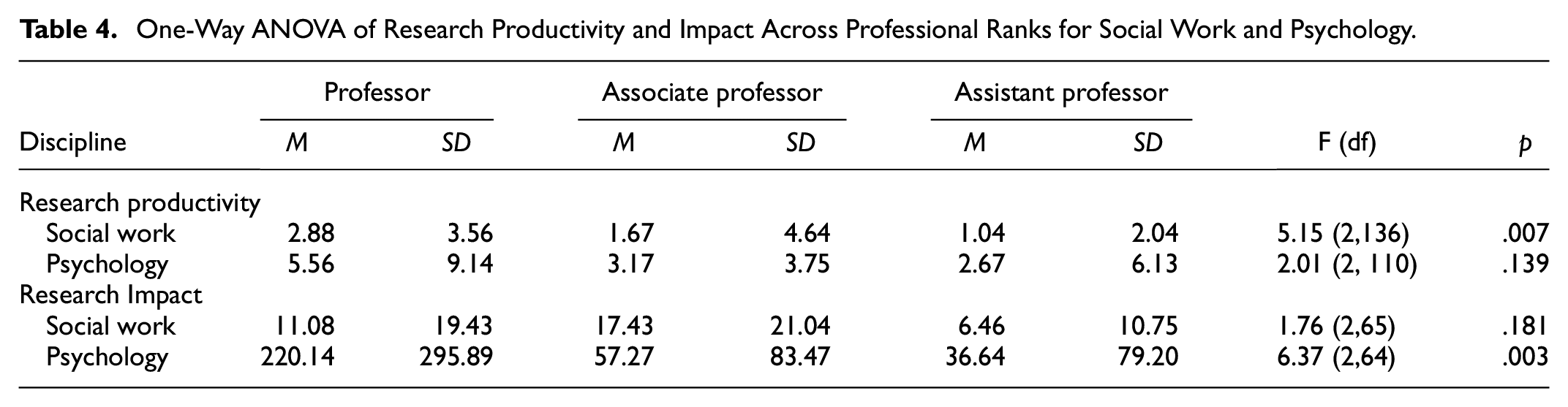
We then analyzed the difference in productivity across faculty ranks using one-way ANOVA (Table 4). Results showed a significant difference in the number of scholarly publications by professors, associate professors, and assistant professors for social work (F (2,136) = 5.15, p < .05). In contrast, a similar difference did not exist based on academician’s ranks in psychology discipline (F (2,110) = 2.01, p > .05).
One-Way ANOVA of Research Productivity and Impact Across Professional Ranks for Social Work and Psychology.
We also assessed the impacts of the publication by the number of citations. Table 5 captures the same for social work and psychology. The column total represents the impact of the faculty by rank, while the row total shows the number of citations by categories ranging from below 10 to 31 and above. One-way ANOVA was used to check for any difference in the impact of publications based on faculty ranks.
Faculty Performance: Social Work and Psychology.

Note. SW = social work; Psy = psychology.
Results, as represented in Table 4, revealed no significant difference between professors, associate professors, and assistant professors for social work (F (2,65) = 1.76, p > .05). In contrast, a significant difference was found for psychology (F (2,64) = 6.37, p < .05).
We attempted to understand the publishing trends by examining the journals where authors published their research. All the articles and research papers published in journals were considered for the same, while book(s) and book chapter(s) were excluded. The impact factor of individual journals was examined and presented in Table 6. Unsurprisingly, it was evident that 83.77% of publications from social work were found to be published in journals without any impact factor, while it was 57.08% for the psychology discipline. This indicates that publishing in quality journals is more prominent among psychology researchers than social work. Further, we have considered the h-index of the researchers and found that 16 researchers from psychology had an h-index of five and above, with 12 being the highest for a researcher. In contrast, only three researchers/faculty members from social work had an h-index of 5 or above. Indications are evident from these estimates that the research impacts of both disciplines under analysis are not promising.
Impact Factor of the Journals.

Note. Book chapters and books were excluded from this analysis.
We attempted to understand the trends and patterns of publishing through collaborations and domains of research. The research publishing in terms of international collaboration is unpromising in the case of both disciplines, as such publications as a result of collaboration remained less than 10%. In contrast, national-level collaborations are comparatively better, as around 45% of the papers in psychology and 40% in social work resulted from such collaborations (Figure 3).

National and international collaborations of academicians from social work and psychology disciplines.
The frequently published domains of research in the disciplines are depicted in Figure 4. In social work, research was undertaken mainly on the themes of social work education (25.37%), health (20.90%), mental health (17.91%), marginalized communities (11.94%), gender (10.45%), social problems (8.96%), and social welfare (4.48%). These research investigations were 48.76% quantitative, 30.85% qualitative, 20.40% essays, and 3.98% review papers in nature. Among the research studies, 95.52% used primary data.

The domains of research.
While in psychology, the research domains included mental health (27.74), cognitive psychology (15.70%), health psychology (12.90%), social psychology (10.75%), organizational behavior (9.03), clinical (8.39%), positive psychology (4.52%), psychometry (3.87%), educational (1.72%), and personality psychology (1.51%). Of these studies, 51.66% were quantitative, 21.63% were qualitative, 15.67% were experimental in their approach, and reviews and essays constituted 7.06% and 3.97%, respectively. The data used was 88.30% primary in nature.
Discussion
Given the importance of research practice, to the best of our knowledge, the current study has been the first attempt to assess research productivity and publishing trends by social work and psychology schools and disciplines across the central universities in India. Additionally, we measured individual faculty productivity and the impact of their scholarly publications. Finally, the study identified trends and patterns of these scholarly publications from 2010 onward. Several interesting findings were evident and are discussed in this section.
When we assessed the research productivity of each school from both disciplines, we encountered a disproportionate ratio of the number of faculty members to publications. For example, in social work, the ratio of faculty to publications for universities such as CU 17, CU 20, and CU 11 was 3:0, 4:3, and 6:30, respectively. The same was observed for the schools of psychology as well. Universities, for instance, CU 3, CU 7, and CU 23′s faculty publication ratios were found to be 7:2, 4:68, and 4:0, respectively. We understand from this that not all the faculty members in the school are involved in research activity. In some cases, the publication is nil for a few schools and faculty members. Hence, the research contribution represented by the majority of schools is made by only some of the faculty members in both social work and psychology disciplines. A noticeable difference in the total number of scholarly publications by social work and psychology disciplines was observed, though not statistically significant. These results are similar to those of the US social work and psychology schools (Holosko & Barner, 2016), indicating a difference where the productivity of social work schools and faculty members remained low.
An increase in publications was gradually seen after 2016 with the implementation of the UGC’s Consortium for Academic and Research Ethics (CARE) List 2016, which emphasized publications in quality journals (University Grants Commission, 2016). For this purpose, UGC has made a list of journals (UGC CARE List Journals), including Web of Science and Scopus-indexed journals. Publication in these journals is preferred for faculty recruitment and promotion. With the increase in publications after 2016, it has to be believed that policies and practices to promote quality publication through this initiative have brought some promising changes. For many, this initiative helped to gain at least some awareness about quality publishing and keeping themselves away from predatory publishing. It is important in the Indian context because publishing in predatory journals is prevalent in India (Azeez, 2017).
Although every school has several publications, we found that not all the faculty members are its contributors. Among most of the schools, at least 1 or 2 faculty members had zero scholarly publications overall. Hence, individual faculty members’ RP was compared at every academic rank: professor, associate professor, and assistant professor. A substantial number of faculty members at each level accounted for having zero or minimal publications. A previous study by Dakik et al. (2006) reported that productivity increased with the faculty members’ academic rank, and our study also supported this phenomenon. A significant difference in productivity across academic ranks was observed for social work but not for psychology. More publications at the higher academic ranks may be attributed to years of experience, expertise in the field, and having funded research projects and publications as a result of doctoral students’ work. Further investigations are required to confirm it. It is important to note that many faculties at each rank have not made any contributions in terms of publications. For instance, nine professors from social work and 12 from psychology did not have a publication in a Scopus-indexed journal. The number is high among assistant professors in both disciplines. This indicates that quality publishing practices are unfamiliar or not prevalent among academicians, even in higher academic grades like professors. Further, the ratio of social work to psychology research output at the professor level was 1:2.58, 1:1.18 at the associate professor rank, and 1:2.19 at the assistant professor rank. Hence, the number of publications in psychology is seen to be greater by academicians when compared to social work.
Though not an aim of the study, we were interested in finding, if not publishing in mainstream journals, where these faculty members are publishing. We could find that many faculty members from these disciplines publish in low-quality and predatory journals. Previous literature suggests that the pressure to publish and lack of awareness of quality publishing practices and predatory journals lead to publishing in low-quality and bogus journals (Kurt, 2018; Rawat & Meena, 2014). The unpromising trends in publishing in these disciplines are a serious concern because all the studied schools in social work and psychology are PhD granting institutions. Also, it is critical that, except for very few, all faculty members in these schools have doctoral degrees, and most of them are guiding PhD students, but their RP remained very low. This points to the question of the quality of doctoral education in the country. Low RP from doctoral degrees is considered a quality issue impacting students’ participation in research (Lee & Kamler, 2008). The evidence from the current study indicates that faculty members with PhDs significantly lack RP, which can be attributed to their doctoral training. However, further empirical investigations are required to establish this connection. Contrary to this unpromising publishing trend, a recent US analysis showed that publications in the social science disciplines have significantly increased since 2010, and early career researchers’ per-person contributions are significant (Savage & Olejniczak, 2022).
The researchers’ publication impact, measured by the total number of citations, also did not reveal promising results, as most published papers and individual researchers have received minimal citations. This is evident in the h-index of the researchers, as only a few had an h-index above 5. Given the importance of the h-index in the field of research, this indication from the social work and psychology researchers from India is unpromising. Further, a significant difference occurred across professors, associate professors, and assistant professors in the number of citations for psychology discipline, while such observations were not significant for social work. This result is coherent with Holosko and Barner's (2016) findings, indicating better scholarly impacts in psychology than social work. What contributes to the research productivity and impacts among faculty of these disciplines should be explored in future studies. A study examining the research productivity of US social work doctoral programs indicates that the proportion of faculty at the associate professor and full professor ranks is a strong determinant of school h-index and productivity along with the school’s age and faculty size, and gender proportion (Smith et al., 2018). However, in the present study, having more associate professors and professors was not found to contribute to the productivity of the schools.
A study among African-American social work faculty found that time, collaboration, mentorship, and strategic planning are challenges to achieving research productivity (Allen et al., 2018). The case of disciplines under analysis in this study may also not differ regarding these challenges but requires further investigations to confirm it. However, we understand that the publication productivity of social work and psychology faculty in publicly funded institutions is less compared to STEM disciplines. In earlier studies, the presence of social sciences as a contributor to the research productivity of Indian universities is not evident (Baskaran, 2013; Pandya et al., 2022). Moreover, something worth mentioning in the context of publishing trends is that a greater proportion of publications are in journals with no impact factor. Also, publishing in journals that are out of the scope of the discipline/subject matter of the field is prevalent in a few cases. This points to the “publish and perish” phenomenon.
The publishing trends in these disciplines indicate the need for diversity in terms of international collaborations. Only a few papers are the results of international collaborations. It has been documented that collaborations, especially international ones, positively impact RP (Abramo et al., 2017; Darmadji et al., 2018; Puljak & Vari, 2014). However, to some extent, the national collaborations evident in the published papers are promising. The domains and fields of publishing show diversity in both disciplines. However, the same is not evident in research methods, especially in psychology; the qualitative methods are the least employed. A study from India from a related field, psychiatry, shows a similar trend of minimal research publications using qualitative methods (Mahapatra et al., 2021). Another recent study also pointed to the lack of diversity in the curriculum in terms of various research approaches, specifically neglecting qualitative methods in social work and psychology Master’s programs in India (Padma Sri Lekha et al., 2023). It is critical to note that a discipline like psychology can better benefit from employing qualitative methods since it has a pluralistic orientation and potential for generating insights into the practice-based experience (Gergen et al., 2015). In both disciplines, the usage of secondary data remained very low. Moreover, as practice-oriented disciplines and professions, psychology and social work are supposed to conduct and produce more research and publications on experimental and interventional domains. However, our analysis shows that such pieces of work are minuscule.
Limitations
Although the present study’s findings are insightful, it is not free from limitations. Despite utmost attention to deriving the most accurate data, we acknowledge some important limitations of the study. First, the analysis does not represent some central universities whose faculty lists were inaccessible on their website. Second, a discrepancy between the names of faculty members on the university website and the Scopus profile was observed, due to which we may have lost the accurate number of publications in a few cases. Third, an institution and discipline-wise search was undertaken to add the contribution of those faculty members who, in the past, were associated with the schools. Despite this, we foresee the chances of under-representation of some faculty members’ contribution to the school’s research productivity, especially in cases where researchers were not given the schools’ names in the affiliation but instead just the university names. Such publications might have been missed for inclusion. Fourth, Scopus is a dynamic database, and we have only considered the data until April 25, 2023. Fifth, though this research focused on research productivity, we have not considered the measure-research grants received by the schools and individual faculty members. Also, we have not considered some determinants of RP evident in previous literature, including the school’s age and the proportion of various faculty ranks. Finally, we have only taken the publications indexed in the Scopus database, considering the potential of peer-reviewed and quality publications. However, we acknowledge that papers published besides Scopus-indexed journals also may carry quality, but we considered only this database to delimit the study.
Conclusion
This study used the bibliometric data from the Scopus database to understand the research productivity and publishing trends of publicly funded social work and psychology schools in India. Insightful results, the first study to report in the context of social work and psychology disciplines in India, are generated. The RP of schools remained unpromising, constituting many faculty members with no publications. Though both schools did not differ statistically in the number of publications, the performance of psychology schools is better. A difference in RP across professional ranks was evident for social work but not psychology. For research impact, a difference existed based on ranks for academicians from psychology only. Publications in high-impact journals and an output of international collaborations remained low in both disciplines. The methodological diversity among the published papers was found to be minuscule in both disciplines, showing quantitative approaches, especially in psychology. The use of secondary data was also minimal in both disciplines. An increase in publication count is evident after 2016. This can be attributed to UGC’s policy for improving the quality of publications. Some concerning trends, including a minimum number of papers in high-impact journals and publishing in journals out of the discipline’s scope, are also evident from the analysis.
This study is insightful regarding social work and psychology schools’ research productivity and these disciplines’ publishing trends. However, we have not attempted to understand the various determinants of productivity. Future studies can explore the determinants of RP, such as years of experience of faculty members, schools’ age, work environment, the nature of doctoral training, and the availability of research grants among the faculty members of these disciplines. It is also important to understand the barriers to faculty members’ involvement in quality research practices and publishing to get deeper insights into RP. Implications include designing appropriate training programs and workshops to improve research capacities among faculty members and researchers from social work and psychology. Policy changes at the institutional and national levels to sensitize and promote quality research culture are integral to enhancing productivity. A culture of research must be highly encouraged within these disciplines while incorporating overall research mentorship for budding researchers.
Footnotes
Declaration of Conflicting Interests
The author(s) declared no potential conflicts of interest with respect to the research, authorship, and/or publication of this article.
Funding
The author(s) received no financial support for the research, authorship, and/or publication of this article.

Data Availability Statement
The data that support the findings of this study are available on request from the corresponding author.