




Abstract
In recent years, Chinese college graduates have faced a challenging employment situation, calling for an analysis of the social stratification function of higher education. This paper used linear regression to analyze factors influencing the occupational status attainment of college graduates. The social stratification function of higher education was found to be significant. Educational factors were essential for occupational status attainment. Nevertheless, new graduates’ occupational status could also be affected by individual and family factors. On the whole, college graduates achieved stratum promotion. Men had higher occupational status and longer mobility distance than women, and rural graduates had higher occupational status and longer mobility distance than urban graduates.
Introduction
Apart from political and economic factors, the factor that has a critical effect on personal occupational status is education (Niu, 2023). One can achieve mobility among stratums by receiving education, especially higher education (Titma et al., 2003). Families are aware of the importance of higher education. Higher education not only equips individuals with sophisticated knowledge but also promotes individuals’ upward mobility in society. Thus, many parents expect their children to receive higher education to attain better occupational status and social promotion. In this way, growing social demand for higher education has connected to family expectations, social status, and stratum mobility.
In 2019, the Chinese higher education gross enrollment rate exceeded 50% for the first time, indicating that China has entered the stage of popularizing higher education. In this context, more and more people are enjoying a good education. Indeed, the expansion of college enrollment has increased the opportunity for individuals to receive a fair education, extended the time limit for entering the job market, and eased the pressure on the job market.
Nevertheless, little is known about the societal effects and employment statistics behind the expansion of higher education. On the one hand, college graduates (it refers to the undergraduate students who have just graduated in the whole article) have lost their former high-educated status and face employment dilemmas. The work Ant Tribe—Record About the Village Inhabited by College Graduates by Lian (2009) gave a detailed description of the living conditions of college graduates after employment, which aroused a strong response in society. In the book, the term “Ant Tribe” serves as a metaphor for low-income communities. On the other hand, special titles such as “poor second generation” and “rich second generation” became popularized. These terms are used to refer to parents’ occupational status and family income. The rich second generation, whose parents have high professional backgrounds and family income, has the opposite meaning of the poor second generation. “Poor second-generation” graduates have not fundamentally changed their destinies by receiving higher education, and their social status has not significantly improved compared with their parents (Dou & Huang, 2011). Children’s inheritance of their parents’ occupations enables family capital to affect social life and therefore interfere with the fairness and impartiality of social systems related to occupational choice and social mobility. Moreover, individuals themselves can also influence occupational status, even if sometimes it is decisive (D. Qiu, 2022). These factors also determine whether a society can fully mobilize labor groups, thereby improving production efficiency as a whole. The various difficulties in the employment of college graduates have raised concerns.
Nowadays, many people are skeptical of the function of higher education, believing that higher education can no longer promote individual upward social mobility (J. H. Wang, 2023). A quantitative analysis conducted by Stephen Machin disappointed those who believe that education can promote intergenerational mobility. The research result proved that intergenerational mobility in the United Kingdom is gradually decreasing over time, and the expansion of education benefits children from wealthy families (Machin, 2004). The process of intergenerational mobility is not only increasingly dominated by education but also influenced by ascribed factors (Saar, 2010). Even the change in social mobility is driven by educational inequality (Grodsky et al., 2008). The role of higher education in improving individuals’ social status has also been questioned by many Chinese people (Dou & Huang, 2011). Family factors have a profound effect on individuals’ occupational status, leading to “starting-point inequality.”
Within this context, this study mainly focused to make clear the current position of college graduates in terms of social stratum. We also researched the family, educational, and individual factors involved in social stratum mobility and differences in the stratum position of college graduates. We also believe that it is necessary to describe the function of each factor on the occupational status of college graduates in order to understand how to optimize their employment situation
Literature Review and Hypotheses
Concerning the relation between social capital and employment, in 1967, American sociologists Blau and Duncan published The American Occupational Structure, proposing the “Blau-Duncan Status Attainment Model.” This model probes into the effect of family background on educational and occupational attainment in American society (Blau & Duncan, 1967), laying the sociological foundation for status attainment research. Since the Blau-Duncan Status Attainment Model was proposed, scholars from various countries have researched status attainment using this model. These studies mainly discuss the influence of “ascriptive factors” and “acquired factors” on occupational status attainment and its mechanisms of action.
Ascriptive Factors Affecting Occupational Status Attainment
Ascriptive factors refer to those inherited by individuals innately, which are resources that graduates possess at birth and inherit from their parents. Family factors play a role in the occupational status attainment of college graduates.
Social relationships in sociology are divided into “strong relationships” and “weak relationships,” as proposed by American sociologist Granovetter (1973). Therefore, interpersonal networks can also be divided into two types: strong relationship networks and weak relationship networks. The strong ones refer to individuals with strong homogeneity in their social networks, close interpersonal relationships, and strong emotional factors that maintain interpersonal relationships. On the contrary, the weak ones mean that individuals have strong heterogeneity in their social networks, and interpersonal relationships are not close, with little emotional support. Parents need to apply strong and weak relationship networks at the same time for their children’s occupational attainment. A weak relationship network can provide information about job hunting and thus overcome the limited information in the labor market (Granovetter, 1973). However, it is also necessary to rely on the powerful assistance of a strong relationship network. Lin (2001) believed that social relationship networks have a significant positive function on job seekers’ occupational status.
Families’ social capital plays an important role in the occupational status attainment of new college graduates. Bourdieu first systematically studied and elaborated on social capital in 1980. Subsequently, many scholars have conducted extensive research on social capital. Coleman (1988) and Putnam (1995) discussed the effect of social capital on individuals at the group level. Portes (1998), Lin (2001), and Bian (1997) studied the investment and roles of social capital from an individual perspective. In relationship-based Chinese society, social capital can not only convey job information to job seekers but also effectively influence employers, so that job seekers can obtain a better occupational status (Bian, 1997).
Zhou demonstrated that social status relationships between parents and children have been strengthened since the reform and opening up of the country (X. Zhou & Xie, 2019). Families’ economic capital, cultural capital, and social capital are significantly and positively related to the occupational status of the offspring. Specifically, the higher income, education level, and occupational status the parent has, the higher the occupational status the offspring may occupy. Children’s education has a complete mediating effect between family capital and occupational status (S. L. Yang et al., 2021). Similarly, Becker and Tomes (1979, 1986) applied the basic tools of neoclassical economics to human resource investment analysis. In their theoretical model, the total utility of the father is a comprehensive function of the current consumption and utility of the offspring. The research concluded that parents’ social status (income level, occupational status, etc.) determines their children’s employment opportunities and occupational status by influencing the human capital accumulation and discussed the relationship between intergenerational transmission and income inequality (Becker & Tomes, 1979, 1986).
Acquired Factors Affecting Occupational Status Attainment
Education is an essential mechanism for social status attainment, as disadvantaged groups long to change their destiny and move upward via education. The vital effect of human capital such as education level on personal status attainment has been empirically confirmed by some studies. For example, C. W. Chen and Tan (2004) believe that factors such as specialty, working competence, appearance, CPC membership, and experience as student leaders are crucial to the employment choices of college graduates. In addition, university rankings also affect graduates’ initial employment. Graduates from famous universities are more likely to enter government or state-owned enterprises. However, graduates from common universities are more likely to enter the second labor market (Yu, 2017).
However, in recent years, there have been some remarks in Chinese society that “education is useless” and that “it’s too difficult for students from poor and humble families to succeed.” The research found that family backgrounds, such as family income and parents working in governmental sectors, significantly increased the chances of job seekers entering the government, and the influence of family background far exceeded the role of education (Liu & Ma, 2016). Similarly, the study discovered that under the market mechanism, education plays the “mediating role” of reproduction, so that the family’s social status is featured by intergenerational reproduction (L. L. Li, 2003). Some studies confirmed that family background played a greater role in the occupational status attainment of college graduates than educational factors (Huang, 2015; Zhao, 2002). With the reform of higher education flourishing in China, both cultural reproduction and resource conversion models have become key factors of educational inequality, which has further deepened. However, as the dominant class is skilled at using market or institutional exclusion mechanisms to achieve stratum reproduction, the opportunity structure in the labor market and even the entire social stratum structure may tend toward rigidity, and the space for self-effort effect may be further compressed (Qin, 2021).
Individual Factors Affecting Occupational Status Attainment
Individual factors include gender, nationality (mainly referring to ethnic groups), and family residence. Instead of serving as a human capital variable like ability, gender differences are related to structural dysfunction caused by stereotypes, prejudice, and discrimination. There are significant differences in employment time, entry salary, and monthly income 1 year after graduation between men and women (Ran & Chen, 2014). These results show the existence of gender discrimination in the traditional employment market. However, with a more regulated, open, modern, and transparent labor market, gender discrimination has declined along with their performance in higher education, at least in terms of employment opportunities. Based on the examination system, women have a higher chance of employment within the system than men (Liu & Ma, 2016) because overall they have achieved higher grades in the exams.
College graduates living in different places also have varied occupational status attainment. Studies have shown that the proportion of rural college students entering governmental sectors in national/provincial level units is lower than that of urban college students. It is believed that the major difference lies in human capital (B. G. Xie & Wang, 2014). One research mentioned that graduates with household registration in Beijing, Tianjin, Shanghai, and eastern China have a higher employment rate in “government sectors” or “foreign enterprises” (Xia, 2012).
Research Hypotheses
Previous studies focused on the influence of ascriptive, acquired, and individual factors on the occupational status attainment of college graduates. This study, however, analyzed the distribution of the occupational stratum for college graduates’ initial employment and used empirical methods to comprehensively analyze and compare the influence of family, educational, and individual factors on the occupational status attainment of college graduates. Based on the research described above, the following four hypotheses are proposed:
The research results on ascriptive factors, acquired factors, and individual factors point out that they have a certain impact on the occupational status attainment of college graduates, and then on their social stratum. Therefore, we conducted Hypothesis 1: Overall, college graduates have achieved social stratum promotion.
According to research on individualized factors, gender is a crucial influencing factor. Although women have advantages in job opportunities and academic performance to a certain extent, men will also have certain advantages in some aspects. Based on the literature, we conducted Hypothesis 2: Different groups of graduates have different occupational stratum distributions and mobility distances. For instance, men have higher occupational status and longer mobility distances.
The above studies have individually analyzed the ascriptive, acquired, and individual factors. However, we have found that these factors are interrelated or even closely influenced by each other. Therefore, we have formed Hypothesis 3: Family, educational, and individual factors all affect the occupational status of college graduates.
Although family capital has a significant impact on occupational status attainment, education, especially higher education, becomes increasingly vital with social changes. The Blau-Duncan Status Attainment Model found that even family influences the offspring’s occupational status mainly through education (Blau & Duncan, 1967). Therefore, Hypothesis 4 is proposed: Educational factors play an important role in the occupational status of college graduates than family factors.
Methods
Sample Selection
Based on the research objective, we will mainly examine the occupational status of college students after graduation, which is closely related to stratum mobility, but not quite to cross-provincial mobility. Therefore, the survey sample was determined as college graduates who graduated from universities in 2018 of Henan Province. Henan Province was chosen because its total population ranks third in China, at 99,365,519. Although the population is large, the development of higher education and employment in the Henan Province is representative. It is typical in that the province’s higher education presents a polarized distribution, with only one national key university and many other ordinary ones. Therefore, teaching quality is under development in this province. In addition, college graduates in Henan Province are relatively evenly distributed across the country and have a very wide range of employment. Based on the population and college students’ amount in Henan Province, it is possible to discover the current flow and trend of college graduates across the country through the employment level of college graduates from this province. The sample comprised 15 universities in Henan Province, which were divided into two categories: world-class universities and common universities based on the regulations of the Ministry of Education of the People’s Republic of China (2017). Furthermore, the survey sample included 12 disciplines, which were further divided into five categories: humanities, social sciences, science, engineering, and medical sciences.
Survey Design and Implementation
The questionnaire design was based on previous smaller-scale interviews with graduates and the analysis dimensions of the research. Before the formal investigation, three pilot tests were conducted on April 3rd and 4th, 2018, with the main purpose of verifying the feasibility of the investigation plan and then improving it. We tested total of 25 students from three typical universities in Henan Province. After the test, we conducted a discussion to address the issues in the questionnaire and made further modifications. After repeated discussions, the questionnaire was officially finalized and printed on May 26, 2018 to do the formal investigation. After the tests, the questionnaire was discussed and revised. The questionnaire has the following main parts: background information, including gender, nationality, family residence, family monthly income, parents’ education level, parents’ occupations, college, specialty, and number of part-time or full-time internships; as well as employment situation, primarily including current employment industry, area, city, salary, type of the unit, cost for searching a job, the degree of relevance between occupation and specialty, evaluation indicators and influencing factors of employment quality, and measures to improve employment quality. In China, university types can reflect the individual ability to some certain extent. Only students with high comprehensive learning abilities can enter double first-class universities. Therefore, the study did not use micro indicators such as individual ability, but rather macro indicators. A total of 5,200 questionnaires were distributed in Henan Province using Wenjuanxing software. The survey may involve some certain personal privacy to some extent for different persons, so some graduates refuse to participate in the investigation. Therefore, among the 5,200 questionnaires distributed, 4,621 completed and valid questionnaires were received and analyzed, for a response rate of 88.9%. Although there is no information about the respondents who did not respond to the survey, as we have surveyed with 5,200 questionnaires, and the 15 universities we did the survey in were representative of the province even in China, the response amount can reflect the general situation. The characteristics of respondents are shown in Table 1.
Sample Characteristics.

Categorizations of Occupational Status
This paper adopted the occupational stratification presented by Lu Xueyi in “Contemporary China’s Social Structural Changes.” Lu divided China’s current social groups into 10 strata based on the possession of organizational resources (of decisive significance), economic resources, and cultural resources. From bottom to top, with numbers corresponding to 1 to 10, these strata are the unemployed and partially employed from urban and rural areas, agricultural laborers, industrial workers, commercial service employees, contractors, office clerks, professional and technical personnel, private business owners, managers, and state and social managers (Lu, 2004). Occupational status was the dependent variable of this study. This hierarchy of 10 occupations was used to analyze social strata and mobility. Based on classification standards of other sociologists, the occupational status hierarchies are divided into five groupings: (a) lower class: agricultural laborers, the unemployed and partially employed; (b) lower-middle class: industrial workers and commercial service personnel; (b) middle class: office clerks; (d) middle-upper class: professional and technical personnel; and (e) upper class: governors and leaders of the country and society, managers, and private business owners. This grouping was used in the analysis of influencing factors.
Based on the classification, the study further assigned values to these 10 strata from low to high, which means that the larger the number is, the higher social strata people enter. The concrete values are as follows: the jobless, unemployed and partially unemployed strata as 1, the agricultural labors strata as 2, the industrial workers strata as 3, the commercial service employee strata as 4, the individual businesses strata as 5, the office clerks strata as 6, the professional and technical personnel as 7, the private business owners as 8, the managers as 9, the state and social administrators as 10.
The mobility distance between strata equals the strata value of the college graduate’s occupation minus the strata value of the father’s. For example, if a college graduate comes from an agricultural family and currently holds an administrative occupation, then the mobility distance is 6 − 2 = 4, which means that he/she has moved up to four social strata. If he/she is current technical personnel, and the father is a national and social administrator, then the mobility distance would be 7 − 10 = −3, which means that the college graduate has not maintained their original strata and has moved down three strata instead. Similarly, the “longer mobility distance” mentioned in the above hypothesis refers to the fact that individuals have experienced mobility with spanning more social classes compared to their parents.
Data Analysis
Descriptive statistics were used to illustrate the employment mobility and stratification of recent college graduates. The statistics reflect the stratified differences and characteristics of employment mobility of college graduates in different groups. The description of the status quo also addresses what kind of stratum status graduates have obtained, the question at the core of social stratification.
In addition, this study used multiple regression methods to understand the influence of multiple independent variables on the dependent variable. In other words, it evaluated the influence of a variable’s change on the dependent variable while other variables remain unchanged. This approach largely avoids the false causality that is likely to occur in scientific research (L. M. Li & Zhang, 2008). The dependent variable “occupational status” is a grade variable, which was treated as a continuous variable in the regression analysis considering the characteristics of the variable. Therefore, traditional general linear regression was adopted to investigate the factors that influence the occupational status attainment of college graduates. The method mainly analyzes the mechanism of social stratification caused by the employment mobility of recent college graduates.
Results
The Distribution and Mobility of the Social Stratum of College Graduates
Stratum Distribution of College Graduates
In this study sample, the social stratum of college graduates’ occupations focused largely on office clerks and professional and technical personnel, which accounted for 37.8% and 37.6% of the total, respectively (Figure 1). In the selected sample, no respondents were unemployed or partially employed, while 0.8% worked as agricultural laborers; 2.6%, managers; 2.8%, individual businesses; 2.9%, private business owners; 4.1%, industrial workers; 4.7%, state and social managers; and 6.7%, commercial service employees. When the occupational categories from lowest to highest were assigned numbers from 1 to 10, the mean value for the college graduates was 6.38, with a standard deviation (SD) of 1.46.

Distribution of social strata of college graduates’ occupations.
Stratum Mobility of College Graduates
To further analyze the mobility of college graduates, the social stratum of fathers’ occupations was subtracted from the social stratum of college graduates’ occupations. The formula is as follows:
Stratum mobility distance = the social stratum of college graduates’ occupations − the social stratum of fathers’ occupations
For example, if the graduate working as a clerk was from an agricultural worker family, the stratum mobility distance would be 6 − 2 = 4, which means that he has moved upward by four social strata, and if the graduate was employed as professional and technical personnel and his father was a state and social manager, then the graduate’s stratum mobility distance would be 7 − 10 = −3, which means that the graduate did not maintain the original stratum status and moved downward by three social strata.
The mean value of the stratum mobility distance of college graduates was 2.62 (SD 2.78). Namely, college graduates increased social strata by 2.62. The result supports Hypothesis 1: “Overall, college graduates have achieved social stratum promotion.” Graduates whose occupational status remained unchanged accounted for 23.9% of the total, while graduates who achieved upward mobility accounted for 63.5%; only 12.6% experienced downward mobility.
Most college graduates achieved upward social mobility, a majority of whom experienced long-distance mobility (Figure 2). As shown by the data, after receiving higher education, most college graduates moved upward by four or five social strata. The figure highlights that the proportion of downward mobility was a decreasing curve. In other words, most graduates who moved downward experienced short-distance mobility. As the stratum distance increased, the number of graduates experiencing downward mobility gradually decreased.

Stratum mobility distance of graduates (%).
Stratum Distribution and Mobility for Different Gender Groups of College Graduates
Stratum Status by Gender
Women in the sample were most likely to have an occupational status of office clerk, with a total of 1,208 (50.5%), followed by professional and technical personnel, with a total of 619 (25.9%) (Figure 3). Men were most likely to have an occupational status of professional and technical personnel, with a total of 1,119 (50.2%), followed by office clerks, with a total of 541 (24.3%). Using the same scale of occupations from 1 to 10, the mean stratum status was 6.39 (SD 1.53) for men and 6.37 (SD 1.38) for women. The men had a slightly higher mean than the women.

Distribution of occupational strata of college graduates of different genders.
Stratum Mobility by Gender
The mean stratum mobility distance of men was calculated as 2.63, with a variance of 2.88. Men moved upward by 2.63 strata. The number of men with upward mobility reached 1,668, accounting for 74.8% of men. There were 267 men (11.97%) whose occupational status remained unchanged and 295 (13.23%) whose occupational status moved downward. Specifically, as the stratum distance increased, the number of graduates experiencing downward mobility also decreased.
The mean value of women’s stratum mobility distance was 2.61, and the variance was 2.68. In other words, women as a whole moved upward by 2.61 strata. The number of women who did not change their occupational status was 256, accounting for 10.71%. The number of women moving upward was 1,849, accounting for 77.33%, and the number of women moving downward was 286, accounting for 11.96%. Among the women who moved downward, the number gradually increased as the distance of mobility decreased. In summary, men had higher occupational status and longer mobility distance, which verifies Hypothesis 2: “Different groups of graduates have different occupational stratum distributions and mobility distances. For instance, men have higher occupational status and longer mobility distance.”
Factors Influencing Graduates’ Occupational Status
Operationalization of Influencing Factors
When the occupational status attainment model was used to analyze the influencing factors, the occupational status of the graduates was considered the dependent variable, and family factors and educational factors were considered the independent variables. In addition, institutional segmentation factors (individual factors) were introduced, since institutional factors also affect the mobility of individuals’ status in China. The study analyzed the effects of educational, individual, and family factors on personal occupational status.
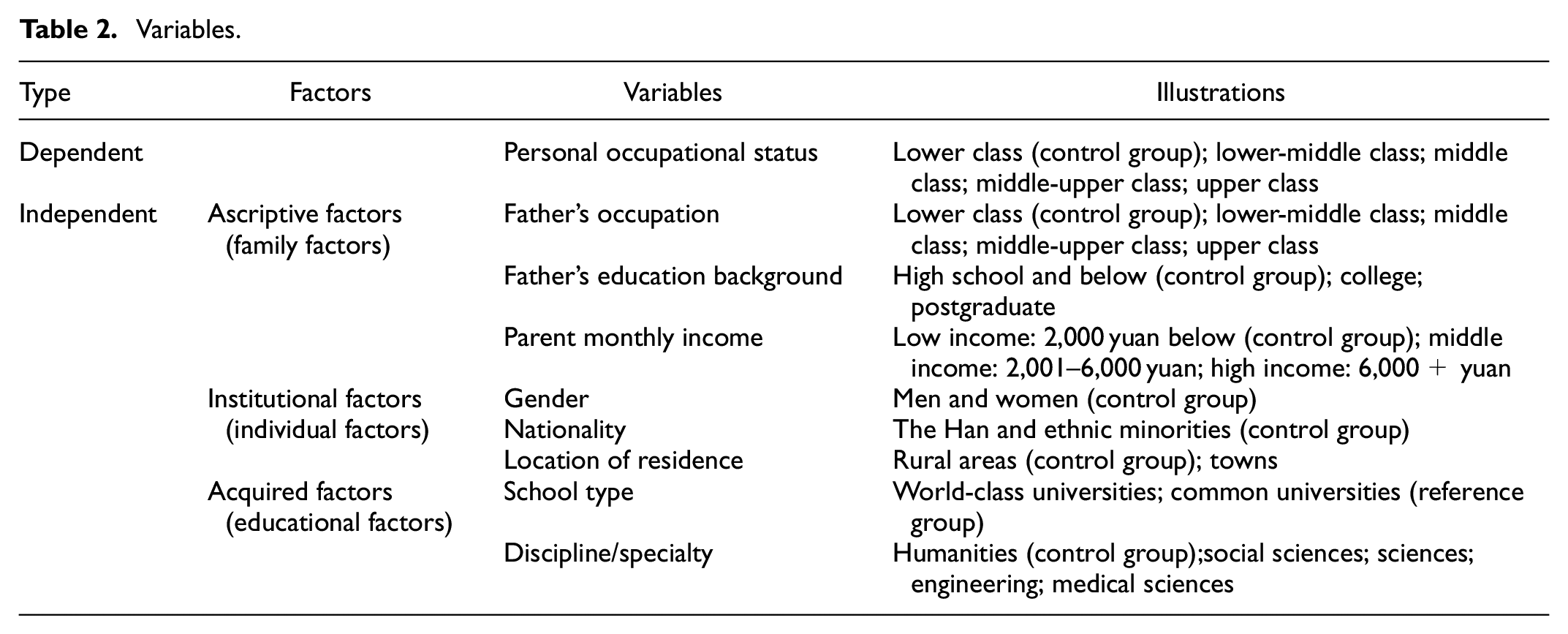
As shown in Figure 4, the study considered three family factors (father’s occupational status, father’s education background, and parents’ monthly income), two educational factors (school type and discipline/specialty), and three individual factors (location of residence, gender, and nationality). For the occupational status of graduates, each factor has an individual effect, and the three factors have a combined effect. Therefore, the study first analyzed the effect of each factor alone on the graduates’ occupational status followed by the common effect of various factors to further explain the occupational status attainment of graduates. The specific variables are shown in Table 2.
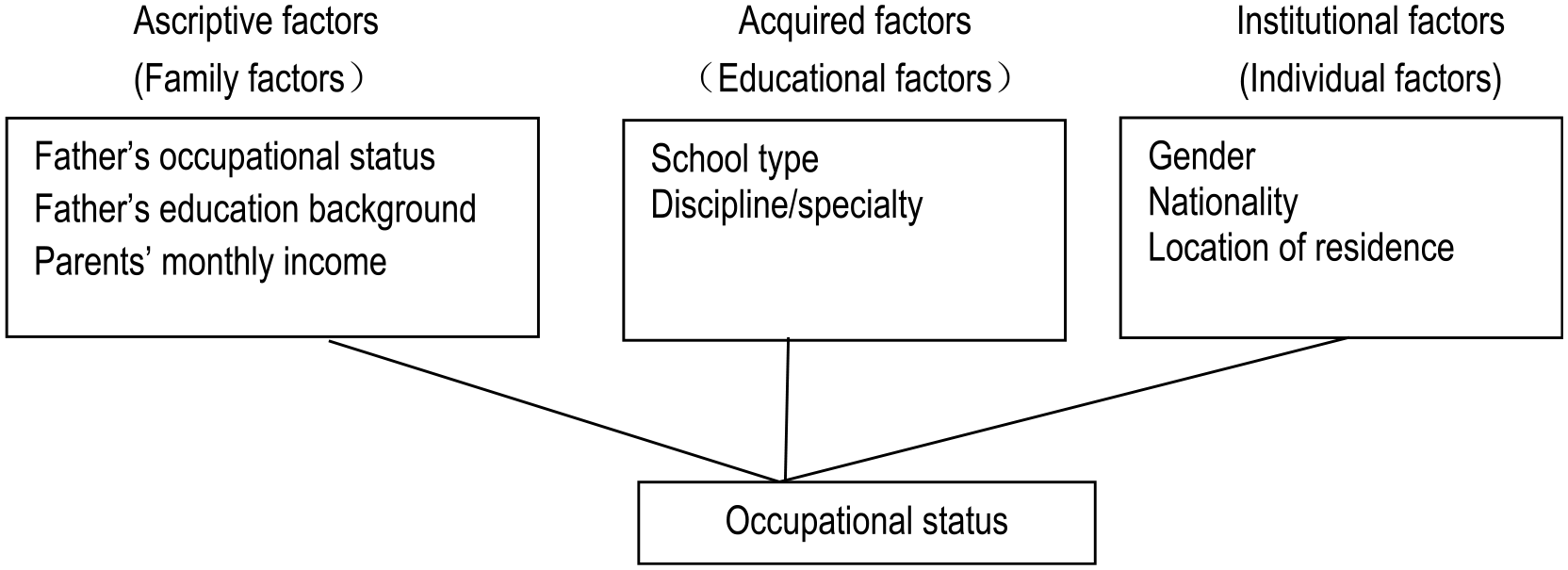
Model of occupational status attainment of college graduates.
Variables.
Types and Analysis of Influencing Factors
The dependent variable “occupational status” was treated as a continuous variable in the analysis of regression considering its features, although it is a ranked variable. Thus, traditional general linear regression was used to analyze factors that influence the occupational status attainment of graduates. Table 3 shows the results of the multiple regression analysis on personal occupational status. Model 1 in this table involves the influence of family factors on occupational status attainment; Model 2 involves the influence of individual factors on occupational status attainment; Model 3 involves the influence of educational factors on occupational status attainment; and Model 4 represents common influences of various factors on such attainment.
Results of Multiple Regression Analysis on the Attainment of Occupational Status.

—, No corresponding variable in the model analysis.
p < .05. **p < .01. ***p < .001.
Among the family factors analyzed in Model 1, only father’s occupational status had a statistically significant effect on graduates’ occupational status. When other variables were controlled, a graduate whose father had an upper or middle-upper occupational status attained an occupational status higher than that of a graduate whose father had a lower occupational status. Such a relationship makes sense: the father’s occupational status reflects the social relationships of a family, and an upper and middle-upper occupational status will bring more social relationships or social investment. In particular, the social relationships and available social investment of fathers who have an upper occupational status will play a great role in children’s employment. If the father’s occupational status was middle or lower-middle class, the occupational status of graduates was lower than that of those whose fathers had lower status (Table 3). Moreover, when the father’s occupational status was in the middle class, the statistical significance test was 0.01, which shows that the occupational status of graduates whose fathers had lower occupational status was significantly higher than that of graduates whose father had a middle occupational status.
Model 2 analyzed the influence of individual factors on occupational status attainment. As shown in Table 3, only the variable of gender was statistically significant. Neither family residence nor nationality was significant. When other variables were controlled for, men had a higher occupational status than women.
The effect of educational factors on the occupational status attainment of graduates was analyzed in Model 3. As shown in Table 3, discipline/specialty had a significant influence on graduates’ occupational status. After controlling for other variables, disciplines in the sciences, engineering, and social sciences passed the significance test, and disciplines in engineering and social sciences reached an extremely significant level (p < .001), whereas medical sciences did not. The standardized coefficients of the disciplines in engineering and sciences were positive, indicating that the graduates in those two disciplines attained significantly higher status than those in the humanities (control group). The standardized coefficient of social sciences was negative, indicating that the occupational status of graduates in this discipline was significantly lower than that of graduates specializing in the humanities. The R2 value of the regression equation shows that educational factors explained more of the occupational status of college graduates than did family factors and individual factors, which verifies Hypothesis 4: “Educational factors play an important role in the occupational status of college graduates than family factors.”
The combined effect of all factors on the occupational status attainment of graduates is analyzed in Model 4. Table 3 shows that five of eight influencing factors were statistically significant when the effects of all three factors were analyzed. That is to say, only five of all influencing factors had a significant effect on the occupational status attainment of graduates: father’s occupational status, gender, nationality, family residence, and discipline/specialty. Father’s occupational status was a family factor; gender, nationality, and family residence, individual factors; and discipline/specialty, an acquired/educational factor. In Model 1 and Model 2, the father’s occupational status and gender had a significant influence on the occupational status of graduates, and that influence remained in Model 4. But the influence degree of each factor changed and standardized coefficients increased. When all variables were controlled, only the upper and middle-upper class in the father’s occupational status were significant; the middle class was not. In Model 2, family residence and nationality failed to attain statistical significance, but they were a significant influence in the comprehensive Model 4. The occupational status of rural graduates was remarkably higher than that of urban graduates. The occupational status of ethnic minority graduates was higher than that of the Han graduates. Gender still had a significant influence on occupational status of graduates. To sum up, family factors, educational factors, and individual factors all influenced the occupational status attainment of graduates, which verifies Hypothesis 3: “Family, educational, and individual factors all affect the occupational status of college graduates.” Moreover, we can find that every factor has influence on each other and therefore we cannot say there is a dominate factor that determines every choice or fate of graduates. For example, college type and discipline/specialty can also be influenced by parents’ monthly income or fathers’ education/occupation. In this way, we find the influences of various factors are intertwined and interrelated.
Acquired factors like discipline/specialty still had a significant influence in the comprehensive Model 4 as they did in Model 3. In Model 4, three variables in discipline/specialty had an effect on occupational status of graduates at different significance levels. Among them, the influence of the disciplines of engineering and sciences was still extremely significant, and there were no changes in the significance level of the social sciences. The occupational status of graduates in engineering was higher than that in the humanities at the level of p < .001. The occupational status of graduates in sciences was higher than that in the humanities at the level of p < .05. The occupational status of graduates in social sciences was lower than that in the humanities at the level of p < .05.
Based on the above analysis, Figure 5 provides a schematic diagram of the influencing factors of graduates’ occupational status.

Schematic diagram of factors influencing graduates’ occupational status.
Discussion
Key Research Findings
Graduates’ Achievement of Stratum Promotion: Overall and Variance by Subgroup
The study showed that the average stratum mobility distance of college graduates was 2.62, indicating that, overall, college graduates achieved upward mobility. The occupational status of men was significantly higher than that of women. This finding is similar to that of other studies on gender and employment (Y. T. Chen, 2016).
In addition, the occupational status of rural graduates was higher than that of urban graduates, which is different from the results of many previous studies. Many scholars believe that China’s long-term implementation of urbanization policies has resulted in large differences between urban and rural families in terms of economic conditions (J. Yang et al., 2015), cultural capital (L. P. Qiu & Xiao, 2011; Y. X. Wu et al., 2017), political capital (Parish, 1984), social capital (Guo & Wang, 2018; R. D. Wang, 2017), educational expectations, and parenting styles (D. Li, 2018; L. P. Sun, 2002). Rural students’ disadvantages in these respects restrict them from obtaining higher stratum status; in addition to the poor family background, rural students are limited by acquired educational disadvantages due to the imbalance and inadequacy of the overall supply of educational resources in China (X. G. Wu, 2007), which leads to large differences in the quantity and quality of educational attainment. Therefore, urban residents can benefit more from their family background advantages, especially the family’s political background (Shang & Wang, 2020).
However, from an individual perspective, although rural college students have a disadvantaged family background, they achieve better in studies than urban students, and have outstanding performance in improving comprehensive abilities through great efforts and diligence. They accumulate more human capital with a diligent and pragmatic attitude, which makes up for the disadvantages in their family background (Q. X. Wu & Cui, 2019). In addition, from the aspect of policy, the Ministry of Education of the People’s Republic of China has issued instructions on promoting the employment of rural college students, in order to deal with fewer employment opportunities, higher employment costs, and employment discrimination for rural graduates. The Ministry of Education requires local education systems and higher education institutions to take more measures to help rural college graduates with employment with greater efforts. First, the Ministry further improves the employment policy for graduates. In particular, it coordinates with relevant departments to further improve policies in terms of promoting employment equality, and tuition compensation for students, so as to benefit more rural college graduates. Second, the Ministry organizes and implements various employment projects to help with the employment of rural graduates. Third, the Ministry implements a job-seeking subsidy policy for graduates from rural families who receive low-income subsistence allowance. It also urges local governments to distribute the subsidies to every rural graduates timely, so as to ease their economic pressure. Fourth, the Ministry provides more targeted and effective employment guidance, so as to enhance graduates’ job-seeking competitiveness and career conversion ability. Fifth, the Ministry strengthens employment information services for graduates and provides assistance for graduates who have difficulties in employment in order to promote the employment rate of rural graduates. Therefore, it is not difficult to understand that the mean value of stratum status of rural graduates exceeds that of urban graduates.
Educational Factors as an Effective Mechanism for Graduates’ Occupational Status Attainment
Among educational factors, discipline/specialty had a significant influence on the occupational status attainment of graduates and contributed the most to personal occupational status. With the humanities disciplines as a control group, engineering and science graduates attained higher occupational status. To some extent, this phenomenon reflects China’s long focus on economic construction, which has enabled the sustainable development of related industries like manufacturing. These industries have a large demand for science and engineering graduates, thereby increasing the employment rate of these disciplines.
In the regression analysis, background variables were adopted as independent variables and had lower R2 values. Using background variables can make results from the variables more authentic. Despite a lower R2 value, the interpretation level is moderate, meaning that the variables in the model can effectively explain the regression results. From the R2 value of the regression equation, it can be seen that R2 in Model 3 is 4.1%, much higher than for individual factors and family factors, indicating that educational factors have a certain extent of influence on occupational status. However, we cannot deny that educational factors are a concentrated reflection of family, individual and social factors, as well as a complex synthesis of external and internal factors. Therefore, in this sense, the influence of educational factors on graduates’ occupational status is actually a combination of various complex social factors. Model 4 is the combined effect of three types of factors. From the R2 value, it is observed that all factors can explain 5.9% of the occupational status of college graduates, not equal to the sum of the R2 values of the previous three models, indicating that factors may interact, leading to an offset of the degree of influence. The greater explanatory power of educational factors means that individuals can obtain a higher occupational status through their abilities, which is conducive to stratum mobility.
Durkheim indicated that there are two kinds of inequality in society. One is external inequality, which is the inequality caused by people’s different origins, that is, ascriptive status. The other is internal inequality, namely inequality caused by differences in individual talents, that is, achieved status. Durkheim stated that “all external inequality is not conducive to organic unity” (Durkheim, 1964). In other words, external inequality, or ascriptive status, affected the function of social order and division of labor, but internal inequality was reasonable, and talented people should be in a position to fully utilize their talents. Durkheim was convinced that inequality based on differences in individual talents is what society needs.
Supportive Role of Noneducational Factors in Graduates’ Occupational Status
According to the regression results, the father’s occupational status as a family factor variable had an influence on graduates’ occupational status, which could reach a significant level if the father’s occupation was in the upper echelons of society. It indicates that the variable still has a function on personal occupational status, not for all graduates, but for the offspring from the dominant stratum. In the social stratum structure, the dominant stratum possesses better resources and social relationships. They can directly influence the employment results of their children through strong social relations, further affecting the attainment of occupational status. However, this intergenerational inheritance is easy to trigger off dissatisfaction of other groups and form social contradictions. This is why the public is dissatisfied with social phenomena such as social stratum rigidity. Therefore, from this perspective, it is necessary to further open the boundaries of all social stratums, especially the dominant stratum.
The study also found that among family factors, father’s educational background (cultural resources) and parents’ monthly income (economic resources) did not have a significant influence on graduates’ occupational status. To a certain extent, this indicates that the distribution in Chinese society is still dominated by power resources (father’s occupational status). Blau’s status attainment model (Blau & Duncan, 1967) views the individual’s occupational status attainment as mainly affected by the employment situation, the nature of the unit, the occupational type, and the educational level (M. Sun, 2011). In addition, the intergenerational mobility model also explains that people’s ultimate attainment of occupational status is mainly based on stratum inheritance, and the capital, wealth, and power of the dominant stratum will be passed on to the next generation, enabling offspring to obtain a higher occupational status (Y. Xie, 1992).
Among individual factors, gender, location of residence, and nationality affected the occupational status of graduates, indicating that the gender division and regional division caused by institutionalization in the process of social stratification are also significant factors that affect the occupational status of graduates. But the effect of such noneducational factors was weaker than that of educational factors. It can also be observed from the R2 value of the regression equation that the family factors explain 1% for the occupational status and the explanation is minimal. Institutional factors explain 2.8% for the occupational status, and the F value reaches a significant level, but with a low level of explanation. It shows non-educational factors don’t play a major role but an auxiliary role in the process where the graduates attain the occupational status.
Mechanisms of Action of Various Factors on Occupational Status Attainment of Graduates
Individual factors affect the occupational status of college graduates through job screening and personal identity verification. Among them, location of residence is a variable that includes institutional arrangements and represents an individual’s household registration status. During job hunting, the location of residence affects the employment results of college graduates due to identity characteristics and thus affects their occupational status. However, the human capital accumulated by rural college graduates through personal abilities can make up for their innate deficiencies. In other words, living in rural or urban areas is no longer a decisive factor for the occupational status of college graduates. It can be considered that after receiving higher education, occupational status will no longer be constrained by location of residence. As far as college graduates are concerned, the roles of household registration status on individuals may be gradually weakening. The influence of gender on the occupational status of college graduates mainly lies in occupational differences caused by gender differences. Such differences cause graduates to show an inclination during job selection and enter different occupational positions through job screening, thereby affecting employment results and occupational status.
American sociologist Granovetter (1974) explained that interpersonal relationship networks can be divided into two types: strong relationship networks and weak relationship networks. The variable of the father’s occupational status works through the social network, including the weak relationships that can obtain effective job-related information and the strong relationships that can assist children through the exchange of favors. For children’s status attainment, the father’s occupational status is a social resource. Fathers with a higher occupational status can provide more assistance to their children than those with lower occupational status. The occupation type of fathers affects the occupation choice of their children, and there is a strong correlation between their occupations (C. J. Chen & Hu, 2016). If the occupational status of fathers is low and social resources are lacking, then the chances of the offspring obtaining a higher occupational status are reduced, and their occupational status will not change significantly compared with that of fathers (Y. Zhou, 2006). The family’s social capital has a positive effect on the offspring’s attainment of management positions. Family network resources, parents’ management level, and familiarity with important persons are all important factors that affect the offspring’s attainment of higher occupational status (Z. J. Li & Yuan, 2019).
Study Strengths and Limitations
The sample of this research was concentrated in Henan, which does not reflect the overall situation across China. The sample of employment surveys for college graduates still needs to be enriched. In addition, the research lacks a follow-up survey and cannot show the changes of influences and internal mechanisms of different factors on the occupational status of college graduates in different periods. These limitations would be noticed and improved in our future research.
Conclusions
The research results show that, overall, college graduates have achieved stratum promotion; men have a higher occupational status and longer mobility distance; rural graduates have a higher occupational status and longer mobility distance; and family factors, educational factors, and individual factors are all essential to the occupational status of college graduates. Educational factors send educational signals to the employment market through diploma certificates and affect employment results through differences in education symbols, educational resources, and educational development, and then affect the occupational status of graduates. Individual institutional factors affect employment results and then affect the occupational status of graduates by their identity characteristics for job screening and identity verification, while family factors affect interview opportunities or employment results and then affect the occupational status of graduates through strong and weak relationships in the social network. Therefore, it is necessary to continue to expand higher education recruitment and rationally allocate resources to achieve equal higher education and promote orderly social mobility, as well as regulate the competitive environment of the job market and weaken the role of family relationship networks in the employment market. College graduates should pay attention to improving personal skills and accumulating personal social relationship networks.
Footnotes
Data Availability Statement
The data are available from the corresponding author upon reasonable request.
Declaration of Conflicting Interests
The author(s) declared no potential conflicts of interest with respect to the research, authorship, and/or publication of this article.
Funding
The author(s) disclosed receipt of the following financial support for the research, authorship, and/or publication of this article: This article has been supported by the National Social Science Foundation Major Project: Research on the Mechanism and Path of the Coordinated Advancement of Chinese Modernization by Education, Technology and Talents (VFA230003). Henan Higher Education Teaching Reform Research and Practice Project (Employment and Entrepreneurship Guidance) “Practical Research on College Students’ Career Development Education Needs and Countermeasures in the Context of Popularization of Higher Education” (No. 2021SJGLX1008). The Soft Science Research Program of Key Research Projects in Higher Education Institutions in Henan Province “Research on the Implementation Form and Training Mode of Henan Province’s Technical Undergraduate Education.” The International Chinese Language Education Research Program of the Center for Language Education and Cooperation in 2022: Research on the Function and Path of the Chinese Language Education System in the German Speaking Area to Serve the Sino-EU Civilization Partnership (No. 22YH20C). The Teaching Reform Project of Minzu University of China: Studies on Courses in Universities Promoting College Students to Cast the Consciousness (No. JG2205). The Capacity Improvement Project for Young Teachers in 2023 of Minzu University of China: The Value and Practical Strategies of Promoting China Europe Relations Through International Chinese Language Education in the New Era.
Ethics Statement
No animal studies are presented in this manuscript. Ethical review and approval was not required for the study on human participants in accordance with the local legislation and institutional requirements. Written informed consent for participation was not required for this study in accordance with the national legislation and the institutional requirements. No potentially identifiable human images or data is presented in this study.
