




Abstract
Two studies compared perceptions of status for occupations based on the gender and race of the workers. In total, 387 college students participated in this research. Across studies, results indicated that participants did not differentially value occupations based on the gender or race of the workers in terms of prestige ratings or salary estimates. However, participants judged that occupations required more education when described as having predominantly male workers rather than female workers. In addition, the participants showed different levels of interest in the positions depending on the occupational gender. These results are compared with similar studies conducted 20 years ago, in which participants showed more overt forms of devaluing occupations associated with women.
Psychologists have studied the devaluation of women in the workplace for more than 40 years. Early research in this area centered on how written work produced by women was valued less than the same work produced by men (e.g., Goldberg, 1968; Paludi & Strayer, 1985) and on the devaluation of highly competent women (Lott, 1985). Studies published in the 1970s and 1980s also showed that male job applicants were more likely to be positively evaluated than female candidates (Bronstein, Black, Pfennig, & White, 1986; Heneman, 1977; Zikmund, Hitt, & Pickens, 1978) and that gender stereotypes affected the evaluation of male and female supervisors (Rosen & Jerdee, 1973).
Public opinions regarding work and gender have become more egalitarian since the 1980s, but perceptions of work are not yet gender neutral. For example, Elsesser and Lever (2011) reported on results from a survey study of 60,470 on gendered perceptions of managers. Results indicated that although 54% reported no preference with respect to the gender of their boss, of those who expressed a preference, approximately 67% were in favor of male supervisors. Thus, the majority explicitly reported no bias with respect to the gender of a manager, yet approximately 31% of the sample still preferred to work for a male.
In addition to looking at the perceived value of work, competence of candidates, or supervisory preferences, an examination of salaries has been used to study the perceived worth of women’s work compared with men’s. The long-standing gender gap in pay in the United States indicates the higher status accorded men’s work (Gibelman, 2003). Across educational levels and occupations in the United States, women earn less than men (U.S. Census, 2011). For example, aggregated across occupation, education, and race, the mean full-time, year-round income for males 25 years of age or older in 2011 was US$67,398, and the comparable mean for women was US$48,404 or 28% less. Among adults with a bachelor’s degree or higher, the mean full-time, year-round income for males was US$96,265 in 2011, and the comparable mean for women was US$66,585 or 31% less.
The data 20 years ago conveyed a similar, but more extreme, story: The mean full-time, year-round income for males 25 years of age and above was US$35,850 in 1991 and US$23,778 for females, 34% less. For those with a bachelor’s degree or higher in 1991, the mean for males was US$50,747 and for females US$33,144, 35% less. (U.S. Census, 2011) There are, of course, various reasons for the gender differential, including factors such as work history. However, in 1984, Shepela and Viviano wrote that at least part of such a salary differential is due to a sexist perception of differences in competence when men’s and women’s work is judged. “Women are paid less because they are in women’s jobs, and women’s jobs are paid less because they are done by women” (Shepela & Viviano, 1984, p. 47). Thus, they argued that women’s labor is not valued less because of the nature of the work itself; it is valued less precisely because women are doing it.
Consistent with this argument, Lips (2013) has presented compelling analyses indicating that the human capital model of occupational status is inadequate to completely explain the gender pay gap. Examinations of investments in work, defined by variables such as work history, education, years of experience, and various occupational behaviors, are insufficient in explaining the salary gaps by gender. Furthermore, many of these variables are influenced by gendered social norms and pressures. Social stereotypes, overt gender discrimination, the gendered nature of the workplace, and the gendered nature of networks are all factors that contribute to a continuing gender difference in occupational achievement (Lips, 2013; Tharenou, 2013). Added to that are implicit stereotypes about women and men that play a role in how male and female work is perceived (cf. Williams, Paluck, & Spencer-Rodgers, 2010).
While narrower than 20 years ago, the pay gap and thus some status gap still exist today. When taken together, the research related to women in the workplace presents a picture of social progress for women, albeit without equality. England (2010, 2011) and Cohen, Huffman, and Knauer (2009) presented evidence that although there is greater gender equality in socioeconomic and occupational status, there has also been a slowing down, if not a stall, in the progress of women in achieving socioeconomic parity with men.
If it is true that occupations associated with women are perceived as lower in status precisely because the workers are women, then several expectations would be logical. First, gender neutral occupations, those without pre-existing gender stereotypes, should be perceived as having less social status if the workers are predominantly female. Furthermore, traditionally male occupations should become less “valuable” when women enter the field in large numbers. Finally, men should show low interest in entering traditionally female occupations, but women should show an interest in crossing occupational gender boundaries.
Interestingly, this appears to have occurred in the field of psychology. Fewer than 30% of PhD degrees in psychology were earned by men in 2008 (Willyard, 2011) compared with 75% in 1971 (Pion et al., 1996). Within professional psychology, women earn less than their male colleagues, approximately 9% less in 2007 (Cynkar, 2007), and according to a 2009 study of doctoral-level salaries in psychology by years in the field, men earned more at every level of experience. However, the difference was most notable for those who had worked in the field for 20 years or more. In that cohort, women earned an average of 18% less than their male counterparts. The gender differential for those with fewer than 5 years of experience was smaller, with women earning an average of 6% less than men (Center for Workforce Studies, 2010).
Over the years, this salary difference has elicited concerns about the “feminization of psychology” as more women have entered the field (Cynkar, 2007; Ostertag & McNamara, 1991; Pion et al., 1996). Given that the feminization of a field often seems to be related to a loss in prestige for that field and an accompanying lowering of salaries, the possible “decline of the field” of psychology was discussed 21 years ago at the 1991 American Psychological Association (APA) conference in San Francisco and was addressed by a 1995 APA Task Force (Cynkar, 2007). According to Dorothy Cantor, chair of that Task Force, as salaries in psychology declined in the 1980s due to a variety of economic factors, men left the field and women filled in the gaps (Cynkar, 2007). Thus, lowered salaries led to men leaving the field and opened the door to women, and in turn as women entered the field, the status and salaries were lowered further. (For analyses of the gender gap in pay within other academic fields, see Travis, Gross, & Johnson, 2009 and West & Curtis, 2006.)
There have been varied experimental findings in psychology about differences in occupational prestige as a function of the gender of the workers. For example, in 1974 Touhey (1974) demonstrated that traditionally masculine occupations (lawyer, professor, scientist, architect, and physician) tended to decrease in perceived prestige when it was expected that women would be entering that profession in greater numbers. Similarly, Liben, Bigler, and Krogh (2001) found that children rated a novel job presented with male workers as more prestigious than the same job when presented with female workers. Vervecken, Hannover, and Wolter (2013) demonstrated that children’s perceptions of occupations, and their interest in the occupations, are impacted significantly by the forms of gendered language used to describe the occupation. When an occupation is described only in masculine terms, girls are less likely to express interest, and both girls and boys expect less success by women in the field.
In the early 1990s, my students and I conducted two studies investigating perceptions of salary worth, along with ratings of prestige, for an occupation based on the gender of the majority of workers (Crawley & Poran, 1992). In one study, college student participants read an occupational description for public relations, which had been pretested and rated as gender neutral (M = 5.30 on a 10-point scale with 1 as feminine and 10 as masculine, n = 20) and moderate in prestige (M = 5.05 on a 10-point scale with 10 as highly prestigious). The description was constant across conditions except for a statement about the gender of the majority of workers. Each of the participants was randomly assigned to read one of the job descriptions, and then rate on 10-point scales how prestigious the occupation appeared to be and how much respect he or she had for the occupation. Finally, the participant indicated what salary a worker who had been in the field for 7 years was worth. Although there were no significant effects of worker gender on ratings of occupational prestige or respect per se, the occupation was judged as worth US$5,880 per year more in salary when the workers were men (M = US$49,880), than women (M = US$44,000), a significant effect, F(1, 80) = 3.96, p = .05.
A second study with the same design used the occupation of mental health casework. We created this job description to be ambiguous in terms of the educational level and status of the workers, although we did not pretest the description. Again, there were no significant effects of worker gender on ratings of prestige or respect, but the occupation was judged to be worth US$5,230 more in yearly salary when the workers were primarily men (M = US$47,690) than women (M = US$42,460), F(1, 105) = 3.86, p = .05. Thus, 20 years ago, these college students seemed to believe that identical work was worth less, and should be paid less, when women did the work.
One possible critique of using estimated salary levels as a dependent measure in this type of research, however, is that participants may simply be aware of gender gaps in wages, and may reflect reality when they give different salary estimates for occupations (Furnham & Wilson, 2011). However, Williams et al. (2010) investigated the expectation that men will make more money than women, and argued that when participants allot a higher salary to men, the difference is not solely a reflection of actual differences in salary within society. They found significant differences in salary estimations for male and female targets, and their results indicated that at least part of the differential estimations was due to an implicit stereotype that links males and wealth.
Gendered Interest in Occupations
Another measure of perceptions of gendered work has been career interest in occupations. Across time periods, research has shown that males and females, adolescent and adult, express more interest in gender-congruent occupations than in crossing gender boundaries (Church, Teresa, Rosebrook, & Szendre, 1992; DiDonato & Strough, 2013; Ellis, Ratnasingam, & Wheeler, 2012). Furthermore, in the views of both men and women, it is more acceptable for women to cross gendered occupational boundaries than men (DiDonato & Strough, 2013; Jiang, Wang, & Wang, 2010). This pattern of expressed interest is more pronounced among individuals who endorse traditional gender values for themselves; self-identified gender “atypical” males and females are more likely to cross boundaries (Ellis et al., 2012; Patterson, 2012). Although societal gender roles in the workplace have become less rigid over time, gendered expectations persist and differences in occupational interest by gender are not likely to change in the near future (Rudman & Phelan, 2010).
Race and Occupational Status
Occupational prestige is, of course, affected by demographic variables other than gender. The literature on race and personal occupational status is vastly complex, with a multitude of factors influencing occupational segregation, work status, and pay differentials (Alonso-Villar, Del Rio, & Gradin, 2012; McDonald, Lin, & Ao, 2009). Gender, immigration status, language proficiency, cultural assimilation are but a few factors that interact with race in affecting individuals’ socioeconomic status and the prestige of racially segregated occupations. For example, across occupations, significant differences in socioeconomic status exist by gender and race and the interaction of the two, moderated by educational attainment in the United States (Lemelle, 2002). In his analysis of occupational status for Black, White, and Hispanic men and women, Lemelle (2002) found that economic status was higher for Whites than for Blacks or Hispanics among people without college educations, but the pattern was modified for those who had attended college. Also, although the socioeconomic index that Lemelle used was generally higher for males than for females among Whites, the reverse was true for Blacks and Hispanics, across educational levels. In addition, Kim and Tamborini (2006) found different patterns of racial discrimination depending on the labor market under scrutiny. Race was less of a predictor of occupational status within technical fields, although still predictive for occupations based on social skills.
Clearly, data indicate that some racial minority groups, across educational levels and occupations, have lower socioeconomic status than Whites in the United States, but the relationship between race and occupational status is moderated by many variables, including gender, education, and type of occupation. Research has also found that while there are stereotypes about the types of work-related abilities that various racial groups have, and overall levels of expected competence (Biernat & Kobrynowicz, 1997; Sy et al., 2010), these stereotypes differ by gender as well. Therefore, once again, the relationship between racial characteristics and occupational prestige is complex. While jobs with a high proportion of some minority groups may be judged as having lower status and have lower salaries, based on past research, it is not clear whether “race neutral” jobs would be judged as lower in status if described as predominantly occupied by a given racial minority group than if described as predominantly White. Certainly, gender and the nature of the occupation should interact with race in affecting perceptions of occupational prestige.
Hypotheses
The current studies were designed to replicate our research on gender and occupational status now that 20 years have passed, using the same type of methodology, with students at the same college. How much of a difference has 20 years made in college student attitudes? Do students still perceive that occupations are worth less when women constitute the majority of the workers? The research design also includes occupational race as a variable to investigate the impact of the race of workers on perceptions of occupations, either as main effects or in interaction with gender.
Based on the past research on gender, race, and occupational status, along with evidence of changing gender norms and the narrowing of the gender pay gap, it is expected that differences in perceptions of occupations by occupational gender will not appear on overt measures of status, such as prestige ratings. However, occupational gender is expected to affect salary estimates, beliefs about educational requirements, and interest in the occupation. Also, occupational race should interact with occupational gender in affecting perceptions of occupational prestige.
Study 1
Method
Participants
A sample of 267 college students, 63 males and 183 females (with 21 not responding regarding gender), 87% of whom identified themselves as White participated in this research. These students attended a public liberal arts college in the northeastern United States, the same college at which the comparable research was done 20 years ago (Crawley & Poran, 1992). The majority of incoming students at this college (56.6%) identify themselves as “middle of the road” politically, with 25.3 identifying as liberal and 18.1% conservative (Institutional Research, 2012). Education and intelligence have been found to be negatively correlated with acceptance of traditional gender roles (Judge & Livingston, 2008). Thus, this college sample is likely to endorse relatively liberal views regarding gender.
Materials and procedure
We created a questionnaire that included a job description for an Abstract Checker, a position in the insurance industry. We used the occupation of Abstract Checker, a real—but little known—job title because it was not commonly recognized, and had no immediate gender stereotype when tested on a separate college sample (M = 5.30 on a 10-point scale from Very Feminine to Very Masculine, n = 30). With respect to occupational race, the majority of the test sample indicated that they expected the job to either have the same ratio of African Americans, Latinos, Asians, and Whites as in the general population (46.67%) or more Whites (40.00%). The job description also tested as moderate in prestige (M = 4.77 on a 10-point scale).
The description included job responsibilities along with some information on the demographics of the people working in the field. A manipulation check was done on a college sample of 20 to test comprehension and memory for the demographic information. Results indicated that 90% of participants correctly recalled the dominant racial group, and 75% reported the gender correctly. See Appendix A for a copy of the job description.
After reading the job description, participants indicated their perceptions of occupational worth by completing a series of dependent measures. Respondents gave estimates of the education needed to work in the field by checking off one of seven choices ranging from “No Educational Requirement” to “Post-Doctoral Work.” Participants also estimated the probable starting salary by naming a figure between US$18,000 and US$90,000, rated their possible interest in the field on a 10-point scale, from “No Interest At All” to “Very High Degree of Interest,” and completed a 22-item Perceptions of Occupational Status Survey (POSS). This survey measures overall occupational status as a single dimension and has been shown to have both convergent validity and internal reliability. Overall scores on the POSS significantly differentiated between occupations that have been ranked differently in other research (Goyder, 2005), such as “cashier” and “veterinarian.” Cronbach’s alpha for the scale ranged from .80 to .92 across five samples and three different occupations (Crawley & Cardinale, 2008; see Appendix B for a copy of the POSS.)
The demographic information on the fictitious job description was manipulated to create six versions in a 2 (gender of the majority of workers) × 3 (race of the majority of workers) design. Although the main focus of the research was on gender, we examined the impact of three racial groupings on the descriptions as well: African American and Latino; White; and Asian. We solicited participants from undergraduate classes and via a subject pool at the college. Each participant was randomly assigned to read one version of the questionnaire and completed the form individually. At the top of the questionnaire, a consent statement appeared, and after completing the survey, each participant was fully debriefed. The surveys took approximately 5 to 10 min to complete; all data were kept completely anonymous.
Results
ANOVA and chi-squared analyses were done on completed surveys. Due to missing data on some items, the sample size for each analysis was slightly different. Results indicated that there were no effects of occupational gender or race on overall prestige as measured by mean scores on the POSS (α = .92): F(1, 212) = 1.51, p = .22 for gender; F(2, 212) = 1.90, p = .15 for race; F(2, 212) = 0.61, p = .55 for the interaction. Similarly, there were no significant effects of occupational gender or race on salary estimates, F(1, 247) = 0.10, p = .75 for gender, F(2, 247) = 0.18, p = .83 for race, F(2, 247) = 1.02, p = .36 for the interaction. The mean starting salary estimate for Abstract Checker when the workers were predominantly males was US$40,260, and the mean for the predominantly female version was US$39, 236. See Table 1 for data on salary and POSS scores and the correlations between the dependent measures.
Means and Correlations for Prestige Scores, Salary Estimates, and Interest Ratings by Occupational Gender for Abstract Checker in Study 1.
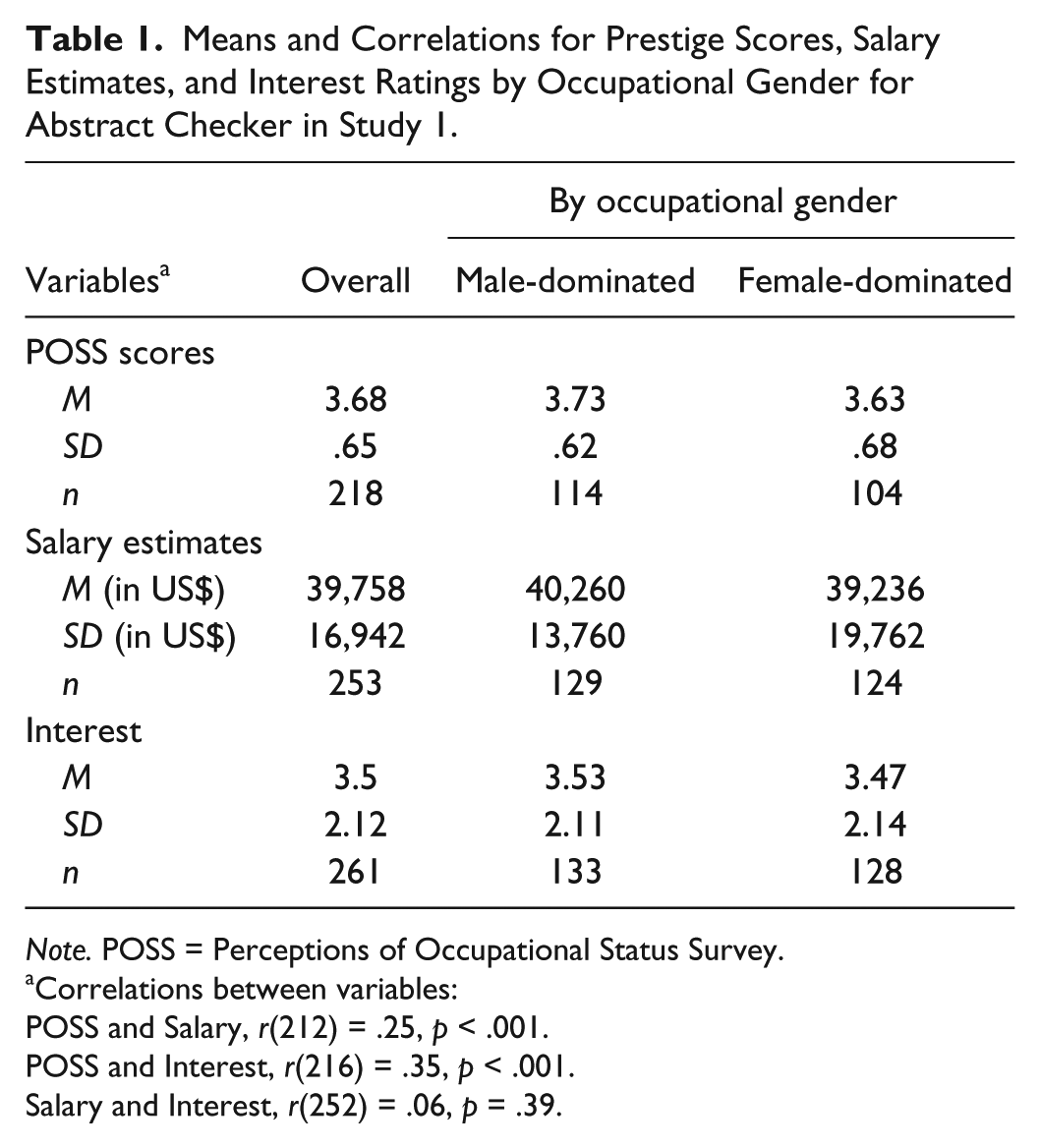
Note. POSS = Perceptions of Occupational Status Survey.
Correlations between variables:
POSS and Salary, r(212) = .25, p < .001.
POSS and Interest, r(216) = .35, p < .001.
Salary and Interest, r(252) = .06, p = .39.
There were no main effects of occupational gender or race on estimates of required level of education; however, the pattern of results by occupational gender was different for the White worker condition than for the other occupational race conditions. The responses regarding educational level were analyzed as nominal data. Responses regarding educational level were put into two categories for analysis—Less than a Bachelor’s Degree or Bachelor’s Degree and Above. As shown in Figure 1, for the White occupational gender condition, participants more frequently chose Bachelor’s Degree or a higher degree when the workers were predominantly male than when they were mostly female, χ2(1, N = 110) = 4.26, p = .04, C = .19. Of the 64 participants in the male occupational gender condition, 39 (61%) estimated that at least a Bachelor’s Degree was required. For the female occupational gender condition, 18 of 46 (39%) made a similar judgment. There were no significant differences by occupational gender when the workers were described as predominantly African American and Latino or Asian.

Frequencies for the educational degree believed to be required to work as an Abstract Checker when the majority of the workers were described as White.
Finally, there were no significant patterns related to interest in the occupation by occupational gender or participant gender, nor did participant gender affect any of the other dependent variables.
Conclusion
These results indicate that there were no differences in perceptions of prestige based on occupational gender or race. Similarly, there were no effects of occupational gender or race on salary ratings, in contrast to the findings on gender reported in 1992; neither H1 nor H4 were supported in this sample. However, the degree of education thought to be required for this occupation was directly affected by the gender of the workers when the workers were described as White. No significant patterns for educational requirement by gender appeared for the other racial conditions for this occupation. Thus, there was an interactive effect between occupational gender and race with respect to educational estimates, supporting H5.
In an attempt to replicate these findings with another occupation, we conducted Study 2. In this case, we created a job title (Point of Sales Systems Coordinator) and a job description in the retail sales industry that do not actually exist. This occupation was created to be ambiguous in status and gender neutral, as verified during pretesting. The overall design for this replication was also simplified into a 2 × 2 design; we reduced the number of worker racial groups to two—White or African American and Latino.
Study 2
Method
Participants
A sample of 120 college students participated. The sample included 30 males and 79 females, with 11 respondents not indicating gender; 63% identified themselves as White.
Materials and procedure
Each participant read one of four versions of a job description for a Point of Sales Systems Coordinator, an occupation fabricated for this 2 × 2 design. The basic occupational job description was rated as gender neutral (M = 4.90 on a 10-point scale, n = 30) and below the midpoint in prestige (M = 3.67 on a 10-point scale). The majority of the test sample (56.67%) expected the same racial mix as in the general population, although 26.67% expected more White workers and 13.33% expected more Latinos. Each version of the description had the same duties listed, but was manipulated in terms of the percentage of women and men who worked in the field, and in terms of the dominant racial group working in the field. The occupation was described as having workers who were predominantly male or female, and predominantly White, or African American and Latino.
After reading the job description, participants completed a series of dependent measures, including estimations of the education needed to work in the field by checking off one of seven educational categories, as in Study 1. Participants also estimated starting salary in an open-ended item and completed the POSS. Finally, respondents rated their possible interest in the field.
Results
Ten participants did not complete the POSS, thus the sample size for the prestige analysis was 110. These 10 participants were among the 11 not indicating gender. Similar to the results of Study 1, data analyses performed on completed survey items indicated no main effects of occupational gender or race on the occupational prestige (POSS) scores (α = .91), F(1, 106) = 0.24, p = .63 for gender and F(1, 106) = 1.67, p = .20 for race. With respect to salary estimates, data from three participants were discarded as their salary estimates on this open-ended item were more than three standard deviations above the mean, and thus were considered outliers; one other respondent did not respond to the item. Based on the remaining sample of 116, there were no main effects for occupational gender, F(1, 112) = .22, p = .64, or for occupational race, F(1, 112) = 1.16, p = .28. The mean salary estimated for the predominantly male occupation was US$37,166, whereas the mean for the female worker condition was US$34,707. There were no significant interactions for the prestige scores, F(1, 106) = 2.65, p = .11, or for salary, F(1, 112) = 3.12, p = .08. See Table 2 for data on salary and POSS scores and the correlations between the dependent measures.
Means and Correlations for Prestige Scores, Salary Estimates, and Interest Ratings by Occupational Gender for Point of Sales System Coordinator in Study 2.

Note. POSS = Perceptions of Occupational Status Survey.
Correlations between variables:
POSS and Salary, r(89) = .29, p = .006
POSS and Interest, r(88) = .30, p = .004
Salary and Interest, r(114) = .12, p = .20.
The estimated level of education required for the occupation, however, was significantly affected by occupational gender. Educational estimate was analyzed as a nominal variable, condensing the responses into two categories—Less than a Bachelor’s Degree or Bachelor’s Degree and Above. Chi-squared analyses indicated that participants were more likely to indicate that at least a Bachelor’s Degree was needed if the occupation was done primarily by male than by female workers, χ2(1, N = 120) = 5.69, p = .02, C = .20, regardless of occupational race, as illustrated in Figure 2. Of the 60 participants in the male occupational gender condition, 34 (57%) estimated that at least a Bachelor’s Degree was required. For the female occupational gender condition, 20 of 60 (33%) made a similar judgment.

Frequencies for the educational degree believed to be required to work as a Point of Sales Systems Coordinator, regardless of occupational race.
Finally, there was no overall difference in interest in the occupation based on occupational gender F(1, 105) = 0.36, p = .55, but there was a significant difference between male and female participants in interest, F(1, 105) = 8.01, p = .006, η2 = .07, with males indicating greater interest (M = 4.63 for male participants and M = 3.37 for females). There was also a significant interaction between occupational gender and participant gender, F(1, 105) = 6.21, p = .01, η2 = .05. Female participants were mildly interested in the occupation, regardless of worker gender (M = 3.05 with male workers and M = 3.64 with female workers), whereas male participants were significantly more interested in the occupation if most of the workers were male (M = 5.19 with male workers and M = 3.33 with female workers), as shown in Figure 3.

Mean ratings of interest in the occupation of Point of Sales Systems Coordinator on a 10-point scale.
Conclusion
Participants did not report different perceptions of prestige or salary for the fictitious occupation of Point of Sales System Coordinator based on the gender or race of the workers. Similar to Study 1, there was no overt sexism or racism exhibited in how the occupation’s prestige was rated, nor were there differences in salary estimates. Once again, H1 and H4 were not supported. However, as with Study 1, a subtle effect was found in that the participants perceived that the occupation required a higher educational level when it was a male-dominated field, in this case regardless of the racial composition of the workers, as predicted in H2. In addition, male and female participants showed a different level of interest in the occupation depending on the gender congruence of workers in support of H3.
Discussion
There are several consistent findings across the two studies described above. First, it appears that there was no overt discrimination in terms of ratings of prestige or difference in salary estimates based on the race or gender of the workers in any of the occupations. Although differences regarding salary were found with nearly identical methodologies at the same college in the early 1990s, such differences among college students were not apparent in this cohort; see Table 3 for the comparisons across time and occupations. The only consistent area in which participants exhibited different perceptions of an occupation based on gender was in judgments of the educational requirements.
Mean Judgments of Salary Worth by Occupational Gender Across 20 Years.

When a field was described as predominantly done by men, most notably White men, respondents assumed that a higher level of education was needed to be hired. Interestingly, it is not the case that participants simply reflected the existing demographic differences in educational achievement in their estimates. The participants were from a state college, and their estimates do not match the actual statistical data on educational achievements by race and gender for the state. Nor do the estimates reflect the gender ratios at the college in which these studies were conducted. Participants did not look at the students around them at the college, see which gender was more likely to be earning a bachelor’s or master’s degree, and make estimates about educational hiring requirements accordingly. In fact, the majority of students (57.4%) earning bachelor’s and master’s degrees at the college are female (Ramapo College, 2012). Thus, the inclination to perceive that a “male” occupation probably requires more education than a “female” occupation appears to be based on a stereotype associating education with men in general.
In addition, in Study 2, male participants showed different interest in the occupation depending on the gender of the workers. Although female participants did not differentiate very much based on worker gender, male participants were more likely to be interested in male-dominated fields than in female-dominated occupations. This is consistent with past research findings and with the idea that there is more social stigma to men being interested in “feminine” occupations, and less stigma to women expressing interest in fields more typically associated with men (cf. Miller & Hayward, 2006; Rudman & Phelan, 2010).
The finding that interest in occupations is still influenced by the gendered nature of the job, while overt ratings of occupational prestige and salary are not is also consistent with research on implicit versus explicit measures of attitudes. Many researchers have demonstrated subtle reactions, due to automatic processes and implicit biases, in cases where overt, consciously discriminatory behaviors are absent or weak. Implicit and explicit attitudes often manifest very differently in terms of cognitive decision-making and behavior (Banaji, & Greenwald, 1995; Dovidio, Kawakami, & Gaertner, 2002; Greenwald et al., 2002; Payne, 2001).
In a meta-analysis, Greenwald, Poehlman, Uhlmann, and Banaji (2009) examined 156 studies that utilized both the Implicit Association Test (IAT) and explicit attitude measures. Their results indicate predictive utility for both types of measures with respect to relevant behaviors and physiological responses; however, there were more variable predictive outcomes for the explicit measures. In addition, for socially sensitive attitudes, such as racial judgments, the predictive validity of explicit measures was diminished. Thus, for topics for which participants might be motivated to control their self-presentation, explicit measures were less effective.
In the studies reported here, the participants did not show overt sexism or racism in their ratings of occupational prestige. They did not estimate that women’s occupations might be worth less in salary than men’s work, as was the case 20 years ago. Decisions about salary and prestige require some reasoned thought, and college students can consciously alter any biases they might feel. As stated earlier, these college students are likely to hold gender equality as a conscious value. However, participants did employ some gender stereotypes regarding educational requirements and interest. These are more subtle measures, without obvious sexist overtones. For example, interest in an occupation can be viewed as influenced by many factors, including the probability of success in the field, comfort level, and other cognitive and emotional reactions to the occupation. Thus, college students are less likely to cognitively guard against biased responses on these types of measures, and implicit stereotypes and biases may come through.
Limitations and Future Research
Although the comparison over 20 years is enhanced by using the same type of sample, the method necessarily limits the generalizability of the findings. These samples were drawn from a liberal public college which draws students from primarily politically liberal geographical regions. While some researchers also have found diminishing gaps in perceptions of occupational prestige by occupational gender (Goyder, Guppy, & Thompson, 2003), other researchers continue to find obvious gaps (e.g., Williams et al., 2010). Continued research is needed to reconcile conflicting results. In addition, past research findings on race and occupational status have provided varying patterns with respect to the impact of racial identity on aspects of occupational prestige and success. The results of the current studies suggest that occupational race and occupational gender interact in affecting perceptions of status, but not in consistent ways across occupations.
One promising avenue for continued research on gender, race, and occupational prestige is the use of techniques to measure implicit gender and race stereotyping with respect to occupations. The IAT and other indirect measures to study subtle, unconscious biases in perceptions of occupations are logical, especially with participants who explicitly endorse liberal attitudes about gender and race (cf. Matheus, 2011; Rudman & Phelan, 2010; Williams et al., 2010).
What then can be concluded from the current research? Have gender biases in perceptions of occupational prestige changed in the past 20 years? In some regard, the answer is yes. In the early 1990s, the wage gap was wider, average educational achievement was lower for women, there were fewer women in visible positions of authority, and research showed that college students displayed overt gender biases when judging the worth of gendered occupations. By 2011, there were still wage gaps, but there has been progress in terms of women’s presence in the societal power structure. In turn, college students’ current perceptions of occupational status are less overtly influenced by the gender of the relevant labor force, although gendered perceptions of some aspect of occupational attainment, such as personal interest and educational requirements, still exist. Hopefully, the next 20 years will see gender biases in occupational perceptions muted even further.
Footnotes
Appendix A
Appendix B
Acknowledgements
I would like to acknowledge and thank the research assistants who worked on this research: Abigail Gunnell, Geoffrey Brown, Maciel Nina, Danielle Villone, Marissa Malkowski, Jennifer Levine, Ryan Savino, and Richard Suarez.
Declaration of Conflicting Interests
The author(s) declared no potential conflicts of interest with respect to the research, authorship, and/or publication of this article.
Funding
The author(s) received no financial support for the research and/or authorship of this article.