




Abstract
Despite the importance of time with family when facing stressful events, there is insufficient understanding of time spent with family during the COVID-19 pandemic among married working women. This study examined how the onset of the COVID-19 pandemic was associated with time spent with family among such women in South Korea, focusing on variations according to occupation and employment status. To address these questions, we pooled cross-sectional data collected before and during the pandemic (N = 13,089) and conducted independent t tests, ANOVAs, and ordinary least squares regression analyses. The results showed that married working women spent more time with their families during the pandemic than before. Furthermore, family time differed significantly according to occupation but not employment status. Both occupation and employment status moderated the association between the pandemic onset and time spent with family. Compared to clerks, managers, and professionals had greater increases in family time, while there were smaller increases for workers in service, sales, craft, and production. Moreover, temporarily employed women had a lower increase in family time than permanently employed women. We suggest that these differences may have arisen from the different levels of feasibility of having family-friendly work schedules and flexible working arrangements in different occupations and forms of employment.
The COVID-19 pandemic and social distancing measures to curb the spread of the virus dramatically changed how individuals in South Korea (hereinafter “Korea”) live and spend their time. As outdoor gatherings during the day and at night and spending time at work, in school, or in private education classes were limited, people became accustomed to staying at home, a space for all daily activities including work, education, care, and leisure (Lee et al., 2020). Studies on the gendered division of the increased household work brought on by the COVID-19 crisis are abundant (Costoya et al., 2022; Fodor et al., 2021; Pabilonia & Vernon, 2023), particularly regarding married or partnered working women (Chung et al., 2021; Craig & Churchill, 2021; Del Boca et al., 2020), but these women’s time with family members during the pandemic is not yet completely understood. Family time is crucial for family functioning, as it can help the family system provide adequate resources and support for its members (Burr, 1982; Rosino, 2016). Indeed, its importance became more pronounced when the pandemic caused multiple unprecedented disruptions in their lives.
Therefore, this study addresses married working women’s family time to better understand the COVID-19 pandemic’s impact on their lives. Specifically, we compare their responses to pooled cross-sectional surveys collected before and during the pandemic to accurately describe trends in their family time. Given the importance of the kind of activities in which families engage when they are together (Crouter et al., 2004; Larson & Richards, 1994), family meals and family leisure are combined here under the term “family time” because the former exemplifies families’ daily routines (Kremer-Sadlik & Paugh, 2007) and the latter represents quality family time (Snyder, 2007).
Married working women in Korea have already faced challenges in securing adequate family time due to an intense work culture. Time use data show that they have approximately 1 hr/weekday to relax and build family relationships after spending long hours on paid work (Cha et al., 2015; Son, 2011; Song, 2017), and they consider this to be insufficient (Jang et al., 2015). Their main opportunities to share meals or engage in leisure with family members fall on weekday evenings or on the weekend when all parties are available (Craig & Brown, 2014; Yoo, 2016). Women’s availability during these hours, however, varies greatly depending on their job characteristics, and it may have widened during the COVID-19 pandemic. Our study contributes to the literature on family and the pandemic, or more broadly, stressful events, by considering women’s occupations and employment status as important resources for coping with the pandemic’s challenges and examining within-group differences in family time.
Theoretical Background and Hypotheses
The current study adopts several key components of the ABC-X model of family stress and coping developed by Hill (1949), who was interested in analyzing the effects of World War II and the Great Depression on families. After interviewing families who had lost their jobs and experienced economic hardships during this time, he posed that families adapt differently to a crisis depending on their available resources and perceptions of the situation (Chaney, 2020; Rosino, 2016). The ABC-X model thus explains how (A) families’ stressors or life events, (B) the resources available to their members, and (C) their definitions of the stressors influence how families adapt to a crisis (X). Several or all the components have been applied to understand the COVID-19 pandemic’s impact on diverse populations, such as adults in Cyprus (Neocleous, 2021), dual-earner parents with young children in Korea (Kim & Joo, 2021), African Americans (Chaney, 2020), and mothers of college students in the United States (Dworkin et al., 2023).
Building on the previous literature, our study applies key concepts of the ABC-X model to married working women in Korea, except for the C component due to limited data. We first conceptualize the stressor event component (A) as the COVID-19 pandemic. This is an unexpected, external stressor event that has caused substantial life changes, such as the increased risk of contamination, more housework and care, and greater difficulties in juggling competing work and life demands. The stressor event is directly tied to the ways that families adapt to a crisis (X), which this study captures as the degree to which married working women spend time with family. Spending more time with family may enable married working women and their families to stay intact and functional when responding to sudden disruptions in social services during the pandemic, although it sometimes engenders tensions among those in dissatisfied relationships (Lee et al., 2020).
Furthermore, a body of literature has shown an increase in family time during Italy’s strict lockdown periods (Canzi et al., 2021) and during the initial wave of the pandemic in Korea (Chin et al., 2020), supporting the association between the A and X components in the ABC-X model. Yet, these studies were conducted during the pandemic’s early phase (between March and May 2020, depending on the country studied) and collected data retrospectively. Further research that captures family time when social distancing measures were relatively relaxed and compares it with family time before the pandemic needs to be conducted. Accordingly, our first hypothesis is as follows.
H1: The onset of the COVID-19 pandemic is associated with married working women’s family time.
Recall that the B component describes resources that may be available to families (Hill, 1949; Rosino, 2016). This component is likely to be associated with how families respond to a crisis, so in this paper, we measure married working women’s occupations and employment status to conceptualize the resources that they, or their families, can access. Having family time requires that their work schedules offer opportunities to meet other family members (Craig & Brown, 2014), meaning that those with occupations or employment status characterized by long work hours or nonstandard schedules (e.g., evenings and weekends) may face greater difficulty in coordinating with family members and thus have less family time available than their counterparts.
To be specific, workers in service and sales occupations are more likely to have nonstandard work schedules than those in other occupations (M. Cho, 2018). There is also evidence that temporary wage workers have less family time than permanent wage workers, as the former group’s work schedules tend to be less compatible with family life (M. Cho, 2018; Yoo, 2016). The relative flexibility and freedom of self-employment may appear to be a solution for married working women to secure family time and a work−life balance (Chin, 2015; Lombard, 2001), but statistics show that self-employed individuals are more likely than traditional employees to work long hours and on weekends (Statistics Korea, 2022b). These findings indicate that the occupations and employment status of married working women may imply the feasibility of having family-friendly work schedules, leading to variations in their family time. We thus formulate the second set of hypotheses:
H2a: Married working women’s occupation is associated with their family time.
H2b: Married working women’s employment status is associated with their family time.
The ABC-X model also notes that stressful events do not necessarily result in a crisis (Hill, 1949), as the interaction of the stressors with the existing resources significantly influences how families adapt to a crisis. In addition to the feasibility of family-friendly work schedules, our study assumes that the feasibility of flexible working arrangements may be an extant resource for which disparities have widen noticeably during the pandemic between those with different occupations and employment status. In Korea, flexible working arrangements were initially introduced in 2017 to help employees balance work and family life (Ministry of Employment and Labor, 2017). However, Korean society was slow to implement these prior to the pandemic because of its strict work culture. Approximately one-quarter of workplaces had adopted flexible work practices in 2017 (Chun, 2020), and less than 5% of workers (not counting agricultural, forestry, and fishery workers) had worked from home before the pandemic (S. Choi, 2020).
Although the COVID-19 pandemic has prompted the Korean government and companies to extend flexible working arrangements, their feasibility varies substantially depending on one’s occupation. For example, most tasks performed by service and sales workers involve direct human interaction (S. Choi, 2020; Oh & Lee, 2020), which makes it almost impossible for them to work from home. Craft and production workers also found telecommuting difficult because the specialized equipment necessary for performing their tasks is unavailable for them at home. Thus, despite the outbreak of the pandemic, married women in these occupations may be less likely to benefit from flexible working arrangements and more likely to maintain pre-pandemic work patterns relative to those in clerical, managerial, and professional jobs who can perform their tasks remotely. This suggests that the onset of the pandemic, when interacted with married working women’s occupation, may be differently associated with their family time.
Employment status is also important regarding the feasibility of flexible working arrangements, as these arrangements are mainly provided for permanent wage workers in the public sector or in large companies in Korea (Jun et al., 2016). The official Korean labor market statistics show that 4.0% of temporary wage workers and 4.7% of permanent wage workers used flexible working arrangements in 2015 (Jee, 2021). These figures increased during the pandemic, but in 2020, temporary wage workers remained less likely to take advantage of flexible working arrangements than permanent wage workers (13.3% of temporary wage workers vs. 17.8% of permanent wage workers). Given the gap between these two groups, regardless of their occupations, the association between the onset of the pandemic and family time may be weaker for temporarily employed married women than for permanently employed married women.
For self-employed individuals, the Korean government provided subsidies to expand flexible working arrangements during the pandemic. However, the responses of self-employed people have varied greatly; some have taken on overtime hours or weekend work after laying off employees, presumably leading to less family time. Others have reduced work hours, temporarily ceased operations, or begun to work from home to reduce costs (Oh et al., 2021), which may be linked to more family time. We thus need to empirically test whether the onset of the pandemic, when interacted with married working women’s employment status, is differently associated with their family time. Accordingly, the third set of hypotheses is as follows:
H3a: The association between the onset of the COVID-19 pandemic and married working women’s family time differs depending on their occupation.
H3b: The association between the onset of the COVID-19 pandemic and married working women’s family time differs depending on their employment status.
Method
Data and Study Sample
We used data from the Seoul Survey, an annual cross-sectional survey conducted by the Seoul metropolitan government since 2003, to better understand the lives of Seoul residents and devise evidence-based policies accordingly (Seoul Metropolitan Government, 2021). Each year, the survey utilizes stratified multi-cluster sampling to obtain a representative sample of 20,000 households in the city. The eligible respondents are all members of each household aged 15 years or older, and information is collected on various aspects of their lives, such as socioeconomic conditions, health, security, leisure, childrearing, and values. Only face-to-face interviews were conducted before the COVID-19 pandemic; both face-to-face interviews and online surveys were conducted during the pandemic.
To select our sample, we obtained the Seoul Surveys from 2019 (administered in September 2019) and 2020 (September 14−October 31, 2020; Seoul Metropolitan Government, 2021). The average number of confirmed COVID-19 cases in Seoul was approximately 26 per day from September 14 to October 11, 2020 (Korea Disease Control and Prevention Agency, 2022). Social distancing measures were relaxed on October 12, 2020, and maintained throughout the remainder of the survey period. There were 83,822 total respondents for the two surveys (43,737 in 2019 and 40,085 in 2020). Next, we restricted our sample to Korean women who were married, working, and between the ages of 25 and 64 years at the time of each survey, yielding 13,112 respondents. We excluded those with invalid responses for the dependent variable (n = 11) and those who were living in a single-person household (n = 12). This resulted in a final sample of 13,089 respondents. There were no missing values for the variables used in this study.
Measures
Family Time
The dependent variable, that is, how families adapt to a crisis (X) in the ABC-X model, was captured as family time. The respondents indicated the extent to which they spent time with family doing five different activities. We selected the two activities of sharing meals and engaging in leisure activities for our analyses because other potential choices were either too specific in their purpose (e.g., consulting with spouse, sister(s), or brother(s) about family problems) or too broad in identifying those with whom respondents had spent time (e.g., talking with parents-in-law, son-in-law, or daughter-in-law). Additionally, these items listed multiple family members, so respondents may not have been able to provide accurate answers. Items were measured on a four-point Likert scale (1 = “rarely” to 4 = “always”), and we calculated their averages, with higher scores representing more time spent with family (Cronbach’s alpha = .61).
COVID-19 Pandemic
We designated the outbreak of the COVID-19 pandemic as the stressful event component (A) in the ABC-X model. Because we pooled the 2019 and 2020 Seoul Survey datasets, the 2019 survey year was coded as 0 and the 2020 survey year was coded as 1 to indicate the presence of the pandemic.
Occupation
Respondents’ occupation was one factor used to measure the resources available to family members (B) in the ABC-X model. Respondents selected 1 of 13 options to answer the question “What is your occupation?” Following the Korean Standard Classification of Occupations (Statistics Korea, 2022a), we divided respondents’ occupations into four mutually exclusive categories: managers and professionals, clerks, service and sales workers, and craft and production workers. Managers and professionals included (1) managers and (2) professionals and related workers. Clerks included (3) clerks (the reference group). Service and sales workers included (4) service workers and (5) sales workers. Craft and production workers included (6) skilled agricultural, forestry, and fishery workers; (7) craft and related trades workers; (8) equipment-operating, machine-operating, and assembly workers; and (9) elementary workers. Because we focused on married working women in this study, we excluded those classified as (10) students, (11) homemakers, (12) not working, or (13) other.
Employment Status
Employment status was also used to measure the resources available to family members. We obtained employment status information only from working respondents who answered the question “What is your employment status?” with 1 of 7 options. We grouped responses into three categories (permanent wage workers, temporary wage workers, and self-employed workers). The categories were combined as follows. Permanent wage workers included (1) permanent wage workers (the reference group). Temporary wage workers included (2) temporary wage workers and (3) daily wage workers. Self-employed workers included (4) independent contractors, (5) self-employed workers with employees, (6) self-employed workers without employees, and (7) unpaid family workers.
Control Variables
The analyses controlled for respondents’ sociodemographic characteristics. We included respondents’ age in the models as a continuous variable because patterns in family time may vary over the life course. Educational attainment was treated as a dichotomous variable, with a value of 1 indicating respondents with a college degree (and 0 otherwise). Respondents also reported their monthly household income by selecting 1 of 13 options, ranging from 1 (less than 0.5 million South Korean Won [KRW; ≈ $415]) to 13 (more than 9 million KRW [≈ $7,475]) at intervals of 0.5 million KRW. We used the midpoint of each category to create values for a continuous variable. These two variables were controlled for class-differentiated time use patterns (Sevilla et al., 2012). We also controlled for the presence of a preschool-aged child in the household, which is associated with availability for shared meals or leisure, treating it as a dichotomous variable (1 = yes).
Analytic Strategies
We first presented descriptive statistics and conducted mean comparisons using independent t tests and analysis of variance (ANOVA). We then employed ordinary least squares (OLS) regression models to test whether the onset of the COVID-19 pandemic, occupation, or employment status were respectively associated with family time after controlling for respondents’ sociodemographic characteristics. The first model included all three explanatory variables and demonstrated their independent effects. The second model, which included the first interaction term created by multiplying the pandemic and occupation variables, showed whether the pandemic’s effect on family time varied across occupations. The third model, which included the second interaction term created by multiplying the pandemic and employment status variables, showed whether the pandemic’s effect on family time varied depending on employment status.
Results
Descriptive Results
Table 1 presents the descriptive statistics for the study variables. The mean family time was 3.00 (SD = 0.67), indicating that on average, married working women often had family time. Almost half of the respondents completed the pre-pandemic survey (48.93%), and about half of the respondents completed the survey during the pandemic (51.07%). Approximately 4 in 10 respondents were clerks (40.54%), and 1 in 10 were managers and professionals (10.60%). Service and sales workers made up 42.85% of the sample, whereas craft and production workers comprised 6.02% of the sample. Most respondents were permanent wage workers (68.84%), followed by temporary wage workers (18.69%) and self-employed workers (12.48%). The average age of the respondents was 44.95 years (SD = 9.53), and 68.91% were college graduates. The mean monthly household income was 5.91 million KRW (SD = 1.71 million KRW; M = $4,927, SD = $1,425). Approximately 16% of the respondents reported having a preschool-aged child in their household.
Descriptive Statistics of Variables Used in the Study.
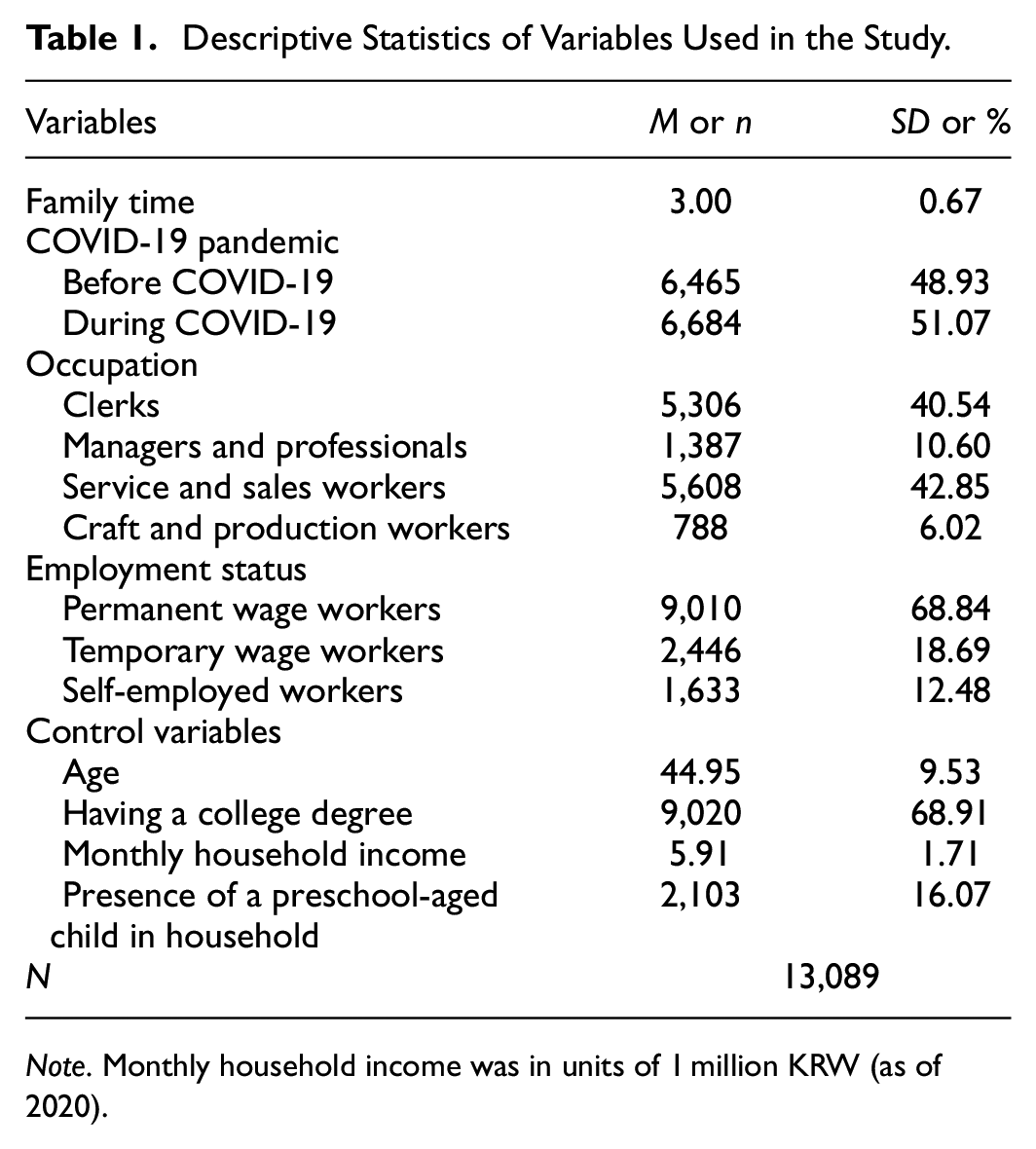
Note. Monthly household income was in units of 1 million KRW (as of 2020).
Table 2 presents the results of the simple mean comparisons of family time across the key explanatory variables. First, a significant difference was found in family time before and during the pandemic (t = 12.10, p < .001). The average score for family time before the pandemic was 2.92 (SD = 0.63), whereas it was 3.07 (SD = 0.70) during the pandemic. Second, family time differed significantly by occupation (F = 150.11, p < .001). The average scores for family time among clerks and managers and professionals were similar (a), but the average score for service and sales workers was 2.89 (SD = 0.65; b), whereas that for craft and production workers was 2.79 (SD = 0.69; c). Third, family time also differed significantly by employment status (F = 45.62, p < .001). Permanent wage workers, on average, spent significantly more time with family (M = 3.03, SD = 0.67; a) than temporary wage workers (M = 2.91, SD = 0.66; b) and self-employed workers (M = 2.92, SD = 0.68; b). A Scheffé post hoc test showed no significant difference between the latter two worker groups. Because not only the key explanatory variables but also the respondents’ sociodemographic characteristics contributed to these differences, we conducted OLS regression analyses, including control variables, in the next stage.
Differences in Family Time Across the Pandemic Phase, Occupation, and Employment Status.

Note. Scheffé post hoc test was conducted, with each letter representing statistically significant differences.
p < .001.
Regression Results
Table 3 displays the results of the OLS regression models predicting married working women’s family time. We included all three explanatory variables in Model 1 and examined the association of each variable with family time with the other variables held constant. We first identified that the onset of the pandemic was associated with a significant increase in family time (B = 0.09, p < .001). Regarding occupation, service, and sales workers reported significantly less family time than clerks (B = −0.13, p < .001). Craft and production workers also reported significantly less family time than clerks (B = −0.20, p < .001). There was no significant difference in family time between clerks and managers and professionals. We also could not find a significant difference in family time by respondents’ employment status.
OLS Regression Models of Married Working Women’s Family Time.

p < .05.**p < .01. ***p < .001.
Model 2 in Table 3 tested whether the association between the onset of the pandemic and family time varied across respondents’ occupations. We found that compared with those in clerical jobs, the positive association between the onset of the pandemic and family time was stronger for those in managerial and professional positions (B = 0.10, p < .05) but weaker for those in service and sales (B = −0.08, p < .01) and craft and production (B = −0.12, p < .05) positions. To more easily interpret these interaction results, we calculated the estimated scores for family time by occupation (Figure 1).

Estimated average scores of family time before and during the COVID-19 pandemic, by occupation and employment status. We calculated these estimates based on the following information in the full sample (Averages: age and monthly household income; Being a college graduate and presence of a preschool-aged child in the household): (a) by occupation and (b) by employment status.
Panel a in Figure 1 shows that the estimated score of family time for the respondents in clerical jobs was 2.99 before the pandemic and 3.11 during the pandemic. For those in managerial and professional positions, the corresponding scores were 2.94 and 3.16, respectively. This means that the increase in the estimated score of family time for managerial and professional workers (3.16 − 2.94 = 0.22) was significantly greater than that for clerical workers (3.11 − 2.99 = 0.12). For service and sales workers, the estimated score of family time was 2.89 before the pandemic and 2.93 during the pandemic. For those in craft and production work, the corresponding scores were 2.84 and 2.85, respectively, indicating that the increase in the estimated scores of family time for sales and service workers (2.93 − 2.89 = 0.04) and craft and production workers (2.85 − 2.84 = 0.01) was significantly smaller than that for clerks.
Model 3, shown in Table 3, investigated whether the association between the onset of the pandemic and family time varied by respondents’ employment status. We found that the positive association between the onset of the pandemic and family time was weaker for temporary employees than for permanent employees (B = −0.06, p < .05). However, we found no significant difference in this association between permanent wage workers and self-employed workers.
Panel b in Figure 1 shows that the estimated score of family time for permanent wage workers was 2.93 before the pandemic and 3.02 during the pandemic. For those who were temporarily employed, the corresponding scores were 2.98 and 3.01, respectively. This indicates that the increase in the estimated score of family time for temporary workers (3.01 − 2.98 = 0.03) was significantly smaller than that for permanent workers (3.02 − 2.93 = 0.09). The increase in the estimated score of family time for self-employed respondents (3.06 during the pandemic − 2.92 before the pandemic = 0.14) was not significantly different from that for the permanently employed respondents.
Finally, we found similar associations between the control variables and family time across the models. Age was negatively associated with family time (B = −0.01, p < .001), whereas monthly household income was positively associated with family time (B = 0.02, p < .001). The presence of a preschool-aged child in respondents’ households was associated with an increase in family time (B = 0.10, p < .001).
Discussion
In the current study, we examined how the onset of the COVID-19 pandemic was related to family time among married working women in Korea. Guided by the ABC-X model of family stress and coping, we conceptualized the pandemic as the stressor event and family time as married working women’s adaption to a crisis. Their occupation and employment status were captured as available resources and used to investigate the direct effects on family time and moderating effects in the association between the pandemic onset and family time.
We first found a positive association between the onset of the pandemic and family time. Respondents reported spending more time with their families during the pandemic than in the pre-pandemic period, which confirms Hypothesis 1. As predicted through the ABC-X model, this result indicates that married working women may have spent more family time to stay functional while substantial constraints were placed on social activities during the pandemic. Given that the family time variable in this study involved family meals and family leisure, the increased family time may have been spent for more leisure, as suggested in previous research conducted in the early phase of the pandemic (Canzi et al., 2021; Chin et al., 2020).
The family time may also have been spent for more family meals, which inevitably entail increased housework, such as cooking, washing dishes, or cleaning. Because there are constraints on when these tasks must be completed, married working women in Korea may have experienced severe time pressure and difficulties in balancing work and family domains during the pandemic (E. Cho & Kim, 2021; B. Choi et al., 2022). This resonates with empirical evidence on the gendered division of housework during the health crisis (Costoya et al., 2022; Fodor et al., 2021; Pabilonia & Vernon, 2023).
The regression analyses showed salient differences in family time among married working women according to occupation, which supports Hypothesis 2a. We found that service and sales workers as well as craft and production workers reported spending less family time than clerks. This provides empirical evidence on a possibility raised by a small number of studies noting negative associations between having long work hours or nonstandard schedules and family time (Cho, 2018; Craig & Brown, 2014). Yet we found little support for Hypothesis 2b that married working women’s employment status is associated with family time. Evidence for this hypothesis was statistically significant in simple mean comparison tests but not in regression analyses. These results imply that all else being equal, different occupations may present different levels of feasibility of family-friendly work schedules that enable married working women to allocate time to family.
Finally, we examined whether the association between the onset of the pandemic and family time is likely to differ according to occupation and employment status among married working women. As predicted in Hypothesis 3a, the results showed that the association between the pandemic onset and family time was not equal across women’s occupations. The estimated increase in family time before and during the pandemic was smaller for sales and service workers than for clerks. Craft and production workers reported that amounts of family time prior to the pandemic were almost the same as those during the pandemic, suggesting that it did not meaningfully influence their family time.
Previous studies have found that sales and service workers as well as craft and production workers perform most of their tasks through direct human interaction and commute to workplaces to use specialized equipment that is essential for their tasks (S. Choi, 2020; Oh & Lee, 2020). Thus, the feasibility of flexible working arrangements is low for these occupations, and our results confirm that this reduced the extent to which family time could increase because of the pandemic. We also found that the estimated increase in family time before and during the pandemic was greater for managers and professionals than for clerks, suggesting that the former were more likely than the latter to be able to decide when or where to work during the pandemic.
The positive association between the onset of the pandemic and family time among married working women was not equal across employment status. As expected in Hypothesis 3b, we observed that the estimated increase in family time before and during the pandemic was smaller for temporary wage workers than permanent wage workers. In Korea, temporary wage workers are less likely than permanent wage workers to have access to flexibility workplace practices, but this difference was relatively unnoticeable before the pandemic because these practices were not used optimally. Despite the encouragement of flexible working arrangements during the pandemic by the Korean government, our results showed that the vulnerability of temporary wage workers to these practices was reflected in the amount of increased family time before and during the pandemic.
Self-employed workers had little access to flexible work arrangements, but their change in family time before and during the pandemic was not significantly different from that of permanent wage workers. Given that self-employed individuals are among those who were most severely affected by the pandemic in Korea (Oh et al., 2021), many may have begun reducing their business hours or working from home to respond to the economic downturn resulting from the pandemic. This could explain the comparable increases in family time among permanent wage workers and self-employed workers. Overall, our findings suggest that the occupation and employment status of married working women represent the feasibility of having family-friendly work schedules and flexible working arrangements, which they could exploit differently when responding to the stressor event, or the COVID-19 pandemic in this case.
This study has several limitations that need to be addressed. First, we were unable to measure the precise amount of time that respondents spend with family and the detailed activities that they do together, because the dependent variable was not measured using time diaries. Previous studies show that both time diaries and Likert scale questionnaires yield consistent findings (Kan & Pudney, 2008; Schulz & Grunow, 2012), but analyzing time diary data would have produced results that were more robust. Second, our dataset did not include how respondents perceive or define the COVID-19 pandemic (the C component in the ABC-X model). Applying all components of the ABC-X model to married working women would be helpful in fully understanding how they and their families have been influenced by the COVID-19 pandemic. Another limitation is that the presence of school-aged children in respondents’ households was not identifiable in the dataset. The disruptive school life of children during the pandemic would have influenced the amount of family time accordingly, but we could not control for this. Finally, our sample consisted of married working women living in Seoul, so caution is warranted when generalizing our findings to those living in other regions in Korea.
In addition to addressing these data-driven shortcomings, we have principal suggestions for future research. Qualitative studies could provide in-depth understanding of what the increased family time has meant to married working women in Korea. The lived experience and meaning of family time directly obtained from married working women would help us further grasp how they and their families have navigated this challenging time and would therefore complement the present results. Moreover, our study focused on married working women, but research incorporating their spouses’ time use could broaden our understanding of how their families as a whole responded to the COVID-19 pandemic. We also used annual cross-sectional datasets containing information collected both before and during the pandemic, so the respondents at the two time points had different socioeconomic characteristics. If future researchers use a longitudinal panel dataset following the same individuals, they could identify within-person changes in family time before and during the pandemic.
To conclude, our study suggests that the onset of the COVID-19 pandemic has significantly increased family time among married working women in Korea. The degree to which this occurred varied across occupation and employment status due to differences in the feasibility of having family-friendly work schedules and flexible working arrangements. Thus, minimizing overwork and unnecessary after-work gatherings and expanding diverse types of flexible working arrangements to all workers would be helpful when coping with stressful events like the pandemic. More importantly, policy makers need to seriously consider different policy measures that could help reshape work and family cultures after the end of the pandemic.
Footnotes
Acknowledgements
The author thanks participants at the meeting for helpful comments and discussions.
Author Note
A preliminary version of this paper was presented at the annual meeting of the Association of Families and Better Life in 2021.
Declaration of Conflicting Interests
The author declared no potential conflicts of interest with respect to the research, authorship, and/or publication of this article.
Funding
The author received no financial support for the research, authorship, and/or publication of this article.
Compliance With Ethical Standards
The ethical review and approval were not applicable because this study did not involve humans or animals.

References
