




Abstract
Research productivity has become one of the main indicators used by higher education institutions (HEIs) as well as the country to support their innovation capability. This study purposely describes the research productivity among ASEAN countries, which is considered to be the world’s current economic hotspot. By using SciVal database to examine the literature over the last 10 years, we describe productivity, citation impact, and economic impact metrics. The findings indicate that Singapore is superior in terms of publication quality (citation) and patents while Malaysia is leading in terms of the number of scientific research. Interestingly, Indonesia’s scientific publication growth has the highest percentage. Furthermore, Engineering & Technology and Life Sciences & Medicine are the two major contributors to ASEAN research productivity. These subjects could be the major locomotives for ASEAN countries to use to sustain their competitiveness if the leaders can transform it into successful commercialization.
Introduction and the Context
Research productivity in higher education must be considered because it is an important criterion in the reputation and prestige of an institution (McGill & Settle, 2012; Mudzakkir et al., 2022). It is also an important component in the world university rankings and funding allocation decisions (Barrot, 2017; Byun et al., 2013; Huang, 2015). World ranking institutions such as the QS World University Ranking and Times Higher Education give a high weight to quality research in their assessment indicators, which is 60%. Shanghai ARWU (Academic Ranking of World Universities) gives research a weight of 80%. This is reinforced by Uslu (2020) who showed that the research reputation component contributes 73.71% to the HEI’s ranking scores. As is well known, university rankings are often used by many stakeholders in HEIs because they can provide a brief overview of the multiple quality dimensions within higher education (Benito et al., 2020).
Research can also be a stepping stone for the country’s development (Upadhyaya & Rajasekharan Pillai, 2019) and it plays an important role in promoting the economic wealth of a country and the welfare of its citizens (Okiki, 2013). This is supported by the direct, indirect, and flow-on impact of research leading to the addition of value-added, production capacity (technology) and consumer surplus (Deloitte Access Economics, 2015). These facts encourage HEIs to strengthen their research capabilities, set strategic goals, and intensify their productivity (Barrot, 2017; Vazire, 2018). As a result, many countries in Asia (e.g., China, Japan, Hong Kong, Singapore and South Korea) have recently demonstrated their research capabilities and scientific positions (Erfanmanesh et al., 2013).
Over the past decade, research in Asia has demonstrated that it has been attempting to catch up with North America and Europe. Based on the SciVal (2020) metadata, research in Asia in the 2010–2019 period occupies the biggest portion (35.73% of the total world publications while previous decade was only 26.88%). The biggest contributors to the collective Asian publications were China (43.32%), India (12.03%), and Japan (11.82%). However, this achievement is different from the total research in ASEAN which only comprises 2.64% of the world publications or 7.39% of Asian publications. In fact, from an economic point of view, ASEAN countries (with more than 600 million people and a nominal GDP of $ 2.31 trillion) are considered to be the world’s economic hotspots. They are the main economic forces in Asia and a driver of global growth (Morgan, 2020). As an economic hotspot, ASEAN needs the innovation supported by research productivity to maintain its high economic growth (Panat, 2014).
The topic of research productivity has been widely researched (Kuzhabekova, & Ruby, 2018; Nygaard, 2017). Erfanmanesh et al. (2013) conducted a study on research productivity with a focus on research in the top 10 Asian countries. At the ASEAN level, several similar studies have focused on particular subjects such as energy and fuel (Sombatsompop et al., 2011), education and psychology (Guido & Orleans, 2020; Vinluan, 2012), library science (Ibrahim et al., 2021; Ramos-Eclevia et al., 2018), and the economy (Kumar et al., 2014). Upadhyaya and Rajasekharan Pillai (2019) conducted research productivity in the BRICS country. This study expands the scope into research productivity at the country level in the ASEAN by looking at all of the subjects’ performance, in particular the subjects that have not been available in the previous research. It will provide a new perspective on how research in the ASEAN region can ultimately increase its collective economic growth (Gholizadeh et al., 2014). In addition, by understanding research productivity, policymakers can select and develop specific areas that might enable its country to catch up in terms of innovation and technology (Li et al., 2019) through patents granted (Nelson, 2009). With this, it can sustain its economic growth in the future (Hasan & Tucci, 2010).
To answer the research questions, we conducted an analysis inclusive of several stages. Our analysis begins by looking at the chronological trend of the publications and citations in order to determine the condition of publications in general in the ASEAN region over the last 10 years. Subsequent comparisons were carried out using productivity and citation impact metrics as the indicators of the quantity and quality of the publications. Through these two groups of metrics, the level of publication in each country and its impact on other research in general became known. We also made comparisons between the number of patents citing publications produced by calculating the patent conversion rate per country. The findings from the entire series of stages provided an academic outcome perspective of our concerns including the unequal university rankings, low innovation capability, and low GDP per capita in the ASEAN region.
There were several contributions to our research. First, we investigated research productivity at the country level in the ASEAN region in order to develop the previous research conducted by Erfanmanesh et al. (2013) which only included the top-level HEIs in Asia. Research related to research productivity in Asia is still limited because it is dominated by the United States, Canada, and Western European countries (Jung & Horta, 2013). This contribution can become a reference for researchers and editors to use to find out that there are still many regions that can be targeted to diversify their existing research context. Second, we examined all subjects and per subject area, while the previous studies focused on the ASEAN region only looked onto certain subjects such as the subject of energy and fuel (Sombatsompop et al., 2011), education and psychology (Vinluan, 2012), computer sciences (Abrizah & Mee, 2017), and the economy (Kumar et al., 2014). Third, we looked at the entire set of economic impact metrics contained in SciVal. The economic impact on the previous research performance examination conducted by Upadhyaya and Rajasekharan Pillai (2019) in the BRICS country only includes the patent citation variable per scholarly output. Finally, we added the publication conversion rate analysis to the number of patents that was ignored in the previous studies.
Relevant Literature
ASEAN Region and Higher Education
Even though the ASEAN has been established since 1967, the granting of a legal personality (legality of rights and obligations) only occurred in 2007 with the adoption of the ASEAN Charter (Phan, 2016). Currently, the ASEAN member countries consist of Brunei Darussalam, Cambodia, Indonesia, Laos, Malaysia, Myanmar, the Philippines, Singapore, Thailand, and Vietnam. This organization aims to increase the region’s economic growth, cultural development, and social progress (Jamaludin et al., 2020). The mission carried out by the ASEAN to develop the quality of life of the member countries also includes higher education. In 1995, the ASEAN created a collaborative network of higher education institutions, namely the ASEAN University Network (AUN) which aims to provide a systematic mechanism to support integration, collaboration, and government investments in the HEIs in Southeast Asia (Jamaludin et al., 2020). The programs implemented by the ASEAN are increasingly diverse. In 2011, the 5-year plan was inaugurated, specifically the ASEAN 5-Year Work Plan on Education. One of the aims was to provide world-class education and research (ASEAN, 2013). The planning intensification in the research field will be continued in the 2016–2020 period in the form of the creation of facilities facilitating student mobilization through scholarships and joint research (ASEAN, 2016). Other forms of research collaboration are also being elaborated on by the ASEAN with a goal-oriented focus such as research supporting food security, agriculture, and forestry (ASEAN, 2019).
The World Economic Forum, through the GCI (Global Competitiveness Index) rankings, also shows that emerging countries in the ASEAN can achieve rankings and scores capable of competing with other developing countries. One of the 12 indicators in GCI, innovation capability has a weighting of 8.3% in the calculation which includes R&D. It provides an overview of the number of publications, patents, and institutions that focus on research. The comparison between the rankings obtained by the ASEAN member countries and their innovation capability ranking is not far away. It shows that the country’s overall ranking is sufficiently supported by its research and development aspect (Figure 1).

Global competitiveness index ranking and innovation capability indicators of ASEAN member countries.
Research Productivity
Conklin and Desselle (2006) define research productivity as the number of original research and review publications submitted and accepted in peer-reviewed journals. Administrators often measure the productivity of a lecturers’ research according to the number of publications. Some lecturers disagree because the publication standard should be the quality of the publication, not the quantity (Quimbo & Sulabo, 2014). Abdekhoda (2014) combines the two by assuming that the common measure for assessing the research performance of a country and an institution is the number of publications and the number of citations obtained from the publications. Since the unit of analysis of this study is a country, we define research productivity as the performance based on the number and citation of publications produced by a country (Abdekhoda, 2014).
As discussed previously, highly reputable ranking institutions (THE WUR, QS WUR, and ARWU) emphasize research more (Bak & Kim, 2015). Table 1 provides an overview of the implications of the research progress in the ASEAN. The indicators of the number of higher education institutions that are included in the world ranking according to both Quacquarelli Symonds (QS) and Times Higher Education (THE) in 2020 have been included. Singapore and Malaysia have higher rankings in QS WUR (top 100) compared to the other ASEAN countries given its achievement for GDP per capita. The relationship is not unidirectional between Indonesia and Brunei Darussalam, whose GDP per capita does not reflect the number of universities ranked highly in QS or THE.
ASEAN Economy and Higher Education Institution Performance.

World Bank (2019).
Methodology
This study used the bibliometric method to compare the publication outputs, citation impacts, and economic impacts of research in the ASEAN countries in 2010–2019. The bibliometric method is a quantitative method used for examining the relationship between numbers and patterns in bibliographic data. Ten years is widely used in research on research productivity, as has been done by El Rassi et al. (2018), Wei et al. (2016), among others. The year 2010 was chosen to be the base year because the ASEAN conditions began to improve in reference to the aspect of financial integration (Fry-McKibbin et al., 2018). The analysis was carried out using Elsevier’s SciVal 2020 data. SciVal data is a reference source used for ranking the QS and THE universities. Besides that, it is also commonly used in research performance research as has been previously done by Avanesova and Shamliyan (2018), Upadhyaya and Rajasekharan Pillai (2019), among others. In terms of explaining research performance, this study considers that the research outcomes (Upadhyaya & Rajasekharan Pillai, 2019), research productivity (Abrizah & Mee, 2017; Vinluan, 2012; Wei et al., 2016), and research performance (Avanesova & Shamliyan, 2018; Kamdem et al., 2017) are the same thing.
The comparison and analysis was carried out over four stages based on measuring the research productivity performance including overall performance and two groups of metrics, namely productivity and citation impact metrics (Upadhyaya & Rajasekharan Pillai, 2019). First, the analysis focused on scholarly output and citation count in order to provide an initial basis for assessing the research outcome of the academic community (Upadhyaya & Rajasekharan Pillai, 2019). Second was discussed the productivity metrics which provide an overview of the research performance focusing on the quantity of the output per country and per author. Third, we looked at the citation impact metrics that show the quality of the publication performance from each country (Elsevier, 2019), in terms of both the number of citations and the number of publications included in the top journals. Fourth, the discussion focuses on the economic impact, consisting of the citing patent count, patent citation count, patent citations per scholarly output, and patent-cited scholarly output. Not only that, but we have also showed the patent conversion rate through WIPO (World Intellectual Property Organization [WIPO], 2020) data in order to see how big the contribution of scientific publications is in the patent process. The conversion rate was calculated by comparing the citing patent count with the number of publications (scholarly output). In this calculation, the researcher used a time lag of 2 years for the year of publication so then the publication data used is t − 2. This was done by considering the conditions under which new patents are generally published, which is 18 months after the application date (WIPO, 2020).
Analysis of the Results
The number of publications in the ASEAN countries on all subjects during the 2010–2019 period has increased (Figure 2). The highest growth (based on the previous year (t − 1)) occurred in 2018 which resulted in a growth of 18.12% (19,244 publications). However, when viewed according to the number of publications, the highest achievement occurred in 2019 by as many as 145,771 publications (more than in previous years) for all of the ASEAN countries’ publications collectively. Of these publications, Malaysia led the number of publications (amounting to 277,240) but Indonesia achieved the highest average growth of 37.27%. Interestingly, Indonesian publications began to significantly increase in 2015 which in the end enabled it to lead the ASEAN publications in 2019, beating Malaysia, which had always been in first position in previous years. However, Myanmar, Brunei Darussalam, Cambodia, and Laos did not have a high number of publications during this period.

Publications (I) and citation (II) of ASEAN member countries 2010–2019.
The citation performance of ASEAN countries does not show a similar trend to the number of publications. As a direct impact of a publication, a citation takes a certain time to reach an optimal number (Golosovsky, 2019). The calculation of the SciVal citations is based on the total number of citations received since an item was published (Elsevier, 2019). This causes the number of citations in the last year to be smaller than in the previous years. Only Singapore has always been in top position in terms of citations (an average annual contribution of 46.04% to the total number of ASEAN citations), although it is not a leader in the number of publications overall. This is in contrast to Indonesia, which has a relatively high number of publications with an upward trend while not being accompanied by an increase in the number of citations, which has even tended to fall. The number of publications and citations is one of the driving factors of the popularity of the subject in a country (Abramo et al., 2019). In this way, research advances in certain subjects can also be used as part of a country’s comparative advantage.
The information on the productivity metrics for research across all subjects (AS) in the 2010–2019 range shows an interesting thing (Table 2). The total number of publications in Asia ranks first (35.73% of world publications, only 26.88% in the previous decade) compared to Europe (31.28%), North America (24.28%), South America (3.36%), Australia (2.93%), and Africa (2.42%). The number of authors also shows the same thing, where the number of Asian authors is 42.70% of the world’s authors followed by Europe (25.17%), North America (20.38%), South America (4.72%), Africa (2.52%), and Australia (1.70%). However, in terms of researcher productivity (measured by publications per author), Asia is in the second-lowest rank among these regions with a value of 1.19 whereas the global average is 1.34. This is in contrast to Australia which ranks first for productivity (although it has the lowest number of authors compared to other regions). This demonstrates Asia’s superiority in terms of published quantity and Australia’s superiority for researcher productivity.
Productivity Metrics During the Period 2010–2019 in All Subjects.
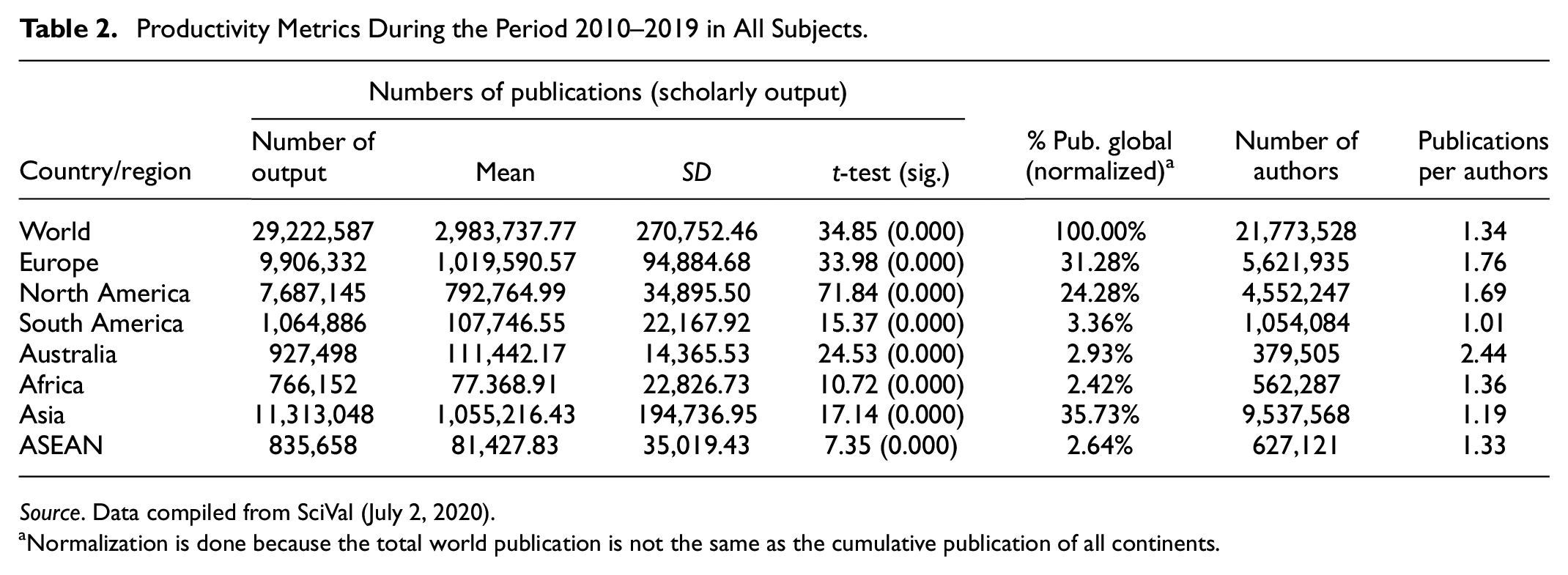
Source. Data compiled from SciVal (July 2, 2020).
Normalization is done because the total world publication is not the same as the cumulative publication of all continents.
The ASEAN region, which is part of Asia, has a higher value of publications per author (amounting to 1.33) compared to Asia (1.19). This shows that the ASEAN has better research productivity than Asia as a whole. The top three ASEAN countries that occupy the top position in terms of the number of publications in a row are Malaysia (277,141), Singapore (206,402), and Indonesia (145,313). Meanwhile, Laos, Myanmar, and Cambodia are in the bottom three positions with their number of consecutive publications being 2,293, 2,855, and 3,397. In terms of the number of authors, Malaysia (189,381), Indonesia (153,187), and Thailand (101,941) are in the top ranks in the ASEAN. In comparison, the number of authors for the bottom three of the ASEAN is occupied by Laos (1,834), Brunei Darussalam (2,342), and Myanmar (2,947). Although it is always in the top three for the number of publications and authors, Indonesia occupies the lowest position for publications per author. On the other hand, even though Singapore is not included in the top three for the number of authors, its research productivity when measured by publications per author occupies first position in the ASEAN. It even surpasses Malaysia which is always otherwise in the top position for the number of publications and authors. This shows that Singapore is superior in terms of its research productivity compared to the other ASEAN countries. Malaysia and Indonesia only excel when in reference to the number of publications and authors.
The information on the productivity metrics for each subject also shows some interesting things. In terms of the number of publications, Malaysia always ranks first in all subjects. The second position is dominated by Singapore, followed by Indonesia. Thailand occupies the second position only in life sciences and medicine (LSM) which shifts Singapore to third position. On the other hand, the lowest position was dominated by Laos, which was in the lowest position in the subjects of arts and humanities (AH), engineering and technology (ET), natural sciences (NS), life sciences and medicine (LSM), and social sciences and management (SSM). SSM is predominantly occupied by Brunei Darussalam and Myanmar respectively. In terms of the number of authors, the first position is still dominated by Malaysia, while Indonesia only occupies this position for the NS subject. The second position for AH, ET and SSM is occupied by Indonesia, while the second position in LSM and NS is occupied by Thailand and Malaysia. Singapore still dominates the third rank in all subjects. In contrast, Laos dominates the lowest positions in all subject areas other than for LSM which is occupied by Brunei Darussalam. Apart from the number of publications, the researchers’ productivity also needs to be considered in each subject by looking at the number of publications per author. Singapore always occupies the top productivity ranking in each sector while Indonesia dominates the lowest rank. It is an important note that in each subject, Singapore can show its researchers’ productivity while Indonesia and Malaysia only excel in terms of the quantity of publications. The contributions for each subject can be found in Appendix 1.
Table 3 shows the effect of country research output represented by several types of citation impact metrics. Overall, three countries dominate almost all of the variables, namely Singapore, Malaysia, and Thailand. Singapore’s superiority in the citation impact metrics shows there to be a huge gap between it and other countries in the ASEAN (3,611,508 citations, 2 times greater compared to Malaysia and 3 times greater than Thailand). The citations received by Singapore’s publications are due to a bigger proportion of them being in high quality journals, in which the top 10% journal percentile reached 54,575 published articles. Malaysia’s total was 22,876 and Thailand’s was 14,010 articles. In terms of the field-weighted citation impact (FWCI), Singapore’s score is 1.45 while Thailand’s is 0.72 and Malaysia’s is 0.62. Consistently, the number of publications in journal Q1 shows that Singapore reached 41.7% of the total ASEAN countries, far more than the other ASEAN countries. The highest number of publications in Q2, Q3, and Q4 is held by Malaysia. Indonesia’s citation performance is not as good as its productivity metrics which is in contrast to Singapore, which performed brilliantly in this metric. Indonesia is third place in the ASEAN in Q2, Q3, and Q4 publications and it has a lower performance in its Q1 publications (13.89% of the total publications). This shows the lack of quality of Indonesian publications which are still focused on Q3 (56.54% of total publications). Even so, Indonesia’s Q1 publication growth is the second highest in the ASEAN (an average of 24.58% per year).
Citation Impact Metrics During the Period 2010–2019 in All Subjects.
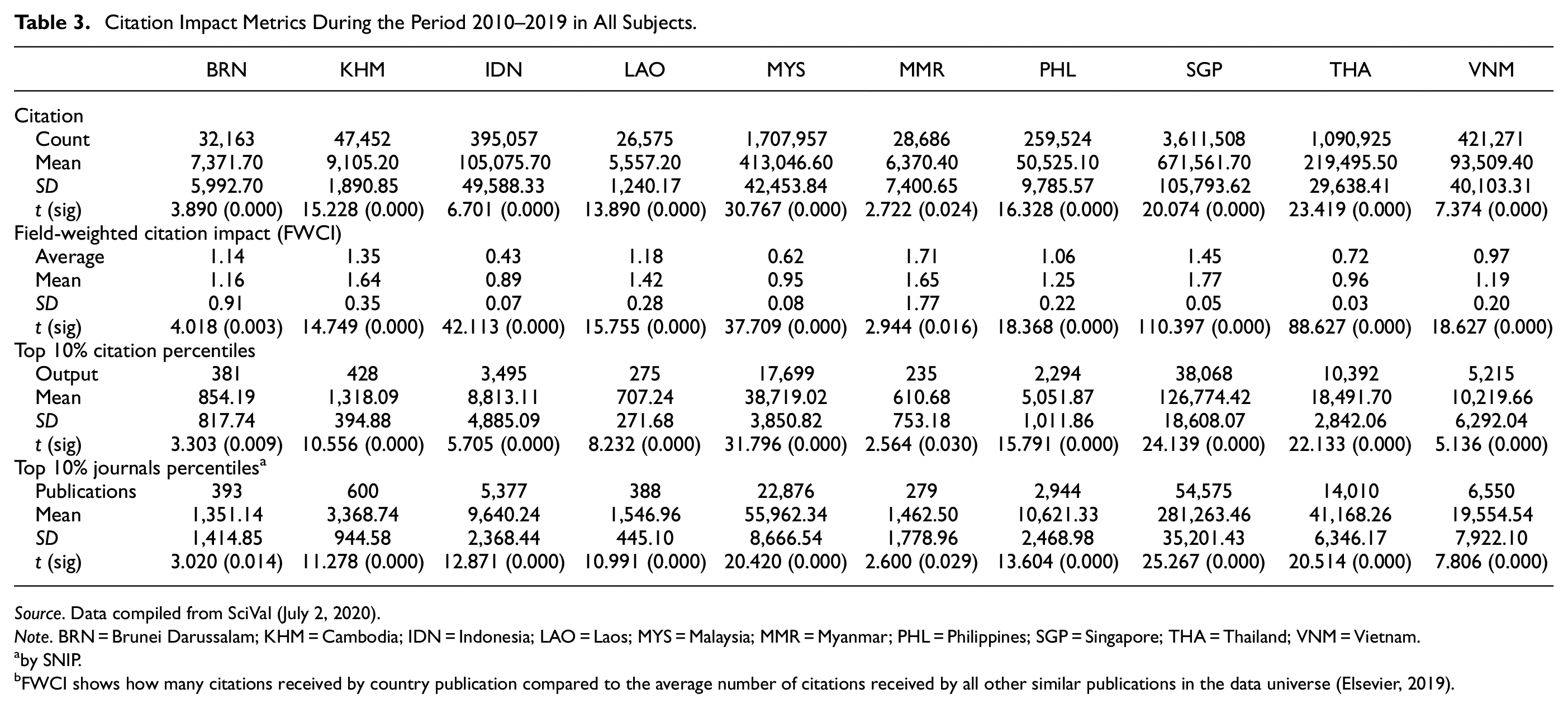
Source. Data compiled from SciVal (July 2, 2020).
Note. BRN = Brunei Darussalam; KHM = Cambodia; IDN = Indonesia; LAO = Laos; MYS = Malaysia; MMR = Myanmar; PHL = Philippines; SGP = Singapore; THA = Thailand; VNM = Vietnam.
by SNIP.
FWCI shows how many citations received by country publication compared to the average number of citations received by all other similar publications in the data universe (Elsevier, 2019).
Although Cambodia, Laos, and Myanmar in many metrics show a low level of performance, the citations per publication of these three countries are good (14.0; 11.6 and 10.0). However, this is understandable because the number of publications from these three countries is relatively small when compared to the other ASEAN countries. The same thing is also found in Myanmar and Cambodia for the Field-Weighted Citation Impact (FWCI) score. In the FWCI variable, Myanmar ranks first among the other ASEAN countries with a score of 1.71, beating Singapore with a score of 1.45 and followed by Cambodia with a score of 1.35. However, the high scores obtained by Myanmar and Cambodia in the FWCI can occur because FWCI tends to fluctuate in small-scale entities/countries (Elsevier, 2019). This statement is also supported by the SciVal data which shows fluctuations in the FWCI Myanmar and Cambodia values from year to year.
When viewed from the contribution of each subject (Table 4), the majority of citation counts in the ASEAN are mostly produced by LSM subjects. The two countries with the highest numbers (Malaysia and Singapore) have the most citation counts in the ET sector. This is followed by the other citation variables which also show that Malaysia and Singapore have superior research quality in the ET sector. Overall, the ASEAN countries tend to have superior publication quality in the LSM sector, followed by the ET sector.
Citation Impact Metrics During the Period 2010–2019 in Every Subject.

Source. Data compiled from SciVal (July 2, 2020).
Previous research has shown there to be a relationship between patents and GDP (Sinha, 2008; Zekos, 2014). The existence of a patent system can encourage innovation by providing an incentive to innovate (Langinier & Moschini, 2002) by commercializing the scientific knowledge (Sukoco et al., 2022). The patent owner is given a special right to monopolize the technology that he invented within a specific time. After the patent is declared to be expired, the knowledge and technology in the patent will become public property. In the end, a country’s industry can enjoy the new technology from the patent and increase its industrial productivity and efficiency (WIPO, 2020). In this case, academic research is crucial because it provides a spillover effect into the patent-making process where academic research is one of the sources of reference (Acs et al., 1992).
Table 5 shows the dominance of Singapore in terms of the economic impact metrics during the period 2010–2019. If added up, the citing patent count of all ASEAN countries (except Singapore) is 10,684 patents. The results collectively are still unable to beat the number of patents owned by Singapore at 17,618 patents. This is because Singapore contributes 62,25% of the total number of citing patent count in the ASEAN. The Singapore conversion rate (Table 6), measured by the contribution of citing patents related to the total publications as a whole, also shows a high number (25.42%) compared to that of other ASEAN countries. This means that 25.42% of the total publications produced by Singapore are used as references in the patent application process. Further, the conversion rate based on patent granted per publication of Singapore generate the highest percentage (14.56%). This shows the excellence of Singapore’s publications in relation to generating patents. A large gap is also shown in the other economic impact variables that clarify Singapore’s superiority in the context of patents. The ASEAN countries other than Singapore, Malaysia, and Thailand performed poorly regarding this metric. This shows that the research conducted by the other countries has not yet been able to stimulate patent creation. Furthermore, in the analysis of the economic impact metrics per subject, LSM is the subject of science that contributes the largest number in each of the ASEAN countries except for Brunei Darussalam where the majority of the largest economic impact metrics are in the subject of ET. This shows that LSM is the research subject with the most significant economic impact through the avenue of patent products in most ASEAN countries (Appendix).
Economic Impact Metrics During the Period 2010–2019 in All Subjects.

Source. Data compiled from SciVal (July 2, 2020).
Description (SciVal, 2019): Citing patents count: count of patents citing the scholarly output published by the entity. Patent citations count: total count of patent citations received by the entity. Patent citations per scholarly output: average patent-citations received per 1,000 scholarly outputs published by the entity. Patent-cited scholarly output: count of scholarly output published by an entity that have been cited in patents.
Overall Conversion rate of ASEAN.

Data compiled from WIPO (August 19, 2020).
Data compiled from Scival (August 19, 2020).
Discussion and Implications
Overall, Singapore is at the forefront of research productivity in the ASEAN. Although the publication output is still inferior compared to Malaysia, Singapore is superior in terms of citations and patents. Singapore’s high citation rate was triggered by the restructuring of the world-class university program that Singapore has carried out since the 1990s (Lee & Gopinathan, 2008). Investments in research and higher education institutions conducted by Singapore were undertaken much earlier compared to other ASEAN countries. Apart from that, the government involvement in research is also a key factor in the research productivity success. This is evidenced by the fact that ASEAN countries (other than Singapore) only allocate less than 1% of GDP to scientific research and development such as Indonesia (0.085%), Thailand (0.483%), and the Philippines (0.138%) (Nguyen & Pham, 2011; World Bank, 2020). Countries and HEIs need to realize the importance of being a world-class university to support their publication performance, as it is known that research is dominant in WCUs.
In addition to being able to support the world university ranking which has an impact on stakeholder perception, research also has an impact on economic growth. The topic of the long-term relationship between innovation and economic growth has been discussed for a long time (Solow, 1956). Previous research has shown that patent citations, patent registration and patent issues correlate with share volume. This is then absorbed by certain variables so then it is associated with economic progress (Senarathne & Wei, 2018). The economic impact metric shows that Singapore looks to be superior, indicating that its research is widely used in the patent process. This finding is in line with the GDP per capita data reported by the 2019 World Bank indicating that Singapore is superior to other ASEAN region countries (amounting to the US $58,830), comparable to the patents that it generates. Thus a country’s ability to produce patents can improve the economy of the country in line with the classical economic point of view that patents can improve the economy (Sweet & Eterovic, 2019).
The high use of research in Singapore’s patent process is closely related to industry funding (Hooi & Wang, 2020). Industry involvement in scientific research is essential when making patents because it will make the research carried out by HEIs more applicable. In addition, the economic condition of Singapore, which has implemented an open economy, has made many multinational companies in Singapore that can transfer knowledge (Wong & Ho, 2007). This is not the case evenly across the ASEAN countries. Some countries are still reluctant to open up to foreign investment. This situation is the cause of the lack of industry funding available and it makes research in the majority of ASEAN countries less applicable in the patent making process. Similar empirical results occurred in America where there was a 20% decline in the number of scientific publications produced by industry between 1980 and 2006 due to the separation of research roles between industry and HEIs (Arora et al., 2019).
Apart from Singapore, Malaysia is one of the ASEAN countries that has had a brilliant level of performance in terms of research productivity. One of the factors driving this is the lecturer recruitment system. Malaysia highly prioritizes the research track record of the lecturers it recruits in contrast to other Southeast Asian countries that prioritize teaching more than research (Barrot, 2017). Another facilitator of growth in terms of publications also occurred in Indonesia due to the government policies. Through the Ministry of Research and Higher Education, Indonesia created a World Class University (WCU) policy that encourages HEIs to improve their quality and capabilities, including in the domain of research (Sukoco, Mudzakkir, et al., 2021; Sukoco, Supriharyanti, et al., 2021; Tanhueco-Nepomuceno, 2019).
The majority of the ASEAN countries’ research is dominated by the LSM and ET subject field. Interestingly, the two countries with the highest research productivity in the ASEAN (Singapore and Malaysia) are more dominant in the field of ET than LSM, whereas other ASEAN countries are dominant in the field of LSM. This is due to Singapore having implemented Information and Communication Technology (ICT) Integration in the education sector since 1997 (Toh & So, 2011). Malaysia encourages publications in the engineering sector through its 5-year development plan (Bakri & Zakaria, 2013).
The findings of this study are an update for the previous research that did not discuss the economic impact metrics in the analysis of research productivity in the ASEAN, such as in the studies by Vinluan (2012), Erfanmanesh et al. (2013), Sombatsompop et al. (2011), Kumar et al. (2014) and Abrizah and Mee (2017). In addition, this study updates the findings of Sombatsompop et al. (2011) which state that Thailand dominates in terms of ASEAN region publications. In terms of citations, these findings strengthen the research of Erfanmanesh et al. (2013) and Sombatsompop et al. (2011) which shows that Singapore has the highest number of citations at both the Asian and ASEAN levels. This study supports the increased innovation through academic products as alluded to in the creative class theory introduced by Richard Florida. Creative class theory puts forward participation from various economic classes including academics to support innovation and investment (Florida, 2014). Florida (2014) also mentioned that the high productivity of creative thinking can help to adapt to new structures and realities.
The insights from this research offer implications for higher education institutions and governments in ASEAN countries. Countries and HEIs can use the legitimacy of the importance of university ranking at the global level to accelerate their research productivity. The government and HEIs also need to create strategies to support the impact of the resulting publications through both citations and the patents citing these publications. A clear patent policy also needs to be made in the HEIs because this policy will stimulate the commercialization of research as well as to determine the rights and responsibilities involved in the commercialization of the research results (Kauppinen, 2014). The country also needs to increase the percentage of GDP invested in scientific research and development. The results of this study also show that the LSM sector can provide the greatest citation for ASEAN countries. ASEAN countries need to adjust their strategies in order to optimize this potential so then they can become a locomotive of future growth.
The ASEAN region is attractive in terms of its wider context and the availability of potential partners for researchers from developed countries. This is because emerging countries such as those in the ASEAN have a higher potential growth when compared to developed countries which tend to be more stagnant. It has also been seen that in the last 10 years, an excellent academic culture has begun to form in the ASEAN as reflected in the increasing number of publications. When viewed from the analysis per sector, the ASEAN is still the same as the majority of other countries in the world which also excel in LSM and ET. ASEAN has an advantage in terms of its higher biodiversity (Von Rintelen et al., 2017). In addition, the ASEAN has also experienced rapid changes in its social and economic conditions in recent years which may provide different concerning issues compared to other regions (Busapathumrong, 2012).
Conclusion and Limitations
Increasing the level of research productivity is a holistic process involving various aspects. In the last decade, the publication conditions in the ASEAN region have increased quite significantly where each ASEAN country now has a diverse variety of research productivity. There is, however, a big gap between the two foremost superior countries (Singapore and Malaysia) and the other ASEAN countries. The majority of countries in the ASEAN need to realize the importance of ranking as a world class university. This will allow them to be implemented in world-class university programs that can better support their country’s research productivity. Governmental and industry support in terms of investing in research and development is also needed to support innovation which will have an impact on the country’s economy. Optimizing the field of research subjects, which are the strengths of each ASEAN country, must be considered in the country’s strategy in order to support the economic strength of the patents that it produces, especially as the ASEAN region has advantages in terms of biodiversity, geography, and socio-cultural diversity.
The analysis carried out in this study has several limitations. This study did not include the outcomes that were not indexed by the Scopus database (the data source of SciVal), although there were several potential journals outside of the database. The main reason for these outcomes not being accommodated is that the journal’s accessibility factor on a global scale tends to be low. In addition, SciVal only compiles patent data from the European Patent Office, Japan’s Patent Office, the UK Intellectual Property Office, the United States Patent and Trademark Office, and the World Intellectual Property Organization. Countries that have patents outside of these offices are not counted in the SciVal database. The next limitation relates to the collaboration metrics that were not included in this study because they were deemed to be less relevant to the existing research question. This way, further research is expected to complement this study’s limitations in order to add to the research productivity literature and research collaboration in the ASEAN region.
Supplemental Material
sj-docx-1-sgo-10.1177_21582440221145157 – Supplemental material for Comparative Study of ASEAN Research Productivity
Supplemental material, sj-docx-1-sgo-10.1177_21582440221145157 for Comparative Study of ASEAN Research Productivity by Badri Munir Sukoco, Rizky Ananda Putra, Humam Nur Muqaffi, Muhammad Vinka Lutfian and Hendro Wicaksono in SAGE Open
Footnotes
Declaration of Conflicting Interests
The author(s) declared no potential conflicts of interest with respect to the research, authorship, and/or publication of this article.
Funding
The author(s) disclosed receipt of the following financial support for the research, authorship, and/or publication of this article: This research was supported by Universitas Airlangga (Top Tier Research Grant 2021).

Supplemental Material
Supplemental material for this article is available online.
References
Supplementary Material
Please find the following supplemental material available below.
For Open Access articles published under a Creative Commons License, all supplemental material carries the same license as the article it is associated with.
For non-Open Access articles published, all supplemental material carries a non-exclusive license, and permission requests for re-use of supplemental material or any part of supplemental material shall be sent directly to the copyright owner as specified in the copyright notice associated with the article.
