




Abstract
This paper innovatively defines the structure of human capital based on existing theories and use the heterogeneous stochastic frontier model to test the relationship between various types of human capital and innovation. It is found that with the progress of technology, the structure of human capital and the mechanism of promoting innovation have undergone profound changes. Together with commercial leasing human capital, financial human capital, and entrepreneurs, information human capital and transportation human capital participate in innovation activities and create a new collaborative space, which in turn helps to spread the value of innovation and influence the effectiveness of the entire innovation system. This study enriches the theoretical research on the mechanism of human capital promoting innovation in the information age and provides new insight to explain the imbalance between human capital input and innovation output. Based on the theory of innovation chain value and flow space, this study redefines the connotation of innovative human capital structure by distinguishing the nature of innovation activities. This study also reveals the difference in the influence of human capital structure on different types of innovation activities. This study partly explains the problem of increasing human capital input but decreasing innovation efficiency in developing countries. Therefore, from a macro perspective, our research provides guidance for understanding the transformation of innovation under the background of technological progress and formulating effective urban innovation strategies for managers.
Plain language summary
Existing studies show that human capital is the core element of innovation activities, and the more human capital investment a country has, the stronger its innovation ability will be. However, there is still no consistent explanation of who promotes innovation and how. This makes it difficult for researchers to explain the problem of increasing human capital investment but decreasing innovation efficiency in some developing countries. This paper innovatively considers the impact of technological progress on innovation activities, and holds that technological progress changes the structure of human capital for innovation, thus affecting the efficiency of innovation. The analysis based on stochastic frontier model proves this view. The conclusion of empirical analysis shows that the total human capital input is not the more the better, but must pay attention to the structure, especially the information human capital and transportation human capital in innovation activities. But at the same time, this paper also believes that whether these two types of human capital will have a threshold effect on other types of human capital needs to be further discussed beyond this paper. This paper provides an enlightening perspective to explain the profound changes of innovation mechanism under the background of technological progress and promote the improvement of regional innovation efficiency.
Introduction
In recent decades, innovation and human capital have been regarded as the two pillars of contemporary economic growth (Aiting et al., 2022; Banbury & Mitchell, 1995; Tomoday, 2018; Tushman & Reilley, 1996). In an effort to foster innovation and achieve cross-country economic development, many developing nations have established active human capital policies. However, in the existing researches, the relationship between human capital and innovation is vague, and whether human capital investment will promote innovation remains to be further discussed. For example, some researchers believe that human capital plays the role of innovation engine (Acemoglu, 1996; Aghion & Howitt, 1998). In other words, the more human capital, the more innovation. Some researchers also pointed out that human capital investment does not necessarily promote innovation, and may even lead to resource waste or hinder innovation (Ang et al., 2011; Danquah & Outara, 2014). Especially in recent years, some new evidence from developing countries shows that the increase in human capital investment has not brought about corresponding innovation growth, but has shown obvious diminishing marginal returns, which is known as the “Solo paradox” phenomenon in the field of innovation (Igna & Venturini, 2018; Li & Nan, 2019).
Technically speaking, the disagreement stems from the definition of human capital structure. Most existing studies use education level, skill level, or health level to distinguish human capital structure (Fleisher et al., 2009; Nasirov et al., 2021; T. Wang & Zatzick, 2019), hence the empirical results are rather different. A deeper reason lies in the lesser consideration of the impact of technological progress on human capital for innovation mechanisms. Although many studies have analyzed the role of information and transportation infrastructure on innovation (Díaz & Sainz, 2015; Orozco et al., 2022; Tan et al., 2022), there is a tendency to emphasize physical facilities over intangible human capital in explaining the mechanisms, and less consideration is given to the changes in the urban innovation space brought about by technological progress, as well as the following changes in human capital structure and urban innovation efficiency. According to Castells (1989), the rapid advancement of technology has broken down the spatial constraints of economic activities, and a dynamic space has formed in which “social practises of shared time can be achieved without geographical proximity,” that is, mobile space, which has a wide range of impacts on human economic activities. The scope of human capital collaboration has been greatly expanded, the social division of labor has been further refined, and the structure of human capital and the mechanisms influencing innovation have also changed, but there are still gaps in research of this area.
By combining the theory of innovation value chain and the theory of flow space, this paper aims to study the change of human capital structure and its impact on innovation efficiency under the background of technological progress. Firstly, the changes in the connotation of human capital structure under the impact of technology are discussed from the theoretical level, that is, information human capital and transportation human capital participate in innovation activities and construct a new collaborative space, which plays a key role in transmitting innovative value together with other human capital. Secondly, the panel data of 31 provinces in China were used to measure the relationship between different types of human capital and innovation efficiency by using the stochastic frontier model considering the heterogeneity of human capital, and to explain the imbalance between human capital input and innovation output from the perspective of structural low efficiency or inefficiency. Lastly, to more fully reflect the variability of the influence of human capital structure on innovation efficiency, we further differentiate the types of innovation activities and the regional effects of innovation activities in the empirical study. This study enriches the theoretical research on the mechanism of human capital promoting innovation in the information age, and it provides a new insight to explain the imbalance between human capital input and innovation output. This study defines the connotation of innovative human capital structure in the information age using the theory of innovation value and flow space. By distinguishing the nature of innovation activities, this study reveals the difference of the influence of human capital structure on different types of innovation activities.
The article is organized as follows. The following section describes the theoretical framework and relevant literature, Section “Materials and Methods” describes the methods, Section “Results” describes the results, and Section “Discussion” discusses the contribution and limitations of the study to the future research agenda.
Theoretical Background
Human Capital Structure and Innovation
According to Schultz (1961) and Becker (2009), human capital can be explained as the knowledge, skills, abilities of individuals and the understanding they have gained over the years through education, training, work experience, healthcare and even immigration. Romer (1986) and Lucas (1988) believe that, human capital can generate innovation or technology. For example, Acemoglu and Autor (2012) shows the different ways that human capital can promote innovation. On the one hand, talents with relevant skills can directly generate new ideas (innovation) through their educational ability; on the other hand, innovation can be indirectly triggered by the externalities of human capital (Coe & Helpman, 1995; Romer, 1990; X. Yu & Zhang, 2019). From a macro perspective, human capital affects not only the technological innovation speed of domestic production, but also the speed of domestic technology imitation and catching up with technologically advanced countries (Benhabib & Spiegel, 1994). From a corporate perspective, Abel and Gabe (2011) and Fulmer and Ployhart (2014) pointed out that, human capital is the combination of skills, knowledge, ability and other attributes that can be transformed into productive forces, and plays a key role in the enterprise’s absorption and organizational knowledge innovation in the process of production (Lenihan et al., 2019; Matzler et al., 2015; Protogerou et al., 2017; Subramaniam & Youndt, 2005; Teixeira & Tavares-Lehmann, 2014). The realization of the role of human capital in innovation mainly depends on education in reality (Benos & Zotou, 2014), skill (Vandenbussche et al., 2006), health (Bloom et al., 2004; Ogundari & Abdulai, 2014; Thomas & Frankenberg, 2002), and other intangible capital accumulation. But the results of many empirical studies show that the accumulation of human capital does not necessarily bring innovation. Total factor productivity (TFP) is often regarded as an indicator of innovation performance, many empirical analysis results show that from this indicator, China’s human capital continues to accumulate but innovation is not enough, which is mainly reflected in the change of total factor productivity showing a downward trend (Whalley & Zhao, 2013). Why is this happening in China and some developing countries? Heckman (2003) pointed out that, the regional distribution of human capital investment in China is different, and the human capital structure between regions is unbalanced, which restrains the improvement of innovation ability to a certain extent. Timmer and Szirmai (2000) believed that although the input of existing innovation elements increases, they are not accurately invested into the required sectors or industries. This results in the mismatch between human capital supply and industry demand, which restricts the overall innovation efficiency. These analysis frame based on Syrquin (1986) provides insights for understanding the relationship between input and output of factors, but it is descriptive in itself. It can only confirm the existence of mismatch but cannot empirically test the attribution hypothesis, nor can it point out what kind of resource allocation is more reasonable, so it can get limited practical enlightenment. In order to explain the imbalance between innovation input and output, many researchers have since started with the structure of human capital, decomposed it according to education level and skill level, and measured the contribution of various types of human capital to innovation (Easterlin, 1981; Fleisher et al., 2009; Nasirov et al., 2021; T. Wang & Zatzick, 2019; Zeng, 2003). This reduces the reason for low innovation efficiency to a certain group of people. However, since classification is often based on researchers’ preferences, the rationality is easy to be questioned because of the lack of authoritative classification standards and theoretical basis. At the same time, it can be difficult for the traditional system of classification based on educational background to accurately capture the value of skill. For example, it is simple to undervalue the contribution of an entrepreneur with only a primary school education to innovation Moreover, the impact of technological progress on innovation is not fully reflected.
Technological Progress and Innovation
With the rapid development of science and technology, many scholars have noticed the impact of technology on innovation activities, and then studied regional innovation efficiency from the perspectives of technological progress and infrastructure inequality. The most important research focuses on the field of information technology. It is believed that, the rapid development of information technology and the deep penetration of digitalization not only affect the quality and generation speed of innovation output, but also affect the innovation work itself, changing the work content, cooperation mode, decision-making authority, organizational setting, governance structure, enterprise boundary, and finally affect the entire innovation ecosystem (Marion & Fixson, 2021). Specifically, some supporters believe that information technology improves the communication efficiency of innovators, influences corporate governance structure and improves corporate innovation culture (Jiang et al., 2022; Özden & Öngel, 2021), enhance the efficiency of enterprise innovation activities (Kafouros, 2006; Marion et al., 2015; Mauerhoefer et al., 2017; Paunov & Rollo, 2016; Qin et al., 2021). Afawubo and Noglo (2022) and Montoya et al. (2009) argue that, when innovative activities and resources are geographically dispersed across multiple sectors, ICT can break down spatial barriers, reduce transaction costs, improve organizational practices, and strengthen relationships with customers and suppliers, thereby providing opportunities for product and market innovation in a global and competitive environment. Especially in the context of the current COVID-19 pandemic, information technology can transform the capabilities of industries and enterprises into sustainable competitive advantages and improve organizational innovation performance (Rehman et al., 2021). Conversely, without the cooperation and coordination facilitated by information technology capabilities, most of the challenges associated with the shift to open or distributed innovation cannot be addressed (Reid et al., 2016), the subject scope, organizational boundary and spatial breadth of innovation will be severely constrained. Although the progress of information technology has obvious advantages in innovation activities, it cannot completely replace face-to-face communication. Therefore, the role of the progress of transportation technology has also attracted attention in recent years. For example, X. Yang et al. (2021) and other researchers argues that, the opening and operation of railway, especially high-speed railway, improves regional accessibility and produces “space-time compression” effect (Hector, 2012; L. Yang & Zeng, 2022), this accelerates the flow and knowledge spillover of innovative elements such as talent, knowledge and information (Tang et al., 2021), leads a profound impact on urban innovation performance (Tan et al., 2022). It should be noted that whether it is information technology or transportation technology, the impact on innovation is not continuous and absolute. For example, through empirical analysis, Ravichandran et al. (2017) found that in recent years, the return on innovation from IT investment is decreasing, which is similar to the trend of human capital investment. Reid et al. (2016) explain that, excessive investment in innovation infrastructure, or construction structure does not fit with local economic structure, may lead to the decline of factor input-output efficiency, and lead to the substitution of information technology for human capital (Chwelos et al., 2009), or create an escape route for local innovation, which acts as a barrier to innovation (Barczak et al., 2008; Bhatt et al., 2010).
The above research indicates that the efficiency of innovation activities is not only related to the structure of human capital, but also influenced by technological progress, which to some extent explains the decline in the efficiency of innovation’s input-output. However, not many people have studied the impact of technological progress on human capital structure, both theoretically and empirically. The lash of this impact on innovation efficiency is even rarer. Therefore, this study is an important attempt to fill the gaps in these literature.
Theoretical Basis
One of the core roles of technological progress in innovation activities is not only in improving the innovation efficiency of individual human capital as a new tool, but also in its changes to the innovation process and related human capital structure. In the early industrial era, knowledge was difficult to spread across regions, so innovation activities became exclusive to the group of scientists. Afterwards, with the advancement of technology, especially information technology and transportation technology, the scope of knowledge dissemination has been greatly expanded, the scope of collaboration has also been expanded, and the process of innovation has also changed. Garud and Kumaraswamy (2010) argues that, after the advent of the information age, innovation activities are gradually engineered, chained and industrialized, and innovation has become a “multi-stage process of transforming ideas into new products,” which includes concept generation, screening, product design, prototype design, testing and verification, commercialization and other links (Qin et al., 2021; Trott, 2017). This is highly in line with the innovation value chain theory proposed by Hansen and Birkinshaw (2007), which more simply summarizes the innovation process into the combination of innovation research and development stage and innovation achievement transformation stage (Dimasi et al., 2016). Throughout the entire innovation process, each link of the innovation process is functionally independent and interrelated, jointly promoting the realization of innovation achievements (Guan & Chen, 2010). The changes in innovation processes have also led to changes in the structure of human capital in innovation activities. Sociologist Castells vividly describes the process of innovation as the entire process of transferring innovation value from one node to another, and objectifying human capital value from knowledge to goods (Castells, 2009). In this process, the lack or inefficiency of human capital at any node can lead to the inefficiency of the entire innovation system (Oyinlola et al., 2021). Combining human capital theory, innovation value chain theory, and flow space theory, this article defines the human capital structure in the context of technological progress as: the information and transportation human capital that fluidizes the knowledge of scientists for easy transmission and transformation, the financial human capital that provides financial support for the commercialization of knowledge flow (Jahanger et al., 2022; Trinugroho et al., 2021), the leasing and business service human capital that serve for innovation (Wood, 2006), the entrepreneurial human capital that searches for patent commercialization opportunities with a special sense of smell (Gennaioli et al., 2013; Lucas, 1978; Murphy et al., 1991; Schumpeter, 1934). In terms of empirical evidence, because the stochastic frontier model has a special advantage in analyzing the efficiency relationship between factor inputs and outputs, and the innovation endowments between cities are also different, the heterogeneous stochastic frontier model is used to measure which type of human capital node has low efficiency, which restricts the improvement of the overall innovation system efficiency, thus providing a special perspective to explain the “Solow paradox” in the field of innovation.
Materials and Methods
Data Collection
In terms of data sources, the data used in this paper are from China Statistics Yearbook, China Science and Technology Statistics Yearbook, China Urban Statistics Yearbook, China Population Yearbook, China Labor Statistics Yearbook, etc. The data covers 31 provinces in mainland China from 2004 to 2017. For ease of analysis, all data were logarithmized before regression, and some missing data were predicted and supplemented using exponential smoothing and mean interpolation methods. All of the above human capital plays an important role in innovation activities.
Independent Variable
In terms of the use of specific data, this paper uses the number of scientific research and technology services human capital in relevant yearbooks to represent R&D human capital directly involved in innovation, and the number of employees in information technology service industry, transportation industry, finance industry, business service industry, residential service industry, accommodation and catering industry represents other auxiliary human capital involved in innovation. Data about the number of entrepreneurs is special. According to the practice of existing research, scholars usually use the number of enterprises to express the number of entrepreneurs (Chen et al., 2018). Therefore, this paper summarized the number of state-owned enterprises above normal size and the number of private enterprises.
Dependent Variable
In terms of measuring innovation achievements, considering that the technology market turnover represents the process of technology development and application, reflecting the commercial contribution of technological innovation to social development, this article selects this indicator to represent the performance of technological innovation. In the later stage of the analysis, in order to deepen the research, additional variables such as new product output value, number of patent applications, and number of patent authorizations were selected as the dependent variables, and compared with the analysis results of technology market transaction volume as the dependent variable to explore the differences in the role of human capital in different types of innovation activities.
Control Variable
In terms of control variables, this paper selects the total value of GDP, the actual use of foreign capital by FDI, and the internal expenditure of R&D funds to respectively control the economic development among different regions, the openness of the innovation environment, and the support of local governments for innovation. In addition, because scientific research investment needs a certain amount of time to accumulate before it can be transformed into scientific research achievements, thus driving social and economic development, the academic community has discussed the lag time of scientific and technological innovation input on output from different levels, and formed different conclusions. The lag time is set as 1 year (Jefferson et al., 2003), 2 years (B. Wang et al., 2011), or 3 years (Guan & He, 2005). This paper believes that the transformation of innovation from knowledge research and development to achievements is a relatively long process. Considering the existing capacity of China’s scientific and technological achievements transformation, it is difficult for scientific researchers to transform their achievements in knowledge research and development into commodities in a short period of time. Therefore, this paper sets the lag period of innovation input output as 3 years.
For ease of presentation, the situation of all variables can be seen in Table 1.
Specific Descriptions and Abbreviations of Various Types of Human Capital, Innovation, and Related Control Variables in Empirical Analysis.

Model Construction
Innovation efficiency refers to the ratio between innovation input factors and innovation output. In academic research, there are usually two methods to measure innovation efficiency: data envelopment analysis (DEA) and stochastic frontier analysis (SFA). Based on the non-parametric method of linear programming, the former is not very strict on whether there is functional relationship between the input and output elements of innovation, and it is best at studying the complex production situation between multi-input and multi-output (Liang et al., 2016). Stochastic frontier analysis method adopts econometric method. Before analysis, production function needs to be established between input and output of production factors. The advantage lies in that it can measure output efficiency of input factors and analyze factors affecting efficiency. Its principle is based on the existing data and models, calculate and set the production frontier, namely the ideal production state of input-output, and divide the actual output value by the ideal output value to get the efficiency value required for analysis. In the initial frontier model, the judgment of production frontier is homogeneous, that is to say, it is assumed that all enterprises or provinces have the same ideal frontier, and then the efficiency value is estimated according to this frontier. However, in reality, this assumption is obviously inappropriate. The social environment and economic endowment of each production unit are different, so even the same input may eventually reach different output frontiers. In this context, the stochastic frontier method considering the heterogeneity of endowment of different production units is more reasonable. It can not only analyze the effect of exogenous variables on the mean value of technical inefficiency, so as to determine whether the input efficiency exists, but also analyze the effect of exogenous variables on the variance of inefficiency, so as to measure the technical efficiency of each individual under the influence of exogenous variables. This helps to explain the “Solow paradox” phenomenon of the imbalance between human capital investment and innovation output in the field of innovation. From the data in this paper, we used panel data for 31 provinces from 2004 to 2017, which has a long time span and large geographical disparities among different provinces, as can be clearly seen from the statistical descriptive results in the previous section. If the data envelopment analysis method is used, technical bias is inevitable. Therefore, this paper uses stochastic frontier analysis of production functions to estimate the impact caused by different types of human capital on regional innovation efficiency. The specific model and explanation are given below. In addition, since this paper takes the innovation input and output of 31 provinces as the research object, each province has different foundation or necessary conditions for innovation such as infrastructure and innovation culture atmosphere, and as pointed out in the previous statistical description, there are considerable gaps in innovation input and output between different regions and provinces. Innovation efficiency estimates that ignore these gaps are obviously inaccurate. Therefore, this paper adopts the heterogeneous stochastic frontier model to measure the efficiency performance of different types of human capital input in innovation activities in different provinces. The expression for the heterogeneous stochastic frontier analysis model is

The heterogeneity of the inefficiency term

In the equation,
Based on the significant differences of regional human capital in China, this paper constructs the following stochastic frontier model by referring to the basic principles of Battese and using logarithmic C–D production functions.

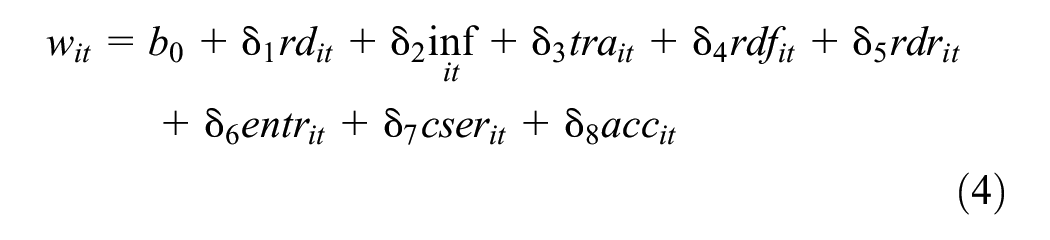

In equation (3),
Results
Analysis of Empirical Results
Based on the stochastic frontier model constructed above and the R&D innovation panel data, this paper uses R software to measure the efficiency of different types of human capital in innovation activities. During the analysis process, we judge whether the existing data are suitable for stochastic frontier analysis based on the value of gamma in the results of stochastic frontier analysis. The value range of this indicator is
Provincial Panel Data Regression Analysis with Technology Market Transaction Volume as The Dependent Variable.

Note. Statistical significance at 0.1%, 1%, and 5% levels is denoted by ***, **, and *, respectively.
From the table, it can be seen that the total investment in human capital represented by rdl is significantly positive, which is clearly in line with expectations, indicating that the investment in human capital still promotes innovation to a certain extent. Specifically, in addition to human capital in the financial industry, the p-values of scientific research and technical service human capital (rd), information human capital (inf), transportation human capital (tra), leasing and business service industry human capital (rdr), entrepreneurs (entr), and resident service industry human capital (cser) are all significant, and most of them are significant at the 1% level, indicating that the different types of human capital assumed in this article have a significant impact on innovation. The “Estimate” in Table 2 represents the mean ineffective rate. A positive sign indicates that the independent variable has a higher effect on the dependent variable than the ideal frontier value, indicating an effective state. A negative sign indicates that the independent variable has a lower effect on the dependent variable than the ideal frontier value, indicating an ineffective rate state. Specifically, the mean inefficiency rates of scientific research and technology services human capital (rd), information human capital (inf), transportation human capital (tra), financial human capital (rdf) and human capital in the accommodation and catering industry (acc) are negative, indicating that although these human capital have played a significant promoting role in innovation activities, their efficiency is not yet fully utilized compared to the ideal random frontier; The mean sign of the inefficiency rate of human capital in other sectors, such as leasing and business services (rdr), resident services (cser) and entrepreneurs (entr) is positive. Based on previous theoretical analysis, whether human capital is higher or lower than the forefront depends on whether this type of human capital has sufficient quality or quantity to support effective innovation collaboration with other human capital. This provides inspiration for explaining the “Solow paradox” in the field of innovation. If we only focus on improving the total amount of human capital without focusing on structure, it will lead to ineffective or inefficient innovation output.
Lag Effect Analysis
Considering the lag in the conversion of knowledge innovation into technology market transaction volume, which means that scientific research and development knowledge achievements generally cannot be quickly converted into commodity output value in the current year, we will refer to the practice of similar literature and analyze again with a three-year lag period (Table 3). The analysis considering the lag period shows that the significant fluctuations of most human capital are not significant, and the symbols are basically consistent with the results of previous econometric analysis, which to some extent verifies the credibility of the above empirical results. At the same time, it should also be noted that the significance of information human capital (inf) and resident service industry human capital (cser) has changed. This article believes that a possible explanation for this is that the role of human capital in innovation will change over time, and the role of human capital in different periods is dynamically changing. In addition, even the same type of human capital may have different roles in different types of innovation activities. For example, there may be differences in the role of information technology human capital (inf) in knowledge innovation and technology transformation activities. This article will further analyze this later.
Provincial Panel Data Regression Analysis with Technology Market Transaction Volume as the Dependent Variable (Three-Year Lag).

Note. Statistical significance at 0.1%, 1%, and 5% levels is denoted by ***, **, and *, respectively.
Supplementary Analysis
Distinguishing Innovation Types
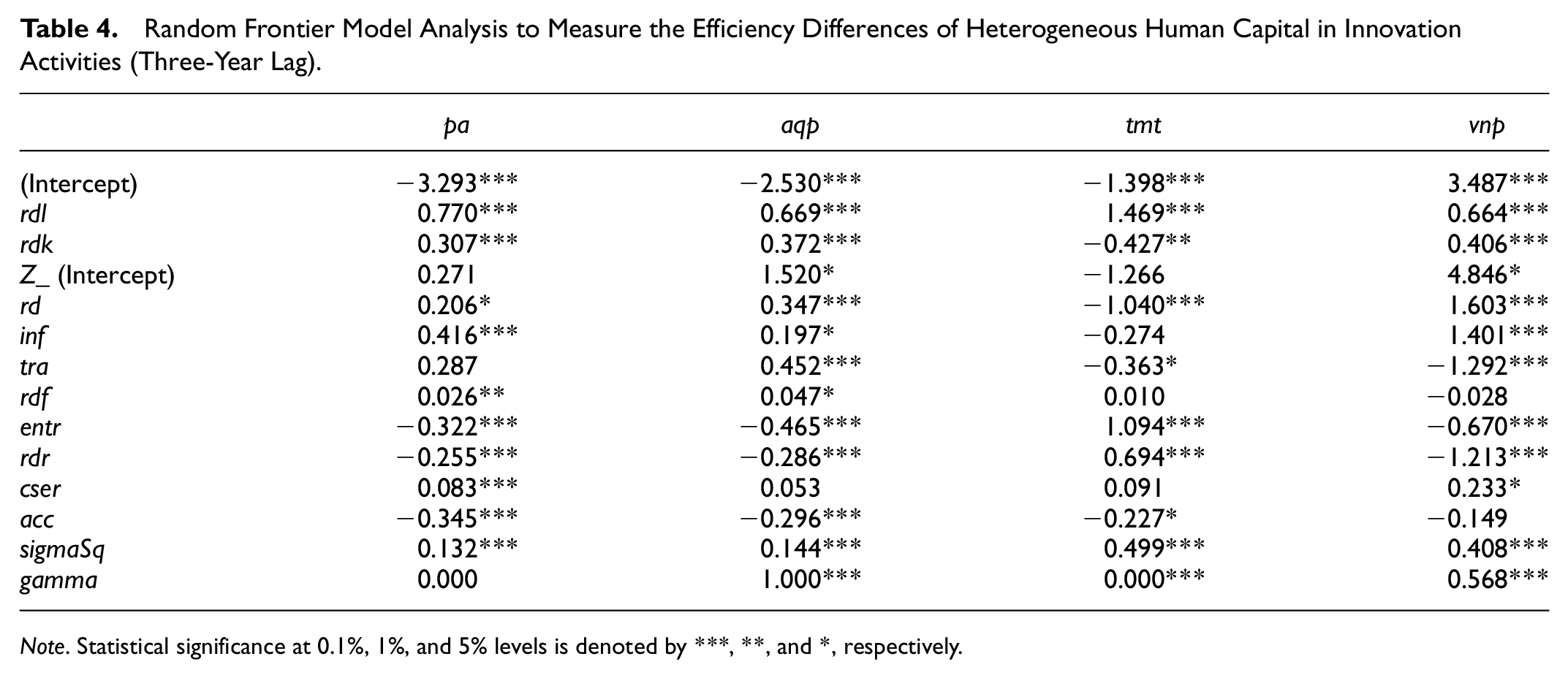
In order to reflect the efficiency difference of human capital in different types of innovation activities more truly and comprehensively, this paper replaces the dependent variable in the original model with four different indicators: the number of patent application (pa), the number of patent authorizations (aqp), the technology market turnover (tmt), and the output value of new products (vnp). According to the definition of China Statistical Yearbook, the number of patent applications refers to the number of patent applicants applying for invention patent certification nationwide, including the improvement of product performance and appearance, which reflects the vitality and effect of innovation activities represented by patents in the whole society. Patent authorization refers to the number of patents approved and authorized in China National Intellectual Property Administration, which reflects the effectiveness of patent innovation activities. Compared with the amount of patent applications, the amount of patent authorization implies the requirement of innovation quality, which is an innovative achievement with high value after government evaluation and screening. The technology market turnover is the transaction volume of the technology part of the total registered contract transactions, which reflects the transaction situation of a country’s innovation achievements in the technology market. The new product output value refers to the proportion of the output value realized by new products to the total industrial output value, which reflects the transformation of industrial innovation achievements. Compared with the technical market turnover, the value of the output value of new products goes further, involving the final sales result of innovative goods, rather than the technical sales result. Overall, this article believes that the number of patent applications and patent authorizations reflect the activity and quality of knowledge innovation, while the transaction volume of the technology market and the output value of new products represent the transaction situation and implementation effect of innovation achievement conversion, respectively. The results of regression analysis are shown in Table 4.
Random Frontier Model Analysis to Measure the Efficiency Differences of Heterogeneous Human Capital in Innovation Activities (Three-Year Lag).
Note. Statistical significance at 0.1%, 1%, and 5% levels is denoted by ***, **, and *, respectively.
Judging from the gamma value, there is no inefficiency in the stochastic frontier analysis with the number of patents granted (pa) and technology market turnover (tmt) as the dependent variables, and the OLS analysis can be directly adopted. Heterogeneous human capital inefficiency exists in the stochastic frontier analysis with the number of patents granted (aqp) and the value of new product (vnp) output as the dependent variables. This difference is determined by the different nature of innovation represented by the dependent variables.
From the overall situation of regression, the total investment in human capital represented by rdl has played a significant role in promoting all types of innovation, which proves that at the current stage, the input of human capital still plays a role in innovation. Specifically, in the innovation activities represented by the patent acceptance number (pa), scientific research and technology services human capital (rd), information human capital (inf), financial human capital (rdf) and human capital in residential service industry (cser) positively promote innovation, but entrepreneur (entr), human capital in the leasing and business services industry (rdr), human capital in the accommodation and catering industry (acc) has a negative impact on innovation. Among the innovation activities represented by the number of patents granted (aqp), scientific research and technology services human capital (rd), information human capital (inf), financial human capital (rdf) and transportation human capital (tra) both play a positive role in innovation efficiency, but entrepreneur (entr), human capital in the leasing and business services industry (rdr). There is inefficiency in human capital in the accommodation and catering industry (acc), which is the same height as the regression result where pa is the dependent variable. This means that such excessive investment of human capital does not better promote the growth of innovation. Instead of increasing the supply of human capital, efficiency should be improved in the innovation activities represented by technology market turnover (tmt), although Total investment in human capital (rdl) can also promote innovation, total physical capital investment (rdk) shows a significant negative correlation. That is to say, the accumulation of material capital alone has been unable to achieve good results. The investment of human capital should also pay more attention to optimize the structure and increase the investment of entrepreneur (entr), human capital in the leasing and business services industry (rdr). In the innovation activities represented by the value of new product value (vnp), Scientific research and technology services human capital (rd) and information human capital (inf) both play a significant role in promoting innovation, and have efficiency. However, entrepreneur, transportation human capital (tra), human capital in the leasing and business services industry (rdr) all exists the situation of inefficiency, which restricts the improvement of the overall innovation efficiency. From the above analysis, it can be found that different types of innovation activities have different demands on human capital structure, but there are some inefficiencies of human capital in general, which restricts the efficiency of “human capital input-innovation output.”
Distinguishing Area Types
Based on the previous data as well as the model, the paper continues with a further analysis of the efficiency of human capital innovation in different Regions of East, Central, and West China to observe the performance of different types of human capital in each region of China. As shown in Table 5, it appears that overall, the eastern and western regions have significant stochastic frontier problems, while the central region has insignificant stochastic frontier problems. The gamma values derived from the model regression for the central region show that all deviations relative to the production frontier in this region are basically caused by stochastic noise. The corresponding values for the Eastern and Western regions are 1 and 0.964, respectively, which perform well relative to the stochastic frontier analysis and validate the high model fit. From the results, the estimated values of rdl indicate that human capital inputs of innovation play a significant role in driving innovation activities in both East and West. However, the total physical capital investment represented by rdk is negative in eastern and western China, which indicates that for the current stage of innovation in China, the accumulation of physical capital alone does not necessarily lead to improved innovation outcomes, but rather inhibits innovation to a certain extent. The explanation given by the theory of human capital agglomeration is that human capital input beyond the carrying capacity of local living and scientific research infrastructure will cause negative talent agglomeration effect, resulting in the decline of marginal productivity, and ultimately reduce the production capacity of individual human capital. The final result is that more human capital is invested, but it actually has the opposite effect of inhibiting innovation, which Lu Ming calls the “erosion effect” of human capital. This result also responds to the paper’s hypothesis that there is a certain structural nature of human capital, and that focusing only on human capital input but not on structure may lead to a broken chain of talent in the innovation process, which affects the final total output and limits the efficiency of human capital output in the dominant link. This hypothesis will be more verified from the subsequent analysis of the empirical results.
Comparative Analysis of Heterogeneous Human Capital Innovation Efficiency Differences in Eastern, Central, and Western Regions of China.

Note. Statistical significance at 0.1%, 1%, and 5% levels is denoted by ***, **, and *, respectively.
In the eastern region, the key roles are played by scientific research and technology services human capital (rd), information human capital (inf), transportation human capital (tra), financial human capital (rdf), entrepreneurial human capital (enhtrth), and living service human capital in the category of accommodation and catering (acc). In terms of the innovation efficiency of a certain category of human capital, the research human capital (rd) directly involved in innovation shows a significant inefficiency of production frontier, which indicates that the increase of research human capital (rd) in the eastern region won’t further enhance the efficiency of innovation. The efficiency coefficients of transportation human capital (tra) and human capital in the accommodation and catering industry (acc) were −1.204 and −0.627, respectively. It also shows that the efficiency of these two types of human capital is lower than the average efficiency frontier. The symbols of information human capital (inf) and entrepreneur (entr) are positive and significant, indicating that increasing the input of this kind of human capital in the eastern region can still better improve the innovation efficiency. This paper argues that the eastern region possesses abundant total human capital and more adequate collaboration between different types of human capital, which can be seen from the more significant results, but at the same time shows a more obvious structural human capital problem, where the lack of quantity or low quality of a certain type of key human capital for innovation also makes it difficult for other human capital that relies on such human capital to cooperate fully, finally affecting the efficiency of innovative collaboration.
In the central region, the impact of scientific research and technology services human capital (rd) and entrepreneur (entr) on innovation is significantly negative. Contrary to this, the impact of financial human capital (rdf) and human capital in the leasing and business services industry (rdr) is significantly negative. To a certain extent, this reflects the difficulties in the transformation of innovation achievements in the central region. On the one hand, there is a relative surplus of human capital for scientific and technological research and development, and on the other hand, there are insufficient financial services and business services required for the transformation of scientific and technological achievements, which restricts the release of entrepreneurial capabilities.
In the western region, the human capital that plays a key role in innovation is not as diverse as in the eastern region, and only information human capital, entrepreneurial human capital, and human capital in leasing and business services have a significant impact on innovation. Among them, it should be noted that the estimated inefficiency coefficient of information human capital (inf) is negative in the western region, which is deviated from the expectation. This paper holds that in order to give full play to the role of information human capital in promoting innovation, it is necessary to combine information human capital with the corresponding information infrastructure construction, or realize the high coordination between information human capital and other types of human capital in innovation activities, otherwise there will be low efficiency.
Discussion
Although the research on the relationship between human capital structure and innovation has attracted extensive attention from scholars, neither theoretical mechanism analysis nor empirical analysis has been able to provide a convincing explanation for the discrepancy between human capital input and innovation output. To help advance this discussion, this paper combines the innovation value chain theory (Hansen & Birkinshaw, 2007) and the flow space theory (Castells, 2009), arguing that innovation in the information age is a highly collaborative organizational behavior of multiple types of human capital. These human capital include scientist human capital, information human capital, transportation human capital, business service human capital and entrepreneur human capital. The absence or low efficiency of any kind of human capital node will affect the improvement of the overall innovation efficiency. In order to verify the above hypothesis, based on the theoretical model framework of Battese and Coelli (1995), this paper adopts the stochastic frontier model considering the heterogeneity of human capital to verify the effects of various types of human capital on the improvement of innovation efficiency. The preliminary analysis results show that, except for the human capital of financial industry, the p-value of other types of human capital is significant, which indicates that the different types of human capital assumed in this paper have a significant influence on innovation. After distinguishing the types of innovation activities, we conducted further analysis and found that all kinds of human capital have different performance in knowledge innovation, technological innovation and the output value of innovation. We conclude that the roles and efficiency of human capital of scientists, information human capital, transportation human capital, business service human capital and entrepreneur human capital are not the same in different natures of innovation activities, which affects the release of the innovation’s overall efficiency.
Theoretical Significance
This study contributes to the research of human capital on innovation in the following aspects. First of all, this study enriches the theoretical research on the mechanism of human capital promoting innovation in the information age. It provides a new insight to explain the imbalance between human capital input and innovation output. In existing studies, researchers have put forward explanations from human capital, technological progress, infrastructure and other perspectives, but the conclusions are often contradictory. For example, in the research on infrastructure, Bhatt et al. (2010) and Barczak et al. (2008) have pointed out that there is no direct relationship between information technology progress and innovation. Gao et al. (2020), Q. Yu (2017), and other scholars believe that high-speed rail accelerates the competition of production factors in different regions and forms a zero economic effect at the national level. These studies are in stark contrast to the pro-camp views. However, these studies also bring important inspirations to this paper. We begin with the structure of human capital, examine the relationship between various types of human capital and innovation, and arrive at a unique explanation for innovation’s low efficiency.
Secondly, based on the theory of innovation value and flow space, this study defines the connotation of innovative human capital structure in the information age. Why is statistically capturing the human contribution to innovation a difficult challenge (Global Innovation Index Report: Wunsch et al., 2014)? This is mainly because in practice, human capital as intangible capital is difficult to measure, and innovation is also affected by many factors (Martinidis et al., 2021). Existing studies classify human capital according to the standards of skill level and educational background. Although it is easy to cause controversy due to the lack of a solid theoretical basis, it also inspires this paper to adopt a structuralist perspective. In addition, a mature innovation process should determine the task objectives of each innovation stage, including the knowledge innovation stage and the knowledge commercialization stage, so as to promote the smooth transformation of knowledge into the final marketable commodities (Desouza et al., 2009). Therefore, the human capital structure set in this paper not only includes the human capital of scientists, but also includes the human capital of scientists. It also includes human capital related to finance and business, and takes into account the impact of technological progress, including human capital of information and human capital of transportation. Compared to existing research that focuses on organizational innovation, this study expands the theoretical connotation of human capital structure on a macro level, echoing the research of the National innovation system (Granstrand & Holgersson, 2020).
Finally, by distinguishing the nature of innovation activities, this study reveals the difference of the influence of human capital structure on different types of innovation activities. In the existing research, what kind of indicators should be used to measure innovation has always been highly concerned, as it is related to what theoretical perspective we adopt to explain the nature of innovation. Thesis is still used today as one of the main indicators to measure knowledge innovation (Dong et al., 2020; J. Wang & Cai, 2020). A better alternative is to use patent data (Acemoglu et al., 2018; Griliches, 1990), but it must be acknowledged that the patent indicator is also flawed in reflecting market value, which can only partially reflect innovation (Cui & Tang, 2022). Based on previous research and data availability, this paper selects four indexes; namely, the number of patent acceptance, the number of patent authorizations, and the transaction amount of the technology market, and the output value of new products, to represent different types of innovation activities. In addition to being a type of index update, it is also a type of theoretical innovation that maps the quantity and quality of knowledge innovation accomplishments, as well as the national market level and enterprise level of market trading vitality and technological innovation vitality.
Practical Significance
After considering the structure of human capital, it can be found that, as a developing country, different types of human capital have different effects on innovation. Overall, both scientific research human capital and information human capital play a role in fostering innovation, but inefficiency is also glaringly apparent. Entrepreneur and business service human capital play an obvious and efficient role in both knowledge innovation and technology innovation. In addition, the role of other human capital is vague and uncertain due to the different nature of innovation. The empirical results of different regions show that the current Chinese innovation is still in the stage of material capital promotion, that is, it relies on the increase of material capital investment to achieve the improvement of innovation ability, but the structure of human capital is not paid enough attention to, resulting in more human capital input, but will have an inhibitory effect on innovation. The policy implication is that there is a large interval difference in the human capital demand of innovation activities in eastern, central and western China, and differentiated innovation policies should be adopted. For the eastern region, it should make up for the shortcomings of information human capital and entrepreneur in order to give full play to its human capital advantages. For the central region, it should do a good job in innovation-related financial services and other business services, and cultivate relevant human capital to promote the landing of scientific and technological achievements. For the western region, in addition to giving full play to the role of entrepreneurs and business human capital, the coupling of information human capital and infrastructure should be strengthened to stimulate the role of information elements in promoting innovation.
Limitations and Future Research Direction
During the analysis, it can be found that similar human capital plays different roles in different regions or plays a significant role in innovation but is in an inefficient state. This paper estimates that this may be because human capital affects innovation not only through its structural state, but also through the quantitative state. Specifically, in innovation activities, information human capital or transportation human capital plays a similar role as a threshold for other types of human capital. When their total amount fails to reach the threshold value, scientist human capital and other human capital cannot give full play to their efficiency, and even hinder innovation (He et al., 2022). Similar studies mainly measure the impact of information infrastructure or transportation infrastructure on regional economy (Mugabe et al., 2022), such as pointing out that there is an inverted U-shaped curve relationship between infrastructure and regional economy (Corea, 2007). But at present, there is no research on innovation efficiency with certain kind of human capital as the threshold. This paper needs to supplement, which also provides the direction for further research. Second, as a developing country, China has prioritized to the quality of its development, calling for high-quality development in all aspects of its economy and society. In such a realistic context, what impact will the differences in the quality of all kinds of human capital have on innovation? It can also bring strong practical enlightenment. Third, although information infrastructure and transportation infrastructure are the results of technological progress, the mechanism of promoting innovation may also differ due to the difference in the nature of technology. For innovation activities, is the relationship between these two kinds of infrastructure a substitute or a complementary relationship? What effect this relationship has on innovation human capital, and also the efficiency of innovation input and output is worth further discussion. Finally, in order to better reflect the difference in innovation effect, this paper comprehensively considers the three types of innovation. The data used involves a wide range, and the release is relatively delayed, but it does not affect the conclusion of the core research. Meanwhile, this paper also adopts the data related to infrastructure as the robustness test.
Footnotes
Author Contributions
Wei Li: Conception or design of the work, fund acquisition, Empirical analysis, and final approval to be published. Yuanxiang Peng: Literature writing and editing, data collection. Jingjing Yang: Data analysis and interpretations. Md Sazzad Hossain: Methodology (data preparation and screening) and conclusion.
Declaration of Conflicting Interests
The author(s) declared no potential conflicts of interest with respect to the research, authorship, and/or publication of this article.
Funding
The author(s) disclosed receipt of the following financial support for the research, authorship, and/or publication of this article: This research was funded by Qingdao’s Philosophy and Social Science Planning Project (QDSKL2201394), the Social Science Federation Humanities, and the Social Science Project of Shandong (2023-ZKZD-062) in China.
Data Availability Statement
All data, models, or code generated or used during the study are available from the corresponding author by request.
