




Abstract
Mobile payment has evolved over time and its adoption and usage have proliferated in the new normal subsequent to the COVID-19 pandemic. This study aims to (1) evaluate the performance and (2) map the body of knowledge in order to (3) chart the avenues to advance mobile payment research in the new normal. To achieve its aims, this study adopts and implements a bibliometric methodology on a corpus of 455 publications retrieved from the Web of Science to provide a retrospective and a prospective of mobile payment research. Using performance analysis, this study unpacks the productivity and impact of the contributors (i.e., journals, articles, authors, countries, and institutions) to mobile payment research. Using science mapping, this study reveals the foundational themes and topical trajectories in the extant literature dedicated to mobile payment research. The findings from the performance analysis and science mapping are subsequently used to inform the agenda for future research on mobile payment.
Introduction
The coronavirus disease 2019 (COVID-19) pandemic has affected most, if not all, economies and societies around the world. Though lockdowns were initially imposed in an attempt to curb the spread of the pandemic (Lim, Kaur, & Cheong, 2022; Lim & To, 2021), the world quickly recognized that both economic and public health are equally important and thus moved at an accelerated pace in its digital transformation of economic and social activities (Lim, 2021).
Of particular interest in this paper is mobile payment, whose adoption and usage have proliferated (Kumar et al., 2022), especially in the new normal emerging from the COVID-19 pandemic. In essence, mobile payment refers to payment services performed through in-store and remote payment technologies such as mobile wallets (m-wallet) and quick response (QR) codes (Liébana-Cabanillas, Ramos de Luna, & Montoro-Ríos, 2015). Specifically, m-wallets facilitate the storage of money and allow users to make payments directly from that money, whereas QR codes function through banking apps or store apps and are integrated with the debit/credit details (Madan & Yadav, 2016; Singh et al., 2017).
Concerns of contracting the virus by touching currency and coins have stimulated a preference for mobile payments over “dirty money” (Gardner, 2020). It is now viewed as an alternate and evolved mode of payment over traditional mediums like cash and cheque (Liébana-Cabanillas et al., 2018). Retailers, along with the other service providers, are also encouraging buyers to pay using their mobile devices, a phenomenon that will only increase mobile payment usage (Pandey & Pal, 2020). Amidst these developments, the scope and utility of mobile payments is increasingly growing. Even governments are now relying on mobile payments for transferring financial assistance in normal circumstances or extending relief during crises (e.g., Government of Malaysia via Boost and GrabPay) (Lim, Kaur, & Cheong, 2022). As the demand for cashless and digital transactions have surged, the attitudes toward mobile payments and the adoption of such payments have been encouraging (Alalwan et al., 2017). More often than not, buyers opt for technology that offers convenient, quick, and valuable services on a single platform (Singh et al., 2020), wherein mobile payment services rely on advanced cross-functional technology involving these features (Abhishek & Hemchand, 2016; Thakur & Srivastava, 2014). Largely, there has been a consensus among experts that traditional payment methods, both cash and debit/credit, are on the decline, which has prompted more banks, retailers, and network operators to offer mobile-based services to their consumers (Shrier et al., 2016).
As a developing field, having links and integration with new technologies and user behavior, mobile payment requires a more holistic, in-depth outlook. The available literature and empirical studies largely focus on the initial adoption of mobile payment (Liébana-Cabanillas, Muñoz-Leiva, & Sánchez-Fernández, 2015; Liébana-Cabanillas, Ramos de Luna, & Montoro-Ríos, 2015; Slade et al., 2014) or its continued use (J. Lu et al., 2017; Zhou, 2011). Notwithstanding the contributions of existing studies on mobile payment, there is a need to evaluate the performance and state of the field in order to chart its future progress, especially in light of the changes resulting from the COVID-19 pandemic. Noteworthily, there is a need to ascertain the major contributors and streams of research in the body of knowledge on mobile payment, which would then enable the objective detection of extant gaps and the informed curation of ways forward for the field (Lim et al., 2022).
Moreover, despite being a new and emerging technology, mobile payment is continuously evolving in different spheres. In addition to using mobile devices for contactless payments, wearable payment technology that is, payment through fashion accessories is gaining popularity (Loh, Lee, Tan, et al., 2022). Similarly, facial recognition payments is becoming popular and is being explored in terms of users willingness to use (Zhang & Kang, 2019), user resistance to use (A. Liu et al., 2022) and its advantages and disadvantages (Agarwal & Prasad, 1998). Still, the discussions around future development trend of intersection in mobile payment, wearable payment and facial recognitions payment technologies these emerging trends in mobile payments needs deeper insights and bibliometric analysis will help in understanding those trends.
Therefore, the aim of bibliometric analysis is to map the progress in mobile payment research and dwell on the following research gaps. The studies in this area has largely been limited to adoption and users’ behavioral intentions (Liébana-Cabanillas et al. (2014). Meanwhile, due to new, and emerging technologies, the area has expanded and became more complex. Therefore, it requires understanding beyond adoption to get the more comprehensive perspective. The paper also addresses the gap in theoretical frameworks employed to study mobile payments. The area is largely dominated with empirical studies (Abdullah & Naved Khan, 2021) and generally see through the lens of information systems. Therefore, for better understanding it is imperative to broaden mobile payment research by focusing on qualitative studies and using multidisciplinary theoretical frameworks. Another area which this paper highlights is the need to follow the mobile payments post Covid world. The payment system evolved during the pandemic (Gardner, 2020) and this evolution needs scholarly attention. It is intriguing to see how mobile payments is shaping up as the Covid is waning and countries resuming travel and economies started functioning just like in pre-pandemic era. Finally, the paper also draws its attention on the gap pertaining to study of mobile payments in different contexts and cultures. Many countries are embracing this phenomenon and there is need to understand how culture influences m-payments. The studies in this area is limited to few countries (Chung & Holdsworth, 2012) and requires more cross-country studies.
This paper adopts a bibliometric methodology to review the extant literature on mobile payment. Unlike alternative review methods (e.g., framework, narrative/thematic), the bibliometric method is a highly objective method for reviewing the literature due to its reliance on quantitative techniques to assess the performance and map the science in the field (Donthu, Kumar, Mukherjee, et al., 2021). Noteworthily, a bibliometric analysis can provide vital insights to determine the direction and intensity of research in the field (Bartoli & Medvet, 2014) by mapping the evolution of research and assess the field’s trends and development (Gaviria-Marin et al., 2019). Taking a leaf out of past studies, this paper explores five research questions that are typically raised and answered through bibliometric studies:
The rest of the paper is structured as follows. Section 2 deals with the theoretical background and explains mobile payment systems, m-wallets, and their importance. Section 3 discloses the methodology that guide the present review. Section 4 presents the results of the review and Section 5 concludes the paper, underlining issues that may form the basis for future research.
Literature Review
Definition of Mobile Payment
Mobile payment is often mediated through mobile applications that can be downloaded on Android and iOS devices through which users can pay and receive money and perform other financial transactions. Generally, one needs a credit/debit card to link with a mobile payment account in order to carry out these transactions (Y. Wang et al., 2016). Schierz et al. (2010) define mobile payment as purchases that are set off and processed through a mobile phone. Similarly, Isaac and Zeadally (2014) present mobile payment as a system that allows users to perform financial transactions through their mobile devices in ways that are safe, uncomplicated, and handy. Dahlberg et al. (2008) view mobile payment as a process that takes place using a mobile device or a tablet using wireless communication technologies. Similarly, J. Wang and Lai (2020) argue that m-payment is a “two-sided platform” that facilitates delivering of payments services for mobile devices. Humbani and Wiese (2019) conceptualize mobile payment as a method that uses an app-enabled mobile phone in lieu of a cheque, a bank card, or cash to pay for goods and services. Liébana-Cabanillas et al. (2017) describe mobile payment as a technological innovation that has brought more convenience to users. According to Liao and Yang (2020), mobile payment is a mechanism used for performing financial transactions using mobile device or computing device. Meanwhile, mobile payment also facilitates users to transact remotely including international transfers of money (Thuita, 2020). Similarly, Purohit et al. (2022) described mobile payments as an emerging technology that has enabled online transactions quickly and easily from anyplace and at time. Therefore, mobile payment, when viewed holistically, can be comprehensively defined as a contemporary system that leverages on mobile devices (e.g., smartphone, tablet) and wireless technologies (e.g., QR code, Internet) to facilitate electronic monetary transactions (e.g., payment, top-up) among users (e.g., buyers and sellers of goods and services), thereby providing an alternative to traditional, non-mobile payment systems (e.g., physical or purely electronic but non-mobile cash and credit transactions).
Contributions and Limitations of Existing Reviews on Mobile Payment
In the past, only a few scholars focused on the critical review of mobile payment research. They presented the emerging trends and showcased how mobile payment is evolving. Dahlberg et al. (2015) examined the progress made in the field up to 2014 through a systematic literature review, where they assessed 188 articles and provided a comprehensive comparative analysis of studies published before and after 2007. They observed that most studies repeated existing work, and little progress was made in terms of theoretical contributions. However, their study focused largely on thematic representation and lacked other important dimensions like network analysis and the use of new tools such as Gephi and VOSviewer to examine relationships between topics in the field. The aforementioned gap was filled in Ramtiyal et al.’s (2021) study, in which they used co-citation analysis and social network analysis to review the literature on mobile payment up to 2017. They obtained 406 articles and 3,424 citation from Web of Knowledge and used keywords such as “mobile payment services,”“m-payment,” and “wireless payment” to extract articles from the database. Authors identified seven key areas where mobile payment research is evolving: (1) adoption and usage; (2) trust, risk, and security; (3) application; (4) scheme; (5) protocol; (6) architecture; and (7) mobile payment corporation. However, their study did not include essential keywords such as “m-wallet” and “mobile payment,” which might have resulted in the exclusion of relevant articles. With rapid growth in the area, these keywords are crucial to draw concrete conclusions. Additionally, the study was published in 2020 and therefore could not cover the surge in mobile payment caused by the COVID-19 pandemic. Though Abdullah and Naved Khan (2021) recently attempted to address this new gap by conducting a bibliometric analysis and on mobile payment adoption by reviewing 56 articles from 2005 to 2020, which found that quantitative research dominated the literature and observed a lack of studies on merchant adoption of m-payment, their study remain limited in terms of its review corpus (i.e., small set of articles). Given the limitations in timeliness, scope, and size of the review corpus in existing reviews on mobile payment, the present review is therefore warranted to provide a more comprehensive and inclusive retrospection of the field in line with the reasons stipulated by Paul and Bhukya (2021) and Lim et al. (2022) for justifying the need for new reviews of a given field.
Methodology
Review Method
This study adopts a bibliometric approach to review the extant literature on mobile payment.
The bibliometric method for review originated from the field of library and information sciences, involving a process in which the bibliographic data of the extant literature is retrieved and reviewed in quantitative fashion by employing statistical methods (Broadus, 1987; Pritchard, 1969). Using bibliometric methods, scholars can explore multiple dimensions of the field (Hota et al., 2020), helping them to develop an overarching understanding of that field (Bar-Ilan, 2008). Specifically, a bibliometric analysis consists of a performance analysis, which explores the productivity (e.g., publications) and impact (e.g., citations) of research (e.g., journals, articles) and research constituents (e.g., authors, countries, institutions), and a science mapping, which reveals the foundational themes and topical trajectories that transpire in the body of knowledge in the field (Kessler, 1963). Noteworthily, according to Kessler (1963), in any academic work, patterns of referencing and similar origin of sources indicate the similarity of scholarly ideas. Similarly, Small (1973) postulates that frequent citation of references from one study to an another reveals a theoretical and scholarly relationship between the citing and cited documents. Concepts frequently discussed in bibliometric literature include co-authorship, which focuses on the authorship pattern among collaborating scholars (Koseoglu, 2016), and co-occurrence, which refers to regular occurrence of bibliographic data (e.g., keywords) revealing scholarly similarity in the literature (Cheng et al., 2018). More importantly, after processing when results are presented jointly in a structured manner, a review using the bibliometric approach can provide a comprehensive view of the growth and development of research in the field (Ramos-Rodríguez & Ruíz-Navarro, 2004), which can then serve as a basis for curating an agenda to advance that field.
Review Procedure
This study adopts a three-stage procedure to review the extant literature on mobile payment, which is illustrated in Figure 1.
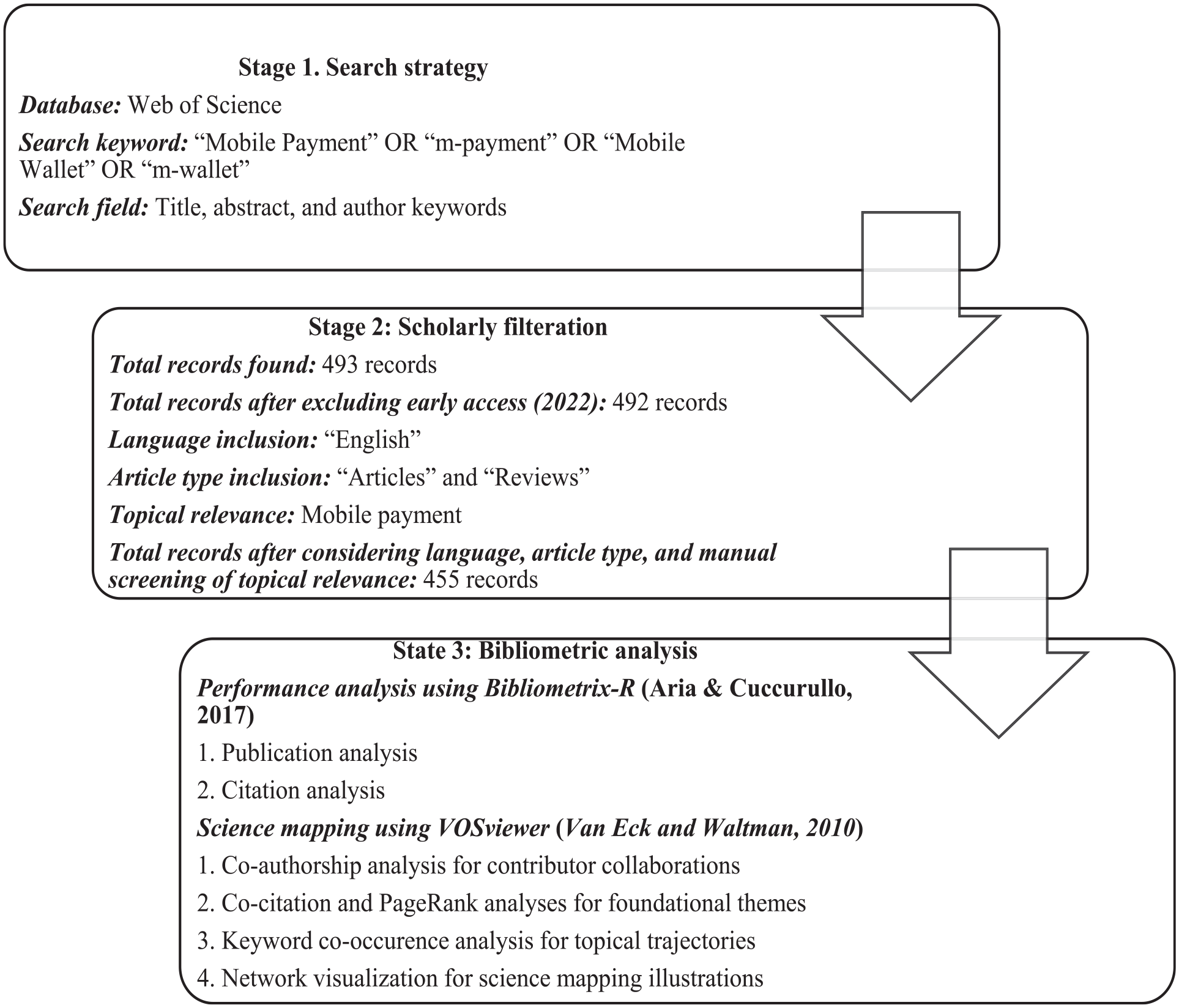
Bibliometric data mining and analysis strategy.
The First Stage is Search Strategy
The bibliographic data used in this review is mined from the Web of Science, which is an established database widely used by scholars for scientific research (Adriaanse & Rensleigh, 2013). The use of multiple databases (e.g., Scopus and Web of Science simultaneously) is not encouraged to avoid potential errors arising from duplications—thus, using either one of the established databases for scientific research is considered sufficient (Paul & Bhukya, 2021). Noteworthily, the data for this review was mined on October 22, 2021, and it includes all articles and reviews up to when the date query was run to extract bibliographic data. The search keywords were curated and agreed upon in a brainstorming session among experts on mobile payment—the keywords “mobile payment,”“m-payment,”“mobile wallet,” and “m-wallet” were searched in the “title, abstract, and author keywords” field in the Web of Science.
The second stage is scholarly filtration. The search strategy, which revealed 493 records, were filtered using several scholarly criteria—namely exclusion of early access records, non-English records, and non-article and non-review records. A manual screening was also performed to eliminate records that did not fit the purpose of this study. Using these filtration criteria, a total of 455 records were obtained and deemed suitable to progress to the next stage.
The third stage is bibliometric analysis. The performance analysis of the bibliographic data of the 455 records on mobile payment was performed using the Bibliometrix-R software (Aria & Cuccurullo, 2017), and the science mapping of the same data was performed using the VOSviewer software (van Eck & Waltman, 2010). The areas covered in the analysis are guided by the research questions, and thus, include publication and citation trends of journals, articles, authors, countries, and institutions (performance analysis), as well as the foundational themes and topical trajectories on mobile payment research (science mapping).
Results and Discussion
The bibliographic data collected from the Web of Science indicates that the first paper on mobile payment was published in 2002, and a total of 493 publications have been contributed to the body of knowledge in the field. After filtering the results to include only relevant articles and reviews published in English, the study ended up with a total of 455 publications for this review. The next sections offer the analysis of these publications considering their different bibliometric attributes related to mobile payments.
Performance Analysis of Mobile Payment Research
Publication Productivity of Mobile Payment Research (RQ1)
Out of the 455 total publications examined in the field of mobile payment, 447 are conceptual and empirical articles and eight are reviews. The first publication in the field was Kreyer et al. (2002) article, “Standardized payment procedures as key enabling factor for mobile commerce,” published in 2002. Only 14.6% of publications in the field were published in the first decade (2000–2010) of mobile payment research, while the remaining 85.4% were published in the second decade (Table 1). The last 5 years have been very productive for the field, contributing 65.8% of the publications. Due to the COVID-19 pandemic, scholars have given mobile payments significant attention in the last 2 years; 38% of the total publications were published during this time period. Overall, there has been an increasing trend in the growth of publications on mobile payment research (Figure 2).
Publication Statistics of Mobile Payment Research.

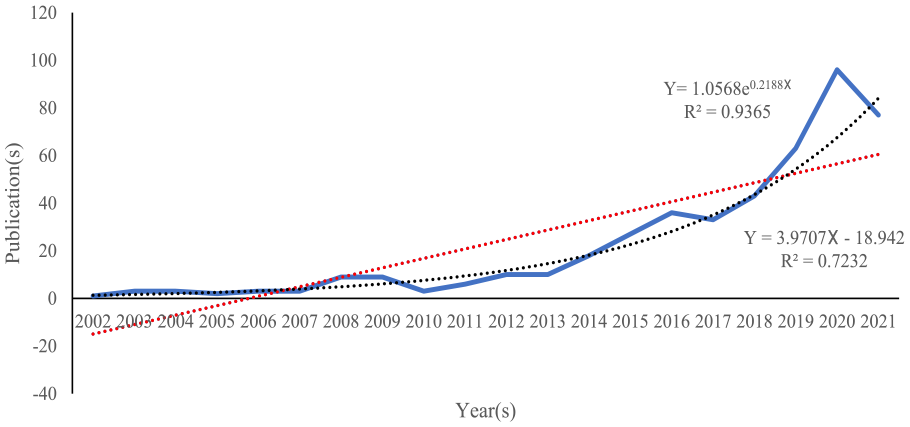
Publication trend of mobile payment research.
Publication Impact of Mobile Payment Research (RQ1)
Citations are an established measure used to understand the impact of research published in the field (Baker et al., 2021). Most citations were received by Kim et al. (2010) article, “An empirical examination of factors influencing the intention to use mobile payment,” followed by Schierz et al. (2010) article “Understanding consumer acceptance of mobile payment services: An empirical analysis,” and Mallat’s (2007) article “Exploring consumer adoption of mobile payments—A qualitative study” (Table 2). These studies concentrate on understanding the factors influencing the adoption of mobile payment among consumers—the former two using a quantitative approach and the latter using a qualitative approach.
Most Cited Publications.

Most Prominent Journals for Mobile Payment Research (RQ2)
The reputation of a journal within its field has an impact on the citation power of the publications in that journal. In the case of mobile payment, scholars have published in journals across different disciplines (e.g., bank marketing, e-commerce, electronic finance, mobile information systems, and wireless and mobile communications).
The journal-wise distribution of publications (Table 3) indicates that Electronic Commerce Research and Applications is the most highly preferred destination for scholars to publish their research on mobile payment (22 publications). The International Journal of Bank Marketing and Journal of Retailing and Consumer Services (16 publications each), along with Sustainability (15 publications), are also popular choices. All the journals are peer reviewed leading journals and rank high in their indexed databases. This indicates that research on mobile payment is getting accepted by top-tier journals.
Most Prominent Journals for Mobile Payment Research.

Note. TP = total publications; TC = total citations; Start PY = starting year of publishing mobile payment research; ABDC = Australian Business Deans Council; CABS = Charted Association of Business School.
Bradford’s law (Bradford, 1934) was used to understand the concentration and dispersion factor of the publication patterns and most productive nucleus in mobile payment research. The law posits that a small nucleus of journals covers a larger proportion while a larger nucleus of journals covers a smaller proportion of publications in the discipline (Alvarado, 2016). As per Bradford’s law, the publications are divided into three zones: Core, Zone 1, and Zone 2. The numbers of journals in Zone 1 and Zone 2 are n and n2 times larger than the core journals, respectively. The ratio among Core, Zone 1, and Zone 2 is 1: n: n2. The articles falling in the Core have a comparatively high concentration of publications, whereas those in the surrounding areas (Zone 1 and Zone 2) are becoming increasingly dispersed. As a result, we can see that the proportion of articles in journals is unequal. A large number of articles can be found in a few journals. If this trend continues, it indicates that the particular field of research is dominated by few research journals which are preferred by most of researchers to publish their work in this field.
The analysis of journals on mobile payment research using Bradford’s law (Table 4 and Figure 3) shows a Core nucleus of 11 (5.8% of total) journals catering to 152 (33.4%) publications. Zone 1 includes 47 (24.6% of total) journals covering 153 (33.6%) publications, and Zone 2 includes 133 (69.6% of total) journals covering only 150 publications (33%). This shows that there is a concentration of publications in the core and indicates unequal dispersion of publications across journals. A small number of journals are preferred for mobile payment research, publishing a large proportion of studies from the field.
Publication Dispersion Zones of Mobile Payment Research Under Bradford’s Law.


Dispersion of mobile payment research in Bradford rings.
Most Prominent Authors Contributing to Mobile Payment Research (RQ3)
A total of 1,145 authors have contributed to mobile payment research. Out of this total, 936 authors (81.7%) have published only one publication, while 140 authors (12.2%) have published two publications. The 33, 17, 6, 5, and 3 authors have contributed 3, 4, 5, 6, and 7 articles respectively. There are five authors who have respectively contributed 17, 12, 11, 9, and 8 articles in the field of mobile payment research. This indicates that mobile payment research is at the nascent stage and largely contributed by only a few scholars (Table 5).
Author Productivity of Mobile Payment Research.

Out of the 1,145 authors of mobile payment research, the most productive author is F. Libana-Cabanillas from the University of Granada in Spain, who has contributed 16 publications since 2014, receiving 624 citations and an h-index of 10 (Table 6). Following F. Libana-Cabanillas, G.W.H. Tan (10 publications) and K.B. Ooi (nine publications) have received 714 and 733 citations, respectively. Since no author in the field has an h-index above 20, it can be concluded that no author has decisive influence on mobile payment research, and the field can still be considered in the precursor stage of research.
Author Impact for Mobile Payment Research.

Note. TP = total publications; TC = total citations; Start PY = starting year of publishing mobile payment research.
Using a co-authorship analysis to understand collaboration patterns, the results indicate that G.W.H. Tan and K.B. Ooi have collaborated the most, with nine co-authored publications (Table 7). This pair is followed by X. Gong and K.Z.K. Zhang with six co-authored publications. In addition to K.Z.K. Zhang, X. Gong has also collaborated with C.M.K. Cheung, C. Chen, and M.K.O. Lee.
Author Collaboration in Mobile Payment Research.

Most Prominent Countries Contributing to Mobile Payment Research (RQ3)
The co-authorship network of countries involved in mobile payment research was analyzed using VOSviewer. The analysis reveals the major co-authorship networks within mobile payment research. The USA is at the center of the first major country collaboration network (purple), collaborating with Spain, Switzerland, Malaysia, Romania, Turkey, and Portugal (Figure 4). The second major country collaboration network (light blue) is driven by China, collaborating with Korea and Japan. India is at the center of the third major country collaboration network (blue), collaborating with the UK and Norway. Upon detailed scrutiny, the distribution of publications on mobile payment research by country (Figure 5) shows that China has contributed the most publications (n = 169, 35%), followed by the USA (n = 47, 9.75%), Korea (n = 38, 7.9%), and India (n = 28, 5.8%).

Co-authorship network of countries for mobile payment research.

Publication(s) on mobile payment research by country.
Most Prominent Institutions Contributing to Mobile Payment Research (RQ3)
The distribution of publications by institution (Table 8) shows that the University of Granada in Spain has contributed the most publications (36 publications) on mobile payment research, followed by University Tunku Abdul Rahman in Malaysia (18 publications), Xi’an Jiaotong University in China (15 publications), and Hangzhou Dianzi University (13 publications) and Zhejiang University (13 publications) in China. Noteworthily, institutions in Asia appear to be the most prolific contributors to mobile payment research.
Institution Productivity of Mobile Payment Research.

Science Mapping of Mobile Payment Research
The body of knowledge on mobile payment is scrutinized using co-citation and PageRank analyses as well as keyword co-occurrence analysis. Noteworthily, co-citation analysis is employed to unpack the foundational themes in mobile payment research, PageRank analysis is leveraged to identify the top publications for each foundational theme, and keyword co-occurrence analysis is used to reveal the trajectory of topical evolution of research in the field (Donthu, Kumar, Mukherjee, et al., 2021).
Foundational Themes in Mobile Payment Research (RQ4)
The co-citation network of leading publications revealed three knowledge clusters representing the three foundational themes of mobile payment research (Figure 6). The top 10 publications for each knowledge cluster were selected based on their PageRank (Table 9).
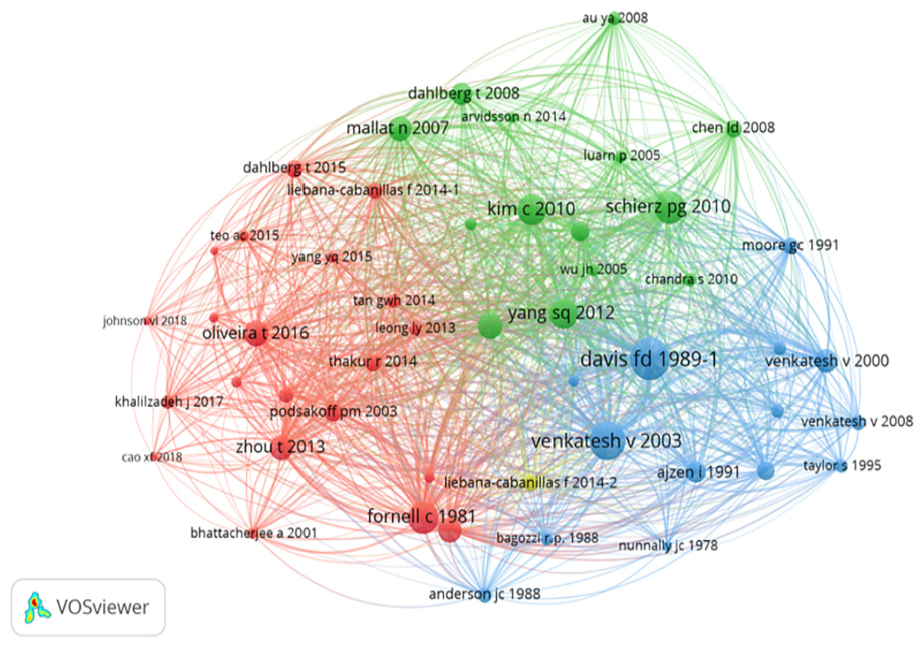
Co-citation network of foundational themes in mobile payment research.
Top 10 Publications According to PageRank for Foundational Themes in Mobile Payment Research.

The first knowledge cluster (blue) relates to foundational theme on the “theoretical foundations of mobile payment,” as it largely covers publications that postulated the theories for technology adoption. Under this cluster, Davis (1989), who proposed the Technology Acceptance Model (TAM), has the highest PageRank. The TAM has been an instrumental and widely popular theory for understanding users’ behavior in relation to acceptance of information systems and technologies. Another popular theory on technology adoption in this cluster is the Unified Theory of Acceptance and Use of Technology (UTAUT), proposed by Venkatesh et al. (2003). UTAUT is a combination of eight well-known theories, including TAM. The Theory of Planned Behavior developed by Ajzen (1991) was among the top 10 theories used in this cluster. This theory emphasizes that perceptions, attitudes, intentions, and behavioral controls are the major determinants of behavior. Similarly, the Theory of Reasoned Action (TRA), proposed by Fishbein and Ajzen (1975), and the Diffusion of Innovation, as well as other theories regarding technology adoption and behavioral intention of users emerged prominently in this cluster. The linkages of publications in this cluster to Fornell and Larcker (1981) indicate that most theories have been empirically established using linear regression methods. Thus, this cluster indicates that scholars have extensively relied on earlier theories to explain and validate phenomena relating to mobile payment.
The second knowledge cluster (green) relates to the foundational theme on the “acceptance and adoption of mobile payment.” The publications in this cluster largely aim to determine user acceptance and adoption of mobile payment. Schierz et al. (2010) article “Understanding consumer acceptance of mobile payment services: An empirical analysis” (PR = 0.019861) and Dahlberg et al. (2008) article “Past, present and future of mobile payments research: A literature review” (PR = 0.019861) share the highest PageRank. Most publications in this cluster focus on understanding the predictors of users’ intention to use mobile payment. In addition to using popular theories based on predictors like perceived ease of use and perceived usefulness, scholars like Y. Lu et al. (2011) studied the role of trust in impacting the behavioral intention for using mobile payment. To understand adoption behavior, scholars like Kim et al. (2010) examined the attributes of mobile payment systems as well. Though most scholars empirically examined mobile payment through quantitative studies, Mallat (2007) adopted a qualitative study using focus group research. Overall, the main objective of publications in this cluster is to assess user behavior and examine users’ intentions to accept and adopt mobile payment.
The third knowledge cluster (red) relates to the foundational theme on the “contemporary issues in mobile payment,” as most publications in this cluster move a step past the initial adoption stage and focus on post-adoption/continued intention for using mobile payment and link them with new, evolving technologies. Oliveira et al. (2016) article “Mobile payment: Understanding the determinants of customer adoption and intention to recommend the technology” (PR = 0.020224) and Zhou’s (2013) article “An empirical examination of continuance intention of mobile payment services” (PR = 0.020221) were the top two publications with the highest PageRanks. Other scholars such as Khalilzadeh et al. (2017) used an integrated model for determining near-filed communication (NFC) under mobile payment technology. Similarly, Tan et al. (2014) researched emerging technology for mobile credit cards under NFC technology. Largely, the publications in this cluster represent the evolution of mobile payment and its linkages with other developing technologies in related fields.
Topical Trajectories in Mobile Payment Research (RQ4)
The co-occurrences between the keywords in all publications used for the bibliometric study were analyzed using VOSviewer. The patterns of keyword co-occurrence were examined over a period of time to identify trends and explore how the field is evolving. Mapping the co-occurrences between keywords against time period helps in understanding the field’s evolution in content and structure (Donthu, Kumar, Pandey, & Lim, 2021). Noteworthily, each keyword represents a topical content in the field, wherein keywords appearing in larger nodes reflect greater occurrences, while closer distances or links between nodes indicate stronger relationships between the nodes.
The keyword co-occurrence analysis indicates that initial research on mobile payment up to 2016 was limited to just electronic commerce and mobile commerce (Figure 7). The trend gradually shifted, and in 2017 and 2018, it was largely dominated by issues related to information technology and mobile payment adoption and its determinants, with research in the field gaining traction with scholars during this period. From 2019 to the time this study was conducted (2021), mobile payment research has essentially focused on empirical examination of banking adoption, convenience, fintech, perceived risk, services, and systems. That is to say, the analysis suggests that with the acceptance of mobile payment, research in recent times began to concentrate more on convenience, services, and risk associated with using mobile payment, as well as its linkage with banking and other related technologies. Moreover, research involving empirical examination using partial least squares structural equation modeling (PLS-SEM) has been widely conducted from 2019 onward.

Topical trajectories of mobile payment research.
Conclusion
Key Takeaways
The existing publications on mobile payment were analyzed to understand the research trends. More specifically, the present study (1) evaluated the publication and citation trends as well as the major contributors of mobile payment research and (2) mapped the foundational themes and topical trajectories in the body of knowledge on mobile payment from inception to October 2021. Comprehensive bibliometric analysis of the literature on mobile payment shows that there has been steady growth in this field of study. The bibliometric analysis enabled the study to answer its research questions and draw nine major key takeaways with implications, which are listed below:
(1) There has been an increasing trend in the growth of publications in the field of mobile payment; the last 5 years have been very productive, especially the last 2 years during the COVID era (RQ1), implying that mobile payment research has much room to grow moving forward into the future, and thus, the usage and transformation of mobile payment in the new normal would be worthy of new research ventures.
(2) Kim et al. (2010) is the most cited article on mobile payment research (RQ1), and thus, future research on mobile payment is encouraged to refer to Kim et al. (2010) as well as other highly cited publications on mobile payment revealed through this study in order to provide a strong foundation and justification for new attempts to advance the body of knowledge.
(3) Electronic Commerce Research and Applications, International Journal of Bank Marketing, and Journal of Retailing and Consumer Services are the most highly preferred journals for scholars to publish their research on mobile payment (RQ2), and thus, future research can consider submitting to such journals that have a good track record of welcoming mobile payment research.
(4) The most frequent co-authorship is observed between G.W.H. Tan and K.B. Ooi, who belong to the same institution (RQ2), and thus, prospective scholars interested in mobile payment can approach these scholars as well as other prominent scholars who actively engage in collaborations to jointly contribute to new research pastures on mobile payment.
(5) Mobile payment research remains at the nascent stage as it is largely contributed by only a few researchers such as F. Libana-Cabanillas from the University of Granada in Spain and G.W.H. Tan and K.B. Ooi from UCSI University in Malaysia (RQ3), and thus, there is room for new scholars to venture into and established a specialist reputation on mobile payment.
(6) China has contributed the highest number of articles of any country, followed by the USA, Korea, and India (RQ3); the high number of contributions from Asian countries suggest that new research outside Asia can contribute to greater diversity in insights for the field of mobile payment, and thus, is highly encouraged.
(7) The University of Granada in Spain has contributed the highest number of publications of any institution, followed by University Tunku Abdul Rahman in Malaysia (RQ3); the institutional analysis also corresponds to the country analysis, and thus, reaffirming the call for new mobile payment research beyond the Asian region.
(8) Science mapping revealed three foundational themes on mobile payment research that future research could rely upon to identify the existing stream of research that their new research wishes to extend and position the novelty of their new research accordingly: “theoretical foundations of mobile payment,”“acceptance and adoption of mobile payment,” and “contemporary issues in mobile payment” (RQ4).
(9) Science mapping also revealed that mobile payment research has focused mainly on electronic commerce and mobile commerce until 2016, whereas information technology and adoption dominated the field from 2017 to 2019, and systems, services, and risks were most prevalent from 2019 onward (RQ4), indicating that new research in the field of mobile payment should go beyond initial acceptance and adoption and actively venture into the mechanisms that would enhance experience and foster loyalty (e.g., satisfaction, continued use, added value) among users of mobile payment.
Future Research Directions
Based on the present review of the extant literature, it is clear that mobile payment research is on an ascending path. However, there are still certain gaps that need scholarly attention. Therefore, the areas that hold potential for future research are highlighted for prospective scholars to consider.
Extending Mobile Payment Research Beyond Adoption and Behavioral Intention
Most studies on mobile payment focus on adoption and users’ behavioral intentions. However, the field of mobile payment is growing rapidly and becoming more complex. Therefore, it is imperative to also focus on other factors of the ecosystem that influence adoption. For example, as pointed out by Dahlberg et al. (2008), there has not been much focus on changes in regulatory, legal, and commercial aspects of mobile payment. Moreover, demonetization in countries such as India, and China’s aggressive launch of its digital currency are important dimensions to understand user behavior. Moreover, acceptance involves much more than merely the intent to adopt mobile payment. For instance, studying variance in the use of alternate channels of payment may bring interesting findings about users accepting or rejecting a particular technology. Furthermore, mobile payment technology is evolving, and each new technology intrinsic to mobile payment requires separate scholarly consideration. Liébana-Cabanillas et al. (2014) proposed that other technologies such as NFC, QR codes, and biometric fingerprints must be involved in future research. The literature in these specific areas has been enriched by the focus on the adoption of NFC mobile payment (Zhao et al., 2019), online security protocol for NFC mobile payment systems, (Al-Tamimi & Al-Haj, 2017), QR payment acceptance (Liébana-Cabanillas, Ramos de Luna, & Montoro-Ríos, 2015) and acceptance of mobile payment by including all three technologies that is, SMS, QR, and NFC (de Luna et al., 2019). Similarly, wearable payment is also one of the emerging technologies and is forecasted as the “future of proximity mobile payment” ( Loh, Lee, Tan, et al., 2022). Wearable payment technology also offers quick, effortless and reliable mode of payment but also comes with its own challenges and therefore needs deeper scholarly deliberations. Another subset of mobile payment is facial recognition payment (FRP) services which is increasingly becoming popular in countries like China (Zhang & Kang, 2019). Despite its advantages, FRP has multiple issues like privacy concerns and user resistance (Y.-L. Liu et al., 2021) that needs much deeper understanding.
However, these studies are still few in number and need to be tested in different contexts.
Strengthening Conceptual Understanding of Mobile Payment
Most scholars have built their conceptual frameworks through the lenses of information technology acceptance theories (Liébana-Cabanillas et al., 2014; Oliveira et al., 2016; Schmidthuber et al., 2020), focusing on factors like, risk, innovativeness, and trust (Kim et al., 2010; Y. Lu et al., 2011. This is justified, as mobile payment is an integral part of information systems. However, this study observed that existing research is heavily inclined toward a user-centric approach and neglects to assess other dimensions like service providers, merchants, and vendors. It has been noted that, despite being a key factor in mobile payment, uptake of digital payment is low among merchants (Ligon et al., 2019). However, not much information is available in the literature on this issue. Therefore, to enhance the rigor of mobile payment research, more real-world cases of mobile payment including all stakeholders must be taken into account, as also highlighted by Dahlberg et al. (2015). Similarly, there is a need for more theoretical integration to cover the vastness of the subject. To achieve this, research must incorporate theories from economics, psychology, and other fields. For example, integrating the information success (IS) model and technology adoption theories with a knowledge-based view (KBV) would be useful to understand the effect of knowledge-based resources like techno-financial literacy on continuous use intention for mobile payment. Additionally, it would be helpful to incorporate constructs of uses and gratification theory to understand the cognitive and affective needs affecting technology adoption models in relation to mobile payment, which has become increasingly gamified in recent times by various mobile payment service providers (e.g., Boost, GrabPay).
Development of Mobile Payment in a Post-COVID World and the New Normal
The COVID-19 pandemic has led to an increase in the use of information technology (Loh, Lee, Hew, & Lin, 2022). The entire payment system has seen a transformation like never before. There has been an upward trend in the publication of research on mobile payment (Mu & Lee, 2022), but few have concentrated on COVID-19 and its impact. Therefore, it would be interesting to study whether the pandemic has driven the usage of mobile payment and how it has changed users’ behavioral patterns. With social distancing measures in place and the fear of getting infected by touching currency (Goel et al., 2022), users have shown an inclination toward using digital payments (Al-Sharafi et al., 2022; Gardner, 2020). It will be interesting to see if this trend continues once the pandemic subsides. Moreover, mobile payment has evolved during the pandemic, as governments are now using digital payments to give aid, and e-tailers are urging customers to pay digitally (Pandey & Pal, 2020). This evolution needs scholarly attention. There is also scope for a comparative study between the two time frames to help understand trends and topics associated with mobile payments.
Mobile Payment for Different Contexts, Cultures, and Users
With an increasing trend toward digital payment and cashless economies gaining popularity worldwide, it is imperative to understand mobile payment in different settings. Studies on mobile payments have thus far been concentrated, if not predominantly limited, to just a few countries, as revealed through this study. It will also be helpful to enhance our understanding of factors that contributed to the spread of mobile payments in emerging and developed economies or Eastern and Western nations while other nations lag behind. Furthermore, there is a need to understand the influence of culture on the adoption of mobile payment and vice versa. With Alipay, Google Pay, and PayPal searching for new markets globally, digital payment service providers need more nuanced understanding of these ecosystems. Despite the importance of mobile payment, only a few scholars have attempted to understand the impact of cultural factors on its adoption and use (Chan et al., 2020; Chung & Holdsworth, 2012. Similarly, most studies have focused their research on younger populations and individuals having at least college education. This limits the generalization of results for the population as a whole. It is imperative to understand the behavioral intentions of people belonging to different age groups (Cham et al., 2022) and people with different education levels, and thus, could be addressed in future research.
Limitations
The present study facilitates understanding of the evolution of mobile payment research. However, it comes with certain limitations. The data came from just one database (i.e., Web of Science). Future scholars can also use Scopus and conduct studies based on the data extracted using the alternative database. Additionally, the keywords in the study were limited to “mobile payment,”“m-payment,”“mobile wallet,” and “m-wallet.” In the emerging field of mobile payment, new terms and methods continue to evolve, and those too need due consideration. Finally, due to paucity of space, not all co-citations could be mentioned in the discussion. It is worth noting, however, that the highly co-cited publications tend to provide a useful precursor of key focus and insights in the field of mobile payment.
Footnotes
Acknowledgements
There are no specific acknowledgments to me mentioned. The work is solely done by the authors.
Declaration of Conflicting Interests
The author(s) declared no potential conflicts of interest with respect to the research, authorship, and/or publication of this article.
Funding
The author(s) received no financial support for the research, authorship, and/or publication of this article.
An Ethics Statement
Not applicable.
