




Abstract
With the emergence of the sharing economy, Airbnb has become the poster child for the digital peer-to-peer accommodation market in the hospitality industry. The study explores the attributes influencing Airbnb user experiences in Sri Lanka by analyzing online guest reviews. The study uses an exploratory research design to examine a large data set of Airbnb user reviews utilizing text mining and sentiment analysis. According to the analysis, five key themes emerged from the review comments: “recommend,”“host,”“experience,”“room,” and “location.” Furthermore, the relationship between the host and the guest greatly impacts the Airbnb user experience in Sri Lanka. Most Airbnb user reviews are positive and primarily focus on the host, while negative ones typically focus on the property’s indoor environmental quality. The study contributes to the literature on the sharing economy by offering a structured and extensive analysis of actual online reviews from Airbnb customers to understand their experiences better while providing valuable insights for various stakeholders in the industry.
Keywords
Introduction
Sharing one’s assets is gaining popularity these days as a result of the sharing economy. Although sharing is not a new occurrence, sharing through the sharing economy or collaborative consumption is a novel concept. The concept of “sharing economy” should be differentiated from the notion of “sharing.” Traditional sharing does not include money and occurs in the absence of market interactions (Oskam & Boswijk, 2016). In contrast, the sharing economy is a digitally driven extension of the market economy. The sharing economy enables individuals and groups to make income from underutilized assets that may be offered as services. In this sense, with the click of a mouse, anyone may become a supplier of a wide range of products and services. As a result, the sharing economy enables an alternate mode of consumption and resource allocation. Many sharing economy startups are springing up and developing sharing platforms for each and every industry imaginable. More established firms, such as Uber and Airbnb, as well as emerging players, such as Neighbor, are giving ordinary people more control over their choices while giant corporations struggle to keep up. This study focuses on Airbnb, a website where ordinary individuals rent their living quarters as tourist accommodations. These listings range from a single futon in a living room to a large castle or an island. Since its beginnings, Airbnb has become a significant player in the travel and hospitality industry, with a brand value of about USD 75 billion and 5.6 million active listings in 100,000 cities across more than 220 countries (Airbnb, 2021). There is an ongoing debate on whether Airbnb is still considered a sharing economy platform or if it has already lost its sharing economy ethos due to the increasing professionalization and commercialization of Airbnb (Demir & Emekli, 2021). However, Airbnb still positions itself under the positive value of the sharing economy, but there are indications that it has become increasingly professional through commercial listings (Demir & Emekli, 2021).
Due to its rising popularity, Airbnb has become a heated topic among scholars, and researchers have begun to explore the phenomenon through systematic studies. As per a structured literature review conducted by Dann et al. (2019), existing literature has examined Airbnb under seven key themes, namely user motives and types; reputation systems; text reviews and self-descriptions; profile images; prices and pricing; economic and media impact; and legal and regulatory aspects. With its innovative business model, Airbnb provides an alternative hospitality experience for its users and undermines the theories and practices followed by the traditional tourism and hospitality industry. Airbnb has positioned itself as a trustworthy community marketplace where individuals can offer, discover and book unique accommodations worldwide (Airbnb, 2021). Considering the above claim, researchers have begun investigations to identify the dimensions or attributes that form the core of the Airbnb experience. Existing empirical research on the phenomena has yielded a plethora of similar but often contradictory evidence (Cheng & Jin, 2019). In different studies, the importance of each Airbnb experience dimension differs. For example, earlier research considered authentic tourist-host interactions to be a key component of the Airbnb experience (Tussyadiah & Pesonen, 2016; Yannopoulou, 2013), whereas Festila and Müller (2017) argue that Airbnb is simply a traditional hotel experience at a reduced cost. Guttentag et al. (2018) found that Airbnb guests tend to place a high value on practical features and a lower value on experiencing features. The above findings are reinforced by the statistics that indicate that most hosts in North America, Europe, and Australasia just rent out the entire home without their presence (Adamiak, 2022). While identifying the attributes of the Airbnb user experience, researchers also focus on the difference between staying in an Airbnb and a Hotel (Belarmino et al., 2019; Bridges & Vásquez, 2018). However, the existing studies have primarily focused on identifying concepts at the macro level, with insufficient attention paid to the subtle elements of the Airbnb experience. This makes it difficult for researchers and practitioners to develop a coherent knowledge base to conceptualize peer-to-peer accommodation experiences and establish appropriate approaches (Cheng & Jin, 2019).
Accordingly, this study explores the elements that influence sharing accommodation users’ experiences in Sri Lanka using guest reviews of Airbnb. The reason for choosing Sri Lanka as the study location is that it has seen a remarkable increase in Airbnb listings, with 26,162 listings as of December 2018 (Munasinghe et al., 2022). In addition, Sri Lanka is a unique and diverse country that offers visitors a distinct cultural and natural experience and is also one of the world’s most popular tourist destinations (Munasinghe et al., 2020). Furthermore, this study broadens the geographic scope of sharing economy research beyond that usually undertaken in large metropolises and countries of North America and Western Europe, which are the platform’s early and major marketplaces (Adamiak, 2022; Cheng & Jin, 2019). Traditionally, studies in the tourism and hospitality sector have mainly relied on consumer surveys and interviews (Xiang et al., 2017). However, user satisfaction measured over time via consumer surveys or focus group interviews is sometimes hampered by low response rates, and inadequate sampling leads to ambiguous assessments (Joseph & Varghese, 2019). Furthermore, the amount of data generated every second in the modern travel and tourism industry suggests adopting big data (J. Li et al., 2018). It is a revolutionary phenomenon associated with large and complex data sets where traditional data processing applications and software tools are insufficient to capture and analyze in a fair amount of time. Accordingly, the study employs text mining and sentiment analysis to analyze Airbnb guest reviews in Sri Lanka to contribute to the discourse on Airbnb user experiences.
Literature Review
Airbnb User Experience
Airbnb’s disruptive nature was not merely due to its ability to offer competitive price options but also completely revolutionized the way travelers see, select, and experience accommodations when traveling (Mody et al., 2017). A study based on American and Finnish peer-to-peer guests discovered two unique motivations driving the choice of accommodation: social appeal and economic appeal (Tussyadiah & Pesonen, 2018). The desire to socialize with the host, who is most likely a local, is referred to as social appeal. As a result, guest–host interactions allow guests to seek recommendations and guidance in the area. On the other hand, the economic appeal is simply the price competitiveness that Airbnb provides when compared to hotels. Authenticity was discovered to be another important component of the distinctive Airbnb experience. Exposure to local hosts, living in a local residential home and getting recommendations on local attractions from locals contribute to the idea of authenticity, which is considered to offer a distinct experience appeal (Liang et al., 2018; L. Lu et al., 2020). Both the social appeal and authenticity emphasized the host’s critical role in fostering the Airbnb experience. Unlike in hotels, where service interactions are frequently faceless, Airbnb guests create a much closer relationship with their hosts. Since the host writes the Airbnb property descriptions, the interaction with the host begins with the information search stage. The host then accepts Bookings, and the same host likewise handles all following interactions. Previous studies have also revealed empirical support for the importance of hosts in online text reviews (Kiatkawsin, Sutherland, & Kim, 2020).
Table 1 summarizes existing studies, which provide an overview of the most important attributes influencing Airbnb accommodation user experience in broad themes and topics of interest.
Summary of Airbnb accommodation user experience attributes.
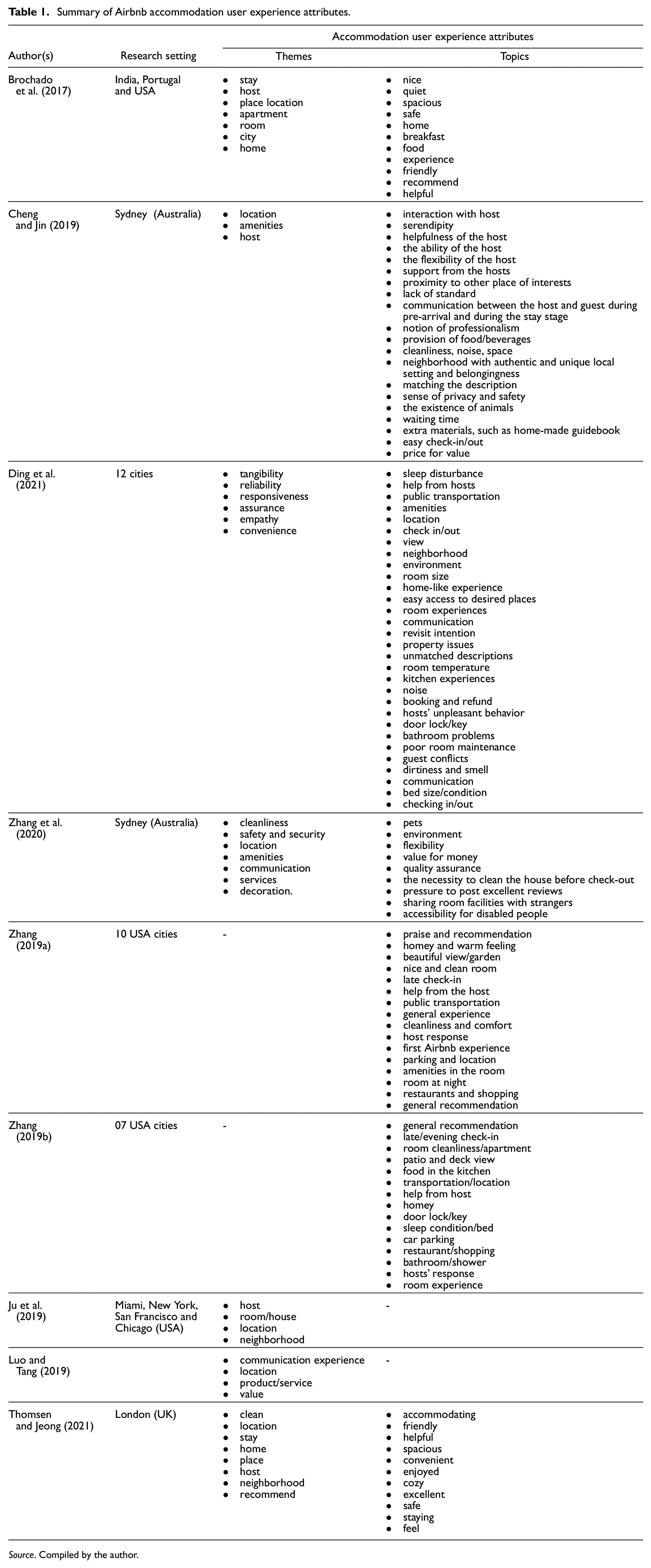
Source. Compiled by the author.
Existing Airbnb user experience studies have two main limitations (Thomsen & Jeong, 2021). To begin with, studies on Airbnb users’ experiences have yielded inconsistent findings. For example, earlier research considered social (guest-host) interactions to be a key component of the Airbnb experience (Cheng & Jin, 2019). Other scholars are less comfortable with such conclusions, claiming that for some users, Airbnb is simply a hotel-like experience at a reduced cost and that Airbnb customers place a high value on practical features while placing a lower value on experiential attributes (Festila & Müller, 2017; Guttentag et al., 2018). According to Hamari et al. (2016) and Lalicic and Weismayer (2018), economic benefits do not affect Airbnb user satisfaction, although they do in Tussyadiah’s (2016) study. Secondly, most studies employ standard survey methodologies and borrow constructs from established theories, but they do not always reflect actual user experiences. For example, using self-determination theory, Mohlmann (2015) allocates variables such as cost savings, service quality, utility, and trust to analyze Airbnb customer satisfaction. In contrast, Priporas et al. (2017) use social cognition theory to measure Airbnb user satisfaction by extracting aspects such as tangibles, convenience, understanding, and caring. Hence, more exploratory studies are required to analyze Airbnb users’ experiences using consumers’ actual reviews.
Table 2 provides an overview of the sample size, data type, research methodology and scope of related studies conducted on the Airbnb accommodation user experience.
Summary of related studies.

Source. Compiled by the author.
Online Text Reviews
Travelers who use Airbnb typically perform online research on destinations, hosts, and reviews before making travel and stay decisions. According to Pang and Lee (2008), more than 70% of individuals said that online reviews substantially influenced their purchase, with more than 32% providing ratings via online rating systems and almost 30% posting online comments or reviews. Furthermore, it is believed that consumers are willing to spend more for an item with an additional star rating (Pang & Lee, 2008). This demonstrates the importance of online reviews in shaping the image of destinations and hosts (Choi et al., 2007; Pudliner, 2007). Furthermore, Choi et al. (2007) contend that the feedback provided on travel blogs is more thorough and richer in substance, making it more popular than likert-scale based survey findings. These demonstrate the success of word-of-mouth marketing as a marketing approach. It is believed that word-of-mouth influences customer decision-making, particularly in the experience-driven tourism business (Litvin et al., 2008).
User-generated content (UGC) has become a popular type of Electronic Word of Mouth (eWOM) in the contemporary digital age (Schwager & Meyer, 2007), described as all informal communications addressed at customers via online regarding the usage or qualities of specific goods and services or their suppliers (Litvin et al., 2008). Guest reviews on travel websites have been frequently utilized to investigate customer perceptions of their real trip experiences by displaying explanatory or sensory signals (H. Li et al., 2019).
Guest reviews are critical to the success of Airbnb and the smart tourism ecosystem as a whole (Kiatkawsin, Sutherland, & Lee, 2020). Prospective tourists looking to have the best accommodation deal must acquire the required information from comments and reviews left by prior guests (Bae et al., 2017). As a result, the pressure to post reviews after staying is greater than while staying in hotels (Zhang et al., 2020). Text reviews provide a broader and deeper set of information while being prone to various biases (Smironva et al., 2020) than numeric evaluations, which can be easily understood and compared. Furthermore, text reviews are typically provided in an unstructured fashion, making it challenging to discover essential information, also known as uncertainty, and producing confusion when there is contradicting information, also known as equivocality (Bae et al., 2017). Increasing the number of reviews can help to reduce uncertainty, while users can learn which information to trust (Kiatkawsin, Sutherland, & Kim, 2020). In other words, writing and sharing travel experiences is a critical component of improving the Airbnb community and the broader smart tourism environment (Bae et al., 2017; Femenia-Serra et al., 2019; Kiatkawsin, Sutherland, & Lee, 2020). Since review data is unstructured and comprises more than numerical data, it has generated questions about the efficacy of traditional research techniques and the need for sophisticated approaches to exploit its potential systemically and effectively (W. Lu & Stepchenkova, 2015).
Big Data Analytics and Sentimental Analysis
Because of the volume of online reviews, big data analytics has become a more effective technique for understanding consumer experience by evaluating enormous amounts of qualitative and quantitative data (Salehan & Kim, 2016). Big data analytics has developed a new research paradigm based on four distinguishing characteristics: volume, velocity, veracity, and variety (De Mauro et al., 2016). However, studies in the tourist and hospitality domain are gradually adopting “big data” (J. Li et al., 2018). However, only a few Airbnb user experience studies were carried out via text mining, mostly on a small sample size or by analyzing the original data gathered from surveys or interviews.
Opinion mining, also known as sentiment analysis, is mining people’s views, assessments, and attitudes toward things, facts, and qualities (Joseph & Varghese, 2019; Liu, 2012). In the case of Airbnb, there is an increasing market focus on sustainability, legality, and customer issues, which necessitates increasing industry and academic attention (Joseph & Varghese, 2019). Therefore, the positive and negative sentiment in reviews and the overall sentiment and consistency are essential criteria for adequately preparing Airbnb hosts to make operational and strategic adjustments.
Methodology
Data Collection
Online reviews have been widely employed in tourism research because they provide more realistic assessments of users’ experiences and ties to organizational performance and social practices, yielding new insights for both practitioners and academics (Tussyadiah & Zach, 2017; Xiang et al., 2015). As a result, this study used a large dataset of Airbnb review comments from Sri Lanka to avoid the inference concerns commonly associated with a limited sample of online review data (Cheng & Jin, 2019). The exploration is built on verified guests’ reviews for accommodation listings on the Airbnb Platform in resort regions declared by the Sri Lanka Tourism Development Authority (SLTDA) in Sri Lanka (Sri Lanka Tourism Development Authority, 2018). A purposive sample of 200 Airbnb listings with more than 50 verified reviews in declared resort regions was selected. This choice is due to the fact that these resort areas are the most sought-after locations by both local and foreign tourists, therefore allowing different perspectives to be studied within different geographical areas. The dataset was scraped from the Airbnb platform using the web scraping technique on 06th June 2020, covering the 200 registered Airbnb listings in Sri Lanka with 42,960 reviews. Ethical clearance for this study was not required since review opinions are in the public domain and can be accessed by anyone (Hookway, 2008; Kozinets, 2010). The dataset was cleaned using the Tableau Prep Builder, resulting in 18,780 English reviews.
Data Analysis
Leximancer, a text mining software, was used to analyze the data. Leximancer, being high-level natural language processing software, begins with no preconceptions, and the analysis arises from the data (Smith & Humphreys, 2006). First, semantic and relational insights or themes in the review comments were identified using text mining through Leximancer. Next, previously discovered themes and concepts were compared to current Airbnb and hotel literature features. By recognizing the similarities and differences, this comparison assisted in gaining new insights. Finally, sentiment analysis was performed using the Leximancer to get likelihood scores and detect users’ positive and negative attitudes toward previously discovered qualities. The findings include direct and unedited positive and negative quotes from the reviews to aid with the ground-level understanding of the essential topics and concepts. A detailed description of the software and its processes, capabilities, underlying mechanisms and reliability can be found in the validation article by Smith and Humphreys (2006) and the Leximancer white paper (Leximancer, 2010). Moreover, many studies have been conducted in various domains using Leximancer, which depicts acceptability as a reliable analytical tool among scholars (Leximancer, 2021).
The data analysis using Leximancer involved five key stages:
Formatting transcripts: As directed in the user manual, the scrapped Airbnb reviews CSV file was formatted to ensure compliance with the software and to aid Leximancer in identifying the attributes.
Automatic text processing and concept seed generation: Tags were automatically assigned for each header column to identify each attribute in the CSV File.
Concept editing: The user did not define tags or concepts; only automatically defined tags and concepts were used. Thesaurus settings were set to software default, and plurals of concepts or identical meanings were merged.
Concept coding: The text was coded with the folder tags, and “all concepts” were identified automatically.
Output: To emphasize the conceptual context in which the words appear and enhance the uncovering of indirect relationships, the social network (Gaussian) map was selected over the topic network (linear) map.
The step-by-step analysis process in Leximancer is further elaborated in Table 3 below. The command adopted by the researcher is highlighted in bold.
Step-by-step process of analysis in Leximancer.

Source. Compiled by the author.
Results
Descriptive Analysis of Airbnb Reviews
A CSV file containing 18,780 online reviews from 200 Airbnb listings was used for the study. Among the reviews, 40% are from “Entire Place” listings, 47% are from “Private Room” listings, and the remaining 13% are from “Shared Room” listings. On average, a listing had around 93 reviews. The average length of a guest review is around 66 words, with a standard deviation of 55.65. The word count distribution is presented in Figure 1. Furthermore, 75.3% of the guest reviews range between 1 and 86 words, and only a tiny percentage (0.01%) of reviews were longer than 500 words.

Distribution of word count.
Text-Mining Results
The Leximancer’s Concept Map presents the concepts within the text and their relationships to one another. When the map is created, the concepts are organized into higher-level “themes.” Concepts that frequently appear in the same pieces of text have a strong attraction to one another and, as a result, tend to cluster together in the map space. The themes facilitate interpretation by categorizing clusters of concepts and are displayed as colored circles on the map. On a Leximancer Concept Map, the themes are “heat-mapped,” which means that the most important themes are shown in hot colors (like red and orange), and the less important themes are shown in cool colors (like blue and green). The relevance of the themes is shown by their connectivity score, which is included in the thematic summary. This score is based on how well the concepts in the theme connect with each other. It lets the user figure out a theme’s importance within the context of the text corpus being analyzed.
Five major themes emerged within the review comments (Figure 2), namely “stay,”“host,”“lovely,”“room,” and “location” based on the order of hits (Table 4). The number of hits indicates the number of text blocks in the project that is related to the respective theme. “Host” emerged as a key theme, which has implications on the role of the host-guest encounter and services in the accommodation experience. Furthermore, “lovely” encompasses all four other themes. This is not surprising given that Airbnb was founded on the principle that Hosts offer one-of-a-kind stays and unique experiences that allow guests to experience the world in a more authentic, connected way.
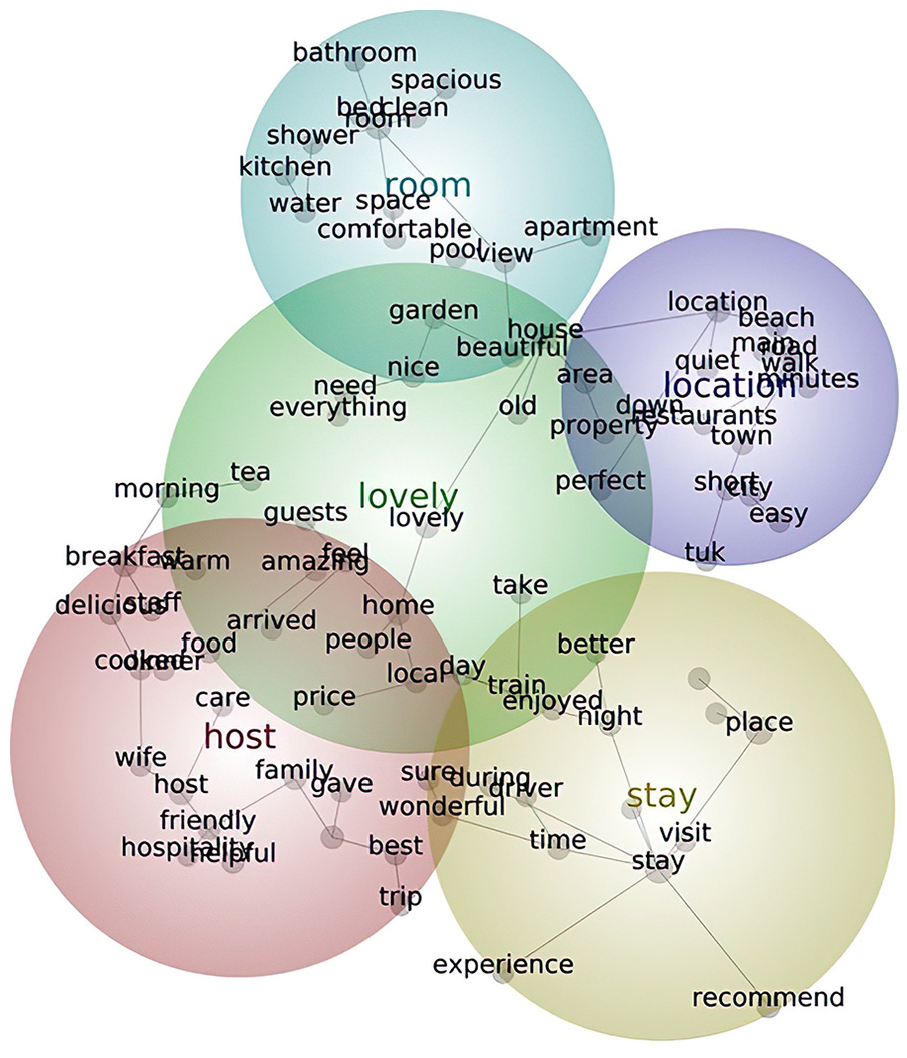
Concept map of the themes and concepts.
Analyst synopsis of each theme.

Source. Compiled by the author.
Sentiment Analysis
The sentiment analysis results in 34,781 favorable terms and 945 unfavorable terms. The sentiment analysis results indicate that Guests who stayed at Sri Lankan Airbnb listings were extremely positive about their stay in many ways (Figure 3). For instance, a likelihood score of 66% for the term “host” indicates that 64% of text segments containing the term “host” contain positive sentiments. Furthermore, related concepts like “nice,”“best,”“wonderful,”“beautiful,”“easy,” and “friendly,” having a likelihood score of more than 80%, are mainly associated with either the host, room or the location (Tables 5 and 6).

Concept cloud tagged based on the review rating.
Excerpt of likelihood scores of positive sentiment analysis.
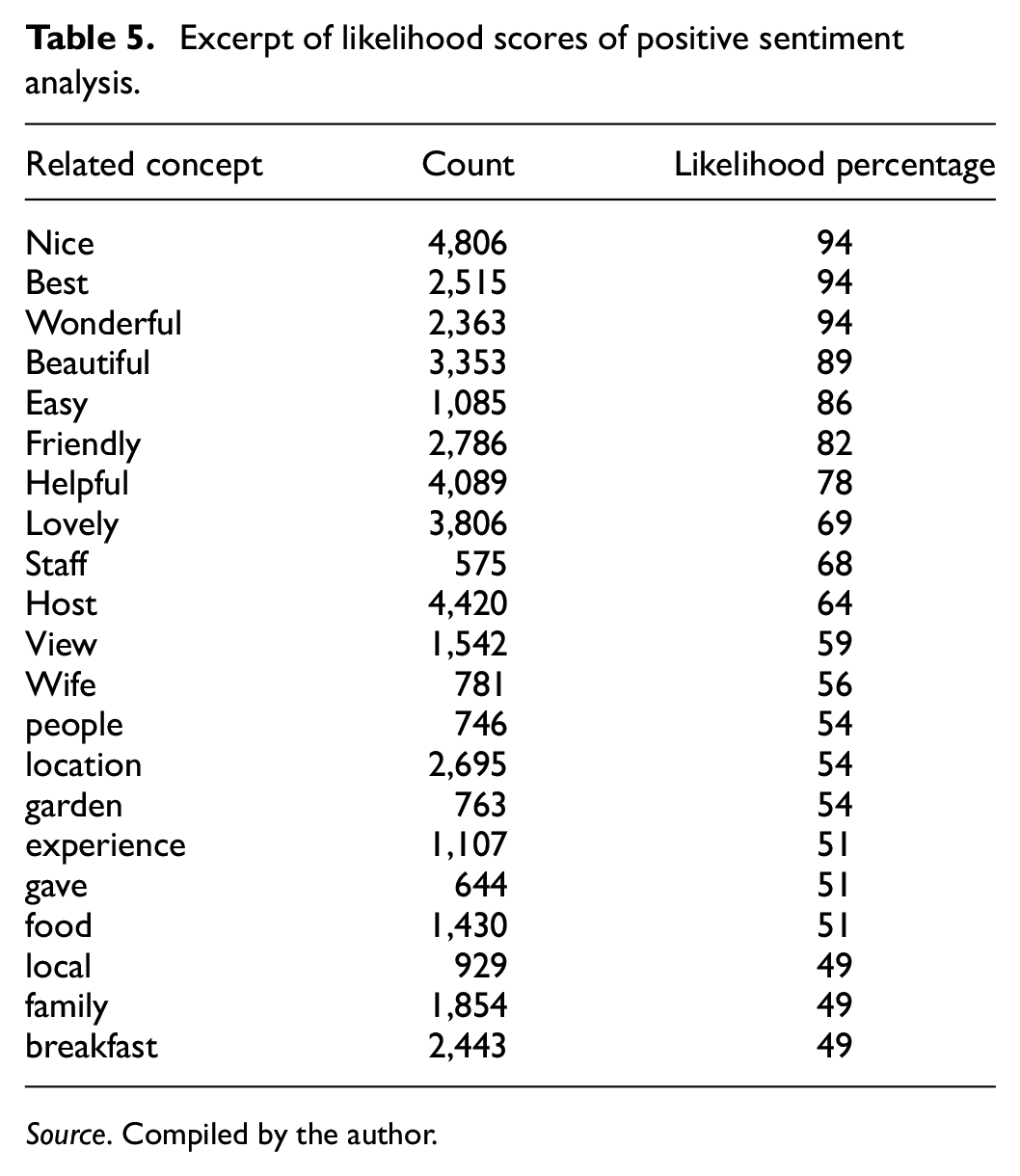
Source. Compiled by the author.
Sample positive sentimental quotes.

Source. Compiled by the author.
The topics that constantly received unfavorable responses, on the other hand, were “down,”“main road,”“water,” and “shower” (Tables 7 and 8). These topic areas highlight significant issues guests face during their stays, such as interruptions in electricity supply, noise from vehicles, interruptions in water and electricity supply, and water pressure for a proper shower. Interestingly, the host has only received a negative likelihood score of 1%. This contributes to the popular belief that Airbnb guest review comments are biased and favoring the hosts in its rating system (Bridges & Vásquez, 2018). Even though the majority of the comments on Airbnb are positive, analyzing the existing negative sentiments provide Airbnb hosts with an opportunity to work on those issues by upgrading the property (e.g., hot water, air conditioning), addressing any maintenance issues (e.g., improving the plumbing system) or setting realistic expectations (e.g., temperature, noise due to busy roads, dogs) beforehand. Furthermore, concepts describing the urban and rural environment, such as transportation, restaurants, town, shops, walking, and gardening, have positive and negative comments, signaling that the general environment may also play an important role in the Airbnb guest experience.
Excerpt of likelihood scores of negative sentiment analysis.

Source. Compiled by the author.
Sample negative sentimental quotes.

Source. Compiled by the author.
Themes
Stay
Stay describes the overall experience of Airbnb accommodation. The important concepts that support the theme (based on the relevance score) are “stay,”“place,”“recommend,”“time,”“night,”“enjoyed,” and “experience.”
Positive
“We enjoyed staying for the two nights we were visiting Colombo and can highly recommend Rom’s place.”
“Thank you for making our stay a pleasant experience, and we would definitely choose the same place for our next visit to Colombo.”
“5 stars, we highly recommend this Airbnb to anyone visiting Anuradhapura, for value and kindness, we cannot imagine a better place to stay.”
“We wanted to experience staying somewhere nontouristic, where we could learn about real Sri Lanka from those who know better than any guidebook.”
“The warmth and generosity of spirit we experienced during our visit really made our stay here, and we cannot thank Manjula and Rhona enough for making the last part of our trip to Sri Lanka so enjoyable.”
Negative
“We cut our stay short because it was such a bad experience and rushed back to Colombo,”
“We forced ourselves to stay out as the hut was so unpleasant,”
“Definitely do not stay here if you do not want mosquitos to bite and birds and chipmunks sharing your food,”
Host
The theme “host” involves a number of concepts underpinning the host’s role in supporting an Airbnb experience. However, the analysis has found concepts such as “helpful,”“friendly,”“family,” and the “food” prepared by the Airbnb host to be more important.
Helpful
The host’s helpfulness relates not only to the host’s assistance with the accommodation but also to various areas of travel and tourism experience. For example, arranging transport for sightseeing in the neighborhood and providing tips and recommendations on sites to visit. However, the quality and level of host assistance may vary dramatically from property to property, with a host being incredibly helpful to being absolutely helpless. Also, Airbnb users tend to use the first name or the host’s nickname in their comments.
Positive
“An amazing tree house experience right in the centre of nature, honestly one of a kind Rukmal is an amazing host and made us feel right at home immediately and was incredibly knowledgeable and gave us amazing tips on where to go, drove us to town when needed and even took us to wash elephants.”
“Tilak never stopped assisting us well beyond our expectations, including booking restaurants, drivers or giving us information on anything we wanted to know about SL.”
“The housekeeper, Madu, could not have been more helpful and gave good tips on where to eat and how to get around.”
“Jagath also helped organise a safari tour, Polonnaruwa and trips to Dambulla caves as well with the bus to Trinco and even took us to the bus stop in his jeep.”
Negative
“But even if we had got on time, there was no one there, so how would they have the time to clean all the house that was full of insects and take out the rat and disinfect the shower with blood.”
“Caretaker was drunk when we reached. rooms were unclean. Property can be misinterpreted by the pictures. Also, the location is very remote. So finding tuk tuk from the property to anywhere can be a problem.”
“..however we had a poor check-in experience as the host failed to show up and upon arrival, needed to clean the room.”
Friendly
Unlike traditional tourist establishments, hosts play an important role in peer-to-peer accommodations. The host has to single handly fulfill multiple roles wherein traditional accommodations, a separate employee fulfils each role. From check-in, answering inquiries, providing food and cleaning, and finally check-out. For a positive hospitality experience, each of these activities should involve the utmost respect and sincerity. This is where being friendly becomes an essential attribute of a host, leading to a better relationship with the guest. Sri Lankans are known for always smiling. A friendly island people known for their relaxed culture and hospitality meet and greet Sri Lankans from every walk of life, always smiling.
Positive
“Aaah.. this was an amazing homestay! From the moment we stepped in, we felt like home! Houseowner Dil was very communicative and friendly.
“Home is where your friends are” This is absolutely true, and Ranjit and his family treated us like this and even more.”
“Amila was super friendly and happy to help with anything! He was either staying on sight or was regularly in contact via mobile to check everything was okay with us.”
Negative
“She seemed pissed with offering us and us not being very grateful, handled us like we were some stupid children and said all windows and so on need to be closed. Like 10 minutes after she was gone, she made the security check if all the windows and doors were closed because it would be soooo expensive, and we felt very uncomfortable with renting the Airbnb and being checked on us…”
Family
The interaction with the host’s family is a natural element of the Airbnb user experience. This is because the guest takes accommodation within the host’s residence where his or her family lives. The only exception is in the case of entire place rentals where the host is not present on the property during the stay. Most Airbnb listings in Sri Lanka are private room rentals, and there are a significant amount of shared room rentals (Munasinghe et al., 2022). Therefore, in most reviews, the concept of “family” can be seen quite frequently and positively. Due to social, cultural and religious influences, most Sri Lankan residences are occupied by extended families. This is very much common in suburban and rural areas. As a result, guests get to experience many different interactions with family members. For example, it may lead to insightful discussions on the neighborhood history and the country and other valuable recommendations for their stay in Sri Lanka when interacting with elders. Interacting with the host’s children or pets may provide a different experience, while the host’s wife may provide insights and experience on Sri Lankan culinary arts and culture.
Positive
“A very warm welcome was given by the whole family, and it was a true homestay. We learnt more about SL in our 48 hours with Dinithi and her family than in the preceding two weeks! Book it now!.”
“The family is lovely: we had great talks and learned a lot about Sri Lanka and its people.”
“Iqbal and his family were extremely accommodating when Abdul was not around. I was given tips, fed food and tea, and experienced the full Sri Lankan hospitality from this family. I would really recommend this Airbnb without a doubt.”
Food
Local foods and beverages are an essential part of the tourism experience. Therefore, many guests take this opportunity to experience the local culinary culture.
Positive
“Home-cooked Sri Lankan breakfast (blew our minds with the awesome taste) and apt suggestions from Channa himself make this an ideal spot for embarking on the Sri Lankan tour,”
“We loved the breakfast (authentic Sri Lankan home-cooked breakfast, fruits, yoghurts and tea) overlooking the city.”
“She let me watch her make a WONDERFUL homemade Sri Lankan curry.”
“You arrive, and you are spoilt by Jagath And his wife. Obviously, there is a Queen of the kitchen who cooks Rice And Curry. With it comes Many insights on how to prepare Sri Lankan Food.”
Negative
“I asked for a vegetarian dinner, and I was served only vegetable fried rice, with a small bowl of curry on the side.”
“We sometimes had the feeling that we were disturbing our hosts (we wanted to visit the temples early and have our breakfast included in the price early, but it seemed to annoy them, and we had sandwiches instead of the traditional breakfast.”
Room
The accommodation environment is described by the cluster of concepts connected with the “room” which includes “view,”“ambience,”“space,”“design,”“decorations,”“amenities,”“privacy,”“cleanliness” of the room, and the overall property. The room is also strongly connected to the environment in and around the host’s place. It is primarily concerned with the quality of sleep as well as the location’s security and seclusion. In terms of sleep quality, most negative sentiments are associated with noise (busy roads, trains, dogs, and late-night parties), cleanliness, size and comfortableness of bed and indoor environmental quality (high temperature, electronic equipment failure, dust, mold, insects). When security and privacy are concerned, lack of sound insulation and room and bathroom locks malfunction have led to guest dissatisfaction.
Positive
“The rooms are based in a spacious house, with a large double terrace from the dining/living room and on the roof with fabulous views over the countryside.”
“The house is bright, spacious and very comfortable with great modern amenities and very good air conditioning.”
“The bedroom was a good size with en suite, and we also had a separate room with a settee and small table, and a kitchenette leading off this with a fridge.”
“In our room, there were two spacious beds (wide!), and the bathroom was provided with all the necessary amenities.”
“Once you get there, the natural lights, airy wind breeze, playful cats, beautifully structured house with Channa’s very own professional works, they just caught me in the unit.”
“There is a fridge in the room, the air conditioning, television, WiFi, Internet and bathroom facilities all worked well.”
Negative
“Bad points: > house was dark and not clean > very uncomfortable nights sleep, pillows were incredibly lumpy, the beds were too short (my feet were hanging off the end, and I am 5”4!), and we had a single mosquito net for two of us which made it cramped > fans in the bedrooms were inadequate for the heat.”
“Mold mainly in the bathroom, which is below standard (photos of the bathroom are not shown in the profile), with almost no water pressure… you can smell mold and dust also in a bedroom, very weak possibility to lock the place..,”
“The WiFi did not reach our room, the bathroom continuously leaked odours into the bedroom, and, to top things off, the a/c was not strong enough to fully cool the bedroom during the day (plenty cold during the nighttime),”
“The kitchen implements are also pretty poor. The cutting board is very bowed, and the knives are nearly useless. The kitchen would have needed a little update with some more knives, new cutting boards and stuff like that,”
“Our only issue (which we know is not the owner’s fault, but we feel it needs to be mentioned) is that the house is on a very noisy road, and also, there are lots and lots of street dogs in the area that are no problem in the day but howl during the night.”
Location
Location describes the convenience of the accommodation to the city center, major tourist attractions, transport facilities and other points of interest (e.g., shops, cafes). Concepts include “walk,”“beach,”“quiet,”“city,”“town,”“restaurants,”“minutes,”“tuk,”“main,”“road,”“short,”“easy” and “property.” Even though some guests had unpleasant experiences related to location (difficulties in locating and accessing the property, noise at night, and unsafe surroundings), they typically considered this as insignificant as long as the location was convenient for them.
Positive
“It was conveniently located slightly away from the town’s hustle and bustle but easy to get around to see the sights.”
“The place is located very well so that the noise of the city was not too bad but going down to the centre was easy and quick.”
“Great location within easy walking distance of horseshoe bay beach, where there were several great beach cafes and restaurants.”
“The location was easy, very close to the new town train station and bus station, close to a supermarket and restaurant as well.”
“The location is superb, within walking distance to the main train station and bus terminal and, most importantly, close to the fort wall where you can watch a spectacular sunset in Galle.”
“Dilo’s place is just off arterial Galle Rd, with the sea at one end and a vital thoroughfare at the other, which offers the possibilities of both, a quiet walk by the ocean and a ride into the commercial and tourist precincts of Colombo Fort, Pettah and Galle Face Green.”
Negative
“Alex Home Stay can be a little difficult to find but mentioning Kandy Private Hospital to tuk-tuk drivers really helped.”
“However, it is located right next to a train track, so several times during the night, we were woken up even when using earplugs!”
“So here is the very first big problem, the location is not good at all for exploring Kandy.”
“The location is in an isolated area, and the interiors are way way different from the photos provided on Airbnb.”
“The drive to the location was a bit tricky, but there are signs by the road that point you to the right place once you get closer.”
Conclusion
Discussion
According to the study’s findings, five main themes identified from the guest reviews are “stay,”“host,”“lovely,”“room,” and “location.” There is a connection between “lovely” and the rest of the themes on a thematic level. The theme “lovely” has emerged from the guest’s interactions with “host,”“room,” and “location.” The positive and negative experiences of such interactions have resulted in guests recommending or not recommending the property. As a result, the theme “lovely” is rather an outcome of the other four themes. The most relevant words for each theme on a conceptual level are “stay,”“breakfast,”“lovely,”“clean,” and “walk,” respectively.
Furthermore, “helpful,”“friendly,”“family,” and the “food” prepared by the Airbnb host are important host characteristics that influence Airbnb users’ experiences. The Airbnb experience can be more divergent and unpredictable for the user, resulting in both good and bad experiences, as opposed to more traditional hospitality operations and services. In general, Airbnb users apply hotel stay attributes to review their Airbnb stays. However, the importance of each attribute changes due to the unique qualities of Airbnb accommodations, such as access to the kitchen and other amenities and engagement with the host, the host’s family, and locals.
Airbnb users are generally more satisfied with their Airbnb experiences in Sri Lanka, particularly with the “host,”“room,”“food,” and “location.” However, when they are dissatisfied, it is usually with the indoor environmental quality (temperature, cleanliness, sound insulation), amenities (fan, air conditioning, kitchen appliances), and the bathroom (shower, hot water). Similarly, as with hotel stays, Airbnb users place a high value on service quality focused on the host and property while caring about the location or neighborhood of the property. For example, guests are more likely to have positive experiences if tourism sites, cities, shops, restaurants, and transportation are within walking distance from the property. Furthermore, the cleanliness and functionality of the bathroom have been a significant issue since professional-level cleaning is not always guaranteed, unlike in hotel accommodations.
The results show that there are two major differences in the review comment structure between Airbnb and hotels. First, Airbnb users frequently mention the host and family members’ names in their comments; comparatively, hotel employees’ names rarely appear in hotel guest reviews (Belarmino et al., 2019). Second, the host’s name has a personal meaning in the Airbnb setting and indicates the host’s close relationship with the guests. Both hosts and guests can use Airbnb reviews and other information to evaluate one another. Since reviews are very much subjective, one must look for both sides of the story. This is especially the case for negative reviews. Alternatively, this non-anonymous review mechanism has created a public curriculum vitae for both hosts and guests. These assessments thus support the argument that the reviews tend to be carefully constructed and have a positivity bias.
Theoretical Implications
This study analyzes a large volume of online reviews on Sri Lankan Airbnb listings to examine features that customers find important and then describes their effect on overall evaluations. In addition, this study can advance the current body of knowledge which explores Airbnb user experience using guest reviews. Most studies have either used scales from other fields using consumer surveys or focus group interviews hampered by inadequate sampling and low response rates, resulting in ambiguous assessments (Joseph & Varghese, 2019). The volume of data generated every second in the modern tourism and hospitality industry suggests the use of Big Data (J. Li et al., 2018). The study is consistent with the findings made by Cheng and Jin (2019) and Thomsen and Jeong (2021) on the macro-level themes of Airbnb user experience. Both studies have identified “Host,”“Location,” and “Recommend” as emerging themes. While the rest of the themes also remain consistent from the conceptual level. For example, the concepts identified within the theme “home” in Thomsen and Jeong (2021) and “amenities” in Cheng and Jin (2019) studies are combined within the “room” theme in this study.
Interestingly, the price was not treated as significant (a connectivity score of 2%) as other attributes when evaluating Airbnb experiences amidst the widespread belief that Airbnb is for budget travelers. Unlike previous studies, “lovely” has emerged as a significant theme encompassing all remaining themes. The study indicates that authentic tourist-host interactions are a key component of the Airbnb experience, which is also confirmed by Yannopoulou (2013) and Tussyadiah and Pesonen (2016). The study disagrees with Festila and Müller (2017) argument that Airbnb is simply a traditional hotel experience at a reduced cost and the claim made by Cheng and Jin (2019) and Thomsen and Jeong (2021) in their studies on “authenticity” not being an important term. This is mainly because most hosts in North America, Europe, and Australasia just rent out the entire home without their presence (Adamiak, 2022).
In contrast, most Airbnb listings in Sri Lanka are private room rentals where host-guest interaction remains strong. The findings can also be further compared to online hotel review literature to understand the differences and similarities between these two alternatives. This study complements the current body of knowledge on Airbnb user experience by addressing the importance of certain themes in specific circumstances and by analyzing the actual experiences of Airbnb guests. The findings stress the importance of electronic word-of-mouth (eWOM) since Airbnb users express their psychological and attitudinal behavior through their positive and negative experiences. The findings add to the evidence for the “positivity bias” discussion under the non-anonymous communication standards of Airbnb through sentiment analysis (Bridges & Vásquez, 2018).
The study contributes methodologically by generating systematic visualization of large data and develops analytical approaches in the research efforts in big data, social media and hotel online review studies (Edwards et al., 2017; Xiang et al., 2015). The adoption of big data analytics decreases the subjective assessment of the researchers and reflects the actual views of Airbnb users more precisely. It underlines the importance of adopting machine learning in social science research and emphasizes the importance of human involvement to derive insights from massive data effectively and efficiently (Cheng & Edwards, 2019). Theoretical reasoning is still necessary to refine and interpret data, even with the tools powered by machine learning. This approach provides a foundation for future studies and creates a novel research paradigm in the sharing economy that involves large volumes of data where conventional research methodologies and tools are inadequate.
Practical Implications
The findings will provide valuable insights for both Airbnb hosts in a number of different ways. Airbnb hosts must keep their properties clean and comfortable. Airbnb hosts receive a higher rating if their property is close to tourist attractions, shops, restaurants, transportation, and town centers, as almost all guests who use Airbnb are traveling for leisure activities. In addition, being friendly and helpful and maintaining good communication would improve their overall guest experience rating. Unlike a traditional hotel stay, Airbnb hosts are expected to deliver a more responsive and personal service. Also, the hosts need to have a peaceful and safe environment within the property while creating a warm and pleasant atmosphere aiming to increase customer satisfaction. The characteristics discussed in this study can assist Airbnb and its accommodation providers in improving their services by refining their rating mechanisms and developing best practices and guidelines. In addition, Airbnb hosts should uphold the attributes that drive favorable user reviews, such as being friendly and helpful, providing delicious food, and providing functional and accessible amenities. The accessibility to household amenities distinguishes Airbnb from traditional hotels. Therefore it is important to equip the property and provide convenient access to necessary amnesties with proper maintenance. Analyzing the user experience enables Airbnb hosts to differentiate and showcase their service features in order to obtain a competitive edge.
Limitations and Suggestions for Future Research
The research followed an exploratory approach due to its novelty and lack of studies evaluating user experience, particularly in the sharing accommodation domain. A mixed-method approach would provide more rigor in empirically measuring the performance of Airbnb listings in terms of user experience. The study utilized Leximancer to analyze the guest reviews, and amidst many advantages, a few limitations would impact the findings. Its main weakness is its inability to capture the communication style and implied tone of voice in review comments, which is critical for evaluating user experience. These included crucial elements of online communication, such as acronyms unique to the online community, the implied tone of voice frequently denoted with exclamation marks (!!!), or with CAPITALS and/or bold lettering, which allowed users to better convey their intended thoughts in their review comments. Moreover, findings may contain concepts and relationships that are unexpected or inexplicable. This study identified key concepts and did not investigate the relationship among all extracted concepts. Furthermore, the study only looked at online reviews of Sri Lanka so that future studies can compare guest review structures across countries and regions. Future studies could also compare reviews considering demographic variables of Airbnb guests and personalities, accommodation preferences, and travel destinations. Another prospective study area could be comparing online guest reviews from other sharing accommodation platforms such as VRBO, Booking.com, and Agoda.com with Airbnb guest reviews.
Supplemental Material
sj-xlsx-1-sgo-10.1177_21582440231199324 – Supplemental material for Peer-to-Peer Accommodation User Experience: Evidence From Sri Lanka
Supplemental material, sj-xlsx-1-sgo-10.1177_21582440231199324 for Peer-to-Peer Accommodation User Experience: Evidence From Sri Lanka by Lasika Madhawa Munasinghe, Terans Gunawardhana, Nishani Champika Wickramaarachchi and Ranthilaka Gedara Ariyawansa in SAGE Open
Supplemental Material
sj-xlsx-2-sgo-10.1177_21582440231199324 – Supplemental material for Peer-to-Peer Accommodation User Experience: Evidence From Sri Lanka
Supplemental material, sj-xlsx-2-sgo-10.1177_21582440231199324 for Peer-to-Peer Accommodation User Experience: Evidence From Sri Lanka by Lasika Madhawa Munasinghe, Terans Gunawardhana, Nishani Champika Wickramaarachchi and Ranthilaka Gedara Ariyawansa in SAGE Open
Supplemental Material
sj-xlsx-3-sgo-10.1177_21582440231199324 – Supplemental material for Peer-to-Peer Accommodation User Experience: Evidence From Sri Lanka
Supplemental material, sj-xlsx-3-sgo-10.1177_21582440231199324 for Peer-to-Peer Accommodation User Experience: Evidence From Sri Lanka by Lasika Madhawa Munasinghe, Terans Gunawardhana, Nishani Champika Wickramaarachchi and Ranthilaka Gedara Ariyawansa in SAGE Open
Supplemental Material
sj-xlsx-4-sgo-10.1177_21582440231199324 – Supplemental material for Peer-to-Peer Accommodation User Experience: Evidence From Sri Lanka
Supplemental material, sj-xlsx-4-sgo-10.1177_21582440231199324 for Peer-to-Peer Accommodation User Experience: Evidence From Sri Lanka by Lasika Madhawa Munasinghe, Terans Gunawardhana, Nishani Champika Wickramaarachchi and Ranthilaka Gedara Ariyawansa in SAGE Open
Supplemental Material
sj-xlsx-5-sgo-10.1177_21582440231199324 – Supplemental material for Peer-to-Peer Accommodation User Experience: Evidence From Sri Lanka
Supplemental material, sj-xlsx-5-sgo-10.1177_21582440231199324 for Peer-to-Peer Accommodation User Experience: Evidence From Sri Lanka by Lasika Madhawa Munasinghe, Terans Gunawardhana, Nishani Champika Wickramaarachchi and Ranthilaka Gedara Ariyawansa in SAGE Open
Footnotes
Author Contributions
Lasika Madhawa Munasinghe: Conceptualization, Methoology, Formal analysis, and investigation, Writing—Original draft preparation; Terans Gunawardhana: Writing—Review and editing; N.C. Wickramaarachchi: Supervision; R.G. Ariyawansa: Funding acquisition, Supervision.
Declaration of Conflicting Interests
The author(s) declared no potential conflicts of interest with respect to the research, authorship, and/or publication of this article.
Funding
The author(s) disclosed receipt of the following financial support for the research, authorship, and/or publication of this article: This study was supported by the Research Grant awarded by the University of Sri Jayewardenepura (ASP/RE/MGT/01/2018/48). The authors also acknowledge the support from the Center for Real Estate Studies (CRES), University of Sri Jayewardenepura.
Ethics Statement
This article does not contain any studies involving animals or human participants performed by any of the authors.

Data Availability Statement
The authors confirm that the data supporting the findings of this study are available within its supplementary materials.
Supplemental material
Supplemental material for this article is available online.
References
Supplementary Material
Please find the following supplemental material available below.
For Open Access articles published under a Creative Commons License, all supplemental material carries the same license as the article it is associated with.
For non-Open Access articles published, all supplemental material carries a non-exclusive license, and permission requests for re-use of supplemental material or any part of supplemental material shall be sent directly to the copyright owner as specified in the copyright notice associated with the article.
