




Abstract
The past decade has witnessed the fast spread of Airbnb, a specific example of sharing economy initiatives. Local governments around the world are struggling with policies and regulations to govern the negative externalities caused by Airbnb. In this respect, knowledge is lacking on differences in governance strategies and their effects. This article starts to fill this lacuna by comparing the governance strategies and their effects of two major, but totally different, cities in terms of governance styles: Singapore and Amsterdam. An analytic framework is developed distinguishing different strategies and governance style in enforcing these strategies and different types of response by sharing economy platforms. The Singapore government applied predominantly a hierarchical approach to address the challenges posed by Airbnb, whereas the Amsterdam government mostly adopted a collaborative approach, resulting in different responses by Airbnb. The article goes deeper into explaining these different governance styles and reflects on their implications as derived from the case studies.
Introduction
In 2007, two university graduates successfully advertised their apartment on a website for conference delegates who were seeking affordable accommodation in San Francisco. After that, they shared their website with others who wanted to share their spare spaces with tourists. In 2009, the website was re-launched as Airbnb.com. Nowadays, Airbnb provides services in over 190 countries. The adoption of Airbnb around the world is highly debated. Proponents argue that Airbnb produces many benefits for users, such as cost-effective services, easy access, sustainable use of idle resources, building trust, feeling at home, living as a local, and gaining local experiences (the taste of authentic neighborhood life) (Guttentag, 2015; Oskam & Boswijk, 2016). Opponents, on the other hand, argue that Airbnb advocates ignore its negative influence on society. Although it creates substantial economic value, the big challenge is to share this value fairly among all participants. Specific concerns about Airbnb include: negative externalities for residents’ living environment, uneven playing field for the traditional accommodation industry (tax free for instance), class, gender, and racial biases (users’ exclusionary behaviors in selecting trading partners), increased inequality (the platform’s tendency toward natural monopoly), and privacy (refusing to share users’ data with governments) (Interian, 2016; Li et al., 2020; Schor, 2016).
Nowadays, local governments around the world are struggling with policies and regulations to govern Airbnb in their cities in such a manner as to reduce the negative externalities (Frenken & Schor, 2017). Current empirical literature on Airbnb is scarce regarding governance strategies and their effects on Airbnb (Oskam & Boswijk, 2016). No best practices have been formulated around the world in governing Airbnb. As such, more empirical research is needed to find out how governments respond and which types of governance strategies are more effective in dealing with issues resulting from Airbnb. In this contribution, we aim to start filling this lacuna by answering the following question: What governance strategies and styles do local governments employ to govern Airbnb, and how does Airbnb respond to these? To answer this question, we report a comparative case study that investigates how Airbnb initiatives are governed in Singapore and in Amsterdam. Both cities are famous for their tourism, and many visitors travel to them every year; and Airbnb has resulted in concerns for governments in the two cities. It is interesting, therefore, to explore how these two cities govern Airbnb. Our study will add building blocks to current literature regarding the governance of sharing economy initiatives, and of Airbnb in particular. Specifically, we will create a typology of governance responses and then historically typify local governments’ responses in Singapore and Amsterdam. Also, this contribution will provide insights for practitioners into the governance of sharing economy initiatives and inspire them to find the best ways to cope with their negative externalities, but, at the same time leave room for the development of Airbnb initiatives.
In the remainder of this paper, we first introduce our conceptual framework. Then the method and the Singapore and Amsterdam cases are reported, respectively. Following that, the two cases are compared. Conclusions and discussions are given at the end.
Analytic Framework
Airbnb as a sharing economy initiative
The sharing economy refers to a market form in which consumers enjoy temporary access to under-used physical goods through innovative technologies (Botsman & Rogers, 2010). Many citizens share “sharable” goods, such as boats, cars, rooms, books, toys, and computers, through sharing economy platforms (Schor, 2016). Various drivers have enabled the diffusion of sharing economy platforms worldwide. Internet access and smart-phone apps have been recognized as key drivers, significantly facilitating the diffusion of, and accessibility to, these sharing services. Meanwhile, service digitalization has increased both opportunities for new areas of entrepreneurship and the democratization of some businesses by reducing barriers to market entry (Oskam & Boswijk, 2016). Moreover, the financial crisis and its fallout have forced people to look for alternative sources of income; houses, cars, couches, and other idle assets started providing new sources of income for many unemployed and under-employed individuals. The quick and unexpected growth of the sharing economy has stimulated positive contributions, such as new employment opportunities for individuals and the regeneration of local communities. However, there are also concerns related to its practices and modus operandi (e.g., tax, regulations, labor, and consumer issues). The economic compensation introduced by this new sector and its evolution, for example, has often been associated with negative externalities. One of the most common criticisms relating to these businesses is that sharing should not involve “profit exchange.”
Airbnb is a particular type of sharing economy. Reviewing the literature on Airbnb and the sharing economy, we distinguish three key characteristics: empowerment through technologies, profit-seeking, and individuals’ initiatives (Schor, 2016).
First, the Airbnb initiative exemplifies the ability of emerging innovative technologies to empower ordinary citizens. The Airbnb platform designers set rules to regulate the interactions between hosts and guests (Oskam & Boswijk, 2016), and Airbnb has a reputation rating system that allows both hosts and guests to post their comments on each other (Allen & Berg, 2014). Furthermore, Airbnb hosts set the price of the accommodation, which they can modify according to seasonal demand.
Second, Airbnb is essentially a for-profit initiative, even if sharing economy services are generally lower in costs than market alternatives. Particularly with peer-to-peer platforms, value can be redistributed across the supply chain (producers and consumers), in part because producers’ costs are lower thanks to the use of under-used assets (Schor, 2016). Airbnb charges service fees to both hosts and guests for each interaction (hosts 3% and guests 6%–12%). Numerous Airbnb hosts have many properties, and they earn a great deal of money through short-term rentals. However, some authors argue that Airbnb exploits workers because it does not provide necessary welfare (such as insurance) for them although it earns substantial profits from them.
Third, Airbnb is not an initiative of a community or of a citizens’ collective, but of individual entrepreneurs. Some sharing economy initiatives, such as Time Banks and Tool Libraries, are launched by local communities with the aim of resolving local issues. Different from them, the Airbnb platform was established by two graduate students, also called micro-entrepreneurs. They received financial support from venture capitalists to advance the development and expansion of the platform (Schor, 2016).
Before the COVID-19 pandemic erupted, the Airbnb platform collaborated with governments around the world to have all hosts following their local rules. It first started with the one-home-one-host policy in critical markets like New York and Barcelona. It has been cooperative in Amsterdam by accepting the 60-day limitation. Also, it agreed to share hosts’ data with local tax authorities. In Barcelona, Airbnb tried to start a dialog, but the authorities did not seem to collaborate with it. Despite the fact that the European Court of Justice decided that Airbnb was correct and should not be considered responsible for the hosts’ actions given that it has been recognized as a mere service-providing platform, the company nonetheless preferred to dialog with local governments and to show its willingness to stop hosts’ illegal actions. This is confirmed by the fact that Airbnb policy teams were established in all of its local offices. Regarding the future of Airbnb, all its strategies and vision are at a standstill because of the COVID-19 pandemic. It is currently focusing its attention on survival. To date, it has fired thousands of people around the world. Its development in the future is consequently full of uncertainties.
Governance strategies and styles in governing sharing economy initiatives
Most successful sharing economy firms are gigantic players in cities’ industries, particularly in transportation, accommodation, and dining. Their spread in many cities has resulted in substantial discussion and debates among various actors, most of which are related to the impacts that these sharing economy platforms may have on public interests (Schor, 2016). Nowadays, governments around the world still face difficulties in successfully managing these platforms (Frenken & Schor, 2017). Studies conducted by governance scholars have led to the use of various concepts, such as network governance, multi-level governance, meta-governance, agile governance, and adaptive governance (Li, 2019). In these governance theories, there is an implicit assumption that, to achieve a win-win governance outcome, collaboration between various actors is required (Whitehead, 2003). Governance strategies adopted by governments must be shared and negotiated among various actors in order to accomplish mutual goals (Klijn & Koppenjan, 2016). This collaboration approach is justified by the fact that go-alone strategies have proven to be ineffective and counter-productive (Li & Ma, 2019; Li et al., 2018).
The current literature on Airbnb and the sharing economy in general (Cortz, 2014; Frenken & Schor, 2017) does not discuss and examine differences in governance strategies and their consequences. Recent strands of governance theory have conceptualized governments’ attempts to influence self-organizing forms of governance without reverting too much to traditional hierarchical forms of command and control in terms of the exercise of meta-governance (Klijn & Koppenjan, 2016). Meta-governance is concerned with how political authorities promote and guide the self-organization of governance systems through the use of various strategies. Building on the literature on meta-governance and relating it to the context of home sharing platforms, three different governance strategies can be identified: monitoring, developing a framework, and active network management (Klijn & Koppenjan, 2016; Whitehead, 2003).
Strategy 1: Monitoring: this means that meta-governors closely supervise, or have oversight of, the evolution of the self-organizing initiatives. For the governance of Airbnb, this strategy, for instance, implies that meta-governors monitor the operation of home sharing platforms to ascertain the number of host listings. Based on this monitoring, local governments may provide feedback toward Airbnb on its operation or on the number of complaints received. Another example of this strategy is governments collecting more information before they make decisions regarding the regulation of Airbnb.
Strategy 2: Developing a framework: this means that meta-governors impose caps, mostly by developing regulatory frameworks, with the aim of controlling or restricting the expansion of self-organizing initiatives; or what Whitehead (2003, p. 7) calls “self-regulation in the context of regulation.” Regarding the governance of Airbnb, this strategy is indicated by the establishment of a permit system that obliges hosts to register with it, limiting the number of people who can stay in a unit, restricting short-term rentals to certain areas, or limiting the number of days per year a unit can be rented out (Gottlieb, 2013). Los Angeles, for example, does not allow hosts to rent out apartments that are not their primary residence. Other examples are that Paris prohibits rentals for less than a full year, and the local government in San Francisco requires local citizens to obtain a permit for short-term rentals.
Strategy 3: Active network management: this means that meta-governors actively manage and participate in the network. This is also typified as hands-on meta-governance as opposed to the first two strategies, which imply a hands-off style of governing. Active network management includes activities like conflict management, brokering compromises, and facilitating the interaction between stakeholders in the network (Edelenbos et al., 2018).
These three strategies can be implemented by different governance styles. Voets et al. (2015) recognize two different governance styles in governing self-organizing initiatives: hierarchical and collaborative, depending on whether the shadow of hierarchy is enacted. The hierarchical style, in line with the shadow of hierarchy notion, means that meta-governors (threaten to) intervene on the basis of authority or coercion. The collaborative style implies that meta-governors apply a horizontal and negotiation approach to implement meta-governance strategies. This style might result in a partnership between meta-governors, Airbnb, and other actors, in which they all assume certain responsibilities in implementing joint decisions, rules, and regulations. These three different governance strategies and the two governance styles are regarded as a heuristic tool for us to analyze how meta-governors govern the Airbnb initiative in both Singapore and Amsterdam. Their relationships are presented in Table 1.
Government Strategies and Governance Styles in Governing Self-Organizing Initiatives.

As a response, Airbnb takes actions to cope with government interventions and neighborhood concerns. It refuses to share its users’ data with governments (Nguyen et al., 2016). Moreover, it has sent lawyers to offer support for its hosts in appeal processes, made background checks to ensure the authenticity of its users’ information (Interian, 2016), formulated alliances with other short-term rental companies, organized lobbying activities, had face-to-face conversations with government officials, released reports to illustrate its complementarity to the traditional accommodation industry (Oskam & Boswijk, 2016), and proved its contribution to local development (Guttentag, 2015). These different actions could be generally categorized into two different styles—go-alone versus more cooperative (cf. Edelenbos et al., 2018). A go-alone style of response means that sharing economy companies take uncooperative actions to cope with government regulations, whereas a cooperative style implies that sharing economy platforms initiate and take collaborative actions with regulators to mitigate negative externalities.
Method
In our study, our primary interest is in the governance of sharing economy initiatives and their responses to government interventions. Airbnb is one of the most reputable and well-known sharing economy platforms. It has substantial societal influence and tends to have considerable interactions with local governments. So, studying Airbnb is both theoretically and practically relevant, as it could provide us with many useful insights into the research question in which we are interested. We use a comparative case study approach to investigate how Airbnb is governed in Singapore and in Amsterdam. We chose these two cases for three reasons. First, both cities are famous tourist destinations. Many tourists travel there, and they favor the use of home sharing platforms to find affordable accommodations. This inevitably influences the business of the traditional accommodation industry and results in complaints and issues for local residents and neighborhoods. Consequently, both cities’ governments must treat this issue—the governance of home sharing—seriously. Second, we opted for a most different comparative case study. Singapore and Amsterdam have strong differences in governance styles, and these differences are useful for exploring different styles of governance response and how Airbnb (as a “constant”) responds differently. This contributes to our understanding of different types of governance strategies and effects. Third, we compare these two cities for a pragmatic reason. The authors of this paper have worked in Singapore and in the Netherlands, making it easier for them to collect empirical data.
The chosen two cases are instrumental, and we are primarily interested in exploring a phenomenon: the governance of sharing economy initiatives. This study does not yield generalizable knowledge about the governance of sharing economy initiatives. However, it provides contextualized and detailed insights regarding the question of how Airbnb as a sharing economy initiative is governed in Singapore and in Amsterdam.
In the Singapore case, over 200 media reports were collected from two mainstream media—Straits Times and Channel News Asia. The former has the largest number of readers in Singapore and is famous for its in-depth reports on social events in and outside Singapore. Channel News Asia, affiliated to MediaCorp, the dominant media corporation in Singapore, widely reports news occurring in Asia. From these secondary data, the process regarding the governance of Airbnb in Singapore was traced and described. Also, we conducted interviews with four respondents: a government official from URA, a sharing economy expert at a university, a media editor from Straits Times, and a staff member from a housing agency. These interviews were conducted face-to-face. Each interview lasted about 60 minutes. The respondents were asked about the general processes regarding the governance of Airbnb in Singapore, how Airbnb responded to government interventions, and how to explain differences in government strategies over time. Furthermore, we had intensive email exchanges with officials from government agencies, the tourist association, and Airbnb staff. They gave us more details about the governance of Airbnb and the conditions that shape governance strategies adopted by the Singapore government.
In Amsterdam, official documents were systematically screened, and documents from 2009 to 2017 were analyzed. Furthermore, different media sources—Parool and the Telegraph—were examined to trace the evolution of the relationship between the Amsterdam government and Airbnb. These two media are the main media to cover Airbnb as a city case. They have constant releases about the case situation in Amsterdam. Moreover, interviews were conducted with a civil servant who is responsible for implementing policies on houses and with two sharing economy experts from Share NL. Moreover, the second author of this contribution spent 6 months with the hosts of local associations and members of home sharing clubs. Finally, she had opportunities to have unstructured interviews with four active hosts. The respondents were asked to report the local Airbnb situation in Amsterdam, the steps that led to the current governance strategy, and the main challenges to be tackled by the Amsterdam government. Details of respondents are presented in Appendix 1.
Governance of the Airbnb Initiative in Singapore and in Amsterdam
The Singapore case
Housing is a key asset for the Singapore economy. In 2015, it was found that the “Residential Building” category accounts for 7.2% of the GDP in Singapore. In total, Singapore has 1,322,900 residential units. Among them, 74.1% are public housing and 19.4% are private houses. Nowadays, more than 80% of Singaporeans live in public housing. Because of its owner-occupier housing structure, Singapore is widely known as a “home owning” nation (Chua, 2000). For middle- and high-income citizens, the Singapore government provides various choices of unsubsidized private housing units. Singaporeans own 90% of houses, and home equity accounts for 40% of their net worth. After the 2008 economic crisis, house prices for both private and public houses experienced a sharp rise in Singapore. This worsened the affordability of houses for citizens. However, lowering the value of housing might lead to the collapse of the Singapore economy given its dependence on real estate. Since 2009, the Singapore government has initiated cooling measures to control house prices. After several rounds of interventions, house affordability for Singaporeans has improved, and the economic situation has not suffered much (Deng et al., 2019).
In 1960, the Housing and Development Board (HDB), a key housing management agency, was established. It, as an autonomous statutory board, is in charge of public housing in Singapore. In 1964, it started a public housing program. This program allowed Singaporeans to own public properties for 99 years, after which government would reclaim them (Thong et al., 2000). Another key housing management agency is the Urban Redevelopment Authority (URA). On 1 April 1974, it became an independent statutory board under the Ministry of National Development. It is Singapore’s land use planning and conservation authority, and it is in charge of private housing. Because the price of private housing is very expensive for Singaporeans, most of them rely on the state to provide housing (Chua, 2000). Originally, the Singapore government ambitiously planned to provide public housing for 90% of citizens. Later, it reduced this to 75% because it found that many Singaporeans desired to have their own private housing. The Singapore government consequently became the monopoly supplier of housing and it assumed responsibility for providing housing for all Singaporeans.
In Singapore, tourism has become a growing industry. In the past few years, the number of visitors to Singapore has increased. However, Singapore’s hotel room revenue has declined. For instance, hotels sold −0.6% fewer room nights in the first half of 2017 compared to the same period in 2016. One possible reason is that visitors prefer to seek accommodations through Airbnb rather than stay at hotels. It seems that the rapid growth of Airbnb has negatively affected the hotel industry. This became a cause of concern for the Singapore government.
The case regarding the governance of Airbnb in Singapore is divided into four phases. We distinguished cases into different phased based on changes in government strategies. In each phase, a (new) strategy was adopted or changed by governments. They are elaborated below.
Phase 1: Ambiguities in regulating the Airbnb initiative
Airbnb opened its Singapore office in 2012. When this office was established, the Singapore government was ambiguous about it. The regulation was that property owners could only rent out their rooms for a minimum of 6 months. Those who violated this regulation would be fined 200,000 dollars or imprisoned for up to 12 months. Although short-term rental was illegal, many Singaporeans used Airbnb to rent out their rooms for less than 6 months. In June 2014, local media reported that HDB repossessed two apartments when they were rented out by the owners to tourists for less than 6 months. In September, the Senior Minister of National Development publicly emphasized the illegality of short-term rentals. However, he additionally pointed out that the Singapore government would consider the implications of Airbnb’s popularity. In December, URA stated that the current regulations on short-term rentals were mainly to safeguard the living environment of local residents. It also decided to conduct a survey to collect public opinion regarding the governance of short-term rentals.
During this phase, the Singapore government applied a monitoring strategy. When Airbnb launched its office in 2012, the office was mainly managing market promotion in Southeast Asia (Interview R1), and URA focused its attention on monitoring Airbnb’s daily operation, and its officials regularly checked the number of properties listed on Airbnb (Interview R3). Moreover, as stated, HBD repossessed two apartments when the owners rented out their apartments for less than 6 months. This implies that the Singapore government played with its citizens’ fear to make Singaporeans recognize the high cost of renting out their rooms for short terms (Interview R4). The regular checking and occasional repossession of apartments by the Singapore government indicate the application of a monitoring strategy.
Phase 2: Opinion collection regarding the governance of Airbnb
In January 2015, URA launched an online survey to ascertain public opinion. Before the end of the survey, the Minister of National Development publicly claimed that he disagreed with home sharing. About 2,000 citizens finally participated in this survey, and URA had conversations with about 100 stakeholders, including home sharing companies, hotels, hosts, and guests. Airbnb also engaged in the review process (Interview R1). The conclusion of the survey was that stakeholders held split views. Meanwhile, Airbnb conducted its own poll, in which 600 citizens participated. Its result showed that 72% of respondents thought that short-term rentals should be allowed in Singapore. After that, the Airbnb managers talked with the URA officials to establish guidelines on governing short-term rentals. However, the Singapore government was not responsive to these suggestions (Interview R1).
During this phase, URA again applied a monitoring strategy. It attempted to collect opinions from different stakeholders regarding home sharing. It organized an online survey and consulted with different stakeholders regarding the governance of Airbnb. Opinion collection indicates the application of a monitoring strategy by the Singapore government.
Phase 3: Struggles regarding the governance of Airbnb
In May 2016, Lee Hsien Loong, the Prime Minister of Singapore, mentioned Airbnb as an example of a disruptive innovation, and he maintained that the Singapore government should learn to accommodate new situations. This showed that the top leader of Singapore had started to notice the positive side of Airbnb. Later, Airbnb publicly emphasized that it helped homeowners to earn more income and that short-term rentals through Airbnb should not be prohibited in Singapore. In October, the Minister of National Development restated that short-term rentals were illegal. Meanwhile, he stressed that the Singapore government supported the expansion of the sharing economy. In November, the Prime Minister claimed new rules were required to better govern disruptive innovations.
During this phase, the Singapore government constantly emphasized the illegality of short-term rentals. This indicates its application of a monitoring strategy.
Phase 4: Clarification and creating a new arena for Airbnb
After November 2016, the Singapore government did not publicly express its position on Airbnb. Then, in February 2017, the Parliament passed a new law that made renting out rooms for less than 6 months illegal. Airbnb publicly expressed its disappointment with this new law. However, R1 argued that the Singapore government would not consider the proposals developed by Airbnb until it had established its own strategic vision on short-term rentals. The new law gave URA officers more power to question anyone suspected of violating the 6-month law (Interview R1). Moreover, the new law stipulated that any apartments rented out for more than 6 months would need URA approval. Furthermore, it clarified that hosts were responsible for their tenants’ unauthorized works. URA meanwhile was planning to develop a new category of housing where short-term rentals would be allowed. However, no details have to date been released. In principle, URA attempted to balance three concerns: hosts who want to rent out their properties for short terms, neighbors who would like to enjoy a peaceful and safe living environment, and the traditional accommodation sector, which demands a fair playing field (Interview R1).
In the end, the Singapore government applied a strategy of developing frameworks. URA decided to create a new category of housing. This new category of housing opened a new window of opportunity for the expansion of Airbnb in Singapore (Interview R1). This means that government was prepared to loosen its control on Airbnb (Interview R2). This indicates the application of a developing a framework strategy by the Singapore government.
Government style and Airbnb’s responses to government interventions
Regarding governance style, the Singapore government’s style was mainly hierarchical. Without the involvement of the other actors, it regularly monitored the development and expansion of Airbnb in Singapore. Also, it occasionally addressed violations by hosts by repossessing the owners’ apartments. These actions indicate the choice of a hierarchical style in implementing a monitoring strategy. Additionally, the Singapore government developed a new category specifically for short-term rentals without engaging other stakeholders. This indicates the application of a hierarchical style in implementing the strategy of developing a framework.
Regarding Airbnb’s strategy in this case, three strategies can be discerned. First, Airbnb used local media to frame its positive effects on the local economy. Airbnb occasionally showed the benefits of home sharing for Singaporeans in local mainstream media, such as Straits Times and Channel News Asia, with its managers for instance stating that average Singaporean Airbnb hosts made about 5,000 dollars a year. Second, it conducted a survey. When URA was reviewing whether short-term rentals should be allowed, Airbnb conducted its own poll, which showed that most Singaporeans agreed that they should be allowed to rent out their rooms for short terms. Third, it drafted proposals to provide guidelines for the governance of Airbnb. Airbnb talked with URA officials to establish guidelines to govern short-term rentals, including allowing homeowners to rent out only their primary rooms or limiting the number of days for short-term rentals per year. These proposals show Airbnb’s intention to participate in the governance of short-term rentals. In short, these three different strategies indicate that Airbnb dominantly adopts a go-alone style of response to deal with government interventions.
The Amsterdam case
The housing system in Amsterdam has had a long tradition of government intervention since the Housing Act in 1901. Amsterdam has 428,000 dwellings, of which 186,000 are owned by Housing Associations and 178,000 are independent dwellings. In the late 1980s, subsidies for social housing were cut to increase owner-occupied dwellings. In 2011, accessibility criteria to social houses were lowered. Housing prices in Amsterdam were higher than the national average level in 2015. Amsterdam has a lower proportion of owner-occupied housing: 30% versus 60% nationally, a larger social rental stock (at roughly 50% vs. 33% nationally), and a larger private rental market (at over 20% vs. 7% nationally). In Amsterdam, the middle class is the most affected in finding availability of suitable homes. Government attempted to build smaller houses to keep the average rent price affordable. In 2015, the city started to build 8,376 new dwellings and encouraged small households to move to smaller places. These programs did not produce satisfactory outcomes however.
The three main actors involved in the Dutch housing sector are the government, the housing associations, and private sector housing. The government is heavily involved in deciding the maximum rental price, yearly adjustments, and lodgers’ protection. Housing associations are non-profit organizations that act on a commercial basis. Their main duties are to house those people who are not able to find an appropriate dwelling themselves, to contribute to livable neighborhoods, and to provide housing (but not care) for people who are elderly and/or handicapped. It is the main government partner for delivering social housing in the Netherlands.
Amsterdam had 17 million visitors in 2016 and the overcrowded effect is a main concern for government. One of its key strategies is limiting the number of nights to 30 days per year for those who rent out entire apartments (with no license) through online platforms.
The case regarding the governance of Airbnb in Amsterdam is divided into three main phases, described below.
Phase 1: The control of short-term rentals
In Amsterdam, the short-term policy was established in 2009. The local government evaluated a shortage of accommodation offers for those who were in the city, not just tourists, but also businesspersons looking for short-term accommodation. The government decided to intervene to maintain Amsterdam’s competitiveness as a business destination. A new formula was developed that allowed hosts to rent out their rooms for a minimum of 7 nights and a maximum of 6 months. This new formula did not interfere with hotel accommodation or with the Housing Act, which applies from a minimum of 6 months. A short-term license was required with a fixed quota per district. In 2011, Amsterdam residents started to use the Airbnb platform, and a first informal host community was formulated (Interview R6). The increasing requests for licenses worried the local government in terms of the consequences of the poor quality of offers and the image of the city in certain areas, as well as the lack of housing for students and locals. Moreover, the government was for the first time considering the new phenomenon of online platforms. In a note of 2014, it declared that the rental websites were changing the market offer: any apartment could now be easily posted online.
In this phase, the Amsterdam government adopted two strategies: developing frameworks and monitoring. It formulated a short-stay formula, which allowed hosts to rent out their rooms for a minimum of 7 nights and a maximum of 6 months. Moreover, hosts had to obtain a license to rent out their houses, and government controlled the quotas. The implementation of this new housing category indicates the application of a developing a framework strategy by the Amsterdam government. Furthermore, no concrete actions were taken to govern Airbnb by the Amsterdam government before 2014 until it recognized that the home sharing platform was changing the housing market. This implies its application of a monitoring strategy.
Phase 2: The first voluntary Memorandum of Understanding: creating an arena for discussion
In 2014, the local government in Amsterdam declared its intention to collaborate with online platforms where people could post their home for tourists. Among all the online platforms, Airbnb represented the biggest housing provider for tourists. A series of talks were held between the Amsterdam government and Airbnb. A first Memorandum of Understanding (MOU) between them was signed, explicating three main areas of cooperation. The first relates to the tourist tax. The platform agreed to collect tourist tax from hosts and remit it to the city government. The second relates to information and communication on municipal policy. Airbnb created a web page that includes information and links to the city rules about rental policies. Also, the page includes a check box on each host listing page where the hosts are asked to declare that they understand and are complying with the local rules. The third relates to prevention. Airbnb agreed to send an email to hosts regularly, reminding them of local regulations. Furthermore, a new category of short stay has been created: vacation rental. It can take place for a period of maximum 60 days without a license, also for a period of just 1 night in hosts’ primary residence, and the hosts can also share their housing for the entire year, but only up to 40% of the entire house space, as Bed and Breakfast (BnB).
In this phase, the Amsterdam government applied a strategy of developing frameworks. The original idea of the 2014 MOU was to limit people to renting out their place for more than 60 days and to prohibit people from renting one unit to more than four people. Also, the Amsterdam government developed a new short-stay housing category. These actions indicate the application of a developing a framework strategy.
Phase 3: A dialog continued
After the MOU in 2014, the press and media reported that opinion on Airbnb was far from positive. Also, political opponents argued that Airbnb increased house prices because people invested in apartments destined exclusively for the tourist market. In December 2015, Airbnb had a successful dialog with the Amsterdam government. On the Citizen website, it announced the extension of the collaboration for another year to promote responsible home sharing. In December 2016, the 2014 MOU was updated and has been active since January 2017. From the Airbnb side, the company tried to counter the attacks by publishing data and reports that showed that 86% of hosts shared their primary residence and two-thirds of the listings were actually located outside the city center. Therefore, two new points of cooperation were introduced: fighting with illegal hosts/hotels and data sharing. To tackle the illegal hotel issue, Airbnb promised to inform hosts consistently of their duties and automatically stop the booking calendars of hosts at the end of 60 days unless they had a short-rental license. Still, the government would operate checks and controls independently. If hosts were found to repeatedly violate local rules, the Amsterdam government would inform Airbnb. Then the platform would remove their listing from its website for a period of 2 years. Regarding the data sharing issue, Airbnb agreed to share aggregated data with the Amsterdam government on active and non-active hosts, number of nights booked, the typology of the listings, and the number of listings in which the apartment was rented to more than four people. The Amsterdam government shares data with Airbnb about number of enforcements and number of fines and complaints received.
In this phase, the Amsterdam government applied the strategy of developing frameworks. In 2016, the Amsterdam government and Airbnb worked together to fight illegal hotels and share data to monitor the rental situation. Hundreds of illegal hotels/hosts were closed by the Amsterdam government after the first MOU in 2014 (Interview R7). These new regulations indicate the application of a developing a framework strategy.
Governance style and Airbnb’s responses to government interventions
Regarding governance style, a collaborative approach dominated in this case. In adopting a monitoring strategy, the Amsterdam government established a partnership with Airbnb, and they shared real-time data with each other. The Amsterdam government provided information to Airbnb about hosts who violated government regulations, and Airbnb removed those hosts’ listings from its platform. This indicates the application of a collaborative style in implementing the monitoring strategy. Furthermore, a framework was developed in a collaborative way. Both the Amsterdam government and Airbnb had several rounds of interactions to jointly decide the content of the frameworks developed in 2014 and 2016, respectively. This indicates the use of a collaborative approach to implementing the strategy of developing a framework.
Regarding Airbnb’s reaction to the Amsterdam government’s governance, Airbnb adopted mainly two strategies. First, Airbnb released reports to illustrate its importance to the local economy. The reports showed that home sharing was spreading outside the city center and that the earnings from it helped to boost hosts’ income. Also, as in the case of a recent article in the local newspaper, Parool, it reported the positive effects of the amended 2016 MOU on reducing the number of hosts who were renting for more than the allowed limit of 60 days. Second, Airbnb assumed more responsibilities for governing short-term rentals. The amendment of the MOU in 2016 led to a new era where the 60-day cap was also enforced by the platform itself. Airbnb promised to maintain an open dialog with the Amsterdam government. Specifically, it agreed to share data and attend regular meetings with the Amsterdam government. In short, Airbnb has learned to adopt a cooperative style of response to cope with government interventions.
Comparison of governance practice in Singapore and in Amsterdam
The Singapore government predominantly applied two strategies: monitoring and developing a framework. Over time, the Singapore government favored a hierarchical governance style that enabled it to regulate effectively. It consisted of reducing the negative externalities resulting from Airbnb, and it seems that negative externalities resulting from short-term rentals have been effectively mitigated. Local media reported that URA received 231, 375, and 377 citizen complaints about short-term rentals in Singapore in 2013, 2014, and 2015, respectively, and it received 161 complaints from January to April in 2016. Although there is no accurate number for citizen complaints in 2017, it has been reported that the number of listings on Airbnb reduced from 6,000 to 300 between May 2015 and June 2017 in Singapore. Given the small number of listings, it can be assumed that the number of citizen complaints has decreased. Thus, it can be concluded that the hierarchical governance style adopted by the Singapore government has mitigated the negative externalities resulting from Airbnb.
In the Amsterdam case, local government predominantly adopted two strategies: monitoring and developing a framework, and these two strategies were implemented in a collaborative style. In May 2017, Airbnb released a report showing that illegal hosts/hotels were reduced by almost two-thirds compared to the previous year in the same period. Listings subject to the 60-day limit represent 79% of the entire Airbnb offering in Amsterdam. By the beginning of 2017, only 5% (including hosts with license) were booked for more than 60 days and 1% over 90 days. These data show encouraging results regarding the effectiveness of implementing the 60-day policy and mitigating negative externalities. Furthermore, Airbnb expressed its satisfaction in the collaboration with Amsterdam government. A survey conducted in February 2016 by Airbnb estimated that about 14,200 Amsterdam residents shared their homes in 2015. In March 2017, there were 18,000 active posts on the Airbnb website. In short, the number of Airbnb hosts seems to have increased. However, because of limited data from the government side, we cannot draw conclusions about the effects of the collaboration between the Amsterdam government and Airbnb on mitigating negative externalities.
The different scenarios in Singapore and Amsterdam regarding choice of governance style and the evolution of the Airbnb initiative are understandable for three main reasons. One is that the two cities have a different housing structure and philosophy. Housing is Singapore is regarded as an important part of welfare for citizens (Chua, 2000), and government has promised to provide houses for all citizens. Over 82% of Singaporeans live in public housing. Public housing is not solely for poor people, and many middle-class people and even some rich people may also live there. Nine out of 10 residents living in public housing own their homes. When Singaporeans purchase public housing, they receive grants from government. Therefore, it is highly unacceptable for the Singapore government and citizens to change housing’s primary function. Most citizens agree that houses are not for profit. Meanwhile, the Singapore government taxes private property owners and investors heavily, and only rather rich people are capable of buying private apartments. Hence, most owners of private properties do not need extra income from Airbnb, and they prefer long-term rentals, which obviate the need for them to deal with the hassle of short-term tenants. However, some residents living in public housing are not well-to-do, and they need extra income. A report released by Airbnb has found that 40% of hosts rely on extra income for their daily life, and 15% of hosts require extra income to save them from foreclosure. Each host is able to earn on average 5,000 dollars per month through short-term rentals. Hence, the Singapore government allows the operation of Airbnb secretly; this implies that it leaves some room for the owners of public housing to obtain extra income, although it publicly states that short-term rentals are illegal.
The situation in Amsterdam is different however. Presently, the main concern of the Amsterdam government is that a big slice of the housing availability is taken up by tourist accommodations (Interview R7). Housing rental is rather common in Amsterdam. However, only around 5% of all rental housing is priced between 700 and 1,000 euro per month. This means that, for households with a gross income between 35,000 and 53,000 euros per year (middle income), almost no affordable housing is available. The 2015 Dutch Housing Act requires housing associations to rent out at least 80% of their social housing to households with an annual income of less than 35,000 euros, thereby making social housing more inaccessible for the middle class. The Amsterdam government has realized this issue and attempted to set targets for the mid-market rental segment. However, the number is still not enough to meet the demands of the middle class. The average income of Airbnb hosts is 3,800 euro per month, and, given the high rental prices, local residents are allowed to earn extra income through short-term rentals within annual days of limitations (Interview R7). It is widely accepted in Amsterdam that the key function of housing is for living, not for profit. Consequently, the 60-day limit is regarded as an acceptable solution for both middle-class citizens and government to address the housing availability issue. Because these two cities have a different housing structure and philosophy, regulators tend to have different governance styles in governing Airbnb.
The second reason relates to the governance tradition in both cities. The Singapore government dominates the governance of public affairs, and other actors do not have many opportunities to engage in decision-making processes (Chua, 2000). In contrast, the Netherlands has a negotiation tradition in governing complex societal challenges (Klijn & Koppenjan, 2016). Intensive interactions took place between Airbnb and the Amsterdam government, resulting in the creation of agreements regarding the governance of short-term rentals. Governance tradition therefore might be the second condition explaining the differences in governance styles in governing Airbnb.
The third reason relates to housing management structure. The housing governance structure in Singapore is highly centralized, and public and private housing are predominantly managed by HDB and URA, respectively. These two agencies have sufficient power to design strategies to govern short-term rentals. Other government agencies, such as the fire management agency and the tourist management agency, do not have many opportunities to engage in governance processes (Thong et al., 2000). This governance structure gives more power to HDB and URA to make and enforce rules. The priority of local residents’ interests—a quiet and safe living environment—is consistently emphasized. This has given the Singapore government an excuse to hold a relatively conservative position in advancing Airbnb (Interview R3). The housing market in Amsterdam is not managed solely by the municipality; other actors (such as housing associations and housing-owner associations) play equally important roles. For instance, citizens in one building form a housing-owner association, and the hosts who want to list their home on online platforms and host guests need the permission of the other people in the association. Moreover, different government agencies all have a say in governing housing issues. The fire department, for instance, believes that the number of persons in one unit might result in a fire hazard, and local regulation takes the number of persons in one unit into consideration. Consequently, different concerns of various government agencies and housing associations have to be taken into account. The different housing management structures in the two cases therefore might shape the different governance styles in governing Airbnb.
Discussion and Conclusions
In this contribution, we compared how the Singapore and Amsterdam governments addressed Airbnb over the past few years and how Airbnb responded to government interventions. Building on the meta-governance literature, we used an analytic framework to typify and analyze the (inter)actions of both governments with Airbnb. This framework included three governance strategies, namely, monitoring, developing a framework, and active network management. It also included two styles in implementing governance strategies: hierarchical and collaborative, and two styles of responses by sharing economy platforms: go-alone and cooperative.
Our study revealed that the Singapore government applied mainly two different strategies in governing Airbnb: monitoring and developing a framework. Generally, the Singapore government favored a hierarchical governance style. It prioritized mitigating the negative externalities resulting from Airbnb, thereby also diminishing the further expansion of Airbnb in Singapore. Airbnb grasped every opportunity to persuade the Singapore government to loosen its control on short-term rentals. This essentially indicates a go-alone style of response.
In the Amsterdam case, government also adopted the two strategies of monitoring and developing a framework but, different from the Singapore government, the Amsterdam government favored a collaborative style in governing the Airbnb initiative. In this case, the Amsterdam government, together with Airbnb, developed policies to regulate short-term rentals. Airbnb cooperated in implementation, and it developed interventions itself to address negative externalities. This indicates a cooperative style of response.
Moreover, we showed that three conditions, namely, housing structure and philosophy, governance tradition, and housing management structure, matter in explaining the choice of governance strategies and styles. However, our contribution is explorative, and more studies, including other cities, are required to further examine and explain differences and effects of governance styles in governing the sharing economy.
Our study has some implications regarding governance of the challenges posed by Airbnb as a sharing economy initiative. How successful the different strategies are in mitigating the negative externalities cannot be deduced from the data. However, the result of the stricter regulation in the Singapore case has been to diminish the number of Airbnb hosts altogether. This is a more defensive way of dealing with negative externalities. Our data show that the more cooperative style adopted in Amsterdam is superior from the point of view of giving room to sharing economy initiatives. The Amsterdam style seems to be a better way to retain room for development of Airbnb in Amsterdam, unlike the situation in Singapore. However, whether the Amsterdam strategy and approach also result in better mitigating negative externalities demands some further investigation of negative externalities per dwelling and altogether.
Last but not least, our study is a comparative case study and conclusions drawn from it may not be generalizable to other contexts. In general, Singapore and Amsterdam are two famous tourism cities, and Airbnb has resulted in concerns for governments in both cities. For some cities (or countries), Airbnb might not be a big concern for governments. Hence, our conclusions may be generalized to those famous tourism cities where Airbnb may result in concerns for governments. In the future, it is expected that more comparative case studies will be conducted by authors to investigate the mechanisms underlying different governance strategies in managing Airbnb in various countries. A feasible option for them is to apply Qualitative Comparative Analysis (QCA) to compare governance practices in different cities and investigate how the combination of various conditions results in different government strategies to manage Airbnb.
Footnotes
Appendix
Interviewee list.
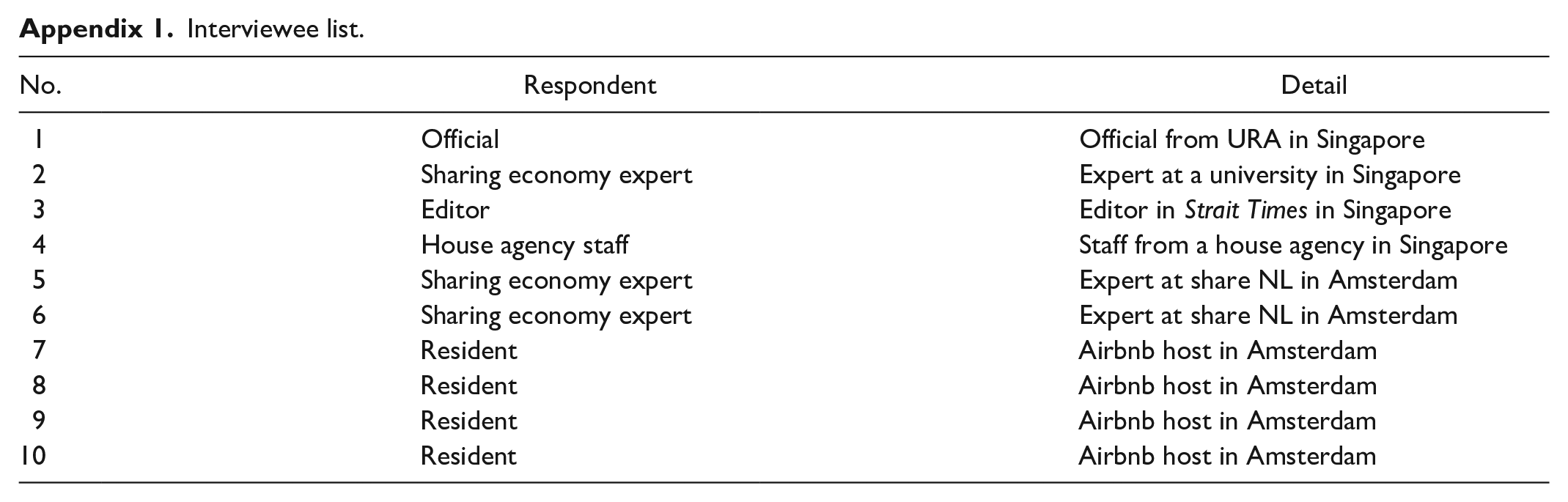
| No. | Respondent | Detail |
|---|---|---|
| 1 | Official | Official from URA in Singapore |
| 2 | Sharing economy expert | Expert at a university in Singapore |
| 3 | Editor | Editor in Strait Times in Singapore |
| 4 | House agency staff | Staff from a house agency in Singapore |
| 5 | Sharing economy expert | Expert at share NL in Amsterdam |
| 6 | Sharing economy expert | Expert at share NL in Amsterdam |
| 7 | Resident | Airbnb host in Amsterdam |
| 8 | Resident | Airbnb host in Amsterdam |
| 9 | Resident | Airbnb host in Amsterdam |
| 10 | Resident | Airbnb host in Amsterdam |
Declaration of Conflicting Interests
The author(s) declared no potential conflicts of interest with respect to the research, authorship, and/or publication of this article.
Funding
The author(s) disclosed receipt of the following financial support for the research, authorship, and/or publication of this article: The authors received funding from the National Philosophy and Social Sciences Office of China (grant No: 20BZZ036)
