




Abstract
This paper aims to investigate the behavioral intention to adopt blockchain technology (BC) in Pakistan’s operation and supply chain management. A conceptual framework is developed by extending the unified theory of acceptance and use of technology (UTAUT) model, incorporating technology readiness, technology affinity, and trust. The model was empirically examined using 198 responses from an online survey directed by a Pakistan operation and supply chain professionals. The proposed model is tested using Smart PLS. The empirical results suggest that BC adoption is positively influenced by facilitating condition, social influence, effort expectancy, technology readiness, and technology affinity, while performance expectancy and trust negatively influence BC to adopt. This research contributes to the advancement and stimulation of blockchain technology acceptance behavior in supply chains and significant managerial implications that could be more meaningful for developing economies.
Introduction
With the unprecedented challenges that the operations and supply chain management (OSCM) sector is experiencing (Chowdhury et al., 2022; Ivanov & Dolgui, 2021), organizations are encouraged to adopt key technology to meet hindrances lift results, and achieve competitiveness. These challenges are due to the increasing proliferation of information and communication technology (ICTs), mainly in the 4.0 period of industry, as among the leading highly innovative innovations lately is Blockchain (Koh et al., 2019). Also called Blockchain Technology (BCT), several market structures are fundamentally revolutionizing (Dolgui et al., 2020). Blockchain technology is a hierarchical directory that impacts production systems and supply chains (SCs) (Pournader et al., 2020; Queiroz et al., 2020). Blockchain Technology has recently been developed to provide greater control and accountability of transactions in SCs (Pilkington, 2016). BCT is a decentralized database that stores transaction data in blocks. These blocks are chronologically attached to create a chronological chain and are exchanged with all participatory bodies and diffused to each other (Underwood, 2016). This architecture’s advantage is the greater traceability and defect and can overcome confidence in the traditional supply chain (Kshetri, 2018). A significant number of practitioners and scholars have been interested in the potential of blockchain technology to change SCs and development processes (Alazab et al., 2021; Dolgui et al., 2020; Pournader et al., 2020; Vatankhah Barenji et al., 2020; Y.-M. Wang et al., 2010). In this respect, there is a considerable discussion on the introduction of new technology in the light of the latest literature on technological adoption (Shin et al., 2018; Yeh & Chen, 2018), particularly in developing economies (Ahmadi et al., 2018; Karamchandani et al., 2020; Queiroz et al., 2021), and in supply chain management context (Kamble et al., 2019; Wamba et al., 2020; L.-W. Wong et al., 2020). For example, Raut et al. (2018) disclosed that trust, management style, technological advancement, risk assessment, and perceived risk in IT security affect cloud computing adoption within the Indian background. Similarly, Ahmadi et al. (2018) revealed that system affiliation, mimetic pressure competitors, normative pressure, and employees’ information system knowledge affect the adoption of information systems by hospitals in Malaysia. In another study, Kamble et al. (2019) discovered that usefulness, attitude, and perceived behavior control are indispensable factors for blockchain technology acceptance and adoption in India. Though BC is in its emerging phase, BCT has several benefits over conventional supply chains and will transform the way purchases are carried out in a revolutionary way (Tapscott & Tapscott, 2017). It is reported that BCT’s different features can boost one-third of the most typical supply chain operations (Camerinelli, 2016). Thus, Blockchain in supply chain management (SCM) has also been studied from various perspectives (Chowdhury et al., 2022; Li et al., 2020; Rahmanzadeh et al., 2020; Wamba et al., 2020). For example, in industries such as transport and logistics, blockchain-enabled SCM has been studied (Koh et al., 2020; Pournader et al., 2020), manufacturing (Aghamohammadzadeh & Fatahi Valilai, 2020), sustainable SCs (Dubey et al., 2020), global trade (Chang et al., 2020), etc.
Regardless of blockchain technology’s increasing importance and development, particularly concerning individual behavior in supply chains (Queiroz et al., 2020). Hence, evaluating the variables affecting BT’s acceptance is of paramount interest to speed up its implementation further (Queiroz et al., 2020). Some studies have used the UTAUT model (Alazab et al., 2021; Queiroz et al., 2020). We intend to utilize this model and expand on this area’s discussion to explore the factors influencing BC technology adoption in SCs. We also add nuance to the research area that incorporates trust, technology readiness, and technology affinity as enhancing constructs to predict for more effective assessment of BC adoption, especially in developing economies, particularly Pakistan. Besides, a better acceptance of blockchain technology usage by various industries, particularly in OSCM, is still vital. Furthermore, a detailed assessment of the behavior underlying blockchain technology acceptance is needed, analyzing this new technology’s extremely competitive ability (Queiroz et al., 2020) and its unparalleled influences on SCs (Dolgui et al., 2020).
To bridge this gap, the novelty of this study aims to identify and gather insights into the driving factors of BCT adoption behavior in the Pakistan OSCM context. Thus, our fundamental research questions RQ (1) What are the deriving factors of acceptance of blockchain technology in Pakistan’s operations and supply chain management (OSCM)? RQ (2) Among factors, which has a stronger relationship to adoption intention? Since BCT is a relatively new technology, IT adoption theories are an appropriate method for understanding the actions taken by those who could embrace it in the supply chain setting. Thus, we build on the UTAUT (Venkatesh et al., 2003) to answer the above questions as a fundamental model for understanding blockchain adoption behaviors. Moreover, the proposed model also has the backing of pivotal research in the growing body of BCT and supply chain literature. We employed the partial least squares structural equation modeling technique (PLS-SEM) (J. F. Hair et al., 2016) and used data gathered in a Pakistan OSCM setting. This research contributes significantly to OSCM and production research by developing and testing a modified UTAUT applicable to BCT in emerging country supply chains.
This paper is organized as follows: In Section 2, we present the theoretical background, including the BCT introduction, the integration of BCT with SCM, and the UTAUT model. Section 3 is dedicated to introducing the hypotheses and the proposed research model. Section 4 draws the methodology adopted, followed by data analysis and findings in Section 5. Section 6 highlights the discussion, showing implications for theory and practice. Finally, Section 7 presents the main conclusions and limitations.
Literature Review and Hypotheses Development
Blockchain Technology
The Blockchain is an intermediate peer-to-peer exchange network that needs no external party. Blockchain technology (blockchain technology) first emerged in the cryptocurrency market (Nakamoto, 2008). These emerging technologies’ notable characteristics are that they work on top of the Internet Protocol and record transaction data in an unchangeable and reliable way by using encryption technologies and decentralized applications of agreement among a community of shared users (Tapscott & Tapscott, 2017). Each platform consumer should first be linked through a point-to-point network, each obtaining two codes: A public key for anyone to use while sending and receiving data and a private key to read a text—for example, registering transactions Blockchain. The transaction is registered and reported on a private key whenever a payment is conducted out. This requires verification and would not decrypt if a problem occurred through processing. Other network consumers who have gained the signed transaction may check their authenticity before transmission to partners. A consensus mechanism organizes the payments by time signposted blocks by mineral nodes. Consequently, blocks are transmitted to the network and may be checked to comprise legitimate transactions and reference a previous hash-based chain block. The block inserted onto the Blockchain would then be effectively tested. A blockchain is a network of time-stamped cryptographically related blocks (Fernández-Caramés & Fraga-Lamas, 2018). They are eternal and tested utilizing optimization and transparency protocols until bound in one chain (Swan, 2015); The monitoring mechanism, along with encryption strategies, successfully safeguards the data from unauthorized accessibility (Y. Wang et al., 2019) And then the “trust” in the Blockchain is coded (Gaehtgens & Allan, 2017) removing verification from third parties. Blockchains could be commonly classified: based on the form of access mechanism:
1: Permissionless Blockchain: In this Blockchain, any transfer is public, and no authorization is necessary until consumers are allowed to read, upload transfers and engage in the collaboration phase. Users stay confidential and are enabled by a reward system to join.
2: Permission Blockchain: Links to and inclusion in the Blockchain should be followed by invitation, supervised by a group or a specific group. Several blockchain applications are enabled to monitor which consumers transfer money or execute payment systems (codes that are automatically activated when requirements are fulfilled) inside blockchains, or a private blockchain can be implemented on a blockchain-free basis. Several research studies are about leveraging blockchain technologies and how they might bring significance to SCs. Fortunately, blockchain acceptance is only in its infancy. As described in the previous section, academic analysis examined and explored conceptually how Blockchain would achieve SCs goals and objectives, but few have focused on the developing countries.
Blockchain Technology Integration With Supply Chain Management
Like other fields, SCM is still not a standard concept with a universally recognized definition. Stock and Boyer (2009) presented an appropriate definition in which they stress the significance of handling the interactions throughout the various network participants, which is feasible when addressing the mobility of resources, services, finance, etc. Nevertheless, it often extracts demand from all investors, including consumers and vendors. Also, SCM has been analyzed with distinctive yet contrasting perspectives (Carnovale & Yeniyurt, 2015). SCM may be seen as a platform as per the different defined outlooks; a dynamic adaptive structure; a subjective viewpoint based on the device; and a network that could be broken into specific organizations (i.e., vendors, focused company, end-user) and supporting organizations (financial organizations’, transportation, etc.). SCM could have been used as an environment where the focus participants could limit the apparent world views. It must be noticed that perhaps the transparent background of the focal organization differs across edges based on the gap (physical, cultural, core proximity) among angles (Carnovale & Yeniyurt, 2015).
In this framework, SCM systems generally have multiple participants, making associations quite dynamic. This leads to the remarkable digital transformation of SCs (Aslam et al., 2021; Queiroz et al., 2019). Blockchain technology can challenge all business models in SCM yet allow additional dynamism and accessibility feasible. Recently, however, blockchain technology has haggard the interest of mutually researchers and practitioners (Fosso Wamba et al., 2020; Isaak & Hanna, 2018; Koh et al., 2020; Kshetri, 2018; Pournader et al., 2020; Rahmanzadeh et al., 2020), In the area of SCM. While many companies are now implementing blockchain technology for certain practices, SCM activities implementing blockchain technology are new (Kshetri, 2018). The blockchain literature has incorporated the term “operation” supply chain (OSCM) (Choi & Luo, 2019; Wamba & Queiroz, 2020). to illustrate the many procedures that are now done owing to blockchain implementations in the SCM field (e.g., traceability of goods, sharing of data, purchases, etc.). Incorporating blockchain technology in OSCM could be numerous advantages in this context. For example, product tracking is dramatically enhanced; in sectors like the wine industry, substance spoilage and money laundering have been tackled due to blockchain technology (Biswas et al., 2017). So it continues for the food sector, where blockchain technology has a standard OSCM food tracking (Dwivedi et al., 2022) associated with improved protection and straightforward quality control of a single product’s whole path through the chain. Furthermore, blockchain technology will improve product traceability and accountability systems (Bai & Sarkis, 2020).
Blockchain technology has demonstrated excellent assistance in plenty of other OSCM settings. Most lately, as Dubey et al. (2022) discussed the influence of blockchain technology throughout the humanitarian supply chain (HSC), they illustrated their profound role in enabling emergency relief operations by exploiting SC stakeholders’ cooperation in a quick and decisive. A fascinating model incorporating blockchain technology, AI (artificial intelligence), and 3D printing for HSC was suggested (Rodríguez-Espíndola et al., 2020). Blockchain technology has also been investigated in worldwide SCM and global trade and transaction processes (Yoon et al., 2020); it was also discovered to make a significant contribution to promoting and guaranteeing trust among both manufacturer suppliers and consumers in the network operations for real estate in SCMs (Choi et al., 2020). Besides, earlier studies worked to affirm the potential gains of this implementation to recognize many of the critical advantages of blockchain technology in SCM domains (Tozanlı et al., 2020; Yoon et al., 2020). Authors emphasized the benefits, as mentioned earlier, of blockchain technology: greater accountability in purchases and processes (H. Kim & Laskowski, 2017), accountability and trust (Vatankhah Barenji et al., 2020), information security (Tian, 2017), Stopping fraud (Chen, 2018), transparency (Biswas et al., 2017; Q. Lu & Xu, 2017), operational performance (Aste et al., 2017), a significant decrease of cost (Kshetri, 2018), and some others. The available research has only resolved blockchain technology acceptance problems in the SCM area, considering such advantages (Kamble et al., 2019; Wamba et al., 2020; L.-W. Wong et al., 2020).
Choice of Theory
Viewing the existing literature, recent years witnessed a series of theoretical models for technology adoption, including “Theory of Reasoned Action (TRA) (Fishbein & Ajzen, 1977),”“Theory of Planned Behavior (TPB) (Ajzen, 1991),”“Task Technology Fit (TTF) (Goodhue & Thompson, 1995),”“Unified Theory of Acceptance and Use of Technology (UTAUT) (Venkatesh et al., 2003),” and “Technology Acceptance Model (TAM) (Davis, 1989).” Among them, many scholars used the UTAUT to examine user behavioral intention (BI) and the actual use of technology (Venkatesh et al., 2003). Numerous studies on the acceptance of blockchain technology have included different variables in the UTAUT. This, in turn, has evolved in various variables and a tremendous number of expanded UTAUT frameworks in the context of blockchain technology acceptance (Pieters et al., 2022). As a result, it is thought that a comprehensive modified UTAUT model is required for blockchain acceptance.
The UTAUT is a popular framework that has been applied in many types of research, including the implementation of a modern IT system, and has prompted scholars to introduce specific improvements to the initial model. UTAUT, for instance, has been introduced along with network theory to clarify the reasons for using Blockchain in the SCs, both Indian and USA practitioners (Queiroz & Fosso Wamba, 2019). Similarly, TAM factors such as PU and PEOU, which have the same characteristics as PE and EE, are also used to determine the intention of using Blockchain technology in supply chains (Kamble et al., 2019). A variable like PEOU was considered to explain the spontaneous willingness to accept cryptocurrencies (Spenkelink, 2014). These scholars have analyzed its robustness experimentally as a technique to comprehend the adoption and usage of one’s technology in industries in diverse institutions, regional areas, and implementations. Besides the uniqueness of UTAUT, several factors would contribute to a less favorable assessment of the adoption of technology through exclusion (Ooi & Tan, 2016) and, therefore, must be expanded (C.-H. Wong et al., 2015). Based on the review of UTAUT’s application in previous technology acceptance contexts, therefore, we established to adapt PE, EE, SI, and FC from the UTAUT and borrowed technology readiness, trust, and technology affinity (Kamble et al., 2019; Larasati & Santosa, 2017; Pattansheti et al., 2016), as the additional independent variables in our research framework, to determine the intention of OSCM adoption. Table 1 represents the summary of a research article that has used UTAUT, technology readiness, technology affinity, and construct such as trust to evaluate technological acceptance in the past as a precedent for determining the acceptance of evolving intention technologies, several of which are associated to BC technology.
Demographics Profile of Respondent.

Research Model and Hypotheses Development
A significant and prolonged research discussion in information system research is how the application of information systems can be efficiently explained (DeLone & McLean, 1992). Researchers have proposed different IS/IT frameworks to understand the adoption and usage of users’ IS. UTAU has been found consistently in many literature reviews’ topmost analytical lens to analyze the acceptance of technologies. As mentioned earlier, this study integrates technology readiness, technology affinity, and trust constructs in the UTAUT model in light of the literature. Accordingly, the model consists of seven factors drastically influencing blockchain technology’s behavioral intention. Besides, UTAUT frameworks were effectively used to predict the intention of using Blockchain in SCs.
All the findings above encourage the development of a research model, which is presented in figure 1.

Proposed research model.
Facilitating Condition (FC)
FC is distinct as “the level to which an individual trusts that a structural and practical infrastructure exists to support the use of the system” (Venkatesh et al., 2003). In earlier research, FC was shown to affect BI and technology’s adoption significantly and positively. User access to an adequate FC set, such as hardware/software, technical support, online tutorials, and online demonstrations, is essential to developing the intention to use. Regarding blockchain technology, organizational assistance will impact facilitating conditions (Francisco & Swanson, 2018), IT infrastructure, cloud storage, Internet speed, etc. FC is considered a substantial predictor of blockchain technology. In SCM with blockchain technology, it is projected that FC will likely influence the behavioral intention to implement blockchain technology. It is also necessary to significantly increase professionals’ effectiveness, reliability, and success. Therefore, in Pakistan’s context, we propose that users need sufficient facilitating conditions to plan to use this emerging technology. We advocate the subsequent hypothesis:
Performance Expectancy (PE)
Venkatesh et al. (2003) theorized that PE is “the degree to which the user can trust that using the technology will help overcome difficulty and help him/her achieve the desired goal in job performance.” If the technology brings benefits that will contribute to service adoption (Tojib & Tsarenko, 2012) and in various previous research, it has been reported that PE affects the acceptance of new through diverse technical domains. Practically, the beneficial effect of FC on usage behavior regarding blockchain technology in the SCM domain has been supported by many studies (Queiroz et al., 2020). In SCM with blockchain technology, performance expectancy is assumed to influence the behavioral intention of implementing blockchain technology. Thus, the argument given encourages the development of the subsequent hypothesis:
Trust
Mayer et al. (1995) demarcated trust as a “willingness to rely on exchange partners where one has confidence.” The impact of trust in behavior was also observed to have a significant variable (Slade et al., 2015). Trust is a fundamental belief that the trusted group must meet the confidant’s responsibilities and suggest they are susceptible to risk to satisfy their needs (Y. Lu et al., 2011). Trust is the subjective conviction that a group satisfies its commitments, which performs a critical role in electronic financial transactions where consumers are subjected to more significant risks due to environmental volatility and a feeling of lack of responsibility (Y. Lu et al., 2011; Zhou, 2013). Trust plays a crucial role in deciding potential behavior between two parties or partnerships and building interpersonal and commercial interactions (McKnight & Chervany, 2001; Sharma & Sharma, 2019; Waseem et al., 2018). Current literature has addressed its capacity to foresee BI to implement a technology (Alalwan et al., 2017; Raut et al., 2018). If SCM is a leading blockchain technology store, the trust may provide greater accountability and obligations amongst the supply chain (Kshetri, 2018). Even though SCM trust’s dynamic complexity, a guaranteed degree of payment safety will encourage blockchain technology to create trust in the SCM system and strengthen it (Aste et al., 2017). Because blockchain technology renders payments unchanged, arbitration is removed, and therefore a particular type of reality is accepted (Aste et al., 2017). Hence, it is hypothesized that:
Social Influence (SI)
Social Influence is nothing more than how a person’s perspective is influenced by the like or disliking of their environment (Saprikis et al., 2020). In the technology context, the effect is called social influence. SI has been enlightened as “the degree to which an individual sees other important [people] believe he/she should use the new system” (Venkatesh et al., 2003). SI has been adequately considered and confirmed as a predictor of personal behavior (Zuiderwijk et al., 2015). In a study conducted in South Korea, the author concluded that SI was noteworthy and noted that it serves as a vital foundation for BI (K. K. Kim et al., 2011). Recently published work also supports and explains the positive effect of social influence on behavior intentions to adopt blockchain technology (Queiroz et al., 2020). This research empirically supports the strong association between SI and BI. Henceforward, we develop the subsequent hypothesis:
Effort Expectancy (EE)
EE is “the extent of ease connected with the use of a system” (Venkatesh et al., 2003). Consumers are generally motivated to accept new technology if they feel it will benefit and reward them daily (Ali et al., 2016). Martins et al. (2014) investigated the significant impact of effort expectancy on BI. Different researchers have shown the positive influence of EE on technology adoption and consider it a critical component of behavioral intentions to embrace new technology in a variety of studies such as healthcare supply chain management (Chong et al., 2015), humanitarian supply chain (Kabra et al., 2017) and manufacturing (Ooi et al., 2018; Schniederjans, 2017). In a study conducted in Brazil on adopting blockchain technology in SCM settings, UTAUT was used. The author found that facilitating conditions, social influence, and personal innovativeness in information technology are key factors affecting behavior intentions to adopt Blockchain. In contrast, performance expectancy did not substantially affect performance (Queiroz et al., 2020). Accordingly, we postulate the resulting hypothesis:
Technology Readiness (TR)
TR is described as “the tendency of individuals to implement and adopt modern technology to achieve residence or workplace objectives” (Parasuraman, 2000). In the background of this research, TR has the considered necessary structure and trust to accomplish work in SCM. TR has been investigated in previous research extensively like the airline to online retailing (Vize et al., 2013), internet movements (Borrero et al., 2014), and SST adoption (Lin & Chang, 2011). TR relates to understanding the technology’s application to enhance efficiency; a favorable awareness is an enhanced BI since the consumer is readier to use the technology (C.-H. Wong et al., 2016). Findings from varying research that has combined TR with different model adoption technologies have reliably shown a good relationship with TR. Sustainable SCM finds technological excellence and flexibility relevant (Kusi-Sarpong et al., 2019). Henceforward, the following is hypothesized:
Technology Affinity (TA)
TA refers to a person’s tendency to participate actively or technology aversion in managing the technology; and is regarded as a unique resource to cope with technology successfully (Franke et al., 2019). Early research has found that a primary determining factor of a broad, diverse array of technological acceptance is the attitude regarding technology (Modahl, 1999; Teo & Zhou, 2014); Higher-affinity people are characterized as more ambitious with the dynamic stretching and enthusiasm spent (Attig & Franke, 2019; Edison & Geissler, 2003). In the framework of OSCM, fundamentally, people who display positive attitudes against technology would be influenced to learn understanding and usage of technology. The more talented a person is in a specific technology, the lower the anticipated perceived effort and the greater the efficiency. Collaboratively, it is considered that the person is more technically oriented for acceptance. Thus, we posit the following hypothesis:
Methodology
Research Flow and Process
Figure 2 shows the current study’s research flow and process, including data collection, measurement of construct development, and data analysis.

Research flow and process.
Sampling and Questionnaire Administration
As the study is engrossed in Pakistani OSCM, a questionnaire pretest was directed to supply chain experts, particularly those specializing in supply chains. A pretest eliminates ambiguity, lack of clarity, and flexibility in developing questionnaires to ensure they are entirely intuitive and direct for the participant. A professional data collector administered the questionnaire. To test the hypotheses, we used a questionnaire to survey Pakistan’s OCMS professionals from three different cities (Lahore, Karachi, and Islamabad), and the respondents were OSCM professionals. Although our concern is linked to the purpose of the OSCM Blockchain’s adoption behavior, all forms have been addressed. Accordingly, we surveyed to collect OSCM professionals’ sentiments and understandings of their intentions to implement blockchain technology. This quantitative research comprises an online data collection sample. Online surveys offer advantages like time-saving and costs by eliminating regional distances. The online survey was generated to explore the association among frameworks introduced in the proposed research model. Data were collected via social network sites (Email). The email provided the detail of the survey, and the purpose of conducting the research was explained. It is vital to emphasize that participants still have not adopted any blockchain technologies and that their understanding of the subject is mainly focused on numerous non-technical references (e.g., media, adoption/implementation research by technology discovery professionals). A sample of 400 questionnaires was circulated via email, and 215 were received, of which 17 responses were not measured for inadequate information. A total of 198 (49.5%) completed questionnaires were used for further analysis.
The respondents’ demographic profile is presented in Table 1. Regarding the age distribution, most participants fell in the age brackets 43 to 50 (28.30%) and more than 51 (24.2%). As for gender distribution, the male represented 69.2% of the responses. Regarding education, the highest level was graduate, which accounted for almost half of the respondents (45.5%), followed by undergraduate (34.8%). When classifying respondents by years of professional experience, we have those with 2 to 6 years of experience achieved (35.4%), followed by those with less than 1 year (20.2%).
Instrument Development
The seven constructs in the current research (PE, EE, SI, FC, Trust, TR, TA, and BI) were measured using a multiple-item perceptual scale based on previously validated instruments from previously published research but formulated to fit into the context of Blockchain. The measurement items, for example, PE, EE, SI, FC, Trust, TR, TA, and BI, were based on earlier studies (Alalwan et al., 2017; Franke et al., 2017; Ooi & Tan, 2016; Slade et al., 2015; Venkatesh et al., 2003, 2012; L.-W. Wong et al., 2020). Performance expectancy and effort expectancy were both operationalized using four-four questions. The social influence was operationalized using three questions, and the facilitating conditions were operationalized using four questions. Similarly, trust was measured using four questions. The technology readiness was measured using four questions, technology affinity was operationalized using three items, and the behavioral intention was operationalized with four items. All these 30 were tested on a scale of 7-Likert points.
Results
The PLS-SEM was applied to evaluate and validate the construct and to assess the hypothesized model. PLS-SEM is an integrated modeling technique that enables researchers to determine the relationships among variables and the reliability and validity of any research framework (J. F. Hair et al., 1998). Furthermore, PLS selection explains that it does not need a distribution assumption, whereas SEM considers a normal data distribution. The PLS-SEM is a multivariate software used in the various functional area of management (Lee et al., 2011), marketing (J. F. Hair et al., 2012), and operation management (Peng & Lai, 2012). PLS-SEM is valuable for empirical studies and exploratory studies. Scholars commonly use the technique where the data is non-normal and small sample size (Reinartz et al., 2009). In this study, we apply this new simplified variance-based SEM approach, PLS (J. F. Hair et al., 2016; Nitzl & Chin, 2017), instead of SEM-based on traditional covariance (CB-SEM) (Jöreskog, 1979). PLS-SEM has been demonstrated to be an appropriate technique for analyzing data on emerging topics (Mital et al., 2018; Shin et al., 2018), as was the case here with data from supply chain Professionals blockchain technology to investigate the adoption behavior and adoption in Pakistan. Accordingly, as our research is an explorative type to explore blockchain technology in Pakistan’s supply chains, PLS-SEM certainly seems to be an appropriate approach.
Measurement Model
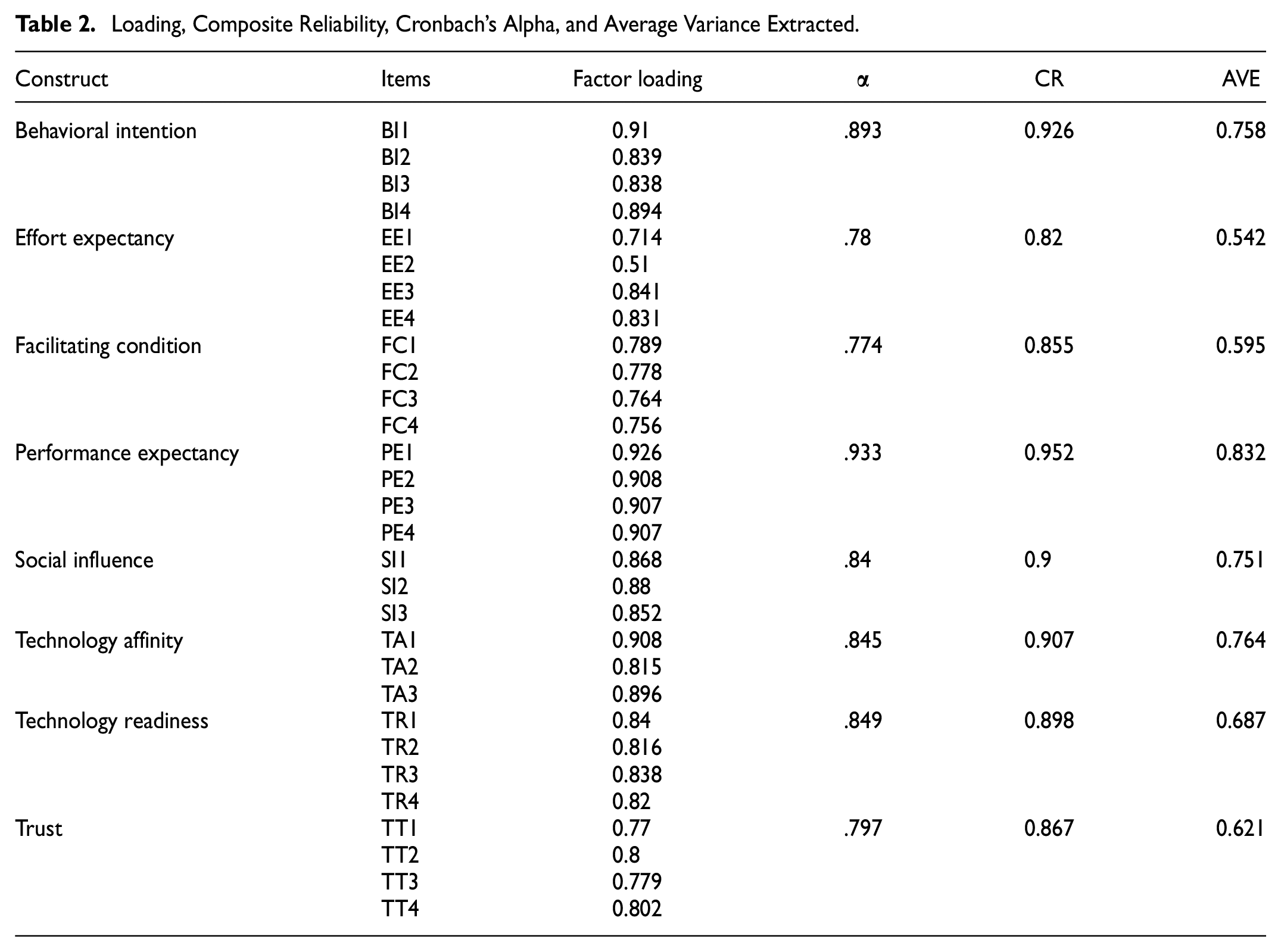
The proposed model has been evaluated using CFA (J. Hair et al., 1998). We measured the proposed model in terms of composite validity, average variance extracted, and Cronbach’s alpha. The PLS algorithm was performed to estimate the outer loads for each construct. Table 2 highlight the results of composite validity, and Cronbach’s alpha constructs’ loadings have crossed the recommended threshold of .7 (J. F. Hair et al., 2016; J. C. Nunnally & Bernstein, 1978), and the AVE variance outperformed the .5 thresholds (J. F. Hair et al., 2014, 2016). CFA results disclose that each item loading factor is more significant than .7. As shown in Table 2, CFA results meet the cut-off value of CA, CR, and AVE, which were more than 0.7, 0.7, and 0.5, correspondingly indicating good convergent validity (Fornell & Larcker, 1981; J. Hair et al., 1998; J. Nunnally & Bernstein, 1978).
Loading, Composite Reliability, Cronbach’s Alpha, and Average Variance Extracted.
Finally, the discriminant validity was tested to determine whether the variable’s measures differed from other variables. Following Gefen and Straub (2005), we have used two approaches to evaluate the discriminant’s validity. As Fornell and Larcker (1981) indicated, we calculated DV by associating the relationship between variables and the AVE of all the constructs. Table 3 demonstrates that the AVE square root for all constructs is overhead the correlation values and shows adequate validity. Secondly, we analyzed the items loading and cross-loading, as presented in Table A (Supplemental Appendix). The study found that the item’s loading value was more significant than the cross-loading of other variables that displayed positive discriminant validity. Third, the Heterotrait–Monotrait Ratio of Correlations (HTMT) was also exploited to evaluate the DV (Henseler et al., 2015). Thus, the result of HTMT in Table 4 simplifies the sufficient discriminant validity.
Discriminant Validity.

Note. BI = behavioral intention to adopt; EE = effort expectancy; FC = facilitating condition; PE = performance expectancy; SI = social influence; TR = trust; Tech R = technology readiness; TA = technology affinity.
HTMT Results.
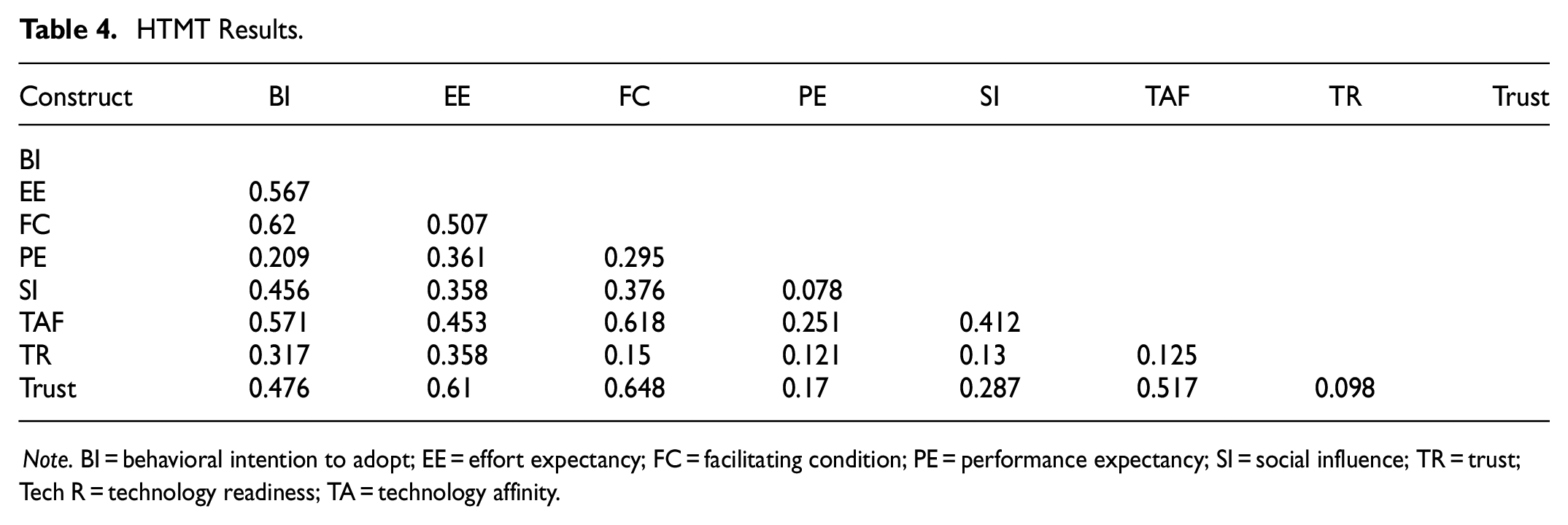
Note. BI = behavioral intention to adopt; EE = effort expectancy; FC = facilitating condition; PE = performance expectancy; SI = social influence; TR = trust; Tech R = technology readiness; TA = technology affinity.
Common Method Biases
Although the questionnaire has been assembled using a self-reporting technique, common bias may become a problem to the validity of the findings. The present study uses the Harman single factor test (Podsakoff et al., 2003). Statistically, if a single factor represents 40% or more, it might be CMB in the dataset. In the present research, all the elements have been loaded and fixed on factor 1; the total number of explained variances results were lower than 40% and 38.45%. Therefore, it is concluded that the current data are free of CMB.
Structural Model Results
A standardized path examination has tested the hypothesized associations between the variables (Henseler et al., 2009). The direct and indirect effects dependent on the independent construct have been studied and offer practitioners potential outcomes, apropos the relationship between variables. The results are obtainable in Table 5. To estimate the significance level (Ringle et al., 2015), We performed the bootstrap method with the resampling of2,000 times, which gives the most desired results with zero change (J. F. Hair et al., 2016). All seven hypotheses were tested, and two hypotheses were found insignificant. The result in Table 5 presenting that FC positively influences the BI to adopt blockchain technology (ö = .242, p < .001), SI→ BI (β = .19, p < .009), EE→ BI (β = .156, p < .049), TR → BI (β = .174, p < .003) and TAF→ BI (β = .205, p < .008). These results indicate that H1, H3, H4, H4, H5, H6, and H7 hold for positively influences the behavioral intention to adopt blockchain technology. Similarly, PE (H2) (β = .008, p < .878) and Trust (H3) → BI (β = .063, p < .428), did not significantly impact the BI to adopt the technology.
Hypotheses Testing.

Note. BI = behavioral intention to adopt; EE = effort expectancy; FC = facilitating condition; PE = performance expectancy; SI = social influence; TR = trust; Tech R = technology readiness; TA = technology affinity.
p < .001. **p < .01. NSp > .05, respectively.
Second, PLS-PM aims primarily at testing the predictive power and core constructs of the developed framework; Thus, it is essential to evaluate the structure model by assessing the construct’s coefficient value R2, as stated by J. F. Hair et al. (2016), demonstrating variations in the proposed research model’s constructs as presented in Figure 2. Overall variance in the proposed research model was measured at 45%, influencing the behavioral adoption of blockchain technology (R2 = .454, demonstrating the extrapolative power of the variation demonstrated by independent variables. Finally, J. F. Hair et al. (2016) indicated that the blindfolding technique was used to measure cross-validated redundancy Q2. J. F. Hair et al. (2016) advised using Q2 to confirm any research model’s predictive power. If the endogenous construct significance of Q2 is supportive (more than zero), it clearly shows that the model adaptability is adequate and appropriate (J. F. Hair et al., 2017). We got a Q2 = 0.33, which indicates that the model is predictable.

Discussion
This research extended the UTAUT model to comprehend better the logic for blockchain adoption among OSCM professionals in Pakistan. Empirical findings showed the model’s significance. The theory and practical implications of the study’s findings on the factors influencing blockchain adoption were discussed.
Implication for the Theory
Our research has significant implications and contributions to the theory of OSCM. In the disciplines of operations, production, and supply chain, blockchain has been the focus of a small number of empirical research (Choi & Siqin, 2022; Gökalp et al., 2022; Wamba & Queiroz, 2020), especially as regards BCT adoption (Aslam et al., 2021). Our research has successfully developed and validated an expanded and modified UTAUT model to examine fundamental factors of BCT adoption in OSCM (Venkatesh et al., 2003), including the trust, technology affinity, and technology readiness construct in the Pakistan OSCM context. Regarding the experimental findings, most are compatible with and even similar to those of other research that explored BCT adoption in the SCM environment (Queiroz et al., 2020; L.-W. Wong et al., 2020) on blockchain adoption in other representative emerging economies, namely Malaysia and India). Moreover, the subsequent studies used facilitating conditions (H1) in technology adoption (Hew et al., 2015; Rana et al., 2017; Venkatesh et al., 2003, 2012). Our model demonstrated that facilitating conditions significantly influenced the behavioral intention to accept a technology (in this case, BCT). In this manner, it implies that both the organizational infrastructure and IT determine the expectancy of OSCM professionals. The social influence (H4) construct was an excellent indicator of the behavioral intention to accept BCT (Sung et al., 2015). This result indicates that coworkers (colleagues) impact blockchain adoption behavior in the Pakistan OSCM setting. Alternatively, this conclusion is consistent with prior findings involving SCM in India, another growing representative economy. (Wamba & Queiroz, 2020). The technology affinity (H6) and technology readiness (H7) were proved to be a good predictor of behavioral intention. Our result also supports the results of the earlier study (L.-W. Wong et al., 2020), which found a positive relationship between technology affinity and the acceptance and adoption of BC technology in the context of Malaysian BCSCM. Similarly, trust (H3) is expected to considerably affect the prediction of the behavioral intention to adopt blockchain in the OSCM context. However, our findings on trust did not match the result of Queiroz et al. (2020) for blockchain adoption in the Brazilian OSCM field. Contrary to other research on the effectiveness of performance expectancy (H2) in determining directly the behavioral intention to adopt a technology, this study demonstrates that effort expectancy does not directly predict behavioral intention (Makanyeza & Mutambayashata, 2018; Maruping et al., 2017; Venkatesh et al., 2003). Interestingly, we discovered a considerable negative impact of performance expectancy on blockchain adoption in Pakistan OSCM. This unexpected result is in line with a recent study on blockchain adoption in OSCM in Brazilian (Queiroz et al., 2020) and other contexts, like intention adoption for contact tracing app adoption (Duan & Deng, 2021). This is one of Pakistan’s first studies on adopting OSCM blockchain technology to describe this unusual behavior. Based on these findings, it appears that supply chain operators in Pakistan cannot implement BCT only due to its promise of increased productivity. Moreover, the data demonstrated that effort expectancy (H5) directly influences BCT adoption. In other words, the ease-of-use BCT facilitates its widespread acceptance. Given the surprising finding about performance expectancy and trust, this factor seems to be a potential barrier to BCT adoption among Pakistan OSCM professionals. In addition, following recent research on blockchain adoption in the supply chain management sector in developing economies (Queiroz et al., 2020; L.-W. Wong et al., 2020), It is obvious that differences in country particularities (such as culture) might influence the outcomes of a study. As such, our result on performance expectancy and trust, which we identify as a probable strong barrier, shows the possibility of additional productivity-related characteristics that might hamper BCT adoption in the Pakistan OSCM environment. Recent research (Saberi et al., 2019) highlighted these and other possible impediments as challenges to BCT adoption. Ultimately, national conditions or idiosyncrasies may raise or decrease the significance of specific factors examined for BCT adoption. This discovery has intriguing theoretical implications that will be addressed in the future. In addition, we argue that the adoption intention behavior might vary among industries within the same country.
Implication for Practice
This study’s results provide valuable insights and implications for OSCM, production managers, practitioners, decision-makers, and all those engaged in implementing any innovative technology, including BCT. Our research demonstrated that although the infrastructure is seen as a barrier by many developing countries, facilitating conditions in Pakistan’s supply chains favorably promotes blockchain adoption. This finding shows that managers should spend extensively on organizational competencies and infrastructure (e.g., internet speed, cloud services, SCM integration, and training). Similarly, the significant effect of technology readiness and technology affinity should be a focus of attention for managers and OSCM practitioners. This indicates that the BI focuses on whether a company has the necessary infrastructure, resources, and critical personnel enthusiastic about discovering different technologies. The reluctance to switch to new systems, the lack of tools for implementing BC, the difficulty in altering culture, and the flawed view of BC have been investigated as barriers to its adoption (Saberi et al., 2019). This implies that firms wishing to explore the potential of OSCM must first overcome the low level of knowledge on BC and establish the necessary competence, interest, environment, and trust for effective implementation. Similarly, social influence by supply chain members has a favorable impact on BCT adoption, and effort expectancy for BCT has a beneficial effect on supply chain operations; consequently, OSCM and production managers must thoroughly comprehend these relationships. Finally, performance expectancy and trust proved to be a hurdle in forecasting BCT acceptance. Under these circumstances, managers and practitioners need to invest (in methods or other training) to understand blockchain’s usefulness in SCM operations and the simplicity of its implementation.
Conclusion and Limitations
Although our study provides valuable information about BC adoption, the current research is not without shortcomings. Ideas for future research also arose from this research’s limitations and implications. A potential drawback of this research is the lack of empirical studies concerning blockchain technology adoption in SCM backgrounds could be one (Kamble et al., 2019; Queiroz et al., 2020; L.-W. Wong et al., 2020). Another limitation; we cannot generalize the findings to developing economies because this research is conducted explicitly in a single country. So, we recommend ongoing research that could extend our research model to other developing economies. Further research may also consider the comparative analysis between emerging economies in the context of results. Despite these limitations, the current study examined the primary determinants influencing supply chains’ adoption behavior and choice to accept/reject BC technology in emerging countries—in this case, Pakistan.
Given the absence of research on the adoption of BC and its efficacy in developing economies, the current research enhanced the well-established UTAUT model by including new factors., that is, trust, technology readiness, and technology affinity, to study the adoption of BC technology by OSCM professionals in Pakistan’s developing economy. Our research findings indicate a strong predictive power in the conceptual BT adoption model. The study found that critical constructs of EE, SI, FC, technology affinity, and technology readiness predict BC adoption intention in Pakistan’s OCSM field. Additionally, the study’s findings indicate that there is no positive correlation between PE, TT, and BI, the adoption of blockchain technology in the Pakistan OSCM context, which conflicted with the one mentioned by Queiroz et al. (2020) and L.-W. Wong et al. (2020).
Supplemental Material
sj-docx-1-sgo-10.1177_21582440231199320 – Supplemental material for Understanding Blockchain Technology Adoption in Operation and Supply Chain Management of Pakistan: Extending UTAUT Model With Technology Readiness, Technology Affinity and Trust
Supplemental material, sj-docx-1-sgo-10.1177_21582440231199320 for Understanding Blockchain Technology Adoption in Operation and Supply Chain Management of Pakistan: Extending UTAUT Model With Technology Readiness, Technology Affinity and Trust by Qingyu Zhang, Salman Khan, Safeer Ullah Khan and Ikram Ullah Khan in SAGE Open
Footnotes
Declaration of Conflicting Interests
The author(s) declared no potential conflicts of interest with respect to the research, authorship, and/or publication of this article.
Funding
The author(s) disclosed receipt of the following financial support for the research, authorship, and/or publication of this article: This research was supported by Key Project of National Social Science Foundation of China (21AGL014).

Supplemental Material
Supplemental material for this article is available online.
References
Supplementary Material
Please find the following supplemental material available below.
For Open Access articles published under a Creative Commons License, all supplemental material carries the same license as the article it is associated with.
For non-Open Access articles published, all supplemental material carries a non-exclusive license, and permission requests for re-use of supplemental material or any part of supplemental material shall be sent directly to the copyright owner as specified in the copyright notice associated with the article.
