




Abstract
Startups are key components of the National Innovation Systems (NISs) and have contributed to sustainable development in many countries. This is because of their ability to create employment opportunities and contribute to the national Gross Domestic Product (GDP). Hence, universities across the world have identified the importance of entrepreneurship training for students to help enhance their capability to develop their own startups. This study seeks to find ways of enhancing the profitability of student startups to galvanize industrial development. The approach adopted was the development of a hybrid model to optimize the development of entrepreneurship skills in university students based on existing theories and literatures. Data of 212 Korean universities were used and the results show that research fund, size of dedicated faculty, size of dedicated staff (academic and non-academic), practical entrepreneurship courses, and non-regular curriculum startup activities are key factors responsible for the profitability of student startups.
Keywords
Introduction
Startups are engines of economic development and have continued to exert their influence in the fourth industrial revolution—through creating jobs and generating profit. Startups developed by students have been proven to enhance the collaboration between universities and the industrial sector. According to H. Kim et al. (2020), startups are bridging the gap between universities and industries—through enhancing cooperation. Startups are young cooperations developed by one or more entrepreneurs to create a new product or service (SendPlus, 2022). The role of startups in sustainable development has been on the rise. Startups play an important role in the development of a vibrant entrepreneur ecosystem driving sustainable development (Bărbulescu et al., 2021). They have been instrumental in solving societal issues—through providing innovative solutions. Several factors besides the one mentioned previously are responsible for the success or failure of startups. For instance, Skawinsk and Zalewsk (2020) concluded that human capital, quality of collaboration, focus on the nature of the market, experience in doing business, and development factors—are key components that determine the success of startups.
Kofanov and Zozul’ov (2018) argued that startups are leading socio—economic transformation globally. This is because through providing solutions to global issues, startups create positive change. They are engines of global change and business growth (Startup Jobs Asia, 2022). Not only do startups provide employment, but they also bring about technological development, drive global economic growth, and lead sustainable research. Also, the role of startups in leading cooperation between the university and industry is well known. For instance, Gann et al. (2018) argued that the three ways to enhance collaboration between universities and industries is through—the transfer of technology (which maybe through startups), development of a talent pool of experts, and the inclusion of aspects of social sciences into Research and Development (R&D). However, there is little empirical evidence to emphasize this hypothesis. This study seeks to bridge this gap by providing empirical evidence through the study of universities in Korea and successful student’s startups. This is because, amongst developed countries, Korea made the transition from a developing to a developed country—fastest (Shenkoya, 2019). Hence, the results of this study will be useful to support the development efforts of the Korean government in enhancing the performance of startups. Also, the results of this study will benefit policy makers, governments, and other key stakeholders in developing and developed countries.
Theoretical Background
Today, startups are contributing to positive technological change, and leading to advanced economic development. This is evident in its contribution to economic development in many countries. Startups are one of the key components of innovation clusters, science and technology parks, and national/regional innovation systems. Hence, governments across the world—including the Korean government—are seeking for ways to enhance their performance. One of the established ways of doing this is through University—Industry (U-I) collaboration. Raphaël et al. (2020) have shown that there is no innovation without partnership which includes collaboration between universities, industrial players, startups, and research institutes. As such, this study seeks to contribute to the body of knowledge through seeking ways to improve the productivity of startups from the viewpoint of U-I collaborations.
A review of literature shows that several studies have been carried out relating to startup development and contribution to change. For instance, Shenkoya (2021) and Neamțu et al. (2020)—identify startups as key components of innovation clusters responsible for the performance of these clusters. The direct and indirect benefits of startups to the development of innovation clusters and national economies make studying factors that enhance their performance important. Several studies have identified the importance of research funds in the development and performance of startups.
Research funds are grants given to entities to conduct scientific research and is usually given through a competitive process (Neema & Chandrashekar, 2021). Singh and Subrahmanya (2020) concluded that financial funding is important for the survival, and growth of startups. While funding categories can be classified broadly as public and private, Doblinger et al. (2019) argued that the funding of universities by the government are in two forms, which includes—provision of funds for R&D to reduce the cost of research, and the implementation of policies to improve the incentives researchers can get. While government finance of startup R&D is important, R&D remains a capital-intensive endeavor that requires huge investment. As such, investment from the private sector is important to bridge the deficit. The increase in research funds for startups has an inherent benefit of improving technology transfer in a U-I collaboration (Nambiar & Balasubramanian, 2020). This study seeks to examine the effect of cumulative funding from both public and private sectors. Based on existing studies, the first hypothesis that this study will test is as follows:
On the other hand, startups created by university students get significant financial support from the university. The funds considered in this aspect are funds that universities give to startups that are not geared specifically toward research funds only, but also toward reducing development and operational cost. Little is known about the impact and relevance of this support. Collins English dictionary (2022) defines financial support as funds provided to an organization or entity to continue its operation. A study of the University of Toronto and how it supports student startup concluded that the university invested significantly in student startups through its “accelerator programs” (Breznitz & Zhang, 2019). Most of this support is geared toward education (Metcalf et al., 2020). However, other universities support student’s startups through incubators.
A study of the University of St. Francis’s College of Business and Health Administration shows that the university has an incubator program that supports student startups and community entrepreneurs (Covelli et al., 2019). Student startups require various support which can be streamlined to 20 categories. These include—core support needs (six types), secondary support needs (six types), and marginal support needs (eight types; Wang & Huang, 2020). While the impact of universities support for student startups has been shown to have a positive effect (Lu et al., 2021), the impact can be guaranteed only if entrepreneurs have a high degree of entrepreneurial skills (Blank, 2021) . A study on the role of the university in the development of startups concluded that they are not only launchpads for startups but are also avenues of entrepreneurship learning (Metcalf et al., 2020).
A study in Korea, showed that government support impacts the innovativeness and performance of startups (Choi et al., 2021). This benefit is better realized if these startups focus on entrepreneurship because entrepreneurship has a positive effect on business sustainability (Lee & Kim, 2019). While most established studies have hypothesized and theorized the impact of university funding on the performance of student startups, little empirical evidence exists to support this. This study seeks to bridge this gap by evaluating the activities of universities in Korea. Based on extant studies, the second hypothesis that will be tested in this study is as follows:
There has been a growing argument on the role of university faculty members in the performance of student startups. However, studies relating to this are few. A study on the relationship between the quality of faculty and the performance of student startups shows that the “quality of faculty” has a positive relationship with enhancing the performance of startups (Showalter & Jensen, 2019). Furthermore, a study on a startup garage and its impact on student entrepreneur in Switzerland shows that the proficiency of faculties managing the program was instrumental to the success of the startups (Citraro et al., 2020). Also, a study on the role of the university in PhD student entrepreneurship concluded that both the quality of faculty and the content of the curriculum of the entrepreneurship program were both instrumental to the performance of students in developing their own enterprise (Muscio & Ramaciotti, 2019).
While the workforce in a university is made-up of both academic and non-academic staffs, the impact of the activities of both groups on the growth and development of student startup needs to be examined in a bid to strengthen the efficiency and performance of these startups. According to Altbach & Salmi (2021), for universities to perform optimally, they must balance academic and professional management and leadership. Few studies exist that considered the relationship between the quality of university faculties, staff (academic and non-academic), and the performance of student startups, but little empirical evidence exists to solidify these claims. This study examined most of the available studies and its addition to the body of knowledge will be to provide empirical evidence on this relationship while studying universities in Korea. Hence, the third and fourth hypotheses in this study are as follows:
Within the university, various entrepreneurship courses are taught to students to build their entrepreneurship skills. These courses range from practical hands-on courses to theoretical studies, but differ considerably in nature. Practical studies are “hand-on” classes which provides students with the opportunity of applying theoretical lessons they have learnt to real life situations (The University of Queensland, 2022), while theoretical studies are activities such as studying academic research, reading academic papers, and understanding research methodologies to help students comprehend the whole aspect of their field or specialization (Licheva, 2018). The debate on the most important aspect of the courses taught to students in the university is ongoing. While some believe practical courses are more important than theoretical course (Maes et al., 2014; Sansone et al., 2021; Walter & Walter 2008), others believe otherwise (Qureshi & Mian, 2021). This study seeks to arbitrate this argument by providing empirical evidence on the importance of both approaches and otherwise.
Herein, literature on the relationship between practical courses and building entrepreneurship skills in students to develop their own startups will be examined. A study on a business incubator and another study on student startups within the university shows that theoretical courses alone were not enough to build entrepreneurship skills in students, rather a combination of both practical and theoretical courses yielded better results (Kayumova et al., 2020; Paschoal & Souza, 2020; Zotov et al., 2019). A research on University Entrepreneurial Ecosystem (UEE) in Russian universities concluded that a perfect balance of both practical and theoretical courses was necessary to build the entrepreneurship skills of students to develop their own startups (Zotov et al., 2019). Similar research studies that assert this view include—Schultz (2021), Soesanto et al. (2021), and Saripah et al. (2019). The approach that will be adopted by this study is to check the impact of both theoretical and practical entrepreneurship courses—individually—with other factors to determine their importance in a complex relationship. As such, the fifth and sixth hypotheses in this study will be as follows:
Non-regular activities within the university for entrepreneurship students have an added benefit in improving the ability of these students to develop their own startups. These non-regular activities include—simulation programs. According to Maxwell et al. (2019), regular activities within the university as well as non-regular activities like simulation yielded a better result than any individual activity alone. Another study identifies five learning stages for entrepreneurs—these include, stimulation, action, construct skills, peer coaching, and evaluation (Pradubthong et al., 2019). Simulation activities vary, but the results of various studies have shown that regardless of the type of simulation activity, all have a positive effect. For instance, a study on the effects of simulation games on entrepreneur students in business schools shows that it had a positive effect on student’s attitude and building their entrepreneurship skills (Zulfiqar et al., 2018).
Similar study shows that simulation games in entrepreneurship training yielded positive results in helping students develop their own startups (Garais & Căruțașu, 2019; Mathushan, 2020; Teague & Liu, 2021). While existing studies on the impact of non-regular methods of developing entrepreneurship skills in students focus on the analysis of single case studies, this study seeks to expand our knowledge on the impact of this style of training on startup development by examining the activities of over 200 Korean universities. Hence, the seventh hypothesis of this study will be as follows:
Understanding the Approach of the Korean Government Toward Supporting Startups
The Korean government has actively been supporting the development and growth of startups in the country, this is because of the contribution which startups have been making to the Korean economy. According to Yoon (2021), in 2020, 13% of Koreans were involved in business startups and this represents the second highest number in Asia. The success of the growth of startup in Korea is because of the Korean government leveraging the partnership between the public and private sector to build a healthy ecosystem for startup (Bite+, 2020). Over the years the Korean government has been strengthening collaboration between universities and industries using the triple helix model (Nam et al., 2019). The major drive of the Korean government in developing the startup ecosystem in Korea started with the introduction of the Tech-incubator Program for Start-up (TIPS) policy in 2013. This policy led to the development of programs to develop technology-based startups using private investment while the government provided matching investment for R&D funding, in-addition to commercialization and marketing of technology (Han, 2019). On the other hand, the government has been increasing its investment in the development of startups through the Ministry of SMEs and Startups (Chau, 2021). The Ministry of SMEs and Startups has a contract department that has a degree program establish to build entrepreneurship in students through a three-pronged approach of training involving students, SMEs, and universities (Park et al., 2022).
Another Korean government’s startup support program in Korea, including those established by students—is the Startup bootcamp, which focuses on startups in the areas of Data, Network, Artificial Intelligence (D.N.A). This program is a 6-month program which is equity free (i.e., the government does not take up equity after the startup has been established). It is a partnership amongst the Korea Ministry of SMEs and Startups, Korea Institute of Startup & Entrepreneurship Development, Korea SMEs and Startups Agency, and SEUM Law (Startupbootcamp, 2022). Furthermore, the Korean government supports local startups through its acceleration program. For instance, the Seoul Startup Hub; which is the largest government owned accelerator in Korea. Startups that participate in the program benefit from free office space, subsidies on operational cost, customized incubating program and customized supports, like—business model analysis, free consulting, and pivoting market strategies (Commonwealth of Australia, 2019).
Also, the Korean government is seeking ways to attract global startups to Korea—through various programs. For instance, the K-Startup Grand Challenge (KSGC, 2021) was a government program which received financial support from South Korea’s Ministry of SMEs and Startups (MSS) and National IT Industry Promotion Agency (NIPA; KSGC, 2021). This program offers residency and accelerator programs for participating startups. The location of the program is at Pangyo Techno Valley, a tech hub near Seoul and the winning startup gets a grant worth $320,000, with the first-place team receiving $120,000 (KSGC, 2021). In 2020, 2,648 startups from 118 countries were involved in the competition and 55 were selected to participate in the program for 3.5 months and received initial funding in-addition to an office space (KSGC, 2022). 2,648 startups from 118 countries competed to be selected for the 2020 K-Startup Grand Challenge, a systematic startup program in Korea. A total of 55 of them were selected to participate in a 3.5 month-long acceleration program and received initial funding and office space.
Another way the Korean government is contributing to the development of the startup ecosystem in Korea is through the introduction of the OASIS (Overall Assistance for Start-up Immigration System) startup visa—which started in 2014. This visa helps to bring in foreign owned startups to Korea. A prerequisite for qualification for this visa—is that the entrepreneur possesses a bachelor’s degree, owns an intellectual property right approved by the Korean government and the startup must be properly registered in Korea (Bischoff, 2014). However, to make the transition to a permanent resident visa, the startup must hire at least two Korean citizens and brings in an investment of KRW 300 million ($280,000; Bischoff, 2014). Further benefits of the visa program—include, classes bordering, patent, intellectual property, Korean culture, business laws, and the Korean society (Kyei, 2021). Also, the Korean government is attracting foreign startups through the Global Accelerator Program for Startups (GAPS). This program has been implemented since 2012 by the Small and Medium Business Administration (SMBA). It supports startups through providing them with an office, mentorship, start-up education, commercialization fund, and various support program (Kyei, 2021). Other similar programs supported by the Korean government—include, the Tech Incubator Program for Startups (TIPS), Seoul Global Startup Center (SEOUL GSC), Born2global Startup Program, and the Seoul Global Center (Kyei, 2021).
Methodology
The methodology adopted in this study was quantitative. Data used herein were collected from the Higher Education in Korea service which has been delegated with the task of providing information on Special Cases concerning Educational Institutions Information Disclosure, Higher Education, Official Information Disclosure Acts, and Public Educational Officials. Furthermore, it offers information relating to universities and their activities in Korea. The information collected for use in this study involved 212 universities and was collected in 2020. A mathematical model was developed based on the use of the forward stepwise statistical method to identify variables from previous studies and existing theories (see Table 1—for more details). The developed model is a hybrid model that synergies previous studies. The multiple linear regression method was used to analyze the data.
Theoretical Background and Development.

A diagrammatic representation of the examined relation between the dependent and independent variables in this study is presented in Figure 1.
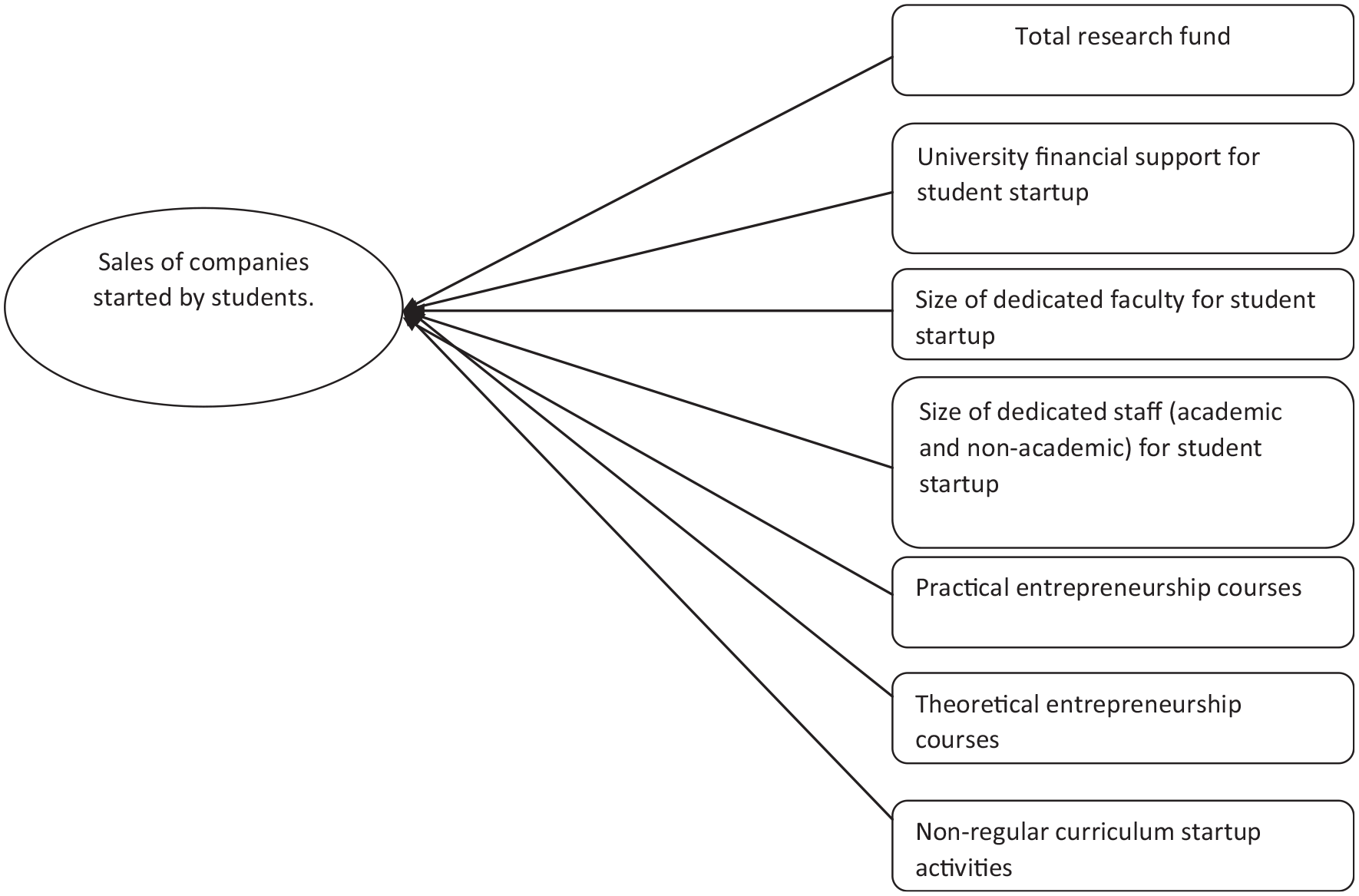
Diagrammatic representation of the theoretical model.
Analytical Results
Firstly, in the development of the model, to avoid the issue of multi-collinearity, a correlation of the variables to be considered in this study was carried out and the results show that there was no case of multi-collinearity amongst the variables in this study. Furthermore, the result of the Variance Inflation Factor (VIF) score in Table 3 shows that there is no case of multi-collinearity (Hair et al., 2014). Secondly, the descriptive analysis of the data was analyzed and presented in Table 2.
Variable Descriptive Statistics.

Thirdly, the model analysis was carried, and the results from this analysis was presented in Table 3. The results from the multiple regression analysis yielded an R2 value of .587. This means that the model has a high impact effect size. This is because according to Cohen (1992), the interpretation of the R2 value is as follows—values between .12 or below, .13 to .25, and .26 and above represent low, medium, and high impact effect size. In the results presented in Table 3, the most significant variables in the model include—total research fund, size of dedicated faculty for student startup, size of dedicated staff (academic and non-academic) for student startup, practical entrepreneurship courses and non-regular curriculum startup activities.
Results of Multiple Linear Regression Analysis.
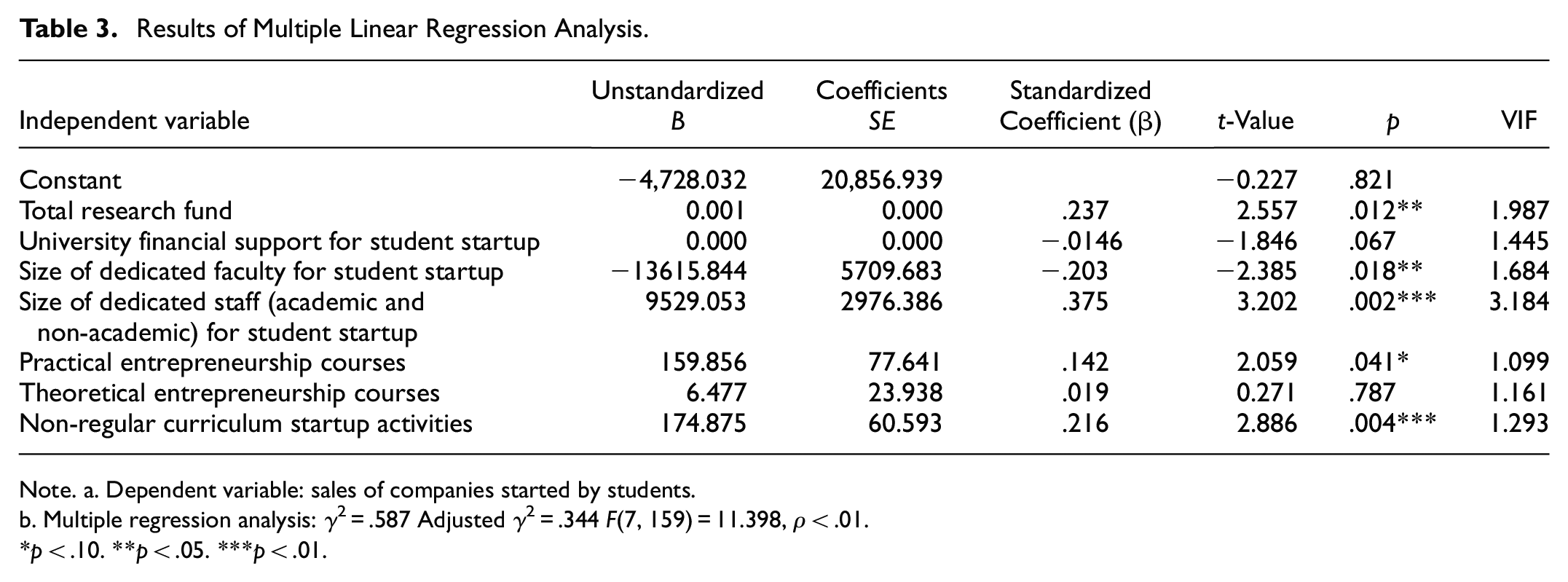
Note. a. Dependent variable: sales of companies started by students.
b. Multiple regression analysis: γ2 = .587 Adjusted γ2 = .344 F(7, 159) = 11.398, ρ < .01.
p < .10. **p < .05. ***p < .01.
Discussion and Conclusion
The contribution of startups to sustainable development in Korea through the provision of employment and its contribution to the national GDP makes studies relating to the enhancement of the performance startups important. Furthermore, the yearly increase in public investment to support startups in Korea makes it important to study how to enhance the performance of startups and reduce waste. On the other hand, lessons from studies such as this are beneficial to policy makers, government, private sector actors, and civil society players seeking to understand and improve the contributions of startups to sustainable development in their countries.
This study used data from 212 universities in Korea (provided by the Higher Education in Korea service) involved in supporting the development of student startups. The approach deployed in this study focused on developing a mathematical model based on theories and existing literatures. We synergized previous studies by developing a hybrid model and providing empirical evidence from the Korean experience. To analyze the profitability of student startups, their ability to attract investors through outright sales was used. Therefore, in the model developed, the dependent variable was “sales of companies started by students” while the independent variables in the model—include, total research fund, university financial support for student startup, size of dedicated faculty for student startup, size of dedicated staff (academic and non-academic), practical entrepreneurship courses, theoretical entrepreneurship courses, and non-regular curriculum startup activities. The results of the analysis yielded an R-squared (R2) value of .587—which shows that the model has a high impact effect size (Cohen, 1992).
In the research model developed, the dependent variable was the “total research fund.” The total research fund represents the total amount of funds raised by universities from both the public and private sectors. Entrepreneurship development requires a lot of resources, hence the importance of this variable. The funds raised by universities for this purpose are for various uses. According to Doblinger et al. (2019), public funding of universities helps to reduce the cost of R&D. Strengthening and enhancing the performance of startups involves a lot of research into modern methods that will yield better results than existing ones. A key component of the use of research fund is the conversion of scientific results into new products and services to be rendered by startups (Still, 2017). Most startups developed these days are startups that seek to solve issues in the 4th industrial revolution. Some of these issues are novel and wicked and require advanced research.
According to Windari et al. (2020), startups are change agents of the 4th industrial revolution seeking to resolve issues capable of revolutionizing industries. Because these researches are high risk in nature, they require high funding. Research funds for startups are mainly to resolve issues such as competitor’s innovativeness, changing customer needs, and the need for new products to replace existing products (Andrieu & Groh, 2021; Dean & Giglierano, 1990) . This is because, research funds are primary factors in driving entrepreneurship and innovation within startups. With this source of funds, startups can take more risk and improve their chances of success. Another importance of research fund is the generation of funds for intellectual property right licensing. A study on the motives of university—startup interaction shows that licensing of intellectual property is expensive and creates a funding gap for startups (Stijn et al., 2017). However, research funds can bridge this funding gap. Hence the importance of research funding in strengthening the performance of startups. This means hypothesis 1 (H1) in this study was satisfied.
A very vital aspect of startup development is the availability of funds to manage operational, managerial, and administrative task that maybe associated with the sustainability of the startup. This study examined the effects of the provision of funds by universities to student startups to meet their financial needs. The results of this study showed that, financial support from the university—when combined with other factors—did not have a significant effect on the entrepreneurship skills of students. This maybe because, financial support given to students by universities is not sufficient. According to Smith (2016), even though university funding for student entrepreneurs is rising, the support is largely insufficient. A study that examined the factors that helped Standford University (in the Silicon Valley) in successfully graduating a high number of student startups, found that—the expertise of the university in indirectly providing financial support for entrepreneurs through linking them with investors was important (Colin, 2021). For financial support of universities to student startups to be effective, first they must be high enough to meet the demands of entrepreneurs. Furthermore, universities must be involved in fundraising activities for entrepreneurs through their networks.
Also, universities must use entrepreneurs as their research assistants and incentivize the work they undertake, so that they can learn on the job. The fund students generate through this process can be utilized to meet the needs of student entrepreneurs to develop their own startups. Funds realized by startups must be geared toward improving the research and innovation within startups to make them relevant. Finally, universities can provide in-kind support to startups to reduce the cost associated with starting an enterprise. In-kind financial supports are non-financial in nature and can help startups grow. A study on the impact of accelerators on startups show that in-kind financial support had a positive impact (Dempwolf et al., 2014). Therefore, hypothesis 2 (H2) in this study was not satisfied.
This study considered the impact of faculty members dedicated to helping students develop their startups. The results of this study show that they have a positive effect on building entrepreneurship in students and this factor was very significant in the model developed. This is because of the tailored learning style of entrepreneurship these faculties used to develop entrepreneurship skills in students. The efficiency of faculty members in delivering lessons to entrepreneurs had an impact on building entrepreneurship skills in students (Hiltz, 1997; Shinnar et al., 2010; Zaini et al., 2015). A study on the relationship between university startup intensity and quality of faculty shows that the quality of faculty had an impact on building entrepreneurship skills in students (Showalter & Jensen, 2019).
The impact of the quality of faculties is evident in the efficiency of the mentorship they offer their students. Prestwich (2013) argued that the main impact of faculties on student entrepreneurs is seen in the proficiency of mentorship—faculties offer students. This is because the quality of faculties is a determinant of how lessons are taught to students and their levels of understanding. In-line with the result of this study, a research on the impact of faculties on PhD student startup development show that there is a positive relationship between them (Muscio & Ramaciotti, 2019). Therefore, hypothesis 3 (H3) was satisfied.
On the other hand, this study considered the impact of both academic and non-academic staff in building entrepreneurship skills in students. The results show that this variable was significant in the research model. As previously noted, the role of academic staff in building entrepreneurship in students is important. Based on this, we can say that the role of non-academic staff as well—is important in enhancing the development of student startups. This is because while university faculty members manage the educational aspect of student development, non-academic staff manage aspects of administration and program management—important for the success of the program. It is important to note that there is a paucity of studies considering the impact of non-academic staff on student startups, hence the importance of this study. A similar study by Muscio and Ramaciotti (2019) shows that the role of both academic and non-academic staff in developing the entrepreneurship skills in students was important. Therefore, hypothesis 4 (H4) was satisfied.
This study also considered the effect of practical entrepreneurship courses taught within the university and its impact on developing entrepreneurship skills in students to be able to build their own startups. The results from this study show that these courses taught to entrepreneurship students were highly significant in the building their entrepreneurship skills. This is because practical skills are very important in identifying and modeling real life situation in which these young entrepreneurs will face. These courses provide entrepreneurs with hands on skills to overcome challenges that they may most likely come across. They provide them with knowledge that was acquired over a long period of studying other startups. This helps entrepreneurs learn from the lessons of their predecessors and avoid similar mistakes. It also helps entrepreneurs build on lessons from their predecessor and build new approaches to avoid pitfalls already identified.
In-line with the results of this study, a study by Olugbola (2017) shows that practical entrepreneurship studies provided students with skills such as business plan development, product / process management, and administrative/management skills. Another study on action-based entrepreneurship training identified various cases that utilized practical entrepreneurship training methods and showed that these were effective in building entrepreneurship in students (Rasmussen & Sørheim, 2006). Based on the results obtained in this study, hypothesis 5 (H5) in this study was satisfied.
The impact of the theoretical approach of building entrepreneurship in universities was examined within the framework of this study. The results obtained showed that theoretical courses did not have any significant effect on building entrepreneurship skills in students. This is because, students find it difficult in translating theory into practice without the right skills and tutorship necessary to achieve this skill. Theoretical courses alone are not effective, they must be combined with practical courses to be effective (Rasmussen & Sørheim, 2006; Sansone et al., 2021). While there is a paucity of studies examining the impact of theoretical studies alone, this study set out to examine its effect to derive useful lessons for governments in developing countries seeking to galvanize entrepreneurship in their evolving economies and also suggest better ways of improving entrepreneurship skills within the university. Based on the results of this study, hypothesis 6 (H6) in this study was not satisfied.
In most universities, entrepreneurship education is divided into regular and non-regular curriculum startup activities. The regular activities include standard training activities and exercises, while non-regular activities are innovative, practical, and simulation activities. This study examined the impact of non-regular activities on building entrepreneurs within universities in Korea. The result of this study shows that non-regular activities was highly significant in helping entrepreneurship student develop their own startups. This is because, while regular activities focus on academic trainings and related activities, non-regular activities involved more practical activities and simulation of real-life events these entrepreneurs may encounter and how they can effectively overcome them. According to S. Kim (2019), a role-playing game for training of startups is a very effective method of motivating and empowering staff. Other studies that support the results obtained in this study are—Maxwell et al. (2019) and Harima et al. (2021). Based on the results obtained, hypothesis 7 (H7) in this study was satisfied. Figure 2 shows the optimal model for improving startup performance based on the results of this study.

Factors that affect the profitability of student startups.
The theoretical contribution of this study includes—it identified the most relevant factors needed to enhance the profitability and development of student startups within universities while providing evidence from a case analysis of universities in Korea. These variables include—research fund, size of dedicated faculty, size of dedicated staff (academic and non-academic), practical entrepreneurship courses, and non-regular curriculum startup activities. By identifying these factors, universities in Korea and other countries can understand how to build entrepreneurship skills more effectively in their students and avoid the issues relating to the poor performance of student startups. While the performance of Korean universities in helping the development of student startups is moderate, improvements can be made through the introduction and implementation of policies that ensure that the results of this study and other studies are combined to aid performance.
Limitation of the Study
This data used in this study were data relating to universities in Korea alone. However, this does not reduce the relevance of the results obtained. In fact, developing, least developing and developed countries can learn from the Korean experience to improve the performance of their startups. Nevertheless, future studies need to evaluate and test the model developed to see if it is valid in other countries.
Furthermore, factors such as social, political and economic factors need to be examined to see if they have any meaningful effect on the performance and profitability of startups. Finally, in a National Innovation System (NIS), the university is one of the key players within the system, while others include the public sector, private sector, and civil society actors. While this study was carried out from the perspective of the university, new research is needed to examine the perspective of other players within the innovation system. However, this does not water-down the results obtained in this study and we believed the results of this study are relevant to policy makers, governments, private sector actors and other key players within the NIS in other countries.
Footnotes
Declaration of Conflicting Interests
The author(s) declared no potential conflicts of interest with respect to the research, authorship, and/or publication of this article.
Funding
The author(s) disclosed receipt of the following financial support for the research, authorship, and/or publication of this article: This work was supported by the Ministry of Education of the Republic of Korea and the National Research Foundation of Korea (NRF-2022S1A5C2A03093218).
