




Abstract
The outbreak of the new crown epidemic has impacted the global industrial chain and caused significant changes in the world economic and political landscape. In the post-epidemic era, promoting high-quality economic development (HQED) has become an important issue. The study selects the spatial econometric model and mediating effect model to verify the role of industrial upgrading in the double cycle for HQED, and concludes as follows: (1) “double cycle” can significantly promote HQED, and there is a significant spatial effect of the double cycle; industrial structure upgrading “ can significantly promote HQED, and there is a significant spatial effect of industrial structure upgrading, which may have a positive impact on the neighboring regions; (2) domestic circulation can promote HQED in the region, but the spatial effect is not significant; international circulation can not only promote HQED in the region, but also promote HQED in neighboring regions . There is a significant positive spatial effect of industrial structure upgrading. (3) The industrial structure upgrading plays a part in the mediating effect of the “double cycle” on the HQED. This study has important implications for the realization of HQED in Chinese regions.
Keywords
Introduction
China’s economy has grown at a rapid pace and achieved fruitful results. Relying on capital driven by traditional factors such as capital, labor, and natural resources, the total GDP has grown from 367.87 billion yuan in 1978 at the beginning of reform to 114.37 trillion yuan in 2021. The people’s living standard has been greatly improved, from insufficient subsistence to overall well-off. However, with the rapid economic development, labor costs are gradually rising, resource supply tends to be insufficient, and the environmental carrying capacity has reached its upper limit, the marginal contribution of traditional factors to economic development is gradually weakening, the demographic dividend, and institutional dividend are disappearing, and the overall economic growth rate is slowing down (Fakher et al., 2021). At the same time, China still has outstanding problems such as unbalanced regional development, irrational industrial structure, insufficient innovation drive, overcapacity, large but not strong real economy, and serious environmental pollution, which need to be solved urgently. So, how exactly should we achieve HQED? This is not only a fundamental requirement for China to enter a new era of socialism, but also a practical problem in the academic world.
In the process of HQED, upgrading industrial structure is the key to realize the transformation of economic development mode. The essence of HQED is to shift from the previous over-emphasis on the quantitative growth of the economy to the stage of winning by quality (Mardani et al., 2019; Rahman et al., 2021). Meanwhile, certain cities and industries in the country have been more dependent on resources in the past, but resources are finite and with the increasing shortage of resources, these cities and industries are not motivated to grow, thus negatively affecting the economic development (Abbasi et al., 2021; Armeanu et al., 2021; Hashmi & Alam, 2019). Therefore, to promote regional economic HQED, it needs to improve the rational allocation of resources and accelerate the transformation and upgrading of traditional industries. China has entered the stage of HQED; however, the difficulty of “locking in the low end of the value chain” is not optimistic.The industrial upgrading is mainly about the manufacturing structure. The most important industrial upgrading is the upgrading of manufacturing structure and the maturity of new industries, while Chinese manufacturing enterprises are very dependent on the international division of labor and the emerging industries are more dependent on foreign technology.
China is facing the problem of increasing the risk of domestic industrial chain shift and the difficulty of further efficient development of manufacturing industry (Yu, 2020). The international environment is characterized by more pronounced uncertainty and instability and deepening risks for China’s current development (Eren et al., 2019). To achieve sound economic development, two domestic and international cycles must be unblocked. For the current external environment, promoting domestic economic development and promoting industrial transformation and upgrading under the double-loop development pattern, how to reasonably plan the industrial upgrading path, so that China’s industry can occupy a high-end position in the international industrial chain division of labor, etc. have become hot topics of research (Cheng et al., 2018), and the deepening and summarizing of relevant research, etc., are important for China’s industrial upgrading and the formation of a comprehensive and efficient development It is important to deepen and summarize the relevant studies, etc., for China’s industrial upgrading and the formation of a comprehensive and efficient development pattern. Accelerating the optimization of industrial upgrading paths allows Chinese industries to take the lead in the smile curve of global industrial chain division of labor.
In this context, this paper can enrich the existing literature on the issue of the path of dual cycle to promote HQED by studying the relationship between dual cycle, industrial structure upgrading and HQED in China, as well as the intermediary effect of industrial structure upgrading.
Literature Review
“Double-Loop” Impact on HQED
The concept of double-cycle development first emerged in the post-industrial revolution global trade phase, initially to solve the problem of economic development and trade conflicts within countries in the global trade division of labor, and then gradually applied to stimulate domestic economic development and achieve economic coordination of national strategic guidelines. In general, the dual-cycle development emphasizes the use of various domestic resources to expand domestic demand in economic development and gradually improve the industrial chain to strengthen its position in the global high-end industrial chain. Although more studies have dealt with the smooth double-loop and HQED, in terms of the discussion of individual issues including the theoretical logic, work focus and modeling description of the double-loop (H. J. Li et al., 2022; Shen & Zhao, 2020; Tian & Li, 2021; Wu & Cao, 2021) and the construction and quantitative measurement of the index system of HQED (L. Ding et al., 2020; Xu et al., 2019) and other individual issues are also discussed in a more standardized and in-depth manner, but there are not many studies that systematically elaborate the relationship between smooth double circulation and HQED, and most scholars take smooth double circulation as the inching background of HQED (S. H. Ding et al., 2021) and the main way to promote economic seol quality development (Tang et al., 2020). There is no literature specifically discussing the entry point to crack the above problem. S. Wang and Ma (2014) point out that the formation of a double-cycle structure is conducive to the balanced and sustainable development of the world economy, and also helps China achieve economic transformation and upgrading. Z. Li (2020) believes that the dual-cycle development strategy should be used as the driver to promote domestic industrial chains and supply chains upgrading; focus on promoting the advanced domestic industrial base and modernization of industrial chains, while strengthening international coordination and cooperation to maintain the security of international industrial chains and supply chains. Zheng and Guo (2021), under the perspective of spatial reconstruction, believe that the “double cycle” needs to clear the “blockage and pain points” of the traditional industrial chain supply chain, optimize the circulation factors, tap the potential of domestic demand, cultivate technological innovation capacity, and enhance regional development. To promote HQED, we need to optimize the circulation factors, tap the potential of domestic demand, cultivate technological innovation capacity, improve market competitiveness on the supply and demand sides, and enhance the coordination of regional development.
Research on the Influence of Industrial Structure on HQED
Foreign scholars’ research on industrial structure started earlier, and at this stage, the scope of research is wider and the content is also very deep. Mostly a large number of domestic scholars studied it from 2018. Lewis (1954) put forward the “dualistic economic development model,” which was the first to involve industrial structure changes impact on HQED. Kongsamut et al. (2001) found that consumer preference for exogenous technological progress is an important driver of changes in factor income distribution, both of which profoundly affect service sector output and the increase in employment. Cortuk and Singh (2013) emphasized that there is a unidirectional causal relationship between industrial restructuring and economic growth, industrial restructuring has been driving the HQED of Indian in the last 20 years, the results show that industrial structure upgrading can improve productivity and promote economic development.
Since the introduction of HQED, the research direction of domestic scholars has shifted to the relationship with HQED. F. H. Zhu and Liu (2020) measured the green total factor productivity of 230 cities, and then studied industrial structure upgrading impact on HQED by constructing a spatial econometric model, and finally concluded that green total factor productivity in China has a fluctuating upward trend and has spatial spillover effects; under different regions, industrial structure upgrading impact on green total factor productivity is different and there are large differences. Ren and Yang (2020) explored the effects of independent and synergistic effects of industrial structure upgrading on regional HQED, found that the synergistic effect of the two can significantly promote the HQED in the east, central, and western regions. Chen and Deng (2019) found that government-led regional integration strategy can promote industrial structure upgrading, thus promoting HQED, through a mediating effect model. Tu and Chen (2019) shown that the shift of industrial structure from low-productivity to high-productivity sectors can promote HQED to a certain extent. Z. S. Wang et al. (2019) showed that industrial structure is positively related to HQED. Using provincial panel data from 2000 to 2017 in China, Shi et al. (2020) empirically examined the relationship between industrial structure and HQED, and the results showed that industrial structure changes are conducive to promoting HQED.
By combing the above domestic and foreign related literature, it can be seen that many scholars have made research on the relationship between the double cycle, industrial structure upgrading and HQED, and have achieved rich research results. However, there are two main limitations of the existing research: First, mainly focuses on the study of the relationship between the double cycles and HQED, or industrial structure upgrading and HQED, and there is little literature to study the relationship between the three. Secondly, there is little literature on the construction of the intermediary conduction effect test model to study the path of the dual cycle to promote HQED, and few scholars have tested and measured the effect of the intermediary. Based on this, the study constructs a spatial econometric model to verify the relationship between the dual cycle, industrial structure upgrading and HQED as well as the intermediary effect of industrial structure upgrading, which can enrich the existing literature on the path of the dual cycle to promote HQED and provide academic contributions to domestic and foreign scholars in this field.
Methods
There is a spatial distribution phenomenon of HQED in China, that is, the HQED of one province is influenced by HQED in other provinces, especially the neighboring provinces, and may be a spatial spillover effect of HQED among provinces. Therefore, spatial factors can be used to explore the spatial correlation between dual cycle, industrial structure and HQED, and HQED of the whole region will also change with the inter-regional interaction, with certain characteristics of spatial dynamics.
Spatial Durbin Model
The spatial Durbin model (SDM) is a more generalized spatial econometric model compared with the spatial autoregressive model (SAR) and spatial error model (SEM), which takes into account both the spatial correlation of the dependent variable and the spatial correlation of the independent variable. Therefore, the spatial Durbin model (SDM) is chosen in this study to better reflect the issue of HQED, the SDM model is set as follows.



DEC is the double-loop, DC is the inner loop, IC is the outer loop, IS is the industrial structure, Col is the control variables of environmental regulation (ER), foreign direct investment (FDI), human capital (HUM), and the level of transportation infrastructure development (INF).
Mediating Effect Model
The intermediate effect test is to quantitatively analyze the effect of independent variables on the dependent variable. In the study, we take HQED as the explanatory variable, double cycle as the key explanatory variable, and industrial structure upgrading as the mediating variable to construct the transmission path of “double cycle → industrial structure → economic quality development.” To avoid the influence of heteroskedasticity on the regression results, all variables are logarithmicized. In this study, the mediating effect model is constructed as follows.


Variable Selection
Explanatory Variable (HQED)
China’s economy has entered a critical period of speed shift, structural adjustment and kinetic energy transformation, and economic development has shifted from focusing on high speed growth to HQED, emphasizing on “strengthening structural reform on the supply side,” improving the quality of the attack system, promoting coordinated regional development, and deepening reform and opening up. The Chinese government has proposed HQED in the new era as a concrete embodiment of the five development concepts of “innovation, coordination, openness, green, and sharing,” which is a high-level state of economic development quality. It includes not only high quality of economic growth, but also high quality of ecological environment, high quality of financial development, high quality of urban, and rural construction, and high quality of people’s life. Therefore, the measurement of HQED should cover innovation, coordination, sustainability, openness, stability, and sharing to meet the requirements of comprehensive and sustainable social development. HQED as a comprehensive concept rich in connotation, this paper builds a comprehensive index system of economic high-quality supported by five subsystems from five dimensions of innovation, green, coordination, openness and sharing, as shown in Table 1.
HQED Index System.

This paper adopts the entropy value method to evaluate the level of each subsystem and the comprehensive level of economic quality development of 30 provinces. The core idea is that based on the standardization of each index, the entropy value method is used to give the weight value to each index, and the final index of economic quality development of 30 provinces can be obtained by adding the product of the calculated weight and the standardized value of each index.
Explanatory Variables
Double loop (DEC). The “double cycle” can be decomposed into “internal cycle” and “external cycle.” From the perspective of product market and resource supply, the “internal cycle” can be interpreted as supplying products and services to the domestic market and using domestic factors of production, while the “external cycle” can be interpreted as supplying products and services to foreign markets and using foreign factors of production. These two cycles are mutually reinforcing and essential. Especially in the context of the epidemic and the unstable international situation, the “internal cycle” as the main body is the inevitable choice of history. At the same time, we also need to make good use of international markets and resources to ensure HQED. Accordingly, the index system is constructed, and the domestic cycle (DC) and the international cycle (IC) are taken as two independent variables and assigned with entropy value method respectively (Table 2).
Comprehensive Evaluation Index System of Domestic and International Double Cycle.

Industrial Structure (IS): The industrial structure of each region is measured in terms of the advanced industrial structure. The ratio of tertiary industry output value to secondary industry output value is used to measure the advanced industrial structure, and this indicator can reflect whether the industrial structure is developing toward “service orientation.”
Control Variables
Human Capital (HC)
Human capital and its structure is the key reason for the upgrading of industrial structure, and the role of human capital in the process of economic development is becoming more and more obvious (Hanushek, 2013). Therefore, there is evidence for using human capital as one of the explanatory variables, and in this study, the average number of students enrolled in higher education per 100,000 populations was chosen as an indicator for evaluating human capital, that is, reflecting the quality of the population.
Foreign direct investment (FDI). The research uses FDI to regional GDP ratio to indicate the intensity of FDI. FDI not only accelerates the flow of technology and talents between industries, but also, FDI is a booster of industrial upgrading by introducing advanced foreign technology and production management experience through technology spillover and knowledge spillover.
Transportation infrastructure development (INF). Transportation infrastructure is the link that generates economic linkages within and between cities. Good transportation infrastructure construction can improve convenience and accessibility, which on the one hand can accelerate labor flow and help local enterprises attract more talented people, and on the other hand can reduce enterprise transaction costs and transportation costs and promote enterprise clustering, thus pushing the local economy in the direction of HQED. In this paper, we use the number of buses per 10,000 people in a region to measure this indicator.
Environmental regulation (ER), this paper selects total industrial wastewater discharge and industrial sulfur dioxide emission as proxy variables to measure the intensity of environmental regulation based on the severity of various pollutant emissions in the region and the availability of data, and calculates the comprehensive evaluation index of environmental regulation intensity through the entropy weight method.
Data Description
In this paper, 30 regions of China are selected as examples, and the 30 regions are divided into eastern, central, and western regions according to the administrative division of the country, and the data from 2006 to 2020 are selected for econometric analysis, and the data are obtained from China Statistical Yearbook(National Bureau of Statistics, 2021), China Energy Statistical Yearbook(Department of Energy Statistics, 2021), and China Industrial Statistical Yearbook(Department of Industrial Statistics, 2021). The results of descriptive statistics as Table 3.
Descriptive Statistics Results.

Results and Discussion
Spatial Model
Spatial Autocorrelation Test
According to the principle of spatial economics, the spatial correlation of each variable should be checked before constructing the spatial econometric model, so Moran’s I is selected to test the spatial correlation of each variable, results in Table 4.
Moran’s Index I Results.

p < .01.
As shown in Table 4, so the core variables full domain Moran index are all significantly positive means that the existence of spatial effects cannot be ignored. Therefore, the spatial econometric model needs to be selected for validation.
Model Selection Test
There are various spatial econometric models, and tests need to be conducted to select the appropriate spatial econometric model, and results in Table 5.
Model Selection Related Test Results.
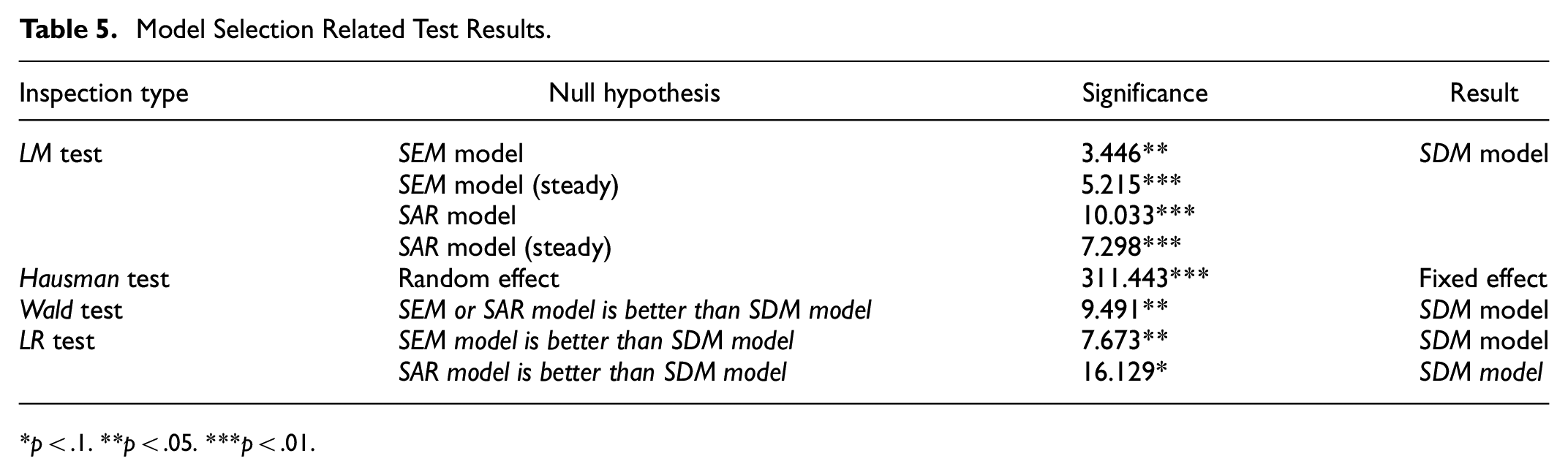
p < .1. **p < .05. ***p < .01.
In Table 5, the LM test results indicate that the SDM model should be selected, and the Hausman test results indicate that the fixed-effects model should be selected.
Spatial Econometric Regression
In this paper, the spatial weight matrix generated in Geoda software was imported into Stata software, and the estimation results of the spatial Durbin model were run with Stata software, and results in Table 6 below.
Spatial Durbin Model Estimation Results.

Table 6 shows that the DEC coefficient is 0.3248 and passes the significance test, indicating that the “double cycle” can significantly contribute to HQED. At the same time, W*DEC is also significantly positive, which confirms that there is a significant spatial effect of the double cycle and may have a positive impact on the surrounding areas. The coefficient of industrial structure is 0.2025, and it passes the significance test, indicating that the “industrial structure upgrading” can significantly promote the HQED, and W* LNIS is also significantly positive, which shows that have a positive impact on the surrounding areas.
Human capital has a suppressive effect on HQED. It may be because although human capital in China can promote green progress to a certain extent, there is an imbalance between supply and demand due to a single level of human capital, a surplus of homogeneous talents and a lack of high precision talents, leading to a structural talent shortage, thus showing a negative impact on HQED. This is consistent with the findings of J. H. Zhu and Wang (2019). Foreign direct investment can improve industrial structure rationalization, indicating that foreign direct investment has to some extent contributed to technology level improvement, which tends to rationalize the industrial structure. FDI brings advanced technology and production management experience, which has a driving effect on industrial optimization and upgrading. The increase of FDI, in the process of participating in the international industrial chain, enhances the international development capacity of China’s industries, promotes the transformation and upgrading of traditional industries, and improves the production quality. It also shows that in the process of introducing technology and capital by foreign investors, the absorption has formed a route conducive to the upgrading of their own industries. The primary coefficient of environmental regulation on HQED is −0.0355, indicating that environmental regulation inhibits HQED, and the spatial effect is significant. The construction of transportation infrastructure can contribute to the improvement of HQED, and the spatial effect is significant.
Spatial Effect Analysis
For exploring the spatial spillover effects of the core variables of each region, the domestic cycle and international cycle are estimated, and results in Table 7 below.
Spatial effect regression results.

Note:***, * means p<0.01 and p<0.1.
In (2) model, domestic circulation coefficient is 0.3562, which indicates that it can promote HQED in the region. However, the coefficient of W* DC is positive but does not pass the significance test, indicating that the spatial effect of the region on neighboring regions is not significant, but the positive coefficient also indicates that this effect is gradually manifested, and the national dual cycle policy needs to be further promoted. This is inconsistent with the results of most scholars, such as Dai et al. (2022), who proposed that “double-circulation” is a key step and specific path to promote HQED, and Yuan and Sun (2022), who found that domestic large-circulation and double-circulation has a significant role in promoting HQED, and the role of The main reason for the difference is that the new development pattern of the large cycle and the double cycle in China has a significant contribution to HQED. The main reason for the difference is that the existing literature mainly focuses on theoretical exploration, mainly studying the paths and mechanisms of its effects, and relatively few have been verified through empirical analysis, thus this study can fill some of the gaps for the existing research.
From (3), it can be seen that both IC and W* IC are significantly positive, which confirms that international circulation can promote not only the HQED of the region, but also the HQED of the neighboring regions. This is consistent with the findings of most scholars, for example, scholar H. J. Li et al. (2022) found that participation in the international cycle promotes digital trade quality improvement by increasing the backward imitation innovation capability, and stimulates China’s digital trade independent innovation capability by exerting the scale effect and competition effect of the double cycle, which promotes the improvement of China’s digital trade quality level.
In terms of industrial structure, it is significantly positively correlated in all models, and the explanatory coefficient of advanced industrial structure is 0.2109, which also passes the 1% significance test, indicating that the improvement of industrial structure level is also beneficial to enhance the level of HQED. The essence of the advanced industrial structure is that the factor resources are continuously transferred from less efficient industries to more efficient industries, thus the efficiency of the whole economic system is improved, that is, there is a “structural dividend” in the process of factor flow, and the release of this structural dividend can boost the level of HQED. The positive spatial effect indicates that the advanced industrial structure not only positively promotes the HQED of local economy, but also promotes the economic development of neighboring regions. This is the same as the conclusions as Zhao (2018), who points out that efficiency and innovation in the process of industrial structure upgrading drive HQED.
Mediating Effect Test
Mediating Effect Test
Based on model (4) and (5), the intermediary effect model is tested and the results are shown in Table 8 below.
Mediating Effect Test Results.

As can be seen from the above table, the coefficient of “double-loop” in model (4) is significantly positive, which confirms that “double-loop” can promote HQED. In model (5), the coefficient of “double-loop” is also significantly positive, which confirms that “double-loop” is beneficial to industrial structure upgrading. In model (1), the coefficients of “double cycle” and industrial structure upgrading are also significantly positive. This indicates that the industrial structure upgrading plays a part of the mediating effect in the influence of “double cycle” on HQED, which is the same conclusion as some scholars, such as He and Liu (2020), who innovatively included population aging, industrial structure rationalization and advanced, and HQED in the mediating effect model. In the study, it is found that population aging has a negative effect on the quality of economic development, and the “push-back mechanism” makes the industrial structure transformation and upgrading play a part of the positive mediating effect and alleviate the inhibiting effect.
Conclusions and Implications
Conclusion
By studying the relationship between the double cycle, industrial structure upgrading and HQED in China and the Mediating effect of industrial structure upgrading, the research can enrich the existing literature on the path of double cycle to promote HQED, and draw the following conclusions.
(1) The “double-loop” can significantly promote HQED, and there is a significant spatial effect of the double-loop, which may have a positive impact on the surrounding areas. Industrial structure upgrading” can significantly promote HQED, and there is a significant spatial effect of industrial structure upgrading, which may have a positive impact on the surrounding areas; therefore, the control variables all pass the significance test, and there is a significant spatial spillover effect.
(2) Domestic circulation can promote HQED in the region. However, domestic circulation spatial effect is not significant; international circulation can promote not only the HQED of the region, but also the HQED of neighboring regions. The improvement of the level of industrial structure is conducive to enhancing the level of HQED, and the advanced industrial structure not only positively promotes the HQED of the local economy, but also has a catalytic effect on the economic development of neighboring regions.
(3) The “double cycle” can promote HQED, and also confirms that the “double cycle” is conducive to industrial structure upgrading, and the “double cycle” and industrial structure upgrading are significantly positive. (3) The “double cycle” can promote HQED.
Suggestions
(1) Give full play to the favorable influence of the new development pattern of the double cycle on the HQED, promote the two-way interaction between the demand and supply sides of the virtuous cycle, regulate the proportion of foreign investment, foreign trade and market access list of the international external cycle, so as to better serve the HQED of the domestic real economy. In terms of the major domestic cycle, vigorously promote key core technological innovation, seize the new round of major national strategic layout, build a complete domestic demand system including industrial chain, supply chain, innovation chain and value chain, focus on the coordinated development of China’s regions, and prioritize the cultivation of new growth points in the regional economy.
(2) Grasp the new development pattern of double cycle and improve the HQED driven by science and technology innovation. HQED can be promoted through the model of local development leading to regional development, such as Yangtze River Economic Belt can radiate the surrounding areas through the HQED. Therefore, under the new development pattern of double cycle, the innovation capacity of each region of Yangtze River Economic Belt should be actively improved to promote manufacturing industry upgrading and HQED. We should make full use of the high-tech and educational resources in the region to accelerate the transformation of industrial scientific and technological achievements, promote industrial upgrading, and then complete the transition from production factor-driven and capital-driven to science and technology-driven; make good use of the leading function of city clusters with advantageous technological innovation resources to further improve the independent innovation capacity of the region by promoting institutional innovation, technological innovation, and product upgrading, so as to enhance the overall industrial chain and drive HQED.
(3) Improve the rational allocation of factors and promote the rationalization of industrial structure. In the rationalization of industrial structure, we should take both measures to achieve the rational allocation of factors. Under the synergy of industrial structure policy and market mechanism, break the division of factors and product market, realize the free flow and efficient allocation of factors among industries; focus on improving the intensive utilization level of production factors, and establish a green, low-carbon, circular development industrial system; at the same time, breakthroughs in water-soil-gas synergistic governance and source control, end management and ecological environment restoration of complete sets of core technology groups, and collaboratively build Circular industrial technology system. At the same time, technological innovation to promote product quality change, industrial development power change, take the road of internal development.
(4) Promote industrial structure upgrading and contribute to HQED
In the process of promoting industrial structure upgrading, we should pay attention to the coordinated development among provinces to avoid the problem of unbalanced economic development among regions. The provinces should make full use of new technologies such as big data and cloud computing to drive the development of high-tech industries, so that China’s industries can occupy a place in international competition to promote industrial structure upgrading and HQED; fourth, optimize the structure of foreign investment, coordinate regional economic development, and technology-intensive industries in the manufacturing sector should focus on attracting foreign investment, while lowering the entry threshold for foreign investment in the service industry and other fields to help HQED.
Shortcomings and Prospects
In terms of indicator construction, the construction of the indicator system of dual cycle and HQED is not comprehensive in this paper because the academic community has not yet formed a unified caliber on the construction of dual cycle and HQED indicator system, and the data disclosure of some indicators is not perfect during the sample study period.
In terms of model selection, it is difficult to exclude the interference of endogeneity in the mediating effect test model, and there are still some controversies, so there are some shortcomings in the model selection in this paper, which need to be further explored.
The data at the provincial level are sketchy. Due to the availability of data, provincial panel data are selected for the empirical analysis in this paper, but the provincial data are relatively single and crude, which may lead to bias in the results. Future research can be conducted at the local and municipal levels or at the county level to produce more scientifically accurate results.
Footnotes
Declaration of Conflicting Interests
The author(s) declared no potential conflicts of interest with respect to the research, authorship, and/or publication of this article.
Funding
The author(s) disclosed receipt of the following financial support for the research, authorship, and/or publication of this article: The paper was supported by The General Project of the National Social Science Foundation “Research on Promoting the High-quality Development of Manufacturing in the Yangtze River Economic Zone” (19BJL061)
Ethics Statement
The work described has not been published previously, and it is not under consideration for publication elsewhere, the submition is approved by all authors. If accepted, it will not be published elsewhere in the same form, in English or in any other language, including electronically without the written consent of the copyright-holder. The research is not applicablefor animal and human studies.
