




Abstract
Over the last decade, various entrepreneurial school practices have proliferated, including the creation of mini-companies. In the Spanish context, the Empresa Joven Europea (EJE) program has been the most widely employed educative program in this respect. Empresa Joven Europea is an educational program that proposes that secondary education students create and manage their own mini-businesses, thereby taking the legal form of a cooperative society and facilitating the acquisition of all basic educational skills through the cultivation of entrepreneurship. Nevertheless, there is still a gap between the theory and the practice of entrepreneurship education which, together with the conceptual expansion experienced in recent years, increases the need to assess the effectiveness of this type of programs. By means of an explanatory and cross-sectional study, we evaluated the impact of the program on the configuration of the entrepreneurial potential of the participating adolescents (N = 270). The analysis has been carried out utilizing PLS-SEM with SmartPLS software version 3.3.9 and SPSS version 25. None of the six hypotheses formulated have been confirmed, which means that the desired effects have not been achieved in any of the three variables under study: attitudes, knowledge, and entrepreneurial skills. Such results may be related to aspects of curricular organization, the type of experiences based on cooperatives, a certain structural and conceptual lack of definition of the pedagogical methodology used, and the development of skills linked to identity. Moreover, it is possible that, although it is not evident in the competencies acquired, the program has influenced the apperception of what it means to be an entrepreneur and of the creation of critical awareness, which is associated with entrepreneurial potential. Our study, in addition to opening suggestions for further research along the same lines, presents several implications related to administrative and organizational aspects, to the design of the different pedagogical elements of the programs and to the evaluative criterion adopted.
Plain Language Summary
We intend to evaluate the effectiveness of an entrepreneurship education program. Through an explanatory and cross-sectional study, we evaluate the impact of an entrepreneurship education program in the configuration of the entrepreneurial potential of adolescents. The effect of the program has been small. Such results may be related to aspects of curricular organization, the type of experiences based on cooperatives, a certain structural and conceptual lack of definition of the pedagogical methodology used, and the development of skills linked to identity. Moreover, it is possible that, although it is not evident in the competencies acquired, the program has influenced the apperception of what it means to be an entrepreneur and the creation of critical awareness, associated with entrepreneurial potential. Our study, in addition to opening suggestions for further research along the same lines, presents several implications related to administrative and organizational aspects, to the design of the different pedagogical elements of the programs and to the evaluative criterion adopted. Contextual variables related to teaching and learning styles have not been considered. Nor have the opinions of the participating teachers and students been considered. The findings obtained are limited to the Spanish (European) context. We need to conduct research that overcomes these limitations.
Keywords
Introduction
There is no doubt that entrepreneurship education constitutes a thriving international research field in which there is an incessant flow of diverse studies and research (Alshebami et al., 2022; Raza et al., 2021). However, there is a gap between academic contributions and achievements in the practice of entrepreneurship education (Crawford et al., 2022; Genus et al., 2021; Parisini, 2021; Seidl et al., 2021). It is even argued that, paradoxically, the traditional paradigm of entrepreneurship education harms precisely what it aspires to achieve: entrepreneurial competence and activity. Murray (2019) highlights a glaring disconnection between the theory and the practice of entrepreneurship education, through a review of the scientific literature and a qualitative study conducted on a sample of entrepreneurship trainers at the University of the West of Scotland.
A new teacher professional development framework for teachers, such as that which has recently emerged in Europe (with good reception in Latin America and Asia), known as EntreCompEdu, can provide a refreshing stimulus for the identification of the competencies that educators need to foster entrepreneurship education in primary education, secondary education and vocational education (Grigg, 2021). It is a matter of training students in a lifelong entrepreneurial approach, based on the EntreComp European Framework of Entrepreneurial Competences. A large regional context, such as that of Europe, politically and administratively coordinated, would perhaps favor a more synergistic implementation of entrepreneurship education (Hudek & Sirec, 2019). The training materials, a veritable bank of teaching practices, available within EntreCompEdu, can contribute towards broadening the appeal of entrepreneurship education and can boost teachers’ professional development. However, their impact may not be as expected if they do not finally effect a conceptual reorientation of entrepreneurship education, capable of projecting training practices more closely linked to the roots of the entrepreneurial nature of the person and not merely linked the skills more clearly associated with the creation of companies and their operation.
Entrepreneurship education is a high-priority line within the policies of the European Union and is not confined to the university environment, but most European countries have also incorporated it into the lower levels of the education system (EACEA-Eurydice, 2016). The growing need for socio-economic and educational measures capable of fostering an entrepreneurial culture makes it increasingly necessary to have a solid conceptualization of the construct in order to, consequently identify the foundation and real scope of entrepreneurship education. To this end, the aim is to attain a baseline of entrepreneurship in students and to evaluate the corresponding interventions at different administrative and educational levels (Oliver et al., 2015). Entrepreneurship education programs have proliferated in most countries in an effort to promote entrepreneurial culture at educational levels prior to university education. However, there are no consolidated advances in the theory and practice of entrepreneurship education, which may be due to any of a variety of causes. The analysis of the real impact of the applied programs, especially those most widespread, constitutes a research problem of unequivocal interest due to its repercussions regarding progress and innovation in this field of knowledge. It is therefore necessary to investigate the effectiveness of the training programs that have been developed in recent years. Our research is situated in this perspective and aims to contribute towards the clarification of the substantiation and development of entrepreneurship training strategies and towards the progressive reduction of the gap between the theory and the practice of entrepreneurship education.
Literature Review and Hypothesis Development
Competence, Potential, and Identity
The value of entrepreneurship education linked to the international movement around the basic competencies approach has been widely claimed. According to Recommendation 2006/962/EC of the European Parliament and of the Council, the key competence “sense of initiative and entrepreneurship” refers to the personal ability to transform ideas into action. Since then, the various guidelines generated aspire to develop competitiveness by boosting the appropriate economy to the knowledge society, while aiming to promote an inclusive cultural training capable of tackling the new social problems of the globalized world (European Commission, 2013). From this it is easy to deduce that entrepreneurial competence implies the ability to act autonomously, which ultimately links it to personal identity, to the ability to formulate personal projects and to be able to carry them out. Furthermore, competence can be formed to the extent that the person has certain dispositions that can be developed, that is, their entrepreneurial potential (Krueger, 2020), which, in turn, is enriched by the acquisition and improvement of their own competence, in a never-ending loop. Thus, potential and competence are closely related, and influence each other in a dynamic and fluid process. The entrepreneurial identity is the result of this intertwining. This progressively claimed construct confers stability and cohesion to entrepreneurial behavior (Donellon et al., 2014; Franklin & Dunkley, 2017; Gill & Larson, 2014; Gregori et al., 2014; Harmeling, 2011; Horst et al., 2020; Hytti & Heinonen, 2013; Ko & Kim, 2020; Leitch & Harrison, 2016; Mmbaga et al., 2020; Radu-Lefebvre et al., 2011; Werthes et al., 2018). Entrepreneurship education is aimed at boosting both the entrepreneurial competence and the entrepreneurial potential, although its goal is situated in the configuration of the entrepreneurial identity. Regarding the extent that entrepreneurial attitudes can represent the formation of entrepreneurial identity, the following hypothesis can be considered:
Hypothesis 1 (H1): The mean value of the Entrepreneurial Attitudes variable and of each of its dimensions is higher in the subsequent subsample than in the subsample prior to the development of the program.
A Recurrent Modality of Implementation of Entrepreneurship Education: Mini-Companies
The development of the entrepreneurial spirit is encouraged at all levels of education. In Spain, since 2006, entrepreneur ship has been introduced as a basic competence in the educational system, and has been preserved within the various legislative changes that have taken place since then. The various Autonomous Communities of the country have striven to promote the development of the entrepreneurial spirit within the framework of their political and management competences. In this context, we have witnessed a considerable number of proposals of various kinds, all aiming to reconcile the entrepreneurial culture with the development of entrepreneurship. Initially, the promotion of entrepreneurship was focused on secondary education and vocational training, in an effort to cultivate the personal skills necessary for entrepreneurship and for setting up and managing businesses. More recently, the concern for entrepreneurship has also been extended to the primary school level, wherein its cross-cutting nature is emphasized in the curriculum. Identified as good practices, both the “design of business plans” and the “creation of mini-companies” are common training practices in entrepreneurship. For the most part, the integration of entrepreneurial competence in Spanish schools has been carried out through pedagogical experiences based on the creation and operation of mini-companies, whereby the creation of certain specific curricular subjects have also been contemplated, with less relevance so far.
In this study, the focus is on an extended experience of mini-companies in the Spanish educational system: Empresa Joven Europea (EJE). This is an educational project designed by Valnalón (2022), a public company under the Ministry of Employment, Industry and Tourism of the Government of Asturias. The purpose of EJE involves training students to attain entrepreneurial skills in lower secondary education (Compulsory Secondary Education) and in higher education (Vocational Training and Baccalaureate). Specifically, the educational objectives of EJE aim to improve entrepreneurial attitudes, enhance knowledge and basic skills to create and manage a mini-company, and promote cooperation between educational centers (La Palma Emprende, 2022). The EJE project is implemented during a school year, where students create and manage a mini-company, by taking the legal form of a cooperative society within their educational center. This program seeks to establish commercial relations between different mini-companies from other autonomous communities and countries so that they can exchange products with each other. The methodology of EJE is characterized by experiential-cooperative learning, and includes five development phases: (1) Creation of the cooperative and its corporate image (logo, statutes, internal organization, etc.); (2) Design and preparation of a catalog of products to be exchanged between the mini-companies; (3) Negotiation of orders, importation and exportation of products; (4) Development of a local market and commercialization of products; and (5) Analysis of the processes and results of the mini-company, payment of invoices, and dissolution of the cooperative society. The EJE project has been considered as an example of Good Practices according to the European Union (BEST procedure. Mini-companies in secondary education. DG Enterprise and Industry—European Commission, 2005) and as one of the most widely disseminated entrepreneurial education programs in Spain.
By bearing in mind the value given to business knowledge and skills in the EJE program, 2 more hypotheses can be formulated:
Hypothesis 2 (H2): The mean value of the Entrepreneurial Knowledge variable and each of its dimensions is higher in the subsequent subsample than in the subsample prior to the application of the program.
Hypothesis 3 (H3): The mean value of the Entrepreneurial Skills variable and of each of its dimensions is higher in the subsequent subsample than in the subsample prior to the implementation of the program.
Evaluation of Entrepreneurship Education Programs
There is a direct relationship between the concern for promoting entrepreneurship in schools and the need to generate a new economic model capable of creating a business fabric. However, entrepreneurship is fundamentally linked to the capacity to create self-employment. Besides, entrepreneurship is not limited to the economic sphere, but has increasingly opened up to the personal and social spheres (Azqueta, 2019), thereby extending its effect to the formation of personalities with initiative and the ability to cooperate. In view of this demanding complexity, it is not only a matter of promoting entrepreneurship in education but also of evaluating its impact, the level of achievement attained, and the degree of reduction achieved between theory and practice. This is not an easy task, however: there is a notable gap between the political proposals for entrepreneurship education and their actual impact at non-university educational levels (Lackeus & Savetun, 2019), although the political discourse also presents weaknesses that require amendment (Dinning, 2019). This impact depends on the set of measures that can be adopted, at the different levels and areas involved, for the most suitable promotion of entrepreneurial culture in schools. In the Spanish context, studies on entrepreneurial education at the lower levels of the educational system are not abundant (Diego & Vega, 2015), as is the case of the international scene (Fayolle, 2018). There is hardly any research that examines the influence of entrepreneurship education programs on the entrepreneurial attitude, knowledge, and skills of students. In previous research, teachers acknowledge the difficulty regarding the evaluation processes in this type of program (Delpozzo & Szpunar, 2022; Morselli, 2019). A recent systematic review (González-Tejerina & Vieira, 2021) on entrepreneurship education at the primary and secondary school levels, states that the educational practices developed in Spain remain in an incipient phase and are of little consolidation. Among the limitations found are the lack of teacher training, the lack of human and economic resources, and the application of ineffective methodologies.
It is therefore necessary to analyze the impact of entrepreneurial educational experiences in secondary education (Compulsory Secondary Education), in order to ascertain whether this type of entrepreneurial education program is having a positive impact on the development of attitudes, skills and knowledge in students. While certain weaknesses and shortcomings of the program’s effect can be highlighted, the analysis and discussion of its results reveal the most relevant factors for the advancement of research on entrepreneurship education in the light of the new theoretical discourses and the current contexts of practice. In this respect, in an effort to find nuances that can improve the explanation of the real influence of the various components of entrepreneurial competence, the following hypotheses are proposed:
Hypothesis 4 (H4): The program has an effect on each of the weights of each of the dimensions that make up the Entrepreneurial Attitudes variable.
Hypothesis 5 (H5): The program has an effect on each of the weights of each of the dimensions that make up the Entrepreneurial Knowledge variable.
Hypothesis 6 (H6): The program has an effect on each of the weights of each of the dimensions that make up the Entrepreneurial Skills variable.
Research Methodology Research Design
The research has been implemented with a pretest and posttest design, with control and experimental groups, to contrast the hypotheses related to participation in the EJE program and its effect on the formative variables considered. This quantitative research is characterized as an explanatory, cross-sectional study with latent variables (Cuevas-Vargas et al., 2019). The development of the research was carried out using PLS-SEM with the software SmartPLS version 3.3.9 (Ringle et al., 2015) and SPSS version 25.
The general objective of the research is to determine the effectiveness of the EJE entrepreneurial education program on the variables: attitudes, knowledge, and entrepreneurial skills in adolescents. To this end, firstly, the variables have been modeled as second-order constructs and the impact of the program has been assessed, whereby it is ascertained whether there are differences between the mean values of each of the variables and their dimensions before and after their implementation. Secondly, we have studied whether there is a change, subsequent to the implementation of the educational program, in the weight of each of the dimensions that configure the variables. In this way, for the first part of the study, the average values of each of the variables and their dimensions are compared, before and after the implementation of the program, through Hypotheses H1, H2, and H3. With these first three hypotheses, we specify that the mean values should be higher in the subsequent subsample than in the previous subsample, through a unilateral contrast in an attempt to confirm whether the effect is positive or not. Likewise, for the second part of the study, we assess whether the weight of each of the dimensions in the formation of the three variables suffers any modification after the application of the program, with Hypotheses H4, H5, and H6. With these last three hypotheses, we check whether the weights of each dimension in the formation of the global variable undergo any modification. This contrast is bilateral in that no specification is given regarding whether the variation is positive or negative.
Sample Design and Data Collection
The sample configuration was created by means of stratified probability sampling. There were two selection criteria: (1) Territorial Statistical Units (NUTS) 1 and 2 comprising Andalusia (South), Community of Madrid (Center), Community of Valencia (East), Castile-León (Center) and La Rioja (Northwest); and (2) Educational centers that taught the EJE entrepreneurial education program and were willing to participate in this study. According to data from the Ministry of Education and Vocational Training for the 2021 to 2022 academic year, the total population in lower secondary education in Spain was composed of 2,039,599 enrolled students. The scales were released in the months of January and June of the 2021–2022 academic year. The Ethics Committee of Andalusia-Spain approved this research with the following code: (C.P. ABG21-C.I.0851-N-21). On applying these two criteria and hence eliminating 25 invalid surveys, the sample consisted of a total of 540 observations, 270 of which were taken prior to the training program and the other 270 after the training program. A priori, it remained unknown whether the variables included in the model followed a normal distribution. If we assume that the variables do indeed follow a normal distribution and for a confidence level of 95%, then by taking the variability of the population with a value equal to 0.5, and a maximum error of 5% the minimum sample size required would be 384 surveys. However, according to Green (1991), for a structural equation model estimated using SmartPLS, and for an 80% confidence level and a 5% error level for a maximum of five predictors the minimum sampling size required for the measurement of the medium-sized effects between the variables would be 91 surveys. Given that the sample size exceeded 384 and 91 surveys, the sample size was therefore acceptable for the purposes of this study. The profile of the respondents is outlined in Table 1.
Respondent Demographics.

Source. Authors’ own contribution from results obtained with SmartPLS 3.3.9 (Ringle et al., 2015). Note. Gender: 1 = Female and 2 = Male. Autonomous community: 1. Andalusia, 2. Madrid, 3. Community of Valencia, 4. Castile-León, 5. Castile-La Mancha, and 6. La Rioja.
Measurement of Variables
Scales previously defined and verified in the scientific literature on the subject were utilized to measure the variables. All the variables are higher order (HOC), measured through different lower-order dimensions (LOC), and modeled as a type-B composite. According to Bollen and Ting (2000) and Gudergan et al. (2008), a confirmatory tetrad analysis was performed that confirmed this choice.
Entrepreneurial Attitudes (AE)
Attitudes were measured using the ATE scale, proposed by Athayde (2009), and adapted to the Spanish environment (ATE-S) by Bernal-Guerrero et al. (2021). The scale measures entrepreneurial potential in adolescents. This variable comprises of five dimensions: creativity, personal control, achievement orientation, leadership, and problem-solving intuition. According to the ATE-S test, these dimensions were measured with a 5-point Likert-type response scale, ranging from completely disagree to completely agree.
Entrepreneurial Knowledge (CE)
The BBKS scale (Bernal-Guerrero et al., 2020) was employed to measure this variable. This scale measures the basic business knowledge of secondary school students. This variable is made up of three dimensions: knowledge in business management, legal knowledge, and strategic knowledge. According to the BBKS application instructions, these dimensions were measured with Likert-type response options ranging from worked and learned to not worked.
Entrepreneurial Skills (HE)
This variable was measured with the BSEC scale (Cárdenas-Gutiérrez et al., 2021), which measures basic entrepreneurial competencies, through three dimensions: operations and marketing competencies, competencies in socio-business, and legal organization and economic-financial competencies. As suggested for the use of the BSEC scale, a Likert scale was used with a range from not at all to a lot.
Data Analysis Method
Our analysis consists of three parts. In the first part, we model each of the variables as second-order constructs, each consisting of a set of lower-order dimensions. This modeling allows us to obtain the aggregate values for each of the higher variables and for each of their dimensions. In the second part, with the aim of assessing the impact of a training program on the variables considered, we analyze whether there are significant differences between the mean values of each of the variables and of each of their dimensions, by considering the subsamples taken before and after the implementation of the educational program. In the third part, the ordinary least squares linear regression technique is employed to estimate each of the variables in terms of their dimensions. We also included in these linear regressions a dichotomous variable that encompasses whether the observation corresponds to the subsample before or after the implementation of the training program. The analysis of the significance of the coefficients enables us to evaluate the impact of the program on each of the dimensions of the three variables considered.
Partial Least Squares (PLS) was utilized to estimate the weights of each of the items in the formation of each of the dimensions and the weight of each of these items in the formation of the higher variables. It also enables to contrast the significance of these values to be contrasted in each of the models. The choice of the PLS methodology (Roldán & Sánchez-Franco, 2012) is due to the following reasons: (i) the relatively small sample size (Hair et al., 2012); and (ii) the nature of the variables included in the model, which responds to a composite mode B. To conduct the analysis, SmartPLS version 3.3.9 software (Ringle et al., 2015) was used.
The PLS methodology has enabled the three variables considered (attitudes, knowledge, and skills) to be analyzed by means of hierarchical component models (HCM). Furthermore, each of the second-order constructs (HOC) and each of the dimensions (LOC) were specified as type-B composite variables. For the measurement of HCMs in PLS-SEM, researchers mainly use of two approaches: the repeated-indicator approach and the two-stage approach. Sarstedt et al. (2019) show that the two-stage approach is superior to the repeated indicator approach. Moreover, according to Hair et al. (2018), the two-stage approach proves to be better if the researcher intends to assess the nature of the higher-order construct using a CTA-PLS analysis. In line with these arguments, our work uses the two-stage approach. In the first stage of this approach, all the LOC indicators are assigned to the HOC measurement model, so that the indicators are used twice, once for LOC and again for HOC. In this way, first-order latent variable (LOC) scores are estimated, and these scores become the indicators for HOCs in the second stage (Hair et al., 2018). In this second stage, the specific weights of each of the dimensions (LOC) in shaping the higher-order variables (HOCs) are estimated. The weights of each of the items involved in the formation of each of the LOCs and the weights of each of the dimensions in the formation of the HOC enable the values of these aggregate variables to be estimated for each of the items in the sample.
Results
Assessment of the Models
Table 2 shows the estimation of the model for the Entrepreneurial Attitudes variable. It is observed that most of the items have significant weights at 99%. Only the third item of the Achievement Orientation dimension and the second item of the Leadership dimension are significant at 95% and 90% respectively. Furthermore, the items do not present multicollinearity problems since the Variance Inflation Factors (VIFs) are all less than 3.3 (Diamantopoulos & Siguaw, 2006). Regarding the relationships of each of the dimensions (LOC) with the higher-order variable (HOC), it is noted that the weights of each of the LOCs are all significant at 99%. Regarding the fit of the model, the Standardized Root Mean Square Residual (SRMR) is computed as an approximate fit of the composite factor model (Henseler et al., 2016) and the results reveal that the SRMR model fits values of .075. Since these values are lower than .08, they can be considered as acceptable for PLS-SEM (Hair et al., 2018).
Model Assessment of Entrepreneurial Attitudes.

Source. Authors’ own contribution from results obtained with SmartPLS 3.3.9 (Ringle et al., 2015).
Note.***p < 0.01; **p < 0.05; *p < 0.1.
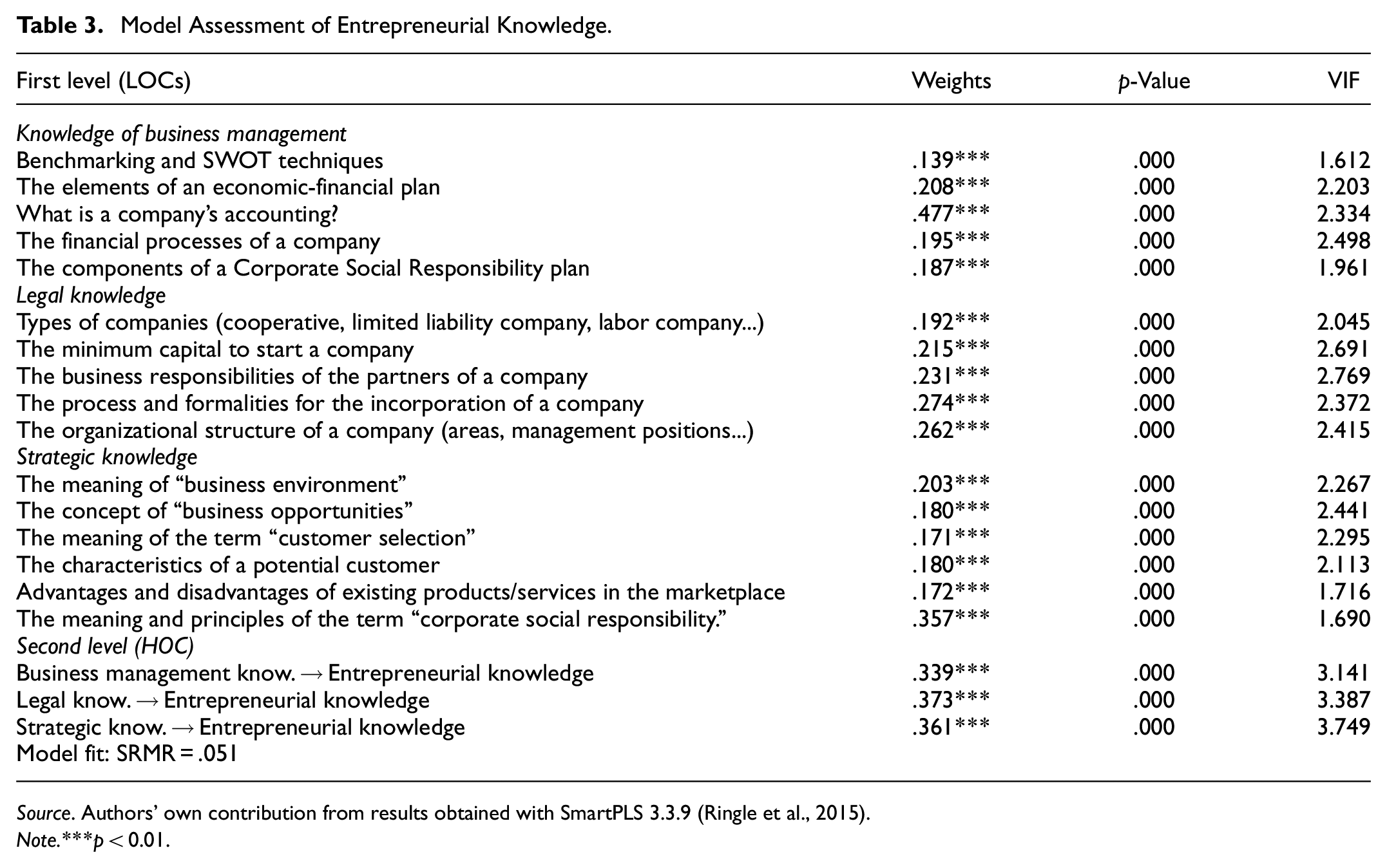
Table 3 shows the estimation of the model for the Entrepreneurial Knowledge variable. It can be seen that all the weights in each of the three dimensions are significant. Regarding the analysis of the possible existence of multicollinearity among the items, it is observed that this problem does not exist, since all the Variance Inflation Factors (VIFs) are less than 3.3. Regarding the relationships of each of the dimensions (LOC) with the higher-order variable (HOC), it can be observed that the weights of each of the LOCs are all significant. Regarding the analysis of the possible existence of multicollinearity between the dimensions, it is noted that the VIF corresponding to Legal Knowledge is at the limit (3.387), and the VIF of Strategic Knowledge is 3.789. Following the recommendations of Belsley (1991), we performed an advanced collinearity analysis, which showed that the condition index is less than 30, which allows us to conclude that there are no multicollinearity problems between the dimensions (LOCs) of the Knowledge variable. Regarding the fit of the model, the SRMR model fits values of .051. Since these values are lower than .08, they can be considered as acceptable for PLS-SEM (Hair et al., 2018).
Model Assessment of Entrepreneurial Knowledge.
Source. Authors’ own contribution from results obtained with SmartPLS 3.3.9 (Ringle et al., 2015).
Note.***p < 0.01.
Table 4 shows the model estimation for the Entrepreneurial Skills variable. It is observed that all the items involved in the formation of each of the dimensions have significant weights at 99% significance. Likewise, the items do not present multicollinearity problems, since all the VIFs are less than 3.3 (Diamantopoulos & Siguaw, 2006). Regarding the relationships of each of the dimensions (LOC) with the higher-order variable (HOC), it can be observed that the weights of each of the LOCs are all significant. Concerning the study as to whether multicollinearity exits among the dimensions, it is noted that the VIFs associated with the three dimensions (LOCs) are slightly higher than 3.3. An advanced collinearity analysis allowed us to conclude that there are no multicollinearity problems among the dimensions of the Skills variable, since the Condition Index obtained is less than 30. Regarding the fit of the model, the SRMR model fits values of .042, and hence it can be considered as acceptable for PLS-SEM (Hair et al., 2018).
Model Assessment of Entrepreneurial Skills.

Source. Authors’ own contribution from results obtained with SmartPLS 3.3.9 (Ringle et al., 2015).
Note.***p < 0.01.
Analysis of the Effectiveness of the Educational Program
The modeling of each of the variables summarized in Tables 2 to 4 allows us to assess, for each element of the sample, the pre- and post-training program levels of each of the variables and of each of their dimensions. Table 5 shows the mean values of each dimension and of each variable for the two subsamples: the subsample before and the subsample after the training program.
Average Values of LOCs and HOCs.

Source. Authors’ own contribution from results obtained with SmartPLS 3.3.9 (Ringle et al., 2015).
In order to assess whether the educational program has had an impact on any of the variables and/or on any of their dimensions, we have tested whether the differences observed are significant or not. The results are as follows in Table 6.
Significance Test of the Difference of Means.

Source. Authors’ own contribution from results obtained with SPSS version 25.
Note.***p < 0.01; **p < 0.05; n.s. not significant.
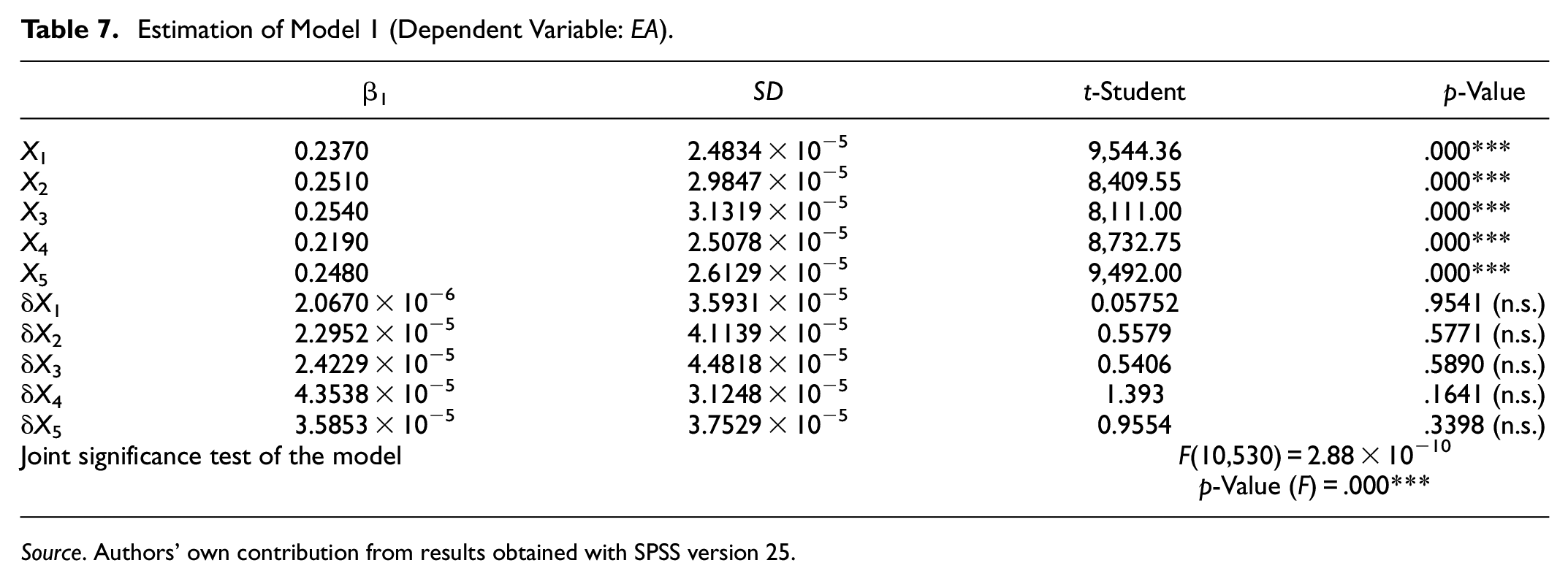
In relation to the first hypothesis, the results in Table 6 indicate that significant differences are observed solely between the pre- and post-program means of the dimensions of Leadership (t = 4.240, p < .000) and Intuition (t = 1.990, p < .048), and between the means of the Entrepreneurial Attitudes variable (t = 2.334, p < .020). However, surprisingly, the significant differences observed lie in the opposite direction to that expected, that is, the values are higher in the pre-program subsample than in the post-program subsample, and hence H1 is rejected. With respect to the second hypothesis, the results in Table 6 indicate that there are no significant positive differences between the previous and subsequent values of the Entrepreneurial Knowledge variable or in its dimensions, and therefore H2 is also rejected. Concerning H3, the results show that there are no significant positive differences before and after the application of the educational program in the Business Skills variable and its dimensionality. These results in Table 6, referring to H1, H2, and H3, confirm that EJE has exerted no impact on entrepreneurial attitudes, knowledge, and skills, nor on any of the variables analyzed. By studying the effectiveness of the educational program in greater depth, the third part of our analysis estimates three multiple linear regressions via the ordinary least squares method. Each of these multiple linear regressions model each of the aggregate variables (HOCs) (AE, CE, and HE) in terms of each of their dimensions (LOCs). A dichotomous variable δ has also been introduced, which takes a value of 0 if the observation was taken prior to the program and 1 if the observation was taken after the training program. The interaction of this variable δ with each of the dimensions reflects the effect of the educational program there on. The study of the significance of each of these coefficients indicates whether or not the program exerts any effect on the dimensions considered. The estimated models were as follows:
Model 1:

Model 2:
EK=γ1Z1+γ2Z2+γ3Z3+γ4δZ1+γ5δZ2+γ6δZ3+u
Model 3:
ES=α1Y1+α2Y2+α3Y3+α4δY1+α5δY2+α6δY3+u
where EA is the Entrepreneurial Attitudes variable, X1 is the Creativity dimension, X2 is the Personal Control dimension, X3 is the Achievement Orientation dimension, X4 is the Leadership dimension, X5 is the Intuition dimension, EK is the Entrepreneurial Knowledge variable, Z1 the dimension related to Management Knowledge, Z2 the dimension referring to Legal Knowledge, Z3 the dimension linked to Strategic Knowledge, ES is the Entrepreneurial Skills variable, Y1 the Marketing Skills dimension, Y2 the Organizational Skills dimension, Y3 the Economic-Financial Skills dimension, and δ indicates whether the values belong to the phase before or after the training program. The results obtained for these three models are shown in Tables 7 to 9.
Estimation of Model 1 (Dependent Variable: EA).
Source. Authors’ own contribution from results obtained with SPSS version 25.
Estimation of Model 2 (Dependent Variable: CE).

Source. Authors’ own contribution from results obtained with SPSS version 25.
Estimation of Model 3 (Dependent Variable: HE).

Source. Authors’ own contribution from results obtained with SPSS version 25.
In relation to H4, the results show the coefficients that accompany the products of the dichotomous variable for each of the dimensions to be not significant (Table 7). Consequently, H4 is rejected since it is evident that the weight of each of the dimensions in the Entrepreneurial Attitudes variable remains unchanged in the comparison of the values before and after the educational program.
Similarly, the results of H5 show no significant variation in the coefficients related to the products of the dichotomous variable for each of its dimensions in the Entrepreneurial Knowledge variable (Table 8). Consequently, H5 is also rejected since there are no modifications in the relevance of each of the dimensions in the Entrepreneurial Knowledge variable. Lastly, with respect to H6, the results again indicate that there is no significance of the coefficients that accompany the products of the dichotomous variable for each of the dimensions (Table 9). Consequently, H6 is rejected since the dimensional weight in the formation of the Entrepreneurial Skills variable has not been modified. As a whole, by rejecting Hypotheses 4, 5, and 6 since none of the coefficients shown is significant, it follows that, by comparing the values before and after the application of the educational program, said program exerts no effect on any of the dimensions of the variables studied.
Discussion
None of the hypotheses formulated has been confirmed. On the one hand, the results obtained from the multiple regressions show a null effect of the program on each of the dimensions of each of the three variables. On the other hand, in the comparison of the mean values of each of the variables before and after the application of the program, it is deduced that there are no significant differences between the means of the previous values and the subsequent values of the variables Knowledge and Skills, nor in any of their dimensions. Significant differences are indeed observed in the Entrepreneurial Attitudes variable and in two of its dimensions, Intuition and Leadership; however, the observed impact is negative and not positive as would be expected, since the mean values after the application of the program are lower than those at the beginning of the program. Therefore, with the development of the program, the desired effects on the learning of conceptual, procedural, and attitudinal contents related to entrepreneurship education have not been achieved.
Aspects related to the curricular organization of lower secondary education (a four-year compulsory stage in the Spanish educational system, from 12 to 16 years of age) offer a possible explanation for the negative effect of the program. Perhaps a key factor lies the lack of entrepreneurship subjects in the first three years of this stage, whereby the program is not introduced linked to a specific subject but involves educational spaces and times outside the official curriculum. The difficulty in the incorporation of this program into the curriculum implies that the program is not evaluable in the competency area of the subjects, and therefore lacks relevance for the academic results of the students. All this implies a mayor educational effort on the part of the students, since it adds new contents to those established in the curriculum of this stage, thereby raising the demands in their performance. These adverse organizational circumstances would have an impact on the disengagement of students in relation to the program. In this way, student entrepreneurship, which could be appreciated as a possibility to counteract the gap between the academic and practical spheres of entrepreneurship education (Hägg & Peltonen, 2014), loses this potential.
Indeed, experiences based on student or school cooperatives, as is the case in EJE and in other programs implemented in Spain and other European countries, usually offer a functional business model for students and a community learning environment in which entrepreneurship skills can be developed. Undoubtedly, the possibility of studying and being entrepreneurs in the cooperative is perhaps an incentive and support for schoolchildren, but it continues to present problems associated with the common organization and the adoption of the corresponding decisions (Henry et al., 2017). Teachers are also challenged by the use and operation of such cooperatives. In a recent study (Hitinkoski, 2016), where teachers from various levels in Finnish schools were interviewed about their experiences with student enterprises, it was appreciated how co-operative entrepreneurship education can be a suitable model when producing new learning from cooperative, entrepreneurial, and active initiatives together with task-based experiences for students. That is, these innovative entrepreneurship education activities have to be integrated as part of everyday teaching and included in other possible school objectives. Not only does this require certain planning, common goals, and a group of genuinely interested teachers—a recent study reveals that intrinsic motivation significantly influences teachers’ entrepreneurial behavior (Buckley & Nzembayie, 2016), but also a leader or principal, interests of students and their families, and sufficient knowledge and education for all participants. As can be imagined, isolated program implementation that lacks sufficient curricular, organizational, and personal integration is unlikely to produce good results.
Furthermore, the program has a unidirectional approach aimed eminently at the creation, management, and development of new enterprises, with little or no attention to the skills that shape the personal and social dimensions of entrepreneurship. Curiously, although EJE is implemented with an innovative methodology of the “education through” type, and while it also contains the idea of educating “for entrepreneurship,” it seems that it still fails to reconcile these different training modalities. On the one hand, education through entrepreneurship, which has a more pedagogical orientation and tends to focus on the promotion of non-cognitive entrepreneurial skills, paradoxically has negative effects on two attitudinal dimensions: intuition and leadership. On the other hand, education for entrepreneurship, which is more focused on cognitive entrepreneurial content and skills, also fails to offer any positive effect. In a study on these two approaches to entrepreneurship education with Danish high school students (14–16 years old), it was observed that education through entrepreneurship generated greater school engagement, while education for entrepreneurship had a stronger influence on entrepreneurial intentions and less on school engagement (Moberg, 2014). Perhaps the implementation of the program was affected by a certain structural and conceptual vagueness, which may in practice have led to confusion regarding the final formative orientation. The three well-known basic modes of entrepreneurship education (Gibb, 2005), education about, education through, and education for entrepreneurship, could perhaps become a 360-degree training scenario around the entrepreneurial identity, and form a convergent foundation of a deeper understanding of entrepreneurial education that moves towards educational models that enable the interpretation, explanation, and justification of the training processes, so that by giving all possible honor to the entrepreneurial competence (business or not), all the possibilities of the entrepreneurial potential are also protected.
Programs such as EJE have perhaps overemphasized the acquisition of the necessary skills for the creation of companies, by relegating to the background all those aspects related to the construction of the entrepreneurial identity (Bernal-Guerrero & Liñán, 2018). It is possible that the formative approach focused almost exclusively on the creation of new businesses and business management, has been a disadvantage, since it leaves aside the development of students’ skills, attributes and behaviors, as advocated by Kirby (2004). The educational opportunities provided by entrepreneurial training shape students’ agency, and their personal maneuvering capacity, especially if they are observed not as simple human capital (Istenic, 2021) but from an integral perspective, capable of bringing together the productive dimension with the creative, ethical, and social dimensions (Azqueta & Naval, 2019)
An additional explanation for these results may lie in the fact that students can become more aware of the process and implications of setting up and running a business. In other words, they are more realistic about the implications and requirements of entrepreneurship. In this respect, it cannot be stated categorically that the program has not affected students’ attitudes. It may well have influenced their future career direction, and may affect their propensity for entrepreneurship as adults. This influence, however, goes both ways. Thus, even if the program does not lead students to intend to start a business, it may have increased awareness of entrepreneurship among these adolescents and led them to value their future as entrepreneurs. Although the entrepreneurial competence did not show a significant increase, perhaps the positive result of the program was largely the formation of ideas regarding what it means to be an entrepreneur and the creation of a critical awareness, which are aspects pointed out by Rae (2010) as the main role of entrepreneurship education. This was also indicated by Bakotic and Kruzic (2010), who argue that entrepreneurship education programs contribute towards increasing the perception of important aspects of entrepreneurship, an towards creating a real vision of entrepreneurship issues. Moreover, given that entrepreneurial intentions are based on perceptions that are more closely aligned with reality, it is not unreasonable to think that training can act as a filter: those who are attracted to an entrepreneurial career are more committed to becoming entrepreneurs (and to learning what it takes to be a successful entrepreneur), and their competency attainment might be higher. In this respect, even if training were not effective in promoting entrepreneurial intentions, in the long run it could have effects in promoting entrepreneurial performance and success. This is a question that can only be answered by longitudinal studies, such as that one recently conducted in Otache et al. (2021), within the framework of the well-known Theory of Planned Behavior (Ajzen, 2011).
In view of these results, and together with Bakotic and Kruzic (2010), we also note the need for the ongoing training of students. The development of programs such as EJE will possibly contribute to a greater awareness of entrepreneurship among students. Continuing education in the later stages of their life and learning experience should focus not only on the further development of their competencies and the on skills, abilities, and knowledge needed later in the market context (Henry et al., 2017; Hisrich & Peter, 2002), but also on the development of an entrepreneurial attitude in general. A recent experience of collaboration between a university research group (EDUFIN, from the University Jaume I) and a consultancy specializing in entrepreneurial training (Dideas), with pre-university students from a proposal for a competition between secondary schools (Soler-Domínguez et al., 2017), has highlighted the importance of fostering entrepreneurial culture from an integral approach in the different educational stages. At the same time, this collaboration has shown the relevance of offering cooperative initiatives capable of fostering significant learning experiences in the entrepreneurial field, which end up having a positive impact on the overall learning experience. Furthering the value of collaboration as a facilitator of learning linked to real environments, beyond the formal education system, Hodges et al. (2015) have carried out an international collaborative project (USA, Thailand, India, Russia, and South Africa), within the framework of the small business, where they have also concluded that the development of specific learning modules increased the entrepreneurial competence of students.
Today, entrepreneurial education includes not only training dedicated to business generation but also the full development of initiative. Associated with the eight key competencies, the European Commission has identified several transversal skills: critical thinking, creativity, initiative, problem solving, risk assessment, decision-making, communication, and the constructive handling of feelings. It is not difficult to appreciate that all of these are closely linked to the development of entrepreneurial competence. The EntreComp Framework insists on the idea that entrepreneurial competence is a resource for increased innovation, creativity, and self-determination, can be applied to all areas of life. Fully understood, entrepreneurial education responds to an integral perspective of education, where the personal and social dimensions are fundamental so that the economic or productive sphere does not result in a sterile formative appendix (Bernal-Guerrero, 2021). This may be the underlying problem in the implementation of programs such as EJE, perhaps excessively directed towards the commercial and economic dimension, with insufficient attention being paid to the development of creative, ethical, and civic elements that ultimately sustain human behavior.
The results from the adoption of one approach or another are not trivial. A given educational orientation exerts an impact on the specific configuration of a person’s way of thinking and acting, or even of that of a group (conceptually known as forma mentis). Two types of mentality (forma mentis) appear to develop: fixed and growth mentalities. Beliefs regarding the immobility of certain personal qualities such as intelligence are related to a fixed mindset, whereas those people who tend to see ability as something that can develop over time are linked to a growth mindset (Dweck, 2007). Recent research (Ricci, 2020) has explored the impact of entrepreneurial education on the forma mentis of high school students, by taking self-efficacy as a mediating variable in the relationship between creativity, network building, and persuasion, on the one hand, and mindset on the other. The results confirmed the mediating role of self-efficacy in the relationships between creativity and network building with a growth mindset. Effective entrepreneurial education programs can exert a decisive impact on the creation of said mindset and, therefore, on the overall shaping of entrepreneurial initiative and personal autonomy processes. Furthermore, a growth mindset, willingness to take on challenges, and self-confidence as a learner can all positively influence overall academic performance if teaching strategies and materials that increase perseverance are appropriately developed (Polirstok, 2017). Given that self-efficacy is among the set of elements that make up entrepreneurial potential, it seems that the optimal design and development of formative programs of entrepreneurial potential are fundamental for the promotion of a growth mindset, in tune with entrepreneurial education. This evidence, infers the need to design programs of a greater scope than those represented by EJE, by focusing on entrepreneurial self-identity as a precursor of the real emergence of stable entrepreneurial behavior (Liñán et al., 2018).
Practical Implications
Our research involves the evaluation of the impact of a well-known entrepreneurship education program in Spain as a whole and has produced certain implications due to the null significance shown in the results. At the level of school organization, the information extracted is relevant for the decision-making of the autonomous educational administrations regarding how to appropriately introduce entrepreneurship education programs in lower secondary education. At the level of the program design, the insufficiency of the contents in relation to the promotion of knowledge, attitudes and skills requires a revision of the educational objectives and contents so that they are not exclusively linked to specific business creation and management skills, but rather to entrepreneurial skills of a more generic nature. The age characteristics of this stage advise the development of more basic entrepreneurial knowledge, skills, and attitudes of a more basic character that are possibly better related to the digital world (Muro et al., 2018), and therefore familiar to the new generations. In relation to evaluation, the ten dimensions analyzed and grouped among the constructs of knowledge, skills and attitudes represent useful indicators that reflect the impact of entrepreneurship education in relation to the learning objectives, thereby facilitating knowledge regarding the effectiveness, potentialities and possible improvements of entrepreneurship education programs.
Conclusions
The impact of the EJE program in terms of improving entrepreneurial capacity is not significant. It does not improve any of the three dimensions analyzed: entrepreneurial attitudes, knowledge, and skills. Possibly, the lack of optimal integration of the program into the curriculum does not favor its positive impact on student learning. Both students and teachers probably encounter organizational problems in the development of the program, as has also been highlighted in similar studies, particularly in cooperative modalities such as EJE. On the other hand, the greater emphasis on training for entrepreneurship, rather than through entrepreneurship, seems to have increased the lack of structural and conceptual definition of the program. In this way, the non-cognitive aspects of entrepreneurship have been relegated, thereby generating a lack of training consistency that would otherwise have been capable of providing a certain entrepreneurial identity for students. The need for an effective integration of the learning of knowledge and skills necessary for the training of entrepreneurs could be inferred from our study, together with the need for the development of an entrepreneurial attitude that reflects the creative, ethical, and civic dimensions of a sustainable enterprise. All these observations together indicate the need to adopt a formative growth mentality, as opposed to a fixed or immobile mentality.
Our research features certain limitations however, which should be borne in mind in future studies. Contextual variables related to teaching and learning styles have yet to be considered. Therefore, it would be necessary to carry out research that introduces such variables. Moreover, the opinions of the participating teachers and students have not been analyzed. In this respect, it would be advisable to design mixed or qualitative research whose objectives involved the narratives of its principal protagonists with the intention of analyzing what happens during the implementation of the program, in greater depth: something that calls for the valuation of the entrepreneurial potential, beyond the mere verification competency. The findings obtained are limited to the Spanish (European) context and it would be interesting to contrast these with studies carried out in other regions of the world equally concerned with entrepreneurship education and the search for its greatest possible effectiveness.
It should also be pointed out that the results should be considered with caution. The small sample size, mainly in the post-program research, may contribute towards the lack of statistical significance. Furthermore, the high mortality rate in the sample from period to period constitutes a serious limitation of these results. These limitations should be avoided in future studies in order to obtain results of a more statistically robust nature.
Lastly, further possible drawback is that program participants dislike the program. Several factors may have contributed to this: participation is mandatory, the time and effort required of the participants is high relative to the academic credit or recognition they attain, and the number of students per group is high (ten or more), which may hinder participation and cause participants to deviate from the path.
Footnotes
Acknowledgements
We thank all the participants for talking their precious time and participating in this study.
Declaration of Conflicting Interests
The author(s) declared no potential conflicts of interest with respect to the research, authorship, and/or publication of this article.
Funding
The author(s) disclosed receipt of the following financial support for the research, authorship, and/or publication of this article: This publication is part of the I+D+I project PID2019-104408GB-I00, funded by MCIN/AEI/10.13039/501100011033/.
Ethical Approval
The Biomedical Research Ethics Committee of Andalusia-Spain approved this research with the following code: (C.P. ABG21-C.I.0851-N-21).

Data Availability Statement
Data sharing not applicable to this article as no datasets were generated or analyzed during the current study.