




Abstract
The purpose of this study is to explore the effects of transformational leadership and knowledge-sharing processes on operational and financial performance in Chinese firms. The article applied structural equation modeling to inspect the influence of transformational leadership on knowledge sharing and their effects on organizational performance, based on the data collected from 263 respondents in 112 manufacturing and service companies in China. The findings show that knowledge collecting and knowledge donating mediate the correlation between transformational leadership and two specific aspects of organizational performance. In addition, transformational leadership has a greater influence on financial performance, whereas knowledge sharing is more significantly associated with operational performance. This article highlights the significance of practicing transformational leadership to stimulate individuals’ knowledge-sharing behaviors, which are important prerequisites for improving organizational performance. The article provides clearer understanding for scholars and practitioners about the new and effective pathway to promote firm’s operational and financial performance.
Keywords
Introduction
Organizational performance (OP) is a measure of an organization progress, and shows how well an organization is successful in achieving its goals (Koohang et al., 2017). OP is critical to the firm’s competitiveness and survival in today’s competitive environment (Z. Wang et al., 2016). It increasingly becomes a significant issue that attracted much interest of many scholars (Brown et al., 2015; H. W. Lee, 2018). Scholars and practitioners considered improving OP as a decisive solution to effectively respond to the competition and change of business environment (H. W. Lee, 2018; Ramezan et al., 2013). Consequently, they have made great efforts in identifying the right pathway to improve OP. However, most of the previous works stressed on the role of characteristics at the firm level such as capital and labor inputs in affecting firm performance without paying much attention to the potential and significant influences of leadership (Brown et al., 2015; H. W. Lee, 2018) and knowledge sharing (KS) activities on OP (Nguyen et al., 2019; Oyemomi et al., 2016). Scholars indicated that “Leadership has a crucial role in the success or failure of an organization” (Le, Lei, & Than, 2018, p. 706), and the global market is bolstering firms that can create, share and apply knowledge a little quicker than their key competitors (Koohang et al., 2017; Porter, 1980). In such a situation, this research is implemented to investigate the influences of leadership and KS processes on OP. Scholars highlighted that transformational leadership (TL) is one of the most effective leadership styles to foster KS activities and key organizational outcomes (Le & Lei, 2018b; Thomson et al., 2016). Transformational leaders motivate their employees to obtain the highest degree of achievement for OP and managerial performance (Garcia-Morales et al., 2008; Nguyen et al., 2017). So, this study strives to explore how TL connects with specific aspects of KS to produce better OP. The article is expected to bring a deeper understanding of potent pathway and mechanism for increasing OP for the following reasons.
First, according to Le, Lei, and Than (2018), KS is very necessary for improving the performance of organizations because it “provides a complete set of essential skills and knowledge for individuals to work or achieve goals more efficiently (p. 706).” Scholars argued that KS is crucial for every organization, yet it is not easy to turn individual knowledge into organizational knowledge because employees tend to be reluctant to share their valuable knowledge and expertise as they are afraid of losing knowledge powers and advantages as compared with others (S. Wang & Noe, 2010). Among the premise factors of KS, leadership is acknowledged as a key factor that has a close relationship and decisive influence on KS (Han et al., 2016; Lei et al., 2019). Although the research that investigated the influence of certain leadership styles on specific aspects of KS is still sparse and limited (Le & Lei, 2018b; S. Wang & Noe, 2010). Given the important role of leadership on KS for improving OP, the first goal of this study is to clarify TL’s effect on knowledge collecting and knowledge donating by posing the first research question:
Second, according to Iyamah and Ohiorenoya (2015), employees’ behaviors toward KS are positively associated with OP. Farooq (2018) argued that “knowledge sharing is considered to be the significant predictor of business performance (p. 239).” KS behaviors are crucial to enhance OP because they helps firms improve the business process, product, and service offerings (Z. Wang & Wang, 2012). However, knowledge of KS’s benefits and effects on specific forms of OP, such as operational performance and financial performance, is still insufficient (Z. Wang et al., 2014). To fill the theoretical gaps, the article will delve and provide further insights into the KS-OP relationship by investigating the effects of knowledge collecting and donating on firms’ operational performance and financial performance. The second question, therefore, arises:
Third, scholars considered leadership and KS as the strategic resources for firms to foster OP (Farooq, 2018; Hassan & Hatmaker, 2015). Specifically, previous research pointed out that a “leader may positively influence his/her organization’s performance by establishing a knowledge-sharing climate” (Song et al., 2015, p. 1752). Meanwhile, KS climate is found to be a significant mediator between TL and key outcomes of an organization such as organizational innovation capability (Choi et al., 2016; Le & Lei, 2019). It also serves as a mediating factor between the organizational factors (such as organizational culture and organizational supports) and OP (Choi et al., 2016; Farooq, 2018). However, few studies have investigated the mediating role of KS, especially in terms of knowledge collecting and knowledge donating in the relationship between TL and specific forms of OP. This limits our understanding of the different ways that leaders can apply effectively to achieve specific goals of performance. To explore the mechanism of how TL affects specific forms of OP, we propose the third research question:
This study attempts to provide the answers for the research questions addressed above by developing a research model to investigate TL’s impacts on operational performance and financial performance through the mediating role of aspects of KS (see Figure 1).

Proposal research model.
To address the above research questions, this study will conduct a complete review of the related literatures aimed at explaining and clarifying the relationship between TL, components of KS, and specific forms of OP. This study will apply the structural equations modeling to analyze and show how independent variables affect dependent variables and the mediating mechanism through a survey data of 263 participants from 112 Chinese firms. The authors expect that this study will provide valuable theoretical initiatives and specific practical guidance for directors/managers to improve the operational and financial performance in their firms.
Literature Review and Hypotheses Development
Knowledge Management and KS Process
Knowledge is the necessary intangible asset for any organization (Z. Wang & Wang, 2012). It is an invaluable resource and dissimilar to the other ones in its thriftiness (Du et al., 2007). The more knowledge is shared, transferred, and applied, the more it becomes useful and beneficial to the creation of knowledge in an organization (Cohen & Levinthal, 1990). Scholars have also suggested that knowledge resources should be elaborately managed (Z. Wang & Wang, 2012). As a result, “both scholars and practitioners have increasingly paid great attention to ability to identify, capture, create, share or accumulate knowledge” (Wang & Wang, 2012, p. 8899).
Knowledge management is a main root for firms to develop core competencies, improve OP (Sheng et al., 2013), and create values and sustainable competitive advantage (V. H. Lee et al., 2016; Rahimli, 2012). Knowledge management enables firms not only to identify and analyze the desired and usable knowledge, but also to plan and allocate resources to further develop knowledge assets to achieve the firms’ goals (Chawla & Joshi, 2010). Scholars considered knowledge management as a series of processes, such as knowledge acquisition, KS, and knowledge application (V. H. Lee et al., 2016). Where knowledge acquisition is the process of discovery and collecting new knowledge from external sources (Arpaci, 2017; V. H. Lee et al., 2016), KS is the process of spreading or popularizing the knowledge acquired by individuals to others, and knowledge application refers to internalize and integrate the knowledge into the processes of an organization (V. H. Lee et al., 2016).
KS is generally believed to be one of the most crucial components of the knowledge management process (Du et al., 2007; Le & Lei, 2017). Step by step, KS promotes and raises the production system and its constituting constituents; it is really closely associated with a firm’s competitiveness and long-term performance (Du et al., 2007). To explore in-depth the specific forms of KS, based on Van den Hooff and De Ridder’s (2004) concept of KS, we define KS as the process/behavior of donating knowledge and collecting knowledge among employees to develop each other’s knowledge capital. According to Le and Lei (2017), knowledge donating “reflects the voluntary and proactive degree of individuals in communicating or supplying personal intellectual capital to colleagues,” and knowledge collecting reflects the process by which individuals collect “skills and knowledge from colleagues to learn what their colleagues know (p. 481).” Previous studies highlight that knowledge donating and knowledge collecting represent two divergent behavior tendencies of an individual toward KS (Bock et al., 2005; Le & Lei, 2017). Hence, investigating the correlation between these two tendencies of KS and the other strategic variables, like TL and aspects of OP, is very necessary for KM literature.
TL and KS
TL is well-known as one of higher ranking leadership styles. It describes the leaders who have capabilities of inspiring individuals to reach the highest degree of achievement and outcomes, stimulating employees to achieve goals beyond expectations, persuading employees to pass self-interest for the organization’s common utilities, serving as the firm’s major force, caring for encouraging new skill development among employees, and unceasingly searching for new opportunities for the firm to develop (Bass, 1985; Y. Chen et al., 2013; Le & Lei, 2017; Riggio & Bass, 2006). According to Le and Lei (2019), “the theory of TL has attracted much observation from scholars and emerged as one of the most powerful leadership theories (p. 529).” These scholars affirmed that TL significantly impacts on the organization’s knowledge capital and major outcomes. So, investigating the TL’s influences on specific types KS has important implications for scholars and practitioners to realize the specific conditions for enhancing employees’ KS behaviors in the organizations.
The KS process of employees plays a crucial role in enriching the firm’s knowledge capital. However, it does not occur randomly. Prior studies have indicated that this process only appears in certain or proper conditions among which the influences and support of leadership have potential and decisive impacts on the extent and intensity of employees toward sharing knowledge (Le & Lei, 2017; Lei et al., 2019; Srivastava et al., 2006). Birasnav et al. (2011) showed that transformational leaders create a positive culture for encouraging KS by enlarging a series of values and expectations associated with knowledge and KS. Transformational leaders, greatly concerned with generating a supportive atmosphere to foster KS among employees, concentrate on issuing a vision and a feeling of mission, or develop a culture of trust and organizational justice (Le & Lei, 2017; Masa’deh et al., 2016). Choi et al. (2016) pointed out that employees proactively share and collect knowledge with their coworkers for innovation under TL. Similarly, Xiao et al. (2017) contended that employees become more innovative and ready to share expertise knowledge with the others under the leadership of transformational leaders. Le and Lei (2019) highlighted that “TL creates a supportive working climate and provides sufficient resources that facilitate KS activities among employees (p. 532).” The findings of Le and Lei (2018b) showed that transformational leaders positively affect both knowledge donating and knowledge collecting by creating a climate of trust among employees.
The above justifications expose the important role of TL in relation to KS activity. However, according to Le and Lei (2018b), the relationship between TL and specific components of KS is still insufficient and restricted. Accordingly, our study is carried out to strengthen and go further in explaining the TL’s consequence on knowledge collecting and knowledge donating. We, therefore, suggest the following hypothesis:
TL and OP
The OP has diverse meanings for different people because the feature of OP has many facets. The measuring OP becomes more compound due to the diversity of expectations of stakeholders (Hubbard, 2009; Ramezan et al., 2013). According to Madella et al. (2005), OP reflects the firm’s capability in obtaining and properly handling its human, finance, and material resources to attain the organization’s targets. I. A. Lee (2008) considered OP as the key outcome of the process of decision-making or organization’s strategy. I. A. Lee (2008) viewed OP as the results/output of an organization that measured against its intended objectives. Richard et al. (2009) defined OP as comprising three aspects of an organization’s outcomes, namely, financial performance, product market performance, and shareholder return. Tsai and Yen (2008) focus on financial and market performance to evaluate the performance of an organization. The current study uses operational and financial performance to evaluate OP as they are the crucial constituents of OP, having critical impacts on organizational survival and competitiveness (Z. Wang et al., 2016). Operational performance reflects the fruit in managing cost, developing quality, achieving customer satisfaction, responsiveness, and productivity, whereas financial performance manifests the success of an organization in exerting its assets to bring about revenues that are represented in its financial statements (Z. Wang et al., 2016).
Regarding the TL-OP relationship, Arif and Akram (2018) indicated that among different leadership styles, the transformational leader has a crucial role in improving OP. Bass (1985) noted that practicing TL is one of the best solutions to increase the OP at the individual and group levels. Many prior researches had explained about the positive relationship between TL and OP (e.g., Arif & Akram, 2018; Bass, 1985; Judge & Piccolo, 2004; Nguyen et al., 2017; Pearce et al., 2003; Tushman & Nadler, 1986). Specifically, according to Bass (1985), OP is fostered by transformational leaders’ capabilities of motivating and inspiring individuals to work and attain outcomes beyond expectations. They build systems which provision direction, vitality, and enthusiasm to the organization, producing a good chance for employees’ learning and innovating for boosting OP (Tushman & Nadler, 1986). Judge and Piccolo (2004) denoted that transformational leaders have positive relationship with leader job performance and OP; they inspired individuals toward the fulfillment of the desired result, with or without the rewards in line with the fruit (Pearce et al., 2003). Garcia-Morales et al. (2008) suggested that the high degree of OP is the result of building an organizational culture, which is fostered by practicing and applying TL style in an organization. Recently, Wang et al.’s (2011) meta-analytic study pointed out that TL is strongly and positively associated with OP, and is needed for better OP (Thomson et al., 2016). In the same vein, with these assessments, Nguyen et al. (2017) stated that TL influences OP by promoting gradual contributions of individuals through striving efforts, more than the call of obligation.
In summary, the above arguments provide support for the significant impact of TL on OP. With the motivation of providing a clearer understanding of how TL affects operational and financial performance, we propose the following hypothesis:
KS and OP
KS is a knowledge-centered activity and a primary method through which individuals can jointly interchange their knowledge to enrich organizational knowledge capital and create the firm’s competitive advantage (S. Wang & Noe, 2010). KS processes in an organization play a pivotal role in improving OP. Many previous works had verified this conclusion (e.g., Du et al., 2007; Foss et al., 2010; Kogut & Zander, 1996; Oyemomi et al., 2016; Z. Wang & Wang, 2012). For example, Kogut and Zander (1996) argued that KS behaviors are the driving force of generating a variety of capabilities for an organization such as innovation and creativity, which are essential to performance improvement. According to Du et al. (2007), in a knowledge-based society, organizational capabilities to develop, sustain, and apply knowledge have a considerable effect on the performance of an organization. KS, therefore, is positively linked with an organization’s performance as it is a good method to obtain success through creating, sustaining, and transferring knowledge. Du et al. (2007) affirmed that KS affects the firm performance at several facets, such as management functions, decision effectiveness, and production processes. Their empirical findings reported a significant and positive impact of KS on OP. Foss et al. (2010) indicated that KS is an important constituent in the process of managing knowledge management. KS assists to transform personal knowledge into organizational knowledge, which results in improving firm performance. It is also a primary element of learning activity and brings to the firm huge benefits (Van Woerkom & Sanders, 2010). Of particular note, Law and Ngai (2008) supposed that KS and learning behaviors might bring to greater performance originated in improving business process and supplying firm’s product and service. The work of Z. Wang and Wang (2012) revealed that, although the activity of sharing expertise knowledge with coworkers may not be easy, it is significantly connected with cutbacks in production costs, quicker implementation of new plans, and OP along with the aspect of sales growth from new goods and services. Their empirical findings highlighted that KS impacts directly and significantly on financial performance or indirectly influences operational performance through firm innovation. In agreement with that, Iyamah and Ohiorenoya (2015) demonstrated that KS is positively associated with OP in Nigeria’s oil and gas industry as the effectiveness of KS process would lead to higher financial performance, better marketing of outcomes, superior supplier support, and better cost reductions, Recently, Oyemomi et al. (2016) considered KS as the main solution to facilitate an organization’s innovation and business performance.
Although the empirical correlation between KS and OP have been shown in the literature, according to our knowledge, no recent study has investigated how aspects of KS (knowledge collecting and donating) make a difference in the relationship between TL and two key components of firm performance, namely, operational and financial performance. Accordingly, the following hypothesis is tested
Research Method
Sample and Data Collection
In summer 2017, empirical data were collected through a survey of 112 manufacturing and service firms in some developed provinces in China. We contacted the firms’ representatives through telephone, email, and personal visits to describe the research’s goal and persuade them to help us in gathering responses to the questionnaires. To achieve the goals of the research relating to the topic of OP, the participants need to be managers, team leaders, or key employees in the finance and accounting department. This study used measurement items that are utilized and developed from prior works. We implemented a pilot test based on in-depth interviewing of five excellent academics, who possess deep understanding on business management and knowledge management gained at some universities, and 50 respondents coming from five companies, to identify the questionnaire’s efficiency before deploying the formal process of collecting data. We released 600 question sheets and received back 319, of which 263 are usable, at the response rate of 43.8%. The response result is comparable with prior relevant works in surveying the same respondents in the context of China (e.g., Le & Lei, 2017). We test potential nonresponse bias based on using the method that was proposed by Armstrong and Overton (1977). Chi-square and t test are implemented to differentiate the earlier and the last 85 participants through firm characteristics, such as number of employees, type of industry, and capital. The results clearly showed that there is no significant variance between the two categories of responses (p > .05). As a result, it is pointed out that common method bias is not a matter of concern. The final sample is composed of 263 respondents with 68.1% male (179), and 31.9% female (84).
Variable Measurement
To make certain the reliability and validity of the article, this study utilized the scales that have been used and developed in the current literature to measure constructs in the proposed model. All variables are measured by using multiple items, which are calculated using 5-point Likert-type scales, ranging from 1 (strongly disagree) to 5 (strongly agree).
TL
This study used four items derived from the research of Garcia-Morales et al. (2008) to measure leaders’/managers’ perceptions of TL in the firms. Some sample items are “We have leaders who have capabilities of motivating and guiding their followers on the job,” and “Leaders in our firm always serve as the organization’s leading force.”
KS
The article used 10 items originated from the study of Van den Hooff and De Ridder (2004) and Liao et al. (2007) to determine employees’ KS behaviors. Specifically, knowledge donating is assessed by five items to examine the employees’ voluntary contribution of knowledge to their coworkers. A sample item is “I often share with my colleagues the new working skills that I learn”; knowledge collecting is assessed by five items to examine the extent to which employees gather knowledge and information from their coworkers; a sample item is “My colleagues often share with me the working skills they know when I ask them.”
OP
This study used subjective perceptions of key participants to measure OP because scholars clarify that subjective measures could be a reliable and valid alternative to measuring OP (Singh et al., 2016). In fact, the high correlation and concurrent validity between objective and subjective data on performance has been widely established by scholars (Homburg et al., 1999; Singh et al., 2016). This implied that studies can use both the subjective perceptions and objective data to calculate OP (Garcia-Morales et al., 2008). In addition, most of current studies have used subjective measures of performance because consistent and comparable data on objective measures are difficult to obtain. Objective data also have their own limitation such as they may be reported based on cross-sectional design (Singh et al., 2016). The article used 11 items obtained from the Z. Wang et al. (2014) study to evaluate firms’ operational and financial performance, where operational performance is assessed by five items that describe the firms’ successful efforts in obtaining quality development, customer satisfaction, responsiveness, productivity, and cost management. A sample item is “Customer satisfaction of our firm is better than that of key competitors.” Financial performance is assessed by six items to describe the firm’s capabilities in using its resources to result in revenues that are displayed in the financial statements of an organization. A sample item is “return on investment of our company is better than that of key competitors.”
Control variables
Firm size (number of employees) acts as the control factor to explain for variations among organization and its potential effect on OP. It is in line with the work of Z. Wang and Wang (2012).
Data Analysis Method
The article uses Analysis of Moment Structures (AMOS) to assess the validation and examine the structural model through the data set of 263 participants in 112 Chinese firms. Confirmatory factor analysis (CFA) is carried out to investigate the reliability and validity of the variable in the proposal research model. Data analysis is performed by using the software of SPSS and AMOS Version 21. Besides, the article also utilized a bootstrapping procedure for the significance checks of the hypotheses in the structure model.
Data Analysis and Results
Measurement Model
We first tested the reliability of the measures for the constructs by examining the private Cronbach’s alpha coefficients (Cα). The results of statistics range from .84 to .96, which are all more than Nunnally and Bernstein’s (1994) recommended level of .7. We continuously analyze the confirmatory factor (CFA) to evaluate the universal measurement model to check the discriminant and convergent validity.
To get the measure of the convergent validity, we adopted Hair et al.’s (2006) suggestion by checking three main measurements:
The values of indicators’ factor loadings need to be statistically significant and higher than .6;
The composite reliability (CR) values require to be higher than .7; and
The average variance extracted (AVE) values require to exceed .5.
Results in Table 1 reported that all three main measurements meet the criteria on convergent validity (factor loadings are in the range of 0.69–0.98, CR values are in the range of 0.84–0.96, and the AVE values are in the range of 0.57–0.82). Table 1 displays the standard deviation, means, AVE, CR, factor loading, and Cα of all constructs.
Reliabilities and Standardized Loadings of Measurement Model.
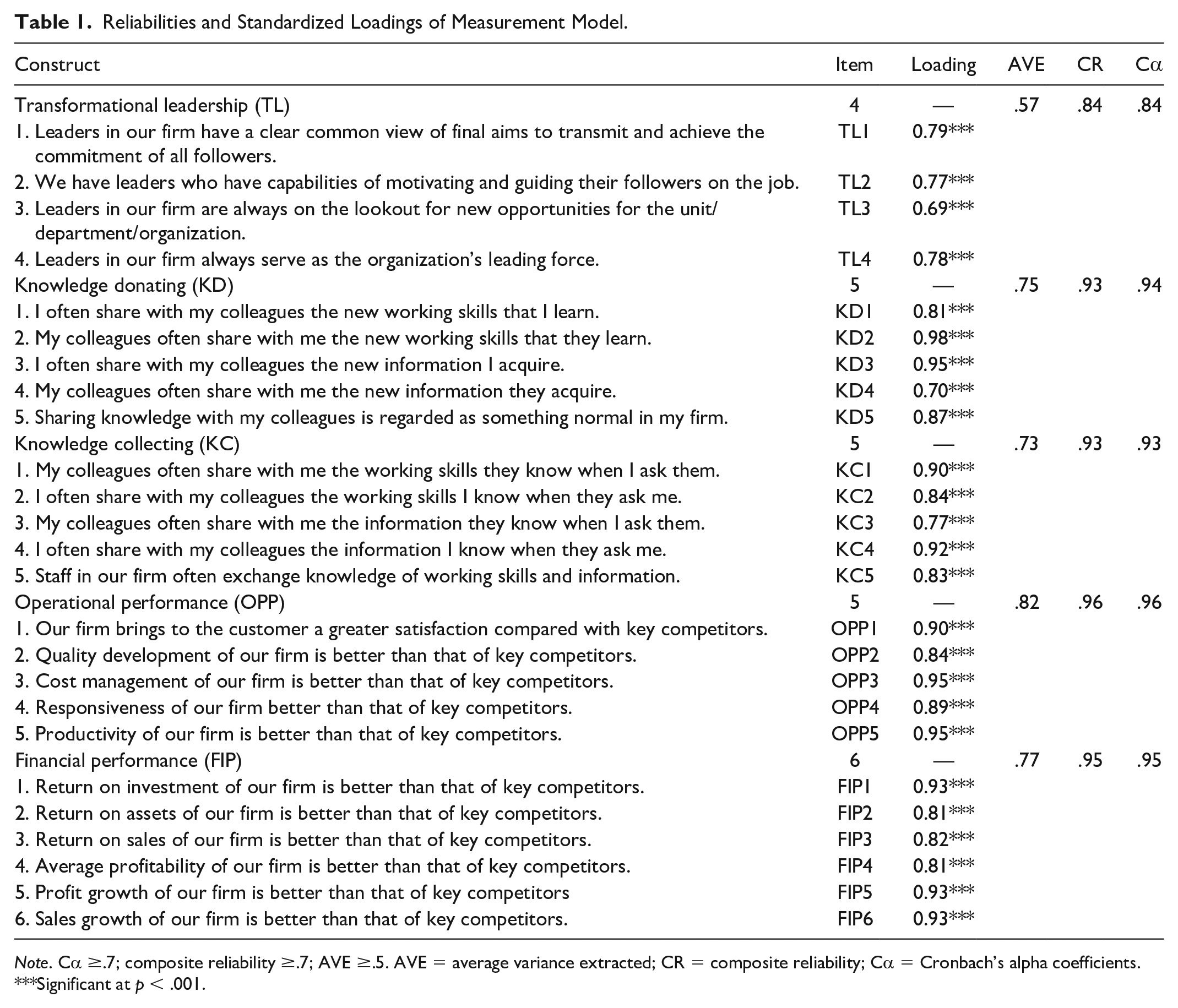
Note. Cα ≥.7; composite reliability ≥.7; AVE ≥.5. AVE = average variance extracted; CR = composite reliability; Cα = Cronbach’s alpha coefficients.
Significant at p < .001.
Discriminant validity refers to the level of the factors that assumed to assess a certain construct does not forecast conceptually independent criteria (Kline, 2010). This article applies the method of Fornell and Larcker (1981) relating to comparison of the AVE’s square root with the correlations among the dormant constructs (see Table 2).
AVE’s Square Root and Descriptive Statistics from Constructs.

Note. Diagonal components (in bold) are the AVE’s square root; off-diagonal components are the constructs’ correlation coefficients. TL = transformational leadership; KD = knowledge donating; KC = knowledge collecting; OPP = operational performance; FIP = financial performance; FM = firm size.
Table 2 indicated that the AVE’s square root of each construct is higher than the correlation coefficients among variables of research model. Overall, the above results show strong evidence for both the reliability of the constructs and the discriminant validity of scales.
We estimated the fit of measurement model based on examining (a) absolute fit values (goodness-of-fit index [GFI], minimum discrepancy per degree of freedom [CMIN/df], and root mean square error of approximation [RMSEA]), (b) incremental fit values (normed fit index [NFI], adjusted goodness-of-fit index [AGFI], and comparative fit index [CFI]), and (c) parsimonious fit values (parsimony goodness-of-fit index [PGFI] and parsimony normed fit index [PNFI]). Table 3 exhibits the fit of measurement model. Consequently, we infer that the research model conforms to the data and it, therefore, can give a good explanation of the research hypotheses.
The Fit Indices of the CFA Model.

Note. CFA = confirmatory factor analysis; CMIN/df = minimum discrepancy per degree of freedom.
Acceptable value. bMarginal value.
Structural Model
This section analyzes the original results of hypothesis assessment of the correlation between the constructs in the research model.
Direct effect analysis
The results in Figure 2 and Table 4 demonstrate that the independent variables’ direct effects on dependent variables ensure statistical significance. Hypotheses H1 to H3 are, therefore, supported. Specifically:

Results of the structural equation model.
Structural Model Results.

Note. TL = transformational leadership; KC = knowledge collecting; KD = knowledge donating; OPP = operational performance; FIP = financial performance.
significant at the .001 level.
For Hypothesis H1a.b, the results showed that TL’s impact on aspects of KS behavior is very considerable. It also showed that the TL’s effects on employees’ behavior of knowledge donating (β = .577, p < .001) is greater than its effect on employees’ behavior of knowledge collecting (β = .558, p < .001).
For Hypothesis H2a.b, the results revealed that TL’s influences on financial performance (β = .401, p < .001) is larger than its influence on operational performance (β = .290, p < .001).
For Hypotheses H3a.b and H3c.d, the results showed that both knowledge collecting and donating have greater impacts on operational performance compared with financial performance. Specifically, knowledge collecting’s influences on operational performance (β = .247, p < .001) and financial performance (β = .228, p < .001) are statistically significant. Similarly, knowledge donating’s influences on operational performance (β = .400, p < .001) and financial performance (β = .276, p < .001) are also supported.
The hypotheses’ assessment results are attained after investigating the effects of the control variable (firm size). The control role of this variable is not supported because its effect on OP is not statistically significant (see Table 4).
Indirect and total effect analysis
As per the recommendation of Preacher and Hayes (2008), we implemented the bootstrap confidence intervals procedure with 1,000 repetitions to check and show the evidence for the TL’s indirect effects on OP. Table 5 showed both the total effects and indirect effects of TL on components of OP.
Test the TL’s Indirect Effects on Operational and Financial Performance.

Note. TL = transformational leadership; KS = knowledge sharing; OPP = operational performance; FIP = financial performance.
p < .005. ***p < .001.
Table 5 showed TL’s indirect influences on operational performance (β = .369, p < .005) and financial performance (β = .286, p < .005), which are all in confidence intervals. It demonstrated the TL indirect impacts on OP based on the mediating role of employees’ KS behaviors. Hence, with regard to the TL’s indirect influences, Table 5 first verifies the mediators of knowledge collecting and knowledge donating in the correlation between TL and components of OP. Besides, the results showed that the total effects of TL on financial performance are very impressive with value of 0.687. It is the result of TL’s direct effect on financial performance that is very significant with β = .401 at p <.001.
Discussion and Implications
OP demonstrates the organization’s success in a competitive environment (Hurduzeu, 2015; Z. Wang et al., 2016). Leaders have a crucial role and responsibility for key outcomes in any organization. As a result, scholars and practitioners have invested a lot of time and effort to identify the specific characteristics of leadership for improving OP. KS is also well recognized as one of the most important activities that help employees discover new ideas and solutions for improvement in their work. It is unfortunate that there is little guidance in the extant literature on how transformational leadership (Arif & Akram, 2018) and KS affect specific aspects of OP, namely, operational and financial performance (Z. Wang et al., 2014; Z. Wang & Wang, 2012). For such reasons, investigating the mediating role of KS between TL and specific components of OP, namely, operational and financial performance provides important practical and theoretical initiatives for leaders to enhance OP in their firms. The findings of this study also significantly contribute to developing theory of knowledge management and OP for the following important reasons:
First, the article significantly contributes to filling the theoretical gaps and increasing the understanding of TL’s correlation and effects on specific aspects of KS behaviors. Indeed, knowledge is a pivotal resource of the organization that bring firms a sustainable competitive advantage to survive before the increasing changes in the business environment and fierce competition (Lei et al., 2019; S. Wang & Noe, 2010). As one knowledge-focused activity, KS is the core means of contributing to knowledge application, creativity and innovation, and OP (Farooq, 2018; Podrug et al., 2017). Many organizations have invested a huge time, effort, and money for improving their organizational knowledge capital through KS. However, they still fail to share knowledge and are losing billions of dollars each year (Babcock, 2004). An important reason for the failure of improving KS is the lack of understanding of how leadership styles or specific leadership characteristics influence KS (Le & Lei, 2018b; S. Wang & Noe, 2010). To address these theoretical gaps, the article has examined the effects of TL on KS behaviors and indicated the significant influences of TL on knowledge donating and knowledge collecting. The finding has underlined the TL’s essential role in exhorting employees’ behavior of knowledge donating in comparison with their behavior of knowledge collecting. This is an extremely significant finding because it is not easy to stimulate the willingness of employees to “share knowledge in an active way without conditions” (Le & Lei, 2018b). The findings reveal that the positive effects, such as treating transformational leaders as the organization’s valuable and rare assets, motivating and guiding their employees carefully, and stressing the momentous role of values, beliefs, and emotions, have encouraged employees to voluntarily share their own knowledge capital with coworkers for creating greater benefit and achieving common goals.
Second, knowledge donating and knowledge collecting represent two contrasting behavior trends in the KS activities of an individual, where knowledge donating reflects the “willing to share in an active way without conditions” and knowledge donating reflects the “willing to share when others ask for the purpose of collecting” (Le & Lei, 2018a, p. 192). By investigating the effects of knowledge donating and knowledge collecting on aspects of OP, the article has contributed to the expanse and arousal the new ideas of improving OP. The findings show that KS behaviors of employees act as the significant predictor of OP. The findings are consistent with Farooq’s (2018) research of a conceptual model of KS. By indicating that (a) aspects of KS have greater impacts on firm operational performance in comparison with their impacts on financial performance, and (b) knowledge donating brings more significant effects on aspects of OP than the effects of knowledge collecting’s influences. The findings are very helpful for managers who wish to understand how specific KS behaviors affect OP in organizations. Specifically, these findings highlight the critical role of knowledge donating in improving OP. In fact, tacit knowledge (such as valuable experiences and expertise, uncommon understandings, and insights and intuitions) plays a decisive role in bringing positive and key outcomes for the organization (Peet, 2012; Z. Wang et al., 2016). However, these types of knowledge are very difficult to gather because individuals “often do not know what it is” to be able to ask and collect. The tacit knowledge is only shared and applied if individuals are “willing to share in an active way without conditions.” Hence, to effectively improve OP, CEOs and managers need to put the right investment and great efforts for stimulating knowledge donating among employees in their organization. Besides, the findings show that TL has a greater influence on financial performance in comparison with its effect on operational performance. From these findings, some practical implications are proposed, that is, (a) to attain better financial goals (such as the return on investment and sales, the growth of profit and sales, and the average profitability), CEO/managers need to pay greater attention on practicing the TL style, and (b) for the firm to attain better strategic goals (e.g., cost management, customer satisfaction, quality development, productivity, and responsiveness), CEO/managers need to pay much attention to create good conditions to encourage KS activities among individuals, especially knowledge donating behavior.
Third, a number of prior studies have incorporated KS activities as a mediator in the relationship between leadership and performance or the other outcomes. However, most of them neglected to investigate the influences of leadership and KS on performance at the firm level. For example, Srivastava et al. (2006) examined the role of KS in linking empowering leadership and team performance, P. Lee et al. (2010) explored the mediating role of KS between team leaders and team performance, and Song et al. (2015) inspected KS as a mediator between servant leadership and team performance. To our knowledge, no previous scholars have explored and provided empirical evidence demonstrating the mediating mechanism of KS behaviors in the TL-OP relationship. As a result, this article contributes significantly to advancing the theory of OP by evaluating the mediating effect of KS in the relationship between TL and the two specific types of OP. The empirical findings have affirmed the mediators of two KS behaviors in the TL-OP relationship, and spotlighted that TL practices can significantly affect operational and financial performance directly or indirectly by stimulating employee behaviors of knowledge donating and knowledge collecting. From the practical implications, the article serves as a reference that provides valuable insights into the necessary factors/conditions as well as the new pathway to promote operational and financial performance.
Inevitably, this study also has limitations. First, the article employs cross-sectional design; this may lead to a situation where causal correlations might fluctuate in the long run, due to changes in individuals’ emotion, and attitude toward KS may change over time. A longitudinal investigation will help to control this limitation and affirm the result. Second, this study examined the correlation among factors based on self-reported data. This may lead to the limitation of common method bias or single source bias. Future research should test the relationship among the constructs, especially in terms of measuring OP based on objective data to consolidate the findings. Third, the results and the benchmarks in this article are more appropriate for the context of Chinese firms. Future research may be implemented in other circumstances to obtain a clearer picture/implication in terms of the correlation among these factors. Besides, two specific aspects of KS are found to have significant impacts on OP. Hence, it is necessary to perform further studies in the future aimed at exposing, more deeply, the effects of TL and KS on the other strategic components of OP, such as knowledge management, team collaboration, and strategic performance (Ramezan et al., 2013).
The article significantly advances OP theory by offering an integrative model to attach TL and specific types of OP through the mediating mechanisms of knowledge donating and knowledge collecting. The article is unique in its attempts to explore the new pathway and provide the initial empirical evidence supporting the proposed research model of TL as a crucial predictor for stimulating KS behaviors and improving operational and financial performance.
In general, this study is unique in its attempts to explore and produce a deeper understanding, and its integrated view of a new pathway leading to specific key aspects of innovation. We supposed that TL practices, by affecting employees’ positive feeling of the transformational leader’s attributes (such as viewing employees as the strategic resource of firm; developing leader–employee emotional relationship, and motivating employees to greater values/beliefs; serving as the organization’s leading force; and focusing on searching new opportunities to bring development for firm), will significantly encourage the proactive approach and behavior of employees in sharing knowledge for improving OP.
Footnotes
Declaration of Conflicting Interests
The author(s) declared no potential conflicts of interest with respect to the research, authorship, and/or publication of this article.
Funding
The author(s) disclosed receipt of the following financial support for the research, authorship, and/or publication of this article: This research is funded by Vietnam National Foundation for Science and Technology Development (NAFOSTED) under grant number 502.02-2019.300.
