




Abstract
The connection between leadership styles and employees’ innovative behavior has been widely investigated. However, none of the studies examine employees’ organizational trust in the public sector. Based on the social exchange theory, this study fills the gap by examining the relationship between transformational and transactional leadership, organizational trust, and innovative behavior of millennial public employees. It also explored the effect of transformational and transactional leadership on innovative behavior mediated by organizational trust. A cross-sectional design was applied by distributing questionnaires to 320 public servants studying at the Universitas Indonesia to obtain their responses. The data were then analyzed using a partial least square structural equation modeling (PLS-SEM). The results showed that transformational and transactional leadership affect the innovative behavior of millennial public employees mediated by organizational trust. This study enriches the knowledge regarding innovative behavior and contributes to public human resources management by enhancing organizational trust.
Keywords
Introduction
Public sector innovation has become a prominent debate since the rise of the new public management movement in the 1990s (Cinar et al., 2019; Günzel-Jensen et al., 2018). Correspondingly, the public organization should be more innovative, adaptive, and creative to magnetize the complex public interest. Many scholars believe that innovative government could be achieved through employee innovative behavior (Demircioglu & Audretsch, 2019). A public organization is challenged to transform to fill public needs and face a dramatic change in human civilization. The transformation requires the organizations to be more innovative and respond quickly to the public demands. Innovation is achieved when the public sector employees innovate and continuously create new procedures to address their tasks and resolve workplace problems. Therefore, various public sector organizations should enhance their members’ innovative behavior. The employee’s motivation to find new ways regarding their task and organizational issues is known as innovative work behavior (Asurakkody & Shin, 2018). This indicates that innovative behavior is the creative process in which employees are motivated to apply unusual methods to solve problems in their job.
Leadership styles predict employees’ innovative behavior in the workplace (Günzel-Jensen et al., 2018; McCann & Sparks, 2019; Zheng et al., 2019). The styles are the manager’s leadership patterns in impressing the members’ actions and attitudes. These attract obedience from the subordinates and ensure they are willing to comply with what the leader needs. Scholars believe that transformational and transactional leadership styles are the strongest predictors of public employees’ innovative behavior (Günzel-Jensen et al., 2018; Ryu, 2022). A manager with a transformative and transactive leadership style is more successful than others. A transformational leader can stimulate the subordinates to implement their creativity and innovative ideas in the workplace. Furthermore, it provides power and makes the subordinates trust and have confidence in their leaders in delivering their job.
Unfortunately, various studies are inconsistent about the interplay between transformational-transactional leadership and innovative behavior (Hansen & Pihl-Thingvad, 2019). Also, they point out the positive impact of the relationship between transformational-transactional leadership and innovative behavior (Muchiri et al., 2020). Some studies showed the negative influence of transformational (Chung & Li, 2021; Ma & Jiang, 2018) and transactional leadership on innovative behavior (Afsar et al., 2017; Günzel-Jensen et al., 2018). Consequently, the different results of the prior studies are crucial for further studies.
Various studies also found the role of organizational factors in illuminating innovative behavior. The factors related to organizational dimensions and conditions enhance innovative behavior (Asurakkody & Shin, 2018). Examples of organizational factors that predict innovative behavior are culture (M. A. Khan et al., 2020; Zheng et al., 2019), commitment (Önhon, 2019; Tang et al., 2019), climate (Liu et al., 2019; Shanker et al., 2017), and justice (Nazir et al., 2019). However, studies on the role of organizational trust in elevating innovative behavior are limited. Previous studies hardly examined the role of organizational trust in leadership styles and innovative employee behavior. Organizational trust determines innovative behavior because an individuals’ positive expectations of the intentions and actions of people in the organization are based on organizational responsibilities, connections, encounters, and interrelatedness (Ozmen, 2019). Trust becomes crucial in enhancing innovative behavior because it relates to the employees’ beliefs about the organization and how the leader encourages their creativity (Lee, 2008).
This study applied the social exchange theory to examine the role of transformational and transactional leadership and organizational trust in determining innovative behavior. According to the social exchange theory, individual attitude and behavior are an exchange effect caused by a positive relationship between employees and organizational environments (Chernyak-Hai & Rabenu, 2018; Cropanzano et al., 2017). The reciprocal exchange mechanism of transformational and transactional leadership and organizational trust dimensions and characteristics determines innovative behavior. As an exchange process, a transformational leadership focusing on the leader’s internal capacity provides freedom and influences employees’ determination, including creativity (Zuraik & Kelly, 2019) and organizational trust (Yu et al., 2018). Moreover, transactional leadership motivates subordinates to follow the organizational mission using a reward as an exchange mechanism to enhance employees’ trust (Hansen & Pihl-Thingvad, 2019).
This study aimed to examine the link between transformational and transactional leadership, organizational trust, and innovative behavior in public organizations. It also discussed public sector human resources management in four ways. First, it clarifies and examines the association between transformational-transactional leadership and innovative behavior due to a lack of a common understanding and contradiction among the previous studies on the relationship. Second, it considers organizational trust a mediator factor in the relationship between transformational and transactional leadership and innovative behavior. Third, it focused on the millennial workforce because it has different attitudes from prior generations regarding innovative behavior (Zhao et al., 2021). Fourth, this study enriches the debate on innovative behavior in public sector organizations hardly investigated by human resources management scholars (Miao et al., 2018).
The first section of this paper presents the review of literature and hypotheses development framing this study. The second section explains the research method, while the third part presents the main findings, discussion, implications, and limitations of this work. The last section summarizes the key points of the study.
Literature Review and Hypotheses Development
Theoretical Underpinning
Innovative behavior is the people’s willful conduct to develop and incorporate new and useful ideas for individual, community, or organizational benefit (Bos-Nehles et al., 2017). This denotes that innovative behavior transcends creativity, particularly at the outset, to produce new and useful ideas (Pian et al., 2019). Creativity is the first step to innovation, covering the ideas’ development, promotion, and realization (Tian & Sanchez, 2017). It is aimed to produce creative outputs and support the person, the community, or the organization.
Studies applied various theories to explain the connection between innovative behavior and its antecedents, such as equity (Adams, 1965), transactional stress (Lazarus & Folkman, 1984), self-determination (Deci & Ryan, 1985), and social exchange (Blau, 1964) theories. Other theories are job demands-resources (JD-R) theory (Bakker et al., 2004), social cognitive (Bandura, 2001), leader-member exchange (Graen & Uhl-Bien, 1995), social network (Granovetter, 1973), conservation of resources (Hobfoll, 1989), and social information processing (Salancik & Pfeffer, 1978) theories. This study applied the social exchange theory because it sufficiently explains reciprocated exchange between leadership styles, organizational trust, and public employees’ innovative behavior (Ciobanu et al., 2019; Eva et al., 2019). Therefore, the theory helps to understand the reciprocal relationships among the study variables.
Two prominent sociologists, Homans (1958) and Blau (1964), developed social exchange theory, which sought tangible and intangible exchange among individuals. According to this theory, individuals respond to the benefit that they are accepted, meaning their behavior is the calculation of cost and benefit because humans are rational entities (Yudiatmaja, 2020). Studies on organizational behavior used social exchange theory to understand the mutual relationship between two parties involved in exchanges in the organization (Cropanzano et al., 2017). This is due to the necessity of a framework for conceiving individual performance, commitment, motivation, and innovation in the workplace (Chernyak-Hai & Rabenu, 2018). The theory also obligates interconnected relationships or transactions compelling supplementary behavior from another actor. One entity’s specific transaction or attitude promotes reciprocal intention for another entity in the exchange relationship. Also, a party’s activity is contingent on the beneficial response of the other entity to the exchange or transactional linkage (Fan et al., 2019).
Leadership Styles and Innovative Behavior
Previous studies examined various leadership styles determining innovative behavior. Afsar et al. (2017) and Kark et al. (2018) examined transformational and transactional leadership, while Karatepe et al. (2020), M. M. Khan et al. (2022), Wang et al. (2019), Zeng and Xu (2020), and C. Zhu and Zhang (2020) analyzed servant leadership. Jønsson et al. (2021), Qi et al. (2019), and J. Zhu et al. (2019) examined empowering leadership, while inclusive leadership was investigated by Javed, Khan, & Quratulain (2018), Javed et al. (2019, 2021) and Shakil et al. (2023). Furthermore, Bagheri et al. (2020), Bagheri and Akbari (2018), Hoang et al. (2022), and A. Iqbal et al (2022) explored entrepreneurial leadership, Yuan (2021) and J. Zhang and Su (2020) examined participative leadership, while Z. A. Iqbal et al. (2020), Lei et al. (2020), and Ullah et al. (2021) investigated ethical leadership. The main findings of these studies underline the crucial role of numerous leadership styles in affecting employee innovative behavior.
In this study, transformational and transactional leadership are chosen as antecedents of innovative behavior for at least three subsequent rationales. First, transformational and transactional leadership are impactful determinants of innovative behavior looked at from the perspective of social exchange theory. Regarding social exchange theory, individuals will boost to act more creatively and innovative in the workplace, when the leader shows positive support. It can be shown by providing encouragement, challenge, and positive stimulation, which can be entirely applied by transformational and transactional leaders (Aboramadan & Kundi, 2020). Eventually, it will be reciprocated with innovative behavior by the follower. Second, transformational and transactional leadership are more worthwhile than others in the context of millennial employees because they are more interested in the leader who can provide an opportunity to maximize their creativity and reward. One of the characteristics of the millennial generation is always challenged with new ways. It needs support from visionary and benevolent leaders to implement creative ideas (Hurtienne et al., 2022). Third, we argue that the leader who motivates and inspires the follower can enhance trust in the organization, in turn, innovative behavior. Therefore, we put transformational and transactional leadership as predictors of innovative behavior, along with organizational trust.
Transformational Leadership and Innovative Behavior
Transformational leadership inspires and empowers individuals, groups, and organizations by transforming paradigms and values toward independence. The three important dimensions of this leadership are charisma or inspirational motivation, intellectual stimulation, individualized consideration, focusing on the goal, and high-performance expectation (Afsar & Umrani, 2019; Eberly et al., 2017). Leaders who have transformational features will attempt to encourage the follower by offering constructive stimulus to achieve organizational purposes. Transformational leaders encourage their subordinates to use motivation and positive stimulus to achieve their innovative efforts.
Each government official has a spirit to transform and innovate the circumstances, though it cannot be realized without organizational and leader support. It depends on the various supported environment in the public organization, such as organizational climate and culture, leadership, reward, and punishment mechanisms (Hughes et al., 2018). Based on the social exchange theory, a transformational leader affects followers’ attitudes and behavior toward creativity and innovation through positive stimulation and motivation. Transformational leadership affects employees’ innovative behavior and has several characteristics, such as stimulation, inspiration, and challenge (Ng, 2017). Furthermore, transformative leaders promote and provide positive stimulation to their subordinates to implement creativity and innovation (Yi et al., 2019). Numerous studies have asserted the positive connection between transformational leadership and innovative behavior in different contexts, such as construction (Y. Zhang et al., 2018; Zheng et al., 2019), companies (B.-J. Kim et al., 2018), hospitals (Afsar & Masood, 2018), hotel (Afsar et al., 2019; Amankwaa et al., 2022), Bank (Amankwaa et al., 2019), and manufacturing industry (Bednall et al., 2018; Pradhan & Jena, 2019). Based on the explanation, this study proposed the first hypothesis as follows:
Transactional Leadership and Innovative Behavior
Transactional leadership focuses on the interpersonal exchange between leaders and followers involving contractual relationships (Jensen et al., 2019). It emphasizes reward and punishment and is associated with innovative behavior, especially reward, enabling employees to perform well. The reward is divided into verbal, material, and immaterial, and it is utilized by a transactional leader to enhance followers’ motivation and performance. Followers respond to the rewards as positive attention from the leader and management. Moreover, leaders offer sanctions in affecting employees’ attitudes and behavior to fit the organization’s agenda. This is in line with social exchange theory, which states that the exchange between leader attributes and employee attitude determines performance and job outcome (Donkor et al., 2022).
Transactional leaders recognize and fulfil followers’ needs through verbal and non-economic rewards that promote innovative behavior more than material rewards. This is because material rewards interrupt intrinsic motivation and negatively impact employees innovative behavior (Ryan & Deci, 2020). In contrast, verbal rewards make employees more innovative because they promote intrinsic motivation and individual creativity (Hansen & Pihl-Thingvad, 2019). Millennial employees are more interested in verbal and contingent than economic rewards (Glazer et al., 2019). Therefore, transactional leadership drives millennial employees’ innovative behavior by providing a non-economic reward to the subordinates, such as positive appreciation and the freedom to choose advanced working methods and an online or offline workplace. Previous studies noted the positive role of transactional leadership in influencing innovative behavior (Z. A. Iqbal et al., 2020; Ma & Jiang, 2018; McCann & Sparks, 2019). Therefore, the second hypothesis is formulated as follows:
Transformational Leadership and Organizational Trust
Organizational trust is an individual’s belief and willingness to act based on another person’s phrases, behavior, and choices (Gustafsson et al., 2021). It is exceptionally related to trust in management and organizational leadership. Subordinates’ organizational trust demonstrates their subjective dependence on the work environment. It shows their commitment to being susceptible to the organization’s purpose of realizing its responsibilities and desires (Jiang et al., 2017). Individuals trust an organization because of the relationship between leaders and employees (E. J. Kim & Park, 2019). Leaders represent the organization in employees’ perceptions, meaning their attitude affects employees’ belief that the organization acknowledges their preferences and mission. According to social exchange theory, leaders’ attitude is a mutual exchange with employees trust in the organization (Javed, Rawwas, et al., 2018). When leaders demonstrate their credibility, fairness, and respect, employees are more likely to put their faith in them and show dedication, commitment, and trust for the supervisor’s motivation. Moreover, employees become committed and motivated to their tasks when they believe their leaders are trustworthy (Afsar & Shahjehan, 2018). Therefore, trust is crucial in establishing long-term exchange relationships between management and employees.
The manager’s transformational leadership characteristics such as intellectual stimulation, charisma, motivation, and individual consideration promote adherent’s innovation to change, applying practical solutions, and implementation of a new idea in the workplace. For instance, followers seek creative ways to solve complex problems through motivation and to develop trust in leaders (Carnevale et al., 2017). Transformational leadership makes the followers believe that their leader and organization allow them to develop and practice their new and creative ideas (Islam et al., 2021). Consequently, they reciprocate their leader’s support and trust through commitment, devotion, and creativity when leaders are trustworthy, equitable, and appreciative. Previous studies highlighted the positive impact of transformational leadership and organizational trust (Holtz & Hu, 2017; Islam et al., 2021; Jain et al., 2019; Zainab et al., 2022). Therefore, the third hypothesis was formulated as follows:
Transactional Leadership and Organizational Trust
Transactional leaders agree with their subordinates to build trust related to calculated-based trust (Young et al., 2021) and involve verbal and economic rewards and contingent punishment. Referring to social exchange theory, the dimensions of transactional leadership, such as contingent reward, management by exception, and punitive actions, are reciprocal elements in affecting employees’ organizational trust (Delegach et al., 2017). Followers’ behavioral response depends on mutual reciprocation between employees’ needs and organizational rewards. Therefore, employees’ organizational trust increases when reciprocated with positive and mutual benefits.
The effect of transactional leadership on organizational trust has become a debate among scholars. Freeman and Fields (2023) stated that transactional leadership negatively influences organizational trust because it makes teachers distrust their organization. However, Xie et al. (2018) identified transactional leadership’s positive and significant role in improving employees’ trust in their enterprise. Public sector organization is significantly different from the private sector in innovation management. The public sector innovation potentially affects individual risks on the carrier because of inconsistent and overlapping regulation (Cinar et al., 2019). Therefore, the millennial employee in the public sector needs the leader and management to guarantee that innovative change conducted cannot eradicate their future in the organization (M. Zhang & Zhao, 2021). In line with this, the fourth hypothesis was formulated as follows:
Organizational Trust and Innovative Behavior
Organizational trust drives innovative behavior through employees’ perceptions that the organization’s leader and management provide an extensive opportunity to realize creative endeavors. Trust in a leader ensures that the manager strongly supports the employees (Afsar & Masood, 2018). In this case, employees seek management support due to the negative impact of unsuccessful innovation. Therefore, trust in management convinces the staff that every creative idea is preserved and insured by the organizational systems and rules (Nazir et al., 2019). The employee believes that every creative and innovative person would be appreciated by the manager and organization (Afsar et al., 2020). The trusting relationship between leaders and management fosters a collaborative environment that facilitates advanced idea formulation and implementation essential for employee innovation (Alsharo et al., 2017). Trust enables an innovation climate to be developed and implemented in the organization. Previous studies showed a positive link between organizational trust and innovative behavior (Song, 2019; Yu et al., 2018). Therefore, the following hypothesis was proposed:
Studies showed that employee trust is a crucial mediating variable of transformational and transactional leadership (Jain et al., 2019). This study also posits organizational trust as a mediator in the effect of transformational and transactional leadership on innovative behavior, which relies on the followers’ degree of faith. Employees’ motivation to apply creativity because of transformative leadership relies on how the organization supports change (Yue et al., 2019). Through trust in their leader and organization, employees are motivated to develop a positive attitude and achieve job outcomes, including innovative work behavior. Social exchange theory states that a trusting environment benefits the organization. It stimulates risk-taking and creative behaviors, innovative acts, and information sharing because employees believe their giving would be reciprocated. Furthermore, employees with a strong trust achieve major job outcomes, such as developing, promoting, and executing new ideas (Tian & Sanchez, 2017). Previous studies showed the buffering role of trust in the association between leadership styles and innovative behavior. According to Xie et al. (2018), trust in leaders intervenes in the effect of transformational and transactional leadership on innovative behavior. M. M. Khan et al. (2021) also found that trust in the supervisor mediated the relationship between servant leadership and innovative behavior. Therefore, this study aimed to highlight the mediating role of organizational trust in the nexus of transformational and transactional leadership on innovative behavior. Regarding social exchange theory and prior studies, the following hypotheses were formulated:
Theoretical Framework
The structural model of this study illustrated in Figure 1 is similar to the assumptions of the PLS-SEM (Hair, Matthews, et al., 2017). The two outer models of exogenous variables are transformational leadership (TRF) and transactional leadership (TRS). Furthermore, the two outer models of endogenous variables are organizational trust (ORT) and innovative behavior (INB). All indicators or manifest variables reflect the construct or latent variables. In this study, organizational trust is the mediating variable intervening transformational and transactional leadership on innovative behavior. The study has five direct and two indirect effects. The direct effect is depicted in a straight line, while the indirect effect is shown in the dashed line in Figure 1.

Research model.
Methods
Design
This study was conducted using a quantitative approach to show the relationship between transformational and transactional leadership, organizational trust, and innovative behavior. Data were collected using a self-administrated questionnaire based on the respondents’ general information, transformational and transactional leadership, organizational trust, and innovative behavior. The respondents were informed about the study objective and assured that all information given would be for academic purposes and anonymous. Each concept was explained briefly to avoid common method bias and ensure content validity. For instance, the questionnaire declared that transformational and transactional leadership referred to the characteristics of participants’ direct leaders in the office. Furthermore, it helped synchronize the perception of the study’s concepts and the participant.
Measures
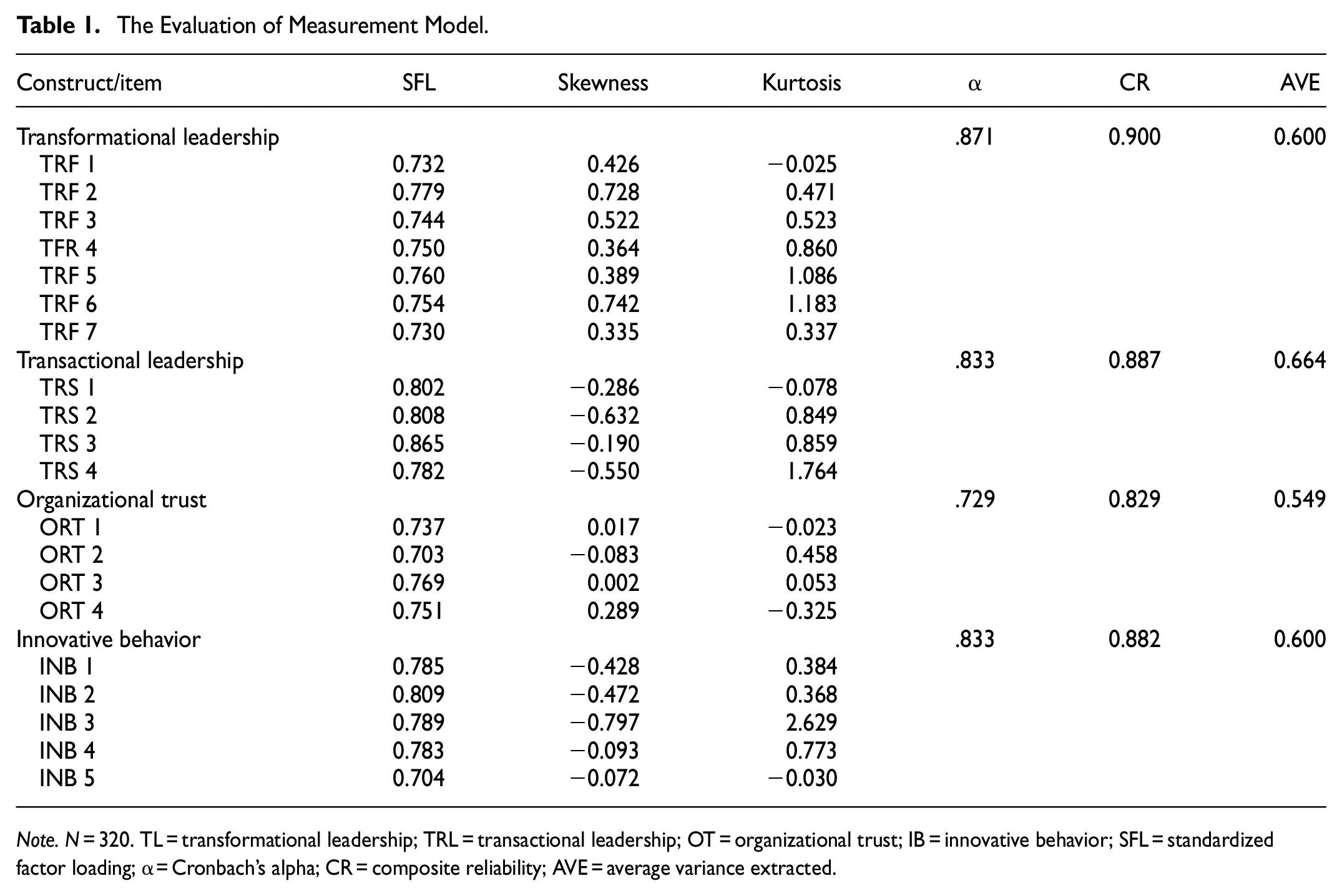
Transformational and transactional leadership were measured using 20 MLQ 5X forms that Avolio et al. (1999) proposed, including charisma, individual stimulation, individualized consideration, contingent reward, active management, and laissez-faire leadership. Items under the 0.70 loading factor were deleted, remaining with 11 items (see Table 1 and Supplemental Appendix). Organizational trust comprised 6 items adapted from Jiang et al. (2017). This study developed Cho and Song’s (2017) items describing employees’ trust in their leader and organization. Additionally, the items built by Bysted and Hansen (2015) were utilized to measure public employee innovative behavior. All items were assessed using a 5-point Likert-type scale ranging from 1 (totally disagree) to 5 (totally agree).
The Evaluation of Measurement Model.
Note. N = 320. TL = transformational leadership; TRL = transactional leadership; OT = organizational trust; IB = innovative behavior; SFL = standardized factor loading; α = Cronbach’s alpha; CR = composite reliability; AVE = average variance extracted.
Data Collection
Data were collected by distributing questionnaires to graduate students of Administrative Sciences, Universitas Indonesia. The respondents comprised millennial public employees pursuing master’s degrees in Universitas Indonesia. They were under 40 years old, as conceptualized by Correa et al. (2021). An online survey was conducted to obtain a larger response from the students working as public servants in the Police Department of the Republic of Indonesia, the Provincial Government of Special Region of Jakarta, and the Provincial Government of West Java. Moreover, 325 participants responded to the survey in which 5 questionnaires were incomplete, leaving 320 questionnaires useful for further analysis. The administrative office Department of Administrative Sciences data indicated 420 students in graduate programs in the 2019/2020 academic year. Therefore, the response rate of the survey was 76.19%. This study involved 53% male and 47% females respondents. Additionally, 76 respondents, or 24%, came from the Provincial Government of the Special Region of Jakarta, 72 or 23% from the Police Department of the Republic of Indonesia, and 67 or 21% from the Provincial Government of West Java, and 33% from other local governments.
Analysis
This study used a partial least square structural equation modeling (PLS-SEM) using SmartPLS software in data analysis. The PLS-SEM is commonly used to explore the association among abstract concepts of specific theories (Hair et al., 2021). The method runs a complex construct with non-normality conditions and a smaller sample (Hair, Hult, et al., 2017). Also, PLS was selected because of its robustness for exploratory and prediction-based studies involving structural theory and has the ability to compute reflective and formative models simultaneously (Hair, Matthews, et al., 2017). The PLS algorithm using SmartPLS was used to test the validity and reliability of the measurement model. A bootstrapping technique (5,000 re-samples) assesses the standardized path coefficient (Beta or β value), t-value, producing a 95% confidence interval bias-corrected and accelerated (BCa), and significance test (p-value) (Streukens & Leroi-Werelds, 2016). It was also used to seek the indirect effect and test the study’s mediation model.
Results
Measurement Model Assessment
The measurement model consisted of four latent variables: transformational leadership, transactional leadership, organizational trust, and innovative behavior. The reflective measurement model was assessed by analyzing the reliability and validity of each construct (Hair et al., 2019). Table 1 depicts the measurement model analysis results, consisting of standardized factor loadings (SFL), skewness, kurtosis, Cronbach’s alpha, composite reliability (CR), and average variance extracted (AVE). SFL of all the items is in the acceptable range because it is above 0.70, as Clark and Watson (2019) recommended. Moreover, CR and AVE were employed to evaluate convergence validity and internal consistency reliability. Similarly, AVEs were in the acceptable range because they were greater than 0.5 (Franke & Sarstedt, 2019). The data show that CR of all latent constructs in the model were good because they are above 0.7 (Hair, Hult, et al., 2017; Yudiatmaja et al., 2021). Cronbach’s alphas were identified to assess the construct reliability. Since the value of Cronbach’s alpha was within the acceptable threshold, all constructs were quietly reliable (Yudiatmaja et al., 2022). Overall, the measurement model in this study was fit with the data and valid for further analysis.
The summary of means, standard deviations, and correlations among studied variables is shown in Table 2. The respondents’ most satisfactory response is transactional leadership (4.13). They are moderately satisfied with their manager’s transformational leadership (3.85), while no extraordinary deviations from the mean are seen in the standard deviations (SD). Furthermore, skewness and kurtosis were less than the threshold of 3, indicating that the data were normally distributed (Cain et al., 2017). The studied variables indicate a strong and positive correlation with each other. The highest correlation among the variables occurs between organizational trust and innovative behavior (r = 0.77, p < 0.001). This implies a positive interaction among observed variables, suggesting that transformational and transactional leadership and organizational trust are important variables in predicting the innovative behavior of public servants.
Means, Standard Deviations, Intercorrelations of Innovative Behavior, and Antecedents Measures.

Note. N = 320. 1 = transformational leadership; 2 = transactional leadership; 3 = organizational trust; 4 = innovative behavior.
p < .001.
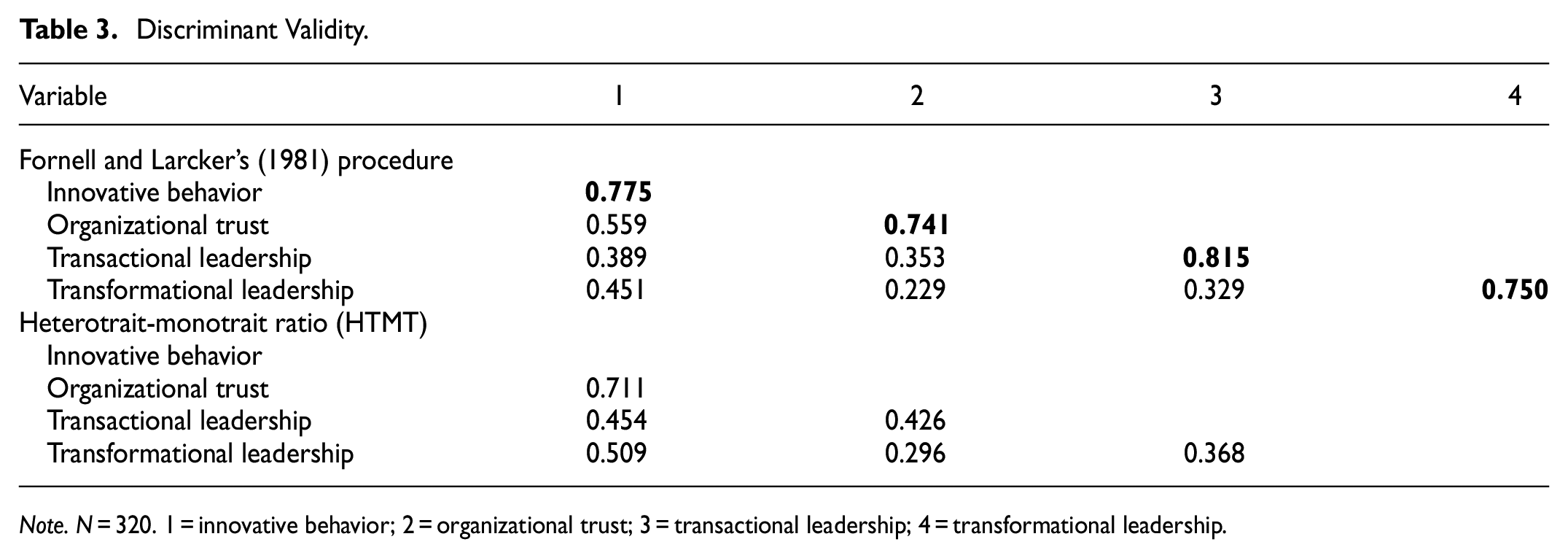
Table 3 depicts the discriminant validity of this study. According to Hair et al. (2017), discriminant validity evaluates the model’s difference with its measurements compared to other structures. It was analyzed by measuring Fornell & Larcker and Heterotrait-Monotratit Ratio (HTMT) criteria. The criteria were exhibited by the square root of the AVE value in the diagonal matrix (in bold values) greater than the off-diagonal value in rows and columns, suggesting available value. HTMT criterion was performed to evaluate discriminant validity because Fornell & Larcker is extremely sensitive to outliers and missing data. Moreover, the averages of the HTMT ratio of correlations were assessed and found to be less than 0.90, indicating no discriminant validity (Henseler, 2017).
Discriminant Validity.
Note. N = 320. 1 = innovative behavior; 2 = organizational trust; 3 = transactional leadership; 4 = transformational leadership.
Common Method Bias
Common method bias probably occurred because the questionnaire was distributed simultaneously. It refers to the measurement mistakes during data collection in cross-sectional studies (Kock et al., 2017). This study applied three strategies to address the common method bias issue. First, measurement items were adapted from different sources to reduce the bias in proposing the measured item in the questionnaire. Second, the correlation matrix among latent variables was analyzed. In Table 3, the bivariate correlation among the constructs is less than 0.9, indicating no common method bias (Podsakoff, 2017). Third, Kock’s (2017) collinearity procedure assessed the common method bias by measuring the outer and inner VIF Values. Using SmartPLS, the findings of colinearity less than the baseline value of 3 indicated no common method bias in this analysis.
Structural Model Assessment
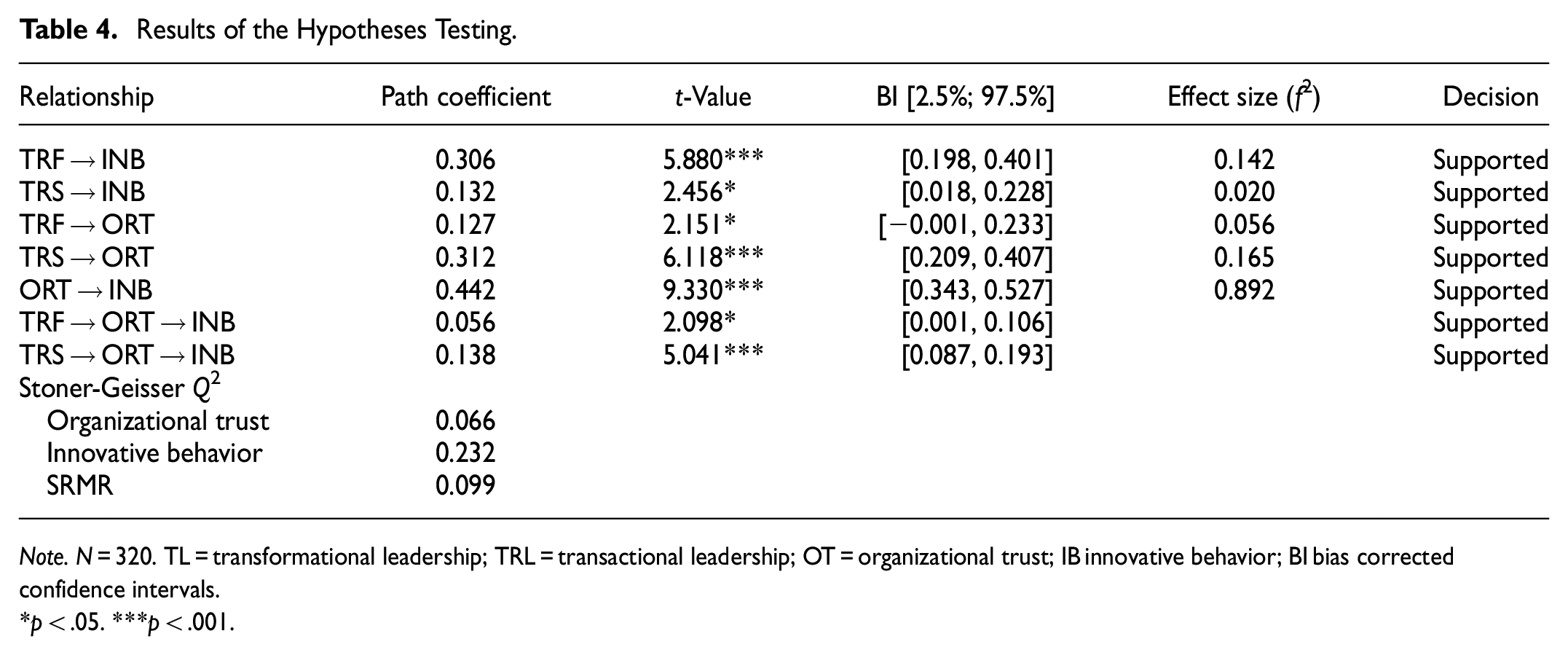
The hypotheses were assessed using SmartPLS with 5,000 re-samples bootstrapping procedure recommended by Hair, Matthews, et al. (2017). Table 4 presents the bootstrapping analysis results of hypotheses testing. H1, H2, and H5 proposing that transformational (β = 0.306, t = 5.880, p < 0.001), transactional leadership (β = 0.132, t = 2.456, p < 0.05), and organizational trust (β = 0.442, t = 9.330, p < 0.001) positively and directly influence innovative behavior were accepted. It showed 2.5% and 95% confidence interval (CI) destitute of the 0 value about 0.198 to 0.401 for transformational leadership, 0.018 to 0.228 for transactional leadership, and 0.343, 0.527 for organizational trust. Therefore, H1, H2, and H5 and are empirically justified. Furthermore, H3 and H4 indicating that transformational leadership (β = 0.127, t = 2.151, p < 0.05) and transactional leadership (β = 0.312, t = 6.118, p < 0.001) were related to organizational trust were supported by the data. It showed 2.5% and 95% confidence interval (CI) destitute of the 0 value about, respectively −0.001, 0.233 for transformational leadership, 0.007 to 0.204 for transactional leadership, and 0.209, 0.407 for transactional leadership. Therefore, H3 and H4 were fully accepted.
Results of the Hypotheses Testing.
Note. N = 320. TL = transformational leadership; TRL = transactional leadership; OT = organizational trust; IB innovative behavior; BI bias corrected confidence intervals.
p < .05. ***p < .001.
The predictive power was assessed based on the coefficient of determination or R-square (R2) value of 0.139. This means that 13.9% of the transformational and transactional leadership effect explicitly determines organizational trust (R2 = 0.139), illustrated in the R2 of the variance in Figure 2. Additionally, the variance of transformational and transactional leadership and organizational trust directly elucidates innovative behavior by 43.7% because R2 = 0.437. Therefore, 56.3% of other factors influence the innovative behavior of public servants. According to Hair, Hult et al. (2017), the explanatory power of transformational and transactional leadership and organizational trust moderately elucidate innovative behavior. This means that public organizations should maintain transformational and transactional leadership and enhance employees’ trust. Moreover, PLS’s model fit was estimated by assessing the effect size (f2) of each relationship between exogenous and endogenous variables, the Stoner-Geiser (Q2) (Hair, Hult, et al., 2017) with blindfolding strategy in SmartPLS, and the standardized root mean square residual (SRMR). The effect size (f2) ranged from 0.020 to 0.892, indicating weak, moderate, and substantial impact (Lovakov & Agadullina, 2021). The Q2 values for organizational trust (0.066) and innovative behavior (0.232) were higher than 0, depicting adequately predictive relevance. Also, the composite value of SRMR was less than 0.07 verge in line with Sguera et al. (2018) (Table 4).

Structural model.
This study recognizes organizational trust as a mediator in the effect of transformational and transactional leadership on innovative employee behavior. Hayes (2018) compiled a criterion using SmartPLS to test the mediation effect. Furthermore, the bootstrapping technique with SmartPLS was used to measure the 95% confidence interval (CI) and evaluate the importance of the indirect effect of the independent and dependent variables via the mediator. The bootstrapping results show that organizational trust mediates the impact of transformational (β = 0.056, t = 2.116, p < 0.05) and transactional leadership (β = 0.138, t = 5.028, p < 0.001) on innovative behavior, as shown in Tables 4 and 5. In Table 5, the total effects of organizational trust in the relationship between transformational (β = 0.362) and transactional leadership (β = 0.270) were described. It implies the mediation role in the association between transformational and transactional leadership on innovative behavior, meaning that H6 and H7 are supported. In this case, organizational trust partially mediates the effect of transformational and transactional leadership on innovative behavior.
Direct, Indirect, and Total Effect.

Note.*p < .05. **p < .01. ***p < .001.
Discussion
This study used the social exchange theory to examine the relationship by proposing seven hypotheses whose models were all accepted by the data. It tested the direct effect of transformational and transactional leadership on innovative behavior. The results show that transformational leadership significantly affects innovative behavior more than transactional leadership in the context of the millennial employee in the public sector. The findings are inconsistent with previous studies that transactional leadership is more important than transformational leadership in inducing employees’ innovative behavior (Afsar et al., 2017; Günzel-Jensen et al., 2018). This means that millennial employees in the public sector are more motivated by transformational leaders because they encourage innovative behavior. Since millennial employees have a higher ambition to change (Stewart et al., 2017), they need a transformational leader to support and implement their new idea. Therefore, the millennial employee expects positive stimulation, full support, inspiration, and challenges to formulate and realize innovative thoughts.
This study examined the impact of transformational and transactional leadership on organizational trust. The findings support the hypothesis regarding the positive and significant impact of transformational and transactional leadership on organizational trust. This means that transformational and transactional leaders boost followers’ belief in the organization. The results support previous studies concerning the significant effect of transformational leadership (Holtz & Hu, 2017; Jain et al., 2019; Zainab et al., 2022) and transactional leadership on organizational trust (Xie et al., 2018). However, these results contradict Freeman and Fields (2023), which found that only transformational and transactional leadership positively and negatively influence organizational trust, respectively. These findings are not similar to Freeman and Fields (2023) because of the contextual differences in the study. They focused on leadership styles in the setting of educational organizations, while we offer special attention to government organizations and the millennial workforce. It is noteworthy that the different contexts may lead to different results in social and behavioral research.
This study investigated the relationship between organizational trust and innovative behavior. The findings show that innovative behavior is significantly affected by an organizational trust. The employee’s belief in the organizational commitment to facilitate and implement innovative ideas drives their innovative behavior. The results corroborate social exchange theory, assuming that trust in leaders and the organization affects employee innovation. The results support previous studies stating the significant effect of organizational trust on innovative behavior. Song (2019) examined the mediating effect of organizational trust and knowledge sharing on the shared leadership and innovative behavior of manufacturer employees in Korea. The study found that the effect of shared leadership on innovative behavior was partially mediated by organizational trust and knowledge sharing.
This study introduced the role of organizational trust in the link between transformational and transactional leadership on innovative behavior in public sector organizations. It hypothesized that the effect of transformational and transactional leadership on innovative behavior is mediated by organizational trust. The hypotheses were accepted, supporting previous studies on the contingent role of trust in the nexus between leadership styles and innovative behavior (M. M. Khan et al., 2021; Xie et al., 2018; Yue et al., 2019). The intermediate effect of transactional leadership is stronger than transformational leadership. The results indicate that transactional leadership contributes to increasing organizational trust, which, in turn, is associated with higher levels of innovative behavior in a millennial employee. Organizational trust is more crucial in explaining the connection between transactional leadership and innovative behavior. It is in line with the character of the millennial employee who is interested in challenges and rewards in achieving high performance (Glazer et al., 2019).
Theoretical and Practical Implications
This study contributes to the literature regarding innovative behavior in the public sector human resources in several key ways. First, it showed that innovative behavior becomes a logical consequence of the positive exchange of employees’ perceptions about transformational and transactional leadership and organizational trust. Second, it re-examines unclear results of previous studies on the effect of transformational and transactional leadership on innovative behavior in the public sector. Third, this study extends the current literature on innovative behavior by focusing on the millennial workforce. According to Kwon and Kim (2020), the age difference of individuals is essential to enrich the study of innovative behavior. Fourth, this investigation expands the research on innovative behavior by linking transformational and transactional leadership, organizational trust, and innovative behavior (Moussa et al., 2018).
The results are implied to the management and enhance innovation for human resources in the public organizations. Innovative employee behavior is crucial in determining public sector innovation and is perennially impressed by leadership styles and organizational trust. Therefore, various strategies could be applied by the public sector management in facilitating the employee to be more innovative. First, public sector managers should play a role in transformational and transactional tasks by catalyzing their subordinates’ innovation and fulfilling their needs to realize better performance. Furthermore, management should promote the organization’s transformational and transactional leadership (Audenaert et al., 2019). Second, public managers should create individual trust in the organization to protect and facilitate the employee in formulating creative and innovative ideas in the workplace.
Limitations and Suggestions for Further Studies
This study used the social exchange theory to discuss employees’ innovative work behavior in government organizations. However, many theories have flourished in numerous studies, such as self-determination (Singh & Sarkar, 2019), social network (Nazir et al., 2019), social cognitive (Newman et al., 2018), psychological empowerment (Miao et al., 2018), and job-demand resources (JD-R) (Kwon & Kim, 2020). The use of such a theoretical viewpoint is important in shaping the findings. Therefore, further studies should adopt other theories while examining innovative behavior. Second, this study only investigated the innovative behavior of millennial public employees. It did not consider the division of public employees into baby boomers, generation X, and generation Z (Denhardt et al., 2020), with different values, behavior, attitude, and motivation (Kalleberg & Marsden, 2019). Therefore, future studies should analyze public employees’ innovative behavior and distinguish them into generational differences. This would help obtain the big picture of innovative behavior in the workplace by including all generations in the public sector. Third, data were collected from employees at three public organizations studying Universitas Indonesia. This created a problem of representation because the data cannot capture all Indonesian public employees (Yudiatmaja, 2019; Yudiatmaja et al., 2018). Therefore, the future should use more samples and apply a specific sample, such as local government employees. Fourth, this study used a quantitative approach limited to analyzing the relationship among variables. Several studies perform qualitative or mixed-method in explaining innovative employee behavior. Therefore, future studies on innovative behavior should apply qualitative or combination methods.
Conclusion
This study aimed to examine the effect of transformational and transactional leadership on the innovative behavior of public employees. It investigated the mediating impact of organizational trust in the nexus. Based on data analysis on millennial public employees, all hypotheses tested were accepted, where transformational and transactional leadership affect innovative behavior partially mediated by organizational trust. The results corroborate the literature on the innovative behavior of millennials in the public organization by recognizing transformational and transactional leadership and organizational trust. Therefore, this study could be adapted by the government in enhancing innovative employee behavior through leadership and trust in organizational improvement. Moreover, the government should encourage public management with transformational and transactional leadership to their subordinates to enhance innovative behavior. It should also develop organizational trust for public employees to preserve their creativity and innovation.
Supplemental Material
sj-docx-1-sgo-10.1177_21582440231178545 – Supplemental material for Fostering Innovative Behavior of Millennial Public Employee Through Leadership Styles and Organizational Trust
Supplemental material, sj-docx-1-sgo-10.1177_21582440231178545 for Fostering Innovative Behavior of Millennial Public Employee Through Leadership Styles and Organizational Trust by Wayu Eko Yudiatmaja, Roy Valiant Salomo and Eko Prasojo in SAGE Open
Footnotes
Acknowledgements
The study was partially taken from the first author’s PhD thesis in Universitas Indonesia under the supervision of co-authors. The authors express deep gratitude to the Research Cluster of Policy, Governance, and Administrative Reform (PGAR) Faculty of Administrative Science, Universitas Indonesia, that facilitated the study publication.
Declaration of Conflicting Interests
The author(s) declared no potential conflicts of interest with respect to the research, authorship, and/or publication of this article.
Funding
The author(s) disclosed receipt of the following financial support for the research, authorship, and/or publication of this article: The study was funded by Universitas Maritim Raja Ali Haji (UMRAH) through Penelitian Akselerasi Doktor (PADD) Scheme (Grant No: 02/UN53.02/Kontrak-PADD/2021).

Supplemental Material
Supplemental material for this article is available online.
References
Supplementary Material
Please find the following supplemental material available below.
For Open Access articles published under a Creative Commons License, all supplemental material carries the same license as the article it is associated with.
For non-Open Access articles published, all supplemental material carries a non-exclusive license, and permission requests for re-use of supplemental material or any part of supplemental material shall be sent directly to the copyright owner as specified in the copyright notice associated with the article.
