




Abstract
Livestreaming has gained popularity as a new e-commerce platform, communication tool, social network, and source of entertainment for millions of users. It is important to examine the nature and history of this developing area of e-commerce since it has the potential to be exploited to overcome the COVID-19 pandemic’s challenges. Therefore, this study critically explores the consumer livestreaming purchasing behavior and proposes a model, which composed of stimulus, organism, and response as the extension of stimuli-organism-organism model. The structural equation modeling approach applies for analyzing 434 survey responses from a convenience sample. The results suggest that the stimulus variable (source credibility, response capability, platform interactivity) significantly affects the organism variables (customer engagement, swift guanxi), which in turn significantly contribute to creating responses (purchase intentions, actual purchase behavior). Customer engagement and swift guanxi also have potent mediating effects in the model. We offer novel insights into new consumer behaviors in livestream commerce that can underpin future research to promote businesses and services even under challenging conditions.
Keywords
Introduction
Livestreaming shopping is ingrained and becoming more popular due to its incredible capacity to reach a variety of customers online, especially to cope with the global pandemic instead of traditional purchasing (Zheng et al., 2019). Online business and e-commerce systems can operate in a variety of ways, but some of them have grown in popularity in reaction to the epidemic because they insist on utilizing digital communication through online platforms, which reinforce to propagate the livestreaming shopping. Consumer purchasing behavior is one of the most important facets of marketing, business, and management, which is closely related to psychological and cultural issues, and also influence each other (Di Crosta et al., 2021). It is perpetually changing as different variables influence people in their internal and external environments. People’s opinions and activities form cultural norms and practices that change over time, and cultural norms and practices also shape the thoughts and actions of individuals. As a result, consumer purchasing habits and intentions are changing, and many people are beginning to favor online shopping, especially livestreaming shopping (Y.-R. C. Lu et al., 2020). Moreover, the marketers are tremendously offering the livestreaming purchasing opportunities surviving with the global crisis.
Even though livestreaming and the enormous growth of social media commerce have a huge impact on the global economy, scholars still ignored to explore the livestreaming purchasing behavior of the consumers (Meng et al., 2021), thus practitioners and academics should pay close attention to this issue (Wongkitrungrueng & Assarut, 2020). Additionally, despite the fact that there aren’t many research focusing on users’ purchasing intentions, those that do rarely have a thorough approach and none are conducted in a nationwide setting. Based on this notion, the current study intends to analyze livestreaming purchase behavior in the context of the stimuli-organism-response (S-O-R) model and subsequently provided a comprehensive model of livestreaming purchasing.
The S-O-R model is commonly used in retail research to understand online consumer behavior, assumes that several components of the environment act as stimuli (S) that influence the emotional states of individuals (O), which can in turn influence their behavioral responses (R) (M. Hu & Chaudhry, 2020). Stimuli are any materials or items used to make respondents more likely to make a purchasing decision in an online market. Source credibility, response capability, and platform interactivity are examples of stimuli that affect the purchasing intentions of customers (M. Hu & Chaudhry, 2020). Source credibility and website or platform interactivity (active control and reciprocal communication) are important in new digital market settings. Website involvement and the types of products featured on websites significantly affect user purchase intentions (K. Kang et al., 2020). In this research about livestreaming e-commerce, source credibility, response capability, and platform interactivity are considered as the stimuli, customer engagement and swift guanxi are the organisms, and purchasing intentions and actual purchase behaviors are the responses.
Customer engagement is an individual’s participation and promotion behaviors in social networks of online brand communities (Zheng et al., 2015). In general, customer engagement is the emotional or psychological state in which consumers are invested with a focal object leading frequent interactions with that object that go beyond a simple transactional motive (Rather et al., 2019; Thakur, 2018). With the emergence of customer experiences in livestreaming, it is essential to conceptualize and operationalize customer engagement to fit traditional and current marketing trends. In addition to customer engagement, swift guanxi is also considered part of the organism. As an extension of traditional guanxi, swift guanxi is defined as “a buyer’s perception of a swiftly formed interpersonal relationship with a seller” (Ou et al., 2014). However, previous studies have not fully explored the features that influence the success of livestreaming commerce. In this regard, we examine those features by discovering the relationships among the stimuli (source credibility, response capability, and platform interactivity), organism (customer engagement and swift guanxi), and response (purchasing intentions and actual purchases).
Therefore, our main objective is to develop and test a comprehensive model of livestreaming purchasing behavior, specifically how the stimuli have influenced purchasing behavior through customer engagement and swift guanxi. Accordingly, we propose three research questions (RQs): RQ1: Do source credibility, response capability, and platform interactivity build swift guanxi and customer engagement in livestreaming on social media? RQ2: Do swift guanxi and customer engagement facilitate purchase intentions and actual purchase behavior? RQ3: Do swift guanxi and customer engagement mediate the links from source credibility, response capability, and platform interactivity to purchase intentions and actual purchase behavior? We gathered 434 data from livestreaming shoppers to validate our conceptual study model and address the RQs, and we used structural equation modeling (SEM) with Amos-24 to look into the suggested relationships.
Consequently, the study makes several contributions to the body of knowledge on livestreaming commerce and managerial understandings. First, by offering a comprehensive model as a maiden study, this will assist managers and business owners in making an informed choice regarding livestreaming commerce among netizens. Second, this study will aid vloggers, owners, or managers in developing their successful marketing strategies by validating the key drivers of livestreaming commerce. This will positively boost the degree of acceptability of livestreaming supplied to online buyers and create a long-term business model. Third, by evaluating the significant mediating impacts of swift guanxi and customer engagement in the model, the current study will be evidenced that antecedents of livestreaming commerce solely are difficult to achieve purchasing behavior. There are additional crucial intervening factors that improve customers’ actual and intended purchasing behavior. Finally, our findings will be applicable to any industry and other similar business environments, enabling livestreamers to adopt the most efficient ways to achieve competitive positions ahead of the competition.
Remaining of the paper is as follows. The next section of this essay includes theoretical background information. The proposed hypothesis and conceptual research model are presented in the following section. The study technique is then condensed, and empirical findings are presented. Following that, we provide insightful discussions of the findings. Finally, we highlight important theoretical and managerial contributions made by the study to conclude the paper.
Theoretical Grounds
Livestreaming
Livestreaming is a new way to influence customers’ purchase decisions, and it has acquired substantial social commerce and special media attributes (K. Kang et al., 2020; Liu et al., 2021). Livestreaming platforms (LSPs) have altered the rules of traditional social commerce by (1) allowing online retailers to display their products in real-time videos, thereby providing customers with extensive information about the product, (2) allowing customers to pose queries via a bullet screen so that online retailers can respond instantly, and (3) providing an opportunity for face-to-face interactions that reinforce authenticity and reduce risk or uncertainty (Wongkitrungrueng & Assarut, 2020). Those new rules have meaningfully increased purchases (Y. H. Chen et al., 2020; K. Kang et al., 2020).
Livestreaming commerce, which is also a type e-purchasing, is a special type of social commerce in which companies collaborate with customers, community members, and broadcasters in real-time chat rooms to sell items (Guo et al., 2020). Livestream purchasing allows showing and eventually advertising products to a live, online audience who can interact in this live experience through online videos, chats, or other tools, and promoters connect directly with customers. The introduction of LSPs to business to consumer (B2C) and consumer to consumer marketing (e.g., livestreaming of consumer testimonials) have built authenticity, trustworthiness, and social transactional spaces online, mitigated the absence of face-to-face or human-human real-time interactions from online marketing, and increased the social presence of e-commerce (Addo et al., 2021). This study considers the B2C model in which retailers sell their products or services online, and customers buy from those sellers in an interactive, lively, communication process. Several studies have examined LSP from a psychological perspective (Addo et al., 2021; K. Kang et al., 2020) and a technical perspective (Sun et al., 2019). Because LSPs involve many human-computer interactions, psychometric perceptions and technical features must be considered comprehensively. Therefore, this study includes psychometric behavioral variables (source credibility, response capability, and customer engagement) and technical attributes (platform interactivity) to provide a comprehensive overview of LSPs and customer purchase decisions. In addition, we consider swift guanxi to gain new insights into how human-computer interactions mutually benefit buyers and sellers.
S-O-R Framework
The S-O-R framework, built by Mehrabian and Rusell (1974), assumes that behavioral responses are triggered by an individual’s cogitative and emotional state that specific environmental features produce the state. In other words, the S-O-R framework emphasizes the mediating effect that individuals’ internal experiences have between stimuli and responses. Lee and Yun (2015) asserted that those environmental features are stimuli from external sources, categorized as a group of factors that affect people’s perceptions. The organism is an individual’s internal state between the stimulus and the response, and that internal state is usually caused by external stimuli such as perceptions, feelings, and thoughts. The response is the final action and takes the form of an avoidance or approach behavior. L. Su and Swanson (2017) further noted that the S-O-R model depicts human responses to the environment in three stages: when a person is exposed to environmental stimuli (S), they generate internal ratings or states (O) that then yield a final response (R). The internal ratings or state (O) thus mediate the link between the environmental stimuli (S) and subsequent behavioral response (R).
Furthermore, the S-O-R model is successfully used to measure consumer behavior to innovative technologies, information and communication technologies, and impulse buying in mobile auctions (C.-C. Chen & Yao, 2018); user engagement in online brand communities (Islam et al., 2018 2017) ; loyalty in social commerce (Wu & Li, 2018); co-creation in social media (Kamboj et al. 2018); and e-commerce livestreaming (M. Hu & Chaudhry, 2020). The S-O-R framework is applied in the current study to assess how stimuli (S: source credibility, response capability, and platform interactivity) generate customers’ internal states (O: customer engagement and swift guanxi) and how those states produce their subsequent responses (R: purchase intentions and actual purchase behaviors).
Stimuli (S)
Modern online customers are very much concerned about information asymmetries between sellers and buyers, the shortcomings of online platforms, security, privacy, immature legal protection tools, inadequate infrastructure, fraud, and the inability to adequately inspect products before they buy them (Flanagin et al., 2014; Miyazaki & Fernandez, 2001). Therefore, customers are more and more determined to examine the trustworthiness of sellers and the quality of their products. On online platforms, a customer cannot usually view a product or meet the vendor before making a purchase, producing a high degree of uncertainty (Flanagin et al., 2014). Those ambiguities signal the high risk and ambiguity inherent in online dealings and suggest the significance of tracing and trusting online transactions that the customer deems credible. Therefore, source credibility, the degree to which an information provider is seen as credible and likely to provide an impartial opinion on an object, is a prime concern (Shan, 2022). Since there is nowhere to witness something in person, the reliability of the source is essential while livestreaming to online viewers. Expertise, attractiveness, and trustworthiness have been proposed as the prime magnitudes of source credibility (J. W. Kang & Namkung, 2019; Tan & Liew, 2020). Therefore, customer response capability reflects a company’s competence in meeting customer requirements through rapid and efficient actions (Jayachandran et al., 2004) and is an increasingly crucial driver of organizational performance and sustained success. According to Liu et al. (2021), customer response capability has two distinct magnitudes: customer response expertise and response speed. Customer response expertise is how a live streamer can successfully meet customer requirements, and customer response speed is how quickly livestreaming can respond to those needs. Live-streamers can thus view comments immediately, reply quickly, assist customers, and help them select products (Z. Lu et al., 2018), creating online intimacy and thereby affecting online engagement (Liu et al., 2021). The response capability of LSPs is a strong force in building customer attitudes and engagement with the LSP (Liu et al., 2021; Zhang et al., 2020).
Interactivity on the internet also provides room for consumers to be an active presence in the persuasion process as they navigate advertising content and control the volume and order of presentation at whatever time based on their wants and preferences (Hoffman & Novak, 1996). Ko et al. (2005) argued that interactivity is mainly two-dimensional: human–message interaction and human-human interaction. Human–message interaction represents how people interact with messages in terms of choosing the messages, levels of interaction, navigation, control, content, structure, pacing, and so on. On the other hand, human-human interactions comprise proper communication, interpersonal interactions, mutual disclosures, role exchange, feedback, connectedness, and reciprocal communication between buyer and seller. Men and Zheng (2019) consider interactivity to comprise active control, synchronicity, and two-way communication, and they report that it positively influences swift guanxi. In this regard, visual appeal with portability and interpersonal influence are essential concerns in developing hedonic and utilitarian browsing motivations on LSPs (Zheng et al., 2019), and usefulness, vividness, and real-time interactions should also be considered when building swift guanxi (Zhang et al., 2020). Therefore, platform interactivity is significant in building customer engagement with an LSP and swift guanxi, which might influence buying decisions.
Organism (O)
Swift guanxi describes a swiftly developed interpersonal relationship between a buyer and a seller that involves reciprocal favors from both parties (Ou et al., 2014). Swift guanxi is a Chinese term framed from resource dependence, as seen in cooperation between business allies that significantly back to business efficiency and competitive advantage. In online businesses, swift guanxi emphasizes how buyer-seller interactions (repeat transactions) are established to comprise mutual understanding, relationship harmony, and reciprocal favors (Men & Zheng, 2019; Zhang et al., 2020). In this context, reciprocal favors are defined as positive benefits derived from the buyer-seller relationship online (Leung et al., 2005), we consider swift guanxi as the special connection between the buyer and streamers in this study. Reciprocal favors are an almost magical opening to effective transactions because both parties offer and receive favors before, during, and after each transaction (Ou et al., 2014). Relationship harmony is a common feature of swift guanxi and refers to shared admiration and conflict avoidance (Ou et al., 2014). Once customers receive valuable information and experience real-time communication from sellers, they might decide to purchase from those sellers in exchange for what they received; therefore, swift guanxi is built through customer–customer and customer–seller relationships on LSPs (Zhang et al., 2020). We propose that swift guanxi, with the dimensions of mutual understanding, reciprocal favor, and relationship harmony, is an essential variable in building purchase intention on LSPs.
Customer engagement is a behavioral indicator of motivational interactions with or intentions toward a brand or company beyond purchase activities (Van Doorn et al., 2010). It manifests itself in spontaneous online actions, such as word-of-mouth, thumbs up, or referrals that create company value (K. K. Kang et al., 2020). Some studies report that experiencing an LSP channel in a particular way builds engagement by drawing customer beliefs from motivation to integration (Addo et al., 2021), and another study suggests that engagement is composed of immersion, presence, and perceived realism (Caroux et al., 2015). Some researchers argue that customer engagement can be separated into low, medium, and high levels and is composed of holistic measures, contribution, consumption, and creation (Schivinski et al., 2016). Therefore, combining the arguments of Caroux et al. (2015) and Schivinski et al. (2016), we consider an aggregate of emotional and psychological customer engagement that covers likes, comments, shares, and creation on LSPs.
Response (R)
Purchase intention and actual purchase behaviors are intensive research phenomena in the marketing literature. Ling et al. (2010) note that purchase intention is a cognitive stance about how a customer intends to purchase a particular product or service. On an LSP, when a customer becomes engaged and satisfied, they intend to make a purchase decision. In short, purchase intention is a customer’s willingness to purchase a product or service. However, actual purchase behavior is the action of placing an order and paying for goods and services. Ajzen and Madden (1986) noted that customer behavior could best be estimated from intentions corresponding to direct actions in context. Several researchers argue that customer engagement, swift guanxi, contracts, and benefits are the prime factors affecting purchase intention on an LSP (Addo et al., 2021; Hussain et al., 2021; Zhang et al., 2020) and successfully generating actual purchase behaviors (Qing et al., 2019; Ou et al., 2014). Therefore, we consider both purchase intentions and actual purchase behaviors as the response variable in the S-O-R framework.
Hypotheses and Conceptual Research Framework
Online shoppers who perceive a source as extremely credible experience high utility and ease of use (J. W. Kang & Namkung, 2019). Choi and Lee (2019) and Qing et al. (2019) noted that source credibility (e.g., attractiveness, expertise, trustworthiness) has a noteworthy positive influence on a consumer’s attitude toward a product, content sharing intention, purchase intention, and actual purchase behavior. J. W. Kang and Namkung (2019) additionally demonstrated that consumer trust positively affects attitudes and is thus likely to increase behavioral intentions in online commerce. Similarly, Zhang et al. (2020) showed that believability, usefulness, and vividness jointly affect swift guanxi, likely increasing purchase intentions. However, people rate the credibility of different media (e.g., newspaper, internet, television) differently for a multiplicity of information types (e.g., news, reference, health, entertainment) (Flanagin et al., 2014). Therefore, the scope of application and dimensions of source credibility remain unknown, and they are a prime concern of this study, as proposed in the following hypothesis.
Hypothesis 1: The source credibility of an LSP is positively related to customer engagement (H1a) and swift guanxi (H1b).
Customer response capability has long-lasting relationships with customer engagement and ties strength on LSPs (K. Kang et al., 2020). Viewers become engaged, perceive intimacy, and develop a close relationship with an LSP when they feel their problems are handled with care (Jayachandran et al., 2004). Customer response capability is thus responsible for building intimacy with the LSP and its other customers (Liu et al., 2021), which potentially affects online engagement. On the other hand, Zhang et al. (2020) state that when customers feel that an LSP’s response capability is high, they favorably feel swift guanxi with the sellers. On an LSP, both the customer and seller have options in hearing and negotiating the details of a purchase, which can develop a mutual understanding between them and achieve satisfaction for both parties. However, a reverse effect can occur once the number of responses exceeds a certain threshold. For example, in a state of limited resources, live-streamers might focus only on certain issues and neglect to create unique and high-quality content (Sreejesh et al., 2020). Therefore, we understand the response capability of an LSP to be a vital stimulus with which to engage customers and build swift guanxi and thus propose the following hypothesis.
Hypothesis 2: The response capability of an LSP is positively related to customer engagement (H2a) and swift guanxi (H2b).
Platform interactivity has been treated as a motivation for building relational contracts between an LSP and its users (Hussain et al., 2021) and attitudes toward the site (Ko et al., 2005). Sun et al. (2019) reported that information technology factors (e.g., meta voicing, visibility, guidance shopping) have a significant positive influence on shopping engagement and presence on an LSP. Similarly, Zhang et al. (2020) showed that usefulness, real-time interaction, and vividness positively affect swift guanxi. Furthermore, Men and Zheng (2019) reported that interactivity directly affects swift guanxi and moderates perceived seller credibility and swift guanxi. Therefore, we consider platform interactivity an imperative factor for LSPs to increase customer engagement and build swift guanxi through its prime dimensions of content usefulness, human-human interactions, and two-way communication. Therefore, we propose the following hypothesis.
Hypothesis 3: Platform interactivity on an LSP is positively related to customer engagement (H3a) and swift guanxi (H3b).
Swift guanxi can produce repurchase behavior (Ou et al., 2014) by reducing conflict and uncertainty, and customers are more likely to make purchases when an LSP has options that support social interactions (Zhang et al., 2020). It is unlikely that customers will make a purchase or repurchase decisions until they find mutual respect and relationship harmony on an LSP (Ou et al., 2014). Because shared understanding is the prerequisite for building swift guanxi, reciprocal favors increase the number of opportunities to create successful transactions, and relationship harmony begets long-term bonding. Kang et al. (2020) note that tie strength with an LSP positively affects customer engagement behavior. Similarly, an affective commitment to the newscaster and online marketplace positively affects customer engagement (M. Hu & Chaudhry, 2020). Therefore, we propose that customers who perceive multiparty understanding, exchange reciprocal benefits, and develop harmonious relationships with sellers on an LSP will make positive purchase decisions toward those sellers. Accordingly, we propose the following hypothesis.
Hypothesis 4: Swift guanxi with an LSP is positively related to customer engagement (H4a), purchase intention (H4b), and actual purchase behavior (H4c).
To quickly build a good relationship and facilitate transactions, customer engagement is essential on an LSP (Wongkitrungrueng & Assarut, 2020) and positively affects repurchase intentions (Ou et al., 2014). Livestreaming shopping engagement inspires customer trust and thereby stimulates their intention to purchase, affecting their actual purchase behaviors (Choi et al., 2019; Sun et al., 2019). Transactional and relational contracts influence purchase intentions (Hussain et al., 2021); customer trust and commitment increase channel stickiness (Y. H. Chen et al., 2020); and customer engagement increases online followership and thus purchase intentions (Addo et al., 2021). Accordingly, we propose the following hypothesis.
Hypothesis 5: Customer engagement with an LSP is positively related to purchase intention (H5a) and actual purchase behavior (H5c).
As analyzed above, the stimulus variables affect the organism variables, positively affecting the response variables. Thus, the relationships establish a triangle model in which the stimulus variables indirectly affect the response variables via the organism variables. Sun et al. (2019) showed that livestream shopping engagement intervenes the link between information technology affordance and purchase intentions. Specifically, they show that immersion and presence mediate the effects of visibility, metal voice, and purchase advice on purchase intentions. Choi et al. (2019) found that a viewer’s attitude toward a product mediates the relationship between content-sharing intention and purchase intention. On the other hand, Zhang et al. (2020) posited swift guanxi as a mediator between information and an integration quality and purchase intention, which is similar to the S-O-R idea that the stimuli increase customer perceptions and trust, significantly contribute to swift guanxi. Although several researches have explored the mediating effects of customer engagement, swift guanxi has rarely been tested as a mediator, thus proposing the following hypotheses.
Hypothesis 6: Swift guanxi and customer engagement have mediating effects on the relationships between source credibility, response capability, and platform interactivity with purchase intention and actual purchase (Figure 1).
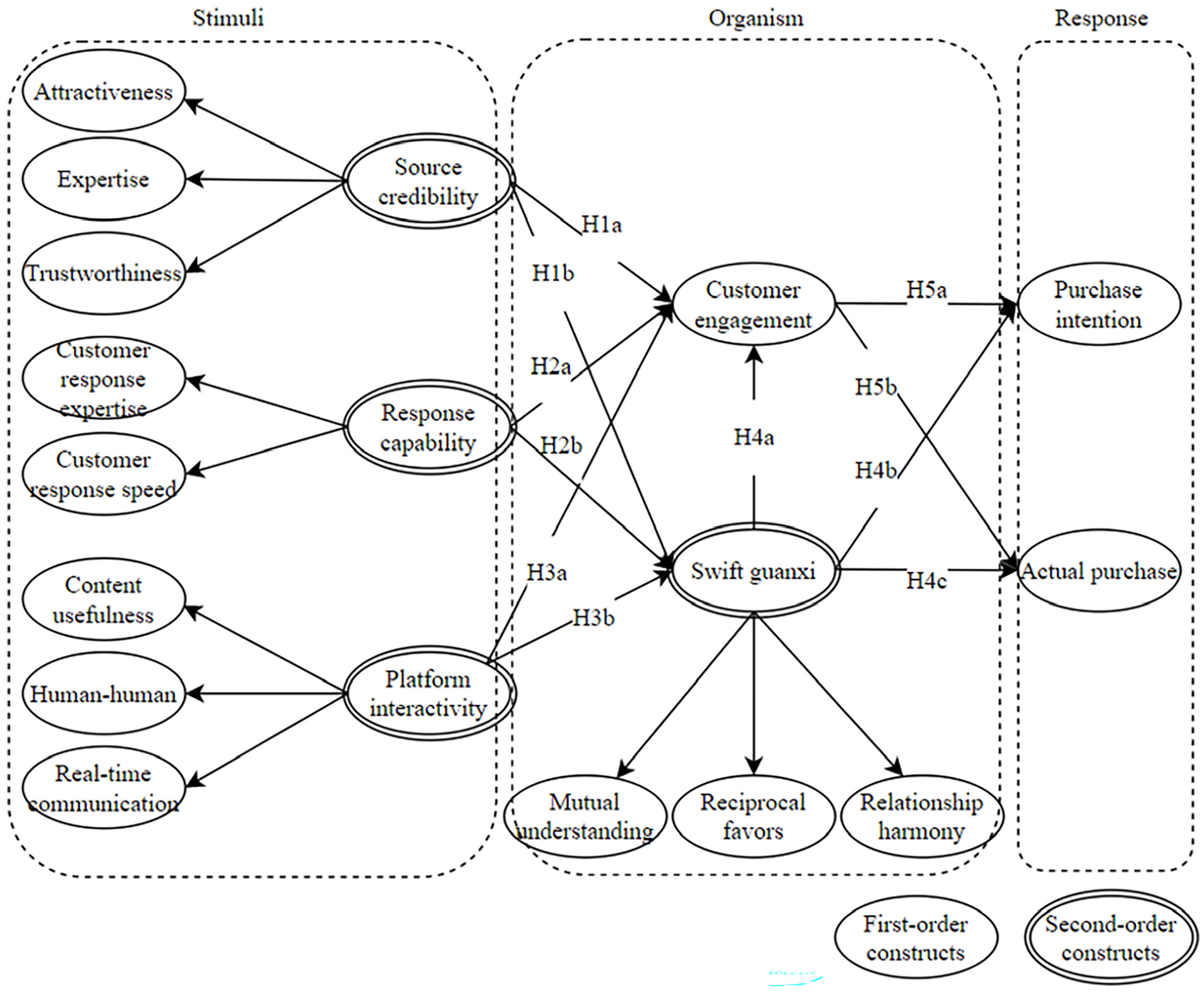
Conceptual model.
Methodology
Measures
The research model contains 14 primary constructs and 4 second-order constructs. To ensure adequate reliability, survey items were collected from the existing literature, with minor adjustments and modifications to suit the context and audience. Specifically, this study adopts items from Zhang et al. (2020) to measure reciprocal favors, mutual understanding, and relationship harmony; from Jayachandran et al. (2004) to measure customer response expertise and customer response speed; and from Choi and Lee (2019) and J. W. Kang and Namkung (2019) to measure attractiveness, expertise, and trustworthiness. We used questionnaire items from Hussain et al. (2021), Ko et al. (2005); from McMillan and Hwang (2002) to measure content usefulness and human–human and real-time communication; from Yüksel (2016) to measure customer engagement; from Choi and Lee (2019) and Zhang et al. (2020) to measure purchase intention; and from Qing et al. (2019) to measure actual purchase behavior. Appendix 1 provides a full description of our measurement instruments. Three experts have reviewed the questionnaire for attaining clarity and comprehensiveness and a pilot testing with 24 respondents also conducted to achieve readability, logical consistency, context suitability, and question sequence. Based on their responses and comments, we polished and finalized the questionnaire. All questions were measured on a seven-point Likert scale that ranged from strongly disagree to strongly agree.
Data Collection and Sample
An online survey was operationalized by sending invitations via email and social media private messages and posting survey links on groups in Bangladesh from July to September 2021. We used an online survey in order to attain cost efficiency, time flexibility, and convenience and maintain respondents’ anonymity. We provided an incentive voucher to 15 randomly selected participants. Before they moved on to the main questions, participants were inquired whether they had experienced LSP buying. Those who answered positively were invited to proceed, and those who said no were stopped from responding further. Initially, we collected 455 responses. Then we examined all the answers, eliminated irregular responses, and cleaned the outliers from the data. We examined the irregular replies and outliers in our data using the authors’ critical observation, the malhanobis test, and standard deviation. In that way, we kept 434 valid samples for our analyses. Table 1 provides the demographic summary of the samples. We collected demographic information about gender (men 73.5%, women 26.5%), age (73.9% were 20–24; 17.1% were 25–29), educational level (bachelor’s degree 58.2% and master’s degree 34.8%), and LSP usage (per day 8.5%, several times a day 32.5%, several times a week 29%, once a month 8.3% and several times a month 17.5%).
Respondents’ Profiles.

Source. Survey data.
Method Bias Test
Since the data were drawn from a single survey, method bias might be an issue. To test for it, we applied procedural and statistical measures. Procedurally, (1) we adopted measurement items from established sources, (2) conducted a focus-group analysis and pilot study on targeted samples, and (3) randomized the questionnaire and used two types of scales to stimulate participants to think objectively before responding and thereby create some psychological separation in the responses. As a statistical measure, we conducted the common method variance (CMV) test recommended by Podsakoff et al. (2003). First, all items were entered into an exploratory factor analysis using the un-rotated solution to a principal component analysis. Those results yielded 14 constituents with an eigen value greater than one, and the first factor explained 31% of the variance and was identical when the solution was prepared using a varimax rotation. Therefore, we can conclude our data had no CMV issue (Podsakoff et al., 2003).
Data Analysis and Results
We used a covariance-based maximum likelihood parameter estimation model for structural equation modeling in AMOS version 24 software. We chose that technique because it clearly outperforms regression analyses in parameter consistency and accuracy (Anderson & Gerbing, 1988; Fornell & Larcker, 1981). This technique also highlights the theoretical associations among variables in our structural model.
Measurement Model
We estimated the measurement model (Figure 2) by observing item-wise factor loadings, average variance extracted (AVE), composite reliability (CR), and Cronbach’s alpha (Table 2). Our results show that individual element loadings for the final measurement elements are all greater than .70, and the AVE values of the respective constructs surpass the threshold value of .50, indicating that our data have adequate convergent validity (Fornell & Larcker, 1981; Hair et al., 2010). The internal consistency of the data was measured by CR and Cronbach’s alpha were greater than .70 for all latent variables, representing sufficient internal consistency (Hair et al., 2010).

Measurement model.
Validity Statistics.
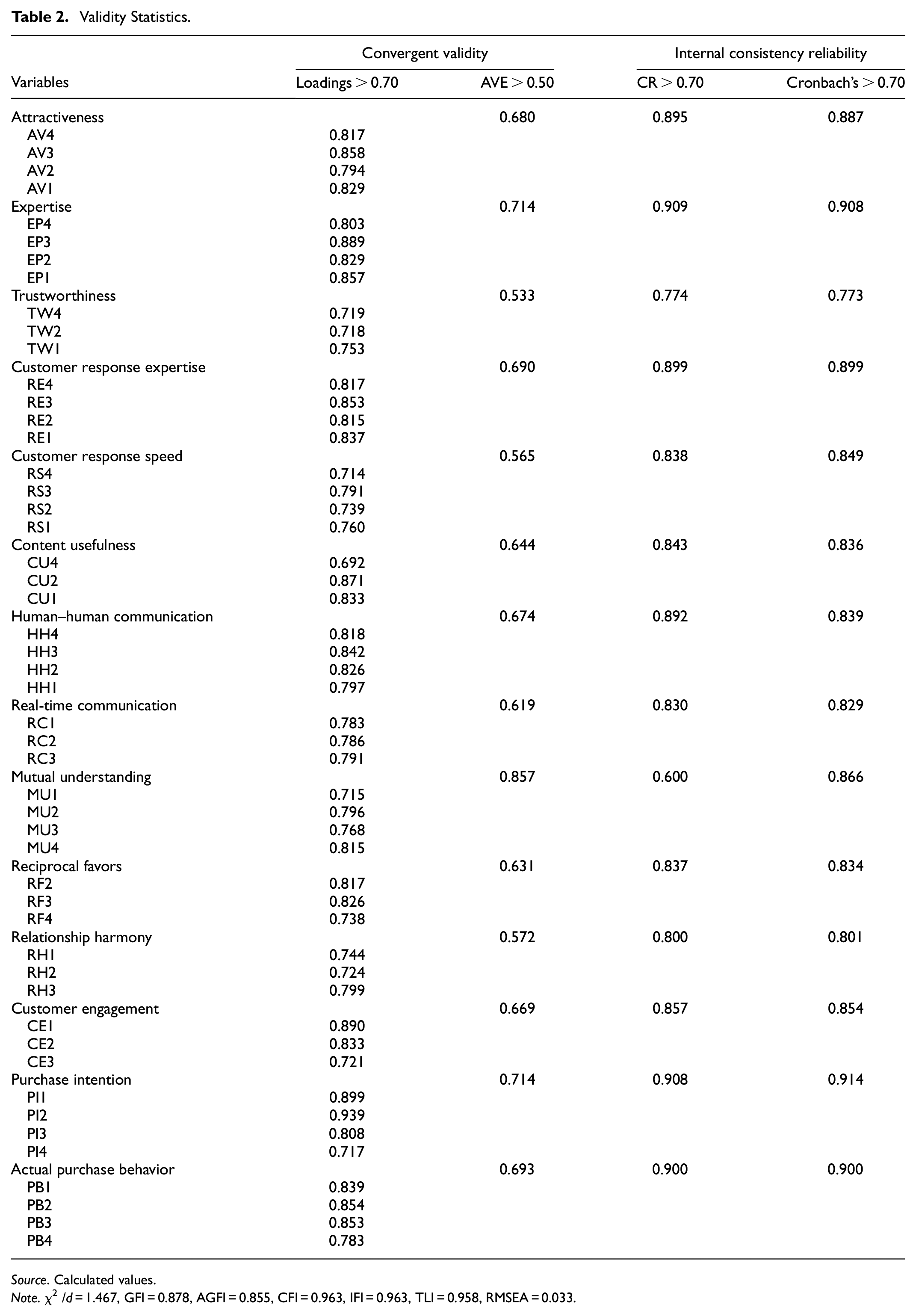
Source. Calculated values.
Note. χ2/d = 1.467, GFI = 0.878, AGFI = 0.855, CFI = 0.963, IFI = 0.963, TLI = 0.958, RMSEA = 0.033.
Discriminant validity was weighed by contrasting the square root of the AVE with the inter-construct correlations. In this regard, each construct should be more strongly correlated with its own construct than with other constructs. The results show (see Table 3) that the square root of the AVE (bold diagonal value) is reliably greater than the off-diagonal correlation. We also examined the cross-loadings of each item. Our results reveal that data have a realistic degree of discriminant validity (Fornell & Larcker, 1981).
Discriminate Validity Statistics.
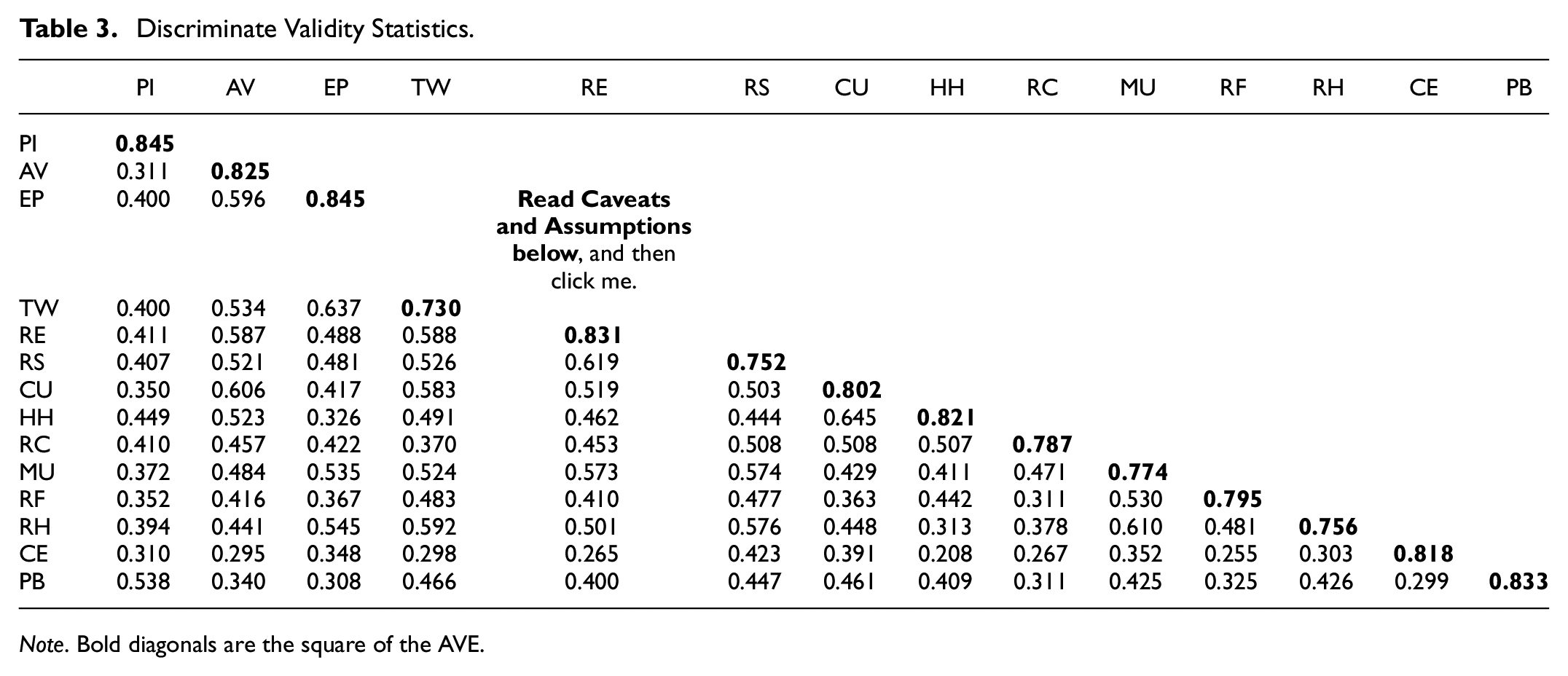
Note. Bold diagonals are the square of the AVE.
In addition, we calculated popular model fit indices, namely chi-squared with degrees of freedom (χ2/df = 1.46), the goodness-of-fit index (GFI = 0.87), adjusted GFI (AGFI = 0.85), comparative fit index (CFI = 0.96) and root mean square error of approximation (RMSEA = 0.03), and all those value surpass their respective cut-off criteria. Therefore, our measurement model has adequate model fitness (Hair et al., 2010; L. T. Hu & Bentler, 1999).
Validity Statistics for Second-Order Models
Table 4 presents second-order reflective models that were made to evaluate the connections between the subdimensions and the major constructs. The findings demonstrate that the item-wise factor loadings are highly significant and that the accompanying t-value, AVE and CR value are within the threshold for each second-order reflective model. Major goodness-of-fit indexes for each model are likewise within the required range. Each diagnostic finding shows that the models accurately capture the sample data, confirming our notion of second-order reflective models (Fornell & Larcker, 1981; Hair et al., 2010; L. T. Hu & Bentler, 1999).
Validity Statistics for Second-Order Constructs.

Source. Amos output and calculated value.
Note. χ2/d = 1.77, GFI = 0.97, AGFI = 0.95, CFI = 0.98, IFI = 0.98, TLI = 0.98, RMSEA = 0.042.
Hypothesis Analysis
Our structural model (Figure 3) shows a considerable degree of the variance, with a coefficient of determination (R2) of 0.13 for customer engagement, 0.58 for Swift guanxi, 0.21 for purchase intention, and 0.23 for actual purchase behavior; indicating a satisfactory level of predictive power. All four conceptualized second-order constructs are perfectly reflected by their respective first-order constructs. Specifically, attractiveness, expertise, and trustworthiness significantly reflect source credibility; customer response expertise and customer response speed stand perfectly with response capability; content usefulness and human–human and real-time communication match platform interactivity; and mutual understanding, reciprocal favors, and relationship harmony contribute notably to swift guanxi.

Structural model.
All hypothetical paths are statistically significant except one (see Table 5). Source credibility has a significantly positive effect on customer engagement (β = .204, p < .05) and swift guanxi (β = .494, p < .001), supporting H1a and H1b. Respectively, response capability (β = .285, p < .001) and (β = .531, p < .001) and platform interactively (β = .152, p < .05) and (β = .227, p < .001) influence customer engagement and Swift guanxi, supporting H2a, H2b, H3a, and H3b.Swift guanxi shows significant effects on purchase intention (β = .394, p < .001) and actual purchase behavior (β = .429, p < .001), but not on customer engagement, which supports H4b and H4c and rejects H4a.Customer engagement was found to have notable positive effects on purchase intention (β = .147, p < .05) and actual purchase behavior (β = .124, p < .05), which supports H5a and H5b.
Summary of Results.

Note. χ2/d = 2.44, GFI = 0.79, AGFI = 0.76, CFI = 0.88, IFI = 0.88, TLI = 0.87, RMSEA = 0.058. n.s. = not significant; t-values are in parentheses.
p < .05. ***p < .001.
Mediating Effects
We applied Hayes (2009) guidelines to test the mediating effects (H6) of Swift guanxi and customer engagement. Bootstrapping with 434 samples was performed, and the process was repeated 5,000 times in the 95% confidence interval. The results (see Table 6) indicate that source credibility and platform interactivity have significant indirect effects on purchase intention and actual purchase behavior via customer engagement and swift guanxi. Furthermore, in the bias corrected model linked to the indirect effect, there is no zero between the lower and upper limits. However, the results for response capability are not the same; therefore, H6 is partially accepted.
Bootstrapping Results.

Note. n.s. = not significant.
p < .05. ***p < .001.
Discussion
First, our results reveal that source credibility, customer response capability, and platform interactivity have direct and significant effects on customer engagement and swift guanxi, which are similar to earlier LSP studies (Y. H. Cheng et al., 2020; K. Kang et al., 2020). Specifically, our findings show that customer response capability during livestream purchasing has the most significant effects on customer engagement, followed by source credibility and platform interactivity. The effects of customer response capability, source credibility, and platform interactivity on swift guanxi are similar to those on customer engagement.
We also found that both customer engagement and swift guanxi are significantly influenced by customer response capability and platform interactivity, which also has the consistency with the previous study (Wongkitrungrueng & Assarut, 2020). Exceptionally, we found that swift guanxi has insignificant effects on customer engagement. Similarly, C. Su et al. (2021) discovered that guanxi meaningfully and negatively moderated the connection between trust toward the seller and social commerce engagement intention, indicating that guanxi has no great effect on consumer engagement intention, which is in line with our results.
Our fourth and fifth hypotheses suggest that swift guanxi and customer engagement on an LSP can significantly influence on purchase intentions and actual purchasing behavior. LSP use social interactions to reduce conflict and uncertainty by building mutual respect and relationship harmony as a precursor to swift guanxi that may build customers curiosity to encourage purchase intentions and actual buying behavior. Both hypotheses were confirmed which are also in line with the previous studies (Men & Zheng, 2019; Zhang et al., 2020).
In addition to those previous studies on swift guanxi, other studieson LSPs also discovered that experiencing shopping engagement as a credible avenue stimulates consumers to build purchasing intentions, which ultimately affects their actual buying decisions (Choi et al., 2019; Sun et al., 2019). Therefore, we further conclude that swift guanxi and customer engagement on LSPs have tremendous influence in building consumer purchase intentions for a product or service and actual purchasing behavior.
Sixth hypothesis reveals that customer engagement has mediating effects in the relationships between source credibility and platform interactivity with the purchase intention; between source credibility and actual purchasing behavior. However, it could not mediate between response capability with purchase intention and actual purchasing behavior; between platform interactivity and actual purchasing behavior. Again, swift guanxi has mediating effects in the relationships between source credibility and platform interactivity with purchase intentions and actual purchasing behavior. It could not mediate between response capability to purchase intentions and actual purchasing behavior. The stated mediating relationships are also in line with the previous study (Sun et al., 2019).
Our stimuli variables positively affect the organism variables, and those organism variables positively influence our response variables. Thus, together the relationships establish a triangular model in which the stimuli variables indirectly affect the response variables via the organism variables. That storyline is significantly consistent with our results, wherein source credibility, response capability, and platform interactivity as the stimuli directly affect the organism variables of customer engagement and swift guanxi. Those organism variables then influence the response variables of purchase intention and actual purchasing behavior. Thus, our results significantly justify our choice of the S-O-R model.
Implications of the Study
Theoretical Implications
This study has several implications for theory and research about what stimulates consumers in their inner states to encourage purchase intentions and actual purchasing behavior on LSPs. First of all, the previous series of studies have paid more attention to the consumer online purchasing behavior on social networks but only a few to the livestream purchasing behavior. On this ground, this study explores the livestream purchasing behavior through the lens of the SOR model, whereby the stimulus factors of source credibility, response capability, and platform interactivity influence organism variables of customer engagement and swift guanxi, which also sway to response behavior of purchase intention and actual purchase. As livestream purchasing has become more popular due to the dramatic expansion of social networks and consumers have tremendous experiences surviving in the global COVID-19 pandemic, this research may provide a new window for relevant scholars. Secondly, previous scholars examined LSP from a psychological and a technical perspective; hence it functions with human-computer interactions, psychometric perceptions, and technical features. From this perspective, this study added value by examining the psychometric behavioral variables of source credibility, response capability, and customer engagement, along with providing deeper insight into how human-computer interactions benefit buyers and sellers by customer swift guanxi. Thirdly, we have dealt with source credibility, response capability, platform interactivity, and swift guanxi as the multiple second-order constructs in addition to the traditional approach to examining the direct effects between the paths, making the research design more contemporary and sophisticated. We have crystal clearly explained the charisma to handle those second-order constructs whereby the relevant researchers may find the super guidelines for their studies. Moreover, the already proven relationships between the paths in this study may support further relevant new studies for establishing an argument. Finally, the study leverages the application context of the S-O-R framework where source credibility, response capability, and platform interactivity are treated as new stimuli and can perform significant antecedents of customer engagement and swift guanxi, contributing to the research on the source credibility, response capability, and platform interactivity in customer purchasing intention and actual purchase in LSP. Meanwhile, the results highlight the crucial mediating effects of customer engagement and swift guanxi as an organism between source credibility, response capability, and platform interactivity (stimulus) with purchase intention and actual purchase (responses) in LSP. Therefore, this study can be considered as a new approach to understanding the path from source credibility, response capability, and platform interactivity to purchase intention and actual purchase through customer engagement and swift guanxi in the context of live stream purchasing. The S-O-R framework’s use in this study may inspire more relevant scholars to do further research.
Managerial Contributions
In terms of practical contributions, this study offers several insights for live stream practitioners about motivating consumers’ purchase intention and actual purchases. First, the study provides new insight for managers to understand the direct and positive effects of source credibility, customer response capability, and platform interactivity on customer engagement and swift guanxi. The practitioners also understand the direct effects of customer engagement and swift guanxi on purchase intention and actual purchase. The study also discovers the negative effects of swift guanxi on customer engagement. Thus, the study provides the avenue to the marketers that source credibility, customer response capability, and platform interactivity are very effective for customer engagement and swift guanxi from a live stream perspective. The study also advocates that the higher customer swift guanxi triggers lower customer engagement revealing that higher customer engagement should be better managed rather than focusing on swift guanxi. Second, the research highlights that the practitioners should make efforts to increase customer engagement and swift guanxi in live stream purchasing that can directly stimulate purchase intention and actual purchase. The research further focuses on that increasing customer engagement and swift guanxi; source credibility, customer response capability, and platform interactivity are very effective, whereby source attractiveness, expertise, and trustworthiness are the practical dimension for source credibility. Again, customer response capability relies on customer response expertise and customer response speed. Finally, the effectiveness of platform interactivity was influenced by content usefulness, human and human-human interaction, and real-time communication. Therefore, for the effectiveness of source credibility, customer response capability, and platform interactivity, the marketer should focus on the aforementioned dimensions. Third, from the mediating results, the practitioners guided that customer purchase intention in live stream purchasing is influenced by the source credibility and platform interactivity through customer engagement and swift guanxi. Actual purchasing behavior is influenced only by the source credibility through customer engagement and swift guanxi. Thus, the source credibility is a highly significant and powerful weapon for motivating the actual purchasing behavior in a live stream perspective through customer engagement and swift guanxi. Finally, the guidelines provided in this study may be conducive for the managers to develop an effective policy to launch the live stream purchasing strategy. It is also a baseline to evaluate the source credibility, customer response capability, and platform interactivity for motivating the customer purchase intention and actual purchasing behavior through customer engagement and swift guanxi.
Limitations and Suggestions for Future Research
First, we used convenience sampling in our study, which may provoke nonrandom selection of participants. We chose this sampling method because our study is one of the first to investigate consumer motivations in customer engagement and swift guanxi and their respective effects on purchase intentions and actual purchasing behavior on LSPs. Nonetheless, our findings and conclusions should be interpreted with caution. Second, we collected cross-sectional data on livestream purchasing, so our findings cannot predict if or how consumer responses to livestream purchasing change over time. Moreover, livestream purchasing is a kind of online e-commerce usually conducted via social media networks, and the social media environment is continuously changing, which could affect the findings of our study.
Third, most of our respondents (73.9%) were aged 20 to 24. Thus, despite the higher acceptance of livestream shopping by young people, they like to shop in diversified ways and will not necessarily stick with a particular mode of purchasing. Thus, analyzing data collected from young people in a particular time might have affected our results. Fourth, other stimuli and organisms might be involved in creating purchase intentions and actual purchasing behavior on LSPs. Future research could extend our findings by interviewing more consumers to identify what motivates them and influences their purchase intentions and actual purchasing behavior on LSPs.
Footnotes
Appendix
Constructs/Items and Sources.

| Attractiveness (Choi & Lee, 2019) |
| The vlogger of this live-streaming site is pretty |
| This vlogger has a sophisticated image |
| This vlogger is very attractive |
| Others will want to resemble this vlogger (deleted) |
| Expertise (Choi & Lee, 2019; K. Kang & Namkung, 2019) |
| This vlogger knows about the posting very well |
| It is an undeniable fact that This vlogger is an expert on the posting |
| This vlogger has a lot of experience with her vlog content |
| This vlogger will give viewers information about her vlog content |
| Trustworthiness (Choi & Lee, 2019; K. Kang & Namkung, 2019) |
| This vlogger would be sincere every time |
| This vlogger would not either exaggerate or lie |
| This vlogger would not pretend to know about what she does not know well (deleted) |
| This vlogger would frankly present her position, thoughts and opinions |
| Customer Response Expertise (Jayachandran et al., 2004). |
| This live-streaming site can easily satisfy the new needs of customers. |
| This site can satisfy customers’ needs much better than others. |
| This site has a reputation for effectively meeting customers’ demands. |
| This site maintain good relationship with customers. |
| Customer Response Speed (Jayachandran et al., 2004). |
| Customer need are responded quickly in this live-streaming site |
| This site take corrective action immediately once customers are unhappy with the appropriateness of product or services. |
| This site believes in being proactive to shape market demand rather than reactive. |
| The concerned department take immediate action when customers would like to modify product or services. |
| Content usefulness (Hussain et al., 2021; Ko et al., 2005) |
| I would click into deeper links |
| I would stay longer for details. |
| The platform also provides different multimedia functions such as pictures and videos for product presentation (deleted) |
| The platform provides a search function to find out exact products according to my needs. |
| Human-Human (Hussain et al., 2021; Ko et al., 2005) |
| I would participate in customer discussions |
| I would provide my feedback to the site |
| I would contact the company |
| I would sign in at the site for information (sometimes people sign in some websites only for getting information and websites send those blogs, articles, new launches, and new offers, etc.) |
| Real-time conversation (Hussain et al., 2021; McMillan & Hwang, 2002) |
| This live-streaming enables two-way communication |
| It enables conversation |
| It is interactive |
| It is interpersonal (deleted) |
| Mutual understanding (Zhang et al., 2020) |
| This live-streaming site can understand each other’s needs. |
| This live-streaming site can understand each other’s point of view. |
| This live-streaming site can make ourselves heard. |
| This live-streaming site show interest in each other’s opinions. |
| Reciprocal Favors (Zhang et al., 2020) |
| If I buy from this live-stream seller, they would provide a discount to me (deleted) |
| We provide a positive rating or comment to each other. |
| We help each other. |
| We proved we were friends by doing a favor for each other |
| Relationship harmony (Zhang et al., 2020) |
| This live-streaming site maintain harmony. |
| This live-streaming site avoid conflict |
| This live-streaming site respect each other |
| This live-streaming site maintain dignity of customer (deleted) |
| Customer engagement (Yüksel, 2016) |
| If the video is viewed by many people, it affects my perspective on the information given in the video. |
| If the video is liked by many people, it affects my perspective on the information given in the video. |
| If many people comment on the video, it affects my perspective on the information given in the video. |
| If vlogger often answers the comments, it affects my perspective on the information given in the video (deleted). |
| Purchase intention (Choi & Lee, 2019; Zhang et al., 2020) |
| I would like to purchase a product from this live-stream seller |
| I would like to recommend my friends and family to purchase products from this live-stream seller |
| If there is a product that I want to purchase, I would like to purchase from this live-stream seller |
| This live-streaming will help you make a purchase decision |
| Actual Purchase Behavior (Qing et al., 2019) |
| I have been purchasing product/service from the live-stream seller within the previous year. |
| The frequency of purchasing product/service from live-stream seller within the previous year. |
| A significant amount is spent on live-stream shopping within the previous year. |
| I will continue to purchase from this live-streaming platform. |
Declaration of Conflicting Interests
The author(s) declared no potential conflicts of interest with respect to the research, authorship, and/or publication of this article.
Funding
The author(s) received no financial support for the research, authorship, and/or publication of this article.
