




Abstract
Live streaming enhances the marketing vitality and possibility. However, the academic research on this new marketing method is still insufficient. To fill this literature gap, this paper tests whether the characteristics of mobile app live streaming (MALS) can create the swift guanxi and enhance consumers’ perceived trust, to enhance consumers’ impulse purchase intention of clothing. Based on the literature review, this paper established a live streaming shopping evaluation system including MALS interaction, MALS entertainment, MALS credibility, swift guanxi, perceived trust, and impulse purchase intention. A total of 537 valid questionnaires were collected. The data were analyzed by structural equation model (SEM) and stepwise regression. The results showed that all hypotheses were verified. The MALS characteristics positively affected the swift guanxi and perceived trust, and the swift guanxi and perceived trust positively affected the impulse purchase intention. This paper added the literature on mobile app live streaming and clothing impulse purchase intention. The results provide suggestions for live streaming companies on how to enhance consumers’ impulse purchase intention.
Plain language summary
This paper tests whether the characteristics of mobile app live streaming (MALS) can create the swift guanxi and enhance consumers’ perceived trust, to enhance consumers’ impulse purchase intention of clothing. Based on the literature review, this paper established a live streaming shopping evaluation system including MALS interaction, MALS entertainment, MALS credibility, swift guanxi, perceived trust, and impulse purchase intention. A total of 537 valid questionnaires were collected. The data were analyzed by structural equation model (SEM) and stepwise regression. The results showed that all hypotheses were verified. The MALS characteristics positively affected the swift guanxi and perceived trust, and the swift guanxi and perceived trust positively affected the impulse purchase intention. This paper added the literature on mobile app live streaming and clothing impulse purchase intention. The results provide suggestions for live streaming companies on how to enhance consumers’ impulse purchase intention.
Introduction
Modern consumers are already in the era of mobile shopping, and many Consumer behavior can be completed through mobile applications. More and more consumers choose to use mobile applications to meet their shopping needs (Y. Kim et al., 2021). Especially mobile application live streaming (MALS), as a new form of mobile shopping, has received increasing love from consumers. MALS shopping is a revolution in internet shopping. In particular, with the outbreak of the new coronary pneumonia epidemic, people have further felt the benefits of mobile shopping. MALS has become a popular marketing tool for mobile e-commerce. Compared with traditional online shopping, MALS can display goods more comprehensively and has higher interactivity and entertainment. Enterprises can better achieve the purpose of attracting consumption through live streaming.
In MALS, through diversified two-way interaction, the anchor shares life dynamics with the public in a scene-based way, displays commodity information in the dynamics, and makes consumers unconsciously produce purchase intention. MALS can enable consumers to obtain product information and use feelings more quickly and directly, and understand goods more truly and stereoscopically. The virtual experience in MALS will bring consumers a sense of pleasure and improve the shopping experience. In MALS, hosts are able to engage in frequent and full interaction with consumers watching live broadcasts, attracts consumers through their own characteristics, stimulates consumers to have a flow experience by means of scenario marketing, and increases their trust in the anchor and its recommended products, furthermore, it promotes consumers’ impulse to purchase products recommended by hosts. In China, Taobao is the representative of mobile shopping applications, and Douyin is the representative of mobile short video applications. Mobile shopping platforms such as Taobao and Douyin are vigorously promoting live shopping. According to data from iiMedia Research, 57.7% of Chinese netizens have 3 to 4 shopping apps on their phones. Now live streaming e-commerce in China has taken up a significant proportion of internet shopping, and it is expected that live streaming e-commerce will continue to rise by 2025. China has a huge live streaming sales market, more and more scholars are paying attention to live streaming sales of mobile app in China.
At present, the academic community is focusing on the study of impulse buying intention in online shopping. For example, Y. Wu et al. (2021) studied impulse purchase induced by online Hunger marketing, such as limited purchase, pre-sale and other Internet marketing means, and Xiang et al. (2022) explored the influencing factors of impulse buying intention from the perspective of consumers. For mobile applications, Zafar et al. (2021) studied the impact of mobile application usage intensity on impulse buying. Z. Zhang et al. (2022) studied the influencing factors of consumer impulse buying in the modern business environment from a psychological perspective. We believed that MALS impulse consumption has become a common phenomenon. There is a lack of commercial standards and operational mechanisms for mobile application live streaming, how mobile application live streaming should develop healthily deserves attention. Mobile app live streaming is a helpless choice in the context of the epidemic, or a rising consumer form. Whether there are differences in the influencing factors of mobile app live streaming compared to traditional consumer markets, and whether mobile app live streaming can promote impulse buying behavior more quickly. The exploration of these issues has practical value for the business of mobile app live streaming in China. MALS often adopts the form of situational performance to create a good consumption atmosphere, especially clothing products. Through multi-directional display and explanation of clothing products, and even the anchor or model tries on clothes, consumers can have a sense of authenticity and experience interactivity, this increased consumer impulse purchase intention.
Based on the Stimulus-Organism-Response (SOR) framework theory, this paper takes consumers who have participated in or watched MALS as the research object to explore the influencing factors of clothing consumers’ impulsive purchase intention in the MALS environment. By studying the MALS scenario and expanding the impulse purchase intention scenario, it can provide a new perspective for the study of consumers’ impulse purchase intention. Combined with the two research backgrounds of impulse purchase intention and clothing, based on literature research, this paper constructs a clothing consumer impulse purchase intention model with the influencing factors of MALS as independent variables and consumers’ perceived trust and swift guanxi as intermediary variables; Through data research and empirical analysis, this paper obtains the relationship between MALS, consumers’ perceived trust, swift guanxi and impulsive purchase intention, and puts forward management suggestions and countermeasures for live streaming platform and clothing e-commerce from the perspective of MALS.
Theoretical Framework and Literature Review
SOR Theory
This paper used SOR model which can be summarized as that under the stimulation of the external environment, consumers’ cognition and emotion change, resulting in use, purchase, and other behaviors. Using the SOR model to explain, when consumers are exposed to external stimuli, their psychological awareness will change and trigger a series of behaviors accordingly (Jacoby, 2002). SOR model has three variables: external stimuli, including external macro and micro stimuli, we use the interactivity, entertainment, and credibility of mobile app live streaming as external stimuli. Organism, including consumers’ cognition and emotional variables, we consider swift guanxi and perceived trust as the organism. Response variable refers to the behavior of consumers due to changes in their hearts under the influence of external stimulus (Goi et al., 2014), we consider impulse buying intention as the response to stimuli. The academic community focuses on using the SOR model to study the influencing factors of consumer behavior. In this mode, when consumers watch the live broadcast, they are stimulated by the live broadcast host, so as to produce cognitive and emotional changes, and make individual response on this basis, that is, impulse purchase intention.
At present, many scholars have used SOR theory to study consumer behavior, Hu and Chaudhry (2020) used SOR model to explore how to enhance the participation of clothing consumers in live e-commerce through relational bonds, this paper has confirmed that relationship ties are the antecedents of consumers’ participation in live streaming shopping. Their research focuses on the social relationships of live streaming marketing, with a focus on the relationships between consumers. However, this article mainly explores the relationship between quick relationships, perceived trust, and impulsive purchasing intentions, with a focus on live streaming characteristics and consumers. Kang et al. (2021) used the SOR framework, studied the impact of interactivity in live streaming on consumer behavior was studied, and this article will also explore the relationship between interactivity and intermediate variables among consumers. Xue et al. (2020) studied the impact of real-time interactivity in live streaming on consumer participation in live streaming activities, and also explored how consumers can drive social relationships to participate in live streaming activities. Hewei and Youngsook (2022) used SOR conceptual model to explore the impact of social media interactivity on perceived value, immersion experience and continuous purchase intention. For mobile live broadcast application shopping, shopping is not the first purpose of consumers. When consumers are watching live streaming, they will be stimulated by the content of the live broadcast, which in turn generates an impulse to purchase. Therefore, this study introduces the SOR model into the mobile live streaming application shopping field, especially the mobile live streaming application clothing shopping.
Swift Guanxi
Ou et al. (2014) put forward the concept of swift guanxi for the first time to explain how unfamiliar buyers and sellers can quickly establish informal relationship in the transaction process, so as to successfully complete the transaction, and expand the complexity of the traditional relationship to online e-commerce. Compared with the traditional relationship, swift guanxi does not require the seller to invest too much time and energy. H. Chen et al. (2022) believed that fast relationships are a form of interpersonal interaction in live streaming shopping, this is reflected in the professional knowledge, affinity and sense of humor of the live broadcast host that consumers feel. Therefore, the swift guanxi involved in this study is closer to the relationship established quickly by the buyer and seller in the MALS environment. This relationship is a non face-to-face virtual relationship, but it is built on the basis of mutual understanding, reciprocal relationships, and harmonious relationships, accumulated over time, and has a profound impact, such as influencing users’ purchase intention, repurchase intention, enterprises can leverage this rapid relationship to enhance their attractiveness and engagement stickiness towards users, it is more suitable for explaining e-commerce. Cheng et al. (2020) believed that it is very important to establish relationships in social business communities, and determined the four preconditions of swift guanxi, namely progress, similarity, interactivity, and personal situation of both parties are positively correlated with the formation of swift guanxi. M. Zhang et al. (2021) believed that more and more retailers are using streaming live streaming services to attract traffic, and the impact of swift guanxi is very important. The information and interactivity provided by live streaming are positively correlated with the formation of swift guanxi, which may affect customers’ intention to purchase live streaming.
Shi et al. (2018) explored the influencing factors of rapid relationships, and the results showed a positive correlation between service quality and rapid relationships. They believe that perceived convenience and services affect the formation of rapid relationships. Their research mainly focuses on the fast relationships of traditional e-commerce, while this paper mainly focuses on the fast relationships of mobile application live streaming e-commerce. Guo et al. (2021) studied the impact of consumer perceived trust on live shopping and confirmed the mediating effect of fast relationships. They ignored the impact of live shopping features, so this paper chose live streaming features as a pre variable for research. More and more scholars are paying attention to the role of fast relationships in e-commerce, but no one has specifically studied the impact of swift guanxi on MALS impulse buying intentions, especially in the fashion industry. Therefore, this paper will explore the role of swift guanxi in clothing impulse purchase intention in MALS.
Impulse Purchase Intention
Beatty and Ferrell (1998) believed that impulse buying is a sudden, immediate and spontaneous behavior. This is an induced behavior, where there is no purchase plan at all, and there is a sudden purchase intention due to some influence. It is a spontaneous action without fully considering the consequences. Liu et al. (2013) believed that impulse purchase is an emotional Consumer behavior, which meets the emotional needs of consumers and makes consumers feel happy in the purchase experience. Compared to offline shopping, consumers are more likely to engage in impulsive purchasing behavior in online shopping environments, which is mostly driven by commodity display or marketing stimulation. Because consumers first generate impulse purchase intention when watching MALS, and then convert it into impulse purchase behavior, this paper mainly studies consumers’ impulse purchase intention when watching MALS.
W. Zhang et al. (2020) explored the process of consumers’ impulsive purchase intention during the COVID-19 pandemic outbreak, and the research results showed that mobile app shopping environments are more likely to induce impulsive purchase intention. Leong et al. (2018) studied the influencing factors of consumer impulse buying in the Facebook environment, with a focus on consumer characteristics. However, this article focuses on exploring the impact of live streaming features on impulse buying. Djafarova and Bowes (2021) applied the SOR model to Instagram, the results showed that advertising, opinion leaders and user generated content play a stimulating role in stimulating positive emotions, thus triggering impulse buying among generation Z women. Phau and Lo (2004) believed that fashion innovators usually show impulsive behavior, they will impulsively buy clothes from Internet stores, however, there is no difference between fashion innovators and non innovators in Internet shopping, which to some extent reflects that fashion consumption is more impulsive, consumers do not buy without clothes, and there are many stimulating impulse buying behaviors. Rao and Ko (2021) studied the willingness of Chinese consumers to purchase luxury goods impulsively in the WeChat shopping environment. The results showed that consumers’ perceived value and perceived happiness were positively correlated with WeChat shopping impulsively. However, WeChat shopping is no longer the mainstream of e-commerce in China, and the focus of this article is to explore the emerging trend of live streaming shopping. These studies generally focused on impulse purchase of online commerce, mobile commerce and social commerce, and pay little attention to MALS impulse purchase. Few people pay attention to the impact of swift guanxi and perceived trust on impulse purchase. Therefore, this paper focuses on exploring the impact of swift guanxi and perceived trust on MALS fashion impulse purchase.
Hypotheses and Conceptual Model
Tong (2017) believed that the interactivity, liveliness, and realism of live streaming enhance the multidimensional interaction between hosts and consumers. Live streaming can maximize the audience’s experience of authenticity and enhance the interactivity of consumers watching live streaming. At the same time, the live streaming uses a variety of communication symbols such as text, image and sound to convey information, creating a good atmosphere and scene for consumers. Lu et al. (2021) believed that live streaming has seven characteristics: credibility, professionalism, interactivity, usefulness, entertainment, skill, and attraction. Ma et al. (2016) believed that the live streaming is highly interactive and enhances the user’s sense of participation. Scheibe et al. (2016) believed that social live streaming services are synchronous, real-time and interactive, and users can participate in live streaming activities. We believed that MALS is a new form based on webcast and social live streaming, which is interactivity, entertainment and credibility.
MALS Interactivity and Swift Guanxi, Perceived Trust
In the process of using MALS, in addition to the host introducing clothing product information, consumers can also ask questions and express their personal opinions on clothing products. In this strong interactive atmosphere, it is easier to stimulate impulsive consumption. Ou et al. (2014) believed that in online e-commerce, swift guanxi is a rapidly formed interpersonal relationship between buyers and sellers. By enhancing buyers’ perception of interaction and existence, swift relationship and trust can be established, so as to predict buyers’ repurchase intention. Lin et al. (2019) believed that interaction, participation, and communication have a positive impact on the rapid and mutually beneficial relationship between buyers and sellers to varying degrees, and are decisive factors in purchasing intention in social commerce. We can understand that in the MALS environment, rapid relationship and perceived trust are formed through interaction. Therefore, we propose a hypothesis H1a and H1b.
H1a. MALS interactivity affects swift guanxi (+).
H1b. MALS interactivity affects perceived trust (+).
MALS Entertainment and Swift Guanxi, Perceived Trust
MALS has a high level of entertainment, which can stimulate consumers to reach an excited and happy psychological state during the shopping process. The short video live broadcast host will add many interesting links in the process of displaying goods, such as personal performance, singing, games, lottery, etc., making the display of goods both entertaining. Meanwhile, consumers who watch live streaming communicate with other online members by sending real-time information, enhancing the entertainment and liveliness of the purchasing process. C. C. Chen and Lin (2018) believed that flow, entertainment, social interaction and endorsement are the four characteristics of live-stream. Social network live-stream makes people feel happy and relieves pressure. Gulfraz et al. (2022) believed that entertainment is an important shopping experience for online shopping consumers, entertainment of online shopping has a significant impact on consumers’ impulsive consumption. We believe that the development of MALS is more for communication and entertainment, while mobile shopping applications are developed for shopping. Therefore, when MALS play the shopping function, the entertainment needs to be highlighted. Therefore, we propose the hypothesis H2a and H2b.
H2a. MALS entertainment affects swift guanxi (+).
H2b. MALS entertainment affects perceived trust (+).
MALS Credibility and Swift Guanxi, Perceived Trust
In the live streaming, the anchor shows and interprets the fabric, workmanship, color and decoration details of the clothes on sale in detail. Other consumers can also make personal comments through the bullet screen, which can create a live atmosphere, so as to enhance the authenticity and credibility. W. K. Wu, Huang, et al. (2021) believed that in the online C2C market environment, that that in the online C2C market environment, the formation of a rapid relationship between buyers and sellers can promote the realization of repurchase intentions. H. Chen et al. (2022) believed that the interpersonal interaction and credibility of live streaming shopping improves consumers’ swift trust, thus enhancing consumers’ purchase intention. In the MALS environment, both the presentation of the host and the participation of consumers create the credibility of the MALS, thus affecting the swift guanxi and perceived trust. Therefore, we propose the hypothesis H3a and H3b.
H3a. MALS credibility affects swift guanxi (+).
H3b. MALS credibility affects perceived trust (+).
Swift Guanxi, Perceived Trust, and Impulse Purchase Intention
Live streaming in the form of mobile short videos can help consumers form a complete understanding of clothing. Live streaming can showcase clothing from all angles and angles. The authenticity shows every detail of the clothing to the audience, so that consumers can have a certain understanding of the parameters, materials and other information, and understand the use experience of other consumers in the interaction, these characteristic of MALS make it easier to form swift guanxi and trust. Sonali et al. (2020) believed that perceived value has the greatest impact on users’ continuous use of live streaming shopping. Managers of streaming media applications should promote their applications to consumers by highlighting various consumption values. H. Chen et al. (2022) used PLS technology to verify that the swift guanxi exists in the interaction and things between the buyer and the seller, in a live streaming environment, swift guanxi promote consumers’ impulse to purchase. Therefore, we propose the hypothesis H4a and H4b.
H4a. Swift guanxi affects impulse purchase intention (+).
H4b. Perceived trust affects impulse purchase intention (+).
Based on the above theoretical analysis and literature review, this paper uses SOR theory to build a conceptual model, this paper discusses whether the MALS characteristics will affect consumers’ impulse purchase intention, introduces perceived trust and swift guanxi, exploring the two moderating effects of MALS features on consumers’ impulse purchase intention, and exploring the mechanism of the influence of MALS features on consumers’ impulse purchase intention. Figure 1 shows the conceptual model of this paper.
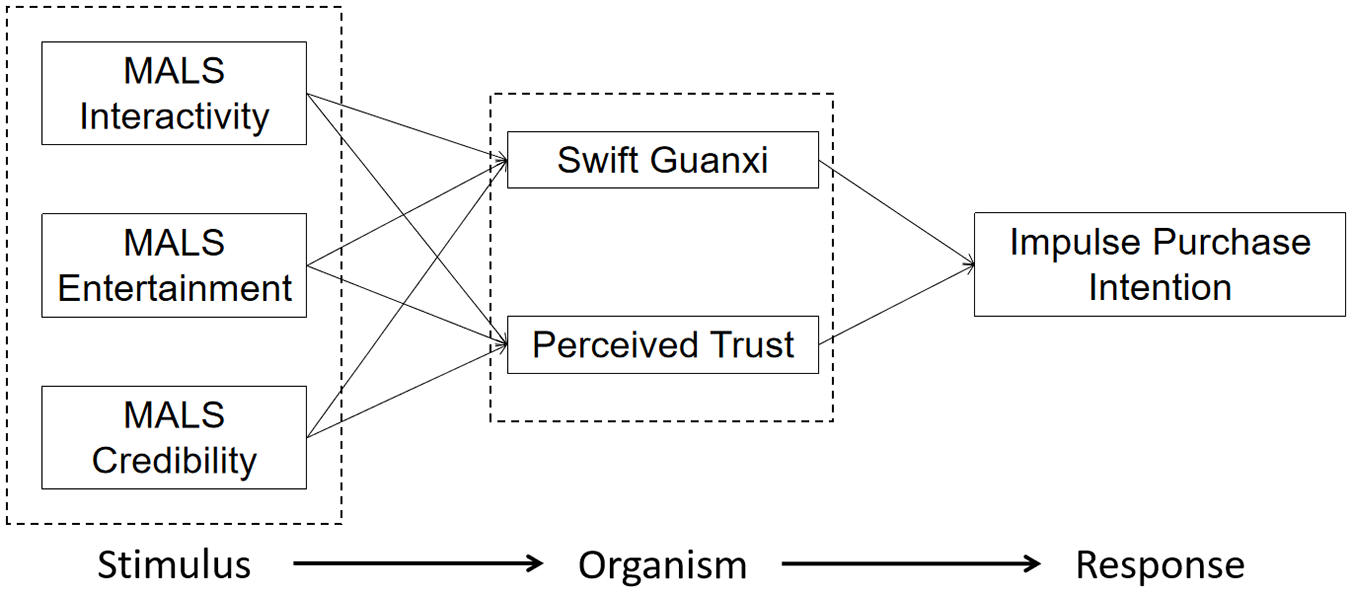
Conceptual model.
Materials and Methods
Questionnaire Design
There are six key variables in this paper, namely, MALS interactivity, MALS entertainment, MALS credibility, swift guanxi, perceived trust, and impulsive purchase intention. To ensure the scientific rigor of data analysis, most of the measurement indicators of the variables involved in this study refer to existing literature that has been confirmed, and are adjusted appropriately based on the MALS scenario of clothing. All variables were measured by Likert 5-level index measurement method, that is, the numbers 1 to 5 indicate the degree of consistency with the viewpoint of the question. The larger the number, the more consistent it is with the viewpoint of the question. The scale is shown in Table 1.
The Scale of This Study.

Data Collection and Sample
This study was approved by the Ethics and Academic Committee of our institution. The investigation does not involve bias and academic ethics. This paper conducts a questionnaire survey on individuals who have had live shopping experience, and makes and distributes the questionnaire through the Questionnaire Star (www.wjx.com). Questionnaire Star is a commonly used questionnaire survey platform in China. This study is aimed at people who have purchased mobile app live streaming and hope to shop through mobile app live streaming. The questionnaire survey platform is free, convenient for questionnaire distribution and collection, and facilitates the implementation of random sampling.
In order to ensure the smooth progress of the investigation, we conducted a preliminary investigation before the formal investigation, selecting 20 subjects for investigation. Through communication with the subjects, data collection and analysis, no issues affecting the formal investigation were found. The formal survey adopts the professional online survey website to publish the questionnaire (Questionnaire Star), after the questionnaire is set up on the Questionnaire Star platform, it will produce a QR code or answer link. We distributed the QR code and link of the questionnaire online, and participants who are willing to participate in the survey are free to participate. The formal questionnaire survey began on November 24, 2021 and ended on December 7, 2021. A total of 603 questionnaires were collected. Based on the conditions of answer time, answer completeness, and answer distribution, the collected questionnaire data was screened and 537 valid questionnaires were ultimately determined, with an effective rate of 89.1%. The number of valid questionnaires met the requirements for further analysis.
The sample distribution (Table 2) shows that there are 323 women, accounting for 60.1%, which is higher than that of men; 226 subjects aged 18 to 25, accounting for 42.5%; 375 people with bachelor’s degree, accounting for 69.8%; There are 270 people whose monthly disposable income is more than 5,000 RMB, accounting for 50.3%; 395 people with more than three years of live shopping experience, accounting for 73.6%; In the MALS clothing shopping, the largest number of people bought trousers, with 477 people, accounting for 88.8%. The population survey situation meets the expected assumptions, the participants in the survey pursue individuality, understand the characteristics of mobile app live streaming, and have experience in using mobile app live streaming to purchase clothing. Population survey analysis ensures the scientific reliability of further in-depth analysis of survey data.
Sample Distribution.

Results and Discussion
Reliability and Validity Test of the Scale
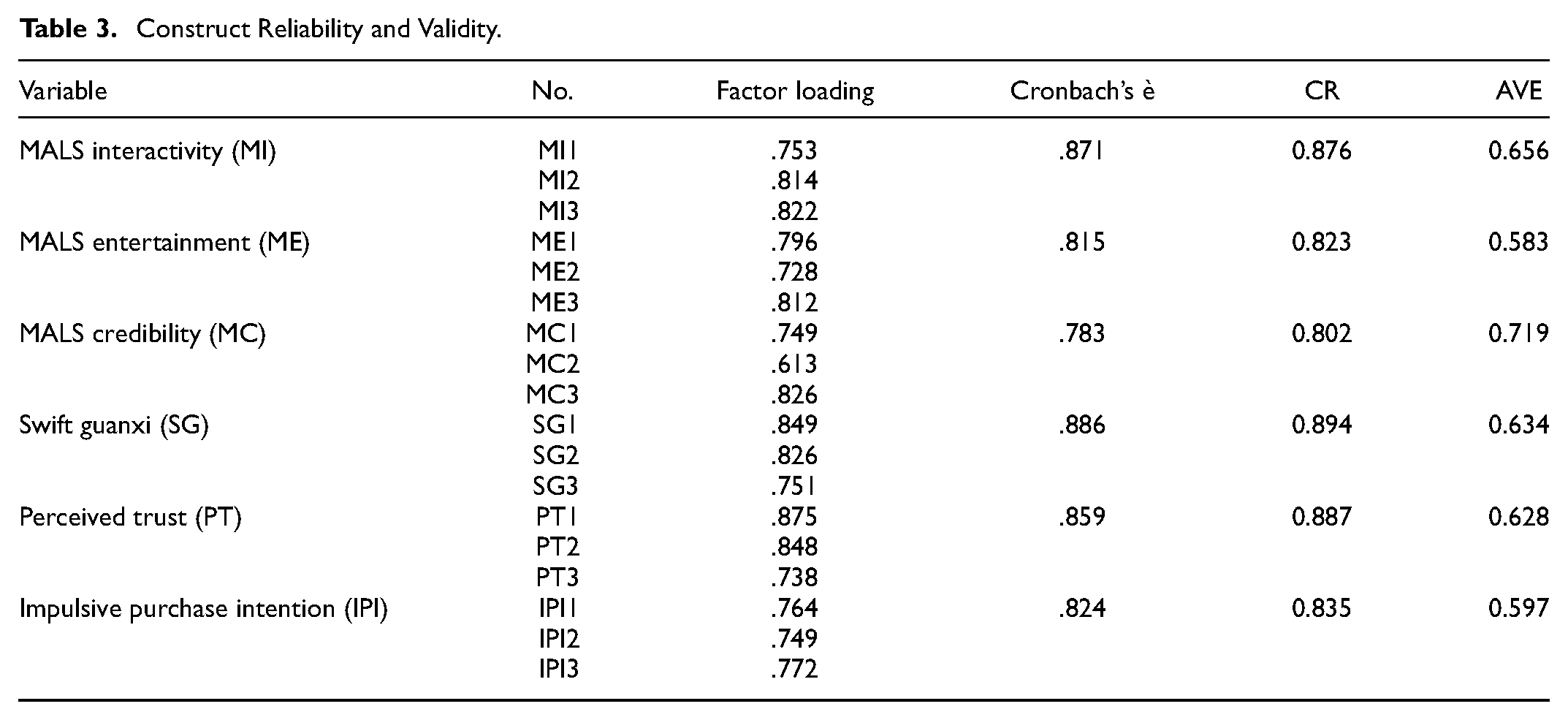
The reliability analysis results of this article are shown in Table 3, and the analysis software used is SPSS26.0. Overall, the Klenbach coefficient is .925, and the Klenbach coefficients for each variable are greater than .7, indicating that this study has good reliability. Meanwhile, the results of confirmatory factor analysis are shown in Table 3. The analysis software used was AMOS26.0, and the load capacity of all variables in this study was greater than .6, indicating that each variable has reliability. In addition, it can be seen from Table 3 that the composite reliability of each variable is greater than .7, and the average variance extraction value is greater than .5, indicating that this study has good validity (Lee & Chen, 2021).
Construct Reliability and Validity.
Structural Model
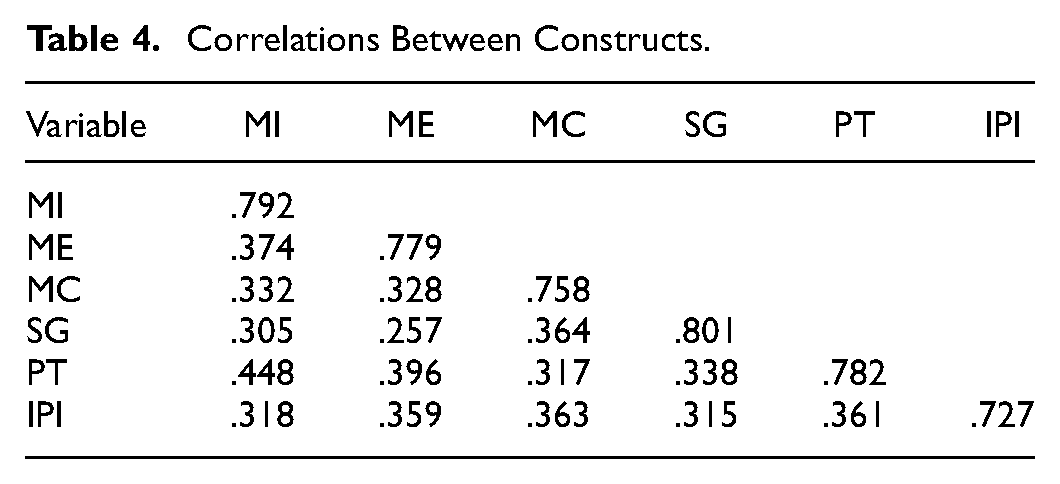
Table 4 shows the correlation between variables. The research results indicate that there is a significant positive correlation between MALS interactivity, MALS entertainment, MALS credibility, swift guanxi, perceived trust, and impulsive purchase intention; There is a significant positive correlation between perceived trust and impulse purchase intention (r = .315, p < .01); There is a significant positive correlation between swift guanxi, and impulse buying intention (r = .361, p < .01). The hypothesis has been preliminarily verified (Tian & Lee, 2022).
Correlations Between Constructs.
This study used AMOS26.0 software to test the path hypothesis and fitting degree of the model. The overall fitting test results of the model are shown in Table 5. The goodness of fit index GFI = 0.921 and the adjusted goodness of fit index AGFI = 0.914, both exceed the reference value of 0.9. All other fitting indicators meet the fitness standard, indicating that the model in this study has a relatively good fit (Li et al., 2022). The model fitting path test results are shown in Table 5 and Figure 2.
Model Fitting Test Results.


Path diagram of conceptual model.
As Dong et al. (2023), it can be seen from Table 6 that the MALS interactivity positively affects swift guanxi (β = .386, p < .001), H1a was verified; The MALS interactivity positively affects perceived trust (β = .272, p < .001), H1b was verified. The MALS entertainment positively affects swift guanxi (β = .388, p < .001), H2a was verified; The MALS entertainment positively affects perceived trust (β = .216, p < .001), H2b was verified. The MALS credibility positively affects swift guanxi (β = .295, p < .001), H3a was verified; The MALS credibility positively affects perceived trust (β = .137, p < .001), H3b was verified. The swift guanxi positively affects impulsive purchase intention (β = .684, p < .001), H4a was verified; The perceived trust positively affects impulsive purchase intention (β = .277, p < .001), H4b was verified.
Model Path Test Results.

Significance levels: *p < .05. **p < .01. ***p < .001.
Moderating Effect Test
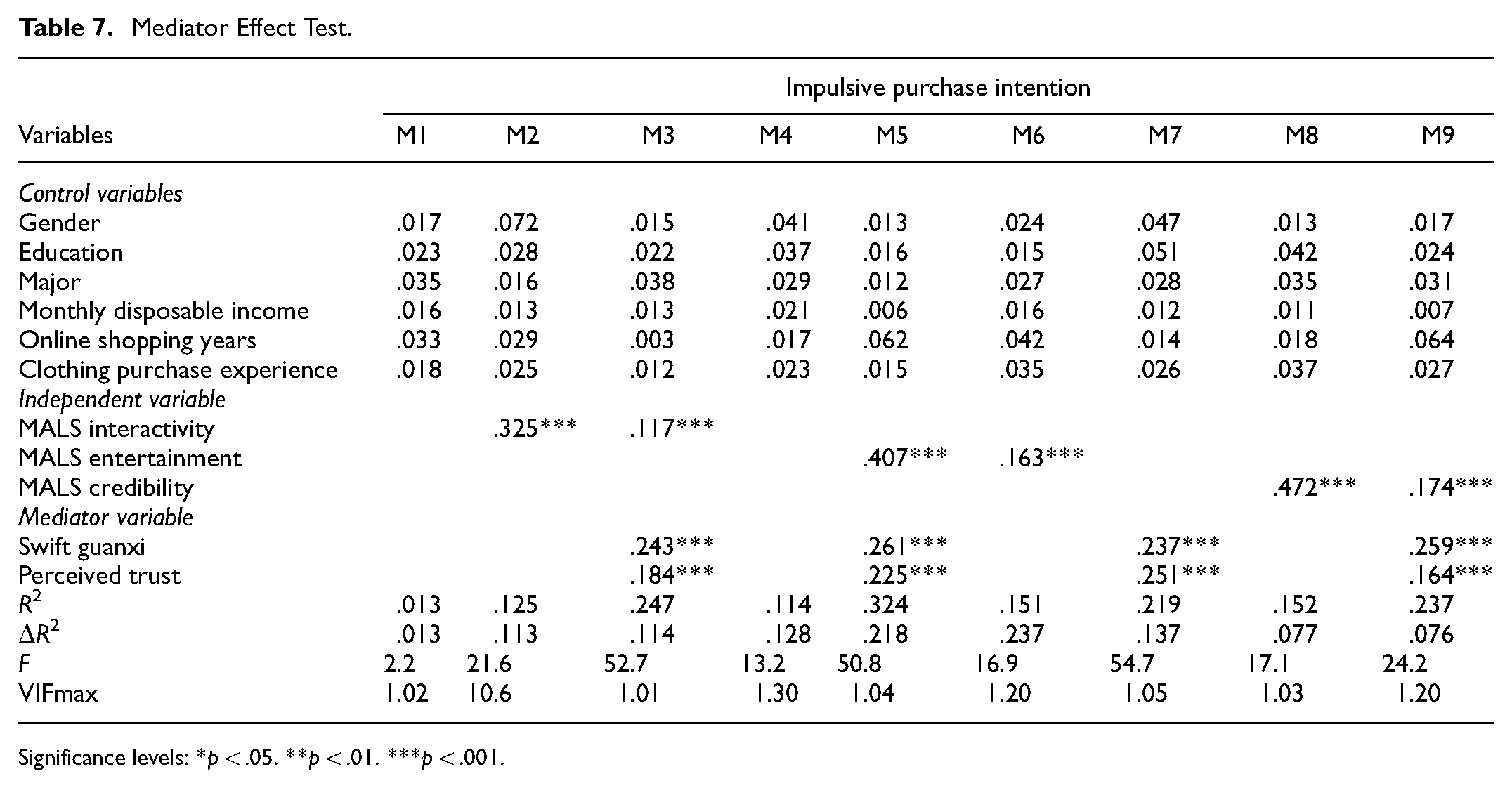
This study further explores whether Swift Guanxi and Perceived Trust play mediating role between Mobile App Live Streaming Characteristics and Clothing Impulse Purchase Intention. As shown in Table 7, multiple linear regression was used to test the moderating effect, and the research results are shown in Table 6. The results showed that after adding the moderating variable perceived trust, the positive impact on impulsive purchase intention has changed; Reduced positive impact of MALS interactivity on impulsive purchase intention (β = .33, p < .001); The positive impact of MALS entertainment on impulsive purchase intention decreases (β = .41, p < .001); Reduced positive impact of MALS credibility on impulsive purchase intention (β = .47, p < .001). Therefore, perceived trust plays a partial moderating role between the MALS characteristics and impulsive purchase intention. After adding the moderating variable swift guanxi, the positive impact on impulsive purchase intention has changed; Reduced positive impact of MALS interactivity on impulsive purchase intention (β = .12, p < .001); The positive impact of MALS entertainment on impulsive purchase intention decreases (β = .16, p < .001); Reduced positive impact of MALS credibility on impulsive purchase intention (β = .17, p < .001). Therefore, swift guanxi plays a partial moderating role between the MALS characteristics and impulsive purchase intention (Tian & Lee, 2022).
Mediator Effect Test.
Significance levels: *p < .05. **p < .01. ***p < .001.
Conclusions, Implications, and Limitations
Conclusions
This paper introduces the S-O-R model into the research on consumers’ impulse purchase intention in MALS, focuses on the impact of MALS characteristics on consumers’ purchase intention, and analyzes the antecedent variables and paths of consumers’ impulse purchase intention through swift guanxi and perceived trust theory. Through empirical research and analysis, the following conclusions are drawn:
MALS interactivity has a positive significant impact on consumers’ swift guanxi and perceived trust. These results are consistent with Ou et al. (2014) and Guo et al. (2021). The stronger the interaction of live streaming, the form of interaction affects swift guanxi and perceived trust. In the live broadcast environment, the speech technology, signboard action, personal image, etc. of the live broadcast host may become the key factors in the formation of swift guanxi and perceived trust, enhance consumers’ sense of shopping experience, and promote consumers to have a sense of excitement and pleasure. At the same time, frequent interaction can make the anchor understand the needs of consumers in real time, increase the familiarity between the audience and the anchor, shorten the distance between each other, and make the audience have a sense of trust.
The MALS entertainment has positive significant impact on the swift guanxi and perceived trust. These results are consistent with Yang (2020) and W. K. Wu, Wu, and Lai (2021). When the anchor has a high charm value, it can increase the popularity of the audience and form a visual and emotional impact on consumers. This is in line with the characteristic that Chinese consumers enjoy a lively atmosphere. Chinese consumers are easy to follow the trend in purchasing, and compared to consumers from other countries, a lively atmosphere is more likely to stimulate Chinese consumers’ impulsive purchasing intention. Many anchors will show their talents in the process of live streaming, such as singing and dancing, which makes consumers feel that watching live streaming is like watching entertainment festivals. They are relaxed and happy in their hearts, making the audience feel that watching live streaming shopping is a beautiful enjoyment. Many anchors have interesting souls or humorous language, and the audience will be attracted in the process of watching the live streaming. So as to form a good relationship between the anchor and consumers, and increase consumers’ trust in the anchor.
The MALS credibility has positive significant impact on the swift guanxi and perceived trust. These results are consistent with Shi et al. (2018) and Bao et al. (2016). Traditional online shopping has the risk of image processing, which leads to the deviation between Buyer show and seller show. Consumers often have doubts about online shopping. The live streaming with goods weakens the risk of lens switching and excessive beautification of pictures. The audience can truly see all the information of the live streaming scene and goods through the lens. Every move of the anchor can be captured by the audience, which increases the credibility of shopping. The credibility of information sources has a positive impact on the formation of fast relationship and perceived trust.
The swift guanxi and perceived trust have significant impact on the impulsive purchase. These results are consistent with H. Chen et al. (2022) and Fan et al. (2019). When the audience feels the swift guanxi formation, consumers feel the mutual understanding and mutual benefit with the anchor and other consumers, and then produce impulse purchase intention. In the process of MALS, consumers’ trust in the anchor and other consumers will reduce consumers’ expectation of risk, increase consumers’ trust in goods, reduce consumers’ risk perception of goods, and promote consumers’ impulse purchase intention behavior. China is a country that places special emphasis on relationships, and the purchasing behavior of Chinese consumers is also influenced by various relationships. Due to the interactivity, entertainment, and credibility of mobile application live streaming, consumers can form swift guanxi (relationship), enhance perceived trust, and ultimately affect their purchasing intention.
Theoretical and Practical Implications
This paper verifies the impact and path of live streaming characteristics on consumers’ impulse purchase intention of clothing, refines the characteristics that affect consumers’ impulse purchase intention in live streaming goods, and finds that different characteristics have different impact paths on consumers’ impulse purchase intention. These conclusions are consistent with the previous research on live streaming of Liao et al. (2022), In live streaming marketing, the anchor can form his own unique style according to the characteristics and advantages of the product and combined with his own characteristics, improve the live streaming effect and promote the realization of product value. At the same time, as a public figure, the anchor should abandon bad live streaming habits, improve professional quality, abide by industry norms, create a positive and optimistic image, and guide consumers to buy products healthily and actively, which is the key to enhance the sustainable competitiveness of live streaming.
Mobile application developers should make clear the development purpose of mobile live streaming applications and mobile shopping applications. As a shopping channel, mobile live streaming applications should focus on the entertainment, interaction and other functions of mobile live streaming applications in the development process. When using mobile live streaming applications, consumers have an impulse to purchase because of the stimulus of live streaming. In this process, consumers have a passive response, Mobile live streaming applications cannot be used as the primary purpose to stimulate shopping, otherwise it will cause adverse effects. In fact, many mobile shopping applications are also opening the live streaming function, but the premise for consumers to choose mobile live streaming applications for shopping is entertainment, interaction and trust. Consistent with Zhou et al. (2021), compared with mobile shopping applications, mobile live streaming applications can more easily form fast relationships and perceived trust, thus stimulating impulse purchase intention and forming impulse purchase behavior.
Mobile application live streaming platforms should focus on relationship management, especially how to quickly promote the formation of swift guanxi. They should actively integrate into users, communicate and provide feedback effectively, and provide timely assistance and support to users, in order to promote mutual understanding and reciprocity between both parties and provide convenient conditions for the establishment of swift guanxi. Mobile application live streaming platforms can enhance their relationships with users through targeted methods such as “improving information” or “enhancing interaction.” Mobile application live streaming platforms should focus on cultivating good relationships, promoting more proactive and continuous sharing among users, and enhancing the resource base for obtaining development opportunities from external sources.
Limitations
The survey in this paper was conducted for Chinese consumers with MALS experience, not in the real MALS scene. Therefore, there may be deviation in consumers’ response. Future research can attempt to use situational experiments to conduct questionnaire surveys, such as providing participants with MALS scenarios and allowing them to fill out questionnaires in a relatively real MALS environment, which may more accurately predict participants’ consumption feelings. Secondly, the model is based on a small sample, and the sample situation is relatively single. Future research can expand the sample size and make in-depth exploratory analysis for age, gender and income. Finally, the impact of MALS characteristics on consumers’ impulse buying intention is very complex, and there are also many influencing factors besides swift guanxi and perceived trust variables. In addition, the dimension division of MALS characteristics may also have unexplored parts, which can also be used as the focus of further research and exploration in the future.
Footnotes
Acknowledgements
We want to thank the reviewers and editors who persevered through revisions of this paper, and helped nurture it to completion. Any remaining errors are fully our own responsibility. IRB permission number is 202210024.
Declaration of Conflicting Interests
The author declared no potential conflicts of interest with respect to the research, authorship, and/or publication of this article.
Funding
The author received no financial support for the research, authorship, and/or publication of this article.

Data Availability Statement
The datasets used and/or analyzed during the current study are available from the corresponding author on reasonable request.