




Abstract
The educational development level of migrant children is affected by many factors, and it is practical to study it. Based on the current situation of migrant children study in China, this study explored the multiple mediating effects of educational support and moderating effect of the age on the level of educational development by policy environment. The study sample was composed of 541 Chinese migrant adolescents aged 9 to 17. They completed educational development questionnaire, educational support questionnaire and policy environment questionnaire. Mediating and moderating effects analysis were used to examine the role of educational support between policy environment and educational development. The results show that the educational development level of Chinese migrant children was relatively high. However, there were significant differences among different schools and ages. It was found that school management played most important role in the educational development of migrant children. Also, it was found that assistance support played a partial mediating role between school management and academic condition, and affective support played a partial mediating role between school management and social behavior, and age played a moderating role between school management and social behavior. School management for Chinese migrant children should be further strengthened. Assistance support and affective support for Chinese migrant children should be further improved. In addition, the management of migrant children aged from 14 to 17 should be the focus of attention. In this study, some suggestions are put forward to improve these influence factors of education development for Chinese migrant children.
Keywords
Introduction
Backgrounds
In China, the scale of migrant population has grown rapidly since the publication of migrant population policy in 1989 (Duan et al., 2013). Some scholars have noticed that the “family migration” has become an important feature of population mobility (Lv et al., 2018). In the past time, migrant families were not stable and moved geographic locations. But, in recent years, the stability of migrant families has been rising. With the tendency of resident for family migration, the proportion of migrant families with children, who studied in the immigrant areas, has rapidly increased in China (Chen, Feng, & Han, 2019). Migrant children mainly refer to the pupils and junior middle school students who follow their parents from rural areas to urban cities and receive compulsory education (Xiong & Johnson, 2022). As an important part of the migrant population, some issues of migrant children, such as education, health, and social integration, have received widespread attention (Zheng et al., 2022). The number of migrant children from rural to urban area is large, and it is growing rapidly, which makes migrant children become a particularly noteworthy group. And there are some obstacles faced by migrant children when they make their way into the city, including the issues of livelihood, safety, and education. Among them, education is the most important part (Chen, Feng, & Han, 2019).
The compulsory education is mainly undertaken by local government in China. According to regulations, migrant children can only go to school in rural areas (Ma & Qie, 2022). But for the family migration, the migrant children cannot receive education like urban children because their registered permanent residence is not in the city but in the countryside (Zhuang, 2020). Unfortunately, at the same time, they are also excluded from the rural educational system because they live without the local registered permanent residence, becoming a huge marginalized group. As a result, most migrant children have to study in some private schools in the city because it is difficult for them to get in public schools for their registered permanent residence (Chen, Li et al., 2019). Han (2007) pointed out that the education for migrant children have become a new obstacle to implement the process of compulsory education. The educational development for migrant children has aroused widespread concern among academics. Education of migrant children is not only critical to themselves and their families, but also has profound long-term consequences on future economic growth and social development (Heckman & Feng, 2018). Therefore, it is practical to study the educational development for migrant children.
Education Development
As for the educational development of migrant children, it is inevitable to pay attention to their academic condition and social behavior (Wang et al., 2021). For school-age children, academic performance is undoubtedly an important aspect closely related to educational development. Children with good academic performance are often accompanied by higher peer status and self-esteem and are favored by teachers (Wang et al., 2021). If migrant children can have excellent academic performance, there is definitely a positive effect on their better integration into the urban learning and life, the acceptance of teachers and classmates, and the high self-identity. However, the special learning and living environment of migrant children makes it more difficult to obtain good academic performance (Chen et al., 2021). On the one hand, the special family environment of migrant children makes their parents not have too much energy and ability to devote themselves to their children’s learning. On the other hand, the school environment of migrant children, especially those who have just transferred to city learning and have to accommodate urban style of living, is not ideal (Zhao et al., 2022). Their original close peer relationship and teacher-student relationship no longer exist. When faced with a group of new classmates and new teachers, they will inevitably feel estranged and lonely (Chen et al., 2014). However, some studies have brought diametrically opposite conclusions, suggesting that the academic performance of migrant children is no worse than that of urban children (Chen et al., 2013; Meng & Yang, 2019). According to the estimation of the propensity score matching model, Meng and Yang (2019) found that the academic performance of migrant children is not necessarily inferior to that of local students, and pointed out that migrant children have the same knowledge and learning ability as local children in the cities. Therefore, they suggested that when evaluating the academic performance of migrant children and urban local children, the personal factors, family factors, and school factors of the students should be taken into consideration before judging whether it is caused by family migration.
Another important factor to evaluate the education development of migrant children is their social behavior. As a special group of minors in society, migrant children follow their parents to an unfamiliar environment, and at the same time they are in a critical period of personality and thought formation. Due to changes in living standards, policies, and resources, there will be difficulties in their growth (Cheung, 2013). From the perspective of children, they are prone to self-doubt and are not able to fit into social life. From a social perspective, if they fail to form correct values, maybe it will be a negative factor after entering society in the future (Liu et al., 2018). Therefore, paying more attention to the social behavior of migrant children is not only related to the healthy growth of the children, but also a vital step for the harmony and stability of the entire society. There are certain resistances to the social behavior of migrant children. There is some disadvantages for children with migration experience. Migrant children have a strong sense of loneliness in urban life, and it is not easy to establish a social network (Chen et al., 2014; Mao & Zhao, 2012). However, compared with left-behind children, migrant children also show higher self-esteem and lower depression (Gao et al., 2022). Li and Sen (2010) found that most migrant children did not show unsuitability to explicit behavior, but showed sensitivity and resistance to some unfair systems in their mind. In other words, even though migrant children are actively participating in social life, they still feel inferior and sensitive, and they do not want others to treat them as a special group. Guo et al. (2005) had adopted qualitative research methods and found that with increasing age, migrant children have a strong psychological experience of social rejection and unfair treatment, which will endanger their mental health.
Influence Factors
However, what are the factors affecting the educational development level of migrant children? Alexander et al. (1996) pointed out that migration itself had no negative impact on migrant children. The case study of the school for some migrant children showed that the main factors influencing the education for migrant children were the isolation of the registered permanent residence system and restriction of the education system (Cheung, 2013; Ma & Qie, 2022). Some scholars pointed out that those migrant children were deprived of equal access to the education for migrant family’s low income and the restrictive registered permanent residence (Tan, 2010). Other scholars pointed out that some systems were the social backgrounds of educational problems for migrant children through some research cases and discussed the influence of school education and family education on the educational situation of migrant children (Wang et al., 2021). There are some researchers who explored the reality of carrying out compulsory education for migrant children in the immigrant areas from three aspects including social environment, school practice, and family relationship (Ma, 2007; Mao & Zhao, 2012). In addition, some researchers have explored the educational development of migrant children from three aspects including parental migration, school choice, and peer effects in public schools (Chen, Feng, & Han, 2019; Ma, 2007; Xiong & Johnson, 2022). These researches indicate that some policy regulation, school condition, and family condition all have important impacts on the educational development level of migrant children.
Status
As an important indicator of the educational development, academic performance is the most direct embodiment of the educational objectives of migrant children. For a long time, most of scholars have paid more attention to children’s academic performance and explored the main influence factors (Meng & Yang, 2019; Wang et al., 2021). A common basic conclusion is that children’s academic performance is affected by a variety of factors including the individual factors and family factors such as level of intelligence, individual characteristics, parents’ occupation and their degree of education, household income, parental rearing styles, and the social environment factors and so on (Zhou & Wu, 2008). However, most previous studies are lacking in quantitative research.
Then, how do the factors of the government, school and family affect the educational development of migrant children? Phenomenological Variant of Ecological Systems Theory (PVEST), which integrates the ecological system theory with the identity development theory, can be used to describe the normal development process for Chinese migrant children (Spencer et al., 2003). It provided an important theoretical foundation for investigating the impact mechanism of policy regulation, school management and family environment on the educational development for migrant children. According to PVEST, the discrimination against migrant children as a risk factor can cause some harmful consequences if migrant children cannot get enough support resources (Fan et al., 2012). Zeng (2011) pointed out that social support moderated the relationship between the stress and psychological adaptation in an effect model, indicating that social support played a protective role in the psychological adaptation of migrant children. Yang (2019) pointed out that schools and families should create a good environment for migrant children to support them and continuously improve their positive mental capitals. Tong and Miao (2020) used China Education Panel Survey (CEPS) data to analyze the relationship between migrant children’s parental participation, school adaptation and teacher care, and found that enhancing parental participation, increasing teacher care and home-school cooperation are effective measures to promote school adaptation for migrant children. Zhuang (2020) noted that efforts must be made to build an education support system for the psychological “same-city” of the children of migrant workers in cities from multiple dimensions. These studies indicated that some kind of supporting factors may play a mediating and moderating role in migrant children development. Thus, educational support for migrant children may also play a mediating and moderating role.
So, our study intends to make further exploration for three aspects by quantitative methods as following. These three aspects are educational development, educational support, and policy environment. On the one hand, whether three levels of policy environment (policy regulation, school management, and family environment) are important factors affecting the educational development of migrant children or not? On the other hand, whether four levels of educational support (learning support, assistance support, affective support, and interactive support) play a mediating or moderating role between the three levels of policy environment and the educational development of migrant children or not?
Method
Participants
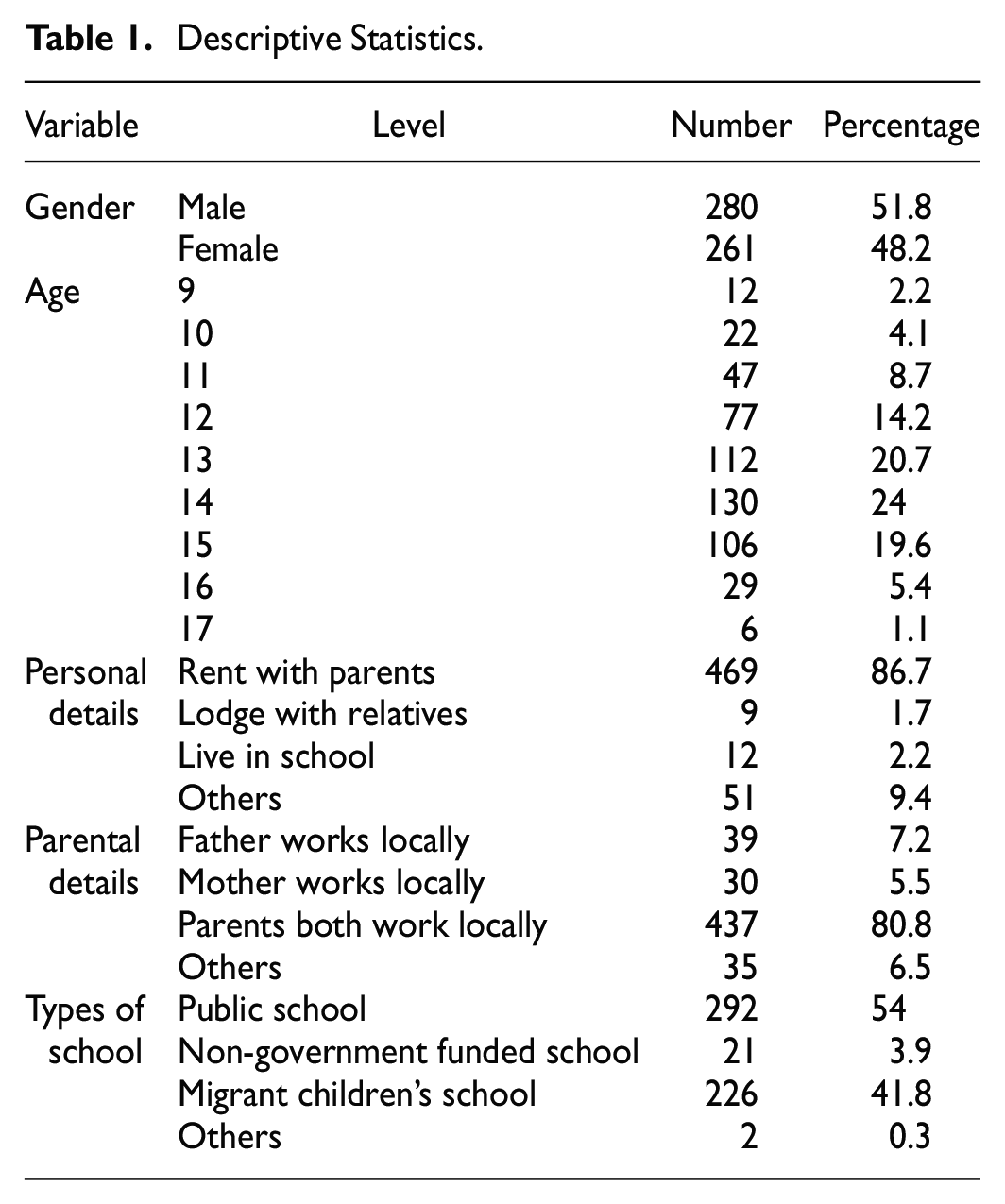
The participants were migrant children from some cities in which most migrant children live aged 9 to 17. Migrant children are mainly from Chinese coastal cities, such as Guangzhou, Shenzhen, and Shanghai, which are economically developed and populous. In these cities, there are relatively more migrant children. We took samples from these cities including Guangzhou, Shenzhen, and Shanghai. They are in the fifth or sixth grade of primary school and the first or second grade of middle school of migrant children’s schools in non-government funded schools and public schools. All study procedures were approved by the University Research Ethics Board (Institutional Review Board). We gave parents the option to opt their children out of completing, but none of parents opted out and all the consents were informed written. A sample of 541 students was involved. Descriptive statistics are shown in Table 1.
Descriptive Statistics.
Procedure
Six schools were randomly selected from an urban school district and seventeen classes were randomly selected from these schools. Data were collected during the class using a paper/pencil version survey administered to all students in these school classes. Each participant was assigned a unique ID. No adolescent changed classrooms or schools over the study period. Students’ physiological indicators (e.g., height, weight, blood pressure) were assessed within the first week following the baseline measures. The academic affairs offices of the six schools provided the measurement sites. Students were wearing light clothes and were barefoot when measured at air-conditioned rooms. Research staffs were trained before they administered the survey. Student assents were obtained from both their schools and parents.
Questionnaires
The questionnaire of educational development for migrant children (EDMC) with 14 items was used. Two dimensions of EDMC are academic condition (7 items) and social behavior (7 items). The sub-dimension of academic condition includes learning attitudes (e.g., “I always finish my homework on time”), efforts and achievement (e.g., “I take every exam seriously”), while the sub-dimension of social behavior highlights their situation in learning (e.g., “I often teach those students whose grades are poor”) and communication (e.g., “I think I should be responsible for damaging my classmates’ belongings”) from the perspective of behavior. Each item has the 5-point scale (1 = completely inconsistent, 2 = inconsistent, 3 = consistent, 4 = more consistent, 5 = completely consistent). Total score of PEMC with 17 items was calculated with higher scores indicating higher level of educational development. Cronbach’s alpha for the whole questionnaire, academic condition and social behavior were, .821, .790, and .834, respectively, indicating a relatively good reliability. Confirmatory factor analysis was done and the index of fitting was as follows: χ2/df = 4.63; CFI = 0.94; TLI = 0.90; RMSEA = 0.06; SRMR = 0.04. The model fit indices indicated a good fit to the data.
The questionnaire of educational support for migrant children (ESMC) with 17 items was used. Four dimensions of ESMC are learning support (4 items), assistance support (5 items), affective support (5 items), and interactive support (3 items). Learning support refers to external forces, including teachers, parents, and peers to help students in learning (e.g., “the teacher tutored me after classes”). Assistance support refers to financial or related supplies from schools, governments, and society (e.g., “the school or society has provided me with scholarships or loans’). Affective support refers to the external emotional support which is concerned of students from school or parents (e.g., ‘my parents encouraged me to study”). Interactive support refers to the communication activities involved in daily life (e.g., “I will play with my classmates in the city on weekends”). Each item has the 5-point scale (1 = completely inconsistent, 2 = inconsistent, 3 = consistent, 4 = more consistent, 5 = completely consistent). Total score of PEMC with 17 items was calculated with higher scores indicating higher level of educational support. Cronbach’s alpha of ESMC was .789. Among the learning support, assistance support, affective support and interactive support were .728, .808, .775, and .773 respectively, indicating relatively good reliability. Confirmatory factor analysis was done and the index of fitting was as follows: χ2/df = 3.51; CFI = 0.92; TLI = 0.90; RMSEA = 0.05; SRMR = 0.03. The model fit indices indicated a good fit to the data.
The questionnaire of policy environment for migrant Children (PEMC) with 15 items was used. The PEMC consists of three aspects, namely, policy regulation (6 items), school management (4 items), and family environment (5 items). Policy regulation mainly refers to the laws and policies related to the migrant children promulgated by the government (e.g., “we can go to local school even without a registered permanent residence”). School management mainly refers to the school’s attitude and system of implementation to achieve the teaching objectives for migrant children (e.g., “school treat us migrant children like urban children equally”). Family environment mainly refers to the family economic status, parental backgrounds, and family attitudes to learning (e.g., “my parents usually control me very closely in my study”). Each item has the 5-point scale (1 = completely inconsistent, 2 = inconsistent, 3 = consistent, 4 = more consistent, 5 = completely consistent). Total score of PEMC with 15 items was calculated with higher scores indicating higher level of policy environment. Cronbach’s alpha of the questionnaire was 0.855, and of the policy regulation, school management and family environment were 0.859, 0.837, and 0.839 respectively, indicating a relatively good reliability. Confirmatory factor analysis was done and the index of fitting was as follows: χ2/df = 4.87; CFI = 0.90; TLI = 0.90; RMSEA = 0.07; SRMR = 0.06. The model fit indices indicated a good fit to the data.
Results
Descriptive Analysis
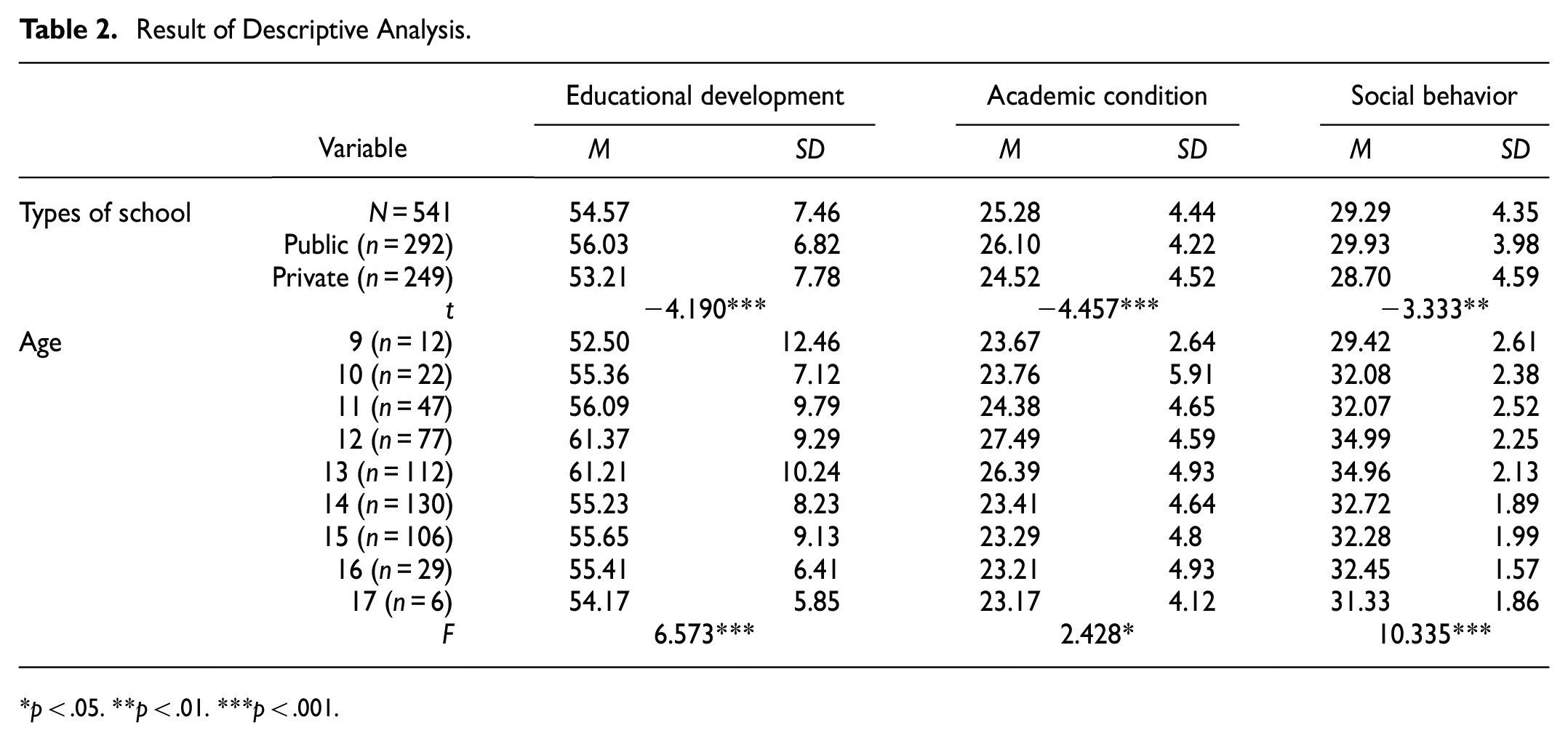
The overall situation about the educational development level of migrant children is shown in Table 2. Also, the significant tests of the age and types of school are shown in Table 2. However, because gender, personal details and parental details are not significant for the educational development level of migrant children, the results about them are not shown in Table 2.
Result of Descriptive Analysis.
p < .05. **p < .01. ***p < .001.
As can been seen from Table 2, the overall educational development level of migrant children scored 54.57, with the average score 3.90, indicating the educational development level is relatively high. Refined to each dimension, the academic condition score is 25.28 with the average score 3.61, which indicates that migrant children’s academic condition is good. The social behavior score is 29.29 with the average score 4.18, which is slightly higher than the academic condition.
From Table 2, types of school have significant difference on the educational development level of migrant children through t-test analysis. The educational development, academic condition, and social behavior scores of public schools are significantly higher than the corresponding scores of private schools (t = −4.190, p < .001; t = −4.457, p < .001; t = −3.333, p < .001).
From Table 2, we can also see that the age has a significant difference on the educational development, academic condition and social behavior. Post hoc test (LSD method) found that educational development level of 12-year-old migrant children is significantly higher than educational development level of 10, 15, and 17-year-old (t = 2.651, p < .05; t = 2.921, p < .01; t = 2.632, p < .05), while 15-year-old migrant children are significantly lower than 12 and 13-year-old (t = 2.998, p < .01; t = 2.531, p < .05), and 17-year-old migrant children are also significantly lower than 12 and 13-year-old (t = 2.508, p < .05; t = 2.533, p < .05). That means the educational development level of migrant children at the end of primary school stage is the highest. Then the educational development level reduces at middle school. Moreover, the results of academic condition showed that the educational development of 12-year-old migrant children was significantly higher than other age groups (except the 13-year-old). The results of social behavior showed that the educational development of 15-year-old migrant children was significantly lower than 14-year-old. It was the problem of migrant children that had significant adverse changes at this stage (t = 2.566, p < .05). As can be seen from Table 2, especially, the age of 14 is an important turning point. Line chart of educational development with the age is shown in Figure 1. For migrant children, it shows that the age of 14 to 17 should be particularly concerned.

Line chart of educational development with age.
The above analysis shows that the educational development level of migrant children is relatively high, but there are significant differences in the age and types of school.
Correlation Analysis
There are some correlation coefficients among those variables and the results of correlation analysis are shown in Table 3.
Results of Correlation Analysis.

Note. 1. Policy regulation, 2. School management, 3. Family environment, 4. Learning support, 5. Assistance support, 6. Affective support, 7. Interactive support, 8. Academic condition, 9. Social behavior, 10. Educational support, 11. Educational development.
p < .05. **p < .01.
From Table 3, the educational development is not significantly correlated with policy regulation (r = 0.078, p > .05), family environment (r = 0.012, p > .05), learning support (r = 0.014, p > .05), and interactive support (r = 0.048, p > .05), while it is significantly correlated with school management (r = 0.184, p < .01), assistance support (r = 0.143, p < .01), affective support (r = 0.184, p < .01), and education support (r = 0.141, p < .01) . Two dimensions of the educational development, which are academic condition and social behavior, are positively correlated with school management (r = 0.187 and 0.178, p < .01), assistance support (r = 0.152 and 0.729, p < .01), and affective support (r = 0.132 and 0.832, p < .01).
The above analysis shows that the educational development of migrant children is closely related to school management, assistance support and affective support. Further investigation of their casual relationships is needed.
Multivariate Linear Regression Analysis
According to Table 2, we can know that the age and types of school are significant. So, they need to be controlled by hierarchical regression. Here, we only list the influence results of independent variables on dependent variables. The results of multivariate linear regression analysis are shown in Table 4.
Results of Multivariate Linear Regression Analysis.

From Table 4, we can see that model 3 is selected because the results of model 3 are significant (F = 30.78, p < .001), compared with model 1 and model 2. The value of R2 is .147, which is the largest among the three models, and the value of delta R2 is .012 (significant).
The model 3 in Table 4 also shows that school management has the greatest impact on predicting the education development level with a coefficient of .301, assistance support with a coefficient of .191 and affective support with a coefficient of .126.
The multivariate linear regression equation established here can reveal the relationship between the educational development and policy environment (school management) and educational support (assistance support and affective support), but the mechanism of their internal influence needs to be further analyzed.
Analysis of Mediating and Moderating Effects
Using SPSS process, the model of mediating effects is shown in Table 5. From Table 5, school management positively affects the academic condition of migrant children. The effect between academic condition and school management is 0.34 (p < .01), R2 is .149. The effect between assistance support and school management is 0.18 (p < .01), R2 is .178. The effects between academic condition with school management and assistance support are 0.31 and 0.18 (p < .01), R2 is .206. Direct effect is 0.34 (p < .01) and indirect effect is 0.0324. Indirect effect is 9.5% of total effect and Z score is 2.60 by Sobel test (p < .01).The relationship between school management and academic condition is constructed by taking assistance support as the mediating variable. At the same time, school management has a significant direct impact on academic condition, so assistance support plays a partial mediating role between school management and academic condition.
Results of Analysis of Mediating Effects.

p < .01. ***p < .001.
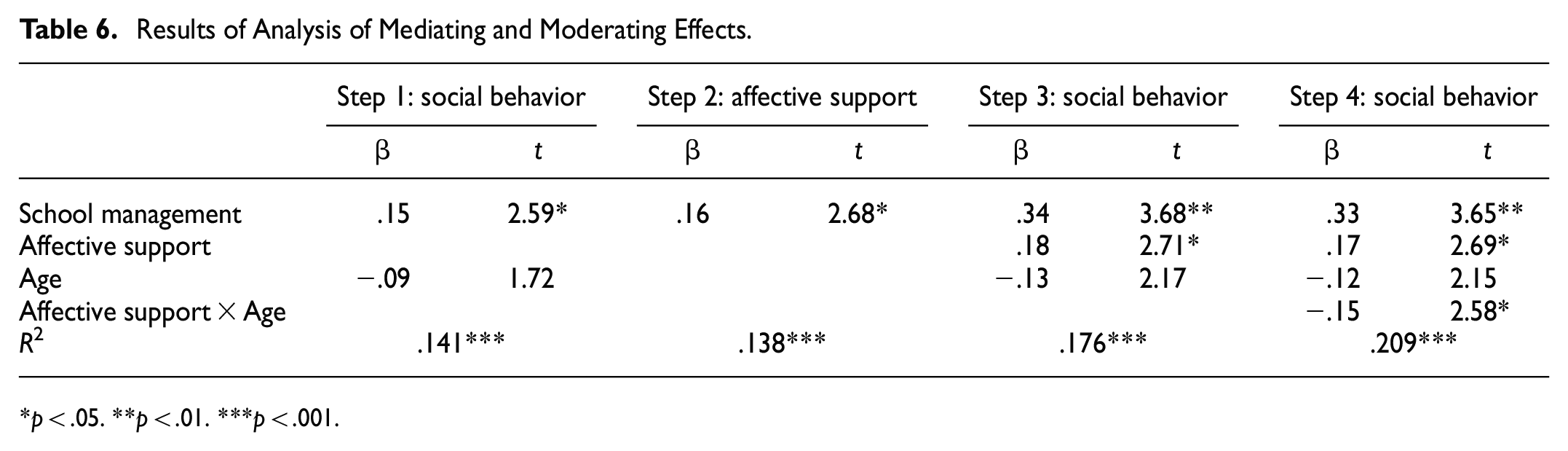
The model of mediating and moderating effects is shown in Table 6. From Table 6, affective support is seen as the mediating variable and the age is seen as the moderating variable (the age is an important factor from the Table 2, especially the age of 14–17). It is divided into three steps as follows.
Results of Analysis of Mediating and Moderating Effects.
p < .05. **p < .01. ***p < .001.
The first step is to analyze the relationship between social behavior with school management and the age. The results showed that the model was significant (β = .15, p < .05; β = −.09, p > .05), R2 is .141. The second step is to analyze the relationship between affective support and school management. The results showed that the model was significant (β = .16, p < .05), R2 is .138. The third step is to analyze the relationship between social behavior with school management and affective support with the age, taking assistance support as mediating variable. The results showed that the model was significant (β = .34, p < .01; β = .18, p < .05; β = −.13, p > .05), R2 is .176. At the same time, school management has a significant direct impact on academic condition, so affective support plays a partial mediating role between school management and academic condition. The fourth step is to analyze the relationship between social behavior with school management and affective support together with the age, according to affective support as the mediating variable and the age as the moderating variable. From the above analysis, affective support can positively affect the social behavior of migrant children. At the same time, school management can also play a role in affective support, but different ages may have different responses to school management, so mediating and moderating analysis has been simultaneously carried out. The results showed that the model is significant (β = .33, p < .01; β = .17, p < .05; β = −.12, p > .05; β = −.15, p < .05), R2 is .209 and Z score is 2.88 by Sobel test (p < .01). Therefore, affective support partially mediates school management and social behavior. And, it is also found that the age plays a moderating role between school management and social behavior (β = −.15, p < .05).
According to Tables 5 and 6, the model of mediating and moderating effects is also shown in Figure 2.

Model of mediating and moderating effects.
Discussion
Characteristics of Educational Development
The above results show that the overall educational development level of migrant children is relatively high, especially that the behavioral development is better than the learning development, but there are also some imbalances. In terms of academic condition, migrant children scored the highest at the age of 12, that is, they had the best academic performance at the end of primary school, but academic performance then dropped significantly in middle school, which is just the turning point where migrant children facing entrance (Liu et al., 2018). Due to the current household registration system restrictions, children are often more difficult to enter public middle schools than public primary schools (Chen, Li, et al., 2019). They often have to go to private schools, such as migrant children schools. Shuang et al. (2022) pointed out that public schools have higher quality educational resources than those students in migrant children schools, which was more conducive to the overall development for migrant children and the improvement of their academic performance.
The results also show that the scores of migrant children in private middle schools (i.e. non-government funded school, migrant children's school and others) are significantly lower than those in public schools, so the unfair school choice is one of the important reasons for the decline of migrant children academic condition, which is consistent with the result of some researches (Cui & Xie, 2021). In addition, the difficulty of curriculum increases gradually in primary school, but increases largely in junior high school. And the increase of the courses is also the possible reason for the decline of the academic condition of migrant children in middle school (Wu & Wu, 2009).
Mechanism of Educational Development
In order to explain the problem more effectively, correlation analysis, multivariate linear regression and mediating and moderating effects analysis were used to study the mechanism of educational development of migrant children.
Firstly, correlation analysis is concerned. It shows that the educational development of migrant children is closely related to policy environment and educational support, which suggests the further analysis of multivariate linear regression and mediating and moderating effects.
Secondly, multivariate linear regression analysis is concerned. The results of multivariate linear regression analysis show that the school management plays the most important role in the educational development of migrant children, because schools are the institutions where migrant children receive education, and school management is closely related to the educational development of migrant children. According to multivariate linear regression analysis, assistance support and affective support also have significant positive effects on educational development, which indicates that these two factors should also be considered in the educational development of migrant children. The multivariate linear regression analysis lays a foundation for the next step of mediating and moderating effects analysis.
Finally, mediating and moderating effects analysis is concerned. According to Figure 2, assistance support plays a partial mediating role between school management and academic condition and affective support also plays a partial mediating role between school management and social behavior, which suggests that if the school can enhance assistance support and affective support in the management process, it can improve their academic performance and social behavior level of migrant children. School management is the most closely related to the educational development for migrant children. Some researches indicate that improving the level of school management will improve the development level of education for migrant children (Yang, 2019; Zhao et al., 2022). School management itself can also have an impact on social behavior, but it is moderated by age which means that if the school management level improves, the social behavior level of migrant children would improve, but the degree of improvement is moderated by the age.
Some Suggestions
Implementing Relevant Laws and Regulations
Many laws and regulations have been enacted at the national level (Duan et al., 2013). On the one hand, the household registration system has been reformed. Opinions of the state council on further promoting the reform of the household registration system in 2014 explicitly proposed the abolition of the agricultural/non-agricultural dual household registration system (Lv et al., 2018). The right to education has greatly alleviated the educational inequality between urban and migrant children. On the other hand, local governments are required to guarantee the right of local migrant children to receive education equally (Han, 2007). It can be said that the national level regulations have been gradually improved. However, the implementation of local governments is not optimistic, mainly reflected as follows.
Firstly, it’s the problem of resource volume. The total number of migrant children and local children are often larger than the total number of the public schools in the immigration area (Duan et al., 2013). As a result, it cannot accommodate most migrant children for the public schools. So local governments often set a higher threshold for migrant children to enter their public schools, which cause that only few migrant children can enter public schools and produce a growth space for the generation of migrant children’s schools (Li & Sen, 2010). The revised decision of the non-governmental education promotion law pointed out that compulsory education should be prohibited for profit schools, which would greatly reduce the growth space of private schools (Chen et al., 2019). So, it requires local governments to make public schools’ bigger “cake” and increase education investment. Only in this way can children be guaranteed access to appropriate educational resources.
Secondly, it’s the resource allocation problem. At present, the educational resources allocated by the government to the migrant children are based on the place of residence rather than non-residence, which causes the flow of people but the corresponding educational resources not to flow accordingly (Zhuang, 2020). If all migrant children are admitted to the local public schools, it will undoubtedly increase the pressure of government education funds. Because of the various problems in the matching of resources, laws and regulations for the protection of migrant children have not been well implemented at the local level for many years.
Improving School Management and Educational Support
Improving the level of school management requires the improvement of educational facilities from the hardware and the improvement the quality of teachers and teaching enthusiasm from the software (Ma & Qie, 2022). The government needs to strengthen the supervision of non-public schools. This paper indicates that affective support contributes to the improvement of children’s social behavior. Therefore, the school must take into account in the emotional management of migrant children, and not just focus on the academic performance. At the key point of entering school, we should pay attention to the migrant children’s school choice anxiety and their antipathy to some unfair educational phenomenon, and solve it in time. At the age of 14 to 17, the direct influence of school management on the behavior of migrant children is gradually declining, so it is more necessary to improve their social behavior through the path of affective support, which is consistent with the views of some literatures (Zeng, 2011; Zhuang, 2020). For example, schools can carry out a variety of healthy activities and attach importance to mental health of students (Mao & Zhao, 2012). The school can also establish some special polices for migrant children, and guarantee regular contact with parents of migrant children. Certainly, teachers can strengthen family education for their parents of migrant children through parent conferences and let them learn how to communicate with their children (Shen et al., 2007).
In addition, the school can do a good job beyond school management. The attitude towards migrant children is also very important, the school should treat all students equally, with no discriminate, which will be conducive to the integration for migrant children into the new environment (Tong & Miao, 2020).
Improving Community Management
The above mediating and moderating effects analysis show that affective support can be an effective mediator variable to reduce the social behavior of migrant children. That is to say, if migrant children are lacking in love and belongings, but through the affective attention from teachers and other social people, there will also be a significant positive impact on their learning and life. As the grass-roots organization to manage the migrant families, the community is closest to the migrant families and should play the most direct role (Wu & Wu, 2009). However, the community has not played a corresponding role in the growth of migrant children (Zhao & Chen, 2022). The registration for migrant population in the community is mainly based on the regulation on the administration of migrant population, which only requires the migrant population aged between 16 and 48 to be registered and included in the scope of management (Cheung, 2013). This leads to the fact that the majority of migrant children are unable to enter the scope of community management, and the educational department is unable to count the number of migrant children in the area, and formulate educational countermeasures. Because of this, the community is unable to determine whether the children of migrant families are dropping out of school, whether the parents of migrant children send their children to school and provide appropriate care for migrant children (Cui & Xie, 2021).
Therefore, to improve the educational development level of migrant children, we must improve the community management by actively registering the number of migrant children, taking good care of migrant children, especially in the summer or winter holidays. Providing children with appropriate activities can effectively prevent migrant children from bad behavior.
Limitations
Firstly, the study sample was composed of migrant children from China, limiting the generalizability of our findings to other populations. For the sample, not all ages are uniform. In fact, the children from 13 to 15 years old took the most samples, while those from other ages took fewer samples. Secondly, for multivariate linear regression analysis, the value of Delta R2 = .012 is relatively low but significant. Last but not least, for Figure 2, the model of mediating and moderating effects is treated separately and isn’t treated holistically. Therefore, we cannot get some fitting indexes for the whole model, such as χ2/df, CFI, TLI, SRMR, and RMSEA.
Implications and Conclusions
School management for Chinese migrant children should be further strengthened. Assistance support and affective support for Chinese migrant children should be further improved. In addition, the management of migrant children, especially aged from 14 to 17, should be the focus of attention. For Chinese migrant children, the allocation of resources should be optimized and the relevant laws and regulations should be implemented. At the same time, we should improve school management and add educational support for Chinese migrant children. In addition, improving community management should also attach more importance to Chinese migrant children.
Footnotes
Author Contributions
Each author has contributed significantly to the work and agreed to the submission. All authors contributed to the design of the study, analysis or interpretation of the data. All authors gave the final approval to the current version of the manuscript.
Declaration of Conflicting Interests
The author(s) declared no potential conflicts of interest with respect to the research, authorship, and/or publication of this article.
Funding
The author(s) disclosed receipt of the following financial support for the research, authorship, and/or publication of this article: This research was supported in part by Grant No. 2021A1515012516 from the Natural Science Foundation of Guangdong Province, and Grant No. 2021wtscx020 from the Characteristic Innovation Project of Colleges and Universities in Guangdong Province (Philosophy and Social Science of Educational Science).
Ethical Statement
There are not any ethical problems in this paper and Ethical Board approvals this paper.
