



Abstract
Job satisfaction is the focus of this study, given its strategic importance, both to generate differentiation and competitive advantages, and to promote better and more sustainable results in organizations. Guided by the Affective Events Theory (AET), the interest is in analyzing the direct and indirect effects of supervisory support and involvement on job satisfaction and highlighting the implications of the academics’ emotions for sustainability-related policies and practices in academic environments. The context selected is the higher education (HE) sector in Malaysia for science disciplines, due to its socio-economic relevance and its direct link to the Fourth Industrial Revolution (IR4), as well as to the Sustainable Development Goals (SDGs). A sample of 579 scientists were selected randomly and the analysis was carried out based on partial least squares structural equation modeling (PLS-SEM) methodology. Our results supported the hypotheses postulated in the study and especially highlighted the effects of supervisory support and positive affect on job satisfaction, as well as the effect of interpersonal conflict on negative affect. In terms of implications, policy makers at ministry level are advised to consider introducing directives which promote a climate of emotional safety and trust in academic institutions, to achieve the SDGs more effectively and efficiently. At the university level, and given the relevance of the observed effects, academic leaders are recommended to contemplate improving university environments in some way that reduces levels of negative work events (interpersonal conflict in our case). This is crucial as the negative work events can trigger negative emotions, which in turn cause scientists’ job dissatisfaction.
Keywords
Introduction
Job satisfaction is considered as an attitude (Weiss & Beal, 2005) with the potential ability to provide organizations with differentiating elements that allow them to develop sustainable competitive advantages (Adiguzel et al., 2020; Chiu & Walls, 2019). For this reason, studies on the factors that influence job satisfaction in a direct or indirect way gain an interest in any field of study. This is particularly true when these fields have a special socio-economic relevance and a strong link with the Fourth Industrial Revolution (IR4) and the interconnected Sustainable Development Goals (SDGs) of the United Nations, engaging all stakeholders, from the public and private sector to academia and civil society (United Nations, 2019; World Economic Forum, 2016). This is the case of the sector we are concerned with in this research: higher education (HE). More specifically, our focus is on science disciplines within the HE of a developing economy (Malaysia) because they underpin IR4 initiatives and are strongly related to a few of the SDGs such as SDG 6 (clean water and sanitation) and SDG 7 (affordable and clean energy). In addition, since job satisfaction, as the main variable in this study, has been viewed as an integral part of well-being (Warr, 2007) and the most talked-about job attitude in organizational research (Schermerhorn et al., 2010), it is clear that this study is in line with SDG 3 (good health and well-being). Moreover, in alignment with SDG 4 (quality education), academics’ job satisfaction can ensure inclusive and quality education for all and promote lifelong learning (Hager, 2004), thereby highlighting the importance of this attitude in HE research. In this context, Affective Events Theory (AET), developed by Weiss and Cropanzano (1996), represents an interesting theoretical lens for developing studies in the above-mentioned direction, to the extent that it explains how job satisfaction of workers (in our case, academics) is influenced by work environment features both directly, and indirectly, through work events and affective reactions (Weiss & Beal, 2005). Nevertheless, an important deficit of studies guided by AET is observed in the HE context in general (as examples, see Ghasemy, Erfanian, & Gaskin, 2020; Ghasemy, Mohajer, et al., 2020), as well as in specific educational disciplines (as an example, see Ghasemy et al., 2019).
In addition, while the issue of sustainability in HE has gained the attention of scholars (Figueiró & Raufflet, 2015; Jang, 2017; Mader et al., 2013; Scott et al., 2012; Wright, 2007), the implications of academics’ affective states for sustainability-related policies and practices have been relatively unexplored (as an example, see Zahid et al., 2020). More precisely, based on the importance of science-related disciplines in achieving SDGs in developing economies, our research seeks to verify a few main tenets of AET in the Malaysian HE system and to provide evidence-based policies to increase scientists’ job satisfaction to ensure the achievement of the specific SDGs.
For this reason, the direct impacts of two work environment features, namely, supervisory support and involvement, as well as their indirect impacts through interpersonal conflict and affective states, on scientists’ job satisfaction, are the focus of our study. The emphasis on job satisfaction highlights its importance in organizational settings as it has been one of the most important employee attitudes in both research and practice (Mitchell, 2011), and is also most often related to several desirable organizational outcomes (Saari & Judge, 2004; Sungu et al., 2019). Arguably, the review of the literature in HE research generally shows the focus has been on the relationships between job satisfaction with other attitudes, behaviors, or demographic variables (see Escardíbul & Afcha, 2017; Padilla-González & Galaz-Fontes, 2015; Webber & Rogers, 2018, as examples) and therefore, as elaborated by Ghasemy, Erfanian, and Gaskin (2020), the evaluation of the psychological predictors (e.g., effective states and emotions) of job satisfaction has been relatively neglected. In relation to this matter of urgency, it is important to highlight that in a healthy academic workplace in which the staff experience positive emotions and feel respected and counted, they have mutual respect and a sense of belonging toward the institution they willingly contribute to (Gappa et al., 2007; Rosa-Díaz et al., 2019) and may be expected to help achieve SDGs and create a sustainable academic environment.
With respect to some other predictors of academics’ job satisfaction, institutional characteristics, such as institutional size, location, or control, and cultural aspects such as collegiality and campus climate, have been known to be significant determinants of faculty satisfaction and productivity (Ambrose et al., 2005). In addition, professional priorities and rewards, administrative relations and support, and quality of benefits and services have been recognized as three of the main job satisfaction determinants in academic settings (Kim et al., 2011).
Finally, as mentioned earlier, we selected the Malaysian HE sector as the context of the study due to its relevancy to the achievement of SDGs and the significant role that academics with science backgrounds play in this regard. This country comprises a variety of religions and ethnicities living harmoniously together and its HE establishment took place after the University of Malaya was conceived in 1949 (Wan et al., 2018). Although Malaysian HE is a hybrid system with public and private sectors, public universities in Malaysia have felt the pressure for producing more research-based knowledge as the government straightforwardly allocates the universities’ annual budget based on the amount of research they produce (Chapman et al., 2017). As a developing economy, Malaysia has plans to base its tenable economy on a more knowledgeable and creative nation (Wan et al., 2015). With respect to partnerships, universities in Malaysia have been assigned to cooperate with universities in ASEAN countries to optimize international collaborations in the region. Therefore, given the harmonization initiatives within the ASEAN countries in terms of qualifications and standards, it is expected that the findings of this research work would be directly applied to the HE systems within this region.
The rest of the article has been organized as the followings: The section “Theoretical Framework” covers theoretical discussions and hypotheses development, the “Method” section discusses methodological and analytical issues, the “Results” section presents the results, the “Discussion” section provides discussions, and the final section covers the concluding remarks, the implications of the findings, the limitations, and the avenues for future research in this area.
Theoretical Framework
AET is regarded as one of the main reference frameworks to understand the role of affective states in causing outcomes at workplaces (Panaccio & Vandenberghe, 2012). This theory allows us to reflect on how particular work events, triggered by the work environment features, become emotional stimuli resulting in positive and negative affective states that act as the drivers for the affect-driven behaviors, attitudes, and judgment-driven behaviors (Weiss & Beal, 2005; Weiss & Cropanzano, 1996). Moreover, personality characteristics have been considered as factors that moderate the relationships between work events and affective states (Weiss & Beal, 2005). It should be noted that for AET, the idea that levels of affection fluctuate over time as a consequence of work events is fundamental (Redmond, 2007; Weiss & Cropanzano, 1996). In alignment with AET, the concept of episodic performance was introduced by Beal et al. (2005), as a way to increase the understanding of how varying emotional reactions affect job performance.
Attitudes are generally influenced by values and focus on specific people or objects (Schermerhorn et al., 2010). Prior to the introduction of AET, job satisfaction had been defined as both an attitude and an emotional reaction to the job (Cropanzano et al., 2017). However, based on AET, it is viewed as one of the enduring attitudes predicting judgment-driven behaviors (Weiss & Beal, 2005; Weiss & Cropanzano, 1996). As indicated by AET, the other type of behaviors are the affect-driven behaviors which include time-bound behaviors, decisions, and judgments immediately caused by affective states and are temporally coincident with those instigating states (Weiss & Beal, 2005). In comparison with judgment-driven behaviors, which consider more factors before a behavior is pursued, affect-driven behaviors appear to be more impulsive and less controlled (Redmond, 2007). Nonetheless, while individuals are swayed by features of the work, the theory elaborates less on the type of work environments or work-related events that might be linked with the affective and behavioral reactions (Tillman et al., 2018). Indeed, there may be many possible responses of an individual for each work event, but once the situation or the event is appraised by the individual, the behavior choices become narrowed down based on the person’s affective responses (Redmond, 2007). Specifically, when individuals experience any events at work, they start appraising it to seek an understanding about its significance and context (Guenter et al., 2014).
It is worth noting that AET has built a strong foundation for other organizational theories. For instance, in an attempt to enrich the understanding of the Leader–Member Exchange (LMX) development (Nahrgang et al., 2009), Cropanzano et al. (2017) integrated AET and LMX development to create Leader–Member Affective Event Theory, suggesting that emotions, in different ways and at different levels of analysis, are relevant to each of the three steps of the progress of high-quality LMX relationships; namely, role taking, role making, and role routinization. Undeniably, AET has integrated affect into leadership research through offering a macrostructure that incorporates work behaviors as the outcomes of affective experiences (Walter & Bruch, 2009). In another attempt, White et al. (2005) integrated AET and Communication Accommodation Theory (Giles & Ogay, 2006) as a means to better understand cross-cultural negotiations. Furthermore, Beasley and Jason (2015) suggested the integration of AET with Cognitive Dissonance Theory (Festinger, 1957).
Figure 1 displays the theoretical framework of the study that is fully consistent with AET. Based on this framework, two work environment features, namely, supervisory support and involvement, influence job satisfaction as an attitude, and interpersonal conflict as a work event. In addition, the impacts of interpersonal conflict on job satisfaction through affective states have been considered. Moreover, age group and marital status, as two of the widely introduced demographic control variables in organizational research studies (Bernerth & Aguinis, 2016), have been introduced.

Theoretical framework.
In our theoretical model, involvement is defined as a cognitive belief state of psychological identification with one’s job (Kanungo, 1982). The degree to which employees experience support and understanding from their immediate supervisor is viewed as supervisory support (Eisenberger et al., 2002). Interpersonal conflict is defined as a dynamic process between individuals including negative emotional states and occurring as a result of real or perceived disagreement, impairment of goal achievement, and incompatibility of interests or needs (Barki & Hartwick, 2004). Emotions (e.g., positive and negative affective states) are well understood as mental states of action readiness that arise from cognitive appraisals of events, social interactions, or even thoughts (Frijda, 2008). And last, job satisfaction is defined as a positive or negative evaluative judgment of an individual’s job or job situation (Weiss & Beal, 2005).
The Direct Effect of Work Environment Features on Attitudes
One of the key points indicated by AET (Weiss & Beal, 2005), which has been verified through previous research works in different contexts, is that work environment features influence attitudes. For instance, the employees are likely to experience decreased hope and affective commitment (which is an attitude) after being abused by a supervisor (a work environment feature) (Tillman et al., 2018). In addition, given the linkage between job autonomy (a work environment feature) with job satisfaction (an attitude), Zaniboni et al. (2016) found that this positive relationship was stronger among older compared with the younger workers. In another study, Ng and Feldman (2015) found empirical evidence for the positive relationship between job autonomy and two attitudes, namely, affective organizational commitment and work engagement, and concluded that this effect is stronger among younger workers. Moreover, Mauno et al. (2013) found empirical evidence for the negative relationship between workload (another work environment feature) and job satisfaction, with the effect being stronger for younger workers. In another study, Taylor et al. (2013) found empirical evidence for the negative relationship between the everyday discrimination at work and job satisfaction among the workers, albeit with the effect being stronger for the older workers. Last, in the academic context, empirical support was provided for the impact of welfare and supervisory support on academics’ job satisfaction (Ghasemy, Erfanian, & Gaskin, 2020).
In line with previous research works and guided by AET and focusing on academics with sciences backgrounds, the following two hypotheses were developed. It is notable that we considered age group and marital status as the control variables to enable the research team address the issue of endogeneity (Hult et al., 2018).
The Indirect Effect of Work Environment Features on Attitudes
For postulating the mediation hypotheses and in line with the main tenets of AET, we have considered the effect of work environment features on work events, the effect of work events on affective states, and the effect of affective states on attitudes.
With respect to the effect of work environment features on work events, Matthews et al. (2010) found empirical evidence for the effect of social support on work–family conflict as a work event. In addition, Ghasemy et al. (2019), in a study in the HE context, provided evidence for the impacts of involvement, workload, and welfare, as work environment features, on role conflict, as a negative work event. Moreover, the findings in the study by Ghasemy, Erfanian, and Gaskin (2020) revealed that three work environment features, namely, supervisory support, involvement, and welfare are significant predictors of both role conflict and interpersonal conflict in academic institutions.
Regarding the linkage between work events and affective states, Li et al. (2018) in the context of medical centers investigated the negative impact of violence in emergency departments, as a negative work event, on outcomes, namely, nurses’ leave and avoidance behaviors, albeit through negative affect. Moreover, Grandey et al. (2002) found a relationship between interpersonal mistreatment and the feeling of anger as well as a linkage between performance recognition and the feeling of pride among the workers in service/sales sector. Furthermore, the study by Basch and Fisher (2000) revealed that negative events related to company policies, high workload, task-related problems, and making mistakes are the main sources of negative emotions such as frustration, worry, and embarrassment. Focusing on the HE sector, empirical evidence has been provided for the impacts of role and interpersonal conflicts on both positive and negative affective states (Ghasemy, Erfanian, & Gaskin, 2020).
Finally, focusing on affect–attitude relationship, Hu and Kaplan (2015) offered a few propositions with respect to the antecedents as well as differential effects of three positive emotions, including pride, interest, and gratitude on relevant workplace outcomes. In addition, a strong empirical evidence for the positive relationship between positive affect and creativity, as an attitude, was found by Volmer et al. (2018). In another empirical study underpinned by AET, Weiss et al. (1999) found evidence for job satisfaction being influenced by affective experiences and job beliefs. Moreover, Ilies and Judge (2002) and Judge and Ilies (2004) measured affective states and job satisfaction multiple times per day over several weeks and found a moderate to strong relationship between affective experiences and job satisfaction. Last, in the HE context, empirical evidence has been provided for the impact of affective states on academics’ job satisfaction (Ghasemy et al., 2019; Ghasemy, Mohajer, et al., 2020).
Therefore, consistent with previous research, the following four hypotheses, which describe the sequential effects of variables through mediation mechanisms, were developed for academics with sciences backgrounds:
Method
Research Design and Analytic Procedure
Our study uses a quantitative design that is underpinned by the post-positivism worldview, and with respect to measurement instrument, it is a survey study (Creswell, 2012). In addition, we applied partial least squares structural equation modeling (PLS-SEM) because of the explanatory-predictive nature of our study (Henseler, 2018) and the need for the latent variable scores for running additional analysis (Cepeda-Carrión et al., 2019; Ghasemy, Teeroovengadum, et al., 2020; Hair et al., 2019). More specifically, as highlighted by Henseler (2018), the endogenous variables’ R2 values, the statistical inference of path coefficients, effect sizes, prediction errors of the model, and the predictive relevance of each effect were in focus in our predictive-explanatory study. In addition, latent variable scores were needed to examine nonlinear relationships in our model through the two-step approach, as a recently recommended robustness check in the context of PLS-SEM (Ghasemy, Teeroovengadum, et al., 2020; Sarstedt et al., 2020).
Measures and Covariates
To measure supervisory support and involvement, we employed the scales by Patterson et al. (2005). The scale of Supervisory Support contains five items, and six items constitute the Involvement scale. The respondents were also provided with a 5-point Likert-type scale ranging from 1 (definitely false) to 5 (definitely true) to rate the items. We operationalized interpersonal conflict using the four-item Interpersonal Conflict at Work Scale (ICAWS) by Spector and Jex (1998) and provided the respondents with a 5-point Likert-type scale (1 = never, 2 = rarely, 3 = sometimes, 4 = often, 5 = always) to rate the items of these two constructs. With respect to affective states, we employed the Positive and Negative Affect Schedule (PANAS) by Watson et al. (1988). This scale consists of 20 words describing different affective states such as interested, attentive, alert, hostile, scared, and jittery. We provided the respondents with a 5-point Likert-type scale ranging from 1 (very slightly) to 5 (extremely) and asked them about how they felt at work on average. In terms of operationalizing job satisfaction, we employed the scale by Macdonald and Macintyre (1997). The scale consists of 10 items and the respondents were asked to rate each item using a Likert-type scale from 1 (strongly disagree) to 5 (strongly agree). We also changed the term “company” in one of the items to “institution.” All scale items have been provided in Appendix A.
It is important to highlight that because our study was explanatory-predictive in nature (Henseler, 2018), to address the problem of endogeneity in explanatory research works (Hair et al., 2019; Hult et al., 2018), we added two well-recognized and widely introduced control variables in social sciences research to our model, namely, marital status and age group (Bernerth & Aguinis, 2016).
Last, we employed IBM SPSS Statistics 24 for data screening and performed the main data analysis with SmartPLS 3.3.3 (Ringle et al., 2015).
Participants and Sampling Method
Scholars with science backgrounds in the Malaysian HE system constitute the target population of our study. The reason for selection of this group of scholars has been their considerable role in achieving a few SDGs as highlighted in the “Introduction” section. Based on the availability of the email addresses via institutions’ websites, we created a database of the email addresses of the faculty and administered the survey using an online survey management platform. Overall, 579 completed surveys were collected on a random basis which deemed to be suitable for the analysis in terms of their completeness (less than 5% of missing values per item). We handled the issue of missing values by replacing them with the median of the variables. Subsequently, we reverse-coded the four items of involvement scale to make them consistent with other items. Next, we focused on detecting multivariate outliers through the examination of the squared Mahalanobis distances (Byrne, 2016) which did not reveal any unusual cases within the data. Although PLS-SEM is a non-parametric approach and does not require the data to be normally distributed, we computed the Mardia’s normalized estimate of multivariate kurtosis (Mardia, 1970, 1974). This value was greater than 5, which was a clear indication of the multivariate non-normality of our data (Bentler, 2006), thereby providing additional rationale to apply PLS-SEM (Ghasemy, Teeroovengadum, et al., 2020).
Remarkably, given that the maximum number of arrows pointing to a construct in our theoretical model was six, the results of the power analysis (Cohen, 1988) showed that the minimum sample size requirement to properly estimate the model with a statistical power of 80% and at 5% significance level to observe R2 values of at least 10% should be 130. Therefore, we did not face any problems with respect to the adequacy of our sample size. Table 1 displays the profile of the academics in our study.
Demographic Information (N = 579).

Common Method Bias (CMB)
We collected data using a self-report survey instrument. According to Chan (2009), self-report scales have been clearly shown to be appropriate to measure constructs related to private events (e.g., positive and negative affective states). Nonetheless, we tested for potential CMB in the data based on two different proposed approaches, namely, procedural and statistical remedies to CMB (Podsakoff et al., 2012). With respect to procedural remedies, we obtained the measures developed through different studies; we minimized the properties of the scales shared by the measures through using scale items in different formats, and we used both positive and negative items.
Regarding the statistical remedies (just detection in this case), we applied the full collinearity assessment approach (Kock, 2015) although there are controversies over its application in the context of PLS-SEM. Based on this method, when an inner (structural) variance inflation factor (VIF) reaches a value greater than 3.3, it is viewed as the pathological collinearity, thereby warning that the model is being contaminated by CMB. Table 2 shows that all the full collinearity VIF values were less than 3.3, indicating that CMB was not present in our study.
Testing for Potential CMB Based on Full Collinearity.

Note. VIF = variance inflation factor.
Results
Measurement Model Evaluation
To evaluate reflective measurement models, known as Mode A composites, we followed the guidelines by Ghasemy, Teeroovengadum, et al. (2020) with respect to indicators’ reliability, internal consistency reliability, convergent validity, and discriminant validity.
According to Ghasemy, Teeroovengadum, et al. (2020), regarding indicator reliability, the factor loadings or correlation weights of each item should be above .708. Therefore, the non-contributing items with low factor loadings were dropped. With respect to internal consistency, the reliability measures—namely, Cronbach’s alpha, rho_A, and composite reliability (CR)—and the lower bound of their one-tailed 95% percentile confidence intervals should be above .7. Our assessment showed that these statistics were above .7 while the upper bound of the confidence intervals, as desired, were below .95. In terms of convergent validity, the average variance extracted (AVE) measures (and the lower bound of their one-tailed 95% percentile confidence intervals) were observed to be above .5, implying the establishment of convergent validity of the constructs. And last, for establishing discriminant validity, we examined the heterotrait-monotrait (HTMT) values (Henseler et al., 2015) based on the guidelines by Franke and Sarstedt (2019) and performed a one-tailed bootstrap test to ensure that the upper bounds of the HTMT confidence intervals were less than 0.85. This analysis denoted the adequacy of discriminant validity among the constructs in our proposed model. In the interest of space, we have provided the detailed statistics and the related confidence intervals in Appendices B and C, indicating the fulfillment of all the quality criteria in terms of measurement model evaluation.
Structural Model Evaluation
In line with the guidelines proposed by Ghasemy, Teeroovengadum, et al. (2020), we evaluated the structural model in terms of the collinearity among the exogenous constructs linked to the endogenous constructs, significance and relevance of the path coefficients, in-sample predictive power of the model (Rigdon, 2012) f2 effect sizes, decomposition of R2 values, and the model’s out-of-sample predictive performance (Shmueli et al., 2019).
To assess collinearity, we focused on the examination of VIF values. While VIF values less than 3 are ideal (Ghasemy, Teeroovengadum, et al., 2020; Hair et al., 2019), our examination showed that all the VIF values were well below this threshold. Next, we tested our directional hypotheses through running a one-tailed test of bootstrapping routine at a significance level of 5% and with 10,000 subsamples (Streukens & Leroi-Werelds, 2016). With respect to the covariates, we ran a two-tailed bootstrapping test with the same significance level and number of subsamples. Notably, in line with the latest recommendations by Aguirre-Urreta and Rönkkö (2018) regarding the bootstrapping procedure and settings, we considered the examination of the percentile confidence intervals in this analysis. Table 3 shows the results demonstrating that all the direct and mediated hypothesized effects were statistically significant and in the theorized direction. In addition, while all the direct effects among the latent variables were significant and practically relevant in our theoretical model, the results showed that (a) the effect of interpersonal conflict on negative affect (β = .510) was the strongest effect; (b) the effect of involvement on job satisfaction (β = .111) was the weakest effect; (c): the magnitudes of the impact of both involvement and supervisory support on interpersonal conflict were almost equal, explaining 15.6% of the variation within this construct; and (d) the size of the path heading from interpersonal conflict to negative affect (β = .510) was almost 2.5 times larger than the size of the path coefficient between interpersonal conflict and positive affect (β = –.199), resulting in a large effect size of f2 = 0.351.
Hypothesis and Path Coefficients Significance Testing Results.
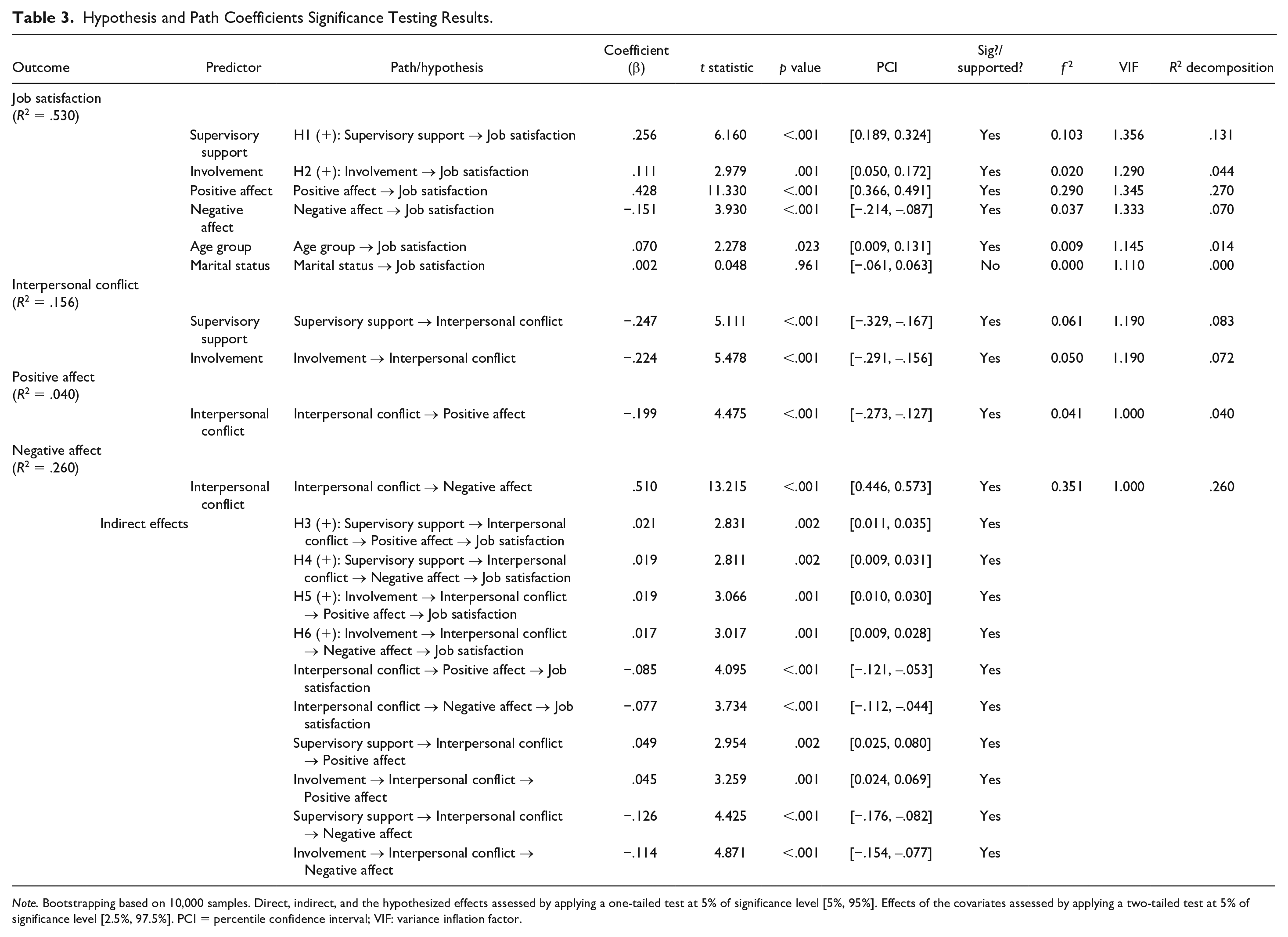
Note. Bootstrapping based on 10,000 samples. Direct, indirect, and the hypothesized effects assessed by applying a one-tailed test at 5% of significance level [5%, 95%]. Effects of the covariates assessed by applying a two-tailed test at 5% of significance level [2.5%, 97.5%]. PCI = percentile confidence interval; VIF: variance inflation factor.
Focusing on job satisfaction as the target construct in our theoretical model, we observed that 53% of the variation within this construct is explained by the constructs linked to it, of which, positive affect with a path coefficient of β = .428 had the biggest unique contribution to this value, followed by supervisory support (β = .256), negative affect (β = –.151), and involvement (β = .111). In addition, as noted by Ghasemy, Teeroovengadum, et al. (2020), while the in-sample predictive power (R2 = .530) was at a moderate level (Hair et al., 2019), contrasting our results with the guidelines by Cohen (1988) showed that the effect size of positive affect (f2 = 0.290) was relatively large and, with respect to supervisory support (f2 = 0.103), it was at a relatively medium level. Other effect sizes were small.
As the last step, we focused on the examination of the model’s out-of-sample predictive power through assessing the prediction errors resulting from the PLSpredict analysis (Shmueli et al., 2019), albeit with the default settings (10 folds and 10 repetitions). The results, with a focus on job satisfaction as the key target construct, are presented in Table 4.
Out-of-Sample Predictive Power Analysis.

Note. PLS = partial least squares; RMSE = root mean square error; LM = linear model.
As displayed in Table 4 and considering the guidelines proposed by Shmueli et al. (2019), all the Q2_predict values under the PLS results section were above zero and the root mean square error (RMSE) statistics of two items (out of four) in the PLS results section were smaller than the RMSE values under linear model (LM) results, thereby inferring a medium out-of-sample predictive accuracy.
Figure 2 displays the final model with factor loadings or correlation weights, path coefficients, and the R2 values of the endogenous constructs within the model.

Final model.
Robustness Check
Even though we tested all the hypothesized effects in our analysis, in line with the latest recommendations by Ghasemy, Teeroovengadum, et al. (2020), we ran a PLS-SEM robustness check (Sarstedt et al., 2020) to assess the non-liner effects as a means to increase the methodological rigor in our analysis. Notably, while nonlinear relationships are often approximated by linear relationships sufficiently well (Hair et al., 2018), this is not always the case (Ahrholdt et al., 2019). In addition, they are generally hard to determine a priori on theoretical grounds (Hair et al., 2018).
In this analysis, we focused on quadratic effects between the linked constructs (Hair et al., 2018), albeit based on the two-stage approach with the default settings, to check whether evidence is offered in terms of the linear effect’s robustness (Sarstedt et al., 2020). The results of the two-tailed percentile bootstrapping test at 5% significance level and with 10,000 subsamples revealed that none of the quadratic effects were statistically significant. In other words, all the relationships between the latent variables were linear, suggesting the robustness of our model. Detailed statistics are provided in Appendix D.
Discussion
As explained in the “Results” section, our analysis revealed that all six hypotheses were supported by the empirical data, indicating the pertinence, relatedness, and meaningfulness of AET in an HE context, and helping to reduce the gap in the HE literature about the influence of affective states on outcomes at workplaces. More precisely, the results shed light on the fact that 53% of job satisfaction of academics with science-related backgrounds is explained by affective states, supervisory support, and involvement. Although our findings indicated that supervisory support and involvement equally influenced interpersonal conflict, the effect of supervisory support on job satisfaction (β = .256), in comparison with the effect of involvement on job satisfaction (β = .111), was more than double, thereby highlighting the role of supervisory support in our model. In addition, the effect of interpersonal conflict on negative affect (β = .510), the strongest effect in our model, was 2.5 times stronger than its effect on positive affect (β = –.199). Moreover, the positive affect construct with a path coefficient of β = .428 was a much stronger predictor of job satisfaction, compared with the negative affect construct with the path coefficient of β = –.151. Importantly, while internationalization in HE suggests that the academic community may be viewed as heterogeneous with subpopulations, our robustness check with respect to detecting nonlinear effects showed that all the effects were linear, thereby implying the homogeneity within the population of academics with sciences backgrounds.
Our findings are generally in alignment with previous research works guided by AET. For instance, with regard to the work environment feature and attitude linkages, our findings were consistent with the findings of Wegge et al. (2006), Ghasemy et al. (2019), and Ghasemy, Erfanian, and Gaskin (2020). With respect to the relationships between work environment features and work events, our findings were in line with the results of studies such as Matthews et al. (2010); Lam and Chen (2012); Ghasemy, Morshidi, et al. (2021); and Ashkanasy et al. (2014). Regarding the findings in terms of the relationship between work events and affective states, our study had similar findings with the findings of some other studies (as examples, see Cho & Yang, 2018; Einarsen & Nielsen, 2015; Ghasemy, Derahvasht, & Castillo-Apraiz, 2021, and Sonnentag & Lischetzke, 2017). Last, with respect to the impact of affective states on attitudes, our findings were consistent with previous research such as Yan et al. (2018), Volmer et al. (2018), and Rezvani et al. (2016).
It is important to highlight that our findings can be applied to similar contexts such as countries with similar HE systems to the Malaysian HE system, educational hubs in East Asia, and the ASEAN member states.
Concluding remarks
Our study focused on direct and indirect predictability of work environment features in predicting job satisfaction of academics with science backgrounds. For this reason, guided by AET (Weiss & Cropanzano, 1996) and in line with previous research findings, we developed a model explaining the causal relations between two work environment features (supervisory support and involvement), a work event (interpersonal conflict), positive and negative affective states, and an attitude (job satisfaction). We applied PLS-SEM based on a few strong justifications and followed the latest guidelines suggested by Ghasemy, Teeroovengadum, et al. (2020) in estimating and evaluating our proposed model. This was followed by performing two robustness checks (Sarstedt et al., 2020), namely, addressing endogeneity through introducing covariates and detecting nonlinear effects.
Regarding policy implications of the findings, policy makers at ministry should focus on introducing directives which promote a climate of emotional safety and trust in institutions of higher learning to facilitate the achievement of SDGs. At the university level, academic leaders are recommended to consider improving university environments. Specifically, policies should encourage creating friendly workplaces in which negative affective events are minimized. In fact, the strongest effect in our proposed model was the effect of interpersonal conflict on negative affect, which highlights the importance of this point. It is important to note that while the impact of age on job satisfaction was not a hypothesized effect in our study, we observed that older academics are more satisfied compared with their younger counterparts which can have some other implications in academic settings.
From a leadership perspective in general, and servant leadership (Greenleaf, 2007) in particular, the figure of the leader becomes especially relevant when conflicts occur between members of their work teams. Hence, leaders should be trained to adopt a generous position, in which, when rational, the needs of their followers may become a priority over those of the leader (Eva et al., 2019; Ghasemy, Akbarzadeh, & Gaskin, 2021; Rosa-Díaz et al., 2019). More specifically, recognizing situations that have the potential for conflict and addressing them in ways that will best serve the needs of both the organization and the people (Walton, 1987) are recommended as best management practices in this regard. This is of high importance, as social emotions such as pity, envy, and jealousy, in contrast to self-conscious emotions, derive from external cues (Schermerhorn et al., 2010), being able to generate counterproductive work behaviors, which constitute intentional actions (e.g., abrupt and disrespectful behavior) as a response of workers to negative situations (Shoss et al., 2016). Moreover, policies should facilitate and value supervisory support among the academic leaders/staff. Indeed, given the practical relevance of the path coefficients in our model, academic leaders may be able to institute internal organizational directives based on these findings.
From a theoretical perspective, this study verified AET in a context-specific organizational domain and added a significant value to the limited literature regarding the affective states experienced by the academic staff with science backgrounds in HE research. Arguably, as no nonlinear effect was detected through our robustness test, the universal model developed based on the data collected from scholars with science backgrounds may be applied to different subpopulation within this context.
As the final remarks, our study was not without limitations. First, in proposing our model, and due to the complexity of AET, we only focused on a few hypotheses. Therefore, future research can focus on more comprehensive models explaining the interrelations between AET constructs. Second, while this study was based on the role of academics with sciences backgrounds in achieving a few SDGs, researchers are encouraged to focus on other SDGs and collect data from relevant academic subpopulations to verify our model. In addition, sector-specific studies (e.g., public or private sectors) in this area are recommended. Third, even though job satisfaction, as one of the main attitudes in workplaces (Schermerhorn et al., 2010), was focused in this study, researchers are encouraged to consider other job attitudes such as organizational commitment and employee engagement (Sungu et al., 2019), as well as other constructs based on the theory, such as personality traits and behaviors (Weiss & Beal, 2005; Zhang et al., 2019). Fourth, this study was cross-sectional, and therefore cannot infer cause. Hence, we recommend future research explore longitudinal effects (e.g., through latent growth curve [LGC] modeling [Bentler, 2018] or hierarchical linear modeling [HLM; Garson, 2013]) to sort out cause and to rule out common source bias. Relatedly, multilevel modeling (Bentler, 2006; Byrne, 2006, 2012; Kline, 2016; Liang & Bentler, 2004; Yuan & Bentler, 2005, 2007) is recommended to provide more accurate pictures of the antecedents and consequences of academics’ affect. Finally, we invite researchers to estimate and evaluate their proposed models using the PLSe2 estimator (Bentler & Huang, 2014; Ghasemy, Hazri, & Gaskin, 2021; Huang, 2013) to simultaneously enjoy the benefits of both PLS-SEM and covariance-based structural equation modeling (CB-SEM) methodologies in their empirical studies.
Footnotes
Appendix A
Items of the Survey.

| Code | Item | M | SD | Skewness | Kurtosis |
|---|---|---|---|---|---|
| INV1 | Management involves people when decisions are made that affect them | 3.35 | 1.033 | −0.540 | −0.710 |
| INV2 | Changes are made without talking to the people involved in them | 2.79 | 1.056 | 0.119 | −1.089 |
| INV3 | People don’t have any say in decisions which affect their work | 2.89 | 1.081 | 0.035 | −1.103 |
| INV4 | People feel decisions are frequently made over their heads | 2.50 | 0.920 | 0.632 | −0.177 |
| INV5 | Information is widely shared | 3.33 | 1.007 | −0.481 | −0.643 |
| INV6 | There are often breakdowns in communication here | 2.70 | 1.020 | 0.245 | −0.829 |
| S_S1 | Supervisors here are really good at understanding peoples’ problems | 3.31 | 0.945 | −0.553 | −0.587 |
| S_S2 | Supervisors show that they have confidence in those they manage | 3.53 | 0.865 | −1.028 | 0.611 |
| S_S3 | Supervisors here are friendly and easy to approach | 3.63 | 0.824 | −0.914 | 0.718 |
| S_S4 | Supervisors can be relied upon to give good guidance to people | 3.48 | 0.863 | −0.703 | −0.042 |
| S_S5 | Supervisors show an understanding of the people who work for them | 3.47 | 0.898 | −0.817 | 0.088 |
| IC1 | How often do you get into arguments with others at work? | 2.39 | 0.821 | 0.328 | 0.08 |
| IC2 | How often do other people yell at you at work? | 1.70 | 0.855 | 1.173 | 0.972 |
| IC3 | How often are people rude to you at work? | 2.06 | 0.922 | 0.785 | 0.505 |
| IC4 | How often do other people do nasty things to you at work? | 1.92 | 0.915 | 0.808 | 0.172 |
| PA1 | I feel enthusiastic at work in general | 3.55 | 0.907 | −0.379 | 0.216 |
| PA2 | I feel interested at work in general | 3.81 | 0.891 | −0.492 | 0.057 |
| PA3 | I feel determined at work in general | 3.81 | 0.883 | −0.567 | 0.349 |
| PA4 | I feel excited at work in general | 3.65 | 0.943 | −0.442 | 0.050 |
| PA5 | I feel inspired at work in general | 3.55 | 0.969 | −0.401 | −0.039 |
| PA6 | I feel alert at work in general | 3.70 | 0.873 | −0.432 | 0.220 |
| PA7 | I feel active at work in general | 3.77 | 0.890 | −0.517 | 0.228 |
| PA8 | I feel strong at work in general | 3.62 | 0.919 | −0.421 | 0.115 |
| PA9 | I feel proud at work in general | 3.77 | 0.963 | −0.535 | −0.079 |
| PA10 | I feel attentive at work in general | 3.72 | 0.873 | −0.385 | −0.034 |
| NA1 | I feel scared at work in general | 1.62 | 0.930 | 1.406 | 1.047 |
| NA2 | I feel afraid at work in general | 1.57 | 0.907 | 1.518 | 1.425 |
| NA3 | I feel upset at work in general | 2.02 | 1.134 | 0.944 | −0.072 |
| NA4 | I feel distressed at work in general | 2.18 | 1.127 | 0.636 | −0.571 |
| NA5 | I feel jittery at work in general | 1.80 | 1.002 | 1.059 | 0.198 |
| NA6 | I feel nervous at work in general | 1.74 | 0.997 | 1.200 | 0.451 |
| NA7 | I feel ashamed at work in general | 1.46 | 0.872 | 1.981 | 3.348 |
| NA8 | I feel guilty at work in general | 1.48 | 0.887 | 1.909 | 3.012 |
| NA9 | I feel irritable at work in general | 1.72 | 1.025 | 1.352 | 0.859 |
| NA10 | I feel hostile at work in general | 1.54 | 0.913 | 1.606 | 1.728 |
| SAT1 | I receive recognition for a job well done | 3.41 | 0.941 | −0.506 | −0.050 |
| SAT2 | I feel close to the people at work | 3.75 | 0.776 | −0.844 | 1.303 |
| SAT3 | I feel good about working at this institution | 3.77 | 0.819 | −0.732 | 1.037 |
| SAT | I feel secure about my job | 3.64 | 0.919 | −0.899 | 0.887 |
| SAT5 | I believe management is concerned about me | 3.18 | 0.953 | −0.390 | −0.109 |
| SAT6 | On the whole, I believe work is good for my physical health | 3.62 | 0.910 | −0.621 | 0.222 |
| SAT7 | My wages are good | 3.44 | 0.954 | −0.627 | 0.058 |
| SAT8 | All my talents and skills are used at work | 3.62 | 0.904 | −0.821 | 0.356 |
| SAT9 | I get along with my supervisors | 3.81 | 0.712 | −0.745 | 1.634 |
| SAT10 | I feel good about my job | 3.89 | 0.754 | −0.834 | 1.673 |
Note. The standard error of skewness is 0.102; the standard error of kurtosis is 0.203.
Appendix B
Factor Loadings, Reliability, and Convergent Validity Estimates.
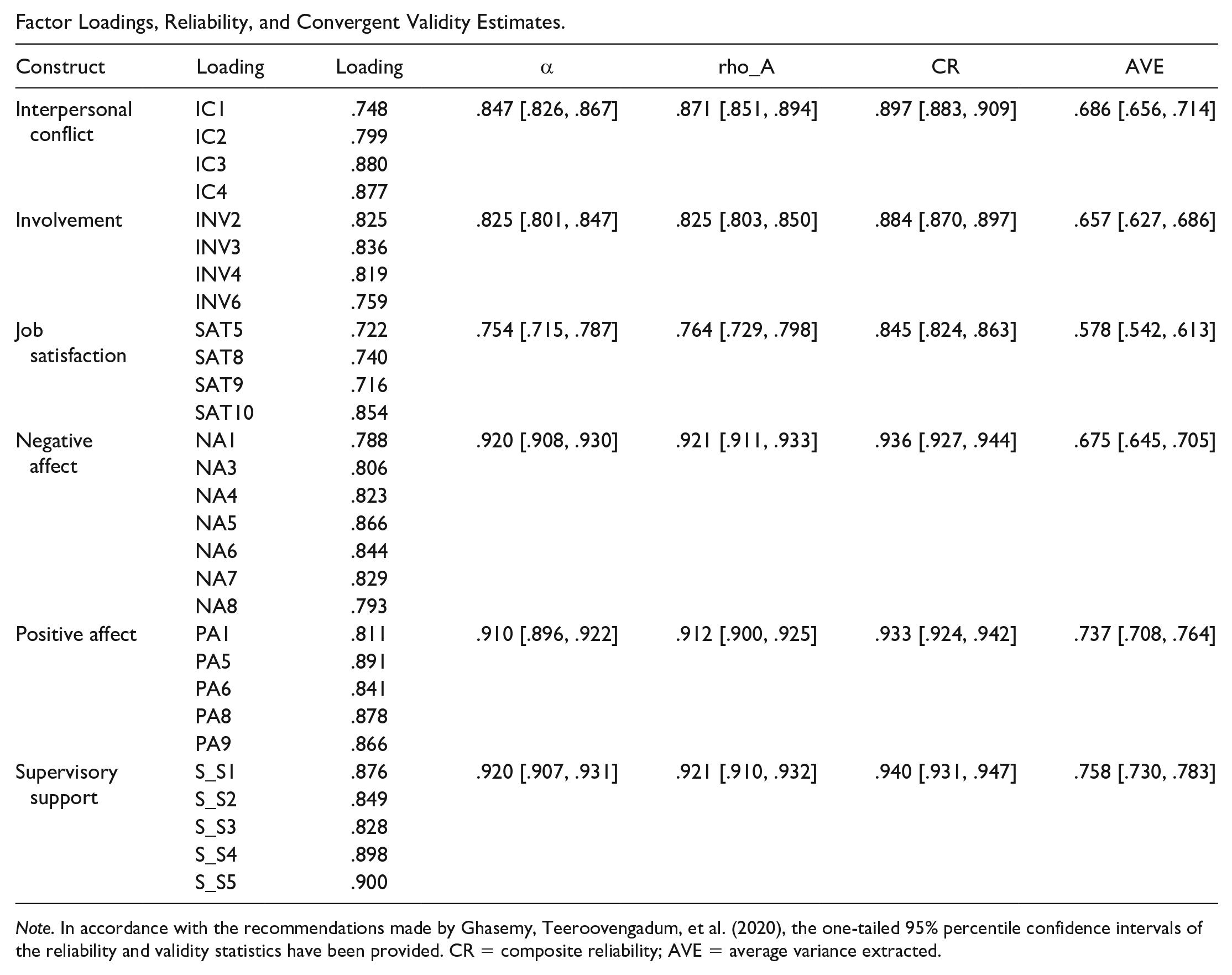
| Construct | Loading | Loading | α | rho_A | CR | AVE |
|---|---|---|---|---|---|---|
| Interpersonal conflict | IC1 | .748 | .847 [.826, .867] | .871 [.851, .894] | .897 [.883, .909] | .686 [.656, .714] |
| IC2 | .799 | |||||
| IC3 | .880 | |||||
| IC4 | .877 | |||||
| Involvement | INV2 | .825 | .825 [.801, .847] | .825 [.803, .850] | .884 [.870, .897] | .657 [.627, .686] |
| INV3 | .836 | |||||
| INV4 | .819 | |||||
| INV6 | .759 | |||||
| Job satisfaction | SAT5 | .722 | .754 [.715, .787] | .764 [.729, .798] | .845 [.824, .863] | .578 [.542, .613] |
| SAT8 | .740 | |||||
| SAT9 | .716 | |||||
| SAT10 | .854 | |||||
| Negative affect | NA1 | .788 | .920 [.908, .930] | .921 [.911, .933] | .936 [.927, .944] | .675 [.645, .705] |
| NA3 | .806 | |||||
| NA4 | .823 | |||||
| NA5 | .866 | |||||
| NA6 | .844 | |||||
| NA7 | .829 | |||||
| NA8 | .793 | |||||
| Positive affect | PA1 | .811 | .910 [.896, .922] | .912 [.900, .925] | .933 [.924, .942] | .737 [.708, .764] |
| PA5 | .891 | |||||
| PA6 | .841 | |||||
| PA8 | .878 | |||||
| PA9 | .866 | |||||
| Supervisory support | S_S1 | .876 | .920 [.907, .931] | .921 [.910, .932] | .940 [.931, .947] | .758 [.730, .783] |
| S_S2 | .849 | |||||
| S_S3 | .828 | |||||
| S_S4 | .898 | |||||
| S_S5 | .900 |
Note. In accordance with the recommendations made by Ghasemy, Teeroovengadum, et al. (2020), the one-tailed 95% percentile confidence intervals of the reliability and validity statistics have been provided. CR = composite reliability; AVE = average variance extracted.
Appendix C
Discriminant Validity Results Based on HTMT0.85 Criterion.

| Construct | Interpersonal conflict | Involvement | Job satisfaction | Negative affect | Positive affect |
|---|---|---|---|---|---|
| Involvement | 0.373 [0.297, 0.441] | ||||
| Job satisfaction | 0.343 [0.251, 0.428] | 0.501 [0.421, 0.573] | |||
| Negative affect | 0.568 [0.492, 0.637] | 0.414 [0.347, 0.476] | 0.546 [0.462, 0.619] | ||
| Positive affect | 0.219 [0.138, 0.303] | 0.330 [0.246, 0.410] | 0.753 [0.697, 0.803] | 0.432 [0.357, 0.503] | |
| Supervisory support | 0.365 [0.280, 0.443] | 0.457 [0.376, 0.532] | 0.621 [0.545, 0.689] | 0.380 [0.297, 0.455] | 0.399 [0.322, 0.472] |
Note. In accordance with the recommendations made by Ghasemy, Teeroovengadum, et al. (2020), the one-tailed 95% percentile confidence intervals of the HTMT values have been provided.
Appendix D
Non-Linear Effects Assessment Results.

| Nonlinear effect | Coefficient | t statistic | p value | PCI | Sig? | f 2 |
|---|---|---|---|---|---|---|
| Involvement → Interpersonal conflict | 0.039 | 1.087 | .277 | [−0.029, 0.110] | No | 0.003 |
| Supervisory support → Interpersonal conflict | 0.058 | 1.478 | .140 | [−0.018, 0.134] | No | 0.007 |
| Interpersonal conflict → Positive affect | 0.021 | 0.514 | .607 | [−0.053, 0.102] | No | 0.001 |
| Interpersonal conflict → Negative affect | 0.053 | 1.310 | .190 | [−0.029, 0.126] | No | 0.007 |
| Involvement → Job satisfaction | −0.035 | 1.249 | .212 | [−0.090, 0.020] | No | 0.004 |
| Negative affect → Job satisfaction | −0.041 | 1.406 | .160 | [−0.096, 0.018] | No | 0.005 |
| Positive affect → Job satisfaction | −0.020 | 0.788 | .431 | [−0.070, 0.029] | No | 0.002 |
| Supervisory support → Job satisfaction | 0.012 | 0.399 | .690 | [−0.046, 0.070] | No | 0.000 |
Note. Bootstrapping based on n = 10,000 bootstrap samples. Quadratic effects assessed by applying a two-tailed test at 5% of significance level [2.5%, 97.5%]. PCI = percentile confidence interval.
Acknowledgements
The authors would like to appreciate the director and the staff of Malaysian Higher Education Research Institute (IPPTN) for their continuous support. The first author dedicates the paper to his father, Ali Naghi Ghasemy, and his late mother, Zahra Soltan Zamani for her unconditional care and love and is grateful to Zeynab Khodaei and Ilia Ghasemy for their patience, support, love, and understanding. This paper is based on a larger research project on “Testing Affective Events Theory in Malaysian Higher Education” led by Majid Ghasemy with co-researchers Hazri Jamil, Morshidi Sirat, and Mahiswaran A/L Selvanathan.
Declaration of Conflicting Interests
The author(s) declared no potential conflicts of interest with respect to the research, authorship, and/or publication of this article.
Funding
The author(s) disclosed receipt of the following financial support for the research, authorship, and/or publication of this article: This research was supported by Grant FRGS/1/2019/SS05/USM/02/5 from the Ministry of Higher Education Malaysia to Majid Ghasemy.
Ethical Approval
The performed procedures were in accordance with the ethical standards of the institutional and/or national research committee (USM/JEPeM/19090523) and with the 1964 Helsinki declaration and its later amendments or comparable ethical standards. No consent was required as the participation was voluntary, information was anonymized, and the paper does not include images that may identify the person.
