




Abstract
This study intends to assess the implementation of policies in high-performance schools (HPS). One hundred fifty-two administrators in 52 HPS were selected using full sampling. Only two factors serve as contributors in knowledge management model for high-performing schools in Malaysia, which were school culture and school strategy. Whereas the correlation indicated that all 10 factors, namely, mission and vision, school strategy, school culture, intellectual modal, learning organization, leadership management, teamwork and learning community, knowledge sharing, new knowledge generation, and digital advancement, have significant relationships with the understanding of knowledge management, at different levels.
Keywords
Introduction
The announcement of the implementation of the National Key Results Areas (NKRA) by the Malaysian Prime Minister, Dato’ Seri Mohd Najib Tun Razak, on July 27, 2009, has greatly affected the Malaysian educational management system. Consisting of six elements, its third element was specifically envisioned and designed to enhance the access to quality and superior education. This task was empowered to the Ministry of Education (MOE) to further focus on the four subsections of Educational NKRA, namely, preschool, Literacy and Numerical (LINUS), high-performance schools (HPS), and new offers for principals and headmasters.
All school administrators, be it from primary or secondary, must undergo a special course conducted in Aminuddin Baki Institute (ABI) to respond with the prime minister’s call. Interestingly, the basis for the course in ABI is mainly Organizational Development (OD), which is relevant in Malaysian context because it is quite related with the sixth element in the 2006-2010 Educational Development Master Plan (EDMP) and the fifth element in the National Mission that focuses on enhancing institutional and implementation capacity. Six main aspects have been identified as the course contents in the ABI program, namely, self-development, leadership, knowledge management, school management system, culture and values, and teamwork. Out of the six main aspects, knowledge management (KM) will be the focus of this study.
The aim of the ABI course is to develop schools as effective learning organizations and able to become HPS. Therefore, defined as schools that possess their personalized unique ethos, characteristics, and identity as well as outstanding in all educational aspects and able to face the worldly challenges (MOE Malaysia, 2010), the selected HPS will have to fulfill all the preconditions as determined by MOE and HPS Task Committee. In the effort to realize world class educational system and make Malaysia a knowledge excellence center, the existence of HPS is one of the best alternatives to be achieved. The characteristics of HPS are as follows, summarized from MOE Malaysia (2010):
Autonomy in curriculum, finance, human resource, and selection of students;
School-based management;
Accountable, proactive, and effective school administration;
High-performance working system;
Achievements are emphasized where HPS will have their own high expectations and success standards in all fields for their students;
Success in achieving several aspects such as producing successful students and towering personalities who can administer leadership in any organization, be it in or out of the country;
Self-identity and self-directed learning, for example, students are permitted to sit for external accredited examinations from other countries; and
High level of relationships and communication, as well as active networking between HPS with other schools within or outside the country and at international level.
Implementation of the above HPS characteristics requires proper management, and KM was proposed as the key for school administrators to be effective and efficient. KM is not entirely a new aspect in economy or business. However, it is still under probation when it comes to educational field, specifically at school level. Noor Farina (2006) states that in today’s challenging world, the enhancement of the quality of life and success are highly dependent on the level of knowledge acquired and possessed by individuals and organizations. Thus, there is a need to instill KM into the school system and gauge its success rate.
As such, organizational performance, which in this context, schools will become the determinant toward organizational success. If a school is less performing and obtained low performance rate, the administrators are obliged to think about the best method to increase its performance. In Malaysia, the government has encouraged performance-based working culture, which is instilled in the civil service for the purpose of increasing the quality of service delivery (Rusmini, 2005). Therefore, initiatives are very much needed to increase their performance because of their importance toward the future of the country.
Schools that are less performing can actually exemplify other schools that are qualified and certified as having good performance. This is where HPS plays important roles, where the management in different HPS can be analyzed to compare whether they are able to increase their performance by practicing KM. Thus, this study is intended to assess the level of understanding of KM in HPS throughout Malaysia. Also, it is hoped to be able to find out the extent to which the implementation of KM in HPS in Malaysia has achieved its aims, and at the same time, to enable the MOE to revamp their actions on the third NKRA and realize their targets (MOE Malaysia, 2010), if necessary.
Background of Study
KM has started to become popular in the early 90s when there was a vast awareness of the importance of intellectuality. Economy experts view management based on knowledge to be helpful in increasing economy status and producing excellent successes. They also portray this era of knowledge as new, knowledge-driven economy that calls for awareness about the importance of knowledge (Sallis & Jones, 2002). This kind of development has been widely accepted and practiced globally and therefore KM has inevitably become one of the imperatives for any organization to generate success. The fast-changing world is also one of the reasons that make KM relevant, especially in terms of technology and multimedia. People nowadays need culture and management that are in accordance with the current needs and necessities, which can also be related with KM.
Lehaney, Clarke, Coakes, and Jack (2004) identified KM to be involving individuals, processes, activities, technologies, and large-scale environment, which permit the identification, creativeness, communication, or sharing and using organizational and individual knowledge. In the same page, Debowski (2006) defined KM as a process of identification, seizing, arranging, and distributing intellectual assets that are critical for long-term performance of any organization. Other theorists who equally viewed KM and contributed toward its development are Peter Drucker and Paul Strassman dan Peter Senge dari Amerika Syarikat (Gao, Li, & Clarke, 2008).
According to Reynolds (2005), KM is proven to benefit students, teachers, and schools based on a study done in New Zealand and Australian schools, which aimed to see the success of adapting KM at school level and it is further solidified with the advancement of technology and communication possessed by these countries. Nonetheless, a study by Zhen, Wen, Rong, Wen, and Yuan (2009) proved to be on the other side of the story where it was found that the main problems faced by teachers in implementing KM in Taiwanese schools were insufficient teaching and learning time and weak infrastructure planning such as scarce funding and limited technology. Therefore, they proposed that schools provide extra training for teachers to heighten up their skills, manage school equipment funding appropriately, encourage teachers to use and apply technology and communication at higher frequency, and foster KM culture with each other. Another proposition, which could suitably add up to the list, is a study by Dagli and Uzunboylu (2007) that intended to view methods applied by principals in Cyprus schools in enhancing KM, where it was found that they gained knowledge by attending meetings with teachers, observations, experience, and online resources.
Aim of Study
HPS are obliged and pressed with the responsibility of maintaining their excellence in various fields, be it in or out of the country. They can maintain high performance through various contributing factors, that is, knowledge-based management. The importance of knowledge in managing organizations was also stated by Senge (1990) in Rowley (2000) who has warned that many organizations are unable to function as knowledge-based organizations, because they suffer from learning disabilities. Ibrahim Shogar (2005) also agreed that possessed knowledge plays vital role in realizing an organization and success in human capital. Although knowledge-based management is important in organizational management, it is still under limited study at educational level.
The success of several giant companies and major organizations that used knowledge management must be taken into account especially in education. Among the companies that practice this type of management are Macintosh and IBM (Despres & Chauvel, 2000). Hence, there is a need for a study about KM at school level, especially in HPS. Due to the fact that HPS have to become the standard for other schools, they must maintain their excellent performance.
HPS were selected from thousands of different types of schools in Malaysia because of their ability to perform and succeed. MOE has identified that one of the ways to increase educational performance is by the application and implementation of KM. Although many researches have been done on KM at companies and industrial and higher learning institutions, they are still lacking at school level in Malaysia. As such, the level of KM practice in increasing organizational performance must be studied to provide the best impact and become one of the policies in schooling system in Malaysia.
Method
Conceptual Framework
Since the beginning of the KM concept in economics in the early 90s, there were several KM models being introduced. Among the famous ones are the SECI Model by Nonaka (1991) that brings about the meaning of socialization, externalization, combination, and internalization; the N-Form Organization Model by Hedlund (1994); and the Three Pillars Model by Wiig (1995). Most of the models were however different because their basis were on companies, firms, and industries. Models for educational context are still few and new. This study adapted the Sallis and Jones (2002) model because the factors involved in their model are appropriate for measuring performance in Malaysian educational context, specifically the out-of-ordinary characteristics of HPS.
The framework adapted from Sallis and Jones (2002) as portrayed in Figure 1 is purportedly to identify the level of understandings of KM in educational organizations. The adaptation was made to comply with the suitability and applicability of this study. From the conceptual framework, two research questions were formed to further find out the extent the implementation of KM in HPS in Malaysia has achieved its aims: (a) Is there any significant relationship between the Understandings of KM (UKM) with Mission and Vision (MV), School Strategy (SS), School Culture (SC), Intellectual Modal (IM), Learning Organization (LO), Leadership Management (LM), Teamwork and Learning Community (TLC), Knowledge Sharing (KS), New Knowledge Generation (NKG), and Digital Advancement (DA)? and (b) Has MV, SS, SC, IM, LO, LM, TLC, KS, NKG, and DA significantly contributed toward UKM?

Conceptual framework.
Sampling
Full sampling was utilized, where 156 samples were selected from among the population of administrators consisting of principals or headmasters, and senior assistant teachers (curriculum and student affairs) from all 52 HPS throughout Malaysia. Out of the 156 samples, 128 responded and returned the distributed questionnaires.
Instrumentation
By using fully quantitative method, the questionnaire constructed for this study was adapted from the 10 factors to identify the level of knowledge management practice by school organization, adapted from Sallis and Jones (2002).
Procedure of Data Analysis
Data were analyzed by using the Statistical Package for Social Science (SPSS) Version 20 to conduct associational and predictive analysis. Pearson correlation was used to determine any significant relationship between the understandings of KM toward the 10 factors to identify the level of knowledge management practice, and regression analysis was done to find out the significant contributor toward understandings of KM. For the former analysis, relationship levels will be graded highly from five stars down to one and zero, whereas for the latter, any significant contributor will be labeled as a star.
Findings
The regression analysis, as portrayed in Table 1, revealed that two factors, SS and SC, were found to be main contributors toward UKM. It is proven here that effective SS (β = .351, p < .05) will push forward HPS to be successful. However, this result contrasts with a study by Mohd Ghazali, Azirawani, Man Norfaryanti, and Mar Idawati (2007) that found info-structure and knowledge takeovers as main factors in forming effective KM. A study by Sharimllah Devi, Chong, and Hishamuddin (2009) also found that instead of SS, there are six factors that can assist in KM, namely, knowledge creation, knowledge mastery, knowledge organization, knowledge storage, knowledge distribution, and knowledge application. Nonetheless, these two studies were not conducted in the context of HPS.
Correlation and Regression Analysis Results.
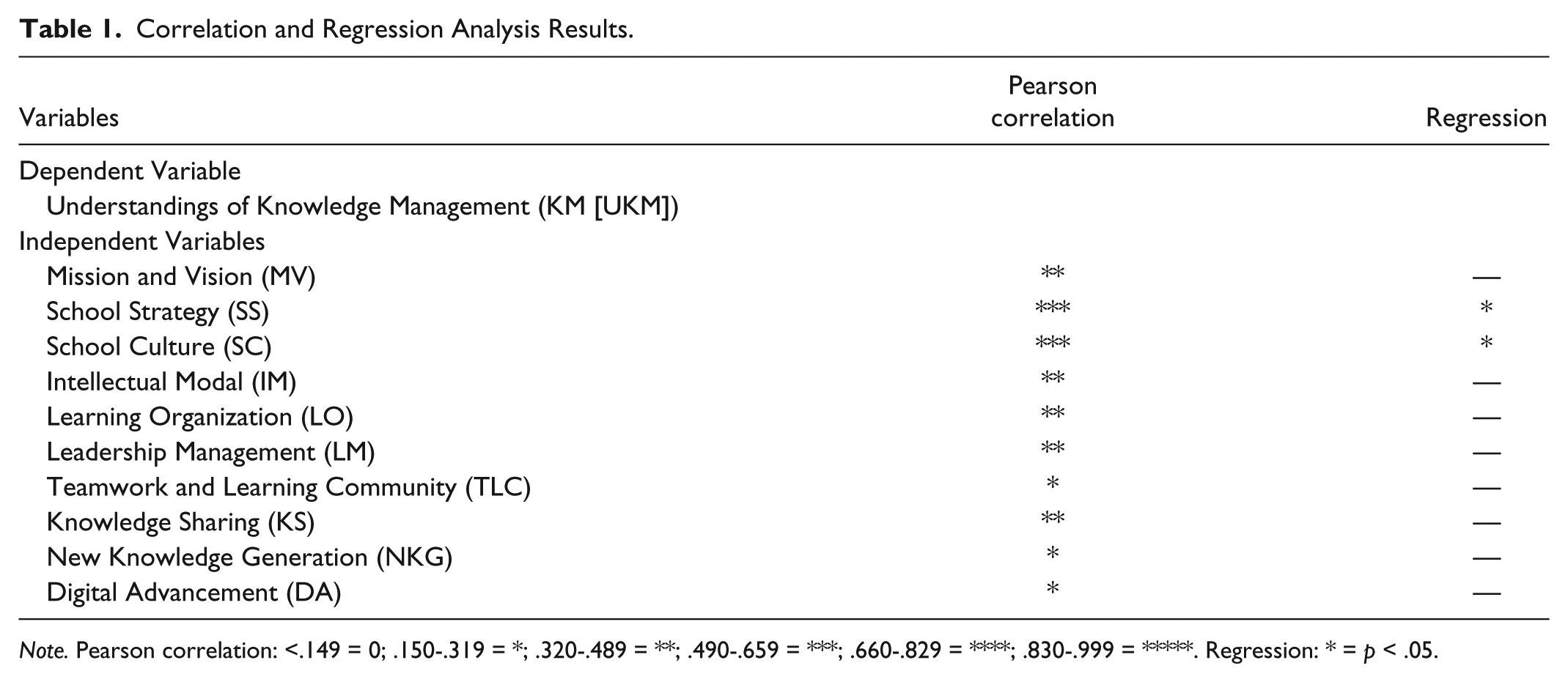
Note. Pearson correlation: <.149 = 0; .150-.319 = *; .320-.489 = **; .490-.659 = ***; .660-.829 = ****; .830-.999 = *****. Regression: * = p < .05.
The other factor, SC (β = .327, p < .05), was proven to be the main element in implementing KM practice as HPS require solid working culture. The success of creating appropriate culture in school environment enables a school to be certified as HPS as agreed by Low, Siti Zaleha, and Hishamuddin (2003) who stated that organizations must overcome culture barriers to succeed in increasing performance. The result was also in accordance with a study by Kai, Minhong, and Yuen (2011) and Marinah, Ramlee, Flett, and Curry (2011) who reported culture as a mean to assist the success of school organizations in implementing KM practice.
Although only 2 out of 10 experimented factors significantly contribute toward UKM, the sum of strength of the duo was recorded at 38%, which can be considered as high and impactful. Also, these two factors were found to have adequately significant relationships at three-star level with UKM. According to Sallis and Jones (2002), this adequately strong relationship can be interpreted as the strategy of the school organization in the process of knowledge creation. The strategy consisted of the ability of the organization to create scenario models for the future, combining and developing KM in strategies as well as possessing knowledge sharing strategy to exploit knowledge itself. As school organizations that can increase their organizational performance are organizations that are good in knowledge assessment, the interpretation from this finding covers the success of school organizations in fostering culture that supports innovation, learning, creativity, and sharing of knowledge. Apart from that, organizational efficiency can be enhanced when practicing the culture of understanding and certifying KM as the main key. Waters, Marzano, and McNulty (2003) suggested that HPS leaders must be aware of current situations, acquire the skill to stimulate intellectuality among teachers and supporting staff, become change agents, involve everyone in school in designing and implementing certain policy and decision making, always make sure of healthy and positive culture, and control and assess effectiveness of practices in schools and their effects toward students’ learning.
The findings reflect association with other research findings that produce similar results related with the importance of strategy, such as the SECI model (Nonaka, 1991), Knowing and Knowledge Model (Earl, 1988), and the Three Pillars Model (Wiig, 1995). Organizations can achieve success if they stress on creativity (Earl, 1988), and one of the three main pillars in KM is the method by which knowledge is created (Wiig, 1995). The importance of culture can be supported with Despres and Chauvel (2000) who stated the basic finding in the success of KM in the Three Pillars Model is cognitive manifestation such as culture, technology, and procedure. Organizational culture is seen to be very important in the success of KM practice that it can be a main barrier if not overcome by organizations (Low et al., 2003).
Generally, the findings denoted that all 10 factors to identify the level of KM practice by school organizations have significant relationships with UKM. MV, IM, LO, LM, and KS, although did not significantly contribute toward UKM, had a two-star relationship level with UKM whereas the remaining three factors (TLC, NKG, and DA) had a one-star each.
Discussion
Overall, the findings concluded that only two factors significantly contributed toward UKM, which are SS and SC. Initially, the original model by Sallis and Jones (2002) suggested that 10 factors must significantly contribute and work together to achieve success in KM practice. Therefore, in terms of SS, based on the items from the questionnaire, administrators have successfully developed the KM strategy by first planning for knowledge organization and knowledge exploitation strategies and later combining them in their strategy as a whole to create a scenario model for the future. Importantly, school organization must understand and identify available knowledge within the organization (Sallis & Jones, 2002). Also, to enhance school organization, the adapted model listed the need of school organization to have a clear and rigid MV, which is shared among the members and can be translated into practical strategies. The findings however showed that even when MV did not contribute toward UKM, SS can still be successfully implemented in HPS.
Culture, as from a study by Low et al. (2003) in Malaysian schools, was reported to be the main barrier in knowledge sharing implementation with a majority of 53% respondents’ agreement. Yet, the result obtained from this study stated the other way around. School administrators have understood that KM is important for organizational success, and thus, recognized it as the central key for organizational effectiveness. They therefore emphasized knowledge and learning as the foremost mission and created the culture of supporting innovation, learning, and knowledge sharing as well as knowledge creation.
In defining KM, Debowski (2006) stated that IM must be taken seriously by organizations if they target long-term performance. However, this study found that IM did not significantly contribute toward UKM due to short-term performance achieved by school administrators in HPS. As Edvinsson (1997) stated, intellectual assets are modals for organization to generate KM development.
Pioneers such as Drucker, Strassman, and Senge stated that LO is a contributor for KM development (Gao, Li, & Clarke, 2008), in line with the Knowing and Knowledge Model by Earl (1988), which supported the aspect of LO as the second function that covers auditing prior knowledge through learning activities. Thus, although LO did significantly related with UKM in this study, it contradicted their statement in the sense that it does not serve as a contributor.
Systematic organizational management will be gained through leaders’ success in supervising and directing individuals to obtain desired outcomes (Lehaney et al., 2004). However, most responses from school administrators disagreed that LM will increase organizational performance. They do not view senior assistant teachers as functional in managing knowledge, let alone believe the head of units to be suitable and efficient in generating knowledge sharing and creation.
Lehaney et al. (2004) viewed KM as involving relationship or sharing by utilizing organizational and individual knowledge. KM is an improvement activity of an organization through information sharing and usage of correct information (McShane & Glinow, 2006). However, KS can sometimes become a barrier for individuals because of time constraint in working environment to together discuss ideas and improve on teaching (Marinah et al., 2011). This study shows that difficulty in executing programs to share knowledge and gather information is the reason why KS cannot be implemented effectively. This will inevitably lead to inability to carry out the process of recording critical incidents in organization and understand how competitors manage knowledge, among all the hidden knowledge. As Sallis and Jones (2002) opined, hidden knowledge is very difficult to be shared among members; therefore, administrators must be well versed in creating adequately timed appropriate activities through metaphoric and analogic communication.
Conclusion
Two factors, SS and SC, were proven to be the contributors for this study. These two will become the main ingredient in creating an excellent model as guideline for Malaysian schools in the effort to enhance their respective organizational performance. Findings from correlation, however, contradicted with the regression where all factors were found to be significantly correlated with UKM. Polanyi’s (1966) study stated that that an organization will face difficulties if it does not understand the hidden knowledge that it owned. This means that the meaning of determined vision and mission based on knowledge must be developed and enhanced accordingly before considering other aspects, justifying the non-contributing nature of MV as well as the remaining others, which are still new in the field of educational management. Furthermore, the fact that HPS is newly implemented has caused most of the factors experimented to be showing no sign of contribution toward UKM.
Implication
HPS basically have applied KM for enhancement of school performance. Based on this study, their implementation level of KM can be improved by using SS and SC as a medium. School administrators must therefore give extra focus toward fostering better culture inculcation and instillation as well as planning better knowledge-based strategies to maintain, if not improve, the high performance level. As Jo, Joseph, and Dana (2010) stated, leadership of ideal HPS principals and headmasters in line with the current era is vital and will greatly affect the formation of HPS. Studies on educational leadership itself have proven that leadership plays vital roles in ensuring success of a school and achieving high performance (Jo et al., 2010). The introduction of HPS, equipped with adequate facilities, proper professional trainings, and initiatives by MOE is an excellent step to provide school administrators with opportunities to be creative and innovative. It is the hope of MOE to achieve effective KM in HPS first before changing its direction as examples for other types of schools. Last, this study is hoped to assist in improving the current KM implementation and trigger adequate change in the nation’s educational system.
Footnotes
Declaration of Conflicting Interests
The author(s) declared no potential conflicts of interest with respect to the research, authorship, and/or publication of this article.
Funding
The author(s) received no financial support for the research and/or authorship of this article.