



Abstract
Many critical decisions about an employee’s innovative performance are significantly based on the training results, as they are accountable for a variety of behavioral-related consequences. Training is among the most important human resource management strategies. The aim of this study is to examine the relationship between employees’ perceptions of training and their innovative behavior in the Malaysian SME sector, as well as the mediating effect of affective and calculative commitment on this relationship. Structured questionnaires were used to collect the data. A total of 635 employees from 200 SMEs were selected through a stratified random sampling method, and structural equation modeling was applied to test the relationship. The findings of the study supported the hypothesized relationships, as training in Malaysia significantly engaged SME employees in innovative behavior. Furthermore, the study discovered that affective and calculative commitment have partial mediating effects on the association between training and innovative behavior. In the context of the SME sector, theoretical and managerial implications have been addressed. The originality of the study is that it examines the relationship between employees’ perceptions of training and their innovative behavior in SMEs. The relationship was measured using a multidimensional approach in the study. The research also adds to the body of knowledge by identifying the mediating effect of affective and calculative commitment.
Keywords
Introduction
In the SME sector, employees are the most important resource for ensuring different kinds of services, which play an important part in the economy’s development (Raut et al., 2020). SME’s distribute capital to maintain risk and cost related variables in order to increase sustainable activities (Srisathan et al., 2020). They are able to achieve significant growth, competitive performance, and an enduring reputation for their businesses (Ferreira & Franco, 2019). Employees that are active in delivering effective services contribute to the success of a small business. Thus, effective human resource management techniques not only improve the performance of SMEs, but also have a favorable impact on the economy’s evolution and development (McKenzie, 2021).
Nowadays, every SME is focusing more on innovation, which is tough to achieve without competent and trained individuals. One of the most serious difficulties for developing countries is a lack of skilled, educated, and trained staff, pushing SMEs to focus on employee training programs (Kitchot et al., 2021). Furthermore, human resource policies are still being overlooked in Malaysia’s burgeoning SME sector, leading to poor quality of service and yearly losses (Haruna & Marthandan, 2017). As a result, SMEs must strengthen their human resource practices and training programs in order to remain competitive in a rapidly changing technological world.
All SMEs in Malaysia seek to hire and retain the best workforce to gain a competitive advantage in the emerging market (Othman et al., 2021). For SMEs, improving the capability and competency of their standing workforce to offer extraordinary excellence is also a challenge. According to previous studies (Miah & Hafit, 2020; Zakaria et al., 2018), Malaysian SME employees lack sufficient general and specialized innovative skills to meet the needs of their employees, resulting in poor firm performance.
Training is an organized process that is carried out by an enterprise to provide expertise and technical skills to employees, as well as to improve their behavior in accordance with the organization’s goals (Jehanzeb & Mohanty, 2019). As a result, providing employees with a relevant and practical training program enhances the firm’s market competitiveness. SMEs must also develop training programs that meet not just the needs of their employees, but also the needs of the company (Lau et al., 2020). Furthermore, SME training programs strengthen employee social capital, which improves firm commitment substantially (Liu, 2017).
Innovative behavior refers to employee innovation that can give SMEs an initiative in their effort to stay competitive or attain a competitive advantage in emerging markets (Hakimian et al., 2016). Škerlavaj et al. (2014) defined innovative behavior as a two-stage process that includes both generating and implementing new ideas. Moreover, Yusof et al. (2018) propose that innovative behavior should improve employee abilities associated with solving work-related challenges to increase employee inventiveness.
The term “firm commitment” refers to an employee’s emotional relationship with the firm, which makes them less inclined to quit. (Dhaundiyal & Coughlan, 2020). Employees with a great firm commitment are more likely to continue with the firm, maintain their association, and help the firm attain its objectives (Mahto et al., 2020). Firm commitment is a condition where employees make sure of their maximum dedication and loyalty to the organization based on projected prospects for growth, training, and job stability (Franco & Franco, 2017). As a result, affective firm-committed employees can have a substantial impact on operational productivity and efficiency, as well as decreased employee turnover (Curado & Vieira, 2019).
Previous research on the mediating influence of firm commitment was also reviewed in this study (Dhaundiyal & Coughlan, 2020; Jehanzeb & Mohanty, 2019), and firm commitment has been found to be infrequently used in research of voluntary behaviors like SME innovative behavior. The work culture in Malaysia is characterized by firm commitment (Naqshbandi et al., 2015). As a result of the commitment gap at the SME level, employees are frequently distracted from work and diverted from firm objectives. Therefore, this study demonstrates that in order to achieve a significant competitive advantage in emerging markets, firm commitment is strongly linked to employee innovation.
Despite considerable research on the topic of employee innovative behavior, very limited empirical studies with firm commitment have been identified in the relationship in Malaysia’s SMEs (Ahad et al., 2021; Hakimian et al., 2016). A study evaluating the association between training perception and employee innovative behavior is still needed, according to the literature. There is rare research in the Malaysian context, in particular, that reflects the mediating consequence of firm commitment among training perception and employee innovative behavior. This research also aims to bridge the gap between past studies and the current challenges that the SME sector encounters. However, the present body of knowledge provides a wide range of research into the relationships between training perception, firm commitment, and employee innovative behavior. For these reasons, the novelty of this research stands in contrast to other studies’ responses to the above research gaps, which are addressed in this study’s first research question (RQ1): “Does training perception improve SME’s employee innovative behavior in Malaysia?” The second research question (RQ2) is: “Does firm commitment mediate the relationship between training perception and employee innovative behavior?”
This study contributes in a several ways. First, the current study makes a theoretical contribution by developing and empirically evaluating a conceptual framework for the relationship between training perception and SME employee innovative behavior. Second, this study contributes to the current body of knowledge by examining the role of firm commitment in mediating the relationship between training perception and employee innovative behavior. Third, the study’s findings are critical for proposing suitable policies aimed at improving employee innovative behavior based on designs by SME’s owners/managers or local regulatory agencies in order to achieve sustainable development and competitive advantage in the emerging market.
Literature Review
Theoretical Perspective
Becker (1964) introduced the human capital theory. According to the author, training or learning improves employee effectiveness by providing them with valuable skills and knowledge. The human capital theory proposes that training is necessary for firms to increase their employees’ ability to accomplish their tasks effectively (Riley et al., 2017). Moreover, theory differentiates both general and specific training, which is based on the transmission of learned skills and expertise (Jehanzeb & Mohanty, 2019). According to Becker (1964), this discrepancy is critical if training programs are to be viewed as an economic activity. It is indeed worth noting that specialized training is defined as teaching employees a marketable skill, whereas general training is defined as improving employee performance (Mihardjo et al., 2020). Thus, this theory identifies that, providing the employees with specific and general training programs will assist them in increasing their skills and performing efficiently.
Chang et al. (2021) conducted research into the relationship between human resource management and employee innovative work behavior. According to the findings, employees with relevant training programs will improve their productivity and encourage them to enhance their work-based social capital. The study’s findings are consistent with Becker’s (1964) theory of human capital, which states that equipping the workforce in a firm with meaningful knowledge and expertise increases their effectiveness. Thus, it is important for SMEs to recognize the critical role of competent employees in accomplishing organizational objectives.
Employee Innovative Behavior
According to innovation theorists (Axtell et al., 2000; Zaltman et al., 1973), the two primary phases of the innovation process, are initiation and implementation. Moreover, King and Anderson (2002) described the point at which the concept is initially embraced, that is, the dividing line between the two phases is evident when the decision to implement the invention is made. The first step concludes with the creation of an idea, whereas the second stage concludes with the implementation of the idea.
According to the previous studies (Blanchard, 2017; Chang et al., 2021; Duradoni & Di Fabio, 2019), employees play an important role in most firm-based innovative activities because they process ideas as they are created and turn them into innovative outputs. To gain a competitive advantage, SMEs may investigate ways to invest in employee development to drive their inventive behavior (Rastrollo-Horrillo & Rivero Díaz, 2019). Innovative behavior, as a single construct, is defined as the behavioral patterns of an employee focused on the development and implantation of novel ideas, adoption of new technologies, and environmental processes to achieve the firm’s desired objectives and improve performance to attain substantial growth in competitive markets (Chang et al., 2021). Knezović and Drkić (2020) proposed that employees’ innovative behavior may help in increasing the efficacy of SMEs by initiating newness, adoption, and modified firm-based resources. Employees’ innovative behavior is significant and essential for SMEs to increase their survival (Blanchard, 2017). According to Lecat et al. (2018), innovative behavior is likely to be linked to the generation of new ideas and then the implementation of those ideas into new products, methods, and services. As a result, SMEs must devote sufficient resources and assistance to the generation and implementation of innovative ideas in order to achieve significant growth (Van Hootegem et al., 2019).
Firm Commitment
Scholars have focused their research on firm commitment because they believe that employee loyalty and commitment have a significant impact on a company’s performance and production (Durand & Georgallis, 2018). Ahmad (2018) defines firm commitment as, “a psychological state that characterizes the employee’s relationship with the organization and has implications for the decision to continue or discontinue membership in the organization.”
According to Mueller et al. (1992), for an employee, workplace commitment may be defined in a variety of ways, including dedication to one’s work, career, job, union, and organization. The two main dimensions of organizational commitment are affective and calculative commitment. Several scholars (Ferris & Aranya, 1983; McGee & Ford, 1987; Meyer et al., 1990) share this two-dimensional perspective on organizational commitment.
Porter et al. (1974) define “affective commitment” as “a strong bond between an employee and the company they work for, based on three factors, first: a strong belief in and acceptance of the company’s goals and values; second: a willingness to put forth significant effort on behalf of the company, and third: a strong desire to remain a member of the company” (p. 604). Moreover, Brooke et al. (1988) explain that higher levels of affective commitment have been associated with better job performance, reduced absenteeism, lower turnover, higher job satisfaction, and more work participation.
Salancik (1977) refers to the term “calculative commitment” as “concerned mainly with the process by which individuals develop a sense of allegiance not to an organization but rather to their own actions within the organizational setting.” According to Romzek (1989), extrinsic incentives, such as money, prestige, promotion, and perks, are frequently associated with calculated commitment.
Training Perception
Training is a planned and executed activity offered by the firm to convey information and enhance job abilities to employees, as well as to improve their attitudes and conduct in accordance with the organization’s goals (Jehanzeb & Mohanty, 2019; Wienbruch et al., 2018). Through training opportunities, employees can obtain innovative information and skills to deal with contemporary job issues, which has resulted in improved employee performance and inter-firm commitment (Ahadi & Kasraie, 2020; Vlados et al., 2020). As indicated in previous studies (Bashir & Long, 2015; Jehanzeb & Mohanty, 2019), the training perception was studied in two dimensions: social support and managerial support for training.
Managers are regarded as the first level of management, or the owners of enterprises in the case of SMEs, and are charged with the primary tasks and obligations of leading a group of employees in a firm (Bozionelos et al., 2020). Supervisors typically collaborate with firm owners to establish, execute, and evaluate organizational policies (Kaur & Soch, 2018), including training programs, as qualified leaders, role models, and problem solvers (Govaerts et al., 2018). Individuals who have had their superiors’ support and social support in participating in training programs are often more likely to engage, acquire, and use new abilities and knowledge (Tafvelin et al., 2019).
Hypotheses Development
Training Perception and Employee Innovative Behavior
Human resources, as an important aspect of a small business, organize training programs to help employees improve their skills, capabilities, and competencies while working with limited resource management (Bos-Nehles & Veenendaal, 2019). Singh et al. (2020) conducted a cross-sectional study with 199 respondents from India’s SME sector to determine the association between training and innovative behavior. According to the findings of the study, human resource practices, particularly training, are favorably connected with the innovative behavior of employees in the SME sector, where capital for development policies is relatively very limited. Aris et al. (2019) employed a quantitative approach to find a significant impact of training programs on innovative work behavior by distributing 284 survey questionnaires to managers at a public organization in Malaysia. The findings of the study have the potential to have a substantial impact on the public sector with recommendations on how to improve their technology, and these consequences will ultimately improve the quality, efficiency, and competitiveness of the companies. In Canada, the empirical study was conducted by Azevedo and Shane (2019), and data was collected from the employees of an energy company. The findings discovered that training programs significantly improve the innovative behavior of employees. Bos-Nehles and Veenendaal (2019) examined the impact of training programs on employees’ innovative behaviors. According to the findings, training perceptions are significantly associated with employees’ innovative behavior. The empirical study conducted by Jehanzeb (2021) to identify the impact of perception of training on innovative behavior of employees, using data from 379 employees of banks in Pakistan, found a positive impact of training on the innovation and creativity of the employees.
Untrained employees have different challenges than trained employees when it comes to generating ideas and implementing them. The crucial advantage of training in terms of employee innovative behavior is likely to be knowledge, skill, capability, and expertise, which allows employees to innovate in ways that are suitably aligned with the reality of their workplace setting (Bos-Nehles & Veenendaal, 2019; Jehanzeb, 2021). However, skills and knowledge may be more useful for their innovative behavior in order to acquire such talents. Therefore, this study shows that employee training programs will improve innovative behavior, and the association between them will be detected across all components of innovative behavior, including idea generation and implementation.
Jehanzeb (2021) recommended two key dimensions of training perception, such as social support (coworkers, friends, and family) and managerial support (supervisor). According to Wynen et al. (2020), there is an association between managerial training support and innovative work behavior. As previously mentioned, employees that have the option to participate in training programs would improve their innovative behavior. The concept of training perception offered by the firm drive reinforces the conception of social exchange theory presented by Blau (1964), which suggests that “when one party gives something to the other, the other will reciprocate positively.” As a result of these findings, the researcher proposes the following hypothesis:
Training Perception and Firm Commitment
The training process creates expressive skills and knowledge (Curado & Vieira, 2019), as well as improves employees’ behaviors toward organizational commitment (Jehanzeb, 2021). All of which are associated with the firm’s basic objectives of sustainable growth and competitive advantage. SMEs, on the other hand, have fewer resources for HR practices than major corporations. Training is an activity that requires sharing expertise in line with the SME’s values and investments in their employees (Curado & Vieira, 2019), which can motivate them to show firm commitment. As previously stated, this study concentrated on two key components of firm commitment: affective and calculative commitment.
Shin et al. (2020) proposed a relationship between training and affective commitment in their study. Data from 6,320 employees from 104 retail sector Spanish SMEs was used to test the hypotheses. The findings support the study’s hypotheses, with training responding more strongly and positively to employees’ affective commitment. In the banking sector, Ocen et al. (2017) hypothesized an association between training and affective commitment in Uganda. The findings revealed that there was a substantial relationship between training perception and affective commitment based on data obtained from 375 employees. Thus, the study shows that training in Uganda’s banking industry helps in the transmission of affective commitment effects to employees. Alamri and Al-Duhaim (2017) investigated the perception of Saudi Industrial Development Fund (SIDF) training and its relationship with employees’ affective commitment. A questionnaire was distributed to 200 Saudi Industrial Development Fund workers. The consequences of the study found a substantial association between training perception and affective commitment after analyzing data and testing hypotheses. Curado and Vieira (2019) conducted research to determine more about the underlying relationship between training perception and affective commitment in small businesses. The analysis relies on cross-sectional data from 582 of Portugal’s top exporting SMEs. According to the findings, training has a significant and considerable impact on affective commitments. This study proposes the following hypothesis based on the previous research findings:
Schneider and Flore (2019) proposed a relationship between training and calculative commitment based on the employees of a German manufacturing firm. Training was found to be positively associated with calculative commitment in research based on employee survey data. According to the findings, company training programs could be part of a paradigm for attaining sustainability in the economy. The hypothesis was developed by Lewicka and Krot (2015) to test the impact of training perception on employees’ calculative commitment. The study was conducted in Poland among 370 employees from companies in two different sectors: services and manufacturing. Based on the findings of the study, it was possible to effectively test the association between training and calculative commitment. Rubel et al. (2021) proposed a relationship between calculative commitment and training. The cross-sectional data was gathered from 365 front-line employees in Bangladesh’s 5-star hotels. The findings revealed a significant association between training and calculative commitment, as well as how firms could profit from this information. Therefore, this study presents the following hypothesis:
Firm Commitment and Employee Innovative Behavior
Commitment refers to employees’ intents to act in a way that benefits the firm. Furthermore, according to Sharma et al. (2021), this field of research seems to have a long history, but Polonsky was the first to investigate it in the context of employee innovative behavior in 1998. Hence, the topic of employee innovation has recently become a research priority. In this study, we focused on employees’ affective and calculative commitment.
Moussa and El Arbi (2020) hypothesized a relationship between affective commitment and employee innovation behavior, and data was collected from 42 Tunisian employees in human resources departments. The findings of the study show that employee affective commitment has a significant association with employee innovative behavior. Indeed, the more actively involved employees are in their companies, the more visible and influential the effects on individual innovation behavior become. Ribeiro et al. (2020) consider how affective commitment influences employee innovation. The data was collected from 177 employees of 26 small businesses. According to the findings, affective commitment has a significant impact on employee innovation. As a result, SMEs can enhance workforce innovation by encouraging more employees to take an emotional commitment approach. The study by Hakimian et al. (2016) aimed to examine the association between affective commitment and innovative behavior among employees. The cross-sectional approach was adopted and questionnaires were distributed to 219 employees of Malaysian SMEs. The statistical findings reveal significant connections between employee emotional commitment and innovative activity. The purpose of Xerri and Brunetto’s (2013) research is to look at the relationship between affective commitment and employees’ innovative behavior. The data was collected from 210 nursing staff from Australian hospitals. Statistically significant paths from affective commitment to innovative behavior were discovered. These findings lead to the following hypothesis:
Gezhi et al. (2020) investigate the potential relationship between employees’ calculative commitment and innovative behavior. For this purpose, the researchers conducted a survey and collected data from tourism-related SMEs in China. The study’s findings reveal that there is a strong link between employee innovation and calculative commitment. Curado (2018) evaluated the relationship between calculative commitments and innovative behavior by collecting data from SME employees. Statistical findings show that a high level of calculative commitment may encourage SME employees to be involved in innovation. Guo et al. (2021) investigate the association between calculative commitment and employee innovation. The study is based on cross-sectional data collected from employees of 217 Chinese companies in the manufacturing sector. The findings suggest that calculative commitment has a promising impact on innovation behavior. As a result of these findings, this study proposes the following hypothesis:
Mediating Role of Firm Commitment
The aim of Camelo-Ordaz et al. (2011) research is to understand how human resource management practices (such as training) influence innovation through employee commitment. They collected the data from employees in 87 departments of Spanish companies. According to the findings, affective commitment appears to mediate the relationship between HRM practices and innovation. Employee commitment is generated by HRM practices, which contribute to innovation. Employee innovation is investigated by Anagha and Magesh (2016), who examine the impact of human resource management (tangible and intangible resources) on firm commitment. The data was collected from 483 software developers working in 180 Indian SMEs. According to the findings of the study, firm commitment has a partial mediation effect on the relationship between human resource management and employee innovation. Sawasdee et al. (2020) investigate the role of firm commitment in mediating the relationship between human resource practices and employee innovation behavior. The information was acquired from existing HR managers and their chosen pharmaceutical employees in Thailand. According to the findings, firm commitment mediates the relationship between human resource strategies (such as training) and employee innovation behavior. Farnese and Livi (2016) investigate the role of firm commitment in boosting innovation, as well as individual and team participation. Overall, the findings revealed that the link is mediated by firm commitment.
As a result of the foregoing discussion, it can be inferred that there is a positive relationship between training perception and firm commitment (affective and calculative), as well as a positive relationship between firm commitment (affective and calculative) and employee innovative behavior. However, few researchers have examined the effect of firm commitment (affective and calculative) in mediating the relationship between training perception and innovative behavior. Thus, this study took advantage of the chance to conduct a thorough investigation into the mediating influence of firm commitment (including affective and calculative) in the relationship between training perception and employee innovative behavior. Based on these arguments, the following hypothesis is proposed:
Hypothesized Framework
As previously discussed, Becker (1964) presented human capital theory and claimed that investments in education, training, and knowledge would improve employee efficiency, productivity, and innovation. Therefore, the first aim of this study is to identify the significant influence of training perception on SME employees’ innovative behavior in Malaysia, and the second aim is to assess the mediating impact of firm commitment between training perception and employee innovative behavior. Hence, Figure 1 shows the hypothesized framework for this study, which conceptualized the major components of training and their impact on innovative behavior. Moreover, the novelty of the study is to introduce the components of firm commitment (affective and calculative) as mediators to explore its effects between training and organizational resilience.

Hypothesized framework.
Methodology
The study design, techniques, methods, and approaches used in a well-planned investigation to discover anything new are referred to as methodology (Daniel & Harland, 2017). Collection of data, respondents, items used, and statistical analysis, as well as all other parts of the methodology, are all covered. In general, methodology expresses the rationale and continuity of the systematic procedures used to carry out research in order to understand more about the problem under study. It covers the hypotheses that have been made, and also the limitations that have been met, and how they were addressed or avoided. It focuses on how researchers learn about the domain or a specific aspect of it (Corry et al., 2019).
To maximize the efficiency and accuracy of research findings, a good design should collect all relevant information. A quantitative technique is used in this study, which is based on the research conceptual model and hypotheses. When the study objectives are confirmatory in nature, a quantitative technique is generally employed (McEvoy & Richards, 2006). A quantitative technique is used to determine the connection between the constructs or to evaluate research hypotheses (Smith & Hasan, 2020). A quantitative technique was chosen because it is a cost-effective approach for gathering primary data in a short period of time (Neelankavil, 2015). In this study, a quantitative survey used to collect data, respondents are requested to answer numerous questions on personal and business information, training perceptions, innovative behavior, and firm commitment.
According to Chin and Lim (2018), the service and manufacturing sectors have traditionally dominated in Malaysia, contributing to 90.6% of MSMEs and 83.3% of GDP. Therefore, this study collects data from the employees of 200 SMEs registered with SMEs Crop Malaysia, as identified by Chin and Lim (2018), two major sector services (total population: 984,643 firms) and manufacturing (total population: 58,439 firms) in Malaysia’s eight metropolitan cities (Kuala Lumpur, Malacca, Kota Kinabalu, Petaling Jaya, Iskandar Puteri, Kuching, George Town, and Ipoh). The questionnaire was included with a covering letter that explained the study’s purpose as well as the criteria and instructions for filling it out. Data was collected from July to December 2020. A stratified random sample approach was used since the study split the SME sector into manufacturing and services. Despite the fact that 1,200 questionnaires were given out during the survey, the response rate was only 61.5%. After the data was screened, only 635 questionnaires were completed in all respects and imported for further analysis. The sample size for a study based on structural equation modeling (SEM) should be at least 100 to 200 (Westland, 2010).
Self-administered surveys, telephone interviews, and personal interviews are all examples of data collection procedures (Kraus & Augustin, 2001). The “drop-off survey” is the type of self-administered questionnaire employed in this study. This method requires the researcher or a spokesperson on behalf of the researcher (in this case, enumerators) to travel to the respondent’s location and give them questionnaires (Chen et al., 2003). These questionnaires were collected back once they were completed. According to Bourque and Fielder (2003), there are two benefits to adopting a self-administered questionnaire. First, a respondent’s availability to answer the questions. Second, face-to-face conversations have the ability to pique employees’ interest in completing questionnaires. Furthermore, other methods of data collection, such as telephone and web-based surveys, were not feasible for this study due to their inability to obtain correct data.
Items were chosen for this study based on SMEs to assess employee perceptions of training (social and managerial support), employee innovative behavior (idea generation and implementation), and the mediating influence of firm commitment (affective and calculative commitment). The items were adapted from the literature to measure the study’s variables. Items for measuring managerial support training were adapted from Noe and Wilk (1993), whereas items for measuring social support training were adapted from Noe and Wilk (1993), as well as Newman et al. (2011). To measure affective commitment, items were adapted from Paul et al. (2016) and Bihani et al. (2019), and for calculative commitment, items were adapted from Gilliland and Bello (2002) and Liu et al. (2010). Items from Woods et al. (2018) and Dediu et al. (2018) were adapted for the construct of employees’ innovative behavior (idea generation and implementation).
To evaluate the hypotheses, structural equation modeling (SEM) was applied to data in a two-stage approach to analyze the structural and measurement models using AMOS 21.0. Researchers employed SEM in this study to examine the causal relationships between the variables. As Kline (2015) described, the measurement model’s convergent validity and causal relationship among adapted items and variables were assessed using confirmatory factor analysis (CFA). As indicated by Hair et al. (2014), the instrument’s validity as well as reliability were also assessed for further analysis. In the second stage, the structural model was used to assess the relationship between the exogenous variables (training perception) and the endogenous variables (firm commitment and employee innovative behavior).
Results
Demographics Characteristics
Demographic characteristics give information on research respondents and are required to determine whether participants in research are part of the target population for maximum output (Salkind, 2010).
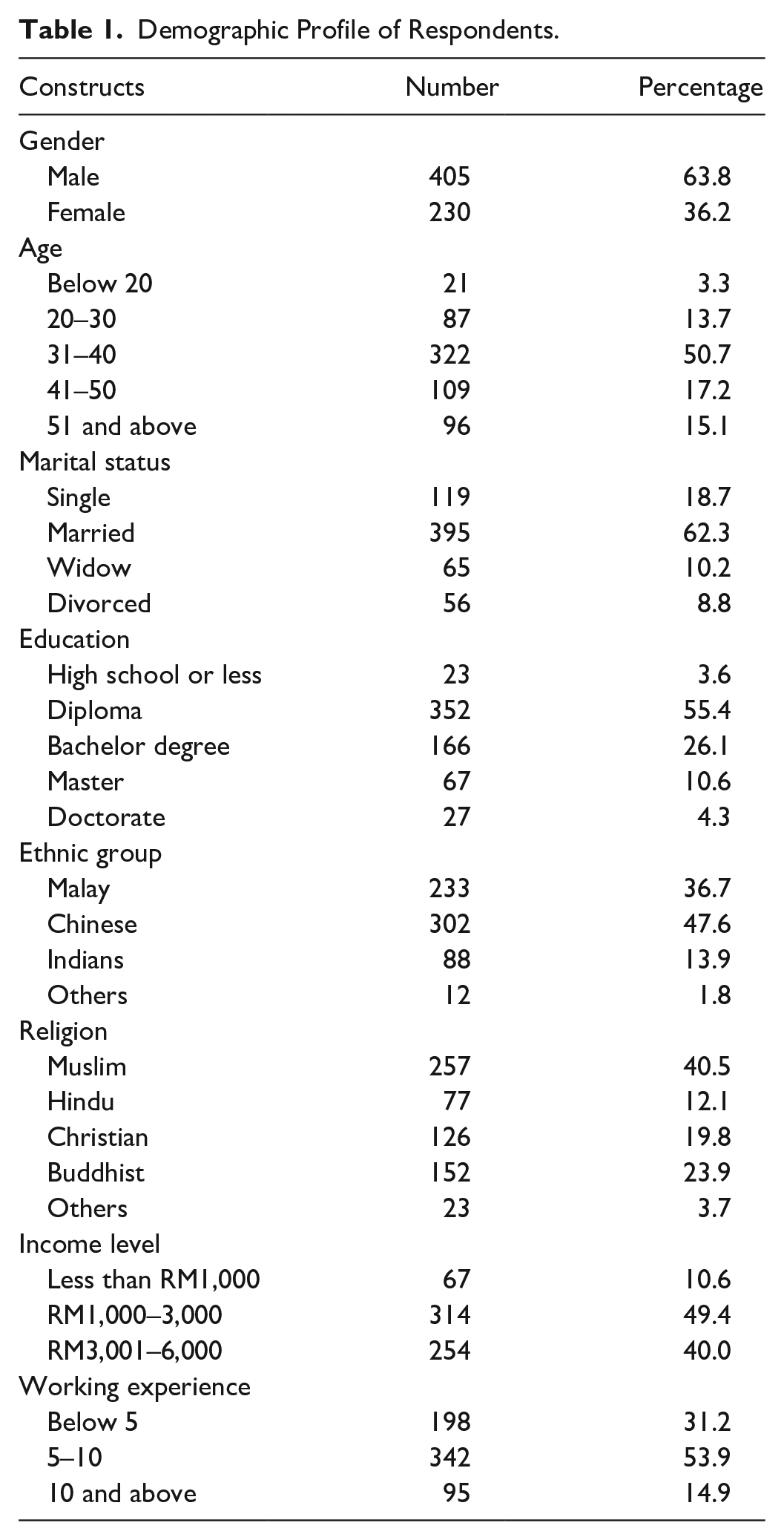
Personal and business data were collected from respondents using survey questionnaires in different cities in Malaysia. The gender, age, marital status, education, ethnic group, religion, income, and working experience of 635 respondents were all categorized. Based on the items in the questionnaire, a descriptive statistic was used to do a demographic analysis to determine the respondents’ backgrounds. As previously stated, the research covered only 200 registered SMEs and focused on two key SME sectors: manufacturing and services. Manufacturing accounted for 124 (62.0%), while services accounted for 76 (38.0%). Moreover, Kheng and Minai (2016) claim that the Chinese community in Malaysia controls and manages the majority of MSMEs. As a result, when compared to other ethnic groups, the Chinese had the highest response rate in this study. Table 1 has further information.
Demographic Profile of Respondents.
Normality Statistics
Testing for multivariate normality is frequently recommended when performing a structural equation model (SEM). SEM assumes continuous variables in the research and produces the best findings when the distribution of data is normal (Andreassen et al., 2006).
Consequently, the descriptive statistics should be used to test the combination of skewness and kurtosis values for each variable in the study (Ryu, 2011). Ghasemi and Zahediasl (2012) recommended that skewness and kurtosis values within the ±3 range may indicate that a variable is distributed normally. The statistical values of skewness and kurtosis of each construct were calculated in this research and presented in Table 2.
Descriptive Statistics.

Reliability
Cronbach’s alpha is the most commonly used reliability measure in research. When a survey form contains multiple Likert-scale questions and the researchers want to know if the scale is reliable for further analysis (Tavakol & Dennick, 2011). In this study, the value of Cronbach’s alpha was .70 and above. According to Kline (2015), it is acceptable in reliability statistical analysis. The reliabilities of managerial support (α = .873), social support (α = .881), affective commitment (α = .916), calculative commitment (α = .897), idea generation (α = .905), and idea implementation (α = .868) within the acceptable range.
Discriminant Validity
The degree to which one construct differentiates from others is referred to as discriminant validity (Cheah et al., 2018). In the same way, Spuling et al. (2020) elaborated, “items on one scale should not load or converge too closely with items on another scale, and that latent variables with significant correlations may be assessing the same construct rather than different constructs.” Therefore, the presence of discriminant validity was shown by low or no correlations between variables. According to Voorhees et al. (2016), the correlation between the two constructs should be less than .85.
As a result, the discriminant validity of managerial support training, social support training, affective commitment, calculative commitment, idea generation, and idea implementation is investigated in this study using SPSS statistics version 22.0. Table 3 provides the findings, which demonstrate that the correlation between the constructs was less than .85.
The Correlation of the Constructs.

Assessment of Measurement Model
The assessment of the measurement model is the first stage of SEM analysis. The analysis was carried out in three steps in this study: Step 1: determining the factor’s unidimensionality (CFA), Step 2: determining the overall measurement model, and Step 3: determining the convergent validity of the final constructs. Therefore, these three steps are discussed in the following sections.
Step 1 Confirmatory Factor Analysis (CFA) Results: The dimensionality of the constructs was tested using principal component analysis. Confirmatory factor analysis was used in this study to examine the variables’ unidimensionality. According to Kline (2015), to examine whether the statistical results of CFA were in the acceptable range; the multiple fit indices results for the assumed constructs and factor loading of each item were tested. Factor loading of each item above .50 was considered acceptable by Shek and Yu (2014), whereas factor loading above .7 was satisfactorily retained in the study. According to the study’s findings, the factor loading of items was found to be satisfactory (above .7), and fit indices such as, chi-square divided by the degrees of freedom (χ2/df), goodness-of-fit (GFI), adjusted goodness of fit index (AGFI), root mean square error of approximation (RMSEA), and comparative fit index (CFI), were in the acceptable range, as recommended by Kline (2015). Therefore, the study could now proceed to assess the overall measurement model.
Step 2 Overall Assessment of Measurement Model: The overall measurement model assessment was examined after the CFA validation results. When evaluating the theoretical framework, the primary concern is whether it conflicts with reality as observed in the sample or how well the theoretical model fits the dataset (Han & Johnson, 2019). AMOS version 21.0 calculates a number of indicators that can be used to assess the fitness of the model. The goodness-of-fit can be determined using five different fitness measuring scales, such as, Chi-square, GFI, AGFI, RMSEA, and CFI (Kline, 2015).
Figure 2 shows the overall measurement model. Moreover, the findings of the study indicated that the indicator of the goodness-of-fit indices for the entire measurement model was well-fitted, such as RMSEA of .041 and chi square value of 598.325 with 634 degrees of freedom, GFI = .929, AGFI = .921, CFI = .957, and CMIN/df = 1.843.

Measurement model.
Step 3 Assessment of Convergent Validity: The assessment of convergent validity is the final step in stage 1 of SEM analysis after a well-fitted overall measurement model. Average Variance Extracted (AVE) and Composite Reliability (CR) measurements can be used to assess convergent validity (Cheah et al., 2018). AVE and CR values of .50 or higher are considered acceptable, while over .70 is considered exceptional (Yadav et al., 2016). Table 4 shows that the statistical results of Average Variance Extracted (AVE) and Composite Reliability (CR) values were within acceptable parameters.
Convergent Validity Evaluation.

Assessment of Structural Model
The analytical approach of the structural equation model (SEM) is the modern method and is capable of simultaneously testing empirical models. It employs a variety of testing statistical methods to investigate the relationship between employee training perception and innovative behavior.
The structural model (stage 2) was evaluated using AMOS 21.0. This was conducted in contrast with previous research (such as Hair et al., 2014; Kline, 2015). In stage two (the structural model), the first step examined all of the variables’ direct relationships, including the mediator. The second step investigated the indirect effect of employee commitment as a mediator.
Step 1 Assessment of Direct Relationship: In stage one, the goodness-of-fit indices for the study’s structural model were examined. The findings were well-fitted, as shown in Figure 3, with an RMSEA of .031 and a chi square value of 643.741 with 634 degrees of freedom, GFI = .931, AGFI = .919, CFI = .955, and CMIN/df = 1.993. Following the evaluation of model fitness, the study can investigate the direct relationship.

Structural model.
The findings of direct relationships are shown in Table 5. A level of significance for p-value <.05, as recommended by Kline (2015), was also taken into account in the study. In assessing the hypothesized relationship, the hypotheses H1a, H1b, H2, H2a, H2b, H3a, H3b, H4a, and H4b were statistically significant.
Testing Direct Relationship.

p < .05.
Step 2 The Assessment of Mediating Effect: In examining the mediator, there are two types of effects to consider: direct and indirect. According to Awang et al. (2015), “the direct effect is the influence that goes directly from the independent variable to the dependent variable, whereas the indirect effect is the effect that comes indirectly through the mediating variable.”
Hypothesized relationships H5 and H6 were tested in this study to examine if affective and calculative commitment mediate the relationship between training perception and employee innovative behavior. The indirect effect of affective commitment was .26 (.56 × .46 = .26), whereas the direct effect of training and innovative behavior was .22; similarly, the indirect effect of calculative commitment was .23 (.54 × .43 = .23), while the direct effect was .22. Since the direct effect remains significant after the mediator enters the model, the type of mediation used here is partial mediation (Awang et al., 2015). As a result, affective and calculative commitment were found to play a role in mediating the interactions.
Use the bootstrapping approach to validate the mediation analysis after confirming direct and indirect effects. Based on the recommendation of Awang et al. (2015), in this study the researchers used a 1,000-bootstrap sample with a bias correction of 95% to calculate the standardized indirect and direct effects, as well as their significance levels. The statistical results for this investigation are provided in Table 6, where Hypothesis H5 and H6 were accepted.
Assessment of Mediating Effect (Bootstrapping Results).

Discussion
This study examines the impact of training on SME employees’ innovative behavior in Malaysian markets. Furthermore, this research contributes to the literature by examining how affective and calculative commitment mediate the relationship between training perception and employee innovation.
The first research question (RQ1) was: “Does training perception improve SME’s employee innovative behavior in Malaysia?”
Research question 1 was related to the test path of managerial and social support are predictors of training perceptions and employees’ innovation improve through training. It was determined that hypothesis H1a, managerial support path 0.41, z-score 4.983, p-value <.05, predicts positive training perception. Hypothesis H1b social support to training perception path 0.38, z-score 4.604, p-values <.005 confirms that social support is a predictor of training perception. H1, a and b testify that positive training perception comprised two predictors named above according to theory Bartlett (2001). Hence the obtained results are according to theory. However, it is worth mentioning that the authors focused on SME employees, in which this study aimed to assess positive training’s role. A more suitable and efficient technique of human resources is applied to attain productive and skillful employees. It aspires to use them as an organization’s resources to improve innovation and creativity. Employees are the first-line workforce who actively participate in innovation. Using positive training perceptions such as managerial and social support, they can flourish in innovation-related activities to increase business value and prestige.
Moreover, H2 was determined that positive training perception is a predictor of employees’ innovative behavior. Hence path TP to IB 0.22, z-score 3.477, p-value <.05 confirms the positive and significant relation between training perception and employee innovative behavior. The results support Becker’s (1964) theory and are consistent with a recent study by Tajeddini et al. (2020), which found a substantial link between training and employees’ innovative behavior. While the findings show that committed employees are the most important antecedents of service innovation, knowledge management, and fostering creativity throughout the organization, Hence, businesses may make use of the advantages associated with human-related aspects to improve innovation and commercial performance.
Hypothesis H2 a and b, the test paths of idea generation and idea implementation, are predictors of innovative behavior. Hence, H2a path IB to IDG 0.35, z-score 4.428, p-value <.05, and H2b path IB to IDM 0.43, z-score 5.012, p-value <.05, confirms that idea generation and idea implementation are two predictors of innovative behavior, according to the innovation theory described by Zaltman et al. (1973). According to the findings, generation and implementation are the two major phases of the innovation process, which are consistent with prior research by Axtell et al. (2000) and King and Anderson (2002).
The second research question (RQ1) was: “Does firm commitment mediate the relationship between training perception and employee innovative behavior?” Research question 2 was related to testing direct relationships (hypothesized by H3a, H3b, H4a, and H4b), and indirect relationships (hypothesized by H5 and H6).
Hypothesis H3a: the test path TP to AFC 0.56, z-score 6.349, and p-value <.05, confirms that training perception has a significant relationship with affective firm commitment. The findings are consistent with the previous study by Grund and Titz (2021). According to the findings, employee involvement in training and a firm’s support for training are positively associated with affective commitment. While our findings show that there is a substantial relationship between firm support for training and employees’ commitment, participation in further training measures and perceived support for personnel development are especially important for innovation and creativity.
Hypothesis H3b: the test path TP to CLC 0.54, z-score 6.120, and p-value <.05, confirms that training perception has a significant relationship with calculative commitment. As previous study of Fatima et al. (2015) consistent with the research findings. The findings from a previous study by Fatima et al. (2015) are consistent with the research findings. The findings indicate that all aspects of training have a beneficial impact on employee commitment. The implications for both researchers and human resource practitioners on how to use organizational training elements to improve employee commitment have been highlighted.
Hypothesis H4a: the test path AFC to IB 0.46, z-score 5.521, and p-value <.05, confirms that affective firm commitment has a significant relationship with employee innovative behavior. The findings are consistent with the previous studies of Xerri and Brunetto (2013) and Hakimian et al. (2016). Positive and statistically significant paths from affective commitment to innovative behavior were discovered. Furthermore, this research has significant implications for business owners and managers, particularly those looking to create an atmosphere that promotes efficiency and effectiveness in the workplace by facilitating commitment and innovative behavior.
Hypothesis H4b: the findings confirm a positive association between calculative commitment and employee innovative behavior (path CLC to IB 0.43, z-score 5.289, and p-value <.05). The findings of the study are consistent with the previous study by Lewicka and Krot (2015). Research findings made it possible to successfully verify the relationship between calculative commitment and innovative behavior.
The hypotheses H5 and H6 in this study focus on the mediating role of affective and calculative commitment between training perception and employee innovative behavior. According to the findings, affective and calculative commitment partially influence the association between training and inventive behavior. Therefore, the hypotheses (H5 and H6) are supported. In their research, Jehanzeb (2021) found a positive association. According to their findings, a strong commitment appears to mediate the relationship between HRM practices and innovation. HRM practices produce strong commitment, which contributes to innovation.
Implications of the Study
From a theoretical perspective, the research adds to the body of knowledge in the fields of organizational behavior, human resource management, and entrepreneurship. Numerous past research has shown the importance of training in the enhancement of employees’ knowledge and skills (Bos-Nehles & Veenendaal, 2019; Jehanzeb, 2021). The Malaysian SME sector has changed dramatically in the last decade, notably in terms of technology usage. In an emerging market like Malaysia, SMEs are often regarded as the most important sector for development at national and regional levels. Therefore, highly skilled professionals are required in the sector. Thus, through training programs, employees are frequently expected to be innovative and develop their skills. As a result, training has become a crucial instrument for fostering employee innovation (Singh et al., 2020). According to Becker (1964), the theory of human capital supported the importance of training in the development and retention of innovative capabilities among employees. Similarly, the research of Jehanzeb and Mohanty (2019) and Jehanzeb (2021) has backed up Becker’s theory views on employees’ commitment and training. The consequences of this research are in line with the majority of findings in the domain of training and innovative behavior of employees (Chang et al., 2021), notably with the human capital theory. Thus, this research supports the idea that well-skilled and trained employees will participate in innovation, for the reason that they are aware of their important role in the workplace.
Employee training is a vital activity, especially in the SME sector. With a conscious and employee-centered training strategy, employees can be brought closer to the goals of an organization. It will provide employees with psychological stability. The findings of this research also provided evidence that employee engagement in training programs is important for the adoption of innovative behavior that leads firms toward substantial performance. As a result, it is critical for SME owners to involve employees from all levels in skills training. Firm owners must be cautious in putting strategic training strategies into action. This will be in accordance with the employees’ developmental needs. Employee training that is clearly targeted and goal-oriented helps assure the effectiveness of the program and promotes firm commitment. Devoted employees go further than their job duties and responsibilities to help the SME achieve its objectives.
The strategists and intellectuals who define the future of small and medium enterprises are policymakers. They are essential to the smooth operation and efficiency of any SME. Policymakers will have lots of opportunities to assess and alter their policies and policy-making systems as a result of this study. In order to prepare SMEs for the future, authorities must make a significant adjustment in the structure of employee training. The sole decision of the firm-owners should not be used for training. Training would be used as a strategic instrument to help the organization achieve its goals. Thus, training for individuals should be connected to national and regional strategic plans. The training programs should not be considered as a simple development of skills and knowledge. Individual growth should be linked to the SME sector’s vision. Therefore, training must be incorporated into the policy framework.
Conclusion
The goal of this study was to investigate a link between employee perceptions of training and their innovative behavior. In the relationship between training perception and innovative behavior, the research examined the mediating influence of firm commitment, which has two key components: affective commitment and calculative commitment. According to the findings of the study, there is a substantial association between employee innovative behavior and training perception in the Malaysian SME sector. Furthermore, the findings suggest that affective and calculative commitment both partially mediate the relationship between training perception and employee innovative behavior. The analysis indicated that individuals with a strong firm commitment can strengthen the link between innovative behavior and training perception.
However, the consequences of the study were consistent with the hypothesis of the research. The goal of the study was to get a broad picture of SME training programs and how they affect individual innovative behavior and SME outcomes. The study achieved its aims by demonstrating that SME initiatives such as training opportunities have a significant impact on individual innovative behavior. Employee training that is clearly targeted and goal-based helps assure its efficacy and boosts employee affective and calculative commitment. Such committed and dedicated individuals are more motivated to go above and beyond their formal job descriptions to help the firm achieve its objectives.
Our findings show that training has a significant beneficial impact on employee innovative behavior, suggesting that a systematic training approach is necessary to improve SME employees’ innovation in Malaysia and further encourage their desire to be creative. Furthermore, it is essential to encourage training perceptions to establish a strong SME sector in Malaysia in order to achieve long-term development and competitive advantage, since training and innovation may bridge the present gap and improve sector effectiveness. Finally, as a mediating variable, firm commitment may significantly increase the positive relationship between training and employees’ innovative behavior. The findings show that dedicated employees go above and beyond their job tasks and responsibilities to assist SMEs in achieving their goals.
Limitations and Future Scope of the Study
The current study has several limitations. First, two components of training, namely managerial and social support, were employed to investigate their impact on employee innovative behavior. However, future research can include the other dimensions as well. Second, firm commitment was investigated through affective and calculative commitment; as a result, other dimensions such as normative commitment will be investigated in the future. Third, due to the extreme COVID-19 sanctions and closure, this study was limited to big cities in various Malaysian states. Nevertheless, the research is not limited to SMEs in urban cities, but also includes rural communities. It is a suggestion for researchers to do a study on rural SMEs or to compare the innovative behavior of employees in rural and urban SMEs. The fourth limitation is that the data was obtained using a cross-sectional design, indicating that it was collected at a single point in time. Researchers can do longitudinal studies in the future and collect data over different time frames, resulting in a variety of outcomes.
Footnotes
Author Note
Wasim Ullah is now affiliated to Universiti Malaysia Terengganu, Terengganu, Malaysia.
Declaration of Conflicting Interests
The author(s) declared no potential conflicts of interest with respect to the research, authorship, and/or publication of this article.
Funding
The author(s) received no financial support for the research, authorship, and/or publication of this article.
