



Abstract
Building upon self-determination theory, the objective of this research was to examine the predictive associations of pre-service physical education (PE) teachers’ basic psychological need satisfaction (i.e., autonomy, competence, relatedness, and novelty) with their academic engagement via the quality of their motivation. A purposive sample of 920 pre-service PE teachers (569 men and 351 women; Mage = 24.73; SD = 5.34) participated in this cross-sectional research. The results from structural equation modeling revealed that autonomy, competence, and novelty satisfaction positively predicted autonomous motivation, and negatively predicted amotivation. While competence satisfaction positively predicted controlled motivation, novelty satisfaction did it negatively. Autonomous motivation and controlled motivation positively predicted academic engagement, while amotivation was negatively associated with it. This research underscores the importance of considering pre-service PE teachers’ autonomy, competence, and, specially, novelty satisfaction in promoting their autonomous motivation and academic engagement in initial teacher education program.
Keywords
Introduction
Teacher shortage, and more particularly the physical education (PE) one, represents one of the main concerns for any Western country, including Spain (Organisation for Econocmic Co-operation and Development [OECD], 2018). To optimize the PE teacher students recruitment and selection process, the different public administrations have particularly turned their eyes towards the PE teachers’ engagement with teaching to be built throughout their initial PE teacher education not only for successfully completing the program in question, but also for coping with the obstacles and challenges that arise throughout their future professional career in the school PE (OECD, 2017). Thus, the study of the potential antecedents of pre-service PE teachers’ academic engagement has taken on particular interest for teacher educators and initial teacher education policy makers. Motivational experiences have been described as key precursors to academic engagement (e.g., Fokkens-Bruinsma & Canrinus, 2014; Jungert et al., 2014) and its examination could help to gain a better insight into academic engagement in initial PE teacher education.
Self-determination theory (SDT; Ryan & Deci, 2017) is a broad theoretical model for the study of motivation, which is receiving a growing attention to explain the influence of motivational experiences in initial PE teacher education (Zhang, 2021). This notwithstanding, no previous studies to date were found to analyze the distinctive roles that pre-service PE teachers’ basic psychological need satisfaction and motivation may perform in their academic engagement. Furthermore, there was no evidence for novelty satisfaction as the fourth basic psychological need within the SDT framework in the specific context of initial PE teacher education. Therefore, the present research sought to examine the relationships between basic psychological need satisfaction, novelty satisfaction and the quality of motivation with academic engagement in a sample of pre-service PE teachers.
Academic Engagement in Initial PE Teacher Education
Academic engagement is typically outlined as a state of mind that expresses a personal commitment to education—in our case, to initial PE teacher education—including the time and efforts pre-service PE teachers spend in learning activities both inside and outside the classroom (Appleton et al., 2008). In accordance with Schaufeli, Martínez, et al. (2002), academic engagement consists of, at least, the elements of vigor (i.e., high energy levels and mental resilience during study), dedication (i.e., high pre-service teachers’ involvement toward their academic tasks), and absorption (i.e., to high concentration and connection levels toward the presented task).
In the general context of initial teacher education, a small basis of evidence has suggested that the pre-service teachers’ academic engagement is largely influenced by their motivational experiences (Fokkens-Bruinsma & Canrinus, 2014; Jungert et al., 2014). To date, only two SDT-based studies with pre-service teachers were found indicating a positive relationship between autonomous motivation and academic engagement (Kaplan & Madjar, 2017), and a negative association of amotivation with academic engagement (López-García et al., 2023). Nonetheless, there was an unclear relationship between controlled motivation and academic motivation, such that López-García et al. (2023) reported a positive association among both variables, and Kaplan and Madjar (2017), instead, revealed a non-significant relationship between them. Although these studies conducted with pre-service teachers made a valuable contribution by shedding some light on the relationship between motivation and academic engagement, it is important to underscore that the interplay between the three qualities of motivation and academic engagement remains still to be explored in the specific context of initial PE teacher education.
Motivational Processes in Initial PE Teacher Education
Unlike the classical motivational theories that operationalize motivation in exclusively quantitative terms, SDT (Ryan & Deci, 2017) conceptualizes motivation from a quantitative and qualitative perspective. This distinctiveness suggests that a great quantity of motivation does not ensure the adoption of the desired behavior, if the quality of that motivation is low (Ryan & Deci, 2017). SDT makes a clear distinction between three qualities (or types) of motivation along a self-determination continuum in accordance with the relative autonomy (or willingness) level present in each of them (Ryan & Deci, 2020; Ryan et al., 2021).
At one end of the self-determination continuum lies autonomous motivation, which represents the prototype of human motivation (Ryan et al., 2021). It refers to undertaking the target behavior guided by the inherent interest, enjoyment, curiosity, and seeking new horizons (i.e., intrinsic motivation), congruence with the person’s core values and goals (i.e., integrated regulation), as well as by conscious identification of the benefits that the behavior itself brings (i.e., identified regulation). At the center of this continuum lies controlled motivation, which refers to undertaking the behavior driven by self-imposed pressures based on internal rewards of self-esteem for success and avoidance of anxiety, shame of guilt for failure (i.e., introjected regulation), as well as by externally imposed pressures relied on social rewards and/or punishments (i.e., external regulation). At the opposite end of the self-determination continuum and contrasted with autonomous and controlled motivation stands amotivation, which expresses the full absence of willingness and regulation towards the desired behavior.
Central to SDT is the assumption that the quality of motivation would depend on the satisfaction of three essential and universal psychological nutrients, broadly known as basic psychological needs. The first of them is autonomy, which concerns a sense of choice and ownership in one’s actions. When people (i.e., pre-service PE teachers) perceive their need for autonomy as satisfied, they feel volition, freedom, and initiative in their behavior. Competence, second basic psychological need, refers to a sense that one can succeed and grow. When people perceive their need for competence as satisfied, they feel able to achieve their expected goals, as well as to experience mastery, efficacy, and accomplishment in their activities. The third basic psychological need is relatedness, which concerns a sense of mutual care, belonging and connection. When people perceive their need for relatedness as satisfied, they feel valued and accepted by their significant others. SDT holds the premise that need satisfaction not only would directly energize autonomous motivation (i.e., bright motivational path), but also it would buffer against experiences of controlled motivation and amotivation (i.e., cross-path) (Ryan & Deci, 2020; Vansteenkiste et al., 2020).
In addition to these three basic psychological needs, a growing body of SDT-based research has postulated the need for novelty as the fourth basic psychological need (see González-Cutre et al., 2016, 2020, 2023; González-Cutre & Sicilia, 2019). Novelty refers to a sense of experiencing something that has not been experienced previously or that differs from the daily routine (González-Cutre et al., 2016). When people perceive their need for novelty as satisfied, they feel the tendency to look for and get involved in new activities, as well as to experience new sensations and situations (González-Cutre et al., 2020). Previous SDT-grounded research conducted with secondary students in PE has gathered evidence in support of the bright motivational path for novelty satisfaction inasmuch as positive and consistent relationships were found between novelty satisfaction and higher-quality motivation (i.e., autonomous motivation) (González-Cutre et al., 2016, 2020; González-Cutre & Sicilia, 2019). However, cross-paths from novelty satisfaction to lower-quality motivation did not empirically supported to date given that nonsignificant associations were found between novelty satisfaction and controlled motivation and amotivation (González-Cutre et al., 2020).
In the general context of initial teacher education, very little attention has been paid to the relationship between pre-service teachers’ need satisfaction and the quality of their motivation. In particular, Burgueño et al.’s (2022) study showed that pre-service teachers’ need satisfaction was positively associated with autonomous, relative to controlled, motivation. Furthermore, Kaplan and Madjar’s (2017) research revealed, in spite of not considering autonomy satisfaction, that competence and relatedness satisfaction were positively related to autonomous motivation, while being unrelated to controlled motivation. Albeit both studies on initial teacher education meaningfully contributed to providing some clues on the role that pre-service teachers’ need satisfaction played in the quality of their motivation, they failed both to consider the satisfaction of all needs separately and operationalize motivation through its three qualities following the SDT’s tenets (Ryan et al., 2021). To the best of our knowledge, no studies were found to analyze the separate role that the satisfaction of each need may play in developing both the three qualities of motivation and academic motivation in the specific context of initial PE teacher education. In addition to shedding light on how the three qualities of motivation would differentially contribute to academic engagement, it is important to expand evidence for novelty satisfaction as the fourth basic psychological need in the specific context of initial PE teacher education by examining the associations with the motivational quality and academic engagement among pre-service PE teachers. This will allow us to meet a basis of evidence that helps teacher educators implement more effective need-supporting and motivating strategies in developing the pre-service PE teachers’ academic engagement throughout their initial PE teacher education program.
The Present Study
Therefore, the objective of the current SDT-based research was to analyze the relationships between the satisfaction of each of the four needs and the quality of motivation with academic engagement in pre-service PE teachers. Building upon SDT (Ryan & Deci, 2017) and following previous research in the general context of initial teacher education (e.g., Burgueño et al., 2022; Kaplan & Madjar, 2017; López-García et al., 2023), we hypothesized that autonomy, competence, relatedness would be positively associated with autonomous motivation, while each would be negatively related to controlled motivation and amotivation. We also hypothesized that autonomous motivation would be positively related to academic engagement, while controlled motivation and amotivation would do it in a negative way. Guided by the previous research with secondary PE students (González-Cutre et al., 2016, 2020; González-Cutre & Sicilia, 2019), we further hypothesized that novelty satisfaction would positively associated with autonomous motivation and negatively related to controlled motivation and amotivation (see Figure 1).

Theoretically hypothesized model with the expected direct paths.
Method
Participants and Setting
Previous to study, a minimum of 876 participants for the trustworthiness of the study’s results under conditions of a statistical power level of .95 and a significance level of α = .05 was estimated using Free Statistics Calculator v.4.0 software (Soper, 2022). Thus, a purposive and non-randomized sample of 920 pre-service PE teachers (569 men and 351 women) aged between from 20 to 57 years (Mage = 24.73; SD = 5.34) from eight Spanish public universities participated in this cross-sectional research. Regarding initial teacher education program, 557 (60.54%) participants were pre-service primary PE teachers who were enrolled in fourth academic course of the BSc. in Primary Teacher Education (i.e., a 4-year full-time program in which pedagogical education and subject-related education take place simultaneously), while 363 (39.46%) participants were pre-service secondary PE teachers who were enrolled in a professional master’s program in education (i.e., 1-year full-time professional course in education after having completed a 4-year full-time BSc. in Sport and Exercise Sciences).
Instruments
Pre-service PE teachers were asked to rate their agreement with the items on a 5-point Liker-type scale ranging from 1 (strongly disagree) to 5 (strongly agree).
Need Satisfaction in Initial Teacher Education
To assess the pre-service PE teachers’ perception of autonomy, competence, and relatedness satisfaction, the Spanish educational version (León et al., 2011) of the Échelle de Satisfacción des Besoins Psychologiques (Gillet et al., 2008) was used. The instrument is headed by the stem: “In my classes …” and followed by15 items distributed over three 5-item dimensions each: autonomy satisfaction (e.g., “I feel a sense of choice and freedom in the things I undertake”), competence satisfaction (e.g., “I feel confident that I can do things well”), and relatedness satisfaction (e.g., “I feel that the people I care about also care about me”). In the present research, the three-factor correlated model obtained a good fit to the observed data: χ2(df = 87) = 174.401,p < .001, χ2/df = 2.004; CFI = 0.974; TLI = 0.967; SRMR = 0.038; RMSEA = 0.049 (90% CI = 0.040–0.058).
Novelty Satisfaction in Initial Teacher Education
To assess the pre-service PE teachers’ perception of novelty satisfaction, the novelty satisfaction subscale developed by González-Cutre et al. (2020) was used. The unidimensional measure of novelty satisfaction is headed by the stem “In my classes …” and includes 5 items (e.g., “I frequently feel there are novelties for me”). In the present research, the primary-order one-factor model obtained a good fit to the observed data: χ2(df = 5) = 7.100, p = .137, χ2/df = 1.420; CFI = 0.998; TLI = 0.994; SRMR = 0.009; RMSEA = 0.034 (90% CI = 0.001–0.070).
Motivation for Initial Teacher Education
To assess the pre-service PE teachers’ perception of autonomous motivation, controlled motivation and amotivation, the Spanish version (Burgueño et al., 2017) of the Academic Motivation Scale (Vallerand et al., 1992). The scale is headed by the stem “I am carrying out this initial teacher education programme …”. It consists of 32 items and is grouped into 4 items per dimension to measure intrinsic motivation to experience motivation (e.g., “For the pleasure of reading interesting topics”), intrinsic motivation toward accomplishment (e.g., “For the satisfaction I feel in overcoming each of my personal goals”), intrinsic motivation toward knowledge (e.g., “For the pleasure of knowing more about the issues that attract me”), integrated regulation (e.g., “Because I consider it agrees with my values”), identified regulation (e.g., “Because it will possibly allow me to enter the labour market within the field that I like”), introjected regulation (e.g., “Because passing at university makes me feel important”), external regulation (e.g., “Because I want to have a good life in the future”), and amotivation (e.g., “I honestly don’t know; truthfully, I feel like I’m wasting my time in the master’s/undergraduate degree”). In accordance with Howard et al. (2017), a composite score for intrinsic motivation was computed by averaging values of the three subtypes of intrinsic motivation. Guided by SDT (Ryan et al., 2021) and following previous research (Burgueño et al., 2020), a hierarchical factor for autonomous motivation was specified by intrinsic motivation, integrated regulation and identified regulation, in the same way as a hierarchical factor for controlled motivation was specified by introjected and external regulation. In the current research, the second-order three-factor model had an acceptable fit to the data: χ2(df = 454) = 1,477, p < .001, χ2/df = 3.254; CFI = 0.949; TLI = 0.944; SRMR = 0.075; RMSEA = 0.055(90% CI = 0.051–0.058).
Academic Engagement
To assess the pre-service PE teachers’ perception of academic engagement, the Spanish student version (Benevides-Pereira et al., 2009) of the Utrecht Work Engagement Student Scale (Schaufeli, Salanova, et al., 2002) was used. The instrument includes 9 items, that grouped into 3 items per dimension, measure vigor (e.g., “When I get up in the morning, I feel like going to class”), dedication (e.g., “I am enthusiastic about my studies”), and absorption (e.g., “It is difficult to detach myself from my studies”). In this study, the second-order one-factor model obtained a suitable fit to the data: χ2(df = 24) = 97.223, p < .001, χ2/df = 4.051; CFI = 0.960; TLI = 0.931; SRMR = 0.038; RMSEA = 0.069 (90% CI = 0.056–0.083).
Procedure
The research team contacted academic managers of the BSc. in Primary Teacher Education (i.e., PE) and of the Professional Master’s program in Education (i.e., PE), as well as those responsible for the Schools of Education, and their teaching staff, to request their collaboration and inform them of the object of the research. The data were collected at the end of the second semester of the 2020/2021 academic year. The administration of the questionnaire took place in quiet classroom environment using an online survey in which we explained the importance of the investigation, the anonymity in answers, the way to complete the online questionnaire, that participation in the study would not affect any qualification in any way, and that it could be abandoned at any time. All participants had to meet the following inclusion criteria: a) being a student of a BSc. in Primary Teacher Education (i.e., PE) and/or a student of a professional master’s program in education (PE); b) presential initial education program; c) having content to use data in the research. Indeed, every participant gave their informed consent for inclusion before they participated in the study. The research was carried out in accordance with the Declaration of Helsinki and the protocol was approved by the Bioethics Committee of the University of Almeria (Ref: UALBIO2021/009).
Risk of Bias
At this point, it should be noted that there was no randomization of the sample, since convenience sampling was followed. There was blinding between the participants and the researchers in charge of the data treatment and analysis. Regarding selection bias, participation in the study was voluntary and communication with students was carried out by email.
Statistical Analysis
Descriptive statistics and McDonalds omega coefficient were, respectively, calculated using the Statistical Package for the Social Sciences v.28 (IBM, Chicago, IL, USA), whereas a two-step structural equation model (SEM) approach was run with Mplus v. 8.4 (Muthén & Muthén, 1998-2017). McDonalds omega shows a good level of reliability with values greater than .70 (Viladrich et al., 2017). Correlations among latent variables were values up to .85 in correlations are representative of the absence of multicollinearity among variables (Kline, 2016).
For the analysis of direct and indirect paths from need satisfaction to academic engagement via motivational quality, a two-step SEM approach was run (Kline, 2016). In the first step, the robustness of a model in which all target variables are freely correlated was tested (i.e., measurement model). In the second step, a structural model consisting of examining the predictive relationships among variables was tested. The model was controlled for gender and type of initial teacher education. The two-step SEM approach was run using the Robust Maximin Likelihood (MLR) estimator given that it provides fit and standard error rates that are robust to non-normality and Likert scales consisting of five or more response options (Muthén & Muthén, 1998/2017). The model’s fit was evaluated by the coefficient between chi-squared and degrees of freedom (χ2/df), comparative fit index (CFI), Tucker–Lewis index (TLI), standardized root mean square residual (SRMR), and root mean square error of approximation (RMSEA) paired with its confidence interval at 90% (90% CI). A good fit was achieved by scores as high as 5 for the χ2/df coefficient, over .95 for CFI and TLI, and below .060 for SRMR and RMSEA, while values up to 3 in the χ2/df coefficient, greater than .90 in CFI and TLI, and lower than .080 in SRMR and RMSEA are indicative of an acceptable fit (Kline, 2016). Indirect effects were also examined by the Hayes’ (2017) methodological proposal, according to which an indirect (i.e., mediated) effect is statistically significant when its 95% CI does not include the zero value.
Results
Descriptive Statistics, Reliability, and Correlations Among Variables
Table 1 reports that, except for amotivation, the remaining variables under study scored higher than the mid-point of their respective measurement scale. McDonald’s omega values were between .79 and .95. Moreover, correlation scores ranged from −.44 to .75. Correlation analysis further revealed that the satisfaction of each need was positively correlated with autonomous motivation and academic engagement, while being negatively related to amotivation. Autonomy, relatedness, and novelty satisfaction were negatively correlated with controlled motivation, whereas competence satisfaction did it positively.
Descriptive Statistics, Reliability Coefficients, and Latent Correlations Between Variables.
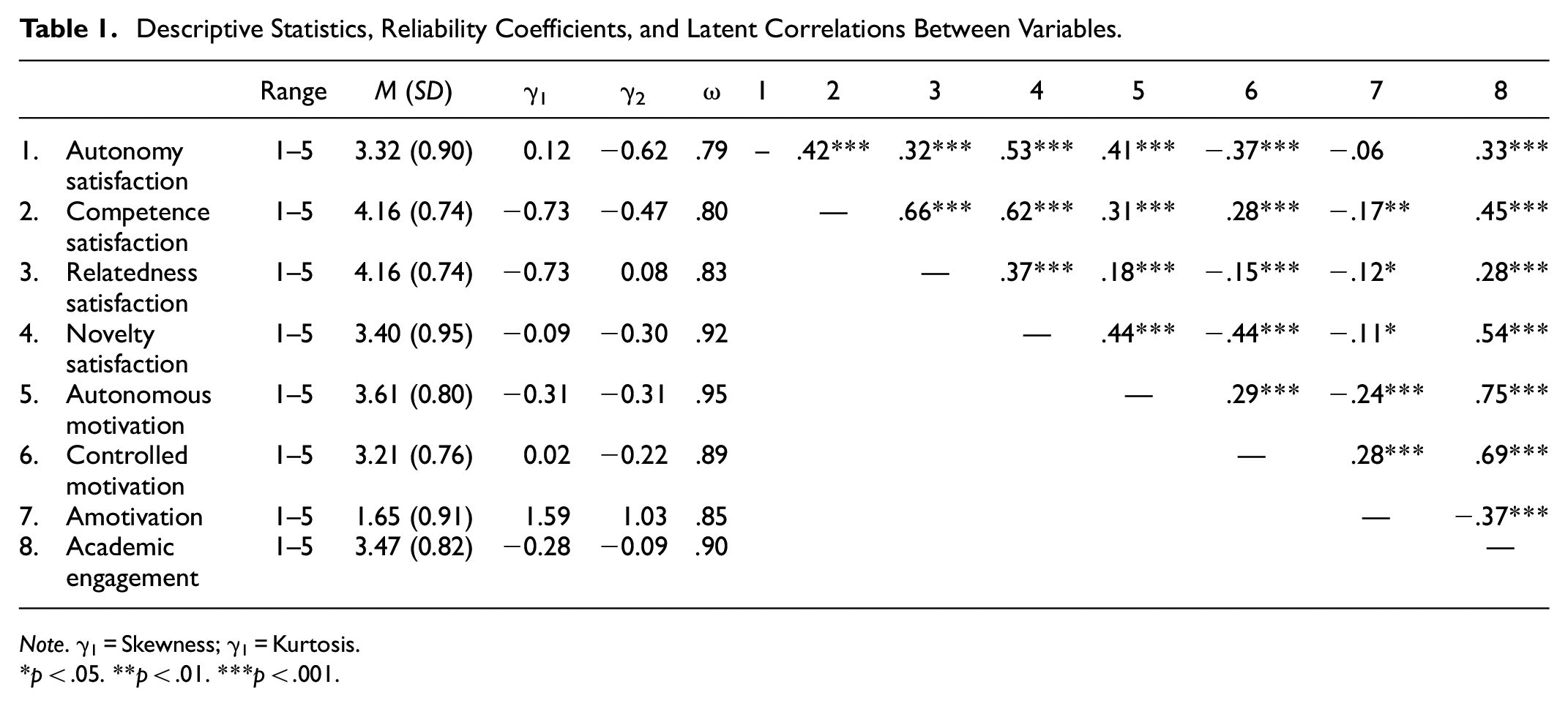
Note. γ1 = Skewness; γ1 = Kurtosis.
p < .05. **p < .01. ***p < .001.
Structural Equation Modeling
In the first step, the robustness of the measurement model was verified (χ2[df = 377] = 1,070.214, p < .001, χ2/df = 2.838; CFI = 0.939; TLI = 0.926; SRMR = 0.053; RMSEA = 0.055[90% CI = 0.052–0.058]). In the second step, the tested structural model had an appropriate fit to the observed data: χ2(df = 378) = 1,076.558, p < .001, χ2/df = 2.848; CFI = 0.935; TLI = 0.925; SRMR = 0.063; RMSEA = 0.049 (90% CI = 0.046–0.053). The total explained variance was 22% for autonomous and controlled motivation, 5% for amotivation, and 90% for academic engagement.
Figure 2 shows that, after controlling for gender and initial teacher education program, autonomy, competence, and novelty satisfaction positively predicted autonomous motivation (β = .16, p = .009; β = .12, p = .015; β = .29, p < .001), while negatively predicting amotivation (β = −.19, p = .001; β = −.17, p = .013; β = −.29, p = .029). Further, competence satisfaction positively predicted controlled motivation (β = .12, p = .022), whereas novelty satisfaction (β = −.36, p < .001) predicted it negatively. In addition, autonomous, and controlled motivation positively predicted academic engagement (β = .63, p < .001; β = .54, p < .001), while amotivation did it negatively (β = −.22, p < .001).

Direct paths from need satisfaction to academic engagement via the quality of motivation in pre-service PE teachers.
Table 2 reports indirect effects from need satisfaction to academic engagement via motivational quality. In detail, autonomous motivation significantly mediated the relationship between autonomy, competence, and novelty satisfaction and academic engagement. Controlled motivation negatively and significantly mediated the relationship between novelty satisfaction and academic engagement. Amotivation negatively mediated the relationship between autonomy and competence satisfaction with academic engagement.
Indirect Paths of Pre-Service PE Teachers’ Need Satisfaction on Their Academic Engagement Via Quality of Motivation.

Discussion
The objective of this SDT-based research was to analyze the associations of pre-service PE teachers’ autonomy, competence, relatedness, and novelty satisfaction with their academic engagement via the quality of their motivation. The main results show that autonomy, competence, and novelty satisfaction were positively associated with autonomous motivation and academic engagement and negatively related to amotivation. In addition, competence satisfaction was positively related to controlled motivation, while novelty satisfaction did it negatively.
Consistent with our hypotheses and in line with previous research (Burgueño et al., 2022; Kaplan & Madjar, 2017), our results showed direct paths from autonomy, competence, and novelty satisfaction to autonomous motivation. Except for relatedness satisfaction, the satisfaction of the remaining three needs adopted an energizing role in developing higher-quality of motivation, which aligned with the SDT’s assumptions (Ryan et al., 2021). A plausible argumentation would rest on the fact that when pre-service PE teachers perceive different choices to complete the target activity, efficacy in completing it and experiences that the task is different from usual, they will are prone to participate in the instructional practice guided by experiences both of enjoyment and because they truly want to take part into it by identifying its relevance to become a PE teacher. It is also important to stress that, in contrast to González-Cutre et al.’s (2020) research conducted with secondary PE students, novelty satisfaction was the strongest predictor of autonomous motivation in pre-service PE teachers. While González-Cutre et al.’s (2020) research revealed that secondary PE students’ competence satisfaction more strongly predicted their autonomous motivation; our findings suggest that pre-service PE teachers need to have the sensation of experiencing tasks, instructional strategies, and assessment formats differing from typical rather than feeling autonomous and competent in developing autonomous reasons that lead them to complete their initial teacher education program and, in consequence, to become in-service teachers.
Contrasted with our hypotheses, pre-service PE teachers’ competence satisfaction positively predicted their controlled motivation. This result differed from Kaplan and Madjar’s (2017) study that revealed that both variables were unrelated in pre-service generalist teachers, while it was partially aligned with the López-García et al.’s (2023) research, given that a positive association was found from pre-service generalist teachers’ need satisfaction to their controlled motivation. This finding makes us suggest that when pre-service PE teachers feel their competence as satisfied, they could also have controlled reasons toward their initial teacher education program. This would be due to when they feel able and efficient during the target activity completion, the activity in question could also be interpreted either as an obligation imposed by their teacher educator to pass a specific subject, or as a personal duty to become a good PE teacher student throughout their initial teacher education program. However, it should also be underlined that the positive path from competence satisfaction to controlled motivation might also be caused by a time characteristic of our cross-sectional research. Thus, there is a need for future longitudinal studies to explore if the positive relationship between competence satisfaction and controlled motivation would be consistently maintained over initial PE teacher education program.
In line with our hypotheses, our results showed a negative and significant path from novelty satisfaction to controlled motivation. Although this result differed from the one reported by González-Cutre et al. (2020), it was congruent with the SDT framework (Ryan et al., 2021) given that novelty satisfaction took a buffering role against controlled motivation in the specific context of initial PE teacher education. It could, likely, be explained by the fact that when pre-service PE teachers develop new activities and are trained by pedagogical models and teaching styles different than usual, they will tend to perceive less pressures in its external and self-imposed nature in completing their initial PE teacher program. On the other hand, and unlike both our expectations and the SDT’s tenets (Ryan et al., 2021), our results displayed that autonomy and relatedness satisfaction failed to buffer against controlled motivation. This would be indicative that for pre-service PE teachers to have a less relevant role than theorized to reduce controlled motivation by being more important for them to feel their need for novelty as fully satisfied in their initial PE teacher education program.
In accordance with our hypotheses and following the SDT’s assumptions (Ryan et al., 2021), the results from our research indicated that, except for relatedness satisfaction, negative associations were obtained from autonomy, competence, and novelty satisfaction to amotivation among pre-service PE teachers. To the best of our knowledge, this is the first research exploring the potential role of the satisfaction of each need on amotivation in initial (PE) teacher education, reporting pre-service PE teachers’ need satisfaction performed a buffering role against their amotivation. Thus, it should be argued that when pre-service PE teachers feel that they have as many choices as desired for the on-going task completion, feel capable to success in its development together with the activity in question differs from the classroom routine, they will be prone to experience less futility and disinterest in their initial PE teacher education.
Partially consistent with the hypotheses of this study and following the SDT framework (Ryan et al., 2021), our results reported autonomous both autonomous and controlled motivation positively predicted academic engagement, with autonomous motivation having a higher prediction. These findings shed some light on the relationships between autonomous and controlled motivation with academic engagement in pre-service PE teachers given that Kaplan and Madjar (2017) only found a positive association of autonomous motivation on academic engagement, while López-García et al. (2023) revealed a positive relationship between controlled motivation and academic engagement. These results further suggest that a large quantity of the two higher qualities of motivation would be enough to keep the pre-service PE teachers’ academic engagement with their initial PE teacher education program. However, it is important to emphasize that when pre-service PE teachers are autonomously motivated, they get more engaged than when they are guided by controlled reasons. Indeed, it is thought that controlled motivation might be an effective way to foster short-term academic engagement among pre-service PE teachers; however, there is a need for longitudinal studies to analyze if the effects of controlled motivation on academic engagement would be maintained throughout initial PE teacher education. Moreover, and following López-García et al.’s (2023) research, our results also displayed a negative association of amotivation on academic engagement. This could be explained in that when pre-service PE teachers with levels of futility, inefficacy, undervaluation, and disinterest in their initial teacher education program, they will be prone to have a lower academic engagement with their teaching career.
Partially delineated with previous research (Karimi & Sotoodeh, 2020), our results additionally showed that pre-service PE teachers’ autonomous motivation positively mediated the relationships between their autonomy, competence, and relatedness satisfaction with their academic engagement. A plausible rationale would rely on that when pre-service PE teachers feel their needs for autonomy, competence, and relatedness as satisfied, they, in turn, participated in their instructional practice guided mainly by autonomous reasons and, in consequence, they will develop a higher academic engagement during their initial PE teacher program. Moreover, the findings from this research also revealed that controlled motivation negatively mediated the relationship between novelty satisfaction and academic engagement. This would imply that when pre-service PE teachers combine experiences of new content and activity outside their classroom routine, but in conjunction with external and self-imposed pressures to participate in the lesson, they would tend to have a lower academic engagement. Lastly, amotivation positively mediated the relationships between autonomy and competence satisfaction with academic engagement. This would entail that when pre-service PE teachers feel their need for autonomy and competence as satisfied in their lessons, but accompanied by experiences of futility and disinterest, they will be prone to have less academic engagement with their initial PE teacher education and, consequently, with their future teaching profession.
Limitations and Future Research Directions
As with any scientific work, this research has several limitations. The first of them is the adoption of a convenience and non-randomized sampling method in recruiting and selecting the participating pre-service PE teachers. This type of sampling technique made it hard to generalize our results to the whole population, so that they should be interpreted with caution. Therefore, future studies should analyze in depth the studied relationships in pre-service teacher samples with more heterogeneous characteristics regarding initial teacher education to discuss or verify the results obtained. The second limitation is the use of a cross-section design, although building upon the SDT framework, makes is impossible to establish causal relationships between the variables under study. Hence, further research is needed to implement longitudinal or experimental designs to determine the causality of the variables considered in this study. The third limitation is the exclusive administration of self-reported measures of need satisfaction, motivation, and academic engagement to collect our data. Thus, additional studies are needed to combine the use of self-reports with other instruments (e.g., interviews) for the purpose of optimally triangulating data. This will allow us to a deeper insight into the role that need satisfaction and the quality of motivation play in academic engagement among pre-service PE teachers throughout their initial teacher education programme.
Conclusions
The main results from the present research show a direct path from the pre-service PE teachers’ perception of autonomy, competence, and novelty satisfaction to autonomous motivation, as well as an indirect path from the satisfaction of these three needs to academic engagement via autonomous motivation. In addition, there is a direct and positive relationship between competence satisfaction and controlled motivation, while novelty satisfaction did it negatively. Further, pre-service PE teachers’ autonomy, competence, and novelty satisfaction negatively predicted amotivation. Lastly, autonomous and controlled motivation positively predicted academic engagement, amotivation did it negatively. This is the first research conducted in the specific context of initial PE teacher education that adds evidence to consider the need for novelty as the fourth basic psychological need within the SDT framework. Indeed, novelty satisfaction was the highest prediction of autonomous motivation in pre-service PE teachers. Our results recommend that PE teacher educators use need-supporting and motivating teaching strategies in optimally developing pre-service PE teachers’ academic engagement through the promotion of autonomy, competence, and novelty satisfaction and autonomous motivation.
Footnotes
Declaration of Conflicting Interests
The author(s) declared no potential conflicts of interest with respect to the research, authorship, and/or publication of this article.
Funding
The author(s) disclosed receipt of the following financial support for the research, authorship, and/or publication of this article: This study is funded by the Andalusian Plan for Research, Development, and Innovation (PAIDI, 2020) of the Junta de Andalucía (Ref project: P20_00148) and the help of the Health Research Center.
