




Abstract
The present study is aimed at examining the links between L2 self-guides and self-determination theory (SDT). 429 Korean university students participated in the study and their responses to the questionnaires on L2 self-guides in the 2 × 2 model and autonomous motivation of SDT were analyzed. The results show that, first, promotion focused L2 self-guides were found to share some characteristics with autonomous motivation, that is, intrinsic motivation and identified motivation. Second, these two types of motivation appeared to have stronger predictor values for motivated learning behavior than L2 self-guides with a promotion focus. Lastly, these L2 self-guides’ relationship with motivated behavior was found to be completely mediated by autonomous motivation. This indicates that when considering the relationship between students’ L2 self-guides and their motivated effort, autonomous motivation should be taken into account.
Introduction
To develop a degree of competence in a target language often requires effort, patience, and persistence. In the face of inevitably many difficulties and setbacks, the drive that engages individuals in their learning track and allows them to continue to strive comes from the individuals’ motivation. Etymologically, motivation is seen as what drives people to action. Theories of motivation focus on what activates and orients behavior (Ryan & Deci, 2017). Many studies have been conducted using various motivation theories (e.g., Garner’s theory of motivation, self-determination theory, possible L2 selves, attribution theory, etc.) as frameworks to explore motivation for language learning. Among them, L2 self-guides and SDT have been widely used to understand English learning and motivation (Tsao et al., 2021). L2 self-guides is a powerful framework that was newly operationalized by noting inconsistent findings in relation to the roles of ought-to L2 self in previous studies (Papi et al., 2019). Initially, Teimouri (2017) raised this issue and attempted to reconceptualize Dörnyei’s (2005, 2009) L2 motivational self-system (L2MSS) which has served as an insightful and informative framework for more than a decade. Papi et al. (2019) further proposed L2 self-guides in the 2 × 2 model by complementing Teimouri's (2017) model based on self-discrepancy theory (Higgins, 1987) and regulatory focus theory (Higgins, 1997); both ideal L2 self and ought-to L2 self in a bifurcated form by own and other standpoints. This model helps understand L2 students’ motivation in language learning in terms of their future selves from two standpoints and two regulation focuses. In addition to L2 self-guides, SDT, as a language motivation framework, includes a few distinct types of motivation, including four different types of extrinsic motivation as well as intrinsic motivation. These motivations reflect the degree to which an individual’s values and regulations are internalized and integrated for a requested behavior or task (Ryan & Deci, 2000). SDT has offered insights on how different types of learner motivations have different impacts on motivational outcomes according to the degree of internalization.
While each of these theories have helped reveal a lot in relation to L2 motivation, testing the boundaries of these theories and extending their research beyond those boundaries may lead to a more profound and richer understanding of motivation in language learning, as suggested by Noels (2009). Some studies have already provided insights into the causal relationships between them (e.g., McEown et al., 2014; Nishida, 2013; Takahashi & Im, 2020; Tsao et al., 2021; Yashima, 2009, etc.), and the direction and scope of the related research are expanding to specific language skill fields such as L2 writing (Tsao et al., 2021). However, there still seems to be a pressing need to further expand and update our understanding by investigating the recently re-conceptualized and re-operationalized L2-self guides along with the SDT constructs. From a similar perspective, Takahashi and Im’s (2020), p. 690) study called for further study into the relationships between L2 self-guides in the 2 × 2 model and the constructs of SDT. To respond to this urgency, the present study investigates how L2 self-guides in the 2 × 2 model, autonomous motivation of SDT, and L2 motivated learning behavior are associated. It appears that motivation in SDT works as a mediator for the relationship between social support and psychosocial outcomes (Deci & Ryan, 2000). Therefore, this study pays attention to the mediating role of autonomous motivation in the relationship between L2 self-guides and motivated behavior.
Literature Review
L2 Self-Guides in the 2 × 2 Model
L2MSS is seen as the predominant framework having the ability to accommodate different perspectives from various theoretical orientations and be adapted to many different academic purposes (Boo et al., 2015). L2MSS is primarily structured on two theories: the possible selves theory (Markus & Nurius, 1986) and self-discrepancy theory (Higgins, 1987). In this framework, it is taken that learners’ discomfort increases as their awareness of the discrepancies between their perceived current selves and their imagined future selves increase, leading them to strive to integrate these two in order to reduce the distance. This serves as a motivator to achieve their goals, that is, their imagined future selves (Dörnyei, 2005, 2009). The tripartite structure of L2MSS proposed by Dörnyei (2005, 2009) includes ideal L2 self, ought-to L2 self, and L2 experience. Ideal L2 self represents the learners’ positive self-image of the type of L2 practitioner they would like to be while ought-to L2 self describes trying to live up to expectations and prevent L2 related negative consequences. L2 experiences are the motives associated with the surrounding learning environment. As Dörnyei (2009) indicates, findings of many empirical studies support that ideal L2 self is a powerful motivator, influencing students’ intended effort or outcomes (e.g., Csizér & Kormos, 2009; Kim, 2020; Marzban et al., 2021; Taguchi et al., 2009; Takahashi & Im, 2020, etc.). Al-Hoorie’s (2018) meta-analysis study, that looked at 32 research articles, also reports that the ideal L2 self has a much greater impact on intended effort, followed by ought-to L2 self. It should be noted that there exist inconsistent patterns in ought-to L2 self as suggested in the study by Papi et al. (2019). For example, ought-to L2 self does not emerge as a significant L2 self-construct (Kormos & Csizér, 2008; Lamb, 2012), or has a weak (Kim, 2020; Taguchi et al., 2009; Takahashi & Im, 2020; Teimouri, 2017) or nonsignificant influence (Csizér & Kormos, 2009; Papi & Teimouri, 2012) over motivated behavior.
With such inconsistency in mind, a few studies (Papi et al., 2019; Tseng et al., 2020) question the theoretical conceptualization of L2MSS and its simple tripartite structure, starting with the work by Teimouri (2017). For example, Teimouri (2017) recognizes that L2MSS does not adequately reflect Higgins’s (1987) self-discrepancy theory. In his study, he included the notion of two standpoints of the self, which are own perspective (personal aspects of learners’ future self-guides, e.g., the aspirations or hopes that learners themselves want to be or possess) versus other perspective (the social dimensions of their future self-guides, e.g., expectations of significant others). He tested the new 2 × 2 model of L2 selves, applying these two standpoints to ideal and ought-to L2 selves, namely, ideal L2 self/own (IDown), ideal L2 self/other (IDother), ought-to L2 self/own (OTown), ought-to L2 self/other (OTother). Performing a factor analysis on the data from 524 Iranian adolescent EFL students, Teimouri (2017) gained a three-factor solution, namely ideal L2 self, OTown, and OTother. Upon failing to yield ideal L2 self as having two positions, own and other, he interpreted that, unlike ought-L2 self, hopes, aspirations, and ideals in language learning from both personal and social perspectives, shown in the ideal L2 self, seem to have been greatly internalized and this may have prevented it from being divided into the two standpoints.
Papi et al. (2019) pointed out that there is still inadequate attention being paid to a regulatory distinction in Teimouri’s (2017) formulations of L2 self-guides. Papi and his colleagues then proposed to reconstruct L2 self-guides in a 2 × 2 model with two key dimensions; standpoints (own and other) and regulatory functions (promotion and prevention focuses) based on Higgins’ two theories; self-discrepancy theory (1987) and regulatory focus (1997). In their newly conceptualized formulations, ideal and ought-to L2 selves can be split into own and other standpoints. They further categorize ideal L2 self and ought-to L2 self separately in terms of different regulatory goal orientations which involve different and distinct strategic inclinations when using and learning L2, that is, prevention versus promotion focuses. The two regulatory focuses function as motivational domains (Higgins, 1987, 1997), in which a promotion focus is ascribed to ideal self which represents L2 attributes that individuals hope or others wish them to possess and a prevention focus to ought-to self which involves L2 attributes that individuals think they ought to or others expect them to have to avoid negative outcomes. Papi et al. (2019) verified that the proposed 2 × 2 model was a significantly better fit than any other models, that is, the dichotomous model by Dörnyei (2005, 2009), and trichotomous model by Teimouri (2017), using confirmatory factor analysis (CFA).
Notably, among the four L2 self-guides offered by Papi et al. (2019), OTown was found to have the strongest predictive value (ß = .37) of intended effort, nearly double that of IDown. All four self-guides had a significant influence on motivated behavior: IDown (ß = .19), OTother (ß = .16), and IDother (ß = .14). Papi et al. (2019) interpreted that, though their findings were incongruent with previous studies, when a model is correctly conceptualized and operationalized, even ought-to L2 self, which has been shown to have little or no significant influence in previous studies, may serve as an influential motivator based on Higgins’s (1987, 1997) claim. These findings should come with some caution, however, given that the study was performed in a native English context, the U.S., with 257 international students from 50 different nations studying ESL enrolled at a university. Their time spent (29 months on average) and financial investments in learning English appear to be quite different from those of participants in many other studies which were conducted in ESL or EFL contexts (e.g., Csizér & Kormos, 2009; Lamb, 2012; Taguchi et al., 2009; Teimouri, 2017, etc.). Papi et al. (2019) also stated that the specificity of this study with regard to the ESL setting may partly explain these findings, suggesting that there can be different results depending on the context. According to McEown et al. (2014) and Heine (2010), the context in which the research is being conducted is an important consideration because different contexts may be reflected differently in the motivational process. This goes to show that such a newly conceptualized and operationalized model as L2 self-guides needs to be tested and compared with more empirical data collected from both ESL and EFL contexts to better understand how motivation works.
Self-Determination Theory and Autonomous Motivation
Self-Determination Theory (SDT) originates from psychology and has been applied to language education with the aim of understanding the examining their optimal functioning and development of motivations and outcomes of students seeking to learn a target language (Niemiec & Ryan, 2009). According to Ryan and Deci (2017), p. 14), SDT focuses on “the different types and sources of motivation” that influence “the quality and dynamics of behavior.” For example, intrinsic motivation reflects individuals’ entire volition when they have internal interests or find value in something, while extrinsic motivation is fully external and creates pressure when they do not find any value in doing a task. Extrinsic motivation involves the four types of regulation; external regulation, introjected regulation, identified regulation, and integrated regulation (Deci & Ryan, 2000). Depending on the behaviors’ level of self-determination and internalization, these types of regulation are placed on a self-determining continuum, fixed as a controlled and autonomous regulation (Ryan & Deci, 2017). As external regulation can be controlled to avail tangible rewards or avoid aversive punishment, it is seen as the most controlled form of motivation, while integrated regulation is considered as the most autonomous form. Identified regulation and integrated regulation along with intrinsic motivation can be seen as a construct called autonomous motivation (AM) (Deci et al., 1994; Ryan & Deci, 2000; Vansteenkiste et al., 2004) in the sense that by recognizing or identifying the value of the activity, internalization becomes more complete, and individuals experience greater ownership of their actions while reducing regulatory conflicts, leading to greater autonomy in their behavior (Deci & Ryan, 2000). In the stage of identified motivation, individuals recognizing and accepting the underlying value of a behavior increasingly internalize its regulation. Integrated motivation is the fullest form of internalization. At this stage, individuals identify the value of the behavior and integrate that identification with other aspects of their own selves (Deci & Ryan, 2000). Similarly, Ryan and Connell (1989) perceived that the more internalized the values or regulations of a behavior, the more autonomously or subjectively it is experienced as closer to the self. In their study, it was found that the middle ground regulations such as introjected and identified regulations lie along in the line of a gradient of autonomy. Ryan and Connell (1989) could distinguish the more autonomous forms of self-regulation which are identified motivation and intrinsic motivation based on the qualitive differences. It is worth noting that some studies point out that integrated regulation is difficult to distinguish from identified regulation (Noels, 2001), and exclude integrated regulation from the category of AM in analysis. Such a categorization has been used in several studies (e.g., Maulana & Opdenakker, 2014; Maulana et al., 2016; Wang et al., 2022, etc.).
Ryan and Deci (2017, p. 20) define AM as “propensities to organize behavior by orienting toward interests, values, and supports for them in the interpersonal context.” When individuals are autonomously motivated, they themselves regulate and accept learning. A few empirical studies indicate that AM is strongly associated with students’ outcome behaviors such as persistence in learning as well as academic achievement in several educational fields; computer-based learning (Liu, Wang, et al., 2021), creative self-efficacy (Liu, Gong, et al., 2021), physical education (Hagger & Chatzisarantis, 2016), etc. A recent retrospective case study conducted by Yu and Geng (2020) investigated the types of motivation seen in 20 Chinese students, considered successful EFL users, in doctoral programs in New Zealand. They found that the participants have had AM since elementary school, indicating the impact of AM on learning and developing a target language. The study by Takahashi and Im (2020) found that AM significantly influences intended L2 learning efforts in line with the previous findings (Konno, 2011; Noels et al., 2000). Some studies in teacher education support the positive role AM plays (Hui et al., 2011; Maulana & Opdenakker, 2014; Maulana et al., 2016). However, it seems that its supposed impact has not yet been sufficiently supported in the area of L2 learning. This suggests that more empirical data are needed to understand how students’ AM influences their motivated behavior in L2 learning.
Interplay of Autonomous Motivation Based on Self-Determination Theory and L2 Self-Guides in the 2 × 2 Model
McEown et al. (2014) view that considering the theories together may help offer a comprehensive and richer way to understand motivation and language learning. In this respect, several studies comparing SDT and L2MSS have been conducted (McEown et al., 2014; Nishida, 2013; Takahashi & Im, 2020; Tsao et al., 2021; Yashima, 2009). In his paper on L2MSS, Dörnyei (2009) assumed that more extrinsic or controlled motivation would be related to ought-to L2 self and less extrinsic or more autonomous motivation to ideal L2 self, indicating that there may exist considerable conceptual similarities between the constituents of the two theories. Several studies support Dörnyei’s (2009) assumptions. The study by Teimouri (2017) claims that ideal L2 self denotes the most intrinsic types of motivation which is highly internalized while the ought-to L2 self denotes the most extrinsic forms of motivation including external factors. Similarly, research conducted by Yashima (2009) in the Japanese EFL context reports that ideal L2 self was significantly correlated with the constructs of AM, such as integrated and identified regulations, and intrinsic motivation with the similar strength (r = 47, 48, and 44, respectively). In the study by McEown et al. (2014), with the aim of identifying the aspects of convergence and divergence in L2 motivation, they investigated the relationships between the constructs of the motivational theories conducting a factor analysis with the data collected from 167 university students who enrolled a Canadian university. Intrinsic motivation, and two types of regulations (identified and integrative) were found to be one factor along with ideal L2 self, while ought-to L2 self resolved as the other factor along with introjected regulation and external regulation. Their study empirically supports the assumptions that there exist some similarities of the components of these two theories.
Takahashi and Im (2020), analyzing the data collected from 545 Japanese freshmen, examined the relationships between components of the two theories; identified motivation and intrinsic motivation in SDT and those suggested by Teimouri (2017), that is, ideal L2 self, ought-to L2 self involving OTown, and OTother. Takahashi and Im (2020) found that the variables in SDT and L2 self-guides are correlated. For example, AM, that is, intrinsic motivation and identified motivation was highly correlated with ideal L2 self. Identified motivation was most closely related to ideal L2 self (r = .75), followed by intrinsic motivation (r = .65). The two constituents of AM were generally correlated with ought-to L2 self (r = .26 and r = .16, respectively). Regarding the relationship between ideal L2 self and identified motivation, the high correlation indicates that the participants of the study have appreciated the personal importance of learning English as Takahashi and Im (2020) interpreted. Interestingly, OTown was found to have a quite high correlation with identified motivation (r = .48). In other words, socially constructed norms such as externally imposed responsibilities or duties affected by the participant’s significant others appears to be related to the recognition of the importance or value to learn a language. Taken together, their study further showed that the two components of AM better predicted intended learning effort than L2 self-guides.
In the field of writing, Tsao et al. (2021) explored the causal relationships between L2 writing selves, that is, ideal L2 writing self and ought-to L2 writing self, intrinsic and extrinsic motivation in conjunction with written corrective feedback and writing performance. They found that ideal L2 writing self was related to both intrinsic and extrinsic motivation. Notably, they found the roles of intrinsic and extrinsic motivation as mediators in the relationship between ideal L2 writing self and learner engagement with written corrective feedback. On the contrary, ought L2 writing self failed to show such relationships. When examining the three items of extrinsic motivation used in their study, all of them appear to address a more autonomous type of regulation, that is, identified motivation because they reflect “a conscious valuing of a behavioral goal or regulation, such that the action is accepted or owned as personally important” (Ryan & Deci, 2000, p. 72) (e.g., “I learn English writing because I want to be that kind of person who can write in a second language—to write English papers and emails.,”“I learn English writing because I have realized that it is a globally used written communication tool.” etc.). Therefore, the relationships between the ideal L2 writing self and intrinsic and extrinsic motivation shown in this study are consistent with the previous studies.
Theoretical diversity can be viewed partly by considering and exploring the two theories together (McEown et al., 2014). This is likely to shed light into diverse perspectives of motivation and help understand the motivational dynamics for language learning. Although previous studies have offered some information, it is still not known how these constructs of motivational theories interactively affect motivated behavior. It is also worth examining their relationship with the recent L2 self-guides in the 2 × 2 structure, which has not yet been investigated. To this end, this study aims to supplement our understanding of the multifaceted motivational mechanism in L2 using mediation analysis to investigate how the constructs of the two motivation theories interactively influence motivated behaviors.
This study examines the correlations of the constructs from the two motivation theories. Then, it looks at the effects of the motivational constructs on motivated behavior. Finally, it will explore how the motivational constructs and motivated effort are related. The specific research questions are as follows:
RQ 1. How are AM in SDT and the L2 self-guides in the 2 × 2 model related?
RQ 2. Do AM in SDT and the L2 self-guides predict motivated behavior?
RQ 3. What is the relationship between AM, L2 self-guides, and motivated behavior?
Methods
Participants
This study was performed at a university in Seoul, Korea. The data was collected using convenience sampling. A total of 429 university students, enrolled in English-related courses which were compulsory modules offered by the general education center at the university, participated in this study. The sample size is considered appropriate for deriving the results aimed in this study. Most were first-year students (Mean = 19.7, SD = 1.4) from various majors (e.g., humanities, health, and life sciences, etc.). The Participants’ English competence can be considered in the range from beginner to intermediate because they were enrolled in English courses that were categorized as beginner and intermediate levels through a placement test administered by the center before the courses started. They voluntarily participated in the online survey which was conducted in the second week of the term.
Instruments
Two questionnaires were employed. Participants were guided to mark each item of the two questionnaires employed on the six-point Likert scale (1 for strongly disagree, 6 for strongly agree) according to their subjective judgments. All questionnaires used in this study were translated into Korean by the author, and back translation was performed by a fellow instructor with more than 10 years of experience in teaching English to ensure its quality and accuracy, and a few differences found were reconciled.
Autonomous Motivation
The AM questionnaire from the study by Maulana et al. (2016, p. 448) was used in the study. They developed the scale based on the study by Ryan and Connell (1989). Their model of AM consists of the two sub-categories; identified motivation and intrinsic motivation. Since the learning contents of English-related courses to which students belonged may have been different, the word, “this subject” was replaced with “English” to mean English learning in general (e.g., “I am studying this subject because I enjoy doing it”→“I am studying English because I enjoy doing it”).
The L2 Self-Guides in the 2 × 2 Model and L2 Motivated Learning Behavior
This study employed the newly conceptualized model of the L2 self-guides proposed by Papi et al. (2019). The four self-guides, namely, IDown, IDother, OTown, and OTother, were divided into two standpoints, that is own and other, and two regulation focuses, prevention and promotion. In order to compare the results of the present study with those of Papi et al. (2019), this study followed the same definitions of the variables and the items from their questionnaire (Table 1).
The Definitions of L2 Self-Guides With Two Standpoints and Regulation Focuses (Papi et al., 2019, p. 346).

Note. Motivated behavior (MB) (n = 5) represents the level of the learners’ investments of time, effort, and cognition in the pursuit of learning.
Procedures
The participants were made aware of the purpose the study and given a google survey link which they voluntarily responded to after the class. They were assured that they would remain anonymous. In addition, the data would only be opened and analyzed the following semester so as to relieve any fear that their answers may have a potential influence on the course they were taking. As data collection was performed using an online tool, there were no missing values found. The data collected were analyzed using SPSS 25.
Data Analysis
For the RQ 1, which addresses how AM in SDT and L2 self-guides in the 2 × 2 model are related, a Pearson-moment correlation was conducted. The two factors of AM were separately treated to examine the relationships between the constructs. To address RQ 2, a serious of standard regression analyses were performed to explore any causal relationship between these variables in both motivation theories and intended behavior. First, to examine how AM in SDT affects motivated behavior, the sub-categories that belong to AM, that is, identified motivation and intrinsic motivation, were used as the independent variables and motivated behavior was a dependent variable. Second, another serious of simple regressions were conducted. The L2 self-guides such as IDown, IDother, OTown, and OTother were used as independent variables. Motivated behavior was the dependent variable.
The RQ 3 aimed to investigate the mediating effect of AM in the relationship between L2 self-guides and motivated behavior. This time, AM was used as one construct in this analysis. For this question, this study employed Baron and Kenny's (1986) three-step mediation test. First, with a simple regression, an independent variable should predict a dependent variable significantly. Second, with another simple regression, the independent variable should predict a mediating variable significantly. Third, with a multiple regression analysis, the independent variable and the mediating variable should significantly predict the dependent variable. Based on the result of the third step, a case where the mediator variable has a significant effect on the dependent variable while the independent variable loses its significance on the dependent variable is called a complete mediation. When the independent variable significantly predicts the dependent variable, but its effect is reduced compared to that in the first step, it is called a partial mediation.
Results
Reliability and Validity of the Scales, and Descriptive Statistics
Before using the scales, their reliability and validity were tested. As for AM, the overall internal consistency of all eight times was high (α = .93). To secure its concept validity with the current Korean sample, an exploratory factor analysis was performed, employing the principal axis factoring method and the oblique direct oblimin rotation method. In order to examine the internal consistencies of the items, reliability was analyzed using Cronbach’s α coefficients. Factors with Eigenvalues less than 1.0 wereα removed. It resulted in a two-factor solution that accounts for 73.1% of total variance, which mirrored the findings by Maulana et al. (2016). The same labels were given to these two factors. The factor loadings for the items under the two categories can be found in Table 2. The first factor of four items belong to “intrinsic motivation,” accounting for 63.3% of total variance (α = .95). The second factor of the other four times was “identified motivation” accounting for 9.7% of total variance (α = .86).
Factor Loading for Autonomous Motivation.

Intrinsic motivation is “the prototypic manifestation of the human tendency toward learning and creativity” and its construct represents a major source of enjoyment and vitality in life (Ryan & Deci, 2000, p. 69). Although the behavior is still externally driven unlike intrinsic motivation, identified motivation becomes more autonomous and part of the individual when one recognizes and internalizes the values underlying the behavior (Deci & Ryan, 2000). These two types of motivation can be identified as AM (Ryan & Connell, 1989). The two factors were considered separately and together for the purpose of the RQs.
In order to ensure the validity and reliability of L2 self-guides in the 2 × 2 model, a confirmatory factor analysis was conducted using Smart PLS 3.0. As Table 3 indicates, the model was a good fit. Cronbach’s alpha for OTother was close to the acceptable level (α = .66), but the other three were of a sufficiently high value. Comparing the Cronbach’s alpha coefficients of these four L2 self-guides with those of Papi et al. (2019) (α = .81, .79, .80, and .72 for IDown, IDother, OTown, and OTother, respectively), it can be seen that they have similar values. The values of Dijkstra-Henseler’s rho (rhoA) for all factors were higher than the acceptable level of 0.7. Composite reliability (CR) was also greater than the acceptable level of 0.7. All values of the average variance extracted (AVE) were greater than the recommended value of 0.5. This result supports the categorization of L2 self-guides in the 2 × 2 model suggested by Papi et al. (2019). The reliability of MB was also found to be high (α = .88). The average scores of each variable were used and the descriptive statistics for the variables in SDT and L2 self-guides in Table 4.
Results of the Confirmatory Factor Analysis for L2 Self-Guides in the 2 × 2 model.

Note. IDown = Ideal L2 self (own); IDother = Ideal L2 self (other); OTown = Ought-to L2 self (own); OTother = Ought-to L2 self (other).
Descriptive Statistics for the Variables.

Note. AM = autonomous motivation; IDown = Ideal L2 self (own); IDother = Ideal L2 self (other); OTown = Ought-to L2 self (own); OTother = Ought-to L2 self (other); MB = L2 motivated learning behavior.
The Relationships Between Motivational Variables Constructed Based on SDT and L2 Self-Guides
RQ1 addresses how these two motivational variables are related to one another. As shown in Table 5, intrinsic motivation and identified motivation, which constitute AM, were correlated with L2 self-guides with a promotional focus; IDown and IDother. In particular, they were more strongly related to IDown with a similar significance (r = .52; r = . 54, respectively) than that of IDother (r = .23; r = . 42, respectively). Identified motivation was also significantly related to OTown (r = .19), and intrinsic motivation had a negative relationship with OTother (r = −.11). These results are generally in line with the findings by Takahashi and Im (2020).
Correlations among the Motivation Variables of AM and L2 self-Guides (n = 429).

Note. IDown = Ideal L2 self (own); IDother = Ideal L2 self (other); OTown = Ought-to L2 self (own); OTother = Ought-to L2 self (other); MB = Motivated behaviour.
p < .05. **p < .01.
Effects of the Two Motivation Theories on MB
Concerning RQ 2, whether the variables in both motivation theories significantly predict MB was examined (see Table 6). First, how the two sub-categories that consist of AM are related to MB was examined. The results of the simple regressions indicate that both intrinsic and identified motivation served as significant predictors of MB; (intrinsic motivation → MB) F(1, 427) = 445.06. p = .0001, explaining 51% of total variance and (identified motivation → MB) F(1, 427) = 432.15. p = .0001, explaining 50% of total variance. These results are consistent with many empirical studies that emphasize the important roles of AM (Hui et al., 2011; Maulana & Opdenakker, 2014; Maulana et al., 2016).
Results of Standard Regressions With Motivational Variables as Predictors and MB as Dependent Variable.

Note. AM = autonomous motivation; IDown; Ideal L2 self (own); IDother = Ideal L2 self (other); OTown = Ought-to L2 self (own); OTother = Ought-to L2 self (other); MB = L2 motivated learning behavior.
Second, the relationships between the four L2 self-guides and MB were examined. The findings show that only the two variables with a promotion focus significantly predicted the outcome variable, MB. IDown had a significant effect on MB; F(1, 427) = 114.97. p = .0001, explaining 21% of total variance. IDother also had a significant effect on MB; F(1, 427) = 40.70. p = .0001, explaining 9% of total variance although this model has much less explanatory power than the model with IDown. The other two variables with a prevention focus did not predict MB significantly; (OTown → MB) F(1, 427) = 2.49. p = .12 and (OTother → MB) F(1, 427) = 0.33. p = .57. These results are not consistent with those of Papi et al. (2019) in that ought-to L2 self with the two standpoints were found not to predict MB with the Korean EFL university students in this study. Rather, the current results are more congruent with previous studies which have been conducted in the EFL context, not ESL (e.g., Csizér & Kormos, 2009; Papi & Teimouri, 2012, etc.).
Taken together, this study found that AM is a predictor that better explains MB than the promotion focused IDown and IDother, which is consistent with the findings obtained by Takahashi and Im (2020). Prevention focused OTown and OTother did not play influential roles in MB.
The Mediating Role of Autonomous Motivation
RQ 3 addresses the relationship between AM, L2 self-guides, and MB. This study examined whether AM plays a mediating role between L2 self-guides and MB. As OTown and OTother were found not to predict motivated behavior in RQ 2, only IDown and IDother were used as the independent variables. To test the mediating effect, the three-step approach that Baron and Kenny (1986) suggested was employed. The results of these regression models are shown in Tables 7 and 8.
The Mediating Role of Autonomous Motivation in The Relationship between Ideal L2 Self (Own) and L2 Motivated Learning Behavior.

Note. AM = autonomous motivation; IDown = Ideal L2 self (own); IDother = Ideal L2 self (other); MB = L2 motivated learning behavior.
The Mediating Role of Autonomous Motivation in the Relationship Between Ideal L2 Self (Other) and L2 Motivated Learning Behavior.

Note. AM = autonomous motivation; IDown = Ideal L2 self (own); IDother = Ideal L2 self (other); MB = L2 motivated learning behavior.
In the first step, the two separate simple regression analyses indicate that IDown and IDother as the independent variables significantly predicted MB as reported in RQ 2. In the second step, both simple regression models were confirmed to be significant. IDown predicted AM significantly; (IDown → AM) F(1, 427) = 209.79. p = .0001, explaining 33% of total variance. IDother predicted AM significantly; (IDother → AM) F(1, 427) = 56.61. p = .0001, explaining 34% of total variance.
The two models in the third step were also found to be significant. IDown and AM as the independent variables significantly predicted MB; (IDown + AM → MB) F(1, 426) = 320.24. p = .0001, explaining 60% of total variance. In this model, when the potential mediating variable AM was placed along with IDown, IDown lost its significance. In other words, while IDown insignificantly predicted MB, the mediating variable AM had a more significant effect on MB. This result indicates that IDown was completely mediated by AM. Similarly, IDother and AM as the independent variables significantly predicted MB; (IDother + AM → MB) F(1, 426) = 321.09. p = .0001, explaining 60% of total variance. However, by adding AM along with IDother, IDother lost its significance while AM significantly predicted MB. In sum, these results suggest that AM fully mediates the impact of both IDown and IDother on MB (see Figures 1 and 2).
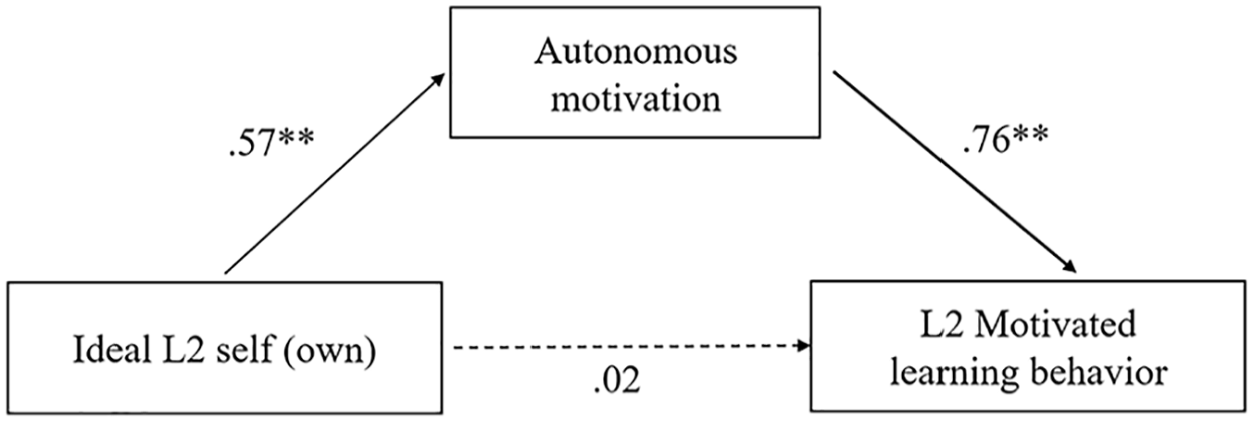
A casual chain including autonomous motivation as a mediator on the relationship between ideal L2 Self (own) and L2 motivated learning behavior.

A casual chain including autonomous motivation as a mediator on the relationship between ideal L2 self (other) and L2 motivated learning behavior.
Discussion
The motivation theories reveal different aspects of motivation through their different approaches to help us identify the causes behind people’s behavior, and the intensity and persistence of their effort (Dörnyei, 2001). This study attempted to make our view of human motivation in the area of language learning more comprehensive by considering constructs of the two major motivation theories that are often employed as frameworks: L2 self-guides and SDT.
Concerning RQ 1, this study examined the correlations between the constituents of the two theories. First, regarding L2 self-guides with a promotion focus, it generally appears they are related to the two components of AM, that is, identified motivation and intrinsic motivation. IDown was shown to have the highest correlation with identified motivation (r = .54), followed by with intrinsic motivation (r = .52). IDother was also correlated with identified motivation (r = .42), followed by intrinsic motivation (r = .23). This is consistent with the findings of Takahashi and Im (2020) although the construct of ideal L2 self in their study is not divided into two based on the standpoints (own and other). On the other hand, L2 self-guides with a prevention focus were found to have weak or nonsignificant correlations with AM. OTown was found to have a significant correlation with identified motivation with relatively weak strength (r = .19), but not with intrinsic motivation. OTother had a negative relationship with intrinsic motivation (r = −.11).
In the current 2 × 2 model, L2 self-guides with a promotion focus reflect individuals’ orientation toward positive future outcomes such individuals’ aspiration, hopes, or ideals (Higgins, 1997) in language learning, including both personal (own) or social (others) points of view. On the other hand, SDT assumes that individuals regulate their behavior according to their sense of self; when the individuals feel that learning a language is in line with their interests, values, or priorities, they tend to be more motivated to engage in language learning. More specifically, it is seen that when individuals’ perceived value or importance in a certain activity is internalized, they are more likely to be motivated to perform that activity (McEown et al., 2014). The findings in this study clearly show that L2 self-guides with a promotional focus are more deeply related to AM than those with a prevention focus when learning English. In other words, it is likely that L2 self-guides with a promotion focus and the two constructs of AM share some characteristics.
To address RQ 2, the predictive powers of the two types of AM and the four L2 self-guides toward MB were examined and compared. As presented in the results, among the four L2 self-guides, only promotional focused self-guides, IDown and IDother, predicted students’ MB. Particularly, looking at L2 self-guides with a promotion focus, own standpoint (which is more internalized) appears to have a more predictive value for MB than other standpoint, which is consistent with Higgins (1987) claim.
Prevention focused self-guides, OTown and OTother, were found not to have any significant predictive values of MB, lending further supports to the findings of several previous studies which were conducted in the EFL contexts (e.g., Csizér & Kormos, 2009; Papi & Teimouri, 2012, etc.). It is worth noting that the current findings are not consistent with those of Papi et al. (2019) although this study employed the same scales developed by them. Papi et al. (2019) reported OTown as having the highest predictive power of motivated behavior among the four self-guides. While Papi et al.’s (2019) study highlights the positive role and effect of OTown in L2 learning, the contextual issue appears to be an important consideration along with accurate conceptualization and operationalization as they indicated. Different contexts may differently impact how those contexts are reflected in the motivational process (Heine, 2010; McEown et al., 2014). The investment of the ESL participants in learning and using English in the study by Papi et al. (2019) appears to be significantly different from the EFL participants in this study and those of several other studies with similar findings (e.g., Csizér & Kormos, 2009; Lamb, 2012; Papi & Teimouri, 2012; Taguchi et al., 2009; Teimouri, 2017, etc.) in terms of finance, time, and effort spent: living an average of 29 months as the international university students in an English academic context in the U.S. Reinterpreting their results from this point of view, it is plausible that prevention-oriented regulations such as subjective obligations, duties, and requirements to avoid negative outcomes have been greatly internalized in these ESL participants, unlike those of the current study. However, this should be in the subject of future studies.
Referring to AM, both intrinsic motivation and identified motivation were shown to have greater predictive values for intended behavior (both ß = 0.71) than those of IDown (ß = 0.46) and IDother (ß = 0.29). In other words, these self-guides, which represent the qualities that individuals or significant others hope them to have in the future, have meaningful effects on MB. However, the current results indicate that the effects of AM toward MB are greater than those of L2 self-guides with a promotion focus. They support Ryan and Deci’s (2000) claim that AM is strongly related to behavioral effectiveness. This is reasonable in the sense that behaviors occur or are informed by what the individuals are interested in, what they consider important, or what they believe to be valuable.
L2 future self-guides with a promotion focus may be a powerful motivator that drives individuals toward their MB by allowing them to imagine a future using the target language competently and actively participating in the imagined community (Kanno & Norton, 2003). However, this study indicates that how much the act of learning a target language activity coincides with the interests, values, and importance that individuals hold, in real time, functions as a much greater motivator for their MB than those of future L2 self-guides.
Concerning RQ 3, this study further explored the relationship between L2 self-guides with a promotion focus such as IDown and IDother, AM, and MB. Because L2 self-guides with a prevention focus, that is, OTown and OTother, were found not to have any predictor values toward MB in this study, they were not included in this investigation. Following the three-step approach of mediation analysis proposed by Baron and Kenny (1986), it was found that AM completely mediates L2 self-guides with a promotion focus and MB. This means that both IDown and IDother affect MB only through AM. These results highlight the role of AM, the mediator, in these causal relationships. It can be interpreted that in order to change the dependent variable, MB, the independent variable, L2 self-guides with a promotion focus should be changed. However, changing these self-guides do not directly affect students’ MB. That is, students’ MB changes only through AM, the mediating variable.
This finding illustrates that, in order to obtain positive outcomes, students need to have both promotion focused L2 self-guides to begin with because this motivational relationship starts from them irrespective of the standpoints of own and other. Students’ vivid imagination for a positive future self is seen as crucial to initiate this positive causal chain. In particular, the study by Papi et al. (2019) confirmed that L2 self-guides with a promotion focus are related to eager strategic inclinations that maximize the presence of positive outcomes. Aspirations or hopes for the imagined future self, whether they are formed from own or other standpoints, are mediated by AM, that is, an individual’s internalized volition, values, or interests of learning English, affecting MB. This finding supports those of the study by Tsao et al. (2021), which identified the mediating roles of more autonomous and internalized types of motivation in the relationship between ideal L2 self writing self and the engagement with written corrective feedback. Importantly, these findings indicate that when examining motivated effort in relation with L2 self-guides with a promotion focus, AM should also be taken into account as a mediator for a more comprehensive picture.
Conclusion
This study aimed to explore the relationships between motivation and its outcome by extending research beyond the boundaries of the two representative motivation theories. To this end, the recently introduced L2 self-guides in the 2 × 2 model and SDT were considered along with the L2 motivated learning behavior to obtain fuller understanding of motivation in the Korean EFL learning context. Through the current study, first, it was found that the major constructs, which are L2 self-guides with a promotion focus and AM share some characteristics. Second, AM based on SDT predicted motivated behavior much stronger than the two self-guides, IDown and IDother. Lastly, in the relationship between the two L2 self-guides, AM, and MB, the results showed that AM serves a role of a complete mediator between the L2 self-guides and motivated behavior. These results indicate that when considering L2 self-guides along with L2 motivated learning behavior, there is a need to include AM to see how the motivational causal relationship affects motivated behavior.
There are some limitations to admit for future studies. First, the study explored the effect of motivation on L2 motivated behavior. It would be informative to include students’ objective English performance data in such a relationship to find out how this causal chain is related to English achievements. Second, the participants in this study were mostly freshmen who have just entered university, so there would have not been many cases of overseas experience, but at the time of data collection, this issue, which could possibly be an important variable, was not addressed. In future research, it would be recommendable to include this variable and compare the causal chains. Lastly, this causal chain, the effect of ideal L2 self on outcome variables via autonomous motivation needs to be further studied in other skill areas such as speaking or listening. This will help to better understand the motivations of students learning English.
Footnotes
Declaration of Conflicting Interests
The author declared no potential conflicts of interest with respect to the research, authorship, and/or publication of this article.
Funding
The author received no financial support for the research, authorship, and/or publication of this article.
