




Abstract
With few adults completing recommended levels of aerobic and muscle-strengthening activities, it is important to examine the motives of those who do, as well as how those motives might differ by participation frequency. Considering the rapid growth of CrossFit Training (CFT), we examined CFT participation motives in individuals training at different frequencies. Adults (N = 732) with >3 months of CFT experience completed an online version of the Exercise Motivations Inventory–2 (EMI-2). Significant correlations were seen between CFT frequency and all EMI-2 variables except for those related to health pressures, ill-health avoidance, and appearance. Kruskal–Wallis tests showed individuals training <3 days/week scored lowest on enjoyment, affiliation, and competition motives. Those training >5 days/week scored highest on challenge, social recognition, strength and endurance, and nimbleness motives, but lowest on weight management. Our results suggest that CFT participants who trained more frequently report motives that satisfied competence, autonomy, and relatedness needs.
Introduction
Although participating in regular physical activity can result in physiological and psychological health benefits, only about 20% of adults in the United States meet the minimum recommendations, which include moderate and vigorous aerobic activity and full-body muscle strengthening (Harris, Watson, Carlson, Fulton, & Dorn, 2013). With lack of time and motivation cited as the most common barriers to exercise (Alharbi et al., 2017; Trost, Owen, Bauman, Sallis, & Brown, 2002), practitioners and public health advocates are in need of effective strategies to increase participation in exercise programs and improve exercise adherence. High-intensity exercise has recently increased in popularity (Thompson, 2017) even though it has been linked with decreased levels of pleasure during the exercise session (Ekkekakis, Hall, & Petruzzello, 2008; Ekkekakis, Parfitt, & Petruzzello, 2011). One such version, high-intensity functional training (HIFT), uses multi-joint exercises that temporally combine aerobic and muscle-strengthening activities with self-selected intensity (Heinrich, Patel, O’Neal, & Heinrich, 2014). This may serve as a time-effective way to satisfy the minimum goals of the physical activity guidelines (Physical Activity Guidelines Advisory Committee, 2008).
As a form of HIFT (Heinrich et al., 2014), CrossFit training (CFT) has rapidly grown in popularity, with the number of CrossFit affiliate gyms increasing exponentially around the world over the past decade (Ritter, 2014). Originally created by Greg Glassman in California in the mid-1990s, CFT offers participants an opportunity for self-improvement and reinvention of the body and of one’s identity (Dawson, 2017). As of 2016, CrossFit, Inc. has evolved into a trademarked fitness company with over 13,000 affiliates worldwide and branded itself the “sport of fitness” (Whiteman-Sandland, Hawkins, & Clayton, 2016).
CFT utilizes constantly varied, multi-joint, functional movements that incorporate both cardiovascular and muscular strengthening exercises, performed at relatively high intensity (CrossFit, Inc., 2014). In addition, CFT workouts are typically completed in a group setting, allowing participants to harness social facilitation effects and a sense of community (Heinrich, Carlisle, Kehler, & Cosgrove, 2017). Thus, compared with other exercise and physical activity programs, CFT is a unique, physically challenging, group-oriented form of exercise that is dependent on an individual’s self-regulation, as each session provides the opportunity to perform a set of exercises at an individual’s own intensity level (Ryan & Deci, 2006).
As an inverse relationship between exercise intensity and affective response (pleasure/displeasure) has been reported, engaging in high-intensity exercises should result in decreased pleasure during the workout (Ekkekakis et al., 2011). But unlike aerobic high-intensity interval training completed at a specified resistance or intensity on a treadmill or stationary cycle (Kilpatrick, Jung, & Little, 2014), CrossFit workouts are completed with the individual self-regulating their workout intensity (e.g., working out as hard as they are able), which may produce greater exercise satisfaction and self-determination (Davies, Coleman, & Stellino, 2016; Heinrich et al., 2014). In addition, workouts can be competitive events where an individual can compete against themselves (i.e., comparing with their previous workout time, repetitions, or weight lifted) or others doing the same workout. As such, this type of training may have greater perceived utility than all other forms of exercise (Lee, Emerson, & Williams, 2016).
CFT blurs the line between exercise (planned, structured, repetitive and purposive activity to maintain or improve fitness) and sport (physical activities involving competition, for which participation is typically measured on a weekly basis) (Kilpatrick, Hebert, & Bartholomew, 2005). CFT has also been shown to promote greater adherence to exercise than typical aerobic and resistance training programs (Heinrich et al., 2014). Considering its rapid growth, the unique context of CFT and its emphasis on both competition and high-intensity exercise training makes it an ideal setting within which to examine participation motives.
Motivation, Self-Determination Theory (SDT), and CFT
Motivation is a compulsive force that a person experiences for fulfillment of his or her biological needs or psychological desires (Ryan & Deci, 2000). It is believed that human motivation is focused on the fulfillment of both fundamental needs (i.e., physiological, safety, belonging) and more advanced needs, such as self-esteem and self-actualization (Maslow, 1943). Motivation is thought to range from intrinsic or internal regulation (e.g., when someone does something for his or her personal pleasure without a reward) to extrinsic or external regulation (e.g., when someone does something tied to others and/or reward) (Deci & Ryan, 1975).
Motivation helps facilitate exercise participation and adherence, and participation motives are the reasons individuals engage in a specific behavior (Ingledew & Markland, 2008). As participation motives are considered specific to a particular domain of behavior (Ingledew & Markland, 2008), a range of motives have been proposed for exercise participation, including skill mastery, competition, social affiliation, recognition, health benefits, and physical fitness (Weed & Bull, 2004). Competitiveness and the development of skills and competencies are also identified motives for sport (Weed & Bull, 2004). Direct comparison of sport versus fitness participants shows sport participants to have higher intrinsic motives (e.g., skill improvement, fun, enjoy competition), whereas fitness participants have higher extrinsic motives (e.g., lose weight, improve physical appearance) (Frederick & Ryan, 1993). This is important because autonomous intrinsic motives (e.g., social affiliation, personal challenge) facilitate participation, and weight loss and appearance motives may hinder long-term participation, especially as the outcome associated with these motives takes longer to occur (Frederick & Ryan, 1993).
SDT (Ingledew, Markland, & Medley, 1998; Ryan & Deci, 2000) is a widely applied conceptual framework used to identify various motives in sport and physical activity and proposes that intrinsic and extrinsic elements are influenced by personal and cultural factors (Deci & Ryan, 1985; Ingledew et al., 1998). SDT identifies three important needs that motivate human action: autonomy, the individual’s desire for self-initiative in regulating actions; competence, the individual’s desire to interact effectively with his or her environment; and relatedness, the individual’s desire to feel connected with others (Rodgers, Markland, Selzler, Murray, & Wilson, 2014; Ryan & Deci, 2006). Fulfillment of these three needs satisfies internal regulation and intrinsically motivates participation in a behavior (Edmunds, Ntoumanis, & Duda, 2006). Therefore, creating an environment where an individual’s autonomy, competence, and relatedness are enhanced should lead to greater motivation and engagement, thereby leading to improvement in performance (Deci & Ryan, 2000).
Characteristics of the SDT may be especially salient in the context of CFT because successful performance of a skill may reflect and reinforce participant motives. One study found that newer participants in this training modality (<6 months experience) reported higher mastery goal orientations than more experienced participants, likely due to their desire to learn new skills and the social norms within this exercise setting (Partridge, Knapp, & Massengale, 2014). Another study found that more frequent weekly participation in CFT (3 or more days/week) was related to higher satisfaction levels for autonomy, competence, and relatedness (Davies et al., 2016). However, to our knowledge, no other study has explored how specific motives may be related to weekly frequency of participation (i.e., adherence) in CFT. Thus, given the exponential growth of this training modality in the United States and around the world, the aim of this study was to examine participants’ motives, within the framework of SDT, among individuals who engaged in this training modality with different training frequencies. We hypothesized that differences would exist between the groups, whereby those training more frequently would have higher intrinsic motives compared with those training less frequently, who would be more extrinsically motivated.
Method
Design and Participants
This study was designed to reach a large cross-sectional convenience sample of participants engaged in CFT. Adults over 18 years with more than 3 months of CrossFit experience were recruited to participate in this study. An electronic questionnaire was developed using a Google-based form to allow for digital administration of the measure. Considering the international appeal of this training modality, both English and Spanish versions of the survey were available. The survey was distributed via CrossFit gym owners and members of the CrossFit community, both nationally and internationally, using social media. The online application Bitly (Bitly, Inc., New York, NY) was used to shorten the survey link and to track the number of “clicks” the survey received. Although this tracking did not store Internet Protocol (IP) addresses from any computer, it allowed estimation of global reach and response rate calculation for the survey. All participants provided informed consent prior to beginning the survey, and the study protocol was approved by the institution’s ethics review board (Study #13-167).
Measures
The questionnaire included several demographic questions, including the frequency of CFT (<3 days/week, 3-5 days/week, >5 days/week). The Exercise Motivations Inventory (EMI) is a validated measure designed to investigate individuals’ reasons or motives for participating in exercise (Ingledew et al., 1998). Using SDT as a theoretical base, Markland and Ingledew (1997) developed the EMI to measure exercise motives that could predict perceptions of autonomy and enjoyment. The original version was later updated (Exercise Motivations Inventory–2 [EMI-2]) to include fitness-related motivational factors, revised wording relevant for nonexercisers, and refined motivational factors (Markland & Ingledew, 1997).
The EMI-2 is a 51-item scale comprising 14 different subscales (Markland & Ingledew, 1997). Each subscale comprises two to four items rated on a 6-point Likert-type scale (0 being “not at all true for me” and 5 being “very true for me”), which required participants to reply to statements concerning reasons why they currently exercised and whether they exercised regularly or not. The 14 subscales included items related to enjoyment, challenge, revitalization, stress management, affiliation, social recognition, competition, health pressures, ill-health avoidance, positive health, appearance, weight management, strength and endurance, and nimbleness. These subscales were all related to five overarching themes based on SDT: Psychological Motives (enjoyment, challenge, revitalization, stress management), Interpersonal Motives (affiliation, social recognition, competition), Health Motives (health pressures, ill-health avoidance, positive health), Body-Related Motives (appearance, weight management), and Fitness Motives (strength and endurance, nimbleness) (Markland & Ingledew, 1997).
Statistical Analysis
Internal consistencies of each item were measured using Cronbach’s alpha (Bland & Altman, 1997), with values ranging from .748 to .929 except for items related to Revitalization (α = .656) and Health Pressures (α = .465) (Table 1). Item deletion for either of the two subscales did not result in an increased alpha. These findings were consistent with those reported by Markland and Ingledew (1997) when generating the EMI-2, which found some ambiguity in the items comprised in the last two subscales.
Exercise Motivations Inventory–2 (EMI-2) Subscale Reliability Assessment (N = 732).
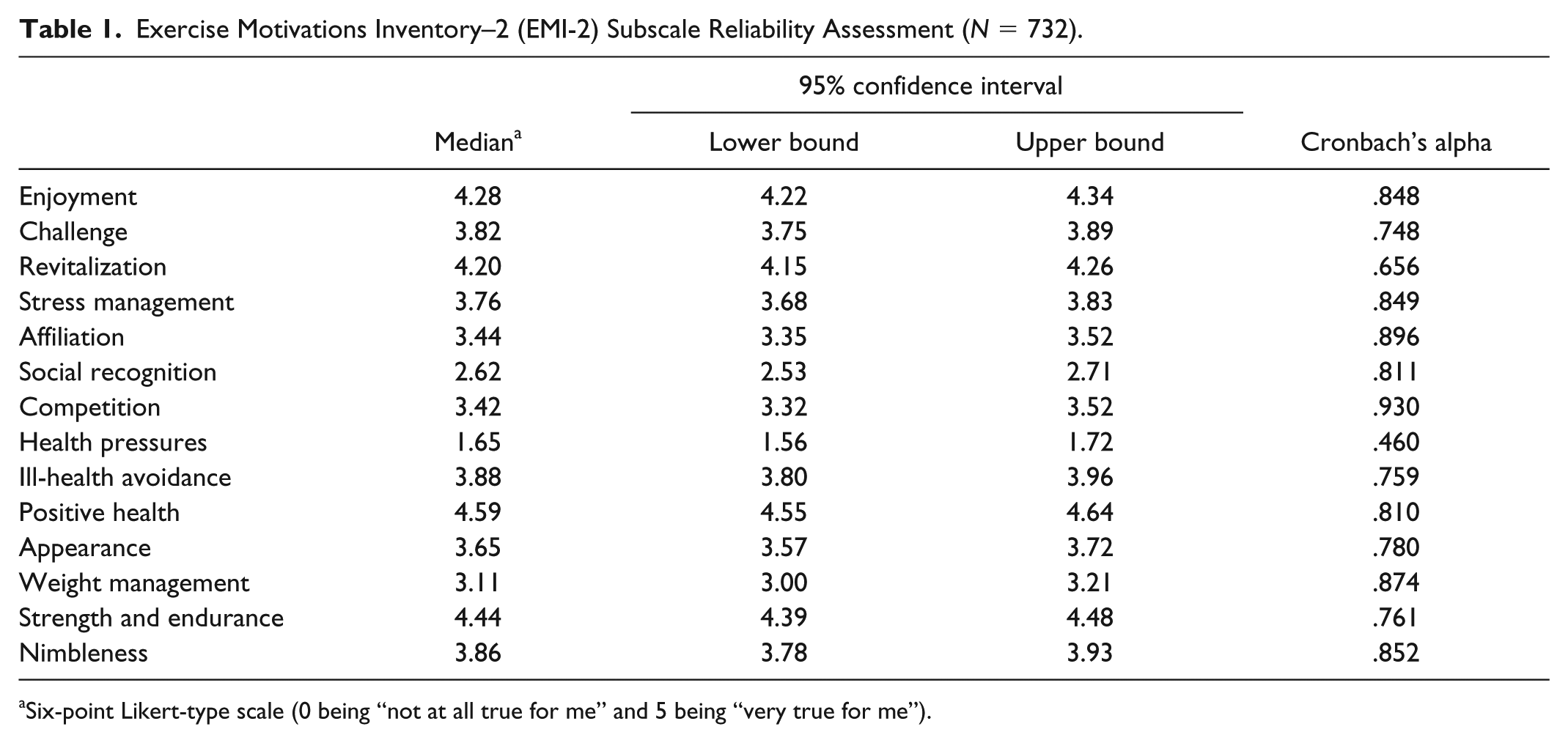
Six-point Likert-type scale (0 being “not at all true for me” and 5 being “very true for me”).
To determine a “score,” the items in each subscale were added, and mean values were calculated. These mean values were tested for normality using the Kolmogorov–Smirnov test. Assumption of normality was violated by all dependent variables; therefore, nonparametric tests were used throughout. Considering this violation of normality by all EMI-2 factors, median (Mdn) and 95% confidence intervals (95% CI) were calculated and reported for all dependent variables.
Spearman’s rho (ρ) was used to examine potential relationships between the EMI-2 variables and frequency of CFT (<3 days/week, 3-5 days/week, >5 days/week). The Kruskal–Wallis H test was used to examine differences in the distribution of the 14 motivational subscales based on the participants’ weekly CFT participation (days per week). Post hoc comparisons were conducted using the Dunn–Bonferroni method to further elucidate differences between those participating in different frequencies of CFT throughout the week. All data were collected between December 1, 2011, and March 1, 2012, via a Google Forms survey and downloaded into Excel 2011 (Microsoft Co., Redmond, WA). Statistical analyses were conducted using SPSS 24.0 (SPSS, Chicago, IL). A significance level of alpha <.05 was chosen to denote statistical significance, and p values are reported as two-tailed.
Results
Although the overall survey reach was unknown, the Bitly application recorded a total of 838 clicks to the survey. Of those, 744 participants completed the survey. Thus, response rate was estimated at 89%, which was above the typical ranges provided for online surveys. Analysis was completed on 732 participants (388 males; 344 females) who confirmed their participation in CFT for more than 3 months; 12 cases had missing data and were removed from the sample. The majority of participants (56%) reported engaging in CFT 3 to 5 days per week. Mean (± SD) participant age was 32.4 ± 8.2 years (Table 2). Although the survey was available to anyone with Internet access, 92% of respondents identified themselves as living in the United States, and 98% completed the survey in English.
Participant Descriptive Information (N = 732).

Note. BMI = body mass index.
Spearman’s rho (ρ) correlations showed statistically significant relationships between CFT frequency and all EMI-2 subscales except motives related to health pressures (ρ = −.037; p = .314), ill-health avoidance (ρ = .01; p = .797), and appearance (ρ = −.024; p = .517) (Table 3). Of note, only weight management was negatively correlated with CFT frequency (ρ = −.192; p < .001).
Spearman’s Correlations Between Training Frequency (<3 days/week, 3-5 days/week, >5 days/week) and EMI-2 Subscales (N = 732).
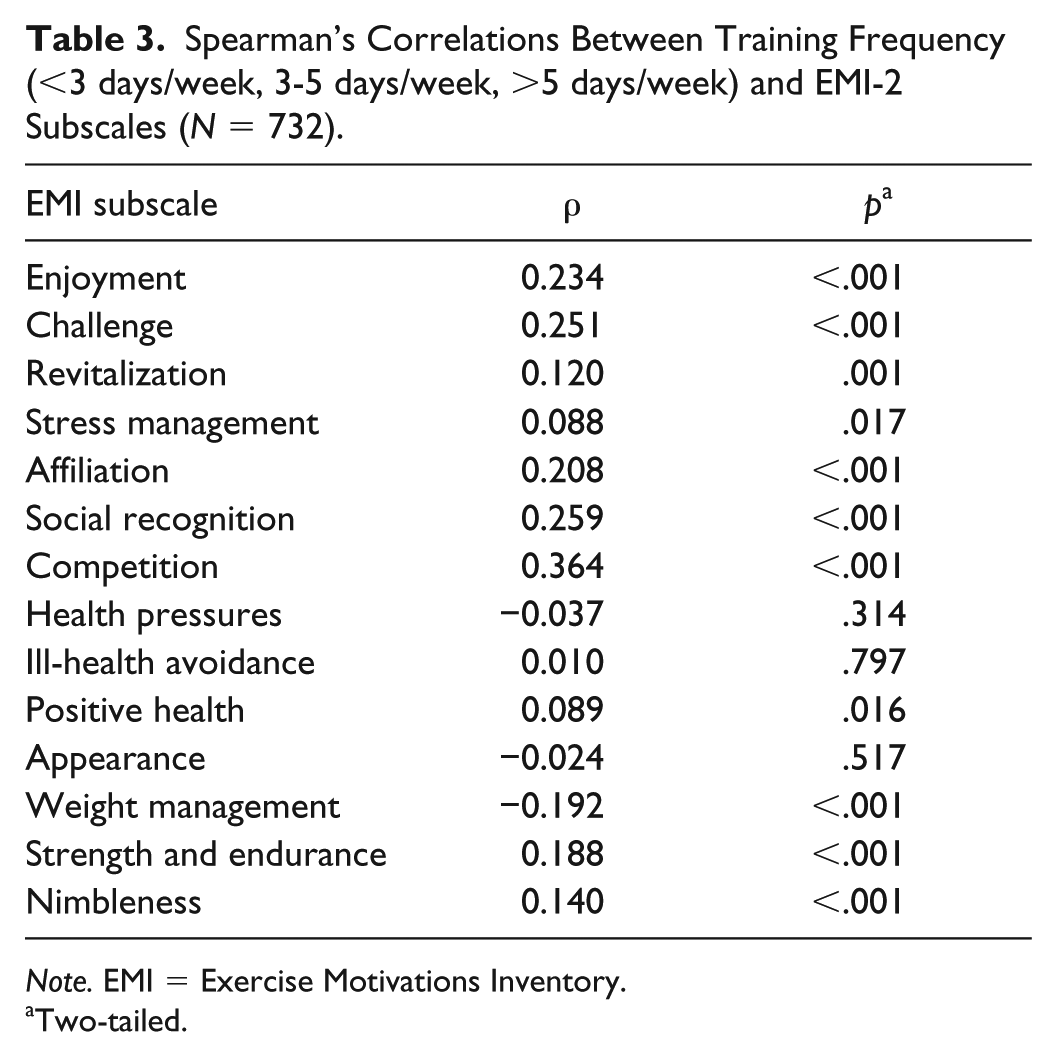
Note. EMI = Exercise Motivations Inventory.
Two-tailed.
Table 4 provides the results of the Kruskal–Wallis H test and Dunn’s post hoc tests. Overall, significant differences were found for the majority of EMI-2 subscales between the three training frequency groups. When compared with those who trained <3 days/week, individuals who reported training 3 to 5 days/week and >5 days/week had higher median scores for items related to enjoyment, affiliation, and competition (all ps < .001). Those who reported training >5 days/week also showed higher median scores related to challenge (p < .001), social recognition (p < .001), strength and endurance (p < .001), and nimbleness (p = .004) than those who reported training 3 to 5 days/week and <3 days/week. In addition, those who reported training >5 days/week had significantly lower median values weight management compared with those who reported training 3 to 5 days/week and <3 days/week (p < .001).
EMI-2 Subscale Analysis Based on Training Frequency (N = 732; Median ± 95% CI).

Note. EMI-2: 6-point Likert-type scale (0 being “not at all true for me” and 5 being “very true for me”). EMI = Exercise Motivations Inventory; CI = confidence interval.
Significantly different from < 3 days/week, p < .05.
Significantly different from < 3 days/week, p ⩽ .001.
Significantly different from 3 to 5 days/week, p ⩽ .001.
Significantly different from 3 to 5 days/week, p < .05.
Discussion
The purpose of this investigation was to examine how intrinsic and extrinsic motivational factors differed between individuals engaging in CFT based on their frequency of training. As hypothesized, significant differences were found, whereby those who trained most frequently (i.e., >5 days/week) scored higher for intrinsic subscales (i.e., enjoyment, challenge, affiliation, and competition), whereas those training 5 or less days/week scored highest for the extrinsic weight management subscale.
It was our underlying assumption that differences between training frequency and motivational factors among individuals participating in CFT would exist. Specifically, it was hypothesized that participants training more frequently would have higher intrinsic motivators compared with those who trained less frequently, who may be more apt to be motivated by extrinsic factors. However, as the findings suggest, both intrinsic and extrinsic motives were related to training frequencies among these participants. According to SDT, individuals are motivated to participate in experiences that satisfy their basic psychological needs for relatedness, autonomy, and competence (Deci & Ryan, 2002). Based on these findings, it appears that those who participate in CFT with greatest frequency are more motived by the need for relatedness through interpersonal motives (i.e., affiliation, social recognition, competition), autonomy through psychological motives (i.e., enjoyment, challenge, revitalization), and the need for competence through fitness motives (i.e., strength and endurance, nimbleness) than those who trained less frequently, who were more motivated by weight management. These results are largely supported by the previous literature concerning SDT (Deci & Ryan, 1985) in sport and exercise settings and present an original insight into the motivational scope of the CFT modality.
It is interesting to note that the subscales comprising health motives and appearance, all extrinsic motives, were rated similarly between the training groups. These similarities among the groups may be related to the relatively younger sample included in this study. Previous investigators have suggested that younger adults are more likely motivated by appearance, whereas older adults are motivated more by the intrinsic aspects of exercise (e.g., health benefits; Davies et al., 2016; Kilpatrick et al., 2005). In addition, stress management did not significantly differ between the groups. However, our data suggest that motivational factors other than health motives, appearance, and stress management are significantly and positively correlated with frequency of training, which supports the notion that participants had multiple motives for engaging in CFT more frequently.
The SDT approach provides considerable flexibility for understanding patterns of exercise behavior, health outcomes associated with exercise participation, and intrapersonal (e.g., basic psychological needs) and interpersonal (e.g., autonomy supportive contexts) factors, which promote more adaptive (or self-determined) motives for exercise (Wilson, Mack, & Grattan, 2008). Due to the unique characteristics of CFT, it has the potential to promote the psychological needs of relatedness, self-determination/autonomy, and competence within this group-oriented fitness modality.
Ryan and Deci (2000) noted that humans have an innate tendency to pursue activities that extend and challenge one’s capabilities. Davies, Coleman, and Babkes-Stellino (2016) suggested that CFT is a unique, challenging, group-oriented form of exercise that depends on an individual’s self-regulation (p. 241). As such, considering the nine motivational factors associated with frequency of training in this study, most participants seemed to be primarily motivated by a combination of fitness motives (i.e., strength and endurance) and relatedness factors (i.e., affiliation and social recognition). It is possible that a relationship may exist between strength and endurance as an acquired skill and perceived training competence (Rodgers et al., 2014). These two factors, competence and relatedness, are at the core of the CFT methodology. Moreover, it may be that CFT may have the potential to combat current levels of physical inactivity not only by providing opportunities to fulfill psychological needs for competence and relatedness but also by providing participants a purpose while exercising—completing a specific number of repetitions in the least amount of time, or the greatest number of repetitions in a specified amount of time. In 2016, Lee and colleagues (2016) proposed that current levels of physical activity participation may simply be an evolutionary tendency to avoid unnecessary physical exertion. Therefore, providing opportunities for greater perceived purpose whereby each person is able to complete a greater range of physical activities as a result of gains in functional capacity (Heinrich et al., 2015) may be influencial in promoting greater levels of physical activity.
Psychological Motives
This subscale included four intrinsic motivational factors positively associated with training frequency: enjoyment, challenge, revitalization, and stress management. However, only the first three were significantly different among the groups. As enjoyment was the only factor that was significantly higher with each training frequency, this suggests that higher enjoyment of this training modality may lead to greater training frequency. Study findings are in agreement with recent studies by Heinrich et al. (2014) and Fisher, Sales, Carlson, and Steele (2017), who reported higher enjoyment among participants engaged in CFT compared with individuals involved in more traditional resistance training programs. To some degree, enjoyment may also be intertwined with relatedness, where individuals attending more often can create meaningful relationships with others and similarly promote greater training frequency. Engagement in activities that satisfy this basic need for relatedness contributes to the individual’s growth and well-being (Deci & Ryan, 2008). Thus, these findings largely support the theoretical underpinnings of SDT (Deci & Ryan, 1985; Deci & Ryan, 2000) and are particularly relevant given the intense physical expenditures often required to participate in CFT.
Interpersonal Motives
When looking at interpersonal motives (i.e., competition, affiliation, social recognition), which are considered extrinsic motives, all were rated significantly higher with increasing training frequency. Competition has been previously found to be an important motivator for participants who engaged in physical training more regularly and considered it part of a sport, rather than just recreation (Fisher et al., 2017; Hanrahan & Cerin, 2009). Recent findings from qualitative research assessing CrossFit coaches identified both social facilitation (improved performance with others versus alone) and sense of community as important factors for initiation of and adherence to CFT (Heinrich et al., 2017), which supports the finding of increased affiliation with more training engagement. Although social recognition was scored the lowest of all items in this category, it was scored significantly higher for those training the most. Whiteman-Sandland et al. (2016) recently demonstrated that CrossFit athletes reported higher social capital compared with those attending a traditional fitness facility. In addition, feelings of belongingness were also higher among the CrossFit trained participants than their traditional training group, which further supports our findings (Whiteman-Sandland et al., 2016).
Health Motives
The items that made up the extrinsic health motives subcategory were all related to an individual’s health status (i.e., health pressures, ill-health avoidance, and positive health). Health pressures were the lowest scored motive for all three training frequency groups, while positive health was the highest, although no statistically significant differences were found between groups. It is likely that an older sample of participants may have rated health motives higher than the current sample, similar to Fisher et al. (2017). As described by Davies et al. (2016), those individuals who were more connected to the training and community seemed to have greater intrinsic motivation and engaged in the activity regardless of any health pressures. Although not actually measured, it is possible that these participants understood the health benefits associated with an active lifestyle, and more specifically with the CFT methodology.
Body-Related Motives
The body-related subcategory comprises appearance and weight management motives. As mentioned previously, differences were not observed for items related to appearance between the three groups. However, individuals who participated in CFT more than 5 days per week had significantly lower weight management motives compared with those who engaged in CFT 5 or less days per week. Previous studies have found that individuals who took part in fitness pursuits were more likely to be motivated by weight management than those who participated in a specific sport (Frederick & Ryan, 1993; Ryan, Frederick, Lepes, Rubio, & Sheldon, 1997). Thus, those who are more dedicated to CFT and pursue the “sport of fitness” may consider it more as a sport and not prioritize it for weight management.
Fitness Motives
Fitness motives are associated with extrinsic concepts related to the enhancement of one’s body, such as improvements in strength and endurance, nimbleness, and/or flexibility. As these are key areas of focus for CFT (CrossFit, Inc., 2014), it makes sense that participants found these motives to be important. However, those who engaged in CFT more than 5 days per week showed significantly higher fitness motives compared with those engaging in CFT less often. Within the context of the SDT, Davies and colleagues (2016) recently described how CrossFit participants in their study were more motivated by internal regulators, including personal goals related to health and fitness. Although CFT participants understand the benefits of exercise, there may be factors that affect participation other than the typical fitness motives.
Although the findings of this research are novel, they are not without limitations. Mainly, the study was restricted to those who agreed to take and complete the online survey, which would allow for selection bias. Only individuals participating in CFT were surveyed, so their responses cannot be compared with participants in other types of exercise and sport. Moreover, the survey included a very small sample of those currently engaging in CFT, which currently spans throughout the world with over 13,000 affiliates. Nonetheless, these findings build upon previous research and begin to establish a more thorough understanding of training motives related to CFT, which have been lacking.
Conclusion
These findings provide novel and significant insight regarding important motives for individuals engaging in different frequencies of CFT. The variety of workouts, the scalability, and the camaraderie make CFT an intriguing form of physical activity that can promote the benefits of an active lifestyle (Heinrich et al., 2017). Because CFT workouts are constantly varied, they allow for new and exciting forms of daily exercise, which in turn reinforces motivational factors for exercise adherence. In addition, as CrossFit workouts incorporate both aerobic and muscle-strengthening activities, they are helpful for meeting current physical activity recommendations (Heinrich et al., 2014). Thus, CFT or other types of HIFT are important forms of physical activity, with potential public health implications. Future studies should attempt to elucidate how motives to participate in CFT are affected by age or length of participation in CFT, as well as how CrossFit participation motives may change over time.
Footnotes
Declaration of Conflicting Interests
The author(s) declared no potential conflicts of interest with respect to the research, authorship, and/or publication of this article.
Funding
The author(s) received no financial support for the research, authorship, and/or publication of this article.
