




Abstract
Information and communication technology (ICT) is substantially beneficial for rural entrepreneurship. A better understanding of factors contributing to ICT adoption is needed for wide promotion, yet it remains underexplored This study investigated the factors affecting ICT adoption intention. From the technology, individuals, and environment dimensions, an extended technology acceptance model (TAM) was proposed, and data from 327 rural entrepreneurs and the method of SEM were used to test the hypotheses. The moderating effect of multi-group on each path was discussed, including online and offline organizations and entrepreneurs with and without previous experience. Results show that, except for core variables in the TAM, social influence and relative advantage positively influence ICT adoption intention directly and indirectly. Increasing the relative advantage of ICT among enterprises with offline businesses can significantly improve their ICT adoption intention. For entrepreneurs without previous experience, perceived ease of use significantly and positively affects attitudes toward ICT adoption.
Introduction
The wide application of information and communication technology (ICT) has a growing impact on various sectors in rural areas. Traditional rural societies ushered in an important opportunity for transformation (Aruleba & Jere, 2022). ICT is a powerful engine that accelerates innovation and entrepreneurship and has greatly facilitated rural entrepreneurship activities (Mivehchi, 2019). Moreover, compared to urban areas, ICT use tends to positively impact entrepreneurship in rural areas through two methods: social network expansion and information and knowledge acquisition (Barnett et al., 2019; Chatterjee et al., 2020). ICT adoption in rural entrepreneurship can lead to increased income (Chatterjee et al., 2020), improved livelihoods (Diaz et al., 2021), enhanced firm performance (Martinez-Caro et al., 2020), and boosted agricultural modernization (Yoon et al., 2015). Thus, enhancing ICT utilization in rural entrepreneurship, which is the backbone of the rural economy, can improve farmers’ livelihoods and promote rural development.
ICT is a concept with rich connotations, including hardware and software, such as the Internet, the Internet of Things, remote positioning, monitoring, identification, and satellite systems, as well as various related services and applications. ICT adoption in rural entrepreneurship encompasses the whole process, from the fact that start-ups demonstrate the need to adopt ICT to the fact that it actually uses and maximizes its potential benefits (Ziemba, 2021). However, these benefits can be demonstrated only when rural entrepreneurs adopt ICT. Moreover, the determinants of rural entrepreneurs’ ICT adoption remain unknown.
Studies on ICT adoption intentions of rural SMEs or communities have investigated the determinants of technology adoption, focusing mainly on organizational and adopter socioeconomic characteristics, such as educational background (Salemink et al., 2017; Tambotoh et al., 2015), digital service awareness, digital skills and literacy (Barnett et al., 2019; Kamutuezu et al., 2021), language barriers (Y. Lu et al., 2019); technical characteristics, such as high cost, operational complexity, and incompatibility with the task (Nkosana & Skinner, 2016); and application environment, such as infrastructure, Internet access, financial resource support, top management support (Kumar Bhardwaj et al., 2021), and environmental uncertainty (Kamutuezu et al., 2021). However, broader issues of social context, organizational factors, and related technological innovation must be examined to reduce ICT adoption barriers, particularly in developing countries (Venkatesh et al., 2016).
Due to the “social” attribute, potential users in China who are cousins, acquaintances, or neighbors of early ICT adopters are more likely to adopt new technologies (Nakano et al., 2018). Social influence or social recommendation plays a crucial role in developing novel usage patterns (Hizam et al., 2021). Some technology adoption barriers can be reduced through policy and regulatory interventions (Musingafi & Zebron, 2014), and informal institutions may also perform more significantly (Geng & Xue, 2023). However, existing research rarely extended this perspective to the social impact dimension. Technology should benefit the end user for the user to accept it (Zuiderwijk et al., 2015). Rural entrepreneurship is an economic activity to maximize profit, which means that entrepreneurs choose to adopt ICT because it is more advantageous than adopting other tools or not adopting them. The intention to use a system or technology is directly influenced by its advantages (Ziemba, 2021). Majority of the research focused on system quality, security, compatibility (Hasan et al., 2015), and so on has neglected the innovative features of the technology, such as its relative advantage.
Technology-based theories have been widely employed to examine ICT adoption behaviors, such as the technology acceptance model (TAM) and its extensions. One’s willingness to accept an innovative technology depends on perceived ease of use (PEOU), perceived usefulness (PU), and attitude toward it, according to the key view in TAM (Davis, 1986, 1989). Studies have criticized that it failed to reveal influences that go beyond the human–technology relationship and proposed a TAM2 (Venkatesh & Davis, 2000), or other extended TAM, in which also involve social influence. But they remain based on the two core variables of TAM and extended in particular research settings. Furthermore, the unified theory of acceptance and usage of technology (UTAUT) was also established, which includes important determinants of social influences, effort expectancy and performance expectancy, and facilitating conditions (Venkatesh et al., 2003); however, its generality of application is limited by the heterogeneity of users or contexts. Actually, effort expectancy, performance expectancy are also similar to perceived ease of use and perceived usefulness. The Diffusion of Innovation Theory (DIT) argues that users adopt or reject innovative technologies on the basis of their beliefs toward innovation (Rogers Everett, 1995). The understanding of new technology adoption and diffusion is further advanced by focusing on key innovation characteristics, such as relative advantage. Thus, simple and primitive TAM, as well as other theories that are relevant to this study, provide the basis for the theoretical framework.
ICT also promotes the development of new industries, formats, and business models. Important differences in ICT adoption intentions and adoption rates can already be observed in different entrepreneurial industries and models (Tan et al., 2012). Organizational factors of rural start-ups that go beyond individual, technological, and environmental factors should also be considered simultaneously. However, no study has further analyzed the marginal impact of business type on ICT adoption intentions in rural enterprises. Additionally, previous experiences can affect behavioral decisions, as lessons are processed instantaneously (Nuthall, 2001). Previous experience with technology enhances users’ in-depth knowledge and understanding of ICT, which may lead to positive or negative attitudes and evaluations of ICT. Thus, the responses of users with and without previous experience with technology to influence ICT adoption may vary. Therefore, the moderating effect of previous experience must be examined for targeted ICT promotion.
To foster ICT adoption in rural entrepreneurship, this study attempts to identify the drivers of rural entrepreneurs’ behavioral intentions to use ICT. The TAM model was expanded to include social influence and relative advantage as external variables, with business type and previous entrepreneurial experience serving as moderators. The main aims are as follows: (1) determine the factors and their relationships that affect ICT adoption intention in rural entrepreneurship; (2) investigate whether the paths in the ICT adoption model significantly differ across organizations engaged in online and offline businesses, as well as entrepreneurs with and without previous experience. Comprehending the factors involved will help the government and relevant departments better understand the factors that affect ICT adoption in rural entrepreneurship to formulate publicity policies and promotion programs successfully. It can also help technical developers improve technical design and increase digital tools, infrastructure’s application, and conversion rate.
The remainder of this paper is organized as follows. Section 2 discusses the theoretical underpinnings and empirical research. Section 3 explains the extended TAM and the proposed hypothesis. Section 4 presents the data and methodology. Section 5 includes our empirical results. Section 6 explains the discussion and implications. Finally, Section 7 summarizes the conclusions and limitations.
Literature Review
Theoretical Background
TAM has significantly and theoretically contributed to understanding technology acceptance and application (Davis, 1989). TAM, proposed by Davis (1989), is used to explain the determinant factors of a computer’s wide acceptance. As a further development of the theory of reasoned action (TRA), TAM is engaged in studying users’ acceptance of information systems (IS). Based on TAM, technology use is determined by behavioral intent, which is led by attitudes toward use. According to TAM, attitude is determined by two particular beliefs: PU and PEOU (Fishbein & Ajzen, 1975). TAM has been used to explain the intention to adopt technological innovations in various contexts, among which are e-learning services (Al-Azawei et al., 2017; Al-Gahtani, 2016; Mailizar et al., 2021), medical services (Hsieh & Lai, 2020; Turja et al., 2020), electronic or mobile devices (Baptista & Oliveira, 2015; Zhong et al., 2021), social media (Hansen et al., 2018; Moorthy et al., 2019), and so on. TAM is also suitable for predicting ICT adoption intentions, as ICT is an innovative technology (Awe & Ertemel, 2021; Zaremohzzabieh et al., 2016).
Although TAM has performed well, some limitations have been revealed. It is widely acknowledged that external variables influence PU and PEOU (Davis, 1986). The external variables have been increasingly enriched, and the external environment (e.g., social influence (Victor et al., 2021), government support (Nazir & Khan, 2022), information sources (Caffaro et al., 2020), users’ socio-economic characteristics (Kabbiri et al., 2018; Nazir & Khan, 2022), users’ psychological perceptions (e.g., trust, perceived risk (Alalwan et al., 2018), perceived enjoyment (Alalwan et al., 2018), perceived cost (Victor et al., 2021), and technology design characteristics (e.g., output quality (Zaremohzzabieh et al., 2016), efficiency, security (Sciarelli et al., 2022), innovativeness (Alalwan et al., 2018)) have been studied in detail as pre-existing variables. However, to date, no specific model exists for ICT adoption in the context of rural entrepreneurship. When examining ICT adoption intention in entrepreneurship, an economic activity, ICT is regarded as a resource that helps firms become more competitive, and its innovative characteristics should be included.
Diffusion can effectively encourage rural entrepreneurs to adopt new technology. The diffusion of innovation theory (DIT) is another theoretical basis for analyzing technology adoption (Hu et al., 1997). DIT is a process in which innovations are communicated through specific channels over time among members of a social system (Asongu et al., 2018; Rogers, 2003). Based on DIT, innovations that are perceived as having greater relative advantages, compatibility, trialability, observability, and less complexity are more likely to be adopted (Rogers, 2003). The user intention to adopt an innovation is related to DIT, whereas how users react to new innovation acceptance is predicted; thus, the reaction of users to adopt is based on how they feel about a particular innovation (Awe & Ertemel, 2021). Several studies confirmed that the DIT and TAM can be used to explore the influence toward technology acceptance (Awe & Ertemel, 2021; Ruangkanjanases & Techapoolphol, 2018;).
Information and Communication Technology (ICT) Adoption
The existing academic literature analyzes the factors influencing ICT adoption from three categories of users: states, organizations or enterprises, and individuals. A study revealed that ICT adoption is easily influenced by economic, infrastructure, and advanced cultural factors in developing countries (Kayisire & Wei, 2016). Another study indicated that local governments’ ICT adoption is mainly affected by the following four constructs: ICT management, information culture, ICT quality, and ICT outlay (Ziemba, 2021). Gallego et al. (2015) found that firms’ ICT adoption is shaped by human capital, size, innovation, and international competitiveness based on a study of 3,759 Columbian manufacturing firms. Akinola et al. (2018) studied the factors that influence ICT usage in town planning firms, including perceived benefits, such as enhanced productivity, reduced time, facilitated decision-making, and so on, as well as perceived constraints, such as high cost, poor security and privacy, and incompatibility. Furthermore, limited knowledge and skills are constraints on ICT usage.
In addition to research exploring drivers and constraints on ICT adoption from the perspectives of countries’ or organizations, research from individual users’ perspective is increasing. The analysis reported that are strong causal relationships exist between social influences, facilitativeness, perceptual beliefs, feelings of use, and personal innovativeness, which are driving factors of ICT adoption intention (Choi & Ji, 2015; Leow et al., 2021; J. Lu et al., 2005). Moreover, perceived risk and trust should not be neglected (Jayashankar et al., 2018). Recently, some psychological factors have been considered, such as self-efficacy and ICT anxiety (Mac Callum et al., 2014). With the continuous demand for customer improvement and the increasing complexity of the modern business environment, new requirements have been proposed for ICT. Instant access, speed, mobility, security, the spread of heterogeneous technology, and real-time tracking have become factors of concern (Mondragon et al., 2017).
However, few studies have considered rural entrepreneurial enterprises as the main adopters of ICT. Entrepreneurship is usually accompanied by innovation. ICT is a pivotal tool for rural entrepreneurs to find projects, implement financing, market promotion and consultation, which should be encouraged to deeply integrate with rural entrepreneurship (Andreopoulou et al., 2014). Additionally, ICT adoption in entrepreneurship can bring success and eliminate obstacles to entrepreneurship (Ajumobi & Kyobe, 2017). Several studies have examined the relationship between ICT adoption and entrepreneurial intention (Chatterjee et al., 2020; Youssef et al., 2021), the influence of ICT on entrepreneurial intention (Asongu et al., 2018; Bowen & Morris, 2019), and the effects of ICT adoption on firm performance (Caldeira et al., 2012). However, less is known about the influencing factors and predictors of ICT adoption in entrepreneurship, especially in rural entrepreneurship, except for Chatterjee et al. (2020), who considered rural women entrepreneurs as the research object and highlighted that mental, material, skill, and usage access contribute significantly toward ICT adoption (Chatterjee et al., 2020). Bridging research on SMEs’ ICT adoption and farmers’ adoption of innovative technologies in agricultural production provides a rich reference for this study. Rural entrepreneurship is an economic activity in a rural area. However, the social influences of rural-specific contexts and the degree to which rural entrepreneurs consider innovation to be beneficial remain underexplored.
Research Model and Hypotheses
Perceived Usefulness (PU) and Perceived Ease of Use (PEOU)
As an antecedent variable, perceived ease of use (PEOU) reflects how easy a person believes it is to use a particular system. When less effort is required to use a specific technology, more users are likely to adopt it (Davis, 1989; Teo & Zhou, 2014; Venkatesh et al., 2003). PU reflects the degree to which a person thinks that using a specific system improves performance (Davis, 1989). In the context of entrepreneurship, PU refers to the extent to which entrepreneurs believe that the use of ICT can alleviate constraints, facilitate the entrepreneurial process by strengthening information communication and expanding opportunities, and enhance entrepreneurial effectiveness. Research showed that the PEU positively impacts PU because technologies are easier to use, thereby enhancing performance further (S. S. Kamble et al., 2021; Sciarelli et al., 2022). Evidence suggests that PEU influences attitudes toward technology acceptance (Al-Rahmi et al., 2021; Teo & Zhou, 2014). Moreover, researches on technology acceptance identified that PU directly and significantly affects attitude (AT) toward ICT (Monteleone et al., 2019; Zaremohzzabieh et al., 2016) and behavioral intention (BI) (Caffaro et al., 2020). We assume that this relationship applies to ICT adoption. Thus, the following hypotheses are proposed:
H1. PEOU positively affects the PU of ICT adoption.
H2. PEOU positively affects AT toward ICT adoption.
H3. PU positively affects AT toward ICT adoption.
H4. PU positively affects the BI of ICT adoption.
H5. AT positively affects the BI of ICT adoption.
Social Influence (SI) as an Antecedent Variable
Social influence is the extent to which a person decides how others, particularly family, friends, and acquaintances, affect them (Venkatesh et al., 2003). Social influence is defined as the attribute that others believe they should use ICT, reflected by encouragement or prevention, in rural entrepreneurship (Chaveesuk et al., 2020). A gregarious family lifestyle prevalent in developing countries, especially in rural areas. People’s social and economic activities are often interdependent in these joint and multiple family systems. The behavioral attitudes of rural entrepreneurs are easily affected by their special rural social environment and social networks. The term social influence can influence PU in technology acceptance in similar studies (Gangwar et al., 2015; Sinha & Verma, 2020; Venkatesh & Davis, 2000). Furthermore, social influence has noteworthy direct or indirect effects on the intention to adopt a new technology (S. S. Kamble et al., 2021; Venkatesh et al., 2017). Thus, we propose the following hypotheses:
H6. SI positively affects the PU of ICT adoption.
H7. SI positively affects AT toward ICT adoption.
H8. SI positively affects the BI of ICT adoption.
Relative Advantage (RA) as an Antecedent Variable
The technology perception of users is affected by the new technology itself, in addition to external influences. As a “rational economic man,” whether one can gain benefits from technology use is a key factor for rural entrepreneurs. ICT-based applications can provide an advantage over previous methods in accomplishing the same task (Redecker & Johannessen, 2013). ICT utilization can promote entrepreneurship by expanding individuals’ social networks. Women entrepreneurs face social isolation and live in closed environments in developing countries (Chatterjee et al., 2020). ICT products and applications reduce information costs and improve the enterprises’ ability to identify business opportunities through information and knowledge acquisition mechanisms (Barnett et al., 2019). It facilitates entrepreneurs to communicate with customers, establish business networks, and acquire skills and strategies for market development (Hernandez-Ortega et al., 2014). The relative advantage is positively related to PU (Gangwar et al., 2015; S. S. Kamble et al., 2021). The unique features and capabilities of digital tools, called relative advantage, motivate people to respond toward technology use, which finally results in the attitude and intention of ICT acceptance (Abdullahi et al., 2021; AlBar & Hoque, 2019; Chaveesuk et al., 2020). Thus, we propose the following hypotheses:
H9. RA positively affects the PU of ICT adoption.
H10. RA positively affects AT toward ICT adoption.
H11. RA positively affects the BI of ICT adoption.
Multi-Group Moderation of Business and Experience Types
The diffusion of ICT is complex, and research have shown that organizational characteristics influence the ICT adoption process, including SMEs’ strategies, business size, type of industry, and organizational culture (Ghobakhloo et al., 2012). Rural entrepreneurship involves various business formats and types of industry. Current research on the drivers and influencing mechanisms of ICT adoption in SMEs presents different views. The literature supports business type as a determinant of IT adoption in SMEs (Ghobakhloo et al., 2010). Studies have also analyzed the moderating role of multiple groups in ICT adoption, considering industry type as a situational factor (Tan et al., 2012), and differences exist between enterprises operating in offline and online modes. As for the former, ICT adoption can be regarded as a fixed asset investment and gains a fixed benefit later, whereas for the latter, the effect of ICT adoption is determined by the specific operation of farmers in the process of production and management (Xueting et al., 2020). This will inevitably lead to different behavioral intentions of ICT adoption driven by factors of start-ups operating in offline and online modes, which will moderate the relationship between the theoretical constructs above.
H1a. PEOU positively affects the PU of ICT adoption, moderated by the organization’s type of business.
H2a. PEOU positively affects AT toward ICT adoption, moderated by the organization’s type of business.
H3a. PU positively affects AT toward ICT adoption, moderated by the organization’s type of business.
H4a. PU positively affects the BI of ICT adoption, moderated by the organization’s type of business.
H5a. AT positively affects the BI of ICT adoption, moderated by the organization’s type of business.
H6a. SI positively affects the PU of ICT adoption, moderated by the organization’s type of business.
H7a. SI positively affects AT toward ICT adoption, moderated by the organization’s type of business.
H8a. SI positively affects the BI of ICT adoption, moderated by the organization’s type of business.
H9a. RA positively affects the PU of ICT adoption, moderated by the organization’s type of business.
H10a. RA positively affects AT toward ICT adoption, moderated by the organization’s type of business.
H11a. RA positively affects the BI of ICT adoption, moderated by the organization’s type of business.
Previous experience significantly impacts whether users reuse or continue to use a technology. If an entrepreneur believes that ICT is advantageous and trustworthy on the basis of their previous experience, they will continue to use the technology (Al-Gahtani, 2016). Under the pressure of an uncertain environment and time, the tacit knowledge accumulated by entrepreneurs with technological experience can help them better understand and explain information as well as improve their reasonable entrepreneurial decisions (Sarasvathy, 2001). The previous experience of entrepreneurs promotes their absorption and transformation of markets, technology, customers, and other related knowledge (S. Shane, 2000). Personal practical experience provides entrepreneurs with tacit knowledge that is difficult to obtain and helps entrepreneurs understand the value of products and services (S. A. Shane, 2003). In addition, studies in related fields have tested or confirmed the moderating effects of previous experience on the correlation among external factors, variables in TAM, and behavioral intention (Abdullahi et al., 2021; Al-Gahtani, 2016). Therefore, entrepreneurs with or without previous experience may moderate several paths of the proposed model.
H1b. PEOU positively affects the PU of ICT adoption, moderated by the entrepreneur’s previous experience.
H2b. PEOU positively affects AT of ICT adoption, moderated by the entrepreneur’s previous experience.
H3b. PU positively affects AT of ICT adoption, moderated by the entrepreneur’s previous experience.
H4b. PU positively affects the BI of ICT adoption, moderated by the entrepreneur’s previous experience.
H5b. AT positively affects the BI of ICT adoption, moderated by the entrepreneur’s previous experience.
H6b. SI positively affects the PU of ICT adoption, moderated by entrepreneurs’ previous experience.
H7b. SI positively affects users’ AT of ICT adoption, moderated by the entrepreneur’s previous experience.
H8b SI positively affects the BI of ICT adoption, moderated by the entrepreneur’s previous experience.
H9b RA positively affects the PU of ICT adoption, moderated by the entrepreneur’s previous experience.
H10b. RA positively affects AT of ICT adoption, moderated by the entrepreneur’s previous experience.
H11b. RA positively affects BI for ICT adoption, moderated by the entrepreneur’s previous experience.
In summary, the theoretical model of this study is shown in Figure 1.

Research model.
Research Methodology
Measurement Development
The survey instrument comprises two sections. The first section included demographic information, gender, age, occupation entrepreneurial industry, business type, and entrepreneurial scale of respondents. The second section contains measurement scales cited from previous papers and revised to the context of ICT acceptance in rural entrepreneurship. Davis (1989) and Venkatesh et al. (2003) used and validated the items to measure variables in TAM, including PEOU PU, attitudes, and behavioral intention. In the context of ICT acceptance in rural entrepreneurship, the scale of PU, for example, “I think using IS can improve performance,” was changed to “I think using ICT can improve performance of start-ups.” The items on relative advantage were adopted from S. S. Kamble et al. (2021) and adjusted according to the advantages of ICT in rural entrepreneurship. For example, “Blockchain will provide access to remote information from any time from any place better” was revised to “I believe using ICT can collect information about consumer needs and preferences easier.” A 7-point Likert scale, with scores ranging from “1–7,” which means “strongly disagree to strongly agree,” were used. As per the theoretical model, 25 measurement items, corresponding to the six constructs, were developed. The business type of a new venture is a directly accessible objective variable. The complete scale is shown in the Appendix. A pilot test with samples from actual respondents was conducted before the formal survey to guarantee the validity and reliability of the questionnaire.
Data Collection and Sample
Jiangxi Province was selected as the target research area, which is located in the plain area of the middle and lower reaches of the Yangtze River. In recent years, rural entrepreneurship and innovation have achieved positive results. Jiangxi Province was selected for two reasons: (1) typicality and feasibility. In terms of typicality, according to statistics from the Ministry of Agriculture and Rural Areas and the Department of Agriculture and Rural Development of Jiangxi Province, the level of rural innovation and entrepreneurship in Jiangxi Province has long been at the forefront of the country. As of September 2021, over 60 thousand entrepreneurs were returning home, numerous excellent entrepreneurship leaders emerged, and more than 600 thousand jobs were driven. Thus, it provides practical evidence for this study. In terms of feasibility, due to early project cooperation, the research work of this study can be strongly supported by the local government and agricultural and rural departments.
The data used in this study were obtained from a survey conducted between December 2020 and January 2021 by the research team. A combination of random and stratified sampling was used to select the sample area and survey object. First, nine districts and counties were selected as sample areas, which are located in Jingdezhen, Yichun, and four other cities in the northeast, central, and southwest of Jiangxi Province. Two townships were randomly selected from each county, and 25 to 30 farmers entrepreneurs from each township who adopted ICT in entrepreneurship were randomly selected as the survey objects. Numerous anonymous online questionnaires were sent to the Qualtrics web platform to collect data. Respondents must have a better understanding of ICT to ensure the questionnaire validity. A brief explanation of ICT was also provided in the beginning before the screening question was set. The respondents were asked whether they were familiar with ICT. If they answered no, participation in the survey was denied.
A total of 426 complete questionnaires were collected from 450 distributed questionnaires. In total, 32 respondents were unengaged, 28 respondents whose answer times were less than 180 s, and 43 respondents whose answers were in patterns of 5555/6666/4444 or a few items were omitted. Therefore, 327 responses were retained for analysis. This represents an effective response rate of 76.8%. For reliable structural equation modeling (SEM), the optional sample size was 100 to 150. According to Bentler and Chou (1987), effective results can also be obtained when the proportion of participants to the number of projects is greater than 5:1. The questionnaire comprised 25 items, the minimum acceptable sample size was 125, and the actual sample size was 327. Generally, the number of samples met these requirements.
Methods
The SEM is superior when dealing with the problem of mixed causality among multiple variables simultaneously. Thus, SEM was used to test the measurement and the structural models. The two-step method recommended by Anderson and Gerbing (1988) is generally accepted and the same method was used in this study. The first stage of this process focused on testing the reliability and validity of the construct measurement items. Specifically, reliability tests were conducted by measuring Cronbach’s α and CR values. The validity of the data was tested for the presence of nonresponse bias, common method bias, normality of the data, and multicollinearity. Meanwhile, the convergent and discriminant validity of the measurement items were confirmed through convergent validity (CR and AVE values) and discriminant validity (Fornell–Larcker criterion). In the second stage, the SEM method was employed to test the predicted hypotheses as well as the mediating and moderating effects. The above steps were implemented using SPSS 22 and AMOS 21 software.
Results
Demographic Profiles
Demographic evidence showed that 234 (71.6%) patients were male and 93 (28.4%) were female (N = 327), as presented in Table 1. Most of the responses engaged in rural entrepreneurship were between the ages of 36 and 50 (44.3%), as the majority of the users. As reported, the participants following amount of educational degree: primary (1.5%), junior (28.4%), Senior (35.8%), junior college degree (10.4%), bachelor’s degree (22.94%), and master’s degree or above (0.9%). Moreover, our respondents included ordinary farmers (38.23%), village cadres (37.31%), township civil servants (3.67%), veterans (0.92%), and migrant workers (5.5%).
Demographic Characteristics of Respondents.

Measurement Model
The Statistical Product and Service Solutions (Hejase & Hejase, 2013) IBM SPSS 22 and AMOS 21 were used to test and explore the reliability, convergent validity, and discriminant validity of the items and constructs. First, the results of the chi-square tests and t-tests revealed no significant differences between the two selected groups (p < .05), indicating that non-response bias is non-existent. Second, the Harman single-factor test was used to test the common method variance (CMV), which showed that the number of factors with a characteristic root greater than 1 was greater than 1, and the variance interpretation rate of the first factor before rotation was 31.23% < 40% (Podsakoff & Organ, 1986), which confirmed that no common method deviation existed. According to Kline (2005), if the skewness and kurtosis were within the range of ±7 and ±1, respectively, the univariate data were distributed at normality. Given that the values of all items fall within the ideal range, it can be inferred that the data are normally distributed. Moreover, the values of VIF fall in the interval of 2.361 to 4.291 and are included in the acceptable region from 0.20 to 5 (Hair et al., 2014; Younis et al., 2022). Thus, the results demonstrate no remarkable multicollinearity across the constructs.
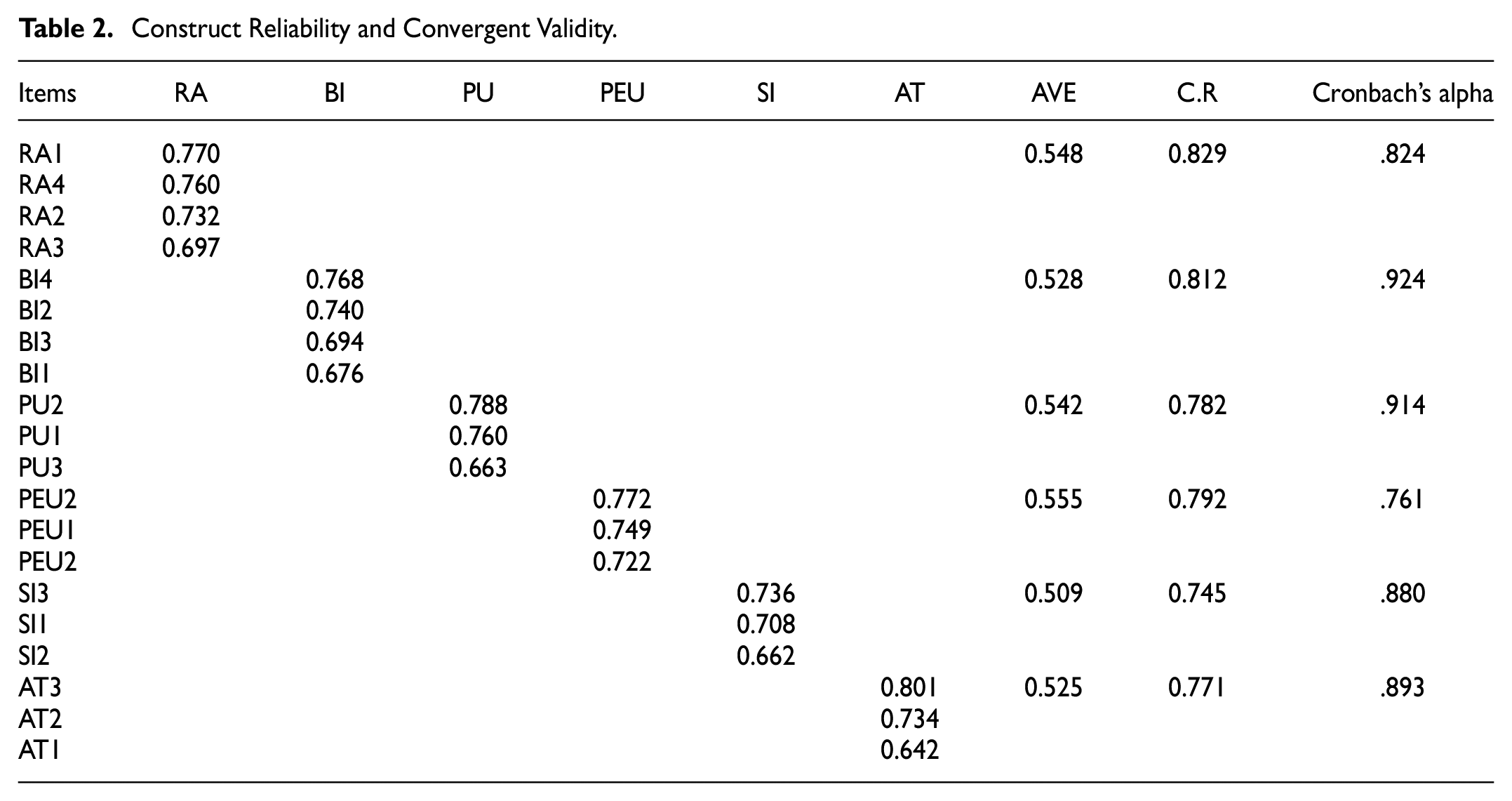
Cronbach’s alpha (α) and composite reliability (C.R.) were used to analyze the reliability of the Likert scale. According to Gefen et al. (2000), when α and C.R. are greater than .7, the reliability of each variable measurement index is high. As shown in Table 2, the Cronbach’s α values of all first-order variables in the whole set of data are between .761 and .924, and the combined reliability is between .745 and .829, which indicates that the scale reached the reliability level. Concurrently, Bartlett’s test results were significant, with a KMO value of 0. 941, indicating that the original variables were suitable for factor analysis. Convergent validity was tested using factor analysis. Hair et al. (2014) suggested that to prove that the scale has good convergent validity, all indicator factor loadings should be significant and exceed 0.5, and the average variance extracted (AVE) by each construct should exceed the amount of measurement error variance (AVE > 0.5). The results indicated that all indicator loadings ranged from 0.642 to 0.801, exceeding 0.5, and all AVEs range from 0.509 to 0.555, exceeding 0.5, indicating satisfactory convergent validity, as exhibited in Table 2.
Construct Reliability and Convergent Validity.
Finally, to test discriminant validity, Fornell and Lacker’s (1981) view was adopted. When the AVE value of each construct was greater than the square value of the correlation coefficient between the other constructs, the scale had good discriminant validity. The results listed in Table 3 demonstrate that all requirements were met, indicating that the discriminative validity of the scale is satisfactory.
Discriminate Validity of the Research Model.

Structural Model
The structural model was tested using AMOS 21. All hypothetical paths were significant, except for H4, H8, and H10, the path from PU to behavioral intention, social influence to behavioral intention, and relative advantages to attitude toward ICT, respectively. After considering construct correlation, estimated path, and model fitting, the model was modified. Table 4 presents the modified model fit indices for which the insignificant path was eliminated. All the indices of goodness of fit are within the ideal range of values suggested by the literature, indicating a good fit for the structural model.
Summary of the Model Fit Indices.

Note. CFI = Comparative Fit Index; GFI = Goodness of Fit Index; AGFI = Adjusted Goodness of Fit Index; RMSEA = Root Mean Square Error of Approximation.
The AMOMs test the significance of the causal relationship of the proposed hypothesis using a bootstrap resampling process of 200 iterations. The outputs generated by the SEM of the model are presented in Table 5 and Figure 2. In the full sample model, PEU had a positive significant effect on PU and AT (H1: β = .328, p < .01; H2: β = .169, p < .001), PU had a powerful influence on AT (H3: β = .371, p < .001), and AT on BI (H5: β = .782, p < .001). SI affects PU and AT (H6: β = .342, p < .001; H7: β = .497, p < .01). RA had a positive and significant influence on PU and BI (H9: β = .240, p < .001; H11: β = .168, p < .01). Evaluation through squared multiple correlations revealed that BI explained 80.9% of the variance, 89.4% of the variance by PU, and 63.5% of the variance by AT.
Parameter Estimates of Path Analysis.

p < .001. **p < .01.

Results of the model testing.
The antecedents affect ICT adoption intention indirectly or directly through a series of mediators, the mediating effect is calculated and inspected using bias-corrected (BC) and percentile bootstrap in 95% confidence intervals, as presented in Table 6. The indirect effects of PEU, SI, and RA on BI are 0.215, 0.480, and 0.079, respectively. The results confirm that PEU, SI, and RA indirectly increase BI through serial mediators PU and AT. The impact of external variables on PU and AT are also exhibited in Table 6, which reveals that all of them are significant at the 95% CI, except for the indirect effect of PEU on AT.
Direct, Indirect, and Total Effect in the Revised Model.

p < .10.
Table 7 depicts specific indirect effects, including the contracts of different mediators and total indirect effects on BI toward ICT (the combination of all specific indirect effects). Despite the insignificant indirect effect of PEU to AT to BI, PEU had significant indirect effect through PU to AT on BI is significant as demonstrated in Table 6 (total indirect effect = 0.215, 95% CI of BC and Percentile). Meanwhile, significant indirect effect of SI to BI through AT is higher than mediators of “PU to AT” (specific indirect effect = 0.383, 95% CI of BC and Percentile; specific indirect effect = 0.098, 95% CI of BC and Percentile), as shown in Table 7. Moreover, there existed significant specific indirect effect from PEU, SI and RA to BI through mediators of “PU to AT,” which were 0.090, 0.098, and 0.079, respectively.
Comparison of Specific Mediating Effects.

Test of Group Differences
To isolate specific differences between different types of organizations (engaged in online and offline business) and entrepreneurs (with and without previous experience), on the basis of similar literature, multigroup analysis in SEM was applied to perform multiple-group analysis (Kim et al., 2018). The moderating effects in links of SI on BI and RA on BI were not tested, owing to the fact that the relationships of those were insignificant.
Moderating effects of different types of organization. First, the full model (N = 327) was divided into online business group (N = 196) and an offline business group (N = 131), and multi-group moderation tests were conducted. Subsequently, the unconstrained structural model, which allowed structural paths to vary across different types of businesses, was compared with the constrained structural model. Commonly, the constrained structural model is constrained by factor loadings, covariance, weights, and residuals to be equal between offline and online groups. The results unveiled that the Delta-P value of the measurement weights model versus the unconstrained model was 0.195 > 0.05, and the Delta-P values of the other constrained models were above 0.05, (χ2 = 1,118.591, df = 308), which demonstrates a significant difference.
The goodness of fit of the two groups (p = .000, χ2/df = 1.982, GFI = 0.853, CFI = 0.939, IFI = 0.940, TLI = 0.926, RMESA = 0.055) indicated that the multigroup model fit well. Then, the differences between the two groups were tested using the critical ratio test (critical ratios for difference [CRD]). The CRD value above ±1.96 (p < .05) indicated a significant difference between the two groups; the detailed results are shown in bold format in Table 8. The outcomes clearly demonstrate the positive effect of PU on the AT of offline respondents (β = .429, p < .001), but for the online (β = .141, p > .05) group, for CR = −2.193 < 1.96, p = .028 < .05. Additionally, the impact of SI on AT was higher for the online group (β = .701, p < .000) than the offline group (β = .414, p < .001), for CR = −2.257 < −1.96, p = .024 < .05. Moreover, the outcomes indicated that RA significantly influenced BI for the offline group (β = .316, p < .001) but did not significantly influence BI for the online group (β = .053, p > .05), for CR = 1.982 > 1.96, p = .047 < .05. These results demonstrate that different types of entrepreneurship moderate the direct relationships between PEU or PU and AT, such as external factors and AT or BI. However, no significant group differences were observed in the other structural paths. Hence, H3a, H7a, and H11a are supported.
Comparison Analysis for the Two Groups.

Note. ***p < .001. **p < .01. *p < .05. + p < .01.
The same procedure was applied to test H13a–H13d. The goodness-of-fit statistics for the group model with and without experience (p = .000, χ2/df = 1.887, GFI = 0.850, CFI = 0.943, IFI = 0.944, TLI = 0.932, RMESA = 0.052) suggest a good fit. As shown in Table 8, the impact of SI on PU was positive for entrepreneurs without experience (β = .513, p < .001), but cannot be seen in the experienced group (p > .05), where CRD = −2.382 < −1.96, p = .017 < .05. Additionally, PEU positively affects the AT of entrepreneurs without previous experience (β = .309, p < .001) but does not affect the experienced group (CRD = −2.544 < −1.96, p = .011 < .05). Moreover, the conclusion that RA significantly influenced BI for the group of entrepreneurs with experience can be drawn (β = .239, p < .001), but not for the group without experience (β = .010, p > .05), where CRD = 2.210 > 1.96, p = .027 < .05. These results demonstrate that whether the entrepreneur had previous experience with ICT moderated the direct relationships between PEU or PU and AT, such as external factors and PU or BI. Hence, H2b, H6b, and H11b are supported.
Discussion and Implications
Discussion
This study established an extended TAM by adding social impact and relative advantage as external variables to explain the intention of ICT adoption in rural entrepreneurship. Meanwhile, group differences by business models of start-ups and previous experience of the entrepreneur were also underscored. This enriches the existing literature in the following four aspects.
First, the results reveal that there are positive relationships between technology perception factors and ICT adoption attitudes or intentions of Chinese rural entrepreneurs. It is found that the link between PU and BI is not significant. This finding is consistent with the previous literature of Awe and Ertemel (2021) and differs from the research of Zaremohzzabieh et al. (2016) and Sciarelli et al. (2022). This suggests that even though users recognize the productivity and efficiency-enhancing effects of ICT, their intention to use it is not directly motivated, and other obstacles exist (Nkosana & Skinner, 2016). This study showed a significant positive effect of PEOU on attitudes, which is distinct from similar studies (Kumar Bhardwaj et al., 2021; Sciarelli et al., 2022). In rural SMEs, the main decision-makers are the owners or managers, whose knowledge and technological literacy determine their perceived ease of use of ICT (Kusumaningtyas & Suwarto, 2015). For less educated rural entrepreneurs, attitudes toward ICT are more likely to be influenced by perceived ease of use. Moreover, compared to PEOU, PU has a stronger influence on attitude (Al-Azawei et al., 2017). The result means that the practical benefits of ICT for entrepreneurship are much more critical to the users (Caffaro et al., 2020).
In addition to the core TAM constructs, social influence and relative advantages positively contribute to the adoption of ICT in rural entrepreneurship. Family members, friends, peers, publicity, and so on were taken as the frame of reference for the former, and technology itself as a static entity was taken for the latter. On the one hand, the greater a person is influenced by others’ positive views of ICT, the more useful perceptions they will obtain. This positive relationship has been widely confirmed (Tambotoh et al., 2015; Zaremohzzabieh et al., 2016). Rural entrepreneurs generally have various interpersonal relationships and are more inclined to receive more information, which can easily influence them to adopt ICT to follow trends in their social communities (De Silva et al., 2009). Consistent with most studies, social influence significantly impacts attitudes toward ICT usage (Hansen et al., 2018), which is also confirmed by existing research (Zaremohzzabieh et al., 2016).
On the other hand, relative advantages are important antecedents for PU. The benefits associated with ICT are an important factor in shaping entrepreneurs’ perceptions of usefulness, which is in line with S. S. Kamble et al.’s (2021) work. ICT offers a relative advantage in the dimensions of access to information and markets, improvement of customer relationships, the establishment of marketing channels, and general administration(Barnett et al., 2019). Similar to previous studies, this study predicted a positive relationship between relative benefits and intention, for example, in the context of smartwatches (Bölen, 2020). However, the empirical results show that relative advantage does not significantly affect attitudes toward ICT, which differs from previous studies (John, 2015). A possible explanation is that entrepreneurs must consider the cost, risk, and other issues in addition to the various benefits of ICT, resulting in their vague attitude toward ICT.
Perceived usefulness and attitudes play a significant mediating role in the effect of social influence and relative advantage on ICT adoption intentions. In terms of the total indirect effect, social influence had the largest total indirect effect among the three antecedent variables of PEOU, social influence, and relative advantage. This result suggests that, in the decision to adopt ICT in entrepreneurship, rural entrepreneurs are more vulnerable to the influence of relatives, friends, or the environment (Geng & Xue, 2023; Tsai et al., 2021). The specific mediating effects of PU and attitude between PEOU as well as external variables and adoption intention were validated, although they were not applicable when attitude was the single mediating variable between PEOU and intention to adopt. The fundamental reason for users to adopt a technology is its usefulness. Therefore, by reducing users’ technology anxiety or barriers to access and increasing PEOU, PU can be increased, which in turn motivates adoption.
Group comparisons by the business model of start-ups also presented valuable findings. The PU of users in the start-up group engaged in offline business significantly affected attitudes toward ICT adoption but did not significantly affect users in the online group. The effect of relative advantage on adoption intention showed similar results. ICTs are necessary tools for enterprises operating online businesses. Usefulness is the basic attribute of ICT that users perceive as not determining their positive attitudes (Steininger, 2019). Contrastingly, start-ups engaged in offline businesses can use traditional production methods instead of ICT. They are more likely to change their attitudes and intentions to adopt ICT when they perceive it to be useful and beneficial (Steinfield et al., 2012). Additionally, the attitude of online group users is more likely to be influenced by social influence than that of companies engaged in offline businesses. For rural entrepreneurship, such as e-commerce, the adoption of ICT, such as cloud computing and blockchain still in its infancy (Sciarelli et al., 2022). Attitudes toward ICT adoption are more likely to be influenced by the opinions of family, friends, and peers, and information from media and websites, given that rural entrepreneurs are facing greater uncertainty.
As for the two groups with and without previous experience, the results show that the group with previous experience did not significantly affect the relationship between PEOU and attitude, whereas the other group was significant. PEOU has two basic mechanisms that affect attitude: self-efficacy and instrumentality (Davis, 1989). More previous experience with technology can make users more familiar with ICT tools than entrepreneurs with no previous experience. Thus, the effect of PEOU on attitude to technology dissolves marginally with users’ increased experience (Davis, 1989). A positive impact exists on the relationship between social influence and attitude toward the ICT group of entrepreneurs with previous experience rather than in the other group. This means that the attitude toward ICT of group of users without previous experience is more susceptible to social influences. Moreover, comprised of the experienced group, the no-experience group did not positively influence the link between relative advantages and behavioral intention, which indirectly underlines the importance of the observability of ICT, that is, its relative advantages are only better reflected when it is applied in practice.
Theoretical Implications
Several basic hypotheses in the classical TAM were verified in this study, confirming the applicability of TAM in ICT adoption in the field of rural entrepreneurship. In addition, the new findings of the current study enrich and promote existing theories in the area of technology adoption. The main marginal theoretical contributions are as follows: (1) extending the TAM model of technology acceptance on the background of Rural Entrepreneurship; (2) investigating the key drivers to adopt ICT in the context of rural entrepreneurs; and (3) the identification of two business types of enterprise: online and offline business; and two entrepreneur’s characteristics: with and without previous experience.
First, it concerns the contextual connection of technology adoption and expands the research field to rural entrepreneurship. Many scholars researched ICT adoption in the education industry and enterprises, and a few studies explored adoption intention in women’s entrepreneurship. This study is novel in that it fills the research gap on ICT adoption in rural entrepreneurship.
Second, this study further extends the existing TAM from the two dimensions of social external influence and technological internal advantage, which pay more attention to the antecedents of PU from perspective. Particularly, this study verified and analyzed the impact of technological advantage on adoption intention and its mediators. As rational entrepreneurs, technological advantages and usefulness are the key factors that determine their adoption intention. The validity of the combined DIT and TAM model is confirmed, while its field of application is expanded.
Third, this study explores the impact of the heterogeneity of micro subjects (entrepreneurial individuals) and meso subjects (new ventures) on the driving mechanism of ICT adoption in rural entrepreneurship. To the best of our knowledge, the business types of firms and entrepreneurs’ previous experiences have been neglected in previous research on ICT adoption. This study identified the moderating effect in the paths of the technology adoption model of two groups of adopters’ typologies: (1) organizations engaged in online and offline business and (2) entrepreneurs with and without previous experience.
Managerial Implications
In addition to theoretical contributions, the results of this study provide valuable managerial implications, not only for ICT developers and promoters, but also for policymakers. Attention should be paid to enhancing the perceived ease of use and perceived usefulness of ICT for farmer entrepreneurs. Improving the adaptability of ICT to the corresponding rural industries facilitates the economic conversion rate of ICT and promotes rural entrepreneurs’ profitability. On the one hand, government sectors and ICT marketers should strive to develop advertising campaigns implemented on media channels or village bulletin boards to reflect the benefits and value of ICT for reference by non-adopters. On the other hand, technology innovation firms and ICT developers should strengthen research on technological innovation on the basis of the needs of farmers’ entrepreneurs. The ease of use should be considered, and ICTs must be designed in accordance with farmers’ technology acceptance level, that is, by reducing the difficulty of technological operation and the threshold required for adoption (Khan Tithi et al., 2021).
The positive direct and indirect relationship between social influence, relative advantage, and ICT adoption intention provides useful guidance for technology promotion. Family, friends, neighbors, peers, media, and so on serve as a direct channel for farmer entrepreneurs to obtain ICT-related information and knowledge, thereby improving their perception of usefulness and attitude toward technology (Geng & Xue, 2023). Therefore, potential users’ motivation for ICT adoption can be increased by establishing demonstration households featuring large-scale operations and good economic benefits. Because relative advantages positively impact potential users’ intention to adopt ICT, a clearer and thorough description of the relative benefits of ICT in the process of publicity and promotion can stimulate users’ interest and intention to adopt ICT.
Owing to the importance of the moderating role of the business models of enterprises and previous experience of entrepreneurs, different ways to promote technology adoption for different types of groups will achieve better results. This highlights that the benefits of ICT for entrepreneurial activities in promotion and publicity to increase the PU of users will effectively increase the positive attitude toward ICT of the group of offline-oriented enterprises. Only by strengthening development and innovation and improving the relevant advantages of ICT can more start-ups engaged in offline business be attracted. Moreover, for users without previous ICT use experience, increasing their PEOU (e.g., through technology training) can encourage a positive attitude toward ICT. Given the more positive contribution of social influence to PU for users with no previous experience, information exchange and experience sharing must be promoted between peers and partners. Overall, these results are conducive to establishing a targeted technology promotion system, innovating, and improving the existing technology to attract more new rural entrepreneurs to adopt ICT while maintaining existing users.
Conclusions and Limitations
Conclusions
This study primarily aimed to reveal the drivers of ICT adoption in rural entrepreneurs and explicate the role of enterprise business type and previous experience in driving paths. This study extended TAM by adding the factors of social influence and technological advantages and tested it using field research data from 327 rural entrepreneurs and SEM. The findings indicate that social influence and relative advantage have direct or indirect positive impacts on ICT adoption intentions, with social influence being more likely to stimulate potential users’ adoption intentions than technical features, that is, relative advantage. PEOU is a necessary condition in the context of rural entrepreneurship. The results also verify that for enterprises engaged in online business, their attitude toward ICT adoption is more vulnerable to social influence than that of the offline group; for enterprises engaged in offline business, the relative advantage of technology significantly impact their adoption intention. Moreover, increasing the PEOU for entrepreneurs without previous experience can significantly increase their positive attitude toward ICT; Increasing the relative advantage of ICT can promote the intention to adopt entrepreneurs with previous experience.
Limitations
The study holds several limitations. The study was carried out in areas where rural entrepreneurship is relatively developed, in the largest developing country, China, whose degree of ICT development in rural areas is between that of other developing and developed countries. Therefore, the outcomes and conclusions may not be generalizable to different contexts. Second, rural entrepreneurship is a complex problem, and understanding ICT adoption in this process involves many factors. If the exogenous variables of entrepreneurial socioeconomic characteristics, such as gender, educational background, and enterprise characteristics, such as natural endowment and organizational readiness, are included in this study as control variables, the results may be more convincing. Third, our research mainly considers users’ perception, external influence, and technology advantage as antecedent variables to study the behavioral intention and influence mechanism of rural entrepreneurs to adopt ICT, which may ignore other factors, such as government support. The Chinese government has substantially invested in information and communication facilities construction in rural development. Thus, the incentive policies and convenient conditions that can be transformed into actual productivity in rural development must be further explored in the future.
Footnotes
Appendix

| Construct | Item | Source |
|---|---|---|
| Perceived Easy of Use (PEOU) | PEU1: I think ICT is easy to learn |
Davis (1989)
Venkatesh et al., 2003 |
| PEU2: I think ICT is easy to control | ||
| PEU3: I think the content of ICT is clear and easy to understand | ||
| Perceived Usefulness (PU) | PU1: I think the use of ICT can improve performance |
Davis (1989)
Venkatesh et al., 2003 |
| PU2: I think the use of ICT can improve productivity | ||
| PU3: I think the use of ICT can improve the quality of business operations | ||
| Relative Advantage (RA) | RA1: I believe using ICT can help expand relationships with other businesses more convenient | S. S. Kamble et al., 2021 |
| RA2: I believe using ICT can collect information about consumer needs and preferences easier. | ||
| RA3: The use of ICT can reduce our company’s management costs, as well as sales and distribution costs. | ||
| RA4: ICT makes it easier for me to find, connect and develop reputable investors | ||
| Social Influence (SI) | SI1: People who are important to me think that I should use ICT to start a business. | Venkatesh et al. (2003) |
| SI2: People who influence my behavior think that I should use ICT products for my healthcare | ||
| SI3: Media reports of many successful business cases encouraged me to use ICT to start a business | ||
| Attitude towards ICT adoption (ATT) | AT1: I believe that using ICT in my enterprise is a smart idea. | Venkatesh et al., 2003 |
| AT2: I believe that using ICT is beneficial to my enterprise. | ||
| AT3: I like using ICT is in my enterprise. | ||
| Behavioural Intention (BI) | BI1: I plan to use ICT in my new start enterprise. | |
| BI2: I will continue using ICT in my enterprise in the future. |
Davis (1989)
|
|
| BI3: I will always try to use using ICT in my enterprise in my daily life. | ||
| BI4: I plan to continue using ICT in my enterprise frequently. |
Declaration of Conflicting Interests
The author(s) declared no potential conflicts of interest with respect to the research, authorship, and/or publication of this article.
Funding
The author(s) disclosed receipt of the following financial support for the research, authorship, and/or publication of this article: The funding statement: This study is supported by the National Social Science Fund, China (18BGL052).
