




Abstract
This article presents a novel insight into the extent to which social capital, social innovation, and women entrepreneurial activities contribute to rural poverty alleviation. Applying the structural equation modeling (SEM) technique through SmartPLS software version 3.0, data from a total sample of 333 women entrepreneurs in the Agribusiness sector from the Sekyere South District in Ghana were empirically analyzed. The findings from the study highlight the transformative potential of rural women entrepreneurs who utilize social capital from both formal and informal social networks toward rural poverty alleviation. Thus, study results revealed that women entrepreneurship growth performance is positively and significantly associated with rural poverty alleviation. Furthermore, the impacts of social innovation and relational social capital on poverty alleviation showed positive. We recommend that policymakers and development practitioners should empower more women into entrepreneurial activities in the agribusiness sector in rural areas to promote rural poverty alleviation in developing countries.
Introduction
Poverty as multidimensional concept refers to the deprivation of human dignity, opportunities and satisfaction in terms of food, nutrition, power, education, health, traffic, and income (Alkire & Foster, 2011; Arndt et al., 2016; Chen & Ravallion, 2008; Si et al., 2015). According to Singer (2006), poor people lack the competence, confidence, power, and opportunities to make their life better and easier. People living in poverty tend to have limited access to employment and with little hope in life. As maintained by Chen and Ravallion (2008) poverty can be categorized in terms of absolute and relative contexts. In the context of absolute poverty, it is a situation where there is a lack of adequate tangible and nontangible needs that improve the wellbeing of mankind. However, relative poverty occurs when one interprets his current living condition as worse when compares with that of the members in the same or different society.
In view of this, the World Bank provides a quantitative money metric measure for poverty. With this measure, people living below USD$2.0 a day are described as poor, whereas those living under US$1.25 as extremely poor. Nonetheless, Singer (2006) emphasized on the qualitative approach to categorize poverty into food poverty, nutrition poverty, power poverty, education poverty, health, poverty, traffic poverty, and income poverty.
In spite of global fight against, poverty especially in the developing countries, people suffering from rural poverty is increasing. In view of this, scholarly studies on rural poverty alleviation particularly in developing countries have received increased attention in recent decades (Alkire et al., 2017). Motivated by this backdrop, this article examines the extent to which the interactions between women entrepreneurship, social capital, and social innovation could contribute to a sustainable approach toward rural poverty alleviation in developing countries.
In the recent times, there is a growing attention and recognition of the vital role of women entrepreneurs in the socioeconomic development of the global economy. Studies by De Vita et al. (2013) have maintained that approximately 187 million women were identified to be actively engaged in creating business as entrepreneurs in 2010 and this number constituted about 42% of entrepreneurs recognized worldwide. The Global Entrepreneurship Monitor (GEM) conclude that women alone perform 66% of active work engagement globally and above 50% of world food are produced by women and this is a sign of how women play a key role in socioeconomic development of the world. This highlights the crucial role played by women in contributing to social problem and improving livelihoods. It is noted that women entrepreneurs mostly in developing countries are usually vulnerable and face several resource constraints (Adom, 2015). Nonetheless, in this study, we argue that developing a sustainable social capital could stimulate business success of women entrepreneurs, particularly in developing countries so that they can fully participate in solving social problems such as poverty and inequality. Social capital encompasses a set of intangible resources obtained through social networks, bonding ties, and trust developed between individuals and social groups within the society (Poon et al., 2012).
According to Mozumdar et al. (2017), social capital creates a business opportunity for women entrepreneurs to survive even in the case of extremely poor rural settings. Similarly, Yusuf (2008) indicates entrepreneurs explore their social capital through their connections and social networks with their customers, suppliers, and other market individuals to create business opportunities. Corroborated by this, Muniady et al. (2015) articulate that the outcome of social capital allows entrepreneurs to access resources and knowledge to improve their financial performance. Increasing women entrepreneurs’ network diversity contributes significantly to improve their social innovative ability and entrepreneurship performance (Alcaide Lozano et al., 2019). What this means is that strengthening the social relationship, ties, trust, and shared values among women entrepreneurs creates smooth platforms for sharing investment, market information resources, and engaging honest communication.
Certainly, these interactions between social capital and women entrepreneurship create more productive resource opportunities toward social innovation abilities, entrepreneurship growth, and poverty alleviation (Weber et al., 2013). Accessing a strong social network alliance by women entrepreneurs should spur their entrepreneurial growth and social innovation abilities in a transformative space which could then lead to poverty alleviation. Social capital could improve the capability of women entrepreneurs especially in extremely poor areas where there are market institutions failures. Through these social networks, women entrepreneurs create a connection to access credit information and contract services which allow them to develop their business. Through these activities, they can contribute to family income and improved livelihood.
More importantly, some scholars establish the need of women entrepreneurs to harness social innovation using their network ties to improve their performance, especially in rural areas. According to Ahuja (2000), social capital has a significant and positive impact on social innovation especially considering social ties and the strength of bonds formed. Social innovation has made a magnificent contribution to changing lives and providing novelty solutions to societal challenges. It involves the coming of novel ideas to cause social changes or provide social needs of other individuals, organization, or society (Poon et al., 2012). Social innovations consist of interactions between new strategy, ideas, opportunities, and social systems purposely to solve social problems such as poverty. Hence, social innovation could serve the purpose of contributing to women entrepreneurship growth and poverty alleviation especially. Unfortunately, the extent to which social capital and social innovation could have both direct and indirect impacts on poverty alleviation through women entrepreneurs has been overlooked by previous studies (Alcaide Lozano et al., 2019).
Based on the above literature, this article focuses on rethinking the mediation role of women entrepreneurship growth and social innovation in the relationship between social capital and rural poverty alleviation in developing countries, specifically in the case of Ghana. This article offers insights into an empirical context in which women entrepreneurship, social capital, and social innovation could provide a sustainable approach to poverty alleviation in extremely poor rural settings. This article extends the theoretical and empirical understanding of the channels through which social capital women entrepreneurship and social innovation contribute to rural poverty alleviation in the developing countries. The subsequent sections of this article include a brief literature review, development of hypotheses, methodology, results, discussion, and conclusion.
Literature Review and Development of hypothesis
Based on the social capital theory, this study investigates the extent through which social capital resources embedded in social networks and relationships contribute to rural poverty alleviation through social innovation and women entrepreneurship growth. Social capital has been categorized into three main dimensions namely, structural, relational, and cognitive dimensions (Alvani et al., 2007). Structural dimension describes the size of social networks, which comprises the number of ties or contacts an individual builds and the network diversity which is the magnitude of ties bonded and contacts developed. Relational social capital however comprises the trust, obligations, and reciprocity of members of the social network. Likewise, the cognitive dimension of social capital refers to the shared language and codes as well as shared narratives of the members belonging to the social network (Chiu et al., 2006; Chua, 2002).
According to Woolcock and Narayan (2000), Social capital comprises the social interactions with people from the same economic status or one’s relationship with other people who are in different economic status. Literature reviewed indicates the relationship between social capital and entrepreneurship growth. Social capital constitutes a nonfinancial resource which can be explored to enhance poverty alleviation among entrepreneurs particularly in the rural areas. Social capital is the value of social interactions and social network alliances (Abdul-Hakim et al., 2010). In most cases, social capital is seen as a key social resource that has the potential to improve entrepreneurship growth particularly in the rural areas (Dastourian et al., 2017; Stam et al., 2014; Woodhouse, 2006) Studies by Lee et al. (2019) confirmed that social capital was significant and enhances the resource acquisition required by entrepreneurs in deprived areas.
Similarly, Muniady et al. (2015) posit that there is a positive influence of social capital dimensions on the performance of women-owned microenterprises in Peninsular Malaysia. Due to the active vital role played by women in the communities especially in a more feminist culture, it is argued that women entrepreneurs should contribute meaningfully to poverty alleviation particularly in the developing country (Bruton et al., 2013). Convincingly, Brush et al. (2006) and Buame (2000) confirm that women entrepreneurs contribute to a high proportion of self-employment and self-income generation and still cater to their families. Women entrepreneurs deepen social ties and improve family life while contributing more to economic growth and development. According to Adom (2015), Loh and Dahesihsari (2013), and Revell-Love and Revell-Love (2016), women entrepreneurship contributes a greater deal to wealth creation, gender equality, and societal welfare in most developing countries.
Prior studies have explored the link between social capital and social innovation (Alcaide Lozano et al., 2019). Social involves the development of novel ideas to cause social changes or provide social needs of other individual, organization, or society. The context of social innovations characterizes the interactions between new strategy, ideas, opportunities, and social systems to cause an impact on the people around. Scholars contend that social innovation cannot occur without social interactions to cause social change. Social innovation can be achieved through social network of actions and social system dynamics. According to Martínez-Torres (2014), social innovation should be understood as a fruit of interactions among social actors, individuals, and communities. It is suggested that the level of social innovation depends on the strength of social network that exists. Social innovation has also been seen as one of the channels through which social capital contributes to entrepreneurship growth and poverty alleviation.
According to Ahuja (2000), social capital has a significant and positive impact on social innovation especially considering social ties and the strength of bonds formed. Increasing entrepreneurs’ network diversity contributes significantly to improve their social innovative ability. Strengthening social relationship, ties, trust, and shared values among entrepreneurs creates smooth platforms for sharing honest communication and investment resources among them (Weber et al., 2013). Consequently, study by Alcaide Lozano et al. (2019) found a positive relationship between social capital and social innovation. Through social connections, new opportunities are created which are relevant to generate new resource methods to solve social problems. Extant literature conceptualizes that the new ideas, new methods, and the entire outcome of the social innovation are utilized by women entrepreneurship to develop their business. Hence, the social innovation generated from the collaboration entrepreneurs’ social network and interaction are explored by women entrepreneurs to develop their business and to solve societal problems such as poverty especially in the rural communities.
Studies by Westley and Antadze (2010) found that social innovation consists of a complex process of introducing new products, processes, or programs that profoundly change the basic routines, resource and authority flows, or beliefs of the social system in which the innovation occurs. In this context, these entrepreneurs who are bonded in a strong ties share new ideas, new methods, and new resources frequently which translate to social innovation. In the results of Kramer (2005), social innovation is the continuous systematic process in which large-scale lasting change is created by utilizing new ideas, business, methods, and changes in attitude and to help society. Owing to this, Angelidou and Psaltoglou (2017) maintain that social innovation has a significant impact on poverty alleviation even though policy makers have overlooked the applications of this concept. Social innovation consists of providing a new ideas, creating new values, and offering new solutions to problems confronting society instead of individual benefits.
Based on this research model, the following hypotheses are developed:
Research Methodology
This study focused on the impact and causative mechanisms through which social capital, women entrepreneurship growth, and social innovation contribute to poverty alleviation. To address this objective, the path analysis with structural equation model was utilized. The survey data were collected from women entrepreneurs who operated in the Agribusiness sector in the Sekyere South District in the Ashanti region of Ghana. According to Adom (2015), women entrepreneurs in Ghana contribute significantly a great deal to the socioeconomic development of Ghana and help to shape the economic welfare of their families.
Our operational definition of agribusiness activities comprises production and distribution of agricultural-related products (Jose, 2009). These activities include the agricultural commodities marketing women, female farmers, and women engaged in distribution of agriculture production inputs (Jose, 2009; King et al., 2010). Women entrepreneurs in this case own new ideas, new business, and social wealth through innovation, creativity, and technology and increase productivity to solve to improve their lives and that of their families (Ali & Ali, 2013; Mitra et al., 2011).
During the survey, the multistage cluster sampling method was employed. This sampling method is more efficient when populations are geographically dispersed (Sedgwick, 2015). In this survey, the cluster procedure was first used to divide the participants based on their geographical location in different communities within the district. The simple random sampling method was then used to select 15 communities and subsequently used to select 333 respondents who are agribusiness entrepreneurs. The demographic characteristics of respondents selected for the study have been presented in Table 1.
Demographic Characteristics of Respondents.
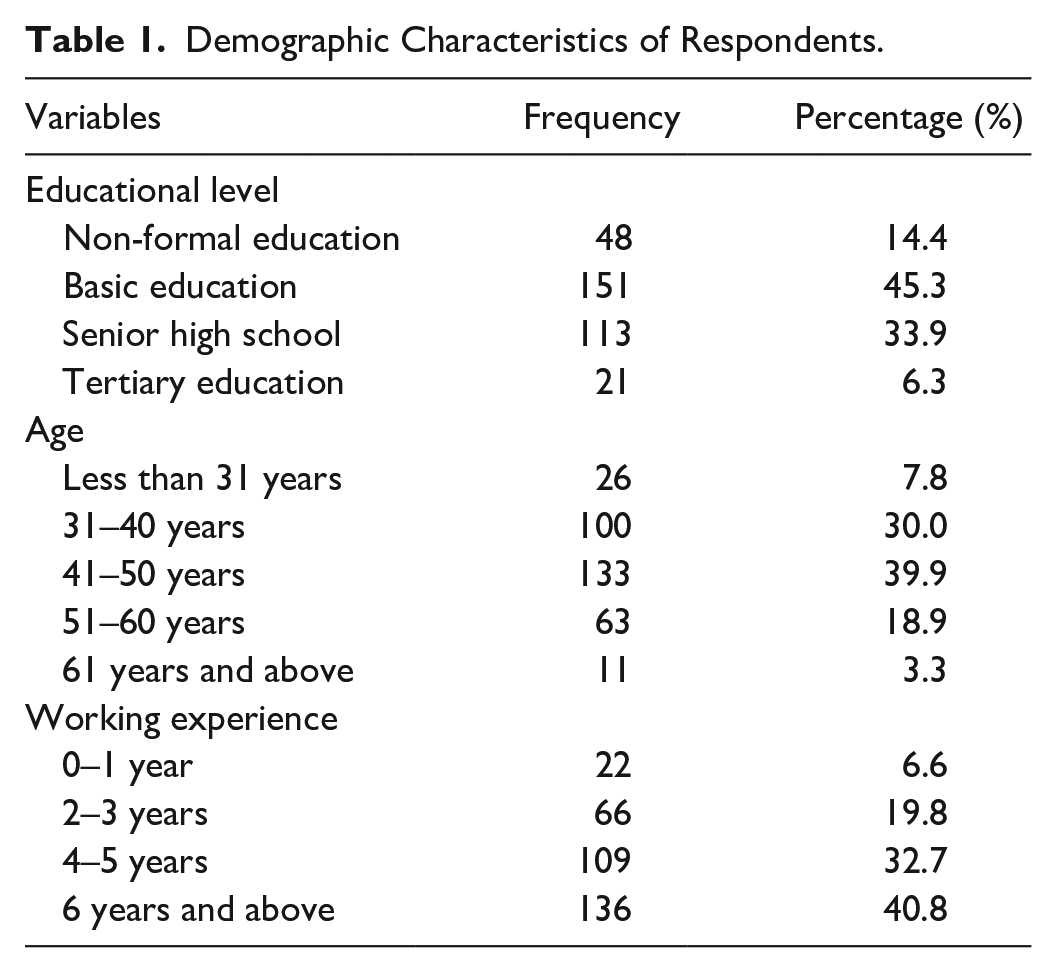
The final sampled entrepreneurs selected were into marketing and production of cereals and legumes (29%); fruits and vegetable (13%); poultry feed and agro-inputs (8.4%); fish (22.2%); poultry, egg, and beef (21.6%); and Palm oil (5.7%). Other demographic features of the respondents included their educational level, age, and years of operation presented as working experience in Table 1: From the table, it can be observed that majority of the respondents have basic education as their highest educational attainment (N = 151, 45.3%); senior high education (N = 113, 33.9%), non-formal education (N = 48, 14.4%), and tertiary education (N = 21, 6.3%) being the least educational level. Table 1 shows the respondents aged between 41 and 50 years (N = 133, 39.9%), between 31 and 40 years (N = 100, 30%), less than 31 years (N = 26, 7.8%), and aged 61 years and above (N = 11, 3.3%). The survey also predominantly constituted respondents who had operated their business for 6 years or more (N = 136, 40.8%), 4–5 years (N = 109, 32.7%), 2–3 years (N = 66, 19.8), and 0–11 years (N = 22, 6.6%).
The structured questionnaire was designed based on a 5-point Likert-type scale responses. The validity, reliability, and Exploratory Factor Analysis of the research instrument constructs were computed using the SmartPLS computer software version 3.0. The item constructs used to measure structural social capital dimensions were adopted from Chua (2002) and Lee et al. (2019). The structural social capital was measured with three items, while the relational social capital was also measured using three items. Similarly, three items were adopted to measure women entrepreneurship growth. The items measured entrepreneurship growth performance such as growth in the sales volume, growth in returns to investment, growth in the market development adopted from Audretsch (2012), Brush et al. (2009), and Dobbs and Hamilton (2007). Three items we also used to measure Poverty alleviation constructs were adopted from Alkire and Foster (2011), which capture the multidimensional concepts of poverty based on the context of the study, such as improvement in respondents’ financial ability to access good health services, to take care of family, and to improve income level.
Finally, two items were used to measure social innovation constructs adopted from Hou et al. (2018), Oslo Manual (2005), and Westley and Antadze (2010). Social innovations consisted of the new or novel products, services, models, markets, or processes that are utilized by the women entrepreneurs in the communities that are directed toward improving entrepreneurship growth and solving social problems such as poverty (Westley & Antadze, 2010).
The study utilized the partial least squares structural equation modeling (SEM) for the path analysis, which examined the mechanisms through which social capital and social innovation impact poverty alleviation in the rural areas. The use of SEM, the SmartPLS, has been proven to be effective to analyze several regression simultaneously (Hair et al., 2013). According to Hair et al. (2013), the PLS technique has high accuracy and ability and produces a better results than other methods which usually use covariance approach. Both direct and indirect pathways of the structural relationships were estimated using the bootstrapping approach.
Statistical Model Specification
To examine the validity and the internal consistency of the item variables in the measurement model, the composite reliability (CR), average variance extracted (AVE), and Cronbach’s alpha, as indicated in Table 2, were utilized. The internal consistency, which is the reliability, measures the interrelationship of the observed items variables. These measurements were computed to check if the factors and indicators were significantly consistent and valid in measuring the latent variable as well as the explanatory power of the model indicated by R2. According to Hayduk and Littvay (2012), if the AVE and CR have loading less than 0.5 and 0.7 correspondingly, it implies a weak convergence validity and are not desired to be maintained for the analysis. Results from Table 1.0 shows that the CR for all the indicators are above 0.7, which implies that the requirements are met. Similarly, the AVE for all the indicators is also above 0.5, which shows that the item indicators are well loaded.
Average Variance Explained, Composite Reliability (Cr), Cronbach’s Alpha, R2.
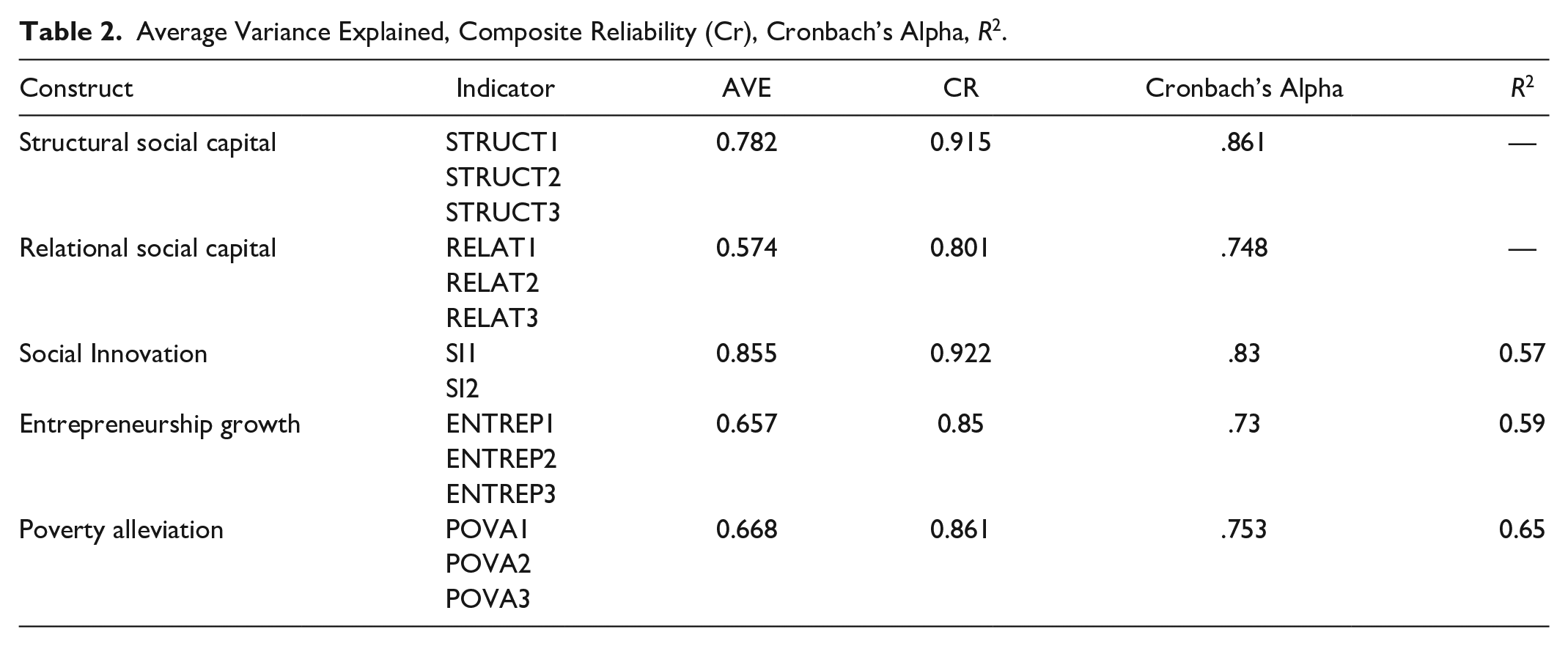
The results from Table 2 also present Cronbach’s α and the R2 for the model. Cronbach’s α measures the validity of the construct items, and any Cronbach’s α value of .7 and above implies that the construct is more reliable. The R2 values are the explanatory power of the model and represent the total amount of the changes in the dependent variables explained by the model. The R2 values of 0.57, 0.59, and 0.65 imply that approximately 57%, 59%, and 65% of the changes in the dependent variables social innovation, entrepreneurship growth, and poverty alleviation, respectively, are explained by the respective independent variables.
The discriminant validity test was also conducted using the Fornell–Larcker criterion to examine the extent to which the constructs differ from one another (see Table 3). The values in the major diagonal represent the square root of AVE of the latent variable constructs, while the values in off-diagonals are the cross-correlations between the constructs. The discriminant validity was then measured by comparing the differences between the overlapping constructs and the square root of the AVE. The results from the study show that the difference between the cross-correlations and the square root of the AVE is minimal. The results, therefore, satisfy the Discriminant validity criterion; hence, proceeding to estimate the structural model can be guaranteed.
Discriminant Validity Using Fornell–Larcker criterion.

The mean, standard deviation values, and factor loadings of the indicator items from the construct are estimated with the SmartPLS and the results presented in Table 4.
Mean, Standard Deviation, and Construct Loading.

The results show that all the factor loadings are greater than 0.5, which suggest satisfactory factors loaded, and therefore, they all satisfy the acceptable criteria. These factor loadings and the standard deviation and means of the individual indicator items of these measurement constructs are also presented in Table 4.
Results
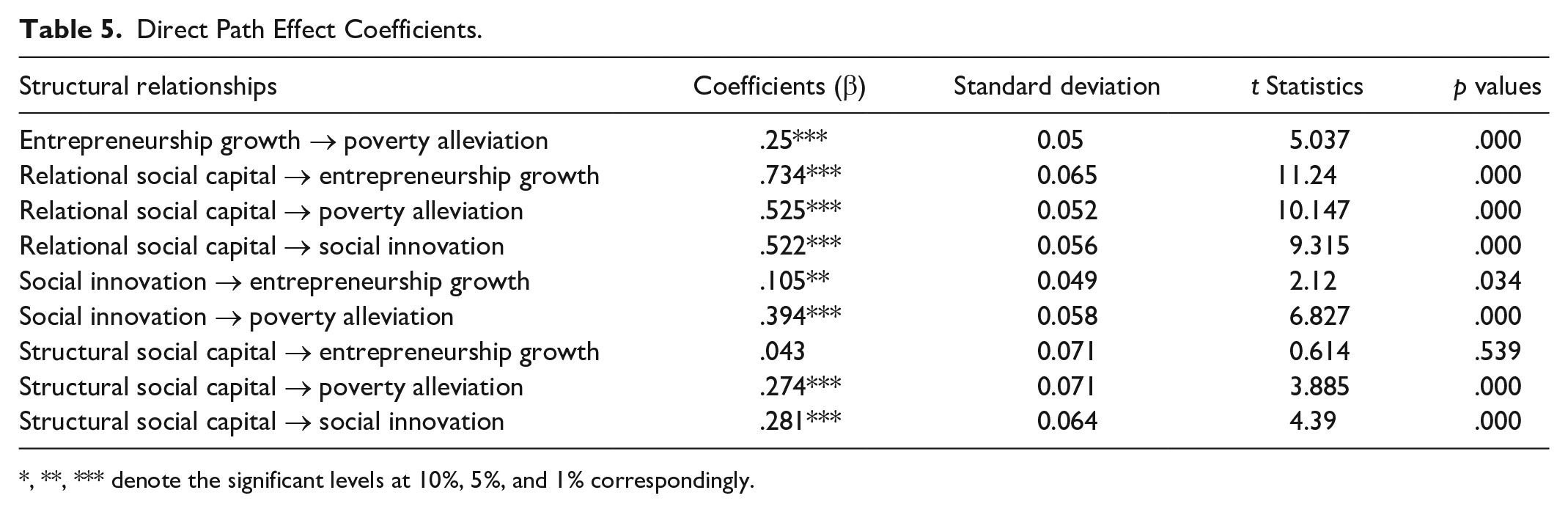
The structural equation model was utilized as the main technique for the data analysis and testing of the hypotheses on the direct impact of social capital dimensions and social innovation on entrepreneurship growth and rural poverty alleviation. The results from the analysis are presented in Table 5 based on the bootstrapping from SmartPLS-SEM. The findings reveal that Female Entrepreneurship Growth Performance (β = .250, p < .001), Relational Social Capital (β = .525, p < .001), Social Innovation (β = .525, p < .001), and Structural Social Capital (β = .27, p < .001) have statistically significant and direct positive impacts on poverty alleviation specifically in the rural area.
Direct Path Effect Coefficients.
, **, *** denote the significant levels at 10%, 5%, and 1% correspondingly.
Again, to explore how women entrepreneurship growth performance is achieved, the results from Table 5 show that Relational Social Capital (β = .734, p < .001) and social innovation (β = .150, p < .05) are the most significant factors that contribute to women entrepreneurship growth performance. Moreover, the results indicate that Structural Social Capital (β = .522, p < .001) and Relational Social Capital (β = .281, p < .001) have statistically significant positive impacts on social innovation. The results from the structural relationships of these variables show the direct pathways effects and the structural model are represented in Table 5 and Figure 3, respectively.

Research model.
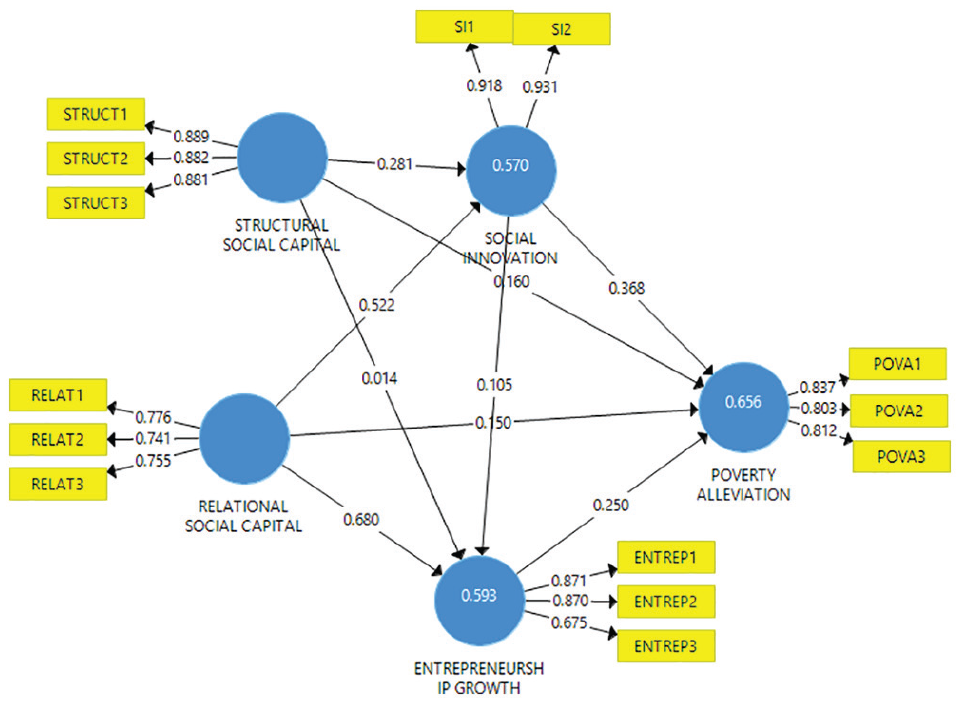
Measurement model with factor loadings of indicator items.
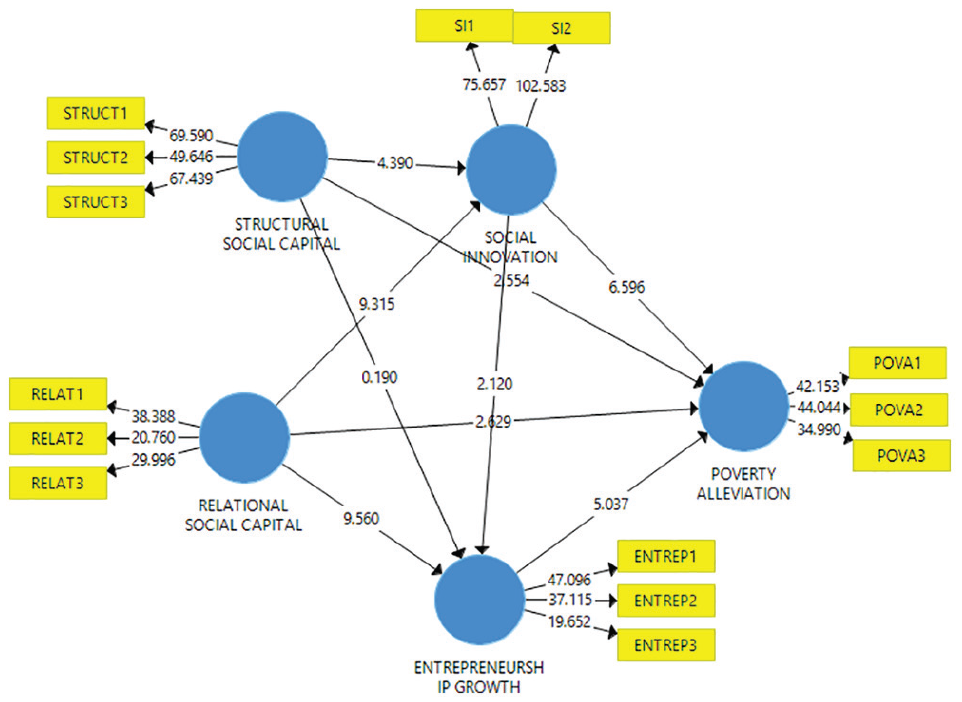
Structural model of bootstrap weighted path diagram.
Figure 3 presents the structural model estimated using the PLS bootstrapping. The diagram shows the statistical significance of the structural relationships among the variables by utilizing the t-statistics. The structural model in Figure 3 shows that structural social capital, relational social capital, social innovation, and women entrepreneurship growth have statistically significant impact on rural poverty alleviation.
This article also examined the mediation effects of women entrepreneurship growth performance and social innovation in the relationship between social capital dimensions and poverty alleviation. Findings from Table 6 show that the women entrepreneurship growth performance does not play a significant mediation role between structural social capital and poverty, hence the finding does not support H1. However, the findings show that women entrepreneurship growth performance pays a statistically significant partial mediation role between relational social capital and poverty alleviation (β = .170, p < .001).
Results From Hypotheses Tests of Mediation Effect of Social Innovation and Women Entrepreneurship Growth.

, **, ***Significant levels at 10%, 5%, and 1% correspondingly.
Again women entrepreneurship growth performance plays a significant mediation role between social innovation and poverty alleviation (β = .026, p < .001). Owing to this, both H2 and H3 are fully supported. Furthermore, the result show that social innovation plays a statistically significant partial mediation role between structural social capital and poverty alleviation (β = .104, p < .001). Social innovation also plays a significant mediation role between relational social capital and poverty alleviation (β = .192, p < .001). The findings support H4 and H5 as indicated in Table 6. More importantly, the results suggest that social innovation partially mediate the relationships between structural social capital and women entrepreneurship growth performance (β = .030, p < .1). Similarly, social innovation mediates the relationship between relational social capital and women entrepreneurship growth performance (β = .030, p < .05). This also supports the H6 and H7 as indicated in Table 6. The findings confirm the simultaneous multiple pathways through which social capital dimensions and social innovation contribute to rural poverty alleviation. The results from the hypotheses testing of the indirect pathways through which social capital, social innovation and women entrepreneurship growth performance contribute to poverty alleviation have been presented in Table 6.
Discussion
The results from the study shed more light on understanding the multiple pathways through which social capital, social innovation, and women entrepreneurship growth performance contribute to rural poverty alleviation. The findings reveal that social capital dimensions have significant direct impacts on women entrepreneurship growth performance and rural poverty alleviation. The results show that relational social capital which consists of trust, obligations, and reciprocity demonstrated by the women entrepreneurs in their social networks with family members, business partners, and community members constitute a productive intangible resources for their growth performance. Building a strong relational social capital, the perspectives of the rural women entrepreneurs provide them with high opportunities to access market opportunities information which are vital to improve their business performance and growth.
These findings are in line with previous studies such as Chiu et al. (2006) and Runyan et al. (2006), who suggest that women entrepreneurs have opportunity to improve their entrepreneurship growth performance by focusing on their relational networks. The extent to which these women entrepreneurs informally interact with social groups such as professional or business advisors, business suppliers, business customers, and community members helps them to learn new market ideas, and innovation ways to contribute to improving their business performance and income levels. These women entrepreneurs consider trust, loyalty, and empathy as key social elements, which help them to sustain their network relationships through which they could develop their entrepreneurial activities. As in a typical rural areas women are the caretakers of the family, they play a substantial role in contributing to solving social problems (Chua, 2002; Lee et al., 2019).
The findings also demonstrate that structural dimension of social capital per se does not have direct significant impact on entrepreneurship growth performance even though it has a positive association with it. However, it has an indirect impact on women entrepreneurship growth performance through social innovation. This confirms that in the rural context, structure of one’s social network does not matter most by directly regulating the growth performance of business. Nonetheless, the degree of their relations, trust, loyalty, and the formal and informal interactions are vital, providing them the opportunity to access information to improve innovation abilities to enhance their entrepreneurial growth performance. Even so, the results show that both structural and relational social capital have significant positive impacts on social innovation utilized by as a resource used by the women entrepreneurs to improve the performance of the entrepreneurial activities.
Intuitively, building strong relational and structural social networks through the social capital resource implies that women entrepreneurs are coming into contact with novel ideas, services, strategy products, markets, and processes which are directed toward improving the market performance of their entrepreneurship. This findings emphasize the fact that as these women acquire new business innovative ideas to improve their business performance in the rural areas, they tend to provide societal needs to improve standard of living particularly among the members of their family (Kramer, 2005). All these efforts toward improving the living standard of their family members are also directed toward alleviating poverty in the rural areas.
Moreover, the findings show that social capital, social innovation, and entrepreneurship growth have direct significant positive impacts on poverty alleviation in the rural areas. We found that encouraging women participation in entrepreneurship activities constitute one of the key development tools to alleviate poverty in the rural areas. In the rural areas where farming is the predominant occupation, women entrepreneurs’ participation in agribusiness has been successful in solving societal problems and contributing to poverty eradication. Consequently, the results show that women entrepreneurs are more efficient in forming social networks and harnessing the social innovation resources to enhance the growth of their business and lifting their families out of poverty conditions. As maintained by Dastourian et al. (2017), social capital and innovation increase entrepreneurship growth performance and impacts positively of poverty alleviation. This provides an evidence that in the rural settings where women entrepreneurs are constrained in terms of tangible resources to support their businesses, forming strong social networking could be advantageous. The social capital and social innovation obtained through the social networking serve as a major intangible resource for the entrepreneurs in the deprived areas.
Again, the results support the view that female entrepreneurship growth and social innovation play a significant partial mediation effects in the relationship between social capital dimensions and rural poverty alleviation. The findings confirm that through the social networking, women entrepreneurs establish and maintain contacts and relationship with new business partners, community members, and customers which enhance their entrepreneurship growth performance. Subsequently, with their connections and networks created, they are able to direct their business earnings toward improving their standard of living and impoverishment. Social innovation also serves as a partial mediation between social capital dimensions namely structural and relational social capital. The implications are that the number of bonding ties, trust and recognition of responsibilities of the entrepreneurs within their membership group, and their formal interactions with businessmen, family, community members, and customers indirectly contribute to poverty alleviation by enhancing the their social innovation. Their association with the network alliance exposes them to best social innovation practices, which remain key source of entrepreneurship growth performance.
The resources tapped by individual entrepreneurs through the shared ties and networks they associate themselves with contribute to reducing the probability of being poor. Henderson and Tickamyer (2008) confirm that social capital such as trust and strong ties among individual entrepreneurs contribute positively to their welfare. The results suggest that strong social capital value is important to the poor to escape from its poverty and find a meaning for living conditions. These impacts of social capital and social innovation on poverty alleviation are indirectly channeled through women entrepreneurship particularly rural setting in developing countries. These findings put forward the need to promote women entrepreneurship growth through social capital and social innovation. To conclude, the findings from the analysis support the view that Social capital dimensions have both direct and indirect structural pathways to influence rural poverty alleviation especially through entrepreneurship growth and social innovation.
Conclusion
This article explored the novel application of structural equation model to examine the multiple pathways through which social capital dimensions, social innovation, and women entrepreneurship growth performance contribute to rural poverty alleviation in the context of a developing county. In this study, we considered women entrepreneurs in the agribusiness industry in the rural areas in Ghana as the key participants and the extent to which they utilize their social networking alliance to improve their business performance.
Findings from the study reveal that social capital dimensions such as relational social capital directly have significant positive impact on women entrepreneurship growth performance and their social innovation abilities. We found that rural women entrepreneurs through their strong network and social interactions with customers, community people, opinion leaders, and maintaining contribute to their ability to identify new ideas, new markets, products, strategies, and opportunities to enhance the growth of their entrepreneurship and their welfare.
Furthermore, the findings in this research suggest that social capital dimensions and social innovation have indirect positive impacts on rural poverty alleviation through women entrepreneurship activities. This study based on the social network theory confirms that women entrepreneurs harnessing social capital such as bonding ties, trust, and establishing formal and informal relationships with businessmen are able to increase their incomes and improve the welfare of their families.
Moreover, in this study, we conclude that social innovation and women entrepreneurship growth performance play a significant mediating role between relational social capital and rural poverty alleviation. Social innovation and women entrepreneurship growth performance serve as the channels through which social capital dimensions contribute to poverty alleviation in the rural settings. In terms of policy, we recommend the need for policy makers and governments in the developing countries to encourage more women to participate in the entrepreneurial activities by harnessing the social innovation and social capital opportunities. Opinion leaders and development partners in Ghana and specifically within the Sekyere South District should promote women entrepreneurship within the District. Again, by-laws should be enacted to prevent gender stereotypes and discriminate against women entrepreneurs. This will provide the opportunity for the women to also contribute fully to solving social problems such as poverty and improve the welfare of their families. We also recommend that more young women should be encouraged to venture into entrepreneurship instead of always seeking for government employment and white-collar jobs.
Nevertheless, one of the limitations of this study was that only women entrepreneurs in the agribusiness sector in the rural areas were considered. Identifying additional moderators and mediators between social capital and poverty alleviation nexus in the developing countries is required. Again, the study was based on cross-sectional data. A longitudinal study could be valuable to confirm the findings of this study further. It will be worthy for future studies to consider comparative study between men and women entrepreneurs in terms of how efficient they utilize social capital resources in other sectors be furthered conducted in future studies.
Footnotes
Declaration of Conflicting Interests
The author(s) declared no potential conflicts of interest with respect to the research, authorship, and/or publication of this article.
Funding
The author(s) disclosed receipt of the following financial support for the research, authorship, and/or publication of this article: The authors received funding from national natural science foundation of China (NNSFC) with grant number 71473106.
