




Abstract
Employee recreation is among the tools, which can be appropriately used to increase employee productivity. In developing countries, both its insufficient use in workplaces, and a lack of academic studies and resources have led to inadequate knowledge and awareness about employee recreation. In this regard, the aim of this study was to test the applicability of employee recreation and its impact on employee productivity through a comprehensive recreation program. The research was carried out according to the Solomon Four Group Design. An employee recreation program covering 6 days a week was used as the intervention. The program was implemented for 6 weeks. The research group consisted of 101 employees of a medium-sized workplace in an Organized Industrial Zone. Significant differences were found in both within-group and between-group comparisons. As a result of the study, it was found that the employee recreation program had a large and positive effect on employee productivity.
Keywords
Introduction
Recreation is used today in planned and programmatic ways in many areas in order to produce beneficial results. One of these areas is workplaces (Anderson, 1950; McLean & Hurd, 2008; Shiffa & Anggiani, 2020; Ward, 1990). According to data provided by the International Labour Organization (ILO), there are 3.3 billion employees in various business sectors around the world in 2019 (Gomis et al., 2020). These employees are all, theoretically speaking, potential participants in employee recreation. However, it is clearly unreasonable to imagine that all employees could be reached in practice. Nevertheless, ensuring that employee recreation is as widespread as possible is likely to yield significant benefits at the individual, national, and international levels. This activity, which can have a positive effect on areas such as physical and mental health, social skills, and personal development, will first benefit individuals in their own lives, and then, as a result, the wellbeing of society in general (Rozi et al., 2020; Tiwasing et al., 2020). However, before coming to the society, it can be stated that the results created by employee recreation practices will be seen more clearly in the workplace. In short, employers and managers are the main people who will benefit from the advantages of workplace recreation programs. Because workplace recreation, by its nature, targets employees in a particular workplace, and it can be thought that positive changes in employees will directly affect the workplace. Managers or employers who want to create positive changes on employees can plan and use recreational activities in line with the objectives of the workplace.
Even in a workplace with only one employee, the performance of an individual at a sufficient level is vital for the proper functioning of the machines and devices due to the high level of automation. Moreover, for a company with many employees and a low level of automation, productivity is defined as what is done by employees rather than machines (Sutermeister, 1976). For this reason, in workplaces where the number of employees is high or where employees are at the forefront in production, the main concern that should be paid attention to in order to increase efficiency is the employees themselves. Employee productivity is seen as one of the best indicators of production efficiency. High productivity levels often turn into high profitability (Rojas, 2008). In other words, employers who want to have a high level of profitability and ensure the economic continuity of the workplace should focus on employee productivity. Thus, it may be possible for employers to eliminate human-induced productivity problems, to increase and maintain their employees’ productivity levels.
In order to maximize the benefits that can be obtained from workplace recreation programs, it is also necessary to maximize the variety of activities first. The variety of activities should mean that different types of activities are included. So, it will not be enough to just have variety in physical activities. Activities can be presented by differentiating them in groups such as physical, intellectual, mental or recreational, skill-based, problem-solving, cooperative groupings, and so on. In this way, the program can address different wishes of different individuals and it may be possible to have higher levels of participation in activities. It is seen that similar programs that have been implemented before are examined by including a certain group of activities in line with their purposes. For example, there are approaches that are prepared for a specific purpose, such as developing team integrity (Buller & Bell, 1986; Zhang et al., 2018), improving the level of wellness (Ben-Ner et al. 2014), relieving stress (Hepburn & McMahon, 2017; Mosca & Grossman, 2019), that is, focusing only on one objective. However, when the variety that should be in the workplace recreation program is provided, it may be possible to achieve a versatile development and reach many of the mentioned objectives at the same time. The gap of the research arises from this difference. Due to its nature, the scientific literature often examines specific and differentiated elements. Thus, more precise information emerges. The magnitude of the impact can underline the importance of employee recreation, with an intervention that will reveal the holistic impact of the recreation program with the different elements presenting this particular information.
It is a desirable that workplaces increase employee productivity and to use every opportunity that has the potential to can positively impact this. For this reason, methods of measuring productivity, factors affecting productivity, and obstacles to increasing productivity are frequently mentioned in the literature (Buntz, 1981; Clarke, 1991; Ertan, 2008; Koç, 1997; Lynch & Riedel, 2001; Pekel, 2001). In parallel with these topics, it is frequently stated that the effects of recreational intervention programs related to the workplace on productivity and factors affecting productivity should be investigated (Conn et al., 2009). In line with this, determining an appropriate recreation program that can increase employee productivity and examining its actual effects on productivity will contribute both to practice and to the literature. In this regard, the aim of this study was to test the applicability of employee recreation and its impact on employee productivity.
Recreation and Productivity
Productivity at the national and sectoral levels in developing countries is lower than in the European Union countries and the United States. However, if the human resources available were used in the most appropriate and beneficial way, productivity could be increased considerably (Hançer, 2004). Recreation should be considered as an auxiliary tool for helping to achieve the goal (Anderson, 1950, 1955; Carr et al., 2012; McLean & Hurd, 2008; National Association for Health and Fitness, n.d.; Ward, 1990). Mittelstaedt et al. (2006) state that the belief underlying employee recreation is that having “active employees will be beneficial to corporate health by increasing productivity.” In this view, employees can and will acquire new skills, develop existing skills and/or develop leadership qualities by participating in sports, arts, culture, or hobby clubs and organizations. At the individual level, employees may benefit from keeping fit and feeling healthy, gaining athletic achievements, and increasing their self-confidence. The main priority of recreation programs is to help employees stay fit and adopt healthy lifestyles by taking advantage of mental and physical exercise and fitness opportunities; this also has the result of reducing healthcare expenditures for both employees and employers (Mittelstaedt et al., 2006). In line with this idea, many researchers (Groves, 1981; Kumar et al., 2009; Mills et al., 2007; Pelletier et al., 2004; Shephard, 1999) have examined the effect of employee recreation on productivity on a fitness and wellness basis.
It can be clearly stated that physical activity and the exercises inherent in recreation are important in improving individuals’ levels of fitness and wellness (Burton et al., 2005; Elia & Rouse, 2016; Gebhardt & Crump, 1990). However recreational activities are related not only to fitness and wellness level, but also to many other factors that affect productivity (Akova & Bayhan, 2015; Burton et al., 2005; Elia & Rouse, 2016; Giga et al., 2003; Henning et al., 1997; Kavak & Vatansever, 2007; Roy, 1959; Tauer & Harackiewicz, 2004). Therefore, it can be argued that if employee productivity is to be increased through employee recreation, a comprehensive recreation program that includes not only physical-based activities but also activities that may affect these other factors (i.e. communication, stress levels, group dynamics, emotion, rest, etc.) (Baird, 2017; Chow, 1994; Faucett et al., 2007; Hurd et al., 2008; McHugh, 1993; Shields & Johns, 2016; Svyantek et al., 1999; Szilagyi, 1980; Tracy, 2013) would be more effective.
Employee recreation activities in developing countries have many issues in terms of accessibility, applicability and results. The reasons for this situation are the inadequacy of the institutions organizing recreation activities, the low level of interest of the existing institutions in employee recreation, insufficient state incentives and support for employee recreation, and the lack of knowledge and awareness of business owners, managers, and employees (Simsek, 2012). It is possible for employers and employees to increase their quality of life by engaging in recreational activities which will both help protect their physical and mental health and contribute to their community development by increasing work productivity (Ardahan, 2014; Kesim, 2003; Lloyd, 2017; Rozi et al., 2020; Schools, 2021). However, the lack of knowledge about the employee recreation in developing countries and the insufficient application of scientific research, and the related lack of data and resources is a significant problem which needs to be solved (Kesim, 2003). Thanks to studies that present this information, workplaces can see the importance of offering a recreation program to employees. As awareness and employee recreation programs increase, workplaces can contribute to social development. Although its effect is not immediately apparent, the psychological, physical, and social well-being of individuals means the well-being of both the workplace and the society.
Materials and Methods
Solomon Four Group Design was used in the study. The Solomon Four-Group Design, which represents the first specific evaluation of external validity factors, was chosen because it meets both internal and external validity. In this design, which allows comparisons to be made in different ways, the measurement results are expected to be M1 < M2, M4 < M2, and M6 < M5 (Babbie, 2014; Campbell & Stanley, 1963).This design is given in Table 1.
Solomon Four-Group Design.
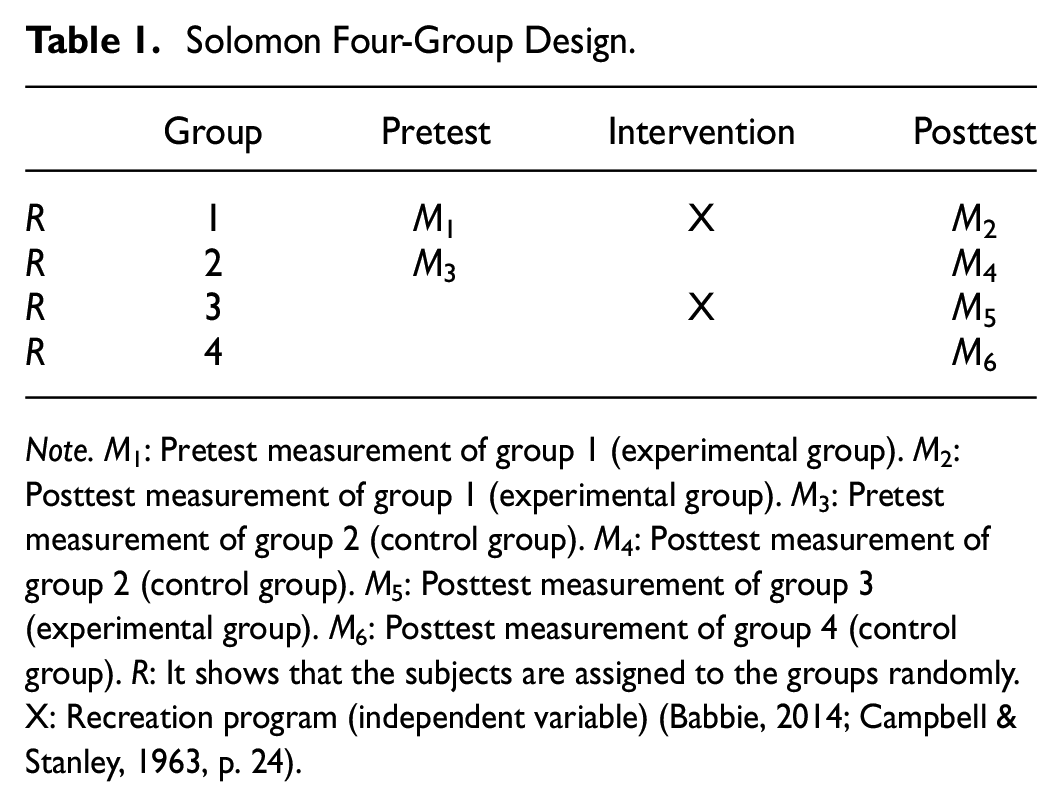
Note. M1: Pretest measurement of group 1 (experimental group). M2: Posttest measurement of group 1 (experimental group). M3: Pretest measurement of group 2 (control group). M4: Posttest measurement of group 2 (control group). M5: Posttest measurement of group 3 (experimental group). M6: Posttest measurement of group 4 (control group). R: It shows that the subjects are assigned to the groups randomly. X: Recreation program (independent variable) (Babbie, 2014; Campbell & Stanley, 1963, p. 24).
While structuring the employee recreation program applied as an intervention in the research design, attention was paid to the fact that the selected activities could affect the dimensions of the Recreation-Based Employee Productivity Scale (Mercanoglu, 2021). These dimensions are organizational commitment, communication, stress relief, rest, motivation, job satisfaction, group dynamics, wellness, reward, and emotion. A list of suitable activities was created and a questionnaire form (Individual Interest Determination Questionnaire) was prepared to determine the individual interests. This questionnaire was used to determine which activities employees would like to participate in. The employee recreation program prepared in line with the wishes of the employees includes team-building exercises, stretching, Pilates, backgammon, folk dances, yoga, bocce, Zumba, football (soccer), basketball, volleyball, Frisbee, creative drama, and child development seminar and individual counseling for parents.
It was thought that the recreation program would particularly affect the organizational commitment, motivation, and emotion dimensions, rather than specific activities. The program involved the selection of definite activities that were thought to directly affect the other dimensions (i.e. creative drama and team building activities for communication and group dynamics; yoga and stretching for stress relief; backgammon and bocce for rest; event tickets and appreciation after the competitive events for reward). The weekly employee recreation program, which it was anticipated would cover all the dimensions, was prepared in this direction. The program was implemented for 6 weeks. The weekly program and explanations about the program are given in Table 2.
Weekly Employee Recreation Program.

Note. • Weekday activities were carried out during the lunch break at the workplace.
• Weekend activities were held at the sports facilities of Eskişehir Technical University Faculty of Sport Sciences.
• During the implementation process, activities were included in addition to the weekly program without a specific day. These activities are Child Development Seminar and Individual Counseling, Creative Drama, and Frisbee. Individual counseling provided by a child development specialist was carried out face-to-face and by phone when requested by the employees.
• Team building exercises were applied for group dynamics. Two fun games that required cooperation were played in 1 day. Tangible and intangible rewards such as celebration, appreciation, and theater or event ticket gifts were given at the end of the activities.
• One of the activities of basketball, indoor football, and volleyball was selected by the votes of the employees and included in the weekly program at the beginning of each week.
Regular physical activity improves health and fitness levels. The program included various physical activities on 6 days a week. The type and intensity of these physical activities were designed in a way that balanced the minimum risk and potential harm with the maximum benefits. To attain this balance, the levels of “activity for health” and “exercise for fitness” specified by World Health Organization. Health Education and Health Promotion Unit (2003) were deemed appropriate.
Participants
The research group consisted of the employees of a manufacturing and exporting company located in the Eskişehir Organized Industrial Zone. The research group thus consisted of 101 employees (51 experimental, 50 control) of a medium-sized workplace. Information regarding the demographic characteristics and physical workload levels of the participants are given in Table 3.
Participants’ Information.

Note. The participants have provided informed written consent to take part in the research.
1 point: jobs with the least physical activity, such as desk jobs; 5 points: jobs with the most physical activity, such as carrying loads.
Data Collection Tool
Data were collected using the Recreation-Based Employee Productivity Scale (see appendix) developed by Mercanoglu (2021). The questionnaire form prepared for data collection consisted of two parts. The first part included a 33-item scale. The scale consists of aforementioned factors that can be manipulated by recreational activities. In other words, factors that can directly affect productivity such as salary but are not related to recreational activities do not exist in the scale. In the second part, there were questions prepared to determine the demographic characteristics of the employees. The data were collected from employees using the face-to-face interview technique by the human resources unit. Employees filled out the questionnaire individually in line with their own opinions. The human resources unit delivered the collected data to the researchers for analysis.
Data Analysis
For the analysis of the research data, the procedures suggested by Akbulut (2014) and Braver and Braver (1988) were taken into account in determining the proper procedures for the Solomon Four Group Design. Descriptive statistical analysis was conducted before testing the assumptions and conducting the comparison. The Shapiro-Wilk test was used to evaluate the distribution of the data. Levene’s test was used to test the measurements to be compared in terms of variance homogeneity. The Kruskal-Wallis test was used to compare the posttest measurements (M2, M4, M5, and M6) of the four groups. Then, Mann-Whitney U analysis was conducted as a post hoc test. The paired samples t-test was used to compare the repeated measurements (M1–M2 and M3–M4) of the pretested groups, and the Mann-Whitney U test was used to compare the pretest and posttest measurements (M1–M3 and M2–M4) between the groups. The analytical procedure required for comparisons was followed in the order given in Figure 1.
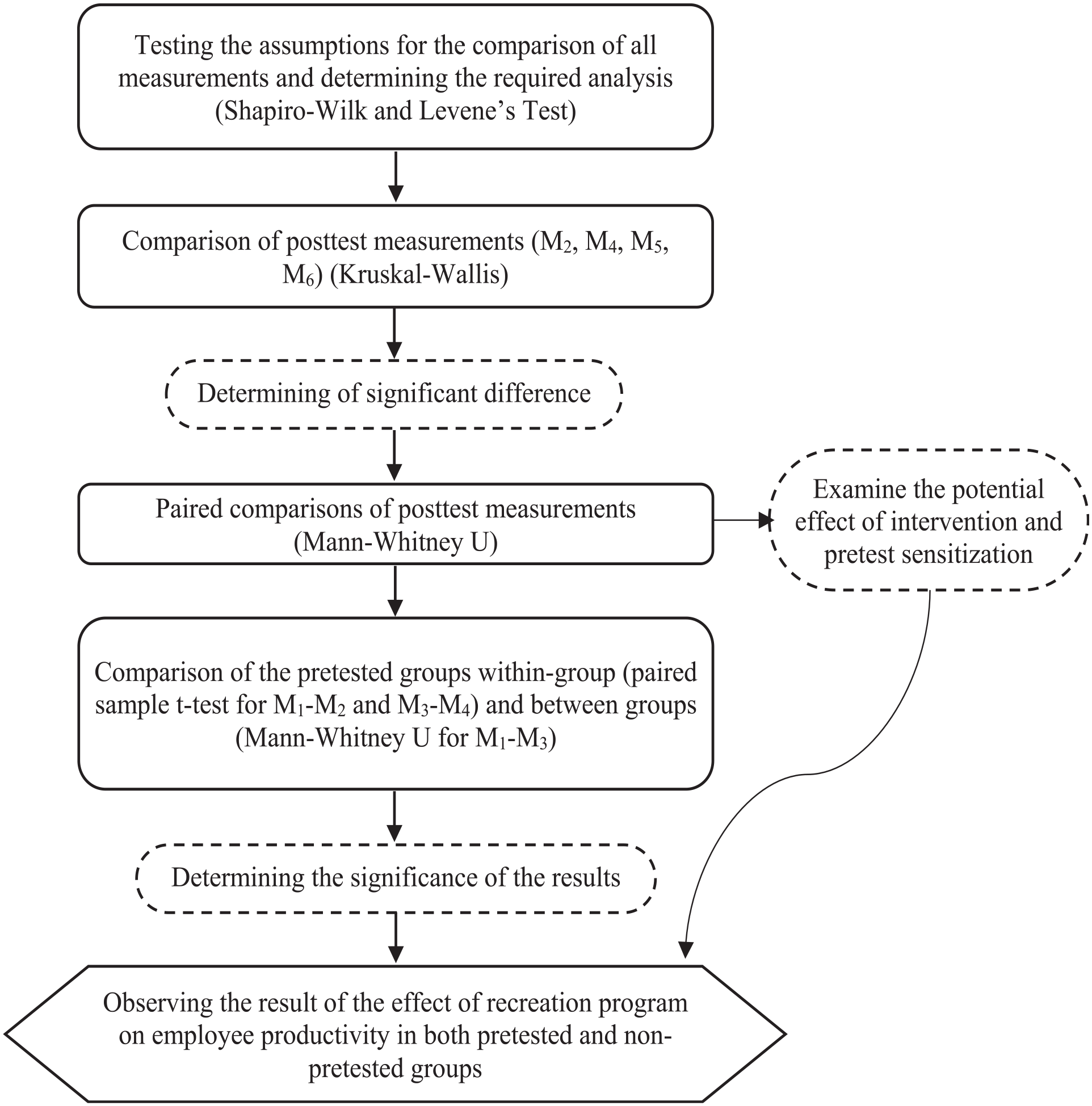
Flowchart of analysis and results conducted for the Solomon design.
Results
When the distribution of the pretest and posttest measurements of the pretested groups was examined, it was determined that the pretest and posttest data of the experimental group did not show a normal distribution. On the other hand, it was determined that the pretest and posttest data of the control group showed a normal distribution. When the data of only the posttest groups were examined, it was found that the control group data did not show a normal distribution but that the experimental group data showed a normal distribution (Table 4). After completing the normality tests for data distribution, the homogeneity of variances was tested.
Shapiro-Wilk Results.
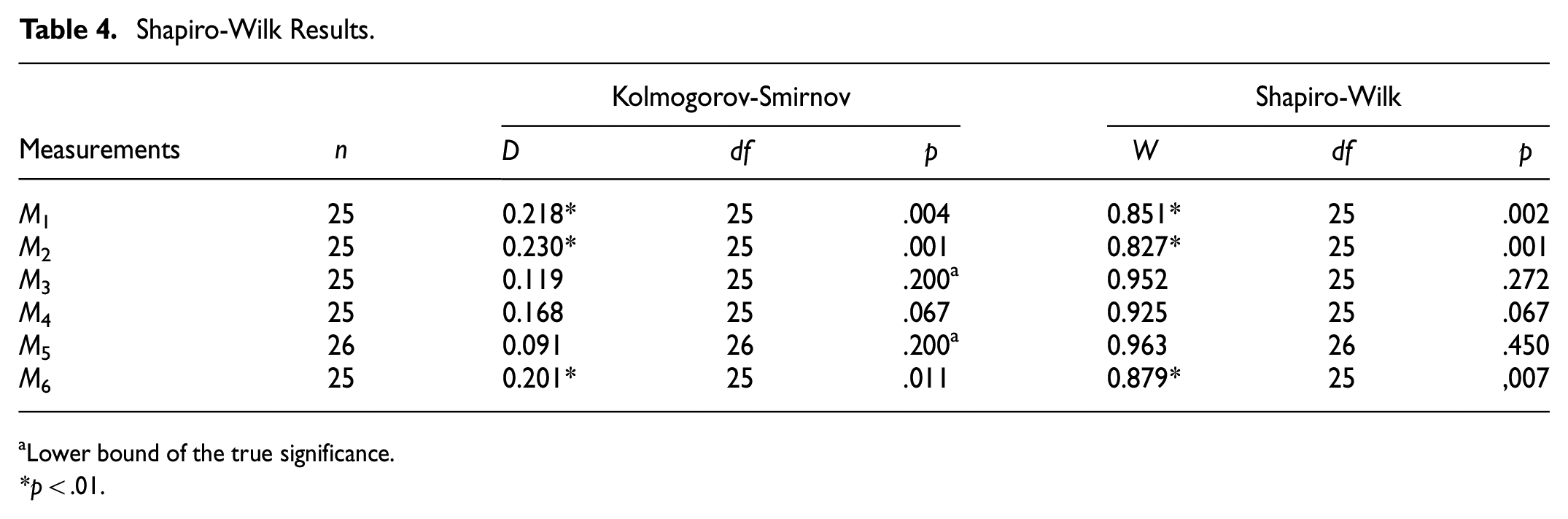
Lower bound of the true significance.
p < .01.
The Levene’s test values of the measurements were calculated in order to test the homogeneity of variances. A statistically significant difference was found between the variances of the M2, M4, M5, and M6 measurements, F(3, 97) = 15.935, p < .001.
Posttest measurements were tested in terms of distribution and homogeneity of variances. It was concluded that they did not meet the parametric data assumptions. Therefore, posttest measurements were compared using Kruskal-Wallis analysis.
The homogeneity of variance was tested in order to decide on the analyses to be carried out on the M1, M2, M3, and M4 measurements. It was determined that the variances of the pretest (M1 and M3), F(1, 48) = 5,074, p < .05, and posttest (M2 and M4), F (1, 48) = 18.673, p < .001, measurements of both groups showed statistically significant differences.
In addition, the pretest and posttest measurements of the experimental and control groups were compared. There was no significant difference between the variances of the pretest and posttest measurements of both the experimental group (M1 and M2), F(1, 48) = 3.142, p > .05, and the control group (M3 and M4), F(1, 48) = 1.552, p > .05.
The differences in the distribution of scores of the M1–M2 and M3–M4 measurements showing homogeneity of variance were also examined. According to the test results, parametric test assumptions were met only for the comparisons M1–M2, W(25) = .248, p > .05, and M3–M4, W(25) = .291, p > .05. In this regard, it was deemed appropriate to use the paired sample t-test for the comparisons of M1–M2 and M3–M4, and the Mann-Whitney U test for the comparisons of M1–M3 and M2–M4.
Descriptive and comparative analyses were conducted after testing the distribution and variance assumptions of the data. Descriptive statistics information regarding mean (
Descriptive Statistics.

When the Kruskal-Wallis results were examined, it was found that at least one of the M2, M4, M5, and M6 groups showed a significant difference from the others, H (3) = 33.413, p < .001. Afterwards, the Mann-Whitney U test was used as a post hoc test to determine which group/groups differed from the others.
The results of the Mann-Whitney U test conducted for pairwise comparison of the groups are included in Table 6. Significance levels were evaluated by Bonferroni correction. Since there were six combinations for the comparison of four groups in the analysis, the cut-off point of the p value was calculated as .0083. Effect size values were calculated with the following equation (Field, 2009):
Mann-Whitney U Results of Posttest Measurements.

p < .001 (p values are lower than Bonferroni corrected cut off point p < .0083).

Values with an effect size of .50 and above indicate that there is a large effect (Field, 2009; Fraenkle et al., 2012).
When the results were examined, a significant difference was found in each of the comparisons between the experimental groups and the control groups, and it was concluded that the experimental groups had higher productivity scores than the control groups. When the effect sizes of the comparisons were examined, it was determined that the employee recreation program had a large effect on productivity (for M4 < M2: U = 79.05, z = −4.52, p < .001, r = −0.64; for M6 < M2: U = 114.5, z = −3.85, p < .001, r = −0.54; for M4 < M5: U = 114, z = −3.98, p < .001, r = −0.56; for M6 < M5: U = 121, z = −3.85, p < .001, r = −0.54). When the two experimental groups and two control groups were compared within themselves, no significant difference was found in the productivity scores (for M2 and M5: U = 277.5, z = −0.90, p > .05, r = −0.13; for M4 and M6: U = 298.5, z = −0.27, p > .05, r = −0.04).
After finding a significant difference between the posttest measurements, the necessary analyses were carried out for within-group and between-group comparisons of the groups that were pretested. When the pretest results were compared, no significant difference was found between the experimental and control groups (U = 261.50, z = −0.99, p > .05, r = −0.14) (Table 7).
Mann-Whitney U Results of Pretest Measurements.

The paired sample t-test results for within-group comparisons of the both experimental and control groups were evaluated. Effect size values for the t-test were calculated with the following equation (Field, 2009):

When the results given in Table 8 were examined, a significant difference was found between the pretest and posttest measurements of the experimental group, and it was concluded that the productivity scores were higher in the posttest. When the effect size value of the comparison including the repeated measurements (M1 and M2) of the experimental group was examined, it was seen that the employee recreation program had a large effect on the increase in productivity scores, t(24) = −5.827, p < .001, r = 0.77. On the other hand, it was determined that there was no significant difference between the pretest and posttest measurements of the control group, t(24) = 0.241, p > .05, r = 0.04.
t-Test Results of Within-Group Measurements.
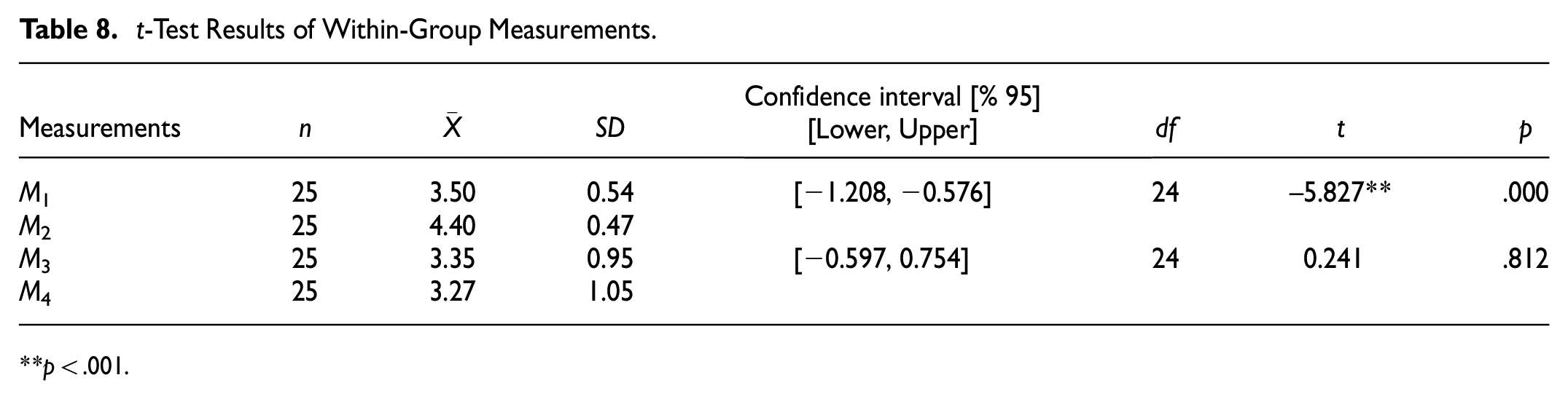
p < .001.
Discussion
Studies on employee recreation bring information on certain subjects to the literature. However, examining the effect of a comprehensive recreation program in which the elements of these specific subjects are considered holistically on productivity is the starting point of the research gap. Accordingly, it is thought that determining and testing a comprehensive recreation program that can increase employee productivity will contribute to both practice and the literature. In this context, the aim of this study is to test the applicability of employee recreation and its impact on employee productivity. In the literature, it is seen that among the programs for workplace recreation and that can be considered close to this study, especially employee fitness programs stand out. It is seen that most of the related studies focus on the financial performance of the workplace such as working performance, productivity, or sales (Wang et al., 2018). In addition to these, Wang et al. (2018) state that employee fitness programs have a positive impact on the overall sustainability performance of the organization. Although it is stated that such programs reduce absenteeism and employee turnover, enable a small increase in productivity, and reduce spending on healthcare, these benefits are viewed with skepticism and concern for their sustainability (Shephard, 1999). Along with fitness programs, certain interventions are carried out for specific purposes, such as meditation programs to relieve stress (Hepburn & McMahon, 2017), health promotion programs to reduce health risk factors (Mills et al. 2007), team integrity exercises to improve group dynamics (Zhang et al., 2018). These interventions also provide positive results in the targeted area, as in fitness programs. However, one of the important issues is to keep the benefit that can be obtained as high as possible. It can be said that a multi-component program that will contribute to each target mentioned on employee productivity will be more effective than programs carried out for separate targets. In this study, one of the reasons why the program has a great impact on productivity can be shown as the fact that the program is designed in a multi-component structure. An important issue that a monotonous and stable program can be an obstacle to is the sustainability of the program. It can be claimed that a dynamic program that will adapt to changes in personal interests and wishes will last longer. For this reason, it will be beneficial to collect information about the wishes of the employees continuously and to shape the program in line with these wishes, especially when conducting long-term programs.
Apart from the differences mentioned, there are features that differentiate this study from previous studies in general or in terms of sections. Some relevant examples are listed below. In the study conducted by Mokaya and Gitari (2012), it was stated that engaging in recreational activities is an important factor in employee performance. They concluded that recreation increased individual’s level of commitment and improved their wellbeing, with a consequent positive effect on job satisfaction, service provision, customer satisfaction, and productivity. One of the important points that distinguishes the current study from Mokaya and Gitari’s (2012) research is the lack of customer-oriented evaluations. Another difference between the two studies is that this study was performed in a factory setting. In addition, the scale used in the data collection process was addressed to all employees in general rather than being sector-oriented. Since the scale was suitable for all employees, it could be applied to employees working in different positions or areas (in the office, in the field, etc.).
In the literature, physical activity programs applied as workplace interventions have been evaluated in terms of specific health outcomes and fitness levels. It has been stated that the effect size of physical activity on health outcomes is in the small-to-medium range, while there is a large impact on fitness level (Conn et al., 2009; Proper et al., 2003). In this study, physical activities, which constitute an important part of recreational activities, were given a high level of importance. Physical activities of different characteristics and levels were included in each day of the weekly program. The effect size of the employee recreation program, which included not only these physical exercises but also many different activities, was evaluated and it was concluded that it had a large effect. Having a large number and variety of recreational activities is more appropriate in terms of increasing productivity, because it gives more employees the chance to participate in them. In addition, the possibility of employees getting bored is reduced as they are not participating continuously in the same activity. One of the most important reasons for having a program with a wide variety of activities is that it is more likely to positively affect different dimensions of productivity.
In the experimental study conducted by Buller and Bell (1986), the effect of team-building activities on the productivity of miners was examined. Although small improvements occurred in some performance metrics, it could not be determined whether these developments were caused by the intervention. Meetings were conducted with employees from different positions as part of the team-building activities. During the meetings, which were led by the consultant, various questions were asked about business-related problems and solutions were brainstormed. The main difference between Buller and Bell’s (1986) study and the current study lies within the scope of team-building activities. In this study, rather than having meetings dealing with work-related issues, activities were included that were not work-related, that involved a low level of physical activity and that were based on play. In these activities, attention was paid to providing opportunities for communication, problem-solving, cooperation, competition, and self-expression. Thus, it was possible to obtain the positive outcomes that arise from recreational activities in general.
This study determined that employee recreation has a large and positive effect on productivity. How the employee recreation program was implemented may have played an important role in the size of the effect. The activities were implemented within an intensive and comprehensive program. In addition, taking into account the requests and feedback of both employees and managers before and during the program, and making any necessary changes to the duration, implementation, and types of the activities will also increase the effect on productivity.
This study clearly shows that productivity can be supported by a well-structured employee recreation program. In addition to their effect on employee productivity, engaging in recreational activities can be recommended because they provide multiple benefits in areas such as family relations, healthy competition, and individual and social development.
Conclusion
The purpose of this study was to examine the impact of employee recreation on employee productivity. The scores obtained from the posttest measurements of all groups were compared in order to examine the potential effect of the pretest sensitization as well as the effect of the employee recreation program on productivity. When the posttest measurements were compared, it was found that the groups participating in the employee recreation program had significantly higher productivity scores than the groups not participating in the program. The level of differences between the measurements indicates that the employee recreation program had a large effect on employee productivity.
There was no significant difference between the posttest measurements of the two groups participating in the recreation program and between the posttest measurements of the two groups not participating in the program. Accordingly, it was concluded that the pretest did not have any effect on productivity scores.
Before the application, pretest measurements were compared in order to test the similarity of the scores of the groups. As a result of the comparison, it was determined that there was no significant difference between the pretest measurements. In this regard, it can be stated that the scores of the experimental and control groups were similar to each other at the beginning.
In order to examine the change in the productivity scores of the experimental and control groups during the research process, the scores of the repeated measurements were compared. When the repeated measurements of the experimental group were compared, it was found that the employee recreation program led to a significant increase in employee productivity scores. When the level of difference was evaluated, it was concluded that the employee recreation program significantly increased employee productivity. It was also concluded that the increase in the employee productivity scores was large. When the repeated measurements of the control group were compared, no significant difference was found in the employee productivity scores. The equivalence of these measurements in the control group indicates that there was no factor affecting productivity during the research process other than the employee recreation program.
To briefly express the results of the research: it was concluded that the employee recreation program had a large and positive effect on employee productivity.
Limitations and Suggestions
Due to the nature of this research, it has one important limitation. This is that the activities used as intervention tools were not evaluated individually. Instead, the holistic effect of the activities in the employee recreation program was examined. Therefore, there is no data on the effects of the activities separately. In addition, only certain activities were selected from among an unlimited number. This was because the activities that could be offered were limited to the available possibilities and, more importantly, because the choices of the participants were taken into account. In other words, a different activity program may be required for each individual workplace because the wishes of the participants may differ. Furthermore, the effects of a particular activity may be different in different workplaces. For this reason, it is important that activities are selected in line with the wishes of the participants rather than being imposed in order to achieve results. Engaging in recreational activities is, in its nature, a voluntary process.
In future studies, the effectiveness of the programs according to the sectors can be examined by preparing programs in line with the demands in different business sectors. In this way, program differences and effectiveness levels in the sectors can be compared. In addition, separate programs can be prepared according to the demands of managers and employees, and it can be investigated whether the effect on productivity differs.
Footnotes
Appendix
(Turkish Version of the Scale). Rekreasyon OdaklıÇalışan Verimliliği Ölçeği.

| Kesinlikle Katılıyorum = 5 |
Kesinlikle Katılıyorum | Katılıyorum | Kararsızım | Katılmıyorum | Kesinlikle Katılmıyorum |
|---|---|---|---|---|---|
| Örgütsel Bağlılık | |||||
| 1. Rekreasyon aktiviteleri, kurumuma olan aidiyetimi artırır. | 5 | 4 | 3 | 2 | 1 |
| 2. Rekreasyon aktiviteleri, çalıştığım kurumun bir parçası olduğumu hissettirir. | 5 | 4 | 3 | 2 | 1 |
| 3. Rekreasyon aktiviteleri, kurumuma karşı hissettiğim bağlılığı artırır. | 5 | 4 | 3 | 2 | 1 |
| 4. Rekreasyon aktiviteleri, işyerimi sahiplenmemi sağlar. | 5 | 4 | 3 | 2 | 1 |
| İletişim | |||||
| 5. Rekreasyon aktiviteleri, birimler arası iletişimi güçlendirir. | 5 | 4 | 3 | 2 | 1 |
| 6. Rekreasyon aktiviteleri, diğer çalışanlarla aramdaki iletişimi güçlendirir. | 5 | 4 | 3 | 2 | 1 |
| 7. Rekreasyon aktiviteleri, iş arkadaşlarımla paylaşımlarımı artırır. | 5 | 4 | 3 | 2 | 1 |
| Stres Atma | |||||
| 8. Rekreasyon aktiviteleri, beni rahatlatır. | 5 | 4 | 3 | 2 | 1 |
| 9. Rekreasyon aktiviteleri sayesinde stres atarım. | 5 | 4 | 3 | 2 | 1 |
| 10. Rekreasyonel aktiviteler huzurlu vakit geçirmemi sağlar. | 5 | 4 | 3 | 2 | 1 |
| Dinlenme & Yenilenme | |||||
| 11. Genel olarak düşündüğümde, rekreasyon aktiviteleri beni dinlendirir. | 5 | 4 | 3 | 2 | 1 |
| 12. Rekreasyon aktivitelerine katıldıktan sonra kendimi yenilenmiş hissederim. | 5 | 4 | 3 | 2 | 1 |
| 13. Rekreasyon aktiviteleri, işin yorgunluğunu atmama yardımcı olur. | 5 | 4 | 3 | 2 | 1 |
| Motivasyon | |||||
| 14. Rekreasyon aktiviteleri, işe gelme hevesimi artırır. | 5 | 4 | 3 | 2 | 1 |
| 15. Rekreasyon aktiviteleri, işe odaklanmamı kolaylaştırır. | 5 | 4 | 3 | 2 | 1 |
| 16. Rekreasyon aktiviteleri, istekli çalışmama katkı sağlar. | 5 | 4 | 3 | 2 | 1 |
| İş tatmini | |||||
| 17. Rekreasyon aktiviteleri, işimde başarılı olmama katkı sağlar. | 5 | 4 | 3 | 2 | 1 |
| 18. Rekreasyon aktiviteleri, bana yeni beceriler kazandırır. | 5 | 4 | 3 | 2 | 1 |
| 19. Rekreasyon aktiviteleri, yaratıcılığımı geliştirir. | 5 | 4 | 3 | 2 | 1 |
| 20. Rekreasyon aktiviteleri işimden duyduğum memnuniyeti artırır. | 5 | 4 | 3 | 2 | 1 |
| Esenlik (Wellness) | |||||
| 21. Rekreasyon aktiviteleri, sağlığımı korumama yardımcı olur. | 5 | 4 | 3 | 2 | 1 |
| 22. Rekreasyon aktiviteleri, dinç hissetmemi sağlar. | 5 | 4 | 3 | 2 | 1 |
| 23. Rekreasyon aktiviteleri, boyun, sırt ağrıları vb. işimden kaynaklı fiziksel rahatsızlıkların azalmasına yardımcı olur. | 5 | 4 | 3 | 2 | 1 |
| Grup Dinamiği | |||||
| 24. Rekreasyon aktiviteleri, yeni bir gruba uyum sürecimi kolaylaştırır. | 5 | 4 | 3 | 2 | 1 |
| 25. Rekreasyon aktiviteleri, iş arkadaşlarımla bir takım olduğumu hissettirir. | 5 | 4 | 3 | 2 | 1 |
| 26. Rekreasyon aktivitelerinin çalışanları birleştirici bir rolü vardır. | 5 | 4 | 3 | 2 | 1 |
| Ödül | |||||
| 27. İşyerim tarafından sunulan rekreasyon aktivitelerini ödül olarak görürüm. | 5 | 4 | 3 | 2 | 1 |
| 28. İşyerimin vereceği rekreatif aktivite biletleri ya da indirim kuponları (sinema, tatil, tiyatro, spor merkezi vb.) benim için iyi bir ödüldür. | 5 | 4 | 3 | 2 | 1 |
| 29. İşyerimin, katıldığım rekreasyon aktiviteleri için yaptığı harcamaları değerli bulurum. | 5 | 4 | 3 | 2 | 1 |
| 30. İşyerimin rekreasyon aktiviteleri sunması, beni takdir ettiğinin bir göstergesidir. | 5 | 4 | 3 | 2 | 1 |
| Duygu | |||||
| 31. Rekreasyon aktiviteleri, işimdeki mutluluğumu olumlu yönde etkiler. | 5 | 4 | 3 | 2 | 1 |
| 32. Rekreasyon aktiviteleri, işyerimde eğlenceli vakit geçirmemi sağlar. | 5 | 4 | 3 | 2 | 1 |
| 33. Rekreasyon aktiviteleri, çalıştığım ortamı keyifli kılar. | 5 | 4 | 3 | 2 | 1 |
