




Abstract
This empirical study aims to examine and validate the factors influencing productivity among remote academic staff in Jordanian higher education institutions during the Covid-19 crisis, with a specific focus on the mediating role of employee engagement. A comprehensive conceptual framework is developed by integrating relevant studies on remote work-from-home, productivity, and engagement, along with insights from in-depth interviews. Employing a descriptive correlational survey design, the study explores the relationships among the study factors using a quantitative approach. Data is collected from a random sample of 408 remote academic staff members who worked from home during Covid-19. The findings robustly support the proposition that organizational, individual, technological, and client-related factors significantly and positively influence academic productivity through the mediation of employee engagement. These results emphasize the importance of considering these interrelated factors holistically to enhance productivity and engagement in remote academic work. The study contributes to a deeper understanding of remote work dynamics and provides practical insights for improving productivity and engagement in the Jordanian higher education context.
Introduction
Since the World Health Organization (WHO) proclaimed the new Coronavirus to be a global epidemic on March 11, 2020, many governments around the world adopted several strict precautionary measures to contain its spread, the most important being “the lockdown or stay at home,” in addition to closing businesses, schools, universities, and worship and public places. Since the lockdown or stay-at-home measures entered into force, many workers were instructed to stay home and work remotely whenever possible. Remote work is a type of employment that enables staff members to work part- or full-time outside of the office, frequently from home, while yet maintaining communication with coworkers and other stakeholders (AbuJarour et al., 2021; Roose, 2020). This is viewed as a form of alternative (or flexible) work arrangement where work is done off-site and employees connect to the office through telecommunications equipment (Allen et al., 2015; Onyemaechi et al., 2018). Work-from-home has created management by outcome rather than by “presenteeism” (Gould et al., 2023). The largest remote teamwork experience in history was made possible by businesses that sent their staff home, including businesses that were previously unaware of the benefits of working remotely.
Despite a modest rise in the number of people working part- or full-time remotely over the years (Eurostat, 2018; Golden & Gajendran, 2019), the pandemic has sped up the adoption of remote working practices. According to Dey et al. (2020), by the first week of April, 31% of employees had made the switch to working remotely. Many people remained working from home even after directives to stay at home were relaxed. According to Gallacher and Hossain (2020), with significant regional variation, 41% of employment in Canada were conducted remotely. During the crisis, communities were subjected to a “forced experiment” on a large scale as sectors operated while they were physically separated, provided that the necessary legal and digital security conditions were met. This had the potential of a significant impact on companies, whether they have adopted remote work previously or not (Organisation for Economic Cooperation and Development [OECD], 2020). Remote work offers benefits for both organizations and employees, as it has been proven to ensure work continuity in disruptive circumstances (AbuJarour et al., 2021). Simultaneously, “its benefits in normal circumstances include reduced commuting time, increased opportunities for workers to focus on their work tasks away from office distractions, as well as striking better balance between work and family life (especially for women) and making them feel that organizations care” (International Labour Organization, 2020). Besides, remote work can improve productivity, the quality of work/life and job performance. However, there is a need to see how remote work activities enabled by information communication technology (ICT) and modern interactive systems could be improved, especially regarding enhancing remote work performance by accelerating information sharing.
The usefulness and opportunities of remote work have received great scholarly attention in recent years under normal conditions (e.g., AbuJarour et al., 2021; Beňo, 2018; Lupu, 2017; Roose, 2020; Wienclaw, 2019), due to the rapid changes in technology and business environment and to globalization and changing customer demand. However, studies on remote work-from-home in higher education institutions empirically during the pandemic have not been conducted, including challenges that face remote-workers, engagement, and productivity. The critical questions for higher education authorities in Jordan will be the extent to which remote work-from-home has been productive? What are the most critical factors/challenges that determine academic remote workers’ productivity and engagement?
To be effective, “remote work must depend on dialogue and cooperation between management and workers. This becomes even more important when remote work is mandatory and takes place on a full-time basis.” (International Labour Organization, 2020) According to studies, management by results, in which both the manager and the employee agree on a single productivity evaluation method, is the best method for managing remote workers (Hickman, 2019). Setting objectives, completing tasks, reaching milestones, and keeping track of progress without onerous reporting are a few examples. Accordingly, it could be assumed that employees are more likely to actively engage in technology-based remote work activities if the information, experience, and recommendations required could be provided by other employees (e.g., Roose, 2020). Several higher education institutions have designed guidance and strategic plans to support supervisors in helping staff members, departments, and employees to be engaged and productive while working remotely. Many of these institutions offer round-the-clock breaks, for example, to alleviate junior faculty concerns about losing months of writing and research due to coronavirus-related disruptions. Others look at various ways to support professors on and off their career path. Some organizations consider telecommuting to be a viable alternative work arrangement under certain circumstances (Brynjolfsson et al., 2020).
In the context of teaching and learning, it is essential to examine the performance and effectiveness of educational practices, particularly considering recent global challenges. The COVID-19 pandemic has significantly impacted educational systems worldwide, forcing a shift from traditional in-person teaching to remote and hybrid learning models. This unprecedented disruption has prompted educators, policymakers, and researchers to evaluate the efficacy of these new approaches and their implications for student outcomes. Considering the unique circumstances of Jordan, it is important to delve into the specific practices and strategies employed in the country’s educational system. By examining the performance of teaching and learning in Jordan, we can gain insights into the strengths and weaknesses of the system, as well as identify areas for improvement. Additionally, by comparing the experiences and practices implemented during the pandemic, we can assess the adaptability and resilience of Jordanian education in the face of adversity. Throughout this study, it is crucial to maintain a focus on the main argument while incorporating the influence of COVID-19 practices and their integration into the Jordanian context. By doing so, we can gain a comprehensive understanding of the performance of teaching and learning, considering both pre-pandemic practices and the innovative approaches adopted during these challenging times. Ultimately, this analysis will contribute to a broader conversation on enhancing educational practices and fostering optimal learning environments for students in Jordan and beyond.
In reviewing academic literature, a wide range of organizational -level factors have the potential to enhance remote workers’ productivity in several service sectors. However, studies that have examined empirically the role of academics’ engagement in WFH productivity during the Covid-19 crisis, particularly in developing countries such as Jordan by an integrated approach, are rarely available. Therefore, this study aims to examine and validate the role of academics’ engagement as mediating factor in WFH productivity and investigating into the factors determining their productivity during Covid19 era. The findings of this study are expected to be significant for top-level managers in universities and for the Ministry of Higher Education officials to develop policies, encouraging, facilitating, and enhancing remote work-from-home productivity and mobilizing workers at universities. Furthermore, the outcome of the present study will provide university leaders with essential insights to make better decisions, guidelines and preparedness that provide academic staff with an appropriate working environment.
COVID-19 and the Status Quo of Higher Education in Jordan
On the 2nd of March 2020, the Ministry of Health in Jordan announced the first case of COVID-19. On March 17, Jordan’s King Abdullah II issued a royal decree activating a 1992 law that grants the prime minister full power for regulatory reinforcement and securitization procedures to ensure effective responsiveness to the potential risks of Covid-19. Accordingly, the prime minister issued Defence Order No.3, tightening curfew regulations. A lockdown was announced on 17 March, which later turned into a strictly enforced curfew when all universities and schools were shut down, and new measures taken by the Ministry of Higher Education were put in place to mainstream online learning as the only option available. Tens of thousands of teachers and university lecturers were suddenly faced with the daunting task of switching to online teaching in a desperate attempt to stop the spread of the novel coronavirus” (Salam Al. Mahadin, 2020). The Higher Education Council as a policymaker has directed university leaders to support access to remote learning during the COVID-19 pandemic. Universities utilized all available resources for proper readiness for online learning and the daily use of the LMS of which moodle was the most popular. Platforms like Microsoft Office, Google Meet and Zoom were among the frequently used platforms.
The migration of universities into online learning in Jordan within those circumstances witnessed some challenges of proper planning, design, and development of effective online instructional programs. Examining intensive versus extensive online learning will convey how the status quo of education during COVID-19 appeared to prove that Jordan did well with identifying the resources for remote and online learning but struggled with the curation process which acknowledges that online teaching represents a shift from a teaching to a learning paradigm. An additional challenge was the ratio of the learning loss and digital gap among university students in the online learning triggered by limited resources and services to poor students or triggered by poor internet connectivity to students who lived in distant areas. On a more positive note, the software and platforms required for the process were available at most universities but with variant degrees, that is, varied internet speeds among universities, varied efficiency of facilities and resources required for conducting and producing synchronous and asynchronous classes and varied degrees of efficacy of the employment of the appropriate pedagogy for the online learning. The common denominators among universities were the reliable video conferencing in almost all universities, a self-paced learning by students who can access the online recorded lectures as many times as they opted. Another was not having to commute to universities to take the classes and save themselves all the hassles of traffic jams and expenses of commuting to universities by students and academics.
As far as the capacity building of human resources in institutions of higher education in Jordan is concerned, The UNHCR and UNESCO Education teams have been working closely with the Ministry of Higher Education (MoHE) to provide university faculty with professional development focused on instructional design and the delivery of online and virtual learning modalities. The MoHE is currently shouldering the responsibility of an ongoing TOT training of faculty members in universities to raise the quality of the deliverables within online learning. The Covid-19 pandemic will eventually decrease, but thoughts about work-from-home will persist, especially since bylaws now allow a percentage of courses to be offered online. By facing challenges and identifying opportunities, “new normal” will be envisioned for where and how work is done. Additionally, as time goes by productivity performance is likely to be better so that the crisis catalyzes change broader and employs smarter and efficient telework practices, raising worker satisfaction and diligence while lowering universities’ expenses. This could push forward the transition into a “new normal,” which would have been slower in the absence of the crisis, considering uncertainties and costs pertaining to the necessary organizational and management changes and other obstacles—such as cultural reluctance or legal impediments.
Literature Review
The Covid-19 pandemic has forced some countries to enforce full-fledged mandatory quarantine, therefore the only choice for higher education institutions in those nations will be hiring workers who can work from home. However, some businesses favored working from home even when there was no epidemic. While remote work has significant benefits both for universities using virtual learning applications and for academics, some challenges should be faced. Many earlier studies (Beňo, 2018; Lupu, 2017; Wienclaw, 2019) have centered on comprehending the process of virtual learning and overcoming the difficulties it presents under typical circumstances. A better work-life balance, fewer mobility or distractions that result in more focused work or lower absenteeism are just a few examples of how remote work can increase worker happiness, motivation, and knowledge production while also raising workers’ productivity. However, it is also possible for workers to be less satisfied with working remotely due to isolation, covert overtime and a mixture between personal life and work, or an inadequate work environment at home. Reduced geographic restrictions on the workforce, an increase in employee engagement to the firm, and a favorable impact on productivity as measured by the quality and quantity of work outcomes are all noted (Osborne & Hammoud, 2017). Germany has demonstrated stronger product innovation intensities, higher efficiency, and more intense worker commitment in institutions that allow trust-based work practices or self-managed work time, including telework (Godart et al., 2017).
According to Roose (2020), remote workers frequently forfeit benefits like creativity and innovation in exchange for the increased productivity they experience. Working from home may result in a decline in creativity and innovation because now, innovation is rarely a solo effort and instead frequently requires team collaboration (Ohly, 2018). Remote labor can also improve organizational performance by enabling cost reductions that free up resources for productivity-boosting innovation and restructuring. Additionally, by using less office space and equipment, remote work could effectively lower capital expenses (Bloom et al., 2015). Telework increases the pool of candidates from which businesses can choose, increasing the supply of skilled workers and improving the match between job seekers and openings, for example, by luring highly skilled workers who are confined to a specific location for personal reasons. As a result, labor costs could be reduced (Baldwin & Forslid, 2019; Clancy, 2020).
According to studies, productivity rises when employees work from home. According to Beckmann et al. (2017) remote workers are happier, more productive, and less likely to leave their jobs than those who commute. Additionally, it revealed that 91% of remote workers believed they were more productive at home. The idea that working from home can increase worker productivity and efficiency was backed by comparable studies (Beckmann et al., 2017; Godart et al., 2017). Even though, it has been supported by many previous studies, Monteiro et al. (2019) argue that the notion that “working remotely contributes to job satisfaction and motivation” requires a fresh evaluation and investigation. To extend the analysis’s focus, they used “a longitudinal panel dataset of enterprises in a sample that is representative of the entire economy, including manufacturing and services industries.” They claimed that when time-invariant factors and unobservable constant firm characteristics were considered, the results were different. The results show that working remotely has a negative impact on average productivity, which may be related to the “significant degree of heterogeneity between different categories of organizations.” Several research on teleworking performance, job perspectives, and isolation among professionals were analyzed by Beauregard et al. (2019). The determinants for successful teleworking are listed as “characteristics of the job, characteristics of the employee, and characteristics of the employee’s manager(s)” after discussing how teleworking influences employees’ wellbeing. They enumerate the prerequisites for effective telework and divide them into technical prerequisites and teleworker-related prerequisites. According to Beauregard et al. (2019), “job duties must be able to be carried out outside of the office, and workplaces at employees’ homes should be safe, secure, and largely distraction-free.” They contend that “successful teleworkers need to be able to operate independently, should be able to keep professional and home life distinct, and must be able to overcome the risks provided by working alone” (Beauregard et al., 2019, p. 34). The mechanisms influencing the productivity of employees who work from home are the main topic of Kazekami’s (2020) research. Many factors are investigated, including stress related to juggling work and home responsibilities, life satisfaction, job satisfaction, and cutting down on commute time.
The study findings indicate a positive relationship between telework hours and productivity, with the ability to avoid long commutes contributing to enhanced productivity (Alghaithi, 2020). However, the effectiveness of working from home depends on the support provided by employers and factors such as organizational culture, employee personality, and family demands (Alghaithi, 2020; Morikawa, 2020). Some tasks may not be suitable for remote work, highlighting the limitations of full-time, forced teleworking during the COVID-19 pandemic (Akbar et al., 2020; Cartmill, 2020). Surveys suggest that occasional remote work under normal circumstances can yield positive experiences (Cartmill, 2020). Managing teleworkers based on performance and outcomes rather than strict schedules or hours worked can help maintain work-life balance (Ozimek, 2020). While there may be temporary productivity improvements during the pandemic crisis, productivity losses are not inevitable and can be mitigated (Ozimek, 2020). Trust-based working time arrangements, where control over working time is released and worker performance is evaluated based on outputs, have shown positive impacts on remote workers’ productivity (OECD, 2020; Ozimek, 2020). Productive companies tend to employ advanced management methods in addition to remote work, increasing the likelihood of remote work utilization (OECD, 2020).
To illustrate, personal interaction is more persuasive to attract further attention or to allow observing “social clues” better (Battiston et al., 2017; Bohns, 2017; Bonet & Salvador, 2017; Golden & Gajendran, 2019; Roghanizad & Bohns, 2017). Increased email traffic or virtual meetings are examples of obstructive modes of communication that may emerge to make up for the absence of personal conversation. Ultimately, in addition to its effects on the internal operations of the company, less interpersonal communication may also negatively affect interactions with significant stakeholders, such as clients and suppliers, with adverse effects on the overall performance of businesses (Hovhannisyan & Keller, 2019). Limited social engagement and isolation are examples of the opposite effects on employees, which can lower productivity and even affect their health (Ruth & Chaudhry, 2008). When there is no planning, there are additional negative repercussions, like an increase in job pressure and endless working hours (Hraskova & Rolkova, 2012). Additionally, having more free time might force employees to work less efficiently (Ruth & Chaudhry, 2008). Also, studies indicate that employees struggle to manage their time at work and have issues with information confidentiality (Montagut et al., 2017).
Although working remotely offers freedom, there are drawbacks include audio and technological issues, the risk of being exposed to ransomware and insecure networks, and restrictions with nonverbal signs like body language. According to a study, teams who collaborate remotely encounter more serious communication problems (Morrison-Smith & Ruiz, 2020). On the other side, the COVID-19 pandemic has inspired companies to dramatically up their connection with staff. Employees who work from home are unlikely to be less innovative, according to a study by Golden and Gajendran (2019). According to the study, when team members work apart from one another, it may have a negative impact on innovation. However, video conferencing can make up for this. An individual’s attitude and disposition toward working from home and productivity are influenced by both personal and technology-related aspects, according to a survey of how academics from around the world adjust to WFH during the present epidemic by AbuJarour et al. (2021). Overall, the evaluation of the literature on remote work from home productivity and work engagement revealed that the research’ conclusions were infrequent, inconsistent, and conflicting.
Research Model and Hypotheses Development
Closer reviewing the main body of literature of remote working leads to notice several models and theories that have been adopted by researchers (Belzunegui-Eraso & Erro-Garcés, 2020; Felstead & Henseke, 2017). For example, an integrated model based on social exchange theory and border theory was proposed by Felstead and Henseke (2017) to see how remote working could grow and how it could reflect on effort, well-being, and work-life balance for employers and employees. The Job Demands Resources theory which was proposed by Demerouti et al. (2001) also considered by Nakrošienė and Butkevičienė (2016) to assess the impact of different telework factors on work results. Workplace conditions can also be broken down into job demands, such as workload, deadlines, recipient contracts, actual workplaces, work schedules, and employment resources, such as evaluations, rewards, control over one’s work, participation, and job security. Because of this, increased job demands result in stress and health problems, yet increased resources result in higher levels of performance (Felstead & Henseke, 2017). Additionally, increased job resources affect productivity and motivation (Fodor et al., 2020). Donnelly and Johns (2021) conceptualized Labor Process Theory as a model base to discover how the remote work nature and location of remote work and its HRM are being re-contextualized. Socio-Technical System (STS) theory, moreover, supports the relationship between social and technological factors (Carayon et al., 2015).
Based upon these theories, previous studies as well as the results of the current study’s in-depth interviews (focus groups), the study model is developed. It is proposed that the academic’s remote working productivity can be thought of to be a function of three interrelated categories of factors/challenges: (1) Organizational factors (2) Individual-related factors (3) Technological-related factors and (4) Clients (students) participations factors. The productivity of the academic staff that operate remotely from home might be affected by these types of circumstances either favorably or unfavorably. Figure 1 illustrates the anticipated association between these categories as independent variables and employees’ remote work as dependent variables through employee engagement as a mediating variable and their demographic characteristics as moderating variables (1). The constructions are addressed below along with research that focused on them. Additionally, the expected relationship between each construct is defined and examined throughout its presentation.

Study model.
The main constructs of the research’s model:
Dependent Variables: WFH Productivity
The academic’s WFH productivity is used as a dependent factor in this study. The results of remote working for both individuals and organizations, as well as the factors determining effective implementation, have been the subject of a great deal of current research (De Menezes & Kelliher, 2017). The evidence on these linkages that potentially affect an organization’s productivity is inconclusive. According to Lupu (2017) and Anderson and Kelliher (2020) one of the main factors driving the adoption of remote work-from-home is the productivity factor, which results in increased focus, increased motivation, job satisfaction, a better employee commitment, and increased work energy by reducing time, disruptive elements, and geographic constraints. Furthermore, working remotely from home saves time, energy, and effort on commutes to and from the workplace, freeing up more of these resources for work and family responsibilities. Additionally, reports indicate that part of the time saved will presumably be used to complete work responsibilities (Dixon et al., 2019). It has additionally been mentioned as an advantage of remote work that firms perceive (Golden & Gajendran, 2019). Working during peak efficiency times, minimizing interruptions and distractions, being in a setting that promotes enhanced concentration, and minimizing inadvertent absence are some of the reasons mentioned (Golden & Gajendran, 2019).
The issue in operationalizing academic productivity measurements (at the individual level) is choosing the type of measure, such as objective or subjective measures, in addition to dimensionality (quantitative vs. qualitative). Numerous academics have proposed that subjective or qualitative productivity measures should be used in place of objective measurements De Menezes & Kelliher, 2017). The relative difficulty of collecting objective productivity statistics makes the use of subjective measures for academic productivity increasingly vital. Faculty members typically carry out a variety of responsibilities that can be challenging to quantify and differ greatly depending on the discipline and kind of school. Additionally, the emphasis placed on aspects of the institution’s mission will affect how faculty members are evaluated in relation to their teaching, research, and public service. Even within one institution, the ratio of time spent on teaching to other scholarly activity will vary by discipline. In addition, subjective indicators like specialty, ranking position, and gender would enable comparisons between academic staff and environments. Additionally, the research frequently uses subjective scale assessments to validate this approach as a viable and trustworthy one (Lindsay et al., 2002; Rose, 2012). Thus, these findings support the notion that subjective measurements can be employed to evaluate the academic productivity of universities and may result in convergent outcomes of various magnitudes. Teaching, research, and community services were chosen as the three key components of academic productivity.
Mediating Variable: Academic’s Engagement
According to previous studies, an organization must use academic engagement as a good work-related outcome to reap the rewards of lower turnover, higher commitment, higher retention, and higher productivity. Several studies have also demonstrated that productive individuals are engaged employees, and financially successful firms have highly engaged workforces. Businesses with high engagement levels are more successful and customer focused (Kim, Cable, et al., 2019). According to extensive research on employee engagement undertaken by Gallup over the past 17 years, engaged employees are individuals who are personally invested in, enthusiastic about, and committed to their work, co-workers, and workplace. According to Kim, Han, et al. (2019), when people are personally immersed in things they value and feel confident in, they choose to express themselves cognitively, emotionally, and physically. Kahn’s concept of engagement and Gallup’s definition are mutually compatible.
The development of employees’ attitudes, intentions, and behaviors to increase work performance can be mediated through academic engagement (Yalabik et al., 2013). Engaged employees consistently look toward the future, maintain good relationships with one another, and perform at a high level for the company (Kim, Han, et al., 2019). Functional, economic, and psychological benefits increase employees’ degree of involvement, according to Tiwari and Lenka (2019). Results demonstrate that employee diligence was strongly correlated with internal corporate communication, perceived communication satisfaction, information transfer, focused learning, and intrapreneurship (Kim, Han, et al., 2019; Yalabik et al., 2013). According to Basquille (2013), employees need to have their superiors’ support to receive growth support, career support, and recognition. These elements effectively increase employee engagement. According to Patro (2013), businesses should provide employees the freedom to make their jobs attractive and create an environment that encourages engagement at work. However, it appears that the research on engagement is restricted to those who work in traditional offices and does not address remote employee engagement (Adkins, 2015; Anita & Aruna, 2016; Dvorak & Sasaki, 2017). According to recent studies (Chokshi, 2017), more people will be working remotely than in offices by 2020 because of Covid-19. The least engaged workers, according to Dvorak and Sasaki (2017), are those who work remotely. Although firms with a high level of engagement do indeed report 22% more productivity, as represented by a new meta-analysis of 1.4 million employees done by the Gallup Organization, improving employee involvement is not just about improving production.
The American Management Association believes that if businesses pay attention and make the correct decisions at the right time, engagement levels may be increased even in difficult economic times (Vickers, 2019). According to Gentry (2010), employers should provide their staff with additional benefits and fair and equal compensation structures during difficult times to keep them motivated. Additionally, businesses provide workers with all the equipment and materials needed to complete their tasks successfully. The study by Talukar (2020) offered five suggestions for promoting employee participation during the COVID-19 pandemic. These suggestions can help you establish a far more effective communication system with your remote workers, show them regular appreciation, be flexible, create a virtual community for all your employees, and add online team-building events. Researchers in this study think that academic staff engagement may be a key mediating factor in enhancing their productivity while working remotely during COVID-19.
Independents Variables
Leadership is more critical than technology in the success of a telework program. Trust is positively associated with high performance and job satisfaction and negatively correlated with workplace stress in remote work settings (Beauregard et al., 2019). University policies can have a contradictory effect on productivity, with faculty members expressing frustration due to increased guidelines that reflect a lack of trust. However, policies can indirectly enhance productivity by providing standards for managing remote teaching and facilitating time management for faculty members (In-depth interviews with 26 university experts).
Some people have found independence from the constraints of office hours through working from home. However, several studies on teleworking, gender, and work-life balance have found negative impacts (e.g., Vyas & Butakhieo, 2021). These demonstrated that, while teleworking allows for the dual function of working and caring for children, it also leaves very little time for leisure activities. Poor well-being, mental health, and physical health, however, have been related to some of the negative effects of teleworking (e.g., Oakman et al., 2020). One of Finland’s primary causes of illness is the increased risk of musculoskeletal problems, which are linked to prolonged periods of sitting without enough rests (Gragnano et al., 2020). Much of the earlier research in this field focused on enhancing people’s work-life balance and, as a result, increasing employers’ productivity (Benito-Osorio et al., 2014). Employees are more productive when they can concentrate on their work and finish tasks without interruptions from co-workers in the workplace if there is a suitable workstation at home. At the same time, productivity may suffer from a loss of face-to-face interactions with coworkers (Flard et al., 2020).
In-depth interviews with selected experts in universities showed that, irrespective of the place of work, productivity usually depends on the individual’s willingness to be committed to their work, ability to manage their time as well as their skills/knowledge using various online platforms and designing online courses. While working from home, faculty members developed their time management skills. They had more time to do research and to participate in various conferences. On the other hand, faculty members struggled to regulate the office-hour meetings with students, leaving the faculty members subject to all-day-long approachability by students and administrators. The availability of massive online conferences, workshops, and academic webinars has given faculty members many opportunities for intellectual exposure and intellectual mobility which has naturally effectively impacted the quality and quantity of their research.
Based upon the above research’s model (Figure 1), the following major hypotheses were proposed:
H1: There is a significant impact of independent variables (organizational, individual, technological and clients’ factors) on WFH productivity (teaching, research, and community service).
H2. There is a significant impact for: a) organizational factors b) individual factors, c) technological factors, and d) clients’ factors on employee engagement of remote working from home.
H3. Academic’s engagement in remote work-from-home will not have any significant influence as a mediating factor between independent variables (organizational; individual, technological and clients’ factors) and WFH productivity (teaching, research, and community service).
Research Methodology
Research Design
To address the research questions and bridge the identified gap, this study utilizes a mixed-methods approach. It is structured into two main phases: an exploratory study and a quantitative survey-based study. The first phase, the exploratory study, involved collecting data through interviews with focus groups consisting of academics who worked remotely during the Covid-19 pandemic. This phase aimed to gather in-depth information about remote work and productivity. Additionally, the researchers sought to develop new items and constructs specifically tailored to measuring productivity and engagement in an educational context. Existing research on remote work provided a foundation, but this study aimed to shed light on previously overlooked factors that hold significance for employees who have experienced remote working, particularly in recent times. The second phase of the study involved administering a structured questionnaire to the selected sample via email. The questionnaire was developed based on current studies and incorporated the main items from the conceptual model depicted in Figure 1. To ensure confidentiality and anonymity, no information regarding participants’ identities was requested or collected.
The content of the questionnaire drew heavily from previous relevant studies. Independent factors (organizational, technological, individual, and students’ preparticipation) were based on previous research, such as Anderson and Kelliher (2020), Fodor et al. (2020), Kazekami (2020), Schwartz et al. (2020), Thorstensson (2020), and AbuJarour et al. (2021), using a seven-point scale ranging from low importance to high importance. The dependent factor, remote academic staff productivity, was based on studies by Lindsay et al. (2002), Rose (2012), and Ghabban et al. (2019), using a scale ranging from less efficient to most efficient. Academic engagement, the mediating factor, was derived from Yalabik et al. (2013), Bedarkar and Pandita (2014), and Kim, Han, et al. (2019), utilizing a seven-point scale ranging from strongly disagreed with to strongly agreed with. Adopting scales from multiple studies ensures measurement validity, comparability, efficiency, and the utilization of existing knowledge. The questionnaire’s content was customized to reflect Jordanian business culture based on pilot research findings and input from six professional academic staff members in the field.
To protect the anonymity and privacy of participants, several measures were implemented throughout the research process. Firstly, confidentiality was ensured by assuring participants that their responses would be treated with utmost confidentiality and used solely for research purposes. Personal information provided by participants would be kept confidential, and individual responses would be aggregated and anonymized to prevent any identification.
Secondly, anonymity was maintained by excluding any personally identifiable information from the questionnaire. This approach guaranteed that researchers analyzing the data would not be able to associate specific individuals with their responses, safeguarding the participants’ identities. Moreover, prior to receiving the questionnaire, participants were presented with an informed consent form. This document transparently explained the study’s purpose, data collection methods, and the rights of participants. By offering the opportunity to voluntarily provide consent, participants were empowered to make an informed decision about their involvement in the study. Lastly, to ensure a sufficient response rate, efforts were made to encourage participants to complete and return the questionnaires. This might have involved providing clear instructions, emphasizing the importance of their participation, and offering incentives or reminders to enhance motivation and engagement.
Sampling
Given the nature of this study, a random sampling technique was used. Therefore, the targeted participants are academics remotely working from home in the university of Jordan as the largest and the oldest university in Jordan. According to the University of Jordan’s annual report (2022), the total number of academics working in the University of Jordan is 1871. According to the research’s presumption that the target population included all academic staff members regardless of education level and level of seniority, a sample of 600 academic staff members was randomly chosen, and 408 valid questionnaires were collected in total (i.e., the response rate was 68%). As shown in Table 1, 58.6% of the academic participants were male, and 39.0% were in the age range between 25 and 44. Besides 88.5% of the participants were married, 48.8 have experience range between 10 and 25 years.
Description of the Respondents’ Demographic Profiles.

The WFH Productivity Results
To measure the academic WFH productivity during COVid-19 in the university of Jordan, three main functions: teaching, research, and community service were selected as the most common functions of academic staff in any university over the world. The respondents were asked to compare the efficiency of their work remotely from home and from their university’s physical offices Since their means are slightly higher than the scale’s mean, which is 4 (i.e., scale mean = Degrees of the scale/7 = 1 + 2 + 3 + 4 + 5 + 6 + 7/7 = 4), the data suggest that the productivity of academic staff members working remotely from home during COVID-19 may be regarded moderate (i.e., 4.12).
The findings were in line with other earlier studies, including those by Anderson and Kelliher (2020), Thorstensson (2020), and Schwartz et al. (2020). Table 2 showed the outcomes of the academic staff productivity across three functions. To describe the overall attitude of the respondents toward each component of the study’s model, the mean and the standard deviation were estimated. Table 3 summarize the results.
Mean and Standard Deviation of WFH.

Mean and Standard Deviation of all the Study’s Components.

Structural Equation Modeling (SEM)
A two-stage SEM approach was adopted to analyze the current study date. In the first stage of SEM, measurement model was conducted with eight latent constructs and 108 scale items. Several criteria were considered to assess the measurement model such as model goodness of fit; constructs’ reliability; and constructs’ validity (i.e., Hair et al., 2010; Kline, 2010). The second stage of SEM: A structural model analysis was applied to validate the conceptual model and test the research hypotheses. More details are provided in the forthcoming subsections.
Measurement Model
Model Goodness of Fit
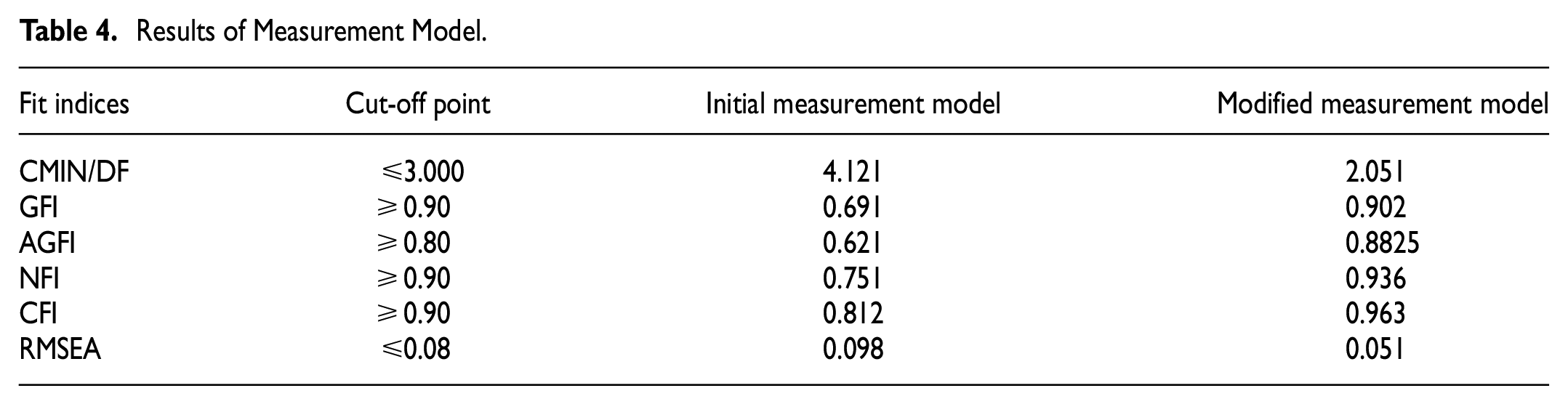
Five common fit indices [goodness of fit index (GFI); adjusted goodness of fit index (AGFI); comparative fit index (CFI); Chi-Square value (χ2)/ degree of freedom (CMIN/DF); Normed of Fit index (NFI); and Root Mean Square Error of Approximation (RMSEA)] (Bagozzi & Yi, 1988; Hair et al., 2010). As seen in Table 4, most fit indices were noticed to be below their recommended level. Therefore, there was a need to enhance the measurement model goodness of fit by removing the most problematic items. In this regard, the item was considered problematic if its regression weight value was less than 0.50 or has a high error term value. Five or so Scale items had issues and were thus eliminated (Hooper et al., 2008; Jöreskog & Long, 1993). When the measurement model was tested again without these items, all fit indices were discovered to be within the required range as follows: CMIN/DF was 2.071, GFI was 902, AGFI was 0.825, NFI was 0.901, CFI was 0.936, and RMSEA was 0.051. (Hair et al., 2010; Kline, 2010).
Results of Measurement Model.
Constructs Reliability and Validity
To evaluate the constructs’ reliability and validity, three popular criteria—Campsite Reliability (CR), Cronbach’s Alpha, and Average Variance Extracted (AVE)—were used (Fornell & Larcker, 1981; Hair et al., 2010). As shown in Table 5, all constructs were able to meet Fronell and Larcker’s recommendation of a CR value of at least 0.70. (1981). The individual factors (IF) have the lowest but still respectable CR value of 0.866, while the student involvement factor (SF) has the greatest CR value of 0.919, followed by organizational factors (OF), which have a CR value of 0.907. The values of Cronbach’s alpha were not far from the CR values. According to Hair et al., 2010), all Cronbach’s alpha values were found to be more than .70. (1978). SF had the highest Cronbach’s alpha value (.917), followed by technological factors (TF), which had a value of 0.908, and individual factors had the lowest Cronbach’s alpha value (.816). All constructs’ AVE values were able to exceed the 0.50 threshold that was considered acceptable by Fornell and Larcker (1981) and Hair et al. (2010). In this regard, Student Participation Factors (SF) had an AVE value of 0.741, followed by Community Service Effectiveness (CE), which had the highest AVE value of 0.74. Individual considerations were considered for the lowest AVE value (0.519).
Constructs Reliability and Validity.

Therefore, both convergent validity and discriminant validity were examined in the current study to ensure a sufficient level of construct validity. Additionally, every construct satisfies the requirements for discriminant validity (Kline, 2010). As predicted by Fornell and Larcker (1981), all inter-correlation values between latent constructs were discovered to be less than the squared root of AVE accounted for the corresponding components (see Table 6).
Discriminant Validity.
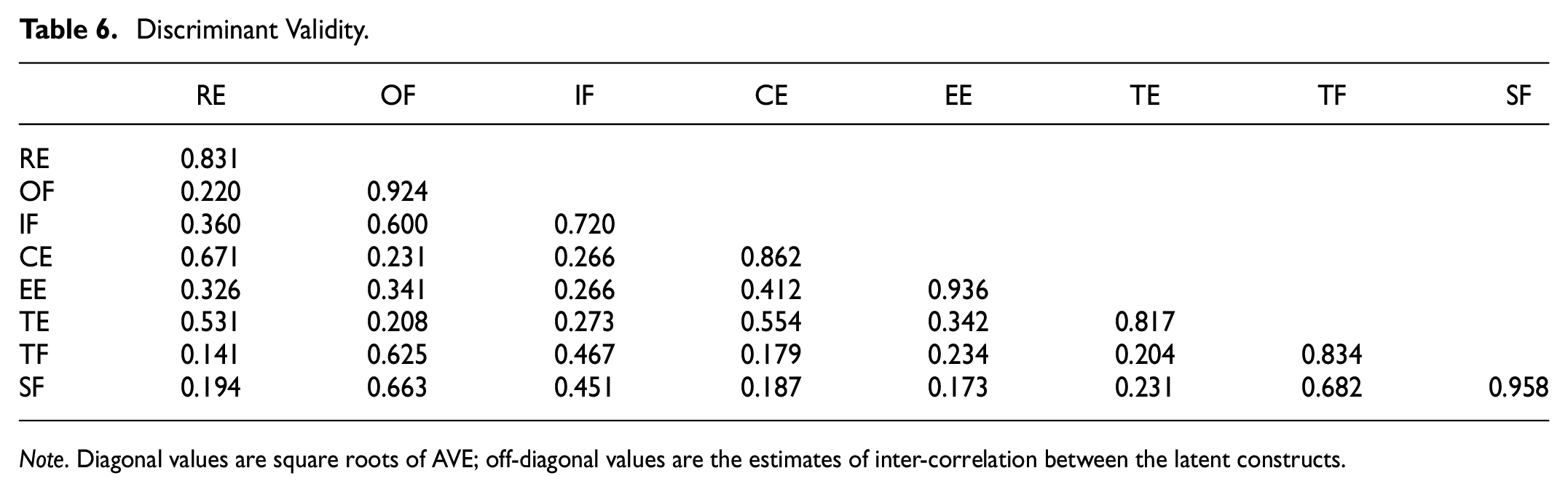
Note. Diagonal values are square roots of AVE; off-diagonal values are the estimates of inter-correlation between the latent constructs.
Structural Model Analysis
The following structural model fit indices were determined to be within their respective threshold levels, along with the measurement model: CMIN/DF was 2.451, GFI was 90, AGFI was 0.807, NFI was 0.901, CFI was 0.914, and RMSEA was 0.060. This indicates that the suggested conceptual model successfully accounts for the collected data. Additionally, the R2 values for CE, TE, and EE, respectively, were found to be .50, .46, and .26, indicating that the current model was able to account for a significant amount of variance in the dependent variables. However, it was found that RE had a lower R2 value (.17). The path coefficient analyses revealed that OF (β = .390, p = .000) and TF (β = .311, p = .000) substantially predicted employee engagement. However, neither SF (β = −.174, p = .067) nor IF (β = .098, p = .264) could foresee any appreciable variation in EE. Additionally, TE, RE, and CE were the only outcomes that EE was able to predict significantly (=0.239, p = .000), followed by TE, RE, and CE (β = .522, p = .000). The roles of OF (β = −.171, p = .013), IF (β = .215, p = .000), and SF (β = .173, p = .006) were found to significantly influence teaching effectiveness (TE), however the role of TF (β = −.043, p = .713) did not. Community Service Effectiveness (CE) was predicted by IF (β = .390, p = .000), SF (β = .236, p = .034), and OF (β = −.269, p = .028), but not by TF (β = −.083, p = .484). Finally, it was discovered that OF (β = −.272, p = .025), IF (β = .597, p = .000), TF (β = .213, p = .017), and SF (β = .263, p = .017) all predicted RE. Table 7 provides a summary of all the findings.
Results of Standardized Estimates of Structural Model (Hypotheses Testing).

Each major hypothesis is divided into 4sub-hypotheses: TE Terracing; RE: research; CE: community.
Mediation Impact of Employee Engagement
Table 8 displays the findings of the mediation impact of employee engagement. According to statistics, IF and CF, RE, and TE interactions might all be mediated by employee involvement (T = 4.362, p = .000; 4.438, p = .000; and 4.387, p = .000). For the associations between OF and OF and CF (T = 2.536; p = .006), OF and RE (T = 2.600; p = .005), OF and TE (T = 2.533; p = .006), and TF and TE (T = 4.571; p = .000), the mediation influence of engagement was also approved in Table 7. However, in the cases of SF and CF (T = 0.054; p = .478), SF and RE (T = 0.054; p = .479), SF and TE (T = 0.054; p = .479), TF and CF (T = 0.336; p = .368), and TF and RE (T = 0.337; p = .368), the mediating effect of EE was not approved.
Mediation Impact of Employee Engagement.

Discussion and Conclusion
This paper examines and validates the role of academics’ engagement as mediating in WFH productivity during the Covid-19 crisis. It also investigated the effect of the organizational, individual, technological and client (students) related factors on academics’ productivity in conducting research, being involved in effective teaching, and participating in community service. Toward this goal, both quantitative and qualitative data were collected. Initially, the perspectives of the academics over the factors that relate to their performance while working remotely from home during the Covid-19 pandemic were gathered through focus groups interview. Consequently, a survey was conducted by combining the emerging qualitative findings together with instruments that exist in literature. This survey was used to test the impact of the factors emerging from the qualitative focus groups and the literature review on academics remote working productivity. Overall, as explained in the results section the independent variables appear to explain the academic remote work productivity in relation to research, teaching and community service productivity.
The findings of H1.2, H2.1 H3.1 suggest that organizational factors play a major role in shaping and improving employees’ productivity while working from home. This finding is consistent with Patanjali and Bhatta (2022) results who found that information technology employees’ productivity is significantly related to various organizational-related factors such as autonomy, empowerment, and freedom to make mistakes. This implies that the organization may be able to support employees’ overall productivity by granting them trust and autonomy. However, as explained by Aboelmaged and El Subbaugh (2012), conclusions that highlight the essential importance of individual and organizational factors in affecting the perceived productivity of Egyptian teleworkers, this is not without the function of individual-related factors. Our findings for H1.2, H2.2, and H3.2 account for this.
In the academic context, productivity and performance can be divided into three parts research work, teaching, and community service. This provides a deeper understanding of productivity in higher education. The research results confirm hypothesis H2.1 which examined the effect of organizational factors and research productivity while working from home. This aligns with Hadjinicola and Soteriou (2005), who found that the availability of resources (research funding, library sources) and facilities results in better research performance. Differently, some scholars found a negative effect of remote working during the Covid-19 pandemic on researchers’ productivity in healthcare due to lack of research funds and closure of labs due to the quarantine. Others associated the research productivity with the teaching load, essentially research productivity appear to be lower when associated with high teaching load as this limits the time available for research (Hassan et al., 2008).
When it comes to remote working, technological factors become even more important for employees’ performance. According to Ding et al. (2010), access to new technology has a significant effect on research collaboration and research productivity. This Finding is consistent with the results of H2.3 as technological related factors have a significant enabling effect on research productivity. Differently, the technological related factors are not significantly related to teaching effectiveness. Even though increasing importance of “remote technologies are caused by the necessity to change the modern educational process” (Stroeva et al., 2019, p. 508), the lack of the relationship between the technological factors and teaching effectiveness can be due to the decrease in students/instructors’ interaction which in turn affect the teaching outcomes and its effectiveness. This result contradicts the Webster and Hackley (1997) findings that suggest that technology acts as an enabler to distance learning outcomes and teaching effectiveness. Moreover, H3.3, which investigated the impact of the technological factors on academics’ community service productivities, was not supported. This could be due to differences in academic disciplines and specializations. Thus, technological factors appear to support different academic activities but neither community services nor teaching-related activities. The fourth factor that was examined is the client (students) related factor. While the role of clients was not much discussed in the literature of academics’ productivity, scholars emphasized the importance of students (clients) and instructors for the effectiveness of the teaching process. Results of hypothesis (H1.4, H2.4, H3.4) suggest that in virtual work the students’ engagement is essential for academics’ productivity in relation to the academic teaching aspect. Students’ engagement (client-related factors) affects instructors’ engagement which indirectly affects their performance effectiveness and productivity as shown in H4.1 and H4.3.
Results showed support for the significant impact of academic engagement on WFH productivity confirming H5. Specifically, the impact of academic engagement on teaching effectiveness was significant which provides support for H5.1. This result is expected since academic engagement might be increased when working remotely due to having more time and flexibility at work. In relation to the impact of academic engagement on research effectives, the results showed that the relationship is significant which confirms H5.2. This result can be explained by the availability of resources that academics can use and access to conduct their research when working remotely from home. Such resources are already made available due to the Covid19 crisis which facilitates conducting research work. The results showed a significant impact for academic’s engagement in community service effectiveness, therefore, H5.3 is accepted. This can be explained by the wide use of internet and working from home option to large number of businesses and community sectors which can be contacted remotely using the technology provided by academic institutions in Jordan.
According to the analysis, productivity appears to be affected by the experience, academic positions, and age as the findings of H7 suggested, demographic factors moderate the relationship between the organizational, individual, technological and client factors and academic remote working productivity. There is a significant difference between males and females in terms of research and community service productivity. This is different from Hartman and Bradley (1991) who found an insignificant impact of various demographic factors on perceived teleworking productivity. However, Cui et al. (2021) in their study of the relationship between gender and productivity, found that female academic research productivity dropped during covid 19 lockdown more than their male colleagues. This can be explained by the increased responsibilities women had during the lockdown.
The study’s integrated model and methods are revealing in the context of higher education in Jordan as a developing country using structural equation modeling techniques. The results have confirmed the study’s hypotheses, which extended the current state of knowledge and literature in examining the productivity of remote working- from-home under abnormal conditions such as Covid-19. The study closely considers the integrated effect of the organizational, the individual and enhanced technology in remote-work productivity and engagement in higher education during Covid-19. Consequently, this study’s contributions and management ramifications include: The following are theoretical contributions from this study that have increased the validity of the literature on remote work from home. It first clarified the hitherto understudied connections between organizational, individual, technological, and client-related aspects, academics’ productivity of remote working from home, and engagement. Second, testing empirically for the first time the impact of academic engagement as a mediating factor between these four interrelated factors and academics’ productivity is considered another contribution for the current study. Furthermore, by highlighting the consequences of remote working in higher education, the study result can be considered as the scientific basis for developing policies for flexible work in higher education. Finally, the research outcomes could provide implications for enhancing the quality of education at Universities in Jordan through understanding the factors that could enhance academics wellbeing and enhance their engagement.
The authors believe that by better understanding these four factors (organizational, individual, technological, and clients) requirements for increasing academic productivity of remote working from home (teaching, research, and community service), as well as its impact on the level of employee engagement, university decision-makers in Jordan could benefit from this study’s findings. This could help them in putting in place the necessary activities and significant changes within their organizations. In conclusion, the findings of the study support the proposition that the productivity of academics’ remote working from home is positively linked to the organizational, individual, technological and clients (students) related factors via the mediating role of employees’ engagement. Therefore, a better understanding of the influence of these interrelated factors upon academic productivity and engagement of remote work from home should be taken together rather than taken fragments. The power of the study’s model indicates that all these three factors are relevant in predicating academic productivity and engagement remote work from home. Some restrictions should be considered when assessing and extrapolating the study’s conclusions such as the investigation was carried out in a single location and under exceptional circumstances (i.e., COVD-19). This warning may limit the applicability of the study’s conclusions to populations and contexts other than the one from which the data were collected. The productivity of remote working overtime may be better understood in the future through longitudinal research since the study used arbitrary academic productivity indicators. This might affect the study’s generalizability and validity.
Theoretical and Practical Implications
The study’s findings offer both theoretical and practical implications that shed light on the realities of academic productivity during the Covid-19 crisis in Jordan. It becomes clear that organizational factors, such as trust and autonomy, significantly impact the productivity of academics in remote work environments. Similarly, individual characteristics and work habits play a crucial role in shaping their performance. Technological factors are identified as key facilitators of research productivity, providing academics with access to resources and enabling collaboration. However, the relationship between technology and teaching effectiveness is more nuanced, reflecting the challenges posed by reduced student-instructor interaction in virtual settings. Furthermore, student engagement emerges as a vital factor influencing academics’ productivity, particularly in the teaching aspect. Fostering student engagement becomes essential to enhance instructors’ performance effectiveness and productivity. The study confirms the significant impact of academic engagement on productivity while working from home. Academic engagement positively influences teaching effectiveness, research productivity, and community service effectiveness. The availability of resources and the use of technology while working remotely contribute to academic engagement, thereby enhancing productivity in these areas.
The findings of this research have important practical implications for decision-makers seeking to enhance remote working from home for academics. The key considerations for improving remote work environments are as follows: Decision-makers should prioritize fostering trust and autonomy among academics, creating a supportive organizational culture that empowers employees and positively influences productivity. Providing necessary resources and technological support further enhances research productivity by enabling effective collaboration and access to relevant information. Additionally, recognizing the role of individual characteristics and work habits, decision-makers can promote self-discipline, time management, and work-life balance among academics. Offering training and support in remote work skills helps individuals adapt to the challenges of remote work, ultimately improving their performance. Ensuring access to up-to-date technology and tools that facilitate remote collaboration, communication, and information sharing is crucial. Embracing technology helps academics overcome challenges associated with reduced student-instructor interaction in virtual settings. Moreover, decision-makers should foster student engagement by implementing strategies such as interactive online learning platforms, virtual discussion forums, and personalized feedback mechanisms, which positively impact teaching effectiveness and productivity. By taking these considerations into account, decision-makers can create an environment that promotes academic productivity and well-being in remote work setting.
Considering these practical implications and implementing corresponding strategies, decision-makers in educational institutions can create an environment that supports and optimizes academic performance in teaching, research, and community service during remote work. These implications offer insights into the factors that contribute to academic productivity during the Covid-19 crisis and remote working conditions. By understanding and addressing these factors, educational institutions and policymakers can devise strategies to support and optimize academic performance in various domains.
Limitations and Future Studies
When evaluating and generalizing the study’s conclusions, it is important to consider the following limitations: (1) The study was conducted in a specific geographic area and during the exceptional circumstances of the COVID-19 pandemic. As a result, caution should be exercised when generalizing the findings to other contexts and populations. The unique conditions under which the study was conducted may restrict the applicability of the conclusions beyond the specific location and time frame. Future research should aim to replicate the study in diverse settings to enhance the generalizability of the findings and (2) he studies utilized arbitrary indicators to measure academic productivity. While these indicators may have provided some insights, their arbitrary nature raises concerns regarding the validity and generalizability of the findings. Future research would benefit from employing more comprehensive and validated measures of academic productivity. This would ensure a more accurate assessment of remote working productivity and strengthen the reliability of the conclusions. Future research should focus on several key areas to advance our understanding of academic productivity in remote work environments. Firstly, longitudinal research is crucial to study remote working productivity over time. Such research would provide valuable insights into the long-term impact of remote work on academic productivity, going beyond the immediate effects of the pandemic. Secondly, conducting comparative studies across different institutions, locations, and contexts is essential. These comparative studies would enhance the generalizability of findings, enabling us to identify both universal and context-dependent factors that influence academic productivity in remote work settings. Additionally, supplementing quantitative research with qualitative approaches, such as in-depth interviews or case studies, can provide a deeper understanding of the experiences and perceptions of academics in remote work environments. This approach would help uncover nuanced factors that impact productivity and shed light on the unique challenges and opportunities presented by remote work. Lastly, intervention studies are vital for exploring the effectiveness of strategies aimed at improving academic productivity in remote work settings. Evidence-based recommendations derived from such studies would offer practical insights for organizations and individuals seeking to optimize productivity in remote work scenario.
Footnotes
Acknowledgements
We would like to thank all respondents for their support and participating in collecting the data for this study.
Declaration of Conflicting Interests
The author(s) declared no potential conflicts of interest with respect to the research, authorship, and/or publication of this article.
Funding
The author(s) received no financial support for the research, authorship, and/or publication of this article.
Ethical Approval
We confirm that all methods were carried out in accordance with relevant guidelines and regulations of our university.
