




Abstract
The cultivation of vocational core competencies is one of the essential guarantees to realizing students’ overall development. It is also a key quality and ability to promote students’ adaptation to lifelong development and career requirements. In this study involving 844 higher vocational students in Beijing, we analyzed the effect of vocational core competencies on innovative behavior. We find that sophisticated relationships exist between vocational core competencies, creative self-efficacy, innovative behaviors, and core self-evaluation. Innovative behavior positively correlated with vocational core competencies, in which creative self-efficacy has a partial mediating effect, positively regulated by core self-evaluation. Thus, higher vocational colleges should emphasize developing vocational core competencies systems and cultivating students’ innovative behaviors to promote all-around development.
Keywords
Introduction
Vocational education is closely linked to socioeconomic development and rapidly responds to economic model changes and social development transformation, thereby promoting education and teaching reforms aimed at developing high quality personnel. In the new period of development of world’s economic and social and industrial structure transformation and upgrading, the status and role of vocational education in the cultivation of talents in society is becoming more and more prominent. The core competencies can be divided into three stages. In the first stage, the UK and Australia initiated the study of core competencies (Trilling and Fadel, 2012; Yehui & Tao, 2015). In the UK, “core competencies” is a basic requirement for interdisciplinary competencies. Australia describes it as “7 core competencies,” which in fact embodies the interdisciplinary core competencies of the UK and extracts seven competencies. The second stage is to expand to the United States and then to the European Union, and this stage is also the stage of the global impact of core competencies; In 2002, the United States put forward “21st Century Skills,” which is a very influential statement about core competencies and is still an overall goal of American education reform. In 2005, the EU officially launched Key Competencies: A European Reference Framework, which recommended eight Competencies to member States as A Reference Framework for promoting lifelong learning and education and training. OECD (Organization for Economic Cooperation and Development) also proposed a set of core competencies standards, which mainly emphasizes that people should learn to deal with tools, with other people, with machines, and with professional work (S. Wei, 2019). In the third stage, it began to expand to Asian countries after 2008. Singapore proposed a very complex set of core competencies, the basic content of which was called “new 21st century skills,” which was proposed based on “21st-century skills” in the United States (S. Wei, 2019). In 2013, UNESCO classified core literacy as “instrumental competencies” and “humanistic competencies” (“human nature competencies”). In 2014, The Ministry of Education of China entrusted Professor Lin Chongde as the head of the research team to start the research on core competencies. In 2016, the Core competencies of Chinese Student Development was released, which was defined as “the essential character and key ability that students of all academic levels should possess to adapt to lifelong development and social development needs” (Core Competencies and Values Research Group, 2016). The core vocational competencies is the requirement of professional talents for the change of career development, which is directly related to the professional environment and job ability, and is related to the necessary character and key ability of individual’s social adaptability, job competitiveness, and career development (Han, 2020)
To study the vocational core competencies of student development is not only an important measure to help students achieve all-round development, but also an urgent need to adapt to the development trend of world education reform and improve the international competitiveness of Chinese education. Core vocational competencies is the core factor affecting the vocational competitiveness of higher vocational students. It is of great practical significance to strengthen the vocational competencies of higher vocational students, both from the social development needs of the new era and from the personal development of higher vocational institutions and students. Therefore, how to cultivate and improve students’ vocational competencies in higher vocational education to meet the demand for high-quality technical skill talents in the new era has become an important issue facing higher vocational education. As revealed by a follow-up survey of vocational college graduates conducted by a research institute in China, employment stability of higher vocational college graduates relative to their peers from ordinary colleges, is generally lower throughout the country. These differences may stem from various factors, including graduates having grandiose aims but puny abilities, job-hopping, extravagance, and lack of necessary ideological and political cultivation and internalization. Such problems are attributable to a disconnect between higher vocational skill education and professional competencies (Core Competencies and Values Research Group, 2016) competencies. The key to cultivating innovative talents is to accurately grasp the factors and mechanisms that affect the innovation of college students. In the context of economic transformation and social development entering a new stage, and the country vigorously advocating independent innovation, “how to stimulate the innovative behavior of higher vocational students” has become a hot issue in the current practice and theoretical research on the cultivation of higher vocational students. Higher vocational students are future mid-to-high-end talents for various national professional disciplines. Thus, it is vital to reinforce vocational core competencies cultivation to strengthen their knowledge-learning capacity, practical skills, innovativeness, and position-task adaptability. Relying on the social cognitive theory, we evaluated the effects of higher vocational students’ core competencies on innovative behavior, mediating effect of creative self-efficacy, and the moderating effect of core self-evaluation. Findings from the study will supplement theories on the relationships between vocational core competencies, innovative behavior, creative self-efficacy, and core self-evaluation. By providing theoretical evidence on the elevation of vocational core competencies and active personal traits, the study offers practical guidance on cultivation of innovative entrepreneurship by higher vocational students.
Definition, Literature Review, and Hypothesis
Definition
Vocational Core Competencies
In 2014, Chinese Ministry of Education organized a joint project team of nearly 100 researchers from several universities, including Beijing Normal University, with Professor Chongde Lin as the general director. After several national processes of consultation, interviews, in September 2016, confirmed by the Chinese Ministry of Education, the core competencies research group led by Professor Chongde Lin officially released the vocational core competencies of Chinese students (Core Competencies and Values Research Group, 2016; Zhang and Guo, 2017), which is the latest and authoritative of the concept in China. Vocational core competencies, subordinated to the scope of students’ core vocational competencies, refers to the essential characteristics and pivotal abilities that learners should possess at the end of their learning phase. It directly connects with the vocational environment and position capabilities, relating to the individual’s social adaptability, job competitiveness, and professional development. Studies have shown that there is a reasonable relation should be taken between key competencies and curriculum goals and different competencies will be emphasized at different educational stages and for different subjects (B. Wei et al., 2022).
Innovative Behavior
As early as 1988, Amabile (1988) conducted a series of studies on creativity, which was the ability to give new ideas and innovative results for existing problems, and the creativity of employees was an important driving force for the continuous innovation process in companies. The rapid development of social economy and science and technology needs a large number of innovative talents, which poses a great challenge to the cultivation of talents in colleges and universities, so both research-oriented, application-oriented, and skill-oriented talents need innovative spirit and innovative ability. The cultivation of innovative talents is hierarchical, and the cultivation of innovative ability should be integrated into the whole process of teaching in higher education (Qi et al., 2011). The innovative behavior of higher education students has been a great concern for both schools and industries. The innovative behavior mentioned in this study originates from the innovative behavior at the individual level. Initially, innovative behavior is defined as the behavior of employees who generate innovative ideas or problem solutions in the work process, and try to seek support for their ideas or problem solutions and apply them to practice (Yang & Zhang, 2013). For students, innovative behavior refers to the ability to develop and create new knowledge and skills using the knowledge and skills they have acquired, which is a potential that everyone has. In essence, the development of innovative ability is to explore this potential through appropriate educational activities, so that it becomes a real ability.
Creative Self-Efficacy
The concept of self-efficacy was first introduced by American psychologist Bandura (1977) and has had a wide and profound impact on the field of psychology and sociology. According to Bandura, self-efficacy is a subjective mechanism of action through choice, thinking, motivation, and psychosomatic response processes. According to the mechanism of self-efficacy, the higher the level of general self-efficacy of college students, the greater their effort and resilience, and the more likely they are to look for their own reasons when they fail, and to strengthen their abilities to a certain extent (Gui & Zhou, 2015). Some studies have shown that self-efficacy can influence the innovation ability of college students. Nowadays, the concept of creative self-efficacy is derived from the self-efficacy theory and creativity theory and refers to an individual’s evaluation of their ability to produce creative results from specific activities (Tierney & Farmer, 2002). It is how confident people believe they can use skills to accomplish certain creative tasks (C.-J. Wang et al., 2014).
Core Self-Evaluation
In the early 21st century, core self-evaluation was introduced into the country and has been used primarily to explore the relationship with mental health (K. Wang & Zhang, 2020). Cognitive theory suggests that the social environment influences individual behavior and emotion through individual cognition. In recent years, foreign scholars have proposed the use of a broader and higher-level concept of core self-evaluation to study personality traits. Judge suggest that individuals with positive core self-evaluations evaluate themselves in a consistently positive manner across contexts, and that they perceive themselves as capable, valuable, and in control of their lives. The characteristics of the core self-evaluation among this study were considered to be self-esteem, general self-efficacy, neuroticism, and locus of control. It is the most elementary assessment of an individual’s abilities and values and a relatively deeper and more recessive description of human traits from a higher level. These characteristics must be integrated to reflect the essence of core self-evaluation (Judge et al., 1997, 2003).
Literature Review and Hypothesis
The Mediating Effect of Creative Self-Efficacy
The range of an individual’s ability to deliver creative outcomes for an organization is referred to as creative self-efficacy, and when an individual has an internal belief that he or she can confidently demonstrate superior creativity, this indicates a high level of creative self-efficacy. Tierney and Farmer subsequently introduced the concept of creative self-efficacy as an important motivating mechanism for individuals to innovate. After that, the correlative role of creative self-efficacy on innovative thinking, innovative behavior, and creativity, as well as the mediating role, have received much attention. According to social cognitive theory, self-efficacy, as an expectation and judgment of the future state, is at the core of various behavioral mechanisms and is a regulator for individuals to make specific behaviors; therefore, creative self-efficacy is an important indicator for predicting innovation behavior. The Creative self-efficacy can inspire creative ideas and support for innovative behavior (Hirst et al., 2015; Jaiswal & Dhar, 2015). Employees with higher creative self-efficacy are more likely to be confident in their creativity and therefore, can carry out innovative work with more positive attitudes, which in turn, influences their innovative behavior (Afsar et al., 2015; Afsar & Masood, 2017). Creative self-efficacy in college students affects their individual innovative behaviors in a positive way and plays a mediating role between innovation support and personal innovation (Kleysen & Street, 2001). Thus, innovative behavior can be predicted from creative self-efficacy. Students need to be inculcated with innovation competencies to achieve lifelong development and social development. As a core competencies (Harris & de Bruin, 2017), innovative competencies is tightly related to the sense of innovative efficiency as well as behaviors and is a vital part of students’ vocational core competencies. However, there is no direct relationship between vocational core competencies and innovative behavior in existing research. Studies have found that psychological availability and followership positively impact innovative behavior (Carmeli et al., 2010) and that technologists with career orientations exhibit more active innovative behavior (Szeto, 2000). The ability to innovate is the basis for coaches’ innovative behaviors (Krapez et al., 2014). Organizational career management has a significantly positive predictive effect on innovative behavior (Takaishi et al., 2019), implying that a variety of appropriate vocational core competencies factors positively affect innovative behavior. Thus, vocational core competencies may positively affect innovative behavior.
Although, studies on the direct impact of vocational core competencies on creative self-efficacy are lacking, strengths-based psychological climate positively impacts creative self-efficacy (Pech, 2001). Various factors, including employees’ capabilities, personal growth and work values, personnel-post compatibility, as well as perceptions on working conditions, vocational development opportunities, and work-life balance, can predict employee creative self-efficacy (Momeni et al., 2014; Volmer et al., 2012).
Based on the above research, we hypothesized the following:
H1: Creative self-efficacy influences the relationship between vocational core competencies and innovative behavior as a mediating role.
Moderation Effect of Core Self-Evaluation
Core self-evaluation has a significantly positive correlated with vocational values of college students, as well as their career decision self-efficacies (Fabio et al., 2012). Significant positive incidence is presented between core self-evaluation and career planning coupled with vocational exploration (Hilbig et al., 2014; Koumoundourou et al., 2011). Furthermore, prior research suggests that innovative behavior is risky behavior (Lin & Ding, 2019). According to approach/avoidance motivation theory(Chang, 2012) and many studies about the mechanism of people’s creative performance (Jian et al., 2009; TaŞGİT & ÇİÇEk, 2020), people scoring high on core self-evaluation have more self-regulatory resources which can be deployed to innovative, which means that the core self-evaluation has a positive impact on innovative behavior (Ding et al., 2022). Self-efficacy as one of the core traits of core self-evaluation (Judge et al., 1997), the influence of creative self-efficacy and core self-evaluation on innovation behavior tends to be consistent, which may lead to the insignificant moderating effect of core self-evaluation on creative self-efficacy on innovation behavior. However, substantive studies of the relationship between core self-evaluation and vocational core competencies are lacking. We hypothesized that core self-evaluation positively influences vocational core competencies, given core self-evaluation significantly positively affects various related vocational core competencies factors. In addition, based on the triadic interaction determinism, core professional literacy as a human subject factor tends to strongly dominate and guide their behaviors, and behaviors and their outcomes may in turn influence core self-evaluation as an important personality factor. Past research has shown that: (a) core self-evaluation of subordinates can affect the positive influence of responsible leadership on their perception for responsibility and innovative behaviors, (b) regulate the mediating role derived from subordinates’ perceptions of their responsibilities under the relationship between responsible leadership and subordinates (Hoch, 2012), and (c) moderate the relationship between supervisor developmental feedback and work input, and employees’ innovative behaviors (Janssen, 2005). Core self-evaluation has a positive influence on innovative behavior (Carmeli et al., 2010; Cohen-Meitar et al., 2009; Fock et al., 2011). Personality traits directly impact creative self-efficacy and creativity (Kim et al., 2010). As a personality characteristic on a deeper level, core self-evaluation is bound to directly affect both.
Based on the above research, we hypothesized the following:
H2: Core self-evaluation has a moderating role on the relationship between vocational core competencies and innovative behaviors.
H3: Core self-evaluation has a moderating role on the relationship between vocational core competencies and creative self-efficacy.
H4: Core self-evaluation has a moderating role on the relationship between creative self-efficacy and innovative behaviors.
The theoretical model for this study based on the above arguments is shown on Figure 1.
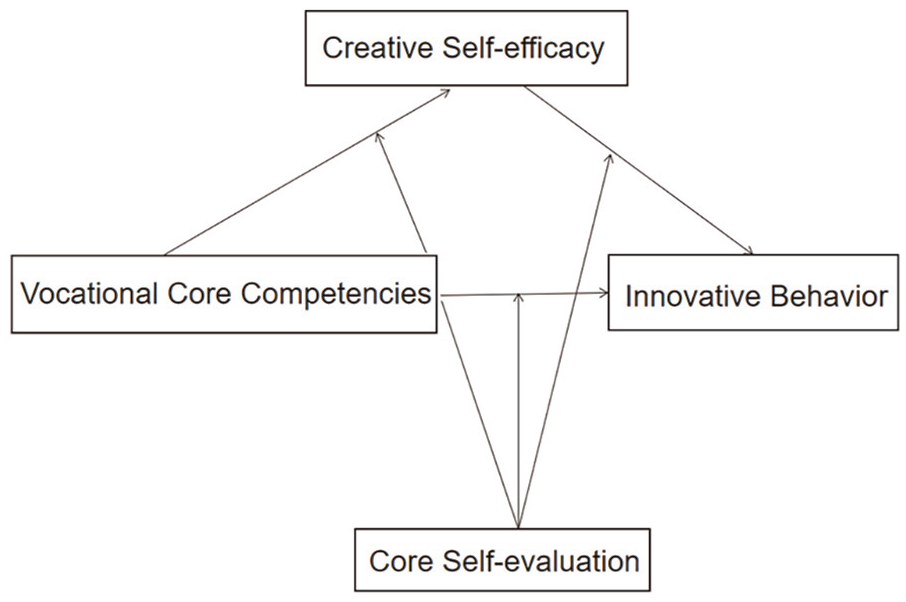
Theoretical model.
Methods
Participants
All participating students gave written informed consent. A total of 950 higher vocational students (including junior college students and students upgraded from junior college to university) from 26 colleges with more than 90 different majors, in China, were involved in this questionnaire survey. About 844 (88.84%) valid questionnaires were retrieved after excluding all questionnaires that selected the same option in the scale. The participants had an average age of 21.09 ± 2.09. A total of 287 were male and 557 females.
A student cadre is a special student who holds some positions in the student group and is responsible for some specific responsibilities to assist the school in management. In the school work and study, student cadres and teachers, students contact more, and ordinary students in school during a variety of experience there are differences (Zaihua, 2020). In order to prevent the different influences of students in different cadre positions, the student cadre in this study refers to the minister of a certain department or the monitor.
Research Tools
Vocational Core Competencies
A self-compiled vocational core competencies scale established by Xie (2019) containing the following 23 questions in six dimensions was used: Vocational Aptitude, Health Living, Learning Ability, Practice and Innovate, Scientific Spirit, and Responsibility Eligibility. A 5-point Likert Scale was adopted. Respondents were asked to evaluate their agreement/disagreement level by giving a quantitative value ranging from 1 to 5, indicating “strongly disagree,”“disagree,”“neutral,”“agree,” and “strongly agree.” Higher values indicated more consistency. The internal consistency coefficient of the six dimensions, and overall questionnaire were .812, .847, .767, .865, .864, .918, and .959, indicating satisfactory internal consistency.
Innovative Behavior
We used an Innovative behavior scale (Yang & Zhang, 2013), a self-evaluation scale, containing six questions in a single dimension translated by Fu Yang and Lihua Zhang. A 5-point Likert scale was adopted. Respondents were asked to evaluate their agreement/disagreement level by giving a quantitative value ranging from 1 to 5, indicating “strongly disagree” to “strongly agree.” The higher the value, the higher the level of acknowledgment for innovation by the tested. The internal consistency coefficient of the overall questionnaire was .881, indicating satisfactory internal consistency.
Creative Self-Efficacy
We used a creative self-efficacy scale (CSES) (Liu et al., 2014), a self-evaluation scale, containing four questions in a single dimension, translated by Zhiqiang Liu et al. A 7-point Likert scale was adopted. Respondents were asked to evaluate their agreement/disagreement level by giving a quantitative score ranging from 1 to 7 separately, indicating “strongly disagree,”“disagree,”“somewhat disagree,”“neither agree nor disagree,”“somewhat agree,”“agree,” and “strongly agree.” The internal consistency coefficient of the overall questionnaire was 0.915, indicating satisfactory internal consistency.
Core Self-Evaluation
We used a core self-evaluation scale (CSES) (Zhihong & Yiduo, 2009), a self-evaluation scale, containing 10 questions in a single dimension translated by Ren, Zhi-hong and his colleagues. A 5-point Likert scale was adopted. Respondents were asked to evaluate their agreement/disagreement level by giving a quantitative value ranging from 1 to 5 separately, corresponding to “strongly disagree” to “strongly agree.” The internal consistency coefficient of the overall questionnaire was .847, indicating satisfactory internal consistency.
Data Processing
Statistical analyses were performed using SPSS version 24.0 and an SPSS macro program PROCESS in Hayes for statistical analyses (Hayes, 2013). First, we described the scores of higher vocational students on each dimension and used t-test to explore scores’ potential differences on each dimension among different groups of gender and cadres. Second, we examined the correlation of vocational core competencies, creative self-efficacy, innovative behaviors, and core self-evaluation of higher vocational students. Then, we tested of mediating effect of innovative behavior. Lastly, we test on moderating mediating effect of core self-evaluation on innovative
Results
Common Method Bias
Harman’s single factor method for common bias tests revealed seven factors with eigenvalues >1, with an explained variance for the first factor of 32.87%, which was below the 40% threshold, indicating no significant common method biases (Hao & Lirong, 2004). Before the questionnaire survey, the teachers of the subjects conducted the survey guidance in advance, emphasized the significance and importance of the questionnaire, and explained the method of answering the questionnaire. Later, analysis of the data structure found that the data results were in the same range as predicted by experts in related fields, proving the reliability of the data.
Descriptive Statistics and Correlation Analysis
Current Status of Vocational Core Competencies, Creative Self-Efficacy, Core Self-Evaluation, and Innovative Behaviors of Higher Vocational Students
Table 1 shows that higher vocational students’ creative self-efficacy, core self-evaluation, and innovative behavior scores in each dimension were in the upper-middle level of the 5-point total. Suggesting that given the emphasis on training practical skills, higher vocational students are equipped with vocational core competencies, while potential for confidence and innovative capacity have room for improvement. Thus, more counseling services and innovative education is needed.
Scores of Higher Vocational Students on Each Dimension.

Table 2 shows that average vocational male students’ scores on each dimension are comparatively higher, while Health Living, Practice and Innovation, and Scientific Spirit scores reveal a remarkable discrepancy between genders (p < .05). However, from a global perspective on genders, higher pressure resistance, adaptability, and endurance result in expectedly higher male students’ scores on the above three dimensions relative to their female peers. Thus, more attention should be put on the education of vocational core competencies in female students.
Scores of Male/Female College Students on Each Dimension.

Table 3 shows that the scores of student cadres are higher relative to those of ordinary higher vocational students on each dimension, indicating noticeable divergences except on the dimensions of Health Living and Learning Ability (p < .05). This might be because working capabilities and comprehensive qualities of student cadres are improved by organizing and participating in various student activities. Indicating that cadre positions have a positive effect on promoting vocational core competencies of higher vocational students.
Scores of Cadres/Non-Cadres College Students on Each Dimension.

Correlation Analysis of Vocational Core Competencies, Creative Self-Efficacy, Innovative Behaviors, and Core Self-Evaluation of Higher Vocational Students
Pearson correlation analysis (Table 4) revealed a salient positive correlation between vocational core competencies, creative self-efficacy, and innovative behaviors. Thus, a mediation analysis can be applied among them. The presence of a predominant positive correlation between core self-evaluation and the average of innovative behaviors, creative self-efficacy, and vocational core competencies, is therefore testified.
Correlation Analysis of Vocational Core Competencies, Creative Self-Efficacy, Innovative Behaviors, and Core Self-Evaluation of Higher Vocational Students.

Note.**represents p < .01. *represents p < .05, N = 844.
Hypothesis Test
Test of Mediating Effect of Creative Self-Efficacy Between Vocational Core Competencies and Innovative Behavior
Model 4 used PROCESS, an SPSS macro to test the mediating effect of creative self-efficacy between vocational core competencies and innovative behaviors (Table 5). This analysis revealed that vocational core competencies correlated with creative self-efficacy (a = 0.575cSE = 0.028, p < .001, 95% CI [0.520, 0.630]). Taking vocational core competencies and creative self-efficacy into account, the correlative effect of vocational core competencies on innovative behaviors is remarkable (c′ = 0.197, SE = 0.029, p < .001, 95% CI [0.140, 0.254]. Based on percentile bootstrap correction, mediating effects of creative core-efficacy between vocational core competencies and innovative behavior are appreciable (ab = 0.342, boot SE = 0.03, 95% CI [0.283, 0.400]. The proportion of mediating effect among entire effects is ab/(ab + c′) = 63.45%.
Test of Mediating Effect of Innovative Behavior.

Note. Sample N = 844; *p = <.05. **p = <.01. ***p = <.001.
Test of Moderating Mediating Effect
Based on the above findings, three groups of moderating mediating models were established using Model 59 in the PROCESS macro on SPSS to verify whether the mediating effect of innovative behaviors affected by vocational core competencies can be adjusted by core self-evaluation (Table 6). From Table 5 results, vocational core competencies correlated with creative self-efficacy (p < .001), core self-evaluation correlated with creative self-efficacy (p < .001), cross-project of vocational core competencies, and core self-evaluation predict creative self-efficacy (p < .001). From equation (2), vocational core competencies correlated with innovative behavior (p < .001), creative self-efficacy correlated with innovative behaviors (p < .001), cross-project of vocational core competencies, and core self-evaluation influence innovative behavior (p < .005). To better illustrate the relationship between the interaction of vocational core competencies, creative self-efficacy, and core self-evaluation, a simple slope test was done by adding or subtracting a standard deviation to/from the averages of core self-evaluation, and dividing them into two groups with high or low scores (Figures 2–4). A simple slope analysis in Figure 2 shows that the association between vocational core competencies and creative self-efficacy becomes stronger at low core self-evaluation. This indicates that core self-evaluation reversely moderates the relationship between vocational core competencies and creative self-efficacy, that is, compared with low core self-evaluation, vocational core competencies has a weaker effect on creative self-efficacy under high core self-evaluation. A simple slope analysis in Figure 3 shows that the association between creating self-efficiency and innovative behavior becomes stronger when the core self-evaluation is high. It indicates that core self-evaluation positively moderates the relationship between creative self-efficiency and innovative behavior, that is, compared with low core self-evaluation, creative self-efficiency has a stronger impact on innovative behavior under high core self-evaluation. A simple slope analysis in Figure 4 shows that the association between vocational core competencies and innovative behavior becomes stronger when the core self-evaluation is high. The results indicate that core self-evaluation positively moderates the relationship between vocational core competencies and innovation behavior, that is, compared with low core self-evaluation, vocational core competencies has a stronger impact on innovation behavior under high core self-evaluation.
Test on Moderating Mediating Effect of Core Self-Evaluation on Innovative Behaviors.

Note. Sample N = 844; *p < .05. **p < .01. ***p < .001.

Moderating effect of core self-evaluation between vocational core competencies and creative self-efficacy.

Moderating effect of core self-evaluation between creative self-efficacy and innovative behaviors.

Moderating effect of core self-evaluation between vocational core competencies and innovative behaviors.
Discussion and Conclusion
Discussion
The Characteristics of Vocational Core Competencies of Higher Vocational Students
The study revealed the influence of vocational core competencies on innovation behaviors and the mediating role of creative self-efficacy among 844 higher vocational students through a survey. The study results showed that the higher vocational students scored moderately high on all dimensions of vocational core competencies. In terms of gender differences, male students scored significantly higher than female students on two dimensions of vocational core competencies, namely, practice and innovate and scientific spirit. Few of researchers pointed out that gender differences would have resulted in individual differences in many aspects (such as shyness and self-disclosure; Li et al., 2020) (G. Liu, Zhang, Mo, Li, & Zhu) and (Gao et al., 2022) showed that the level of social anxiety of female students was significantly higher than that of male students, and Xiao and Wang (2017) found that behind the overall weaker vocational competence of female college students than that of male students was the restraint and inhibition of women’s social life and cultural activities by order of gender relations constructed by traditional society, which are likely to be the reasons for the above results. In terms of differences in student leader experience, there were significant differences in all dimensions of vocational core competencies among senior students, with those who had been student leaders scoring significantly higher than those who had not been student leaders. This is most likely due to the fact that student cadres organize and participate in a large number of student activities during their school years, and in this process, many abilities and competencies closely related to the workplace are exercised and improved, so the scores on several dimensions are significantly higher than those of students who have not served as student cadres (Cailie et al., 2015).
The Relationship Between Vocational Core Competencies and Innovative Behavior and Creative Self-Efficacy of Higher Vocational Students
There is a significant positive correlation between vocational core competencies and innovative behavior and creative self-efficacy of vocational higher students, and the mediation analysis also found that vocational core competencies of vocational higher students acted on innovative behavior through creative self-efficacy. This is consistent with the hypothesis made in the previous research. Vocational core competencies is a necessary character and key ability that should be cultivated by higher vocational students in the terminal stage of study, which is directly related to the vocational environment and job competency, and is related to the social adaptability, job competitiveness, and career development of individuals. Beneficial vocational core competencies will also promote the innovative behaviors of higher vocational students. This is in line with studies showing that employees’ career planning ability facilitates their innovative behavior (Carmeli et al., 2010). A sense of personal mission drives them to improve their performance and work innovation (Pieterse et al., 2009). Career-oriented technologists are more motivated to exhibit innovative behaviors (Ferlie et al., 2005). We found that by developing vocational core competencies can help students improve their personality and lead them to consciously externalize their knowledge, abilities, personality, and attitudes into practical activities, thus promoting their innovative behaviors. In addition, promising vocational core competencies promote innovative behaviors of higher education students through creative self-efficacy. It has been suggested that inclusive HRM practices significantly influence employees’ innovative behaviors, in which employees’ creative self-efficacy has a mediating role, which is consistent with previous studies such as Choi et al. (2016). Innovation self-efficacy has a significant mediating role between non-academic diversity experiences and student innovation development (Rose Anderssen & Allen, 2008). Here, we found that vocational core competencies can effectively enhance students’ motivation to engage in creative activities and increase their confidence in their personal creative abilities, thereby stimulating their sense of innovation. With creative self-efficacy as a mediator, students are better able to externalize their creative abilities and sense of innovation in their creative activities.
The Moderating Role of Core Self-Evaluation
The direct or indirect effects of vocational core competencies on innovation behaviors of higher education students were moderated by core self-evaluations. Consistent with our findings, the study showed that for researchers in a strong innovation reward context, internal and external motivational preferences positively moderated the effect of innovation rewards on creative self-efficacy and mediated the effect of innovation rewards through how innovative behaviors were positively influenced by creative self-efficacy, which is consistent with some previous research (Lin & Ding, 2019; Michael et al., 2011). Based on our study, under a high core self-evaluation environment, the phenomenon that the influence of vocational core literacy on self-efficacy is attenuated, can be attributed to the fact that core self-evaluation and self-efficacy are affirmations of oneself. Therefore, expression of high self-efficacy is more likely to appear with high self-evaluation. Moreover, the impact of vocational core competencies and creative self-efficacy on innovation behavior is more intense under a homogeneous environment, which authenticates the influence of core self-evaluation as a deeper personality trait in the relationship between the three.
Conclusion
The main findings obtained in this study are as follows.
(1) For vocational core competencies of higher vocational students, male students scored higher than female students in all dimensions, and some dimensions were significant. All dimensions of having been cadres students are significantly higher than those of non-cadres students.
(2) Vocational core competencies of higher vocational students positively predicted their innovative behaviors.
(3) Creative self-efficacy partially mediated the relationship between vocational core competencies and innovative behavior.
(4) Core self-evaluation plays a moderating role in the relationship between vocational core competencies, innovative behavior, and creative self-efficacy.
Suggestion
Higher vocational students should continuously hone their professional core qualities, strengthen creative self-efficacy, and establish firm belief in what they can do. With the committal task of learning as well as an endeavor of mastering occupational skills, higher vocational students should cultivate the ability to think and innovate actively, and to willingly advance their comprehensive knowledge and competence. Additionally, students should practice under the guidance of professional instructors to avoid theories being disembodied from reality, and to encounter difficulties in practice and find innovative solutions. This is one of the preponderant approaches of potentiating innovative capability in students.
Higher vocational colleges should also focus on comprehensively improving student’s core professional literacy, and vouchsafe students with operant assessment and exuberant incentives to help them comprehend their preponderance and liability in occupational literacy. Thereby enhancing their creative self-efficacy and career confidence. Colleges should introduce responsibilities of major logistical undertaking to provide excellent and complete platforms for innovation. This would help students refine core professional literacies and innovative ability by improving the quality of innovative education, innovative curriculum design, activity organization, and strengthening guidance on individualized competency.
Higher vocational education is a type of education that comes out of undergraduate education to meet the social and economic development. Therefore, the talent cultivation of higher vocational education should be different from the academic and professional cultivation mode of undergraduate colleges and universities, and should focus on cultivating students’ comprehensive quality and innovation ability. Widespread entrepreneurship and innovation call for efforts to create an environment conducive for innovators at a macro policy level. Due to practicability and applicability of higher vocational education, more solicitude on governmental level should be enticed for the development of higher vocational students, and to accomplish incessant progress on educational ideology of higher vocational colleges. This would nurture innovative talents through policy and substantiating necessary policy endorsement for enforcement of core professional literacy education in higher vocational colleges.
In summary, the cultivation of core professional literacy in higher vocational students should be foregrounded and students’ innovativeness continuously improved. Realizing this goal not only requires effort from higher vocational students, but also investment from the country and commitment from educators.
Footnotes
Acknowledgements
The authors express their gratitude to their colleagues for their valuable guidance and input, which greatly enriched their research. They extend their thanks to all the students, research associates, and teachers who participated in this project and were involved in organizing the data collection. Additionally, the authors would like to acknowledge Professor Li Lei from the School of Education at Renmin University of China for serving as their study mentor. Professor Lei provided guidance on the study design and the final research.
Correction (September 2023):
Article updated online to correct the affiliation of the author “Xin Xie” in the corresponding author’s section.
Declaration of Conflicting Interests
The author(s) declared no potential conflicts of interest with respect to the research, authorship, and/or publication of this article.
Funding
The author(s) disclosed receipt of the following financial support for the research, authorship, and/or publication of this article: This work was supported by the grant of the 2023 continuing project of the 14th Five-Year Plan for Education Science in Beijing, “Research on the Talent Training Model from Vocational Secondary to Higher and Undergraduate education Based on Vocational Core Literacy” (CEFA23068), China, which Xin Xie is the PI.
Data Availability Statement
Due to the nature of this research, participants of this study did not agree for their data to be shared publicly, so supporting data is not available.
