




Abstract
The study examined the perception of undergraduate students towards choosing the broiler value chain (BVC) business as a vocation after graduation. A questionnaire was used to collect cross-sectional data from 728 students in 4 universities. The findings show that the overall perception index of students somewhat agrees that there were sociocultural, economic, government policy, and resource availability factors that constrained their ability to engage in the BVC. Students also agreed that government policies were inimical to BVC businesses, which could affect their decision to engage in the BVC after graduation. The results of the three-way factorial MANOVA did not show any statistically significant difference. Hence, any policy aimed at increasing the participation of students in BVC business after graduation can be designed without exception. The components extracted following the PCA were sociocultural, economic, and production resource. This implies that the three factors are influencing students’ decisions to engage in the BVC after graduation. Available literature on the engagement of young people in agriculture in Ghana has predominantly focussed on agriculture in general and a few on cocoa, but not the livestock or broiler industry. This study, therefore, highlights the role perception plays in the decision-making process of students in choosing to engage in the BVC as a vocation. It is recommended that the government implement policies that create an enabling business environment for BVC businesses to be profitable, ensure national macroeconomic stability, and increase access to land and productive resources to shape positively the perception of students.
Introduction
Chicken meat is an important commodity in Ghana, supplying animal protein to the population, which ensures household food security (Christian et al., 2019; Kwadzo et al., 2013). A significant source of chicken meat is broiler production, an aspect of commercial poultry production in Ghana.
The poultry industry contributes to the agricultural sector’s gross domestic product (GDP), which stood at 2.9% at the end of the year 2024 (Ghana Statistical Service, 2025). As well as a major source of animal protein (Kinsley, 2022). The per capita consumption of chicken meat in Ghana increased from 1 to 6 kg from 1990 to 2015. However, most of the chicken meat supply in Ghana is through importation (Sumberg, Yeboah et al., 2017). According to Taylor (2024), chicken meat imports into Ghana formed 85% of the total consumed chicken meat in 2020.
The waste generated through broiler production (litter) and processing (furthers, viscera, and waste water) can be used to fertilise crops or sold to manufacturers of biofertilizers (Boimah et al., 2022). Additionally, an increase in chicken meat production in Ghana would expand the demand for maize and soybeans for feed formulation. This would benefit smallholder and large-scale crop farmers and increase economic activities in processing, packaging, and transportation (Amanor-Boadu et al., 2016; Andam et al., 2017).
This would create employment opportunities for the youth, particularly graduates from tertiary institutions in Ghana, as government sector employment opportunities have experienced a steep decline (Baah-Boateng, 2013), resulting in a quarter of Ghanaian youth being unemployed (Ghana Statistical Service, 2023). At the same time, Ghana is experiencing a youth bulge with 56% of the country’s population under the age of 25 years old (United Nations Children’s Fund, 2022). The need to explore employment opportunities in agricultural value chains, such as the broiler value chain (BVC), has become imperative to enable students to take up roles as business owners or employees in the BVC after graduation.
However, Tuoho (2023) have reported a trend that shows actors in Ghana’s broiler value chain are ageing; for instance, the average age of broiler producers was 48, poultry processors 47, and live bird sellers was 45. This creates an uncertain future for the industry in terms of sustainability. The objective of this study, therefore, is to examine the perception of undergraduate students towards choosing a broiler value chain business as a vocation after graduation.
The Government of Ghana (GoG) and other development partners in the country are making efforts at equipping the graduates of Ghanaian tertiary institutions with training, and in some instances, with additional capital support to enable the graduates to take up roles in agricultural value chains (Mastercard Foundation, 2024; National Youth Authority, 2025). To address unemployment, reduce import bills in the chicken meat sector, and increase the involvement of young people in sectors such as the broiler value chain. Students in Ghanaian tertiary institutions are mostly within the age bracket of 18 to 35 years, which is considered as youth age bracket in Ghana (Ministry of Youth and Sports, 2010).
The programmes by GoG and development partners towards increasing the involvement of young people in agricultural value chains have been criticised for lacking empirical and theoretical bases. This also comes against the backdrop of the falling growth rate in the agriculture sector. As such would require consistent strategic efforts to promote the sector as an avenue of employment for young people (Sumberg et al., 2012; United Nations Children’s Fund, 2022).
Similarly, youth’s perception towards agribusiness or agriculture is reported to influence their participation in agriculture (Ruiz Salvago et al., 2019), with literature on this topic suggesting that in Ghana, as in many other developing countries, the youth do not have an interest in agriculture as a means of self-employment (Leavy & Hossain, 2014; Mwaura et al., 2015; Okali & Sumberg, 2012; Sumberg & Okali, 2013; Sumberg, Yeboah et al., 2017; United Nations Children’s Fund, 2022; White, 2012).
Additionally, there have been some studies that have looked at the influence of perception on the engagement of the youth in agriculture by taking up employment or setting up businesses in the sector (Metelerkamp et al., 2019). For instance, Bosompem et al. (2017) examined the willingness of undergraduate students to venture into agribusiness in Ghana. Kodom et al. (2022) also assessed the perception and attitudes of youth involvement in cocoa farming in Ghana. While Kodom et al. (2022) was commodity specific, thus cocoa, the study by Bosompem et al. (2017) was agriculture in general.
Fanatico et al. (2025) reported on sustainable poultry education for undergraduate students that was aimed at designing learning materials to improve the theory and practical components of poultry production by students. While Meyer and Bobeck (2023) studied how undergraduate students taking a poultry science course, their backgrounds and demographics affect their perception of animal production. None of these studies focussed on undergraduate students’ perception of engaging in the BVC after graduation. This has created a gap in the literature. Hence, the literature on the measurement of the influence of perception on the choice of final-year undergraduate students to engage in the activities of the BVC as a vocation after graduation is limited. This study seeks to fill this gap by examining the perception of undergraduate students towards choosing a BVC business as a vocation after graduation.
Against this backdrop, this study measured the influence of socio-cultural perception, economic perception, government policy perception, and resource availability perception on tertiary students’ decisions to engage in the BVC business as a vocation after graduation. To achieve the objectives of the study, the following hypothesis was formulated; ‘there was no significant difference in the linear combination of the mean vectors of the socio-cultural, economic, government policy, and resource availability across the level of the independent variables’ (university, programme of study, and sex of the students).
This study considered the entire BVC activities. This presented more employment and business options to study participants than most studies have done by only focussing on the production aspect of agricultural commodities. This has helped to shape the study recommendations to improve government policies and the programmes of development partners, including non-governmental organisations (NGOs) on youth employment and entrepreneurship, career guidance, and public perception campaigns in the livestock subsector of agriculture. In theory, this study adds to the literature of the sustainable livelihood framework (SLF) and the Theory of Planned Behaviour (TPB).
Additionally, the employment of young people empowers them and keeps them away from poverty, and social vices which can lead to crime, drug addiction, and the breakdown of social order in communities. As such, this study also addresses three of the United Nations Sustainable Development Goals (SDGs), thus: Goal 1 (No Poverty), Goal 8 (Decent Work and Economic Growth), and Goal 11 (Sustainable Cities and Communities; United Nations, 2025).
The rest of the sections of this paper include a literature review, which reviews theoretical and empirical literature on the influence of perception in the decision of young people to engage in agriculture value chain businesses as a carrier. The methodology section outlines the procedure for choosing the study area, study design, data collection, and the analytical framework used to examine the influence of the perception of undergraduate students to engage in BVC activities after graduation. The results section presents the results of the analysed data and discussions. A conclusion and recommendations section constitutes the last section, which is built from the discussions of the results upon which recommendations were made to shape government policy and the programmes of development partners.
Literature Review
Theoretical Framework
The study was anchored on the sustainable livelihood framework (SLF) and the Theory of Planned Behaviour (TPB). The SLF was introduced by the Department for International Development (DFID) in 1999 (DFID, 1999) and later enhanced by the United Nations Development Programme (United Nations Development Programme [UNDP], 2017 ). SLF is adopted to understand and improve the livelihoods of individuals and societies, directed at building assets and promoting resilience (Natarajan et al., 2022).
SLF is an all-inclusive, people-centred approach that recognises the importance of various factors affecting livelihood outcomes, such as access to resources, social connections, and vulnerability (UNDP, 2017). The framework classifies five categories of assets that contribute to livelihoods, which are social capital, physical capital, financial capital, natural capital, and human capital (Birhanu, 2023). Social capital is seen as the formal and informal relationships that can be established in a variety of social settings, offering people a range of opportunities and benefits in their quest for employment.
It includes both horizontal and vertical networks and connections that improve people’s capacity for cooperation and trust, as well as their access to more significant organisations like governmental and civic entities. Financial capital is the term for the monetary resources people use to achieve their livelihood objectives. It includes credit savings and production equipment (Sen, 1997). Physical capital refers to the infrastructure and production resources needed to sustain livelihoods and open the door for livelihood strategies.
A marketable location, easily accessible transportation, proximity to communities and the capital city, adequate housing, access to water and sanitation, and information are all examples of infrastructure. It is commonly believed that infrastructure and producer commodities are necessary to maintain livelihoods (Solesbury, 2003). The term natural capital describes the stocks of natural resources (land, trees, water, air, genetic resources, etc.) that provide valuable resource flows and environmental services (such as pollution sink, erosion prevention, nutrient cycling, hydrological cycle, etc.) for a living (Natarajan et al., 2022).
Human capital includes abilities such as literacy, skills, health, and employment capacity. The combination of abilities, leadership potential, and health status, among other things, is part of human capital assets. According to the SLF, human capital is a livelihood asset, meaning it is a part of or a way to achieve livelihood outcomes (Sen, 1997). This study focussed on human capital as a livelihood asset developed by undergraduate students in agricultural science as part of their training in agriculture, with the ability to venture into the BVC as a means of employment after graduation. The other four capitals were not the focus of the study.
Perceptions are cognitive constructs and mental representations of individuals’ external environment that have been captured by their senses and magnified in their minds and may differ from one individual to another (Baron, 1998, and Busenitz & Barney, 1997 as cited in Liñán et al., 2011).
TPB is one of the rational choice models that predicts the intentions of individuals to engage in a behaviour at a given time and place. The behaviour by individuals is driven mainly by intention, which is determined by subjective norms, attitude towards behaviour, and perceived behavioural control (Ajzen, 1991). The TPB explains the behavioural intentions of individuals. The word ‘intention’ is what defines the motivating factors, such as the willingness or efforts to perform the behaviour; it is a measure of behaviour. The stronger the intention, the higher the likelihood of the performance of the behaviour, in this context, choosing to engage in BVC business as an entrepreneur or an employee (Ajzen, 1991; Razak et al., 2016).
The behaviour intentions of individuals or their ability to enact certain behaviours are determined by three factors: attitude towards behaviour, subjective norms, and perceived behavioural control. The attitude towards behaviour refers to the thought given to the performance of a behaviour, whether negative or positive, that an individual considers before undertaking an activity or decision of interest.
While subjective norms refer to the perception an individual has about the surrounding social environment he or she is in, particularly if people around think the individual would perform the behaviour or not. The third determinant, perceived behavioural control, is the perception of how easy or difficult it is to perform the behaviour by an individual. This particular determinant increases with increasing availability of resources and confidence to perform the behaviour (Ajzen, 1991; Conner & Armitage, 1998).
If students perceive that engaging in BVC as entrepreneurs or employees would negatively affect them, they will not choose it after graduation, but if they perceive otherwise, they will choose to engage in it. Similarly, students who perceive that there are negative social-cultural perceptions about youth involvement in the BVC would choose to engage in other sectors of the economy since the environment around them is not congenial for such an activity. The perception of economic opportunities in the BVC and government policies that create the enabling environment for broiler businesses to grow, as well as the availability of resources such as capital, land, feed, and a produce market, would positively increase the perception and confidence of students. That if they start a BVC business and they will succeed or get sustainable employment in the industry.
Empirical Review
The population of Ghana can be described as youthful, having recorded 38% of the population aged between 15 and 35 years old (Ghana Statistical Service, 2022). The high number of young people in any population has positive and negative consequences. It is a demographic phenomenon known as ‘the youth bulge’ (Ortiz & Cummins, 2012).
The positive potential of a youth bulge can be tapped by a nation when the high youthful population is gainfully employed. It lowers the dependency ratio while increasing the per capita income of the people (Lin, 2012). On the contrary, large numbers of unemployed youth can bring insecurity to nations, lower economic growth, and waste their talents (Agbor et al., 2012).
According to Brooks et al. (2013), the agricultural sector was specially placed to employ Africa’s youth as it is a sector familiar to most youth, especially those from rural areas, adding that the key to this approach was for policy makers to view the sector as holding the key to employment creation for the youth.
It is therefore important to understand the views or perceptions young people hold towards engaging in agriculture as a career (Consentino et al., 2023). This is critical in integrating young people into agriculture, which is considered not prestigious and hard work, for which reason they move from rural areas to urban areas (Girdziute et al., 2022).
Though evidence abounds in the literature that shows the agricultural sector is capable of employing young people. However, the decision of the youth to take up careers in agriculture is reported to be affected by their negative perception of agriculture (Kadzamira & Kazembe, 2015; Magagula & Tsvakirai, 2020; Metelerkamp et al., 2019; Ninson & Brobbey, 2023).
Negative perception is one of the driving forces of youth non-engagement in agricultural value chains. Kadzamira and Kazembe (2015) reported that the youth’s attitude towards agriculture was negative in Malawi. They perceived agriculture or farming to belong to people who have no alternative enterprises to pursue and not as a business, but rather as a way of life for rural people. Similarly, only 206 (36%) out of 573 youth in South Africa (Western Cape, KwaZulu-Natal, and Limpopo Province) studied had a positive perception towards employment in agriculture; while 64% had a negative perception towards employment in agriculture, and viewed work in agriculture as a means of survival. These negative perceptions contain themes including agriculture being a dirty job meant for the elderly and poor people. Additionally, employment in agriculture was perceived to require very hard work but yield very little financial reward, coupled with very high risk for those who choose it as a career path (Metelerkamp et al., 2019).
On the contrary, Zambian youth had a positive perception regarding the agricultural sector: they believe the sector is not for old people and that it can provide them with livelihood opportunities, with females being more positive than males. In Vietnam, the youth had a negative perception towards agriculture; however, the negative perception among females was higher than among males (Mulema et al., 2021).
In Nkomazi Municipality, South Africa, Magagula and Tsvakirai (2020) conducted a study that focussed on how the perception of youth directs their individual entrepreneurial decisions. The results showed a mixed (both negative and positive) perception regarding the agricultural sector. Economically, the youth perceived that there are opportunities in the agricultural sector that would allow them to achieve their individual economic goals; although individually, they did not believe that their personal abilities, qualities, and ambitions are suitable for the agricultural sector. Socio-culturally, the youth perceive an alignment between the activities of the agricultural sector and their social values.
This notwithstanding, some empirical studies have found that among young people pursuing undergraduate studies in agriculture, variables such as age, family, engaging in farming-related activities such as gardening, and their course of study influence their perception towards career choice in agriculture (Ifeanyi-obi & Ewurum, 2019). Additionally, Shayo et al. (2020) also identified the predictors of a youth’s choice of a career in agriculture and found that gender and age have no influence, but rather subjective norms, attitudes, and perceived behaviour control had an influence on the choice of a youth’s career in agriculture in Tanzania
Al-Bahrani et al. (2020) have also argued that there are contextual variables that influence the career choices of young people. These may include the sex of individuals, parents’ education level, and the academic performance of the youth. In designing career interventions for young people, it is therefore important that these contextual variables are taken into account.
In one of the earliest empirical published research on this subject in Ghana, Sumberg et al. (2012) acknowledged the problem of young people and their involvement in agriculture and how policy response was not supported by evidence, history, and theory in a sensitive context, using the phrase ‘opportunity space’ to denote ‘the spatial and temporal distribution of the universe of more or less viable options that a young person may exploit as she/he attempts to establish an independent life’ (p. 5).
In studying young cocoa farmers in Ghana, Amon-Armah et al. (2023) underscored the need for policy interventions that are pragmatic and take into account young people’s ecological environment and their socio-economic characteristics, as these influence their decision to engage in agriculture as a career.
Further, Kodom et al. (2022) assessed the impact of the MASO Programme in changing the negative perception of youth taking up cocoa farming as a career activity in Ghana. It was found that the perception of the youth before their involvement in the MASO programme included ‘farming is meant for people without good career prospects and school dropouts’ (p. 962). Farming, particularly cocoa, was generally viewed by the youth as an activity that keeps people in poverty, while female youth saw cocoa farming as the preserve of males. Parents in beneficiary communities encouraged their children who dropped out of school to move to urban areas or cities to search for jobs or learn a trade, irrespective of the child’s interest in farming, as the parents could not make it economically in farming.
Similarly, Sumberg, Awo, and Kwadzo (2017), in a study involving 38 Senior High School (SHS) students in Ghana (Tepa and Savelugu SHS), found that education, location, availability of services in rural areas (e.g., electricity, schools, options for employment), farming lacking modernity (or dirty work), parental influence, lack of respect for farmers, farmers work hard for little reward, and farmers are poor, were factors that drive young people away from farming and agricultural-related work.
Beyond perception and the socio-economic characteristics of young people, challenges such as high market competition of agro-products with imported products, unstable prices of agro-products, absence of insurance in agribusiness, and unfavourable land tenure arrangements negatively influenced their willingness to start their agribusiness after graduation (Bosompem et al., 2017). The perceived risk in the agricultural sector due to market and climate failures makes young people believe the sector cannot give them the decent employment they desire, thereby perceiving agriculture to be unattractive and not a respected sector for educated youth (Anyidoho et al., 2012; Mwaura et al., 2015).
Critical to all these is that macroeconomic stability has a profound influence on profit-minded youth (Bank of Ghana, 2022). Similarly, access to credit for BVC businesses and the Ghanaian poultry industry in general has been one of the challenges limiting the expansion of the industry. Adei and Asante (2012) reported that among poultry farmers in Dormaa, only 19% had funding from banks and financial institutions to finance their activities. Similarly, Mensah-Bonsu et al. (2019) reported credit access among commercial poultry value chain actors to include producers (16%), traders (15%), and processors (4%).
Knowledge Gap
Despite these empirical studies that have assessed undergraduate students and young people’s engagement in agriculture in general through different theoretical and methodological approaches. There are no empirical studies that have examined the perception of undergraduate students towards choosing the BVC business as a vocation after graduation, to our knowledge in Ghana or Africa at the time of designing this study protocol. We employed the three-way factorial multivariate analysis of variance (MANOVA) and principal component analysis (PCA) to examine the influence of perception on undergraduate students’ engagement in the broiler value chain.
The factorial multivariate analysis of variance (MANOVA), is a statistical tool used to determine the relationships and interaction effects between more than one variable of interest and their joint influence. A study by Goodale (2021) explored the impact of gender and college major on student levels of environmental concern and knowledge in the USA by using the MANOVA analysis. The study findings show that females, compared to male students, expressed higher environmental concern. In Ghana, the perception of students on the impact of a lecturer’s rank on their performance was evaluated using the MANOVA statistical technique. The findings of this study show that the rank of a lecture influenced their performance (Nyame et al., 2018). In this light, only a few studies can boast of the use of MANOVA in the literature in studies similar to ours.
Through this novel approach, the study fills the gap by providing empirical evidence of how perception influences undergraduate students towards choosing the BVC business as a vocation after graduation in the Ghanaian youth employment context.
Methodology
Study Context and Design
The study was designed as a quantitative research study that collected cross-sectional data in four public universities in Ghana. This enabled the examination of the relationship between the perception that undergraduate students have about Ghana’s BVC and how that influences their choice to engage in the sector after graduation (Creswell, 2014). The choice of quantitative method was to enable the full comprehension of the variables under consideration through rigorous statistical analysis of the quantitative data. Since the focus was on Undergraduate students in the final year of their studies who may be considering the available employment options for them, it was appropriate to collect cross-sectional data instead of longitudinal data (Neuman, 2014).
The University of Cape Coast (UCC), Kwame Nkrumah University of Science and Technology (KNUST), the University of Energy and Natural Resources (UENR), as well as the Akenten Appiah-Menka University of Skills Training and Entrepreneurial Development (AAMUSTED). These institutions are all located (see Figure 1) in the major poultry producing regions of Ghana (Amanor-Boadu et al., 2016; Yevu & Onumah, 2021) and offer a 4-year first-degree programme of study in agriculture with specialisation in either agribusiness, agricultural extension, agricultural economics, animal science, crop science, agricultural biotechnology, and agro-processing.
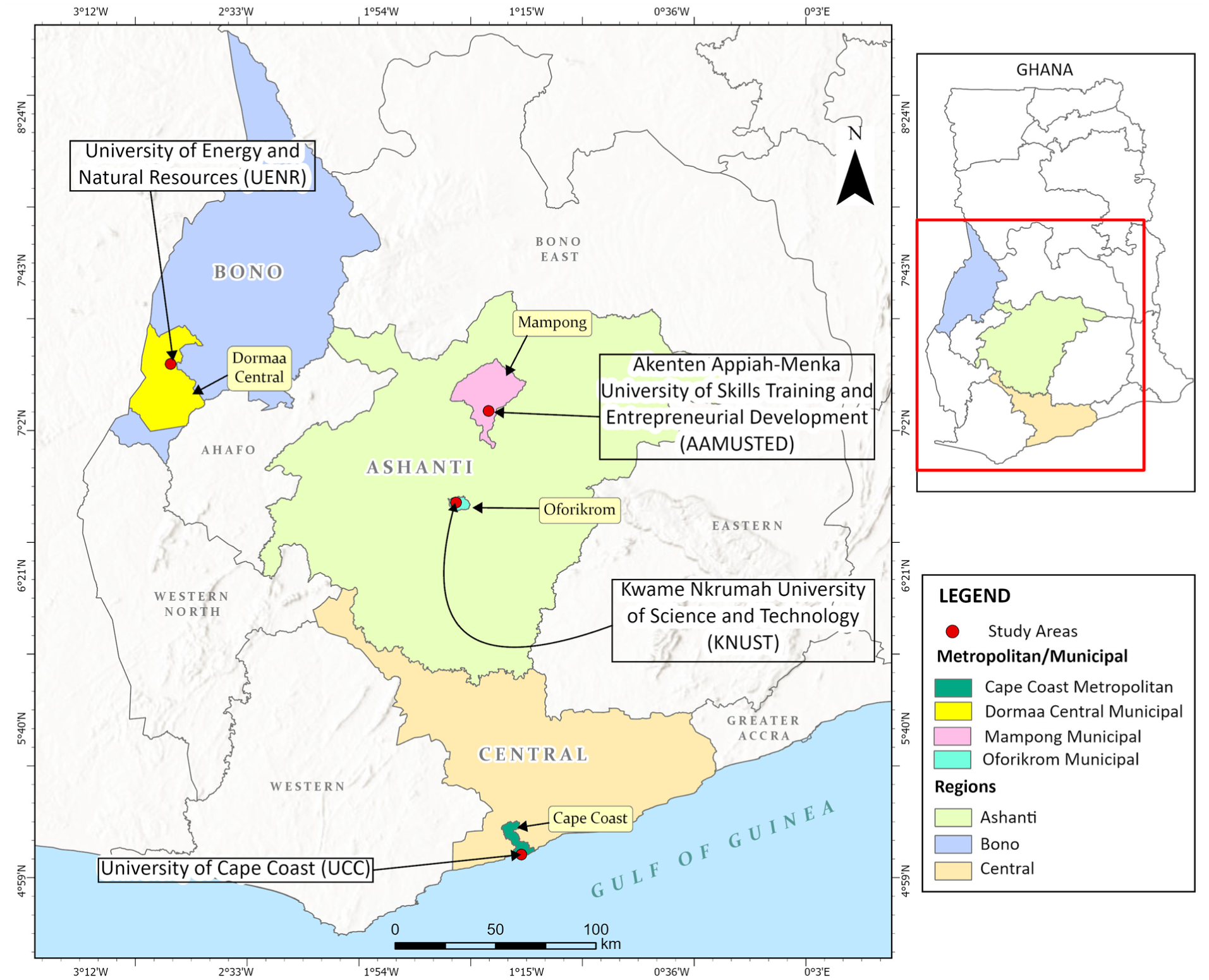
A map of Ghana the location of study universities.
Study Population, Sampling Procedure, and Sample Size
The study population was undergraduate final-year students pursuing agriculture and agriculture-related programmes. The choice of final-year students as the study population was premised on the assumption that they were about to enter the job market to seek employment, and would be considering their options for employment more than third, second, or first-year students. The total study population, which was sourced from the examination offices of study universities (UCC, KNUST, UENR, and AAUSTED), was 1,129 (UCC - 61, KNUST - 671, UENR - 59, and AAUSTED - 338). The student population per university varies because admissions are largely driven by institutional capacity and decisions of prospective students to choose a specific institution or programme of study.
There is also a visible inequality in the enrolment rate between male and female students in higher education, predominantly in Science, Technology, Engineering, and Mathematics (STEM) fields such as agriculture (Quarshie et al., 2023). There is therefore no consistent formula for a fixed number of students admitted by these universities. Hence, the disparity in our data in terms of student population in the four universities and the gender representation.
A census was conducted on these 1,129 students using a structured questionnaire. The census was carried out in all four study universities to allow each student to participate in the research.
Data Collection Instrument and Measurement
A questionnaire, made up of two parts, was used to collect the data. Section one measured variables on the demographic characteristics of the undergraduate students, including sex, programme of study, and affiliated university. While the second section looked at the perception of students on four constructs or themes, namely socio-cultural, economic, government policies, and the availability of resources, that can influence their decision to venture into BVC.
This was measured on a five-point Likert scale: strongly disagree (1.00–1.44), disagree (1.45–2.44), somewhat agree (2.45–3.44), agree (3.45–4.44), and strongly agree (4.45–5.00). Accordingly, the results obtained from the Likert scale have been interpreted based on the assigned (corresponding) meanings to the scales. The section was made up of 35 statements. These were aimed at measuring students’ perception towards engaging in activities of the BVC after graduation, by starting their own business or being employed in the sector.
Though the Likert scale has been criticised as being inappropriate for use as a scale of measurement and the type of data analysis appropriate for data collected from it (Jamieson, 2004). Carifio and Perla (2007, 2008) and Norman (2010) have argued that it is appropriate for measurement and data collected using a Likert scale to be analysed using parametric statistical methods.
The questionnaire was assessed for its face and content validity by two experts in animal science and agricultural extension from the University of Cape Coast. Before data collection, the institutional review board of UCC gave ethical approval (ID: UCCIRB/CANS/2021/35) for the study to be conducted. A pre-test study involving 41 final-year undergraduate students in the general agriculture and animal production programmes in UCC was undertaken (27th January 2022–16th February 2022).
The pre-testing of the questionnaire was done to ensure the reliability of the instrument. The Statistical Package for Social Sciences (SPSS) software was used to analyse the scale items to generate the Cronbach’s Alpha coefficient. Cronbach alpha coefficients of the subscales were sociocultural factors (.83), economic factors (.70), government policies (.70), and resource availability (.77). According to Vaske (2008), an instrument with a Cronbach Alpha coefficient of .65 or above is deemed to be reliable; hence, the questionnaire was adopted for the study.
The questionnaire was administered to undergraduate students in their classrooms after the objectives of the study had been explained to them. The students were allowed to complete the questionnaire and return it after 1 week. The data were collected between 14th March 2022 and 26th August 2022. At the end of the data collection exercise, a total of 1,129 questionnaires were administered and 728 returned, representing approximately a 65% response rate.
Data Processing and Analytical Procedure
Coded entries were made of the data collected in Excel and uploaded onto the Statistical Package for Social Sciences (SPSS) version 28.0 software, which was used to analyse the data. The data was screened to identify errors for correction as well as address issues of missing data, while the suitability of the data for the various statistical tests undertaken in this study was assessed to enhance the quality and reliability of the study findings (Landau & Everitt Chapman, 2004; Pallant, 2016).
To this end, a common method bias (CMB) test was carried out to assess the presence of common method bias (CMB) in the dataset using Harman’s single-factor test. The results (see Appendices 1a and 1b) show that the first factor explains only 17.66% of the total variance, which is significantly below the 50% variance threshold (Podsakoff et al., 2003). This suggests that common method bias was not a serious concern in our data; as such, the results of subsequent analyses are not likely to be substantially influenced by method effects.
A normality test was also undertaken to ascertain if the dataset was normally distributed. The Kolmogorov-Smirnov Test (K-S test) was used, and the results (see Appendix 2) show no significance K-S (728) = 0.05, p = .59 (Socio-Cultural Perception), p = .82 (Economic Perception), p = 3.72 (Government Policy Perception), and p = 3.25 (Resource Availability Perception). The test results showed that the data is generally normally distributed and had no statistically significant p-values, which indicates normality (Pallant, 2016).
The descriptive statistics, including frequencies, percentages, means, and standard deviations, were used to analyse the socio-demographic characteristics of the undergraduate students; while frequencies, percentages, means, standard deviations, three-way factorial multivariate analysis of variance (MANOVA), and principal component analysis (PCA) were utilised to analyse the factors influencing the decision of undergraduate students to venture into the BVC as a means of employment after graduating from the university.
Three-way factorial MANOVA was carried out to determine the statistically significant differences in the perception of the students on four factors (social-cultural, economic, government policy, and resource availability) and their sex, institution (UCC, KNUST, UENR, and AAMUSTED), and programme of study (Pallant, 2016).
The PCA was used to identify the factors that influence the perception of tertiary students towards choosing BVC business as a vocation after graduation. The PCA approach used was based on its data reduction ability. The technique reduces large data sets to a smaller data set while maintaining their originality by limiting the loss of information (Asioli et al., 2014; Mwadzingeni et al., 2020). This study employed the PCA to identify among the four constructs, statements (35 Likert-type statements) that influence the decision of students to engage in BVC activities after graduation.
Results
Demographic Characteristics of Final Year Undergraduate Students
Table 1 presents the results of respondents’ demographic characteristics based on the institutions and programmes of study. The results indicate that males dominate their female counterparts in all four universities. For example, AAMUSTED had the highest male population (86.1%), followed by UNER (males = 72.3%), KNUST (males = 70.2%), and UCC (males = 56.8%) in that order. The agriculture and agricultural-related programmes studied by students in the four public universities and the percentages of students per programme are presented in Table 1, which shows that more than one-third (34.8%) of the students studied crop science as their area of specialisation. Of this number, about three-fourths of them (75.5%) were males, while the rest were females. This finding is not surprising, as prior studies have reported that females are underrepresented in university education and in agricultural programmes on the African continent (Asitik & Abu, 2020; Van Houweling et al., 2020).
Students’ Demographics Characteristics.

Source. Field data (2022).
Students studying Agribusiness were the second highest group, representing a little over one-fifth (21.7%) of the student population. Animal Science students, who were the third highest in the population, represented less than one-fifth (18%). The rest of the students, who were enrolled in study programmes such as Agric Biotech (11%,), Agricultural Extension (7.3%), Agricultural Economics (5.5%) and Agro Processing (1.8%), respectively, were fewer than one-tenth of the total. The mean age of the students was 24.12 ± 2.76 years. On the other hand, 7 in every 10 (71.0%) of the students were between the ages of 21 and 25 years, while approximately one-fourth (24.9%) were 26 years or above.
Perception of Ghanaian Tertiary Students Towards Choosing Broiler Value Chain Business as a Vocation
The results of students in four public universities perception towards engaging in BVC activities after graduation as a vocation is presented in Table 2. The results of the cultural factors indicated students ‘disagreed’ (index 2.11 ± 1.08) with these factors influencing their decision to venture into boiler value chain as a vocation after graduation. Despite the fact that students ‘somewhat agreed’ that broiler value chain jobs are difficult or more demanding, farmers work hard for little reward and females are supposed to carry out marketing activities in the value chain, they however disagreed that broiler value chain activities are dirty to do, broiler value chain businesses are not respected, females are supposed to carry out poultry processing and feed milling jobs are for males.
Perception of Students Towards Engaging in the Activities of the Broiler Value Chain.

Source. Field survey (2022).
Means were calculated from a scale of 1 = strongly disagree, 2 = disagree, 3 = somewhat agree, 4 = agree and 5 = strongly agree.
Figures in parenthesis are in percentages.
When the economic factors were examined, the results revealed that generally, the students somewhat ‘agreed’ that economic factors will affect their decision to enter into broiler value chain after graduation (Index = 3.33 ± 1.10). Even though students ‘somewhat agreed’ that broiler value chain jobs are not well paying, they ‘agreed’ that high feed cost would affect the business turn over (profitability). Students also ‘agreed’ that the depreciation of the Ghanaian currency may increase the cost of production, rendering the business unsustainable.
The students agreed that the whole-scale importation of poultry production inputs makes the broiler value chain business frustrating to young starters. Furthermore, the students agreed that broiler value chain businesses are capital-intensive, and because of this, young people cannot start such a business on their own, and the business is a high-risk one due to disease outbreaks (Bannor et al., 2023).
The results show that students agreed’ government policies would affect their decision to venture into the broiler value chain business after graduation (Index = 3.46 ± 1.20). The undergraduate students agreed that local broiler businesses are not given subsidies to lower the cost of production, the government has no consistent poultry production policy, and no import substitution policy to reduce and eliminate the importation of frozen chicken into the country.
Assessing resource availability and how it would affect the decision of the students to enter into the BVC business showed that students somewhat agreed that resource availability would affect their decision to venture into the BVC business after graduation (Index = 3.18 ± 1.19). Even though students ‘somewhat agreed’ that information needed to support broiler value chain activities is not easily available, and it is not easy to sell broiler meat and meat products in the country, they however ‘agreed’ that young people do not have easy access to get land for broiler value chain activities, it is not easy for young people to access credit to start or scale-up broiler production, and production inputs are not readily available.
Differences in Factors Influencing Students’ Decision to Venture Into Broiler Value Chain and Programme of Study, Institution, and Sex of Student
The linear combination of the differences in the four factors (sociocultural, economic, government policies and resource availability) influencing students’ decision to venture into the broiler value chain for the institution of study (UCC, KNUST, UNER and AMMUSTED), programme of study (Agribusiness, Agricultural Extension, Agricultural Economics, Animal Science, Crop Science, Agricultural Biotechnology and Agro Processing), and sex (Male and female) were examined with three-way factorial multivariate analysis of variance (three-way factorial MANOVA). There were no significant violations found in the preliminary evaluation to test for multicollinearity, univariate and multivariate outliers, linearity, and normality. Table 3 shows the results of the three-way factorial MANOVA. The Box’s M test was used to verify that the variance-covariance matrices were homogeneous. Covariance matrices across groups should be homogeneous, according to the calculated Box’s M value of 382.66 (F (260,9757.18) = 1.23, p = .008). When testing for statistical significance, Wilks’ Lambda (Λw) was employed. The results established no statistically significant difference between the institution at which the students are studying and the linear combination of the socio-cultural, economic, government policies, and resource availability (F(12,1839.09) = 1.04, p = .41; Λw = 0.98; η2 = 0.006) factors influencing students’ decision to venture into broiler value chain as a vocation after graduating from the universities. Secondly, there was no statistical significance difference between the programme of study of the students and the linear combination of the factors influencing their decision to go into the broiler value chain after graduation from the university (F (24,2425.78) = 0.61; p = .93; Λw = 0.98; η2 = 0.005). Thirdly, male and female students did not differ on the linear combination of sociocultural, economic, government policies and resource availability that would influence the decision to work in the broiler value chain as a vocation after their studies in the universities (F (4,695.00) = 0.81, p = .52, Λw = 1.00; η2 = 0.005). Furthermore, there were no noticeable differences in the interaction between institution and the programme of study of the students (F (24,2425.78) = 0.78, p = .77, Λw = 0.78; η2 = 0.007), institution and sex of students (F (12,1839.09) = 0.98, p = .47, Λw = 0.98; η2 = 0.006), programme of study and sex (F (24,2425.78) = 0.53, p = .97, Λw = 0.98; η2 = 0.005), and institution, programme of study and sex (F (16, 2123.90) = 0.62, p = .87, Λw = 0.99; η2 = 0.004). The results indicate that students in the four public universities, their programme of study, and sex do not significantly impact the sociocultural, economic, government policies, and resource availability factors influencing their decision to venture into the broiler value chain after completing their university education. The results infer that when an undergraduate student decides to participate in the broiler value chain as an employment opportunity based on the sociocultural, economic, government policies, and resources availability, their university, programme of study, and sex, and the interaction between these variables would not have any bearing on that decision.
Multivariate Test of Institution, Programme, and Sex on Broiler Value Chain Factors.

Source. Field survey (2022). * = p < 0.05
Factors Influencing Undergraduate Students’ Decision to Engage in the Broiler Value Chain Business as a Vocation
Undergraduate students’ opinion about engaging in the BVC business as a vocation was subjected to principal components analysis (PCA) to examine the factors influencing such a decision. The data set was examined to ascertain its suitability for computing the PCA. Analysis of the correlation matrix showed that correlation coefficients .30 or higher were dominant indicating that the sample was suitable for the PCA (Pett et al., 2003). To assess the sample size adequacy of the data set, the Kaiser-Meyer-Olkin (KMO) measure of sample size adequacy was used. KMO value of 0.86 indicated sample size adequacy because it is higher than the recommended KMO value of 0.6 (Pallant, 2016). Following that, Bartlett’s Test of sphericity revealed that the PCA was statistically significant (X2 (595) = 8766.30, p = .00). The Bartlett’s test implies that the correlation matrix supports the factorability of the variables used to examine the factors influencing undergraduate students’ decision to engage in the BVC business as a vocation (Tabachnick & Fidell, 2013).
Examination of the initial eigenvalues of the PCA revealed nine components with eigenvalues greater than one. The nine components (component 1 = 17.66%, component 2 = 12.75%, component 3 = 7.67%, component 4 = 4.92%, component 5 = 4.01%, component 6 = 3.93%, component 7 = 3.25%, component 8 = 3.19%, and component 9 = 2.96%) collectively accounted for 60.33% of the variance in the decision of the undergraduate students to engage in BVC business. Cattell’s scree plot was examined to determine the breaking point of the graph [Appendix 3] (Cattel, 1966). The graph showed the breaking point on the sixth component. To confirm the six components, Watkins, (2000) Monte Carlo Parallel analysis was computed with the 35 items, 728 sample size, and 1,000 replications (35 variables × 728 cases × 1,000 replications). The results of the parallel analysis showed that six components of the initial PCA had eigenvalues greater than the corresponding criterion values from the parallel analysis (see Table 4); hence, six components were accepted, which accounted for 57.93% of the variance in the data set.
Monte Carlo Parallel Analysis.

Source: Field data (2022).
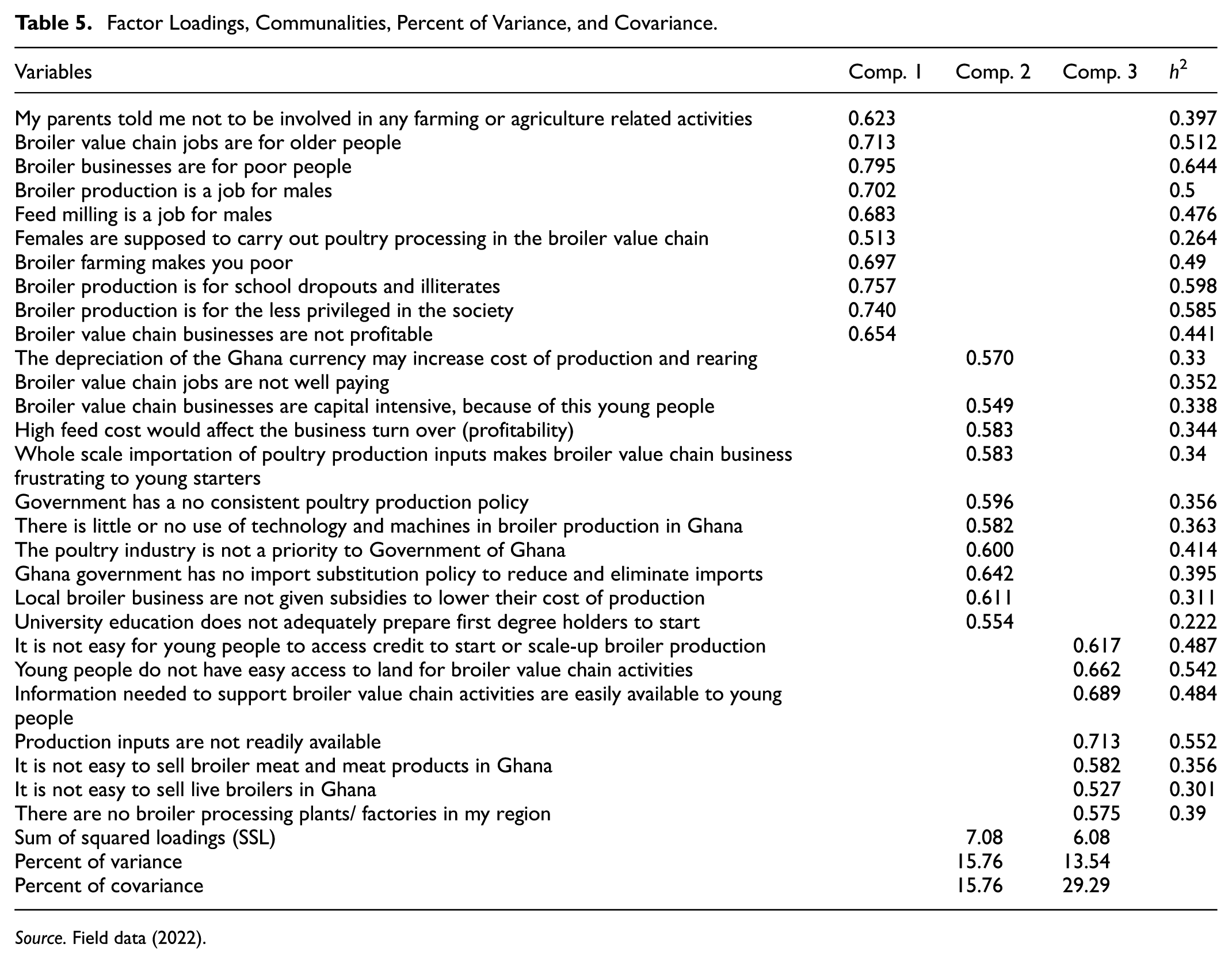
When the six components were extracted, only three had factor loadings greater than 0.50 and were therefore retained. The lower factor loading suggests a weaker correlation between the variables and the principal components (Samuels, 2017). Loadings less than 0.50 indicate that the variable’s differences are not strongly explained by that specific component, signifying that it might not be important to the overall structure of the data for the components (Williams et al., 2010). These three components cumulatively accounted for 38% of the variance in the decision of undergraduate students to engage in BVC business as a vocation, with component 1 predicting 17.66%, component 2 predicting 12.75%, and component 3 predicting 7.67% of the variation. The variance of the three retained components accounted for the reduction from 57.93% for six components to 38%. Rotation adequacy of the PCA was determined by examining the correlation matrix of the three components. Davis (1979) convention for determining the magnitude was used to assess the correlation coefficients. The results showed no correlation between the three components (r = .00), therefore varimax orthogonal rotation was performed to support the interpretation of the three components (Pallant, 2016).
Table 5 shows the factor loadings, communalities, percent of variance, and covariance. To assist in the interpretation of the results, the three components were ordered and grouped based on the magnitude of factor loadings greater than 0.50. The three components were ordered as socio-cultural factors (component 1), economic factors (component 2) and production resources availability (component 3), and three suggested interpretations were given to the components. Ten items loaded strongly on both components 1 and 2, while seven items loaded strongly on component 3. Zeros were used to replace all factor loadings less than 0.45 (20% of variance). Eight items that had factor loadings less than 0.50 were deleted from the PCA.
Factor Loadings, Communalities, Percent of Variance, and Covariance.
Source. Field data (2022).
Therefore, socio-cultural factors (e.g., my parents told me not to be involved in any farming or agriculture related activities; broiler value chain jobs are for older people; broiler businesses are for poor people; and broiler production is job for males). Economic factors (e.g., the depreciation of the Ghana currency may increase cost of production and rearing; broiler value chain businesses are capital intensive and because of this young people cannot start such a business on their own; high feed cost would affect the business turn over; whole scale importation of poultry production inputs makes broiler value chain business frustrating to young starters). And production resource availability (e.g., it is not easy for young people to access credit to start or scale-up broiler production; young people do not have easy access to land for broiler value chain activities; information needed to support broiler value chain activities are easily available to young people; and production inputs are not readily available) were identified to influence the perception of students. The results from the PCA imply that the key socio-cultural, economic, and production resource availability factors would influence undergraduate students’ decision to engage in broiler value chain business as a vocation. In other words, sociocultural, economic, and production resource availability are factors engaging the minds of agriculture and agricultural-related undergraduate students in the four public universities in Ghana.
Discussion
Sociocultural factors are reported to influence the decision of the youth to participate in agricultural value chains. The results of this study show a general disagreement by the students that these factors would influence their choice to engage in the BVC as entrepreneurs or employees.
However, a diverse perception of students was observed in some of the individual statements of the socio-cultural construct. The disagreement of students with the statement ‘my parents told me not to be involved in any farming or agriculture-related activities shows that parents have not told their wards not to be involved in any farming or agriculture-related activity. This implies that should students venture into agriculture or farming after school, it would be an independent decision. They are also likely to get the support of their parents. The finding contradicts what was reported by Sumberg and Okali (2013) and Kodom et al. (2022) that African parents who are farmers discourage their children from taking up farming after them, as the parents could not make it economically in agriculture.
Similarly, students disagree that BVC activities are not respected. It can be concluded that students in search of a noble venture to undertake after school will likely consider an activity along the BVC because they see it to be noble. This finding is out of sync with what has been reported by Mwaura et al. (2015) on the perception of Ghanaian youth towards agriculture in general.
Additionally, students disagree that BVC jobs are for older people and that no specific activity along the BVC was meant for any gender. This provides a promising future for the BVC since most (52.5%) of the youth do not perceive it to be a prerogative of older people, and activities along the chain can be undertaken by any gender. This notwithstanding, Mensah-Bonsu et al. (2019) in a study reported that 90.7% of poultry producers in the Dormaa and Sunyani enclave were men, whereas the trading and processing segments of the poultry value chain were dominated by women who constituted 89.2% and 84.4%, respectively.
On the perception of BVC activities being a job for the less privileged or poor people in society, the findings show that students disagree. This implies that the majority of students do not think broiler production is for the less privileged in society. This finding collaborates with what has earlier been reported by several authors, in that engagement in livestock value chain activities as a livelihood or business venture was an easy path to escape poverty on the African continent (African Union, 2015; Mensah-Bonsu et al., 2019; Rich et al., 2009).
The results (see Table 2) on the economic perception construct show that of the seven statements students only disagree with two, and the construct index (3.33 ± 1.10) demonstrates a tilt towards students agreeing that the prevailing economic environment in which broiler businesses were operating would negatively influence their decision to engage in the BVC activities as entrepreneurs or employees after graduation.
Specifically, students perceived the broiler business to be profitable as they disagree with the statement ‘broiler value chain businesses are not profitable’ and students disagree that ‘broiler value chain jobs are not well-paying’. This means students who intend to pursue a profitable business or take up a well-paying job will consider choosing broiler production and its related value chain activities. Magagula and Tsvakirai (2020) have posited that youth who have a positive economic perception about a particular agribusiness are more likely to venture into it.
Students perceived broiler production and the activities along the broiler value chain to be a high-risk activity (3.55 ± 1.16). This was revealed in the findings as 53.8% of the students agree that broiler production is a high-risk venture due to disease outbreaks. This concurs with the report of Ruiz Salvago et al. (2019) who reported on how perceiving farming as high risks was keeping the youth of Thailand’s Prachinburi Province away from engaging in the sector.
Moreover, students perceive the macroeconomic conditions (3.85 ± 1.09) of the country to be affecting BVC activities. The majority (65.5%) of students agreed that the depreciation of the Ghanaian currency would increase the cost of production since some cost items used in production and processing activities are imported. These findings demonstrate the high level of awareness of students about the BVC and the Ghanaian economy. Given that the Bank of Ghana reported in October 2022 that the Ghanaian currency had lost more than 37% of its value against the US dollar and other international currencies (Bank of Ghana, 2022), this lowers the competitiveness of Ghana’s BVC businesses (Van Horne, 2018).
Furthermore, students perceive broiler production to be capital intensive (3.66 ± 1.18) and that the high cost of feed would affect profitability (3.96 ± 1.08). The statement ‘high feed cost would affect the business turnover (profitability)’ recorded the highest mean among all the statements. Students agree that the economic conditions in the country do not favour broiler production as they perceive it to impact the feed cost and the margins of actors. It implies that students with a profit mindset would not choose a broiler value chain business as a venture under the prevailing circumstances.
In value chain development, the issue of government policy, interventions, regulations, levies, or taxes is a critical growth catalyst. These create an enabling environment for businesses to thrive (Vermooij et al., 2018). These types of government policy interventions in a sector can increase investments in businesses and export opportunities (Dlamini et al., 2014). Government interventions such as the introduction of import levies have the potential to increase or decrease the competitiveness of BVC businesses. At the same time, it can increase participation in the value chain.
The perception of students on government policies in the BVC shows interesting findings, as students agreed with a composite mean index of 3.46 ± 1.20 that government policies do not support the growth and sustainability of the poultry industry, particularly the BVC.
Students agreed that the ‘government has no consistent policy’ (3.59 ± 1.14) and ‘Ghana government has no import substitution policy to reduce and eliminate importation of frozen chicken into Ghana’ (3.59 ± 1.17). This means students perceive that importation of poultry and related products will be an issue to them should they venture into broiler production, as the government has no policy to reduce the importation. This is a major concern to actors of the chain, as imported chicken is cheaper than that locally produced, therefore affecting the demand decisions of chicken consumers (Asante-Addo & Weible, 2020; Asante-Addo & Weible, 2019). This result contradicts Sumberg et al.’s (2017) findings that although there was government policy on the poultry industry, it was, however, challenged by the fact that it lacks trade policies that offer minimal protection to poultry farmers, and available mechanism that enables the gathering of data for the poultry value chain in Ghana. Additionally, market access was found to be a motivation factor for the youth of Zambia to take up a career in agriculture (Mulema et al., 2021). Similarly, Bosompem et al. (2017) found that accessibility and availability of a market for agro-products positively influence students’ willingness to enter into agribusiness as self-employment.
A surprising result from this study was that 50.9% of the students agreed (3.44 ± 1.34) that ‘University education does not adequately prepare first degree holders to start their own business’. This suggests that the current form of undergraduate education respondents are receiving does not fully equip them to be entrepreneurs.
The results on the resource availability perception construct show that students disagreed that a lack of resources would influence them not to engage in the BVC after school. However, students agreed to three out of the seven statements under this construct. Students perceive (3.81 ± 1.17) that ‘young people do not have easy access to land for broiler value chain activities. This concurs with Ng’atigwa et al.’s (2020) finding that lack of land access was a key factor that was keeping the youth of Njombe Region in Tanzania from horticulture agribusiness. Similarly, Bosompem et al. (2017) also reported that unfavourable land tenure arrangements were negatively influencing the willingness of undergraduate students in starting their own agribusiness after school in Ghana.
Respondents agreed that (3.68 ± 1.31) ‘it is not easy for young people to access credit to start or scale-up broiler production’. Students who intend to use borrowed funds in starting a broiler production business or its related activities are likely not to do so since they perceive it was not easy or possible to acquire a loan. This is consistent with previous literature (Adei & Asante, 2012; Mcleod et al., 2009; Mensah-Bonsu et al., 2019).
There was also an agreement (3.56 ± 1.13) by students to the statement that ‘production inputs are not readily available’. This indicates that students perceived that this issue could hinder any future BVC business venture if nothing is done to make inputs more readily available. It can, therefore, affect their decision to choose BVC activities as a vocation after school.
The three-way factorial MANOVA results showed no statistically significant difference between the institution the students are studying, programme of study, sex of student, institution*programme, institution*sex, programme*sex, institution*programme*sex and the linear combination of the sociocultural, economic, government policies, and resource availability. This surprising result implies that any policy intervention aimed to increase students’ participation in the BVC as entrepreneurs or employees can be generalised for all the students in the four public universities.
Particularly worth noting is the result showing male and female students did not differ on the linear combination of sociocultural, economic, government policies resource availability that would influence the decision to work in the broiler value chain as a vocation after their studies in the universities. This implies that gender does not influence the choice of students engaging in entrepreneurship in the BVC or taking up employment in the sector. This finding contradicts long standing reports on how gender influences a student’s entrepreneurship intentions (Westhead & Solesvik, 2016; Wilson et al., 2007).
Additionally, the MANOVA results indicate that students in the four public universities, their programme of study, and sex does not significantly impact the sociocultural, economic, government policies and resource availability factors influencing their decision to venture into the broiler value chain after completing their university education. This means male and female students pursuing different specialisations in agriculture in the four public universities share the same perception on the four-perception construct. This may hold true according to the findings of Inegbedion and Islam (2020). The authors found that among students in the Southwest of Nigeria, studying agriculture was motivated by their quest to acquire skills that would help them to be self-employed after graduation. It is therefore plausible that these students in Ghana’s universities are not influenced by the sociocultural, economic, government policies and resource availability factors. As their objective may be to start their own businesses like the Nigerian students.
The principal components analysis (PCA) results demonstrates that the socio-cultural, economic and production resource availability are three key factors that would influence undergraduate students’ decision to engage in broiler value chain business as a vocation after graduation. These three factors have the potential of discouraging students from participating in the BVC either entrepreneurs or employees. Studies by Sumberg, Awo, and Kwadzo (2017) and Bosompem et al. (2017) both acknowledge these factors to be part of the reasons students would choose not to participate in the activities of agricultural value chains after graduation.
Policy interventions that address the constraints faced by BVC actors by creating an enabling businesses environment that ensures macro-economic stability, availability and affordability of inputs and market access will boost their confidence and increase their participation in the BVC.
Addressing the negative perception young people (students) have about activities of the BVC and agriculture in general is critical to increasing the participation of students in BVC activities after graduation.
Conclusion and Recommendations
The overall perception of students on the issues that would keep them away from engaging in BVC business after school was that they somewhat agree (3.02 ± 1.14) that there were socio-cultural, economic, policy and resource availability perceptions that could prevent their participation in the activities of the BVC after school. Among the four factors or constructs on which the perception of students was measured, students agreed (3.46 ± 1.20) that existing government policies does not support the growth and profitability of BVC businesses, suggesting that if there is no policy shift by government before they graduate, they will likely not engage in the BVC. The statement that recorded the highest mean score (3.96 ± 1.08) with 70.7% agreement among students was ‘high feed cost would affect the business turn over (profitability)’. However, students also agreed that the depreciation of the Ghanaian currency may increase cost of production rendering the business unsustainable. Students also agreed that current government policies and the state of the country’s economy do not support or favour the growth of broiler value chain businesses, which may affect their decision to participate in BVC activities after graduation. The agreement by students to these statements buttresses the high level of awareness of students regarding the BVC and the Ghanaian economy.
Although it was surprising, the three-way factorial MANOVA results suggest that if an undergraduate student decides to participate in the broiler value chain as an entrepreneur or employee, the decision would not be due to the influence of factors such as sociocultural, economic, government policies and resources availability, their university, programme of study and sex, and the interaction between these variables. However, the principal components analysis (PCA) results have shown the three important factors that influence undergraduate students’ decision to engage in broiler value chain business as a vocation after graduation are socio-cultural, economic, and production resource availability.
These findings highlight the important role perception plays in the decision-making process of undergraduate students or young people in choosing to engage in the agricultural sector, particularly the broiler value chain, as a vocation. Predominantly available literature on the engagement of students or young people in agriculture as a business vocation or employment in Ghana has been focussed on agriculture in general, although few studies exist on cocoa, but not the livestock or broiler industry. Hence, this study provides compelling evidence that students’ perception of the socio-cultural, economic, and production resources availability factors in the industry are the three important factors that shape their decision to engage in broiler value chain business as a vocation after graduation. Policy intervention by the government, aiming to encourage graduates of Ghanaian universities or young people, must first address the broiler industry challenges. The involvement of graduates in the broiler value chain as entrepreneurs or employees will serve as a means of employment, which will enable them to contribute to the national economy. They would also bring to the industry technical know-how and youthful energy, and the assurance of industry sustainability. This has the potential to reduce social vices common among unemployed youth in the country, such as violent crimes and drug abuse.
In view of these findings, to change the perception of students and encourage agricultural graduates to engage in activities of the BVC as a vocation, the Government and development partners need to double their efforts to make BVC businesses look attractive to the youth by demystifying socio-cultural barriers. The government should also create an enabling business environment and ensure national macroeconomic stability that positively impacts the growth of agribusinesses, particularly BVC businesses. A clear policy by the government that addresses access to land and risk mitigation, such as insurance for start-ups, should be considered to attract university graduates to the broiler value chain business as entrepreneurs or employees in the sector. Though in Ghana, there are traditional universities and technical universities that offer a first degree in agriculture. This study did not include the technical universities in Ghana, hence a limitation of this study. It is recommended that future research on this subject should include technical universities.
Footnotes
Appendices

| Construct | Kolmogorov-Smirnova | |
|---|---|---|
| K-statistic | p-value | |
| Socio-cultural perception | 1.03 | .59 |
| Economic perception | 0.37 | .82 |
| Government policy perception | 20.39 | 3.72 |
| Resource availability perception | 775.91 | 3.25 |
Acknowledgements
The authors will like to express gratitude to the students from the universities who participated in the study. We also wish to acknowledge the valuable advice and suggestions given us by Dr. Seth Etuah of the Department of Agricultural Economics, Agribusiness and Extension. Kwame Nkrumah University of Science and Technology. Kumasi, Ghana.

Ethical Considerations
The University of Cape Coast (UCC) Institutional Review Board (IRB) granted ethical clearance approval– ID (UCCIRB/CANS/2021/35) for the study.
Consent to Participate
On the consent to participate declaration, the researchers first introduced the study to participants, including its objective, and also informed participants that their participation in the survey was voluntary; for this reason, they can choose not to answer any individual question or all of the questions. Participants willing to participate in the survey were to tick the Yes box for ′1. Yes [] to confirm participation; on the contrary, if No, the No box 2. No [] was ticked to confirm non-participation. A confidentiality statement was also provided to participants on the questionnaire for participants, informing them that the information they provide would be treated confidentially and the data would be used for the research only. The questionnaire also captured the information on the approval of the study by the Institutional Review Board of the University of Cape Coast, and the contacts of the Institutional Review Board were provided on the questionnaire for participants to report any concerns they may have regarding the conduct of the survey. This study does not require a consent to publish declaration, as the outcome of the research, which included publication, was communicated to participants for approval before the survey instrument was administered
Author Contributions
Bombason Kweku Tuoho, conceived and designed the study, interpreted the data and also drafted the manuscript. Samuel Kwesi Ndzebah Dadzie, contributed to study design, data interpretation and revision of the manuscript critically to ensure intellectual content. Julius Kofi Hagan, literature search, design of interview schedules and the provision of technical advice in the study design as well as critically revising the manuscript for intellectual content. Martin Bosompem, contributed to the design of interview questionnaire and the design of the study, revised critically the manuscript for intellectual content. Robert Aidoo, contributed to study design and interview questionnaire drafting, data interpretation and revision of the manuscript critically to ensure intellectual content. Isaac Kwasi Asante, analysed the data, also critically reviewed the manuscript for intellectual content. All authors have approved of this version of the manuscript and also agreed to be accountable for all aspects of the work.
Funding
The authors received no financial support for the research, authorship, and/or publication of this article.
Declaration of Conflicting Interests
The authors declared no potential conflicts of interest with respect to the research, authorship, and/or publication of this article.
Data Availability Statement
Data would be made available upon reasonable request from the corresponding author – Bombason Kweku Tuoho