




Abstract
Providing long-term career coaching or counseling has become an increasingly important part of university life as the coronavirus pandemic rapidly sweeps across the world. Career coaching has become one of the most important drivers of revenue and enrollment growth in nongovernmental schools. However, little research has been carried out to evaluate the effectiveness of these long-term career coaching or counseling services. Accordingly, this study aims to use a mixed method approach to track and measure students’ satisfaction from private higher vocational colleges to identify opportunities for improving employment services. Students were asked how satisfied they were with employment services provided by this private vocational school. The results obtained lead us to suggest that private higher vocational colleges could strengthen the employability of graduates by providing a wide variety of enrichment activities and establishing a regular monitoring mechanism to evaluate perceptions of their engagement and educational experiences in the current coronavirus crisis.
Introduction
With the rapid development of higher education in China, the number of students attending college has risen significantly since the official enrollment expansion in 2001. China is now at an important stage of supply-side reforms and economic transformation, with its economy facing more downward pressure. Today’s Chinese students are more career-focused and under pressure to take on extracurricular activities, internships, and work experience to compete in the hypercompetitive labor market. College graduates in China are subject to increasing employment pressure, and the labor force participation rate for recent college graduates has become one of the most important issues facing the country. The number of Chinese college graduates is estimated to reach 9.09 million in 2021, an increase of 350,000 over 2020 (Ministry of Education, 2021).
The Chinese economy has experienced astonishing growth (Li et al., 2019; Woo, 2019; Zhang et al., 2018) but has been buffeted by a series of shocks, such as the coronavirus pandemic (Chakraborty & Maity, 2020; Norouzi et al., 2020; Wang & Wang, 2020). The outbreak of COVID-19 has severely affected the global economy. China has been facing slower economic growth and rising unemployment, and graduates from Chinese universities are facing the hardest job-hunting season in the nation’s history. Many public colleges and universities in China developed their strategic plans and gave students a leg up on career planning. Chinese colleges and universities have made efforts to expand the enrollment scale of postgraduates, provide university students with financial support in pursuit of their academic goals, and increase the availability of on-campus and major-related employment (Wei, 2005). However, employment services in private higher vocational colleges are commercial and public in nature. For example, providing public services for the community is one of the functions of private higher vocational colleges. Private higher vocational colleges must take the initiative to expand employment channels for graduates amid the COVID-19 outbreak and prepare our students for the ‘real world’ that exists around them. Profit private colleges in China are operated by private and profit-seeking businesses, and effective resource allocation plays a very important role for their employment service. Thus, students’ perception from private and public universities may be different in terms of curriculum, employment services, etc. However, to our knowledge, there is little information in the literature to answer this question.
Until recently, however, to the best of our knowledge, very few empirical studies have been performed to measure how satisfied students are regarding long-term career coaching or counseling services within these private schools. In the present study, we intend to investigate and evaluate private higher vocational colleges students’ satisfaction with employment services offered and hope this study could guide further research in the theory–practice nexus regarding vocational guidance in private schools.
Literature Review
Employment Service Across Countries
The employment of services, policies, content, forms, and implementation mechanisms is very different from country to country (Brown et al., 2019; Canny, 2002; Dey & Cruzvergara, 2014). For example, the employment service system in the United States (US) is a complex, multistage process with multiple participants, such as government institutions, enterprises, vocational colleges, and intermediary agencies. The German government has established a college coordination team to offer courses that provide employment services to college students. The team contacts the employing units, offers employment skill training and vocational counseling, collects and publishes employment information, and has set up a “marketing institute” for recruiting top executives in enterprises and for engineers to act as teachers and train students in colleges and universities. Career guidance for students in the United Kingdom (UK) is provided by colleges that have the ability to provide access to independent and impartial counseling services, interview skills, job-hunting guidance, etc. In contrast to job-hopping Americans, Japan’s jobs-for-life culture has guaranteed generations of workers. Thus, the structure of guidance services in schools, employment offices, universities, and colleges in Japan is long-term or lifetime employment. As demonstrated, governments, society, academies, intermediary agencies, and other specialists participate in the existing employment service systems across different countries, but their duties and operating modes differ (Ledwith, 2014; Vinichenko et al., 2016).
The most recent research concerning the employment service system of colleges has focused on public colleges (Tam & Morrison, 2005; Wong & Ngok, 2006). Specific topics include implementation mechanisms, service content, service modes, and information platforms among public colleges. However, there have been very few studies conducted on the employment service system of private vocational schools.
Satisfaction With Career Services
Satisfaction can be defined as an individual’s pleasure response when a system meets his or her diverse desire and want (Álvarez-García et al., 2019; Chen et al., 2019). The disconfirmation of expectations paradigm has dominated research on student satisfaction or dissatisfaction. For example, when products or services meet their expectations, they are likely to feel satisfied. That is, if students’ feelings outweighed their previous expectations, then they would feel satisfied (Tessema et al., 2012). If students’ previous expectations outweighed their feelings, they would feel dissatisfied (Strayhorn & Johnson, 2014).
Several research studies have been conducted to explore students’ satisfaction and their perceived learning outcomes. The employment services department in colleges or universities is the authority that connects jobseekers with employers (Vinson et al., 2014). Employment services include a wide range of activities, such as career counseling, job development, job training, internship opportunities, job-search skills, work-ready skills, vocational guidance, and connections to local employers (Kettunen & Sampson, 2019). The employment services department acts as an intermediary between schools and employers. Helping young people prepare for work, gain work experience, and find a job is an important part of colleges or universities (Lehker & Furlong, 2006). Compared to other institutes, one of the main goals for private colleges or universities is to enable students to find gainful employment more quickly after graduation. Thus, the attitudes of students toward employment services departments are an important predictor of success in colleges or universities. However, very few studies have explored students’ satisfaction with career services, such as internships and career counseling services.
Satisfaction With Career Services in Private Vocational Colleges
Higher education in China is the largest in the world and is expected to continue to expand over the coming decade in accordance with the country’s economic development (Li et al., 2008). The government is expanding public university capacity, and public colleges are government-funded in China. However, small, private higher education institutions rely on tuition, and endowments have faced significant challenges in recent years due to declining enrollments, changing demographics, and rapidly evolving technology development (Scott et al., 2006). Students who graduated from private colleges felt less secure in regard to employment; they were more concerned about the COVID-19 pandemic impacting their job prospects in China.
It is important to evaluate students’ attitudes toward employment services in private colleges. All these emotions could have important effects on enrollment in private nonprofit institutions. It can also help propose an effective strategic countermeasure against the different challenges identified. Very few studies have focused on how to effectively develop a measure of the efficiency of employment services in private colleges in China. Items such as employment-to-population ratio, employment rate, unemployment rate, etc., are the most widely used in evaluating career and employment services among private schools (Hua, 2007). However, there are extra dimensions of career and employment services, each of which has its own unique conceptual direction but shares a substantial overlap with other aspects as well between different national cultures and societal norms. Therefore, in practice, it is crucial to define and develop measures for each indicator that is important for career and employment services in private schools in China.
Methodology
Study Site
The Sanya Institute of Technology was selected for this study. It is located in Sanya City, Hainan Province and is approved by the Ministry of Education to establish an independent set of private ordinary undergraduate institutions. It has grown into a premier institution of research and education, with more than 1,000 active faculty members working in almost all frontier areas of science and technology. At present, the Institute has over 20 major departments and centers organized into nine different Divisions: automobiles, tourism, catering, economic management, architectural engineering, health, art, internet technology, and airline services. The coexistence of various departments on the same campus gives a unique opportunity to researchers to participate in research within as well as across various disciplines.
With the help of the country’s years of operating experience in higher vocational education, as well as the unique geographical advantage of Sanya City, Sanya Institute of Technology has built modern higher vocational education with an international vision and explores and practices a mechanism for improving the efficiency and quality of employment service. Thus, the Sanya Institute of Technology was selected as an example because it is new, highly independent, and showed tremendous potential for sustainable development. The Sanya Institute of Technology is highly representative of China’s private higher vocational colleges. Thus, the sample can be representative to ensure that we can generalize the findings from it to other cases.
Selecting Indicators for Evaluation
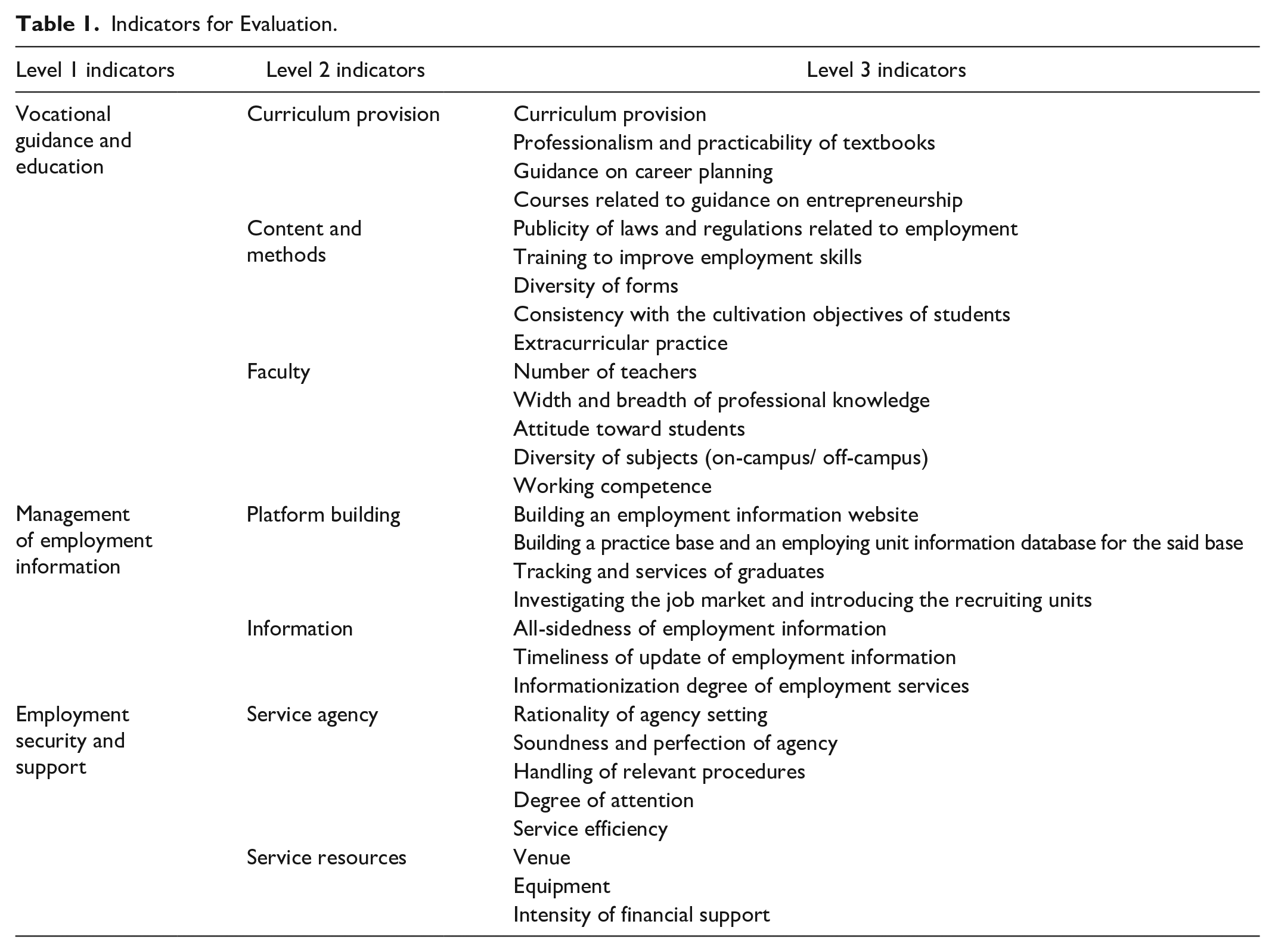
To evaluate the students’ satisfaction with employment services in private higher vocational colleges, the characteristics and actual conditions of private higher vocational colleges are considered, and the principles of objectivity, hierarchy, representativeness, and operability of the index are followed (see Table 1). Several indicators have been identified based on a literature review (Hiebert, 2009). Indicators have been modified to better reflect the Chinese labor market regulation and this study’s research objectives. Three dimensions have been developed. They are vocational guidance, information management, and individual employment security. These dimensions have been tested, applied, and adopted as the basis for the development of indicators of employment services. Some practical items, such as curricular materials, teaching resources, vocational training provision, career guidance, etc., are selected to ensure the long-term operability of this evaluation system. To better reflect the key characteristics of private school education, this system also includes students’ perception of courses such as entrepreneurship education, employment law claims and smart solutions. In addition, items such as instructional effectiveness, student-to-teacher ratio, etc., are selected to evaluate teachers’ quality. Given that employment security is an important dimension of quality of employment and that secure employment is the main means to secure income, the items measuring employment security are also included.
Indicators for Evaluation.
Reliability and Validity of Measurement
Web-based surveying is becoming widely used in social science research, especially during infectious disease outbreaks. Web-based questionnaires were thus adopted and distributed to assess students’ perceptions of employment services in private higher vocational colleges. A total of 1,034 students were randomly selected and invited to participate using convenience sampling. Students’ demographic information is shown in Table 2. Several statistics are assessed by considering the survey’s reliability and validity. For example, reliability was measured by Cronbach’s a. The calculation formula of coefficient a was revised as follows:

Basic Information of Respondents.

When the value of α was ≥.7, then reliability was considered acceptable. In this study, by calculating the value of α for each indicator of the samples using SPSS24.0, it was found that the values of α were higher than .98, indicating good reliability (see Table 3).
Values of Cronbach’s α for Each Indicator of the Samples.

The Kaiser–Meyer–Olkin (KMO) measure of sampling adequacy and Bartlett’s test of sphericity were further examined. The KMO test is often used to compare the simple and partial correlation coefficients between variables. According to the rule of thumb for interpreting this statistic, a KMO value larger than 0.9 or above indicates that the sampling is very adequate. The statistics of Bartlett’s test of sphericity were calculated by the determinants of correlation coefficient matrices and approximately followed a chi-square distribution. The construct validity was generally tested using factor analysis, and the resulting validity was assessed using a variety of indicators.
In this study, using the KMO measure of sampling adequacy and Bartlett’s test of sphericity with SPSS24.0, the observed value was 59,583.4, and the probability was p = 0, suggesting a significant difference between the correlation coefficient matrix and identity matrix. Moreover, the KMO value was 0.988, which implies that the sample data had very high validity (see Table 4). Exploratory factor analysis (EFA) was employed to understand the shared variance of measured variables that is believed to be attributable to a factor or latent construct in the early stages of scale development. Through an explanatory factor analysis of the questionnaire results, it was found that the contribution rate of the first principal component of each evaluation item was greater than 0.5, suggesting that the common factor can explain each indicator (see Table 5).
KMO Values of Each Indicator of the Samples.

Contribution Rate of First Principal Component of Each Indicator of the Samples.

Results
Perception of Vocational Guidance Services
Key findings drawn from the survey have demonstrated that students generally hold positive attitudes toward employment services offered at the Sanya Institute of Technology. Approximately 10% of students know about employment services because of their involvement with those activities. More than 30% of students lean slightly toward a favorable response. However, approximately 55% know just a little or not at all about the detailed employment services (see Figure 1). Many of them do not know the guidance services that can assist them in discovering themselves—their potentialities and limitations, making appropriate choices in educational, vocational, and other fields, etc. (see Figure 2).

Students’ perception on employment service.

Students’ understanding regarding career services.
On the other hand, the institute does not provide a wide range of vocational guidance services and treats it as just a day-to-day responsibility. Most of the students enter vocational colleges with little direction and are naïve about how the real world functions. They have not developed a sense of responsibility and self-motivation. They practiced little social skills and had not chosen a career path. Beyond choosing a college to attend, the parents require that their children choose a college major in a field with good employment prospects in return for financing the children’s education without considering the major if closely aligned with their children’s strengths and interests, which could be the best predictors of college success. In addition, the information students received about careers was too narrow. However, among students who were aware of vocational guidance services, it was found that the proportion gradually increased from graduates to freshmen.
With respect to the comprehensive evaluation of the vocational guidance services in this institute, statistical analysis shows that 40% of students were “very satisfied,” 26% were “satisfied,” and 8% were “less satisfied or not satisfied at all,” suggesting that students have a positive attitude toward the vocational guidance services (see Figure 3).

Students’ satisfaction with career services.
To make students’ satisfaction scores with the institute’s employment services more accurate, the author retained the questionnaires of students who knew the services “very well” or “well” for further analysis. Students’ scores for factors affecting their satisfaction with the employment services offered by the institute are shown in Table 6. It can be observed that the overall scores of employment services were high for Sanya Institute of Technology, and there were no differences between the scores of these indicators. The top 10 evaluation items included teachers’ attitude toward students when offering employment services, teachers’ working competence, employment security & support, equipment, number of teachers, width and breadth of teachers’ professional knowledge, handling of relevant procedures, intensity of financial support, timeliness of the update on employment information, informatization degree of employment services, and service efficiency. Overall, students were satisfied with the vocational guidance services.
Scores of Various Indicators of Employment Services in Sanya Institute of.

High-Quality Teaching
The analysis of the survey data identified five indicators about students’ attitudes toward the institute’s faculty. They are teachers’ attitudes toward students when they offer employment services, teachers’ working competence, number of teachers, and breadth of science knowledge. Therefore, it can be concluded that teachers’ quality and ability played a decisive role in students’ satisfaction with employment services. In addition, two indicators related to teachers’ services (handling of relevant procedures and service efficiency) were also ranked higher among these 10 items. The main reason for this was that the institute adhered to certain strict norms in the selection of teachers to identify high-quality teachers who would be a good fit of the institute culture and were aligned with the mission of the institute. The institute offers a welfare package to teachers and provides them with security in housing and the schooling of children, which relieves teachers from these worries and enables them to work with enthusiasm. The institute has established a performance incentive scheme such as salaries, secondary benefits, and intangible rewards. Moreover, the institute has a well-formulated vision that teachers can be motivated to continue moving forward to achieve their goals.
High Degree of Informatization and Strong Financial Guarantee
Among the top 10 items, timely and frequent employment information and informatization degree of employment services ranked eighth and ninth, respectively. In the information society (Society 4.0), the winner is whoever obtains information first. The Sanya Institute of Technology becomes more aware of its own professional knowledge and action by challenging assumptions of everyday practice and developing competencies for assessing strengths before putting them into practice. The career service center in this institute responds to specific requests from students, such as internships and part-time, full-time positions, in a timely manner, whether they are freshmen determining their career path or a senior looking for his or her first full-time opportunity.
With respect to employment security, service equipment and intensity of financial support ranked third and seventh, respectively. The Sanya Institute has invested heavily in employment security and support equipment. It reflects the characteristics of private college education. Benefiting from investment and support, the Sanya Institute of Technology is more efficient and flexible in expenditure equipment to support the regular operation of the implementation. It is also easier for private higher vocational colleges to keep pace with the reforms and innovations. Enough investment effort is a powerful stimulus to further innovation.
Lower Scoring Items
From Table 6, five items show a systematically lower score. They are vocational guidance forms, effective textbooks, training programs, extracurricular practice, and courses related to the guidance on entrepreneurship. To guarantee efficiency, the institute offered students vocational guidance services through courses, lectures, and reports, combined with targeted guidance from counselors and teachers. This method was highly efficient and individualized, but it was not possible to teach students in accordance with their aptitude. Moreover, the institute did not pay adequate attention to vocational guidance courses. It attaches great importance to teaching professional knowledge but gives little importance to curriculum provision and training to improve employment skills. Students expect to receive direct guidance from distinguished graduate alumni or famous public figures who have achieved great success in their careers. The institute’s vocational guidance center needs to reinforce guidance to students and invite a greater number of alumni graduates to the school to give lectures and instruct students on career selection. When asked about the actual role of employment services provided by the institute in their employment success, 22% of students said that they were “very helpful,” 22% said they were “helpful,” and 2% considered them to be “useless.” Thus, the institute must continue to attach importance to students’ vocational guidance services (see Figure 4).
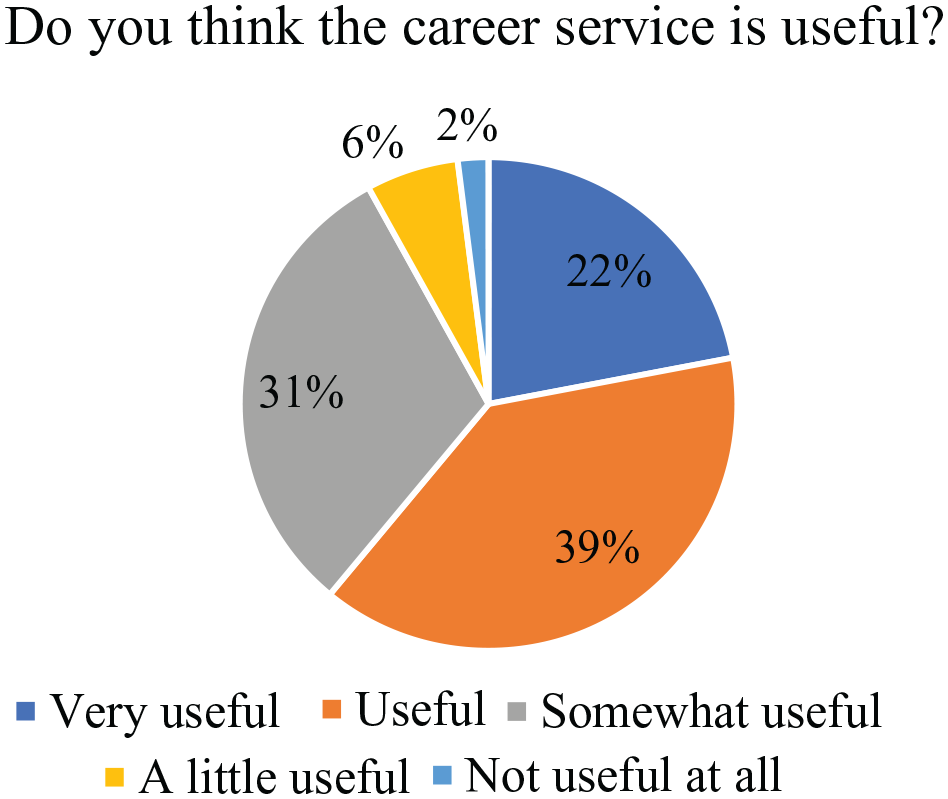
Usefulness of career service.
Discussion and Conclusions
Theoretical Implications
The higher education institutions in China are normally divided into two main groups: state (public) and private (nonpublic) institutions. Most vocational programs in China take 3 years or less and have become increasingly popular. Academics have recently put more emphasis on the measurement of the degree of student satisfaction with career services from public institutions at the macro level. However, little empirical research has been conducted to reveal the level of students’ perception of employability services in private schools. This study’s key theoretical implications are twofold.
First, researchers should define and develop measures for each attribute that is important for students’ satisfaction with education and employability in private schools. The indicator measures the extent to which the students from private schools are satisfied with the career services. This study found a relatively positive attitude held by the students toward vocational guidance services. While building an effective mechanism to evaluate students’ satisfaction with vocational guidance, private higher vocational colleges can improve students’ satisfaction scores by referring to their overall evaluation, identifying the problems existing in colleges’ employment services, improving students’ awareness of vocational guidance services, and enhancing their employment services. This is an important impetus mechanism for private higher vocational colleges to improve the level of employment services. In addition, establishing an effective mechanism to evaluate students’ satisfaction with vocational guidance is of great significance for education departments to regulate and coordinate inclusive and equitable policies and school practices in vocational education from a sociological perspective.
Second, it is important to develop a vocational guidance concept with students’ perceived quality as the focus. The survey results suggest that there is a widespread lack of knowledge of quality in the vocational guidance offered by private higher vocational colleges. In addition, investigation and long-term follow-up management of students’ perceived quality of vocational guidance services is found to be lacking. Our study results show that students have relatively lower levels of satisfaction with the vocational guidance services provided by this private higher vocational college. There is well-established evidence that students’ satisfaction may directly or indirectly influence the stability harmony of social order in a mainly collectivistic society. Therefore, private higher vocational colleges exert themselves to improve students’ perceived quality of vocational guidance services is not only responsibility toward students but also to the entire society, and this stimulates private higher vocational colleges to improve their educational attachment.
Managerial Implications
The Sanya Institute of Technology performed well in terms of faculty, but there is still significant room for improvement in terms of vocational guidance and education, such as curriculum provision, professionalism and practicality of vocational guidance, teaching materials, and training to improve employment skills. Therefore, school guidance and counseling programs are of great importance.
First, it is necessary to teach students according to their aptitude with diverse abilities and interests. It is important to give students the right to study independently and responsibly based on a set of career goals. Individual career choice was not accidental but a process of making decision choices, which is influenced by multiple factors that are associated with several experiences and inspired in many ways. A key initiative is to educate an individual about career awareness before he or she chooses a job. Super (1980) argued that individual career development is composed of five stages, each with a distinct emphasis: the first is the growth stage that helps students develop transferable knowledge and learn about the world; the second is the exploration stage that creates career awareness and helps students identify skills and interests; the third is the establishment stage, that is, exploring career ideas and discovering more potential career paths; the fourth is the maintenance stage, that is, sustaining the current position without leaving the current job; and the fifth is the declining stage, that is, retirement planning. It is obvious that college students are in the stage of academic and career planning; that is, they are in various phases of exploration and decision-making. Private higher vocational colleges should help students identify their tentative occupational choices based on their interests and skills and encourage them to explore these choices. Educators help and guide students to explore their values, interests, and skills and help them find educational and career options that match up with career goals.
Second, it is important that the major groups continue to work together to support efforts for ensuring that various training career-related courses run through the entire learning process of students. Vocational guidance services for private college students are supposed to run through the complete learning process of students and provide them with targeted education and training during different stages of development. An institute is expected to insist on combining the inside classroom with the outside classroom yards. In the inside classroom school yards, a teaching and research office for vocational guidance can be established to improve instructional resources and assessments and enhance the quality of the teaching process. It is necessary to schedule lessons for freshmen to describe their career interests and goals and inspire them to think about their college life and future career development. For freshmen under age 21 who enroll in this 3-year degree program, two courses, namely, Career Planning and Guide on Career Selection, can be required to help them take responsibility for their career, starting with an accurate assessment of their current skills and talents and providing a comprehensive guide on how to make a career plan.
An institute is expected to infuse content related to employment into students’ daily teaching programs. In regular teaching, importance must be given to professionalism and practicality. The content and goal of teaching must be combined with employment. Only this can ensure that the lessons taught will be useful to society and help students in the future.
Third, through face-to-face talks with top executives from famous enterprises and alumni forums in the outside classroom, students can prepare for life beyond school, familiarize themselves with the recruitment process, and determine their core work values. It is necessary to increase the percentage of practical courses in higher vocational colleges. Related courses and programs must attach greater importance to gaining proficiency in practical operations and skills. In addition, great outside school counselors need to be successful in the workplace and should love educating students and set a positive example for students. An outside school counselor’s every word and deed play a steering role. Outside school counselors are expected to grasp the real needs of private college students, teach the students practical tips for how to simplify their daily lives and make them happier.
Fourth, private higher vocational colleges can also establish a career development counseling division and build a normal working mechanism to enroll full-time counselors, outstanding senior schoolmates, celebrities in the workplace, and corporate HR with rich experience in terms of employment to serve as consultants and give advice to provide career information resources, discuss career development, etc. Teachers have a better understanding of the challenges and opportunities for designing efficient employment services, implementing the full coverage of informatization, and improving informatization service capabilities. Private higher vocational colleges can improve the following aspects: completion of employer information, the service of graduate tracking, job market surveying, introduction of recruiting units, etc. An institute must set up an e-student information system that provides a job search database, valuable information on workplace matters for people with disabilities, job hunting tools, a listing of internships, etc., to ensure that students and employers can promptly understand and learn about each other’s requirements (Boeltzig-Brown, 2017; Venable, 2010). That channel can give job seekers important clues that help them find a career direction, and employers can receive notifications when jobs that match qualifications and preferences are posted.
Limitations and Suggestions for Further Research
This study has several limitations worth noting. The first limitation exists in the current study beginning with the sample being drawn from a population of students at a single and private Chinese university. Thus, its findings are not generalizable to students at other schools with different settings. Second, the information provided by the current study is exploratory, descriptive, and correlational, and mixed methods could be used in future studies to fully understand causal relations. Finally, the research was further limited by the duration of this survey, which was relatively short, so that students were investigated over a relatively short timeframe.
Footnotes
Declaration of Conflicting Interests
The author(s) declared no potential conflicts of interest with respect to the research, authorship, and/or publication of this article.
Funding
The author(s) disclosed receipt of the following financial support for the research, authorship, and/or publication of this article: This research was supported by Hainan Planning Office of Philosophy and Social Science (Grant Numbers: hnsz2019-53, HNSK(YB)19-93), Key Scientific research Projects of Hainan Universities in 2022 (Grant Number: Hnky2022ZD-26), and the GuangDong Basic and Applied Basic Research Foundation (Grant Number: 2022A1515010376).
