




Abstract
Performance appraisal, as a powerful tool for human resource management, has become an important driving force for organizations to achieve sustainability. However, only when employees believe that a performance appraisal is fair can an organization’s performance appraisal truly work and have a positive impact on employees. Hence, based on social exchange theory and social identity theory, we theorized and validated a dual path model to explore the influence of performance appraisal justice on employee job performance through work engagement and organizational identification. Survey data from 404 Chinese employees and their direct supervisors in high-tech enterprises were analyzed using multiple regression and structural equation modeling. Results indicate that performance appraisal justice of employees has a positive impact on their work engagement, organizational identification, and job performance. In addition, both work engagement and organizational identification of employees partly mediated the relationship between performance appraisal justice and their job performance. Our conclusions mean that when employees perceive justice in organizational performance appraisals, they will actively engage in their daily work and truly identify with their organizations, thus improving job performance, which is conducive to the sustainable development of organizations. The limitations and implications for future research and practice are also discussed.
Keywords
Introduction
As the core of human resource management, performance appraisal has become an integral part of modern management tools for organizations to motivate their employees (Dangol, 2021; Gupta & Kumar, 2012), and it is likely to have an important impact on the realization of organizational performance goals. Many previous scholars have verified that how to effectively improve employee job performance is directly related to organizational performance (Ju et al., 2021; Lee et al., 2019). And among these numerous researches on the influencing factors of employee job performance, the perspective of human resource management practice (e.g., performance appraisal) is gradually becoming the focus of research (Boswell & Boudreau, 2002; Meijerink et al., 2021). Specifically speaking, performance appraisal can directly affect an employee’s work behaviors, such as job satisfaction (Poon, 2004), organizational commitment (Salleh et al., 2013), turnover intention (Kuvaas, 2006), and well-being (Dal Corso et al., 2019). However, the employees are more likely to accept the performance appraisal results only if they believe the performance appraisal of the organization is fair (Gupta & Kumar, 2012; Seljak & Kvas, 2015; Thurston & McNall, 2010). Any appraisal system is useless if employees think that the performance appraisal is unfair (Meijerink et al., 2021; Roberts, 2003). This means that individual employees’ perceptions of performance appraisal justice determine their acceptance of a performance appraisal and its results, and also directly affect their future work attitude and performance.
Performance appraisal justice refers to the degree of employees’ perception of fairness in the performance appraisal system, process, and results of the organization during the performance appraisal period (Dangol, 2021; Erdogan, 2002; Iqbal et al., 2019). Previous studies have verified it can not only make individuals feel satisfied with the performance appraisal system, process, feedback, and so on (Rana & Singh, 2022; Su et al. 2022), but also further enhance their psychological security, sense of self-worth, organizational commitment, and group status (Kahn, 1990; Meijerink et al., 2021; Seljak & Kvas, 2015). When employees believe that an organizational performance appraisal is fair, they will try to maintain a high level of job performance out of the desire to reward the organization (Siyal et al., 2020). They will also take the initiative to improve the defects found in their work (Dangol, 2021; Salanova et al., 2005), which will eventually lead to the improvement of their job performance. Hence, based on employees’ perceptions of performance appraisal justice, the present study first attempts to explore the factors affecting employee job performance and expects that employees’ perception of organizational performance appraisal justice is positively related to their job performance. In other words, when employees can perceive justice in the organization’s performance appraisal, job performance in their daily work will be improved.
According to social exchange theory, when employees feel that they are treated fairly by an organization, they tend to show more positive attitudes and behaviors to reward the organization (Emerson, 1976). Work engagement, as a positive working state of employees (Bakker & Demerouti, 2008; Inam et al., 2021), is likely to be promoted by performance appraisal justice. Specifically, performance appraisal justice can be regarded as the specific application and reflection of organizational justice in the specific context of an organizational performance appraisal (Schleicher et al., 2019). When the employees perceive that the organization’s performance appraisal is fair, they will be more proactive (Rana & Singh, 2022), and have a strong interest in their work (Jyoti & Bhau, 2015), which naturally leads to a higher level of work engagement. In this case, employees usually think that they can deal with various challenges in their daily work, which can help them finish their work faster and more effectively (Dal Corso et al., 2019), and they are more likely to show higher levels of job performance (Truxillo et al., 2012). Hence, the second aim of the present study is to examine the mediating role of work engagement in the relationship between performance appraisal justice and employee job performance.
In addition, social identity theory suggests that organizational fairness can promote employees’ identification with their organizations (C. K. Kim et al., 2001), and thus positively affect their work attitude, behavior, and performance (Bednar et al., 2020). Organizational identification is a special form of social identification, which describes the internal relationship between employees and their organizations, as well as the degree of employees’ recognition of their organizations (Koçak & Kerse, 2022; Riketta, 2005). Prior scholars have verified performance appraisal justice as the concrete embodiment of organizational fairness in performance management (Schleicher et al., 2019), which can further enhance the organizational identification of employees (Piccoli et al., 2017). When employees have a high degree of organizational identification, they are more likely to rely on and trust the organization (Chang et al., 2022; Smidts et al., 2001), so they are more willing to contribute their own strength to the organization and take the initiative to improve their job performance (Palaiologos et al., 2011). Therefore, we believe that organizational identification can also mediate the relationship between performance appraisal justice and employee job performance, which is the third aim of this study.
Taken together, the present study attempts to build and validate a dual path model to discuss the influence of performance appraisal justice on employee job performance. Based on social exchange theory and social identity theory, the present study introduces work engagement and organizational identification as mediators to explore the internal processes between performance appraisal justice and job performance. By analyzing the data collected from pairing samples of employees and their direct supervisors at high-tech enterprises operating in a National Hi-Tech Park in Shanghai, China, the present study tests whether those above relationships are also established among Chinese employees. Therefore, the present study contributes to the existing literature that deals with the relationships between performance appraisal justice, job performance, work engagement, and organizational identification, especially in the Chinese culture. In addition, the conclusion of the present study can provide a reference and thinking in relation to how enterprises can continuously stimulate the work engagement and organizational identification of their employees through a fairer and more reasonable performance appraisal system, and thus improve employee job performance.
Review of Literature
Performance Appraisal Justice
Performance appraisal justice refers to the degree of employees’ perception of fairness in the performance appraisal system, process, and results of the organization during the performance appraisal period (Dangol, 2021; Erdogan, 2002; Iqbal et al., 2019). In essence, it is the employees’ individual perception of the justice of the performance appraisal system in a specific organizational context (Elicker et al., 2006; Ju et al., 2021). Many previous studies have pointed out that employees’ perception of performance appraisal justice determines their acceptance of the performance appraisal process and its results, as well as the possible effects of the performance appraisal. For example, Keeping and Levy (2000) argued that performance appraisal justice has always been the most important index to measure the effectiveness of performance management in an organization. This is not only because employees have a high sensitivity to justice (Levy & Williams, 2004; Sarfraz et al., 2021), but also because the results of performance appraisals are often directly linked to the interests of employees in terms of salary and promotion (Su, Lyu et al., 2019; Seljak & Kvas, 2015). In addition, Schleicher et al. (2019) pointed out that employees’ perception of performance appraisal justice would inevitably affect their work behaviors and attitudes.
For the specific content of performance appraisal justice, Greenberg (1986) first proposed that employees’ perception of performance appraisal justice includes two dimensions: procedural justice and distributive justice. Colquitt (2001) further enriched the structure of performance appraisal justice, dividing it into four dimensions, namely procedural justice, distributive justice, interpersonal justice, and informational justice. Procedural justice refers to employees’ perception of organization’s performance appraisal criteria and the fairness of procedures used by supervisors in the performance appraisal process (Erdogan, 2002; Nagin & Telep, 2020). Distributive justice refers to the fairness of performance appraisal results perceived by employees, that is, whether employees think their performance evaluation results are commensurate with their actual work efforts relative to their colleagues (Colquitt, 2001; Hu & Han, 2021). Interpersonal justice refers to the degree of politeness, dignity, and respect given to employees by their superiors when executing procedures or determining outcomes, and informational justice emphasizes the completeness and accuracy of all information about performance appraisals perceived by subordinates (Greenberg, 1993; Gupta & Kumar, 2012). Combined with the practical characteristics of performance appraisals and the main points of previous research, the present study will continue the four-dimensional division of performance appraisal justice. For the measurement of Chinese employees’ perception of performance appraisal justice, the present study applies Gupta and Kumar’s (2012) 17 item scale, which is also divided into four sub-scales: distributive justice, procedural justice, interpersonal justice, and informational justice.
Performance Appraisal Justice and Job Performance
For a long time, performance research has been at the core of human resource management and organizational behavior research (Awan et al., 2020; Zacher et al., 2010). The job performance of employees refers to what they do during their daily work and the actions they take to achieve organizational goals (Campbell & Wiernik, 2015), which can drive the entire sustainable economy (Jyoti & Bhau, 2015). It is essentially a multi-dimensional, target-related behavioral structure that can be assessed (Borman & Motowidlo, 1997; Meijerink et al., 2021). From the existing literature, it is apparent that employee job performance depends on their own characteristics and external situational factors. The research on employees’ own characteristics mainly emphasizes the different influences of employees’ individual characteristics on their job performance, such as personality characteristics (Barrick & Mount, 1991; W. Kim et al., 2013), motivation (Van Iddekinge et al., 2018), and ability (Kaasa, 2009). Those studies of external situational factors mainly emphasize the influence of the internal and external environments of an organization on employees’ job performance. For example, Robbins and DeNisi (1994) constructed a model of the factors that affect the job performance of employees from the aspects of individual and organizational environments. Swalhi et al. (2017) verified the positive influence of employees’ perceptions of organizational justice (distributive, procedural, and interactive) on their job performance. Consistent with their study, the present study infers that performance appraisal justice, as a specific form of organizational justice in performance appraisals, can promote employee job performance.
Equity theory states that if employees perceive an unfair ratio of input to return, they will reduce their input (Carrell & Dittrich, 1978; Rana & Singh, 2022). In other words, when employees think that they are treated fairly by the organization, they will reward the organization with positive work attitudes and behavior (Ucar et al., 2021; Uddin et al., 2019). On the contrary, employees will adopt negative attitudes and behaviors to respond to unequal treatment (Colquitt, 2001). Many previous studies (e.g., Greenberg, 1993; Nagin & Telep, 2020; Schleicher et al., 2019; Steensma & Visser, 2007; Swalhi et al., 2017) have also verified that employees’ perceptions of procedural justice, distributive justice, interpersonal justice, and informational justice in organizational performance appraisals have a significant influence on positive work-related attitudes and behaviors. Besides, Roberts (2003) argued that the performance appraisal, as a complex and controversial human resource technique, is closely related to the formation of an organizational atmosphere. A fair performance appraisal system can create an organizational atmosphere of full trust, support, care, and understanding (Long et al., 2013; Rubin & Edwards, 2020). The employees who work in such an organizational atmosphere tend to work harder (Tsai et al., 2015) and show higher levels of job performance. Therefore, we propose the following hypothesis:
Hypothesis 1: Performance appraisal justice is positively related to employee job performance.
Mediating Role of Work Engagement
The concept of work engagement was first proposed by Kahn (1990), as “the individuals’ willingness to actively engage in their work roles from physical, cognition and emotion in their daily work.”W. Schaufeli (2012) argued that work engagement is essentially the state in which employees put themselves into their work, and it is a positive attitude toward work, characterized by vigor, dedication, and absorption (p. 74). Vitality refers to high levels of energy and mental resilience at work, as well as the willingness to work hard and persevere even in the face of difficulties (Rich et al., 2010). Dedication refers to high degrees of involvement in the work, experiencing feelings of meaning, passion, inspiration, pride, and challenge (Uddin et al., 2019). Absorption is featured by being fully concentrated and happily absorbed in an individual’s work, whereby one feels that time passes quickly and it is not easy to separate from the work (Inam et al., 2021). Since then, with the development of positive psychology, work engagement, as a positive work attitude, has gradually become a new research hotspot in the field of psychology, human resource management, and organization behavior (e.g., Bakker, 2022; Gupta & Kumar, 2012; Kaya & Karatepe, 2020; Shuck, 2011).
Both Kahn (1990) and W. Schaufeli (2012) have verified that organizational justice perceived by individuals from the external situation is an important factor affecting their work engagement. Masterson et al. (2000) also confirmed that organizational justice perceptions of employees have a significant influence on their work engagement. As an important part of organizational justice, performance appraisal justice can be regarded as the specific application and reflection of organizational justice in the specific context of organizational performance appraisals (Inam et al., 2021; Schleicher et al., 2019). When the employees perceive that the organization’s performance appraisal is fair, they will be more engaged in their work. In addition, based on the principle of reciprocity (Palaiologos et al., 2011), employees tend to show a more positive attitude when they perceive fairness within the organization, because they believe that if they work hard, the company will know and reward them (Dal Corso et al., 2019; Saks, 2006). In other words, when treated fairly in organizational performance appraisals, employees will respond through positive work attitudes and behavior, such as work engagement (Fong & Ng, 2012). Therefore, employees’ perception of performance appraisal justice will greatly increase their work engagement, and the following hypothesis is proposed:
Hypothesis 2: Performance appraisal justice is positively related to work engagement.
In recent years, many empirical studies have found that work engagement plays a significant mediating role between job performance and its antecedent variables (Kaya & Karatepe, 2020; W. Kim et al., 2013). Based on these studies and the above discussions on the relationships among performance appraisal justice, work engagement, and job performance, the present study speculates that the relationship between performance appraisal justice and job performance may be mediated by work engagement. To be specific, when employees perceive performance appraisal justice in the organization, they will experience more interest and enthusiasm at work, which urges them to focus more on their own work, and devote themselves to the completion of work tasks and the realization of performance goals, so as to achieve better job performance. Besides, social exchange theory (Emerson, 1976) emphasizes that when employees feel that they are treated fairly by the organization, they tend to show more positive attitudes and behaviors to reward the organization. When employees feel satisfaction with the organizational performance appraisal, they can perceive the organization’s recognition of their previous efforts (Levy & Williams, 2004; O’Neill et al., 2011). This sense of recognition greatly increases their work enthusiasm and motivates them to serve the organization more actively, resulting in better job performance (Nagin & Telep, 2020). Based on the above analysis, we speculate that the relationship between performance appraisal justice and job performance is mediated by work engagement. Therefore, the following hypothesis is proposed:
Hypothesis 3: Work engagement mediates the relationship between performance appraisal justice and employee job performance.
Mediating Role of Organizational Identification
As a concept derived from social identity theory, organizational identification was introduced into the research field of organizational behavior by Ashforth and Mael (1989) and defined as “the individual’s identification of themselves as a certain part of the organization.” It is a special form of social identification, which describes the internal relationship between employees and their organizations, and the degrees of employees’ recognition of their organizations (Koçak & Kerse, 2022; Riketta, 2005). Simply put, when an employee feels that he or she belongs to an organization, he or she will identify with the organization (Ashforth et al., 2008). Then, he or she is prone to being dependent on the organization, more willing to actively contribute to the organization, maintain the image of the organization, and ultimately improve the performance of the organization (Zhao et al., 2019).
Employees usually define themselves in terms of how the organization treats them (C. K. Kim et al., 2001), which means that how the organization treats its employees determines their organizational identification (Riketta, 2005). Tyler (1999) argued that if employees can feel the recognition and appreciation of the organization, they will feel that they are respected in the organization, which greatly promotes their identification with the organization. Steensma and Visser (2007) verified that when employees perceive that performance appraisals are fair, they can generate a sense of being treated fairly, as well as recognition and appreciation from the organization. Hence, as an indicator of how employees are treated by their organizations in the performance management system (Rubin & Edwards, 2020), performance appraisal justice is likely to have an important impact on their organizational identification, and the following hypothesis is proposed:
Hypothesis 4: Performance appraisal justice is positively related to organizational identification.
According to social identity theory, individuals with high organizational identification are more likely to respond to organizational justice, and their behavior is more likely to be consistent with organizational goals and behavior (C. K. Kim et al., 2001; Postmes et al., 2019), which means employees with high organizational identification are more likely to perceive organizational justice (Ashforth et al., 2008), and therefore prefer to engage themselves in the organization. Even at the stake of losing their own interests, they may make decisions that best suit the interests of the organization (Graham et al., 2020; Smidts et al., 2001). In addition, as an organizational phenomenon caused by organizational performance appraisals, performance appraisal justice is also possibly affected by the degree of employees’ identification with organizations. If the performance appraisal of the organization is fair and easily accepted by the employees, then the employees show stronger organizational identification, resulting in better job performance. Therefore, we believe that employees who perceive performance appraisal justice from their organization usually have higher organizational identification, are more likely to be stimulated by performance appraisal justice, and are more willing to improve their performance. Based on the above analysis, the following hypothesis is proposed:
Hypothesis 5: Organizational identification mediates the relationship between performance appraisal justice and employee job performance.
According to previous literature, the overall research model of the present study is shown in Figure 1:

Theoretical model.
Methods
Samples and Procedures
The main purpose of this study was to investigate the relationship between Chinese employees’ perceptions of performance appraisal justice and their outcomes. Hence, the sample comprised Chinese employees from high-tech enterprises operating in a National Hi-Tech Park in Shanghai, China. With the approval of management departments, we selected 500 Chinese employees and their direct supervisors as the respondents of the questionnaire. The questionnaire was divided into two parts: Chinese employees and their immediate supervisors. Chinese employees were asked to provide their perceptions of performance appraisal justice, work engagement, organizational identification, and demographic information. The direct supervisors were invited to rate their respective subordinates’ job performances. After discarding the mismatched and fuzzy samples, we finally obtained 404 dyads of valid questionnaires, including 404 Chinese employees and 98 supervisors, with a response rate of 80.8%.
Among the 404 valid respondents, 72.5% were male and 27.5% were female. Given the slightly skewed gender ratio in the final sample, we conducted T tests for male and female Chinese employees. The results indicated that there was no significant difference between male and female Chinese employee data on the main research variables; that is, the gender imbalance did not affect the validity of the study results. In terms of age, the majority of the respondents were in the post-1985 and post-1990 generations, accounting for 75.5%. For education level, respondents with bachelor’s degrees or above took up 88.4%, and 23.5% of the respondents had master’s or doctoral degrees. In terms of tenures, the distribution was relatively average, with 26.5% of employees under 3 years, 30.4% in 3 to 5 years, 22.3% in 5 to 10 years, and 20.8% over 10 years.
Measures
Performance appraisal justice: The 17-item scale revised by Gupta and Kumar (2012) was used to measure Chinese employees’ perception of performance appraisal justice in the present study. This was adapted from Colquitt’s study (2001) and has been validated in countries with different cultural backgrounds (Dal Corso et al., 2019), including China. A sample item is “The results of performance appraisal are consistent with what I have accomplished.” All the 17 items of Chinese employees’ perception of performance appraisal justice were scored on a 5-point Likert-type scale (1 = “completely disagree” to 5 = “completely agree”). The Cronbach alpha for this section in the present study was .934.
Work engagement: For the measurement of Chinese employee’s work engagement, the present study used the nine-item scale developed and verified by W. B. Schaufeli et al. (2006) in 10 different countries, including Spain, Australia, Canada, South Africa, and so on. This scale also has been validated with Chinese samples by Fong and Ng (2012). A sample item is “When I get up in the morning, I want to go to work.” All the nine items of Chinese employees’ work engagement were scored on a 5-point Likert-type scale (1 = “completely disagree” to 5 = “completely agree”). The Cronbach alpha for this section in the present study was .899.
Organizational identification: For the measurement of Chinese employees’ organizational identification, the five-item scale developed by Smidts et al. (2001) was used in the present study. Many prior researches in the Chinese context have shown that it has high reliability and validity for Chinese samples (Fong & Ng, 2012; Ye et al., 2019). A sample item is “I am honored to be a member of my organization.” All the nine items of Chinese employees’ organizational identification were scored on a 5-point Likert-type scale (1 = “completely disagree” to 5 = “completely agree”). The Cronbach alpha for this section in the present study was .824.
Job performance: For the measurement of Chinese employees’ job performance, the present study used the four-item scale developed by Van Dyne and LePine (1998). The direct supervisors of Chinese employees were invited to assess their subordinates’ job performance. This scale had also been verified with Chinese samples (Holley et al., 2019; Ma et al., 2016). A sample item is “This employee can perform the duties specified in the job description.” All the four items of Chinese employees’ job performance were also scored on a 5-point Likert-type scale (1 = “completely disagree” to 5 = “completely agree”). The Cronbach alpha for this section in the present study was .904.
Control variables: Previous studies (e.g., Barrick & Mount, 1991; Chang et al., 2022; Nangoy et al., 2020; Rich et al., 2010; Su et al., 2019) have illustrated the significant influence of employees’ demographic characteristics, such as gender, age, educational level, and work tenure on their job performance. Hence, this study selected the above five variables as control variables. Specifically, consistent with these previous studies, the present study encoded males as “1” and females as “2.” Age was divided into five levels: under 20 was coded as “1”; 21 to 30 was coded as “2”; 31 to 40 was coded as “3”; 41 to 50 coded as “4”; and over 51 was coded as “5.” Educational level was divided into four levels: college graduate degree or low was coded as “1”; Bachelor’s degree was coded as “2”; Master’s degree was coded as “3”; and PhD degree was coded as “4.” Work tenure was also divided into four levels: no more than 3 years was coded as “1”; 3–5 years was coded as “2”; 5 to 10 years was coded as “3”; 10 years and above was coded as “4.”
Data Analysis
Prior to testing the five hypothesized relationships, we first performed confirmatory factor analysis (CFA) to check the discriminant validity of the theoretical model. Consistent with previous studies, five indices, which include χ2/df, root mean square error (RMSEA), Tucker-Lewis index (TLI), comparative fit index (CFI), and standardized root mean square residual (SRMR) were selected to assess the overall model fit. The specific ideal evaluation criteria are as follows: χ2/df should be less than 3.00, TLI and CFI should be more than 0.90, RMSEA and SRMR should be less than 0.08 (Fan et al., 2019; Ucar et al., 2021). We also calculated the correlation coefficients between four core variables to preliminarily test the correlation among them.
Then, a series of hierarchical regression analyses were performed to initially test the five hypotheses. According to Preacher and Hayes’s (2008) suggestions, we applied a two-step procedure to initially analyze the direct and indirect influence of performance appraisal justice on job performance. For the direct effect, we used the hierarchical regression analysis to test the direct influence of performance appraisal justice on work engagement, organizational identification, and job performance. For the mediating effect, we adopted Baron and Kenny’s (1986) procedures to check the mediating roles of work engagement and organizational identification.
Finally, we performed structural equation modeling (SEM) to further verify the whole dual path model and further test the five proposed hypotheses (Fan et al., 2019; Ucar et al., 2021; Uddin et al., 2020). To be specific, the final SEM results verified the theoretical model had good fit indices: χ2/df = 2.294 < 3.00, RMSEA = 0.066 < 0.800, CFI = 0.932 > 0.900, TLI = 0.928 > 0.900, and SRMR = 0.061 < 0.800. Hence, the path coefficient of the model reflects the causal relationship between the potential variables reasonably and effectively and can be used to test the proposed hypotheses.
Results
Validity Test
At first, the confirmatory factor analysis (CFA) was conducted to evaluate the measurement model in the present study. In the four-factor model, performance appraisal justice, work engagement, organizational identification, and job performance were loaded on a single factor. In the three-factor model, work engagement and organizational identification were loaded on one factor. In the two-factor model, performance appraisal justice, work engagement, and organizational identification were loaded on one factor. In the single-factor model, all four variables were loaded on a single factor. The results of CFA are indicated in Table 1.
Comparison of the Measurement Models.

Note. PAJ = performance appraisal justice; WE = work engagement; OI = organizational identification; JP = job performance. Deal model fit indicators are χ2/df < 3, RMSEA < 0.080, CFI > 0.900, TLI > 0.900, SRMR < 0.080.
As shown in Table 1, the four-factor model exhibited a better fit than the other three models. The specific fit indexes included χ2 = 607.70, df = 203, χ2/df = 2.994 < 3.00, RMSEA = 0.074 < 0.800, CFI = 0.920 > 0.900, TLI = 0.909 > 0.900, and SRMR = 0.068 < 0.800 (Fan et al., 2019; Ucar et al., 2021). Then, we used Composite Reliability (CR) and Average Variance Extracted (AVE) to further test the measurement model (Haque et al., 2019; Jyoti & Bhau, 2015). The results showed that the CR values for four constructs were respectively 0.949, 0.889, 0.895, 0.956, which all exceeded the required threshold values of 0.70, and the AVE values for four constructs were respectively 0.861, 0.619, 0.588, 0.687, all exceeding the required threshold values of 0.50, too. Hence, the validity and reliability of the underlying four core variables in the present study were very good.
Descriptive Analysis
The means, descriptive statistics and correlations for performance appraisal justice, job performance, work engagement, and organizational identification are shown in Table 2. The results indicated that Chinese employees’ perceptions of performance appraisal justice were significantly and positively related to their work engagement (r = .566, p < .01), organizational identification (r = .583, p < .01), and job performance (r = .521, p < .01). Similarly, work engagement (r = .548, p < .01) and organizational identification (r = .377, p < .01) of Chinese employees were also significantly and positively related to their job performance. Taken together, all four variables in the present study were moderately significant, and basically consistent with results reported in the relevant literature, which were suitable for further analysis.
Results of Correlation Analyses.

Note. SD = standard deviations.
p < .01.
Inspection of Direct Effect
Table 3 reports the regression results of performance appraisal justice, work engagement, and organizational identification on job performance. For the direct influence of performance appraisal justice on work engagement, organizational identification, and job performance, the results of Models 1 to 6 were able to provide initial support. After control over Chinese employees’ gender, age, education, and tenure, Models 5 and 6 indicated that performance appraisal justice was positively related to job performance (β = .518, p < .001), therefore, Hypothesis 1 was initially verified. Similarly, Models 1 and 2 indicated that after control over Chinese employees’ demographics, performance appraisal justice was positive related to work engagement (β = .568, p < .001), hence, Hypothesis 2 was also initially verified. In addition, Models 3 and 4 indicated that performance appraisal justice was also positively associated with organizational identification (β = .584, p < .001). Hence, Hypothesis 4 was initially supported.
Results of Regression Analysis.
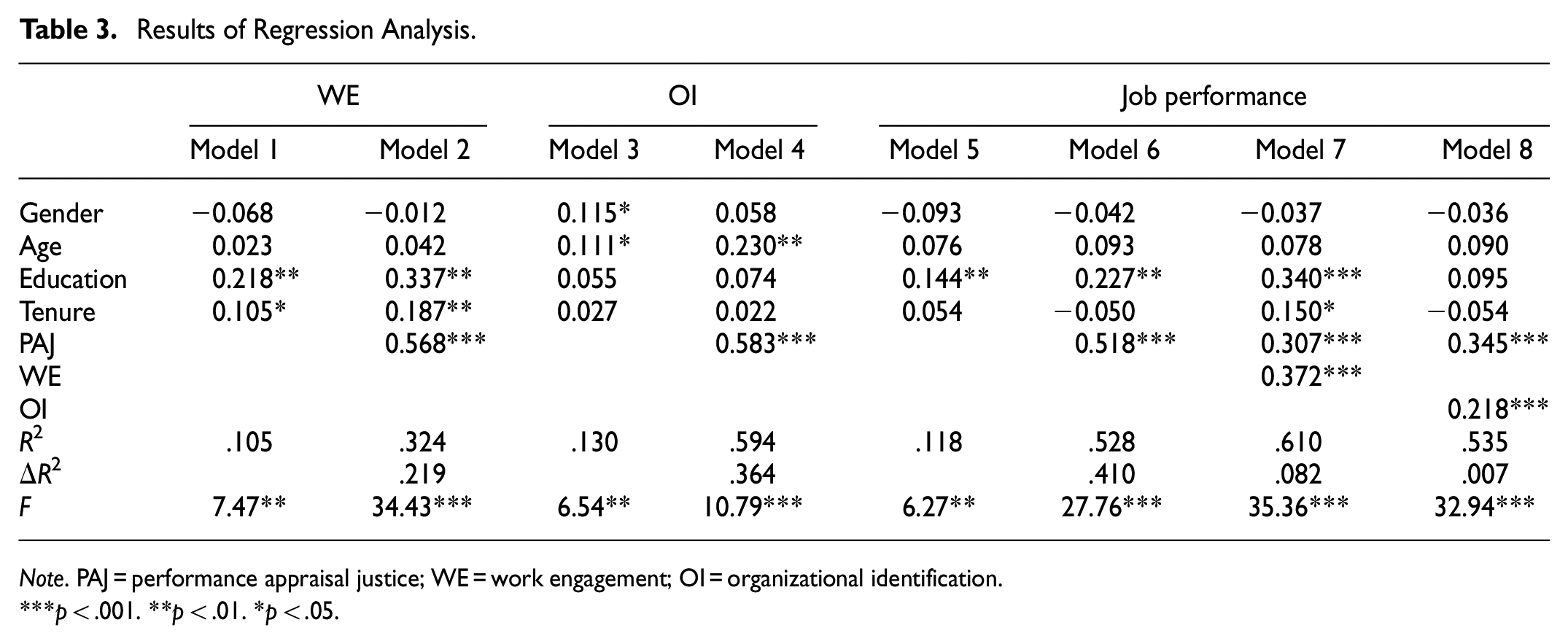
Note. PAJ = performance appraisal justice; WE = work engagement; OI = organizational identification.
p < .001. **p < .01. *p < .05.
Inspection of Mediating Effect
For testing the mediating roles of work engagement and organizational identification in the relationship between performance appraisal justice on job performance, we followed Baron and Kenny’s (1986) suggestions and a three-step procedure via regression analyses was applied in the section. We first tested the direct effect of performance appraisal justice on job performance, then tested the direct effects of performance appraisal justice on work engagement and organizational identification. Finally, we tested the joint effects of performance appraisal justice and work engagement on job performance, and the joint effects of performance appraisal justice and organizational identification, to see whether the effect of performance appraisal justice on job performance had changed. The results are also shown in Table 3.
As shown by the results for Model 7 in Table 3, work engagement was positive related to job performance (β = .372, p < .001), and the indirect influence of performance appraisal justice on job performance was also significant (β = .307, p < .001), indicating that work engagement could partially mediate the influence of performance appraisal justice on job performance. Hence Hypothesis 3 is initially verified. Analogously, Model 8 in Table 3 indicates that organizational identification was positively related to job performance (β = .218, p < .001), and the indirect influence of performance appraisal justice on job performance was also significant (β = .345, p < .001), indicating that organizational identification also could partially mediate the influence of performance appraisal justice on job performance. Hence Hypothesis 5 is initially verified.
Inspection of Whole Model
Regarding the verification of the whole theoretical model, we employed SEMs (Jyoti & Bhau, 2015; Ucar et al., 2021) to analyze the relationship between performance appraisal justice, work engagement, organizational identification, and job performance. The standardized path coefficients for the whole model are reported in Figure 2.
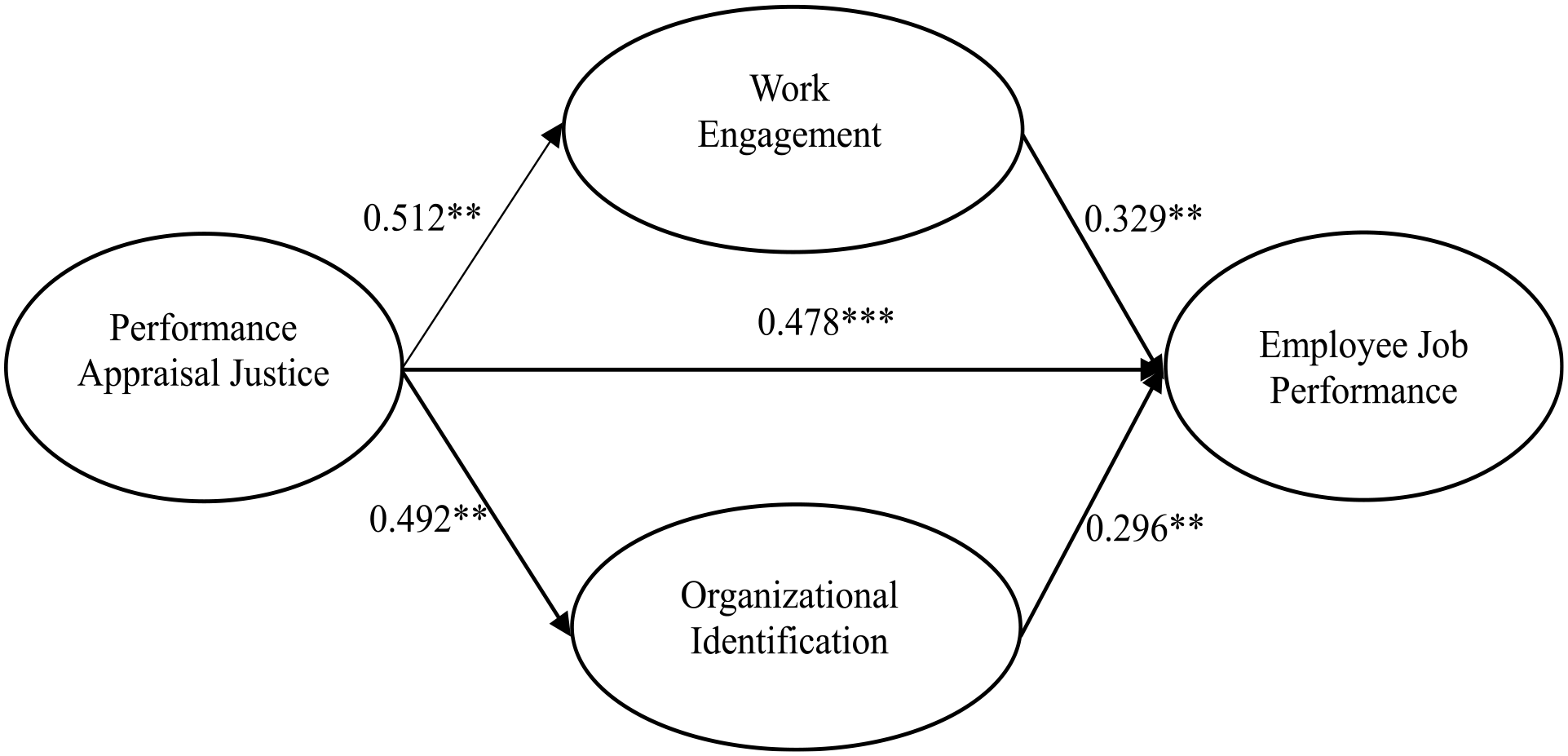
Results of structural equation modeling (SEM).
As shown in Figure 2, the standardized path coefficient between performance appraisal justice and job performance was 0.478 (p < .001), which means that Chinese employees’ perceptions of performance appraisal justice exerted a significant and positive influence on their job performance, therefore, Hypothesis 1 was assumed to be fully supported. In addition, the standardized path coefficient between performance appraisal justice and work engagement was 0.512 (p < .001), providing evidence that Chinese employees’ perceptions of performance appraisal justice also exerted a significant and positive influence on their work engagement. Hypothesis 2 is therefore fully supported. In addition, the standardized path coefficient between performance appraisal justice and organizational identification was 0.492 (p < .001). This means that Chinese employees’ perceptions of performance appraisal justice exerted a significant and positive influence on their organizational identification as well, which therefore fully supports Hypothesis 4.
For estimating the indirect effect of performance appraisal justice on job performance via work engagement and organizational identification, Figure 2 indicates that performance appraisal justice exerted significant and positive effects on job performance (β = .478, p < .001), and work engagement also exerted a significant and positive effect on job performance (β = .339, p < .001), which verified that work engagement played a partly mediating role in the relationship between performance appraisal justice and job performance. Hence, Hypothesis 3 is assumed to be fully supported. Additionally, organizational identification exerted a significant and positive effect on job performance (β = .296, p < .001), and this suggested that organizational identification also played a partly mediating role in the relationship between performance appraisal justice and job performance, which is fully supportive of Hypothesis 5.
Discussion
Many previous studies (e.g., Jabareen, 2008; Jyoti & Bhau, 2015; Lee et al., 2019; Nangoy et al., 2020) have proved that how to continuously improve employee performance is an important task for organizations to achieve development goals. From the perspective of performance management, the present study mainly attempted to examine whether employees’ perceptions of performance appraisal justice affect their job performance. Meanwhile, based on social exchange theory and social identity theory, the present study introduced work engagement and organizational identification as mediators into the relationship between performance appraisal justice and employee job performance. To maintain consistency, this study proposed five hypotheses to discuss in detail the relationship between performance appraisal justice, work engagement, organizational identification, and job performance.
In order to verify the above proposed model and hypotheses, the present study collected matching data from 404 Chinese employees and their direct supervisors at high-tech enterprises operating in a National Hi-Tech Park in Shanghai, China. Empirical analyses of these pairing data indicated that performance appraisal justice has significant and positive effects on the work engagement, organizational identification, and job performance of employees. Both work engagement and organizational identification of employees could partly mediate the relationship between their perception of performance appraisal justice and job performance. This means that when employees believe that an organizational performance appraisal is fair, they will have a higher level of organizational identification and actively engage in their daily work, thus generating better job performance.
Theoretical Contributions
The present study designed and verified a dual model to explore the relationship among performance appraisal justice, work engagement, organizational identification, and job performance. The results confirmed a positive relationship between employees’ perceptions of performance appraisal justice, work engagement, organizational identification, and job performance. One possible reason for these results may be that when employees feel they are being treated fairly by the organization, they reward the organization with positive work attitudes and behaviors (Awan et al., 2020; Jawahar, 2017). Besides, the ultimate purpose of organizational performance appraisal is to help employees identify their strengths and weaknesses through the appraisal results (Dangol, 2021; Kuvaas, 2006), improve their working ability, and finally promote their job performance. In doing so, employees’ perception of performance appraisal justice, as a specific form of organizational justice (Rubin & Edwards, 2020; Zacher et al., 2010), is also positively related to their job performance. To our knowledge, the present study is the first research to explore the direct relationship between performance appraisal justice and employee job performance, which further enriches the research on the influencing factors of job performance (e.g., Erdogan, 2002; Jyoti & Bhau, 2015; Lyu et al., 2022) and highlights the importance of organizational performance appraisal justice.
In addition, based on social exchange theory and social identify theory, the present study confirmed that work engagement and organizational identification of employees are two important mediators in the relationship between performance appraisal justice and their job performance. Both work engagement and organizational identification can partly mediate the influence of performance appraisal justice on employee job performance. These two findings suggest that when employees perceive that an organizational performance appraisal is fair, they will have higher organizational identification, actively engage in their daily work, and thus improve their job performance. These conclusions fill the research gap to a certain extent as previous research (Ju et al., 2021; Palaiologos et al., 2011), has not explored the internal mechanism for how performance appraisal justice affects employee job performance, especially in a Chinese context. Meanwhile, the two results of the present study are also basically consistent with previous literature, that is, work engagement (e.g., Kaya & Karatepe, 2020; Saks, 2006; W. Schaufeli, 2012) and organizational identification (e.g., Bakker & Demerouti, 2008; Rubin & Edwards, 2020; Zhao et al., 2019) play mediating roles in the relationship between other related variables. Therefore, these two conclusions can further enrich the relevant academic research on the mediating roles of work engagement and organizational identification.
Practical Implications
Given the important role of performance appraisal justice in organization management, the organization’s performance management should first ensure justice (Erdogan, 2002; Hu & Han, 2021). In practice, organizations and their managers should use objective indicators as far as possible to evaluate each employee, accurately measure the contribution and effort of each employee (Erdogan, 2002; Gupta & Kumar, 2012; Nagin & Telep, 2020), and ultimately effectively improve employees’ sense of distributive justice. Meanwhile, in the specific performance appraisal process, managers should fully respect and care for each employee (Iqbal et al., 2019; Lin & Kellough, 2019), fully communicate with each employee, and improve their sense of interactive justice (including interpersonal justice and informational justice). In addition, the organization should strive to standardize the system and procedure of performance appraisal (Rana & Singh, 2022; Rubin & Edwards, 2020), ensure that all the appraisal rules are equal, and improve employees’ sense of procedural justice.
However, work engagement and organizational identification of employees are not only affected by their perceptions of performance appraisal justice, but also have significant and positive impacts on their job performance. This means that in the same performance appraisal practice, the differences in employees’ needs will lead to differences in their work engagement (Kaya & Karatepe, 2020; Roberts, 2003) and organizational identification (Riketta, 2005; Zhao et al., 2019), and finally lead to differences in their job performance. Accordingly, organizations and their managers should pay attention to the key roles of work engagement (Bakker, 2022; Saks, 2006) and organizational identification (Ashforth et al., 2008; Wang et al., 2017) in promoting job performance among their employees. For example, organizations and their managers should strive to create an open, just, fair, and free organizational atmosphere for employees to improve their perception of justice in performance appraisals (Sarfraz et al., 2021; Veldhoven et al., 2017), and finally promote their work engagement and organizational identification, leading to improvement in their job performance.
Limitations and Future Research
There are certain limitations in the present study due to confined research resources. First, the present study collected the sample data only from high-tech enterprises in a National Hi-Tech Park in China, which may limit the generalizability and external validity of our conclusions. Therefore, further scholars can replicate the theoretical model of the present study using different types of enterprises. In addition, China is a country with a collectivist culture (Chang et al., 2022; Su, Lin, & Ding, 2019), and Chinese employees may react differently to performance appraisal justice compared with Western employees. Hence, the present study advises further scholars to take cultural backgrounds into account when constructing theoretical models.
Second, in order to control the common method variance (Tehseen et al., 2017), the present study invited supervisors to evaluate the job performance of their direct subordinates. To some extent, this measurement of employee job performance depends on the subjective evaluation of supervisors, which may lead to additional problems of measurement validity and causal logic. Therefore, we advise future research to use employee self-reported assessment methods at different times to measure employee job performance. At the same time, future scholars can also use quasi-experimental methods to further improve the accuracy of the conclusions.
Finally, the present study only investigated the mediating effects of work engagement and organizational identification in the relationship between performance appraisal justice on job performance, and there might be other factors that can mediate this relationship, such as organizational commitment (Salleh et al., 2013; Steensma & Visser, 2007), trust (Holley et al., 2019), and empowerment (Hassan et al., 2019). Meanwhile, the boundary conditions of the proposed model have not been discussed in this paper. Therefore, future research can go further by incorporating other mediating variables or moderating variables, such as employee motivation (Steensma & Visser, 2007), individual personality (O’Neill et al., 2011), and sustainable HRM practices (Tzabbar et al., 2017) to explore the internal mechanism and boundary conditions of these relationships (Qi & Ming-Xia, 2014; Yeh & Huan 2017).
Conclusions
The present study used questionnaires and empirical analyses to explore the influence of performance appraisal justice on employee job performance, as well as the mediating roles of work engagement and organizational identification among Chinese employees. Specific conclusions are as follows: (1) Employees’ performance appraisal justice can facilitate their job performance. This finding shows that employees will be motivated to promote their job performance when they perceive the organization’s performance appraisal mechanism is fair and objective. (2) Work engagement and organizational identification of employees both play intermediation roles in the relationship between performance appraisal justice and their job performance. These two findings explain the extent to which work engagement and organizational identification affect the direct influence of performance appraisal justice on employee job performance, and when employees perceive their organization’s performance appraisal is fair, they will have higher organizational identification, actively engage in their daily work, and thus produce more job performances. To sum up, the conclusions of the present study can provide several valuable guidance for organizations and its managers to continuously stimulate the work engagement and organizational identification and promote job performance of employees by building a fair performance appraisal system, and ultimately achieve organizational success, and sustainability.
Footnotes
Declaration of Conflicting Interests
The author(s) declared no potential conflicts of interest with respect to the research, authorship, and/or publication of this article.
Funding
The author(s) received no financial support for the research, authorship, and/or publication of this article.
