




Abstract
The goal of this study is to determine the function of work engagement as a mediating factor in the relationship between job crafting, task performance, and employability in the hospitality sector. A questionnaire was applied and participants were drawn from 209 hotel employees in İstanbul, and Kocaeli, Türkiye. To test these hypotheses, structural equation modeling was implemented. The findings show that job crafting is linked to employability and task performance positively. Furthermore, this research looks into the role of work engagement as a mediator in the links between job crafting, perceived employability and task performance. The findings reveal that there are considerable indirect effects, implying that work engagement is mediated. Thus, our results suggest that job crafting was a positive predictor of perceived employability and task performance and work engagement has a mediator role between those variables in the hospitality sector.
Introduction
Job design is a systematic tool to increase employees motivation and value to the organization. Although a number of scholars have been working on job design models for years, there is no definitive job design model to fit all employees. The effects of changing working environments such as globalization, technological developments, diversification of workforces and the dissipation of flexible work methods have led to more uncertainty and put more burden on employees and employers. Organizations must focus on inclusivity in their workforce to compete and grow. Today’s changing work environment pushes employees to redefine their job roles and constantly renew their skills, and abilities if they want to perform well or remain employable. Thus, proactivity has come into prominence (Grant & Parker, 2009). Job crafting is
The main aim of the study is to deepen understanding of the relationship between job crafting and perceived employability and task performance in the hospitality industry. The proposed research model is built based on the job-demands resources (JD-R) theory (Bakker & Demerouti, 2007) and broaden and build theory (Fredrickson, 2001). Job crafting has drawn the attention of hospitality researchers. Hospitality is among the largest growing industries with a high labor-intensive and turnover rate in which attitudes and behavior of hospitality employees are a major concern in the organization’s success. Jobs in the hospitality industry are characterized by intense contact between employees and customers. The demands and expectations of consumers have greatly expanded and are replacing quickly (Karatepe & Kim, 2023). Employees ought to respond to them right away. For them to achieve outstanding service, their capacity to take initiative and proactive behavior skills is essential (H. Kim et al., 2018; Tian et al., 2022). Employees must strike a balance between job demands and available resources in order to accomplish this. Moreover, hotel employees undertake excessive workloads, long working hours, and highly intense working conditions while earning low wages. Job crafting is a critical strategy to overcome all these negative conditions (Karatepe & Eslamlou, 2017; Yadav & Dhar, 2021). The design of the job or the social environment must be changed, employees must influence the way they currently work, and they must actively participate in changes to their jobs by adapting them to their unique requirements and skills. Employees are assumed to regularly refresh their knowledge and abilities in the hospitality industry, look for job resources, and manage job demands while providing qualified service to customers (Chen et al., 2014).
Job crafting improves employees’ work roles, knowledge, abilities, and skills. These factors foster employability. Employability is seen as the key to success within and outside the organization. Previous studies show that job crafting is a strategy to improve employability (Brenninkmeijer & Hekkert-Koning, 2015; Tims et al., 2012). Consequently, this study addresses this relation in the hospitality industry. In addition, task performance is also considered in this study. There are two main reasons to focus on task performance, the first of which is the importance of task performance for organizations to achieve their goals (Sonnentag & Frese, 2002). Secondly, previous studies show that task performance is an explanatory factor in determining an employee’s job performance, dwelling upon whether employees want to stay within the organization (Rotundo & Sackett, 2002). Accumulating evidence indicates that job crafting positively influences job performance (Bakker et al., 2012; Lee & Lee, 2018; Tims et al., 2013, 2015; Van Wingerden et al., 2017). However, it is not clear whether job crafting can increase task performance (Dubbelt et al., 2019). Therefore this study contributes to the hospitality management literature by examining the relation between job crafting and task performance.
The another purpose of this study is to determine the function of work engagement as a mediating factor in the relationship between job crafting, task performance, and employability in the hospitality industry. The research about the effects of job crafting on work outcomes in hospitality organizations is still limited and there are inconsistent results on the relationship between job crafting and work engagement (Chen et al., 2014; Lee & Lee, 2018; Petrou et al., 2012; Tims et al., 2012). This study addresses this gap in hospitality research by analyzing whether work engagement acts as a mediator in job crafting-task performance and perceived employability. Job crafting enables employees to obtain the resources they require for work, improving their sense of well-being that is related to work engagement. Employees who tailor their occupations to their inclinations, abilities, and other factors become more enthusiastic and invested in their careers, and their work engagement rises (Bakker & Albrecht, 2018). Moreover, work engagement is associated positively with employee satisfaction (Schaufeli et al., 2008) task performance (Bakker, 2011; Bakker et al., 2008), and creativity (Bakker et al., 2020) related adversely to decrease turnover (Harter et al., 2002). Yet, there are also limited studies about the antecedents and outcomes of work engagement in the hospitality industry (Chen, 2019). Although it has been suggested that perceived employability links positively to work engagement, no studies have examined the effects of work engagement on perceived employability. This study proposes that employees who are engaged and have a greater degree of energy are eager to gain new talents, information, skills, and capabilities. This provides them with a feeling of power and control over the employment relationship and their careers. Job crafting actions that increase job resources motivate employees both intrinsically and extrinsically (Bakker, 2011). Highly engaged employees dedicate themselves to their work and become more energetic and have more job-related sources that lead to higher levels of perceived employability. The study probes the underlying mechanism between job crafting and perceived employability via work engagement.
This study contributes to job crafting literature in a few ways. First, this research examines the associations among job crafting, work engagement, task behaviors and perceived employability of hospitality employees. Second, this study examines how work engagement mediates the relation between job crafting and task behaviors, perceived employability. Besides, culture can influence employees’ attitudes and work behavior (Caramelli & Briole, 2007; Gelfand et al., 2007). As an example, Türkiye’s culture is considered to have higher collectivism, more power distance, and a higher relationship orientation than Western culture. This study aims to show how job crafting influences task performance, perceived employability, and work engagement among hospitality employees in a non-western culture, collectivist culture namely Türkiye.
Theoretical Background
Job Crafting
Job crafting has recently played a critical role in the job design model. Wrzesniewski and Dutton conceptualized job crafting as a three component model (Wrzesniewski & Dutton, 2001). This definition of job crafting is mainly related to the changing aspects of the jobs. In line with this approach job crafting makes changes in employees’ work tasks, relationships in the workplace and cognitions about work. However, Tims and Bakker (2010) emphasize that these three job crafting characteristics are insufficient to describe all job crafting-related actions. Tims et al. (2012) explained job crafting concept by job demands-resource model (JD-R) that is an exhaustive conceptual structure for describing how work-related attitudes and motivation are affected by job demands and resources. They used four aspects to implement job crafting: increasing structural job resources, increasing social job resources, increasing challenging job demands, and decreasing impeding job demands (Tims et al., 2012).
Job resources are useful in accomplishing career objectives, encouraging self improvement, training, and advancement (Bakker & Demerouti, 2007, 2017). Job resources are linked to better organizational results (Hakanen et al., 2008). Increased structural job resources such as asked for autonomy, created more opportunities to learn are one of the job resource factors. They influence the design of jobs. Increased social resources, such as feedback from their supervisors and co-workers for employee behaviors, coaching, and mentorship (Tuan, 2022), social interactions (Harju et al., 2024) are another job resource component.
Any part of the work that requires sustained physical and/or mental effort or skill is what job demands are defined as. There are two types of job demands: limiting job demands and challenging job demands (Demerouti et al., 2001). Job demands that are too demanding impose strain on employees, causing them to lose focus on their objectives. As a result, they reduce employee happiness and productivity; resulting in demand decreasing behaviors (Tuan, 2022). Challenging job demands necessitate extra effort and place staff under stress, all while enhancing the motivation of employees, capabilities, and training. As a consequence, employees are involved in job crafting by minimizing cumbersome job demands and identifying stressful job demands and supplies.
Job crafting actions may actively prevent employees from becoming bored, making the work more meaningful (Harju et al., 2016). Therefore, job crafting has become antecedents of employees’ positive work attitudes and behaviors such as self-image, task performance, job satisfaction, and work engagement (Kim & Koo, 2017; Petrou et al., 2012; Zhang & Parker, 2019). Some limited studies in in the hospitality and tourism industry found positive consequences of employees’ job crafting behaviors on their attitudes and performance. Ok and Lim (2022) showed that hotel and restaurant employees’ job crafting behaviors significantly increase work engagement and job performance. Teng (2019) demonstrated the positive association between job crafting and employees’ performance of customer service behaviors in hotels. Y. Guo and Hou (2022) found that job crafting increased tour leaders’ work engagement. Thus job crafting of hospitality employees has several positive effects for their organizations and the employees themselves.
Job Crafting-Work Engagement
Schaufeli et al. (2002) defined the concept of work engagement as vigor, devotion, and absorption of a positive, satisfying work-related mental state. Employees with enthusiasm have strong amounts of energy and can focus on the task without becoming exhausted (Schaufeli & Bakker, 2010). Employees’ excitement and motivation are referred to as dedication (Schaufeli & Bakker, 2004). Employees who are completely concentrated on their work are said to be absorbed (Bakker et al., 2012).
Employee attitudes and actions are heavily influenced by motivation. External or internal motivations are promoted by all job resources. They are the means of achieving work objectives and creating a productive working environment (Bakker et al., 2012). Job resources assist employees to feel attached to their work and improve their job proficiency while also instilling internal incentives by addressing the individual’s requirements for autonomy, companionship, and achievement (Bakker, 2011). Likewise, job resources aid in the achievement of objectives by enhancing external incentive elements such as financial needs, rewards, peer influence (Shkoler & Kimura, 2020). According to JD-R theory, if the job resources for the employees start to increase, they will be much more motivated for learning and development. Furthermore, with more job resources at hand, these employees shall reach out to their goals much more easily. Therefore, it is clear that more job resources create more willing, more focused and more devoted employees. In other words, more resources increase the commitment level of the employee to work.
With increasing job resources, employees become more dedicated, concentrated, and highly energetic in their work. (Schaufeli & Bakker, 2004; Schaufeli & Salanova, 2007). Challenging job demands put pressure on the employees to promote themselves (Crawford et al., 2010; LePine et al., 2005). Increasing job resources relieves the stress resulting from job demands while fulfilling work goals. (Petrou et al., 2015). Motivation will improve and work engagement will be strengthened when expanded job resources are harmonized with expanded job demands.
According to JD-R theory, if the job resources for the employees start to increase, they will be much more motivated for learning and development. Further, with more job resources at hand, these employees shall reach out to their goals much more easily. Therefore, it is clear that more job resources create more willing, more focused, and more devoted employees. In other words, more resources increase the commitment level of the employee to work.
Recent findings suggest that there are beneficial links between job crafting and work engagement in several industries (Akkermans & Tims, 2017; Hakanen et al., 2006; Schaufeli & Bakker, 2004; Tims et al., 2015). Moreover, job crafting has a favorable association with work engagement in the hospitality industry (Chen, 2019; Karatepe et al., 2018; Shin et al., 2020). Engaged employees who tend to perform well increase the competitiveness and productivity of a company, they are of great importance for the highly competitive hospitality industry. In this study, job crafting is considered as an antecedent of work engagement which has a mediating role as well.
Based on theoretical background, literature review, and empirical findings, the following hypothesis was derived for hotel employees in Türkiye.
H1: Job crafting is positively related with work engagement.
Work Engagement—Task Performance
Task performance is a kind of job performance that reveals the required outcomes and behaviors to achieve organizational goals (Motowidlo & Van Scotter, 1994). Work engagement is a three-component model (vigor and dedication, absorption). Bakker claimed (2011) that highly engaged employees are energetic, positive, and more creative in work activities. Engaged employees are likely to experience positive emotions, such as happiness and enthusiasm (Demerouti & Cropanzano, 2010). According to Fredrickson (2001), Positive emotions can stimulate varied thoughts and actions and people with positive emotions have more tendency to integrate diverse ideas better which makes them more likely to perform better (Tims et al., 2013). In addition, their engagement level affects their surroundings in the work environment and influences other employees. Engaged employees are more prone to handle job demands and show elevated performance (Arıkan & Çankır, 2019; Bakker et al., 2008; Rich et al., 2010, Shuck et al., 2013).
Engaged employees are more likely to handle problems in the workplace with all their strength. They are more careful and attentive in their work, and more committed to their work they do not want to waste time and avoid distracting things (Halbesleben, 2010; Leiter & Bakker, 2010; Shuck, 2011). In this context of the issue, work engagement is thought to be effective on task performance. The study that had 766 participants working at educational institutions in Türkiye found out that work engagement as an individual variable has a mediating effect on predicting job performance significantly (Karataş & Çankır, 2023).
Literature review of hospitality studies revealed that only a few studies on work engagement and job performance exist (Karatepe & Olugbade, 2016; M.-S. Kim & Koo, 2017; Wang & Chen, 2020). Karatepe and Olugbade (2016) and Wang and Chen (2020) showed that work engagement results in task performance of hotels’ employees at a high level. However, M.-S. Kim and Koo (2017) found that the relationship between work engagement and job performance is nonsignificant.
On the basis of theoretical background, literature review, and empirical findings, the following hypothesis was derived for hotel employees in Türkiye.
H2: Work engagement is positively related with task performance.
Work Engagement—Perceived Employability
In the broadest sense, perceived employability is the individual’s perception of finding a job, staying in this job and his/her capacity to change jobs and organizations (Clarke & Patrickson, 2008). In other words, perceived employability is conceptualized as an employee’s possibilities of staying and progressing in his or her current organization and re-entering the labor market after leaving his/her organization (Ellig, 1998). These definitions break down perceived employability into two categories: inward and outward employability (Rothwell & Arnold, 2007). Internal employability is acquired with the organizational related knowledge, skills, and competencies. External employability is defined as having job related skills and knowledge that are transferable to the other organization. Employees’ perceptions of their internal and/or external employability are referred to as perceived employability.
Several research revealed that perceived employability is associated with work engagement (De Cuyper et al., 2008; Ngo et al., 2017). Yet, Vanhercke et al. (2016) propose that that well-being can affect perceived employability. Work-related well-being can be framed positively in terms of work engagement (Bakker et al., 2012). High work engagement pushes employees to bind their work, work harder, and have higher levels of energy at the workplace. They increase their skills and abilities more than their non-engaged colleagues (Van Dam et al., 2017). Thus, engaged employees have more job related sources that lead to higher levels of perceived employability (J. Guo et al., 2022). Research on the influence of work engagement on perceived employability, however, is scarce (De Cuyper et al., 2019; Vanhercke et al., 2016). Engaged employees perceive themselves as more employable in their present jobs and also in future career opportunities in the hospitality sector. In conclusion, we propose the following hypothesis among hotel employees in Türkiye.
H3: Work engagement is positively related to perceived employability.
Work Engagement Has a Mediating Role on the Connection Between Job Crafting and Task Performance
Work engagement is related to the more powerful effect of task performance rather than job satisfaction. Thus, a number of scholars have recently drawn attention to work engagement. Business perceptions and actions such as perceived organizational support and organizational commitment are mediated by work engagement (Rich et al., 2010).
Job crafting actions that increase job resources motivate employees both intrinsically and extrinsically (Bakker, 2011). Highly motivated employees dedicate themselves to their work and become more energetic. In other words, work engagement increases with job crafting behavior. Moreover, employees perform better when job resources that stimulate their work engagement are increased (Demerouti & Cropanzano, 2010). Employees improve their working conditions by seeking different ways to increase job resources, and they provide the skills necessary for high performance. By enhancing job resources employees stay involved in their tasks, grow and thrive (Petrou et al., 2015). Increasing job resources will also increase their engagement, and they will perform more competently in new situations (Saleem et al., 2023). Tims et al. (2012) discovered that job crafting is significantly associated with task performance, with work engagement serving as a mediating factor.
Bakker et al. (2012) found that work engagement has an intervention impact on job crafting and task performance, while Tims et al. (2013) found the same finding on a group and organizational level. Work engagement acts as a mediator between job crafting and task performance, according to a meta-analysis study on the impact of job crafting interventions (Oprea et al., 2019). In the hospitality business, job crafting actions could have high level job performance through the mediation effect of work engagement (Karatepe et al., 2018; Shin et al., 2020). On the basis of theoretical background, literature review, and empirical findings, the following hypothesis was derived for hotel employees in Türkiye.
H4: Work engagement has a mediating role between job crafting and task performance.
Work Engagement as a Mediator in the Job Crafting-Perceived Employability Relationship
Activities related to job crafting help employees obtain job related knowledge and skills, and form relationships that allow them to increase their employability level and adapt to change (Akkermans & Tims, 2017). Job crafting behaviors result in increasing responsibility, professional experience, and networking. These contribute to the increasing employability levels. Thus, employees can adapt to the changing environment, and become and stay employable (Plomp et al., 2019, Sartori et al., 2023). Job resources are regarded as a spring of inspiration in the JD-R paradigm (Bakker, 2011), and workers can foster work engagement through increasing job resources (Crawford et al., 2010; Halbesleben, 2010). Work engagement plays a key role in job resources and work outcomes through the motivational process in JD-R theory (Bakker et al., 2023). Work engagement is an indicator of contentment. Employees who demonstrate job crafting behaviors by boosting job resources and minimizing workplace requirements that are inhibiting their productivity will be more engaged. Employees who are engaged and have a high level of well-being are better able to learn new things and improve their employability. Job crafting means reshaping working conditions to benefit the employee. By improving job conditions, job crafting is beneficial in maintaining and increasing work engagement. Increasing job crafting actions motivate employees to dedicate happily to their job and experience positive emotions (Bakker, 2011). Employees who are engaged and have a greater degree of energy are eager to gain new talents, information, and capabilities. This provides them with a feeling of power and control over the employment relationship and their careers (De Cuyper et al., 2008; Irfan et al., 2024). Thus, employees feel themselves more employable in their current employment or for future positions within or outside the organization (Akkermans & Tims, 2017).
According to the review of the literature, work engagement’s mediator role between job crafting and perceived employability has not been examined. Individuals who expand their job resources have higher levels of work engagement. In addition, work engagement can function as a mediation mechanism that transfers job crafting into judgments of employability through enhancing engagement. In conclusion, we propose the following hypothesis among hotels employees in Türkiye.
H5: The association between job crafting and perceived employability is mediated by work engagement.
Methodology
Participants and Data Collection
The data were gathered from hotels Istanbul and Kocaeli, Türkiye. Data were collected from April 2019 to September 2019. Participants were promised anonymity during the data collection process, and the results were exclusively used for educational purposes. A total of 209 responses were received from 350 employee surveys.
A power analysis was conducted using G*Power (Faul et al., 2007, 2009) to determine the minimum sample size required to detect significant relationships. It was chosen that SEM analysis includes multiple regression and multivariate analysis, and the sample size was calculated (Appendix A). Based on the assumed medium effect size (f 2 = 0.15) and a power of 0.95, the power analysis indicated that a sample size of 107 participants would be sufficient to yield reliable and generalizable findings. According to Faul et al. (2007, 2009) and Hair et al. (1998) in the structural equation model, it is ideal for the sample size to be between 160 and 300, and considering the number of items in the research, a sample size of 200 is sufficient. A power analysis using G*Power was conducted to determine whether or not the sample size (n = 209) of this study was enough.
The researchers reached out to hotel businesses via phone and email to describe the goals of the empirical project and request authorization to collect data. However, just six hotel companies in Kocaeli and Istanbul gave the researcher their approval. Five of the 20 hotels that were randomly chosen and asked to participate in this study did so. Non-probability convenience sampling was employed in this investigation. Table 1 provides the sample’s demographic details.
Demographic Variables.

The authors declare that the ethical rules are followed in all processes of this study. The ethics committee decision is taken before this study’s data were collected. Participation in the survey was voluntary. Participants came from different hotel departments (e.g., front office, food and beverage, housekeeping, marketing, spa, wellness, etc.). In order to get a high rate of return, it was important that the hotel management urged their staff to fill out the questionnaire in conjunction with the investigators and that the surveys were sent out by the researchers during a time of reduced workload.
A total of 60% of people responded. Men made up the majority of the participants (56 %). A bachelor’s degree was held by 37%, a high school diploma by 34%, and a master’s degree by 3% of those interviewed. The participants’ average age was 34.45 years (SD = 2.80; range 34–41). They’ve been working for an average of 6 years (SD = 2.15; range 1–15) and have worked in their current company for 2 years (SD = 1.20; range 1–7). Harman’s one-factor test was adopted to test for common method biases (CMB) among the research variables. Factor analysis was conducted on the items concerning all constructs, leading to the extraction of 10 factors with eigenvalues higher than one without rotating the factors. The cumulative percentage of variation explained was 68.18%. and the percentage of variance explained by the first factor accounted for only 19.18%. Thus, we CMB is not be a problem for the study (Podsakoff & Organ, 1986).
The Measuring Instruments
Tims et al., devised a 21-item scale to assess job crafting (2012). It has four components: expanding structural job resources, enhancing job resources, challenging job demands, and reducing impeding job demands. On a five-point scale, replies ranged from 1 (strongly disagree) to 5 (strongly agree). The second scale, which has three sections, measures work engagement. Schaufeli et al., created this metric (2002). This is a 15-item assessment with a 5-point range of frequency numbered from 1 (strongly disagree) to 5 (strongly agree). Rothwell and Arnold created an 11-item scale to assess perceived employability (2007). Exterior employability and interior employability are the two aspects. The four items by Abramis (1994) were used to evaluate the task performance. It was graded on a five-point scale from 1 (strongly disagree) to 5 (strongly agree). All items are listed in the Appendix B. The data was collected in Turkish. One English–Turkish bilingual translated job creating, work engagement, employability, and task performance scales into Turkish. The author used proven ways to convert the interpreted values back into English and then adjusted them in the Turkish version. The validity and reliability of final translated versions of metrics were verified in a pilot research involving 30 employees.
Data Analysis
The present study dealt with the relation between job crafting, work engagement, task performance, and employability.
To test the hypothesized model, we examined the relationships via structural equation modeling and confirmatory factor analysis using LISREL. Our study employed a series of confirmatory factor analyses to ascertain the factor structure of job crafting. Confirmatory factor analysis was used to create the dimensions of the scale and CFA was used to create an overall measurement model. Structural equation modeling was used to examine the relationships among the variables (job crafting, work engagement, task performance, and employability).
The relations were assessed using structural equation model. Confirmatory factor analysis was performed to test each individual scale used in the study. Variables that showed negative variance, exceeded standard coefficients (nearing 1.0) or large standard errors were determined (Hair et al., 1998; Jöreskog & Sörbom, 1993) and non-conforming variables were eliminated.
Since there should be no missing data in the data set, statements containing missing data were identified and missing data analysis was applied in the SPSS program before performing the CFA. As it was determined that the missing data in these expressions were not systematically distributed, the mean value of the expression it belonged to was assigned to the missing data using the mean of the series method.
The scales obtained after the confirmatory factor analysis were given in Table 2. As GFI, AGFI, RMSR, RMSEA, CFI, NFI, NNFI, and x2/SD fit indices of model adaptive values were found to be inadmissible as a consequence of the confirmatory factor analysis. Accordingly, job crafting was reduced from four subdimensions to two subdimensions. The three-factor structure of work engagement was confirmed by confirmatory factor analysis. The two-factor structure of employability and two-factor structure of task performance were validated by confirmatory factor analysis.
The Variables of the Scales Used in The Study After Modification.

As a result of the modifications suggested by the path analysis, 14 statements in job crafting scale, 4 statements in work engagement scale, 2 statements in employability scale, and 2 statements in task performance scale due to statistical nonconformity were eliminated. The path diagram of the remaining variables are given in Table 3. Cronbach’s alpha coefficients were used to verify reliability analyses prior to actually verifying the structural model. The coefficients were all more than .7, suggesting a strong dependability (Nunnally, 1978). The Sobel test was used to assess the mediating effects.
The Compliance Values of the Research Model Before and After Modifications.

Results
The research model was tested using LISREL within the scope of SEM via a two-stage approach involving measurement model and structural model. Covariance matrix was found using the Maximum Likelihood calculation method as data collected from the participants were found to have a normal distribution on the five-point Likert scale. First, the measurement model involving job crafting, work engagement, and task performance, and employability variables was tested. The result of the analysis showed that fit indices were acceptable. After the confirmation of measurement model, latent structural model was tested. The covariance matrix used in the measuring model was employed in the calculation of parameter values in the structural model. The path coefficients between latent variables in the structural model and the variance values they refer to are given in the table below. According to the results given in Table 3, the ratio between the chi-square value of 267.59 and 60 degrees of freedom was found to be 4.459. Considering the recommended range is between 1 and 5, this value is acceptable, and with the modification, this ratio was reduced to 2.655. While the CFI was initially 0.130, it was increased to 0.94 with modifications to an acceptable level. Adjusted goodness of fit index (AGFI) was 0.75, which was increased to 0.88 with modifications. RMSR value is 0.17. This value was found to be 0.054 after modifications. RMSEA value was 0.213 and was found to be 0.080 after modifications. According to these values, the fit indices of the research model are within an acceptable range.
The results of the hypothesized correlations are presented in Table 4. WE is significantly influenced by JC (s.v. = 0.53, t = 5.51). As a result, H1 is recommended. The effects of work engagement on employability and task performance were studied in H2 and H3. Work engagement was found to have a positive relationship with employability (s.v. = 0.33, t = 2.08) and performance (s.v. = 0.27, t = 2.28). H2 and H3 were supported by these findings. It may be possible to assess the mediating function of work engagement in the connection between job crafting, task performance, and employability. WE largely mediated the effect of JC on EMP (z = 4.712, p = .00) and TP (z = 4.625, p = .00) according to the results of the Sobel test. The study focused on the role of WE in mediating the interactions between TP and EMP. WE acts as a mediator between JC and EMP, according to the data. Table 4 corresponds to Figure 1 and provides the overall effects, direct effects, and indirect effects. Table 4 shows that JC had direct favorable effects on WE, EMP, and TP. WE mediated the interaction between JC and EMP and TP in part. Hypotheses 4 and 5 were therefore partly confirmed.
The Relations Between Research Model Variables After Modification.

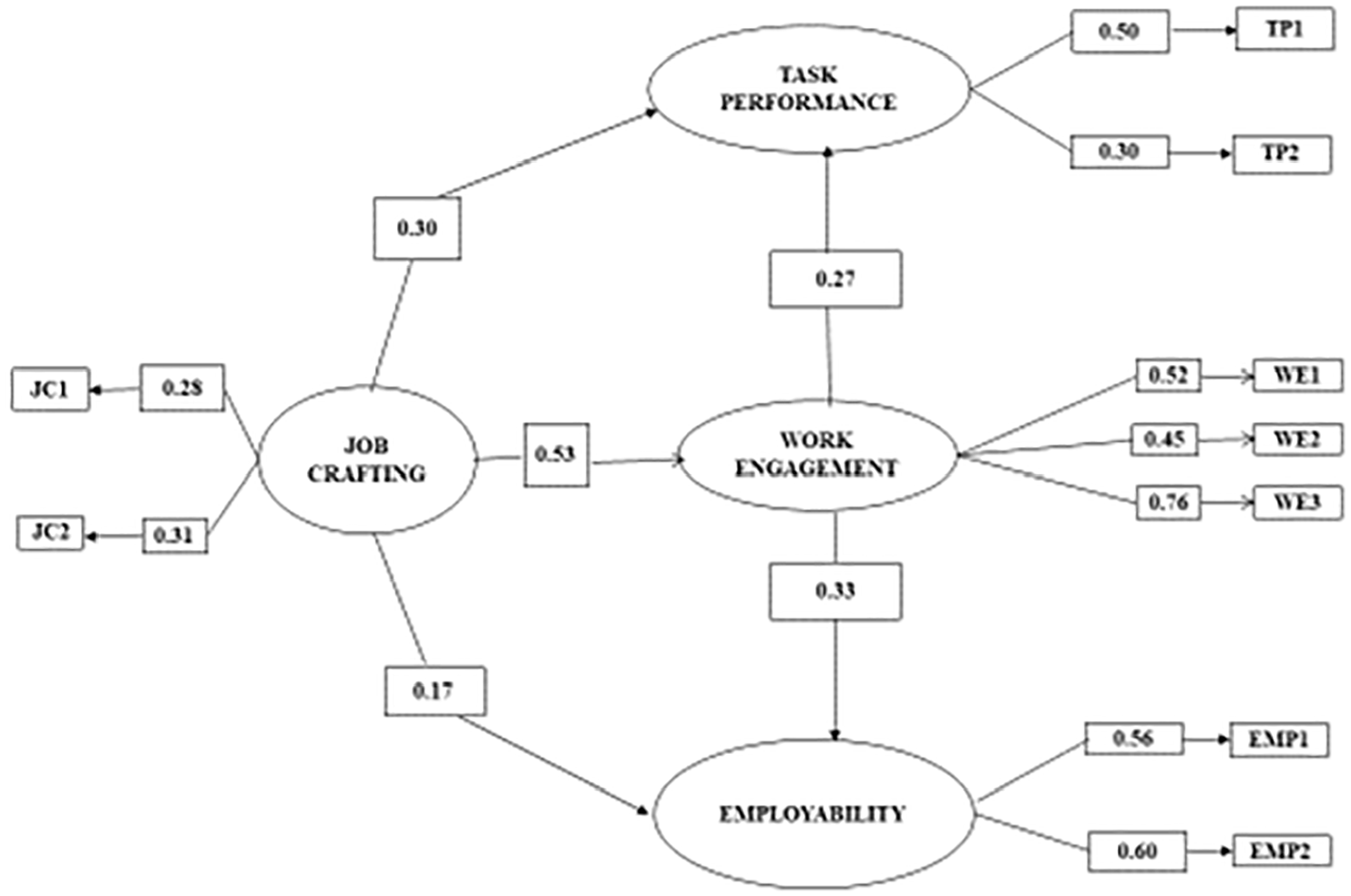
Model test results.
Discussion
The purpose of this research is to look into the links between job crafting, work engagement, perceived employability and task performance in the hospitality industry. The findings show that job crafting is linked to perceived employability and task performance. These results back up a widely held belief in the literature that there is a relationship between job crafting, perceived employability, and task performance. Furthermore, this research looks into the role of work engagement as a mediator in the links between job crafting, perceived employability, and task performance. The findings reveal that there are considerable secondary effects, implying that work engagement is mediated. The present research empirically validates findings from the literature by synthesizing the insights from job design theory and by examining the relationship among hospitality employees’ job crafting, work engagement, task performance, and perceived employability.
Job crafting is a set of proactive employee behaviors aimed at balancing the conformity of their personal qualities and inclinations with the demands of their jobs. Job crafting includes, among other things, enhancing structural job resources, boosting social job resources, raising challenging job demands, and diminishing the barrier to job demands. According to the JD-R model, job crafting may trigger a motivational process related with work engagement (Akkermans & Tims, 2017; Bakker & Demerouti, 2014; Tims et al., 2012). The results reported in the study provide support for the motivational process of the JD-R model (when the results reported are taken into consideration, it can be depicted that the study provides support for the motivational process of the JD-R model).
Tims et al. (2012) developed the job crafting scales, which consist of four dimensions: increasing structural job resources, increasing social job resources, increasing challenging job demands, and decreasing hindering job demands. Many researchers do not use all four dimensions. Lee and Lee (2018) reviewed 28 empirical studies about job crafting. They mentioned that some researchers have found different factor analysis results (Chinelato et al., 2015). From another perspective, some studies combined several dimensions to simplify their models and make the models consistent with their hypotheses (e.g., Kooij et al., 2017; Rofcanin et al., 2016; Tims et al., 2015). In this study, all dimensions of job crafting are combined into one factor.
The literature examined positive outcomes of several resource-seeking behaviors, such as feedback seeking (Ashford et al., 2003) and social support seeking (Carver et al., 1989). Hobfoll (2001) also suggests that basic human motivation is directed toward the accumulation of resources that are important for the protection of other valued resources. Bakker et al. (2012) and Tims et al. (2013) suggested that when employees craft their work environment to contain sufficient job resources and challenging demands, they are more engaged in their work. Employees who engage in proactive behaviors at work, like job crafting, are more engaged in their work and more satisfied with their jobs.
A motivational process connected with work engagement can be triggered by any task resource or personnel resource. (Bakker et al., 2007; Tims et al., 2012; Vogt et al., 2016). This study’s empirical findings are in line with those of this research. Poor workplace environments, such as antisocial, overwork, work shifts, severe workloads, and comparatively low earnings (Karatepe & Olugbade, 2009), cause employees in the hospitality business to have negative opinions toward their jobs. Employees’ physical and mental resources are depleted as a result of such a poor workplace environment resulting in low levels of energy and engagement (Luu, 2021). Reduced employment demands may result in increased energy and time for their task. An employee that takes the initiative to create and tailor his/her job provides better customer service and becomes more engaged at work (Chen et al., 2014). The findings suggest that job crafting is linked to work engagement.
According to Karatepe and Eslamlou (2017), job crafting behaviors among flight attendants have an impact on employees’ intentions to leave their jobs through work engagement. According to Ma et al. (2019), versatile team leadership may encourage front-line personnel to do job crafting in hotels. Job crafting strongly influences job performance through the intermediary process of work engagement in two samples with flight attendants and hotel employees from South Korea (Shin et al., 2020). These results are consistent with the earlier research that support the critical importance of job crafting to service workers’ performance (Leana et al., 2009; Lyons, 2008). Frontline service people should cope with demanding client requirements and desires since the ability of the employees to proactively modify their jobs is typically crucial for task performance (Shin et al., 2020).
In addition to that, organizations are no longer able to offer long-term employment and job security to their employees. In order to remain employable, employees should develop their skills, abilities, and knowledge. With job crafting, employees can improve themselves and can take proactive actions (Plomp et al., 2019).
Work engagement acts as a mediator between job crafting, task performance, and employability. The favorable association between job crafting and task performance was somewhat mediated by work engagement. In contrast to the literature, work engagement mediated the relation between job crafting and perceived employability which is most considered as the antecedent of work engagement.
In conclusion, the findings of this study support the JD-R theory by demonstrating that job designing can trigger a motivational process that is linked to work engagement (Bakker, 2011). Work engagement improves task performance in the tourism and hospitality business (Bhardwaj & Kalia, 2021; Karatepe & Olugbade, 2016; Reijseger et al., 2017). Employees who are engaged devote their time and energy to their jobs. They show personal initiative and are more eager to learn, as they become more self-developed. Hence, they believe that they are more employable inside or outside the company (Schaufeli, 2012).
Theoretical Implications/Contributions
The following are some theoretical implications of our investigation that are contributed to hospitality literature. First, culture can influence employees’ attitudes and work behavior (Caramelli & Briole, 2007; Gelfand et al., 2007). Job crafting were theoretically developed in the United States context and data with samples from the Netherlands were used to develop and validate the job crafting scale (Rofcanin et al., 2016). Although Türkiye culture is considered to have higher collectivism, more power distance, and a higher relationship orientation than Western culture, the results of the study comply with the previous studies by providing findings from Western culture.
Second although much research has defined, theorized about, and investigated job crafting (Zhang & Parker, 2019), the needs for more studies of job crafting in the hospitality context exist (Ok & Lim, 2022; Teng, 2019). Job crafting can help create positive work attitudes/outcomes and work engagement is the construct that explains the impact of job crafting behaviors on task performance (Zhao et al., 2023). The present research extends the job crafting literature by quantifying the association between job crafting, work engagement, and task performance based on the JD-R model in the hospitality sector which has highly challenging and demanding environment (Karatepe & Eslamlou, 2017).
Third, based on prior research in the field of job crafting with a reference to the JD-R theory, job crafting primarily has a positive impact on work engagement. The theory posits that job crafting is the main components of the motivational process that ameliorate work engagement and other related work outcomes such as employability and performance (Irfan et al., 2024). Moreover, the motivational process of the JD-R model indicates the role of work engagement as a mediator in the relationship between job resources and organizational outcomes (Paek et al., 2015). The theory proposes that employees proactively seek job challenges, job resources, and reduce job demands to perform better and become more employable. Tims et al. (2013) confirmed that work engagement mediated the relationship between job crafting and task performance at both the individual and team levels. This study supplements the previous research on work engagement as a mediating variable in the hospitality sector in, a non-Western context.
Fourth, the concept of perceived employability is considered the antecedent of work engagement in most studies. Even though, it is less frequently mentioned in the literature, it can be that well-being affects perceived employability (Vanhercke et al., 2016). This study tested the relationship between work engagement and perceived employability in accordance with engaged employees who are more likely to achieve their work goals and have positive self-beliefs about their capabilities and making them more employable. Further, the validation of work engagement as a mediator in explaining the relationship between job crafting and perceived employability advances the extant literature.
To demonstrate job crafting behaviors, the employee must enhance their access to job resources. One can see today that access to resources in the workplace is difficult. Employees can boost their job resources by being proactive with job crafting actions. They perceive that they have the necessary competencies to perform well in their work and sustain at work (Petrou & Xanthopoulou, 2021; Sartori et al., 2023). According to Tims and Bakker (2010), job crafting accelerates liability and, subsequently productivity since people who change their workplace proactively match the requirements and funds of their occupations with their abilities and needs. These trigger the motivational process that leads to a high level of work engagement and then superior task performance and perceived employability at a high level. The result of the study confirms that in the hospitality sector, particularly non-Western context.
Managerial Contributions
In today’s changing environment, where customer and employee needs have diversified, job crafting is an important topic. To accommodate these differences, job designing has an essential place. Hotel managers should learn how to create conducive environments for the growth of job crafting behaviors. Employees are given flexibility in their work, thereby encouraging employees’ job crafting behaviors.
Job crafting may be facilitated or supported by management (Van Wingerden et al., 2017). As an example, job crafting intervention programs that increase employees’ awareness regarding how they can adapt their jobs to their own needs can be implemented (Demerouti et al., 2019). As a matter of fact, job crafting interventions tend to support employees regarding practicing acquired knowledge. When this example is analyzed, it can be clearly seen that the situation can lead to meaningful changes in perceived employability and task performance (Sartori et al., 2023). Thus, hotel managers and supervisors can support to stimulating employees to keep crafting their job after the intervention, Hospitality managers should put forward some practices to improve employee job resources, such as increasing social support (Lu et al., 2022). Moreover, managers or supervisors influence the extent to which their employees can craft their own jobs. they should be role model with their job crafting actions that suit the organizational value, culture (Renkema et al., 2023).
Moreover, the management of the organization should encourage all types of job crafting behaviors to boost work engagement, task performance, and employability explicitly or implicitly (Tims et al., 2013). Hotel managers can create an organizational climate with incentive and reward mechanisms that promote employees’ job crafting and encourage employees to exhibit customer service behaviors.
Bakker et al. (2012) mention that managers or supervisor has a critical role in enhancing work engagement by giving feedback and support. This assistance is essential, yet it is insufficient. Managers should be aware that work engagement has positive work-related attitudes such as increased task performance. Managers or human resource practitioners should create a work environment that job crafting behaviors are supported. The support from managers or supervisors about employee’s job crafting actions may create more possibilities for job crafting with the augmentation of work engagement.
Limitations and Further Studies
In light of a few constraints, the findings of this investigation should be taken into account. First the study used a self-report approach that may have resulted in response bias to measure job crafting, work engagement, task performance, and perceived employability among hotel employees. However, in line with the suggestions of Podsakoff et al. (2012), The participants’ answers were kept anonymous to prevent technique bias and they were told that there were no right or incorrect answers and that they should respond to questions honestly. Future researchers could implement variables at different time points or adopt a multiple-source empirical research design to avoid this problem.
Second, this research is a cross sectional analysis, which may affect the causal inference of the results. Thus, it is not possible to assert causal relationships among the variables due to the lack of a longitudinal design. Future scholars can conduct a longitudinal study to strengthen the causal inference.
Another third limitation of the study is that the study only looked at hotel employees who work in Kocaeli and Istanbul and had a small sample size. The findings cannot be applied to all hospitality staff in Türkiye or other nations and other tourism industries. Future scholars can examine similar topics in other tourism industries.
Fourth, this study is not included job related attitudes and situational factors such as perceived organizational support, social interaction, autonomy support, and person-job fit. Future studies could include these variables as moderators or mediators and propose an alternative model. Fifth, this study examined job crafting in terms of the job demands–resources theory, Future studies could examine job crafting from different perspectives that can change the findings of the study.
Conclusion
This study focused on the mediating role of work engagement in the relationship between job crafting, task performance, and perceived employability in the hospitality industry. The current research demonstrates that job crafting is related to task performance and perceived employability and that the positive relationship between job crafting and perceived employability was partly mitigated by work engagement in the hospitality context.
As a result, the current study’s results will aid researchers and hotel industry practitioners in gathering empirical proof of the influence of job crafting, perceived employability, and task performance was mediated by work engagement. The outcomes of this study carried out through a survey questionnaire of hotels, hotel employees tend to deliberately optimize their work, suggesting that they engage in job designing practices. They should be encouraged to contribute to the company by engaging in job crafting behaviors, and hotel managers should ensure that they are aware of opportunities and tactics for doing so.
Footnotes
Appendix A
α err prob = .05
Power (1 − β err prob) = .95
Number of tested predictors = 2
Total number of predictors = 5
Critical F = 3.0863712
Numerator df = 2
Denominator df = 101
Total sample size = 107
Actual power = 0.9516875
Appendix B
Job Craftıng
Increasing Structural Job Resources
Decreasing Hindering Job Demands
Increasing Social Job Resources
Increasing Challenging Job Demands
Work Engagement
Vigor
Dedication
Absorption
Employability
Internal Employability
External Employability
Scale: (1) Strongly disagree, (2) Disagree; (3) Neither agree nor disagree; (4) Agree; (5) Strongly agree
Task Performance
In the last (7 days l week you worked), how well were you
Scale: (1) Very poorly, (2) Not very well (3) All right, (4) Very well, (5) Exceptionally well
Acknowledgements
This manuscript is an original work that has not been submitted to nor published anywhere else. All authors have read and approved the paper and have met the criteria for authorship.
Author Contributions
Literature investigation, data collection and analysis were performed by Hatice Güçlü Nergiz and Banu S. Unsal- Akbiyik. The first draft of the manuscript was written by all authors commented on previous versions of the manuscript.
Declaration of Conflicting Interests
The author(s) declared no potential conflicts of interest with respect to the research, authorship, and/or publication of this article.
Funding
The author(s) disclosed receipt of the following financial support for the research, authorship, and/or publication of this article: This work has been supported by Kocaeli University Scientific Research Projects Coordination Unit under grant number SBA-2020-1607.

Data Availability Statement
The datasets generated during and/or analyzed during the current study are available from the corresponding author on reasonable request.