




Abstract
Rooted in both the self-concept based theory of transformational leadership and the conservation of resources (COR) theory, transformational leadership is hypothesized to elicit follower-felt support for excellence and, through it, follower psychological capital (PsyCap), resulting in high follower job performance as well as work engagement. We examined this three-path mediation model with change scores from a two-wave study of 149 Indonesian healthcare workers. When applying structural equation modeling to the change scores, the integrated model was supported. Further cross-lagged analysis showed that transformational leadership had a lagged effect on follower PsyCap and that follower PsyCap had, in turn, a lagged effect on follower job performance. Hence, PsyCap is proposed as a parsimonious element in the self-concept-based theory of transformational leadership. Moreover, the results suggest that the transformational style can be added as a so-called “key” resource to COR’s notion of “gain spirals.”
Keywords
Introduction
Substantial COR research has been done on the role of resources in reducing people’s stresses and strains (Halbesleben & Wheeler, 2015). Resources can affect employees’psychological states through which they attain goals (Halbesleben et al., 2014; Hobfoll, 1989; Hobfoll et al., 2018). A resource might be internal or external to the self and may fluctuate or be long-lasting (Hobfoll, 2001; Hobfoll et al., 2018). According to the COR theory, a “key” resource is one that generates other resources with which people can achieve desired outcomes (Contreras et al., 2020; Halbesleben & Wheeler, 2015; Hobfoll et al., 2018; Schmitt et al., 2016). An individual who can draw on a “key” resource is more likely to gain positive resources in the future, thereby generating a resource “gain spiral” that helps to meet goals (Halbesleben et al., 2014, p. 1339). Based on the results of studies by Gooty et al. (2009) and Lei et al. (2020) as well as Seitz and Owens (2021), we will argue in this paper that transformational leadership functions as such a “key” contextual resource in organizations. While transformational leadership is already known to lead to desirable work outcomes, the mechanisms with which this occurs need more clarification: the latter is an essential research gap addressed by our study. Prior studies have focused on the effects of psychological resources (e.g., psychological capital or PsyCap), but their antecedents have not been fully examined (Avey, 2014; Mao et al., 2021). Hence, the present longitudinal study focuses on the role of transformational leadership as a key resource with which leaders generate psychological resources among their followers. Specifically, we will explain the effects of this leadership style on followers, through the self-concept based theory of transformational leadership (Shamir et al., 1993). One job-based resource examined here through this lens is follower-felt support for excellence. We propose and test that transformational leaders inspire followers with collective values expressing an excellence norm, which is part of their self-concepts (Shamir et al., 1993). By means of this norm, transformational leaders trigger their followers’ resource base (Shamir et al., 1993) which in turn is known to be conducive to high follower job performance. Next to this follower-felt support for excellence, PsyCap is examined here as another psychological resource through which transformational leadership may affect not only follower job performance but also work engagement (Al Kahtani & Sulphey, 2022; Gooty et al., 2009).
Even though some scholars have noted that job performance and work engagement overlap conceptually, they do not always interrelate with each other (Halbesleben, 2021; Harrison et al., 2006; D. A. Newman & Harrison, 2008). Hence, we will treat them as separate phenomena. Also, according to Parker and Griffin (2011, p. 64), “engagement and behavior must be considered as separate constructs, and a straightforward association between them cannot be assumed.” Work engagement is defined as “the harnessing of organization members’ selves to their work roles; in engagement, people employ and express themselves physically, cognitively, and emotionally during role performance” (Kahn, 1990, p. 694). While highly engaged employees do not always perform highly, the same psychological states may, nonetheless, precede both job outcomes (Bakker et al., 2011; Halbesleben et al., 2009; Wood et al., 2020). Most prior research suggests that work engagement has positive outcomes, yet it can lead to unfavorable results in some settings (Halbesleben, 2021). In the present study, we examine how transformational leadership works as a “key” follower resource for high follower job performance and work engagement: we hypothesize this occurs through follower-felt support for excellence and PsyCap and, consequently, report empirical support for this three-path mediation model (Figure 1).

The hypothesized model.
Our research contributes to the literature in several ways. First, in response to calls to understand better how employee resources can work effectively (Carlson et al., 2019; Ferguson et al., 2015; Halbesleben et al., 2014), we integrate elements from the COR, transformational leadership, and PsyCap theories (Hobfoll, 1989; Larson & Luthans, 2006). Secondly, we report on our longitudinal examination of the relationships among transformational leadership, follower-felt support for excellence, PsyCap, job performance and work engagement; by increasing follower-felt support for excellence, transformational leaders become enhancers of followers’ PsyCap as well as job performance and engagement. These behaviors are dynamic in nature. Although many studies have examined these variables (with the theories in which they are embedded), they did not employ a longitudinal research design (Carter & Youssef-Morgan, 2019; Halbesleben et al., 2014; Judge et al., 2006; Smith et al., 2022). Hence, thirdly, our research will add knowledge about how employees utilize psychological resources at work. Based on this study’s results, we propose transformational leadership should be added to Halbesleben et al.’s (2014) seven “key” social resources. Below, we first theorize the links among the five core constructs.
Theory and Hypotheses
Transformational Leadership and Follower Job Performance/Work Engagement
According to various meta-analyses, transformational leadership increases the work performance of followers (e.g., Baig et al., 2021; Lowe et al., 1996; Wang et al., 2011). We argue here that transformational leadership is a valuable type of support (or resource) for followers because it increases their job efforts. Four types of leader behaviors are involved herein. First, leaders with this style express a common vision and high expectations, motivating and inspiring employees to work well: inspirational motivation (Sosik et al., 2004). Secondly, while serving as role models for their followers, they show so-called idealized-influence behavior: leaders who walk their talk (Dragoni et al., 2014; Wang et al., 2011). Thirdly, transformational leaders encourage their followers to be creative and inventive; they are positively inclined toward followers’ suggestions and ideas: intellectual stimulation (Zhu et al., 2009). Fourthly, transformational leaders pay attention to the unique needs of their followers and treat each of them with individual consideration. That way, they also increase followers’ trust in and contentment with the leader which, in turn, brings out the followers’ best efforts: individualized-consideration behavior (Podsakoff et al., 1990). A leader’s transformational style constitutes, therefore, a positive resource for followers (see, also, Gooty et al., 2010; Lei et al., 2020; Seitz & Owens, 2021). When followers believe their leader will render them adequate resources or support, it strengthens their confidence to perform well (Schaubroeck et al., 2007). Transformational leaders can thus facilitate employees’ feelings of resourcefulness which enables the effective release of other resources as well (Tafvelin et al., 2019; Ten Brummelhuis & Bakker, 2012).
Transformational leadership is not just associated with follower job performance, but also with work engagement (Baig et al., 2021; Christian et al., 2011; Monje-Amor et al., 2020), including in healthcare settings (Ree & Wiig, 2020; Salanova et al., 2011). In another study, 61 naval cadets (on a ship for 34 days) scored higher work engagement on the days when their leader showed more transformational leadership (Breevaart et al., 2014). The link between transformational leadership and follower engagement was also demonstrated by an online experiment with a sample of 190 individuals from diverse backgrounds (Kovjanic et al., 2013). The studies by Ng (2017), Schmitt et al. (2016), and Seitz and Owens (2021) offered further evidence for the significant relationship between the transformational leadership style and work engagement.
In line with the COR theory, we assume that a follower who is highly engaged in work tasks is more likely to have felt the support from a transformational leader (Tims et al., 2011). According to the COR theory (Hobfoll, 1989, 2002), individuals tend to work hard to maintain, protect and acquire resources that are important to them. This theory also argues that workers’ resources come in “caravans” that can consist of both individual and organizational elements. The COR theory (Hobfoll, 2002) classifies support from a supervisor as a potential (contextual or external) follower resource. To date, there is sufficient evidence to assume that especially transformational leadership can enact such a positive follower resource (Arnold et al., 2015; Bayraktar & Jiménez, 2020; Geibel et al., 2022). In addition, we propose that transformational leadership is also significantly linked to employee engagement through the latter’s value preferences. Followers will engage highly in their work when they see their leaders’ work values align with their own values (Groves, 2014; Van Tuin et al., 2021). Hence, we formulate the following first hypotheses:
Hypothesis 1a: Transformational leadership is positively related to increases in both follower job performance and work engagement.
Hypothesis 1b: Increases in transformational leadership are positively associated with increases in both follower job performance and work engagement.
Transformational Leadership, Psychological Capital, and Job Performance/Work Engagement
The effects of transformational leader behaviors on high job performance and work engagement may also occur through intra-psychological mechanisms (Gooty et al., 2009; Ree & Wiig, 2020) which may, in turn, condition the emergence of follower PsyCap, consisting of self-efficacy, optimism, hope and resilience. Hobfoll (2002) argued that followers with more intra-psychological resources are more likely to be engaged in goal accomplishment effort and they enjoy their task-based challenges. Likewise, followers with an increased level of PsyCap are assumed to enhance their job performance and engagement. These arguments are aligned with the “resource caravan” idea in the COR theory. Moreover, earlier empirical studies have suggested that personal resources, such as optimism, self-efficacy, resilience, and organizational self-esteem (Halbesleben, 2010; Mauno et al., 2007; Schaufeli & Salanova, 2007; Xanthopoulou et al., 2007) are important for job engagement. Such engagement exhibits a motivating component and is reflected in an individual’s investment in job effort. Job performance indicates a job outcome that an organization recognizes and values. Through motivating stimuli, workers’ PsyCap levels and changes can be transformed into beneficial organizational behaviors (Alessandri et al., 2018). Transformational leadership is seen as an external resource that spurs followers’ internal psychological resources (Al Kahtani & Sulphey, 2022; Halbesleben & Wheeler, 2015; Ten Brummelhuis et al., 2011). This idea is rooted in the cross-sectional field study by Gooty et al. (2009), showing that PsyCap mediates between transformational leadership and follower in-role performance. Their results are in accordance with the self-concept theory of transformational leadership. Moreover, the Avey et al. (2011) meta-analysis demonstrated that PsyCap has a positive impact on desirable employee attitudes, behaviors, and multiple measures of performance. In addition, Peterson et al. (2011) undertook a relatively short (3 months) longitudinal study and found that PsyCap affects job performance (see, also, Paliga et al., 2022). The present study will test the causal effects of PsyCap on both follower job performance and work engagement over a relatively long period: 1 year. We formulate the following hypotheses:
Hypothesis 2a: Transformational leadership is positively related to increases in follower PsyCap.
Hypothesis 2b: PsyCap is positively related to increases in both follower job performance and work engagement.
Hypothesis 2c: Changes in follower PsyCap mediate between changes in transformational leadership and changes in both follower job performance and work engagement.
Transformational Leadership, Follower-Felt Support, and Psychological Capital
How do leaders with a transformational style affect their followers? According to, for instance, Breevaart et al. (2014) and Schoch et al. (2021), leaders who perform as resource-supplying actors can greatly affect how their followers behave. First, a transformational leader acts as a coach, mentor, and/or role-model to followers: by being supportive to do well in their jobs (Buil et al., 2019; Gong & Li, 2022; Howell & Hall-Merenda, 1999). Secondly, transformational leaders typically enhance followers’ aspiration levels (Dvir & Shamir, 2003; Ehrhart & Klein, 2001; Noguerol, 2018). Thirdly, the transformational style tends to broaden or enrich the followers’ goals, giving them the confidence to work beyond the expectations set out in implicit or explicit exchange agreements (Dvir et al., 2002, p. 735). Fourthly, transformational leaders synchronize followers’ identities to the collective identities that include shared norms among their peers: through fostering followers’ intrinsic motivation to work hard toward the jointly desired outcomes (Jung et al., 2003; Shamir et al., 1993). More generally, leaders who offer solid support and care to their followers can also instill the norm of offering peers the needed job resources (Lei et al., 2020; Liao & Chuang, 2007; Wilderom, 1991). A transformational leader’s typical behavior assures or offers followers the job resources they need or value. Such resources tend to have a built-in standard of excellence. A transformational leader imparts this norm through vision, role modeling, constructively challenging followers, being appreciative of or accepting and reciprocating their humanity, and mentoring/coaching them so that it arouses work-based friendship with and among the followers (Le, 2020; Sosik et al., 2004). Thus, by invoking the self-concept theory of transformational leadership, we may assume that transformational leadership affects followers through their felt support for excellence. According to Shamir et al. (1993, p. 580), the transformational style ensures that followers’“standards and cultural norms are internalized into the self-concept in the form of evaluative standards.” Accepting the support offered by their leader is relevant for people at work: as cues for norms and standards (Halbesleben & Wheeler, 2015; Shaheen et al., 2023; Ten Brummelhuis et al., 2011). Through social information processing and normative pressures, followers can certainly affect their peers via their shared excellence norms (Tucker et al., 2010). In effect, followers tend to activate a shared mental model when pursuing excellent work outcomes (e.g., Moser & Axtell, 2013).
Public-sector employees, in particular, are expected by such leaders to behave as professionals who attain “professionally sound solutions…and keep a high quality of task performance” (Kjeldsen, 2012, p. 61). These types of followers are likely to hold each other accountable to a common code of conduct. Leader-induced changes among followers can thus also come about indirectly through support from peers supervised by the same or a similar leader (Rafferty & Griffin, 2004). Hence, followers can feel high levels of support on pursuing shared high-level outcomes, not only from one or more transformational leaders but also from their peers who experience the same leadership style (Ten Brummelhuis & Bakker, 2012; Williams et al., 2010). Hobfoll (1989) argued that social support enlarges resource availability for followers and can rejuvenate their latently available resources. Follower-felt support at work can thus be co-induced by colleagues who are also led by transformational leaders (Derks et al., 2015; Halbesleben, 2006; Lei et al., 2020; Morris & Venkatesh, 2000).
Furthermore, a high level of follower-felt support induced by transformational leader behavior may affect the level of follower PsyCap, which is defined as: “an individual’s positive psychological state of development characterized by: (a) having confidence (self-efficacy) to take on and put in the necessary effort to succeed in challenging tasks; (b) making a positive attribution (optimism) about succeeding now and in the future; (c) persevering toward goals and, when necessary, redirecting paths to goals (hope) in order to succeed; and (d) when beset by problems and adversity, sustaining and bouncing back and even beyond (resilience) to attain success” (Luthans, Youssef et al., 2007, p. 3). Gooty et al. (2009) showed that PsyCap is related to transformational leadership. The PsyCap dimensions are similar to some of the psychological resources embedded in the self-concept based theory. According to this theory, transformational leaders trigger followers’ feelings of being supported through the stimulation of (a) self-efficacy, (b) internalization of (leader’s) optimism, (c) maintenance of hope, and (d) self-consistency (Shamir et al., 1993). Hence, it can be assumed that PsyCap acts as a follower’s psychological resource which can be engendered through a transformational leadership style. Accepting the supporting help of leaders and co-workers can thus be professionally and personally relevant for people at work (Halbesleben & Wheeler, 2015; Lyubykh et al., 2022; Ten Brummelhuis et al., 2011). A high level of job support, coming directly from one’s transformational leaders and indirectly from one’s peers, might thus act as a gainful social resource, offering the followers a high level of PsyCap. Therefore, we state that:
Hypothesis 3a: Transformational leadership is positively related to increases in follower-felt support for excellence.
Hypothesis 3b: Follower-felt support for excellence is positively related to increases in PsyCap.
Hypothesis 3c: Changes in follower-felt support for excellence mediate the association between changes in transformational leadership and changes in follower PsyCap.
Follower-Felt Support, Psychological Capital, and Job Performance/Work Engagement
We argue here, furthermore, that PsyCap mediates the relationship between follower-felt support and job performance/work engagement. A high level of social support from various sources at work may contribute to followers’ self-efficacy and optimism (Liu & Aungsuroch, 2019; Luthans et al., 2008). This is due to sharing a similar mental model in which one notes and foresees positive events within the job environment (Mathieu et al., 2000). Followers’ perceptions of their work setting might thus encourage them to be more committed to meet shared goals (Michel et al., 2013). It can be assumed, moreover, that the higher the followers’ commitment to shared goals, the more hope and resilience is invoked.
Avey et al.’s (2011) meta-analysis offered evidence for the link between PsyCap and job performance. Peterson et al. (2011) found in a three-wave longitudinal study in a US financial service organization that PsyCap affects job performance. Other research has shown that PsyCap is a mediator between a supportive climate and job performance (Luthans et al., 2008). Therefore, we suppose that follower-felt support will elevate PsyCap, which in turn, will induce high job performance (Luthans & Avolio, 2009 ).
Similarly, increases in followers’ PsyCap may enhance their work engagement (Fredrickson, 2001; Grant et al., 2011; Martínez et al., 2019; Peláez Zuberbühler et al., 2021). Self-efficacy seems to be an important condition for job absorption, that is, if an employee has a high level of efficacy, he or she will be absorbed in the tasks at hand, as reflected in vigorous performance (Luthans, Youssef et al., 2007; Martínez et al., 2019; Salanova et al., 2010). Optimism tends to enhance one’s psychological availability for a higher level of work engagement, while hope creates a positive job-resource spiral with an effect on work engagement (Kahn, 1990). Finally, resiliency strengthens people’s ability to engage in future work (Luthans, Youssef et al., 2007; Salanova et al., 2010) and follower-felt support is likely to elevate followers’ work engagement through PsyCap (Hobfoll, 1989, 2001; Llorens et al., 2007; Powell & Greenhaus, 2010; Tims et al., 2011; Verleysen et al., 2015; Xanthopoulou et al., 2007). Hence, one may expect that PsyCap is also a mediator in the relationship between the felt support and work engagement. Thus, we state:
Hypothesis 4a: Follower-felt support for excellence is positively related to increases in follower PsyCap.
Hypothesis 4b: Changes in follower PsyCap mediate the relationship between changes in follower-felt support for excellence and changes in both follower job performance and work engagement.
Methods
Cross-Lagged Longitudinal Design and Sample
An aim of this study was to highlight some of the dynamics of psychological resources at work. We conducted a repeated measures study to test relationships among variables through cross-lagged analysis. Data were collected at two points in time with a survey. At time one (T1), the survey was administered on paper to 220 part-time healthcare workers (i.e., 160 nurses and 60 pharmacists) who were simultaneously studying for their Bachelor or MSc degrees in nursing and pharmacy at a large university in Bandung, Indonesia. These part-time students worked in a variety of settings, such as hospitals, universities, pharmaceutical companies, and drug stores. About a year later, the same survey was administered to most of the healthcare workers who had participated at time one. The number of T2 respondents that matched the T1 respondents was 149, and this sample was used to test the hypotheses. The mean age of this group was 32.1 years (SD = 5.87) and the mean length of work experience in their current job was 6.5 years (SD = 1.84); 73% of the group consisted of women. The design is longitudinal, as independents measured at T1 are related to dependencies measured at T2, after controlling for the same dependencies at T1. The results provide an indication of the causal nature of the relationships.
Measures
Prior to the main study, we piloted the survey with seven nurses and pharmacists who met the study’s selection criteria. According to these criteria, they were part-time students of an Indonesian university and worked as part-time (assistant) nurses or pharmacists in a hospital, drugstore or clinic (Anderson & Gerbing, 1991). They appeared to have no problem in understanding and answering the survey questions. Using the back-translation approach, the originally English scales had been translated into Indonesian (Bahasa).
Transformational Leadership
We measured transformational leadership with a scale consisting of seven items (Carless et al., 2000). This scale was found to have strong test-retest reliability as well as construct and discriminant validity (Doci & Hofmans, 2015; Harold & Holtz, 2015). An example item is “communicates a clear and positive vision of the future.” The responses were based on the seven-point Likert scale, ranging from 1 (strongly disagree) to 7 (strongly agree). The Cronbach’s alpha of transformational leadership was .95 and .96 at T1 and T2, respectively.
Follower-Felt Support for Excellence
The participants were asked to indicate to what extent they felt individually supported to attain a high level of job performance. Since the nature of their jobs was essentially service oriented, use was made of Mayer et al.’s (2009) nine-item scale, denoting the degree of individually received support in executing their jobs. With this scale, we did not only measure the job support from their immediate leader and peers but also the support from other resources in the organization. This is in agreement with Luthans et al. (2008, p. 225) who defined follower perceived support “as the overall amount of perceived support employees receive from their immediate peers, other departments, and their supervisor that they view as helping them to successfully perform their work duties.” Previous studies of employee support mainly focused on either support received from immediate supervisors (e.g., Paterson et al., 2014), or peers (e.g., Eisenbeiss et al., 2008) or the organization (e.g., Kurtessis et al., 2017; Luthans et al., 2008). Our comprehensive measure integrated the support service employees receive from their supervisors, peers, and members from other departments they directly work with. We added normative labels such as “support for excellence” in each item, indicating that the support is explicitly channeled toward doing a great job.
One of the items of this scale was similar to one in the transformational leadership scale, and another was akin to a job–performance item. Therefore, these two items were excluded from our measure. An example of the set of remaining items is “How do you rate the recognition and awards employees receive for delivering a superior and excellent service?” The responses were given on a seven-point Likert scale, ranging from 1 (poor) to 7 (excellent). The Cronbach’s alpha of the shortened seven-item scale was .92. and .93 at T1 and T2, respectively.
Psychological Capital
We measured PsyCap with a short version of the questionnaire developed by Luthans, Avolio et al. (2007), consisting of 12 items and four dimensions: efficacy, optimism, hope, and resilience. The followers were asked to what extent they agreed with each statement (e.g., “I always look on the bright side of things regarding my job”). The seven-point Likert scale ranged from 1 (strongly disagree) to 7 (strongly agree). The Cronbach’s alpha was .88. and .90 at T1 and T2, respectively.
Job Performance
We assessed job performance by using the well-established Williams and Anderson (1991) instrument, consisting of five items. A sample item is “I complete assigned duties adequately.” The responses were given by the followers on seven-point Likert scales, ranging from 1 (strongly disagree) to 7 (strongly agree). The Cronbach’s alpha was .87. and .90 at T1 and T2, respectively.
Work Engagement
The followers filled out a short nine-item version of the Utrecht Work Engagement Scale (Schaufeli et al., 2006). An example item is: “At work, I am bursting with energy.” A seven-point Likert scale was used for the responses, ranging from 1 (strongly disagree) to 7 (strongly agree). The Cronbach’s alpha was .81. and .83 at T1 and T2, respectively.
Analyses
We conducted confirmatory factor analysis with AMOS 23 to evaluate the measurement model of the focal variables, that is, to examine if transformational leadership, follower-felt support for excellence, PsyCap, job performance and work engagement were distinct at time one. We used the maximum-likelihood estimation procedures here. The five-factor model yielded the following fit values: χ2 = 1187.36, df = 1728, p < .001; CFI = 0.93; RMSEA = 0.05; SRMR = 0.09 and χ2 = 1407, df = 701, p < .001; CFI = 0.93; RMSEA = 0.05; SRMR = 0.07 for the data at time one and time two, respectively. These values met the goodness of fit statistical criteria (Hu & Bentler, 1999), indicating a reasonable fit.
We tested the hypotheses with structural equation modeling (SEM). The hypothesized effects were tested with cross-lagged analyses and the hypothesized changes with analyses of the data representing the changes in the variables from T1 to T2. The cross-lagged regression analysis involved a 1-year time lag, like Ryan et al. (1996) and Koys (2001), because substantial changes in the study variables and their effects on each other are more likely to occur in such a time period.
We also performed cross-lagged analyses to investigate possible reverse effects, thereby examining if an independent variable at T1 is related to a dependent variable at T2, when controlling for the same dependent variable at T1 and vice versa. Here, the item scores were the observed variables, and the latent variables represented the constructs. Conclusions about the causal nature of the relationships can only be drawn with caution because the independent T1 variables were not randomized, as in experimental studies. In addition, to test such effects, the independent and the mediating variables must be stable during the study. In this dataset, these variables were not very stable as evidenced by the moderately high correlations between the same variables measured at T1 and T2 (see Table 1). Therefore, we also used change scores to account for these changes.
Correlations, Means, Standard Deviations, and Cronbach’s Alphas in the Matched Sample (N = 149).
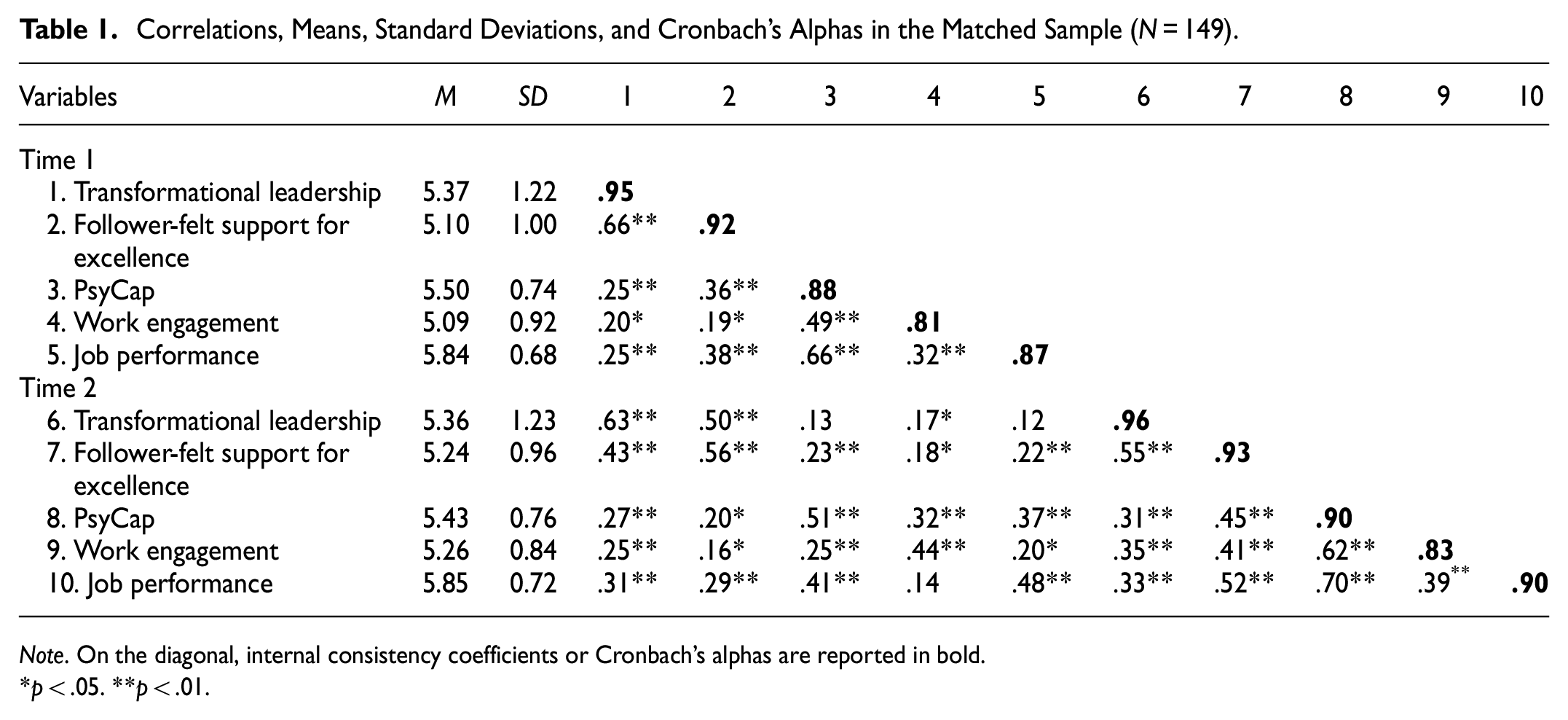
Note. On the diagonal, internal consistency coefficients or Cronbach’s alphas are reported in bold.
p < .05. **p < .01.
To investigate the mediation effects, we applied the MacKinnon et al. (2002) test of joint significance, according to which a mediation effect is considered present when two conditions are fulfilled: (1) the relationship between the independent variable and the mediator is significant, and (2) the relationship between the mediator and the dependent variable, while controlling for the independent variable, is significant. Following the Finkel (1995) method, unexplained variances of the constructs at T2 were allowed to correlate and the error variances of identical items measured at T1 and T2 were also allowed to correlate.
In addition, a three-path mediation model (Figure 1) was tested. In such a model, two mediators (M1 and M2) intervene in a series between an independent and a dependent variable (X and Y) (Widianto, 2018). Taylor et al. (2008) indicated that three conditions need to be fulfilled to conclude that such a model is supported: (1) the relationship between X and M1 is significant, (2) the relationship between M1 and M2, while controlling for X, is significant, and (3) the relationship between M2 and Y, while controlling for X and M1, is significant.
To perform the analyses with the change scores, we regressed the T2 item scores on the corresponding T1 item scores and saved the standardized residual scores. Standardized residual scores are more suitable for two-wave longitudinal studies because they control for the impact of the baseline on the second assessment (Kisbu-Sakarya et al., 2013; Lipshits-Braziler et al., 2015; Salhothouse & Tcuker-Drob, 2008). We entered the standardized residual scores into the structural equation modeling with AMOS. We followed the Kooij et al.’s (2017) approach, by using the item scores to determine the standardized residual scores of the respective constructs in the hypothesized model. We did not control for a common latent factor in the longitudinal analyses since longitudinal studies address typical rater-bias issues associated with self-reports (Griffin et al., 2010).
Results
Table 1 presents the means, standard deviations, internal consistencies, and zero-order correlations of the variables in the matched sample. All the calculated internal consistencies were high. This shows that the operationalizations of the measures of transformational leadership, follower-felt support for excellence, PsyCap, job performance and work engagement are reliable for the work settings in which they were administered. In each correlation matrix, transformational leadership was significantly related to follower-felt support for excellence, PsyCap, job performance and work engagement. Follower-felt support for excellence was significantly related to PsyCap, job performance and work engagement. PsyCap was strongly related to job performance as well as to work engagement. These results are in accordance with the hypotheses; the results of our tests will be reported next.
Testing the Hypotheses
Hypothesis 1a (that transformational leadership is positively related to increases in both follower job performance and work engagement) was tested by the model with paths from transformational leadership at T1 to job performance and work engagement at T2, while controlling for job performance and work engagement at T1, respectively. The paths from transformational leadership at T1 to both job performance and work engagement at T2 were significant (β = .21, p < .01 and β = .20, p < .05, respectively). The results of the fit test were: χ2 = 942, df = 525, p < .001, CFI = 0.88, RMSEA = 0.07 showing that the fit was adequate, but that the model needed some improvement. Therefore, both parts of hypothesis 1a are supported by the lagged data.
We employed an additional analysis to test the reverse effect paths: from both job performance (T1) and work engagement (T1) to transformational leadership (at T2), while controlling for transformational leadership at T1. The paths from both job performance (T1) and work engagement (T1) to transformational leadership (at T2) were insignificant (β = −.07, ns; and β = .07, ns, respectively). The results of the fit test were: χ2 = 15.257, df = 1, p < 001, CFI = 0.85, RMSEA = 0.31, showing that the fit was not adequate.
We tested hypothesis 1b, which states that changes in transformational leadership are related to changes in job performance and work engagement, with the change scores. The fit statistics of this model were: χ2 = 352, df = 181, p < .001, CFI = 0.89, RMSEA = 0.08. The results showed that the model had a moderate fit. The paths from changes in transformational leadership to changes in job performance and work engagement were significant (β = .16, p < .05 and β = .19, p < .05). Therefore, hypothesis 1b is supported.
Hypothesis 2a, stating that transformational leadership is positively related to increases in follower PsyCap, was also tested through lagged panel analysis. The coefficient of the path from transformational leadership at T1 to PsyCap at T2, while controlling for PsyCap at T1, was significant (β = .17, p < .01; χ2 = 1738, df = 994, p < .001, CFI = 0.82, RMSEA = 0.07). This result shows that transformational leadership had a lagged effect on increases in follower PsyCap. The standardized path coefficients among the latent variables of this model are presented in Figure 3. The reverse effect of PsyCap on transformational leadership was not significant (β = −.04, ns). Hypothesis 2a was supported.
Hypothesis 2b states that PsyCap is positively related to increases in both follower job performance and work engagement. The path from PsyCap (T1) to job performance (T2), controlled for by job performance (T1), was significant (β = .27, p < .05), see Figure 3. However, the path from PsyCap (T1) to work engagement (T2), while controlling for work engagement (T1), was not significant (β = .06, ns). The fit statistics of the model with both job performance and work engagement as dependent variables were: χ2 = 1692, df = 985, p < .001, CFI = 0.85, RMSEA = 0.07. However, the model without work engagement had a good fit: χ2 = 564, df = 355, p < .001, CFI = 0.93, RMSEA = 0.06. These results show that PsyCap affected increases in job performance but not in work engagement. The relationships between job performance and work engagement at T1, on the one hand, and PsyCap at T2, on the other hand, while controlling for PsyCap at T1, were not significant (β = −.07, ns, and β = .18, ns, respectively), indicating no reverse effects. Therefore, the results support first part of hypothesis 2b that PsyCap is positively related to an increase in follower job performance but do not support the second part of hypothesis 2b that PsyCap is positively related to an increase in work engagement.
Hypothesis 2c states that changes in PsyCap mediate the relationship between changes in transformational leadership and changes in job performance and work engagement. On being tested, changes in transformational leadership were significantly related to PsyCap changes (β = .21, p < .01), while PsyCap changes were significantly related to both job-performance and work-engagement changes, while controlling for transformational-leadership changes (β = .63, p < .01; and β = .42, p < .01, respectively). The fit statistics of the model were: χ2 = 1627, df = 446, p < .001, CFI = 0.87, RMSEA = 0.07. These results support Hypothesis 2c.
Hypothesis 3a states that transformational leadership is positively related to increases in follower-felt support for excellence. The path from transformational leadership at T1 to follower-felt support at T2, while controlling for follower-felt support at T1, was not significant (β = .05, ns). The fit statistics were: χ2 = 548, df = 186, p < .001, CFI = 0.87, RMSEA = 0.11. Thus, hypothesis 3a is not supported by the data.
According to hypothesis 3b, follower-felt support for excellence is positively related to increases in PsyCap. The path from follower-felt support at T1 to PsyCap at T2, while controlling for PsyCap at T1, was not significant (β = −.14, ns). The fit statistics of this model were: χ2 = 1417, df = 659, p < .001, CFI = 0.80, RMSEA = 0.09. Hypothesis 3b is not supported.
We also explored the reverse effects of PsyCap on follower-felt support, and follower-felt support on transformational leadership. The PsyCap at T1 was not significantly related to follower-felt support at T2, while controlling for follower-felt support at T1 (β = .01, ns), but follower-felt support at T1 was significantly related to transformational leadership at T2, while controlling for this leadership style at T1 (β = .20, p < .05). These results indicate that PsyCap did not affect follower-felt support, but that leader support did affect follower perceptions of transformational leadership.
Hypothesis 3c was tested with the change scores. Support was obtained for the hypothesis that changes in follower-felt support for excellence mediates the relationship between changes in transformational leadership and changes in PsyCap. Transformational-leadership change was significantly related to changes in follower-felt support for excellence (β = .46, p < .01). In turn, changes in follower-felt support for excellence were significantly related to PsyCap changes, after controlling for changes in transformational leadership (β = .30, p < .01). The fit statistics of the model were: χ2 = 1359, df = 283, p < .001, CFI = 0.94, RMSEA = 0.05, indicating a good fit. Hypothesis 3cwas supported.
Hypothesis 4 is also supported by the change data. Changes in follower-felt support for excellence were significantly related to psychological-capital changes (β = .34, p < .01) while psychological-capital changes were significantly related to both job-performance and work-engagement changes, after controlling for changes in follower-felt support for excellence (β = .63, p < .01; and β = .44, p < .01, respectively). The fit statistics of the model were: χ2 = 1698, df = 448, p < .001, CFI = 0.84, RMSEA = 0.07. Hypothesis 4 was supported.
Three-Path Mediation Model
The entire hypothesized model was tested with the change scores. The fit statistics of the model indicated that the model fit met the criteria (χ2 = 1.469, df = 671, p < .00, CFI = 0.90, RMSEA = 0.06). The standardized path coefficients are presented in Figure 2. Since follower-felt support for excellence mediated the effect of transformational leadership on PsyCap, the first two (Taylor et al., 2008) conditions are fulfilled. Also, PsyCap was significantly related to job performance and work-engagement, after controlling for transformational leadership and follower-felt support for excellence (β = .80, p < .01 and β = .65, p < .01, respectively). Thus, the change data supported the modified three-path mediation model: the relationship between changes in transformational leadership and changes in job performance and work engagement were mediated in a series, first by changes in follower-felt support for excellence, and then by changes in PsyCap. The indirect effects of changes in transformational leadership on both changes in job performance and work engagement were significant (β = .07, p < .05 and β = .05, p < .05, respectively).

The standardized path coefficients of linkages between the key variables examined with the change data (N = 149).
Discussion
The present longitudinal field study of healthcare employees shows how transformational leadership increases job performance and work engagement. One can see from the results that the effects of transformational leadership on job performance and work engagement are obvious a year later, after controlling for the baseline of these dependent variables 1 year earlier. In addition, changes in transformational leadership are related to changes in job performance and work engagement. Although this is not an experimental study, and therefore cannot offer causal effects, the results strongly suggest such effects.
Furthermore, the results show that the relationships between changes in transformational leadership and changes in job performance and work engagement are mediated by changes in follower-felt support and PsyCap in a series, as shown in Figure 2. The relationships between transformational leadership and PsyCap, and between PsyCap and job performance, are supported through cross-lagged analyses (see Figure 3), suggesting causal effects. However, the relationships between transformational leadership and follower-felt support, between follower-felt support and PsyCap, and between PsyCap and job performance, are not significant in this analysis and thus do not support causal relationships. This difference between the results of the mediation test with the change scores and those obtained through cross-lagged analyses may be due to the changes in transformational leadership, follower-felt support and/or PsyCap over the 1-year period. Regardless, the results about the effects of transformational leadership on job performance and work engagement can be explained by both follower-felt support and PsyCap as mediators: in support of the self-concept based theory of transformational leadership.

The significant results of testing the lagged effects: Transformational leadership Affect PsyCap and PsyCap affect job performance (N = 149).
The results of this study extend previous work and theories. Specifically, we show how healthcare employees can obtain useful resources at work through a “chainlike” resource or gain spiral; a manager’s transformational leadership style is shown here as a “key” social or contextual resource, one that facilitates followers to rely on different available social resources at work (Halbesleben et al., 2014, p. 1338). We also demonstrate that the transformational leadership style can raise followers’ PsyCap levels. This chain reaction leads to high follower job performance. By presenting the transformational leadership style as a social resource that generates positive-performance ripple effects, our findings add to both the COR and transformational leadership theories. A social resource might be volatile, especially if it involves “support from a leader.” Yet, some other studies have already demonstrated that the transformational leadership style ensures that “norms are internalized into the self-concept” (Shamir et al., 1993, p. 580) among followers which in turn can enhance their level of PsyCap. Even though the COR theory has assumed, so far, that “social support of a supervisor” is a social resource, our study points to the transformational leadership style as a “key” social resource. Thus, as stipulated, this specific behavioral style affects follower job performance by boosting followers’ self-efficacy, optimism, hope, and resilience.
Prior COR research has been mainly conducted with cross-sectional designs. The longitudinal design used here sheds light on how people at work may activate a particular latently available resource, and its impact on both job performance and work engagement. Specifically, the presents study substantiates and explains how a psychological “gain spiral” can be started by the behavioral style of a transformational leader. We show that this can happen through the mediation of changes in follower-felt support for excellence and changes in PsyCap in a series. This finding is consistent with COR’s theoretical notion that individuals can build up their PsyCap over time (Hobfoll, 1989). Our results show a resource gain spiral over time initiated by “transformational” support from leaders who generated a performative ripple effect on their followers’ personal PsyCap resources. Yet, we cannot rule out the possibility that a 1-year interval may have been relatively too long for this variable that is (conceivably erroneously) considered to behave “like a state” (Alessandri et al., 2018).
The results of this study also indicate that the relationship between work engagement and job performance is significant when measured at the same time, but not when measured at a different time (T1 & T2). Thus, these results suggest that work engagement does not predict job performance and vice versa. There are at least three possible explanations. First, some employees with high levels of work engagement may have a greater degree of work-family conflict or higher workloads leading to poor job performance (Fiabane et al., 2013 ; Halbesleben, 2021). Second, healthcare workers tend to be highly engaged in their jobs but, if they do not develop sufficiently in their organization, this will likely inhibit their potential performance (Parker & Griffin, 2011). Third, engaged employees can really remain engaged in their jobs if they can co-shape their work environment proactively (Bakker et al., 2012; Kotzé, 2022).
A notable outcome of this study is that the influence of PsyCap on work engagement and job performance over time can be broken down into two components: effects due to the level of PsyCap observed at T1, and effects due to changes in PsyCap over time. Thus, we show how PsyCap levels are not only connected with current levels of job performance/engagement, but also that individuals with high PsyCap scores can improve their engagement and performance over time (see Alessandri et al., 2018).
Although Hobfoll et al. (2018) noted the role of leaders, citing the Breevaart et al. (2014) research, they have not endorsed the transformational style yet as a “key” social resource, as shown here. Therefore, our present study extends the COR theory with the idea that individual employees gain personal resources through their experiences with a transformational supervisor who also influences their colleagues at work. Hence, this leadership style can be seen as a “key” social resource. In fact, evidence is reported here for Corrollary 1 in the COR theory that “individuals with more resources are better positioned for resource gains. Individuals with fewer resources are more likely to experience resource losses” (Halbesleben et al., 2014, p. 1337).
With respect to employees who are not supported by a boss with a transformational style, gaining personal resources from their work context might become problematic. However, one could assume crossover effects of resource flows between leaders and single followers, through LMX exchange, which may help to facilitate job performance and engagement (Hobfoll et al., 2018). Our results show that transformational leadership is positively related to a social resource (e.g., follower-felt support) which in turn elevates a follower’s psychological capital and job performance. Although the present study did not examine LMX, it is likely to be an underlying mechanism, particularly in nurses’ work contexts (Laschinger et al., 2007 ).
Even though a direct effect was found between follower PsyCap and job performance, under the strictest statistical test, there was no significant effect between PsyCap and work engagement. The chances for high personal work engagement could have been dampened by the high real-life pressure under which the nurses and pharmacists in our sample work. Hence, future research could build models in which job demands interact with work engagement (Bakker & Demerouti, 2007 ; Demerouti & Bakker, 2011 ). Peterson et al.’s (2011) longitudinal study found that PsyCap and job performance are reciprocally related. Although show that, with our longer time interval, PsyCap has an effect on follower job performance, our cross-lagged analyses do not show a significant reverse effect or an effect on work engagement.
Strengths and Limitations of This Study
The reported research has several methodological strengths that increase the validity of the results: (1) its longitudinal design allows for tentative conclusions on causal relationships between the variables and helps to curb biases typically associated with self-report data from cross-sectional designs (Griffin et al., 2010); (2) the respondents worked in a variety of settings; (3) the response rate in the main sample at T1 was nearly 100%, so there was no self-selection bias involved at T1.
This study has also got several limitations. First, all data were collected with one questionnaire, which was only filled out by follower-type respondents. Similar future research should rely on multiple data sources and a larger sample size. Secondly, in our study, we only investigated the changes over 1 year. As to how the mechanisms work over a longer period of time is of interest whereby future research could apply latent growth analysis. Selig and Preacher (2009), for example, recommended testing longitudinal mediation in a study with at least three data waves and measuring the independent variable, mediator, and dependent variable at three consecutive points in time. Thirdly, the study’s work settings were not under full control of the researchers. This makes firm conclusions about causality between the variables impossible. The students in the sample may have raised their performance and PsyCap due to their graduate-training program in which they were enlisted. To control for these and other factors, we should examine this paper’s mediation model in a single organization, such as a hospital (Oh, 2014).
Fourthly, these Indonesian findings may not be generalizable to Western settings. People of the Southeast Asian culture, including Indonesians, place a relatively high value on harmonious and careful interactions with others (Oh, Guay et al., 2014; Selmer & De Leon, 2003). Accordingly, Indonesians often show strong connectedness with group members at school and at work. Therefore, replications with non-Asian samples are called for.
Practical Implications and Future Research
We find that transformational leaders stimulate their followers’ PsyCap and, through it, followers’ job performance. We establish that changes in the studied variables (transformational leadership style, follower-felt support for excellence, PsyCap and job performance/work engagement) form a “psychological chain” or caravan for followers. Thus, the organizations’ clients and healthcare professionals would benefit from training their leaders in this style to increase all the elements of this chain. HRM professionals should adopt this leadership style to effectuate smart training in this style and/or use it as a requirement when recruiting and promoting their organization’s future leaders.
This study presents evidence for one assumption of the COR theory: that personal and job resources thrive in so-called caravans, that is, the presence of one resource may generate additional job resources in the near future (e.g., Halbesleben & Wheeler, 2015; Kelly et al., 2020). Likewise, given the “contagious” nature of positive personal resources (Fredrickson, 2001; Luthans, Avey et al., 2006; Miao et al., 2021), increasing one dimension of PsyCap may elevate another, creating ripple effects, leading to followers performing at a higher level. In addition, we recommend future research to investigate more than two different time frames when testing how resource caravans fluctuate over time.
COR theorizing should now be furthered with interventional field research, combined with multi-source and -level data, to examine how to train the transformational leadership style and/or PsyCap to improve follower job performance and work engagement. Then, as to how transformational leaders and their followers behave more precisely should be investigated with micro-behavioral studies that complement survey assessments (e.g., Halbesleben & Wheeler, 2015; Humphrey & Aime, 2014).
Moreover, prior research on resource loss (Demerouti et al., 2004; Ortqvist & Wincent, 2010) and “gain spirals” (Hakanen et al., 2008; Weigl et al., 2010) allow for reciprocal causality assumptions. Thus, future longitudinal studies should look at how reciprocal causality between performance/engagement and PsyCap (and their antecedents) might occur over a longer period of time in various work contexts. Subsequently, established concepts from, for example, the goal-setting theory, could be incorporated to reveal whether (workfloor) teams of employees with a relatively high level of PsyCap have higher levels of job-goal specificity, which then affect their (team) performance and engagement (see, e.g., Luthans, Avey et al., 2006; A. Newman et al., 2014). The COR and other theories, such as LMX/TMX and the crossover theory (Hobfoll et al., 2018), should be integrated to further explore more specifically how the relational resources between a leader and his or her individual followers “work” within teams (Hobfoll et al., 2018).
Conclusion
In answering this paper’s leading question, we find that the effects of transformational leadership on follower performance and work engagement can be explained by the mediating effects of follower-felt support for excellence and follower PsyCap in a series. Through these two mediators, the transformational leadership style can be added to Halbesleben et al.’s (2014) seven other “key” resources. Future longitudinal research using COR’s “key” resources in various types of work contexts is strongly recommended. What is especially intriguing about COR-based research is that it allows for the integration of different theoretical perspectives. It also opens up rarely examined questions such as: Under which precise circumstances can the personal resources (e.g., energy, traits) of individual followers have contagious effects on the (transformational) leader’s personal resources (i.e., leader-follower resource congruence)? The fragmented and broad Organizational Psychology/Behavior landscape needs more longitudinal studies on these kinds of newer question to creatively invoke a potentially unifying framework.
Footnotes
Acknowledgements
The author would like to thank Dr Peter Van Den Berg for his helpful advice on various technical issues examined in this paper.
Data Availability Statements
The datasets generated and/or analyzed by the current study are available from the corresponding author on reasonable request.
Declaration of Conflicting Interests
The author(s) declared no potential conflicts of interest with respect to the research, authorship, and/or publication of this article.
Funding
The author(s) disclosed receipt of the following financial support for the research, authorship, and/or publication of this article: This study was funded by Indonesian Ministry of Education, Culture, Research, and Technology.
Compliance with Ethical Standards
This research involves Human Participants.
Consent to Participate
Informed consent was obtained from all the individual participants included in the study.
