




Abstract
This study explored the factors affecting curriculum delivery as well as the way in which subject advisors deliver curriculum changes in selected rural schools in a selected education district in South Africa. Quantitative research was adopted for data collection. Questionnaires were administered to 17 educators, 35 school management team (SMT) members, and 165 subject advisors, who were purposively selected. The findings of the study show that non-involvement of educators in the curriculum planning phase, political instability, poor infrastructure, workload of educators, among other things, affect curriculum delivery, leading to curriculum change. The study recommends that educators be involved in and consulted during curriculum planning, and that political instability of the state not interfere with the planned curriculum guiding teaching and learning activities in the state. Adequate infrastructure should be provided to enhance teaching and learning activities, while more educators are recruited to reduce their workload.
Keywords
Introduction
Failure of learners have been attributed to different factors such as lack of infrastructure (Barrett et al., 2019), socio-economic background of learners’ family (Gobena, 2018), lack of parents’ involvement (Cekiso et al., 2022), among others. However, not much seems to have been stated with regards to leadership in terms of rapid curriculum change and delivery. Meanwhile, review of the work of Bromley (2018) shows that curriculum design remains useless without adequate delivery. Curriculum is crucial and determines the extent to which teaching and learning activities are carried out. Moreover, Mitra (2011) asserts that education is the bedrock upon which development is hinged in any society. Suffice it to say that development depends on curriculum delivery. According to Uleanya et al. (2018), curriculum delivery is significant in achieving the aim of establishing rural-based institutions of learning as well as development in rural communities. This implies that poor curriculum design and delivery hinders the desired development which institutions of learning are expected to bring to their host rural-based communities. However, such aims are achievable only when the designed curriculum is localized and properly delivered. Meanwhile, Sehoole and Nkomo (2007) are of the opinion that curriculum delivery remains unachievable, as several factors influence the extent to which curriculum delivery will be adequately achieved, regardless of how well it may be designed.
Political and Social South Africa
South Africa remains a dominant nation in the African continent based on its economic and political influence (Howell, 2019). This has brought about increase in the number of immigrants in the nation, thus, confirming the allusion of South Africa being a rainbow nation (Machinya, 2022). However, the case is fast becoming different considering the recent trends in xenophobic attacks (Machinya, 2022). Additionally, Howell (2019, p. 101) states that “The “new” South African government has yet to fundamentally correct the political, economic, and societal injustices that defined the apartheid system. Substantive freedoms, rights, and dignity remain inaccessible to many, especially those who still live in overcrowded, poorly serviced “townships” or urban slums. For these, the “dream” of democracy has largely been deferred (Howell & Shearing, 2017).” Thus, attempts are being made to realize the dreams of democracy. Meanwhile, from a social perspective, the apartheid in the country affected its structure and lives of its people (Pinnock, 2016). Alluding to the work of Mceachern (1998) as an example, Howell (2019) states that “The spatial areas of the communities—such as the infamous District Six—that were bulldozed by the apartheid state were not only physically broken apart, but in the process, the social structures and ties which provided individuals both with invaluable support in the face of daily oppression and an identity were also destroyed” (p. 97). The foregoing somewhat accounts for reasons behind certain moves by the South African government in an attempt to correct injustice through the education sector. Nonetheless, the question remains: how successful has the South African government been able to combat injustice through education?
Institutional Policies and Legislation
The South African government has proposed that young learners may not repeat the same grade (John, 2015; Parker, 2019). Review of the work of Sakhayedwa (2022) shows that no-fee schools, a rigid curriculum, the Post Provisioning Norms (PPN), the system of grading schools and educator mobility are all very prescriptive. One of the government policies affecting curriculum delivery within special education is “no child left behind” (Powell et al., 2009), which in and for the US is built upon four pillars: stronger accountability for results, more freedom for states and communities, encouraging the use of proven educational methods and more choices for parents (US Department of Education, 2004). With this policy, teachers are to be held accountable for students’ progress on state standards, that is, standards set by the government based on the objectives that the educational system has set out to achieve. This suggests that the curriculum is expected to reflect teaching to the standards, not just teaching for learners to be tested and pass.
The Individuals with Disabilities Education Improvement Act (IDEI) of 2004 reflects the government’s attempt to align it with the No Child Left Behind (NCLB). The IDEI Act focuses on greater accountability and having highly qualified special education teachers in the classroom. It also has an increased focus on preparing students with disabilities for further education. Similarly, in the South African context, a review of the work of Bernstein (2004) shows that South Africa is suffering from the aftermath of apartheid. This has led to many poor households especially black dominated to be denied access to studying. Hence, the South African government is taking different measures to ensure that no child is left behind (Bernstein, 2004). Amongst these measures according to Bernstein (2004) are reviewing and revising of policies, using high and good performing schools as well as incentives where and when necessary (Bernstein, 2004). In the same vain, the work of Kgari-Masondo and Mkhabela (2021) shows that following the outbreak of the Covid-19 pandemic, the South African government took measures in ensuring that “no child is left behind.” This was based on the practice of “umuntu akalahlwa” which is used to mean “a human person is not disposable.” The measure considered by the government was the adopted pedagogy. Kgari-Masondo and Mkhabela (2021) highlights that “The pedagogy tallies well with the tenets of South Africa’s Constitution, Act 108 of 1996 of equal treatment of everyone, and as such must be implemented, as the world currently faces the pandemic” (p. 80). This implies that the use of the policies together with other strategic measures is paramount.
Teaching Media/Resources Curriculum Materials
Materials that facilitate the teaching and learning process cannot be overlooked. These materials are commonly described as teaching media. They come in the form of print media and non-print media.
Print Media
Resources in this category, as the term implies, are usually in print form, that is, hard copy materials. They are easily read, for example newspapers, textbooks, magazines. Tan et al. (2011) describe print media resources as important for effective teaching and learning to take place in any given formal situation. Print media resources cannot be overlooked or overemphasized. It is true that non-print media has come to stay and seems to be taking the place of print media resources; nevertheless, print media resources are still relevant (Tan et al., 2011).
Advantages of Print Media
Some identified advantages of print media as stated by Tan et al. (2011) include: being enduring, that is, if well preserved, they can last for a long time, especially as the case is with libraries. This is more applicable in developing countries where ICT is still a challenge (Akah et al., 2022; Aruleba & Jere, 2022; ITU, 2022). Also, print media resources are cheaper than the non-print (Tan et al., 2011). Print media resources are always complete and more reliable (Tan et al., 2011). For instance, sometimes non-print media resources only give the abstract of a certain work, expecting that interested users/readers can afford to purchase that work. Print media is also reliable, unlike non-print media resources where different people tend to post whatever they like about any subject matter due to their accessibility to the internet. Tan et al. (2011) further posit that print media is nostalgic in the sense that a reader is attached to books that they have read and marked. The moment the reader sees these marks; they bring back memories.
Non-print Media
Non-print media is soft copy material. Resources in this category include television, radio, internet, social media, etc. In the 21st century, this media is rapidly taking over all sources of information. These resources also enable the teaching and learning process in different capacities. Teaching and learning seem to be more appreciated in environments where these materials exist and are put to use. Tan et al. (2011) list some advantages of non-print media as being faster than print media. For instance, by merely punching keys or clicking buttons, a command is issued and several articles related to the topic are made available. By contrast, with print media the user will have to travel from one market to another seeking books that sometimes are as yet unpublished. Non-print media resources are more interactive than print media resources (Tan et al., 2011). Also, non-print media is versatile and more specialized. Several views are discussed on a specific subject matter in the same way that different topics receive special treatment from specialists. This enriches the content (Tan et al., 2011). It is quite easy and convenient to search for information online than on hard copies of materials. Non-print media resources are more environmentally friendly and helps the physically challenged. For example, blind people can afford to listen the material (Tan et al., 2011).
To further support the need for resource materials in either soft or hard form. Veriava (2015) explains that textbooks are a crucial part of every child’s learning journey. This could be owing to the reason that textbooks tend to cater for the learners with the lowest ability in the classroom, as well as the average and the more abled. Smart and Jagannathan (2018) add that textbooks contribute to enhance the learning quality and improve the performance of learners. In other words, textbooks are indispensable materials that aid the realization of any planned and well-thought-out curriculum.
Teacher Factors
Books can be provided by the government and learners made to read these books, but the place of a teacher is extremely important. Review of the works of Chabalala and Naidoo (2021) as well as Keiler (2018) show that teachers shape how curriculum is delivered in classrooms. The work of Alsubaie (2016) suggests that teachers play a more direct role than textbooks in delivering curriculum as they make the final decision about what needs to be taught. Teachers’ pedagogical approaches, beliefs about course content, knowledge about the community in which students live, content knowledge and their own personal experiences all influence the delivery of the curriculum (Alsubaie, 2015). All this makes the place of the teacher indispensable in the realization of the curriculum.
School and Social Factors
Mabwe (2015) explains that social factors are contributory to curriculum design and delivery. Location (rural/urban), resource allocations, grouping of schools, the dipping system and religious beliefs all combine to affect the structuring and usage of the curriculum. The location of the schools plays a major role in terms of curriculum delivery. For instance, in the rural areas, the majority of the schools do not have sufficient resources compared to schools in the urban areas and are therefore not likely to perform in the same way as their urban counterparts. The majority of schools in rural areas lack media centers or computers and this hinders the teachers and learners from carrying out research, expanding their knowledge and obtaining more study material, whereas in the urban areas these resources are provided. The dipping system is found in the rural areas. Normally people in the rural areas own cattle and children have to help their parents take the cattle for dipping rather than attending school. The religious beliefs of the learners affect schools in both rural and urban areas because learners have to go away for a certain period for initiation which affects the teaching and learning process.
A district’s curriculum and philosophy, as well as the school building can influence curriculum delivery (Budak, 2015; Hondrich et al., 2016). Other school variables affecting curriculum delivery are the setting (rural, urban, or suburban) and size (Judging by the study of Indoshi et al. (2010), there are three categories of factors influencing curriculum delivery: environmental factors, curriculum-related factors and administrative factors, all of which play vital roles in promoting or hindering good curriculum delivery. Each category has other factors that determine their usefulness.
Environmental factors: Various societal issues can influence the delivery of a curriculum, placing the learner as the focal point. This factor focuses on the following: placement of subjects in schools, ranking of subjects, peer influences, parental influences, student feedback, nature of talents and career.
Curriculum-related factors: In this regard, factors pertaining to the designed curriculum itself are considered. At this point, an attempt is made to review all the necessary resources available that will help ensure the survival of the planned curriculum. All resources available are maximized and efforts are made to obtain all the unavailable resources or possibly improvise using what is available where possible. If the unavailable resources are essential and cannot be made available and improvisation seems impossible, then the curriculum may have to be revisited. Thus, the following factors are considered: time, professional qualification of teachers, in-service training of teachers, professional experience of teachers and performance.
The above factors are important and must be treated as such. For instance, timing regarding the curriculum must be suitable: this entails the time of its delivery and the time scheduled for certain actions to take place. Time is crucial to curriculum delivery. Similarly, the qualifications of teachers to deliver the curriculum must be considered as well. If this is not handled properly, all efforts to plan and develop the curriculum may be frustrated. The place of the teachers, their qualifications, skills, disposition, attitude, etc. will determine the success or failure of the delivery of the curriculum (Bush & Bell, 2002). It is further stressed by Bush and Bell (2002) that these teachers must be trained regularly/periodically. It is important for teachers to be refreshed on the teaching profession, in order to harness the necessary and current skills needed in their chosen profession. One major way by which this is made possible is by ensuring that teachers are made to attend training, workshops, seminars and other programs that will help improve their pedagogical skills, thereby making them better and more appreciated by the learners. Also, the professional experience of teachers must not be undermined; they must be treated with great respect. Thus, teachers who have retired can still participate where possible, though not in an active manner as they did while in service. In this way, less experienced teachers will gain from their expertise. Performance can then be graded or observed in order to identify where more efforts can be made.
Administrative factors: These deal with bringing the office to the classroom and vice versa. In this regard, administrative members of staff are expected to be very observant, diligent, effective and efficient to be able to act promptly, meeting the needs of the learners and teachers as well. Factors to be noted by the staff and expected to influence their decisions include expenses for a subject, facilities and school policy.
The administrative members of staff are expected to know the total amount spent on each subject, how much has been budgeted, etc. This will help proper planning and consequently delivery. This possibly accounts for why there is usually an officer in charge of specific subjects. Of course, the facilities within the school must be in place to enable the flow of teaching and learning. It is one of the responsibilities of the administrative office to ensure that facilities are put in place, as this will help motivate the teachers to teach, and learners will find learning interesting and easy. In addition, every institution must have an operating policy. It is the responsibility of the administrative office to work out a policy that will help the smooth running of school activities and guide all members of staff, teachers and other interested parties.
Additionally, curriculum delivery is crucial and one of the most important phases which determines the effectiveness of a planned curriculum. However, several well-planned curricula seem ineffective and unproductive in certain nations. This has led to a series of changes from one curriculum to another even though the existing curriculum is well planned, useful and possibly remains the most appropriate for that society. The problem therefore seems not to be in the designed curriculum, but its implementation. Hence the reason for this study, which explored the factors affecting curriculum delivery and leading to rapid curriculum change. The study also explored the way in which subject advisors deliver curriculum changes. The study is envisaged to possibly influence curriculum designers and policy makers to avoid anything that would affect the delivery of the curriculum negatively. Thus, it focuses on investigating the factors of rapid changes in curriculum delivery and how subject advisors deliver such in the South African context. To achieve the objective, attempt is made to proffer answers to the identified research questions guiding the study. The research questions are: What are the factors of rapid changes in curriculum delivery in the selected education district in South Africa? How do subject advisors deliver changes in the curriculum in the selected education district in South Africa? The study is further structured into significance of this study, conceptualization of terms, methodology, results and discussion of findings, conclusion, recommendations and limitation.
Significance of This Study
This study is significant in that it would add to the existing literature on the role and challenges of subject advisers in curriculum delivery. This is particularly because this is an area that has received minimal attention in researches within the Faculty of Education across institutions of higher learning and South Africa as a nation.
Conceptualization of Terms
Educators: These are teachers who are saddled with the responsibility of educating/teaching students (Chazan, 2022). In the context of this study, the word educators is used interchangeably with teachers.
School Management Team (SMT): This is a group of individuals saddled with “…the sole function of giving leadership guidance, direction and assistance in the teaching/learning situation (Elias et al., 2014, p. 367).” In the context of this study, SMT implies a team within the school with the responsibility of performing roles of leadership guidance, directing and assisting in the situation of teaching and learning.
Subject advisors: The Basis International Schools (2020) presents school advisors as “…experienced teachers who are available not only as a resource for questions about curriculum, lesson plans, and school relationships; but also mentor teachers in the subject–across schools in the network–on how they can best implement the … curriculum and engage students in their discipline” (par. 1). Chigona (2017) had earlier stated that subject advisors are expected to provide assistance to teachers. In this study, subject advisors are teachers who are experienced in the field of teaching and capable of providing relevant support and assistance to teachers in their specific subject areas.
Methodology
A quantitative method was adopted for this study. This is in alignment with the submission of Kumar (2019) and Creswell (2014) who hold the view that adoption of quantitative method in a study aids generalization of result. Purposive sampling was employed in selecting the rural schools and respondents of the study. Purposive method was employed in order to ensure that schools selected possessed the features characterizing rural schools. These features include being situated in rural areas which are mostly characterized by high rate of poverty, unemployment, poor road network, among others. Thus, many rural schools lack infrastructures. The respondents of the study were also purposively selected. Thus, the positions they occupy in the schools were considered before being approached to take part in the study. Hence, the population of the study comprise educators, school management team (SMT) members and subject advisors in selected rural schools within a nThungulu Education District, KwaZulu-Natal Province of South Africa. The reason for this is because they are the immediate leaders of the school. The study population were 217 purposively selected staff members of rural schools within the selected education district: 17 educators, 35 SMTs, and 165 subject advisors. More subject advisors were selected for this study based on their roles which is to support and monitor how the designed curriculum is implemented in different relevant specific subjects through the sourcing and providing of appropriate teaching and learning material in order to improve performances of learners in the subject (Basis International Schools, 2020; Chigona, 2017). SMTs were selected in this study based on their role of ensuring the distribution of leadership to other colleagues regardless of their level, or status (Elias et al., 2014). In other words, SMTs were selected for this study because they oversee in some ways the activities of the subject advisors as well as educators. In order to get the opinion of teachers who implement the curriculum and serve as middlemen between the subject advisors and learners, few teachers (17) were selected.
Data was collected through the use of a self-designed questionnaire. The questionnaire was designed based on deductions from reviewed relevant literature adopted for the study. For instance, reviewed literature showed that curriculum changes occurred sometimes due to political reasons/issues. The same was reflected in the questionnaire in order to know the perception of respondents with regards to such. Also, items of the questionnaire were targeted at obtaining the opinion of respondents regarding curriculum changes and delivery in the selected schools. Thus, a 5-point Likert scale questionnaire was used ranging from Strongly Agree (5), Agree (4), Undecided (3), Disagree (2) Strongly Disagree (1). The scale was used to investigate the consensus of respondents to each questionnaire item. However, during the analysis, both “strongly agreed” and “agreed” were considered as one item, while “disagreed” and “strongly disagreed” remained one item. Undecided was included in order to give the respondents the opportunity to be neutral in instances where they are unsure.
The questionnaire had two sections. The first section aimed at obtaining the demographic information of respondents, while the second section obtained information on their opinions on curriculum changes and delivery. The collected data was analyzed using the Statistical Package for the Social Sciences (SPSS).
Validity and Reliability
To ensure the validity of the instrument, the researchers endeavored to follow the steps for scale design as put forward by Boateng et al. (2018, p. 1) which are: “pre-testing the questions, administering the survey, reducing the number of items, and understanding how many factors the scale captures.”
In testing the reliability of the instrument used for this study, a pilot study was conducted in two different schools within the same district. The schools where the pilot study was conducted were removed from the list of schools used for the actual study. The findings based on the responses of the respondents during the pilot study showed that certain items needed clarification. Hence, the questionnaire items were adjusted where necessary. The researchers ensured that they were all in agreement with the items before the questionnaire was administered. Also, the number of items presented in the questionnaire was at its minimum to increase the response rate of respondents. Meanwhile, the scale captured all factors identified by the researchers in alignment to the research questions guiding the study and deductions from reviewed relevant literature.
Ethical Consideration
The researchers ensure to apply for and collect ethical clearance from the appropriate institution and offices. Permission was also sought from and granted by the Provincial Department of Education. This gave the researchers the authority to visit schools. Informed consent of respondents were obtained prior to data collection. The respondents were made to know that they could back out of the study at any time. They were promised that their names or any identifying feature of theirs were not going to be reported or reflected anywhere in the study to ensure anonymity.
Results
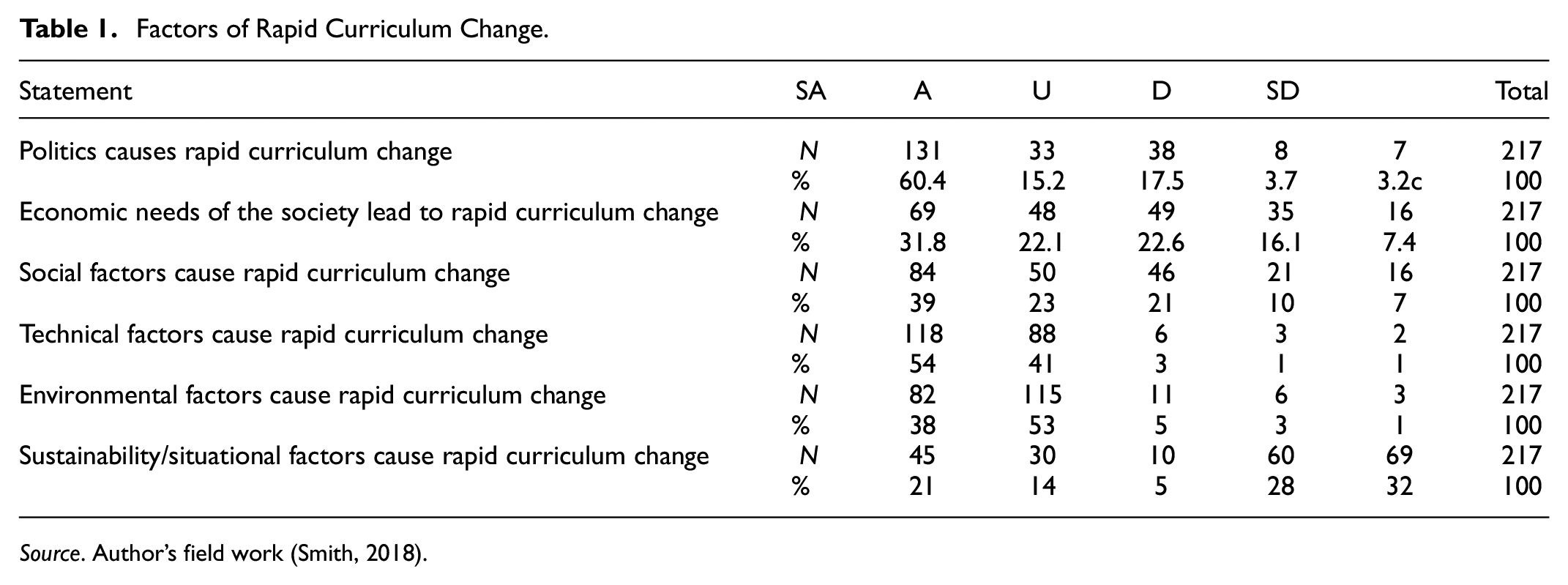
The findings of the study showed that curriculum are designed and planned in the absence of stakeholders such as teachers. This affects teachers in the implementation process. Also, rapid curriculum change affects its implementation. The results are as presented below based on the research questions. The results of the study are presented in the Tables 1 and 2. This is based on the research questions guiding the study.
Factors of Rapid Curriculum Change.
Source. Author’s field work (Smith, 2018).
How Educators Respond to Curriculum Change.

Source. Author’s field work (Smith, 2018).
Research question 1: What are the factors of rapid changes in curriculum delivery in the selected education district in South Africa? The results are as presented in Table 1
Table 1 shows that out of the total respondents (217), while 75.6% agreed that politics causes rapid curriculum change, 17.5% were undecided and the remaining 6.9% disagreed. The results also show that the majority of the respondents believed that the economic needs of society lead to rapid curriculum change. For instance, while 52.9% are in agreement, 22.6% were indifferent and the remaining 16.1% and 7.4% disagreed. Also, Table 1 showed that social factors could lead to rapid curriculum change. The majority of the respondents 61.7% agreed that social factors cause rapid changes in curriculum, while 21.2% were undecided and 17.1% disagreed. Furthermore, the results presented in Table 1 show that the majority of the respondents, 95% to be precise agreed that technical factors are responsible for rapid curriculum change. However, while 3% were indifferent and 2% disagreed. Table 1 also showed that 88% which formed majority of the respondents agreed that environmental factors cause rapid curriculum change, while 5% were indifferent and 4% disagreed. Also, while 35% of the respondents agreed that they do not think that sustainability or situational factors influence rapid curriculum change, 5% were undecided, and 60% disagreed.
Research question 2: How do subject advisors deliver changes in the curriculum in the selected education district in South Africa? The results are as presented in the Table 2.
The results presented in Table 2 show that majority (91%) of the respondents felt burdened and worried each time there was a change in the curriculum, 4% were indifferent and 5% disagreed. Similarly, most of the respondents (91.3%) agreed that they got confused and bothered each time there was a change in curriculum, though 4.1% were undecided, and 4.6% disagreed. Furthermore, Table 2 showed that due to constant change in the curriculum, some educators prefer to change careers or leave the profession. For instance, more than two-thirds of the respondents (84%) agreed to the statement that “some educators change careers and leave the profession due to curriculum change.” However, while 11% were undecided, 5% disagreed. Also, results presented in Table 2 showed that majority of the respondents (92%) agreed that they discourage learners to take up teaching as a profession, while 4% were undecided, and another 4% disagreed. Table 2 further indicates that 45% of the respondents in defiance of curriculum change, stubbornly stick to the old curriculum, while 42% disagreed, and 13% were undecided. Furthermore, 78% of the respondents agreed that educators speak negatively about the new curriculum each time it is changed while 4% were undecided, and 18% disagreed.
Discussion of Findings
Research Question 1
The finding from Table 1 on political influence causing rapid curriculum change supports the work of Kasuga (2019) who holds the view that political influences is capable of causing rapid curriculum change. Suffice to state that instability in government contributes to curriculum changes. This finding indicates that quick curriculum change affects curriculum delivery in terms of posing confusion to both subject advisors and educators on the right curriculum to implement. Meanwhile, continuous change in curriculum causes instability in implementation and such is envisaged to affect the learning abilities of learners and consequently their academic performances. The finding of this study on occurring due to economic factors coincides with the finding of the work of Uleanya et al. (2018) who state that curriculum changes occur sometimes due to economic factors. This implies that the economic needs of society cause a shift in focus and lead to curriculum change. Curriculum planners change the curriculum to ensure that the economic needs and demands of society are met through education using new curriculum delivery. However, such changes can have negative effect on teaching and learning if not well managed. The finding of the study on social factors contributing to curriculum change is in line with the work of Mabwe (2015) who holds the view that social factors can contribute to rapid curriculum changes in different nations. Thus, in a bid to meet common social trends in society, the curriculum is sometimes changed. This is aimed at enabling learners to be current and on par with their contemporaries in other societies. However, such rapid changes if not well handled is capable of affecting teaching and learning activities. Furthermore, the study showed that technical factors are responsible for rapid curriculum change. This finding is in alignment with the works of scholars like Shah and Dani (2016) that technical factors such as community involvement and culture can lead to rapid curriculum change in society to ensure that learners are relevant to and in their societies. This is described as a case of glocalization: using global standard to meet local needs (Grigorescu & Zaif, 2017; Roudometof, 2016). Sequel to this finding of the study, it can be deduced that when technical factors cause quick succession in change of curriculum change, the delivery by extension is envisaged to be affected as well. The study also indicates that environmental factors are responsible for rapid curriculum change. This corroborates the work of Indoshi et al. (2010) who found that environmental factors can provoke rapid curriculum change. This suggests that the rapid change in curriculum due to environmental factors is likely to affect its delivery. Sustainability/situational factors from the study were also revealed as part of the factors of rapid curriculum change. This agrees with the work of Uleanya et al. (2018) that situational factors within host communities or nations can lead to curriculum change. In other words, the situation in which host communities find themselves is envisaged to determine the kind of curriculum that is to be put in place in such environment. This finding shows that curriculum guiding teaching and learning activities in schools can be influenced by the situational or sustainable factors of the community. Suffice to state that rapid changes in curriculum due to such identified factors is considered as being able to affect its delivery.
Sequel to the research question 2, the study showed that educators felt burdened and worried each time there was a change in the curriculum. This finding is in alignment with the work of Nuraini (2019) who found that teachers feel burdened during curriculum change and that sometimes it is the work of members of the community that encourage educators during that period. This finding suggests that once teachers feel burdened due to curriculum change, the delivery of the newly designed curriculum may remain a challenge. Also, the finding on educators being confused each time there is a change in curriculum corroborates one of the findings of the work of Mufanechiya (2015) who holds the view that educators get confused when there is a rapid change in curriculum. This may be because they are not included in the curriculum planning phase. The finding indicates that delivery of the new curriculum may remain a challenge following the confusion of teachers. Thus, teachers are likely to implement the curriculum wrongly due to the experienced confusion or choose not to deliver it. Meanwhile, this finding of the study on educators having to change careers and leave the profession due to curriculum change agrees with one of the findings following review of the work of Sugino (2010) which shows that educators are likely to get frustrated due to rapid curriculum change. This implies that frequent curriculum change may be a demotivating factor for educators, especially those who seem less passionate about their jobs and feel left out. They may choose to change profession in search of satisfaction. Suffice to state that there could be loss of seasoned teachers due to frequent curriculum changes leading to frustration for teachers. Similarly, the result of the study on educators discouraging learners from becoming teachers due to curriculum change supports the work of Lekgoathi (2010) who suggests that when educators are not happy or encouraged by their profession for different reasons, among which is rapid curriculum change, they tend to discourage learners from studying adequately or taking on the profession in future. This may be through their attitude and less enthusiasm about their work. This finding shows that learners can be unhappy due to rapid change in curriculum and since they are directly involved in teaching learners, the desired support expected from them may be lacking, thereby discouraging learners from acting as expected and desired. Furthermore, the finding of the study on educators stubbornly sticking to the old curriculum and refusing to implement the new one is in line with Stears (2009) who found that educators feel left out during curriculum planning and so continue with the old curriculum. From this finding of the study, it can be deduced that educators being left out at the time of curriculum planning, may influence their acceptance and delivery of the newly designed curriculum. Additionally, the finding of the study on educators speaking negatively about the new curriculum corroborates the work of Mufanechiya (2015) which also showed that rather than accept the changed curriculum, educators speak negatively about it. This attitude negatively influences and impacts learners. According to Hutt and Tang (2013), this constitutes academic negligence. This finding of the study suggests that there are likely to be challenges in the delivery of the curriculum considering the disposition of educators to it.
Conclusions
The study revealed that curriculum delivery is a challenge due to rapid change. In other words, changing of the curriculum due to various reasons and factors have effect on the delivery. Its acceptability is firstly an issue to educators who are meant to implement it though excluded in the planning phase. Meanwhile, when educators are confused about and displeased with the newly designed curriculum, the outcome is envisaged to affect both they the teachers and the learners. For instance, the educators are likely to become unhappy and frustrated and in turn choose to neglect to or poorly deliver on the curriculum. Such affects the learning abilities of the learners, and consequently their academic performances. To this end, the following recommendations are made.
Recommendations
The number of subject advisers should be increased and they should be made to organize workshops and other refresher training for educators to remain familiar and up to date with the curriculum in order to function accordingly. This will help make them effective and efficient in their jobs. By doing so, more schools will be covered by the subject advisers and more educators will be helped.
Regular training of educators is one of the strategies that can be used to manage curriculum change and implementation. Thus, periodic trainings should be organized by education leaders to keep educators abreast of the curriculum in use.
Education leaders should ensure the improvement of the existing infrastructure in schools. This will promote teaching and learning as educators and members of the SMT discharge their duties.
Proper monitoring from members of the SMT should be ensured. This will help in making educators perform as expected.
Adequate funding from the government will help promote teaching and learning activities in intermediate phase schools. However, proper monitoring measures must be put in place to ensure that the fund from the government is adequately and judiciously utilized in meeting the demand of schools, educators and learners with regard to teaching and learning.
Recruitment of qualified educators will help improve the ratio of educators to learners. The possibility of educators being efficient then becomes high. Overcrowding in primary classes is likely to hinder the level of productivity. Educators will likely have more impact with fewer learners; there is therefore a need for more educators to be recruited to help improve their efficiency and productivity.
Curriculum change should be checked. Due process should be observed and followed before any curriculum is changed to avoid confusion for educators. Also, where it has to be changed, educators who are the actual deliverers of the curriculum should be consulted and have an input in the final curriculum. By doing so, educators feel involved and possibly prepared to adjust to the changed curriculum.
Limitation of the Study
The study was limited to selected schools in only one district (uThungulu) in Kwazulu-Natal Province, South Africa. Also, the findings of the study relied heavily on mean scores and percentages. This may not be sufficient for generalization. Hence, it is suggested that similar study be conducted using two or more districts, provinces, and/or countries as well as methods. Also, more in-depth analysis should be considered.
Footnotes
Declaration of Conflicting Interests
The author(s) declared no potential conflicts of interest with respect to the research, authorship, and/or publication of this article.
Funding
The author(s) received no financial support for the research, authorship, and/or publication of this article.
