




Abstract
This study gazed upon curriculum delivery in postcolonial Guyana. The key focus was on the impact of effective curricula instructional materials on curriculum delivery. A descriptive survey method was employed to gather data and a sequential transformative strategy which embraced a mixed method approach was utilized to analyze and interpret the data. One hundred mainstream teachers were asked to respond to five questions on a questionnaire. The sample represents 13% of the entire teacher population at the University of Guyana and 25% of the primary level teacher population of the Faculty of Education and Humanities. These teachers were randomly stopped and asked the questions as they made their way to class on the Turkeyen Campus. These teachers have all acquired initial qualified teachers’ status and at least 2 years of mainstream teaching experience. The teachers indicated that they are limited in their use of technology in mainstream schools, as many schools do not have Information and Communication Technology (ICT) support and physical space is limited. Teachers stated that they produced at least 90% of the curricula instructional material they use in mainstream classrooms. They indicated that they sometimes have to self-fund the raw materials needed to produce the instructional materials necessary for effective curriculum delivery in mainstream schools. Teachers are expected to do this without either allotted planning or preparation time. The production of instructional materials, done independently with little support from the senior leadership of the mainstream schools, is sometimes neither adequate nor cater to the diverse needs of all learners especially learners with Special Education Needs and Disabilities.
Keywords
Introduction
Postcolonial Guyana is one of the 13 countries in South America. It is a multilingual territory where at least 10 indigenous languages are in use alongside English, which is its sole official language. Guyana has more regional ties and integration with the Caribbean. It has one of the leading mainstream education systems in the Caribbean. Guyana provides free mainstream public education from nursery to secondary.
Guyana’s mainstream education system has not evolved much over the last two decades (Andrews & Frankel, 2010; Lashley, 2018). Despite advances in science and technology, the development of the postcolonial education system has been on a slowly revolving path (Ismael, 2012). As a lecturer at both the University of Guyana (UG) and the Cyril Potter College of Education (CPCE), the researcher visited numerous mainstream schools to assess teachers, and in all of the lessons observed, the researcher realized that most of the instructional materials used were teacher-made. Most of them were two-dimensional, and the writing was not always done to facilitate all learners because of their various seating positions in class. The researcher also observed many times that the materials did not stimulate a significant number of the learners and soon became uninterested in the concept being delivered.
The researcher randomly selected learners and inquired about their views on the instructional materials used by the teachers and in most cases, the responses were negative. Learners with Special Education Needs and Disabilities (SEN/D), like the gifted and those with learning disabilities, always indicated that the instructional materials did not cater to their needs. Learners from the general population would indicate that they had learnt parts of the concepts with or without the instructional material brought and utilized by the teachers. These initial observations made it clear that there are many disparities in production and use of instructional materials in mainstream schools. Hence, this study explored curriculum delivery in postcolonial Guyana, focusing on the impact of useful instructional materials.
Whenever the researcher on the occurring phenomenon engaged level supervisors or other members of senior leadership, they would indicate that they are too overwhelmed with academic records and other forms of supervision to assist teachers with the production of instructional materials. They would further state that it is expected that qualified teachers who graduated from the Cyril Potter College of Education should be proficient in making well-constructed and useful instructional materials. They neglected one crucial factor; that is, initial teacher training does not make teachers proficient in producing all necessary instructional materials. Designing, constructing, or selecting suitable instructional materials is only one aspect of initial training. The limitations of initial teacher education on instructional materials design, creation, and/or selection are at odds with the expectations in actual mainstream school practice in postcolonial Guyana (Lashley, 2017, 2018). This gave rise to the problem of the study, which is the use of inappropriate instructional materials and its adverse effect on curriculum delivery.
The researcher has been a mainstream teacher for more than 17 years, and this research is a part of a series on the experiences of learners in mainstream schools. The researcher focuses on curriculum delivery and finding ways to enhance learners’ experiences and achievement in mainstream schools in Guyana. This studied build on the 2017 publication on the curriculum delivery in Grade 4 mathematics class in the same area of study. In the previous study, the researcher analyzed how computer-aided instruction enhances pupils learning in mathematics and also discovered the void in the production and selection of instructional material even when computers are available. As computers and Information and Communication Technology (ICT) support are very limited in postcolonial Guyana, it is essential to ensure that the instructional materials use genuinely fit for purpose.
Research Questions
Two key research questions guided this study:
Review of Literature
The literature related to curriculum delivery and the selection and/or production of instructional materials were analyzed and synthesized to provide a theoretical guide for this study.
Curriculum and Curriculum Delivery
Curriculum delivery is the many ways by which the curriculum enables learners to achieve their learning goals. Designing or selecting instructional material, teaching, learning support, advice and guidance, coaching, mentorship, peer and collaborative learning, feedback and assessment, personal development planning and tutoring, skills development and practice, and access to resources are processes encompassed by the term “curriculum delivery.” Although teachers remain as the key element in effective curriculum delivery, the instructional materials and resources used have a significant impact on curriculum delivery and learners’ achievement and performance (Ko & Sammons, 2014; Stabback, 2016). The effectiveness of curriculum delivery is connected to the quality of instructional materials (Ko & Sammons, 2014). School leadership’s contribution has an impact on curriculum delivery, and the quality of instructional materials teachers use in the classrooms (Ko & Sammons, 2014). Teachers need to be knowledgeable of the curriculum in use, and the resources necessary for its effectiveness, which should be aligned with curriculum goals. When teachers fail to align high standard instructional materials with curriculum goals and learners’ need, the entire process is compromised, and failure is inevitable.
The curriculum describes everything that a learner encounters and interacts with: the means of the encounter and interaction, time of the encounter and interaction, and what the encounter and interaction entail (Stabback, 2016). In simpler words, the curriculum is the what, why, how, and when of students learning (Stabback, 2016). Curriculum delivery needs to be transformed to enhance learners’ encounter and interaction with concepts and learning experiences. Transforming curriculum delivery needs to be through the selection and/or production of curricula instructional materials and their use in the curriculum delivery process. Curriculum delivery at its core aims to enhance curriculum impact on the learning and teaching experiences in mainstream schools. Curriculum delivery in this context embraces the many ways in which learners are enabled to achieve the outcomes offered to them by the curriculum. This includes teaching, learning support, advice and guidance, coaching, mentorship, peer and collaborative learning, feedback and assessment, personal development planning and tutoring, skills development and practice, and access to curriculum resources especially curricula instructional materials. The conception of the term “delivery” in this study intends for delivery to mean the provision of information to learners in an appropriate way, enabling all learners to achieve curriculum goals.
As curriculum delivery impacts the students’ learning experiences directly, the quality of curriculum delivery is the concern of every stakeholder in mainstream education in Guyana (Lashley, 2017). However, curriculum delivery presents many complex challenges for mainstream school teachers and school administration, for example, responding to changing learner needs, ensuring availability of high-quality learning resources and environment, and delivering more engaging and flexible learning experiences (Ardzejewska, McMaugh, & Macquarie, 2010). The approach supported in this study started by understanding that curriculum delivery is impacted by a range of other things like the quality of curricula instructional materials and is only part of the more extensive student experiences.
Curricula Instructional Material
Instructional materials are educational resources, for example, teaching and learning aids bought or made to improve students’ knowledge, abilities, and skills, to monitor their assimilation of information, and contribute to their overall educational development. The standards of the instructional materials in the classroom for curriculum delivery directly impact the quality of the learning experiences (Harwood, 2017; Polikoff & Koedel, 2017; Shawer, 2010; Steiner, 2017; Wette, 2009, 2010, 2011). The learning experiences for the various types of learners are directly impacted by the instructional materials teachers take into the classroom. Instructional materials which are deficient in the standard are commonly used in the mainstream classroom, and they negatively affect the learning experiences for children. Instructional materials must be of very high quality. Instructional materials created by mainstream teachers need to be connected to ongoing and sustained professional learning in content knowledge and pedagogical content knowledge in their discipline and/or level of curriculum delivery (Steiner, 2017).
Mainstream teachers in postcolonial Guyana have significantly improved their innovativeness in reproducing recycled curriculum instructional materials (Lashley, 2017). There is still a need for postcolonial Guyanese teachers to improve and increase their innovativeness and effectiveness when producing instructional material of the highest quality and specificity for curriculum delivery. The development of high-quality instructional materials, especially in science and mathematics at the primary level in postcolonial Guyana has been significantly slow (Lashley, 2017). The effectively delivered curriculum is the most important and critical antecedent in student academic achievement and success (Jankowska, 2011). As a result, the instructional materials used must be sound inappropriateness, quality and quantity.
Most of the research and literature on instructional material focus primarily on textbooks, leaving unexplored and unstudied potentially durable curricula materials that are not textbooks (Hill & Myatt, 2007). Hence, this study explored instructional materials directly. Textbooks are not the only element of the curriculum that is genuinely significant in curriculum delivery (Hill & Myatt, 2007). There are other critical elements, like teaching and learning aids. This impact on learners’ achievement is worth the investment in time and resources. The capital expenditure on the education budget in placing strong curricula in the classrooms is not significantly different from utilizing inferior quality curricula materials (Opfer, Kaufman, & Thompson, 2016; Polikoff & Koedel, 2017; Rentner & Kober, 2014; Steiner et al., 2017; Wei, Darling-Hammond, Andree, Richardson, & Orphanos, 2009; Zubrzycki, 2016). However, the impact on learners’ achievement is significantly different. Textbooks and other instructional materials are relatively inexpensive and tend to be similarly priced (Opfer et al., 2016; Polikoff & Koedel, 2017; Rentner & Kober, 2014; Steiner et al., 2017; Wei et al., 2009; Zubrzycki, 2016). The implication is that the marginal cost of choosing a more effective textbook and higher quality instructional material over a less effective alternative is essentially zero (Opfer et al., 2016; Polikoff & Koedel, 2017; Rentner & Kober, 2014; Steiner et al., 2017; Wei et al., 2009; Zubrzycki, 2016).
Many researchers suggest mainstream teachers may be supplementing with noncommercially published instructional materials more than administrators are aware (Chen-Gaddini, Burr, Marple, Bugler, & Finkelstein, 2017; Chingos & Whitehurst, 2012; Gewertz, 2015; Perry, Marple, & Reade, 2017; Rentner, Kober, Fizzell, & Ferguson, 2016; Southern Regional Education Board [SREB], 2017). As a result, sometimes, they are mismatched with core knowledge intended in the stated curriculum (Stringfield, Datnow, Borman, & Rachuba, 2000). This also affects curriculum delivery, and more specifically, it directly affects learners’ achievement and performance.
Learners’ interest and diversity are seldom considered in the selection and/or production of instructional materials. Learners must have their voices premeditated in the acquisition and/or production of instructional and learning materials (Chen-Gaddini et al., 2017; Chingos & Whitehurst, 2012; Gewertz, 2015; Lashley, 2018; Rentner et al., 2016; Shogren, Wehmeyer, Burke, & Palmer, 2017; SREB, 2017). This improves the effectiveness of the selected and/or produced instructional materials. The central role of instructional materials in the classroom can never be overemphasized (Banilower et al., 2013; Perry et al., 2017; Shogren et al., 2017). Hence, instructional materials need to maintain high standards.
High-quality instructional materials demand considerable thought and careful design to achieve the needed impact (Bybee, 2013; Schmidt et al., 2001; Taylor, Gardner, & Bybee, 2009; United Nations Educational, Scientific and Cultural Organization [UNESCO], 2016). Mainstream teachers need support, guidelines, and resources to produce high-quality instructional materials for effective curriculum delivery. Teachers need to be encouraged to attend seminars, workshops, and conferences to improve their knowledge and skills in handling the production, selection, and utilization of instructional materials (Achimugui & Onojahi, 2017). Teachers need to be aware of how the instructional materials and other resources they use are likely to be helpful or unhelpful in structuring their learners’ thinking (Harwood, 2017; Polikoff & Koedel, 2017; Steiner, 2017; Steiner et al., 2017). Besides the physical presence of a learned teacher in the classroom for curriculum delivery, instructional materials are the most paramount and significant resources needed at the classroom level (Lyimo, Too, & Kipng’etich, 2017). High-quality instructional materials help to facilitate out of the box thinking and guide discoveries while making learning meaningful for the learners. They help teachers also to manage unintended and spontaneous interactions with students that skew learning outcomes positively or negatively (Burch, Heller, Burch, & Heller, 2016).
Further reflection on the curriculum, what it is, and what it means in education show that it considers collectively the instructional and learning materials presented in the classroom and the pedagogical approaches utilized by teachers in the presentation of the materials. Many researchers disagree about the conditions under which such practices are valued in the curriculum delivery process and students learning achievements (Harwood, 2017; Shawer, 2010; Steiner, 2017; Wette, 2009, 2010, 2011). However, they all agree that the quality of instructional materials has a significant impact on the learning experiences, performances, and achievements of learners.
Physical facilities complement instructional materials. School physical resource facilities are the material resources dispensed for staff and students to optimize their achievement and productivity in curriculum delivery (Chism & Pang, 2014). The United Republic of Tanzania (URT; 2013) indicated that physical facilities include classrooms, laboratories, libraries, ICT facilities, dormitories, health and kitchen facilities, as well as facilities for students with disabilities help to enhance students’ access to the curriculum. Physical resources and facilities procure and maintain inclusive, diverse and creative educational environments which contribute to high achievements and performance for all learners (Chism & Pang, 2014). They provide the opportunity for learners to interact with the instructional materials present for effective curriculum delivery and enhance students’ learning.
Research Design
A sequential transformative strategy which embraced a mixed method approach was employed in this study. The primary purpose of the following transformative strategy is to employ the methods that will best serve the theoretical perspective of the researcher (Creswell, 2003; Terrell, 2011). In this study, it supported the theoretical framework and helped me to understand better the phenomenon that is changing as a result of being studied. Moreover, as such, the researcher hoped to change mainstream teachers’ practices about the selection and/or production of curricula instructional material. This was achieved by the teachers becoming aware of the negative impacts of their practices on curriculum delivery while they complete the questionnaire or participated in the interviews.
The descriptive survey method was employed because it allowed for the use of the following transformative strategy in a mixed method approach. The descriptive research fundamentally presents the understanding of the phenomenon of interest, situations or issue as experienced, lived, or interpreted by the population (Hale, 2012; Jackson, 2009). The descriptive survey was also chosen because it allowed the mainstream teachers to share the existing situation about the selection and/or production of instructional materials for curriculum delivery. The descriptive survey method allowed for more mainstream teachers to participate in producing knowledge which described the current situation about the selection and/or production of instructional materials for curriculum delivery from the teachers’ perspectives in postcolonial Guyana. Also, the descriptive research design allowed for more than gathering and quantifying data in statistical tables. It also allowed the opportunity to gather data which will contextualize the tabulated data and explain meanings and interpretations (Ololube, 2006). These were the three main reasons why this research design was chosen for this study. It allows for a comprehensive study of the situational practices in mainstream schools about instructional material design, selection, or production by the participating mainstream teachers in postcolonial Guyana.
Instrument
A questionnaire with five questions was used to gather data for this study (see Appendix B). One hundred teachers were randomly selected to complete the questionnaires on the university campus. Although the teachers completed the questionnaires, there were opportunities to have an unstructured interview to discuss the impact of high-quality instructional materials on curriculum delivery in mainstream schools. To indeed gather comprehensive data, researchers utilized situations to stimulate participation in more in-depth discussions to elicit meaningful data, which may not be stated on a questionnaire (Xerri, 2017). Interviews functioned in this capacity during the study.
Population
The population comprised of 756 teachers over the two academic years. The primary-level teachers comprised of 398 out of the 756 teachers in the population (see Tables 1 and 2).
The Student Enrolment for Teachers Attending the University of Guyana in the Education Faculty for the Academic Year 2016-2017.

Source. University of Guyana student registry.
The Student Enrolment for Teachers Attending the University of Guyana in the Education Faculty for the Academic Year 2017-2018.
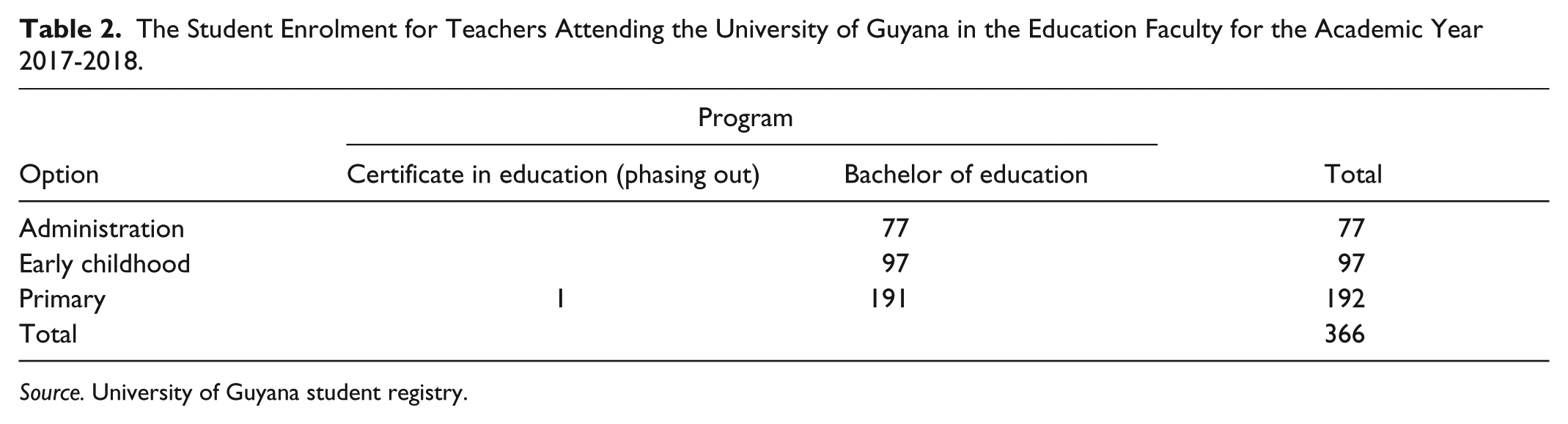
Source. University of Guyana student registry.
Sample
The sample was selected through simple random sampling. Simple random sampling is the most comprehensive and most straightforward sampling technique which can be employed to gather a representative sample of the population without personal biases or prejudices to participants (Ololube & Egbezor, 2012). The sample of 100 mainstream teachers represented 13% of the entire teacher population at the University of Guyana and 25% of the primary level teacher population.
Data Analysis
The data gathered in this study were analyzed and tabulated using percentages to reflect and quantify teachers’ perspectives on the selection and production of curricula and instructional materials. The open-ended responses were coded and grouped to present a comprehensive understanding of the situation from the perspectives of the participating teachers in postcolonial Guyana as it relates to the selection and production of curricula and instructional materials in public mainstream schools. The tabulated and grouped data together with the stated facts which could not be tabulated or grouped were stated to tell the whole story comprehensively. In this research, a sequential transformative strategy was actively utilized. It is paramount that the data analysis and interpretation factually, logically, and sequentially presents the studied phenomenon in its entirety (Maxwell, 2005).
Results
The Criteria Used to Determine the Suitability of Instructional Materials to Be Used in Curriculum Delivery
Recent work on curriculum use has focused on how teachers use instructional materials in curriculum delivery (Lashley, 2017; Sherin & Drake, 2009). Mostly, these emphasize the importance of considering students’ thinking in the midst of using curriculum and mobilizing instructional materials for curriculum delivery (Brown, 2009; Remillard, 2005). Fifty-eight percent of the mainstream teachers indicated that they would ask the learners if they like the instructional materials during or after the lesson. However, this is used as a criterion to evaluate the instructional material during or after its use in curriculum delivery. This revealed that the important inputs of learners are not considered to determine the suitability of instructional materials to be used in curriculum delivery before their actual use. In addition, to asking learners about the suitability of instructional materials during or post curriculum delivery, 42% of the participating teachers stated that they either use their judgment based on learners’ response to the used instructional materials or they assess the effectiveness of the instructional materials when they do lesson and/or curriculum evaluation (see Table A1).
The revelation by 82% of the participants is that there are no known formal or implied criteria used to judge quality, suitability, or effectiveness of the instructional materials mainstream teachers use in curriculum delivery (see Table A1). This is of great concern to the researcher because in a typical mainstream classroom, in developing multicultural, multiracial postcolonial Guyana, there is an extraordinary diversity among learners, who also have varied needs and many learners with SEN/D. In the era where learners with SEN/D are placed in mainstream schools and the general population of learners has varied needs, it is essential to be sure of the quality, suitability, or effectiveness of instructional materials.
Eighteen percent of teachers indicated that they follow the general criterion during initial teacher training at the Cyril Potter College of Education (see Table A1). These criteria are very generic and focus more on letter size, contrast, color use, and creativity. They do not focus on content organization and individualizing or contextualizing instructional materials. This creates a significant problem in mainstream education when learners come from various cultures, backgrounds, and level of readiness. This jeopardizes the entire curriculum delivery process.
How Teachers Acquire the Instructional Materials Needed for Curriculum Delivery
Forty-five percent of teachers revealed that they use whatever instructional materials are available, whatever they can make or acquire within the school or at home. Twenty percent of teachers use what is recommended by the Ministry of Education in the curriculum guides provided to mainstream schools. Twenty-eight percent use ideas from the textbooks and provided curriculum guides, while 7% indicated that they use the Internet for ideas. They also stated that they select or produce instructional materials from what they have observed other teachers using (see Table A2). They do this without assessing the suitability of the instructional materials for their cohort of learners. It is significant to note that whether the instructional materials used in curriculum delivery are either recommended by the Ministry of Education or are ideas from textbooks, the Internet and other teachers, 71% of them are made by teachers (see Table A5).
In the absence of evaluatory benchmarks, how then do teachers acquire high-quality instructional materials? This is left to the discretion of individual teachers, as was indicated by the participants. Individual discretion is very subjective and hinders consistency in the quality of instructional materials used across the country. This will also account for the variation of performances of learners with similar abilities. The data also indicate that mainstream teachers consult neither best practices nor research as a means of developing high-quality instructional materials needed for curriculum delivery.
The Approaches Used by Mainstream Teachers in Postcolonial Guyana to Assess the Effectiveness of the Instructional Materials
Fifty-eight percent of teachers indicated that they ask the learners about their perceptions of the instructional materials during or after the lesson as a means of evaluation. It is highly unlikely that any suggestions made at this point will be utilized to enhance the effectiveness of the instructional materials. Twenty-two percent of teachers indicated that they use their judgment based on learners’ response to the instructional materials. Also, 20% of teachers indicated that they assess the effectiveness of the instructional materials when they do the lesson and/or curriculum evaluation (see Table A3).
The approaches used by mainstream teachers in postcolonial Guyana to assess the effectiveness and quality of instructional materials are very subjective and left to the individual who produced or selected them. Furthermore, learners are not directly involved in the assessment of the materials which directly affect their learning; if they are consulted, it is after the instructional materials have been used in the curriculum delivery process.
Support Provided by Senior Leadership and the Department of Education for Teachers to Aid the Production of High-Quality Instructional Material
Eighteen percent of teachers indicated that they do not receive support to prepare instructional materials from neither senior leadership at school nor the various department of education. Sixty-seven percent of teachers indicated that support is only provided in the form of limited raw materials. Fifteen percent of teachers stated that sometimes senior leadership would walk around the schools and point out errors on instructional materials on display after they have already been used in curriculum delivery (see Table A4).
All the subjectivity in the selection, production, and evaluation of instructional material had already indicated the absence of support for mainstream teachers by senior leadership and the department of education to teachers to aid the production and/or selection of high-quality instructional material. Because every child learns differently, and every child is different, the most effective instruction is designed to fit each learner (Connor et al., 2011). Teachers cannot effectively design and produce instructional materials to fit each learner without support (Brown, 2009; Connor et al., 2011). As teachers make instructional plans, they set goals for instruction and then select appropriate tasks and instructional materials for implementation (Smith & Stein, 2011); however, task selection and the role of the curriculum are not ubiquitous among teachers. Hence, teachers need support throughout the curriculum delivery process (Smith & Stein, 2011).
There are no apparent benefits from senior leadership walking around the school to point out errors on instructional materials on display after they have already been used in curriculum delivery. Instructional materials are not materials to enhance schools’ aesthetic appeal. Teachers rely on their knowledge and beliefs in designing instructional material. This in some cases is limited. This further highlights the importance of curriculum experts and school leaders supporting teachers in curriculum instructional material design and production and most importantly, curriculum delivery (Boschman, McKenney, & Voogt, 2014). Active engagement with senior school leadership and curriculum experts offer an opportunity for teachers’ professional development and allow for the production of instructional materials that are more in line with effective classroom practices and learners’ needs (Ben-Peretz, 1990; Borko, 2004).
The Type of Instructional Materials (Teacher-Made or Commercially Produced) Mostly Utilized in Mainstream Schools in Postcolonial Guyana
Seventy-one percent of mainstream teachers use teacher-made instructional materials because they are convinced by the practices in mainstream schools that self-made instructional materials show teachers’ innovation. Also, they are more guaranteed that they would be available when they are needed. Twenty-nine percent of teachers revealed that they use commercial/specialist produced because they are easily accessed. These teachers indicated that they believe that commercial/specialist produced instructional materials are assumed tested and proven effective (see Table A5).
Moreover, teachers’ appraisals are connected to the production of instructional materials. This demonstrates that mainstream schools’ practices are biased against mainstream teachers by providing limited resources, support, and raw materials necessary to produce instructional materials yet connecting it to their appraisals. Instructional materials must be assessed independently of the overall teachers’ appraisal. These materials must be assessed for content, relevance, appeal, meeting learners’ needs, comprehensive, and the support they provide learners to achieve educational goals.
The teachers who preferred commercial/specialist produced instructional materials indicated that they have this preference because they believe that these instructional materials are easily accessed. These teachers further assumed that they had been tested repeatedly and proven effective. However, many commercial instructional materials used in postcolonial Guyana are not products which have been tested repeatedly in mainstream schools. Local curriculum and content specialist seldom evaluate them.
Discussion
How Are Instructional Materials Selected and/or Produced for Curriculum Delivery in Postcolonial Guyana?
Curricula instructional materials are subjectively selected and/or produced by mainstream teachers for the delivery of the stated curriculum. The participating mainstream teachers indicated that there are no formally stated criteria given to them to guide the selection and/or production of instructional materials. They are expected to independently provide learners with the materials needed during instruction to enhance curriculum delivery. Learners are never consulted during the selection and/or production process for instructional materials.
The participating mainstream teachers indicated that as a result, many typical mainstream primary classrooms in Guyana are four walls decorated with cardboard-made two-dimensional instructional materials or teaching aids. These nonstandardized materials sometimes are marred with wrong concepts and spelling errors. They do not pass through stringent quality checks at the local school level. Research has proven that the learning and achievement of students are directly and significantly impacted by the selection of instruction material (Harwood, 2017; Polikoff & Koedel, 2017; Shawer, 2010; Steiner, 2017; Wette, 2009, 2010, 2011).
Although teacher-made instructional materials demonstrate mainstream teachers’ innovativeness with limited resources in postcolonial Guyana, some concepts are not effectively delivered with teacher-made instructional materials. The participating teachers indicated that the substitution directly impacts learning, performance, and achievement. The need for better and high-quality instructional materials is urgent and real, and materials and implementation need to be connected to ongoing and sustained professional learning for teachers (Steiner, 2017). Teachers in mainstream education within Guyana, who were trained at the Cyril Potter College of Education, lack knowledge and skills in the continuous production of high-quality instructional materials. They continue to be in dire need for ongoing and sustained professional development on the selection and/or production of instructional materials in mainstream schools, while significant emphasis must also be placed on curriculum organization, material preparation, and delivery. Despite the increased need for innovative and effective instructional material of the highest quality and specificity, the development of high-quality instructional materials, especially in science and mathematics at the primary level in postcolonial Guyana, has been slow (Lashley, 2017).
The participating mainstream teachers indicated that learners’ interest and voices are rarely considered when teachers are making instructional and learning materials to be used in mainstream schools. Learners must have their voices premeditated in the acquisition and/or production of instructional and learning materials (Chen-Gaddini et al., 2017; Chingos & Whitehurst, 2012; Gewertz, 2015; Rentner et al., 2016; Shogren et al., 2017; SREB, 2017). This must be considered especially in subjects with high failure rates like Mathematics and Science. Recent studies on curriculum emphasize the importance of considering students’ thinking in the midst of mobilizing, designing, and producing instructional materials for curriculum delivery (Brown, 2009; Remillard, 2005; Sherin & Drake, 2009). These studies emphasize that teachers consult learners before producing or selecting instructional materials. In such consultations, learners must be allowed to state their needs and expectations. Teachers must consider these while consulting the planned curriculum when mobilizing or producing instructional materials.
Instructional materials play a central role in science classrooms (Banilower et al., 2013; Perry et al., 2017; Shogren et al., 2017). They reside at the intersection of standards, pedagogy, and assessment, often providing engaging and academically challenging learning experiences for students. Instructional materials are a medium for making academic disciplines accessible to learners and are often students’ first introduction to those disciplines. This further highlights why it is essential for the instructional materials learners are exposed to in a traditional mainstream schools need to be content sound and reliable as well as reflective of the needs and interest of learners while maintaining curriculum and other academic standards.
The Curriculum and the Instructional Materials Selected and/or Produced
A more in-depth exploration of the conception of the curriculum by the participating mainstream teachers indicated that curriculum encompasses everything that learners are exposed during their course of study. This indicates a vagueness of structure and form in the curriculum. The curriculum in mainstream schools needs to be overtly and precisely stated in postcolonial Guyana. This is so because even cases in which teachers adhere to the overt and formal curriculum (as was intended by curriculum and content specialists such as National Centre for Education Resource Development [NCERD]), they do not cater for spontaneous interactions. There are always unintended spontaneous interactions with students that skew learning and results positively or negatively (Burch et al., 2016). These spontaneous interactions are directly limited by postcolonial Guyana standardized lesson planning and strict time table monitoring by head teachers and education officers. The extreme monitoring mechanisms in place are limiting spontaneity in the classroom, which limits innovative thinking by learners and teachers. This can be directly associated with why Guyana has not invented anything significant in the last two to three decades and more. This limitation in inventions can be associated with the limitation in inventiveness and spontaneity in the mainstream classrooms of postcolonial Guyana from nursery to university.
Further reflection on the curriculum, what it is and what it means in education, shows that it considers collectively the instructional and learning materials presented in the classroom and the pedagogical approaches utilized by teachers in the presentation of the materials. However, many researchers disagree about the conditions under which such practices are valued in the curriculum delivery process and students learning achievements (Harwood, 2017; Shawer, 2010; Steiner, 2017; Wette, 2009, 2010, 2011). For instance, should practices be counted only when they are described within the materials? Alternatively, should practice added by the teacher be included? Taking a poststructuralist perspective on Steiner (2017), postulation material presented and teachers’ practices would indicate a dilemma in mainstream education in postcolonial Guyana for the participating teachers. The dilemma starts with the self-made instruction materials by teachers, those selected and those provided by the mainstream system curriculum and subject specialists. The autonomy of the teachers’ selection versus the standardized expected use of the Easy Path Series recommended by postcolonial Guyana’s Ministry of Education.
According to Lyimo et al. (2017) besides the physical presence of a learned teacher in the classroom for curriculum delivery, instructional materials are the most paramount and significant resources needed at the classroom level. For curriculum delivery to significantly succeed, instructional material selection and production must be handled with utmost objectivity. Therefore, this means more effort needs to be put into the production of instructional materials, whether teacher-made or produced by subject and curriculum specialists. The importance of instructional materials in an evolving mainstream education system like that of postcolonial Guyana is important as they are teachers’ main support in curriculum delivery.
Instructional materials in many rural schools in postcolonial Guyana are often inadequate in terms of quantity and diversity to meet individualized and contextualized learning needs of learners. During the survey conducted with 100 mainstream teachers in postcolonial Guyana within 2017, all the teachers who participated indicated that there are always thin instructional materials in terms of quantity, quality, and diversity. The participants indicated that mainstream teachers in postcolonial Guyana sacrifice their resources and time to make instructional materials, but these do not always meet the overwhelming needs. Ninety percent of the participating teachers indicated that mainstream teachers are struggling to find ways to help students understand concepts with limited instructional materials. This makes the learning process more challenging for all learners, especially those with SEN/D.
What Specialist, Technical, and Administrative Supports Are in Place to Ensure That Instructional Materials Used by Mainstream Teachers in Curriculum Delivery Are of High Quality and Suitable for the Intended Learning Outcomes?
The effectively delivered curriculum is the most significant and critical antecedent in student academic achievement and success (Jankowska, 2011). It must be effectively delivered to all learners to develop the human resource of Guyana. However, the participating mainstream teachers expressed that there is dominance in the use of self-designed or selected instructional materials by individual Guyanese mainstream teachers. They claim this is so because there is a limited specialist, technical, and administrative supports in place to ensure that instructional materials used by mainstream teachers in curriculum delivery are of high quality and suitable for the intended learning outcomes. According to the participating mainstream teachers, most students are taught through curricula not defined by the Ministry of Education but directed by the individual teacher’s available instructional materials, knowledge, and skills. The participating teachers asserted that it is directly connected to the high prevalence of failure of mainstream learners at national and regional assessments. They claim that this results from curriculum delivery being left solely to mainstream teachers with limited support to select and/or produce instructional materials and without any guidance to improve their pedagogical content knowledge.
In postcolonial Guyana, like many other parts of the world, all kinds of materials are considered curriculum materials. This is dangerous to curriculum delivery and learners’ performance. Most research and literature explored on instructional material focused primarily on textbooks, leaving unexplored and unstudied potentially strong curricula materials that are not textbooks (Hill & Myatt, 2007). According to the participating mainstream teachers, the specialists, technical, and administrative personnel of the education sector place more emphasis on the Easy Path textbooks without any emphasis on the instructional materials teachers select and/or produce to complement these textbooks. They alluded that the misplaced emphasis has also led to this dilemma. Most instructional materials are also made from the Easy Path textbook series and neglect the emphasis on instructional materials which may be indigenous and original to individual communities in Guyana because of geographic and cultural location as well as the quality of teachers and support available. The participating mainstream teachers strongly asserted that the limitation in specialist, technical, and administrative support has contributed to the significant levels of subjectivity in the selection and/or production of instructional materials used by mainstream teachers in curriculum delivery.
The participating mainstream teachers informed the researcher those education authorities who are higher up the mainstream hierarchy in Guyana need to recognize also that despite curriculum being nationally organized and produced by The NCERD, at the classroom level in mainstream schools, the curriculum becomes very varied. The teachers said that it creates the conundrum of how do they quantify any differences between the effectiveness that the teacher made versus the published curriculum or between that which is Ministry of Education endorsed versus teacher selected or implemented? The participating teachers reported that there is no existing or known taxonomy of curricular features. Recent similar studies have not explored the elements of the curriculum that are truly significant in teaching and learning (Hill & Myatt, 2007). The existing knowledge and literature are limited in explaining what makes a curriculum useful. However, this does not deem the superiority or inferiority of teacher-made instructional materials versus those produced by curriculum specialists or publishers and subject or content specialists.
The participating mainstream teachers; the specialist, technical, and administrative personnel within the mainstream education hierarchy; and government of postcolonial Guyana are always referring to the amount of money spent to provide local mainstream schools with resources (instructional materials and textbooks) but there is never any reference to any money spent to assess the effectiveness of these curricula and instructional materials. The capital expenditure on the education budget in placing strong curricula in the classrooms is not significantly different from utilizing poor quality curricula materials (Opfer et al., 2016; Polikoff & Koedel, 2017; Rentner & Kober, 2014; Steiner et al., 2017; Wei et al., 2009; Zubrzycki, 2016). Textbooks are relatively inexpensive and tend to be similarly priced (Opfer et al., 2016; Polikoff & Koedel, 2017; Rentner & Kober, 2014; Steiner et al., 2017; Wei et al., 2009; Zubrzycki, 2016). The implication is that the marginal cost of choosing a more effective textbook over a less effective alternative is essentially zero (Opfer et al., 2016; Polikoff & Koedel, 2017; Rentner & Kober, 2014; Steiner et al., 2017; Wei et al., 2009; Zubrzycki, 2016).
The participating mainstream teachers indicated that multilevel support is needed for effective curriculum implementation and delivery in postcolonial Guyana. Successful curriculum implementation and delivery rely on strong and effective instructional leadership support and guidance from the schools’ administration, the teachers’ willingness to transform practices, and specialist and technical guidance from the Department of Education in each region. Successful implementation and curriculum delivery also rely upon suitable and diverse resources provision and the adequacy of financial resources for the purchase of core materials for each neighborhood school. Also, mainstream teachers in postcolonial Guyana need planning time, as well as the organization of time, space, and professional development designed to support designing and developing instructional materials. Another need in postcolonial Guyana is the need to ensure that mainstream primary teachers have the core knowledge necessary for curriculum delivery and the core knowledge necessary to be transmitted to the learners. Core Knowledge implementation is impeded by the absence of multilevel stakeholder support in mainstream education and the increased pressures on teachers and schools to adhere and strictly accede to state standards and accountability systems that are mismatched with core knowledge (Stringfield et al., 2000).
The participating teachers also stated that instructional materials’ development or selection support is needed for newly qualified mainstream teachers in Guyana because they are limited in content knowledge, pedagogical content knowledge, and experience in actual classroom practices. The participating teachers indicated that limited support would continue to hinder mainstream teachers in effective curriculum delivery. The teachers indicated that in postcolonial Guyana, there is some significant discrepancy between mainstream teachers’ and senior leadership and administrators’ perceptions of the curriculum materials currently in use. Many researchers advocate that this is suggesting that teachers may be supplementing with noncommercially published materials more than administrators are aware (Chen-Gaddini et al., 2017; Chingos & Whitehurst, 2012; Gewertz, 2015; Perry et al., 2017; Rentner et al., 2016; SREB, 2017).
The participating mainstream teachers claim that in Guyana, it is the standard practice for mainstream teachers to use more teacher-made (noncommercially published materials) instructional materials in their mainstream classrooms. The teachers indicated that many mainstream school administrators are entirely against teachers using commercially published materials. There is a dilemma of inconsistencies in curriculum expectations within this postcolonial education system. This also affects teachers’ confidence and practices during the process of curriculum delivery.
It is safe to postulate that high-quality instructional materials represent a critical link between effective curriculum delivery and high academic achievement for learners. High-quality instructional materials demand considerable thought and careful design to make the needed impact (Bybee, 2013; Schmidt et al., 2001; Taylor et al., 2009). Mainstream teachers, school administrators, and other senior officers up to the mainstream education hierarchy in Guyana need to consider the value of high-quality instructional materials in postcolonial Guyana’s mainstream schools. This is necessary to reduce failure rates and improve performances.
Education in the post-2015 development period is the primary emphasis of Sustainable Development Goal Four. It intends to “ensure inclusive and equitable quality education and promote lifelong learning opportunities for all” (UNESCO, 2016). Curriculum delivery plays the most crucial part in enabling meaningful learning. It is also paramount in stating and supporting education that is relevant to collective improvement and development. It is essential that attention is given to the quality of instructional materials used in the mainstream classrooms in postcolonial Guyana. Conversely, we are presupposing that curriculum vital capacity to ensure education for all is paramount in the articulating and achieving of Sustainable Development Goal Four (UNESCO, 2016).
Primarily, it is the curriculum that actuates the inclusiveness and diversity in education. By this, the curriculum ensures that all learners access the experiences and opportunities needed for academic success. It is a curriculum that indicates how learning is organized in structure, form, and actuality, especially with limited human and material resources. Finally, it is a curriculum which contributes to the public improvement and capacity development (UNESCO, 2016).
Teachers need to be encouraged to attend seminars, workshops, and conferences to improve their knowledge and skills in handling the production and utilization of instructional materials (Achimugui & Onojahi, 2017). Mainstream teachers in postcolonial Guyana need to adhere to the postulation of Achimugui and Onojahi (2017) and the realizations made by the sequential transformative exploration this study provided. The appropriateness of the resources should be judged by the extent to which the mental images that children form as a result of the use of the resources are likely to be helpful or unhelpful in structuring their thinking for all learners (Harwood, 2017; Polikoff & Koedel, 2017; Steiner, 2017; Steiner et al., 2017). The participating mainstream teachers solidified their asserted stance that within the mainstream schools in Guyana, teachers lack both resources and specialist, technical, and administrative support.
Conclusion
There is neither support in place to ensure that instructional materials used by mainstream teachers in curriculum delivery are of high quality and suitable for the intended learning outcomes nor formal guidelines for the production of high quality and suitable instructional materials. Instructional materials production and/or selection are subjectively made by mainstream teachers, and their effectiveness is seldom assessed. Although teachers remain the critical elements in effective curriculum delivery, the subjective production and/or selection of instructional materials and resources used have negatively impacted curriculum delivery in Guyana and learners’ achievement and performance. The effectiveness of curriculum delivery is connected to the quality of instructional materials (Ko & Sammons, 2014). The subjectivity reflected in the production and/or selection of instructional material has comprised the effectiveness of curriculum delivery. It should not be taken for granted that mainstream teachers are knowledgeable about the curriculum in use, and will objectively select or produce the instructional materials necessary for its effectiveness. It should also not be taken for granted that mainstream teachers will consciously and objectively align selected or produced instructional materials with curriculum goals. When teachers fail to align high standard instructional materials with curriculum goals and learner needs, the entire process is compromised, and failure is inevitable.
High-quality instructional materials are essential to curriculum delivery. They are the key which opens the doors of learning and enhance the learning experiences. They make a tremendous impact when teachers lack pedagogical content knowledge. Although the teachers indicated that they select and produce instructional materials to enhance the learning experiences for all learners, they have indicated that they seldom assess the quality and impact of the instructional materials. This act negatively affects the curriculum delivery process in Guyana. Finally, the teachers indicated that learners are seldom allowed to assess the quality of instructional materials. This also comprises the effectiveness of the curriculum delivery process. Learners must assess instructional materials as they are the end users.
Author’s Recommendations
This section presents the author’s recommendations. It provides some criteria mainstream teachers in postcolonial Guyana can utilize to enhance the selection and/or production of instructional materials for curriculum delivery.
Criteria for the Selection and/or Production of Instructional Materials for Curriculum Delivery
Instructional materials to be used in curriculum delivery by mainstream teachers must reach the criteria listed below:
Instructional materials selected or produced must be high in quality. They must be produced from materials which are easily manipulated but durable and safe.
The content must be sound and presented in a form which is easily understood by all learners, even those with learning disabilities.
Instructional materials must be designed to enhance the learning experiences for all learners. They are meant to be an integral part of the teaching–learning interactions.
Instructional materials must be diversified enough to cater to the various learning styles, background, cultures, readiness, level of development, and most importantly, any specific individualized learning needs learners may have.
Instructional materials must be reviewed to match new knowledge discovered by research. Learners must assess them as they are the end users.
Provide equitable learning and achievement opportunities for all learners.
Recommendations for the Ministry of Education, Mainstream Teachers, School Administrators, and Curriculum Specialist
Furthermore, based on the knowledge produced by this study, the researcher recommends that more support is given to mainstream teachers in postcolonial Guyana to ensure high-quality instructional materials are used in mainstream classrooms. The researcher also advised that the hierarchy of the ministry of education and teachers in mainstream schools in postcolonial Guyana used the Lashley 2019 Criteria for Selection and Production of high-quality curriculum materials states the following:
The physical structure of all instructional materials must be safe and easily manipulated by all learners, promote hands-on activities and an applied approach to learning during the curriculum delivery process.
Ensure learners’ voice, interest, abilities, readiness, and other unique characteristics are always considered in the selection and/or production of instructional materials.
Ensure that the instructional materials are stimulating enough to grab and sustain learners’ interests while still challenging them to analyze the concept represented critically.
The content must be free from error, ambiguity, and information which can lead to misinterpretation and confusion during curriculum delivery. Also, there must be gender neutrality or equality in the use of instructional material.
Instructional materials must be flexible, adaptive, and created in such a way that they can be reused as reinforcement, revision, and/or introduction in other lessons or stages in curriculum delivery.
The design of instructional materials must employ a combination of modern creative technology and tradition sound ideas to cater to this new generation of learners.
Instructional materials must be the product of current research and best practices and must be updated with every new cohort of learners.
Ensure that the instructional materials are congruous for the academic discipline and for the diversity of learners, including their readiness and capacity to handle the curriculum in its entirety.
Instructional materials must be activity-based rather than lecture-based to promote the full participation of all learners, especially those with SEN/D.
Keep language use as simple and precise as possible when presenting the essential facts.
Be collaborative and objective with parallel teachers, senior leadership, and content specialist when selecting or producing instructional materials.
Always assess the effectiveness of instructional materials before, during, and after use in curriculum delivery. Ensure instructional materials are designed so that learners can immediately apply the skills, knowledge, and behaviors they have acquired in class.
There should be punitive improvement within the Cyril Potter College of Education training on pedagogy specifically on the production, selection, and use of instructional materials in curriculum delivery. This will help to mitigate the continued deficiencies in posttraining or university studies in curriculum and instruction/pedagogy.
Footnotes
Appendix A
Appendix B
Acknowledgements
I wish to extend gratitude to all the postcolonial Guyanese mainstream student teachers from the Faculty of Education and Humanities, University of Guyana, who participated in the study. Thank you very much for participating and helping to build an understanding of the process of curriculum delivery and instructional material design, selection, and/or creation in postcolonial Guyana. Special thanks to Mrs. Ardith Conway for her insightful comments throughout the writing of this article.
Declaration of Conflicting Interests
The author(s) declared no potential conflicts of interest with respect to the research, authorship, and/or publication of this article.
Funding
The author(s) received no financial support for the research, authorship, and/or publication of this article.
