




Abstract
Scientific instrument platforms (SIPs) and their operation appraisal have received extensive attention in recent years. However, SIPs struggle to incorporate sustainability into their organizational strategies and implement it in their innovation and business activities to improve their performance levels. This study adopts a SIP sustainability evaluation framework and develops a fuzzy synthetic DEMATEL approach to evaluate the mutual influence between the attribute criteria based on the opinions of diverse stakeholders within the SIP system. The findings suggest that operational characteristics, mainly including organizational reputation, construction goals, staff welfare and external services, drive the current SIP performance. Interactive control of top management and executive’s action plays a major role in sustaining an excellent SIP, while becoming a central issue for most SIPs at the current development phase. The contribution of this study is to shed light on why some successful SIPs are able to achieve their goals and remain prominent, and how those inefficiently operated SIPs should capture and change the failing properties to positively and practically improve their bad situation.
Keywords
Introduction
The sustainable and stable operation of technological support systems effectively promotes scientific and technological innovation activities (Lu, 2008). Representatively, the efficient and ethical operation of scientific instrument platforms (SIPs for short) has become a focus of public attention. Established by their management units such as scientific research institutes, universities, and a few research enterprises with a number of large-scale scientific instruments and equipment and a group of full-time scientific and technological personnel, SIPs usually operate and maintain the scientific resource to devise testing methods, exploit advanced techniques and provide comprehensive services for researchers and social organizations (X. Wang et al., 2021b). To integrate sustainability into SIP operational management is not only the entry point for theoretical research and application of scientific and technological resource allocation and scientific research management, but also the actual demand and management challenge for sustainable development of most current social organizations (Jayawardhana et al., 2022). Although SIPs are different from social enterprises and supported by government annual financial grants, SIP sustainability reveals a fresh but ongoing problem and challenge for contemporary organizational management and business models capable of transforming the social landscape of science, technology and the market economy. That means, SIP sustainability can no longer be deconstructed into economic, social, environmental and temporal aspects as corporate sustainability does, from a holistic conceptual perspective (Lozano, 2012; Meuer et al., 2020). While promoting social and economic benefits, there is an opportunity to enrich sustainability concepts and applications by understanding the relationship between SIP sustainability and its latent variables.
There are countless case studies and administrative measures attempting to use an alternative course of action to advance the SIP operation level, and matched incentive mechanism to compensate for the myopia of SIP practices (X. B. Wang, 2020b; J. Wang et al., 2019). It is unfortunate that the performance features of operational management among evaluated SIP management units remain inadequate and imbalanced (J. Wang, 2020a). In the 2022 open and sharing assessment of large-scale scientific instruments organized by the Ministry of Science and Technology (MOST) of China, for instance, a SIP named protein science research platform has won the champion for its fifth year in succession. On the other hand, there is still a frequent occurrence of some poorly operated SIPs being transformed into excellent sequences by rectification measures, while at the same time some of the first class fall into the general class. That is, merely highlighting good and bad is not sufficient to address the problem of SIP performance deficiency, nor is it a viable approach to address the gap between the deficiency and the improvement of SIP performance. Even then, decision-makers and SIP stakeholders are unaware of their SIP development strategies and their stages of SIP development.
Diagnosing the current stage of SIP development, identifying the crucial attributes of SIP sustainability, and quantitatively studying the relationship between different properties are urgent scientific questions that need to be addressed in the current research on organizational sustainability. Setting different development strategies and corresponding key factors around operational management is the basis of a multi-objective decision-making process under a balanced development scenario (Aktaş & Demirel, 2021). Most of the previous studies essentially use case descriptions or qualitative evaluation methods (Lozano, 2012; X. B. Wang, 2020b; Witjes et al., 2017), making potentially key attributes from benchmarking SIPs inefficient and inapplicable for reference. At the same time, the relationship between hidden messages used for organizational operations and operational attribute factors is not properly understood. This study thus attempts to fill the research gap and identify the key attributes of SIP satisfactory operation under a given development strategy and their interaction relationship through a fuzzy synthetic cause-effect model based on DEMATEL, so as to determine the critical properties restricting SIP sustainable development and provide scientific decision-making suggestions for improving SIP performance.
This study brings three contributions: (1) it collects evaluation opinions of multiple experienced stakeholders according to the hierarchical model of SIP sustainability, obtaining that the overall SIP operating development stage still stays in the initial state of accumulation and the crucial attributes contains construction goals, top management, organizational reputation, staff welfare, executive’s action and external services; (2) it identifies both the prominent characteristics of successful SIPs and prioritized issues of poorly run SIPs, suggesting that top and middle management ultimately determine the performance level of SIP operations at current stage; (3) it clarifies the knowledge gap between SIP performance level and organizational management system could be closed stepwise, mainly by the commitment of management unit leaders contributing to promoting construction goals and SIP organizational reputation and by the SIP heads in enforcing own talent team building and goal achievement.
Literature Review
Problem Description
People’s understanding of sustainability is frequently weak and ambiguous, so serious disagreements are bound to arise over development issues and the assessment of perspectives (Derksen & Mithöfer, 2022). Sustainability usually contains three main pillars of economy, society and environment (Elkington, 1997). SIP sustainability may be associated with operating performance, generally, its financial and academic performance, though the principles of performance evaluation in early research and practice have taken environmental and social factors into account, rather than a single short-term economic goal (Bansal, 2005; Dao et al., 2011). A long-term corporate strategy toward sustainability should include technological updates and innovation, most notably through the adoption of social responsibility and practices for operational and dynamic capabilities (Chaudhary & Akhouri, 2018; T. Wang & Bansal, 2012). Operational capability refers to the control of tacit understanding and imitable processes, thus which ensure that the organization is always in a stable business atmosphere (L. Wu et al., 2017). Dynamic capabilities also require absorption and innovation to integrate and build potential for coping with rapidly changing external environments, although this often means higher costs and meagre returns (L. Wu et al., 2017). Therefore, attempts to deconstruct the SIP sustainability should focus on specific social practices and economic activities that emphatically bear social responsibility within the SIP operational functional chain.
Robust operational management of SIPs is one thing, but in numerous cases, whether they could solidly support both their management units and the external society, which would be regularly evaluated by third parties, is quite another (J. Wang, 2020a). There is always a cooperating barrier between SIPs and their management unit, such as SIP-established universities and institutes, leading to dislocation competition and internal friction, running counter to sustainability (X. B. Wang et al., 2021a). So far, the truth about why some SIPs constantly stand out has served as a reference for those that operate poorly, if they are eager to receive improvements. Given that the level of SIP performance is related to the fulfillment of social responsibility, the multiple stakeholders closely related to the social activities of the enterprise organization can be used as the benchmark for performance evaluation (Shafiq et al., 2014). Quantifying the level of organizational sustainability performance from the perspective of stakeholder participation provides ideas for identifying the key factors in the sustainable and stable operation of social organizations (Johnson et al., 2018). The unified cognition and cultural concept of sustainable development for multisubject and nonmandatory stakeholders will help realize organizational sustainability (Varadarajan, 2017). Therefore, bridging the knowledge gap in stance unification between SIP operation level and management units by integrating existing management theory and practical experience of multiple SIP stakeholders is imperative for balancing and improving the overall SIP operational performance level.
SIPs With Diverse Operational Strategies
At present, Chinese Academy of Science (CAS) SIPs are the largest, most standardized and most novel technological support system in China. By 2021, more than 100 SIPs with named institutional centers for shared technologies and facilities form the technological support system for 16 large-scale instrument regional centers throughout CAS. The average annual participation rate of CAS SIPs in the 2018 to 2021 MOST review and ranking of the open and sharing of large-scale scientific research instruments is about 28.0%. At a national annual average of 13.6%, CAS’s average rate of excellence is 33.0%, or 67.7% of the average number of outstanding places. In addition, SIP stakeholders are already engaged in platform management operations and evaluation both for the CAS systems and universities. Hence, the integration of SIP operations and management with multiple stakeholders in the CAS and its complete openness and autonomy suggest its suitability as an object of related research (X. Wang et al., 2021b).
People orientation is the original intention of SIP construction and operation within CASs (Lu, 2008; X. B. Wang et al., 2021a). Human resource management is an important part of sustainable development activities of enterprises (Ehnert et al., 2016). Especially, the team structure is the influencing factor that brings about the diversity and sustainability of the organization (Edgeman & Fraley, 2008; X. B. Wang et al., 2021a). Talent team building with continuing education training is an important measure to promote the growth of talent teams and the improvement of service level (Oliveras-Villanueva et al., 2020; Sarkis et al., 2010; Yusr et al., 2017) and the main way to acquire sustainability capacity (Wijethilake & Upadhaya, 2020). By now the service quality, functional contents, participation in scientific research tasks, and R&D and application ability, which are summarized as professional and innovation ability, can be long-term consolidated and cultivated (Chaudhary & Akhouri, 2018; Delmas & Pekovic, 2018).
Entering the “14th Five-Year Plan” development stage, the CAS technology support system development strategy also keeps pace with the times. Open and sharing (P0) representing current social responsibility of most SIPs is both a strategic leading direction for the will of the state and a tactical practice for the highland of technology, as shown in Figure 1. Open and sharing will also provide impetus and development space for innovative service interoperability and organizational sustainability of SIPs (Lai et al., 2015). As an important cumulative way of original innovation, the technological support work of the platforms (P1) and the expanded service business for social responsibility (P2) turn the concept of open sharing into concrete behaviors (J. Wang, 2020a; X. B. Wang, 2020b). Scientific research collaboration (P3) and technological research implementation (P4) should be fully carried out, leading technological support (P1) and commercial services (P2) to be promoted from the level of basic research (Han, 2020). The choice of a development strategy is then a multi-target decision rather than a single one, and there seems to be no conflict but rather a synergistic or catalytic effect between the strategies. However, it is still necessary to distinguish the priority of attributes and their relationships under different strategies.
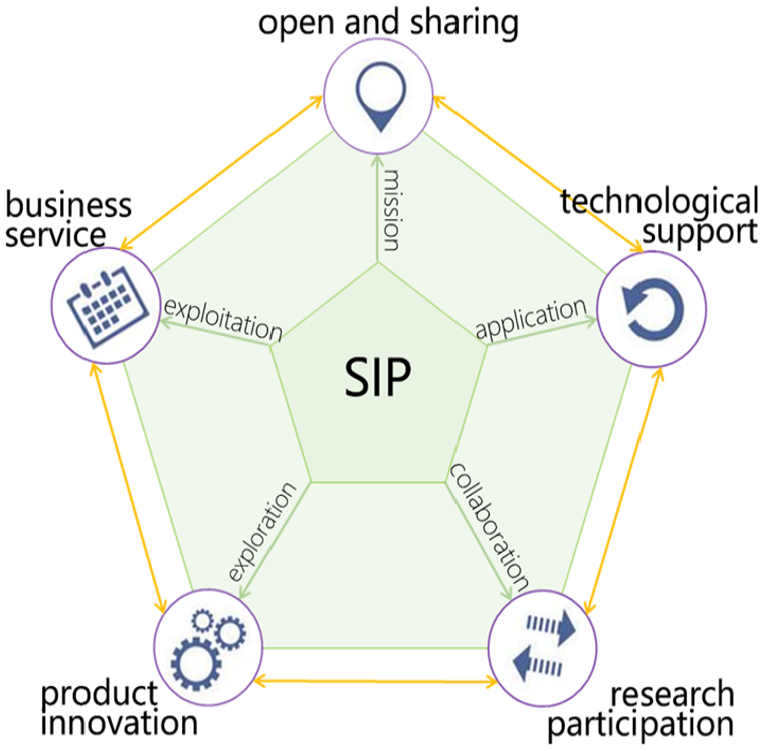
Diversify the development practices of export services for CAS SIPs. The light green arrows indicate selective emphasis on the operation process with P0 to P4 strategies, while the yellow solid arrows indicate positive interactions between different strategies.
Study Protocol
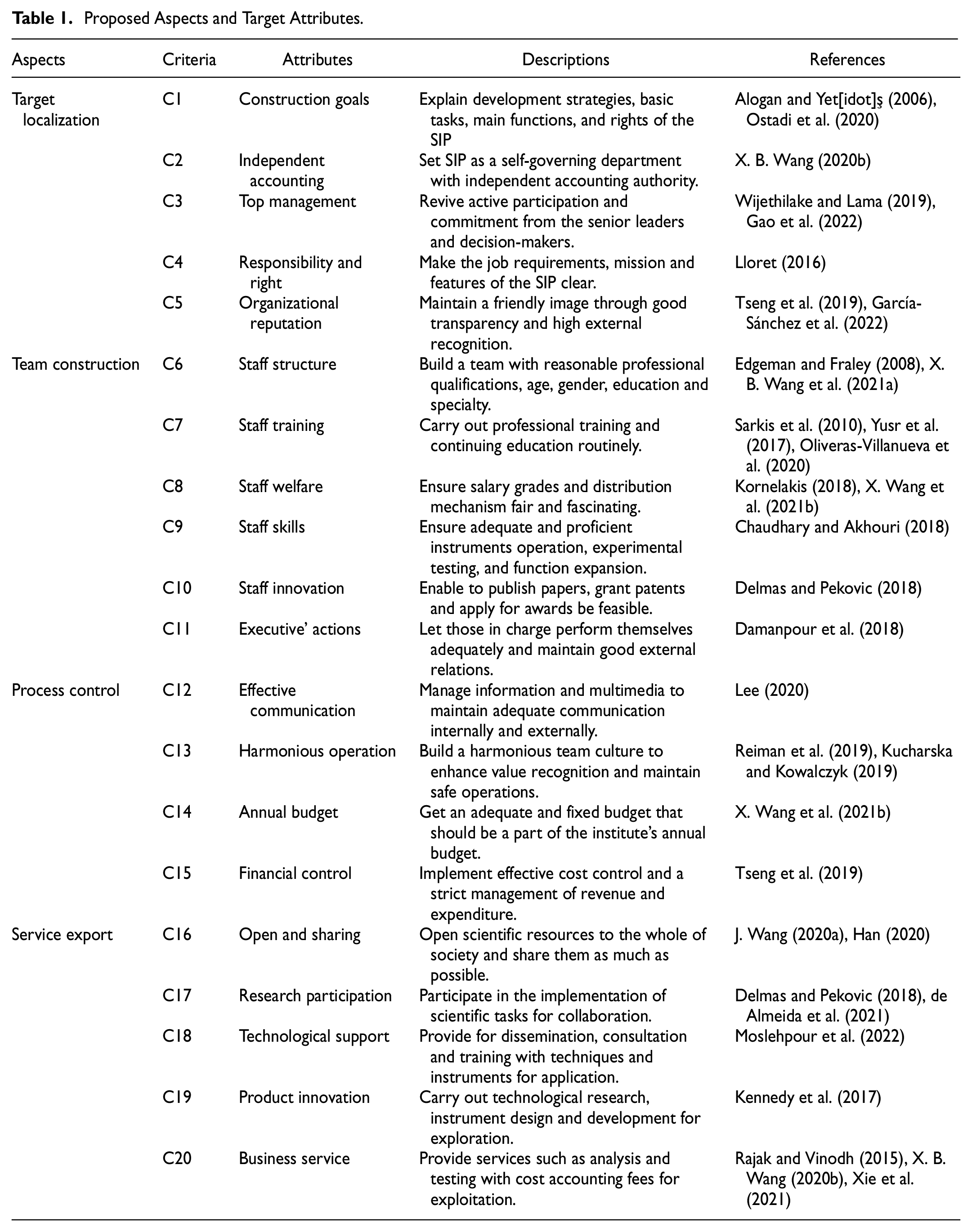
Based on the SIP sustainability evaluation framework, the reasons that some SIPs get into excellent level by rectifying and reforming their operational mechanism and that the other remain unchanged, though they have changed managing process would be revealed by their stakeholders (X. B. Wang, 2020b; X. Wang et al., 2021b). This helped narrow the survey to focus on the main aspects of the management and operation of the SIP process. Specifically, it can be distinguished from the four aspects of target localization, team construction, process control, and service export, as shown in Table 1.
Proposed Aspects and Target Attributes.
Because sustainability is extremely nonlinear, partially inconsistent and multidimensional, the results of expert evaluation inevitably contain subjective and uncertain information (Tseng et al., 2019). The fuzzy synthesis method is a branch of fuzzy set theory, which can be used to solve a variety of problems with nondeterministic characteristics (Tseng et al., 2009). Based on this approach, fuzzy synthetic evaluation (FSE) is developed to characterize and judge fuzzy attributes based on the semantic preferences of experts and to address the interdependence between attributes, which is then transformed into quantitative relations in a hierarchical framework (Shidpour et al., 2016; Tseng et al., 2019). FSE is widely used in the evaluation research and application of development strategies, sustainable performance and sustainable community management (Rajak & Vinodh, 2015). In this way, the evaluation workload of experts can be reduced and the consistency and accuracy of evaluation results can be improved (K. J. Wu et al., 2019). According to the dispersion of the evaluation data, the uncertainty processing method of information entropy is used to mine the potential information of the data, and the truth can be approximated to the maximum extent (Q. Wang et al., 2022).
DEMATEL, developed by the Science and Human Affairs Program of the Battelle Memorial Institute of Geneva between 1972 and 1979, is an effective method for analyzing the interrelationships between proposed attributes considering classification and importance (Gao et al., 2022; Kumar & Dixit, 2018; Lin & Tzeng, 2009). However, the original DEMATEL method cannot solve the problem of hierarchical structure, cannot guarantee the reliability of the data that directly affect the matrix, and cannot deal with incomplete information in the analysis process (Cui et al., 2019). Thus, exploratory factor analysis (EFA) can be used to find the structural reliability and validity of the proposed attributes (X. Wang et al., 2021b). Then, the FSE modified by the entropy weight method is combined with DEMATEL, which can meet the related needs of the identification of key factors and quantification of the influence level (Gao et al., 2022; Tseng et al., 2019; Yazdi et al., 2020). In other words, the combination of the modified FSM and DEMATEL enables decision analysis to identify crucial factors based on the semantic preference logic of hierarchical model visual causal association.
Data and Method
Sample and Data
The data for this study was collected in the form of paper questionnaires for pairwise comparisons among sustainability attributes, which were printed as 20-by-20 grids. In mid-July of 2021, the Lanzhou Regional Center of Resources and Environmental Science Instrument (CAS) hosted an in-house technical symposium with more than 50 professionals in Qingdao, China. During the conference, the study group carefully and constructively reported an attribute-based evaluation framework for sustainable SIPs with 20 extracted attribute metrics. Various stakeholders, such as the vice-presidents of several institutes as the top management, the executive officers in charge of their SIPs as the middle-level manager, the core technological staff as members, and scientific researchers as clients were all invited to participate in the evaluation. Volunteers of diverse institutes and universities were invited to give a matrix of five-point responses ranging from 1 (merely little influence) to 5 (very high influence) to represent the ratings of each of 20 criteria affecting the 20 proposed indicators. The study group had attracted at least 15 senior leaders and platform heads who had participated in one or more SIP evaluations at the national level and were familiar with the SIP operations in universities and research institutes. It should be noted that all participants were informed that their opinions would be used in the study.
A total of 45 questionnaires were sent out to those attending the symposium, of which 42 were recovered, of which 2 were invalid because their single-grade of judgments accounted for more than 90% of the total. Finally, 40 replicas of the response evaluations with variable proportions of judgments considered valid and viable outcomes were classified into this study dataset. Overall, 57.5% of respondents were male and 42.5% were female. The degrees of Doctor, Master, and Bachelor were 45%, 42.5%, and 12.5%, respectively. Their scientific, technological, managerial, and assistant positions comprised 27.5%, 45%, 25%, and 2.5%, respectively, in agreement with the distribution of positions in the annual statistical reports of the competent departments. All of them have more than 5 years of experience in SIP operations and management and a thorough knowledge of SIP sustainability, and 35% of them have been working for more than 15 years.
Fuzzy Synthetic Cause-Effect Model
Specific steps are as follows:
(1) Establish an evaluation set. Define a magnitude of the judgments of merely little influence, low influence, moderate influence, high influence, and very high influence, the evaluation set can be transformed into the qualitative evaluation frequency set of different attributes

where ci means the ith criterion and

where k is the number of experts.
(2) Calculate the weight of an attribute indicator. Firstly, the factor weights

where

in which,

(3) Calculate the membership function. Membership function

once the membership function obtained, the corresponding weighted values, namely crisp values

(4) Establish the direct relation matrix. After the crisp value obtained by aggregation calculation, the direct relation matrix

where p is the number of criteria of the s perspective, if on the overall,
(5) Calculate the total relation matrix. total relation matrix

where
(6) Evaluate the impact of different perspectives on the importance of criteria. By using the geometric mean value, the critical value

The weight coefficient of the criterion under the corresponding perspective is:

All the expert evaluation information can be integrated into the perspective, and the average frequency is calculated using the following equation:

make these aggregation frequencies be correlated with factor weights to obtain the membership function of perspective s:

Then, by using Equations (7) to (9), the total relation matrix of the aspects is obtained.
(7) Calculate the quantified correlation. Calculate the influence relationship between perspectives or criteria using the following equation:

if
Analytical Steps
(1) The 20 proposed criteria for SIPs have been evaluated by 40 SIP stakeholders. Before performing the EFA analysis, the judgments should be transformed into an ordered scale of 1 to 5. Once the evaluation results satisfy the hierarchical model, the evaluation set is deemed valid.
(2) The evaluation results would be converted into quantitative values by referring to Equations (1) and (2), and then the crisp values could be converted by Equation (3). The criteria membership function is calculated by combining the factor weights obtained from Equations (4) and (5). Then, the direct relation matrix is obtained through Equations (6) and (7).
(3) After obtaining the direct relation matrix (8), Equation (9) are used to calculate the total relation matrix. Based on the total relationship matrix, the centrality and causal degree are calculated by combining Equation (10), and then the criteria causality diagram can be obtained for visual analysis.
(4) Equations (11) to (13) are used to obtain the membership function of the perspectives and calculate the crisp value, and then these results are used to produce the direct relationship matrix and total relationship matrix of the perspective for causal association analysis. Depending on the location of attribute features in the centrality and causality 2D coordinate system, the first to the fourth quadrants can be named as strong driving factor, voluntary factor, independent factor and critical problem.
(5) Equation (14) is used to calculate the criticality value between different criteria or perspectives, which is used to identify the mutual relationships, and it is integrated into the aforementioned causal relationship diagram.
(6) To test the robustness of the above results, sensitivity analysis is needed in this study. The reliability of the model results is verified by randomly increasing and decreasing the number of available expert feedback opinions, such as introducing 10 additional or removing 10 existing evaluation results for comparative analysis.
Results and Discussion
Exploratory Factor Analysis
As with the evaluation of pairwise comparisons for each criterion, the evaluation of a set of judgments for 20 attributes under a certain criterion can also be treated as an assessment of the importance of SIP sustainability. That is, 40 experts evaluated the 20 metrics 20 times, covering all perspectives, returning a total of 800 evaluations. EFA is a statistical method that can be used to find the hierarchical structure of proposal within a set of attributes. In this study, EFA extracting 2 to 6 common factors was achieved by Mplus, version 8 (Muthén and Muthén, 1998–2017), and the final best fitting model was determined according to estimation parameters such as the chi-square value, df, AIC, BIC, CFI, TLI, RMSEA, and SRMR. The number of common factors is judged by the model recommendation, with lower values indicating better inclusion of AIC and BIC, while RMSEA and SRMR are less than 0.08 and CFI and TLI are greater than 0.9.
The 2- to 6-factor EFA results show that the values of chi-square, df and AIC continue to decrease as the number of common factors increases, while the BIC reaches its lowest value at four common factors. At the same time, a Chi-square of 235.218 (p < .001) and df of 116 means a ratio of 2.03, falling within the suggested range of 1 to 3, while CFI, TLI, RMSEA and SRMR are 0.970, 0.951, 0.036 and 0.022, meeting the recommended values, respectively. Therefore, the 4-common factor model is likely to be the best result. The results of the hierarchical structure model are then used for reliability and validity tests in the confirmatory factor analysis, where the analysis method is set to bootstrap = 5000. The output shows that the chi-square value is 332.623 (p < .001), the df is 164, CFI and TLI are 0.958 and 0.951, and RMSEA and SRMR are 0.036 and 0.035, respectively. The factor loading value of each attribute, namely, the estimated values of the verification model of all four aspects, is greater than 0.5, with each significance value (p) less than .001, as shown in Table 2, and the coefficient of variance variation is positive, demonstrating that attribute indicators are selected effectively and exactly. The composite reliability of each aspect exceeds the recommended value of 0.7, indicating a good agreement of these metrics within all four aspects. The validity of convergence is measured by the average variance extracted (AVE), which has a suggested value of 0.5 but tends to moderate to 0.36 and turns out to be consistent with the threshold, implying that the hierarchical structure converges.
Reliability, Convergence Validity, and Discriminant Validity Tests of the Dataset.

Note. The bold values at the diagonal for F1 to F4 measure their discriminant validity.
Among the aspects, the discriminant validity is measured using the square root of the convergence validity as the measurement criterion, as indicated by the bold values in Table 2. Pearson correlation coefficients between aspects show significant positive correlations, which are smaller than the reference values in bold type in each row and column, indicating good discriminant validity of the structural model. Meanwhile, the correlations between dimensions are all below 0.4, which could be used to clarify that the effect of collinearity between different dimensions is negligible. Therefore, four aspects of SIP operation management can be identified by EFA, and the hierarchical structure for sustainability evaluation is also consistent with the CAS SIP operation evaluation system. The latter includes the overall situation (10%), technological team (45%) (including platform capacity building), operational contribution (25%) and institutional mechanism (20%) (X. B. Wang et al., 2021a). This confirms the effectiveness of the four aspects of the SIP sustainability assessment framework (X. Wang et al., 2021b).
Deconstruction Into Aspect Level
According to the evaluation results of 40 experts and the semantic preference differentiation of the five-level scale, Equations (1) and (2) have been applied for translation and calculation, and for example, the C1 result under criterion C2 is (0, 0.2, 0.325, 0.325, 0.15), which means the evaluation frequencies of attribute features at levels 1 to 5, respectively. However, this raw evaluation information still needs to be fully data mined in terms of the information entropy contained in the evaluation results themselves. Therefore, Equations (3) to (6) are applied for conversion, and membership functions with different standards are obtained, as shown in Table 3. It shows the results of the same attribute index of target localization under criterion C1. These scales are converted to explicit crisp values for further computation of the direct correlation matrix. Specifically, by using Equation (7) the crisp value of C1 can be calculated as follows: a(C1-C1) = 1 × 0.6371 + 2 × 0.0647 + 3 × 0.1251 + 4 × 0.1190 + 5 × 0.0541 = 1.888, as shown in gray in Table 3.
Membership Functions for Crisp Values Under Criterion C1.

Equation (8) can be used to calculate the standard direct correlation matrix of target positioning, then the normalized direct correlation matrix can be obtained. Finally, the total relation matrix shown in Table 4 is obtained.
Total Relation Matrix of the Criteria Within the Target Orientation Aspect.

According to Table 4, the d and r values of different attributes within the target positioning aspect can be obtained, and the centrality (d + r) and causal degree (d-r) can be calculated, as shown in Figure 2. Taking the first aspect as an example, it indicates that construction goals (C1) and independent accounting (C2) play a strong driving role in current SIP operations management because they both causal and crucial factors. Although clear rights and responsibilities (C4) is also located in the II quadrant representing the voluntary nature, it is influenced by C1 and C5, while significantly affects the result of top management (C3). C3 is generally considered to be a relatively important attribute, but an outcome attribute in terms of target localization, which means that SIPs need to improve the other attribute cases before changing C3 in their routine operations. In practice, however, poorly run SIP organizations often drive their top leadership to burst into spontaneous change.

Causal effects and influences between the criteria within the aspects: (a) shows the relationships in the target orientation aspect, (b) for talented teams, (c) for process control, and (d) for service exports.
The stakeholders all believe that the department image (C5) is not a very important attribute but a bellwether for C3 who would make their mind to put a high value on SIPs if it was good. As shown in Figure 2a, a positive SIP with outstanding operational contributions must have a good image and reputation, which plays a vital role in helping it understand what extent its social mission has been achieved. The resulting organizational reputation (C5) is not only the comprehensive value display of the operation process but also the core content of realizing strategic goals and promoting organizational culture (García-Sánchez et al., 2022; Tseng et al., 2019). In practice, few SIP leaders regard departmental reputation as an element of self-assessment and self-diagnosis, and most dismiss it as irrelevant. Conversely, product image and organizational reputation directly or indirectly affect the final performance level in the operation process (Ko et al., 2013). Corporate organizational management behavior usually involves linking and practicing between social sustainability goals and financial performance to finally obtain reputation feedback (Sroufe & Gopalakrishna-Remani, 2019). In addition, organizational reputation also reflects the level of cognition and acceptance of organizational strategies by internal members (Özcan & Elçi, 2020). This is also the reason why organizational culture plays a transformative role in realizing the sustainable development of organizations (Wijethilake et al., 2023). Therefore, focusing on the role of department reputation is the cut-off point that management control would use to make a change and helps a SIP to dynamically and timely correct deviations in daily operations.
The aspects of talented teams and process control will be discussed together in section 4.3. From the specific classification of target positioning, that is, the P0–P4 perspective interaction relationship of service exports, the centrality and cause degree of Figure 2d are obtained. Technological support (C18) is currently positioned as the most important attribute of SIPs as it is their own work. The concept of open and sharing (C16) has been deeply rooted in SIP stakeholders’ hearts, influencing various development strategies and service contents in actual operations and management. On the other hand, research participation (C17) and product innovation (C19), as independent attributes, can be selected according to the strategic intentions and realistic goals of different SIPs. In addition, business service (C20), although authorized and recognized at the national level, is also considered an alternative development strategy in practice. This is because C18 itself is an alternative economic behavior within SIPs, and its essential economic and contractual ethic dictates the implementation of technological support through paid services.
Causal Effect Between Criteria
All criteria together, the importance and sensitivity rankings of the proposed attributes can be obtained by simply calculating the crisp values of all indicators under different development strategy orientations, as shown in Table 5. Here, the influence degree values for each attribute are already treated as importance rankings, while the sequence of affected degrees are treated as priority orders, both of which can be treated as key attributes for successful and unsuccessful SIPs, respectively. The results show that the success of any development strategy is inseparable from the contribution of department reputation (C5), business service (C20) and staff innovation (C10), as listed at the top of Table 5. But different strategies consist of diverse orders and combinations of other attributes. The failure of any strategy is no more than a collapse of top management (C3), executive’s actions (C11), staff innovation (C10), staff skill (C9), and construction goal (C1). This suggests that disparate successful SIPs exploit similar conditions, while poorly operated SIPs suffer from nearly the same problems. And these attributes can be critical building blocks for stable and sustainable SIPs.
Prominence for Success and Priority Against Failure of Criteria Under Different Developing Strategies.

Note. P1&Px means a double choice, and its critical value is calculated by the geometric average.
The total relation matrix is then determined according to the DEMATEL steps, and the quantitative results for causal association analysis are presented in Table 6. Among them, executive’s action has the greatest effect on stable and sustainable SIP operation, followed by staff skills and construction goals, and financial control turns out to have the smallest impact in column d of Table 6. From the perspective of current SIP operations, the person in charge of a public technology platform decides the performance level of the platform. Moreover, stable operating SIPs present a high level of staff skills and clear construction goals. On the other hand, top management and executive’s action are the most affected factors, followed by staff innovation, while the annual budget is the least affected in the r-column of Table 6. That is, top management and executive’s action are both input and outcome attributes subject to self-interference and external intervention. This suggests that recognition and action by leaders and staff innovation are critical to the achievement of SIP objectives. As the same in Figure 2b, stuff structure (C6), staff skill (C9) and staff innovation (C10) are the core issues of talent team building for current SIP operation management to get improvement, while their performance levels are more influenced by C6, stuff training (C7) and executive’s actions (C11).
The Result of Prominence and Relation Axis for Cause and Effect Groups.

Figure 3 shows that the strong drivers are construction goals (C1), staff welfare (C8) and development strategies P1–P4 (C17–C20). While the strong drivers have a major impact on the core problem factors C3 and C11, they are not effective in time because C3 and C11 are higher up the hierarchy. These two attributes are potentially rewarded with severe impact on SIP operational management for their highest centrality values. This also indicates that the expert evaluations in this study is consistent with the actual overall operation and management of CAS SIPs. The participation and promotion of C3 and C11 is not only the original driving force for the deepening development of SIPs themselves, but also a catalyst for the overall performance improvement of SIPs. Including open and sharing (C16), different goal orientations of SIP operations management all allow each SIP to achieve its organization’s social responsibilities and economic ideals through a variety of feasible paths.

Cause and effect diagrams and their strong influence among the criteria. The effects of C20 on C3 and C11 are strong and moderate, respectively, as of the same is true for C16.
Leadership and accurate leadership behavior are the keys to establishing successful sustainable practices (Camuffo et al., 2017). As the results of this study show, poorly operated SIPs always correspond to poor input from the top management. There is another synergetic factor that the construction goal (C1) and its development strategies (C16–C20) seem to not yet have the concrete restriction effect. As a common target strategy in the current development stage, open and sharing (C16) indeed promotes the SIP self-actualization and has a strong influence on C3. To strictly implement the goals, however, top management (C3) with enough attention and participation is the key to resolving all obstacles in organizational change (Gao et al., 2022; Wijethilake et al., 2023). Therefore, it is urgent to reconcile the relationship between top management commitment and diverse stakeholder pressures (Wijethilake et al., 2023). At this time, the decision-making level should study and determine the SIP responsibility and rights (C4), not only for the operation space of SIPs to ensure stability but also for the contractual relationship between SIP and stakeholders to establish a cooperation path to promote long-term sustainable development (Lloret, 2016).
Meanwhile, SIPs operating excellently in any development strategy are inseparable from the accountable actions of the platform supervisor (C11). These chief managers not only have a profound impact on the development and implementation of the relevant business of the organization but also determine the realization and improvement of organizational performance (Damanpour et al., 2018). As an incentive mechanism to achieve sustainable development, management integrity and management responsibility are not only the driving force for the formulation and implementation of strategic goals but also the key hub for reconciling diverse stakeholders (Hong et al., 2019). This also proves the effectiveness of leaders at the level of personal motivation and action, which is not only a key factor in human resource management and talent team construction (Aguinis & Glavas, 2012), but also an important input indicator for SIP operation services (X. B. Wang et al., 2021a). Therefore, in SIP operation management, a reasonable supervision and evaluation mechanism must be built to ensure that the platform manager’s values and emotions are in line with the collective interests to do the right and fair things (Strand, 2014). That is, authentic leadership in SIP operational management is eagerly needed (Cavazotte et al., 2021).
In contrast to the rapidly regulating factors of management units, the failure of talent cultivation (C8 to C10) usually could not be ameliorated quickly. Staff skill (C9) and innovation ability (C10), both based on a reasonable team structure (C6), are important factors for SIP operations to have competitive advantages and sustainable and stable development. Therefore, focusing on the growth and development of technical teams and young personnel is also the key to achieving a sustainable and stable operation of SIPs. In a platform with a low operational performance level, the initial improvement of employee welfare (C8) can practically achieve a significant moderating effect. This facilitates consensus among multiple stakeholders (Beusch et al., 2022). In addition, allowing platform leaders to choose and use the right measures is particularly important to achieve a balance between the various elements of the organization (Mundy, 2010).
In addition, organizational reputation (C5) and the internal process control aspect, which are mainly made up of effective communication (C12), harmonious operation (C13) and annual budget (C14) are prominent causal factors in whole SIP operational management. In terms of internal process control, the maintenance and improvement of financial performance (C14 and C15) are the main problems at present, while practitioners need to pay more attention to the role of communication and culture (C12 and C13) to ensure them, as shown in Figure 2c. This illustrates that better reputation and regulation equals to successful operational SIP situation and vice versa. In contrast, the resulting factors in the current development phase of SIP operation are insufficient performance levels of attributes C3, C4, C7, C9 to C11, and C15. Of these, C3 and C11 are affected by almost every other attribute, leading to paradoxes of many levels. Collectively, the benefits of SIP development lie in the win-win outcome of the achievements of the top management and the promotion of the bottom members in the dynamic operation of SIPs.
Influential Analysis for Aspects
The aspect weights can be computed using the entropy weight method with the expert evaluation dataset. Correspondingly, the weight coefficients of different aspects of this study are successively target positioning (A1, 25.1%), team building (A2, 30.3%), service export (A4, 25.3%) and management control (A3, 19.3%), which is close to the indicator system mentioned in section 4.1 and of which A2 becomes the most prominent of all. According to Equations (11) to (13), the evaluation opinions of expert feedback can be integrated into the aspect dimensions of the hierarchical model, and the total relation matrix can be obtained. Figure 4 shows the causal links for the four aspects of the hierarchical model used for SIP sustainability performance evaluation. This reveals strong effects from A3 to A2 and A4, from A1 to A2 and A4, and from A4 to A2, while not in the opposite direction, indicating the first-phase character of SIP development. At the same time, there is a weak effect from A2, A3 and A4 to A1 and from A2 to A4, indicating the complexity during SIP operation, for which SIPs cannot change one aspect to achieve overall improvement. This also suggests that building a skilled and innovative team helps improve the level of SIP operational performance, and that bottom-up internal process control drives SIP operations at the current stage.
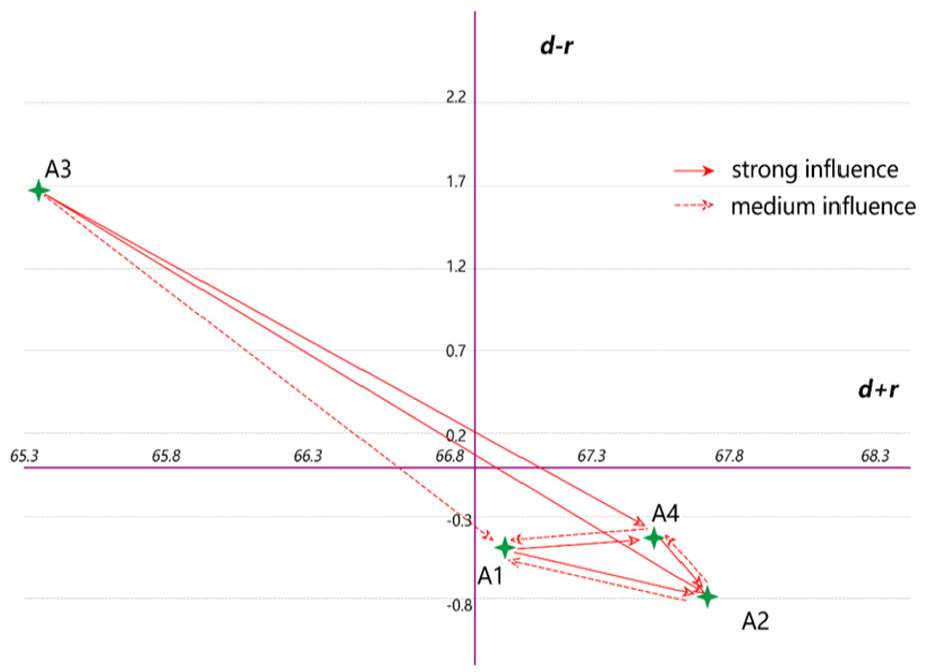
Causal diagram analysis for four aspects of SIP structural model.
Currently, the corporate sustainability goal is more used as an instrumental concept and an inclusive concept of corporate profitability (Hahn & Figge, 2011). To broadly integrate economic, social and environmental goals into corporate sustainability is nothing but to force the intersection of these three (Bansal, 2005). Defining specific types of social organizations that are suitable to carry out business activities conducive to their own development and characterizing the interaction between performance activities and SDGs are effective ways to promote sustainability goals (Zanten & Tulder, 2021). Therefore, the A1 of SIP sustainable and stable operation is decomposed into operation strategy and the conditions and paths for its realization, which not only avoids repeating the inefficient path up based on economic growth, but also demonstrates the potential of reform in the SIP operation and management when meeting the interest of management units (Eisenmenger et al., 2020). This answers at least two questions. First, the SIP performance level in the current phase can be improved by addressing the core issues, which turn out to be top-level appreciation and management control in the SIP operation process. Second, SIP sustainability reaffirms its role as a technology-oriented organization, which requires sustainable innovation to maintain competitiveness (Varadarajan, 2017). The so-called sustainable technology innovation for SIPs is the unifying and updating of A2 and A4.
To better manage public organizations, both strategic management and total quality management theory indicate the importance of a limited number of strategic objectives (Alogan & Yet[idot]ş, 2006). However, the A1 aspect of SIP operational management does not show the expected strong driving effect and falls into the core problem category. This indicates that the business on the A1 needs to be improved. Third-party evaluation and assessment by higher authority are currently the most efficient methods of SIP organizational improvements (J. Wang, 2020a). Even so, A1 still has a profound implication for A2 and A4 of SIP operational management and suffers from them simultaneously. This shows that in SIP operation management, the strategic goals and the actual operating conditions are dynamically adjusted and the optimal configuration is not achieved. This proves that the overall development status of current SIPs has not reached the threshold that requires the strict implementation of the social division of labor and responsibility. This result is consistent with the goal-oriented role of the resource perspective or the triple bottom line principle (Lintukangas et al., 2019). A1 is affected by the reactions A2 and A4, but also by the effects of A3. This suggests that the goals and strategies of the current SIP operation management process are still not clear enough, and there is a disconnect between strategic goals and daily implementation, which is an essential reason for the low level of overall sustainability performance (Millar et al., 2012).
In contrast, A3, as the most influencing factor, maintains the stability of SIPs, illustrating that SIP practitioners attach importance to their own work and the role of team culture construction in technological support systems (Han, 2020; X. B. Wang, 2020b). This also points to the fact that those stakeholders in the technical teams are enthusiastic and take SIP operations more seriously than their superiors. The literature has pointed out that financial performance has a decisive effect on organizational performance, while organizational culture promotes the former (Abu Mahfouz & Muhumed, 2020). But it is clear that it is harder to maintain excellent operating SIPs bottom-up than top-down. In view of the fact that the current states of A2 and A4 still lie in the core issue area of the causal quadrant and in the process of effectively improving the performance of SIPs in the future, these two aspects need to be fully improved to integrally promote the balanced operation and healthy development of SIPs.
Ultimately, to verify the impact of expert cognition on the research results, it is necessary to analyze the sensitivity of the sample data. In this case, on the basis of the existing evaluation result set, 10 feedback opinions (F-10) are randomly removed, 10 (F10), 20 (F20) and 30 (F30) results randomly selected from the evaluation set are added, and the actual results (F0) are all combined to carry out sensitivity analysis. The causality of the sensitivity analysis is shown in Figure 5. The A1 and A4 have some sensitivity. Nevertheless, both remain in the IV quadrant and are as robust as the results indicated by A2 and A3. In summary, despite the strong subjectivity of the experts in the evaluation process, the fuzzy synthetic evaluation of the factor weights computed by the entropy weight method ensures that the results tend to be consistent.
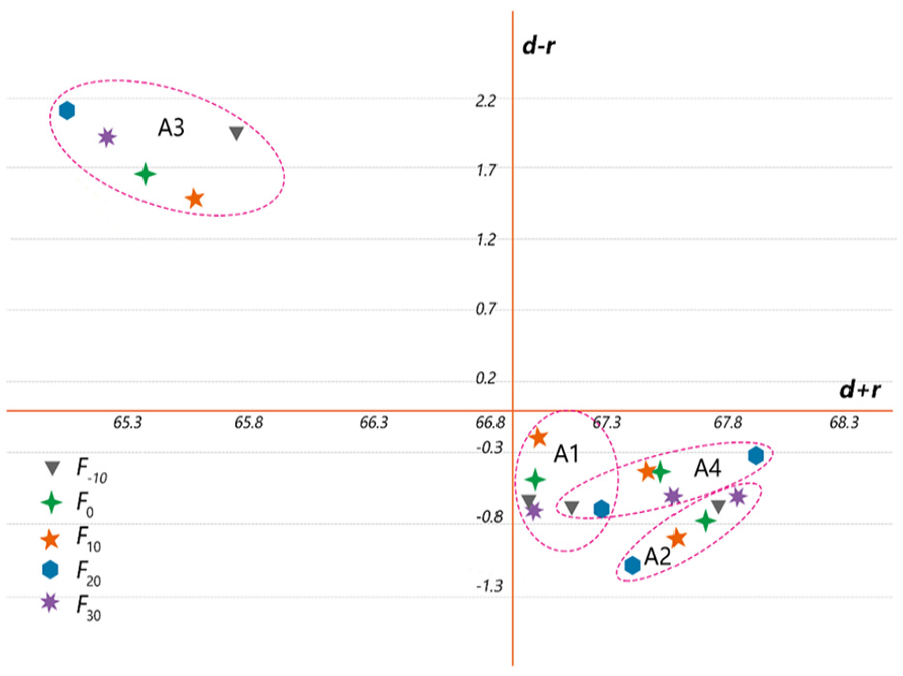
Sensitivity analysis for causal relationship of aspects. The 2D coordinate system is established by the origin of F0, which is not the raw coordinate system for others, but a relative alignment.
Conclusion
There are currently confusing implications for academic and economic activities involving the development of technological support systems. Without greater efforts by practitioners, policymakers and academics, technological support performance cannot become a strong organizational purpose and practical guideline for SIPs and their management units. This study focuses on the characteristic indicators that contribute significantly to the performance output of SIP operations and management within the CAS systems, including department reputation, team innovation ability, business service, welfare, scientific research participation, and professional competence. Factors available to improve the performance level of SIP operations include top management, executive’s action, staff innovation level, professionalism level, and construction goal, pointing out the importance of talent team building and manager actions for SIP operations management. These results confirm that the current construction and operation of SIPs are still in the initial state of accumulation, and that existing economic and commercial activities are insufficient to promote organizational reform and image change.
To further improve and stabilize the SIP sustainable development, the following measures should be taken comprehensively: (1) government departments and competent authorities should play a leading role in promoting the open and sharing of scientific and technological resources, enhancing the recognition of leaders at all levels of management units, reforming the existing performance appraisal system and establishing a supervision system. (2) SIP management units should play a main role in pursuing the SIP sustainable development, intensifying publicity efforts and improving the public awareness of open and sharing, especially making right appointments to entirely perform all the development strategies. (3) SIPs themselves should play an active role in achieving sustainable and stable operation management, proactively exploring and maintaining contacts with the customers, routinely implementing training mechanism, and continuously improving professional and innovation ability level to promote their department images transformation.
There is a limitation in raw data acquisition. The quantitative analysis of this study was carried out using evaluation comments from multiple stakeholders. All respondents were carefully selected based on their years of involvement in SIPs and adequate knowledge of management. However, there is likely to be a reasonable degree of evaluation bias due to the respondent’s inability to guide the judging process. Similarly, it is not clear whether respondents working in different job positions and cultural perspectives, with heterogeneity across management units and SIP performance levels, will consistently maintain preference coherence at a given evaluation scale. For example, SIP executives at different performance levels prefer different operation schemes. Moreover, the rating information given by different stakeholders may differ significantly, and the final integrated judgment may also deviate from the original judgment when one or some types of stakeholders are completely excluded. Future research should be based on clear application requirements, with a more reasonable and clear advisory group to evaluate the proposed attributes. Hence, further unifying the values and cultural identities of multiple stakeholders within SIP organizations is conducive to meeting more challenges in future deepening development and organizational change.
Footnotes
Acknowledgements
Thanks for the suggestions from the management committee of Lanzhou Regional Center of Large-scale Instrument for Resource and Environment and the help from those sibling regional centers.
Declaration of Conflicting Interests
The author(s) declared no potential conflicts of interest with respect to the research, authorship, and/or publication of this article.
Funding
The author(s) disclosed receipt of the following financial support for the research, authorship, and/or publication of this article: CAS Independent Intellectual Subject of Lanzhou Regional Center of Large-scale Instrument for Resource and Environment (Grant No. lz201901).
Ethics Statement
All participants were informed that their opinions would be used in the study.
