




Abstract
Information technology (IT) projects frequently struggle to fulfill their potential in today’s rapidly evolving technological landscape. Empowering leadership (EL) has emerged as a critical factor for project success; however, the underlying mechanisms of how and why EL is linked to IT project success remain largely unknown. This study aims to fill this gap by investigating the mediating and moderating roles of workforce agility (WA) and top management support (TMS) in the EL-IT project success relationship. Purposive sampling was used to collect data from 328 IT professionals in the main cities of Fujian Province, China. The data were analyzed using SPSS 24 and SmartPLS 3.2.9. The results indicate that EL is positively and significantly related to IT project success and WA, respectively. Consequently, WA has a significant and positive relationship with IT project success. The results also supported the mediating role of WA in the relationship between EL and IT project success. The study also revealed that TMS positively moderated the relationship between EL and WA. Theoretically, this study expands the project management literature by applying self-determination theory (SDT) and conservation of resource (CoR) theory to demonstrate the crucial role of EL in IT project success, particularly in the Chinese context. By focusing on the mediating and moderating effects of WA and TMS, this study provides valuable insights into the complex mechanisms underlying EL’s impact on IT project success.
Keywords
Introduction
Since the 1980s, businesses worldwide have invested in IT projects to remain competitive, lower operational costs, and meet business needs (Gemünden et al., 2018; Lei et al., 2020). However, the COVID-19 pandemic has caused an unprecedented surge in the importance of IT projects (Khattak et al., 2022). In 2023, government IT spending worldwide is expected to reach $588.9 billion, a 6.8% increase from 2022 (Gartner, 2022). Despite the significance of IT projects, some scholars argue that they remain risky and intricate (Lei et al., 2020). Cost overruns and schedule delays continue to plague most IT projects globally, with only 16.2% completed within the allotted time and budget and 31% of projects being abandoned (Khan et al., 2022a). For several decades, scholars and practitioners have attempted to identify the critical success factors that contribute to project success (Ahmadabadi & Heravi, 2019; Chow & Cao, 2008; Chua et al., 1999; Ika et al., 2012; Kaufmann & Kock, 2022; Khattak et al., 2022; Mata et al., 2023; Müller & Jugdev, 2012; Pinto & Slevin, 1987, 1989; Wateridge, 1995; Westerveld, 2003). One of the vital success factors for project success is project leadership support (Aga et al., 2016; Ali et al., 2021; Mubarak et al., 2021). However, few studies have investigated which leadership style is most effective in achieving project success (Fareed et al., 2021; Khan et al., 2020).
Project management scholars have recognized the need for new leadership styles (Müller & Klein, 2020; Khan et al., 2022b). Although EL has gained increasing attention as an emerging leadership style in the project management domain (Capaldo et al., 2021), its application in the context of IT initiatives remains understudied (Ahmad et al., 2022). Bhatti et al. (2022) argue that the modern world’s increasing globalization and technological advancement require a decentralized corporate structure and flexible leadership style to facilitate rapid change. EL is considered particularly suitable for achieving employee acceptance and effectively managing organizational changes (Frick et al., 2021). EL is a leadership style that empowers employees by delegating authority, encouraging self-directed and independent decision-making, providing coaching, sharing information, and soliciting input (Sharma & Kirkman, 2015). This approach is considered an integral part of managing organizational transformation by gathering ideas from followers (Kundu et al., 2019; Li et al., 2016) and facilitating self-autonomy and self-control (Srivastava et al., 2006). Despite its potential benefits, empirical research on EL has yielded mixed and incongruent findings, highlighting the need to examine further mediators and moderators that underlie its effect (Cheong et al., 2019).
The present inquiry proposes WA as a mediator between EL and triumph in IT projects. As defined by Breu et al. (2002) and Muduli (2013), WA denotes the capacity to adapt, innovate, and respond swiftly to unforeseen situations while displaying sufficient competencies throughout project execution. Attributes such as resilience, adaptability, and proactivity are the main constituents of WA (Cai et al., 2018). Prior research underscores the importance of leadership in fostering agile individuals (Muduli, 2013; Stoker et al., 2019), whereas empowered workers tend to become more agile (Cyfert et al., 2022; Patil & Suresh, 2019). In addition, employees with WA have been found to significantly enhance organizational success in technological ventures (Patil & Suresh, 2019). Consequently, this study posits that agile project personnel can aid EL in realizing success in IT projects.
The characteristics of a project manager who empowers their team can be a valuable asset, but it may not always be enough to ensure project success and maintain an agile workforce without the help of TMS (Ahmed & Azmi Bin Mohamad, 2016; Ali et al., 2020; Das et al., 2022). Research suggests that both TMS and leadership are crucial for ensuring project success and maintaining an agile workforce (Ahmed & Azmi Bin Mohamad, 2016; Ali et al., 2020; Das et al., 2022). Despite the importance of TMS and leadership in successful project completion (Ong & Bahar, 2019), previous studies have rarely investigated their role in ensuring successful project completion and workforce agility (Ali et al., 2020). Besides, for an organization’s strategy to be effective, top management must understand the business environment in-depth (Ali et al., 2020). Therefore, it is predicted that TMS may moderate the impact of EL on WA.
In sum, this study proposes a model (Figure 1) predicting the indirect effect of EL on IT project success through WA moderated by TMS.

Conceptual model.
Literature Review and Hypotheses Development
Empowering Leadership, Workforce Agility and IT Project Success
EL is a leadership style that involves delegating power to subordinates, allowing them to make independent judgments and decisions (Al Otaibi et al., 2022). This leadership style has been shown to increase motivation, responsibility, and authority among followers while reducing conventional organizational practices (Amundsen & Martinsen, 2014; van Dijke et al., 2012). Besides, EL encompasses accountability, authority, information sharing, self-directed decision-making, coaching, and innovative performance skill development (Konczak et al., 2000) and positively impacts employee outcomes, particularly goal achievement (Lee et al., 2018). To effectively implement EL, research suggests that leaders must exhibit relational behaviors, such as respect, trust, concern, and support (Kim et al., 2018).
In the context of project management, EL is particularly relevant because the distribution of power and autonomy inherent in this leadership style can increase the significance of project work, boost participants’ perceptions of their competence, and inspire job obligations and performance (Cheong et al., 2016). Encouraging project staff to confront uncertainty, challenges, and unexpected events to achieve project objectives is a key feature of EL (Zheng et al., 2022). Leaders who foster empowerment among their followers encourage self-reliance, self-assurance, self-control, and openness to constructive criticism (Ahmad et al., 2022). Xue et al. (2011) suggested that such leaders use empowerment to improve communication and assist project workers in completing tasks and achieving their goals. Furthermore, EL can foster communication and information exchange within project contexts, assisting followers in managing complex situations (Zheng et al., 2021). Self-determination theory (SDT) also explains the impact of EL on IT project success and workforce agility. This theory posits that empowering leaders who support their followers’ basic need for autonomy, competence, and relatedness can promote positive attitudes, enhance workforce agility, and improve performance (Lu et al., 2017; Saputra et al., 2023). The SDT explains that followers who perceive advantageous settings created by empowered leaders can build trust, demonstrate positive attention to their leaders, and improve their overall performance due to these interactions (Deci et al., 2017; Gao & Jiang, 2019). In summary, EL gives employees greater autonomy and freedom to share information and knowledge (Ahmad et al., 2022; Zheng et al., 2022). Based on SDT (Deci & Ryan, 1985) and related literature, we propose the following hypothesis:
H1: EL is positively related to IT project success.
H2: EL is positively related to workforce agility.
Workforce Agility as a Mediating Mechanism
Workforce agility (WA) is defined as the ability to respond quickly and flexibly to changes in the work environment (Breu et al., 2002; Dyer & Shafer, 2003). Pro-organizational employee characteristics, such as proactivity, adaptation, and resilience, are critical elements of WA (Petermann & Zacher, 2021). Proactivity involves anticipating and solving problems, whereas adaptation entails being open to learning and changing how one interacts with others (Das et al., 2022). Adaptability refers to the ability to adjust to changing circumstances without compromising performance (Petermann & Zacher, 2021). In the context of IT projects, agile workforces are crucial for successful change management, and scholars have emphasized the importance of worker adaptability (Bender et al., 2016; Patil & Suresh, 2019; Petermann & Zacher, 2021).
Prior research has shown that leaders significantly promote WA by encouraging creative and critical thinking among their followers (Ajgaonkar et al., 2021; Cyfert et al., 2022; Das et al., 2022). Additionally, EL fosters workers’ agility by improving their adaptability and promoting effective communication between leaders and subordinates (Grass et al., 2020; Saputra & Patrick, 2022). By promoting followers’ intrinsic motivation and emotional intelligence, EL encourages their proactive goal-seeking behavior and task mastery ((Deci et al., 2017; Ohly & Fritz, 2007) and enables them to sustain resilient behavior (Nguyen et al., 2016). As previously asserted by (Saputra & Patrick, 2022), there is a high probability that EL will enhance workforce agility, ultimately generating successful IT project outcomes. In parallel, self-determination theory (SDT) advocates that WA is a mediating element that complements effective leadership in achieving IT project success. As successful IT projects rely on workers demonstrating high intrinsic motivation, EL can incite intrinsic motivation and superior WA to increase the likelihood of project success (Deci et al., 2017). Thus, it is speculated that:
H3: Workforce agility is positively related to IT project success.
H4: Workforce agility mediates the linkages between EL and IT project success.
Top Management Support as a Moderating Mechanism
According to Chatterjee et al. (2022), a moderator is a variable that can either strengthen or weaken the relationship between two variables. In the current context, TMS acts as a moderator and may play a critical role in changing the relationship between EL and IT project success and WA. Scholars acknowledge that TMS is crucial in determining a project’s success or failure. Therefore, project leaders should seek the assistance of senior management to improve their performance and that of their teams (Ali et al., 2021; Young & Poon, 2013). TMS encompasses a range of elements, such as structure, resources, communication, expertise, and authority (Ahmed & Azmi Bin Mohamad, 2016). It involves offering financial, material, and human support to a project team, such as appointing a project manager, creating an encouraging environment, developing strategies, allocating resources, and establishing procedures (Ahmed & Philbin, 2022; Zwikael, 2008).
Based on the conservation of resources (CoR) theory (Hobfoll et al., 2018; Hobfall & Freedy, 2017), scholars have argued that TMS provides a working environment for leaders who can help project managers efficiently produce and utilize organizational resources (Ali et al., 2021). The concept of TMS constitutes the availability of financial and human resources to help project employees achieve their goals (Ahmed & Azmi Bin Mohamad, 2016; Yusof et al., 2017). TMS can be expanded to incentivize project employees to attain incredible accomplishments, such as adding new facilities and resources and recruiting highly experienced project personnel (Ahmed & Philbin, 2022; Ali et al., 2020). Thus, in line with the CoR theory, an employee’s capacity to develop and preserve their pool of resources primarily depends on external factors such as TMS (Hobfoll et al., 2018; de Jong et al., 2019). Effective management systems that foster a positive working environment can provide human resources, dispute resolution mechanisms, operational resources, and the ability to make group-led decisions, thereby creating “caravan resource corridors” that promote and enhance individual, group, and workforce resources (Hobfoll, 2011). By perceiving TMS as a supportive mechanism, leaders and the workforce can potentially increase WA and the likelihood of successful project completion. Based on the discussion, the following hypotheses are proposed:
H5: TMS moderates the linkage between EL and workforce agility such that higher TMS strengthens the association between EL and workforce agility.
Methodology
Sample and Population
The data for this study was collected from Fujian province in China for the following reasons. First, the Fujian province IT industry has experienced tremendous growth due to the “Internet Plus” strategy that promotes the integration of the Internet and traditional industries. Second, this strategy has helped the IT industry in Fujian flourish, and in 2019, the added value of the IT industry reached 470.1 billion yuan (approximately 72 billion USD), accounting for 12.8% of the province’s GDP. Third, the software and information technology services sector is one of the fastest-growing industries in Fujian.
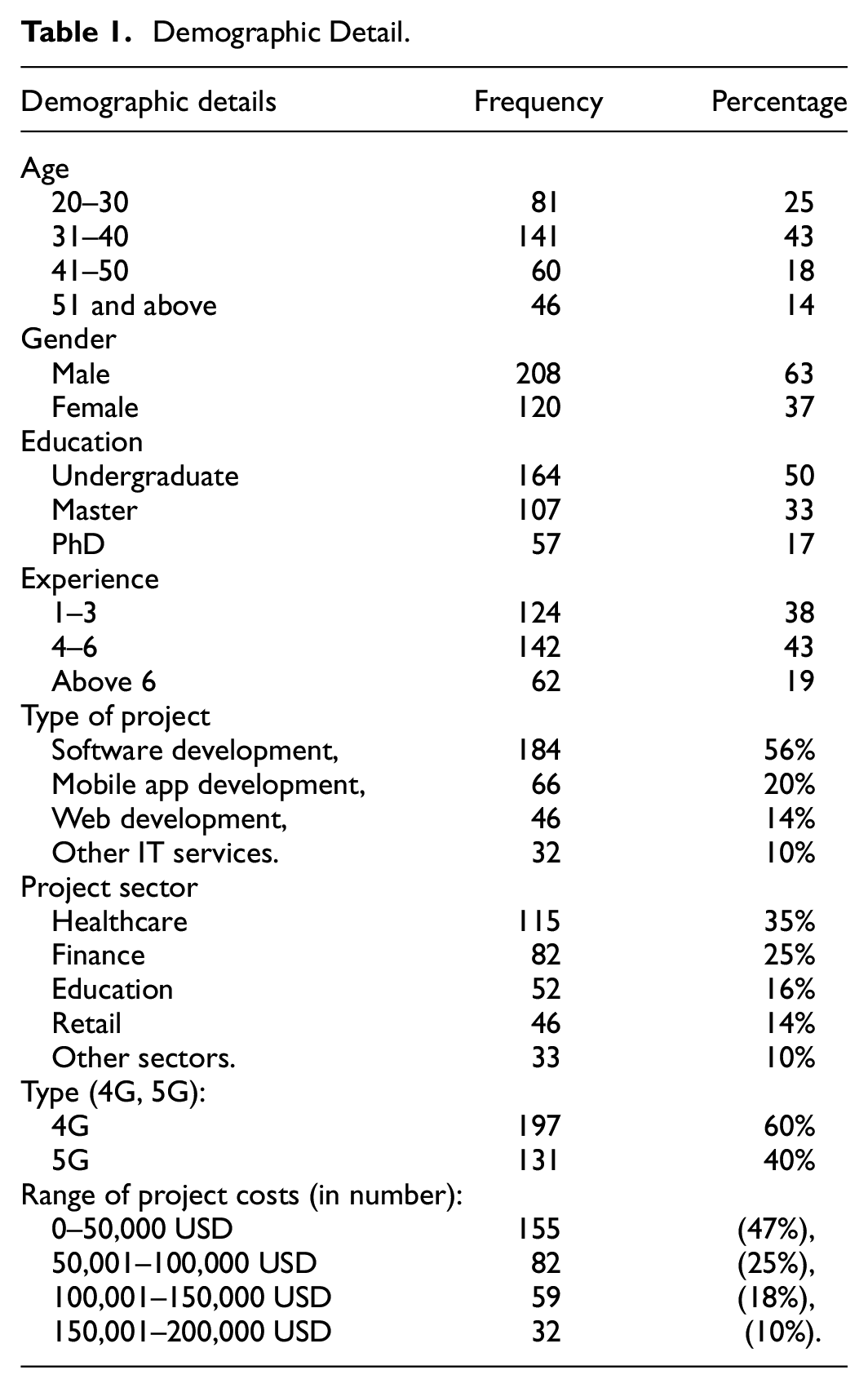
We used purposive sampling to select the respondents of the study. This sampling technique was used to carefully select target respondents, events, and settings to provide essential information that cannot be gathered from other sources (Maxwell, 2012). The target respondents of the study were employees of IT companies in Fujian, China. Furthermore, we used a three stages time-lagged questionnaire-based survey with a time interval of 4 weeks for data collection. The initial stage included questionnaires related to demographics and TMS. Respondents were asked questions about the independent variable (EL) in the second stage. Finally, questionnaires related to the mediating variable (workforce agility) and dependent variable (IT project success) were asked in the last stage of data collection. Out of the 435 questionnaires distributed, 328 complete responses were received. Demographic details are listed in Table 1 below.
Demographic Detail.
Measures and Methods
A ten-item scale by Vecchio et al. (2010) was used to solicit feedback from respondents concerning EL, with items such as “my leader encourages me to find solutions to my problems without his/her direct input.” Respondents rated their feedback on a five-point Likert scale ranging from 1 (strongly disagree) to 5 (strongly agree). The agility of the workforce was evaluated using a seven item scale developed by Muduli (2017), with the following example item: “I am flexible to quickly change from task to task, job to job, and place to place.” TMS was measured using a twenty-two-item scale developed by Ahmed and Philbin (2022), with a sample item like “provided sufficient resources for instituting organizational change to facilitate effective system implementation.” Aga et al.'s (2016) Fourteen-item scale was used to obtain participant feedback on IT project success, with one of the sample items asking respondents if “the project was completed on time.” Many researchers have used the same scale for the measurement of project success in the IT industry (Khanet al., 2022a).
Data Analysis
The data were analyzed in two steps. First, IBM SPSS 24 was used for the descriptive analysis (mean, standard deviation, and correlation) of the data (Hayes et al., 2017). Second, Partial Least Square-Structural Equation Modeling (PLS-SEM) was applied for data analysis using SmartPLS 3.2.9 software. PLS-SEM is a nonparametric technique that does not assumes normality or linearity of the data and can deal a small sample size. Two main stages were performed for data analysis using SmartPLS 3.2.9. First, confirmatory factor analysis (CFA) was performed to evaluate whether the observed variables measured the same underlying construct (Kline, 2015). In the second stage, we used bootstrapping (5,000 sub-sample) to assess the structural model and estimate the path coefficients between different variables of interest.
Results and Findings
Descriptive Analysis
The results of the descriptive analysis presented in Table 2 reveal that EL has a positive and significant correlation with WA, TMS, and IT project success. The correlation of WA with TMS and IT project success is also positive and significant. Likewise, the mean of the study variables ranged between 2.74 and 3.26.
Mean, Standard Deviation, and Correlations.

Note. EL = empowering leadership; WA = workforce agility; TMS = top management support; IT PS = IT project success.
p < .01 (two-tailed).
Measurement Model Analysis
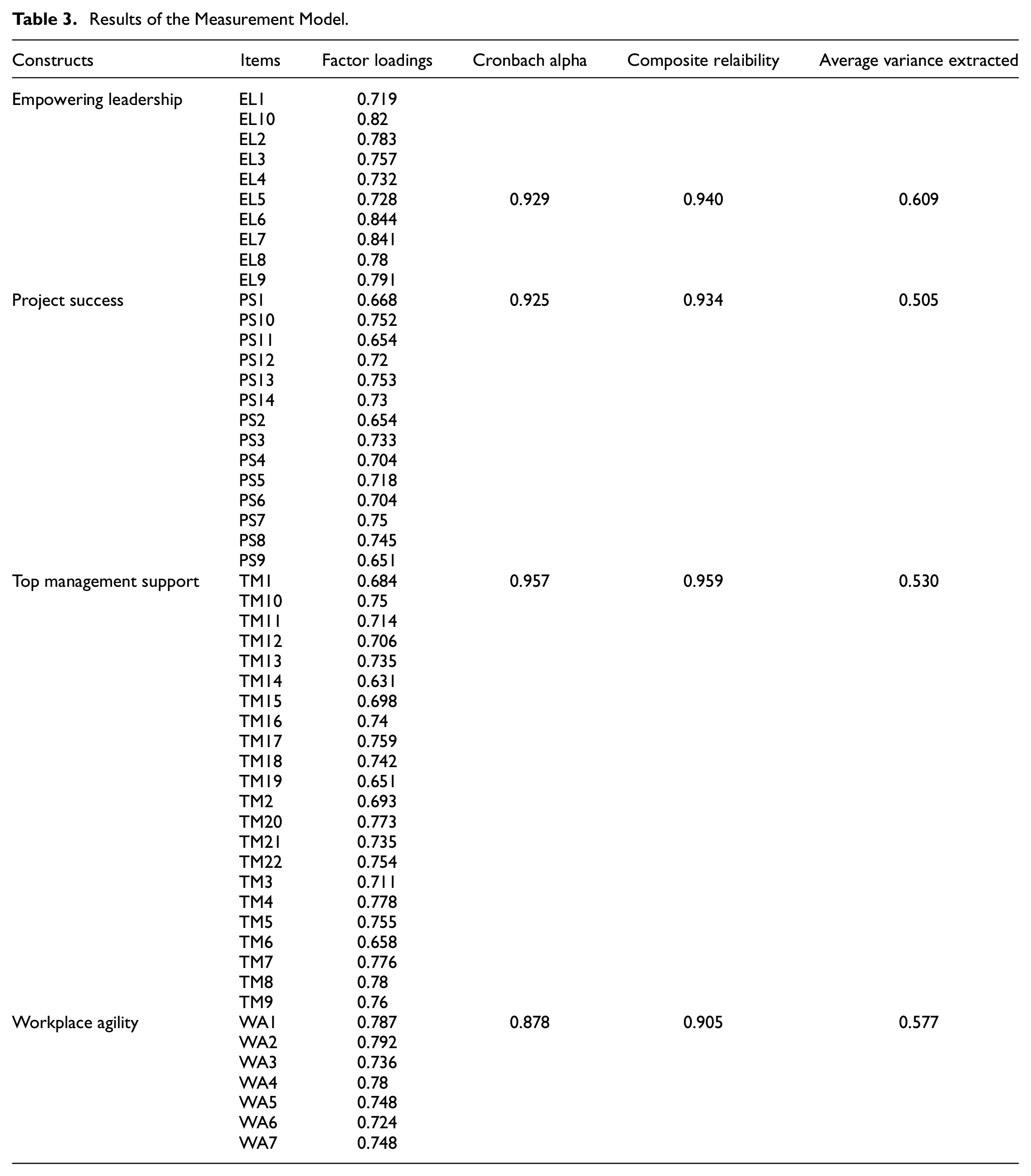
Measurement model analysis involves the assessment of the items and constructs’ validity and reliability. The measures of the measurement items and constructs’ reliability and validity are factor loadings, composite reliability and average variance extracted (AVE). Items reliability requires items factor loadings and composite reliability to be greater than 0.70. AVE values greater than 0.50 is mandatory for convergent validity. As shown in Table 3 and Figure 2, the results of the measurement model reveal that the values of factor loadings, composite reliability, and AVE exceeded their minimum thresholds of 0.60, 0.70, and 0.50, respectively (Bryne, 2010; Hair Jr et al., 2014)). These results suggest that all items and variables of the study are reliable.
Results of the Measurement Model.

Measurement model results.
Concerning discriminant validity, we used the Fornell-Larcker criterion. This criterion assumes that a construct is discriminantly valid if the square root of the AVE of each construct is greater than its correlation with other constructs (Fornell & Larcker, 1981). The results shown in Table 4 indicate that the square root of AVE of each construct is greater than its correlation with other constructs.
Fornell-Larcker Criterion.

Structural Model Assessment
Structural model assessment involves the estimation of path coefficients, t-statistics, and p-values. The results of the structural model (Table 5 and Figure 3) revealed that EL has a positive and significant impact on IT project success (β = .211, p < .05). As seen in Table 5 EL significantly predicted WA (β = .183, p < .05). The impact of WA on IT project success was also positive and significant (β = .530, p < .05). The significance of paths a, b, and c justify the presence of a mediating variable between EL and IT project success.
Structural Model Results.


Structural model results.
Mediation Analysis: Workforce Agility as an Explanatory Mechanism
To examine the WA as a mediating variable between EL and IT project success, we used bootstrapping method with 5,000 samples (Hayes & Scharkow, 2013). The findings indicate that the indirect effect of EL on IT project success via WL was positive and significant (β = .097; 95% CI [0.032, 0.168], thus providing support for H4. The beta coefficients for H1 were statistically significant in the presence of indirect effects of EL on IT project success. Thus, this result indicates the WA partially mediated the relationship between EL and IT project success.
Moderating Analysis: Top Management Support as a Key Determinant
We used a repeated indicator approach to test the moderating role of TMS between EL and WA (Hair et al., 2021). For the said purpose, we created an interaction of EL * TMS. We then obtained results through bootstrapping, and the results revealed that TMS positively moderated the impact of EL on WA (β = .099; 95% CI [0.005, 0.183]). The graphical analysis (Figure 4) also shows that the impact of EL on WA is higher when TMS support is present. In simple words, the data reflected that WA is strengthened with increased TMS input while an upsurge in EL upgraded the WA. Also, the EL-TMS interaction significantly predicted WA. These findings demonstrated the importance of considering TMS in the relationship between EL and WA.

Moderation analysis.
Discussion and Conclusion
The present study delved into the significance of EL in IT project success, focusing on the mediating and moderating effects of WA and TMS, respectively. First, of the four hypotheses tested, the results established a positive relationship between EL and IT PS, which is consistent with Ahmad et al. (2022) and can be attributed to empowering leaders’ use of recognition and incentives to enhance creativity in the workplace (Al Otaibi et al., 2022). Second, previous studies have linked EL to worker proactivity (Singh & Rangnekar, 2020), suggesting that EL enhances work mindfulness and reconciles bureaucratic restraints, enabling project employees to work confidently toward positive results (Zheng et al., 2021). This study also empirically validated that WA partially mediates the relationship between EL and IT PS, which has not been tested before.
Third, the results affirmed that TMS moderates the link between EL and WA, supporting Kanwal et al.'s (2017) claim that TMS moderates project leadership and performance. The study found that EL prioritizes TMS to ensure project success, highlighting the importance of top-level support for project managers (Ali et al., 2020; Yusof et al., 2017). This finding suggests that TMS is pivotal to enhancing WA, an essential factor in achieving IT project success. Conjointly, it is concluded that EL provisioning for TMS is perceived as more effective by followers in mobilizing WA toward successful IT project completion.
Theoretical Implication
The present research study significantly contributes to the field of project management. Firstly, the study utilizes the Self-Determination Theory (SDT) to elucidate how EL can facilitate the successful completion of an IT project. This theoretical framework enables a deeper understanding of the role of EL in project management, shedding light on the motivational factors that contribute to project success (Van den Broeck et al., 2019). Moreover, the study employs the lens of the Conservation of Resources (CoR) theory, contributing to the project management domain. The findings emphasize the critical role of TMS in developing workforce agility, thereby ensuring project success. This finding is consistent with previous research that underscores the importance of TMS in project management (Eskerod & Huemann, 2013; Hong & Kim, 2002). Secondly, this study is the first to examine workforce agility as a mediator for EL in the project context. By introducing workforce agility as a mediator, the research fills a critical gap in the literature and emphasizes the importance of agility in project management. This finding resonates with recent research on the critical nature of agility in project management, particularly in uncertain and dynamic environments (Ajgaonkar et al., 2021; Kerzner et al., 2021; Patil & Suresh, 2019). The extension of previous work expands the scope of the findings, providing insights into how workforce agility can be leveraged to achieve project success within an organizational context (Almahamid,2019).
Thirdly, this study adds to the CoR theory by introducing TMS as a moderator in the EL and WA nexus for the first time. The findings suggest that TMS plays a crucial role in enhancing workforce agility and thereby reinforcing the impact of EL on project success. Overall, this study provides new insights into the role of EL, workforce agility, and TMS in project management, highlighting the theoretical underpinnings of these constructs and their practical implications for project success. These findings are critical for project managers and organizational leaders seeking to improve project outcomes and increase organizational agility in dynamic and uncertain environments.
Practical Implications
The current study has significant practical implications for the IT business that should not be overlooked. First and foremost, organizations operating in the IT sector of Fujian should promote and educate their executives about the benefits of EL to improve the success rate of IT projects. By embracing EL, leaders can improve project outcomes by creating an environment that fosters creativity and innovation (Al Otaibi et al., 2022). Second, leaders in IT organizations should alter their style and approach to guide their team members. Encouraging team members to take the initiative, involving them in decision-making, and supporting them during uncertain situations can boost their overall performance and contribute to the project’s success (Zheng et al., 2021). Third, the study findings highlight the crucial role of TMS in project success and WA, implying that project leaders must receive top-level support from management to ensure they can effectively lead their teams and complete projects. While the study results assert that project leaders in China and other countries encourage their followers to work with greater enthusiasm and dedication, they simultaneously stress the role of TMS as an essential element in providing critical support to project leaders (Ali et al., 2020).
In a real-life industry context, Chinese tech giants such as Huawei and Tencent have recognized the importance of empowering leadership in driving innovation and achieving success. For instance, Huawei’s founder and CEO, Ren Zhengfei, has emphasized the importance of empowering employees to foster innovation and has implemented a “wolf culture” that encourages employees to take risks and challenge the status quo. Similarly, Tencent has adopted a “meritocracy” culture that values talent, creativity, and innovation, encouraging its employees to be entrepreneurial (The Economist, 2022). In other words, organizations are encouraged to create an environment that fosters creativity, innovation, and agility by promoting EL. At the same time, embracing new leadership models, enriching and altering conventional leadership style inventory, and providing TMS, could ultimately lead to successful project outcomes.
Future Recommendation
The presently offered research has a great deal of room for improvement. For instance, one of the limitations is the use of a cross-sectional research technique, which reduces the reliability of our causal conclusions (Ali et al., 2020). Longitudinal research may be conducted to provide more robust evidence for the proposed causal conclusions. In addition, the current study only addressed EL; however, in the future, researchers may investigate the influence transformational leadership has on the success of IT projects. As various scholars have pointed out, project management experts need to do more empirical studies on transformational leadership, particularly in the information technology industry; this is necessary because more than 80% of projects fail due to inadequate leadership (Kabore et al., 2021).
Moreover, the current study uses TMS as the only moderator variable; however, a future study may incorporate top management methods for WA as a moderator. According to several researchers, the absence of WA methods among top management is the primary factor contributing to the failure of organization transformation initiatives (Evangelist-Roach, 2020; Patil & Suresh, 2019; Tessarini Junior & Saltorato, 2021). Additionally, future research can explore other potential moderator variables, such as project complexity or team size, to better understand their impact on the relationship between EL, workforce agility, and project success (Ajgaonkar et al., 2021; Kabore et al., 2021). Beyond that, future studies can also focus on some of the following other undermined areas: the role of emotional intelligence in EL and IT project success (Wang & Yang, 2021); the impact of cultural diversity on WA in IT projects and its mediation effect on the relationship between EL and IT project success (Chen et al., 2024); the relationship between EL and IT project success in the context of digital transformation and its potential implications for project management in the IT industry (Sambasivan & Veeraraghavan, 2022); the role of technology readiness in moderating the relationship between EL and IT project success, and its potential implications for the IT industry (Choi et al., 2021); the impact of team trust on the relationship between EL and workforce agility in IT projects and its potential implications for project success (Kim & Ko, 2021).
Footnotes
Declaration of Conflicting Interests
The author(s) declared no potential conflicts of interest with respect to the research, authorship, and/or publication of this article.
Funding
The author(s) received no financial support for the research, authorship, and/or publication of this article.
Ethical Statement
All potential procedures were adhered to safeguard compliance with national and international ethical standards. All procedures in this study involving human participants comply in strict accordance with the Belmont Report, and Nuremberg Code, and 1964 Helsinki declaration and its later amendments or comparable ethical standards. A consent form was signed by all individuals who participated in this study.

Data Availability Statement
The data analyzed in this research are available upon request from the corresponding author.