




Abstract
Sustainable energy is considered to be the most important input for any organization owing to its noteworthy impact on the liquidity and performance of the firms. Hence, it is imperative to evidence the impact of sustainable energy on a firm’s liquidity and performance. As the disruptions in sustainable energy adversely impact the performance of manufacturing firms by reducing production directly and amplifying operational leverage, it is significant to investigate the impact the sustainable energy on a firm’s liquidity and performance. Further, the impact of disruptions in sustainable energy is size specific, therefore, the study also assumes the moderating role of firm size in shaping the stated relation. So, the aim of the current research is to investigate the impact of sustainable energy supply on liquidity and performance of the firms keeping in view the moderation effect of firm size. Using financial data of 120 textile firms from the year 2010 to 2022, the current investigation has employed a panel data methodology to quantify the impact of the sustainable energy disruption on a firm’s liquidity and performance. The results revealed that the sustainable supply of energy sources significantly impacts liquidity and working capital management as well as the performance of the textile sector in Pakistan. Further, firm size tends to moderate the relation between sustainable energy supply and performance. Although the effect is found to be partially moderated. It is recommended that in the long run, the firms might opt for alternate energy sources resulting in savings from huge performance losses. Encouraged by the inadequacy of empirical evidence in developing economies like Pakistan and keeping in view the importance of working capital management and performance efficiency, the current work is the need of the day. The impact of sustainable energy sources must be researched to gauge the impact on the manufacturing industry’s performance.
Introduction
Management of working capital plays an important role in the growth and survival of manufacturing firms. The effective management of working capital leads not only toward value creation and profitability but also enables firms to react to market changes efficiently while the inefficiencies may trigger firms to insolvency and dissolution (Padachi & Carole, 2014). Therefore, the factors that impact the management of working capital has been an important area for past researchers and scholars to explore (Nyeadi et al., 2018). Keeping in view this notion, the importance and impact of the short-term financial decisions on firm’s performance has widely been argued in corporate finance literature (Anton & Afloarei Nucu, 2020; Najib et al., 2021). Almost all authors agreed that the important of working capital management is inherent in firms’ ability to create access liquidity (Knoll & Senge, 2019). So as a buffer of liquidity creation for the firm, working capital has played a substantial role during economic turmoil (Baños-Caballero et al., 2019; Enqvist et al., 2014). It has also been widely reported in previous literature that liquidity constraints has been the important factor which hinders firms’ performance (Afrifa, 2013) while excess liquidity may impact firms’ performance adversely (Najib et al., 2021). Therefore, to maintain a balance between liquidity and solvency is important for the firms to avoid any negative consequences.
Existing literature provides noteworthy arguments that firms bankruptcy will be caused by ignoring short-term financing needs, adverse selection of financial opportunities and high involvement in long run investments (Aktas et al., 2015). So, it is important to maintain a balance between liquidity and performance to avoid adverse outcomes. Hence, the shortage of working capital has become the primary motive for the firms’ insolvency (Tufail, 2010). Therefore, the management of working capital is foremost indispensable for firms owing to the fact that it can generate balance between current assets and current liabilities to handle any imbalances in working capital needs but it also has the ability to handle unexpected liquidity shocks to cover operational expenditures (Asif et al., 2021).
Many past studies have directly examined the factors that impact the working capital management on firm performance (Cole et al., 2018; Mensah, 2016; Sarwar, 2020) but scare evidence are available which analyzed the real time determinants of the working capital management like labor strike, resource availability, and sustainable energy supply, etc. As far as the economy of Pakistan is concerned, electricity is the most important determinant that have direct impact on firms’ working capital management and ultimately performance. Like, during summer where sustainable energy supply is a regular failure, firms have to manage alternate energy supply in the form of investment in heavy generators etc. which increased the total cost of the production. Further, the continuous changes in fuel prices can disturb the operational budget when there will be availability of expensive fuel to run generators to maintain steady production. In case, where firms are not able to provide sustainable energy supply, the production will expected to be stop or disturbed impacting sales revenues directly. This case would be severe if firms will not be able to maintain their production which will ultimately lead the firms to insolvency. The ongoing discussion clearly indicates that the tenacious problem of sustainable energy supply disruptions in the form of electricity breakdowns can impact the firms’ liquidity and performance by aggregating total expenses and disturbing sales targets. Hence, the need to identify the impacts of sustainable energy/power supply on the liquidity and working capital needs of the manufacturing sector and ultimately its impact on performance is inevitable.
Further, previous studies have also shown their concerns regarding the role of firm size on firm performance that occurs when sustainable energy supply is taken as a determinant of working capital management (Cole et al., 2018) which is an area yet to be explored. Therefore, the current study also seeks to determine the moderating role of firm size on working capital-performance relation. The current work contributes to the ongoing literature by many ways. First, it directly discusses the issue sustainable energy supply failures as a determinant of working capital by extending previous evidence. Secondly, it provides direct evidence about the role of the energy crisis on firms’ performance taking into account the moderating role of firm size. Although, the relationship of energy crisis and firm performance is obvious still there is need to address the resolutions by taking into account firm size that the current investigation will provide to practitioners to enable managers to manage working capital needs, and the performance of the textile companies keeping in view real-time time factors. The present research aims to put forward specifically the distress caused by electricity crisis on listed textile companies. In fact, as per the best of authors knowledge, no existing study has stated the transformations between the pre and post-energy crisis leading to firm’s distress by incorporating panel data from selected textile companies of Pakistan for the time period of 2010 to 2022.
Overview of the Pakistan Textile Sector
Textile sector is the largest sector under the umbrella of non-financial firms having 423 textile units currently. Textile sector is considered important for the growth of Pakistan as it contributes 8.5% toward the GDP of the country. In the year 2020, the textile exports for the country reached to 1.28 billion dollars reported by The News. Further, the textile exports have recorded an extraordinary growth of greater than 17% in the value added sector. As per the recent data, the textile industry contributes almost more than 60% of total exports amounting almost to 5.2 billion US dollars. The textile industry contributes 46% to the total output produced and exported by Pakistan.
Taking into account the importance of textile sector for the growth of the Pakistan economy, sustainable power supply plays an important role toward the conduction of smooth operations. Therefore, the current study provides notable arguments as how the textile firms can cope with the power shortage and what alternative measures can make steady working capital management leading to reducing its adverse impact on overall performance.
Figures 1 and 2 defines the economic reality regarding the power consumption requirements by each sector and supply capacity of power resources. It is quite obvious that current generation of power resources is inadequate to meet the needs of all sector leading toward the power shortfall. Further, the continuous inflationary pressure of fuel and electricity prices has disturb the working capital management of the industry and budgeted estimates as well. So, the phenomena under consideration must be brought forward by some logical reasoning to devise some rational strategies to come out of the current prevailing situation.

Power supply and demand analysis.

Power consumption share by individual sector.
Previous studies conducted in Pakistan have given more preference to the issues of managing working capital, profits and capital as a whole for non-financial sector but the textile sector was not being given full importance keeping in view its relative importance toward the economic development. Therefore, the gap must be covered by creative research including the current problems of sustainable energy supply to explore its impact on the liquidity and profitability in the textile sector of Pakistan.
Hypotheses Development
The aim of the current study is to quantify the impact of power crisis as a determinant of working capital on firms’ performance. In the eyes of many scholars, electricity is considered the main driver effect the performance of every sector of an economy (Xu et al., 2022). Though, the sustainable power supply is a substantial input for most businesses’ success especially manufacturing. While, for many developing countries where sustainable power supply is a major hindrance in conducting firm’s operational activities (Allcott et al., 2016). The shortfall of electrical power has impacted almost every sector of the business. Many studies conducted in the past has established rationale logics regarding the loss of performance due to unreliable electricity supply for which these businesses have suffered losses for billions of Rs. (Pasha et al., 1990).
The unsustainable power supply can hamper the performance of the business in many ways. Firstly, it can force firms to make heavy expensive investments for self-generation of sustainable electricity sources which can lead toward high operational expenses and ultimately high operational leverage (Asif et al., 2021; Xu et al., 2022). Secondly, due to incapability to invest in such expensive investment, the small businesses may have to shut down their productions owing to power failure which can further increased the cost of labor and raw materials into production process (Allcott et al., 2016). Thirdly, many business units can outsource some of their production activities which can further increase the cost of production (Fisher-Vanden et al., 2015). Therefore, the main research hypothesis can be stated as follows:
H1: “There exists a direct relation between sustainable power supply as a determinants of working capital and firm performance in the Textile sector of Pakistan”
Since the impact of sustainable power supply in industry specific. It is more evident on the firms who are electricity intensive like textile manufacturing units and further the intensity of sustainable electricity shortfall also depends on the size of the firm. Large firms with high access to capital market can manage alternative expensive electricity resources while small firms find it difficult to manage with limited capital investment. So, the intensity of the sustainable power shortfall is tend to be industry as well as size specific. Therefore, we assume that firm size tend to moderates the relation between sustainable power supply as a determinants of working capital and firm performance. Based on these discussions the hypothesis for the current research is stated as follows:
H2: “There exists a direct relation between working capital management and performance in the Textile sector of Pakistan”
Research Methodology
The population of the study consists of all the firms in from the textile industry in Pakistan. Currently, 423 textile firms are working under the umbrella of the textile sector. To be included in the sample, the firms have to fulfill certain filtering criteria. It is considered that selected textile firms must be listed on the Pakistan stock exchange throughout the study period. The sample firms have complete data for the selected study variables for the selected study period. Firms must not belong to the financial industry. After applying filtering criteria, we are left with 120 firms listed on PSX from the textile industry of Pakistan. Table 1 defines the selected study variables and their measurement:
Study Variables.

Due to the presence of endogeneity problems within study variable, fixed effects provides inconsistent and biased estimates. The problems of FE inconsistency is resolves by the use of two steps panel GMM method developed by Arellano and Bover in 1988. GMM is applied on panel data of 120 textile firms with 13 years financial data (2010–2022). The regression equations are as follows:

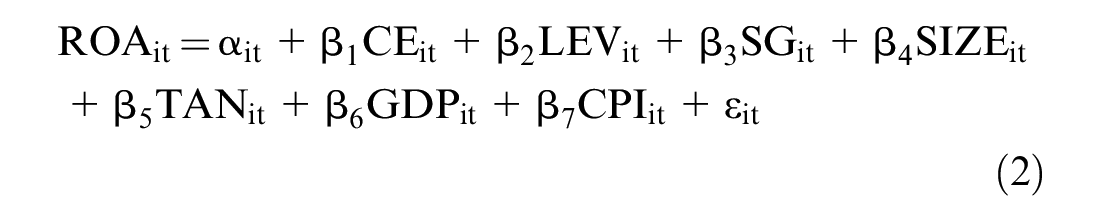

To analyze the moderation impact of firm size on the sustainable energy-performance relation, the variable of size is re-measured to divide the firms into their relative size using median of firm size. Then, equations are revised and re-estimated using size category as moderator. The revised equation is as follows:

Analysis and Findings and Discussions
Table 2 shows the descriptive statistics of the study variables. It is obvious from the statistics shown in Table 2 that mean value of ROA is 3.36% while mean value of ROE is found to be 25.8% which means that textile firms in Pakistan are making their earnings from equity rather than assets utilization. This could be due to the fact that disruption in sustainable energy supply may hinder firm assets to be translated into performance. Further, the mean value of liquidity variable stands at 35.6% showing that textile firms in Pakistan maintain almost 36% of their total assets in the form of liquid resources. Overall, descriptive statistics shows that firms in Pakistan remain profitable during the study period.
Summary Statistics.

Table 3 explains the correlation diagnostics of the study variables. The diagnostics for correlation among the selected study variables clearly shows that variables are free from multicollinearity and further tests can be performed to investigate the stated relationship.
Correlation Diagnostics.

Note. *, **, *** signify the level of significance at 10%, 5% and 1% respectively.
Results of regression analysis are given below in Tables 4 to 6. The empirical findings for equation (1) are given in Table 4 while empirical findings of equations (2) and (3) are given in Tables 5 and 6. Empirical findings from the panel regression stated under Table 4 show that the value of adj. R2 stands at .806 indicating the selected model explains 80.6% variance in explained variable. The p value for main independent variable sustainable energy supply is found to be statistically significant at 5% while it is found to be negatively associated to ROA stating that high shift in expense ratio may damage return from assets and hence performance. While, the variable of leverage is also found to be statistically significant and negatively associated to explained variable posing that high operational leverage tend to impact performance adversely when performance is translated in the form of ROA.
Empirical Findings From Equation (1).

Note. Dependent is ROA. CE explains change in expense ratio, Lev stands for leverage, SG shows sales growth, Size explains size of the firm, TAN explains tangibility, GDP accounts for gross domestic product, and CPI shows inflation.
Empirical Findings From Equation (2).

Note. Dependent is ROE. CE explains change in expense ratio, Lev stands for leverage, SG shows sales growth, Size explains size of the firm, TAN explains tangibility, GDP accounts for gross domestic product, and CPI shows inflation.
Empirical Findings From Equation (3).

Note. Dependent is LIQ. CE explains change in expense ratio, Lev stands for leverage, SG shows sales growth, Size explains size of the firm, TAN explains tangibility, GDP accounts for gross domestic product, and CPI shows inflation.
The findings from Table 4 indicate that the control variables are found to have significant association with ROA stating that null hypothesis is rejected because p-value is <.05 proving existence of significant relation between control and explained variables. It is because that efficient management of working capital in the form of low change in expense ratio leads toward smooth operationalization of business. Further, the results of macroeconomic variables defines that GDP is found to have positive while inflation has negative association with ROA although both relation are statistically significant at 5%. This is because at high level of economic development, firms tend to adopt aggressive strategy to translate their assets into sales and hence tend to be more profitable but high inflation leads to high operational expense which ultimately adversely impact performance. These relations are as per the conventional wisdom define in the existing literature (Afzal, 2012; Asif et al., 2021). It can be suggested on the basis of obtained findings that the maintenance of efficient working capital is very significant for textile industry. However, currently the textile industry in Pakistan is on slow pace due to additional operational costs.
Table 5 shows the empirical findings for equation (2). In case of equation (2), the results show that the value of adj. R2 stands at .577 stating that model can explain 57.7% variations in explained variable. The p value for main independent variable sustainable energy supply is found to be statistically significant at 5% while it is found to be negatively associated to ROE stating that high shift in expense ratio may damage return from equity and hence firm performance. While, the variable of leverage is also found to be statistically significant and negatively associated to explained variable posing that high operational leverage tend to impact performance adversely when performance is translated in the form of ROE.
The findings from Table 5 indicate that the control variables are found to have significant association with ROE stating that null hypothesis is rejected because p-value is <.05 proving existence of significant relation between control and explained variables. It is because that efficient management of working capital in the form of low change in expense ratio leads toward smooth operationalization of business. Further, the results of macroeconomic variables defines that GDP is found to have positive while inflation has negative association with ROE although both relation are statistically significant at 5%. This is because at high level of economic development, firms tend to fund their sources from equity which provides a capital cushion against unexpected risk hence tend to be more profitable. Simultaneously, high inflation leads to high operational expense which ultimately adversely impact performance. These relations are as per the conventional wisdom as defined in the existing literature (Afzal, 2012; Allcott et al., 2016; Fisher-Vanden et al., 2015). So, it can be suggested on the basis of obtained findings that the maintenance of efficient working capital is significant for textile industry for the maintenance of expected profitability level to maintain performance. However, currently the textile industry in Pakistan is on slow pace due to additional operational costs. Therefore, remedial measures are necessary to devise and implement to ensure sustain performance.
Table 6 explains the reasoning and findings of the regression model for equation (3) where liquidity is taken as dependent variable of the study. It is clear from the obtained statistics that model is found to be significant and appropriate with adj. R2 of 59.36%. The value of R2 explains that selected model explains almost 60% of the variations in explained variable. While, change in expense ratio, leverage, tangibility, and CPI are found to be negatively associated with liquidity. These result are highly significant and show that in case of high expense ratio, the low free cash flow may pose firms toward low liquidity and performance. While, high leverage, and tangibility also show that when firms invest more in long term liabilities and fixed assets, they have less to be shown as working capital which will impact liquidity of the firms. And the high inflation also found to have high operational expense and less liquidity. The regression outcomes for the model 3 can be justified through prior research work in literature (Afrifa, 2013; Audretsch & Elston, 2002). For example, literature supported that when a firms’ expenses increases its performance tend to reduce which ultimately impact ROA and ROE adversely. So, firms have to invest extra funds to maintain the sustainable power supply to continue production but the burden of high expense is manageable by large firms which have budget to do so. Hence, the size of the firm has significant impact with profitability (ROA, ROE) and liquidity because of the reason that firm size matters in the issue of budgeting and funds availability. Therefore, the current investigation also seeks a moderating role of firm size on the stated relation. The result for the moderation analysis are given in Table 7.
Empirical Findings for Moderation Impact of Firm Size.

Note. Dependent is LIQ. CE explains change in expense ratio, Size explains size of the firm while size*CE shows moderation of firm size, Lev stands for leverage, SG shows sales growth, TAN explains tangibility, GDP accounts for gross domestic product and CPI shows inflation.
, *** signify the level of significance at 10%, 5% and 1% respectively.
The moderation analysis of size variables are performed by introducing a dummy variable of size into the model. For this purpose, the data is divided into two parts one for small size firms and other for large size firms based on the median value of firm size. The 1 and 0 codes are assigned to large and small size firms into the model to show the moderation effect of size variable. The result for the moderation analysis are found to be highly significant and shown in Table 7.
The negative impact of firm size on explained variable shows that small size firms are low in profitability when translated into ROA and ROE but at the same time small is also related to low liquidity. While, the moderating variables of firm size for ROA and ROE show positive association explaining that when ROA and ROE are used as explained variables, size tend to moderates the relation of sustainable power supply and firm profitability. It means that large size firms can better manage their working capital and can be profitable even if change in expense ratio is high. Further, the moderating role of firm size shows that there exist a U-shaped relation between firms’ size and profitability. It may be due to the fact that up to a particular level of increase in expense large firms are able to control the profitability of the firms afterward the profit tend to decline if large firms are not capable enough to handle increase in expense. While, the moderating role of firm size is not proved in case where liquidity is used as dependent variable. This could be due to the fact that large size firms have higher liquidity and they can also manage their operational expense and ultimately working capital. The detail of hypothesis testing for main hypothesis is given below in Table 8:
Hypotheses Testing Results.

Conclusion
The current research was conducted to view the impact of sustainable power supply on the financial performance of corporate firms. The moderating role of firm size was also considered in the light of the importance given by literature to firm size. The results of the study revealed the fact that the sustainable supply of energy sources significantly impact the performance of the textile sector in Pakistan. Moreover, the firm size tends to moderate the association of sustainable energy supply and corporate firm performance on the basis of these results it can be recommended that although the sustainable energy is beneficial for the corporate firms in their urge to achieve efficiencies and performance but at the same time it is the need of the day that the concept of the sustainable energy must be clear to the corporate managers and there must be a clear differentiation between what is sustainable and what is not? Further there must be clear objective for the corporate managers based on which the measurement for the concept of sustainable energy will be focused to have its impact on corporate performance. It is also recommended that in the long run, the firms might have to opt alternate energy sources resulting in savings of corporate costs, huge performance losses and most importantly environment protection. The limitation of the study is the non-availability of financial data and research restrictions. This major implications of the study for textile sector can also be managed by conducting research on different explanatory variables like company governance and access to financial markets to further its scope. Further this research can be replicated on other corporate industries to view the impact of variable of interest.
Footnotes
Declaration of Conflicting Interests
The author(s) declared no potential conflicts of interest with respect to the research, authorship, and/or publication of this article.
Funding
The author(s) received no financial support for the research, authorship, and/or publication of this article.
