



Abstract
Employability and proactivity are believed to be key factors for survival in uncertain and unpredictable environments. Despite the related importance of continuous learning, little is known how learning-related factors enhance employability and proactivity. The purpose of this study was to examine the role of reflection in enhancing perceived employability and proactive behavior in turbulent conditions, drawing on positive psychology. A two-wave survey of Japanese employees (n = 408) was conducted during a pandemic period of coronavirus disease (COVID-19). Results of a structural equation model show that reflection on success had positive direct and indirect effects on perceived employability mediated through proactive behavior, while reflection on failures had no significant effect on perceived employability and proactive behavior. The findings extend prior research on employability and proactivity by examining the role of learning-related cognitive factors based on the broaden-and-build theory.
In current turbulent and uncertain work environments, dynamic changes and contingencies may cause economic structural shifts, and could result in unemployment or underemployment. Employees must adapt to such changes in cases of lay-offs and work reduction (Callanan et al., 2017; De Cuyper et al., 2011a). In particular, the current COVID-19 pandemic forces organizations to implement unprecedented large-scale changes that create uncertainties for employees (Li et al., 2021). Furthermore, job insecurity due to the pandemic has been described as causing anxiety and depression (Aguiar-Quintana et al., 2021). To survive such a turbulent situation, perceived employability, that is, the individual’s perception of his or her possibility of gaining employment (Berntson & Marklund, 2007), is believed to play a critical role in maintaining and finding employment (Forrier et al., 2015).
Previous studies have established that perceived employability does have a positive effect on health, well-being (Berntson & Marklund, 2007), self-efficacy (Berntson et al., 2008), internal and external job transitions (Forrier et al., 2015), job search strategy (De Battisti et al., 2016), and life satisfaction (De Cuyper et al., 2011b). To promote and sustain both employability and career success, proactive behavior, that is, anticipatory actions that employees take to impact themselves and/or their environments (Grant & Ashford, 2008, p. 8) is imperative, because employees must continually add value to both the organization and to themselves, especially in an unpredictable environment (Fuller et al., 2015; Parker & Collins, 2010; Seibert et al., 2001; Strauss et al., 2017). Meanwhile, as new career concepts (e.g., boundaryless career, Arthur, 1994) suggest, employability depends on continuous learning (Lysova et al., 2018; Scholarios et al., 2008), which could be facilitated by proactive behaviors. Hence, to effectively respond to a rapidly changing environment, employees need to engage in continuous and sustainable learning through self-initiated proactive activities for career development, today and in the future (Hall, 1996; Kuznia et al., 2010; London & Smither, 1999; Tymon et al., 2020).
Despite the importance of continuous learning, prior research has not explicitly explored the learning-related antecedent of perceived employability and proactivity. To address this research gap, the present study focused on the role of “reflection on success” in enhancing employability and proactivity, drawing on the broaden-and-build theory (Fredrickson, 2001, 2013) as an overarching theoretical framework. There are three reasons for its inclusion. First, reflection is believed to be a fundamental human mechanism for professional learning and performance improvement (Boud, 2012; Boud et al., 2006; Schön, 1983; van Woerkom, 2004). As Kolb’s (1984) model indicates, individuals cannot learn from their experience without reflection. Second, as the broaden-and-build theory (Fredrickson, 2001, 2013) suggests, positive emotions enhanced by a reflection on success may broaden thought-action repertories, which results in building personal resources. For example, positive psychology training (Seligman, 2019; Seligman et al., 2005, 2009) suggests that reflecting on successful experiences enables individuals to identify their strengths, which can be a basis for proactivity and employability. Third, as people tend to focus on weaknesses or deficits (Bowers, 2009), this tendency may be particularly evident in uncertain environments and may perhaps jeopardize the positive aspects of learning.
It is important to note that proactive behavior is hypothesized to mediate the relationship between reflection on success and employability, because employees may perceive their employability not only by identifying their strengths through reflecting on their success but also by using the strengths of anticipatory action to change their environment. In other words, reflection on success is believed to directly and indirectly promote employability through proactive behavior.
There are three main contributions of this study. First, this research contributes to the literature by identifying the role of reflection on success as a learning-related cognitive factor in enhancing perceived employability. This study could be the very first to explore the characteristics of productive reflection for perceived employability. Second, this study uncovers the mediating role of proactive behaviors as self-initiated proactive activities that link reflection on success to employability. The findings suggest that reflection on success broadens not only “perception” but also “actions” (Fredrickson, 2001, 2013) for continuous learning. Third, this study confirms the importance of distinguishing “reflection on success” from “reflection on failures” (Matsuo, 2020, 2021) by demonstrating that the former promotes proactivity and employability, whereas the latter has no significant effect on these attributes. This study contributes to reflection research by identifying the characteristics of productive reflection to drive proactivity and employability.
Figure 1 describes the hypothesized model. Specifically, this study examined the direct and indirect effects of “reflection on success” and “reflection on failures” on perceived employability, mediated through proactive behavior. Proactive behavior was incorporated in the model because proactive personality is a dispositional construct (Bateman & Crant, 1993) which is difficult to change. The model was tested by using a two-wave survey of employees with various occupations in Japan during a pandemic period caused by Novel Coronavirus disease (COVID-19). By examining the model during such a difficult time, it may be possible to identify proactive processes for enhancing employability in response to challenging environments.

Research model.
Literature Review and Theoretical Background
Perceived Employability
According to Forrier et al. (2015), employability has been conceptualized as the following three points of view: mobility (job transition), personal strengths (knowledge, skills, and attitudes), and perception (perceived employability). Some researchers have developed models of employability which include multiple components. For example, Fugate et al. (2004) described employability as a form of proactive adaptability which includes career identity, personal adaptability, and social and human capital. Van der Heijde and Van der Heijden (2006) also proposed a five-dimensional model including occupational expertise, anticipation and optimization, personal flexibility, corporate sense, and balance.
Although these multi-dimensional models are useful to capture a whole nature of employability, such an approach has been criticized as a “fuzzy and catch-all concept” (Forrier et al., 2015). Therefore, this study focused on perceived employability. By distinguishing the perception of employability from its determinants, it becomes possible to examine the process on how perceived employability is enhanced (Forrier et al., 2015). As perceived employability reflects how individuals perceive their opportunities in the labor market (Berntson & Marklund, 2007), it captures the interaction between personal and situational factors (Forrier et al., 2015; Vanhercke et al., 2014; Veld et al., 2015).
Regarding antecedents of perceived employability, previous studies have found that movement capital (Forrier et al., 2015), mobility supporting activities (Veld et al., 2015), career insight (De Vos & Soens, 2008), career resilience (Peeters et al., 2020), and extrinsic job opportunities (Van Emmerik et al., 2012), promoted perceived employability. It should be noted that proactive career behaviors (Chughtai, 2019) and proactive orientation (Creed et al., 2017) had positive impacts on perceived employability. As multi-dimensional models of employability also include proactivity as a dimension (e.g., McArdle et al., 2007), proactivity may be a critical determinant of perceived employability.
Proactive Behavior
Proactivity has attracted attention, because a number of organizations have faced dynamic challenges from uncertain and dynamic environments (Thomas et al., 2010). An initial approach to proactivity was to examine the effect of proactive personality, that is, the relatively stable tendency to effect environmental change (Bateman & Crant, 1993, p. 103), on positive work outcomes. Over the past two decades, researchers have focused on the role of proactive behaviors which are influenced by individual differences and contextual factors (Crant, 2000; Grant & Ashford, 2008; Parker et al., 2010).
Grant and Ashford (2008) defined proactive behavior as “an anticipatory action that employees take to impact themselves and/or their environment” (p. 8), which consists of anticipation, planning, and action directed toward future impact. Specifically, proactive employees anticipate future outcomes, develop plans to implement their ideas, and signify their physical manifestation of anticipation alongside planning in concrete behaviors, in order to change themselves and to influence the environments (Grant & Ashford, 2008). Such behaviors are beneficial not only for organizational success but also for employees’ career success particularly in unpredictable environment (Fuller et al., 2015; Grant et al., 2009). A meta-analytic study found that proactivity including proactive personality and behaviors is positively related to employees’ satisfaction, organizational commitment, social network, and performance (Thomas et al., 2010).
Although proactive personality has been seen to be able to promote employability (Creed et al., 2017; Fuller & Marler, 2009; Guilbert et al., 2018; Seibert et al., 1999), only limited studies have examined the effect of proactive behaviors on employability (e.g., Chughtai, 2019). Considering the common features between proactive personality and proactive behavior, it is possible to predict the positive effect of proactive behavior on employability.
The main rationale for the proactivity—employability relationship is associated with the assumption of a new career concept that continuous learning is necessary to enhance employability (De Vos et al., 2011; Lysova et al., 2018; Scholarios et al., 2008). That is, employees need to proactively develop their competencies and acquire skills to navigate their boundaryless careers (Colakoglu, 2011). Specifically, proactive employees are likely to perceive ease of movement and alternatives because they develop their competencies and skills through identifying and pursuing opportunities for self-improvement and performance (Seibert et al., 1999). Therefore, the following hypothesis was proposed.
Reflection on Success and Failures
This study focused on the role of reflection for two reasons. First, reflection has been regarded as a basic human mechanism for learning (Boud, 2012; Boud et al., 2006; Schön, 1983), which is imperative for enhancing employability (Arthur, 1994; De Vos et al., 2011; Lysova et al., 2018; Scholarios et al., 2008). Previous learning theories have indicated that individuals learn through reflection on their experiences (Kolb, 1984; Korthagen, 2005; Mezirow, 1990; Schön, 1983). Second, since proactive behavior is an anticipatory action with planning (Grant & Ashford, 2008), reflection as a cognitive activity may become necessary for such anticipation and planning. Accordingly, Schön (1983) also suggested that “reflection in action” is a key for professional development and innovation.
Hatton and Smith (1995) defined reflection as “deliberate thinking about action with a view to its improvement” (p. 40). More specifically, Korthagen (2005) proposed that reflection consists of “looking back on the action,” “awareness of essential aspects,” and “creating alternative methods of action.” Similarly, Kolb (1984) stated that individuals gain abstract concepts for future development by reflecting on their experiences. Based on these studies, the present research conceptualized reflection as “deliberate thinking about experience to improve one’s capacity, behavior, and performance,” which includes the steps of “looking back on the experience,” “awareness of essential aspects,” and “extracting lessons for improvement.”
Drawing on the broaden-and-build theory (Fredrickson, 2001, 2013), which is closely associated with positive psychology (Peterson & Seligman, 2004; Seligman, 2019), this study focused on the role of “reflection on success.” It is important to bring up a positive psychology exercise called “Three Good Things,” which has been seen to have a positive effect on participants’ happiness and self-efficacy (Guo et al., 2020; Mongrain & Anselmo-Matthews, 2012; Seligman et al., 2005, 2009). The exercise asks participants to write down three good things that happened each day, and to reflect on why they happened (Seligman et al., 2005, 2009). This exercise can be explained by the broaden-and-build theory (Fredrickson, 2001, 2013), which suggests that positive emotions enhanced by reflecting on successful experiences broadens the thought-action repertories which help individuals expand their personal resources. This method has been applied to performance appraisal research as “strengths-based approach,” in which managers encourage employees to reflect on their successful experiences, discover their strengths, and use them to improve performance (Bouskila-Yam & Kluger, 2011; Kluger & Nir, 2010).
Importantly, following these studies, Hiemstra and Van Yperen (2015) classified self-regulated learning strategy into “strength-based strategy” and “deficit-based strategy.” In the former strategy, participants identify their strengths and select development activities to improve those strengths, while in the latter strategy, participants identify their shortcomings and select development activities to improve those shortcomings. Using an experimental study of college students, they found that participants using strength-based strategy achieved higher competence through enhancing intrinsic motivation and effort intentions, than those using deficit-based strategy.
Based on Hatton and Smith (1995), the broaden-and-build theory (Fredrickson, 2001, 2013), and positive psychology (Seligman et al., 2005, 2009), Matsuo (2020) conceptualized “reflection on success” as deliberate thinking about experiences of success to increase one’s strengths and “reflection on failures” as deliberate thinking about experiences of failures to improve one’s weaknesses. The former corresponds to strength-based learning strategy, while the latter corresponds to deficit-based learning strategy (Hiemstra & Van Yperen, 2015). In association with this conceptualization, Matsuo (2020) developed and validated scales of reflection on both success and failures.
It is necessary to note that “success-failures” reflection should be distinguished from “positive-negative” reflection, which refers to the recall of positive and negative events (Fritz & Sonnentag, 2005, 2006). Fritz and Sonnentag (2006) have reported that negative work reflection during vacations predicts exhaustion and disengagement after vacation. In contrast to “positive-negative” reflection, “success-failures” reflection focuses on deliberate thinking about work experience for improvement.
Notably, research on strengths-based approach rooted in positive psychology has found that individuals who identify and use their strengths tend to show higher happiness, well-being, efficacy, self-empowerment, intrinsic motivation, and perceived competency (Austin, 2006; Hiemstra & Van Yperen, 2015; Linley et al., 2010; Proctor et al., 2011; Seligman et al., 2005). These studies suggest that strengths can be personal resources, that is, the beliefs on control over environment, for self-initiated change behaviors and employment, as indicated by Job Demands—Resources (JD-R) Theory (Bakker & Demerouti, 2014, 2017). Accordingly, Matsuo (2021) reported that reflection on success promotes proactive behavior. The results correspond to previous studies reporting that activated positive mood or affect enhanced proactive goal regulation, which includes envisioning, planning, enacting, and reflecting (Bindl et al., 2012; Wang et al., 2021). Thus, the findings of Matsuo (2021) can be interpreted to mean that a positive effect activated by reflecting on success may enable employees to set higher goals and encourage self-initiated action (Bindl et al., 2012; Ilies & Judge, 2005). Based on the broaden-and-build theory (Fredrickson, 2001, 2013), positive psychology (Seligman et al., 2005, 2009), and the empirical evidence, employees who reflect on their successful experiences to improve their capacities, are likely to better identify their strengths, which enable them to change their circumstances. Therefore, the following hypothesis was created.
Considering that the concept of employability includes “personal strengths” (Forrier et al., 2015), identifying one’s strengths through reflection on success may enhance employees’ perceived employability. Even if personal strengths are not used to change circumstances, their identification may increase the perceived possibility of gaining new employment by recognizing one’s repertories of thoughts and actions, as suggested by the broaden-and-build theory (Fredrickson, 2001, 2013) and positive psychology (Seligman et al., 2005, 2009). Therefore, the following hypothesis was proposed.
In contrast to individuals who reflect on success, employees reflecting on failures are more likely to identify their weaknesses rather than strengths. For example, Matsuo (2020) found that reflection on failures was not significantly related to the use of strengths. Importantly, weakness-based coaching was found to result in defensive reactions and a decreased desire to improve performance (Aguinis et al., 2012; Jawahar, 2010). Hiemstra and Van Yperen (2015) also reported that participants with deficit-based learning strategy showed lower perceived competence and intrinsic motivation than those with neutral learning strategy. The findings can be interpreted to mean that employees who focus on negative results such as failures, weaknesses, and deficits may downwardly adjust their goals (Ilies & Judge, 2005). Based on these studies, employees who reflect on failures are likely to identify their weaknesses and problems, which may downgrade goal levels and self-efficacy for changing the existing circumstances. Therefore, the following hypotheses were proposed.
Given Hypotheses 1 and 2, it is predicted that proactive behavior positively mediates the relationship between reflection on success and perceived employability. The mediation derives from the function of proactive behavior which includes anticipatory planning to foresee future outcomes (Grant & Ashford, 2008). That is, employees who identify their strengths through reflecting on success, may have a positive anticipatory plan for their career. However, the mediation effect may be partial rather than full, because reflection on success could directly enable employees to be conceptually employable just by promoting the understanding of their strengths. Therefore, the following hypothesis was proposed.
Considering Hypothesis 4, proactive behavior may negatively mediate the relationship between reflection on failures and perceived employability, because employees who identify their weaknesses and problems through reflection on failures, cannot have a positive anticipatory plan for their career. Given Hypothesis 5, the mediation effect may be partial, because reflection on failures could directly lower the confidence for movement by identifying their weaknesses and problems. Therefore, the following hypothesis was proposed.
Methods
Participants and Procedure
Data were collected using a two-wave online panel survey in Japan with a 3-week interval. Specifically, reflection on success and reflection on failures were measured on Time 1 (March 27–29 in 2020), whereas proactive behavior and perceived employability were assessed on Time 2 (April 17–19 in 2020). In Japan, the number of people tested positive with coronavirus sharply increased at the end of March, and the Japanese government declared a state of emergency on April 7, which forced the majority workforce to change their work practices (provided with the feasibilities) such as working from home or temporary work suspension. According to the experiential learning cycle (Kolb, 1984), which consists of “concrete experience,” “reflective observation,” “abstract conceptualization,” and “active experiment,” a prolonged time-lag should not exist between reflection and subsequent perception and behaviors. Thus, a 3-week interval was considered appropriate for the research model. Notably, Fritz and Sonnentag (2006) measured well-being and task-performance 2 weeks after measuring work reflection.
An online survey was adopted because it is possible to collect data from individuals with various occupations in wider geographical location (Ahn et al., 2007; Holland et al., 2013). The survey was conducted via a well-known internet research company in Japan. This study was announced by the company to full-time employees in their research pool. In collecting data, the research company stratified sample by gender, age (20, 30, 40, and 50 years), and position (non-manager vs manager) as well-balanced until the number of respondents was over 500. Within 3 days after announcement, 520 employees voluntarily responded to the first questionnaire. Of the participants, 408 employees responded the second questionnaire 3 weeks after the first one.
The sample was 50.5% male, with an average tenure of 13.2 years (SD = 10.4). Respondents’ age varied between 20 to 60 years (M = 40.9; SD = 10.5). Their positions were non-manager (50.0%), junior manager (27.0%), middle manager (14.7%), senior manager (5.9%), and executive officer (2.5%). The respondents worked in private firms (79.9%) and government sectors (20.1%). The size of organizations that the respondents worked for were 99 or fewer (31.4%), 100–499 (21.1%), 500–999 (12.3%), 1,000–4,999 (15.9%), 5,000–9,999 (7.4%), and 10,000 or more (12.0%).
Measures
As the questionnaire was in Japanese, back translation was performed to check the equivalence between original English version and translated Japanese version, following the procedure outline by Cascio (2012).
Reflection on success and failures:
Reflection on success and failures was assessed using the scales developed by Matsuo (2020). All items are shown in the Appendix. Both constructs were evaluated using a five-point scale (5 = strongly agree, 1 = strongly disagree), respectively. The Cronbach’s alpha and composite reliability were .87 and .87 for reflection on success, and .87 and .87 for reflection on failures.
Perceived employability:
Perceived employability was evaluated using a four-item scale created by De Cuyper et al. (2011a). A sample item is “Given my qualifications and experience, getting a new job would not be very hard at all.” Ratings were on a five-point Likert scale (5 = strongly agree, 1 = strongly disagree). Cronbach’s alpha and composite reliability were .89 and .89, respectively.
Proactive behavior:
Proactive behavior was assessed using a six-item scale developed by Griffin et al. (2007), which includes three items for individual task proactivity and three items for team member proactivity. Sample items are: “I initiated better ways of doing my core tasks (individual task proactivity),” and “I suggested ways to make our work unit more effective (team member proactivity).” Ratings were on a five-point Likert scale (5 = always, 1 = never). Cronbach’s alpha and composite reliability were .93 and .93, respectively.
Control variables:
Following previous studies (e.g., Griffin et al., 2007; Strauss et al., 2015), gender (1 = male; 2 = female), position (1 = non-manager; 2 = junior manager; 3 = middle manager; 4 = senior manager; 5 = executive officer), and tenure (years of experience in the organization) were control variables included in the model. In addition, size of organization (number of employees: 1 = 99 or fewer; 2 = 100–499; 3 = 500–999; 4 = 1,000–4,999; 5 = 5,000–9,999; and 6 = 10,000 or more) was controlled because it may affect stability of employment.
Common Method Variance
Although this study conducted a two-wave longitudinal survey, proactive behavior, and perceived employability were measured at Time 2. Thus, it is necessary to examine the possibility of common method bias. Based on the recommendation of Podsakoff et al. (2003), the unmeasured latent method construct (ULMC) approach (Williams et al., 1989) was used to assess common method variance (CMV). In this approach, items were loaded both on their theoretical constructs and on a latent methods variance factor (Podsakoff et al., 2003). Specifically, CMV is estimated by specifying factor loadings from the ULMC to all the items of the model, although ULMC does not have any unique indicators of its own (Williams & McGonagle, 2016). If the proportion of variance attributed to ULMC is less than 25%, which is the median method variance across studies (Williams et al., 1989), it is generally concluded that common method bias is not significant in the data (e.g., Carlson & Kacmar, 2000; Choi & Chen, 2007). This method has been used and supported in previous studies (Min et al., 2016; Podsakoff et al., 2003, 2012; Williams & McGonagle, 2016). This approach was also adopted in the present study because the specific factors responsible for method effects are not necessary to detect CMV. The results showed that the proportion of variance attributed to ULMC was 12.4%, which was smaller than the median of 25%, suggesting that common method variance was not significant in this study.
Analytical Strategy
A series of confirmation factor analyses (CFAs) were performed to examine the discriminant validity of the constructs in the model. To test the hypotheses, structural equation modeling (SEM) with the Mplus Version 8.3 (Muthén & Muthén, 1998–2017) was used. Following Mathieu and Taylor (2006), the fit indices of the hypothesized partial mediation model were compared with those of an alternative full mediation model to determine the best model. The mediation hypotheses were tested by bootstrapping analyses with 2,000 samples. Finally, multiple regressions analyses were performed to calculate Variance Inflation Factors (VIFs), to assess multicollinearity.
Results
Measurement Model
As shown in Table 1, the results of a series of CFAs indicate that the hypothesized model with four factors had better fit to the data than those of three, two, and one-factor models. Table 2 shows that the average variance extracted (AVE) estimates for each construct were greater than the shared variance estimate. These results suggest discriminant validity of the hypothesized model. Table 2 also shows that Cronbach’s alphas and composite reliabilities of all constructs were greater than .70, indicating internal consistency of the constructs (Nunnally, 1978).
Comparison of CFAs.

Note. Four-factor model: each variable was loaded on a single factor; In the three-factor model, reflection on success and reflection on failures were combined; In the two-factor model, reflection on success, reflection on failures, and proactive behavior were combined; In the one-factor model: all variables were combined in a single factor.
p < 0.001.
Descriptive Statistics, AVE, CR, Cronbach’s alpha, and Correlation Matrix.

Note. Gender (1 = male; 2 = female). Size of organization (number of employees: 1 = 99 or fewer; 2 = 100–499; 3 = 500–999; 4 = 1,000–4,999; 5 = 5,000–9,999; and 6 = 10,000 or more). Position (1 = non-manager; 2 = junior manager; 3 = middle manager; 4 = senior manager; 5 = executive officer). Tenure = years of experience in the organization. AVE = averaged variance extracted. CR = composite reliability. α = Cronbach’s alpha.
p < .05; **p < .01; ***p < .001. Correlations are below the diagonal, and squared correlations are above the diagonal.
Hypotheses Testing
Before testing the hypotheses, the fit indices of the hypothesized partial mediation model were compared using SEM with those of an alternative full mediation model which had no direct paths from reflection on success and reflection on failures to perceived employability. The results show that partial mediation model had better fits (χ2 = 528. 40, df = 236, CFI = .947, RMSEA = .055, SRMR = .052) than the full mediation model (χ2 = 546.84, df = 238, CFI = .944, RMSEA = .056, SRMR = .063). Hence, hypotheses were tested using the partial mediation model.
Regarding the effects of control variables, Table 3 shows that a higher position leads to higher proactive behavior (.32, p < .001), while female employees tend to perceive lower employability (−.11, p < .05). Results also indicate that employees with a longer period of tenure showed lower employability (−.13, p < .01) (Figure 2).
Results of SEM.
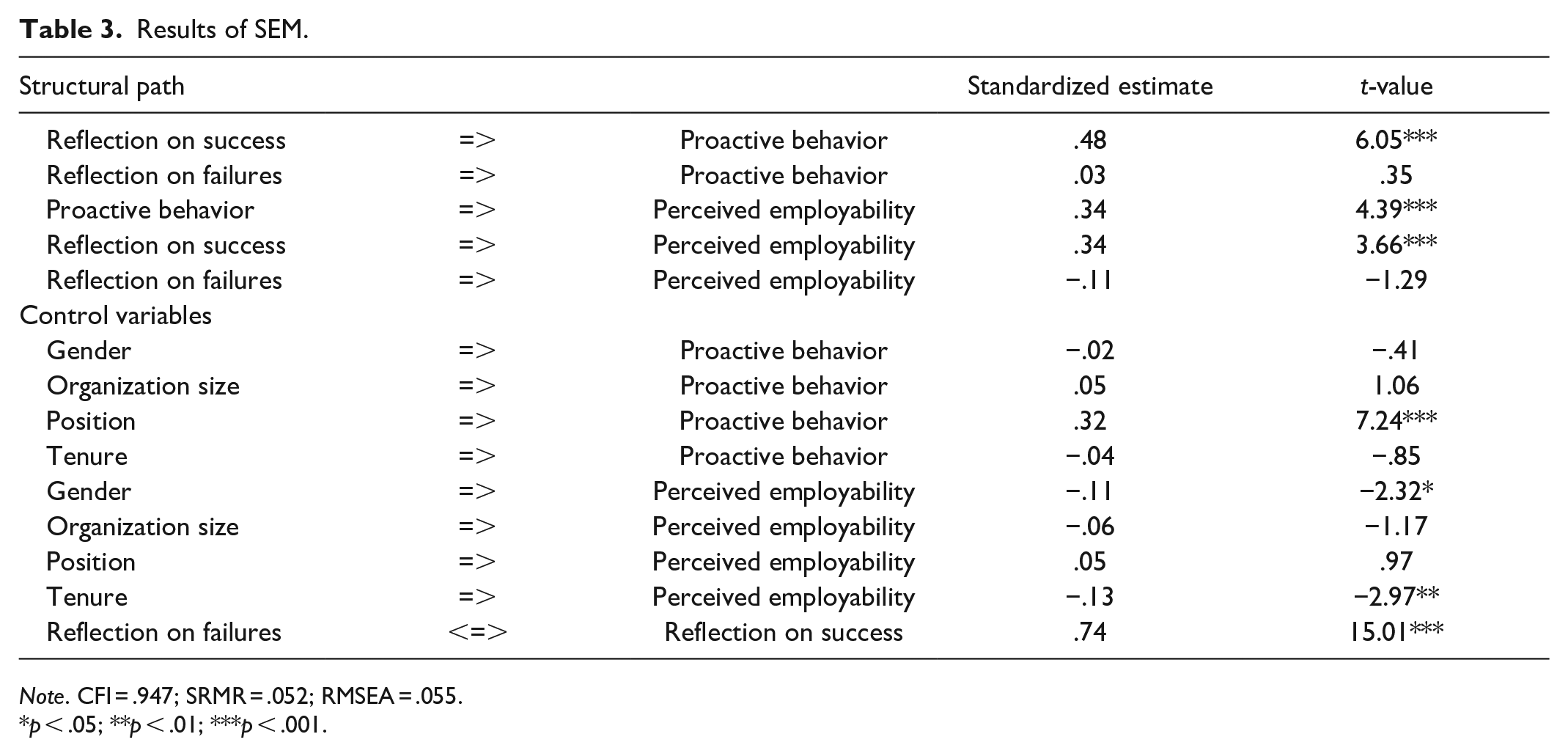
Note. CFI = .947; SRMR = .052; RMSEA = .055.
p < .05; **p < .01; ***p < .001.

Summary of SEM results.
As shown in Table 3, SEM results indicated that proactive behavior was positively related to perceived employability (.34, p < .001), supporting Hypothesis 1. Table 3 also shows that reflection on success was positively related to proactive behavior (.48, p < .001) and perceived employability (.34, p < .001), which supported Hypotheses 2 and 3. On the other hand, reflection on failures was not significantly related to proactive behavior (.03, ns) and perceived employability (−.11, ns). The results did not support Hypotheses 4 and 5 which predicted the negative relationships among variables.
To test the mediation hypotheses, boot strapping analyses were conducted with 2,000 samples (Table 4). The results show that indirect effect of reflection on success on perceived employability through proactive behavior was significant (indirect effect = 0.16, p < .001), and the 95% confidence intervals (CIs) for the indirect effect excluded zero (95% CI [0.10, 0.24]), while indirect effect of reflection on failures on perceived employability through proactive behavior was not significant (indirect effect = 0.01, ns), and the 95% CI for the indirect effect included zero (95% CI [−0.03, 0.06]). Therefore, Hypothesis 6 was supported, while Hypothesis 7 was not supported.
Results of Bootstrapping Analyses.
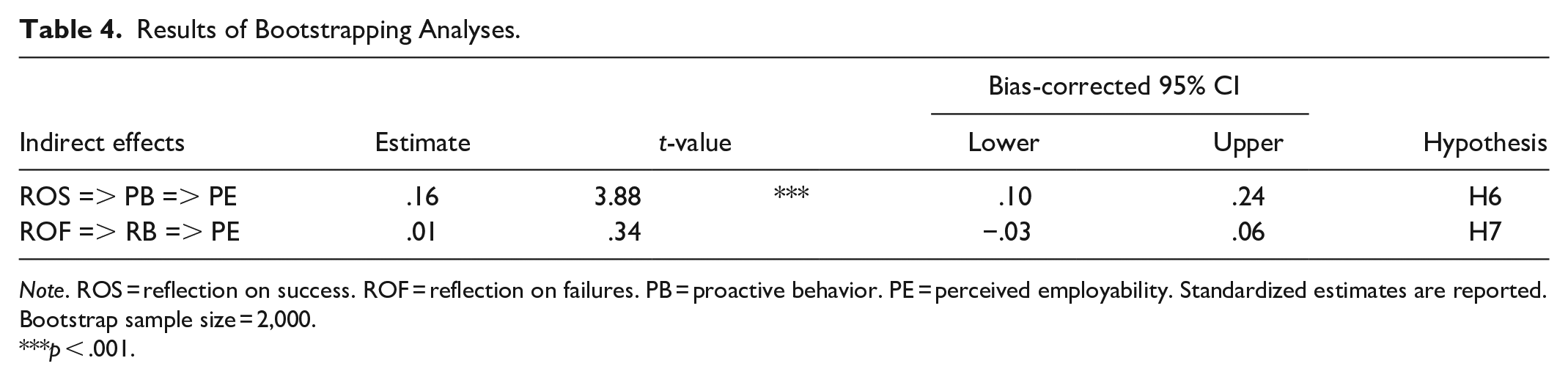
Note. ROS = reflection on success. ROF = reflection on failures. PB = proactive behavior. PE = perceived employability. Standardized estimates are reported. Bootstrap sample size = 2,000.
p < .001.
As the correlations between reflection on success and reflection on failures was high, multicollinearity may have influenced the results. To check the effects, two multiple regression analyses were performed to calculate Variance Inflation Factors (VIFs). First, a multiple regression analysis was conducted to evaluate the effects of reflection on success, reflection on failures, and control variables on proactive behavior. Second, a multiple regression analysis was performed to evaluate the effects of reflection on success, reflection on failures, proactive behavior, and control variables on perceived employability. The analyses generated results similar to the SEMs, and the VIFs were from 1.05 to 1.97, which were lower than the threshold of 10 (Mason & Perreault, 1991). Thus, multicollinearity may not be a serious problem in the present research.
Discussion
The COVID-19 pandemic has forced organizations to implement changes (Li et al., 2021) that can cause employee job insecurity, anxiety, and depression (Aguiar-Quintana et al., 2021). To survive in such uncertain and unpredictable environments, employees must engage in continuous learning to enhance employability and proactivity (Forrier et al., 2015; Fuller et al., 2015; Grant et al., 2009). Using data from a two-wave survey conducted in a pandemic period, this study found that reflection on success rather than reflection on failures, plays a critical role in enhancing both proactive behavior and perceived employability. The findings suggest several theoretical and practical implications.
Theoretical Implications
There are three theoretical implications. First, the results showed that reflection on success directly enhances perceived employability. According to the broaden-and-build theory (Fredrickson, 2001, 2013) and strengths-based approach (Bouskila-Yam & Kluger, 2011; Kluger & Nir, 2010; Seligman et al., 2005, 2009), positive emotions enhanced by reflecting on successful experiences may enable employees to identify their strengths, increasing perceived possibility to gain new employment. It is important to note that data were collected during a pandemic period (COVID-19). By reflecting on success, employees can recognize their personal resources, or sense their ability to control and impact their environment successfully (Bakker & Demerouti, 2014, 2017), helping them survive such uncertain situations. Personal resources would further drive perceived employability substantially in pandemic’s precarious environment. This study may be the first to identify the role of reflection on success as a learning-related cognitive resource in promoting perceived employability.
Second, it was found that reflection on success indirectly enhances perceived employability mediated through proactive behavior. The results indicate that employees who reflect on their success can increase the perceived possibility of gaining new employment or sustaining current employment by not only recognizing their strengths but also by setting higher goals and self-initiated actions (Bindl et al., 2012; Ilies & Judge, 2005) to change their work environment. Referencing the broaden-and-build theory (Fredrickson, 2001, 2013), positive emotions enhanced by reflecting on success may broaden employees’ “thought and actions” repertories, and facilitate proactive goal regulation (Bindl et al., 2012; Wang et al., 2021) to change themselves and their environment (Grant & Ashford, 2008). Previous studies have already found a positive effect of proactivity on employability (Chughtai, 2019; McArdle et al., 2007), as well as a positive relationship between reflection on success and proactive behavior (Matsuo, 2021). This study contributes to the existing literature by identifying the role of reflection on success in broadening proactivity and employability, based on the broaden-and-build theory (Fredrickson, 2001, 2013).
Third, the results show that reflection on failures had no significant effect on either proactive behavior or employability. This may be because employees who review their failures focus on their weaknesses and deficits rather than on the strengths that can change their circumstances and stabilize employment (Matsuo, 2020). It is also suggested that reflecting on failures downgrades proactive goal regulation (Ilies & Judge, 2005) during the COVID-19 pandemic period. Although reflection on failures was not as harmful as hypothesized, the findings correspond to previous studies showing minimal effectiveness of weakness-based coaching (Aguinis et al., 2012; Jawahar, 2010) and a deficit-based learning strategy (Hiemstra & Van Yperen, 2015) in improving perceived competence and performance. Such training approaches focusing on an individual’s weaknesses and deficits may be less effective, especially in an insecure environment. In line with Matsuo (2020, 2021), the present study extended the literature on reflection by specifying the characteristics of productive reflection for proactivity and employability.
Practical Implications
There are some practical implications for employees and organizations in uncertain and unpredictable conditions. First, the findings suggest that self-reflection on successful experiences may be beneficial to promote proactive actions and a feeling of being employable. As we tend to focus on deficits or weaknesses (Bowers, 2009), it is necessary for employees to have a time periodically and consciously to reflect on their success rather than failures, using some methods such as reflective journaling (Hubbs & Brand, 2005). When reflecting on successful experience, employees need to extract lessons why they succeeded, and how to develop their strengths and good practices.
Second, managers can help subordinates reflect on their successes in periodic interviews or meetings. Feedforward interviews, rooted in positive psychology (Seligman, 2019; Seligman et al., 2005), may be useful to support employees. In this interview, managers ask employees to review their successful experiences, help them discover their strengths, and encourage them to apply these strengths to improve performance (Bouskila-Yam & Kluger, 2011; Kluger & Nir, 2010). Online communication using e-mail or web meeting software may be effective to explicitly visualize the reflection process.
Third, in self-reflection and feedforward interviews, it is important to note that lessons gained through reflection on success should be linked to proactive behaviors and employability. That is, employees need to be aware and encouraged to use their strengths identified in the process of reflection to change the circumstances and enhance a feeling of being employable.
Limitations and Future Research
This study is not without limitations. First, as the data were collected from employees working in Japanese organizations, there is a possibility that national culture might affect the results. The model should be examined by using survey data from various cultures and countries. It would be interesting to investigate the moderating effect of a particular national culture on the relationships between reflection, proactive behavior, and employability.
Second, CMV was assessed using ULMC, but it is possible that social desirability may affect the results (Podsakoff et al., 2003, 2012). To control for such influence, future research needs to include social desirability as an independent variable in the model.
Third, the results indicated that reflection on failures had no significant influence on proactive behavior and employability. Considering that failures are a significant source of learning within organizations (Carmeli & Gittell, 2009), future research should include other dependent variables for reflection on failures, to investigate its role in learning in the workplace.
Fourth, the antecedents of reflection on success and failures should be investigated to clarify the developmental reflection process. As proactive personality is believed to be a determinant of proactive behavior (Tornau & Frese, 2013), it is necessary to investigate how proactive and other personalities influence reflection on success and failures, and subsequently shape proactive behavior and perceived employability.
Finally, there are several potential mediators between the two types of reflection and employability. For example, it is predicted that reflection on success and failures affects self-efficacy, which promotes employability. Career adaptability (Savickas, 1997) may also be regarded as a mediator between reflection and employability.
Footnotes
Appendix
Measurement Scales for Reflection on Success and Reflection on Failures.

| Items |
|---|
| Reflection on success |
| I often review my work successes and re-evaluate them for a better future |
| I often reflect upon if I have been working effectively |
| I often review the prevailing approaches for getting my job done |
| I often reflect on my work behaviors to see if I could have done something better |
| I often re-appraise my successful work experience so I can learn from it and improve for my next performance |
| Reflection on failures |
| I often review my work failures and re-evaluate them for a better future |
| I often reflect upon why I have not been able to work effectively |
| I often review any ineffective methods I have used for getting the job done |
| I often reflect on my ineffective work actions to see whether I could have improved on what I did. |
| I often re-appraise my work failures so I can learn from it and improve for my next performance |
Note. Matsuo (2020).
Data Availability
The data that support the findings of this study are available from the corresponding author upon reasonable request.
Declaration of Conflicting Interests
The author(s) declared no potential conflicts of interest with respect to the research, authorship, and/or publication of this article.
Funding
The author(s) disclosed receipt of the following financial support for the research, authorship, and/or publication of this article: This work was supported by the Japan Society for the Promotion of Science [grant number 18K01744].
