




Abstract
Frontline employees can generate tremendous value for both the customer and the organization through innovation. While prior research has revealed that frontline employees’ emotional labor significantly affects their own creativity, it is unclear whether it has a spillover effect on other frontline employees (i.e., co-workers) and how it shapes their behaviors, especially proactive innovation behavior. Based on emotion-as-social-information (EASI) theory, we construct a mechanism model to illustrate this aforementioned spillover effect. By analyzing the questionnaires collected from 268 frontline employees in China, we found that (1) deep acting (surface acting) of co-worker influences frontline employee’s proactive innovation behavior positively (negatively); (2) affective commitment plays a mediating role between emotional labor and proactive innovation behavior; and (3) emotional sensitivity reinforces the positive (negative) effect of deep acting (surface acting) on proactive innovation behavior. The conclusions provide valuable insight into understanding the spillover effects of emotional labor among frontline employees.
Keywords
Introduction
Emotional labor was first proposed by Hochschild who observed a common phenomenon where frontline employees managed their emotions to satisfy customers or meet the requirements of organization (Ashforth & Humphrey, 1993; Grandey & Melloy, 2017). It was defined as the “management of emotions to create a facial and bodily display in service encounter” and was considered valuable by service organization because appropriate emotional labor can deliver high-level service quality, stimulate customers’ positive mood, and thus elevate organizational performance (Choi et al., 2019; Hur et al., 2015; Shi et al., 2021).
The mainstream literature on emotional labor consists of two aspects:(1) the effect on frontline employees themself, such as the effect on one’s work status or mental health (Choi et al., 2019; Diestel et al., 2015; McGinley &Wei, 2020); (2) the effect on others, such as the impact on customer satisfaction and participation (Ashforth & Humphrey, 1993; Chi & Chen, 2019; Hur et al., 2015; Seger-Guttmann & Medler-Liraz, 2016). While most of prior studies have focused on the discussion between frontline employees and customers, recent studies indicate that emotional labor also occurs when interacting with co-workers (Gabriel et al., 2020; Kang & Jang, 2022). Considering the cooperative characteristics of service encounters, frontline employees interact with co-workers in their daily work inevitably and the interactions among co-workers tend to be more continuous and impactful compare to one-time customer services (Gabriel et al., 2020). For example, frontline nurses may take other co-workers’ demands or requests by regulating positive emotion to better collaborate during the patient care. However, a majority of prior research emphasize the importance of emotional labor toward customers, and the attention to emotional labor toward co-workers is substantially overlooked. Given that co-workers’ interactions profoundly shape their work-related attitudes and behaviors, our knowledge of the spillover effect of emotional labor, that is, whether and how emotional labor affects other frontline employees’ behaviors, need to be enhanced.
Differing from prior studies that focused on the creativity of frontline employee (Geng et al., 2018), the current study uniquely links emotional labor with proactive innovation behavior, a type of proactive behavior in which employees take the initiative to improve their work environment and spontaneously put effort into solving problems that arise during the innovation process (Fan et al., 2022; Segarra-Ciprés et al., 2019; Wu et al., 2018). While the two concepts (i.e., creativity and proactive innovation behavior) share common parts, they emphasize different aspects: the former refers to the development of a creative idea and is more of an individual-level construct associated with weak social ties; the latter places more emphasis on active attitudes and real-time innovative ideas generated in social interaction, which require more supportive resource and emotional arousal (Dang et al., 2021; Fan et al., 2022). As a critical resource for service organization, frontline employee can effectively increase customer satisfaction and service performance through proactive innovation behavior, contributing to the organizational competitiveness in a complex and fast-changing external environment (Dang et al., 2021; Ma & Ye, 2022; Namin et al., 2022). Unfortunately, despite the prevalence of training and incentives, managers fall far from expectations because they know little about how to motivate frontline employees to perform proactive innovation behavior.
It has shown that, compared to material incentives, emotional factors such as the harmonious interpersonal interaction are more likely to influence the generation of proactive innovation behavior (Fan et al., 2022; Shin et al., 2017). Drawing from the emotion-as-social-information (EASI) theory, we construct a theoretical model to elucidate the spillover effects of emotional labor toward co-workers and to explore the generating mechanism of proactive innovation behavior. EASI theory assumes that emotions during interpersonal interactions contain part of social information, and that the receiver is able to reason about others’ emotional attitudes, relationship orientations, and behavioral intentions from emotional authenticity and recognition information (Hatfield et al., 1993; Van Kleef, 2009). In this vein, we propose that the perception of different forms of emotional labor may lead to different attitudes of employees toward co-workers, which in turn make a differential impact on proactive innovation behavior.
We introduce affective commitment, the core dimension of organizational commitment, as a mediator to explain the aforementioned influence mechanism. Affective commitment refers to employees’ emotional attachment and identification with the organization that predicts job performance significantly (Allen & Meyer, 1990; Mercurio, 2015; Rhoades et al., 2001). Especially in the Chinese cultural context, where guanxi (literally interpersonal connections) are emphasized, emotional experiences play a unique role in predicting attitude orientation and work-related behaviors (Chen et al., 2013). Therefore, based on the analysis of the role of emotions in EASI theory as well as previous research findings (Ribeiro et al., 2020), we choose affective commitment as a mediator in explaining the effect of emotional labor on proactive innovation behavior.
Furthermore, we also examine the boundary conditions under which emotional labor functions. Specifically, emotional sensitivity, a concept reflecting the extent to which individuals are influenced by others’ emotions, is set as a moderator to explore the boundaries of this spillover effects. Although prior research has shown that individual traits (e.g., big-five-personality [Kiffin-Petersen et al., 2011]) are important factors influencing the effects of emotional labor, insufficient knowledge is available to help us understand what role the emotional sensitivity plays.
In summary, the contributions of our study are threefold. First, different from previous studies that discuss emotional labor between employee and customer, we explore it in the context of co-workers’ interaction. A few studies have begun to concern the issue of emotional labor toward co-workers (Gabriel et al., 2020; Kang & Jang, 2022), but not yet sufficient. Thus, we complement the relevant literature. Second, we explore the relationship between emotional labor and proactive innovation behavior while other studies have not been aware of this association. We not only enriched the study of antecedents of proactive innovation behavior, but also expand the study of the consequences of emotional labor. Third, we explore the process mechanism and boundary condition by which emotional labor affects proactive innovation behavior. We deepen the theoretical understanding by introducing affective commitment and emotional sensitivity and contribute to the relevant literature.
Background Literature and Research Hypotheses
Emotional Labor
The concept of emotional labor originates from the service encounter and refers to frontline employees’ management of their own emotions to create an outward expression that meets the requirements of the organization and customer (Ashforth & Humphrey, 1993; Diefendorff et al., 2005; Grandey & Melloy, 2017). Previous research has focused on the following two topics, i.e., the antecedents and outcomes of emotional labor. It has been revealed that person characteristics (e.g., personality traits, work motives and emotional abilities [Mikolajczak et al., 2007; von Gilsa et al., 2014]) and event characteristics (e.g., the moods of frontline employee and customer mistreatment [Simillidou et al., 2020]) are two main factors that contribute to the occurrence of emotional labor, and emotional labor could affect employee well-being (e.g., job satisfaction and health [Hur et al., 2015]) and organizational performance (e.g., task performance [Grandey & Melloy, 2017]).
In recent years, with the expansion of the theoretical boundaries, scholars have shifted the research object from outside the organization (emotional labor between frontline employee and customer) to inside the organization (emotional labor between employee and other organizational member). A recent stream of studies suggests that members of organization (co-workers and leaders) use emotional regulation in their internal interactions even greater extent than in external interactions with customers (Gabriel et al., 2020; Kang & Jang, 2022). Despite the gradual increase in research on emotional labor among co-workers, however, it is still inadequate compared to the employee-customer interaction issues. Table 1 presents an overview of recent literature on emotional labor.
Overview of Recent Literature on Emotional Labor (Chronological Order).
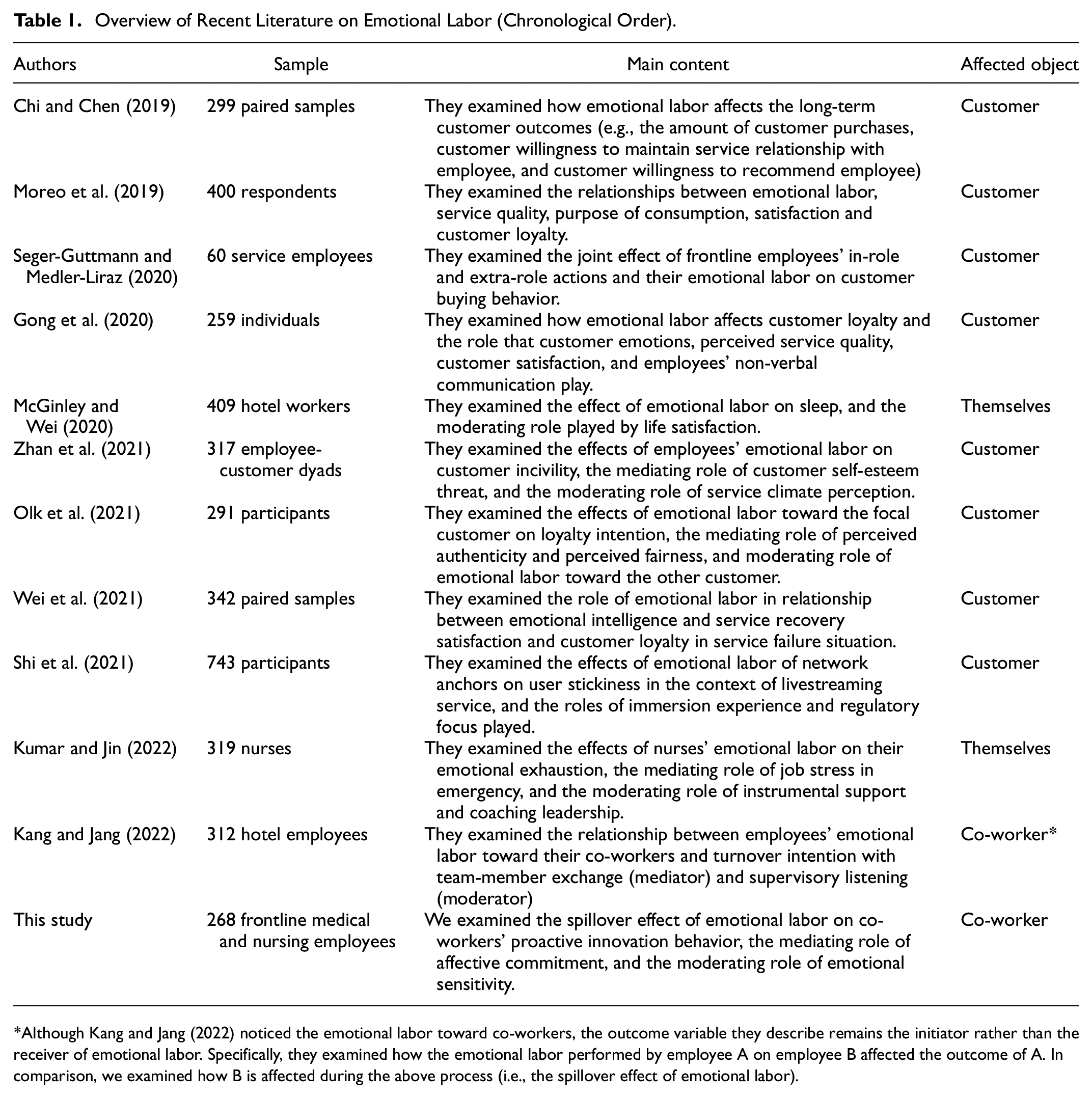
Although Kang and Jang (2022) noticed the emotional labor toward co-workers, the outcome variable they describe remains the initiator rather than the receiver of emotional labor. Specifically, they examined how the emotional labor performed by employee A on employee B affected the outcome of A. In comparison, we examined how B is affected during the above process (i.e., the spillover effect of emotional labor).
Surface acting and deep acting are usually considered as two strategies of emotional labor. The former indicates that employees conceal their true inner feelings and disguise certain emotions; the latter indicates that employees’ emotions flow naturally and realize the unity of inner feelings and outer emotional expression (Ashforth & Humphrey, 1993; Diefendorff et al., 2005). Most previous research has been based on a subjective perspective, exploring the effects of emotional labor performed by employees on themselves (e.g., psychological well-being [Choi et al., 2019]) or on others (e.g., work engagement [Chi & Chen, 2019]). In this perspective, surface acting is mostly associated with negative outcomes, including individual-level emotional exhaustion, decreased job satisfaction, and reduced organizational performance (Choi et al., 2019; Kumar & Jin, 2022; Yao et al., 2019). Deep acting is mostly associated with positive outcomes, including employee fulfillment, increased job satisfaction (Grandey & Melloy, 2017; Gulsen & Ozmen, 2020; Yao et al., 2019). However, these studies have mainly concerned with the effects of emotional labor on themselves and shown a lack of attention to the spillover effect of emotional labor, that is, whether the emotional labor of frontline employees has an impact on other frontline employees (co-workers).
Beside the object of study, there are also limitations in the perspective. Some scholars reveal the inconsistency between the perceptions of the receiver and the sender in the emotional labor process, and argue that the feeling of the receiver is more important for the outcome (Gong et al., 2020; Groth et al., 2009). There are several studies that support the above argument that there are differences in perceptions between the two sides of emotional labor (Gong et al., 2020; Groth et al., 2009; Liu et al., 2019). Distinguishing emotional labor observation perspectives is necessary because both parties comprehend the emotional labor process differently and the subsequent effects may not be consistent.
Overall, we adopt Groth et al.’s (2009) suggested perceptual perspective (perceived co-worker’s emotional labor) and focuses on the effect of perceived emotional labor on proactive innovation behavior. The connotation of emotional labor in this perspective changes accordingly, that is, emotional labor is no longer a choice of strategy, but a judgment and perception of the authenticity of others’ emotions (Lechner & Paul, 2019).
Emotional Labor and Proactive Innovation Behavior
Proactive innovation behavior (PIB) is an extra-role behavior, which refers to the process in which employees actively and positively improve their work environment and voluntarily and put corresponding efforts into the innovative activities (Fan et al., 2022). It shown that proactive behavior is often based on communication with others and is more dependent on a good organizational climate (Haynie et al., 2017; Wu et al., 2018). Especially in the Chinese cultural context, emotional factors profoundly influence the relationships and behavioral tendencies within organizational members (Chen et al., 2013; Liu et al., 2022). Therefore, emotional labor toward co-workers may influence the generation of proactive innovation behavior.
EASI theory proposes that emotions contain some social information and that the receiver can usually infer emotional attitudes, relationship orientations and behavioral intentions from the other party’s emotions, which in turn influence the behavior adopted by the receiver (Hatfield et al., 1993; Van Kleef, 2009). According to the EASI theory, for frontline employees, the emotional labor of co-workers brings about changes in their own emotions, which in turn affects the formation of cognition thus the proactive innovation behavior.
However, two different emotional labor strategies (surface acting and deep acting) may have different effects. We will next argue for each of these two forms of emotional labor based on the EASI theory and conservation of resource theory (Hobfoll et al., 2018).
When deep acting occurs between frontline employee and their co-worker, recipient of emotional labor recognizes positive social messages conveyed by emotions and may perceive them as sincere, friendly and even altruistic, gaining a sense of trust psychologically (Gabriel et al., 2020; Van Kleef, 2009). The deep acting makes employees perceive themselves as being in a solid and friendly reciprocal network among co-workers, which leads to positive rewarding intentions and behaviors. Employees will enhance information sharing behaviors with co-workers, promoting the generation of proactive innovation behavior. Recent research shows that deep acting enhances team member exchange, which means that both parties are more likely to gain more information and inspiration in the process of communication and exchange (Kang & Jang, 2022). Innovation usually requires more frequent information and emotional exchange (Engen & Magnusson, 2018), as well as adequate external support, which are transmitted in the form of emotional resources by deep acting.
From the affective reaction and inferential process’s view of EASI theory, on the one hand, deep acting is more likely to evoke positive emotions in employees because they are authentic expressions of emotions and can produce a stronger emotional contagion effect (affective reaction). Previous study showed that positive emotions have a significant positive effect on individual creativity and innovative thinking (Geng et al., 2018; Hao et al., 2017). Meanwhile, positive emotions make employees more inclined to engage in proactive and cooperative behavior (Wu et al., 2018). On the other hand, the interpretation of positive emotions conveyed in co-workers’ deep acting establishes the intimate relationship and translates into an affirmative and supportive evaluation (inferential process). This external supportive resource in the form of social information creates additional psychological capital for employees to make them engage in groundbreaking innovative solutions (Eisenberger et al., 2002). Therefore, emotional labor in the form of deep acting may be more likely to stimulate frontline employees’ proactive innovation behavior.
However, considering the characteristics and the proven negative effects of surface acting, we point out that surface acting may be detrimental to proactive innovation behavior. First, employees may view their co-worker’ surface acting conveying emotions as unreal, and interpret the information conveyed in the emotions (Lechner & Paul, 2019). Facing with their fake performances, employees may think about the motives, such as the self-interested motives or unfavorable purposes of co-worker. Previous research has revealed that individuals may perceive others’ surface acting as manipulative, creating a sense of insecurity and, in turn, an increased awareness of the need to protect their own resources (Wu & Wu, 2019). Consequently, surface acting hinders the proper communication and collaboration of co-workers because the information conveyed in emotions threaten their resources (Hobfoll et al., 2018). Conservation of resource theory states that when employees perceive a threat to their resources, they activate psychological defense mechanisms and reduce positive extra-role behaviors, such as proactive innovation behaviors (Diestel et al., 2015; Hobfoll et al., 2018). Second, employees need to go through the process of receiving, analyzing and judging the social signals transmitted by co-worker’s surface acting, and the recognition process will consume part of employees’ cognitive resources (Liu et al., 2023). According to the imitation-feedback mechanism of emotional contagion, employees tend to respond the same way with surface acting, causing further depletion of emotional resources (Hatfield et al., 1993). The depletion of employees’ own cognitive and emotional resources prevents them from devoting more resources to proactive innovation behaviors. Again, because surface acting is an inauthentic expression of emotion, the uncertainty of the delivered message reinforces negative emotions and generates boredom and rejection. Research has shown that negative emotions are an important antecedent of reduced proactive innovation behaviors (Fan et al., 2022; Haynie et al., 2017). Finally, since co-workers are usually regarded as an important part of the organization’s image, surface acting may reduce employees’ goodwill and identification with the organization, which in turn reduces the internal drive for proactive innovation behaviors (Chen et al., 2022). Based on the above analysis, the hypothesis was proposed:
The Mediating Role of Affective Commitment
Affective commitment is one of the dimensions of organizational commitment, which reflects individuals’ emotional attachment, involvement, and recognition to the organization (Rhoades et al., 2001; Ribeiro et al., 2020). The humanistic culture of China makes affection a key factor in the relationship between individuals and organizations (Chen et al., 2013). Numerous scholars also agree that affective commitment is a stronger predictor of employee’s positive behavior than other dimensions of organizational commitment, that is, continuance commitment and normative commitment (Loi et al., 2012; Mercurio, 2015). Scholars have found that leader’s emotional labor has a significant impact on the formation of affective commitment in employees (Deng et al., 2020). In this vein, as a bridge to present organizational image and provide organizational support, co-workers could also influence employees’ affective commitment, which in turn has an impact on their proactive innovation behavior.
From the perspective of EASI theory, the authentic and positive emotions quickly infect employees when deep acting occurs. Employees associate the genuine concern of co-workers with the perception of organizational support, generating high levels of affective commitment (Allen & Meyer, 1990; Eisenberger et al., 2002). Since deep acting bring positive emotional experiences to employees through emotional contagion mechanism, it tends to facilitate communication and cooperation more readily, thus strengthening the knowledge sharing and innovation climate within the organization and enhancing team cohesion (Cropanzano et al., 2017; Gabriel et al., 2020). Study has shown that employees within well organizational communication climates develop higher affective commitment, which increases their sense of belonging to the organization and reinforces the perception of insider identity, making them more confident and strengthening proactive innovation behavior (Rhoades et al., 2001). In addition, from the perspective of resources, the emotional resources conveyed by co-worker’s deep acting can be regarded as a resource supplement that can, to a certain extent, buffer interpersonal relationships from the depletion of psychological resources, increasing the level of employees’ affective commitment (Hobfoll et al., 2018). As a result, employees are able to invest more time, energy, and other resources in finding innovative solutions to work challenges, which improves proactive innovation behavior.
Since surface acting is a strategy that requires masking one’s true emotional state, surface acting of co-workers not only fails to promote positive emotions but even has the opposite effect. Specifically, employees are often able to discern disguised emotions through various cues, and the perception of surface acting triggers negative cognitive judgments (Van Kleef, 2009). When employees perceive that their co-workers are deliberately concealing their true emotions, they become distrustful of them, affecting their rapport and reducing their affective commitment. At the same time, the process of identifying, analyzing, and processing information conveyed by employees’ untrue emotions, on the contrary, consumes a large amount of psychological resources (i.e., the emotional contagion process triggered by surface acting comes at the cost of depleting employees’ psychological resources). According to the viewpoint of conservation of resource theory, employees will reduce communication and other behaviors with co-worker for the purpose of protecting their resources and not devote more resources to proactive innovation behaviors that benefit the organization (Hobfoll et al., 2018). Based on the above analysis, the hypothesis was proposed:
The Moderating Role of Emotional Sensitivity
Hatfield et al. (1993) stated that the process of transferring and understanding emotions can vary for individual differences, resulting in different outcomes. Emotional sensitivity is an individual trait defined in this study as the degree to which an individual is influenced by the emotions of others (Melanie & Gembeck, 2015; Verbeke, 1997). Individuals with high emotional sensitivity process information more deeply and are prone to interpret and expand connections to others’ emotional information in depth, which in turn influences behavioral patterns. Previous study confirmed the moderating effect of emotional sensitivity on the process of emotional contagion, that is, individuals with high emotional sensitivity have a greater influence on negative emotional contagion compared to individuals with low (van Zutphen et al., 2015). Melanie and Gembeck (2015) found that individuals with high emotional sensitivity have a stronger tendency to produce social avoidance behaviors.
When emotional labor occurs, employees with different emotional sensitivities are not uniformly affected, as shown in Figure 1. On the one hand, according to EASI theory, employees with high emotional sensitivity have a stronger degree of information cognitive processing, interpret emotionally transmitted information in depth, and are more likely to produce negative cognitions in surface acting contexts (Van Kleef, 2009). Employees may perceive co-worker’s emotional labor as deceptive or as having undesirable motives, generating feelings of resistance such as mistrust and insecurity (Groth et al., 2009). Such negative associations reduce employees’ affective commitment and thus prevent proactive innovation behaviors from arising. In contrast, low emotional sensitive employees are more tempered by these affective processes.

The perception of emotional labor by different emotional sensitivities.
When employees with emotional sensitivity perceive deep acting, they are more likely to interpret them as positive signals such as co-worker’s care and emotional support, and are more likely to develop empathy as well as positive perceptions, thus facilitating the establishment of friendly and trustworthy relationships (Melanie & Gembeck, 2015). Under such circumstances, employees are prone to exhibit more proactive innovation behaviors. From the perspective of emotional contagion, when co-workers perform deep acting, employees with high emotional sensitivity show rapid emotional feedback to the stimulation of positive emotional information, thus producing a stronger effect of emotional contagion (Hatfield et al., 1993). Positive emotions promote the formation of employees’ affective commitment and further enhance the initiative and motivation to generate subjective positive behaviors (i.e., proactive innovation behavior) under the principle of social exchange (Cropanzano et al., 2017). In contrast, low emotional sensitivity has a weaker effect of emotional contagion and produces less subsequent influence. Based on the above analysis, the hypothesis was proposed:
In summary, we propose a research framework, as shown in Figure 2. At the interface of interaction between frontline employee and co-worker, the emotional labor of co-workers (surface acting and deep acting) affects frontline employee’s proactive innovation behavior through the affective commitment. Emotional sensitivity plays a moderating role.

Research model.
Methodology
Sample Collection
We used a questionnaire method to collect primary data. The participants were from a large hospital in China and worked in frontline job. Research shows that the health care industry is typical of where emotional labor occurs very frequently (Delgado et al., 2017; Kumar & Jin, 2022). Moreover, nursing staff often required communication and collaboration in their daily work, playing critical roles in demonstrating proactive innovation behavior. Our corresponding author contacted the personnel office and completed the questionnaire with the assistance of the administrator. A total of 316 questionnaires were collected. After eliminating invalid questionnaires (apparent random answers or answers that were contradictory), the final valid questionnaires obtained were 268, with the efficiency rate of 84.81%. The statistical information of the sample is shown in Table 2.
Statistical Information of Sample (N = 268).

Measurement
The questionnaire consists of two parts. The first part collected basic information about the participants by setting single-choice questions, including questions about gender, age, and years of working experience. The second part was the core content of the questionnaire and contained the questions corresponding to the measured variables. The questionnaire was closed with an acknowledgement to the participants.
The scales used in this study were pre-established scales which were tested in previous studies. To ensure the validity of study, all items were converted to Chinese using the translation-back process, and two linguistic experts were consulted to make adjustments. All items were scored on a five-point Likert scale, which asked respondents to choose their level of agreement with each statement based on their true perceptions.
The measurement of perceived emotional labor (surface acting and deep acting) referred to the study of Diefendorff et al. (2005), and it included eight items (Cronbach’s alpha = 0.83). The measurement of affective commitment referred to the study of Allen & Meyer (1990), which included four items (Cronbach’s alpha = 0.81). The measurement of emotional sensitivity referred to the study of Verbeke (1997), which included four items (Cronbach’s alpha = 0.80). The measurement of proactive innovation behavior referred to the study of Griffin (2007), which included six items (Cronbach’s alpha = 0.93). All the items displayed in the Appendix.
Results
Common Method Bias
The following work was done in this study to control for common method bias. First, this study conducted a small-scale pre-survey with 19 participants, and adjusted some of the descriptions based on the feedback to ensure the comprehensibility of the question items. Second, the questionnaire was designed in such a way that there was a written description before filling in the answers to promise the subjects that the survey would be used for academic research only and the data would be kept strictly confidential. This was followed by a description of the terminology and scales that appeared in the questionnaire. A random distribution of question items was used to disrupt all scales, and some reverse items were set. Finally, this study used SPSS 21.0 to perform factor analysis on the summary data with eigenvalues greater than 1 and without rotation conditions by Harman’s one-way test method, and the results showed that the first principal component factor explained 31.46% of the variance, which can be considered as not having serious common method bias.
Discriminant Validity Analysis
In this study, model fitting was performed using AMOS to test the study model discriminant validity. The results showed that the five-factor measurement model fitted best. All indicators of the five-factor model outperformed the other alternative models, indicating good discriminant validity. The fitted values of the remaining alternative models are shown in Table 3. In addition, the variance inflation factor (VIF) was tested in this study, and the results showed that all values were much less than 10, so it can be concluded that there is no multicollinearity between the variables.
Fitting Values of Different Factor Models.

Note. SA = surface acting; DA = deep acting; AC = affective commitment; ES = emotional sensitivity; PIB = proactive innovation behavior (adopted abbreviated form).
The descriptive statistical analysis of the variables is shown in Table 4, which shows the good correlation and significance variables. The results of the correlation analysis were consistent with the direction of the hypothesis, driving the regression analysis below and the examination of the hypotheses.
Descriptive Statistical Analysis of Variables (N = 268).

p < .01, *p < .05, the root mean square of AVE values in diagonal brackets.
Hypothesis Testing
In this study, the main and mediating effects were tested with SPSS 21.0, and the results are shown in Table 5. First, Model4 tested the effect of control variables (gender, age, and work experience) on proactive innovation behavior. The results showed that employees’ work experience had a significant effect on proactive innovation behavior (β = .19, p < .05). After controlling for gender, age, and work experience, the results of Model5 and Model7 showed that surface acting had a significant negative effect on proactive innovation behavior (β = -.49, p < .01) while deep acting had a significant positive effect (β = .55, p < .01). Hypothesis 1 and 2 were verified. Models 1, 2, 3, 6, and 8 were used to test for mediating effects as suggested by Baron and Kenny (1986). The Model2 and Model3 results showed that surface acting had a significant negative effect on affective commitment (β = -.48, p < .01) while deep acting had a significant positive effect (β = .52, p < .01); Model6 and Model8 results showed that after adding the mediating variable affective commitment, the negative effect of surface acting on proactive innovation behavior remained significant (β = -.20, p < .01) and the positive effect of deep acting remained significant (β = .21, p < .01). Meanwhile, the mediating variable affective commitment had a significant positive effect on proactive innovation behavior under both paths (β = .59, 0.56, p < .01), and the results indicated that there was a partial mediating effect of affective commitment between emotional labor and proactive innovation behavior. Hypothesis 3 was verified.
Tests for Main and Mediating Effects.

p < .01, *p < .05, all coefficients in the table are standardized regression coefficients.
We next examined the moderating effect of emotional sensitivity. After standardizing the variables, we constructed the interaction terms by multiplying surface acting and deep acting with emotional sensitivity, respectively. In the next step, we put them into the regression equation separately and the results were shown in Table 6. The coefficient of interaction term was significant according to Model9 (β = -.21, p < .01) and Model11 (β = -.23, p < .01), indicating that the moderating effect of emotional sensitivity existed. In the same vein, the moderating effect was also existed in the path of deep acting according to Model10 (β = .31, p < .01) and Model12 (β = .38, p < .01). Additionally, in order to better visualize this effect, we produced the moderating effect plots, as shown in Figures 3 and 4. Hypothesis 4 was verified.
Tests for Moderating Effects.

p < .01, *p < .05, all coefficients in the table are standardized regression coefficients.

The moderating effect of emotion sensitivity (the pathway of surface acting).

The moderating effect of emotion sensitivity (the pathway of deep acting).
Furthermore, we are interested in exploring whether the moderated mediating effects exist. The PROCESSv3.3 plug-in was used to test the moderated mediating effect. The PROCESS plug-in is an SPSS macro program based on the bias-corrected nonparametric percentile Bootstrap method, which has been widely recognized and used by scholars since its introduction for its accuracy and reliability. We performed Bootstrap tests with the moderated mediation model built into the plug-in (95 confidence interval and5,000 samples), and the results are shown in Table 7.
The Analysis of Moderated Mediating Effect.

The results of Bootstrap indicated that the moderated mediating effect were significant in the pathway of deep acting (LLCI = 0.064, ULCI = 0.147, interval excluding 0) and surface acting (LLCI = −0.121, ULCI = −0.037, interval excluding 0), and the indirect effect at different levels were also significant (see the 95% CI all excluding 0). Specifically, for those employees with high emotional sensitivity, the deep acting (0.412) and surface acting (−0.334) made a greater impact on proactive innovation behavior through the mediating effect of affective commitment.
Discussion
Based on 268 valid questionnaires collected from frontline employees, this study explores the influence of co-worker’s emotional labor on frontline employees’ proactive innovation behavior within the service organization. First, the emotional labor performed by frontline employee has the spillover effect on stimulating co-worker’s proactive innovation behavior. However, this spillover effects only works when frontline employees adopt deep acting rather than surface acting. The deep acting can promote their proactive innovation behavior while the surface acting can hinder this drive, which is consistent with previous literature in the field of customer service where deep acting by frontline employees with customers can lead to more positive customer behavior (Chi & Chen, 2019; Gong et al., 2020). Employees identify the emotional authenticity of their co-worker’s emotional labor and process the social information contained in their emotions. When they perceive deep acting, interpersonal relationships among co-workers are more harmonious, which leads to more positive emotional states and more communication and collaborative behaviors, and thus facilitates the generation of innovation. While when they perceive surface acting, false emotions negatively affect their attitudes toward co-workers, weakening their willingness to communicate and work actively, which hinders the generation of proactive innovation behavior.
Second, affective commitment mediates the relationship between emotional labor and proactive innovative behavior. This is in line with previous studies that affective commitment plays a crucial role in eliciting positive behavior of employee (Rhoades et al., 2001; Ribeiro et al., 2020). Positive emotional experiences brought by deep acting increase affective commitment of co-workers, and they would invest more resources in extra-role behavior, eliciting the generation of proactive innovation behavior. When surface acting occurs, the distrust and insecurity reduce employees’ affective commitment and also deplete employees’ psychological resources, thus reducing proactive behaviors for the purpose of protecting their own resources, which hinders the generation of proactive innovative behavior.
Finally, emotional sensitivity moderated the process of influence of emotional labor on proactive innovation behavior through the affective commitment, which validate previous research proposing that emotional sensitivity is an important factor on the effect of emotional contagion (Hatfield et al., 1993). When co-worker adopted deep acting in communication, those employees with high emotional sensitivity are more likely to establish friendly and harmonious interpersonal relationships with their co-workers, and are also more likely to contract positive emotions and exhibit more proactive innovation behavior. In contrast, when surface acting is perceived, employees with high emotional sensitivity tend to perceive co-worker’s false emotions as the existence of self-serving purposes, which is not conducive to establishing harmonious relationships with them and weakens the initiative to invest resources in proactive innovation behavior.
Theoretical Contributions
First, this study uniquely links the emotional labor of frontline employees and proactive innovation behavior of co-workers. Most previous studies have focused on the emotional labor in service sector, that is, the emotional labor between frontline employees and customers (Deng et al., 2020; Eisenberger et al., 2002). We shift this topic to the objective of co-workers, and explores the mechanisms by which it affects proactive innovation behavior, completing the antecedent studies of proactive innovation behavior.
Second, this study explores the process mechanism of proactive innovation behavior by proposing and examining the mediating role played by affective commitment. The findings open the black box of the influence of emotional labor on co-worker’s proactive innovation behavior, not only emphasizing the importance of affective commitment in generating proactive innovation behavior, but also providing new evidence for the previous research (Loi et al., 2012; Rhoades et al., 2001).
Third, the boundary conditions under which frontline emotional labor affects proactive innovation behavior are examined (i.e., the moderating role of emotional sensitivity). When previous studies have explored the influence of emotional factors on proactive innovation behavior, they have often neglected the influence brought by individual differences. This study introduces an important individual difference variable, emotional sensitivity, to explore the boundary conditions of proactive innovation behavior, and emphasizes that proactive innovation behavior, as an extra-role proactive behavior, is more likely to be influenced by employees’ subjective will, further deepening the related research.
Finally, this study examines the issue of emotional labor based on the emotional labor perception perspective, which not only facilitates the elucidation of the motivation for the generation of proactive innovative behavior from the frontline employee’s perspective, that is, how they are subjectively influenced by their co-worker’s emotional labor, but also responds to the call of scholars represented by Groth to pay attention to the issue of emotional labor perception (Gong et al., 2020; Groth et al., 2009; Liu et al., 2019). In addition, this study further extends the application of emotional labor theory in intra-organizational contexts and has implications for the development of emotional labor theory.
Management Implications
Innovation plays a key role in improving competitiveness under fierce market competition (Liu et al., 2022). The findings of the study have some implications for managers on how to effectively improve frontline employees’ proactive innovation behavior. First, pay attention to the issue of emotional labor within the organization, and correctly view the important role of emotional factors in influencing employees’ positive behavior. If employees can actively generate innovative behaviors, making the organization full of mutual communication, thinking collision innovation atmosphere, no doubt can they effectively enhance the competitiveness of enterprises (Long & Cooke, 2022; Shin et al., 2016). In this study, we found that the emotional labor of frontline employee significantly affects co-worker’s proactive innovation behavior. Specifically, employees exhibit more proactive innovation behavior when they perceive deep acting, while they exhibit significantly less proactive innovation behaviors when they perceive surface acting. Therefore, managers should pay more attention to the forms of emotional expression among organizational members, advocate positive and effective communication, and take certain incentives to create a harmonious organizational communication atmosphere. Managers take the lead in learning to use deep acting strategies and infect employees with positive and sincere attitudes in daily routines.
Managers should recognize that affective commitment is an important factor to influence employee’s proactive innovation behavior. Organizations can improve employees’ affective commitment in various ways, such as fair performance evaluation and appropriate career development plans. In return, employees will be more inclined to put this affective commitment into practice and thus generate proactive innovation behavior. As an important way to demonstrate organizational support, emotional labor can significantly influence affective commitment. This study shows that deep acting increase co-worker’s affective commitment, which in turn stimulates proactive innovation behavior. However, managers should pay special attention to the negative effects of surface acting, as the rapid decline in affective commitment when employees recognize their co-worker’s false care will inhibit the emergence of proactive innovation behaviors. Therefore, managers should listen more to their subordinates’ feedback, and set a good example in improving their emotional expression and communication style.
Finally, this study demonstrates the differences in the impact of employees with different emotional sensitivities on proactive innovation behaviors. Organizations should pay attention to examining employees’ personal traits and other characteristics, screening employee emotional sensitivity categories, and establishing perfect talent information files. Regularly examining the psychological condition of employees and understanding the interpersonal relationship among employees are helpful. For employees who are more innovative and sensitive, managers can give extra attention to their work and life, and cultivate a good sense of belonging to the organization to improve affective commitment. Adopt various strategies to guide organizational members to adopt deep acting strategies in their daily communication to promote good interaction among employees. In addition, timely psychological counseling is provided to employees with surface acting tendencies to enable them to adjust their emotions and then engage in their work.
Limitations and Future Research
There are still some limitations in this study. First, the sample of this study uses cross-sectional data to test the strength of the relationship between variables. Given the limitations of cross-sectional data, the follow-up studies may use multi-temporal and multi-stage longitudinal tracking studies to further verify the findings. Second, the survey subjects of this paper are frontline employees of a hospital in China, and the applicability of findings for other industries as well as other countries need to be further examined. Emotional labor exists widely within various organizations, and whether there are differences in effects or new characteristics under different industries needs to be explored deeply in future studies. In addition, the spillover effect of emotional labor needs to be verified in more cultural contexts, and future research can explore relevant topics in cross-cultural situations.
Conclusions
This study examined the spillover effect of emotional labor. The results indicated that frontline employee’s emotional labor affected their co-worker’s proactive innovation behavior. Specifically, deep acting, an expressive strategy of emotional labor, had a positive impact on proactive innovation behavior through the enhancement of affective commitment. In addition, emotional sensitivity reinforced this spillover effect. However, surface acting, another form of emotional labor, had an opposing impact, and emotional sensitivity reinforced the aforementioned negative impact, resulting low-level of proactive innovation behavior.
Footnotes
Appendix (scales used in the study)
1.I can feel that my co-worker hides his/her true mood and inner feelings.
2. I can feel that my co-work shows feelings to others that are different from what he/she feel inside.
3. I think that my co-work just pretends to have the emotions he/she need to display for job.
4. I think that my co-work put on a “mask” in order to display the emotions he/she need for the job.
1. I can feel that my co-worker makes an effort to actually feel the emotions that he/she needs to display toward others.
2. I can feel that my co-workers work at developing the feelings that he/she needs to show to others.
3. I think that my co-workers work hard to feel the emotions that he/she need to show to others.
4. I think that my co-worker expresses his/her feelings from his/her heart rather than disguising them
1. I take pride in being a part of this organization.
2. This is a good organization to work at.
3. I have a strong sense of belonging to this organization.
4. I hope to continue working at this organization if other things remain the same.
1. I pay attention to what other people are feeling.
2. I’m very sensitive to the changes in the emotions of others.
3. I’m very accurate in judging other people’s feelings.
4. When someone paces back and forth, I feel nervous and anxious.
1. I often take the initiative to think of better ways to get the job done.
2. I often take the initiative to implement new ideas.
3. I often address the problem from multiple perspectives.
4. I would initiate better ways of doing my core tasks.
5. I would come up with ideas to improve the way in which my tasks are done.
6. I would make changes to the way my core tasks are done.
Declaration of Conflicting Interests
The author(s) declared no potential conflicts of interest with respect to the research, authorship, and/or publication of this article.
Funding
The author(s) received no financial support for the research, authorship, and/or publication of this article.
