




Abstract
The research aims to reveal the effect of teachers’ agile leadership perceptions on their affective occupational commitment and how employee voice plays a mediating role in this effect. The study group of the research consists of 354 teachers working in Istanbul in 2021. The research is carried out according to the relational survey model. Correlation analysis is carried out and tested using the suggested mediation model based on the relationship between the variables to determine the relationship between variables. According to the research findings, the agile leadership characteristics of school principals positively affect their affective occupational commitment. Additionally, mediation analysis showed that employee voice is a partial mediator between agile leadership characteristics and affective occupational commitment. This research contributes to the theory by revealing the important effects of the agile leader in the school. In the light of the findings, the implications of the agile leader, employee voice, and occupational commitment of teachers were discussed, and suggestions were made for future research.
Introduction
The developments in science and technology and the rapid change felt in every field have differentiated the problems within the organization and made them more complex. Organizations today are trying to cope with situations described as volatile, uncertain, complex, and ambiguous, which is briefly stated as VUCA (Horney et al., 2010). To successfully manage the VUCA world, educational institutions must also make adjustments in all organizationally relevant areas and closely monitor developments. Agile leaders who have the competence to manage this process effectively by taking successful, correct, fast, and smart steps and dealing with confusion and uncertainty are seen as the answer to today’s search for leadership (De Meuse et al., 2010; Horney et al., 2010; Joiner, 2019).
On the other hand, one of the critical factors affecting educational organizations’ success is teachers’ affective commitment to their occupation (Elliott & Crosswell, 2002). Affective occupational commitment is the most desired type of occupational commitment. Affective occupational commitment begins with career choice and is shaped by experience because teachers with high affective occupational commitment strive to perform their educational activities smoothly, avoid unethical behaviors, closely follow occupational developments, have a professional perspective, and work to improve the quality of their school (National Council for Teacher Education [NCTE], 1988). In the first years of a career, people’s occupational commitment is low. However, work experiences that positively affect career goals and person-occupational harmony in the following years increase affective occupational commitment (Goulet & Singh, 2002). Leader-member interaction is also one of the important variables affecting occupational commitment. Leaders have a significant impact on the effectiveness of their members with their practices to achieve predetermined goals. Because the role of the leader is very important in increasing the level of work integration of the employees (Wang et al., 2010). Hence, it can be said that agile leaders can affect teachers’ occupational commitment. As an agile leader, the school principal is expected to rely on the input of teachers in order to adapt to changing business conditions, make sound decisions, and generate solutions before problems escalate. Teachers who can articulate their thoughts are a valuable source of information for administrators and leaders (Holland, 2014). Teachers may sometimes experience the dilemma of expressing useful information and ideas or being silent according to the attitudes and behaviors of the leaders (Morrison, 2011; Zhang & Shen, 2022). Agile leaders can contribute to increasing teachers’ voices by allowing teachers to express themselves comfortably and include their thoughts in them on the management and educational process by valuing their thoughts. On the other hand, teachers who believe they can express their opinions, ideas, and concerns in the working environment will also have high levels of affective occupational commitment (Rees et al., 2013). In this respect, determining whether the employee’s voice has a mediating role in the relationship between the agile leadership characteristics of school principals and teachers’ affective occupational commitment will contribute to these discussions.
Theoretical Background and Hypotheses Development
The Relationship Between Agile Leadership and Affective Occupational Commitment, and Employee Voice
Agile leaders are high-performing individuals (Dai et al., 2013; De Meuse, 2017; Lediju, 2016) who can think outside of the box, produce fast and applicable solutions, and provide flexibility between applications (Hollis, 2017). They are aware of the necessity of developing new skills in the face of rapid change and know how the organization can improve it. For this purpose, while trying to learn more through experiences, they direct the employees around them to this process (Briscoe & Hall, 1999; Lombardo & Eichinger, 2000). Encouraging continuous learning, collaboration, and knowledge sharing cause them to improve their agility and cope with volatility, uncertainty, and ambiguity more easily (McKenzie & Aitken, 2012; Narel, 2017; Yazıcı, 2020). In addition, the agile leader’s correct assignment of employees in organizational management processes, their self-awareness that can control their stress and emotions in the face of new situations, and their balanced management understanding provide a positive working environment for employees (Jonier & Josephs, 2007; McPherson, 2016). Accurate and fast decision-making features protect the organization and employees against dangers and transform it into organizational agility, a more perfect and more robust structure (Gren & Lindman, 2020; Joiner, 2019; Nold & Michel, 2016; Young, 2013). Although most of the research on agile leadership focuses on organizational employees, similar results are found in studies conducted at schools and with teachers. It has been determined that helpful and supportive agile leadership behaviors such as participation in the decision-making processes of school administrators, fair evaluation, and open communication affect teachers’ occupational commitment, occupational development, and performance (Singh & Billingsley, 1998; Ware & Kitsantas, 2007; Yalçın & Özgenel, 2021). However, as far as we know, the relationship between the agile leader, who has important effects on the organization’s functioning, and the effective occupational commitment, which causes the teachers to fulfill their occupational duties and responsibilities fondly and willingly, has not been examined.
Occupational commitment is the cognitive, affective, and behavioral attitude of the individual toward his/her occupation (Cohen, 2003). In other words, it is the individual’s perception of the significance of his/her occupation (Greenhaus, 1971), its increase or decrease before and after service (Aranya & Ferris, 1984), belief and acceptance of the occupation’s values, continuation of his/her occupation, and voluntary retention in the occupation (Firestone & Rosenblum, 1988; Vandenberg & Scarpello, 1994). On the other hand, affective occupational commitment can be defined as a psychological relationship based on the affective reaction that an individual feels toward their occupation (Lee et al., 2000). Affective commitment reflects how close the individuals feel toward their occupation (Salancik, 1977) and is measured by the degree of acceptance of the values of the occupation (Morrow & Wirth, 1989). Meyer et al. (1993) argue that affective occupational commitment is the type of commitment most desired in employees. Individuals with high affective occupational commitment have high occupational commitment. They feel privileged by their, see the goals of the occupation as their own, and do not think of leaving their occupation (Boylu et al., 2007; Chen et al., 2010; Koç, 2017; Yıldız, 2013), embrace their occupation, do it with love, value their occupational development, and willingly fulfill their occupational duties and responsibilities (Meyer et al., 1993). Teachers with high affective occupational commitment show high performance because of such attitudes and behaviors (Özgenel, 2019) and significantly contribute to school effectiveness (Özgenel & Koç, 2020). While the theoretical and given empirical evidence focuses on the outputs/behaviors of employees with high affective occupational commitment, determining the factors affecting effective occupational commitment will further contribute to the development of effective occupational commitment. In this context, the supportive behaviors of leaders, especially in organizations managed with agile approaches, enable employees to connect to the organization (Prommegger et al., 2019) and improve their affective commitment to their occupation by influencing them (Darden et al., 1989; Detert & Treviño, 2010; Eilers et al., 2020; Veeriah et al., 2017).
It is important for the development of the organization that the employees communicate their ideas and thoughts to the decision-makers by communicating effectively in a dynamic process. This situation, expressed as the voice of the employee in the organization, is encouraged to improve the organization’s functioning. Employee voice is the voluntary expression of ideas, suggestions, concerns, or opinions about work-related issues (Morrison, 2011). Although there are empirical studies linking leader behaviors and employee voice in this area (Detert & Burris, 2007; Düger, 2020; Henderson, 2013), few studies are showing how agile leadership affects employee voice. The agile leader seeking feedback to increase their level of agility (Hollis, 2017; McKenzie & Aitken, 2012), establishing effective communication where they can speak face-to-face and express themselves truthfully (Jonier & Josephs, 2007), can positively influence employee voice.In the light of the given theoretical information and empirical findings, we propose the following hypotheses:
H1: There is a positive relationship between school principals’ agile leadership characteristics and teachers’ effective occupational commitment.
H2: There is a positive relationship between school principals’ agile leadership characteristics and employee voice.
The Relationship Between Employee Voice and Effective Occupational Commitment
Employee voice is how and means by which employees try to have a say in organizational affairs and potentially influence decision-making processes regarding issues affecting their jobs and managers’ interests and expectations (Wilkinson et al., 2014). Here, employee voice is the field of human resource management (HRM), where the interaction between various stakeholders of the organization is most evident (Marchington, 2007). In particular, organizations that want to gain a competitive advantage (Farndale et al., 2011), consider employee voice in the context of organizational behavior (Budd et al., 2010; Holland et al., 2011), and it is stated that employee voice has a positive effect on the performance and outputs of employees and the organization (Harley, 2014; Holland et al., 2011; Marchington, 2007; Mowbray et al., 2019; Pohler & Luchak, 2014). Despite the positive effects of employee voice on employees, employees who think they are not supported and valued due to the fear of punishment hide their views from the management, leading to employee silence (Milliken et al., 2003). In an organization where employee silence is dominant, the affective occupational commitment of the employees’ decreases, leading to conflict with other employees, resistance to management and ultimately leaving the job (Holland et al., 2019). When considering employee voice in the context of schools and teachers, teachers’ participation in decision-making in school management processes, planning and implementation of education-teaching and extracurricular activities, and their ability to freely express their own opinions can play a significant role in the formation and development of teachers’ affective occupation (Farndale et al., 2011; Holland et al., 2011, 2019). In the light of the given theoretical information and empirical findings, we propose the following hypothesis:
H3: There is a positive relationship between employee voice and affective occupational commitment.
The Mediator Role of Employee Voice
The primary determinant of the factors that determine the level of voice, such as reward and punishment systems, decision-making approaches, and one-way or two-way communication implemented in the organization, is the organization’s leader (Xiao & Pan, 2017; Zhang et al., 2015). In other words, it is stated that there is a close relationship between the dominant leadership understanding in the organization and the voice of the employee (Dedahanov et al., 2016; Morrison & Milliken, 2000). Leaders who support employee-voice enable employees to share their ideas comfortably with their colleagues; in organizations where hierarchical and autocratic leaders are at the forefront, sharing ideas is limited (Detert & Burris, 2007; Frazier & Fainshmidt, 2012). Agile leaders, who have a different understanding of the organization’s functioning, try to gather their employees around a common goal. For this reason, they develop relationships based on mutual commitment, trust, and cooperation with their employees (Joiner, 2009). If the agile leader builds good and close relationships with their employees through group discussions (Jonier & Josephs, 2007), this can positively influence employee voice. Minimizing employee mistakes and the communication ways they establish can cause employees to think that they are listened to, be comfortable with their leaders, and develop a sense of trust among them. On the other hand, the feeling of trust that can occur between the leader and the employees increases the voice of the employees and causes the development of more commitment (Rees et al., 2013). Moreover, it has been reported in the literature that there is a relationship between agile leadership, organizational commitment (Özdemir, 2020) and school effectiveness (Çalışkan-Yılmaz, 2021), affective commitment, and employee voice (Jena et al., 2017; Kim & Leach, 2020; Walden et al., 2021). In the studies carried out in schools, it has been determined that the employee voice acts as a mediator in the relationship between the teacher’s leader-member interaction and the integration with the work (Gürler, 2018), the school principals’ use of a motivational language and information sharing (Arslan & Yener, 2016a). Therefore, the collaboration, communication, empathy, and uncertainty management skills of agile school leaders who demonstrate effective management can influence teachers’ voices of employees (Jonier & Josephs, 2007; Taylor, 2017), and employee voice may moderate the relationship between affective occupational commitment and agile leadership (Özdemir, 2020; Valencia, 2013). In the light of the discussions and research findings in the literature on agile leadership, occupational commitment, and employee voice, it is possible to reach the following hypothesis.
H4: Employee voice has a mediating role/effect in the effect of agile leadership on affective occupational commitment.
Developed hypotheses revealed that employee voice may mediate the effect of agile leadership on affective occupational commitment. The theoretical model to be tested in the research is presented in Figure 1.
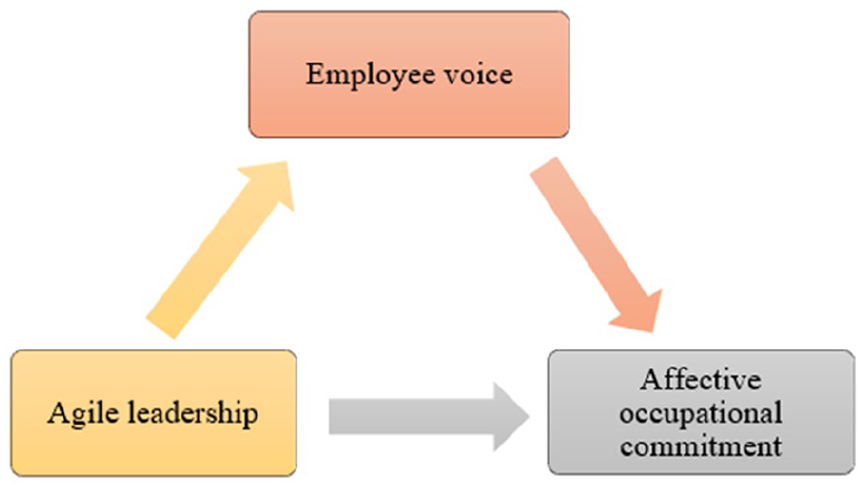
Theoretical model.
Method
Research Model
In this study, a theoretical model has been suggested to determine the mediating role of employee voice in the relationship between agile leadership and affective occupational commitment. Before testing the suggested model, the relational survey model was used to determine the relationship among the three variables. Using the Structural Equation Model (SEM), the proposed mediation model was evaluated based on the relationship between the variables. SEM is utilized to examine theoretical models that explain the correlations between variables (Hu & Bentler, 1999; Tabachnick & Fidell, 2007).
Participants
In this research, the study group consists of 354 teachers actively working in (Pendik, Kartal, Tuzla, Maltepe, and Sultanbeyli districts) Istanbul in 2021. A simple random sampling method was used to determine the study group, and the participants completely volunteered for the research. In structural equation model analysis, it is important to consider the proposed model, the number of variables, the analysis method, and whether the data are normally distributed when determining the sample size (Barrett, 2007; Brown, 2006; Kline, 2011). In this study, it is possible to conclude that the number of participants is sufficient. Considering the distribution of the participants, 254 of the 354 people (71.8%) were women, and 100 (28.2%) were men; 308 (87%) of them were undergraduate graduates, and 46 (13%) of them were postgraduate graduates. Two hundred forty-nine (70.3%) of them work in primary school, 62 (17.5%) in secondary school, 43 (12.1%) in secondary education institutions; 63 (17.8%) were 30 years or younger, 173 (48.9%) were 31 to 40 years old, 75 (21.2%) were 41 to 50 years old, 43 (12.1%) were 51 years or older; 40 (11.3%) had 5 years or less seniority, 104 (29.4%) had 6 to 10 years of seniority, 73 (20.6%) had 11 to 15 years of seniority, 47 of them had (13.3%) had 16 to 20 years of seniority, and 90 (25.4%) had 21 years or more.
Tools for Data Collection
In this research, the Four-Dimensional Occupational Commitment Scale, the Employee Voice Scale, the Agile Leadership Scale, and the personal information form were used for data collection.
Personal information form
This form includes data on such participants’ demographic characteristics as gender, age, level of education, type of school, and seniority
Affective commitment
Four-Dimensional Occupational Commitment Scale: It is developed by Blau (1985) to measure teachers’ occupational commitment and adapted to Turkish culture by Utkan and Kırdök (2018). The scale consists of 24 items and four dimensions (affective commitment, normative commitment, accumulated costs, and limitation of alternatives). In this study, the affective commitment sub-dimension consisting of six items is used. A high score on the scale indicates a high level of affective occupational commitment. Consistently, the Cronbach alpha reliability coefficient of the scale (.890) was calculated, and the goodness-of-fit values of the confirmatory factor analysis were at an acceptable level (x2/df = 2.736; RMR = 0.009; IFI = 0.992; CFI = 0.992; RMSEA = 0.070).
Employee voice scale
The scale was developed by Van Dyne and LePine (1998) and adapted to Turkish culture by Arslan and Yener (2016b). The scale consists of six items, all constituting a single dimension. The 5-point Likert-type scale does not have an inverse item. The highest score obtained from the scale points to a high level of employee voice. In this study, the Cronbach Alpha reliability coefficient of the scale (.922) was calculated, and the confirmatory factor analysis fit values were found to be at an acceptable level (x2/df = 3.143; RMR = 0.008; IFI = 0.993; CFI = 0.993; RMSEA = 0.045).
Agile leadership scale
The scale was developed by Özgenel and Yazıcı (2020) to determine managers’ agile leadership characteristics. The highest score obtained from the scale developed as a 5-point Likert type shows that managers have agile leadership characteristics. The scale consists of 34 items and three sub-dimensions (situational awareness, human relations, and self-awareness). Self-Awareness: The manager is aware of himself and his environment and provides concrete feedback for this. Human Relations: The manager’s ability to establish positive and effective relationships with others and have a flexible perspective. Situational awareness: The manager’s ability to quickly analyze the problems and complex events around him, adapt to these situations, and offer effective solutions based on his experience. As a total score can be obtained from the scale, the sub-dimension items can also be collected and evaluated. The Cronbach Alpha reliability coefficient of the scale (.975) was calculated, and the confirmatory factor analysis fit values were found to be at an acceptable level (x2/df = 3.221; RMR = 0.031; IFI = 0.902; CFI = 0.901; RMSEA = 0.079).
Data Analysis
In this study, correlation, and structural equation model analysis was used to determine the mediating role of employee voice in the relationship between agile leadership and affective occupational commitment. Before proceeding to the correlation analysis, three variables were checked for normal distribution. In Table 1, skewness and kurtosis values for each variable are given.
Normality Values for Agile Leadership, Affective Occupational Commitment, and Employee Voice.
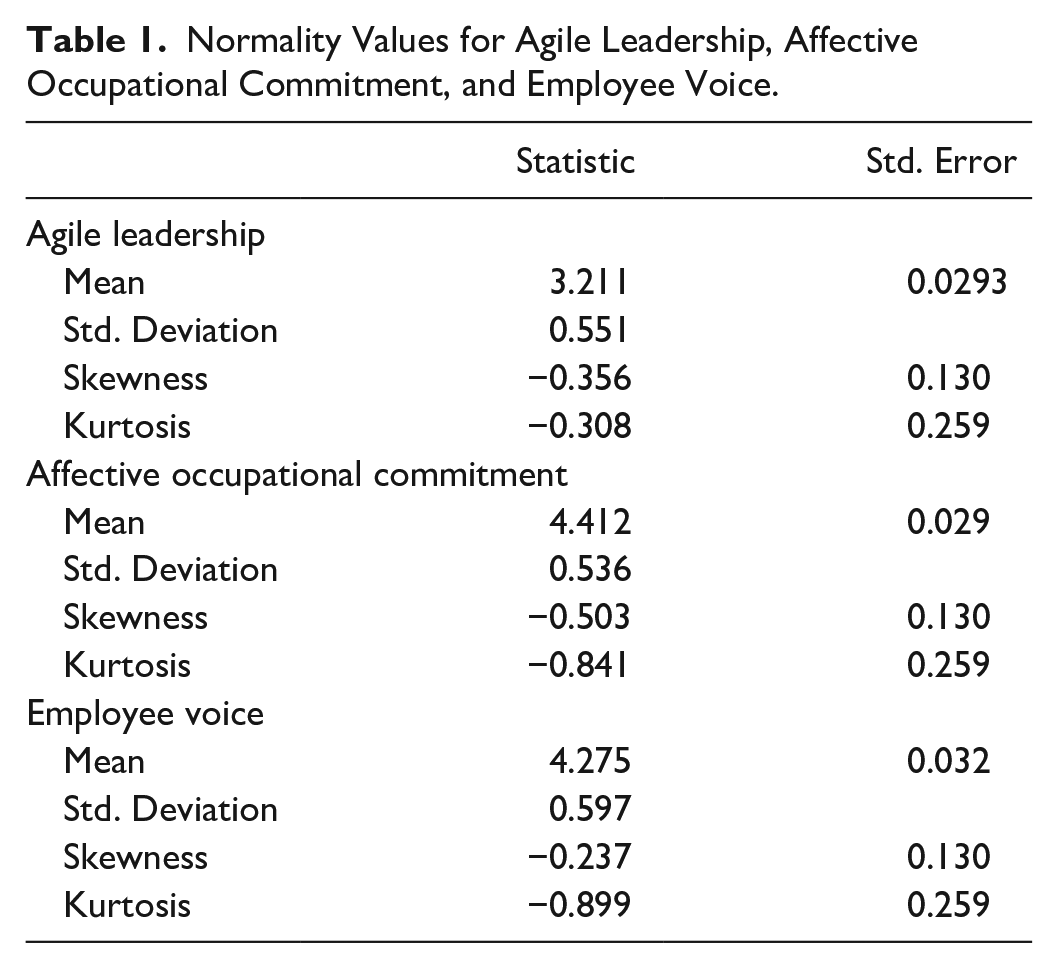
As seen in Table 1, the skewness and kurtosis values of the three variables remained between ±1, meaning a normal distribution. The skewness and kurtosis values for the normal distribution were evaluated considering the ±1 values suggested by George and Mallery (2019). After confirming the normal distribution, the reliability coefficients for the research scales were calculated. Results are shown in Table 2.
Reliability Coefficients for agIle Leadership, Affective Occupational Commitment, and Employee Voice.
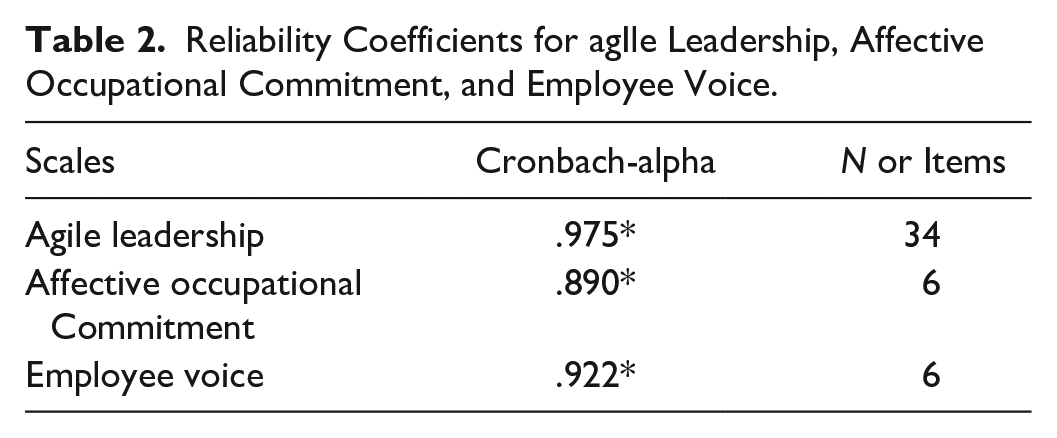
As can be seen in Table 2, the reliability coefficients of the scales used in the study vary between 0.890 and 0.975. It is clear that the scales have excellent reliability values for research (Özdamar, 2017). Once the normal distribution of variables was confirmed and the reliability of the scales was tested, the Pearson correlation coefficient was calculated. Then, Structural Equation Model (SEM) analyzes were used to determine the mediating role of employee voice in the relationship between agile leadership and affective occupational commitment. In the structural equation model analysis, the mediation model steps suggested by Baron and Kenny (1986) were followed. According to Baron and Kenny (1986), the independent variable (agile leadership) should affect the dependent variable (affective occupational commitment) and the mediator variable. In addition, the mediator variable should affect the dependent variable. When the independent variable and the mediator variable are analyzed together, the effect of the independent variable on the dependent variable should be “0,” or it should decrease evidently. As a result, it can be concluded that the mediation model is accepted.
Findings
The correlation coefficients between agile leadership, affective occupational commitment, and employee voice were first calculated to test the theoretical model.
Table 3 suggests a positive relationship between agile leadership and employee voice (r = .222; p < .01) and agile leadership and affective occupational commitment (r = .212; p < .01). Again, a positive correlation is observed between employee voice and affective occupational commitment (r = .203; p < .01). The correlation analysis indicates that there is a significant relationship between the variables, so the testing phase of the model has begun. Initially, the impact of agile leadership on affective occupational commitment and employee voice was determined. The influence of employee voice on affective occupational commitment was then determined.
Correlation Values Between Agile Leadership, Affective Occupational Commitment, and Employee Voice.

N = 354. **p < .01.
As seen in Figure 2, agile leadership affects affective occupational commitment and employee voice. The employee voice also affects affective occupational commitment. Employee voice was added to the correlation between agility and affective occupational commitment, and then the theoretical model was put to the test.

The impact of agile leadership on affective occupational commitment and employee voice; and the impact of employee voice on affective occupational commitment.
An analysis of Figure 3 suggests that agile leadership has a direct impact on affective occupational commitment (d = 0.23; p < .01) and employee voice (d = 0.24; p < .01). It was also found that employee voice directly affects affective occupational commitment (d = 0.21; p < .01). In addition, employee voice can be considered a partial mediator in the relationship between agile leadership and affective occupational commitment (I1 = 0.18; p < .01). Agile leadership affects affective occupational commitment both directly and through employee voice. In other words, employee voice functions as a partial mediator in the relationship between agile leadership and affective occupational commitment. However, a regression analysis was carried out to evaluate the model and determine the significance of the path coefficients (regression) given in Table 4.

Model with agile leadership as the independent variable.
Regression Coefficients Between Variables.

p < .001.
The path coefficients indicating the impact of agile leadership on employee voice and affective occupational commitment, as well as the impact of employee voice on affective occupational commitment, were found to be statistically significant (p < .05) as shown in Table 4. Besides, it is seen that the path coefficient showing the effect of employee voice on affective occupational commitment is also significant (p < .05). Total, direct, and indirect effect values of the variables are given in Table 5.
Total and Individual Values for the Direct and Indirect Effects of the Variables.

As seen in Table 5, it can be said that employee voice has a “partial” mediating role in the relationship between agile leadership and affective occupational commitment (ß = .041; p < .05). However, these values were insufficient to decide whether the model was compatible with the mediation analysis, and the fit indexes given in Table 6 were examined.
Fit Indexes for Proposed Models.
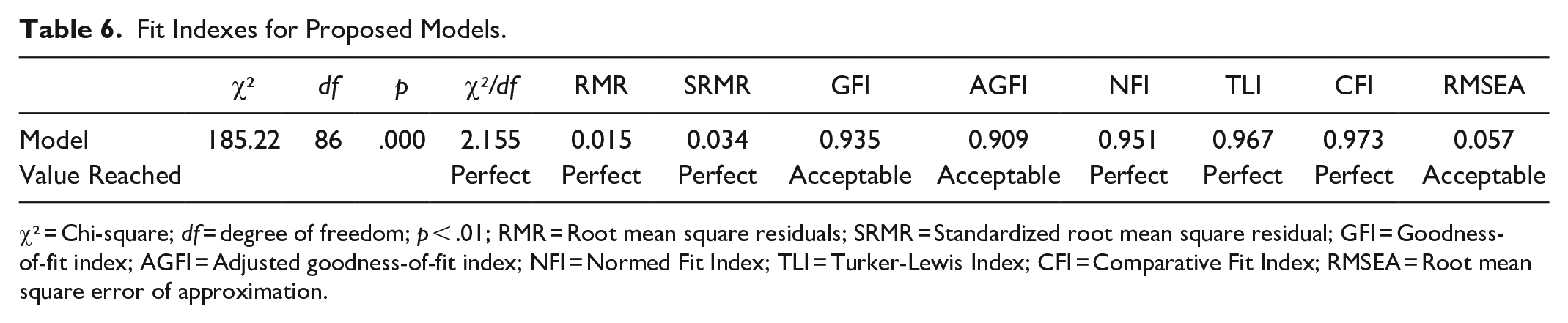
χ² = Chi-square; df = degree of freedom; p < .01; RMR = Root mean square residuals; SRMR = Standardized root mean square residual; GFI = Goodness-of-fit index; AGFI = Adjusted goodness-of-fit index; NFI = Normed Fit Index; TLI = Turker-Lewis Index; CFI = Comparative Fit Index; RMSEA = Root mean square error of approximation.
When the fit indexes of the theoretical model given in Table 6 are examined, it is seen that they meet the criteria for the fit indexes suggested for the validity of a mediator model in literature (Hu & Bentler, 1999; Kline, 2011; Maydeu-Olivares & Garcia Forero, 2010; Schermelleh-Engel et al., 2003; Schumacker & Lomax, 2010). As a result of the analysis, the hypotheses H1, H2, and H3 were confirmed. The H4 hypothesis is refuted. On the other hand, employee voice can be said to partially moderate the effect of agile leadership on affective professional commitment. In other words, it is understood that the model is valid, but employee voice “partially mediates” the relationship between agile leadership and affective occupational commitment.
Conclusion and Discussion
The mediation role of employee voice in the relationship between agile leadership and affective occupational commitment was examined in this study. According to the findings of the study, teachers’ affective occupational commitment is positively influenced by principals’ agile leadership qualities. When principals demonstrate to teachers how to be adaptable leaders, teachers’ affective occupational commitment increases. Agile leaders significantly impact organizational and employee commitment (Fitaloka et al., 2020; Özdemir, 2020). Additionally, agile leaders’ management style and effectiveness shape teachers’ affective commitment to their occupation. Agile leaders are comfortable with uncertainty and ambiguity (Lombardo & Eichinger, 2000), can easily manage teams (Gren & Lindman, 2020), work together with their employees and let them help make decisions, are open to different ideas (Valencia, 2013), and can adapt to different situations and events (Fachrunnisa et al., 2020; Hollis, 2017; Parker et al., 2015) and can have a positive effect on employees because they can control their emotions (Jonier & Josephs, 2007). Managing the effectiveness of group members is an important element of an effective leader (Humphrey, 2002). Leaders who can control their emotions in the face of difficulties and show an agile approach in the face of pressure reflect this situation to their group members and direct their behaviors. Leaders tolerate uncertainty and ambiguity in this process and give emotional messages by mobilizing employees. Employees perceive the emotional reactions of the leader, make affective comments, and reflect on their behavior (Pescosolido, 2002). This situation, which emerged from the current research, demonstrates that the ability of agile leaders to manage the negative aspects of the management process by controlling their emotions with agility, acting quickly in response to events, being receptive to cooperation and communication, and adapting to challenging situations has led to fewer problems in the education process and can help teachers increase their affective commitment to their profession. Additionally, teachers who strive to improve themselves in matters related to their occupation can help them move away from the feeling of burnout and show more affective commitment to their occupation.
Another finding of the study is that the voices of teachers are positively affected by the agile leadership characteristics of school principals. Numerous studies confirm that leadership behaviors influence employee voice (Chan, 2014; Dedahanov et al., 2016; Walumbwa & Schaubroeck, 2009; Zhang et al., 2015). When leaders develop a sense of trust with their employees (Gao et al., 2011), establish strong communication (Ward et al., 2016), behave consistently in words and actions (Peng & Wei, 2020), and perform innovative work (Detert & Burris, 2007), it has been shown that employees are more likely to express their voices, opinions, and suggestions (Gao et al., 2011). They turn to feedback for the agile leader to have self-awareness, improve their leadership skills and evaluate their performance. In this way, they can review their qualifications, while they perceive more clearly what the employees feel and their deficiencies (Anseel, 2017; De Meuse, 2017; De Meuse et al., 2012). Besides, the agile leader’s encouragement of employees’ cooperation and knowledge sharing and finding innovative solutions in uncertain situations (Jonier & Josephs, 2007), will provide the opportunity to make positive or negative suggestions that will involve the employees in the management process. It can be said that school principals’ agile leadership characteristics, strong communication, empathy, and flexible behavior in management style cause teachers to express their complaints, problems, or satisfaction more. In addition, it is thought that the agile leadership characteristics of school principals cause teachers to express their beliefs, ideas, and opinions more comfortably in finding effective solutions to problems.
The study revealed that teachers’ voice of employees positively affects their affective occupational commitment. It can be argued that as teachers’ ability to express their ideas, suggestions, concerns, and opinions about work increases, their affective occupational commitment also increases. When the studies on employee voice are examined, it is revealed that employee voice affects organizational commitment (Farndale et al., 2011; Prasadika & Nishanthi, 2018). When employees voluntarily express their knowledge and constructive opinions, recommendations or suggestions for improvement on any subject (LePine & Van Dyne, 1998; Van Dyne & LePine, 1998; Van Dyne et al., 2003), it can increase not only their organizational commitment but also their affective occupational commitment. Teachers with increased occupational commitment feel more valuable in the organization and integrate with the organization (Bogler & Somech, 2004). According to the research, the occupational commitment of teachers is low in the first years of their occupation (Hung & Liu, 1999; Lee et al., 2000). Still, the commitment of teachers increases over time, thanks to the organizational climate that increases the voice and contains ethical values. As a result, employee voice has a critical role for teachers to carry out education smoothly, have a professional perspective, and stay away from unethical behaviors. On the other hand, with the increase in employee voice, it can be said that agile leaders, who have another critical role for the organization, will have a very valuable source of information in making more effective decisions in dynamic processes in the organization and solving organizational problems.
In accordance with the primary purpose of the study, the results indicate that the agile leadership characteristics of school principals influence teachers’ affective occupational commitment both directly and indirectly via low-level employee voice. In other words, it has been determined that the employee voice has a “partial mediation” role in the relationship between the agile leadership characteristics of school principals and teachers’ affective commitment. Individuals’ commitment to their organization is also related to their commitment to their occupation (Lee et al., 2000; Vandenberg & Scarpello, 1994). In the literature, it has been determined that there is a significant relationship between teachers’ leadership behaviors and their organizational commitment (Ford et al., 2019; Hulpia et al., 2011) and their affective occupational commitment (Muthiah et al., 2020; Ross et al., 2016; Veeriah et al., 2017). The mediating role of employee voice in the current research can be explained in three ways. First, the data of the study were collected during the pandemic period. In this period, school principals could not find an environment where they could display their agile leadership characteristics, and they may not have been able to provide effective communication and interaction with teachers. Therefore, it may have partially mediated teachers’ affective commitment to their occupation. This situation can also be considered a limitation of the research. The second is the idea that variables other than employee voice mediate between the agile leadership characteristics of school principals and teachers’ affective occupational commitment. Third, the relationship between agile leadership and teachers’ affective occupational commitment may be strong without accepting any other mediating variable. Agile leaders motivate to involve employees in this process to achieve organizational goals. These characteristics of the agile leader also pave the way for them to accept the differences of opinion and discussions that will lead to development. In this way, they take different views into account when making strategic decisions that are important for the organization (Joiner, 2019; Setili, 2015). To this extent, it is thought that school principals’ agile leadership characteristics allow them to participate in the management process by keeping communication channels open with teachers. It can be said that it enables teachers to express their difficulties, compensation ways, suggestions, and satisfaction in the education process. The agile leadership characteristics of school principals can lead teachers to an area where they can express their ideas without hesitation and feel comfortable. Additionally, agile school principals’ listening, understanding approaches, and competence in making correct and quick decisions can increase teachers’ belief that their needs and expectations in educational environments will be met. Thus, teachers can be attached to occupational goals and values, causing them to develop positive feelings toward their occupation and make more efforts.
It can be stated that the results of the research contribute to the educational administration literature in various aspects. First of all, this study is one of the first to test how agile leadership and employee voice affect teachers’ affective occupational commitment. According to this research, the agile leadership characteristics of school principals positively affect employee voice and occupational commitment. However, it should not be forgotten that the employee’s voice partially mediates the effect of agile leadership characteristics on teachers’ affective occupational commitment. In the future, studies investigating the causes of these two conditions can be carried out. Additionally, it can be said that there is a need for studies that reveal which characteristics of school leaders will positively affect teachers’ occupational commitment.
Footnotes
Declaration of Conflicting Interests
The author(s) declared no potential conflicts of interest with respect to the research, authorship, and/or publication of this article.
Funding
The author(s) received no financial support for the research, authorship, and/or publication of this article.
