




Abstract
Writing has a leading role in learning and, although elementary-school curricula emphasize the development of this complex skill, many students still struggle with their writing performance. This study aimed to assess the efficacy and social validity of CriaTivo, a curriculum-based intervention developed following a Response to Intervention model to promote self-regulation of the writing process (i.e., planning, monitoring, revising) applied to the written composition of narrative texts across third and fourth grades. Two hundred eighty-one Portuguese students (55% boys, M = 8.58 years, SD = 0.79) and their teachers participated in the study. A mixed-methods research design was used, and data was collected at two points in time. Regarding the intervention’s efficacy, results were promising, depicting improvements at posttest in students’ planning and monitoring skills, as also in their writing quality. The findings also supported the intervention’s social validity for both students and teachers. Despite requiring further research, CriaTivo appears to be a promising curriculum-based intervention which responds to the previously identified research and practice needs.
Introduction
Writing is a powerful and essential communication tool for learning, collecting, preserving, and transmitting information (Graham & Perin, 2007; Graham et al., 2013). Learning how to write generally occurs in the early years of elementary education, where it is a necessary skill for the acquisition of subsequent academic knowledge. However, in Portugal, as internationally, the teaching of writing has been overlooked (Festas et al., 2015) and governmental reports indicate that elementary-school students experience several writing difficulties (National Center for Education Statistics, 2012), namely in Portugal (IAVE, 2019, 2021). When referring to writing skills, the literature emphasizes the need to develop students’ writing performance as early as the first years of schooling through the explicit teaching of two writing dimensions: one regarding the writing processes (i.e., related to the organization/production of the text, namely through the learning of self-regulation strategies) and the other concerning the quality of the writing product (i.e., mechanical and content-related aspects of writing, e.g., content, structure, vocabulary). Therefore, and in view of students’ writing difficulties, new guidelines and standards for language arts instruction were established in Portugal (Ministério da Educação, 2018), with the explicit instruction to not only develop writing skills such as grammar, punctuation, spelling, and sentence construction, but also the writing process (Festas et al., 2015). However, these difficulties continue to persist (IAVE, 2019, 2021) and were intensified by the outbreak of the COVID-19 pandemic which impaired students’ learning process worldwide (e.g., Gupta & Jawanda, 2020). Against this background, several studies and prior research have reinforced the need to design valid and theoretically and empirically based interventions to improve students’ writing skills (Barrett et al., 2020; Festas et al., 2015; Fidalgo et al., 2011; Graham, Harris et al., 2018; Graham, Liu et al., 2018; Högemann et al., 2018, 2021; Limpo & Alves, 2013b; Prata et al., 2019; Rosário et al., 2017, 2019; Veiga Simão et al., 2016). Moreover, the literature in this field has invested in understanding how elementary school settings can offer opportunities to stimulate core competences of the learning process such as critical thinking, problem solving and autonomy (Bronson, 2000). Those elements are even mentioned in the Portuguese elementary education guiding documents (Ministério da Educação, 2017). Nevertheless, prior research has focused mainly on understanding the relationship between the writing process and the quality of the writing product, and methodologically robust studies that assess evidence-based interventions aiming to develop writing process skills to improve writing quality are still scarce (Graham & Harris, 2018; Graham et al., 2013; Graham, Harris et al., 2018; Graham & Perin, 2007). Thus, the present study adds to the current literature by aiming to present and assess the efficacy and social validity of a curriculum-based intervention which sought to improve third and fourth graders’ writing quality through the development of self-regulation of writing skills.
The Writing Process
For the production of a text, students are required to think about and plan what they write, detect errors and inconsistencies, solve problems, and improve the quality of the text. Hence, the composition of a written text mobilizes a wide set of cognitive (i.e., any of the mental functions involved in acquiring, retaining, and managing knowledge) and metacognitive (i.e., awareness of one’s own cognitive processes) processes and strategies that interact with affective, motivational, social, and cultural factors (Zimmerman & Kitsantas, 2007). The management of these processes is therefore a highly demanding and cognitively complex task with which students often struggle, as it integrates the domain of reading, writing, and problem-solving skills (Hayes & Flower, 1980, 1986).
Taking this together and as previously mentioned, writing has been recognized as a priority area of intervention which still lacks explicit and evidence-based instruction regarding the writing skills associated with both the writing process (e.g., self-regulation strategies), and the structural features of writing (e.g., punctuation, spelling), the latter usually perceived as an indicator of writing quality. Hence, prior literature has invested in understanding how students’ writing quality can been improved. In this context, two major aspects have emerged. On the one hand, research has sustained and highlighted the importance of promoting strategies linked to the writing process, namely self-regulation strategies such as planning and revision skills (Graham, Harris et al., 2018; Limpo & Alves, 2013a), while on the other, the direct and indirect involvement in reading activities have also been linked to the increase of students’ writing quality (Graham, Liu et al., 2018).
Self-regulation strategies to promote writing quality
Flower and Hayes (1981) model conceptualizes the self-regulation of the writing process in three phases—forethought/planning, monitoring, and revising—, which interact in a cyclical process of action, continuously open to new improvements, with different progress and retreat moments and is enhanced by previous experience (Zimmerman, 2013). According to this model, the self-regulation of the writing process stresses the complexity, interactivity, and dynamism of the writing composition process by highlighting the interaction between the task’s environment, long-term memory and the writing process itself in the written composition. Even though self-regulation phases are presented as sequential, research conducted on the writing process indicates that it is reductive to think that the students first plan their text, then write it, and only at a final moment is the text revised (Berninger, 2012; Hayes & Flower, 1980). Thus, the act of writing should be described as a recursive process, in which a writer plans, writes and revises in a complex, dynamic and interdependent manner, less often sequentially. However, it can be useful to develop activities and strategies that specifically help to raise awareness and regulate each of these processes separately in the early stages of teaching writing (Harris & Graham, 1996).
Moreover, by developing self-regulation strategies, students became more autonomous in their writing, allowing them to become more active during classroom activities and perform a main role in their learning process (Zimmerman, 2013; Zimmerman & Kitsantas, 2007). Thus, being successful in a writing task does not only depend on the correct application of the mechanical and content-related knowledge of writing (e.g., spelling and text structure, respectively) but also on the ability to self-regulate the writing process from a procedural perspective of the writing process (Graham, Harris et al., 2018; Veiga Simão et al., 2016).
Reading stories to promote writing
As with the self-regulation strategies, the literature also emphasizes the contribution of reading to increasing the quality of writing (Graham, Liu et al., 2018). Sharing stories, in an oral tradition sense, has been a common practice in various societies for centuries. It is also frequent for teachers to read stories aloud in the early stages. However, reading is a necessary competence for writing achievement, but it can also be considered a resource for promoting writing skills (Graham, Liu et al., 2018). Students’ indirect exposure to reading by observing others read improves the quality of their writing (e.g., spelling, content) (Graham, Harris et al., 2018). Likewise, students’ direct engagement in the process of reading words or texts, reading, and analyzing texts produced by others, and observing how readers interact with the text also contributes to the acquisition of important writing insights (Graham, Liu et al., 2018). Therefore, prior research has shown that both indirect and direct exposure to reading, along with other activities (e.g., questions to explore the story), contribute to the improvement of students’ literacy and writing skills (Al-Mansour & Al-Shorman, 2011; Aram & Biron, 2004; Duursma et al., 2008; Ramírez-Santana et al., 2018).
In addition, stories can be used to promote the learning of academic content (Prins et al., 2017). When applied in classes, stories can promote greater retention of information and a deeper understanding of the subject (e.g., Negrete & Lartigue, 2010). Considering the persuasive power of narratives (Green & Brock, 2000), stories become a valuable resource to learn and adopt self-regulatory strategies (e.g., cognitive and behavioral). In addition to the positive indicators highlighted by previous literature, the opportunity to read the narrative aloud in the classroom, giving students the opportunity to personify characters, may be an even better way to promote understanding of self-regulated and writing strategies.
Overcoming Students’ Writing Difficulties: Interventions to Promote Students’ Writing Performance
Despite the acknowledged relationship between self-regulation strategies and reading and students’ writing quality, the development of writing skills is still a struggle for students worldwide. In Portugal, as in other countries, governmental reports constantly alert to students’ difficulties in writing and learning to write (IAVE, 2019, 2021). More specifically, data from recent national assessment reports on elementary education stress how second graders strain with writing performance, namely regarding the procedural aspects of writing (IAVE, 2019, 2021). Even though some improvements have been observed since the establishment of new guidelines and standards for language arts instruction (Ministério da Educação, 2018), around 41% of the students still display difficulties in preparing their texts, and these struggles with the writing domain largely surpass difficulties in orality, reading, and language functioning domains (IAVE, 2019). Following the patterns of other countries, these writing difficulties increase with the advancement of schooling and the increased complexity required (Festas et al., 2015). In fact, better results are observed at a lower cognitive complexity level (e.g., knowing/reproducing) than at medium and higher levels of complexity (e.g., self-regulated learning) (IAVE, 2021). Therefore, the development and validation of theoretically and evidence-based interventions that explicitly aim to develop writing process skills to improve writing have been encouraged and recommended in international literature (Graham & Harris, 2018; Graham et al., 2013; Graham, Harris et al., 2018; Graham & Perin, 2007).
In view of these needs, efforts have been made to develop effective interventions, and international research related to instructional practices in the writing domain has been consensual in demonstrating the success of instructional models for writing that focus on both the explicit instruction of mechanical and content-related writing strategies along with the procedures for regulating those strategies (Graham & Perin, 2007; Graham et al., 2012; Graham, Harris et al., 2018; Koster et al., 2015). More specifically, the Self-Regulated Strategy Development model (SRSD; e.g., Mason et al., 2011) emerges as one of the most effective evidence-based methods with promising results. It supports the premise that the explicit teaching of writing process skills (i.e., self-regulation strategies) leads to the improvement of the quality of students’ written composition (Harris et al., 2012; Limpo & Alves, 2013a, 2013b; Rosário et al., 2019; Zumbrunn & Bruning, 2013), as well as teachers and students’ positive appraisal of the strategies learned and the implementation of the model (Festas et al., 2015; Harris et al., 2012; Limpo & Alves, 2013b). Indeed, this type of intervention is characterized by sustaining the explicit instruction of self-regulation strategies resorting to innovative techniques such as (1) dual-coding and acronyms to support learning and recall (Malpique & Veiga Simão, 2019), (2) specific practical activities performed by students to develop their self-regulation strategies, and (3) feedback practices which contribute to the improvement of the quality of writing even in students with writing difficulties (Barrett et al., 2020; Högemann et al., 2021). The contributions of this type of intervention has been referred to in international research, namely since, along with the promotion of students’ writing quality, it also helps students to develop investigative thinking, promoting a critical attitude toward the world, questioning, enriching their curiosity, and developing problem-solving strategies (Graham, Harris et al., 2018).
Despite the promising results that interventions tailored to the explicit teaching of self-regulation strategies appear to have in increasing knowledge and the use of these skills (e.g., Ferreira et al., 2015; Zumbrunn & Bruning, 2013), the literature addressing the impact of these interventions is still scarce (Barrios & Uribe, 2017). In Portugal, some SRSD interventions have already yielded satisfactory results in middle-school students (Festas et al., 2015; Limpo & Alves, 2013b; Malpique & Veiga-Simão, 2016; Malpique & Veiga Simão, 2019; Prata et al., 2019; Rocha et al., 2019). However, although this data suggests the potential of these interventions, very few SRSD interventions have been applied in Portuguese school contexts and elementary education continues to require research in this regard. Taken together, these findings point to the need to develop culturally and contextually adapted interventions that address the psychological processes within the writing process. Thus, to promote the development of writing skills in whole-classroom settings as part of the school curriculum, more research is needed to investigate and evaluate effective teaching methods and strategies as well as to design evidence-based interventions that may help teachers develop and implement those methods/strategies in their classrooms.
The Present Study
This study aims to present and assess the efficacy and social validity of CriaTivo, an innovative universal intervention designed to promote the self-regulation of the writing process in a curricular-infusion approach. CriaTivo was theoretically grounded on the construct of self-regulated learning, which comprises the planning, monitoring and revising strategies (Zimmerman, 2013). Furthermore, it resorts to active and engaging methodologies (e.g., reading aloud, dual-coding, and use of acronyms to support learning and recall), the use of which has been recommended across the literature since they facilitate the learning process (e.g., Negrete & Lartigue, 2010), stimulate children imagination, strengthen motivational factors, and increase students’ writing skills (Aram & Biron, 2004; Graham & Harris, 2018; Graham, Liu et al., 2018). Together, the explicit instruction of self-regulation strategies, the use of engaging methodologies and the support of a narrative that models and guides the training, CriaTivo enables the development of transversal learning-related competencies (e.g., metacognitive strategies) while applying them to the writing process (e.g., planning and monitoring the written composition, time management, self-reflection on the process and the writing product). Therefore, CriaTivo appears to integrate a set of promising tools to improve students’ writing performance (Graham et al., 2012; Koster et al., 2015). Thus, in order to assess the effectiveness of CriaTivo, two hypotheses were established:
H1: At posttest, elementary-school students will increase their use of self-regulatory strategies associated with the writing process, namely Forethought/Planning, Monitoring and Revising skills, compared to pretest.
H2: At posttest, elementary-school students’ writing quality (i.e., mechanical, and content-related aspects) will have increased, compared to pretest.
Additionally, since intervention outcomes are impacted by participants’ engagement and responsiveness (Berkel et al., 2011), and the explicit instruction approaches to writing and self-regulatory strategies and classroom-based projects are positively perceived by the students and teachers (Edwards & Burns, 2016), a research question was also established in order to evaluate, CriaTivo’s perceived social validity:
Q1: Will students and teachers find CriaTivo to have acceptable social validity?
Method
Participants
This study was conducted in five Portuguese schools from the Lisbon district, three of which were included in the Priority Intervention Territory of Education Program (PITEP). The PITEP is a governmental program which targets schools in economically and socially disadvantaged areas, aiming to prevent and reduce early school drop-out and absenteeism, decrease indiscipline, and promote educational success for all the students. To ensure the program’s goals, the schools integrated in the PITEP support the development of various educational projects involving a diverse set of measures and intervention actions within the school grounds and in the broader community. In this context, the present study was supported by the Lisbon Council within the scope of the Participatory Budget, and the schools involved were previously selected by the Lisbon Council.
The intervention was applied to 16 third and fourth grade (11 of the third grade) classes. A convenience sample of 281 students (55% boys, M = 8.58 years, SD = 0.79; aged between 7 and 11 years) and their teachers (N = 16, 11 females, with between 10 and 35 years of experience) participated in the study. Most of the students (n = 170) were third graders. Although the intervention was delivered to every student of the 16 classes, only those without special education needs and who spoke Portuguese fluently were eligible for research purposes.
Measures
Assessment of the writing processes
Diary task
An adaptation of the Diary of Guided Self-Regulated Learning for children (DOGS-RL; Ferreira et al., 2015) was used to assess students’ perceived use of self-regulated strategies during written composition tasks. The DOGS-RL is organized in three scales (e.g., forethought/planning, monitoring, revising), each integrating four quantitative items (i.e., “I liked to plan/monitor/review my work,” “I found it difficult to. . .,” “I made an effort to. . .,” and “I was able to. . .”), which the students were required to select immediately after engaging in the writing activity. All the students received instructions on how their diary should be completed, and all the items were read aloud before they responded. The items were answered on a four-point scale (1—Not at all to 4—Very much). Students filled in their responses to the DOGS-RL at the beginning of the intervention (T1) and at the end of the intervention (T2). Following an exploratory factor analysis which explained 73% of variance, a confirmatory factor analysis was conducted and revealed good values according to the literature (Hooper et al., 2008), namely χ2 = 80.547, p > .05, χ2/df = 1.79, CFI = .99, TLI = .98, SRMR = .06, RMSEA = .06. Extracted factors did not present cross-loadings or low loadings (<.40). All three scales presented good internal consistency, namely forethought/planning (ωT1 = .94; ωT2 = .93), monitoring (ωT1 = .84; ωT2 = .93) and revising (ωT1 = .93; ωT2 = .94).
Spontaneous planning
A behavioral measure was applied to assess the quality of the forethought/planning strategy used. Specifically, each student received a blank page before beginning the written composition at pre and posttest, and they were told they should use it as they saw fit. What the students wrote (or not) was rated on a three-point scale: “1—Did not plan” (did not use the sheet to plan); “2—Rehearsed” (used the sheet to practice words, phrases or draft); and “3—Planned” (revealed signs of planning or the intention to plan).
Assessment of the writing quality
Writing precision
Students’ writing precision was assessed before and after the intervention through the analysis of four objective criteria, that is, number of words written, number of words misspelled, number of sentences written, and precision of written production (i.e., number of words misspelled divided by number of words written).
Written Composition Assessment Measure (WCAM)
The WCAM (Oliveira et al., 2019) was used to assess the mechanical and content-related aspects of the writing quality. The WCAM (ωT1 = .93; ωT2 = .90) was designed on the basis of the Wechsler Individual Achievement Test (WIAC-IIUK) and includes analytical measures of both mechanical (e.g., punctuation, grammar, and spelling) and content-related (vocabulary, organization, ideas, and overall structure) writing skills (Dunsmuir et al., 2015; Wechsler, 2005). By focusing on the analytical assessment of the writing skills, the application of the WCAM highlights the message conveyed in the text, instead of the spell check, and provides a scoring system that is consistent with Portuguese curricular approaches (Buescu et al., 2015). More specifically, the WCAM is composed of six criteria: Structure and Organization (i.e., the organization of the text information in an effective structure), Content (i.e., the presentation of the text information in a coherent and cohesive manner), Vocabulary (i.e., the range and accuracy of the context-appropriate language choices), Audience (i.e., the author’s ability to guide and engage the reader), Grammar (i.e., the author’s ability to use the grammatical conventions of the written language), and Creativity (i.e., the use of imagination in writing, originality, and creation of innovative resources by the author). In the WCAM protocol, each criterion is rated on a four-point scale where a specific and clear description of each point is presented, to avoid bias (e.g., Structure varies from “1—Text without logical sequence, incoherent and incomprehensible” to “4—Well-structured text: proper introduction, development, and end”). The WCAM assessment can be interpreted based on the individual value of each criterion or on a global scale score. In this study, to test inter-rater reliability, 10% of the texts produced were randomly selected and scored by four independent raters, and the Intraclass Correlation Coefficient (ICC) was calculated for each criterion and total scale (ICCtotal_scale = .95, range from .81 to .91 within each criterion) indicating an “almost perfect” agreement (Landis & Koch, 1977). Following an exploratory analysis explaining 61.56% of the variance (Oliveira et al., 2019), a confirmatory factor analysis revealed good fit of the model, complying with the literature’s cut-off recommendations (Hooper et al., 2008), namely χ2 = 9.818, p > .05, χ2/df = 1.40, CFI = .99, TLI = .99, SRMR = .02, RMSEA = .04.
Social validity
In addition to developing the writing process and writing quality skills, CriaTivo aimed to give the participants the opportunity to reflect on the intervention’s relevance as regards individual, school, and social aspects. Therefore, at the end of the intervention, students were asked what they liked most about CriaTivo, what skills they felt had improved during the intervention, and what needed to be changed to enhance it. The teachers’ perceptions were collected through a questionnaire. The teachers were asked to rate whether the intervention goals had been achieved, the pertinence of the activities to attain those goals and their general satisfaction with CriaTivo on a five-point scale. In the open-ended questions, the teachers were also asked about their perception of the students’ evolution, their opinions of CriaTivo, utilization of the learned strategies, and if they would recommend the intervention to other colleagues.
Intervention Program: CriaTivo
CriaTivo (Veiga Simão et al., 2017) is a curriculum-based intervention program designed to promote elementary-school students’ self-regulation of the writing process in a curricular infusion approach. The program was implemented in 13 sessions (two sessions per week; see Table 1) for 2 months (Figure 1).
Structure of the Intervention.


Intervention design.
An effort was made to endow this program with scientific-based strategies that promote students’ writing process skills. The instruction model for the explicit teaching of strategies follows a self-regulation approach (Zimmerman & Kitsantas, 2007) and empirically validated instruction models (e.g., Mason et al., 2011). Thus, the teaching of the strategies comprehends their discussion, modeling, the facilitation of their memorization using mnemonics, the supported written production (namely through the feedback provided by the teacher or by peers) and the evaluation and reflection on the use of the strategy. There are two components that set this program apart from the above. One is that the whole program is developed around a narrative and therefore, the discussion and modeling of strategies arise through the characters (Figure 2). Second, the use of dual-coding, for example, through verbal (i.e., words) and visual (i.e., images) association or through the use of mnemonics (Malpique & Veiga Simão, 2019; Sadoski & Paivio, 2013) can be observed in several components of the intervention, used to facilitate the memorization of strategies as well as the process of self-regulation.

Narrative synthesis and main characters (“Tivo” the pirate and “Cria” the macaw).
More specifically, a narrative of an imaginary setting was built to deliver learning activities, inviting and motivating the students to personify them. When embodying the main character (“Tivo,” the pirate), the students can learn in a positive environment, experiencing a writing adventure, and making use of creative thinking to accomplish different writing tasks (Table 2). Through the narrative, the students acknowledged the different self-regulation strategies learned by the characters, namely forethought/planning, monitoring, and revising. The narrative takes place in an Archipelago represented on a map (Figure 3), working as a visual reminder of the three phases of the self-regulation process (Zimmerman, 2013) and showing multiple writing processes which link an island to each phase. The map facilitated the explanation of the writing task and its multiple processes by linking an island to each phase. Every adventure and strategy taught was related to a specific phase and at a later stage all the phases were shown to be cyclically linked. Throughout the adventure, some of the characters’ names (e.g., “POMI” and “ECAS,” the names of a detective and a lighthouse keeper of the Lighthouse Island) or verbalizations (e.g., “QOQOC” representing the sound made by Cria, the macaw) are acronyms, entailing a writing strategy (Figures 4 and 5). Thus, students are able to connect the characters’ name/sound to its behavior which, in turn, introduced the writing strategy. Through the map and pins (i.e., small images related to each adventure that were placed on the map in every session; Figure 6) students were reminded of which story and consequent strategy was learned in each place, connecting them to the new characters, while placing each new strategy in the cyclical nature of the writing process.
Description of Writing Tasks Presented During the Narrative.


The writing archipelago map.
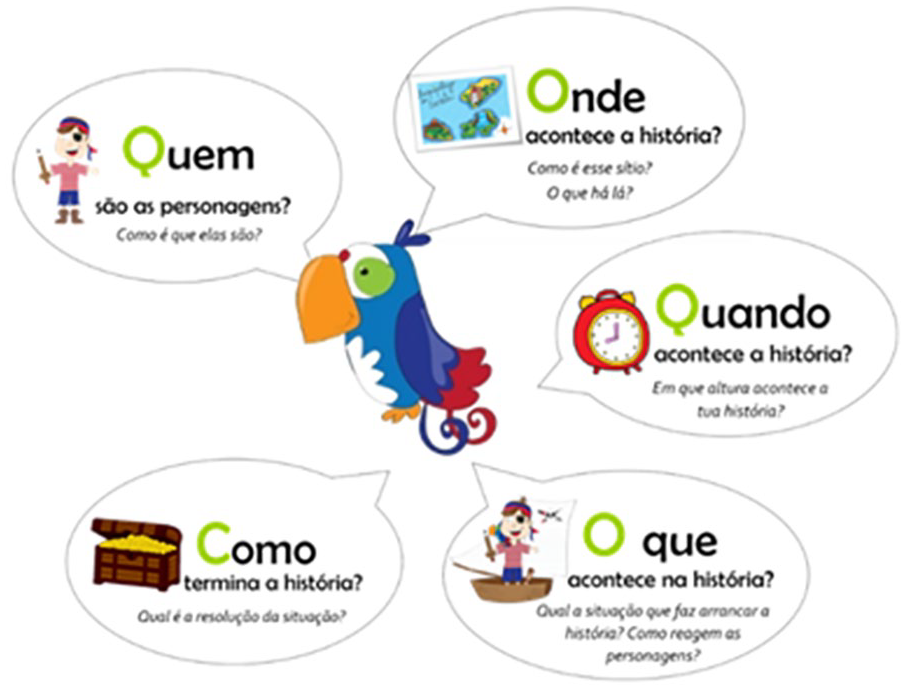
Acronym “QOQOC,” a mnemonic that mimics the sound produced by the macaw and represents five planning questions.

Acronyms “POMI” and “ECAS” referring to the revision code.

Examples of the pins used to identify each adventure.
All the sessions had the same five steps: introduction (promotion of students engagement in the session), narrative reading (presentation and discussion of the strategy, model and writing activity as a challenge or problem-solving activity), writing task (practice of the learned strategy), reflection (group discussion on the self-regulatory strategy trained), and end of session (rewarding students for solving the problem and motivating them to engage in more writing challenges outside the session, in a non-compulsory manner).
The intervention was conducted by four trained psychologists with a master’s degree in educational psychology. They were carefully selected and invited to join the research team due to their previous experience and knowledge related to self-regulated learning and writing. To be properly prepared, before the intervention sessions, the psychologists practiced their competencies with roleplays supervised by experts. All the sessions were held in class time in the teacher’s presence, who acted as an observer without intervening; their collaboration was intended to support the students’ behavior regulation. The combined work of the teachers and psychologists made it possible to maintain a productive classroom environment, the students’ motivation, and the fulfillment of the planned activities. Furthermore, to ensure the validity of the intervention and mitigate heterogeneity and inconsistencies during the intervention’s delivery, the psychologists followed a step-by-step session script. These scripts were written, studied, and revised in weekly team meetings, settling all the elements in advance: how to monitor the time session, how to perform activities, how to manage task transitions, where to emphasize the narrative expressive reading, how to answer different questions, what to say and when. Moreover, the supervision meetings with the experts aimed to exchange perceptions on how the project was running, and to offer solutions to potential difficulties and doubts. So that the application protocol was not put at risk, the team (i.e., psychologists and supervisors) tried to find solutions that could fit the characteristics of each context. After the sessions, protocol checklists were completed by the psychologists with a view to checking each session point, and ensuring, to the extent possible, the standardization of the implementation. Although CriaTivo was developed as a universal intervention (i.e., in which contents and support are provided to all students, regardless of their individual characteristics/needs), with the necessary adjustments to the context, it is a versatile intervention that can also be applied to small groups and an individual intervention.
Procedures
This research project was approved by the Lisbon Council and authorized by the school principals. An intervention and research protocol was signed with the research team authorizing the intervention implementation and the data collection and analysis, and ensuring compliance with ethical procedures (Contract no. 15033699, 18.01 – 8/DE/2015, CML). Moreover, the Lisbon Council and school principals communicated and obtained the informed consent to participate in the study from the teachers, the students, and their legal guardians. As for the research design, an exploratory study with a mixed method design was developed. Firstly, as regards the CriaTivo’s efficacy assessment, a one-group pretest-posttest research design with quantitative methods was used to collect the data. Our study used a convenience sample, and it was not possible to include a control group. To assess the intervention’s efficacy, measures of the writing process and the writing quality were applied before and immediately after the intervention sessions (i.e., in Session 1 and, 2 months later, in Session 13). In both waves, the students were given 30 minutes to write a text/written composition under the theme “An adventure” without any other instruction. The texts produced were then evaluated in terms of their writing quality with the WCAM. At the time of the written compositions, with the aim to objectively assess the use of planning skills, the students also received a blank sheet, and they were told to use it as they saw fit. This was used as a behavioral measure as previously described on page 9, “Spontaneous planning.” Additionally, the students also completed the diary task, at pre and posttest, where they self-reported how they used (or not) the self-regulation strategies in their writing process. As far as social validity assessment is concerned, the teachers and students’ perceptions of CriaTivo were collected using both quantitative (i.e., teachers’ questionnaire) and qualitative (i.e., students’ interviews and teachers’ open-ended questions) methods, at the end of the intervention. The research timings and procedures are depicted in Figure 7.
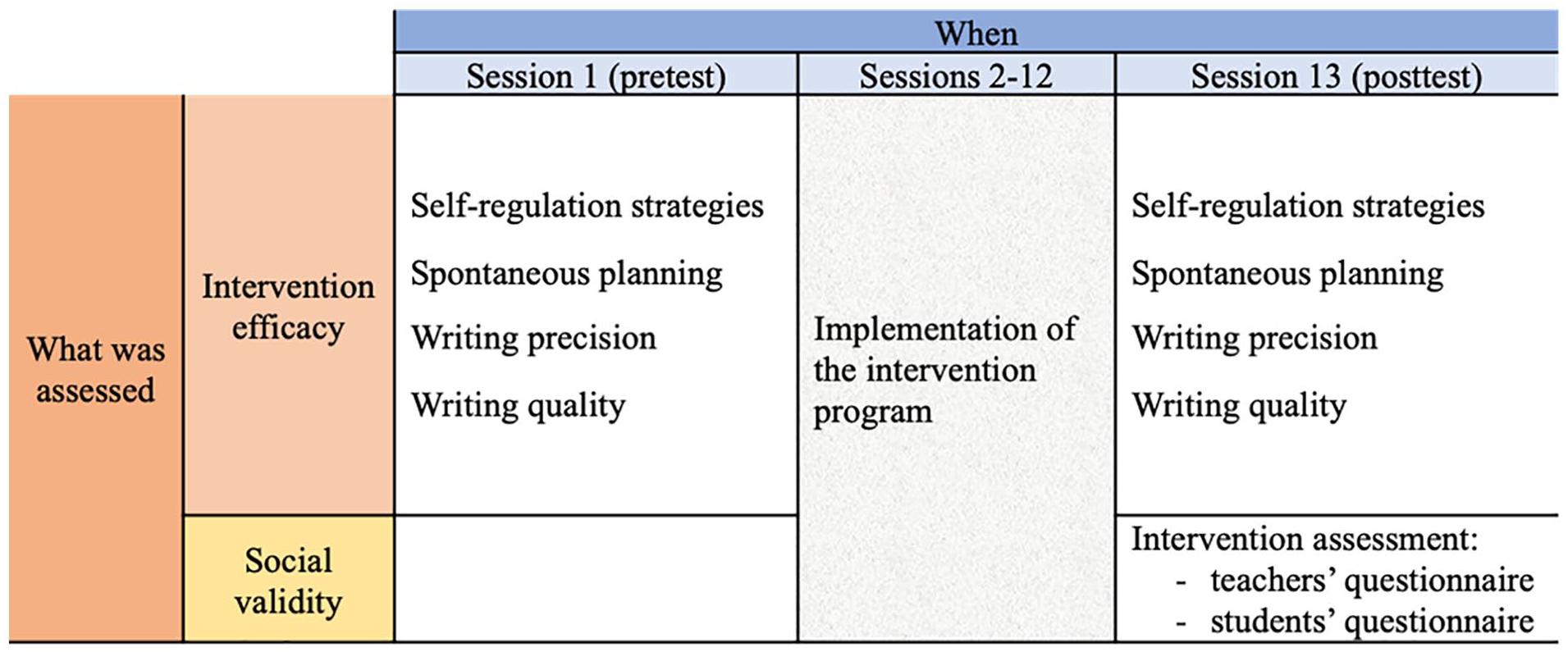
Research timings and procedures.
Data Analysis
Initial analyses to ensure data quality were performed using IBM SPSS Statistics, version 24.0 for macOS. Scale diagnosis for missing values, outliers and normality distribution was computed (Tabachnick & Fidell, 2013). Missing values had little expression (<5%), although they did not present a completely random distribution in accordance with MCAR de Little test [χ2 (1,538) = 1,796.425, p < .001]. Regarding normality and outliers’ analyses, despite the presence of some extreme values on the MACE’s monitoring scale at pretest, Q-Q plots evidenced a tendency for normal distribution for all outcome variables (i.e., |z| < 3; Kline, 2011), suggesting that the outliers did not have a marked impact on the data distribution. Considering these results, mean differences for the hypothesis test were assessed through robust one-way ANOVAs based on trimmed means (20% trimming level) (Mair & Wilcox, 2020). Significant effects were considered for p < .05. The magnitude of the findings were evaluated through the effect sizes (
Results
Writing Process
As highlighted in Table 3, at posttest, the participants reported a statistically significant increase in the use of Forethought/Planning and Monitoring strategies applied to the writing process. With regards to the use of Revising strategies, the mean difference between pre and posttest was not significant. The results also displayed a statistically significant difference in students’ spontaneous planning scores at posttest (F(1, 281.85) = 37.72, p < .001,
Means (and Standard Deviations) for Self-Regulatory Strategies Assessed in the Diary Task, Robust One-Way ANOVAs and Effect Size to Compare Means Between the Two Data Collection Waves.

Writing Quality
With regards to writing precision, the results showed a statistically significant main effect of CriaTivo on three of the four indicators assessed, with students writing more words and more precisely (with fewer spelling errors) at posttest (Table 4). The results also showed a statistically significant effect of CriaTivo on all the indicators used to assess both mechanical and content-related writing skills (Table 5). The analysis revealed that students had improved their writing quality at posttest, as there was evidence of better organization and overall structure of written compositions, vocabulary enhancement, more reader consciousness, as well as better ideas at the content level, and greater knowledge and use of grammar conventions. The findings also showed a statistically significant difference in the creativity expressed by participants between the testing waves. The analysis expressed an improvement of this measure at posttest in students’ written compositions.
Means (and Standard Deviations) for Writing Precision Measures, Robust One-Way ANOVAs, and Effect Size to Compare Means Between the Two Data Collection Waves.

Means (and Standard Deviations) for Writing Skills Assessed With WCAM, Robust One-Way ANOVAs and Effect Size to Compare Means Between the Two Data Collection Waves.

Social Validity
Students
When asked about what they had learned and improved during the intervention, the students identified four major contributions of CriaTivo on their own: writing quality skills, writing self-regulation strategies, writing creativity, and motivational attitudes toward writing (Table 6).
Content Analysis of Students’ Improvement Perceptions (Percentage of Responses) (N = 83).

Teachers
In general, the teachers involved in CriaTivo evaluated the intervention positively. They identified several benefits, namely its contribution to students’ improvement in text planning, text revision, creativity, motivation toward writing, text structure and engagement.
Teachers’ perception of achievements was in line with the established goals. When directly questioned, most of the teachers considered that CriaTivo’s aims had been accomplished and that the activities were relevant to this purpose. Table 7 presents the teachers’ perceptions regarding the achievement of each goal.
Percentage of Perceived Objective Accomplishment by Teachers.

Note. 1—Not at all; 2—Slight; 3—Reasonable; 4—Recurrent; 5—Total.
The teachers also noted that the students had transferred and applied certain strategies developed in the intervention to the context of the classroom, namely strategies for planning and revision. They highlighted the use of mnemonics and auxiliary materials, such as revision cards (e.g., “They used all the strategies, but mainly the code for the revision of the texts, which they continue to use in their daily lives,” “They still use acronyms in the writing of all their texts, especially QOQOC”).
Discussion
Regarding the gaps identified in prior literature on interventions focused on self-regulatory processes in writing, and the need to promote students’ competencies in this area, the present study aimed to advocate a curriculum-based intervention to attain those goals. In this section, the findings are discussed according to the aforementioned hypotheses and the research question. The limitations of the study are stated, and recommendations for future research are suggested, as well as implications for practice.
As far as the first hypothesis (H1) is concerned, it was partially sustained by our results. In fact, in the diary task, the students displayed an increase in their planning and monitoring strategies (p < .05) and, although not significant, they also reported, in general, enhanced revision skills. These results were reinforced by the spontaneous planning measure used which also point to a significant growth of spontaneous planning evidence after the intervention with CriaTivo. The findings allow us to strengthen our assumption that CriaTivo promotes the development and use of self-regulation strategies in students, in line with previous studies in the field (e.g., Ferreira et al., 2015; Zumbrunn & Bruning, 2013). Although statistically significant results were expected in all the three self-regulatory strategies assessed, these results may have come to light if the students had had more training time. In fact, even though planning strategies were only explicitly addressed in the first three sessions, they were revisited and practiced during all the 13 intervention sessions, allowing the students more time to train and assimilate these strategies. The same occurred with the monitoring skills which were revisited and practiced from Session 5 onward. In fact, our results corroborate those of others (e.g., Cer, 2019) where students improved their writing skills through the practice of metacognitive strategy processes and reinforce the need for school contexts to explicitly teach and create training opportunities for the students to develop and consolidate the use of these strategies (Harris & Graham, 1996).
Regarding the second hypothesis (H2), the results concerning writing quality allow us to support our initial expectations. In line with the findings of other authors (e.g., Festas et al., 2015; Graham & Perin, 2007; Graham et al., 2012), the use of explicit instruction of procedural writing skills such as the self-regulation of writing process, which characterizes CriaTivo, has shown positive impacts on students’ written quality in terms of both mechanical and content-related writing skills, reflected in a significant increase of the various measures assessed (e.g., writing precision, overall structure, vocabulary, grammar conventions). These results reinforce our initial thoughts that the use of a variety of learning resources, such as different writing strategies, writing challenges, activities, and particularly the narrative, appears to promote the learning of the instructed content as well as an increase of the writing quality skills.
In third place, our research question (Q1) was sustained for both students and teachers, who recognized improvements with the intervention in writing quality skills, self-regulatory strategies (mostly in text planning and revision), creativity, and motivational attitudes. The narrative was also perceived as a valuable and persuasive resource (Green & Brock, 2000) that provide students with the opportunity to personify an adventurer who is able to solve writing challenges; this point may help to reinforce self-efficacy beliefs on the topic. Furthermore, the students mentioned progress in personal development, underlying the importance of the social dimension of learning, as the CriaTivo promoted teamwork and coping with writing and emotional challenges. In fact, the need to develop these competencies from the first years of education are even part of the mandatory schooling guidelines (Ministério da Educação, 2017), highlighting the relevance of progressively mastering self-regulatory processes associated with central learning skills such as writing.
Limitations and Future Studies
In addition to the promising results of this study, some limitations need to be addressed. Since better results were observed in the planning and monitoring skills, which were the phases with more training time, perhaps the intervention could be adapted to allow for equal training time in each phase, so that skills in each self-regulatory phase become more balanced. As regards the diary task, some limitations can be identified as it is a self-report measure completed by students. Although an additional behavioral measure (i.e., spontaneous planning) was used to assess the students’ planning skills, no complementary measures were used to assess monitoring and revising. Thus, future studies should consider data triangulation with a multimethod approach where several measures are collected simultaneously (Erdmann & Hertel, 2019) to strengthen the results’ reliability in self-regulated strategies during written composition. Another limitation, due to the nature of our convenience sample, was the geographic circumscription of the partaking schools and the lack of an active control group in the present study which did not allow for Hawthorne effects to be considered. Therefore, despite the promising findings in this exploratory study, to establish it as an evidence-based intervention and ensure that the observed improvement of skills results from the intervention program, future studies using CriaTivo should anticipate institutional conditions and schedule to perform an active control group, in order to improve the effectiveness of the quality measures (Balbi et al., 2018) as well as implement this intervention in more geographical diverse contexts. Moreover, a follow-up evaluation would be the appropriate procedure to analyze whether students’ improvements are established, and the use of the strategies continued across time.
Implications for Research and Practice
Despite its limitations, this study contributes to practice as CriaTivo appears to be an innovative educational intervention that contributes to elementary school students’ success in writing. Our results present good indicators of success in the training of self-regulatory strategies that is concomitant with the improvement of writing skills. Moreover, our results show that the use of specific resources to promote learning (e.g., the narrative) establishes the difference between this intervention and similar models (e.g., Graham et al., 2012). Therefore, it would be useful in future research to verify the narrative impact by comparing the success of the same learning task through the use of the narrative versus not using it. The students and teachers’ acceptability and positive evaluation of CriaTivo lead us to believe that it could be considered as a component of the elementary education curriculum. It would not only support students’ attitudes toward writing, especially those with low motivation for this type of task, but also reinforce all students’ engagement in the continuous improvement of their written communication skills (Álvarez-Fernández & García-Sanchez, 2014). Moreover, CriaTivo can be considered as a set of tools, frequently identified by elementary-school teachers as elements that are lacking in the school scenario, to teach and motivate students to write, and specially to promote self-regulated learning competencies. Furthermore, as CriaTivo was also implemented in schools in disadvantaged areas with the aim to support educational success, these findings and contributions are particularly promising in the period we are currently experiencing. The outbreak of the COVID-19 pandemic has impaired elementary-school students’ learning process worldwide (e.g., Gupta & Jawanda, 2020). In Portugal, particularly, a learning recovery plan (Plano 21|23 Escola+; Ministério da Educação, 2021) is currently in progress, and CriaTivo could serve as a useful tool to integrate in educational contexts and help promote educational success and learning recovery. With the required adaptations and additional validity studies, this intervention program could also be extended beyond the Portuguese context to other languages and cultures. In line with the design of pertinent resources to teach and learn writing, and to help face current social and educational challenges, CriaTivo has interesting characteristics which would enable it to be turned into a digital tool (e.g., technological game) (Vue et al., 2016).
Another aspect worth noting is that the writing activities applied in CriaTivo give children the chance to co-regulate the writing process as they work in small groups. These practices are showing promising results in other studies even with older students where collaborative writing helps enhance students’ writing fluency (Pham, 2021). On the other hand, socially shared regulation has been highlighted as a very pertinent competence for the learning process, and more research should be conducted on the topic (Hadwin et al., 2018).
Additionally, the insights provided by CriaTivo might prompt the use of narrative, storytelling, challenges, and problem-solving to increase the learning of various contents and promote metacognitive strategies from the early stages. Finally, the intervention shows good signs of students’ positive emotion experiences, autonomy skills, sharing and praising while learning, reinforcing self-efficacy beliefs and a more active role during classroom activities (Alvarez-Alvarez & San Fabián-Maroto, 2018). By including all these elements, this intervention contributes to a changing social view on elementary students’ development, as it gives them the main role in their learning process (Lay-Lisboa & Montañés Serrano, 2018).
Conclusion
In the last decades, research has increasingly disclosed studies on the development of students’ self-regulation processes in writing by using interventions for its promotion. However, the availability of curriculum-based interventions for elementary education students that have been assessed in terms of efficacy and social validity are still scarce. The present study partially supported H1: At posttest, elementary-school students will increase their use of self-regulatory strategies associated with the writing process, namely Forethought/Planning, Monitoring and Revising skills, compared to pretest, since the participants displayed higher results in the self-regulatory phases where they had more opportunity to practice (i.e., Forethought/Planning and Monitoring strategies). Moreover, it was possible to study specific changes in writing quality as highlighted in H2: At posttest, elementary-school students’ writing quality (i.e., mechanical, and content-related aspects) will have increased, compared to pretest. In fact, the results at posttest indicated improvements in all the assessed features, underlining the pertinence of intervening in this area, considering the relevance attributed to writing production in schooling. Finally, this research found sustainability in social terms as the intervention was positively perceived by the students and teachers, as advanced in Q1: Will students and teachers find CriaTivo to have acceptable social validity? The participants referred to several enhancements in writing competencies and even in social skills, as they had the opportunity to interact during the intervention. Those perceptions were reinforced by the teachers who identified changes in their students, mostly in their attitudes toward writing (e.g., stronger self-efficacy beliefs, resilience, less fear of making mistakes). Although some limitations may be overcome in future studies, CriaTivo clearly has relevant practical and research benefits. Finally, as this study presented good preliminary results, some gaps in the literature have been narrowed, particularly that concerning projects geared toward self-regulatory processes in writing and the need to promote students’ competencies in this area.
Footnotes
Declaration of Conflicting Interests
The author(s) declared no potential conflicts of interest with respect to the research, authorship, and/or publication of this article.
Ethics Statement
Authorization to conduct this study was granted by the Lisbon Council (no. 15033699 - 18.01 - 8/DE/2015), the schools’ boards of directors, and the participants themselves.
Funding
The author(s) disclosed receipt of the following financial support for the research, authorship, and/or publication of this article: This work received national funding from the Lisbon Council in the scope of the Participatory Budget, and from FCT—Fundação para a Ciência e a Tecnologia, I.P., through the Research Center for Psychological Science of the Faculty of Psychology, University of Lisbon (CICPSI; UIDB/04527/2020; UIDP/04527/2020). This research is part of the Program for the Study of Self-regulated Learning (PEAAR;  ).
).