




Abstract
This study aims to reveal the cognitive demands of senior high school English as a foreign language textbooks in China and their potential impact on students’ thinking development. To achieve this, the study employed content analysis, using an analytical framework adapted from the revised Bloom’s taxonomy, to examine the cognitive demands incorporated in the activities across nine target textbooks from three different publishers. The study found “Understand” to be the most common cognitive demand in the examined textbooks. However, it also identified that lower cognitive demands “Remember,” “Understand,” and “Apply” were less prevalent than the higher demands “Analyze,” “Evaluate,” and “Create.” Additionally, the study observed variations in the distribution of cognitive demands within the textbooks for 10th, 11th, and 12th grades. Despite these variations, the distribution of cognitive demands across the three grade-level textbooks was found to be remarkably similar, with an increase in the occurrence frequency of cognitive demands “Apply,” “Analyze,” “Evaluate,” and “Create,” and a corresponding decrease in the occurrence frequency of cognitive demands “Understand” and “Remember.” These findings indicate that senior high school English as a foreign language textbooks in China are intentionally designed to accommodate the thinking skill needs of students at each grade level and to promote the development of their thinking skills, with a particular emphasis on higher-order thinking skills. The findings hold significant implications for the design and use of language textbooks, highlighting the importance of integrating appropriate and challenging cognitive demands to effectively support students’ thinking development.
Plain language summary
This study aims to uncover the cognitive requirements presented by senior high school English textbooks in China and their potential impact on students’ thinking skill development. The researchers analyzed the content of nine target textbooks from three publishers using an analytical framework based on the revised Bloom’s taxonomy. The findings showed that the most common cognitive requirement was “Understand.” However, lower-level cognitive requirements like “Remember,” “Understand,” and “Apply” were less common than higher-level requirements such as “Analyze,” “Evaluate,” and “Create.” The study also found differences in cognitive requirement distribution among textbooks for 10th, 11th, and 12th grades, yet the overall pattern was similar. As students progress through grades, there’s an increase in the occurrence frequency of higher-level cognitive requirements and a decrease in that of lower-level ones. These results suggest that the examined textbooks are intentionally designed to meet the thinking skill needs of students at different grade levels and to promote the development of their thinking skills, especially higher-order thinking skills. This study highlights the importance of including appropriate and challenging cognitive requirements in EFL textbooks to support students’ thinking development effectively.
Keywords
Introduction
In China, the English as a foreign language (EFL) curriculum for senior high schools has undergone significant reform, shifting its focus from merely developing students’ language skills to a more holistic approach that concurrently enhances their thinking skills and language proficiency (Wang & Luo, 2019). The latest revision to the national EFL curriculum standards for senior high schools reflects this shift, emphasizing the importance of cultivating students’ logical, critical, and creative thinking skills alongside their language development (Ministry of Education, PRC, 2020). These new standards, which prioritize both language acquisition and thinking development, have profoundly influenced every aspect of EFL curriculum design and implementation at the senior high school level, including textbook development.
Historically, EFL textbooks in China were developed locally to support the national education reform agenda and EFL curriculum standards of the time (Wang, 2007). This strategic effort has persisted and evolved, leading to the successful creation of numerous local EFL textbooks that now adhere to the updated senior high school EFL curriculum standards. Among these textbooks, three have gained prominence due to their publication by prestigious publishing houses: People’s Education Press (PEP), Foreign Language Teaching and Research Press (FLTRP), and Beijing Normal University Publishing Group (BNUPG). These textbooks are particularly noteworthy as they are designed to enhance both students’ thinking skills and language proficiency, which are the current focus of the senior high school EFL curriculum standards in China.
The effectiveness of EFL textbooks in cultivating students’ thinking skills is significantly influenced by the inclusion of cognitive demands (Mishan & Timmis, 2015). To develop robust thinking skills, students need to interact with materials that challenge and extend their cognitive abilities. Therefore, EFL textbooks should present a variety of cognitive demands to effectively stimulate the development of students’ thinking skills. While higher cognitive demands are crucial for fostering higher-order thinking skills and enriching learning experiences (Mishan & Timmis, 2015; Tomlinson, 2011), the value of lower cognitive demands should not be underestimated. A comprehensive approach to developing thinking skills necessitates a balanced integration of both lower and higher cognitive demands in EFL textbooks. This balance ensures that students build foundational thinking skills while progressively challenging them to engage in more complex analytical and creative thinking, thereby fostering comprehensive thinking development (Maley, 2011).
Examining the cognitive demands incorporated in EFL textbooks allows researchers and educators to gain critical insights into how these materials support the development of students’ thinking skills. The integrated cognitive demands serve as indicators of the textbooks’ potential influence on fostering essential thinking skills necessary for students’ language learning and broader academic pursuits. Recognizing this significance, numerous studies have been conducted to analyze the cognitive demands embedded within EFL textbooks (e.g., Chen et al., 2023; Tomlinson et al, 2001; Tomlinson & Masuhara, 2013). These studies contribute to a deeper understanding of the intricate interplay between teaching materials and thinking development, highlighting the crucial role that well-designed textbooks play in shaping students’ thinking skills.
However, there are notable gaps in the existing research. Some studies have focused exclusively on a single cognitive demand, such as creative thinking (e.g., Li & Xu, 2021), without considering the full spectrum of cognitive demands present in EFL textbooks. This narrow focus limits the inquiry into the comprehensive cognitive demands of EFL textbooks and their potential impact on students’ overall thinking development. Additionally, other research has concentrated on specific sections of EFL textbooks, such as the reading section (e.g., Freeman, 2014), potentially overlooking the contributions of other textbook sections to the development of students’ thinking skills. By examining only one section, these studies fail to evaluate the entire EFL textbook in terms of its cognitive demands, thus providing an incomplete picture of the textbooks’ impact on students’ thinking development.
To address the identified gaps, this study conducted an exhaustive analysis of the cognitive demands present in China’s senior high school EFL textbooks published by PEP, FLTRP, and BNUPG. Employing content analysis, the study evaluated the full range of cognitive demands integrated into the activities across all textbook sections, utilizing an analytical framework adapted from the revised Bloom’s taxonomy (Anderson et al., 2001). This comprehensive design ensured a detailed examination of the cognitive demands within the target textbooks, leaving no cognitive demand or textbook section unexamined. Such a thorough examination allows for an accurate evaluation of the textbooks in promoting students’ thinking skills, thereby providing valuable insights into their pedagogical value.
Literature Review
The Significance of Cognitive Demands Within EFL Textbooks
Cognitive demands refer to the level and type of thinking skills required for students to effectively engage with and complete a task (Anderson et al., 2001). They indicate the cognitive complexity of the task and the scope of thinking skills necessary for its successful completion. Bloom’s taxonomy is a widely recognized framework for categorizing these cognitive demands (Bloom, 1956). In 2001, Anderson et al. revised this taxonomy, delineating it into six cognitive processes: “remember,” “understand,” “apply,” “analyze,” “evaluate,” and “create” (see Figure 1). These cognitive processes represent a hierarchy of cognitive demands, with the first three being the lower cognitive demands and the last three being the higher cognitive demands. In the context of this study, the cognitive demands in EFL textbooks are identified by these six cognitive processes, which students must engage with to effectively participate in the textbook activities.

The six cognitive processes in the revised Bloom’s taxonomy.
The integration of cognitive demands into EFL textbooks is of significance for several compelling reasons. Firstly, EFL textbooks that incorporate appropriate cognitive demands align with students’ current cognitive abilities. This strategic alignment enables students to process and internalize EFL materials with greater assurance, leading to deeper learning and better retention (Mishan & Timmis, 2015). A scaffolded textbook design that consistently offers suitable cognitive demands allows students to build a solid foundation of thinking skills, preparing them to tackle more complex cognitive demands within EFL textbooks.
Secondly, addressing higher cognitive demands in EFL textbooks facilitates the development of essential 21st-century academic and professional skills, including problem-solving, decision-making, critical thinking, and creative thinking (Partnership for 21st Century Skills, 2009). By requiring students to engage these skills, the materials not only promote durable learning but also enhance higher-order thinking capabilities (Mishan & Timmis, 2015; Tomlinson, 2011). Therefore, integrating higher cognitive demands in EFL textbooks ensures that students develop both language proficiency and thinking skills, especially higher-order thinking skills, which are indispensable for success in the 21st century.
Thirdly, the inclusion of diverse cognitive demands in EFL textbooks is essential for engaging a broad spectrum of students with varying cognitive abilities (Maley, 2011). This diversity not only caters to the unique cognitive levels of each student but also enriches their overall cognitive experience. For instance, the textbooks that include the “Evaluate” cognitive demand challenge students to critically assess and synthesize information, while those with the “Create” cognitive demand encourage students to think outside the box and use language innovatively.
Lastly, balancing cognitive demands in EFL textbooks is instrumental in maintaining student motivation and engagement. The textbooks with excessive lower cognitive demands may fail to provide sufficient cognitive challenge, leading to boredom and disinterest due to a lack of intellectual stimulation. Conversely, the textbooks that are overly cognitively challenging can overwhelm students, resulting in discouragement and demotivation, which impede learning progress and enjoyment. Therefore, a well-curated textbook should thoughtfully balance higher and lower cognitive demands, ensuring that all students remain motivated and engaged.
In summary, incorporating cognitive demands in EFL textbooks is crucial for fostering both language and thinking skills. It accommodates students with diverse cognitive abilities and stimulates their motivation and engagement. Consequently, EFL textbooks enriched with cognitive demands establish an environment that is both supportive and challenging, enabling students to achieve excellence in both linguistic and cognitive domains.
The Analysis of Cognitive Demands Within EFL Textbooks
Research on the analysis of cognitive demands involved in EFL textbooks has significantly evolved, shifting its focus over the years. Initially, studies predominantly examined adult EFL textbooks. Tomlinson et al. (2001) found that only four out of eight adult EFL textbooks published by UK publishers offered sufficient cognitive demands. This figure subsequently declined to three out of eight in Masuhara et al.’s (2008) study. In a more recent review, Tomlinson and Masuhara (2013) observed a significant decrease, with only one out of six textbooks providing adequate cognitive demands. These pioneering studies utilized expert evaluations against established criteria to assess cognitive demands, providing a broad overview of the cognitive demands present in adult EFL textbooks. However, they did not delve into the specific cognitive demands of the textbooks, as their research scope was not directed toward such detailed analysis.
More than a decade later, the academic focus turned towards secondary school EFL textbooks. Freeman (2014) conducted a comprehensive examination of reading comprehension questions in 10 international intermediate-level EFL textbooks, categorizing them into eight distinct types: “textually explicit,” “textually implicit,” “inferential comprehension,” “reorganization,” “lexical,” “form,” “personal response,” and “evaluation.” The study’s findings indicated that all eight types of questions were present, with “inferential comprehension” questions being the most prevalent. Freeman’s innovative use of a taxonomic framework not only effectively categorized the questions but also improved the methodological rigor in this area of research.
Continuing this rigorous line of research, Ulum (2016) applied Bloom’s (1956) taxonomy to analyze the cognitive demands of reading comprehension questions in an international high school EFL textbook. The analysis revealed that the questions lacked the necessary cognitive demands to engage students in higher-order thinking skills. Expanding on this inquiry, Carcámo Morales (2019) utilized Day and Park’s (2005) question taxonomy to evaluate the cognitive demands of reading comprehension questions across Chilean high school EFL textbooks for Grade 10, 11, and 12. Interestingly, the study found that 12th grade textbooks contained a higher prevalence of literal comprehension questions compared to those for 10th and 11th grades. Although these studies employed various taxonomies to achieve methodological rigor, they primarily concentrated on the cognitive demands of reading sections in the examined textbooks. This narrow focus may have overshadowed other textbook sections that also contribute to cognitive demands, leading to an incomplete assessment of the overall cognitive demands included in EFL textbooks.
More recent studies have delved into specific cognitive demands embedded in EFL textbooks, such as critical thinking and creative thinking. Solihati and Hikmat (2018) utilized Ilyas’s (2015) critical thinking framework to investigate critical thinking tasks in Indonesian high school EFL textbooks, discovering a lack of diverse tasks specifically designed to enhance students’ critical thinking. Building on this, Chen et al. (2023) developed an analytical framework based on the studies of Kneedler (1985) and Paul et al. (1995) to examine the cultivation of critical thinking in the reading sections of two sets of senior high school English textbooks in China. Their findings revealed that both textbook sets systematically fostered students’ critical thinking through reading tasks.
Additionally, Li and Xu (2021) conducted a data-driven analysis of creative thinking development in three sets of China’s senior high school EFL textbooks, concluding that these textbook sets effectively foster students’ creative thinking. This conclusion is corroborated by Zou and Zhu’s (2023) study, which also demonstrated the positive impact of such textbooks on developing creative thinking. While the above studies offer valuable insights into the cultivation of critical or creative thinking in EFL textbooks across various countries, they may not capture the full spectrum of cognitive demands that these textbooks are designed to address. Since EFL textbooks are unlikely to develop thinking skills in isolation, existing research might only present a partial view of the comprehensive cognitive demands inherent in these textbooks.
It is evident that previous studies have made significant contributions to exploring the cognitive demands within EFL textbooks. However, these studies tend to focus on specific cognitive demands and particular sections of textbooks, limiting a comprehensive analysis of the cognitive demands present in EFL textbooks. To address these gaps, this study employs an analytical framework adapted from the revised Bloom’s taxonomy (Anderson et al., 2001) to analyze the full range of cognitive demands involved in activities throughout all sections of China’s senior high school EFL textbooks. The aim is to uncover the cognitive demands of these textbooks and their potential impact on students’ thinking development.
Research Design
Research Questions
This study seeks to address the following research questions:
What are the most common cognitive demands incorporated in China’s senior high school EFL textbooks?
How are the cognitive demands of these textbooks distributed within and across grade levels?
The first question is centered on the identification of the most frequently occurring cognitive demands within China’s senior high school EFL textbooks. By addressing this question, this study can determine which thinking skills are prioritized for development in the examined textbooks. The second question extends the inquiry by examining the distribution of the cognitive demands within and across the textbooks for 10th, 11th, and 12th grades. This exploration is crucial as it can uncover whether the textbooks are designed to correspond with the thinking skill needs of senior high school students at each grade level.
Research Materials
This study focuses on the analysis of senior high school EFL textbooks in China, specifically those published by PEP, FLTRP, and BNUPG. The selection of these textbooks was driven by several key factors: their extensive use in senior high schools, the esteemed reputation of their publishers, and their wide public accessibility. Each of these textbooks is designed to align with the senior high school EFL curriculum standards in China and aims to strengthen students’ thinking skills by integrating a range of cognitively demanding activities such as critique writing, role-playing, and project learning. Consequently, the selected textbooks encompass the cognitive demands that senior high school students commonly encounter when studying EFL textbooks.
In 2019, the PEP, FLTRP, and BNUPG publishers released three textbooks designed for senior high school students in Grade 10, 11, and 12, respectively. The PEP textbooks include five units in each book, with an additional welcome unit in the Grade 10 book, which serves as an introduction to the textbooks. Each unit in the PEP textbooks is organized into eight sections: Listening, Speaking, Reading, Writing, Pronunciation, Structure, Project, and Video Time, all within a span of 12 pages. The FLTRP textbooks contain six units per book, with each unit divided into six sections: Starting Out, Understanding Ideas, Using Language, Developing Ideas, Presenting Ideas, and Project, also spanning a total of 12 pages. The BNUPG textbooks comprise three units in each book, with each unit consisting of ten sections: Topic Talk, Lesson 1, Lesson 2, Lesson 3, Writing Workshop, Viewing Workshop, Reading Club, Focus on Language, Check Your Progress, and Project, extending to a length of 21 pages.
To ensure a focused and consistent analysis of the textbooks across different grade levels and publishers, this study excluded the introductory welcome unit from the PEP textbooks and concentrated on the main units in the PEP, FLTRP, and BNUPG textbooks. A detailed overview of the analyzed materials is presented in Table 1. In total, this study examined nine senior high school EFL textbooks published by PEP, FLTRP, and BNUPG, encompassing 42 units and 585 pages.
The Information of the Analyzed Materials.

Research Method
To address research questions, this study employed content analysis to explore the cognitive demands of senior high school EFL textbooks in China. Content analysis, which involves the examination and interpretation of textual materials, whether they are written, spoken, or visual (Krippendorff, 2018), was chosen for several important reasons. Firstly, it facilitates an objective analysis of the cognitive demands embedded in the textbooks, ensuring consistency and impartiality in data analysis. Secondly, it yields quantitative data that clearly reflects the distinctive features of the cognitive demands involved in the textbooks. Lastly, content analysis is a practical choice for this study, as it can be conducted at any time and place, at a low cost, provided researchers have access to the textual materials (Schreier, 2017).
It is important to note that this study analyzed the cognitive demands of senior high school EFL textbooks by focusing on the activities they involve. Activities are the primary means through which cognitive demands are incorporated in EFL textbooks (Solihati & Hikmat, 2018). They are intentionally designed to engage students in various thinking processes. For example, debates and discussions encourage critical thinking and the ability to articulate arguments. Writing assignments require students to organize their thoughts coherently and creatively while reading comprehension exercises demand analytical thinking skills to understand and interpret complex texts. Furthermore, activities are easily identifiable and quantifiable, allowing them to be categorized and counted according to the types of cognitive demands they present.
While the texts in senior high school EFL textbooks can also impose cognitive demands through complex vocabulary, intricate sentence patterns, and thought-provoking topics (Mishan & Timmis, 2015), these demands are significantly shaped by the associated activities. For instance, the text Cinderella, when presented to younger students, could be paired with activities that have lower cognitive demands, such as introducing characters or retelling the plot. In contrast, for older students, the same text might be accompanied by activities with higher cognitive demands, such as comparing different cultural versions of Cinderella or critically analyzing the text for underlying gender ideologies. By focusing on the activities rather than the texts, this study can more accurately and thoroughly assess the cognitive demands incorporated into China’s senior high school EFL textbooks.
Additionally, recognizing that certain activities in the examined textbooks consist of multiple questions, this study conducted a detailed analysis of each question within these activities. Such an analysis was taken because each question, while part of a larger activity, represents an individual cognitive demand. For example, in an activity from the PEP textbooks that includes a series of questions based on a reading passage, the first question asks, “What do you think the text is about?” Although this question is part of a larger activity, it places a cognitive demand of “Understand” on students, requiring them to read, comprehend, and identify the main idea of the text (see Table 2). By analyzing each activity with this level of detail, the study provides a more complete and comprehensive analysis of the cognitive demands inherent in senior high school EFL textbooks in China.
The Analytical Framework for Analyzing Cognitive Demands Within EFL Textbook Activities.

To support data analysis, this study developed an analytical framework, adapted from the revised Bloom’s taxonomy (Anderson et al., 2001; see Table 2), to analyze the cognitive demands within the activities of the target textbooks. This framework categorizes cognitive demands into six levels: “Remember,” “Understand,” “Apply,” “Analyze,” “Evaluate,” and “Create.” The first three levels represent lower cognitive demands, while the last three indicate higher cognitive demands. Besides, the framework outlines specific thinking processes associated with each demand and provides examples of textbook activities that illustrate these processes. Using this framework, this study analyzed the cognitive demands of all activities in the target textbooks, counted the occurrence frequency of each cognitive demand, and compared them within and across the textbooks for 10th, 11th, and 12th grades. Through this analytical procedure, the study identified the most common cognitive demands posed by the textbooks and determined their distribution within and across the three grade-level textbooks.
The Trustworthiness of the Study
The trustworthiness of this study was ensured by adhering to four key criteria: credibility, dependability, confirmability, and transferability (Lincoln & Guba, 1985). Credibility, which refers to the truthfulness and authenticity of the research findings, was established through a combination of expert reviews and the researcher’s recognized authority. The researcher’s authority was grounded in an intimate familiarity with senior high school EFL textbooks in China, coupled with extensive research and practical experience in EFL materials. To further strengthen credibility, an expert researcher in EFL materials was invited to review the analytical framework and entire analytical procedures. This expert researcher provided invaluable feedback, particularly on clarifying the ambiguous meaning of cognitive demands within the framework. In response, the researcher incorporated specific examples of activities from the examined textbooks to elucidate the meaning of each cognitive demand (see Table 2).
Dependability, or the degree to which the study’s findings can be consistently replicated, was achieved through a re-coding procedure. The researcher initially analyzed the activities in the examined textbooks and then re-coded them after a two-week interval. The high consistency rate of 95% between the two coding sessions demonstrated the dependability of the study, suggesting the reliability and replicability of the findings. Any inconsistencies that arose were addressed by re-examining the textbook activities and consulting their design intent described in the teacher’s books.
Confirmability, which ensures that research findings are not unduly influenced by the researcher’s personal biases or perspectives, was addressed through several strategies. The researcher maintained reflexive journals throughout the 45-day coding process, documenting nearly 15,000 words of introspective reflections. Furthermore, an EFL materials expert was invited to independently verify the analysis results for a sample of 10% of the textbook activities under review. The interrater coding consistency of 93% further enhanced the confirmability of the study. In cases of disagreement, discussions were held with the EFL materials expert to reach a consensus.
To enhance transferability, referring to the extent to which findings can be generalized to other settings or contexts, the study strategically selected the most representative senior high school EFL textbooks in China. This strategic choice was complemented by a thick description of the textbooks and the analysis process. The detailed account of the research materials and methods, coupled with their representativeness, ensures that the applicability of the research findings extends beyond the study itself to other similar contexts.
Research Results and Discussion
The Most Common Cognitive Demands Identified in the Textbooks
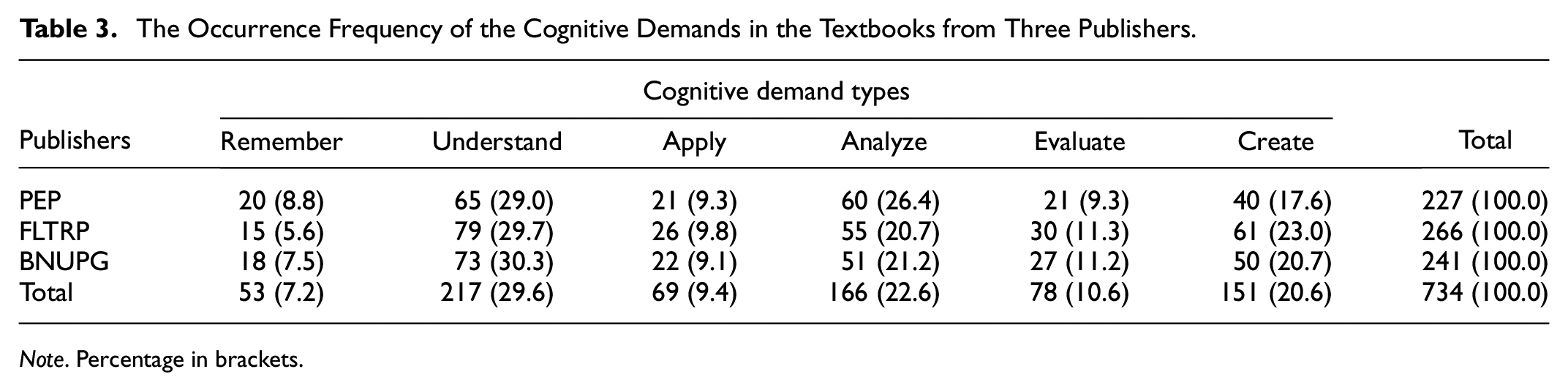
After analyzing the most common cognitive demands inherent in the examined textbooks, this study reveals that the “Understand” cognitive demand is the most prevalent, accounting for 29.6% of the total cognitive demands presented in the examined textbooks (see Table 3). This is followed by “Analyze” at 22.6%, “Create” at 20.6%, “Evaluate” at 10.6%, “Apply” at 9.4%, and “Remember” at 7.2%. The significant emphasis on the cognitive demand of “Understand” suggests that the analyzed textbooks prioritize the development of students’ thinking skills, particularly in terms of comprehension and interpretation. The finding is consistent with Freeman’s (2014) research, which identified the predominance of comprehension questions in the reviewed EFL textbooks.
The Occurrence Frequency of the Cognitive Demands in the Textbooks from Three Publishers.
Note. Percentage in brackets.
Notably, the “Understand” cognitive demand encompasses a variety of thinking processes, such as categorizing words, exemplifying grammatical structures, recognizing spoken communication, and making predictions from provided information. This is exemplified by an activity with the “Understand” cognitive demand in the Unit 1 of FLTRP textbook 1, where students are tasked with filling gaps based on listening input. Similarly, in the Unit 3 of PEP textbook 1, there is an activity with the same cognitive demand, where students are challenged to infer the main ideas of the text from the titles and illustrations. Both activities, although categorized under the same cognitive demand, involve different thinking processes, ranging from basic comprehension to more complex interpretation.
The presence of varied thinking processes within the “Understand” cognitive demand underscores its inherent complexity. This complexity highlights the urgent need for future research to delve deeper into the nuances of the “Understand” cognitive demand. By identifying the subtle differences among the thinking processes within this cognitive demand, researchers can gain critical insights into how essential thinking skills, such as comprehension and interpretation, are cultivated in EFL textbooks.
Following the “Understand” cognitive demand, the “Analyze” cognitive demand emerges as the next most prevalent, constituting 22.6% of the total cognitive demands in the textbooks (see Table 3). The frequent inclusion of the “Analyze” cognitive demand reflects the emphasis placed on the cultivation of logical, critical, and analytical thinking within the reviewed textbooks. This deliberate emphasis aligns seamlessly with the requirements of China’s high school EFL curriculum standards, which prioritize fostering students’ logical and critical thinking (Ministry of Education, PRC, 2020).
The emphasis on the “Analyze” cognitive demand is further demonstrated by the variety and depth of analytical activities incorporated into the textbooks. These activities involve a range of thinking processes, such as exploring the author’s perspective, comparing language structures, distinguishing facts from inferences, and analyzing phonological features. An exemplary activity that embodies the “Analyze” cognitive demand can be found in the Unit 2 of PEP textbook 3, which focuses on phonological changes in English consonants. In this activity, students begin by listening to and reciting words and phrases that illustrate these changes. They are then encouraged to listen to audio recordings and collaborate with their peers to investigate the question, “How does the pronunciation of consonants change in the recordings?.” Through self-driven analysis and pair discussion, students progressively understand and acquire the phonological changes in English consonants. This inductive approach to phonology instruction not only enhances students’ understanding of the target phonological phenomenon but also develops their analytical thinking skills, which are critical for academic success and lifelong learning (Anderson et al., 2001).
The “Create” cognitive demand, ranking as the third most common, accounts for 20.6% of the total cognitive demands in the textbooks (see Table 3). This significant presence indicates a strong commitment by the reviewed textbooks to developing students’ creative thinking, a finding that echoes previous studies on the cultivation of such skills in China’s senior high school EFL textbooks (Li & Xu, 2021; Zou & Zhu, 2023). When encountering the “Create” cognitive demand, learners engage in a variety of thinking processes, such as designing graphic texts, creating oral texts, and completing group work.
For example, an activity that involves this cognitive demand, found in the Unit 2 of PEP textbook 1, challenges students to undertake a group project titled “Planning a camp for teenagers.” The project begins with students brainstorming ideas for camp themes, such as adventure, science, or arts and crafts. Following the brainstorming session, students move on to more detailed planning. This phase includes creating a schedule of activities, designing promotional materials, budgeting for resources, and considering safety protocols. Finally, each group is tasked with presenting their camp plan to the class, explaining the rationale behind their choices and the expected outcomes for participants. Through this multi-faceted activity, students not only enhance their English proficiency but also develop their ability to innovate, communicate effectively, and think critically.
The cognitive demand “Evaluate” ranks as the fourth most common, representing 10.6% of the overall cognitive demands in the textbooks (see Table 3). This demand encourages learners to critically assess texts, consider authors’ perspectives, and reflect on their own learning experiences and outcomes. A relevant example can be found in the Unit 1 of BNUPG textbook 1, where an activity prompts students to compose a diary entry that includes self-reflection and self-assessment of their learning throughout the unit. This activity guides students to analyze their learning journey, identify strengths and weaknesses, and consider ways to improve. Engaging in these evaluative and reflective processes is vital for students’ language acquisition and cognitive development, as it significantly enhances their ability to internalize new information and exercise evaluative thinking skills (Anderson et al., 2001).
The less common cognitive demand “Apply” constitutes 9.4% of all cognitive demands included in the textbooks (see Table 3). This cognitive demand involves the thinking processes of using learning strategies to complete tasks and using language knowledge to complete texts. For instance, an activity in the Unit 2 of PEP textbook 3 exemplifies this demand by asking students to employ reading strategies acquired from previous activities to comprehend a new text. Through this application, students refine their reading strategies, enhance their reading efficiency, and exercise their application-based thinking skills. Besides, the “Apply” cognitive demand plays a crucial role in developing students’ language transfer skills (Bloom, 1956). By enabling students to use their language knowledge in different contexts, it broadens their ability to apply what they have learned in various situations.
The least common cognitive demand is “Remember,” which accounts for 7.2% of the total cognitive demands in the textbooks (see Table 3). This finding suggests that the reviewed textbooks minimally engage students in the thinking processes of listing information and recalling prior knowledge. While this might seem positive at first glance, it is important to recognize that these thinking processes are essential for developing lower-order thinking skills (Anderson et al., 2001). Without sufficient opportunities to develop their lower-order thinking skills, students may struggle to build the necessary foundation for higher-order thinking skills.
An example of an activity with the “Remember” cognitive demand can be found in the Unit 1 of the BNUPG textbook 1, where students discuss in groups different types of stress and the coping strategies they have previously learned. By sharing personal experiences and recalling specific techniques for managing stress, students activate their background knowledge and prior learning experiences. This process helps them to better engage in the group discussion, thereby enhancing their recall thinking skills. However, despite the inclusion of such activities, the general scarcity of activities with the “Remember” cognitive demand raises questions about whether the reviewed textbooks provide sufficient opportunities for students to build a strong foundation in lower-order thinking skills, which are necessary for the development of higher-order thinking skills.
The Distribution of the Cognitive Demands Within and Across Three Grade-Level Textbooks
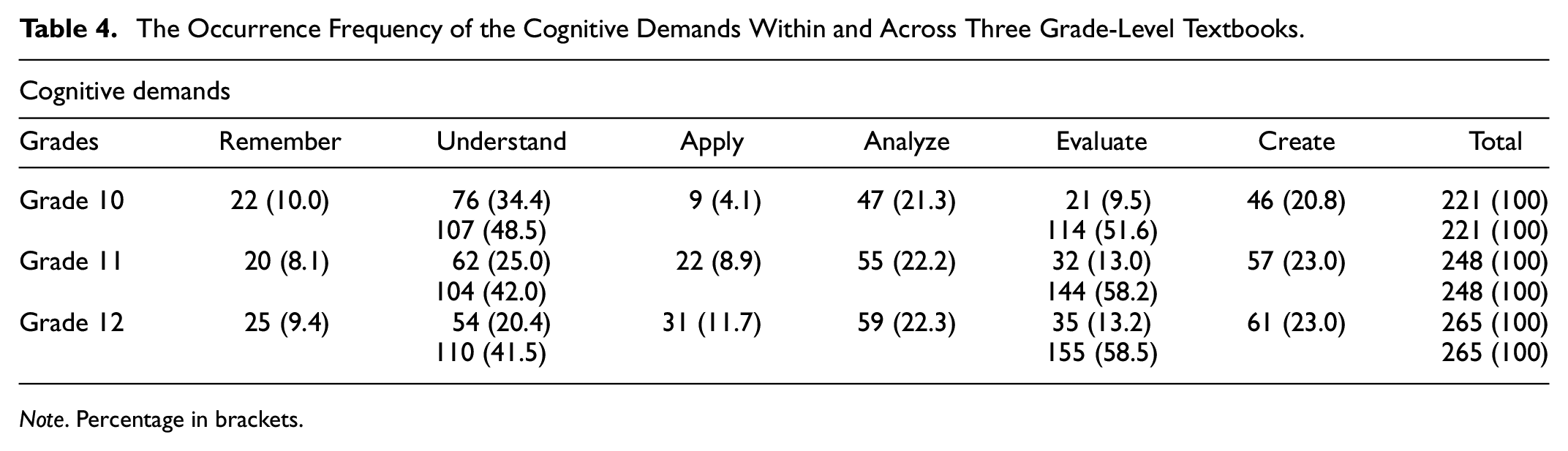
After analyzing the cognitive demands within and across three grade-level textbooks, several noteworthy findings have emerged. Firstly, the distribution of cognitive demands is similar in the Grade 10, 11, and 12 textbooks. Higher cognitive demands, such as “Analyze,” “Evaluate,” and “Create,” occur more frequently than lower cognitive demands, such as “Remember,” “Understand,” and “Apply” in the three grade-level textbooks. Specifically, the occurrence frequencies of higher and lower cognitive demands are 51.6% and 48.5% in Grade 10 textbooks, 58.2% and 42.0% in Grade 11 textbooks, and 58.5% and 41.5% in Grade 12 textbooks (see Table 4). Such a consistent distribution suggests that the examined textbooks are intentionally designed to promote thinking skills, particularly higher-order thinking skills, which is a key emphasis of the senior high school EFL curriculum standards in China (Ministry of Education, PRC, 2020).
The Occurrence Frequency of the Cognitive Demands Within and Across Three Grade-Level Textbooks.
Note. Percentage in brackets.
Secondly, the distribution of cognitive demands differs in the Grade 10, 11, and 12 textbooks, primarily reflected in the different highest and lowest occurrence frequencies of cognitive demands in the three grade-level textbooks. Specifically, the highest and lowest occurrence frequencies of cognitive demands are “Understand” (34.4%) and “Apply” (4.1%) in the 10th grade textbooks, “Understand” (25.0%) and “Remember” (8.1%) in the 11th grade textbooks, and “Create” (23.0%) and “Remember” (9.4%) in the 12th grade textbooks (see Table 4). This varied distribution of cognitive demands indicates that the reviewed textbooks are tailored to the thinking development needs of senior high school students at each grade level.
For instance, recognizing that 12th graders have more advanced linguistic and cognitive skills compared to their 11th and 10th grade counterparts, the textbooks designed for them include the most activities with the cognitive demand “Create” and the fewest activities with the cognitive demand “Remember.” By minimizing the number of activities with the cognitive demand “Remember” and maximizing those with the cognitive demand “Create,” this thoughtful design ensures that students in their final year of senior high school are given ample opportunity to develop and enhance their creative thinking, which is critical for their further academic and personal growth. Furthermore, this observation is consistent with Zou and Zhu’s (2023) research on three sets of China’s senior high school EFL textbooks, which found that the 12th grade textbooks were more effective in fostering creative thinking than those for the 11th and 10th grades.
Thirdly, the occurrence frequency of higher cognitive demands increases across the three grade-level textbooks. Specifically, the “Analyze” cognitive demand occurs at frequencies of 21.3%, 22.2%, and 22.3%, the “Evaluate” cognitive demand at 9.5%, 13.0%, and 13.2%, and the “Create” cognitive demand at 20.8%, 23.0%, and 23.0% in Grade 10, Grade 11, and Grade 12 textbooks, respectively (see Table 4). This observed increase represents that the examined textbooks are deliberately designed to scaffold higher cognitive demands and promote higher-order thinking skill development as students progress through grades. Importantly, this finding aligns with the established principle that EFL materials should correspond with students’ cognitive growth over time (Mishan & Timmis, 2015). Therefore, the textbooks not only adhere to the principle of textbook development but also support the cognitive development of students in a structured manner.
Surprisingly, the occurrence frequency of the lower cognitive demand “Apply” also shows an upward trend across the three grade-level textbooks, accounting for 4.1% in Grade 10, 8.9% in Grade 11, and 11.7% in Grade 12 (see Table 4). This finding contrasts with previous research on Chilean high school EFL textbooks, which reported that cognitive demands, including “Apply,” are not regularly distributed across textbooks at different grade levels (Carcámo Morales, 2019). The inconsistency between the findings may be due to several factors, such as differences in the analytical framework, textbook writers, and textbook development philosophy.
For example, the increased occurrence frequency of “Apply” cognitive demand in the examined textbooks reflects their development philosophy of “learning by doing” (Wang & Wang, 2019), which stresses that students’ active use of linguistic knowledge significantly enhances their comprehension and internalization of that knowledge. Future research could further explore factors that influence the cognitive demands of EFL textbooks, providing valuable insights into optimizing the design of EFL textbooks to foster students’ thinking skills.
Finally, the occurrence frequency of the cognitive demands “Understand” and “Remember” decreases across the three grade-level textbooks. Specifically, these two demands account for the occurrence frequency of 34.4% and 10.0% in Grade 10 textbooks, 25.0% and 8.1% in Grade 11 textbooks, and 20.4% and 9.4% in Grade 12 textbooks (see Table 4). It is reasonable to assert that Grade 10 textbooks have a higher occurrence frequency of the two demands compared to Grade 11 and Grade 12 textbooks. This is because 10th graders typically have lower thinking skills than their peers in higher grades, necessitating more emphasis on foundational thinking skills to build a strong cognitive base before progressing to more cognitively demanding learning materials.
Unexpectedly, this study found that the occurrence frequency of the “Remember” cognitive demand slightly increases from Grade 11 to Grade 12 textbooks. This finding may be explained by the specific learning environment of 12th-grade students in China, who are intensively preparing for the highly competitive college entrance examination, known as the Gaokao. The Gaokao places a significant emphasis on the recitation and memorization of language knowledge. Consequently, Grade 12 textbooks are deliberately designed to include more cognitive demands related to knowledge recall and retention, thereby better equipping students with the necessary thinking skills to excel in this critical examination.
Conclusion
This study analyzed the most common cognitive demands embedded in China’s senior high school EFL textbooks and the distribution of the cognitive demands within and across the textbooks for 10th, 11th, and 12th grades. The study found that the most common cognitive demand is “Understand.” It also identified that higher cognitive demands “Analyze,” “Evaluate,” and “Create,” are more prevalent than lower cognitive demands “Remember,” “Understand,” and “Apply.” Additionally, the study observed variations in the distribution of cognitive demands within the three grade-level textbooks. Despite these variations, the distribution of cognitive demands across the three grade-level textbooks was found to be remarkably similar. There was an increase in the occurrence frequency of cognitive demands “Apply,” “Analyze,” “Evaluate,” and “Create,” and a corresponding decrease in the occurrence frequency of cognitive demands “Understand” and “Remember.” Based on these findings, this study concluded that senior high school EFL textbooks in China are tailored to meet the thinking development needs of students at each grade level and are designed with cognitively complex demands to foster thinking skills, particularly higher-order thinking skills.
The findings and conclusions of this study bear significant implications for three key groups in EFL education: teacher educators, instructors, and textbook designers. Each group plays a distinct yet interconnected role in enhancing the development of students’ thinking skills through EFL textbooks. Textbook designers hold the critical responsibility of developing EFL textbooks that are both cognitively engaging and stimulating. By carefully incorporating appropriate and challenging cognitive demands, they ensure that these textbooks offer students ample opportunities to cultivate their thinking skills, especially higher-order thinking skills. EFL teachers are tasked with identifying and leveraging the cognitive demands inherent in EFL textbooks. Their role involves facilitating the effective implementation of these cognitive demands in the classroom. By doing so, they assist in achieving the objectives of the EFL textbooks to foster the development of students’ thinking skills. EFL teacher educators play a pivotal role in preparing EFL teachers to understand and address the cognitive demands of EFL textbooks. They equip these teachers with the knowledge of cognitive demands and the skills to use these textbooks, thereby maximizing their impact on students’ thinking development.
However, this study is not without limitations. The study focused its analysis on nine senior high school EFL textbooks in China, which may limit the generalization of the findings to a broader context. Additionally, the study did not examine the actual use of these analyzed textbooks in the classrooms, which could provide valuable insights into how the cognitive demands of these textbooks are addressed in practical teaching scenarios. To address these limitations, future research should expand its scope to include a wider range of textbooks from different educational levels and regions. It is also recommended that future studies investigate the practical application of cognitive textbook demands in real classroom settings. Moreover, longitudinal studies are welcomed to explore the long-term effect of exposure to textbooks with varying cognitive demands on both students’ academic performance and thinking development. By addressing these areas, future research can provide a more thorough and compelling analysis of the cognitive demands embedded in EFL textbooks and their impact on fostering students’ thinking skills. This, in turn, will inform the development of more cognitively engaging and stimulating EFL textbooks.
Footnotes
Acknowledgements
I would like to thank my supervisor, Prof. Xiaotang Cheng, for his help with this research.
Declaration of Conflicting Interests
The author declared no potential conflicts of interest with respect to the research, authorship, and/or publication of this article.
Funding
The author received no financial support for the research, authorship, and/or publication of this article.
Ethical Approval
Ethics statements are not applicable in this article.

Data Availability Statement
All data included in this research are available upon request by contact with the author.