




Abstract
The need to account for the direct and indirect influence of competitive intelligence and learning orientation on SMEs export performance given the poor export performance of SMEs in developing economies precipitated this study. This has become relevant in view of the need to ensure that SMEs remain an engine room for economic growth and development. Hence, we collected data from a sample set of 400 employees from SMEs that engage in export activities. Structural equation model (SEM) with the aid of AMOSv27, was used in analyzing the data. The study found that competitive intelligence affects export performance of SMEs. We also found that learning orientation has a positive link to SMEs’ export performance, and it mediates the relationship between competitive intelligence and export performance, though partially. Drawing insight from the resource-based view theory, we advanced competitive intelligence as a firm intangible resource that can affect export performance, even when channeled through learning orientation. Hence, manager’s ability to first gather and analyze reliable information about its firms’ readiness comparatively to that of their competitors and creating an enabling environment that supports information sharing and willingness to alter existing practices to replicate novel information from their competitive intelligence activities are fundamental in ensuring increased export performance.
Introduction
The increasing spate of competition faced by firms today has made it almost impossible for them to take actions without proper information and guidance in order to ensure an optimal course of action (Dishman & Calof, 2008; Wright et al., 2002). David (2010) argued that the ability of a firm to obtain reliable information about its rivals and its operational environment would provide them with a competitive edge toward ensuring that they remain competitive. This makes it more expedient for firms to ensure that they have a strategic and deliberate approach that seeks to gather reliable and timely information that its managers can rely on for decision making, and this is where competitive intelligence comes in for firms (Fleisher & Bensoussan, 2003; Maune, 2014).
Competitive intelligence allows for gathering competitive strategic information on competitors (Tahmasebifard, 2018). While the concept of competitive intelligence is not new to management and business scholars (Bergeron & Hiller, 2005; Du Plessis & Gulwa, 2016; Juhari & Stephens, 2006), there seems to be no accepted framework underlying the construct. This could be because a firm’s information needs and manner of collection differ, and what accounts for justifying the extent of competitive intelligence also depends on the resources available to the organization (Lim et al., 1996).
Despite the relevance of information intelligence and its value to business, it is strange to discover that the concept has attracted limited attention from scholars. Research on this concept has become necessary because information needs of firms are never ending, as it is continuous and not constant; hence, the need for increasing scholarly discussion that would lead to building new theories and extending scholarship on the construct.
Ekwoaba and Emmanuel (2019) opined that competitive intelligence is useful for new businesses that seek to make new entry, as it allows the firms to assess its readiness comparatively to that of their competitors. This allows for better planning, which leads to increased performance. Assadinia et al. (2019) opined that marketing planning is critical to SMEs export performance. This is because they cannot make mistakes with limited resources; hence, justifying the need to adopt competitive intelligence as an internal resource toward gathering relevant information that would form useful knowledge for decision making.
However, this has not been the case for most SMEs in developing economies, most especially Nigeria, as there is a rising spate of small business failures in both the local and the export market. The poor decision making of most SMEs has come at enormous cost to the managers and the owners (Isichei et al., 2020), as it has led to both disrupting export activities and winding down of the firms. Small firms’ inability to harness internal resources, which would allow them to gather reliable information to act proactively, take risk, learn, and apply new knowledge account largely for these challenges (Gračanin et al., 2015).
The inability of SMEs to gain reasonable market share for its products has been a source of concern for governments and investors in Nigeria (Babatunde, 2017). The apparent poor access to information, resource constraints, and the inability to respond to fluctuations in their ever-changing business environment are also key challenges. Addressing these challenges would ensure SMEs are key drivers of economic growth and development. Hence, this paper focused on unraveling the relevance of competitive intelligence to export performance of SMEs.
There have been studies that have assessed the link between competitive intelligence and export performance. However, the result has been inconsistent, as some studies have confirmed competitive intelligence has a positive link with export performance (Tarek et al., 2016; Yazdi Ramezani Mojarad et al., 2014), while others have shown a statistically insignificant effect (Adelaide & Akpan, 2015). Hence, justifying the need to explore this relationship further, given the relationship remains unclear.
Scholars have advanced the need for exploring possible mediators on export performance based on the need to broaden understanding on the construct and x-raying new insight on the multifaceted interconnections explaining firm’s internal intangible resource, its strategic activities, and their export performance (Monteiro et al., 2019; Safari & Saleh, 2020; Sousa et al., 2008). We adopted Sinkula et al. (1997) dimensions of learning orientation as a precursor to further explain this relationship. Assadinia et al. (2019) posit that export learning increases export performance, and competitive intelligence provides firms with new knowledge to learn, however, an organizations learning orientation determines how it perceives and learn from the information, hence supporting the need to explore the mediating role of learning orientation on competitive intelligence and export performance.
The role competitive intelligence and learning orientation play in supporting SMEs to respond appropriately to market interplays has remained unanswered in literature. There is limited knowledge on how learning orientation drives export performance, most especially in developing economies; hence, we closed this gap. There are limited studies that have examined competitive intelligence and export performance and the indirect influence of learning orientation in emerging economies, most notably in sub-Saharan Africa, Nigeria. This prompted our focus to assess the relevance of competitive intelligence toward improving export performance and examine the indirect interplay of learning orientation in the relationship between the constructs. We presented theoretical framework and hypotheses development next, followed by material and method. Next was results; followed by discussions and conclusion, implications of the research, and finally limitations of the study.
Theoretical Framework and Hypotheses Development
The underpinning theory that guided this study is the resource-based view (RBV). RBV presupposed that organizations’ internal resources are critical for gaining competitive advantage and these resources can be tangible or intangible (Roth, 1995). The theory holds that the resources must be superior in use and difficult to imitate before the firms can use it to gain competitive advantage. The resource advantage allows the firm to gain a strategic position among competitors in the industry, as the organization can effectively influence their activities, thus creating competitive advantage that enhances export performance (Delgado-Gómez et al., 2004).
Organizations’ resources have been described as physical and human assets, information and knowledge and capabilities, which are within its control and can be explored to ensure increased performance (Isichei et al., 2020). Barney (2001) distinguished between the human and physical assets. The human comprises the training, staff strength, and experience of the managers, while the physical comprises the equipment, land and building. Employees are fundamental resource for strategic competitive advantage (Monteiro et al., 2019) and Freeman et al. (2012) held that an organization’s success is anchored on the extent that it can manage its specific resources and develop capabilities to create meaningful value. Hence, when employees engage actively in the organization’s competitive intelligence process, and they encourage learning in the organization, there is a greater chance that it would lead to improved export performance, given that employees’ roles are critical to export performance. Hence, RBV application is justified in this study.
Organization internal practices that provide them reliable information in form of trends, advanced technology, and competitors’ practices are triggers for change and most often they respond with changed practices. However, their response to these trends are determined largely by the organization’s learning orientation, as it is what determines how they perceive the information and convert same internally toward gaining superior performance. Thus, relying on this theory, we propose that learning orientation mediates competitive intelligence and export performance relationship.
Competitive Intelligence
The concept of competitive intelligence has progressed to encompass wide ranging tactical positioning that has revolutionized the business world (Maune, 2014). Ghannay and Mamlouk (2012) opined that competitive intelligence comprises perceptible as well as imperceptible asset besides capacity to develop intelligence by sourcing, evaluating as well as circulating information that will result to tactical decision making as well as establish substantial gain when integrated by an organization. Yazdi Ramezani Mojarad et al. (2014) defined competitive intelligence as assembling, handling, examining information about rivals, as well as the environment to build, as well as maintain an edge over them.
Tena and Comai (2004) agreed that competitive intelligence is a methodical procedure introduced by industries to organize as well as evaluate information about rivals besides social and economic environment which involves exploring, choosing, scrutinizing as well as circulating information to maintain a significant edge over rivals. Competitive intelligence refers to practices whereby a company source for as well as utilize information about products, consumers including rivals to develop tactics that help in enhancing decision-making process (Fleisher & Bensoussan, 2003). It encompasses procedures that ensures company pays attention to its environment in order to have concrete information that would aid them in decision-making and carry out activities that will lead to the attainment of its stated goal.
There are different competitive intelligence that organizations utilize for their own benefits and to continually maintain an edge over their rivals (Tahmasebifard, 2018). They include: market intelligence, technology intelligence, competitor intelligence amongst others. Market intelligence is concerned with constant observation of the market as well as interrelating with individuals, machineries including processes in order to assemble, categorize, examine as well as circulate important, precise information to be utilized by managers in enhancing their market design, execution and regulation (Trainor et al., 2013). It also involves utilizing both core and outward information, investigation and numerical modification to advance market reaction.
Technology intelligence encompasses information on current and future technological events that would be a source of new knowledge for an organization (Tahmasebifard, 2018). Organizations using this form of intelligence are mostly technology inclined, as it is useful in furnishing managers with information on technology to comprehend technological trends. It encompasses practical information about technology advancement and trends capable of affecting an organization’s economical ranking besides maintaining an edge over its rivals (Chen et al., 2004). Competitor intelligence refers to ascertaining, observing as well as comprehending certain existing rivals to enhance the competitive edge of the organization while lowering that of its rivals (Deschamps & Nayak, 1995).
Strategic competitive intelligence provides information about fears and prospects (Yazdi Ramezani Mojarad et al., 2014). It refers to accurate comprehension and utilization of information to formulate befitting tactics that are suitable for the organization (Pirttimäki, 2007; Salih & Abdulrahman, 2015). An organization’s strategic intelligence ensures an organization detects growing inclinations and configurations within certain trade while forecasting likely difficulties that can upset their existing functional environment (Keikha & Hadadi, 2016). The combination and utilization of these or specific type of competitive intelligence by an organization is likely to lead to improved performance and competitive advantage (Tahmasebifard, 2018).
Export Performance
The concept of export performance has attracted quite several attentions from international business scholars (Anil & Shoham, 2017; Krammer et al., 2018; Love et al., 2016). There is generally no specific definition of export performance (Sousa, 2004), as the concept has been defined from varying perspectives. This has led to a none existing framework that allows for a consensus and synthesis concerning its conceptualization, operationalization and methodology (Katsikeas et al., 2000; Lages & Sousa, 2010; Sousa, 2004; Zou et al., 1998).
However, several scholars have provided varying perspectives, which have been relied on to better explain export performance (Das, 1994; Evangelista, 1994; Sousa & Bradley, 2008). Cavusgil and Zou (1994) opine that export performance is the outcome of organizations’ strategic activities in response to internal and external demands. It can be explained to be the strategic drive of organization that aims to capture a market for itself in order to achieve its overall set goal and objectives. Also, export performance is the outcome that an organization gets from engaging in export activities through the total of the interplay between the firm-specific resources and environment specific reactions (Diamantopoulos, 1999; Shoham, 1998).
There has been varying level of the measures of export performance. Literature has shown export performance is assessed at the firm, export venture and product level (Katsikeas et al., 2000; Madsen, 1998; Oliveira et al., 2012). We relied on the firm level to analyze export performance and this is because it allows for gathering a holistic detail of the export operation of the firms. There is a consensus among scholars that export performance is a multidimensional construct (Alvarez, 2004; Morgan et al., 2012) and most commonly used is the objective and the subjective measures of export performance. The objective measure captures the sales growth and intensity, export profit and market share expansion (Morgan et al., 2012).
The subjective is borne out of the argument that export activities also depend on the organization’s basis for engaging in export activities (Das, 1994; Francis & Collins-Dodd, 2004), as such, the manager’s perception of the export success is vital to determine if the organization’s export performance is satisfactory (Cavusgil & Zou, 1994; Evangelista, 1994). There have been studies that have called for a combination of the measures (Julian, 2003; Sousa & Bradley, 2008), as there are limited studies that have assessed export performance using a multidimensional perspective. This study is a response to such call, as the measure of export performance was done using both the objective and subjective measure.
Learning Orientation
Learning remains one of the most valuable intangible resources for employees in any organization. Learning helps change orientation, ensures advancement, and modifies attitude to the benefit of both the organization and the employees (Vega Martinez et al., 2020). Sinkula et al. (1997) define learning orientation as a collection of guiding strategies that dynamically affect knowledge acquisition to analyze, assess, adopt, or discard data that a firm receives. For Baba (2015), learning orientation is the entirety of competence gleaned from cognitive and experiential processes, which supports the accumulation, transmission, and application of information.
Learning orientation is the extent to which a company acquire as well as circulates information about market alteration, consumer’s anticipation and desires, activities of rivals and current technological advancement to produce novel product or services of higher quality (Calantone et al., 2002). This study views it as the value or inclination of an organization toward learning about its market and ensuring optimal utilization of the information received toward advancing the organization processes and performance. It is a crucial element of an organization’s strategic process, which improves and ensures an organization maintains an edge over its rivals (Sinkula et al., 1997).
Learning orientation does not focus mainly on obtaining information from consumers and competitors alone, it involves obtaining, forming as well as circulating information that can contest present beliefs and standards in order to replicate novel information and understanding for the attainment of novel standard (Ismail, 2013; C. L. Wang, 2008). Hence, the importance of learning orientation to an organization cannot be overemphasized, as it helps to detect market prospects and ensure long-lasting progress and performance of the organization (Dimitratos et al., 2012).
There are varying theoretical models proposed on learning orientation, however, this study relied on the dimensions of Sinkula et al. (1997) that operationalized learning orientation as commitment to learn, open mindedness and shared vision. The choice of aligning to this construct is because it best explains the learning orientation among firms in Nigeria. Commitment to learning is the willingness to convert and identify the exact significance of the learning process.
Sinkula et al. (1997) explained that commitment to learning is the degree to which an organization value learning as well as stimulates learning culture within its environment. Hence, when a firm highly regards learning, learning culture will permeate its environment. Calisir et al. (2013) opined that commitment to learning refers to an organization’s willingness to alter present routines via merging prevailing knowledge or fitting novel knowledge through obtaining, communicating, consenting, as well as merging knowledge within the organization.
The capacity to query current philosophy in order to determine its rationality and usefulness is premised on the extent of an individual’s openness (Vega Martinez et al., 2020). Open mindedness is the degree an organization freely contests old practices, philosophies, opinions, while connecting it to the idea of unlearning (Sinkula et al., 1997). Unlearning is crucial in ensuring modification while open mindedness is the fastest path that expedites unlearning, hence organization ought not to rely on previous performances established on old practices and procedures, which most unlikely fit into present environmental outlook (C. L. Wang, 2008). An organization that is open minded usually assesses its old practices while finding a current method of doing things (Calantone et al., 2002). Moreover, many innovations arise from individuals within the firm, hence there is a need for firms to imbibe open mindedness as it will have a positive effect on their performance (Calisir et al., 2013).
Shared vision is an essential background to learning which establishes the path of what to learn as well as the reason behind the choice of learning the subject matter (Hult, 1998; Pearce & Ensley, 2004). It defines the profound shared purpose of the organizations, as well as guide the framing of tasks, which drives employees toward the shared objective of the organizations, thus leading to a shared sense of purpose. It influences the learning process and the extent of open mindedness, while also stimulating the degree of learning (Sinkula et al., 1997). Despite the importance of commitment to learning and open-mindedness, without shared vision, the employee will not be conscious of what to learn or experience, moreover, it stimulates, drive, as well as establish path toward learning (Fang et al., 2014). Shared vision enhances devotion of workers to the objectives of the organization as well as ensures learning occurs with exact optimism (Calisir et al., 2013).
Linking Competitive Intelligence and Export Performance
Literature has established the relevance of market knowledge as a critical factor that advances export performance (Haddoud et al., 2019; Nalcaci & Yagci, 2014; Pinho & Martins, 2010). When an organization acquires information about rival organizations or its internal and external market, and can transform same into knowledge, it will probably aid in the formation, as well as, execution of proactive and positive tactics expected to impact on the performance of the organization (David, 2010; Nalcaci & Yagci, 2014).
The objective of competitive intelligence is to gather reliable information that forms useful knowledge source that organization can act with to improve their performance (Calof & Brouard, 2004). The information helps managers plan and overcome obstacles, thereby leading to improved export performance (Haddoud et al., 2019; Nemkova et al., 2012); as competitive intelligence system supports the provision of timely and verifiable information (Fleisher & Bensoussan, 2003). Competitive intelligence is an essential business philosophy and an important factor that aids in determining the overall sustainable performance of an organization (Calof & Brouard, 2004; Yazdi Ramezani Mojarad et al., 2014). Tarek et al. (2016) revealed a positive relationship between competitive intelligence and export performance. Competitive intelligence distinguishes a performing organization from a non-performing one, as it improves financial performance (Johns & Van Doren, 2010; Tej Adidam et al., 2012).
Competitive intelligence activities are relevant for firms engaging in international and export market, as any error in judgment and activities will lead to the failure of the organization. Since it ensures that organization makes a precise judgment at the right time, it will aid the organization in developing superior products and intelligent response to changes in their environment, which will translate to superior performance for the organization in the international market.
Organization would perform better and maintain superior performance when they utilize competitive intelligence, and they will also be able to offer their product at a competitive price and be able to differentiate itself from its rivals, which would help them to gain an increased market share and achieve the organization’s export strategic objective. We draw insight from the resource-based view theory that proposes that information and knowledge are strategic resource to gain competitive advantage, and thus propose that:
Mediating Role of Learning Orientation on the Relationship Between Competitive Intelligence and Export Performance
Change is inevitable, hence as environment undergoes alteration, organizations will also have to modify its operation in order to survive and succeed, which can be made possible through learning. Commitment to learning is a crucial element necessary for the survival of any organization (Calantone et al., 2002), as it determines the extent an organization can respond to changes in its environment (Karunaratne, 2017; Sinkula et al., 1997). Ussahawanitchakit (2008) found a positive relationship between commitment to learning and performance of an organization.
Calisir et al. (2013) opined that commitment to learning helps an organization gain experience and be able to change its practices to suit prevailing circumstances. Love et al. (2016), and Ganotakis and Love (2012) also found a positive link between experience and export performance. However, to gain valuable experience that would lead to improved export performance, there is a need for renewed knowledge (De Clercq et al., 2012), and commitment to learn avails the organization new knowledge. García-Morales et al. (2006) held that commitment to learning improves knowledge, which leads to an increase in organizations’ performance.
The complexity of export market requires that firms consistently engage in activities that allow them renew themselves in order to meet up with changing market dynamics. Achieving export market strategic objective most especially for small businesses requires that they engage actively in innovative ventures that will drive increased performance (Haddoud et al., 2019), however, offering innovative products to a consistently changing market requires that the firm can commit itself to learning new things, as learning could be on new technology, modification of existing products and relatively new ways of managing customers. Commitment to learning allows for long term tactical positioning of any organization interested in sustaining performance. We therefore submit that:
We argue that competitive intelligence is a precursor to commitment to learn based on the argument that competitive intelligence serves as an intelligent means an organization utilizes in filtering information received from its environment which allows for quality decision making and help them cope with changes in their environment (Ghannay & Mamlouk, 2012; Rouach & Santi, 2001). When this intelligent information is gathered, it stimulates the need to understand or unravel how the information would be impactful to the organization, and Sinkula et al. (1997) opined that commitment to learn allows for understanding the relevance of gathered information toward improving organizations performance.
The need to make a quality decision from engaging in competitive intelligence activities would stimulate commitment to learn, as commitment to learn provides for a vivid understanding of the cause and effect or consequences of deciding based on the information gathered, which in the end would make for effective quality decision that would improve export performance. The commitment to learning allows the firm to be able to convert the information gained into knowledge, which is useful in ensuring increased export performance.
Competitive intelligence activities provide information on new and changing markets dynamics (Tarek et al., 2016) and this leads to commitment to lean, which Ismail (2013) opined serves as a source of obtaining new knowledge. Ghannay and Mamlouk (2012) opined that the success of competitive intelligence activities is hinged on the organization’s ability to consistently ensure that it remains focused on gathering reliable information that would aid decision making. This invariably would lead to investing in activities that consistently yield new knowledge and not relying on previous ones, making for optimal decision making based on current information. In the view of Nalcaci and Yagci (2014) acquiring new knowledge and information is central to increase export performance and most especially information on competitors, changing technology, market, and industry trend. Hence, we propose that:
Calisir et al. (2013) opined that open mindedness is the core prognosticator of ground-breaking performance. Open mindedness, when allowed within an organization, stimulates innovation and leads to improved performance of the organization. Vega Martinez et al. (2020) held that open mindedness allows for discovering opportunities, and opportunity discovery allows the organization to spot gaps in its market (X. Wang et al., 2020) and organizations ability to proactively discover opportunities and act on them would enhance the possibility for increased export performance (Donbesuur et al., 2020).
Toften (2005) found that there is a favorable link between openness in utilizing certain aspect of export information and performance. Lin et al. (2022) found that open mindedness as an organizational culture, improves valued processes and procedures within the organization and leads to firm’s continuous competitiveness and performance. Karunaratne (2017) found that open mindedness leads to improved organizational performance. Haddoud et al. (2019) also found managerial disposition as a factor that influence export performance.
Organizations that are more open to using intelligent information generated from the market will naturally perform better than others (Song et al., 2009). This is because open mindedness would enable an organization to identify unexploited consumers’ needs, and the ability to exploit effectively and proactively the consumers need ahead of competitors would allow the organization minimize cost, gain first timer advantage and recoup its initial investment before other competitors.
Also, drawing inspiration from the resource base view theory that presupposes that organizations’ internal resources are critical to gaining competitive advantage. It is worthy to state that, except managers are open minded, they would not be able to effectively identify and manage their internal resources toward gaining competitive advantage. An organization with managers that are open minded will be ambidextrous in their leadership approach with employees and this would be beneficial toward improving export performance, as they will explore and exploit toward innovation for improved performance. Thus, we propose that:
Core values that support a free flow of information, its utilization and circulation of knowledge are fundamental in improving performance. Firm’s culture of open mindedness can be a useful mediator that helps increase performance. Competitive intelligence activities provide the firm with diverse information (Ghannay & Mamlouk, 2012; Tej Adidam et al., 2012), and the need for objective assessment and analysis of the information for decision-making demands managers have an open mind toward learning, as open mindedness does not support drawing irrelevant conclusion out of sentiments, not relying on previous knowledge, and not showing interest to unlearn and relearn. The quest for objectivity in competitive intelligence activities supports the need for open mindedness to effectively manage the new information and properly act in the organization’s interest.
It helps an organization to comprehend its environment and grasp useful information on the best approach in operating its business. Hence, the useful information obtained can translate to new practices that will probably lead to improved performance. An organization that is open is adaptable and can interact perfectly with individuals and organizations from different settings, which can facilitate access to essential intelligence. Especially when playing in the global market, open mindedness to novel experience ensures an organization can adapt to cross-cultural settings.
Open mindedness ensures an organization detects important pointers useful in reacting appropriately to changing circumstances. When an organization combines competitive intelligence with open mindedness, it allows the firm to treat information without bias and sentiment, thus reducing cognitive conflict associated with large information and leading to increased performance. The diverse information from competitive intelligence activities can be easily synthesized through open mindedness, thus allowing for a superior decision that would lead to increased export performance, as managerial objectivity accounts for higher export performance. Thus, we propose that:
Shared vision enhances devotion of workers to the objectives of the organization (Calisir et al., 2013). When employees are devoted to the goals and objectives of the organization, it will lead to improved organizational performance. However, Calisir et al. (2013) found shared vision not to significantly impact on performance. Calantone et al. (2002) opined that shared vision ensures there is a clear direction for learning, which helps to improve the quality of learning and the strength of the organization.
Karunaratne (2017) asserted that shared vision is an important factor in an organization’s performance. García-Morales et al. (2006) revealed that shared vision has a significant effect on performance. Similarly, Ussahawanitchakit (2008) found a positive link between shared vision and performance. Shared vision makes employees feel valued, and this translates to increased commitment, which would account for increased performance. We thus propose that:
The outcome of the competitive intelligence activities gives birth to the direction of the learning process, as an organization can rely on the information to continue or change its shared goals and objectives, which helps to direct employees to work toward improving organizational performance. Competitive intelligence activities also provide employees relevant information that relates to their roles toward improving organizations’ performance (Bergeron & Hiller, 2005). This helps stimulate employee’s interest to learn and, through centralization of learning, commitment is built, which would lead to increased export performance (Shavazi et al., 2015).
Bergeron and Hiller (2005) indicated that the competitive intelligence process involves the filtering and re-examination of the information gathered to determine its usefulness. This process leads to aligning the information to the shared vision of the organization, as such, this allows for discarding information that is not useful to the overall objective of the organization, as not all information would serve the immediate need of the organization. Shared vision creates a defining path that allows for managing complexity of information and aligning them to organizations’ goal and objectives (Shavazi et al., 2015).
Bature et al. (2018) opined that learning orientation supports the organization’s ability to adopt new knowledge to gain competitiveness. When employees understand the organization’s environment and knowledge need, the existence of shared vision would stimulate a goal oriented competitive intelligence activity, which would invariably lead to improved export performance. This would be achieved through synchronizing the shared vision toward reflecting the reality of the organization from the information gathered, and direct or redirect its activities toward ensuring that the firm gain increased export performance, most especially when operating in a highly competitive market.
Export performance can be improved when there is a process of acquiring and assessing new knowledge and shared vision on other hand offers opportunity for the legitimate acquisition and attainment of new knowledge for organizations’ decision makers, as decision makers play a vital role in the entire process of competitive intelligence. They influence and take decisions on any perceived intelligence received from the environment, as their opinion affects the entire process. This can be through resources provision to the entire competitive intelligence process, as their vision and what they desire to achieve are fundamental factors that would drive resource allocation toward the process. Thus, shared vision accounts for the relationship between competitive intelligence and export performance. We therefore propose that:
Material and Method
Information from the Nigerian export promotion council and Manufacturers’ Association of Nigeria (MAN) provided easy access to identify the selected firms that took part in the survey. The sector of interest is the textile industry, which was once a major source of revenue for the country. The study population covers textile firms from the six regions of the country. This was done to get a good data spread from firms in both the north and southern part of the country. The criteria for selection of the firms were first the willingness to take part in the survey, registration with Corporate Affairs Commission and evidence of engaging in export activities in at least one country in Asia, Africa and America. Sample dataset from 400 employees (managers and supervisors) were used for the study. To confirm sample size adequacy, we used G*Power to conduct a post hoc power analysis. The result confirms sampling adequacy criteria was met, given that a sample size of 89 was required to have a statistical power of 95%, while the current sample dataset exceeds 89. Convenient sampling technique was adopted in the sample selection. The justification for this technique is its suitability in selecting participants that are accessible and willing to take part in the survey and the difficulty associated with collecting data from firms in developing economies. Questionnaire was used for collection of data and internal consistency and construct validity were assessed through a pilot study of 150 participants before the full collection of data. This was done to ensure that the instrument was suitable for the study environment, since the original scale was designed for firms in developed economies. We carried out the full collection of data between October 2019 and January 2020. Structural equation model (SEM) with the aid of AMOSv27, was used to test the formulated hypotheses. SEM has the advantage of testing statistical theory in an established phenomenon (Byrne, 2006), hence justifying its use in this paper (See Figure 1 for model).

Theoretical relationship between competitive intelligence, learning orientation and export performance.
Measures
The questionnaires were divided into sections with nothing indicating a link of the variables and this was done to reduce problem associated with collecting information on the dependent and independent variable from one source. Next, a letter was attached notifying the respondents on the need of the study and assuring them of ethical compliance with the data collected. Harman’s single-factor test was conducted with exploratory factor analysis and the result showed that only one factor accounted for 29.12% variance, as none exceeded 50% (Podsakoff et al., 2003), thus, showing an absence of common method variance bias. The result showed absence of univariate or multivariate outlier.
Competitive Intelligence
Adapting the conceptualization of Yap et al. (2011) in operationalizing competitive intelligence provided a guide in designing the scale used in measuring competitive intelligence in the study. However, this scale differs from Yap et al. (2011) scale that was designed mainly for CEOs. We made the current scale to capture employee’s perspective on competitive intelligence. This became necessary given the view that competitive intelligence is an organization wide strategy that requires input from not only the top managers but also the middle and lower-level managers. Our scale had seven (7) items outlined in a Likert format, from 1 (strongly disagreed) to 5 (strongly agreed). However, the scale was pilot tested and principal factor analysis result provided justification for removal of two items. The final scale was made of 5 items and the reliability coefficient was 0.711. The items sample are “Our organization has been able to get reliable information on market trends that have been beneficial”“Our organization relies on its operational intelligence units for technological changes” and “Management decisions on new ideas/change in processes are based on the information gathered”
Learning Orientation
The scale measuring learning orientation was designed using a five-point likert format ranging from 1 (strongly disagreed) to 5 (strongly agreed). This study adapted Sinkula et al. (1997) dimensions of learning orientation to operationalize the variable. Commitment to learning had four items. Some samples of the scale are “Our organization place great value on learning,”“Our organization consistently encourages employees to commit to learning new skills and develop them.” Open mindedness is the degree to which the organization is open to new ideas and perspectives. The scale had three items and the sample items are, “We ensure we undertake regular in-depth reflection on our shared assumption about our customers and operational activities” and “Our organization supports employees to consistently question the way they perceive the marketplace..” Finally, the scale for shared vision had four items and sample from the scale are, “We have a shared commonality of purpose in our organization,”“Our employees are committed to the organizations shared goals” and “Every unit and department in our organization have knowledge and agree to the organizations vision.”
The initial scale in total was made up of 11 items, however, the pilot test from the 150 samples through principal component factor analysis result led to the removal of one item from commitment to learning and shared vision, leaving the total scale with nine items and the Cronbach alpha reliability result shows that the scale was reliable with coefficient of .698, .714, and .700 all within the threshold recommended. The result confirmed the multidimensional nature of the construct.
Export Performance
The study measured export performance using both the objective and subjective approach, however, from the manager’s perspectives, which literature has shown is appropriate to measure export performance (Gertner et al., 2007; Madsen, 1998). This was done owing to limited studies that have adopted both measures of objectives and subjective. The items were adapted from the study of Zou et al. (1998). The choice of the scale is because it has been found to be reliable and valid to measure the concept. The scale contained nine items. The scale was designed using a five-point with 1 as (strongly disagreed) to 5 as (strongly agreed). Principal component factor analysis showed that all items in the scale had a factor score that was above 0.60 and the Cronbach alpha (∞ = .791) was within the threshold of .60 and above, as Hair et al. (2010) recommended. Sample items from the scale are “Our firm has achieved rapid growth from engaging in export ventures,”“Our profit has improved owing to our engaging in export activities,”“Our global competitiveness has increased through engaging in export activities” and “Engaging in export activities have strengthened our strategic position.” The difficulty in assessing actual financial data of the firms, given their unwillingness to share them, was what necessitated the use of a scale that captures issues on their objective measure of export performance.
Data Analysis and Results
We adopted a repeated visit style and engaged two research assistants that helped followed-up with the collection of the questionnaires. The distribution and retrieval of the instrument lasted for 12 weeks. We distributed 510 questionnaires, and the returned instrument was 426, which is about 84% of the distributed instruments. The response rate difference led to conducting a chi-square test for difference and the result showed that the difference was not significant (χ = 189.21, p > .05). Data screening led to the removal of 26 instruments for varying reasons, such as non-response on some items, double ticking, and mutilations. Thus, the study relied on the 400 dataset that was found suitable for further analysis, which is 78% of the total distributed and in line with the recommendation of Creswell et al. (2003) the suitable response rate is sufficient for further analysis. Ghasemi and Zahediasl (2012) opined that Shapiro-Wilk test was best for assessing normality of data, hence, normality test was conducted using this tool. The result showed the data has a good spread, showing that the data is normal as p > .05 for all variables. The demographic distribution result shows male participants were 213 (53%) while female was 188 (47%), work experience showed 0–5 years were 179 (45%), 6 to 10 years are 77 (19%), 11 to 15 years 83 (21%) and 15 years and above are 61 (15%) and educational background of the respondents showed with post primary education were 61 (15%), Graduates were 218 (55%) and respondents with post graduate qualifications were 121 (30%).
Measurement Model
We carried out a descriptive and confirmatory factor analysis. The descriptive analysis showed a good mean value for all the variables, however, with shared vision having the least mean value. The factor loadings for all items of the constructs in the model loaded sufficiently, as all the values were greater than 0.70 (Hair et al., 2010) (See Table 1 and Figure 2). The variance inflation factor (VIF) result showed that none of the variables had a score above 2 (Kline, 2005), thus indicating the result does not have a multicollinearity problem. Internal consistency reliability measure of Cronbach alpha and composite reliability were adopted to determine the reliability of the instrument and the result as shown in (Tables 1 and 2) shows that the instruments were reliable, as all the variable had coefficients that were above .70, thus, supporting our claim of reliability of the research instrument.
Measurement Result.
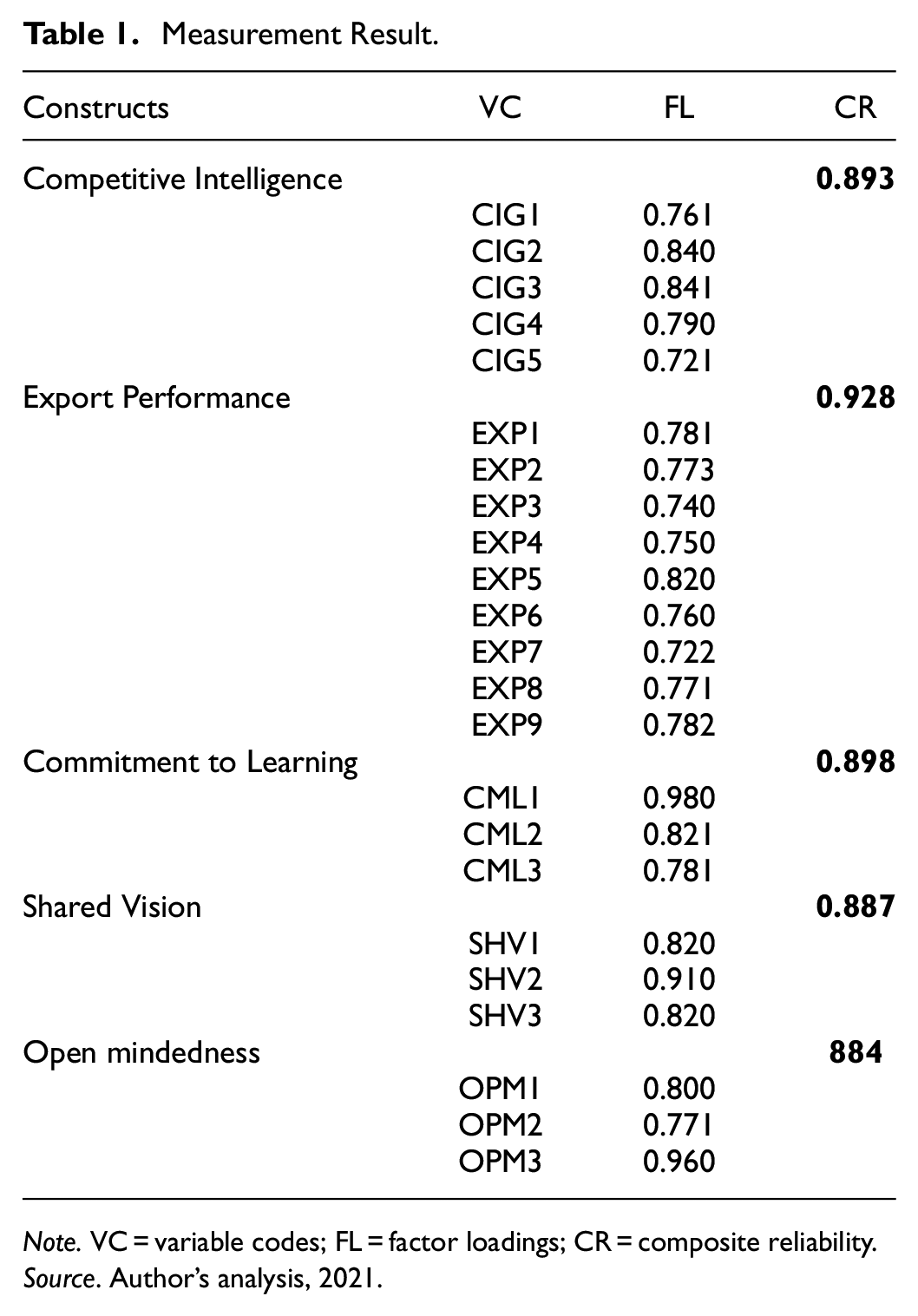
Note. VC = variable codes; FL = factor loadings; CR = composite reliability.
Source. Author’s analysis, 2021.

Confirmatory factor analysis result.
Descriptive Statistics, Cronbach alpha, Correlations and AVE result.

Source. Author’s analysis, 2021.
Note. Diagonal is the square root of AVE; **Correlation is significant at the .01 level (2-tailed).
Further, the validity of the instrument was confirmed using convergent validity (Hair et al., 2010), which was determined by the average variance extracted (AVE). The values were within and above 0.50 recommended (Holmes-Smith et al., 2006), as such, the instrument is valid (See Table 2). Supporting the validity of the measurement instrument, discriminant validity was assessed using Fornell–Larcker criterion that requires comparing the squared correlation between two constructs and the correlation values (Fornell & Larcker, 1981). The result confirms that the discriminant validity of the model is confirmed, as the squared correlations were greater than the correlation values (See Table 2, diagonal values indicating the square root of the AVE).
The model measurement preceded the structural model analysis, which is in line with the two-step that Anderson and Gerbing (1988) recommended. We compared each model to alternate models to further enrich the outcome and findings (Kelloway, 1998). The model fit that involves assessing the extent the data suitably explains the underlying theory was determined using the square root of approximation (RMSEA), which Hooper et al. (2008) stated is a key informative index that is susceptible to sample size. Hu and Bentler (1999) recommended value less than 0.05 for good model fit using the RMSEA. The comparative fit index (CFI) and goodness of fit (GIF) index for assessing model fit were also used to confirm model fit and Tabachnick and Fidell (2007) and MacCallum and Hong (1997) recommended values within the threshold of 0.80 and 1.
The confirmatory analysis (CFA) for competitive intelligence indicates the model is fit as the chi-square (99.604, p < .05); RMSEA = 0.018, CFI = 0.913 and the GFI = 0.904 all satisfying the threshold (Hu & Bentler, 1999; MacCallum & Hong, 1997). All items produced a factor score greater than 0.60, indicating suitability in the model (Hair et al., 2010). Similarly, the CFA result for export performance showed a good fit, though less comparatively to that of competitive intelligence, as chi-square (39.083, p < .05); RMSEA = 0.031, CFI = 0.912 and the GFI = 0.892 and all factor scores were greater than 0.60. The first and second order construct of learning orientation proved to have a good model fit and all the items were retained. For open mindedness chi square (16.184, p < .05), RMSEA was 0.022, CFI was 0.904 and GFI was 0.814.
Comparatively, shared vision had a better model fit, as the chi square (23.11, p < .05), RMSEA was 0.013, CFI was 0.915 and GFI was 0.906. Commitment to learning model also showed a good fit as the chi square (29.634, p < .05), RMSEA was 0.036, CFI was 0.914 and GFI was 0.961. However, the overall model of learning orientation, when combined, had a better fit, and confirmed the multidimensionality of the construct, as chi square (216.362, p < .05), RMSEA was 0.032, CFI was 0.946 and GFI was 0.901. Further, the direct relationship between the proxies of learning orientation and export performance showed a good model fit, as the chi square (484.766, p < .05), RMSEA was 0.012, CFI was 0.934 and GFI was 0.855. Finally, the overall model that has the independent variable, mediating and dependent variable also showed a good and better model fit. As chi square (941.585, p < .05), RMSEA was 0.033, CFI was 0.926 and GFI was 0.902, all are within the recommended threshold (Hu & Bentler, 1999).
Structural Analysis Result
The structural paths show the relationship and the significance of the model. The study adopted the bootstrapping samples of5,000 at 95% confidence interval. The result is presented below. The result confirms the essence of the study and supports the hypotheses developed from reviews and theoretical perspectives related to the study.
The result in Table 3 is the summary result on the test of the study hypotheses. The result from the structural path analysis shows that the direct effect of competitive intelligence on export performance was found to be positive and significant (β = .205, p < .05), thus, hypothesis (H1) was supported that competitive intelligence affects export performance.
Summary of Hypotheses testing Result showing the Standardized Structural Estimates of the study model.

Source. Author’s analysis, 2021.
Note. Bootstrapping re-samples = 5,000 @ 95% confidence intervals.
The path between commitment to learning as a dimension of learning orientation and export performance also proved to be significant (β = .197, p < .05), thus, implying that commitment to learning directly affects export performance, as such, the hypothesis (H2a) is supported that the higher the commitment to learn, the higher the export performance. The total indirect effect of competitive intelligence on export performance that is accounted for mainly by commitment to learning was found significant (β = .195, p < .05), thus, hypothesis (H2b) was accepted, which implies that commitment to learning mediates the relationship between competitive intelligence and export performance.
Further, the direct effect of open mindedness on export performance was proved significant. The hypothesis (H3a) was accepted (β = .186, p < .05). The total indirect effect of competitive intelligence on export performance that is accounted for mainly by open mindedness as a measure of learning orientation was also found to be significant (β = .118, p < .05). Thus, hypothesis (H3b) is accepted, which implies that open mindedness mediates the relationship between export performance and competitive intelligence.
The result supports that shared vision directly affect export performance, as the outcome shows (β = .229, p < .05), thus hypothesis (H4a) is accepted. The total indirect effect of competitive intelligence on export performance that is accounted for mainly by shared vision was confirmed significant, as (β = .219, p < .05). Thus, hypothesis (H4b) is accepted, this implies that shared vision mediates the relationship between competitive intelligence and export performance.
Finally, the result confirms the direct effect of competitive intelligence on export performance. Also, the indirect effect of learning orientation is also confirmed, though, the result confirms that the significant total indirect effect of competitive intelligence on export performance was stronger through the shared vision path (β = .219, p < .05). The variance of each endogenous variables in the model, which explains the hypothesized relationships were 0.147 (14.7%) for open mindedness, 0.227 (22.7%) for commitment to learning, 0.351 (35.1%) for shared vision and 0.473 (47.3%) for export performance.
Discussion and Conclusions
The study examined the influence of competitive intelligence on SME export performance and the indirect effect of learning orientation. Demographic distribution of the respondents shows a good spread of the respondents. The result from the analysis showed that all the paths were significant, as all proved positive and significant, thus, learning orientation partially mediates the relationship between competitive intelligence and export performance.
We confirmed the link between competitive intelligence and export performance to be positive and significant. This implies that competitive intelligence and export performance are positively related. This outcome is consistent with the finding of Tarek et al. (2016), which also found that competitive intelligence influences export performance. Similarly, the finding of Tej Adidam et al. (2012) further supported the finding from this study. Hence, we conclude that SMEs’ ability to engage in competitive intelligence would lead to improved export performance, as it gives them reliable information for decision making that would guide managers in export activities (Calof & Brouard, 2004).
Also, the result supports that commitment to learning has a direct link with export performance. This agrees with the finding from the study of García-Morales et al. (2006) that also found that commitment to learning has a direct influence on performance. The outcome from the study of Sinkula et al. (1997) is also similar to the study result. We also assessed the mediating influence of commitment to learning on competitive intelligence and export performance. The result shows that the link is positive and significant. The result is consistent with the views of Ghannay and Mamlouk (2012) that opined that competitive intelligence activities can be aligned through an organizational wide strategy that supports gaining new knowledge that would aid decision making and ensure increased performance. Hence, we conclude that competitive intelligence as an internal resource, when channeled through commitment to learn would lead to increased export performance. Since commitment to learn is what determines the relevance of every information and how it is perceived, it would be useful in ensuring that competitive intelligence activities are not just used to gather information need of the organization but also support the advancement of organizational outcomes (Nalcaci & Yagci, 2014).
In addition, the result confirms that open mindedness directly affects export performance. This is in line with the findings of Karunaratne (2017), which also had a similar result. The result is also supported by the study of Lin et al. (2022) that confirms that open mindedness is critical for firms that desire to gain competitiveness. The result underscores the need for employees to have an open mind toward learning, as unstable business environment opens firms to new events that could impact on its performance. The study also confirms that open mindedness mediates the link between competitive intelligence and export performance. This supports the views of Tej Adidam et al. (2012) that competitive intelligence information is only useful when the firm can be open to objectively adopting them toward meeting their information need. Hence, we conclude open mindedness affects the performance of SMEs and when competitive intelligence is channeled through open mindedness, it would account for improved export performance.
Further, the result confirms that shared vision accounts for export performance increase. This agrees with the finding from Karunaratne (2017) study, which also found that shared vision affects performance. Similarly, the study of García-Morales et al. (2006) and Ussahawanitchakit (2008) also revealed that shared vision has a significant effect on performance. Conversely, the study result differs from the study of Calisir et al. (2013) that found that shared vision does not affect performance. This difference in finding could be because of the difference in geographical location, sampling and method used. Furthermore, the result confirms that shared vision mediates that link between competitive intelligence and export performance. The result affirms the views of Shavazi et al. (2015) that shared vision allows for managing information available toward organizations’ goal and objectives. Hence, we conclude that shared vision affects export performance of SMEs and when competitive intelligence is channeled through shared vision, it would also account for improved export performance in SMEs. Finally, the study confirms that competitive intelligence affects export performance, and learning orientation mediates the relationship between competitive intelligence and export performance.
Implications for Research and Practice
The study offers both theoretical, managerial, and societal implication having explored the link between competitive intelligence, learning orientation and export performance. The study drew insight from literature on competitive intelligence, learning orientation and export performance through which we developed an integrative framework which captures the direct and indirect influence of competitive intelligence, learning orientation and export performance. The findings resulting from the framework have further enhanced our knowledge of competitive intelligence and its influence on export performance, most importantly through learning orientation.
This paper puts to rest the argument on the relevance of competitive intelligence in SMEs, as the study confirms its relevance, as an internal resource rather than managerial activities that are useful for advancing SMEs export performance. The study highlights a new frontier in SMEs export performance literature given the paucity of studies that have addressed the interplay between competitive intelligence, learning orientation and export performance, most especially from an emerging economy perspective. The result confirms the need for managers to concentrate on their competitive intelligence activities, as it is useful to drive increased export performance.
Based on our argument that competitive intelligence is an organization wide activity that requires input not only from the top managers but also from the middle and lower-level managers, this research provides a validated instrument that captures competitive intelligence beyond the activities of the CEO and supports the growing and renewed perspective of competitive intelligence, as organization’s internal resource. Further, our application of developing country measures/propositions earlier constructed and tested in other settings to an emerging economy is another significant theoretical value of this study.
Also, the study advances the relevance of firm intangible resource toward improving performance, as espoused by the resource-based view theory (Barney, 2001). This implies that SMEs manager’s ability to effectively advance competitive intelligence, as an internal resource, would lead to increased export performance. Also, relying on the theory, we contend that since employees are a fundamental resource in the organization’s competitive intelligence process, the existence of an organization-wide strategy that supports learning would be useful toward improving SMEs’ export performance. Hence, validating the resource based view theory, as a relevant lens through which competitive intelligence, learning orientation and export performance can be explored. By this, we add to the growing streams of literature on the theories that explain competitive intelligence, therefore, enriching this body of scholarship.
The study offers value for managers as it resonates the need for increased attention toward competitive intelligence as a resource for increased information and knowledge, which is cogent in driving increased export performance. Competitive intelligence allows the firms to have a better understanding of activities in its environment, as such allowing it to make objective decisions and adjust to accommodate new knowledge, which would lead to increased export performance.
This study highlights the need for firms to encourage learning in the organization. SMEs managers must ensure that employees develop the desire to gain new knowledge and this can be best done when they provide them with a conducive atmosphere for learning. There is a need for developing a learning culture that supports new knowledge and sharing same toward improving export performance. However, this is only possible when there is a defined shared vision, a system that supports open mindedness and commitment to learning in the organization.
Further, societal implication of the study is hinged on the reality that government from developing economies that are desirous toward encouraging indigenous firms to develop their export market, which would help serve as a source of foreign exchange can first start through initiating support programs that provides a vivid approach that underscore effective competitive intelligence process, while also encouraging them to advance effort that stimulate their strategic process toward increased learning, as most of the firms most especially small-scale firms may not have the financial and technical capacity for competitive intelligence activities. This has become necessary from the outcome of the study that shows competitive intelligence has a direct influence on export performance.
Limitations and Future Research
The study was limited to a quantitative positivist approach that support data collection through self-reported questionnaire, thus, future studies could attempt to adopt a longitudinal approach to the study given that competitive intelligence is not a one-off set of activities but a long-term set of activities. The study is limited to the textile sector in a developing economy and interestingly most of the textile firms are small-scale firms it would be rightly put that the study was limited to small-scale firms, as such future studies should be directed at verifying this finding using large firm’s perspective, from a different sector and from a developed economy. Future research can also consider the use of other dimensions of learning orientation, besides the organizational value perspective of Sinkula et al. (1997). Despite the limitations outlined, the study offers a new perspective to competitive intelligence as it joins the growing amount of literature that considers competitive intelligence as an internal resource from a small firm’s perspective.
Supplemental Material
sj-doc-1-sgo-10.1177_21582440231184979 – Supplemental material for Linking Competitive Intelligence, Learning Orientation and Export Performance of SMEs
Supplemental material, sj-doc-1-sgo-10.1177_21582440231184979 for Linking Competitive Intelligence, Learning Orientation and Export Performance of SMEs by Ejikeme Emmanuel Isichei, Ike Nnia, Agbaeze Kalu Emmauel, Anthony Igwe, Chukwu Benjamin Ibe and Godwin Iyuwuna Dodd Peterside in SAGE Open
Footnotes
Acknowledgements
We wish to acknowledge the management of University of Nigeria for their support in undertaking the research.
Declaration of Conflicting Interests
The author(s) declared no potential conflicts of interest with respect to the research, authorship, and/or publication of this article.
Funding
The author(s) received no financial support for the research, authorship, and/or publication of this article.

Supplemental Material
Supplemental material for this article is available online.
References
Supplementary Material
Please find the following supplemental material available below.
For Open Access articles published under a Creative Commons License, all supplemental material carries the same license as the article it is associated with.
For non-Open Access articles published, all supplemental material carries a non-exclusive license, and permission requests for re-use of supplemental material or any part of supplemental material shall be sent directly to the copyright owner as specified in the copyright notice associated with the article.
