



Abstract
Drawing on the attention-based view and literature on small- and medium-sized enterprises’ (SMEs) internationalization, we explore the value of international attention (i.e., managerial time and effort devoted to understanding the international marketplace) for SME export performance. We further argue that SMEs are heterogeneous in terms of situated contexts and organizational structures, and for that matter, differ in performance gains achieved through their managers’ international attention. A distinction is therefore made between pure exporters and so-called “micromultinationals (mMNEs)” that engage in more committed international activities besides exporting. Based on a survey of Dutch SMEs, our findings indicate a positive association between managers’ international attention and firms’ export performance. This relationship is stronger for mMNEs than for pure SME exporters, pointing to the implication that managers’ international attention should be commensurate with firm specifics in order to add values.
Keywords
Highlights
International attention is defined as managerial time and effort devoted to understanding the international marketplace.
The more international attention, the better the export performance will be.
mMNEs have more to gain from a manager’s international attention than pure SME exporters do.
Introduction
Exporting represents a widespread activity for small and medium-sized enterprises (SMEs) (Ferreras-Méndez et al., 2019). Motivated by the fact that SMEs account for over 50% of total exports and occupy a central position on policy agendas (OECD, 2014), a growing body of research has attempted to understand why some SMEs perform better in exporting than others (Freixanet et al., 2018; Jean & Kim, 2020; Majocchi et al., 2005; Makri et al., 2017). In many SME export research, managerial demographics, and other subjective characteristics such as risk perception, growth expectation stand out as the principal force behind a firm’s export success (Dhanaraj & Beamish, 2003; Freixanet et al., 2018; Hutchinson et al., 2006). However, the role of these managerial traits in export performance is still a subject of ongoing debate that produces inconclusive findings (Hutchinson et al., 2006). For example, while some scholars have found strong relationships between managers’ demographic characteristics and SME exports (Holzmüller & Kasper, 1990), others find no empirical evidence supporting these relationships (Manolova et al., 2002).
The mixed findings seem to suggest that an alternative approach is needed in order to better understand managerial effects enabling SME exports (Andersson & Florén, 2011). Our study answers this call by introducing the attention-based view (Ocasio, 1997) and considering managerial attention the major determinant of SME export performance. Managerial attention here is understood as “the noticing, encoding, interpreting, and focusing of time and effort by organizational decision makers on both (a) issues: the available repertoire of categories for making sense of the environment. . .and (b) answers: the available repertoire of action alternatives” (Ocasio, 1997, p. 189). Distinct from managerial trait approach, we move beyond what a manager looks like or what he or she thinks and study the respect in which a manager actually invests his or her time and effort. The ABV argues that a firm’s decision makers have limited ability to attend to and act on the surrounding stimuli that are virtually unlimited. Hence, what decision makers do—ultimately shaping firm behavior and performance—depends on where they focus their attention. When entering international markets, a key challenge for managers is breaking away from their domestic focus and paying attention to the global business environment (Nummela et al., 2009). To extend this line of thinking, Bouquet et al. (2009) have theorized specifically how a manager’s international attention, defined as the time and effort devoted to acquiring a better understanding of the international marketplace, may be relevant to a firm’s international competence. However, this stream of research has focused narrowly on large global companies. With some exceptions such as De Clercq and Zhou (2014) who applied the ABV in the context of international new ventures, few studies have attempted to understand (international) attention on the part of SME managers. As a result, several new and important questions remain to be answered: What are the features of international attention for SME managers? What are the performance implications of international attention for specific international activities in which SMEs engage? This study tackles these questions by developing a research framework for studying the effect of international attention on SME export performance.
Moreover, we explore the contingency of the focal relationship by distinguishing two groups of SMEs. In doing so, this study offers new insights into international attention that are not apparent in large global companies. SMEs generally are associated with liabilities of smallness (Brouthers et al., 2015), and constrain in international operation to exporting. However, some SMEs engage also in more committed international activities, such as licensing, franchising, investing in joint ventures and/or establishing own subsidiaries. Such SMEs are coined as micromultinationals (mMNEs) (Dimitratos et al., 2003, 2014; Ibeh et al., 2004; Stoian et al., 2017). mMNEs have developed a corporate structure that is different from “pure” SME exporters. As managerial attention depends largely on contexts and structures (Ocasio, 1997), we expect that the effect of managers’ international attention on firm export performance may vary between mMNEs and SME exporters.
This study thus contributes to the literature in multiple ways. The novelty here is to break new ground both by forwarding theory regarding international attention and by advancing measurement and empirical achievements under the SME context. First, the ABV implies an alternative approach to study managerial effects on SME export performance. It highlights the complexity of international activities vis-à-vis the limited attention on the part of decision makers, which should have crucial ramifications for the likelihood that a manager devotes actual efforts in developing knowledge about international markets (De Clercq & Zhou, 2014). Also, by focusing on the extent to which a manager invests his or her time and effort, the ABV represents an approach—that is more observable than others based on tacit attributes such as cognition and mindsets—to understanding how managers make sense of the environment and make decisions that shape firm performance.
Second, we adapt the ABV theory and the concept of international attention originally developed in large corporations to the study of SME internationalization. Previous research has discussed the concept of international attention and the impact on large global companies (Bouquet et al., 2009). However, it remains unknown whether and how international attention may add value to SMEs’ international success. We address this issue by developing the path leading from international attention to the performance of a major international activity (here exporting) that most SMEs engage. Moreover, we tailor the measure of international attention to suit the SME research context. The custom-fit measure offers researchers a valid and reliable tool to investigate other important issues around the concept.
Third, we explore the moderating effect led by the differences between mMNEs and SME exporters on the anticipated attention–performance link. Previous literature tends to compare firms that internationalize early in the life cycle (born globals or international new ventures) with firms that follow a more incremental process of internationalization (Oviatt & McDougall, 1994, 2005). However, apart from the pace of internationalization, there are alternative variations among SMEs regarding how they operate in foreign markets and the corporate structure resulted thereof. Such firm specifics will affect the effectiveness of managerial attention (Ocasio, 1997). The comparison between mMNE and pure SME exporter is thus validated. By juxtaposing mMNEs with pure SME exporters (“SME exporters” hereafter), we are able to theorize and test a more robust explanation of the relationship between managers’ international attention and firms’ export performance.
Literature Review
Managerial Effects on Export Performance
Often, research in this area adopts a trait perspective, focusing on a manager’s demographic characteristics (e.g., age, education, professional experience) (Cavusgil & Naor, 1987; Dhanaraj & Beamish, 2003) and/or more subjective characteristics reflecting a manager’s attitude and vision toward exports (e.g., risk perception, growth expectations) (Freixanet et al., 2018; Holzmüller & Kasper, 1990). As mentioned earlier, these findings are, however, inconclusive, indicating that the trait-based perspective may be insufficient for explaining managerial effects on SME export performance. While personal traits may be indicative of one’s preference in decision making, how managers make sense of the environment and make decisions still remains a “black box.” It is argued that the ABV can help open the “black box” by providing a complete framework of studying the interplay among environments, managerial attention, and firm behavior as well as performance, with a particular emphasis on managerial attention (Ocasio, 1997).
International Attention
Despite the potential value of the ABV for understanding decision making and firm performance, attention-based research in the international business (IB) field is few and far between. Only recently have scholars introduced the attention perspective in research on large global companies (Bouquet, 2005; Bouquet et al., 2009; Bouquet & Birkinshaw, 2011). We now have insights into the attention that senior executives give to the international marketplace—so-called “international attention”—and how it matters for large global companies (Bouquet et al., 2009). The emergence of the concept international attention represents an application of the ABV to the IB context, yet the studies have been limited to large companies. While SMEs are a major source of growth and job creation, they appear to be under-represented in the international marketplace (OECD, 2008). This low level of international involvement of SMEs could be attributed to a series of barriers encountered when expanding into foreign markets. Among these barriers, a lack of knowledge about international opportunities and foreign markets acts as a major impediment to SME internationalization (for a review, see Arteaga-Ortiz & Fernández-Ortiz, 2010). The ABV suggests that the focus of managerial attention influences a young and new venture’s international learning effort (De Clercq & Zhou, 2014). The issue of managers’ international attention is particularly relevant because it helps managers to improve their understanding of the international marketplace and the competitive dynamics that emerge therein (Bouquet, 2005; Bouquet et al., 2009; Bouquet & Birkinshaw, 2011). Yet, managers’ international attention has not been studied in the SME context.
At the same time, literature has shown that SMEs are making efforts to overcome the information barriers during the internationalization process. For example, prior research has noted that SMEs conduct environmental scanning regularly and spend a large amount of time seeking market information (Miocevic & Crnjak-Karanovic, 2011), so much so that an export market orientation may be developed within the organization (Cadogan et al., 2002). However, most of the research focus on the organizational level, despite that in SMEs individual managers are decision makers who support all these efforts. More importantly, it is individuals (i.e., managers/entrepreneurs) who are central to the process of international opportunity identification (Muzychenko & Liesch, 2015). Our study thus addresses the gaps by explicitly examining the impacts of managers’ international attention on SME export performance.
Hypotheses
International Attention and Export Performance
International attention is defined as the time and effort that top managers in MNEs invest in improving their understanding, mainly through (1) international scanning, (2) overseas communications, and (3) internationalization discussions (Bouquet, 2005; Bouquet et al., 2009; Bouquet & Birkinshaw, 2011). To be noted, international attention is different from a related construct—global mindset/orientation. The latter represents “a highly complex cognitive structure . . .and the cognitive ability . . .” (Levy et al., 2007: 244). Simply put, global mindset/orientation is about cognitive structures of managers, while international attention is concerned with their practices.
Specifically, dedicating to international scanning is likely to increase the stock of foreign-market knowledge, resulting in better managerial decisions that enhance export performance. Foreign markets are commonly categorized as external factors that operate beyond the control of management, offering both opportunities and threats to a firm’s international activities (Sousa et al., 2008). Scanning is a direct method through which managers collect information about the market environment and reduce strategic uncertainty (Daft et al., 1988). Since individuals vary in their scanning behaviors (e.g., frequency, scope), an information advantage regarding environmental opportunities and problems arises. In this sense, environmental scanning becomes an instrument for firms competing against one another (Daft et al., 1988). A related line of argument, centering on information search among SME exporters, has tried to link various information search efforts with SME export performance (e.g., Hart & Tzokas, 1999). As Julien and Ramangalahy (2003) suggest, the more frequently SME exporters search for export-related information the more competitive is the firm’s export strategy and the better the firm performance. Although not explicit on the engagement of managers in this information practices, the research provides evidence that successful SME exporters (and hence their managers) devote more time and effort to acquiring information about their business environments than other exporters do.
It has long been recognized that communicating with network contacts (here seen as overseas communications) can help SMEs obtain relevant information and identify new opportunities in foreign markets (Andersen, 2006; Puthusserry et al., 2020). Unlike large multinationals that rely on overseas subsidiaries as a major vehicle for global knowledge generation, SMEs usually lack ownership of operations in foreign markets and are more likely to marshal external and personal information sources during internationalization (Musteen et al., 2010). Besides the general information benefits, overseas communications, from an exporter’s point of view, lead to a better understanding of the specific customers it serves. The existence of uncertainty (about the partner or the benefits/costs involved) usually hampers the development or maintenance of a business relationship. Such uncertainty could be attributed to insufficient communications between the exchange parties (Leonidou, 2003). In international business relationships, the physical and psychic distance between partners provides all the more reason to establish intensive and open communications. Frequent communications offer exporters an opportunity to understand the needs and the behaviors of their foreign customers, to overcome problems associated with national, organizational, and personal differences (Leonidou et al., 2002), and to make better decisions regarding how to serve the customers. As a result, more demands can be expected, thereby leading to better export performance.
In a similar vein, investing more time and effort to international discussions contributes to smarter decisions in managing exports. Previous literature shows that many SME exporters do not undertake significant planning but instead respond to unsolicited export orders (Samiee & Walters, 1990). However, Andersson and Florén (2011) have recently identified that information sharing and discussions, as a means of formal planning, feature the managerial behaviors in international SMEs. Managers who do plan will consider a wider variety of strategic alternatives and adopt a more comprehensive decision process than others who do not. Such enhanced strategic decision process is associated with higher levels of firm growth (Doole et al., 2006). Following this logic, spending more time and effort in discussing export strategic decision will improve the quality of the decision-making process and eventually contribute to better export performance. Given the above arguments, we hypothesize that:
H1: Managers’ international attention will be positively associated with SME export performance.
Moderating Effects: mMNEs Versus SME Exporters
While managerial attention in itself is crucial, it has to be bundled with complementary firm specifics to generate above-average value. This bundling feature brings us back to the notion that to fully understand a firm’s competitive advantage and value creation one should integrate managerial attention with resource perspectives (Ocasio, 1997). As such, it seems valuable and relevant to understanding the different resources and capabilities across firms if we are to acquire an in-depth understanding of the relationship between managers’ international attention and firms’ export performance. To further illustrate this logic and also as a first step, we distinguish two groups of SMEs: SME exporters and mMNEs.
As noted above, mMNEs are a group of SMEs that establish an international market presence in their own right and behave much like multinationals (Lu & Beamish, 2001). They own or control activities in more than one country through higher-commitment modes beyond simple exporting (Dimitratos et al., 2003, 2009, 2014; Ibeh et al., 2004, 2009; Prashantham, 2011). Thus, mMNEs are endowed with a wider range of resources and capabilities than SME exporters that enable them to engage in one or a combination of advanced market-serving modes including cooperative alliances, joint ventures, and wholly owned subsidiaries across international markets (Dimitratos et al., 2003), Simply put, mMNEs are being more “international” than pure SME exporters. This notion, combined with the bundling logic we explained above, lead us to expect that the effect of managers’ international attention on firm export performance may vary between mMNEs and SME exporters.
Compared with SME exporters, mMNEs have higher levels of organizational readiness for international venturing (Dimitratos et al., 2003). mMNEs exhibit better product offerings (Ibeh et al., 2009), richer social capital, and stronger networking capabilities than SME exporters (Prashantham, 2011). At the same time, with a variety of cooperative and investment portfolios, mMNEs also have a better position to obtain complementary assets than SME exporters (Dimitratos et al., 2003). Lu and Beamish (2001), for example, suggest that partnering with local firms and gaining access to their resources, as is the case with mMNEs, offer efficient ways to address typical SME challenges—resource deficiencies and shortage of local knowledge. The foreign direct investment literature suggests that multinational firms can gain various location-based advantages (Kogut, 1985) such as access to cheap labor, capitalizing on tax incentives, and acquiring key or new knowledge. To the extent that value creation requires resources, mMNEs seem to provide better firm-specific advantages than SME exporters for managers’ international attention to be effective. Hence, we hypothesize that:
H2: The positive relationship between managers’ international attention and SME export performance will be stronger for mMNEs than for SME exporters.
Method
Sample and Data Collection
To test the hypotheses, we conducted a mail survey on SMEs originating in the Netherlands. The Netherlands is considered as an appropriate domain of study in this research. More than 99% of the firms in the Netherlands can be classified into the category of SMEs, according to the definition set out by the European Union. The relatively small domestic market gives Dutch SMEs a strong incentive for internationalization (Hessels, 2005).
We compiled our sample from the Orbis database, based on the following sampling criteria: (1) be SMEs defined by the European Union, meaning enterprises that employ fewer than 250 persons and have an annual turnover of less than EUR 50 million, and/or an annual balance sheet not exceeding EUR 43 million; (2) engage in exports and have export sales—since export performance is the main focus of our study (It is likely that managers from non-exporting SMEs may also have international attention. Compared to these domestic SMEs, however, it can be expected that managers from exporting SMEs show greater variations in their international attention, which ensures getting meaningful results in the empirical analysis); (3) be independently owned, not a subsidiary or an affiliate of another entity. By ensuring firm autonomy, the manager’s attention could not be influenced by a parent firm. One thousand five hundred seventy-four companies were qualified, among which we selected a random sample of 750 companies to whom we sent our questionnaire.
The data were collected from October 2014 to February 2015 via a structured questionnaire directed at the owner-manager or the managing director (i.e., the decision maker) of each targeted company. While most of the questions and items were adapted from previous literature, some new ones were developed to serve the purpose of our study. We invited scholars that are familiar with SME exports to review the initial instrument. A pilot test through in-depth semi-structured interviews was conducted with five managers of international SMEs with different degrees of international involvement. With these procedures, we were able to refine the instrument. The revised questionnaire was then translated into Dutch following the forward-backward translations process (Brislin, 1970).
After an initial mailing and two reminders, a total of 158 responses were obtained from a total 716 questionnaires that were successfully delivered. Twenty-three unusable responses were those returned incomplete or blank. The usable responses of 135 consist of our final sample, representing an effective response rate of approximately 19%. The response rate is appropriate for a regular mail survey without telephone follow-up or pre-contact (Harzing, 1997). The sample firms cover all the agriculture/forestry/fishing, manufacturing, construction, wholesale trade, and transportation sectors as does the initial population.
Measures
Export performance
The dependent variable export performance was measured at the firm level with the percentage of total sales accounted by the export sales. Using percentages instead of absolute values was based on the suggestion that SME managers would be less likely or unable to respond to questions regarding absolute export sales volume (Katsikeas et al., 1996). This had also been confirmed in our pilot interviews. In fact, export-to-sales ratio, also known as export intensity, is by far the most widely used indicator in empirical research on export performance (Katsikeas et al., 2000).
International attention
The measurement scale of international attention (IA) was adapted from Bouquet and his colleagues’ study in which international attention is denoted as a higher-order construct that includes three components: international scanning, overseas communications, and internationalization discussions (Bouquet, 2005; Bouquet et al., 2009; Bouquet & Birkinshaw, 2011). Noting that the information sources and management tools available to SMEs are limited compared with large companies, the specific items from the original scale were modified to some extent and additional items were developed in order to capture unique features in the SME research context. In the following, we will explain in detail how we adapted the scale. International scanning, or the environmental surveillance activities through which SME managers sense the stimuli occurred in international markets, was measured with four items: collect strategic information from around the world (IA1), organize and/or participate in marketing research to analyze international market developments (IA2), use public information sources to discover international opportunities (IA3), and routinely compare the company against key competitors worldwide (IA4). Items IA1 and IA4 were drawn from the original scale. However, SMEs seldom use sophisticated information systems (Sawyerr et al., 2003), the original item—use business intelligence software to analyze global market development—was dropped. Instead, we introduced items IA2 and IA3 as they represent the more common approaches adopted by SMEs in collecting foreign market information (Hart & Tzokas, 1999). Overseas communications here are understood as social exchanges between managers and their foreign contacts since SME managers usually turn to their personal contacts for export market information. Also, because a majority of SMEs lack subsidiaries in their foreign market operations (Burgel & Murray, 2000), we dropped the original items that describe the communications between top executives and subsidiary managers. Alternatively, three new items were developed: attend international trade fairs, exhibitions etc. (IA5), visit foreign contacts on a regular basis (IA6), involve foreign contacts in key decision-making processes (IA7). The last item was inherited from the original scale—a managerial practice has also been identified in SMEs (Doole et al., 2006): the amount of time (as a percentage) spent traveling abroad all year round (IA8). Internationalization discussions, namely management practices to share and discuss important information and decisions about internationalization within the firm, were measured with the original items: have informal talks with other staff in the firm concerning internationalization decisions (IA9), make internationalization decisions after a free and open exchange of ideas within the company (IA10), make internationalization decisions all alone (reverse coded) (IA11). A new item—the total meeting time in a year spent discussing internationalization decisions (IA12)—was added in that more extensive discussion implies greater attention (Tuggle et al., 2010). All the items focus on the practices of individual decision makers, since in SMEs the owner or entrepreneur is often the general manager responsible for all important business operations including internationalization (Miocevic & Crnjak-Karanovic, 2011). Respondents were asked to indicate, on a seven-point Likert scale ranging from 1 (very rarely) to 7 (very frequently), the extent to which they behave in the way described in each item.
Moderator
Following the literature (Dimitratos et al., 2014), a dummy variable was introduced to determine whether a firm is an mMNE or not. A value of 1 was coded if the respondent indicated that the firm uses advanced mode(s) to serve international markets such as licensing, franchising, and investing in joint ventures and/or wholly owned subsidiaries, while a value of 0 was coded if the firm only exports.
Controls
We included a number of control variables to account for alternative explanations for variations in SME export performance. Firm size usually proxies a firm’s resources and capabilities to achieve high productivity and economies of scale (Majocchi et al., 2005). Hence, we controlled for firm size, measured by the logarithm of the number of employees. Firm performance legitimizes or denies current exporting practices and is likely to affect subsequent investments in exporting (Dhanaraj & Beamish, 2003). For this reason, we controlled for firm performance, using a perceptual measure by asking respondents to rate on a 7-point Likert scale their satisfaction about the firms’ performance achieved in the previous year. As a firm’s business experience can influence its export performance (Majocchi et al., 2005), we controlled for firm age measured by the number of years elapsed since the firm’s inception. Some also suggest that firms with greater international experience may have established processes and procedures that can lead to superior export performance (Brouthers et al., 2015). Hence, we included export experience measured by the number of years that a firm has been involved in exporting. Previous literature has built up a link between a firm’s market expansion strategy (i.e., diversification) and its export performance (Lee & Yang, 1990). We controlled for this effect by including the variable export diversity measured by the total number of exporting countries served. Management international experience also matters to a firm’s international performance (Fischer & Reuber, 2003). Accordingly, we added manager international experience in the analysis measured by the number of years that a manager has worked, studied, or lived outside the Netherlands. Finally, we considered the effects of industry-specific factors. We used the two-digit NACE Rev.2 industry classification and classified the sample firms into (A) agriculture, forestry and fishing, (C) manufacturing, (F) construction, (G) wholesale and retail trade, and (H) transportation and storage. We included four industry dummies while taking the wholesale trade sector as the base case in our analysis.
Sample Representativeness and Bias Tests
To check for the sample representativeness, we compared the final sample used in this study (i.e., the 135 companies) with the survey sample that received our questionnaire (i.e., the 750 companies) and the initial research population derived from the Orbis (i.e., the 1,574 companies) for firm age, number of employees, and industry distribution. These criteria were chosen because data were available for all three groups. As Table 1 shows, the sample used in this study (i.e., the 135 companies) is fairly representative of the initial research population in terms of firm age, number of employees, and industry coverage. It is worth noting that the proportion of agriculture firms is about twice as high in our final sample as it is for the other two groups (20.74% versus 10.67% and 9.78%, respectively). For this, one-way ANOVA were performed in the final sample to test whether there are significant differences in international attention and export performance between the five industries. The results show that there are no statistically significant differences in international attention means (F = 0.91, non-significant), nor are there differences in export performance means (F = 0.69, non-significant). The results suggest that any bias stemming from errors in the random sampling procedure is likely to be limited, giving confidence to the results obtained in this study.
Sampling Distribution.

Since data on both our dependent and explanatory variables were collected from the same respondent, common method bias may occur. Besides the ex ante efforts to control for common method bias in the design of the questionnaire, we followed statistical procedures recommended by Podsakoff et al. (2003) to test for the potential bias. The Harman’s single-factor test showed a five-factor solution with the first factor (eigenvalue = 5.65) accounted for 33.25% of the variance, and the cumulative variance explained by all five factors was 64.32%. We further conducted a confirmatory factor analysis (CFA) to investigate whether all the survey items were loaded on a common “method” factor. This analysis yielded poor model fit to the data (χ2 [209, n = 135] = 450.34, p < .001, RMSEA = 0.093, GFI = 0.77, NNFI = 0.84, CFI = 0.88). These results suggest that common method bias is unlikely to be a problem in our data.
To estimate the likelihood of non-response bias (Armstrong & Overton, 1977), we examined whether responding and non-responding firms differ significantly on firm age (t = –0.61, p = .54) and firm size (t = 0.69, p = .49). We chose these variables because data for the variables are available for both groups. We further compared early respondents (who replied to the first mailing) and later respondents on firm age (t = 0.52, p = .60), firm size (t = –0.52, p = .61), export experience (t = 0.24, p = .81), export diversity (t = –0.01, p = 1.00), and export-to-sales ratio (t = 1.14, p = .26). The results of the two tests show no indication of response bias.
Empirical Results
Measurement Assessment
We began our analysis by first testing the validity and reliability of the measurement scale of international attention. A CFA was performed using LISREL 8.80. The model was fitted to the data and items that were not unidimensional were dropped until a satisfactory fit was realized.
Table 2 shows the CFA results for the measure of international attention. In the analysis, item IA8 was dropped due to correlated errors with item IA6 and low factor loading (0.37). Item IA11 was also dropped due to low factor loading (0.09). The hypothesized factor structure provides a good fit to the data (χ2 [32, n = 135] = 36.71, p = .26, RMSEA = 0.03, GFI = 0.95, NNFI = 0.99, CFI = 1.00). The Cronbach’s alpha of the final measure was .89, exceeding the benchmark of .70 recommended by Nunnally (1978). All items loaded significantly on their respective factors/components (loadings > 0.50). Composite reliability ranged from .75 to .95, higher than the benchmark of .60 recommended by Fornell and Larcker (1981). The values of average variance extracted (AVE) were above 0.50 in all cases, providing support for convergent validity.
Confirmatory Factor Analysis of International Attention. a
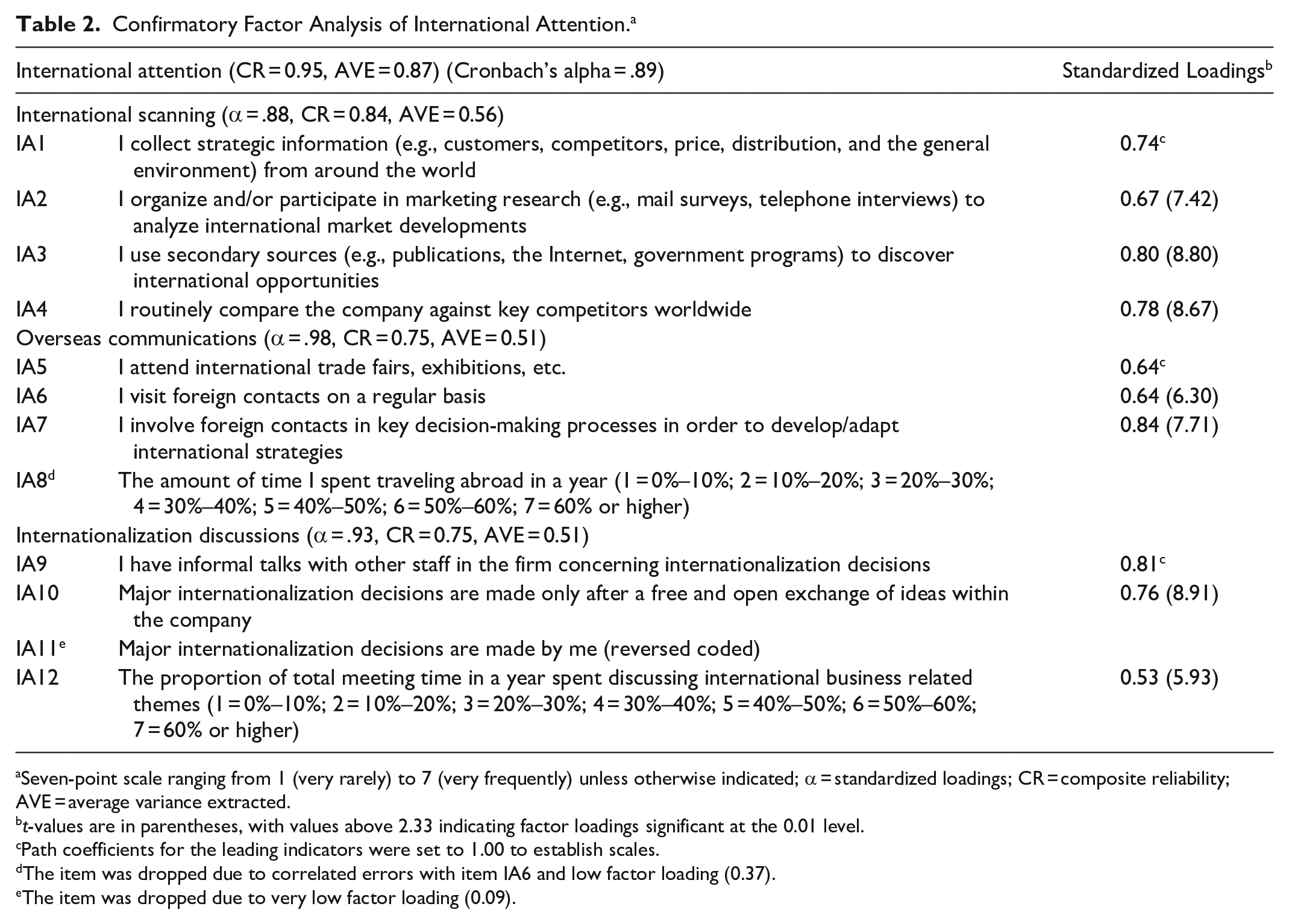
Seven-point scale ranging from 1 (very rarely) to 7 (very frequently) unless otherwise indicated; α = standardized loadings; CR = composite reliability; AVE = average variance extracted.
t-values are in parentheses, with values above 2.33 indicating factor loadings significant at the 0.01 level.
Path coefficients for the leading indicators were set to 1.00 to establish scales.
The item was dropped due to correlated errors with item IA6 and low factor loading (0.37).
The item was dropped due to very low factor loading (0.09).
Following Bouquet et al. (2009), we compared this three-factor model with two alternatives: (1) a one-factor model that incorporates all items into a single factor, and (2) a two-factor model in which the component of internationalization discussions was retained while the other two components were combined into one. Both the one-factor model (χ2 [35, n = 135] = 68.94, p < .01, RMSEA = 0.09, GFI = 0.91, NNFI = 0.97, CFI = 0.98) and the two-factor model (χ2 [35, n = 135] = 67.23, p < .01, RMSEA = 0.08, GFI = 0.91, NNFI = 0.97, CFI = 0.98) fit poorly with the data. The Chi-square difference tests (Δχ2 = [68.94–36.71] = 32.23, p < .001; Δχ2 = [67.23–36.71] = 30.52, p < .001) further confirmed that international attention is better operationalized with a three-component construct.
We first calculated the score for each component by averaging the corresponding items. The mean of the three component scores was then obtained to create the composite index of international attention.
Tests of Hypotheses
Table 3 reports the means, standard deviations, and correlations for the variables utilized in this study. Thirty firms (22.2% of all the observations) can be identified as mMNEs, aligning with the reality that only a small number of international SMEs behave like multinationals (European Commission, 2015).
Descriptive Statistics and Correlations. a
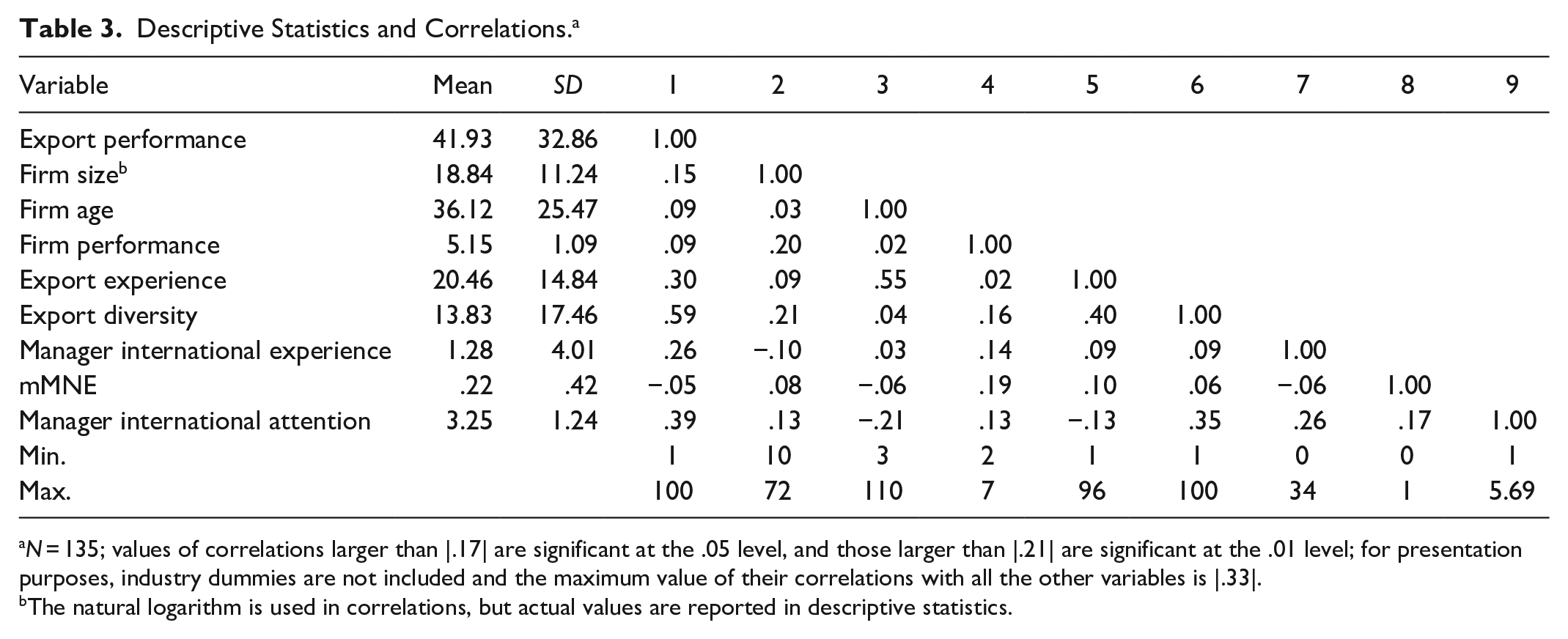
N = 135; values of correlations larger than |.17| are significant at the .05 level, and those larger than |.21| are significant at the .01 level; for presentation purposes, industry dummies are not included and the maximum value of their correlations with all the other variables is |.33|.
The natural logarithm is used in correlations, but actual values are reported in descriptive statistics.
To test the hypotheses, we adopted hierarchical ordinary least squares (OLS) regression technique. Since variables in our models were measured at different scales, all continuous variables were standardized in the regression analyses. Robust standard errors were used to correct for unknown forms of heteroskedasticity (Wooldridge, 2015). Calculations of the variance inflation factor (VIF) ranged from a low of 1.11 to a high of 2.19, far below the cutoff figure of 10 recommended by Hair et al. (2006).
Table 4 reports the results of the regression models. Model 1 is the baseline model that includes only control variables. In Model 2 we added international attention. In Model 3 we examined the interaction effect between international attention and mMNE dummy. The various fit parameters show that our model increasingly fits the data better. The adjusted R-square is significantly improved from 36% in Model 1 to 42% in Model 3. Also, the estimates remain robust in terms of signs and significance levels across the models. We focus our discussions based on the results obtained with Model 3.
Regression Results: International Attention and Export Performance in Dutch SMEs. a

N = 135; robust standard errors are in parentheses; +p < .1, *p < .05, **p < .01, ***p < .001; all continuous variables are standardized.
The base industry is wholesale trade.
Among all the control variables, the construction sector has a negative and (marginally) significant estimated coefficient (b = −11.63, p < .10). This suggests that, ceteris paribus, the average export performance of SMEs in the construction sector is significantly lower than that of SMEs in the wholesale trade sector. Export diversity (b = 13.14, p < .001) also has a significant positive impact on a firm’s export performance.
For our main variables of interest, the estimated regression coefficient for international attention is positive and significant (b = 6.15, p < .05). The coefficient means that a firm’s export intensity will increase by 7.62 (1.24 × 6.15) percent, given one standard deviation change in international attention. Hypothesis 1 is thus strongly supported: managers’ international attention has a positive effect on SME export performance. The results also strongly support Hypothesis 2. The estimated coefficient for the interaction term is positive and significant (b = 11.78, p < .05), confirming that the performance gains achieved through managers’ international attention is greater in mMNEs than in SME exporters. Specifically, given one standard deviation change in international attention, the increase of export intensity of mMNEs will be 14.61 (1.24 × 11.78) percent larger than that of SME exporters. Alternatively, we split the sample into two groups (i.e., mMNEs versus SME exporters) and regressed the export performance on the international attention with all proposed controls. The estimated coefficients are significant for both groups (b = 16.92, p < .05 for mMNEs and b = 7.11, p < .05 for SME exporters). By calculating the standard deviations of international attention for both groups, the coefficients suggest that given one standard deviation change in international attention, the increase of export intensity of mMNEs will be 17.60 (1.04 × 16.92) percent while the increase of export intensity of SME exporters will be 6.90 (0.97 × 7.11) percent. The results again support Hypothesis 2 where we argue that the performance gains achieved through managers’ international attention is greater in mMNEs than in SME exporters.
While it is not a focus of our analysis, the significantly negative main effect of the mMNE dummy (b = −13.94, p < .01) implies that the average export performance of mMNEs is lower than that of SME exporters. This is plausible considering the overall limited resource availability for a given firm, and for that matter there might be a substitution effect between exporting and other international activities. Unlike SME exporters, who allocate all possible resources to a single task—exporting—mMNEs need to distribute their resources over several market-serving modes and thereby achieve on average a limited level of export performance. When it comes to the performance gains resulted from managers’ international attention, however, mMNEs become the bigger beneficiary, as explained in our model.
To better understand the size and precise nature of the moderating effect, we follow the suggestion of Dawson (2014) and plot the attention-performance relationship for both mMNEs and SME exporters in Figure 1. The figure vividly shows that the positive relationship between managers’ international attention and firm export performance is stronger (evident in steeper slope) for mMNEs than it is for SME exporters. We also plot the marginal effects of international attention on export performance depending for the two groups of SMEs respectively. As can be seen from Figure 2, both the lower- and upper-bound of the 95% confidence intervals lie above the zero line, indicating the impact of international attention on export performance is significantly stronger for mMNE than for SME exporters. Hence, we find full support for Hypotheses 2.

International attention and export performance: mMNEs versus SME exporters.

Marginal effect of international attention on export performance: mMNEs versus SME exporters.
Robustness Analyses
To further verify our findings, we performed additional tests of robustness. First, we tested the model with an alternative measurement of export performance: the ratio of export profits to total profits. One may argue that higher export sales do not necessarily imply higher export profits. The alternative measurement of export performance makes it possible to test whether our results are influenced by the measure of the dependent variable. The findings shown in Panel A of Table 5 confirm our main results.
International Attention and Export Performance: Robustness Analyses. a

N = 135; robust standard errors are in parentheses; +p < .1, *p < .05, **p < .01, ***p < .001; all continuous variables are standardized.
The base industry is wholesale trade.
Second, we estimated models with additional control variables: family ownership, manager age, and manager education. We included family ownership as an additional control variable inasmuch as this particular form of organization is substantially different from listed or shareholder companies. We also controlled for manager age and education, as it is suggested in the trait-based literature that both age and education can proxy for a manager’s tendency of taking risks and capability of understanding new knowledge (Hutchinson et al., 2006), and consequently their propensity for internationalization. Panel B of Table 5 shows that with these additional control variables the results are identical to what those found in the main tests and hence confirm the robustness of our regression results and conclusions. Moreover, the insignificant results of these addition controls further confirm the idea that managerial traits do a poor job of explaining SME exports (Andersson & Florén, 2011), and the attention-based approach offers a better understanding of managerial effects enabling SME exports.
Third, we tested the possible existence of curvilinear effect of international attention on the grounds that an over-invest in international attention may be counterproductive and result in a decreasing marginal return of attention to performance (Bouquet et al., 2009). The results for this robustness test do not indicate any statistically significant non-linear relationships between managers’ international attention and the firm’s export performance (see Panel C of Table 5). The linear effect of international attention and the interaction effect hold, just as we hypothesized.
Finally, we consider the possibility of reverse causality. It is possible that managers of export-intensive SMEs show higher level of international attention, which could drive the main results. To reduce this concern, we first regressed international attention on the variables corresponding to export intensity (i.e., export experience and export diversity) and the variable manager international experience. Subsequently, we calculated the residual from the regression model, which can be considered as “pure” international attention. A positive and higher value implies a higher likelihood of international attention. We included this new variable of international attention in the main regression model. Such model limits the possibility of reverse causality and helps understand the “pure” effect of international attention on export performance. The results show the same pattern as what presented earlier (see Panel D of Table 5).
Discussion
Although managerial attention plays a vital role in shaping firm behavior and performance (Ocasio, 1997), the effects have seldom been examined in the IB research in general or in SME contexts in particular. Focusing on international SMEs, we show the positive effect of managerial international attention on firm export performance. Our findings reinforce the role of managers played in SMEs and their international success. As SMEs typically face high external uncertainty during their internationalization efforts, keeping track of changes emerging in the international marketplace—through international attention—is necessarily important to developing a fitted strategy and achieve superior export performance (Robertson & Chetty, 2000). To this end, the attention-based approach can be considered a complement to trait-based perspectives for explaining managerial effects on SME export performance.
The finding also adds to the emerging stream of empirical studies that apply managerial attention to the international business research field (Bouquet et al., 2009). Aside from extending the use of international attention to the SME research context, what is new here is that we link managers’ international attention to the performance of a certain international activity (i.e., exporting) that an SME engages. By doing so, we are able to understand where exactly international attention may add value that ultimately contribute to a firm’s overall success.
The distinction made between mMNEs and SME exporters constitutes another contribution of our study. The emerging phenomenon of mMNEs suggests that within the SME sector firm heterogeneities, other than size, matter. Our evidence corroborates this proposition by exhibiting a stronger effect of international attention on export performance in mMNEs than in SME exporters. The mMNE literature is still in its infancy. The implications of our findings are important for this research field that aims to understand the new group of companies that operate in a competitive space between stereotyped SMEs and large MNEs.
The final contribution is the modified measure of international attention that has validated its use in the SME research context. The international attention and more generally the attention-based literature have hitherto focused exclusively on large corporations (Bouquet, 2005; Ocasio, 1997), despite the fact that managerial effects are more significant in SMEs. Note further that SME managers may behave differently from their peers in large organizations corresponding to international attention because of the smallness and resources deficiency. By taking the SME particularities into account, our study therefore presents a preliminary mapping of the content domain of SME managers’ international attention, which holds promise for future research in this area.
Managerial Implications
Our findings offer important implications for SME managers. First, SME export performance benefits when increased managerial attention is allocated to the international marketplace. The importance of being aware of foreign market signals, collecting and interpreting pertinent information, is not an entirely surprising finding. Mainstream theory in international business has long recognized the information-reliant nature of internationalization process (see, for instance, Johanson & Vahlne, 1977). However, it is not clear in the extant literature how managers can add to this aspect. Our theory and empirical results show that a manager’s international attention certainly has a role to play. Accordingly, managers should keep themselves alert to changes emerging in the international business environment, search globally for new sources of information and knowledge, and spend more time discussing and processing gathered information. All of these practices are crucial to understanding the international marketplace, thereby contributing to better decisions in exports.
Second, it appears that mMNEs have more to gain from a manager’s international attention than pure SME exporters do. To be clear, this is not to encourage all SME exporters to adopt more advanced market-serving modes and become mMNEs. As Prashantham (2011) puts, not all SMEs can readily become mMNEs. Instead, our finding suggests that SME managers need to ensure that their investment of time and effort is commensurate with specific context defined by their firms’ international operation structures. Hence, there are at least two things that SME managers need to think and act: (1) when and how to diversify their firms’ international operations into an mMNE-corporate structure; and (2) as their firms adopt more committed market-serving modes they should continue to pay attention to the international marketplace.
Limitations and Directions for Future Research
The present study has limitations that open avenues for future research. We measured export performance using a widely used indicator—export-to-sales ratio. However, it might be that export performance is more complex than a single sales-related value.
We differentiate mMNEs from SMEs with a dummy. This is an important first step toward detecting the moderating effect, but it also may lead to a loss of critical information that would otherwise be captured by more composite measurements. Future research could extend our work by developing measurements that enable more fine-grained perspectives on these two groups of firms.
Our theory implies that managerial attention appears to be a determinant of SME export performance. However, the cross-sectional dataset prohibits concluding on causal relationships. It is plausible that performance being realized affects the subsequent allocation of attention (Cyert & March, 1963; Greve, 1998). Testing such feedback loops can be a valuable direction for future research.
This study is based solely on Dutch data. Although an individual country/culture setting is desirable in reducing variation in the perceptions of the key constructs, evidence from other cultural and institutional environments will add to the generalizability of the results.
Finally, our study demonstrates the positive implication of international attention for SME exports. That said, international attention may share costs and disadvantages with other firm activities and strategies (Bouquet et al., 2009). Questions regarding whether and to what extent international attention is valuable for all performance outcomes merit further investigation, especially in SME contexts.
Overall, this paper has important implications for the literature on SME export performance. We provide the first evidence pertaining to the effect of managers’ international attention on firms’ export performance and how it varies between mMNEs and SME exporters.
Footnotes
Declaration of Conflicting Interests
The author declared no potential conflicts of interest with respect to the research, authorship, and/or publication of this article.
Funding
The author disclosed receipt of the following financial support for the research, authorship, and/or publication of this article: This work was supported by “the Fundamental Research Funds for the Central Universities” “The Belt and Road” research database construction project of UIBE (No. TS4-02).
