




Abstract
The study proposes a frontline deliberate learning (FDL) process involving knowledge generation, knowledge articulation, and knowledge codification, which enable organizations to capture knowledge embedded in the frontlines. It examines the antecedent effects of three orientations (i.e., performance, learning, and customer orientation) at both the individual dispositional level and strategic business unit (SBU) level on frontline deliberate learning. The proposed model was tested using survey data from multiple respondents from the healthcare industry. The results indicate that knowledge articulation plays a mediating role in the influence of knowledge generation on knowledge codification. Individual performance, learning, and customer orientation primarily affect knowledge generation. However, these three orientations at the unit level have different effects on knowledge articulation and the unit level’s codification.
Keywords
Introduction
The issue of maintaining a sustainable competitive advantage has attracted increasing attention from scholars and practitioners (Barney, 1991; Barreto, 2010; Dhir et al., 2020; Zollo & Winter, 2002). Research from different disciplines has converged on the notion that an organization’s deliberate learning ability is the ultimate source of competitive advantage (e.g., Barreto, 2010; Dhir et al., 2020; Kale & Singh, 2007; Vargo & Lusch, 2004; Zollo & Winter, 2002; Zuo et al., 2019). Scholars and practitioners increasingly realize that learning from the frontline is very important because the interaction between the company and customer and customer relationship management is crucial (Bohmer, 2010; Hartline et al., 2000; Keeling et al., 2020; Roth & Jackson, 1995; Ye et al., 2012). Frontlines of service organizations are unique interfaces for organization-customer exchanges that involve heterogeneity in encounters, require adaptive and dynamic responses, and afford potential for situated knowledge (Homburg et al., 2009). Valuable new knowledge about the persistent problem of service provision and how to organize the delivery of service is often generated in frontline employees’ daily practice. Because service employees are physically and psychologically close to customers, customer needs can be better identified and instilled in frontline employees who are appropriately engaged (Dhir et al., 2020; Homburg et al., 2009; Schneider & Bowen, 1984; van Doorn et al., 2010).
Despite the prominent role of frontline deliberate learning (FDL) in developing organizations’ market-driven capabilities (Ye et al., 2012; Zollo & Winter, 2002), the knowledge embedded in frontlines’ daily customer service is rarely given enough attention. On the one hand, the literature on organizational learning finds out that the formation of organizational knowledge is a process that begins with the generation of tacit knowledge from the experience of frontline employees, and then transforming this unprocessed, unwieldy, and unusable knowledge (Ye et al., 2012) to explicit knowledge by the organizational routines (Nelson & Winter, 1982). But, the learning role is rarely expected of or assigned to the frontlines in an explicit manner, and the mechanism of FDL is still poorly understood. By recognizing the process of deliberate learning and understanding the internal mechanisms of FDL, managers can better guide and shape the daily organizational routines (Ye et al., 2012; Zollo & Winter, 2002), which ultimately improve firm’s competitive advantage. On the other hand, existing studies mainly explore the effects of FDL on firm’s performance (e.g., Evangelista & Mac, 2016; Homburg et al., 2009), little is known about what individual and organizational factors drive FDL. In the well-known framework for deliberate learning that has been developed by Zollo and Winter (2002), organizational learning mechanisms include (1) individual experience accumulation and (2) group level knowledge articulation, and (3) firm level knowledge codification. In this complex learning process, the efficiency of learning is bound to be affected by various factors. For example, for a knowledge-intensive firm, it is very important to continuously learn from daily work experience. But for a labor-intensive firm, organizational learning, especially for frontline employees, is less important. Hence, there are gaps in existing studies that develop a more in-depth understanding of the mechanisms and specific antecedents of FDL.
This study focuses on two purposes. First, by using a process-oriented, bottom-up approach, we aim to explore how companies absorb and transform the knowledge of frontline employees into organizational knowledge. Drawing from research on organizational learning, this study develops a theory-grounded multilevel model of the FDL process involving individual knowledge generation (KG), group knowledge articulation (KA), and unit knowledge codification (KC). Based on the organizational learning literature (Zollo & Winter, 2002), this study proposes a cross-level model of the FDL process, which involves KG at the individual level, KA at the group level, and KC at the unit level. KG refers to individuals’ experience accumulation through reflective observation, abstract conceptualization, and active experiments in daily routines. KA is defined as the process of sharing personal experience, discussing collectively, explaining causal links between actions and performance, and ultimately generating implicit knowledge. KC is a process of converting articulated knowledge into manuals, guidelines for the execution of future tasks and other process-specific tools.
Second, according to the theory of organizational behavior, individual behaviors are subject to the influence of both individual dispositional orientations and the climate of the units in which individuals work. Existing research has identified three different types of orientation at the level of personal dispositional and unit climate: performance orientation (PO), learning orientation (LO) and customer orientation (CO) (Button et al., 1996; Deshpandé et al., 1993; Furlan et al., 2019; Kohli et al., 1998; Nerstad et al., 2019). According to existing organizational climate literature, most employee work related decisions, such as participating, producing and learning, are influenced by the organizational climate of which he/she is part (e.g., Suliman & Abdulla, 2005). This study aims to discuss the effects of employee personal dispositional (i.e., individual climate) and organization climate on FDL. Specifically, we compare the different effects of individual and SBU levels of PO, LO and CO on FDL behaviors. In doing so, we hope to identify what orientations are most beneficial for fostering FDL behaviors.
The current research makes several contributions to the existing organization learning literature. First, our study extends the organization literature by analyzing the bottom-up process of individuals’ KG, groups’ KA and units’ KC in the frontline employee context. Second, we uncovered some important antecedents (i.e., three types of orientations) that influence FDL. Third, our study further compares the impacts of orientations (i.e., PO, LO, and CO) at three levels (i.e., individual level, group level, and unit level) on FDL.
Theory and Hypothesis Development
According to organizational learning literature, organizational learning composes of multiple or multi-level subprocesses (e.g., Miller, 1996; Zollo & Winter, 2002). Although researchers have different arguments about organizational learning processes, such as single loop learning, double loop learning, or action learning, there is a basic consensus that organizational learning consists of multiple processes: knowledge acquisition, knowledge distribution, and knowledge integration (Flores et al., 2012). Consist with the organizational learning literature, the current research develops a theory-grounded multilevel model of the FDL process involving individual knowledge generation (KG), group knowledge articulation (KA), and unit knowledge codification (KC).
Among the factors believed to influence organizational learning, organizational climate—defined as an attribute of the organization itself as perceived by employees within the organization—is regarded as fundamental. Different organizational climates have different effects on organizational learning process. For example, if a firm regard pursuing great financial performance as the sole goal, the employee need to give full play to their abilities and efforts to achieve these goals (Keeling et al., 2020; Nerstad et al., 2019; Oliver & Anderson, 1994) and they are bound to put little effort into organizational learning process. Hence, this study proposes that different unit orientations (i.e., PO, LO, and CO) have different effects on DL process (i.e., KG, KA, and KC). More important, Foss et al. (2010) argue that KG happens at individual level and that, as a result, it is important to focus on individual motivations, activities. The current study proposes that individual dispositional orientation makes it possible for individuals to cognize, process, and respond to events or outcomes differently (Dweck, 1999; Janssen & Van Yperen, 2004), and ultimately have an impact on individual KG.
Frontline Deliberate Learning Process
The concept of deliberate learning builds on the deliberate learning framework of Zollo and Winter (2002) and incorporates the multilevel organizational learning proposed by Crossan et al. (1999). Specifically, deliberate learning is an important learning process that consists of three interrelated stages at different levels (i.e., individuals, groups, and units): KG, KA, KC (Keeling et al., 2020; Zollo & Winter, 2002).
FDL begins with KG. Every frontline service encounter consists of customer interactions and service deliveries that create and embed knowledge (Cook & Brown, 1999; Gilstrap & Hart, 2020; Lages & Piercy, 2012). Due to the characteristics of inseparability and variability associated with services (Parasuraman et al., 1985), frontline employees exert cognitive effort to make sense of these encounters and try to address them within organizational guidelines (Lages & Piercy, 2012; Langer, 1989; Louis & Sutton, 1991). The cognitive engagement of individual frontline employees helps activate tacitly embedded knowledge for higher-order awareness and reflection. KC cannot compensate for the lack of KG because if there are no new insights or knowledge, there is nothing to articulate and codify.
However, the knowledge generated by individual frontline employees cannot be readily communicated and codified in the frontline units. Knowledge generated by individual frontline employees is widely distributed, largely tacit and unprocessed, highly context dependent, and potentially biased. Transforming knowledge generated by frontline employees into codified knowledge requires an indispensable process of the transition process (i.e., KA). In this process, frontline members express their and acquire others’ opinions and beliefs and engage in intense discussions (Argyris & Schön, 1978). As a result, the knowledge that no member possessed a priori emerges (Kogut & Zander, 1992). In addition, KA captures the interpretations of others and invites mutual scrutiny. Sharing perspectives, ongoing conversations and negotiations can facilitate consensus-based solutions (J. S. Brown & Duguid, 1991; Mittal, 2019). In short, KA helps transform tacitly embedded knowledge generated by frontline employees into systematic knowledge ready for codification. Hence, the following is hypothesized:
H1: The relationship between KG and KC is mediated by KA.
Antecedents of Frontline Deliberate Learning
Individual dispositional orientations
Individual dispositional orientations are the different perception-cognitive frameworks that each person has, which makes it possible for individuals to cognize, process, and respond to events or outcomes differently (Dweck, 1999; Janssen & Van Yperen, 2004). According to the existing organizational behavior literature, two types of individual goal orientation have been proposed: learning orientation and performance orientation (Button et al., 1996; Furlan et al., 2019; Haldorai et al., 2021). When an individual’s goal orientation is performance-oriented, the individual needs to maintain a high level of performance. This requires individuals to make efforts to prove their competence through task performance for positive judgments and avoid negative judgments. According to the formation of personality literature, these orientations are fostered by “self-theories,” which naturally form and develop into stable characteristics (such as intelligence, personality, habit) (Dweck, 1999). PO tends to view a person’s attributes as fixed and internal, focusing on the results of actions (i.e., performance). If the personality of frontline employees is performance-oriented, his/her result-oriented approach leads to avoiding challenges in the face of difficulties and focusing too much on results and performance rather than self-learning and growth in the process. He/she is less likely to consciously generate new knowledge at work. Accordingly, we hypothesize the following:
H2a. A frontline employee’s PO negatively affects his/her KG.
In contrast, when a task goal orientation is learning-oriented, individuals need to keep abreast with new things or improve competence in some aspects through learning (Button et al., 1996; Dweck, 1999; Nerstad et al., 2019). The LO tends to believe that a person’s attributes are changeable and dynamic and that he or she can improve his or her competence and performance through continuous learning (Annosi et al., 2020; Haldorai et al., 2021). With a LO, individuals tend to input persistence of time and increasing effort to solute difficult tasks and learn from their doing (Bell & Kozlowski, 2002), which are the sources of KG. When a frontline employee is learning-oriented, his/her learning instinct allows him/her to learn new knowledge, tackle new challenges, and gain more experience from these activities. As a result, these employees are more likely to generate new knowledge. Based on the above discussion, we propose the following:
H2b. A frontline employee’s LO positively affects his/her KG.
In service marketing, customer orientation is usually an important requirement for frontline employees, which is another kind of orientation in the service field in addition to LO and PO. If frontline employees have customer-oriented characteristics, it indicates that frontline employees need to meet the needs of consumers in the work context and summarize consumers’ preferences and consumption behavior (T. J. Brown et al., 2002). In the process of interacting with consumers, frontline employees need to summarize the experience of dealing with the uncertainties encountered in daily services and the special needs of consumers, and they need to find and propose potential ways to improve service delivery. It is the experience summarized and refined by frontline employees in the process of serving consumers that generated new knowledge. Therefore, we hypothesize the following:
H2c. A frontline employee’s CO positively affects his/her KG.
Unit orientations
Unit orientation is a unit climate or culture created and updated in unit routines for very specific management activities, including the work ethic that the employees of the unit should have and the ultimate goals the organization pursues and the rewards and punishments (Ames, 1992). In addition, since employees in the same unit often share experiences and discuss problems encountered in work in the same unit climate, unit orientation gradually becomes stable and clear. This consistent perception of unit orientation, whether learning-oriented, performance-oriented, or customer-oriented, will exert a crucial influence on FDL behaviors. We will discuss the influence of unit orientation on FDL behaviors.
Unit performance orientation is an organizational climate in which the unit pursues the final result and emphasizes the goal’s efficient achievement. This climate is mainly reflected in the assignment of efficient and high-quality goals and the evaluation or assessment of employees based on their performance. When employees are in such a results-only unit climate, they need to give full play to their abilities and efforts to achieve these goals (Keeling et al., 2020; Nerstad et al., 2019; Oliver & Anderson, 1994). At the unit level, PO makes units pay more attention to the performance of the whole unit. Managers will guide employees to exchange their experience and find solutions to improve efficiency and performance. In this dynamic process, new knowledge is generated, which is articulated at the unit level. However, because the unit emphasizes the importance of performance, once the predetermined goal is achieved, employees will not invest more extra efforts to codify knowledge, although this knowledge can form new routines and update the existing manual to improve the future performance of the unit (Anderson & Oliver, 1987; Nerstad et al., 2019; Zollo & Winter, 2002). Therefore, in a climate where the unit PO focuses on the established goals, more knowledge may be generated, more knowledge may be articulated, but employees may not input more effort to articulate this knowledge. We propose the following:
H3a. Unit PO positively affects frontline employees’ KG and KA but does not affect KC.
A unit learning orientation is an organizational climate in which the unit emphasizes that employees can improve their competence by learning new knowledge, devoting themselves to continuous improvement by summarizing experience and failures, understanding new things, and devoting themselves to innovation. According to Kahn’s (1990) study, if frontline employees feel that their participation in the DL process is meaningful, they will consciously participate and put more effort into the DL process. When the organizational atmosphere of a unit is learning-oriented, employees will also receive a clear signal that the unit encourages and underlines mutual learning among members of the organization to generate new or renew existing knowledge (Ghoshal & Bartlett, 1994; Haldorai et al., 2021; Keeling et al., 2020). In this kind of unit that underlines LO, members will take the initiative to summarize and share their experience, discuss with colleagues, search new knowledge to solve existing problems, accumulate personal knowledge to the unit level, and finally create new or renew existing routines based on the collected knowledge. Based on the above discussion, we hypothesize the following:
H3b. Unit LO positively affects frontline KG, KA, and KC.
Unit customer orientation is an organizational climate in which the unit emphasizes that employees should do their best to meet customer needs and provide superior customer service (De Jong et al., 2004). CO is inherently an LO because it always involves generating new information about current and future customer needs (Kohli & Jaworski, 1990; Sinkula, 1994). In a customer-oriented unit, it is expected that employees will more actively engage in individual and collective deliberate learning behaviors such as collecting information about customer needs, sharing service experience, and analyzing reasons for service failure. A customer-oriented unit is also more likely to encode new procedures and processes to continuously improve customer service delivery. Thus, we hypothesize the following:
H3c. Unit CO positively affects frontline KG, KA, and KC.
Method
Research Context and Sampling
Testing our hypotheses requires an empirical setting in which CO, PO, and LO, as well as multiple organizational levels (e.g., individual, group, unit), are available. A healthcare organization with multiple frontline SBUs in the northeastern United States was selected for the study. We choose the healthcare industry as our research context for the following reasons: (1) The healthcare industry is a knowledge-intensive industry. For knowledge-intensive industries, companies need to learn to keep and improve their competitiveness. This research explores the representative significance of deliberate learning by front-line employees. (2) Based on the need to learn to keep competitive advantage, the healthcare industry not only needs to pay attention to performance, but also to underline their customers. This provides a very good context for the different effects of the three orientations discussed in this study on learning. (3) To test our proposed framework, we need to choose the multiple level organization because we discussing the KG at individual level, KA and KC at unit level. We collected survey data from both frontline managers and service employees for the different constructs studied. The use of multiple respondents for different levels of constructs increases the validity of the empirical results and prevents common method bias (Podsakoff et al., 2003; Rindfleisch et al., 2008).
We surveyed 85 frontline managers and 1,213 frontline employees from 50 frontline units. Participants received a questionnaire packet at their home address. Managers and frontline employees received different questionnaires. Respondents were assured that all responses would remain confidential. Three weeks after the first questionnaire was issued, we sent the same questionnaire to those who did not respond to the first-round questionnaire. When we dropped invalid questionnaires, we received 398 employee and 56 manager responses from 47 units.
Measurement
Deliberate learning constructs
As we discuss in the previous conceptual section, deliberate learning constructs include three dimensions: KG, KA, and KC. To measure the deliberate learning constructs that we were interested in, we adopted the scale in the existing research to perform the measurement (Ye et al., 2012). To measure the KG, we asked participants should answer the questions “how often did the following happen in your work” by scaling on a five-point Likert scale (1 means never and 5 means very frequently). For example, one of the questions that is I tried different ways to improve productivity without sacrificing quality of patient care. We asked participants to answer the questions “how often did the following occur in the unit meetings in your unit” to measure the group or unit level variable KA. For example, one of the questions that is we discussed different ways that improve both productivity and quality care. To measure the unit level KC, both employee and manager are required to answer “how often has your unit developed alternative practices to improve both productivity and quality care.”
Individual/unit orientation
Because the existing research on individual/unit orientation is very rich, the scales for individual PO, LO, and CO and unit PO, LO, and CO were adopted from previous research and modified for the purpose of this study (T. J. Brown et al., 2002; Bunderson & Sutcljffe, 2003; Button et al., 1996; Kohli et al., 1998; Narver & Slater, 1990). Specifically, we adopted the scales from Button et al. (1996) to measure individual performance and learning orientation, and we adopted the scales from T. J. Brown et al. (2002) to measure individual customer orientation. Because of the different means between individual and unit climate, unit performance orientation was measured by the scales developed by Kohli et al. (1998), and unit learning orientation was measured by the scales developed by Bunderson and Sutcljffe (2003). Finally, the scales for unit customer orientation were adopted from Narver and Slater (1990).
Analysis and Results
Method of Analysis
Measurement model analysis
We conducted a standard confirmatory factor analysis to assess the measurement model. The CFA including all the studied constructs was conducted. We dropped four items (i.e., ILO 3, UPO 4, ULO 4, UCO 4) because of poor factor loading (i.e., less than 0.4). The measurement model yielded the following model fit indexes: χ2 = 1,102.52, df = 428, p < .01; NFI = 0.92, NNFI = 0.94, CFI = 0.95, SRMR = 0.051, and RMSEA = 0.055 (Table 1). The loading of each item is significant and exceeds the 0.6 threshold (e.g., the minimum loading is 0.68.). In addition, the composite reliability estimates exceeded 0.75. The extracted average variance of each construct was greater than the corresponding highest shared variance. Overall, the CFA results indicate that the constructs we proposed have reasonable convergent and discriminant validity (Fornell & Larcker, 1981).
CFA of the Studied Constructs.

Note. The Model Fit Index: chi-square (df) = 1,102.522 (428), p < .00; NFI = 0.92, NNFI = 0.94, CFI = 0.95, SRMR = 0.051, RMSEA = 0.059, 90% CI of RMSEA = 0.055 to 0063.
The estimates are standardized coefficients (all p < .01) and T-values from the maximum likelihood solution using EQS.
Item dropped due to poor factor loading.
Hypothesized model analysis
Our analysis unit involves individual and unit level. We employed multiple respondents to avoid common method bias (Podsakoff et al., 2003). Specifically, we used unit managers as the key informants for KC and unit-level orientation and frontline employees as the key informants for KG, KA, and individual-level orientation. In addition, we argued that employee characteristics may influence the efficiency of FDL. For example, employees with higher education and work experience tend to exhibit different learning behaviors from those with lower education and work experience. To rule out such alternative explanations, we included two control variables—income and education level—based on prior research that identified those characteristics as influential in group processes (Campion et al., 1993; Gladstein, 1984). To account for individual unobserved heterogeneity and the multilevel structure of the data, we utilized a random parameters model (Greene, 2003) that allows for between- and within-unit effects.



where i and j denote individual and unit, respectively; IPO = individual performance orientation; ILO = individual learning orientation; ICO = individual customer orientation; UPO = unit performance orientation; UCO = unit customer orientation; ULO = unit learning orientation; KG = knowledge generation; KA = knowledge articulation; KC = knowledge codification; and the coefficients
Furthermore, in our hypothesis model, there may be heterogeneity characteristics of employees that influence the estimation of the model. According to existing research, we include several employee-level control variables in our model, such as income, education, and work of experience (Campion et al., 1993; Gladstein, 1984).
Results
Table 2 summarizes the construct means, standard deviations, and intercorrelations. Table 3 summarizes the results of the hypothesized model testing. KG positively affects KA (b = 0.09, p < .01), and KA positively affects KC (b = 0.17, p < .01); thus, H1 is supported. Individual PO has a negative effect on KG (b = −0.07, p < .01), while individual LO and CO are positively associated with KG (b = 0.27, p < .01 and b = 0.23, p < .01, respectively). Thus H2a, H2b, and H2c are supported. In accordance with H3a, unit PO was positively associated with KA (b = 0.03, p < .01) but was not associated with KC (b = −0.01, p > .05). As per H3b, unit LO is positively associated with both KA (b = 0.15, p < .01) and KC (b = 0.24, p < .01). Finally, unit CO positively affects KA (b = 0.27, p < .01) but negatively affects KC (b = −0.07, p < .01); thus, H3c is partially supported.
Summary and Correlations of Studied Constructs.
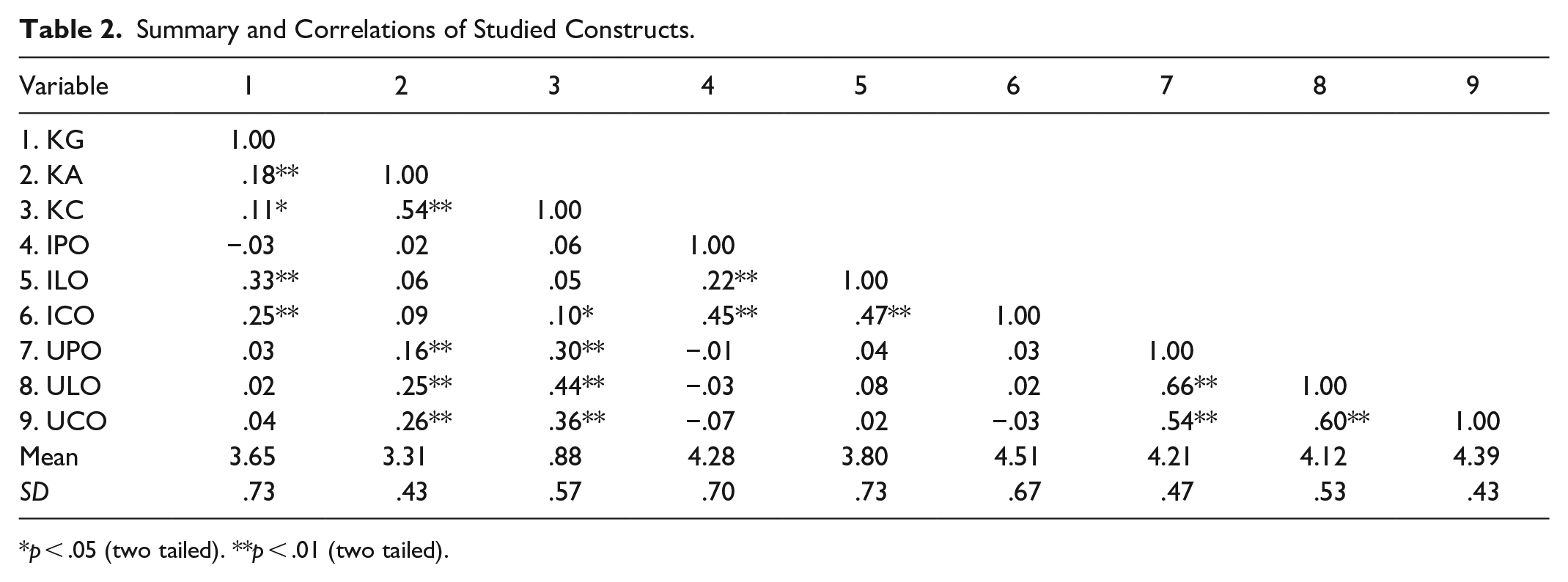
p < .05 (two tailed). **p < .01 (two tailed).
The Estimated Coefficients From the Hypothesized Model.
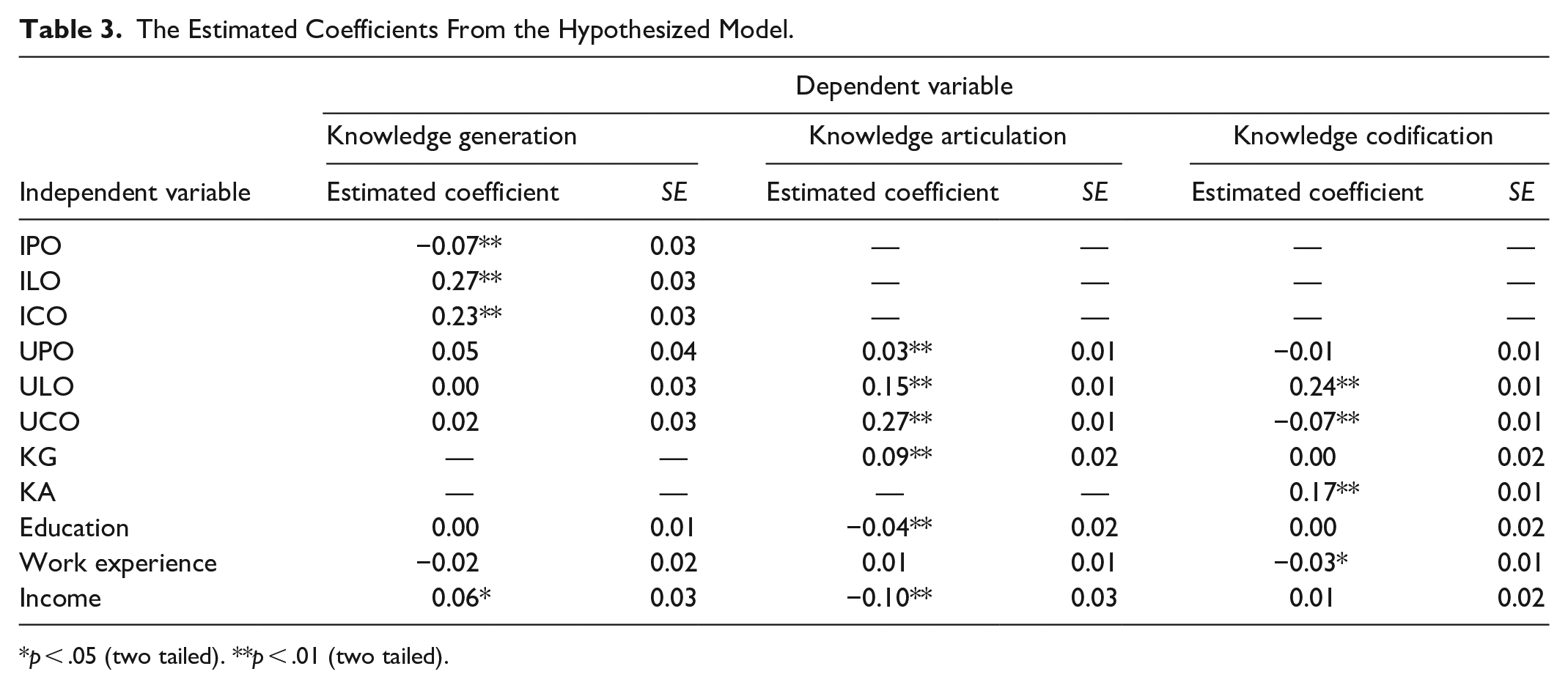
p < .05 (two tailed). **p < .01 (two tailed).
Conclusions and Discussion
Conclusions
The current study develops and empirically tests the antecedents of FDL by explicating the differential effects of two orientations (i.e., individual and unit orientations) on the deliberate learning process we consider. This research offers the following main findings.
First, by using a process-oriented, bottom-up approach, the results of this study reveal the FDL process that companies absorb and transform the knowledge of frontline employees into organizational knowledge. Specifically, the results show that KG at the individual level has a positive impact on KA at the group level, while KA at the group level positively impacts KC at the unit level. The findings of this study are consistent with existing studies: DL contains KG at the individual level and KC at the unit level, while KA at the group level plays a mediating role (Keeling et al., 2020; Ye et al., 2012; Zollo & Winter, 2002).
Second, based on paired survey data from frontline managers and frontline employees in the healthcare industry, the results of this study reveal the differential effects of performance, learning, and COs at the individual and unit levels on FDL behaviors. Individual KG is primarily driven by individual-level orientations but not affected by unit-level orientations. As we predict, individual orientations have different effects on KG. Specifically, IPO negatively affects KG, ILO, and ICO positively affect KG. By contrast, group KA is promoted by all three types of unit orientation. Most interestingly, the three unit-level orientations have different effects on KC behaviors. Specifically, UPO has no effect on KC, ULO positively affects KC, and UCO negatively affects KC.
Theoretical Contribution
First, the findings of this study are consistent with existing studies: DL contains KG at the individual level and KC at the unit level, while KA at the group level plays a mediating role (Keeling et al., 2020; Ye et al., 2012; Zollo & Winter, 2002). Specifically, the results show that KG at the individual level has a positive impact on KA at the group level, while KA at the group level positively impacts KC at the unit level. More importantly, we propose that this bottom-up deliberate learning process is initiated by frontline employees and eventually codified into unit-level knowledge. This research reveals the specific process of learning in the organization. First, frontline employees form tacit knowledge based on their own experience or knowledge. In essence, the output of this process is not obvious, but knowledge is produced as implicit knowledge. Then, through group discussions, regular work activities, and group-led knowledge collection activities, the tacit knowledge generated by frontline employees is accumulated and transferred to explicit knowledge. Finally, the organization renews existing routines or creates new routines and forms manuals or workbooks based on the explicit knowledge generated by the group (Salvato & Vassolo, 2018).
Second, we uncovered several important antecedents that influence FDL. This research further explores the effects of three orientations (i.e., PO, LO, and CO) on the FDL process. Our results indicate that frontline employee KG is primarily driven by individual-level goal orientations. Individual LO has a positive effect on KG, and individual CO also has a positive effect on KG. In contrast, individual PO hinders frontline employees’ KG. The results of this study show that orientations at the individual level and orientations at the unit level have different effects on the three processes of FDL. These findings enrich the existing research on the antecedents of the FDL process (de Jong et al., 2021; Haldorai et al., 2021; Keeling et al., 2020). The results of this study prove that cross-level orientations have different effects on the process of knowledge accumulation at each level. Specifically, the three different orientations at the individual level only have an impact on knowledge. The three different orientations at the group level have an impact on the last two processes of FDL. This study reveals in detail the pre-influencing factors of organizational learning.
Third, the three orientations at the unit level have no influence on individual KG. Our findings seem counterintuitive at first glance, but they make sense of closer consideration and are consistent with organizational climate literature. Generally, the organizational climate will have an influence on the behavior of employees, but the influence depends on whether the influence is forced or voluntarily accepted by employees. According to organization climate literature, as a key element of group or unit climate, individuals’ perceptions and evaluations of the environment rather than the environment itself mediate their attitudinal and behavioral response (James et al., 1978; James & Jones, 1974). When the climate of an organization conflicts with employees’ personal goals, employees’ work-related decisions are affected (e.g., Suliman & Abdulla, 2005; VandeWalle et al., 2001). For example, an organizational climate that conflicts with personal goals can reduce employee engagement, reduce employee productivity, and increase employee turnover. In this study, for example, with regard to the unit’s PO, the unit emphasizes that performance leads employees to try their best to complete tasks efficiently. Even if employees know that the knowledge they have can be useful for the future of the company, they may also choose not to make the extra effort to summarize this knowledge. For the LO of the unit, the LO indicates that the organization and employees should make efforts to learn to improve their ability. However, this may be in conflict with employees’ self-oriented performance, leading to employees’ willingness to learn knowledge beyond the job skill requirements. Similarly, for the CO of a unit, employees may still follow the routine to meet the needs of customers but lack more motivation to search and create new knowledge.
However, group KA is promoted by units PO, LO, and CO. All three types of unit-level orientations have a positive effect on employee KA. Unit CO demonstrated the strongest positive impact on KA. More importantly, KC is positively associated with unit LO, negatively associated with unit CO, and not associated with unit PO. Specifically, the negative effect of unit CO is the opposite of what we hypothesized. A plausible explanation is that CO emphasizes providing customized service and satisfying customers’ needs. Because customer service encounters are heterogeneous and involve unpredictable human dimensions, a certain degree of autonomy or empowerment is needed for frontline employees to exercise discretion and deliver the best services. Therefore, in a customer-oriented unit, KC may not be favored because codifying everything into scripted procedures or routines may reduce frontline employees’ autonomy in customizing service delivery and thus may harm customer service quality.
Managerial Implications
In today’s business environment, market-based knowledge generated and embedded in the frontlines through frontline employees’ daily interactions with customers is valuable and can generate positive performance outcomes if the knowledge can be captured and utilized effectively. This study provides some valuable suggestions for managers.
First, the results show that the three steps of the FDL process are indispensable and are formed level by level and have an impact on the organization. First, organizational knowledge comes from individuals (Nonaka & von Krogh, 2009). Only after individuals generate tacit knowledge through summarization or abstraction can they integrate this knowledge through group communication and discussion, and finally, this knowledge can be formed into operational tools or guidelines at the unit level. Managers should start from these different levels. Only by having a definite object in mind can they promote the generation of knowledge and articulation and codification.
Second, the study reveals that three orientations at the individual and unit levels have differential effects on FDL behaviors. Unit-level orientations have no effects on individual KG because the unit manager does not force front-line employees to generate knowledge in the frontline context. Moreover, among the unit-level orientations, an LO is the most effective in promoting KA and KC. Customers and POs should not be adopted if codifying and disseminating knowledge are emphasized within organizations. For managers, these findings are of great significance to firm. For example, in the medical industry, companies not only need to consider which orientation can bring performance improvements, but also whether the trade-off orientation can enable the company to maintain long-term competitiveness.
Limitations and Future Studies
The limitations of the study are outlined as follows. First, this study only discusses the correlation between three parts of the FDL process. Although the causal and sequential relationships among them have been discussed theoretically, the causal and temporal relationships between them have not been tested in empirical studies. Future research can further discuss the causal and temporal relationships in this process. Second, there are limitations in sample selection. The healthcare industry was selected as the context of this study, which is aknowledge-intensive industry. Whether the KG process of front-line employees proposed in this study exists in labor-intensive industries remains to be verified. Future research can generalize the conclusions of this study to more industries.
Third, this study compares only the influence of frontline employees’ individual dispositional orientations and unit orientations on KG, articulation and codification but does not discuss the influence on other variables such as customer satisfaction, firm financial performance, employee satisfaction, and employee emotion (Arthur & Huntley, 2005; Nembhard & Tucker, 2011). Future research can discuss whether frontline employee deliberate learning mediates the effects of individual and unit orientations on firm innovation, firm financial performance, customer satisfaction, employee satisfaction, and employee emotion.
Fourth, we collected unit-level data (i.e., group level KA and unit level KC) from unit managers. However, as a key element of group or unit climate, individuals’ perceptions and evaluations of the group or unit climate rather than the climate itself mediate their attitudinal and behavioral response (James et al., 1978; James & Jones, 1974). There may be inconsistencies between employees’ perceptions of group or unit climate and managers’ perceptions. Future research could measure perceived group or unit climate by multi-level employees, such as frontline employees, managers, or high-level supervisors.
Finally, because the FDL process is a complex and huge thing, it is affected by the industry, company environment, organization structure, and employee composition. The complex process from the generation of knowledge of front-line employees to the creation or update of company routines may be affected by multiple factors. Future research could explore the moderators in the FDL process to promote the FDL theory development.
Footnotes
Declaration of Conflicting Interests
The author(s) declared no potential conflicts of interest with respect to the research, authorship, and/or publication of this article.
Funding
The author(s) disclosed receipt of the following financial support for the research, authorship, and/or publication of this article: This work was supported by the National Nature Science Foundation of China (No.11804189).
