




Abstract
This paper explored a trend analysis related to takaful research from 1989 until March 2022. This research aims to determine: (1) the current growth and trends of publications in takaful; (2) the most productive contributors in takaful studies; (3) the highly-cited documents in takaful research; and (4) the essential keywords and themes involved in the takaful studies. The data was obtained through the Scopus database with the keywords “takaful,”“Islamic insurance,” or “sharia insurance.” The search resulted in 423 documents and became 356 documents after screening. The data has been exported and analyzed using tools such as Biblioshiny, VOSviewer, Publish or Perish (PoP) and Microsoft Excel. The results showed that most publications were in 2017 and 2020. The most significant contributor that published the most research documents were Syed Ahmad Salman by the author (21 publications), International Islamic University Malaysia by Institution (24,4%), English by language (97,5%), Malaysia by country (64,04%), Journal of Islamic Accounting and Business Research by title (22 publications). This study found the article “the cost efficiency of takaful insurance companies” written by Kader as the most cited publication. Moreover, based on the results of network visualization mapping, takaful research was divided into four main themes: risk management in the takaful industry and its relation with Islamic banks, efficiency in the takaful industry, and behavior of takaful customers, and development of takaful. This study recommended a systematic literature review on popular topics such as efficiency and family takaful for further studies.
Introduction
Takaful is an Arabic word that means assuring each other. Participants agree to share losses from the stated risk (Swartz & Coetzer, 2010). To assist danger mitigation is takaful in Islam, which is more assured than most (Zein et al., 2021). Insurance, often known as takaful, is a guarantee given to the insured (Nugroho et al., 2021; Wahyono & Palupi, 2021). In detail, the guaranteeing party pays the insured a set premium as compensation for the catastrophe (Nurbaya & Alam, 2019).
Takaful schemes require to be under Islamic ethics and norms. Takaful operations refer to the primary sources of the Qur’an and Sunnah (Alam & Hidayati, 2020). Therefore, takaful can be accepted among Muslims where the existence of principles such as cooperation (ta’awun) and alms (tabarru’) are required (Nazarov & Dhiraj, 2019). Takaful also represents three mutuality aspects: helping each other, protecting each other from loss, and taking responsibility for each other (Dahnoun & Alqudwa, 2018). The conceptual difference between takaful and conventional insurance is that the risks are not exchanged (traded) in takaful. Takaful participants pay the takaful company a fee (tabarru’ fund). The company, in this case, does not sell risk but acts as the manager of tabarru funds on behalf of takaful participants. Thus, the company does not take the risk, but the risk is distributed among takaful participants who agree to share the risk (M. Khan et al., 2012).
Globally, takaful research has grown and established several takaful firms. It suggests that people’s comprehension of takaful has grown. Many people require insurance to protect their life (Purnamasari & Alam, 2020). Given the enormous potential for takaful, experts continue to advocate its growth, particularly in Muslim-majority nations (Kusmayadi et al., 2021).
Sharia insurance is not only in demand in countries that have a population with a Muslim majority. Sharia insurance began to be in great demand in several European countries (Al-Amri & Hossain, 2017). This phenomenon shows the importance of takaful bibliometric studies to get a global picture of the development and direction of the takaful industry going forward. In addition, several studies show a fairly common understanding and awareness of takaful from the global Muslim community (Abdulsater, 2017; Ha et al., 2018; Sadeghi, 2010). The study of the bibliometric publication of takaful is expected to have an impact on increasing the understanding of the global community regarding the phenomenon of the takaful industry.
This research aimed to perform a bibliometric analysis by mapping research related to takaful indexed by Scopus. Among the analyses conducted in this study include the development of the number of takaful research published from 1989- to March 2022, the productivity of the number of takaful research publications by authors, institutions, countries and source titles, highly cited documents, the network and overlay visualization of takaful studies based on author’s keywords.
This study addresses the following research questions (RQs): RQ1: What is the current state of takaful research and its trends? RQ2: In terms of authors, institutions, countries and source titles, who are the most productive contributors to takaful studies? RQ3: In takaful research, what are the most often cited documents? RQ4: What are the essential keywords and themes in takaful research?
Literature Review
Theoretical Definition of Takaful and Its Global Phenomenon
One of the primary goals of Islamic law (Shari’a) is to ensure that all individuals, regardless of their religious beliefs, have access to the protections and benefits that will help them feel safe, secure, and free from harm (Khorshid, 2004). The general purpose of Islamic law indicates support for takaful who want to reduce the adverse effects of harm. Takaful can be defined as cooperation or joint guarantee. It is a not-for-profit set up where individuals club together by contributing to a common pool (Karbani, 2015).
Takaful combines a Shari’ah-compliant mutual structure for participants (policyholders) with a Shari’ah-compliant management business organized by Takaful Operator (Archer et al., 2012a). Takaful operators manage premium payments by separating them into the participant’s and tabarru’ accounts (Ha et al., 2018). The takaful operator will invest the member’s money to earn a profit, but the money in the participant’s account belongs completely to the participant (Ha et al., 2018). If something bad happens to one of the contract’s signatories while the agreement is in effect, the money from this account will be utilized to compensate them (Ha et al., 2018).
There are some distinctions between takaful and conventional insurance. The takaful is based on mutual collaboration, solidarity, and indemnification, with one party protecting the other against future losses or catastrophes (Nazarov & Dhiraj, 2019). Participants agree to share the financial burden and assist group members in overcoming the designated incident (Nazarov & Dhiraj, 2019). Meanwhile, conventional insurance transfers risk from the insured person to the insurer firm (Nazarov & Dhiraj, 2019).
Various countries have accepted the phenomenon of takaful as alternative insurance in parts of the world. The Asian and African continental region is a history of discussion about Sharia insurance which is inseparable from the role of the views of Middle Eastern scholars such as from Shia, Egypt, and Saudi Arabia. Contemporary scholars, including Ibn Abidin, explained that Islam regulates trade law with various contracts, including insurance (Mankabady, 1989). The recognition of mutual protection as a form of insurance that complies with Islamic principles and is acceptable was strengthened in 1976 during the first international conference on Islamic Economics in Makkah, Saudi Arabia (Sadeghi, 2010). The demand for Sharia insurance products has increased over time and penetrated several other European countries, such as the United Kingdom of France and Germany (Abu-Hussin et al., 2014). As a sign of the development of Sharia insurance in Europe, Takaful insurance is also found in Switzerland, Belgium, and Australia (Alhumoudi, 2012). One of the fatwa committees in Europe, the European Council for Fatwa and Research (Al-Majlis Al-Auruby li al-Ifta’ wa al-Buhuts), decided that conventional commercial insurance is strictly prohibited due to certain elements such as interest, uncertainty and gambling (Abu-Hussin et al., 2014). These elements are the Factors underlying the prohibition of conventional insurance systems in Islam (Abu-Hussin et al., 2014). The British state became the most dominant country on the continent in the publication of studies around Islamic insurance (Nasir et al., 2021).
Several countries in the Americas and Australia also opened up opportunities for developing the takaful industry. Al-Amri and Hossain (2017) and Rahman (2009) stated that north American countries began to show interest in Sharia insurance by establishing Sharia insurance institutions. Sharia insurance products will expand to Australia, and it is expected that further, this will expand to other regions of the world people will tend to adopt Takaful insurance instead of conventional insurance shortly (Hassan et al., 2018). Abdulsater’s study (2017) highlights the importance of raising awareness of such products among Australian Muslims and is a pioneering study in the context of secular non-Muslim countries.
Evolution of Takaful Studies
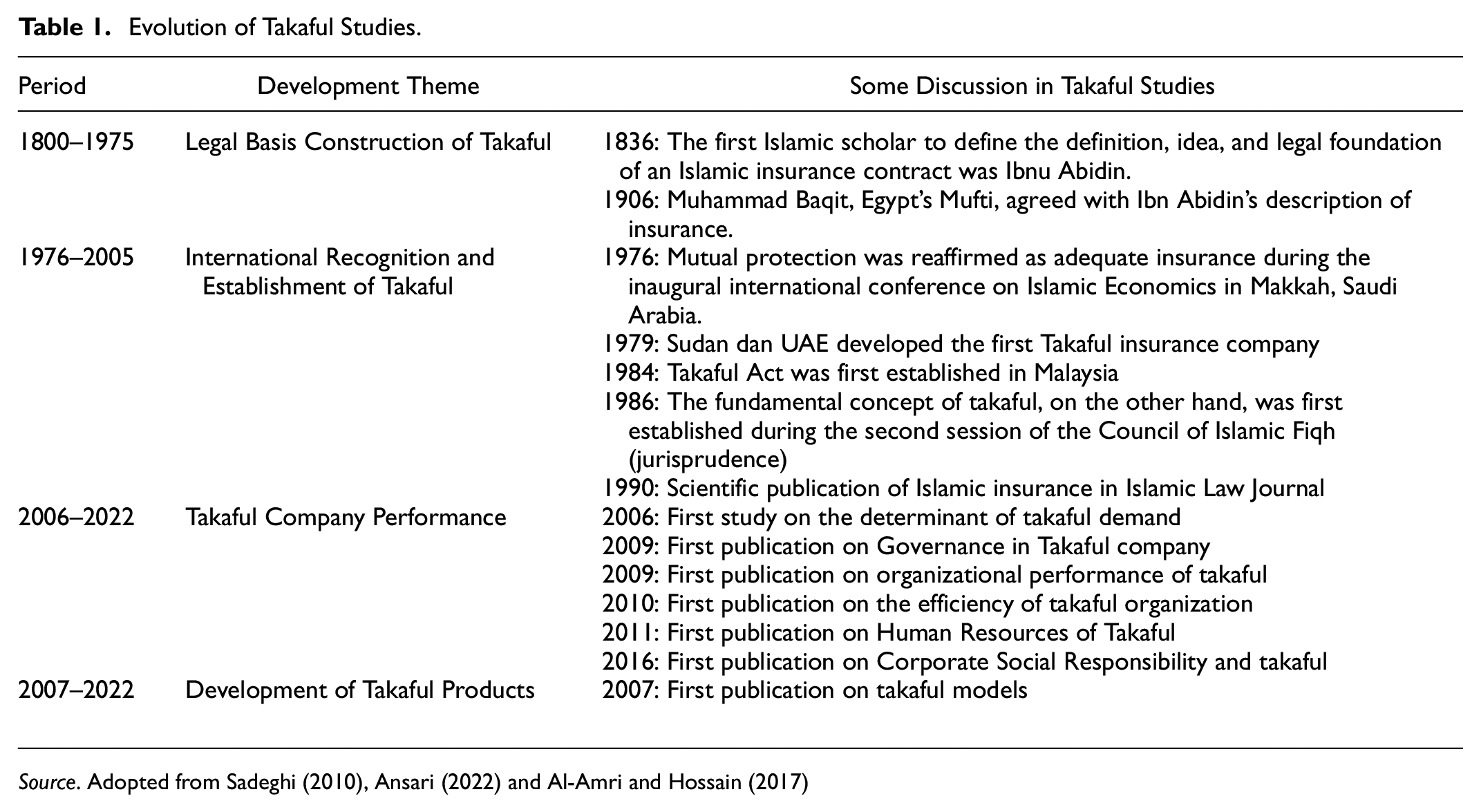
This section attempts to reveal the evolution of the development of takaful studies. The results of the takaful evolutionary progress can be seen in Table 1. The idea of the emergence of takaful originated from the study of Islamic scholars in providing definitions and legal foundations drawn from the sources of Islamic law in the 18th century (Sadeghi, 2010). After the initial picture of Islamic Insurance emerged, muftis or Muslim legal experts, also agreed with the idea of takaful in the 19th century (Mankabady, 1989).
Evolution of Takaful Studies.
Source. Adopted from Sadeghi (2010), Ansari (2022) and Al-Amri and Hossain (2017)
Takaful company was called to stand at a conference on Islamic economics in Makka, Saudi Arabia, in 1976 (Sadeghi, 2010). In 1979, the first takaful company was established in Sudan (Al-Amri & Hossain, 2017). Starting in 2006, many good publications about the performance of Sharia insurance institutions about the development of models and takaful products (Ansari, 2022).
Past Studies
Previous researchers have done research that examines the literature about takaful. Sadeghi (2010) conducted a literature review without a detailed explanation of search techniques that explored the emergence and evolution of Sharia insurance—Takaful—both from a theoretical and practical perspective. Al-Amri and Hossain (2017) conducted a literature review of takaful studies. The study did not detail how the literature was searched and brought up the historical highlights of the growth of takaful insurance globally.
Olorogun and Noor (2014) conducted a literature review by collecting 100 documents and selecting them into 60 documents based on originality and ranking. Olorogun and Noor (2014) classify their findings into topics of institutionalization, operations, and regulation relevant to the academic curriculum. With content analysis techniques, Olorogun and Noor’s (2014) research verifies whether sharia insurance literature can produce experienced Sharia insurance professionals. The results suggest that disputes over the available literature may have contributed to the failure to have a standardized curriculum to teach Islamic insurance as a profession in academia at national and international levels. Literature and curriculum reviews are recommended. However, Olorogun and Noor (2014) do not explain the details of the source of the literature database. It focuses more on the study of literature in Takaful Education. Furthermore, this study shows the importance of researching the literature on takaful.
Nasir et al. (2021) conducted a bibliometric study on takaful studies by reviewing 149 selected documents from 183 published from 2000 to 2019. They have classified four main themes: Behavioral factors, Conventional insurance, Insurance demand, and products. However, the study still did not convey detailed information about the source of the literature search database and limited the study to journal-shaped documents.
This research is different from previous research. A. Khan et al. (2020) use data sourced from the ISI Web of Knowledge (ISI WoK) with 69 documents. Kusmayadi et al. (2021) also conducted a bibliometric analysis using a database of dimension.ai. Kusmayadi et al. (2021) used data from 2014 to 2021 with 500 documents without explaining the source of the search database. Nobanee et al. (2021) analyzed 176 documents focusing on the role of risk management in promoting business sustainability practices and advances in the specific scope of life insurance with bibliometric techniques. This Nobanee et al. (2021) study examined documents sourced from Cambridge’s online database to determine the current trend direction of this field.
Ansari (2022) conducted a bibliometric study with 20 years of literature published in takaful between 2000 and 2019. Ansari (2022) selected 96 documents from the search results of 304 relevant documents and conference papers, and the review papers have been for general analysis. The documents are grouped into exclusive themes: consumer behavior, financial and non-financial performance, takaful models, human resources, and governance. This study uses a Scopus database from 1989 to March 2022 with 356 documents that have previously gone through the data selection stage from 425 documents indexed in Scopus. This study is bibliometric in Islamic insurance, with the most documents sourced in the reputable database Scopus and coverage of the longest publication time of 33 years of research.
Methods
The term bibliometrics was first coined by Pritchard (1969), replacing the classic term “statistical bibliography.” Since then, bibliometric analysis has developed rapidly and has been perfected along with the exponential growth of science (Moral-Muñoz et al., 2020). Researchers used this bibliometric analysis for various reasons, such as to explore the intellectual structure of a particular domain in the literature, to visualize the research collaboration patterns and to uncover an emerging trend in the performance of documents. The data center of research in bibliometric analysis tended to be massive and objective. Bibliometric analysis was used to map and describe the cumulative scientific knowledge and evolutionary nuances of a field of science by closely understanding large volumes of data. Therefore, this bibliometric analysis could advance a field of science.
In addition, bibliometric analysis also allows researchers to get new research ideas, identify gaps in a scientific discipline, and make direct contributions to the field (Donthu et al., 2021). Researchers often use bibliometric analysis, mapping, and clustering techniques. Moreover, clustering and mapping techniques depend on very different ideas and assumptions. The approach shows that the VOSviewer mapping technique and the parameterized and weighted variants can be derived from the same basic principle. This approach combines mapping and clustering the most frequently cited publications appearing in a given period (Effendy et al., 2021).
Data Collection
This study’s technique is based on how data has been obtained and filtered through to the final data collection. Then, the solid data is ready to be analyzed. Earlier, the topic and scope of the study must be specified, which should be based on the study’s goal; we want to focus on all takaful studies available in the Scopus database. The Scopus database was chosen because it is a significant source for bibliometric analysis and has a broad multidisciplinary scope (Chin & Chew, 2021). A broad multidisciplinary scope becomes essential in getting a research perspective on relevant content and dynamics of research activities worldwide (Suprapto et al., 2021). In addition, soups are one of the largest abstracts and citation databases in the world and offer the most comprehensive overview of international research in science, technology, medicine, socio-humanities, and the arts (Ahmi et al., 2019; Boonroungrut et al., 2022; Jeflea et al., 2022). Several bibliometric studies in various disciplines have used data from the Scopus research database (Akpan & Ezeume, 2022; Kudaibergenova et al., 2022).
The documents obtained for this study were chosen based on the research process, depicted in Figure 1. As of March 4, 2022, the statistics were retrieved from the Scopus database. Due to the limited number of takaful studies, we searched the papers related to takaful studies within the title fields, abstracts, and keywords as of March 4, 2022. The following query was used to attain this goal: TITLE-ABS-KEY(“takaful” OR “Islamic insurance” OR “shariah insurance”). There was a total of 423 documents returned from this query. A series of data cleanings revealed no duplicate papers. Therefore, the same number of documents were kept after the procedure. Sixty-seven out of 423 documents were removed from the analysis section because they did not make takaful in the sense of Islamic insurance and Shariah insurance as the main discussion. Thus, a total of 356 documents remain for further bibliometric analysis.

Flow diagram of the search strategy.
Analysis Tools
The data from the Scopus database was then exported as comma-separated values (.csv) and research information systems (.ris) files. This dataset contains type, year, language, topic area, source title, keywords, abstract, country, affiliation, citations, and authorship. We have utilized Biblioshiny, Publish or Perish, VOSviewer and Microsoft Excel tools to conduct the bibliometric analysis. These tools have been used to run statistical analyses and bibliometric network maps.
Biblioshiny is a shiny web-based application that works within the Bibliometrix R package. This application is an open-source tool for quantitative research to conduct bibliometric analysis. This tool is developed by Aria and Cuccurullo (2017). The Bibliometrix R package provides descriptive and other research-structure analyses after converting and uploading bibliographic data in R. The descriptive analysis provides snapshots of annual research development, productive authors, papers, countries, and most relevant keywords (Aria & Cuccurullo, 2018).
On the other hand, Publish or Perish is a software program that retrieves and analyses academic citations. It gathers raw citations from various sources, analyses them, and displays a variety of citation metrics, such as the number of papers, total citations, and h-index (Harzing, 2007).
VOSviewer offered a text-mining function to visualize a published article citation correlation. This publication map would be displayed in various ways and functions, such as system zoom, searching, and scrolling, so the published map displayed was more detailed (Tupan, 2016). VOSviewer would convert the data into an interconnected map (Al Husaeni & Nandiyanto, 2022). VOSviewer graphically represents the nodal network, such as the number and overall strength of the connections, using two uniform weights. The relevance and power of the linkages are reflected in the network size and network-connecting interlinking lines. The advantage of VOSviewer is that this program uses text mining functions to identify relevant noun phrase combinations with an integrated clustering and mapping approach to examine co-citation data and co-occurrence networks. VOSviewer also has advantages in its visualization (Effendy et al., 2021).
The VOSviewer is displayed in items, lines, and colors in a network visualization map. Items with a higher weight will appear more prominently than items with a lower weight. The items themselves are represented by labels and are also circled by default. The item’s weight determines the size of the circle and the label of the item. The more the item weighs, the greater the forgetting of the item’s label and circle. VOSviewer divides the visualization results into several clusters. Each cluster is distinguished by color. The cluster determines the color of an item. Lines connecting items indicate a link (van Eck & Waltman, 2021).
Results and Discussion
The analysis of this paper used the following aspects of scholarly works to answer the research questions developed in the previous section: publication by year, document types, publication by source title, source types, publication by country, publication by institutions, languages of documents, subject area, citation patterns, and themes in takaful studies based on keywords and title and abstract. The majority of the data is supplied in frequency and percentage. The number of cited publications (NCP), total citations (TC), average citations per publication (C/P), and average citations per cited publication (C/CP) has all been included in some of the studies.
Current State of Publication on Takaful Studies
In order to answer RQ1: (What is the current state of takaful research and their trends?), we examined the publication trend in the takaful studies using total publications by year, language, document type, source type and subject area.
Figure 2 shows the development of journal publications each year. It could be observed that from 1989 to 2021, the highest number of publications on Scopus occurred in 2017 and 2020, with 43 research publications. The number of research publications jumped to 38 in 2013 from only eight in the previous year. From 2012 to 2021, publications on takaful studies 16 published on average during the current decade.

Growth and impact of publications by year of takaful research.
Islamic insurance is developing at a slower pace than Islamic banking. Banking regulations, as well as Malaysian regulations, came first. Malaysia is the first country to have a dual banking system, with concurrently Islamic and conventional banking services. Although the Islamic Banking Act of 1983 empowered the Central Bank to create and supervise new Islamic banks, the finance minister retains ultimate decision-making authority. Islamic insurance businesses are still in the early stages of growth, and they are modest (Khorshid, 2004). Publications on takaful studies experienced rapid development starting in 2017 and the growth of various Islamic Insurance products (Billah, 2019). Various Sharia insurance products responded well, especially for needy Muslim consumers (Billah, 2019).
Figure 2 also shows that during the first 12 years, the number of publications on takaful studies was minimal. The first publication about takaful studies was written by Mankabady (1989) in a journal entitled “Insurance and Islamic Law: The Islamic Insurance Company.”Mankabady (1989) discussed the position of insurance in Islamic law in response to the absence of credit that banks can provide to finance the import of the oil industry in Arab countries without insurance protection.
On the other hand, Figure 3 shows the trendline of the cumulative number of publications of takaful studies between 1989 and 2022. Regarding their exponential growth, there is a significant correlation between the cumulative number of publications and the cumulative polynomial number of publications from 1989 to 2022 with a coefficient of determination (R2 = .9538). In addition, the trendline equation revealed a favorable upward trend in takaful publication productivity, which is expected to continue.

Trendline of the cumulative number of publications.
There has not been much progress in the number of takaful-related publications in the first decade. However, since 2013 the number of publications has increased dramatically. The number is projected to increase in 2022, along with the development of Islamic Insurance products. Table 2 shows the performance of citations from documents that discuss takaful studies. The growth of citations of document publications has a positive relationship with the number of documents. The most significant number of citations was generated by publications in 2016, with 203 citations, followed by publications in 2017, with 200 citations.
Publications by Year.

Notes. TP = Number of publications; TC = Number of citations; C/P = Citations per paper; C/Y = Citations per year; CY = Citable years.
A developmental portrait of takaful studies from the language side in Table 3 shows that English dominates the number of publications with 347 documents. From the table, the research on takaful has also been published in other languages, such as Malay, Arabic, Russian, Ukrainian, and Urdu.
Publications by Language.

Interesting findings are found in the highest annual citation analysis in publications in 2004 and 2008, totaling 33 per paper. In addition to being the only article, Khorshid’s (2004) publication in the form of a book attracted many academics to do citations. Khorshid (2004) explains a practical insurance framework that allows Muslims to compete with non-Muslims in businesses that have wide coverage in everyday life and equipped arguments from pro and anti-insurance jurists. The publication by Akram Laldin (2008) produced findings on the development of the Islamic financial sector, including banking, capital markets, and takaful, after an in-depth examination of the many stages of growth that Malaysia has experienced.
Table 4 compares the number of publications about takaful studies based on the document type. The article is the dominant type of document compared to other documents, such as conference papers and book chapters, representing 77% of publications in takaful studies.
Publications by Document Type.

As shown in Table 5, the development of takaful studies is published in the journal, with 82.6% of total publications followed by books, conference proceedings and book series.
Publications by Source Type.

Based on Table 6, publications on takaful studies were published predominantly in the journals categorized in Business, Management and Accounting, followed by Economics, Econometrics and Finance, and Social Science.
Publications by Subject Area.

Productive Contributors
In order to answer RQ2 (In terms of authors, institutions, countries and source titles, who are the most productive contributors to takaful studies?), this section presents the statistic of the publication by authors, institutions, countries and source titles.
Publications by Authors
As depicted in Table 7, during the observation period, Syed Ahmad Salman was the author who published the most research documents on takaful studies on Scopus, with 21 publications. He was followed by Puspa Liza Ghazali, with 13 publications and Musthofa Mamat, with 10 publications. Then, Rusni Hassan, Sheila Nu Htay and Rubayah Yakob each published eight documents. The underlying thing why these authors dominate takaful publications is their expertise and consistency in discussing takaful in their research and writing. For example, Syed Ahmad Salman is the author of a book on takaful and a mass media column.
Ten Most Productive Authors.

Notes. TP = Number of publications, NCP = Number of cited papers, TC = Number of citations, C/P = Citations per paper; C/CP = Citations per cited paper; h = h-index; g = g-index; m = m-index; PYS = Publication year start.
Publications by Institutions
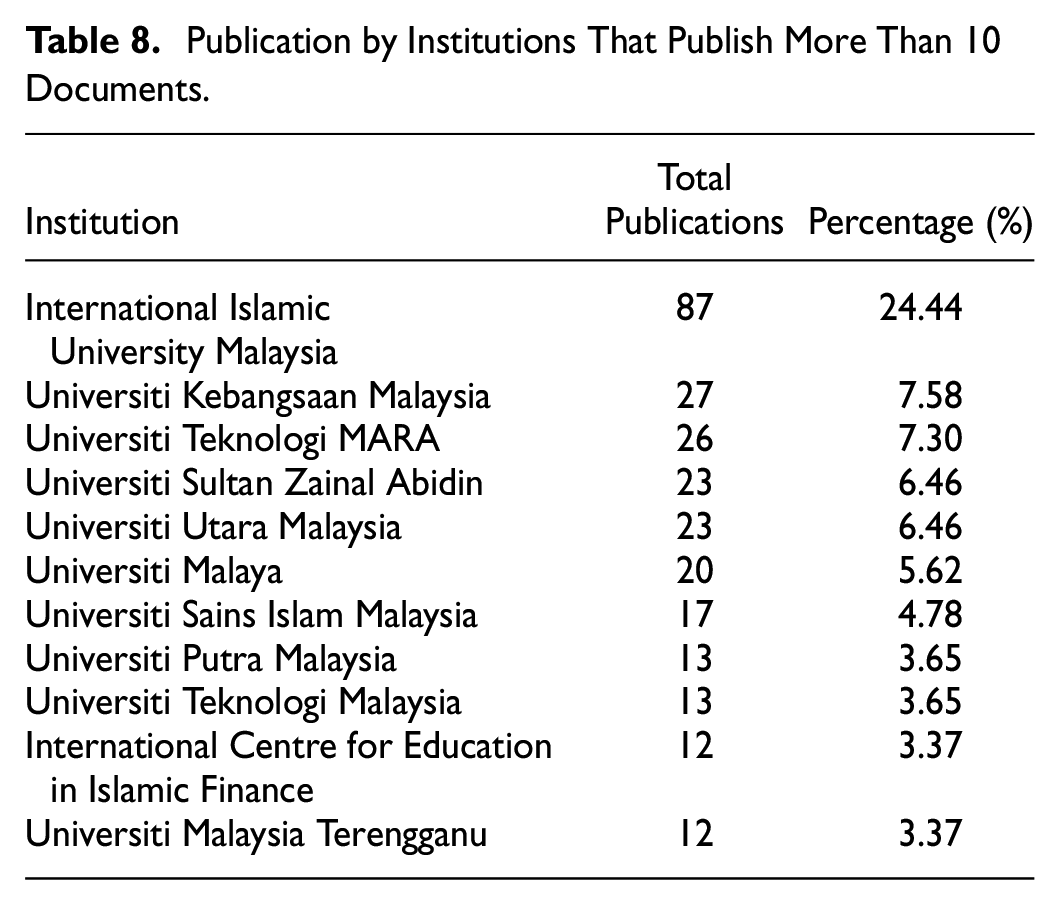
Table 8 shows an overview of the institution’s distribution of publications in takaful studies. International Islamic University Malaysia was ranked first with 87 publications or 24.44% of total publications. The second and third level is attached to Universiti Kebangsaan Malaysia institution with 27 publications, and Universiti Teknologi Mara, with 26 publications. It is not surprising that International Islamic University Malaysia dominates Takaful-related publications. The thing that can explain this phenomenon is that International Islamic University Malaysia is the first world campus to apply the integrase of Islamic science curriculum with general sciences that have existed (Amin et al., 2007). As a result, researchers from the International Islamic University Malaysia initiated many developments in takaful-related science.
Publication by Institutions That Publish More Than 10 Documents.
Publications by Country
Apart from the year, all documents related to takaful studies were also analyzed based on the country the authors are affiliated with (see Table 9). The top 9 of the 40 defined countries that published documents in takaful studies on Scopus were analyzed. The dominance of research related to takaful was carried out in Malaysia, representing 64%, with a total of 228 documents published, followed by Pakistan with 27 documents, Saudi Arabia with 25 documents, Indonesia with 23 documents, the United Kingdom with 23 documents, the United Arab Emirates with 12 documents, the United States with 12 documents, Australia with eight documents, and Russia with five documents.
Publication by the Top Nine Countries That Publish Five or More Documents.

Since its start in 1984, the takaful industry in Malaysia has been growing steadily, and the country has now established itself at the forefront of the takaful industry across Southeast Asia (Arifin et al., 2013). Malaysia’s takaful sector (Islamic insurance) is becoming increasingly important, which should help the country’s economy develop sustainably. In addition, statistics show that Malaysia’s takaful industry is growing faster than any other in Southeast Asia (Lee et al., 2019). Because of this, there have been a disproportionately large number of takaful research published by dan compared to other countries.
Takaful global’s assets, on the other hand, increased 10.9% year-over-year to US$51 billion, a significant increase over the previous 2 years’ losses (Alpen Capitan and Alpen Asset Advisor, 2021). Saudi Arabia, the world’s largest Takaful market, increased by 8.8% YoY due to mandated health insurance, which attracted new business (Alpen Capitan and Alpen Asset Advisor, 2021). Malaysia’s takaful assets rank third after Saudi Arabia and Iran (Islamic Corporation for the Development of the Private Sector, 2020), but their takaful studies publications dominate. Meanwhile, despite having the most operators compared to other countries, Indonesia only occupies the fifth position in the number of takaful publications (Islamic Corporation for the Development of the Private Sector, 2020).
Publication by Source Titles
Table 10 shows takaful studies based on source titles. Table 10 describes 14 source titles that have published takaful studies publications of more than five documents. Journal of Islamic Accounting and Business Research is the source title with the most publications. The Journal of Islamic Accounting and Business Research published 22 documents. The Journal of Islamic Marketing filled the following position with 18 documents, followed by 14 documents published by the Takaful Insurance Concepts and Regulatory Issues.
Publication by Source Title That Publishes Five or More Documents.

Notes. TP = Total number of publications, TC = Total number of citations, NCP = Number of cited papers; h = h-index; g = g-index; m = m-index; PYS = Publication year start.
Most takaful studies publications are published by title sources closely related to the Islamic economic and finance journal scope. There are still very few sources in the general economy field that publish takaful studies. The term takaful or Islamic Insurance, which has a different concept from conventional insurance, is still not as familiar as Islamic banking. It needs to be developed how other sources of tittle general economy that have published Islamic banking studies also publish takaful studies.
Highly Cited Documents
This section will answer RQ3 (What are the most often cited documents in takaful research?).
Usually, citations per publication were used to assess the relative impact on the whole field (Serenko & Bontis, 2009). A citation shows the number of times an article is cited by all documents in the database (Tian et al., 2008). The number of citations was obtained from the Scopus database, then extracted through Mendeley into a research information systems (.ris) format, and then analyzed using the Publish or Perish (PoP) application. Table 11 illustrated that a full 20 documents in takaful studies had more than 22 citations. The most cited document was “The cost efficiency of takaful insurance companies” (Kader et al., 2010). In the 2010 Geneva Papers on Risk and Insurance: Issues and Practice, the journal already had 52 total citations and 4,33 citations per year.
Top 20 Highly Cited Documents.
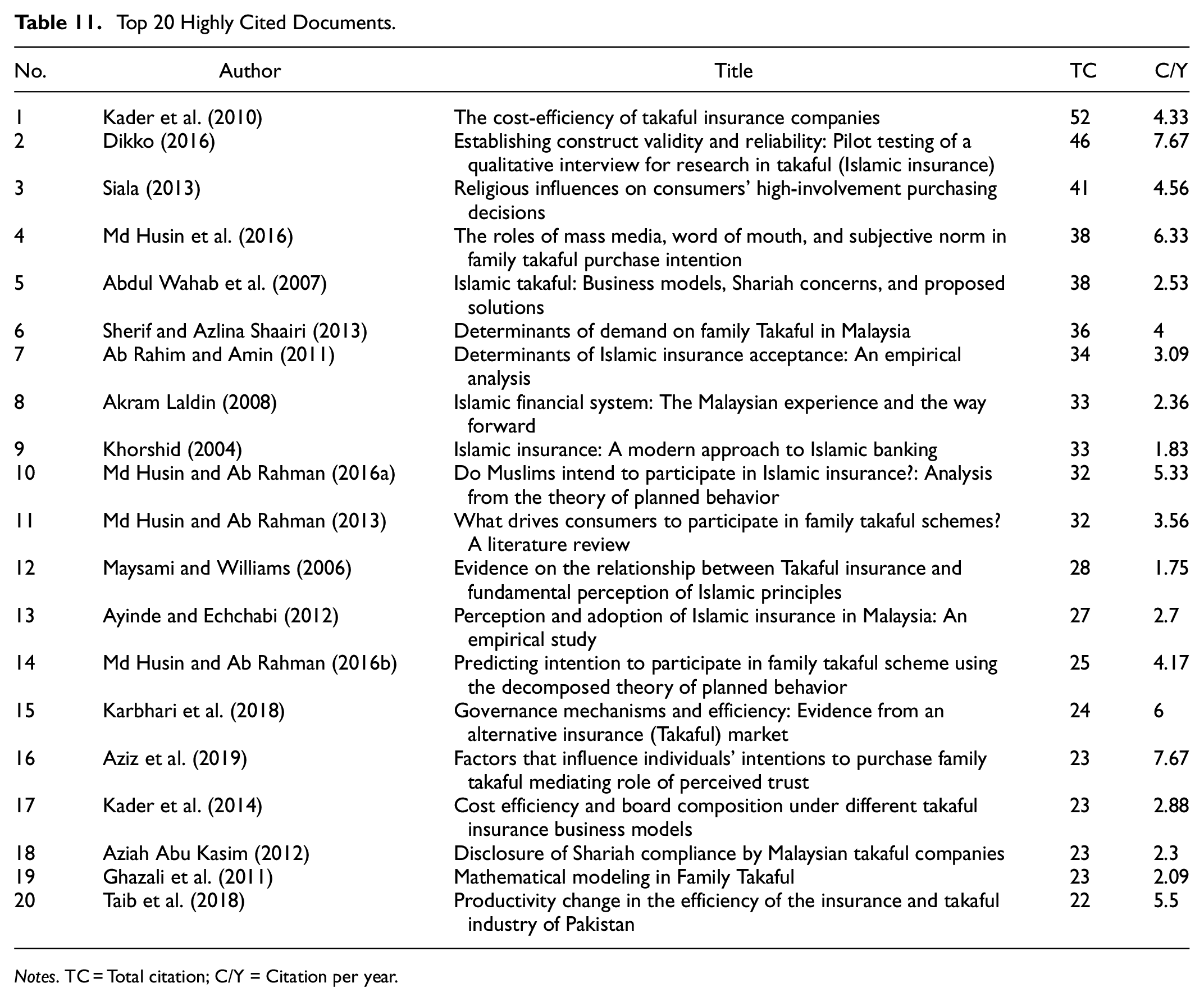
Notes. TC = Total citation; C/Y = Citation per year.
Among the reasons why Kader et al.’s (2010) research gets the most citations is the position of quartile 2 of the publisher’s journal in the Scopus database. The higher the quartile of the journal position in the Scopus, the more it will get a reputation and attention from academics or writers. Liu (2013) and Mas-Bleda and Thelwall (2018) asserted that the popularity and quality of journal publishers could significantly impact the development of citations.
Kader et al. (2010) investigated the cost-effectiveness of non-life Takaful insurance enterprises operating in 10 Islamic countries. According to our findings, Kader et al. (2010) found that non-executive directors and the separation of the Chief Executive Officer and Chairman duties do not promote cost efficiency. On the other hand, the board size, company size, and product specialization have a beneficial influence on Takaful insurers’ cost efficiency. On the other hand, the regulatory environment is determined to have little statistical significance in boosting cost efficiency.
Dikko (2016) conducted pilot testing to study the relationship between Islamic principles and objectives, Islamic financial law, and Nigeria’s takaful (Islamic insurance) operations and practices. Semi-structured interviews were tested on a small sample of people, and found that people had different perspectives on broad Islamic financial issues, including takaful (Dikko, 2016). Siala (2013) examines whether Muslim customer religiosity and religious centralism can lead to brand loyalty attitudes to insurance companies that offer high-engagement redress services that correspond to religion. Siala (2013) found devout Muslims highly devoted to religiously exclusive indemnity services and insurance companies that offered such indemnity services.
Themes in Takaful Studies
In order to answer RQ4 (What are the essential keywords and themes in takaful research?), we examined the frequency and created the network and overlay visualizations of the author’s keywords. At the same time, we also presented the occurrences networks of terms based on the title and abstract of the downloaded documents.
Author’s Keyword Analysis
Undoubtedly, author keywords are critical for academics looking for research trends. Aside from that, Wen and Huang (2012) argue that author keyword analysis is critical for assessing the growth of research topics. There are 160 types of keywords used in takaful studies publications. The study indicates (see Table 12) the 10 most active author keywords in the takaful studies based on more than 10 times frequency. Takaful became the most dominating keyword of takaful publications, followed by the word Islamic Insurance and Insurance.
Top 10 Keywords.

Figure 4 shows the network visualization of the most frequently author’s keywords used in takaful research co-occurrence. A threshold of five keywords was applied for the 356 documents in the dataset. Out of 796 authors’ keywords, 43 keywords have met the criteria.

Network visualization of co-occurrence of author’s keywords.
For keyword analysis, the study used VOSviewer for mapping analysis. VOSviewer software maps these words’ appearance together, as seen in Figure 4. The distance between nodes in this visualization network represents the relationship between phrases or concepts, while the node itself reflects a term or concept (Sedighi, 2016). In this diagram, each color shows a cluster. This visualization map will include four groups, each representing one of four topics. These clusters can be categorized into four themes: Risk management in the takaful industry and its relationship with Islamic banks (red—12 items), efficiency in the takaful industry (green—11 items), the behavior of takaful customers (blue—11 items), and development of takaful products (yellow—9 items).
Table 13 shows four themes in the publication of takaful studies. The first theme is risk management and the relationship between the Islamic insurance industry and banks. This theme shows that along with the development of Islamic banks’ needs, other financial products that support the operation and conformity of Shariah, including the need for Islamic insurance.
Research Themes in Takaful Research Based on the Author’s Keywords.

The second theme is the study of the efficiency of Islamic insurance institutions. On this second theme, the primary word insurance still tends to be attached to the efficiency study. Efficiency research approaches in the Islamic insurance industry still tend to use the same efficiency analysis tools in the efficiency studies of conventional insurance institutions. This research’s theme alluded to the Data Envelopment Analysis (DEA) method and cost efficiency theory.
The third theme is the study of the behavior of consumers or service users of takaful financial institutions. This theme is dominated by publications in the takaful studies area of attitude, subjective norms, awareness, and intentions in buying takaful products. Research on consumer behavior also covers religiosity and trust factors in sharia insurance agency products. The fourth theme is the development of takaful product models, including using sharia agreements such as mudharabah. According to Islamic law, takaful product development is often associated with other Islamic financial institutions and significant studies on its conformity.
The way to do the evolution of theme analysis is to count the number of times the same pair of keywords appears in the same article, revealing the relationship structure of these terms and further exploring the growth of the research topics they represent (Chen et al., 2019). The evolution of theme analysis is one of the limitations in past research bibliometrics conducted by Nasir et al. (2021) in takaful studies.
Figure 5 depicts the overlay visualization of the author’s keywords that could determine research topic trends. The keywords that appeared were grouped by year. The analysis was carried out for the last 10 years in this research by dividing it into two periods. Period I was from 2012 to 2016, and period II was from 2017 to 2021. In period I (2012-2016), emerging research topic trends were related to the takaful industry, Malaysia, the insurance system, marketing, intention, and SEM. Meanwhile, in period II (2017-2021), the trend of research topics that emerged included takaful, Islamic insurance, data envelopment analysis, corporate governance, Islamic finance, family takaful, attitude, and service quality.

Overlay visualization of co-occurrence of author’s keywords.
Term Analysis
The appearance of publication titles and a combination of titles and abstracts from documents obtained from the Scopus database are also examined in this work as part of text analysis (Kushairi & Ahmi, 2021). Figure 6 visualizes the relatedness publications based on title and abstract co-occurrence terms. This visualization allows you to see the essential terms in a cluster of articles and the co-occurrence of relationships between them. Clustering is predicated on the premise that items in the same cluster indicate comparable subjects (Nobanee et al., 2021).

Network visualization of co-occurrence of terms based on the title and abstract.
Items were indicated by nodes that had been grouped by cluster. Each cluster had a different color. The larger the node size, the more critical the item was. The visualization above showed that the research development was divided into three clusters. The network visualization results showed at least three critical items with the most significant nodes: family takaful, issue, and efficiency. A more detailed explanation for each cluster is as follows:
Family Takaful
After being connected, it turned out that research that discussed family takaful was related to several things, namely size, takaful company, context, relationship, customer, Pakistan, trust, intention, attitude, awareness, issue, premium, fund, plan, integrated model, subjective norm, and strategies. Family takaful is often a long-term coverage, similar to traditional life insurance (Arifin et al., 2013). Takaful Family protects its clients and dependents against financial loss due to unexpected death, incapacity, or severe illness (Md Husin et al., 2016). Publications on the takaful family cluster talk about consumer behavior toward the most famous Islamic insurance products. Factors such as premiums, funds, and factors that affect customers’ intentions get wide attention.
Issue
The discussion of the issue related to the words article is family takaful, efficiency, regulation, quality, perspective, customer, activity, uncertainty, and takaful company. The second issue cluster is a published document highlighting the conceptual side of Islamic Insurance. Publication documents discussing legal issues in takaful as written by Hussain (2012), Salman (2014), and Archer et al. (2012b). In addition, the more specific side of conceptual issues is discussed regarding rating takaful companies, as written by Murray (2012) and takaful supervision, as written by Casey (2012).
Efficiency
The words related to efficiency based on the VOSviewer analysis results were DEA, risk, insurer size, performance, Saudi Arabia, relationship, customer, Pakistan, framework, form, and issue. The third cluster is a publication that examines the performance of takaful institutions in terms of efficiency. Attention to the efficiency study of takaful institutions is still relatively small (Almulhim, 2019). Data Envelopment Analysis (DEA) is the most popular and most widely used method in researching the efficiency of Islamic Insurance institutions, as did Kader et al. (2010), Lee et al. (2018, 2019), Xin et al. (2019), Yakob et al. (2014), Benyoussef and Hemrit (2019), Almulhim (2019), and Shaddady (2022).
Conclusion
According to the findings, this paper concluded that most publications occurred between 2017 and 2020. Syed Ahmad Salman by the author (21 publications), International Islamic University Malaysia by the institution (24.4%), English by language (97.5%), Malaysia by country (64.04%), and Journal of Islamic Accounting and Business Research by title were the most prolific contributors (22 publications). In this analysis, the most referenced paper was by Kader et al. (2010) article on “The cost efficiency of takaful insurance businesses.” Furthermore, the takaful study was separated into four primary themes based on the findings of network visualization mapping: risk management in the takaful industry and its relationship with Islamic banks, efficiency in the takaful industry, takaful customer behavior, and takaful development. The research also elaborates on other significant findings that previous Islamic insurance literature studies have not studied, including the evolution of takaful research development, research themes, and text analysis. This study provided theoretical implications that Islamic Insurance has had a fairly long history and has broad development opportunities in terms of products and what makes them different from conventional insurance. In addition, this study also provides a direction for the future development of takaful studies. For tafakul stakeholders, this study can provide global insights and a map of the development of takaful studies globally.
Future Research Direction
There were opportunities for further research based on the research results related to the development of takaful research. The opportunities in question are as follows:
Takaful had the opportunity to conduct a systematic literature review (SLR) research related to family takaful and efficiency. Family takaful is the most popular and dominant Sharia insurance product compared to other products. There have been many studies exploring customers’ behavior toward family takaful products. Therefore, there needs to be a systematic study of the literature on the family takaful to determine the new research direction. Studying the impact of modification of family takaful product models with other features, such as waqf, on customer behavior will be an important study to advance the Sharia insurance industry.
In addition to family takaful studies, efficiency studies of sharia insurance need to get more attention and be systematically studied. The issue of efficiency becomes critical to maintaining the sustainability of an Islamic Insurance company. The current efficiency study still relies on the financial aspects of takaful companies. There have not been many studies discussing the importance of utilizing digital technology to improve Sharia insurance institutions.
Footnotes
Acknowledgements
we would like to express our special thanks of gratitude to Universitas Airlangga and Universitas Muhammadiyah Surakarta in supporting this research article
Declaration of Conflicting Interests
The author(s) declared no potential conflicts of interest with respect to the research, authorship, and/or publication of this article.
Funding
The author(s) received no financial support for the research, authorship, and/or publication of this article.
Ethics Statement
I testify of behalf of all authors that our this article submitted to Sage Open has not published in whole or part in elsewhere, and the article is not currently considered for publication in other journal, and all authors have been personally and actively involved in substantive work leading to the manuscript, and will hold themselves jointly and individually responsible for its content.
