




Abstract
This research study is primarily conducted to tap the potential of academic leadership, experiential learning, and students’ employability in enhancing higher education performance. The study uses a survey to collect responses of 400 respondents from Higher Educational Institutions (HEIs). PLS-SEM has been used to design the model. Academic leadership (AL) covers three dimensions, Academic culture (AC), Academic environment (AE), and Academic operations (AO). It is essential to understand how AL influences Experiential Learning (EL). EL is based on the Kolb model and covers four subdivisions of experience viz Concrete Experience, Reflective Observation, Abstract Conceptualization, and Active Experimentation. All these dimensions are essential; however, Abstract Conceptualization emerges more substantial than the other three dimensions, setting the stage for the emergence of Active Experimentation. Higher Educational Institute Performance (HEIP) has three dimensions, student satisfaction (SS), employers’ satisfaction (ES), and sustainability perspective (SP). Initially, the study examines the impact of AL on EL. The results highlight that AL influences EL. The next stage was to explore the direct effects of EL on HEIP. The results again support that EL affects performance. In HEI, a lot of focus is being imparted to employability competencies, thus we tried to examine how EL through indirect effect with the mediation of employability impacts HEIP. The results lend support to the mediation effect of employability which enhances the impact of EL on HEIP. Thus, given these results, it can be inferred that AL has a pertinent role to play and develop EL in HEIs. Furthermore, there is a need to focus intensely on the employability perspective in HEIs. The study has meaningful implications for policymakers at universities to enable them to strategize around practices conducive to the creation of experiential learning environment and employability to enhance HEIP.
Keywords
India’s Education System: Current Scenario
This study examines the role of academic leadership (AL), experiential learning (EL), and employability of students in enhancing higher educational Institute performance (HEIP). This paper highlights the role of leadership in an academic organization. The research investigates how academic leadership influences experiential learning and examines its impact on overall HEIP. In Higher educational Institutions (HEIs), a lot of focus is being imparted to employability competencies; thus, we tried to examine how experiential learning (EL) through indirect effect with the mediation of employability impacts HEIP.
Leadership is a process that influences the activities of a structured group in its way toward goal setting and achievement (Stogdill, 1950). However, academic leadership is a well-defined way of leadership in educational settings. Clark et al. (1984) suggest that an influential academic institute gives importance to parameters like the acquisition of skills by students, learning goals, the culture of the organization, and significant academic leadership. Effective management of teachers, students’ success, and their satisfaction are the dimensions that should be considered while measuring organizational effectiveness. Another important parameter for measuring organizational effectiveness is how academic leaders cope with the environment, as Hoy and Ferguson (1985) suggested.
The National Education Policy (NEP) 2020 in India presents the future of India’s education system with a focus on making education accessible, equitable, and inclusive. Experiential learning and creating critical thinking among students is the main focus of the National Education Policy (National Education Policy 2020 Ministry of Human Resource Development Government of India, 2020). The NEP focuses on skill development. It is estimated that more than 50% of young people in India will not have the essential skills for employment (This Scorecard Is a Joint Publication by the Global Business Coalition for Education and the Education Commission, n.d.). There is a need to converge to provide outcome-based knowledge through experiential learning and critical thinking for enhancing employability. There is enough evidence to consider experiential learning as a training method, which can help in reducing the skill gap. Moreover, as advocated by Nenzhelele (2014) employability is enhanced by experiential learning. Thus, it is time to have greater depth regarding how experiential learning through employability impacts HEIP (Nenzhelele, 2014).
Since there is no universal best teaching practice. Hence, it is essential to recognize the best way of learning in HE institutes and that is why hands-on experiments can be a great way to ground developing knowledge (Bransford et al., 1999). The contribution of Alexander et al. (2009) through a multidimensional framework covering “what, where, who, and when of learning,” tried to combine diverse philosophies of learning. This, in turn, assisted in understanding that divergence is not the result of the incompatibility of views of different learning methods. Alexander et al. added a “why” dimension in his framework, which allows us to understand why students prefer one of the learning methods over others. It also enables students to understand their motivation and the lack of engagement in a particular learning form. The “why” dimension focuses more on our culture than our evolutionary history. This helps students’ understand their motivation to learn and their preferences for “what, where, and how” to learn. Thus, the “why” dimension of learning emphasizes the motivational differences of students’ learning preferences (Csikszentmihalyi & Hunter, 2003).
Students need feedback about what they know, when, where, and how to apply their knowledge. Sometimes, students who believe they are learning enough are shocked when they take examinations with randomly presented problems from the complete course. Students sometimes mistakenly think that they have conditionalized their knowledge and in fact they have not (Bransford, 1979). Learning and problem solving occur outside the classroom, as students engage with others, use resources, and tools available in the surroundings. Students work collaboratively on projects/problems and clarify their thinking through argument and discussion (Vye et al., 1998). Group problem solving via collaboration (Dimant & Bearison, 1991) and argumentation (Youniss & Damon, 1992) is more beneficial than individual problem solving, suggests various studies.
A supportive framework for understanding how an individual learns through observation and modeling (Horsburgh & Ippolito, 2018) is delivered by Bandura’s social learning theory. This means cognitive processes are vital to make sense of and adopt what to see to copy the behavior (Horsburgh & Ippolito, 2018).
Experiential education recognizes the practices essential for achieving the outcomes. EL helps identify the structured thinking method to help students associate experience with the concept and grow their ability to practice what they have learned. EL defines learning as the process whereby knowledge is shaped through the conversion of experience and knowledge outcomes from the mixture of grasping and conversion experience (Kolb, 1984). Kolb’s (1984) experiential learning theory is a “meta-view” of learning, combining experience, perception, cognition, and behavior. According to Kolb’s model, as shown in Figure 1, EL has the following stages:
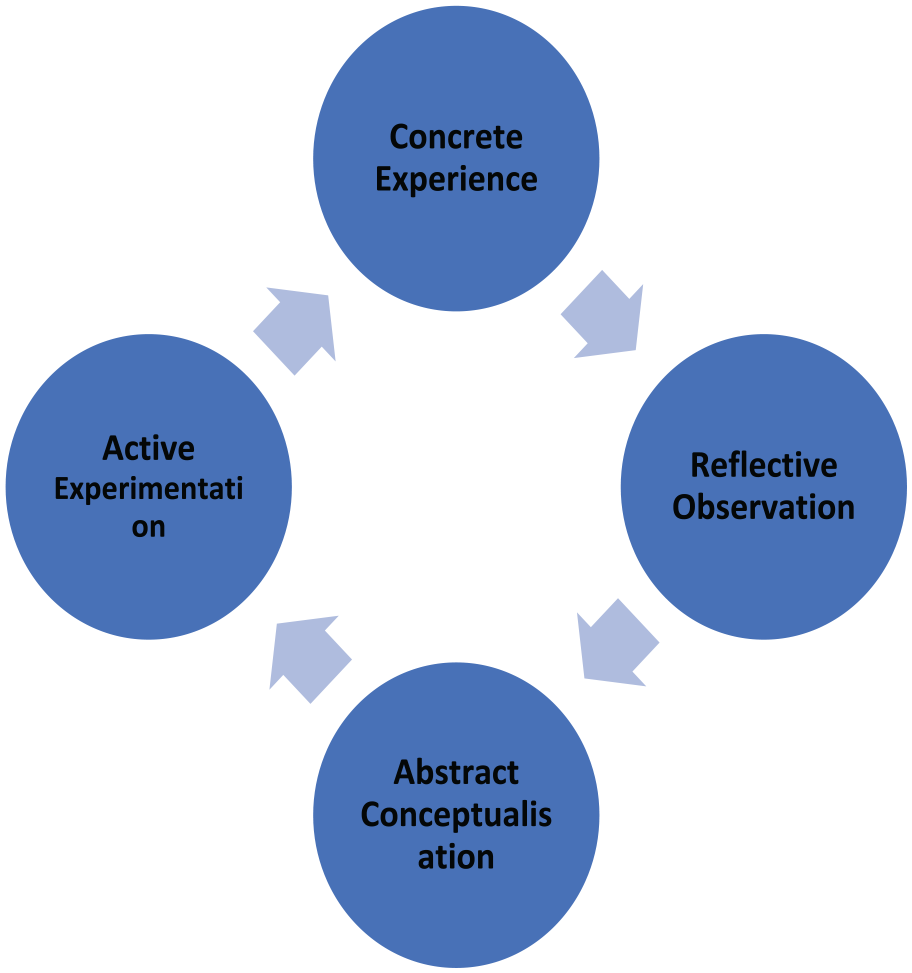
Experiential Learining Model.
Concrete Experience
The learning process cycle starts with a concrete experience, which could be a completely new experience or even a re-imagined experience of what had already happened. Each learner engages in an activity or task in a concrete experience.
Reflective Observation
Engaging in the concrete experience must be shadowed by reflections. The learner engages in questioning and discussing the experience with others. In this way, the learner is able to capture if there is any difference between his/her understanding and the experience.
Abstract Conceptualization
At this stage, a shift from reflective observation to abstract conceptualization is observed by the learner, to categorize conceptions and create conclusions on pre-occurred events. Inferring the experience to their current understanding is covered in this stage. This also involves modification of their conclusions on already existing ideas.
Active Experimentation
In Active experimentation learners apply their conclusions to new experiences. This stage is essential for making predictions, investigating tasks, and creating plans for the acquiring knowledge.
In the current research, we have applied Kolb’s experiential learning model. The most crucial feature of Kolb’s theory is that every phase of this learning model is connected to a different learning style. Every scholar has a favorite learning style and knowing that style is the foremost step for the students to make them conscious of their learning undertakings. A vast chance for the students is offered by Kolb’s learning theory to recognize their special learning style. Thus, it becomes essential to apply Kolb model for examining the impact of Experiential learning on HEIPs.
Moreover, Kolb’s learning styles and EL cycle help students transmit the knowledge into real-world concepts. Kolb’s model helps apply the learning processes into classroom learning activities; furthermore, it helps the students become more flexible and embrace the various demands of learning settings. Even individuals, groups, or organizations can adopt this learning method as this is robust and among the prominent learning theories (Sharlanova, 2004).
Kolb’s experiential learning theory (KELT) is a practical learning approach to stimulate learning capability reflected in research (Healey & Jenkins, 2000). It deviates from the traditional learning approaches with a focus on cognitive process. Passing through each level will assist in providing the active linkages of the stages and assist in holistic learning. The new KLSI 4.0 has introduced nine style types, which are methodically arranged on a two-dimensional learning space, defined by Abstract Conceptualization (Thinking)-Concrete Experience (Feeling) and Active Experimentation (doing)-Reflective Observation (Feeling; Kolb, 1984). Experiential learning stimulates understanding of academic concepts through practical and active learning and thus enhances HEIP.
At the university level, various studies preach how active-learning practices and methodologies impact students’ performance (Leal-Rodríguez & Albort-Morant, 2019). Active learning increases scores on concept inventories and is effective for all class sizes, although maximum advantage may be in small-sized classes (Freeman et al., 2014). Experiential learning approaches are highly influential when the focus is student-centered education (Backman et al., 2019).
The enormous emphasis these days across the globe is on outcome-based, project-based education. Hands-on experience is the key to project-led education and this is finding its way into engineering curricula. Establishing experiential education helps acquire skill sets, culminating in capstone projects. Embedding theoretical concepts with experiential learning helps develop solutions for complex engineering problems. Engaging students in an interactive simulation involves experiential learning and allows them to control their learning process. This also creates a sense of ownership (Marin, 2015). Keeping an open dialogue with students helps to understand their needs and expectations, stimulates their motivation and involvement, and results in active participation and better results (Dziewanowska, 2017).) Studies also suggest that to be effective, the academic environment needs to promote student effort, and interactions between students, teachers, and peers (Tam, 2002).
Learning by doing (LBD) projects enhance holistic learning and prepare students for higher research-oriented education (Minhas & Perret, 2017). Entrepreneurship courses provide them with sufficient knowledge and the required skills that change the students’ mindsets by increasing their entrepreneurial awareness (Mosly, 2017). Imparting EL through practical courses and capstone projects are the need of the hour. Growing the community of ambitious engineering entrepreneurs is an issue of concern and needs attention (Gilmartin et al., 2019). Over the last few decades, there have been changes required in leadership to address the shift like responsibility, power, and allocation of resources to deal with the challenges faced by the education system (Bolden, 2015). Thus, it is time to see the intricacies and linkages of academic leadership on imparting and introducing experiential learning in Institutions to influence employability competencies and thus stimulate HEIP.
For embedding experiential learning in the curriculum, the role of academic leadership cannot be ignored. The literature background sets forth the research, and it becomes primarily important to examine how Academic Leadership influences experiential learning (EL), and what impact EL has on HEIP. Since a lot of focus is being imparted to employability competencies thus, it is extremely important to examine whether the mediation of employability enhances the impact of EL on HEIP. The results from this study may contribute to understanding whether AL has a pertinent role to play and develop EL in HEIs. Furthermore, there is a need to focus intensely on the employability perspective in HEIs. The study has been undertaken with a premise that it may have meaningful implications for policymakers at universities to strategize around practices conducive to creating experiential learning environment and employability to enhance HEIP.
In this study, authors have tried to investigate the potential of academic leadership, experiential learning, and employability of students in improving performance of higher education providers. Academic Leadership has been researched a lot, however there are few studies relating Academic Leadership with Experiential leaning. The construct of Academic Leadership has been deepened by considering, Academic culture (Academic environment and Academic operations, Hsu et al., 2014).This study uses Kolb’s experiential learning model. Learning models indicate impact of education on HEI performance, however there is need to focus on experiential learning as with Kolb (1984), learning is always through experience of oneself or others and suggested that experience without reflection is of no use, as learning from experience is fruitful only when we reflect upon our experiences (Boud et al., 1993). The Lewinian model based on “action research” relied on “Feedback” process. Active Experimentation and Reflective observation, the researchers highlight better retention and improved performance (Kolb 1984). Earlier studies have related employability directly with HEI performance (Hahn & Kim, 2018), however the current study examines the mediating role of employability between experiential learning and HEI performance (Nenzhelele, 2014). Furthermore, the HEI performance scale is a broad scale, covering three dimensions, student satisfaction (SS), employers’ satisfaction (ES), and sustainability perspective (SP). From student satisfaction to sustainability the scale has taken the current literature where sustainability aspect cannot be ignored. Employers’ satisfaction could always lead to enhanced recruitments and hence improve HEI performance. Initially, the study examines the impact of AL on EL. As in HEIs, a lot of focus is being imparted to employability competencies, thus we tried to examine how EL with the mediation of employability impacts HEI Performance (Abubakar et al., 2018).
Theoretical Framework and Hypotheses Development
Experiential learning departs from the traditional approach of passive one-way communication. EL involves hands-on training and enables the student to learn through reflections. Teachers’ development and training are vital components of the experiential learning models. EL prepares the learners to share and help in the progress of knowledge, where the path they tread will be full of new challenges. This continuous learning approach by incorporating the latest techniques and technologies will make the teachers think of new activities and projects to make their students more interactive and active learners, thinking of new solutions to problems. Academic leadership is widely essential for organizational effectiveness and learning outcomes. Academic leadership is observed as a function, behavior, and leadership relationship, from students as leaders to headteachers (Gunter, 2001). Management has a role to play to overcome the harmful influence of organizational by allowing employee involvement in decision-making processes and developing a work culture that highlights accountability and high moral standards. Implementing practices creating an achievement-oriented learning environment and culture can enhance student attainment of goals (Karadağ et al., 2014). Section 4.2 focuses on literature related to Academic Leadership.
Academic Leadership
Many writers regard leadership as more than and different from management and leadership should ideally be something more than management. The leadership literature is so absolute of problem-solving that assuming to abstract leadership as an intangible category of higher calling is impossible (Thrupp & Willmott, 2003). Research also enlightened the difference between leaders and managers by educating how leaders emphasize vision for the future and motivate workforces to leave their comfort zone to achieve future goals (Kotterman, 2006, p. 14). Academic leadership may also be termed teacher leadership since all the leaders in academic institutions are necessarily teachers first and leaders later. Teacher leadership reinforces power and hierarchy whereby “leaders” look for a set of pre-set morals to be achieved (Fitzgerald et al., 2003; Fitzgerald & Gunter, 2006) Academic leadership is more noteworthy in terms of its influence on educational values and identities (Bolden et al., 2012)
Academic leaders are relatively influential practitioners and are appreciated for their practical experience. Other elements like personal and interpersonal outcomes, learning and teaching outcomes, recognition and reputation, financial performance, and practical implementation are the leading performance elements of academic leaders in academic settings (Fullan & Scott, 2009; Scott et al., 2008). A study on university leadership by Scott et al. (2008) considered planning and implementing successful transformations a critical leadership quality. Staff give prominence to leaders who emphasize change, recognize performance, possess expertise in teaching and curriculum, resource acquisition, and listen to team views (Ramsden, 1998). He also reported that staff value leaders who have a vision, uphold standards, select people, and evaluate performance. Working independently as well as collaboratively and exploring new ways to help manage change is the quality of inspiring and influential academic leaders (Ramsden, 1998),
Among several factors that have been identified affecting learners’ academic achievement, organizational culture seems to be an essential factor. A positive culture seems to exercise a remarkably positive influence and leads to achieving the school’s specified goals. The management plans can improve the organizational culture of low-achieving schools to enhance their academic achievement (Van Der Westhuizen et al., 2016). Curriculum, evaluation, and teaching methods are the inputs in control of hierarchical organizational structures and efficiently managed inputs and resources credit to student knowledge (Bowles & Gintis, 2011). Academic leaders are intra-organizationally influential resource-dependent players (Kohtamäki, 2018).
Student outcomes and organizational characteristics are related to higher or lower student achievement (Hallinger, 2011; Leithwood et al., 2004; Leithwood & Jantzi, 2008; Robinson et al., 2008). Academic/educational leadership is linked to an institute’s culture and politics, which many traditional leaders would not need to look into (Anthony & Antony, 2017). Studies reflect that although there is a significant relationship between academic performance and culture, the only noteworthy predictor of academic performance is competitive culture (innovative team culture is also a construct of academic culture; Köse & Korkmaz, 2019).
Effective leadership behaviors like creating a strategic plan, resources management, adjusting workloads, making academic appointments along with permitting staff to participate in decision making, boosting them for open dialogue and creating a positive work atmosphere are identified in the literature impacting the reputation of the institute (Virkus & Salman, 2020). Farhan (2022) also advocated that visionary, transformational, and learning leadership enormously help achieve the organization’s purpose. Farhan (2022) quoted, “a clear vision is at the core of transformational leadership.” A clear vision involves the introduction of innovations and strategies to implement the vision. Strategies like “restructuring curriculum, redirecting the allocation of funds, implementing changes in an administration method and culture, introducing new academic programs and enhancing established programs” are paramount. Learning leadership involves improving the organization’s performance, coping with resistance, and maintaining the new culture. Learning leadership may include benchmarking with the processes of other universities to bridge the gap and set the university ahead of others. The importance of responsibility and positional power is a unique feature of academic leadership ((Bich et al., 2021; Scott et al., 2008).
For embedding Experiential Learning in the curriculum, the role of Academic leadership is very crucial. It becomes essential to examine the relationship between Academic leadership and Experiential Learning. It will also be related to exploring the dimensions of Academic leadership. Leadership related to planning service outcomes implies a significant influence over student satisfaction. Leadership strategies and positive outcomes like better jobs and salaries affect the university’s ranking Students’ future education choice rests on the academic environment rather than infrastructure and associated facilities (Arif et al., 2013).
There is a need to maintain the quality and significance of higher education (HE) programs and improve the employability competencies of graduates. Students’ satisfaction is the outcome of a quality culture-oriented place of work created by universities. Constructive feedback from the student is also mandatory for quality improvement (Ardi et al., 2012). Mentorship through academic leaders leads to student engagement is cited in the literature (Cameron & Freeman, 1991; Smart & St. John, 1996). The research also shows a connection between academic performance and organizational culture. The organizational culture has two most significant types: competitive and creative team cultures. The relationship between academic performance and both competitive culture and innovative team culture has been reflected in various studies. However, competitive culture emerged as the sole significant predictor of academic performance (Köse & Korkmaz, 2019). Organizational culture plays an essential role in the comprehensive student learning approaches. Educational leaders also impact learning environments, affecting HEIP (Hsu et al., 2014).
Academic Operations strives to prepare students to reach their holistic potential promoting retention, persistence, and completion. Academic Operations and Services engage students, faculty, and staff through innovative and flexible learning opportunities, quality instruction, comprehensive resources, and academic support services. In addition, accreditation provides operational efficiencies that support and sustain a culture of evidence. Academic operations and services offer quality assurance, assessments, and support services related to articulation, compliance, student outcomes, and accreditation to enhance the student experience. The related hypothesis is:
HI: Academic Leadership is a multi-dimensional construct, consisting of Academic culture (AC), Academic environment (AE), and Academic operations (AO).
Vince and Reynolds (2009) opines that our educational approach reflects two dialectically associated styles of gaining experience, that is, Concrete Experience (CE) and Abstract Conceptualization (AC) and two dialectically connected modes of transmitting experience, viz Reflective Observation (RO) and Active Experimentation (AE). The related hypothesis is:
H2: Student experiential learning is a multi-faceted construct, consisting of Concrete Experience (CE) and Abstract Conceptualization (AC), Reflective Observation (RO), and Active Experimentation (AE)
Academic Leadership and Experiential Learning
Quinlan (2014) deliberates academic leadership in HEIs as “a ‘leadership of teaching for student learning.’” It makes a difference by creating a policy for devoted leadership roles for teaching and learning as per the demands from stakeholders for student satisfaction and quality assurance (Ghasemy et al., 2016). Also, it has become a saying that “leadership makes a difference in improving student learning” (Hallinger & Heck, 1996; Heck & Hallinger, 2014; Leithwood & Jantzi, 2008; Orphanos & Orr, 2013; Robinson et al., 2008). Therefore, a predominant conviction is that leadership is second only to teaching in its ranking for student learning (Leithwood & Wahlstrom, 2008).
Academic leadership helps determine the school’s mission and promote a positive climate (Hallinger, 2005; Hallinger & Murphy, 1985). Leadership is not a novel conceptualization (Senge, 1990), but leadership concept (Marion & Uhl-Bien, 2001) has worthy theoretical connections for student learning. Thus, as seen through literature, there is increased demand for dedicated academic leaders to help improve HEIP.
Learning theories like Bandura’s social learning theory helps to understand how learning happens via observation and modeling (Horsburgh & Ippolito, 2018). Learners must understand and sense what they see to replicate the behavior. Psychological handling is required to match reasoning and behavior amongst observation and the performance (Horsburgh & Ippolito, 2018). Bandura’s social learning theory can also be considered experiential learning, which means the method of learning by doing or “experience.” It is agreed that it is distinct from traditional learning based on passive one-way communication and rote methodology. EL with practical learning helps students cultivate reflecting on their experiences. It moves outside the classroom boundaries and includes students more energetically and closely in the learning process. Much importance is impacted on teachers’ training, a vital component of the EL model. Therefore, a novel model must develop, which must be human-centered, environmentally sound, and a developmental model to prepare learners to be contributors to knowledge rather than simple information receivers. Experiential education helps students bridge the gap between classroom teaching and real-life scenarios.
Cognitive learning from direct experience can be attained by observing people’s actions and the consequences (Bandura, 1986; Rosenthal & Zimmerman, 1978). Similarly, Dewey also thought that people learn via a “hands-on” approach. Students must interrelate with their environment to adapt and acquire knowledge. The same is valid for teachers and teachers and students must learn together. The purpose of education is broader than just communication of knowledge; it is sharing of social experience to facilitate learners integrate into the democratic community.
Learning is a continuous process (Purdie & Hattie, 2002). Baker et al. (2005) emphasize that dialogues enthuse reflection and creativity among students as they learn from their own experiences. The problem-based and experiential learning enables lively involved student participation (Keogh et al., 2007). Cox (2012) suggests that working on projects provides a practice-based learning opportunity for students and become “industry ready” trained through the rich experience of capstone projects.
Academic leaders must review instructive programs and practices from a learning point of view (Myran & Sutherland, 2019). So that they could be more critical consumers of knowledge in theory and practice. The scholars consider learning dependent on the active learner and thoughtful outlooks and behaviors. The student assumed as a passive recipient of learning has reached functional and philosophical restrictions. A functional shift is now visible whereby students are considered active agents (Myran & Sutherland, 2019).
Early development of RBL competencies in undergraduate engineering programs prepares undergraduate students for further studies and even assist in professional careers (Noguez & Neri, 2019). Sadler (2016) reveals the vital role of assessment practices and its effect on pedagogical practices and student learning experiences. This calls for a shift to continuous assessment through quizzes, role plays, minor projects, and term papers, as Sadler (2016) highlighted. However, self-assessment enables the students to identify standards to apply to their work. Students can also judge the extent of meeting the norms and standards (Boud, 1991).
Kolb’s learning styles and experiential learning cycle played a critical role in applying the learning methods into classroom activities involving multiple interdisciplinary subjects (Sharlanova, 2004). Despite criticism from Miettinen (2000), for the phases in the Kolb’s model being separate and unconnected and for Kolb’s model does not focus on concrete experience as per Herron (as cited in Yorks & Kasl, 2002, pp. 180–181), for many researchers Kolb’s model is holistic. Thus, it was found worthwhile to use this model in our study. Regev et al. (2009) embed experiential pedagogy to enable students to have a simulated work environment embedded with complexities. As currently, higher-order intellectual and practical competencies for many graduates are below satisfactory levels; this enforces a need for academic leadership to rethink and reform aspects of learning through experience. The related hypothesis is:
H3: There is a positive influence of Academic Leadership on experiential learning.
Experiential Learning and Employability
Harvey (2002) considers students’ desire as a critical factor to having the advantage of employability development opportunities provided by HEIs. Employability development activities include the provision of employability skills, experience, and career management supported by a readiness to acquire knowledge and reflect on previous learning. The pedagogic process that leads to development, self-reflection, and the articulation of experiences impact employability. The marketing of educational services is also essential. It creates a favorable image and helps to recruit the best brains (Munisamy et al., 2014). University needs to be practical in recruiting students. Although, as per the educational perspective, the plasticity of intelligence is vital for further clarification, it is also quoted that the general intellectual ability can be enhanced by appropriate educational strategies, an effective technique for education to progress (Adey et al., 2007).
There is an evident relationship between supposed employability and quality of employment on extra-role performance (Hahn & Kim, 2018). Employers’ needs and the learner’s skill enhancement capabilities should be considered in framing skills assessments in the future. The related hypothesis is:
H4: Employability is a multi-dimensional construct, consisting of career development services, co-promotional activities, entrepreneurial mindset, constant recruiter evaluation, faculty-employer relationship, good reputation of employees, and job competencies.
Cantor perceives experiential learning as helping the HEIs fulfill the need “to more closely interface with business and promote economic development” (Cantor, 1995). Experiential learning can support institutions paying importance to students’ needs by providing them with the necessary skills required by the employees. Experiential learning can bring together people of diverse social and economic classes and prepare them for entry into the world at large (Cantor, 1995).
Employment may be a realistic pathway for validating transferrable skill development (Fede et al., 2018). Experiential learning enables the cultivation of communication and social skills. University employment has also been positively related to academic success, but less research is available on the potential to develop transferrable skills. The authentic learning approaches like the learner-centered effective approach enable learners to improve and enhance their employability skills (Ornellas et al., 2019). Under these new experiential education settings, it becomes worthwhile to examine how student experiential learning impacts higher educational performance. Experiential learning develops critical thinking, which induces employability skills. Critical thinking is the scholarly process of theorizing, relating, examining, creating, and/or appraising information. Critical thinking is a valued employability skill today and a must for employability outcomes. It has become a most focused factor to achieve for education systems worldwide. Critical thinking necessitates engaging students in a learning experience that matches their pace and thus, experiential education helps create social skills, work ethic, and practical expertise. Experiential education as a powerful learning tool can be assisting students to achieve employability skills and goals allied with education for example, an understanding of subject matter, ability to think critically, applying knowledge in complex situations, and finally ability to engage in all-time learning.
Experiential learning as a learning technique has been recommended to reduce the skills gaps and promote student engagement activities. Employers look for technology and information use skills. Experiential learning influences employability to a greater level (Nenzhelele, 2014). Experiential learning effectively links students to job opportunities and brings modifications in their individual lives and empowerment wisdom (Domask, 2007). In this study, the next hypothesis is:
H5: Student experiential learning through the mediation of employability of students positively influences Higher education performance.
The present study proposes Academic leadership (AL) influences experiential learning (EL) and directly impacts strategic matters regarding education and enhancement of HEI performance. It also is an effort to examine whether experiential learning through employability has more impact on higher education performance. The Kolb’s Experiential learning model focuses on exposing students to entrepreneurial and career developmental activities under career development services demonstrating concern for student learning via recruiter feedback and faculty-employer partnerships. This study is supported by researchers suggesting that the performance of a higher education institution for learning is measured via parameters like academic reputations, employability, research productivity, international collaborations and student intake, funding support for projects, infrastructures, and other facilities (Abubakar et al., 2018).
Proposed Model
In our research study, the academic leadership indicator is measured through the parameters like academic environment, academic operations, and academic culture. The level of experiential education imparted has been gauged through Kolb’s Experiential Learning model covering Concrete Experience (CE); Abstract Conceptualization (AC); Reflective Observation (RO); and Active Experimentation (AE; Vince & Reynolds, 2009). Each learner engages in an activity or task in the stage of a concrete experience. Learners must actively engage in the task. Scale items like learning through knowledge sharing, creative thinking, logical thinking, ability to solve complex problems, improved communication (written and spoken), and confidence to learn independently form the basis of concrete experience. Engaging in the concrete experience must be followed by reflections. The learner engages in questioning and discussing the experience with others. This is to catch any inconsistencies between their experience and understanding. The scale items included a well-structured course, a well-focused course, a clear explanation of course learning outcomes (CLOs), well-defined objectives of assessment of course learning outcomes to measure learning achievement, the well-defined criterion for direct assessment and indirect assessment, and feedback provided to help the student to learn. Abstract conceptualization deals with the conceptual depth of learning, resulting from modifying their conclusions on already existing ideas. The scale items used to measure this parameter included active learning through discussion and participation. The curriculum is regularly revised to encourage innovation and research. The curriculum is monitored to derive desired learning outcomes and accessibility of academic resources to students. In the active experimentation stage, the learners participate in a task and apply their inferences to new experiences. This also helps the learner make forecasts about the problems, analyze tasks, and make strategies for the acquired knowledge in the future. The scale items used to measure the variable of Active experimentation include institutes focusing on experiential learning, students participating in entrepreneur activities, teachers demonstrating concern for student learning, and making them practice as “team-players” within or outside study requirements. The feedback survey from graduating students assists in measuring the EL effectiveness.
Employability indicator is measured through the level of competencies acquired by the student to get the job; employers hiring the students to possess the good reputation of the institution; institute also conducts recruiter evaluation effectively; faculty/institute is having a meaningful partnership with employers (globally); there is active employer presence on campus through careers fairs, company presentations, or any other self-promoting activities; career development opportunities built for the students; institute/university produce a good number of high-achieving graduates (innovative and creative individuals/entrepreneurial). Employability skills achieved by the learner make them capable of procuring initial employment, sustaining the same, and acquiring a new career if needed (Hillage & Pollard, 1998).
To summarize, this study attempts to inspect the factors inducing the performance of HEIs via a model associating student experiential learning experience (EL) with academic leadership and employability of students. HEI performance is measured through student satisfaction, employer satisfaction, and sustainability perspectives. Student satisfaction is measured via scale items: increased demand for educational services provided by the institute; quality of academic programs offered to the students; quality of support services available to the students; stipends/teaching assistantship provided to the research scholars; programs are accredited by national and international regulatory bodies and last but not the least institute appears in reputed national and international rankings surveys. Employer satisfaction is evaluated from the quality of jobs offered to the students and graduate employability rate; the recruiters are offering the best average salary (CTC) to the students; a good number of companies are revisiting the campus for providing jobs to the students.
When the actions of a HE institution are naturally sound, socially just, and economically viable, it indicates a sustainable higher education. It also shows the HEI will sustain for upcoming generations. Sustainable perspective in the current study has been examined through the following scale items: the institute attracting and retaining outstanding faculty/staff; a significant increase in funded research funding; adequate research facilities available to all, and the demands and changes in the environment are responded well; a substantial upsurge in the number of institute research publications in reputed journals; stakeholders are included in developing learning programs; institute focuses on establishing start-ups under entrepreneurial initiatives; institute supports integrity and service to the community; institute promotes and enhances sustainability; institute focuses on optimization of expenditures.
The following research objectives are proposed:
To examine the relationship between Academic Leadership (AL) and Student experiential learning (EL).
To examine the relationship between student experiential learning (EL) and employability (E) of students.
To examine the role of academic leadership (AL), student experiential learning (EL), and employability (E) on the Higher Educational Institute Performance (HEIP).
Research Design
This is a perception-based study getting inputs through a survey. For short-listing Engineering institutes, National Institutional Ranking Framework (NIRF) was used. NIRF is a ranking framework which was setup on 29th September, 2015 and approved by Minister of Human Resource Development (MHRD), Government of India. Primary data for this study were collected from the students of top 50 ranked institutions located in North India. The responses were collected from 15 Engineering institutions in North India out of which six institutes were public and nine were private. Supplemental Appendix 1 provides details of the scale. A total of 400 respondents were included in the sample, which covered 150 faculty members and 250 student respondents from top-rated public and private Higher Education Institutes. Informed consent was taken from the respondents. The respondents were duly informed about the reason for undertaking the present research. This research has been carried out to design a model for embracing a balanced emphasis on the necessity for quality academic management, creating the basics for a teaching-learning environment and creating the quality learning experience.
As per the studies, academic management is a broad view of academic culture, academic environment, and academic operations. In this research, authors have prioritized the experiential learning experience components and studied the significance of experiential learning activities incorporated into the learning. ELE component measures the level of student engagement, learning assessment, and finally, student satisfaction. The learning outcomes need detailed experiences to be provided to the students and a careful evaluation of their attainment. Student assessment indicates where learning has occurred and has to be enhanced upon. It is essential to pay attention to collecting and analyzing data on student learning outcomes and using it to plan and overcome learning barriers. Norm of using assessment or evaluation as a gauge for assessing student performance, attainment of learning objectives and planning, and other significant information regarding teaching-learning are also to be looked upon properly. The role of experiential learning education as a source of employability skills for the students is stressed, and it has been considered responsible for augmenting the performance of HEIs.
A clear relation between supposed employability and the hypothetical employment quality on extra-role performance is perceived (Hahn & Kim, 2018). The competence model highlighted the base competencies required of current HE graduates as an instrument in learner-centered, self-assessment, and self-reflective pedagogy (Berdrow & Evers, 2011). In this study, employability is measured on the following scale items: career development services; co-promotional activities; entrepreneurial mindset; constant recruiter evaluation; faculty-employer relationship; the excellent reputation of employees; job competencies.
Universities need to implement a new measure for determining the performance of higher learning institutions. Reputations, faculty/student ratio, graduate employability, research output, achievements and medals, internationalization, resources abundance, research funding, facilities, and community service are scale items used by researchers to measure the institute’s performance (Abubakar et al., 2018). In the current study, authors tried to group these measures of Higher educational Performance on three parameters, that is, student satisfaction (SS), employer satisfaction (ES), and sustainability perspective (SP). The primary emphasis is to examine how academic leadership impacts experiential learning (measured through Kolb mode); and how experiential learning through employability influences higher educational performance.
Analysis
Measurement Model
The model adequacy is measured by the reliability of items and internal consistency between items. The mean, standard deviation, and factor loadings for each variable is provided in Table 1. Cronbach’s alpha, average variance extracted (AVE), composite reliability, along with the correlations of all constructs, are depicted in Tables 2 and 3. Cronbach’s alpha of all constructs is beyond the acceptable range of .70, reflecting internal consistency (Carrasco & Jover, 2003).
Reliability and Average Variance Extracted.

Fornell-Larcker Criterion (Discriminant Validity).

Outer VIF and Inner VIF.
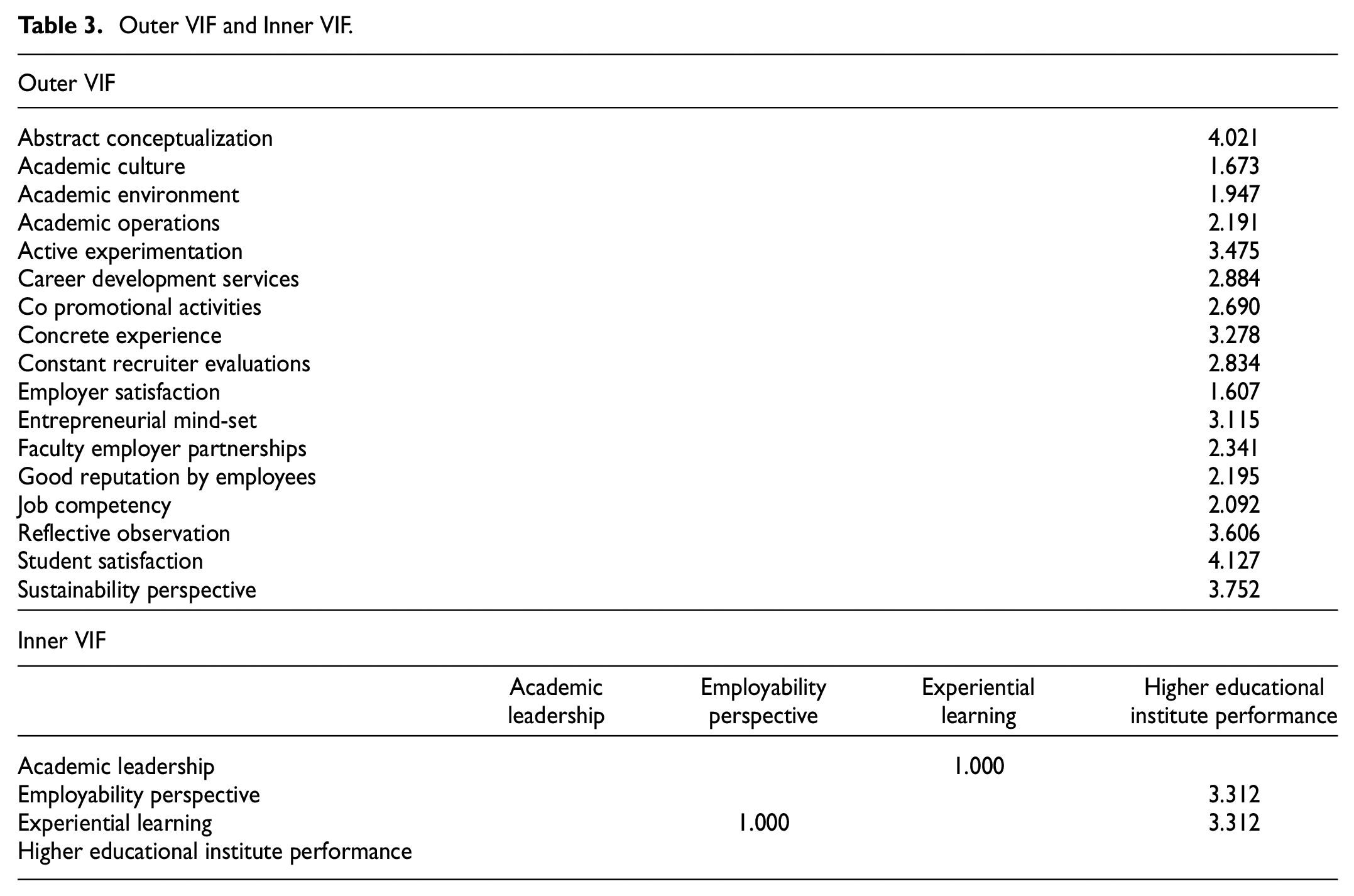
As shown in Table 2, discriminant validity is good and composite reliability is greater than .6 and AVE (average variance) ≤.50. Also, the square root of the AVE (latent variables) value is greater than the absolute value of the correlation coefficient among latent variables. Moreover, as shown in Table 3, the diagonal values are higher than the squared inter-construct correlations, indicating that discriminant validity is acceptable.
Since in this study, survey participant’s responses were used it is vital that the common method bias problem should not be reflected in results. Common method bias (CMB) occurs when variations in responses are caused by the instrument, rather than by the actual pre-dispositions of the respondents. This may result in inflated variation. Harman’s single factor score suggesting loading all items (measuring latent variables) into one common factor was applied and the total variance for a single factor was less than 50%, thus reflecting that CMB does not affect the data (Podsakoff et al., 2012). The occurrence of a VIF greater than 3.3 is proposed as an indication of pathological collinearity, and as an indication that a model may be contaminated by common method bias. We also checked whether all VIFs from a full collinearity test were less than 3.3, thus indicating absence of common method bias. The details as provided in Table 3 depict that all VIF values for variables used in model were also less than 3.3 thus, it was thought to proceed ahead with analysis.
Structural Model
As shown in Figure 2, the research study examines how academic leadership, experiential learning (EL), and students’ employability can enhance the performance of Higher Education Institutes (HEIs). As per Table 4, results of Academic leadership highlight that outer weights of AC, AE, and AO lie in the range of 0.816 to 0.899 and all these are significant. Thus, HI: Academic Management is a multi-dimensional construct, consisting of Academic culture (AC), Academic environment (AE), and Academic operations (AO) has been empirically supported, hence accepted. Academic operation emerges as the key dimension from these three dimensions, followed by academic environment and academic culture.

PLS model.
Structural Model.

p ≤ .001.
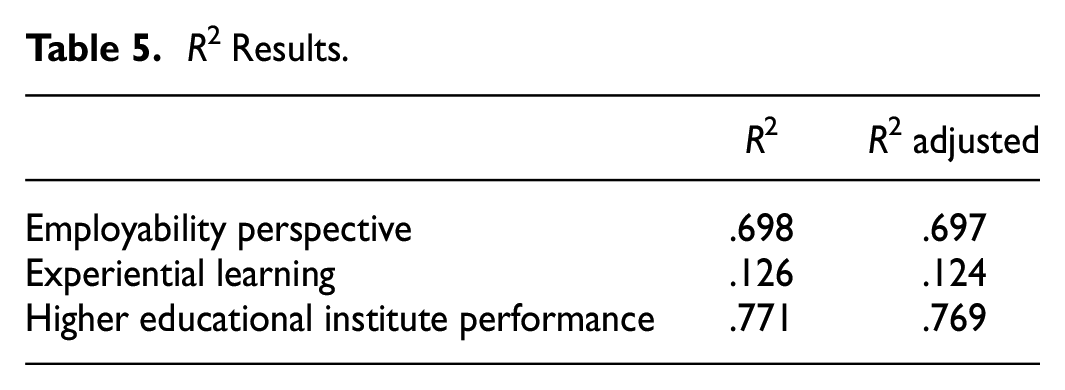
As per Table 5, the R2 value for the overall model is .771, indicating the strength of predictors to explain the dependent variable.
R2 Results.
Moving over to experiential learning, the outer weights of all sub-constructs of EL are high, CE (0 .905), AC (0.926), RO (0.918), and AE (0.907). This supports hypothesis H2: Student experiential learning is a multi-faceted construct, consisting of Concrete Experience (CE); Abstract Conceptualization (AC); Reflective Observation (RO), and Active Experimentation (AE).
The next step was to examine the relation between Academic Leadership (AL) and student experiential learning (EL). The results highlight that Academic Leadership influences Experiential Learning as the β value is .355 (t-statistics: 5.515; p ≤ .001). Hence, we accept H3: There is a positive influence of Academic leadership on experiential learning.
Moving further, it becomes important to examine the sub-dimensions of Employability Competency. The outer weights of Employability are career development services (0.848), co-promotional activities (0.835), entrepreneurial mind-set (0.839), constant recruiter evaluation (0.826), faculty-employer relationship (0.815), good reputation of employees (0.795), and job competencies (0.772). All outer weights values are more than 0.750 and are statistically significant; hence we accept H4: Employability is a multi-dimensional construct consisting of career development services, co-promotional activities, entrepreneurial mind-set, constant recruiter evaluation, faculty-employer relationship, good reputation of employees, and job competencies.
The next hypothesis is H5: Student experiential learning through the mediation of employability of students positively influences Higher education performance.
We analyzed the direct effect of Student experiential learning on Higher education performance and the indirect effect of Student experiential learning on Higher education performance through employability competency. As shown in Figure 3, the direct effect of the β value of Student experiential learning on Higher education performance is .429 (t-statistics: 8.225; p ≤ .001). However, the indirect effect of Student experiential learning on Higher education performance through employability competency emerged stronger hence we accept H5: Student experiential learning through the mediation of employability of students positively influences Higher education performance. EL impacts the employability of the students (β = .836). EL has a less direct impact (β = .429) on the HE performance than the indirect impact it has through the Employability perspective (β = .836 + .487). Thus, it can be inferred that Academic leadership influences student experiential learning experience (EL) and student experiential learning experience (EL), through employability of students positively influences Higher education performance.

Bootstrapping model.
Discussion
As per Table 6, all the hypotheses are supported by this research. The experiential learning variable is mainly influenced by abstract conceptualization followed by reflective observation, active experimentation, and concrete experience. This has been supported by Earnest et al. (2016). He opined that experiential learning enables students to embed theory with practical knowledge, facilitating the transition to being active employees (Friedman & Goldbaum, 2016). Reflection on experience links accepted practice (Harvey et al., 2016). Moreover, as suggested by Kolb, viz, abstract, concrete, reflective, and active, the diverse learning modes lead to active learning (Calvert et al., 2016).
Status of Hypotheses.

The most critical impact on employability is due to career developmental service and entrepreneurial mind-set followed by co-promotional activities and constant recruiter evaluation. As highlighted by Kneale (2008), subgroups of skills, such as “creativity” or “personal effectiveness” or “decision-making” are desirable to improve employability (Marshall et al., 2008). This has been reflected through the current study, as high weight emerges for entrepreneurial mind-set. The previous employment models focusing on providing security and lifelong employment are inappropriate for the new world. Instead of “employability” with emphasis on the good reputation of employees, Job competencies and faculty-employer partnership emerge stronger and, thus, play a more critical role in enhancing HE institute performance (Baruch, 2001; Petrakaki & Kornelakis, 2016). Therefore, the study supports that steady life-long employment may not be the primary focus, and challenging jobs may be the favored option.
HEIs stakeholders regulate the performance of higher institutions on the scale, like faculty/student ratio, academic reputations and achievements, graduate employability, research output, internationalization, infrastructures and facilities, and service to the community (Abubakar et al., 2018). Universities are increasingly corporatized (Ball, 2012; Parker, 2014) and focus on employability. In this study, university performance is also measured is on three parameters, that is, student satisfaction (SS), employer satisfaction (ES), and sustainability perspective (SP). The study concluded that student satisfaction is the highest achieved parameter, followed by sustainability perspective and employer satisfaction.
Conclusion
This study concluded academic leadership (AL) influences experiential learning (EL) and strongly impacts strategic matters regarding education and enhancement of HEI performance. All the four subdivisions of experience based on Kolb model viz; Concrete Experience, Reflective Observation, Abstract Conceptualization, and Active Experimentation are important; conversely, Abstract Conceptualization emerges stronger than the other three dimensions, which include active learning through discussion and participation, regular revision of curriculum to encourage innovation and research and continuous monitoring of curriculum to derive desired learning outcomes. This study sets the stage for the emergence of Active Experimentation, which includes factors like focus on experiential learning, exposing students to entrepreneurial activities and demonstrating concern for student learning. Job competencies had the lowest loading (0.772) under employability. There is extra focus needed to be paid to it, as reflected in the earlier study (Berdrow & Evers, 2011). This study is supported by researchers suggesting that the performance of a higher education institution for learning is measured via parameters like academic reputations, employability, research productivity, international collaborations and student intake, funding support for projects, infrastructures, and other facilities (Abubakar et al., 2018). Experiential education is a vehicle that offers opportunities to incorporate many of the desired traits. HEIs worldwide need to recognize the importance of a change in education. Variables like hands-on experience; real-world problem solving; are finding their way into university curricula. Although no unique solution has been identified, the consensus is that the new paradigm must be rich in applying knowledge in a real-world setting.
The educational intervention through experiential learning will help to improve critical thinking and practice-based training. Equipping learners with the skills and practice oriented courses will improve employability by opening new vistas of opportunities. Thus, this study has supported that the higher educational institutes need to pay added attention to experiential learning, with the flavor of enhanced employability, by generating new skills to improve HEI performance. The study concluded that student satisfaction is the highest achieved parameter, followed by sustainability perspective and employer satisfaction. Institutions across the globe need to acknowledge the transformation in the educational scenario. Variables like hands-on experience; real-world problem solving; are finding their way into university curricula. Thus, the new paradigm must be rich in implementing knowledge in a real-world situation, ultimately leading to student satisfaction.
Academic leadership (AL) influences experiential learning (EL) and impacts strategic matters regarding education & enhancement of HEI performance. This is supported by Heck and Hallinger (2014). EL unlocks capabilities as it deals with active learning (Jennings & Wargneir, 2010). This is also corroborated by Mate and Ryan (2015) as they highlight that EL promotes career success by helping students to cultivate new skillsets that cannot be learned in a classroom setting. This However, experiential learning through employability may have more impact on higher education performance. Employability skills are essential for life-long learning and a successful business career and assist in improving HEI performance (Stoner & Milner, 2010). This study fulfils that aim to examine whether experience based on Kolb model focuses on exposing students to improved learning through recruiter feedback and faculty-employer partnerships. This study is supported by researchers suggesting that the performance of a higher education institution for learning is measured via parameters like academic reputations, employability, research productivity (Chatterji & Kiran, 2017), international collaborations and student intake, funding support for projects, infrastructures, and other facilities (Abubakar et al., 2018).
Implications of the Study
Kolb’s concepts have influenced the work of educationists involved with learners of higher education (Fielding, 1994, Robotham, 1995), which induced the researchers to examine this in Indian context. Accurate insights are gained through the current study, reflecting that learning is the procedure and knowledge is deliberated through the transfer of experience. Evidence from this research supports the applicability of Kolb’s experiential learning for enriching and enhancing higher educational performance. There is a reconfirmation through empirical findings that experiential learning theory with an emphasis on fieldwork, lab sessions, developing critical thinking and building an entrepreneurial mind-set can do wonders and linking experiential learning with employability training is essential to enhance higher educational performance. Thus, restructuring course curriculums with emphasis on experiential learning is the need of the hour. As Experiential learning is built on the foundations of interdisciplinary and constructivist learning with “outcomes being unpredictable.” This maximizes the real world learning experience; enhances t creativity and critical thinking of learners and thus, “learners play a critical role in assessing their own learning” (Wurdinger, 2005, p. 69). This was also corroborated by Charyton and Merrill (2009) suggesting that creativity and innovation can be cultivated through the use of experiential activities.
The inference drawn from this research work can be implicated for more research, policy, and practice. The theorists have stressed the need for effective leadership in learning. Still, before that, educational leaders need to deal with defining learning and operationalizing it within the field appropriately. Leaders must interview educational programs from a learning lens, upholding the importance of learners’ active agency. Furthermore, there is a need to focus intensely on the employability perspective in HEIs. The study has meaningful implications for policymakers at universities to strategize around practices conducive to creating experiential learning environment and employability to enhance HEIP. This study might impact policies and procedures to focus more on emerging comprehensive leadership programs to develop the leaders of tomorrow.
Limitation and Future Research
This study has a few limitations that should be reflected while interpreting the results. The study involved participants from institutes of North India only. The study could be extended to include a sample from other regions for generalizability. Thus, future research can include a more different and more extensive sample to generalize these findings. Also, it could be interesting to conduct a case study to validate the results leading to a deeper insight into several issues related to experiential learning and employability as perceived by academic leaders in diverse contexts. The biggest challenge is that experiential learning tends to be more unstructured and informal than traditional learning. Future research focusing on these aspects will assist in architect the learning experiences for students of Indian institutes.
Supplemental Material
sj-docx-1-sgo-10.1177_21582440231183932 – Supplemental material for Tapping the Potential of Academic Leadership, Experiential Learning, and Employability of Students to Enhance Higher Educational Institute Performance
Supplemental material, sj-docx-1-sgo-10.1177_21582440231183932 for Tapping the Potential of Academic Leadership, Experiential Learning, and Employability of Students to Enhance Higher Educational Institute Performance by Alka Pandita and Ravi Kiran in SAGE Open
Footnotes
Declaration of Conflicting Interests
The author(s) declared no potential conflicts of interest with respect to the research, authorship, and/or publication of this article.
Funding
The author(s) received no financial support for the research, authorship, and/or publication of this article.

Supplemental Material
Supplemental material for this article is available online.
References
Supplementary Material
Please find the following supplemental material available below.
For Open Access articles published under a Creative Commons License, all supplemental material carries the same license as the article it is associated with.
For non-Open Access articles published, all supplemental material carries a non-exclusive license, and permission requests for re-use of supplemental material or any part of supplemental material shall be sent directly to the copyright owner as specified in the copyright notice associated with the article.
