




Abstract
This qualitative inquiry aims at identifying the main issues in Malaysian higher education (HE) system and its sectors from the perspectives of Malaysian academic leaders. For this purpose, four open-ended questions were distributed among 2,786 academic leaders in 25 universities. More than 235 completed questionnaires were collected, containing nearly 4,500 records of priorities, values, challenges, and solutions. Through a quantitative content analysis approach, the records were categorized using the software package ATLAS.ti 7. This resulted to the emergence of 112 categories. Using SPSS 23, the top five categories with maximum frequencies of records were focused for further evaluation. The comparison of the issues in Malaysian HE and its sectors revealed that some of issues were common in all the sectors. In addition, the examination of these categories of data did result to the classification of them into five major categories namely Academic Core Activities, Change and Leadership, Management, Relationships, and Work Values.
Keywords
Introduction
In the 21st century, universities in all around the world are facing new challenges. The shift from the elite higher education (HE) paradigm to mass HE (Daniel, 1993; Ramsden, 1998), internationalization and globalization (De Wit, 2011; Enders, 2004; Karim & Maarof, 2012; Rostan & Ceravolo, 2015; Shin & Harman, 2009; Van Damme, 2001), wide utilization of information technology (Scott, Tilbury, Sharp, & Deane, 2012; Stensaker, Maassen, Borgan, Oftebro, & Karseth, 2007), and the new fundraising approaches in HE (Keener, Carrier, & Meaders, 2002; Shin & Harman, 2009; Teixeira & Koryakina, 2013) deem to be a few of the main sources of the change forces for the newly emerged challenges. Not only the universities are facing challenges, but also they cause many changes in societies. In fact, paradigms, theories, hypotheses, stereotypes, models, frameworks, prejudices as well as myths, and even sometimes status quo are challenged through university temperament which culminate in emergence of new paradigms, theories, ideologies, technologies, and civil order (Soaib & Hussin, 2012).
The challenges of HE, to a considerable degree, do have an undue influence over the university inputs, operations, functions, processes, and outcomes. For this reason, identifying the main issues and challenges in HE has attracted the attention of the scholars and practitioners of social science and education. In other words, numerous studies have focused on probing HE challenges as well as proposing recommendations to shatter these impeding factors in the 21st century. For example, the changes in university organizations and the changing nature of academic work (Ramsden, 1998), the intensification of institutional accountability to legislative and governing authorities (Harbour, 2003), the environmental challenges for universities (Malm, 2008), the managerial reforms due to neoliberalism (Shin, 2015), the expansion of networks and external relations (Shin & Harman, 2009; Van Damme, 2001), and the issue of consumerist turn in HE (Naidoo, Shankar, & Veer, 2011) have been scrutinized. Other main identified challenges include academic leadership challenges (Black, 2015; Drew, 2010; Fullan & Scott, 2009), sustainability challenges in HE (Mader, 2012; Mader, Scott, & Razak, 2013; Scott et al., 2012), university mergers and transnational virtual delivery of HE (Van Damme, 2001; Yung-Chi Hou, Morse, & Wang, 2015), challenges pertinent to embedding a quality culture in universities (Lomas, 2004), gender issues in HE (Baker, 2016; Cotterill & Letherby, 2005), and the challenges of merging divergent campus cultures to form coherent educational communities (Harman, 2002).
Also, among the region-specific studies, the ones focusing on the main policy issues pertinent to the attractiveness of European HE (Kwiek, 2009), internationalization issues of HE in Organisation for Economic Co-Operation and Development (OECD) countries (Van Der Wende, 2007), market challenges in European universities (Morris, 2012), and the challenges of African HE in the 21st century (Teferra & Altbach, 2004) have been viewed as a few major studies in this area.
With respect to country-specific studies, the research works centering on the social, political, and economic challenges in American HE (Altbach, Gumport, & Berdahl, 2011); key challenges of governance, quality assurance, and finance in Vietnamese HE (Dao, 2015); challenges of change implementations in French HE (Evans & Cosnefroy, 2013); policy and research challenges in Australian tertiary system (Goedegebuure & Schoen, 2014); dilemmas and challenges in China’s move to mass HE (Bai, 2006); policy challenges in Irish HE (Hazelkorn, 2014); research challenges in Japanese HE (Huang, 2014); privatization and marketization of HE in Indonesia (Susanti, 2011); challenges of international students attraction and hosting in Lithuanian HE (Urbanovič, Wilkins, & Huisman, 2016); and some general HE challenges in Ghana (Atuahene, 2008) and South Africa (Wangenge-Ouma, 2012) may be stated.
It is worth noting that the challenges of HE have been probed from the perspective of students as well. In fact, as elaborated by Ramsden (1998), some HE challenges such as poor and inferior quality of assessment processes, ineffective presentations through lecturing, lack of active independent learning encouragement, vogue and unclear aims, unclear objectives and standards, and not being considered as a partner in the process of learning have been addressed as the main concerns of the students.
Among the aforementioned studies, the research work undertaken by Fullan and Scott (2009) was more pertinent to academic leadership, justifying the launch of essential transformation programs in HE. Through this study, a few of the main internal change challenges throughout higher education institutions (HEIs) were introduced as the followings:
Cultures which are change averse.
The existence of unresponsive, unnecessary, bureaucratic, and unfocused processes such as structural, planning, review, and administrative processes which do not add value to the system.
The existence of inefficient or unaligned decision making, accountability, funding, and reward systems.
Fragmentation and inconsistent quality in the delivery of main activities in terms of learning, research, and engagement as well as the related services which support them.
Nonproductive or even nonexistent change implementation strategies.
The existence of incorrect approaches to leadership selection as well as development and leadership performance management.
The other pertinent study to leadership challenges in HE, as mentioned earlier, is the one conducted by Black (2015) in which, the following challenges for effective academic leadership had been proposed:
Collaboration, partnership, and interdisciplinary
Student experience enhancement
Learning communities and learner-centered approaches
Bureaucracy which leads to inefficiency and ineffectiveness
Using resources efficiently
Multirole academic leaders (lecturer, researcher, citizen, manager)
Collegial preference tending toward a self-serving culture
Transitional roles for academic leaders
The existence of conflict between management and research aspects of academic leader roles
Differences between the demands encountered in professional, academic, and senior leadership
The need to adapt to new circumstances and promote or grow the organization
Individualism and external loyalties
The issue of leading diversity and inclusion
Globalization and internationalization
University governance
Focusing on multicultural, multilingual, and multiracial Malaysia, as one of the leading countries in providing HE in Asia-Pacific region as well as one of the main educational hubs (Knight & Sirat, 2011; J. T. Lee, 2014) with the academic staff population of 33,000 in public universities and 2,500 in private institutions (Wan et al., 2015), some research studies related to HE issues have been conducted. A few of these studies include the investigation of the relationship between the quality culture and workforce leadership performance in Malaysian HE (Ali & Musah, 2012); the issue of knowledge management, knowledge sharing, and research collaboration in Malaysian public universities (Tan & Md. Noor, 2013); strategic planning in Malaysian HEIs; university autonomy and political uncertainties (Sirat, 2010); global trends; national policies and institutional responses toward restructuring of Malaysian HE (M. N. N. Lee, 2004); internationalization challenges in Malaysia (Karim & Maarof, 2012); leadership crisis in Malaysian public universities (Sirat, Ahmad, & Azman, 2012); and the main issues of Malaysian public and private HEIs (M. N. N. Lee, 2015). It is noteworthy that as elaborated by M. N. N. Lee (2015), the privatization of HE, the corporatization of public Malaysian HEIs, the embedment of quality assurance in HE, the diversification in sources of funding, and the internationalization of HE were addressed as the main critical issues of Malaysian HEIs.
Given the fact that the conducted studies in Malaysian context did extend the literature noticeably and are considered as a great contribution to the knowledge generation, still there is lack of research about Malaysian HE issues and challenges. In other words, work priorities which demonstrate the routine activities and practices in universities as well as the values with their great impact on the daily practices (Lazaridou, 2007) need to be focused and explored. Also, not only the challenges, as the main barriers being faced by academic leaders, but also the solutions to these impeding factors in the context of HEIs need to be scrutinized. For this reason, the current study, in alignment with the proposed practices on the grounds of Malaysian National Higher Education Strategic Plan as well as the practices encouraged by Malaysian Higher Education Leadership Academy (AKEPT in Malay language), was undertaken with the main purpose to identify these issues descriptively from the perspective of a large number of academic leaders in Malaysian HE System, Public Research & Comprehensive HEIs, Public Focused HEIs, and Private Focused HEIs. More specifically, it aimed at identifying the major areas of focus through ranking the issues in Malaysian HE and its sectors to provide a more precise picture of the current situation in HE industry in Malaysia for the new policy making purposes. Remarkably, through this study, a descriptive comparison will be made to compare the viewpoints of academic leaders in Malaysian HE and its sectors in terms of priorities, values, and challenges to provide a more meaningful picture of the current situation in Malaysian HE. This comparison will be beneficial in making informed decisions and policies toward promoting Malaysian HE.
Method
Design, Sampling, and Data Collection
This study deals with descriptive data collected through the distribution of a survey containing four open-ended questions through a qualitative inquiry. For this purpose, a quantitative content analysis (Newby, 2014; Schreier, 2014) and a descriptive statistics approach (Field, 2013) were adopted to exhibit a quantitative representation of what respondents wanted to communicate in terms of the main issues in Malaysian HE. It is notable that quantitative content analysis has been described as a tool to explore communication with the implication being that the greater the frequency of occurrence of a word or phrase, the more important that element is from the viewpoint of the communicator (Newby, 2014). Also, the target population was all the academic leaders, namely, vice-chancellors, deputy vice-chancellors, deans, deputy deans, directors, deputy directors, department heads, and the university professors without formal positions working in public research and comprehensive universities, public focused universities, and private focused universities. Notably in this study, public research and comprehensive universities refer to public universities with a significant degree of research activities and a wide range of programs run by different faculties. In addition, public focused and private focused universities refer to institutions in public and private sectors with a focus on limited number of programs.
To collect the data, the list of public and private universities in the website of Malaysian Ministry of HE was considered and 25 universities were selected randomly. Afterward, a database of 2,786 email addresses of the potential respondents was created. Then, using an online data collection platform, the following four open-ended questions were distributed among the potential respondents.
What are the priorities for doing the job in your current role? (you can mention up to 10 priorities)
What are the values that you consider important in doing your job effectively? (you can mention up to 10 values)
What are the main challenges that you face in doing the job in your current role? (you can mention up to 10 challenges)
Given the challenges that you face in doing the job in your current role, what are the suggestions to resolve these challenges?
In total, a number of 248, 247, 244, and 236 respondents answered question 1, 2, 3, and 4, respectively. Table 1 summarizes the demographic information of the respondents who had answered the work priority question (Question 1). It is notable that due to the considerable similarity between the demographic information of the respondents of Question 1 and other questions, the demographic information of the respondents to Questions 2,3, and 4 have not been exhibited.
Demographic Information of Work Priorities Question.

Note. HE = higher education; HEIs = higher education institutions.
Also, it is noteworthy that in this study, more than 80% of the professors without current leadership role have held leadership roles as their previous immediate role in their respective institutions, indicating the relevancy and importance of their opinions in terms of Malaysian HE context. Moreover, the relevant proposed ethical principles in conducting qualitative inquiries (Newby, 2014) such as honesty in relation to the data and considerations about the standards to represent and disseminate the results were followed throughout the entire steps of the study to minimize the level of inaccuracy and increase the level of dependability or reliability of the findings.
Initial Data Screening Procedure
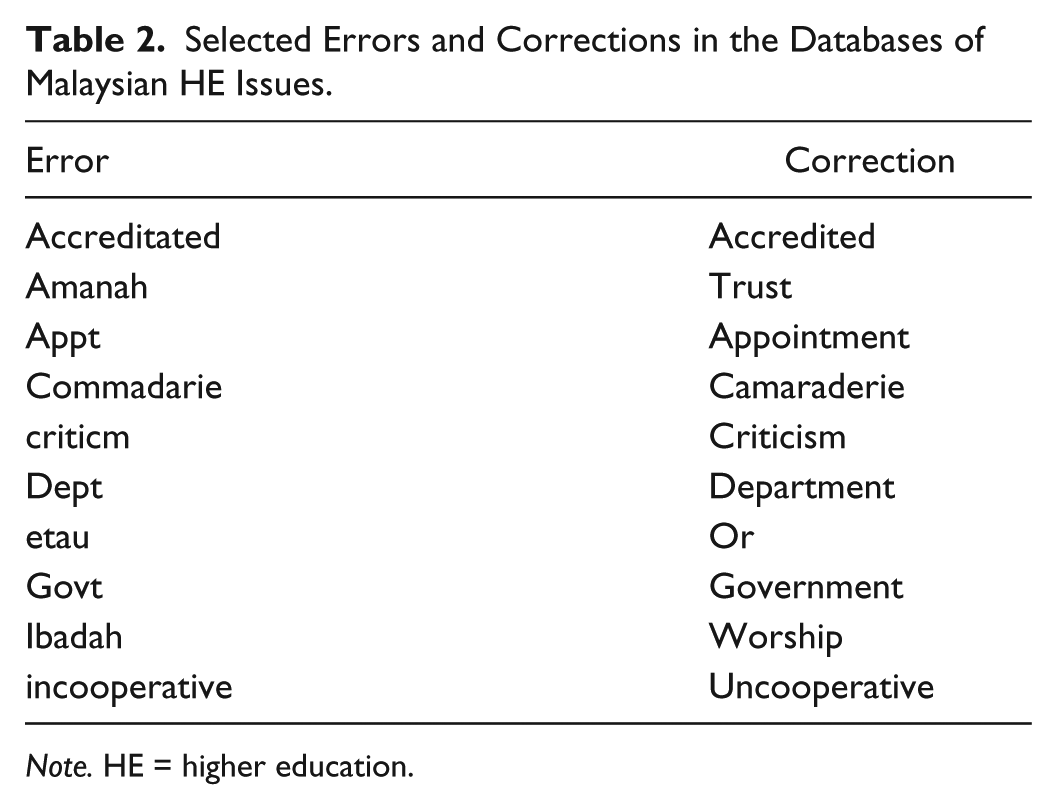
The collected data were exported to Microsoft Excel for data cleaning and purification. For this aim, spelling errors were identified and corrected and the exactly phrased statements were evaluated. Through this procedure, abbreviations were also corrected and necessary words were capitalized. In addition, because a few of the respondents had answered the questions in Malay language, one professional translator cooperated with the research team to translate these words and phrases into English. Some examples of data cleaning and purifying have been presented in Table 2.
Selected Errors and Corrections in the Databases of Malaysian HE Issues.
Note. HE = higher education.
Thereafter, the answers were evaluated for their managerial and semantical relevancy. This procedure yielded to identify and eliminate irrelevant records from the database. Table 3 summarizes the number of respondents and valid records for priorities, values, challenges, and solutions, categorized based on Malaysian HE System and its sectors.
The Number and Percentage of Respondents and Records for Priorities, Values, Challenges, and Solutions.

Note. HE = higher education.
Data Analysis Procedure
The collected data, containing almost 4,500 records of priorities, values, challenges, and solutions, were the immediate responses of many decision makers and leaders in Malaysian HE that had been captured. The software package ATLAS.ti 7 was employed for categorizing similar records into meaningful categories. To that end, a quantitative content analysis method (Newby, 2014; Schreier, 2014) was adopted, the records were read and evaluated thoroughly, and then were assigned to proper categories. It is noticeable that a few of the records, due to their meanings and relevancy, were assigned to more than one category. Next, the categories were given proper labels and through a descriptive analysis technique using SPSS 23, the frequency of the records under each category were examined. In total, the data were categorized into 112 classes of issues. In the following section, the results related to the top five categories under each of the issues, namely, work priorities, work values, work challenges, and work solutions have been provided and explained.
It is remarkable that the examples of assigning records to different categories have been provided in the appendices section.
Findings
Priorities
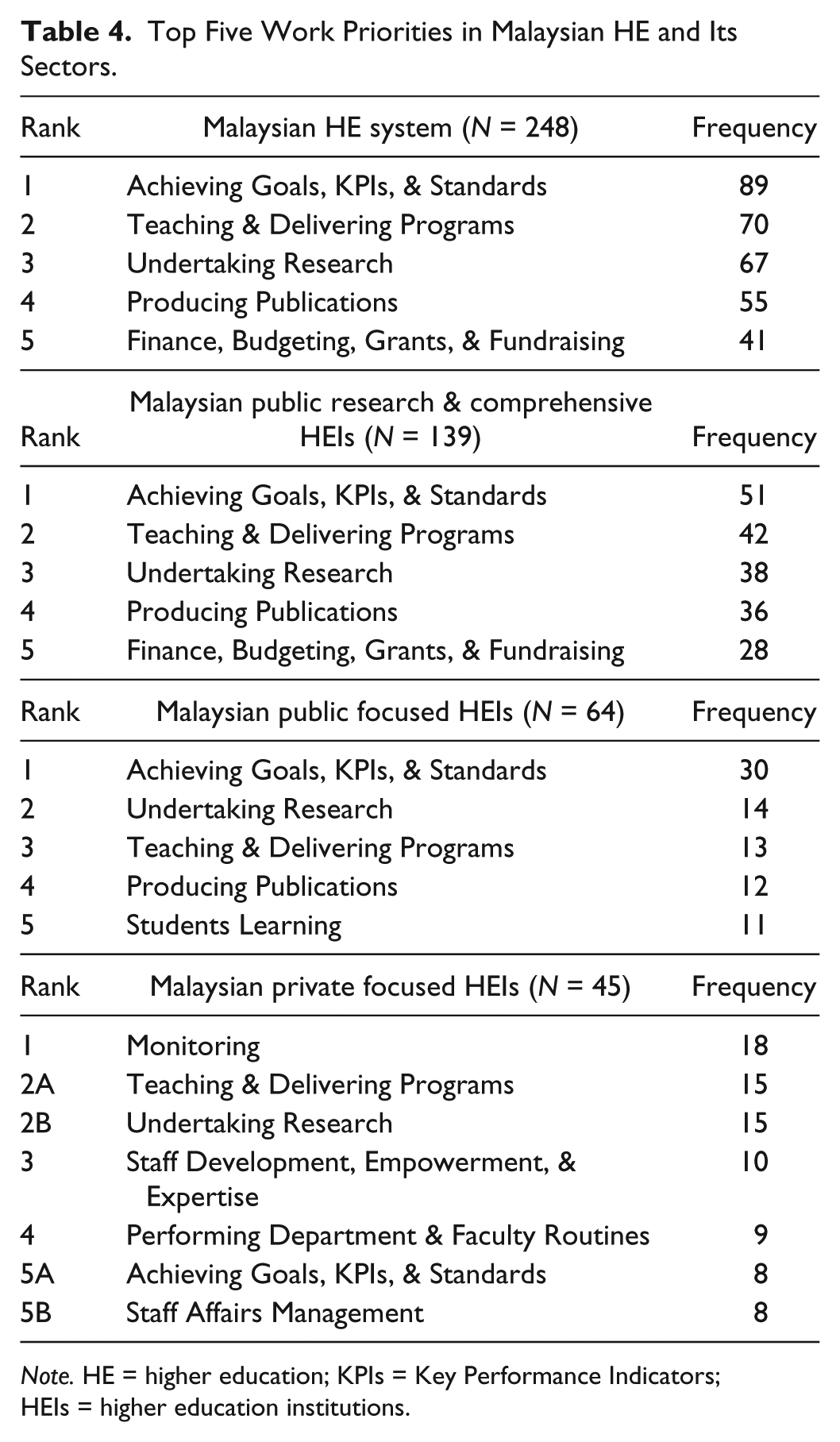
Regarding the entire HE System, the results showed that the top five priorities in Malaysian HE System were exactly analogous to the top priorities identified within the context of Malaysian Public Research & Comprehensive HEIs sector. These priorities included all the activities related to Achieving Goals, KPIs (Key Performance Indicators), & Standards; Teaching & Delivering Programs; Undertaking Research; Producing Publications; and Finance, Budgeting, Grants, & Fundraising.
Focusing on the public sector, the results revealed that Achieving Goals, KPIs, & Standards; Teaching & Delivering Programs; Undertaking Research; and Producing Publications were the top common priorities identified within the context of Malaysian Public Research & Comprehensive HEIs and Public Focused HEIs. Regarding Malaysian Private Focused HEIs, it was yielded that Monitoring; Teaching & Delivering Programs; Undertaking Research; Staff Development, Empowerment, & Expertise; Performing Department & Faculty Routines; Achieving Goals, KPIs, & Standards; and finally Staff Affairs Management were the top priorities of academic leaders in this context. It is noticeable that Achieving Goals, KPIs, & Standards; Teaching & Delivering Programs; and Undertaking Research were the three common top priorities from the viewpoints of the academic leaders in all the three sectors of Malaysian HE system, as shown in Table 4.
Top Five Work Priorities in Malaysian HE and Its Sectors.
Note. HE = higher education; KPIs = Key Performance Indicators; HEIs = higher education institutions.
Values
The results of this descriptive analysis were very amazing about work values. The main finding was that the category of Honesty & Integrity had the maximum frequency in Malaysian HE System and its sectors. This finding was also in alignment with the findings of the study conducted by Ghasemy, Hussin, and Megat Daud (2016) in which the item “Being transparent and honest in dealing with others” had been identified as the topmost important behavior rated by the academics in Australia, New Zealand, and Malaysia. In addition, four categories including Honesty & Integrity; Trustworthiness, Truthfulness, & Sincerity; Commitment, Passion, & Loyalty; and Hard-Working, Diligence, & Persistence were common in all the contexts. Notably, Team-Working was the only common value in Malaysian HE System and Malaysian Public Research & Comprehensive HEIs. Moreover, Kindness, Empathy, & Sympathy was the only common category between Malaysian HE System and Malaysian Private Focused HEIs.
Also, as displayed in Table 5, two categories namely Responsibility and Patience & Tolerance were only among the top values identified within the context of Malaysian Public Research & Comprehensive HEIs. Additionally, the category of Professional Development Training & Continuous Improvement was only among the top values in the context of Malaysian Public Focused HEIs, and a few other values such as Creativity & Innovation, Punctuality & Timeliness, and Discipline were only among the top values in the context of Malaysian Private Focused HEIs.
Top Five Work Values in Malaysian HE and Its Sectors.

Note. HE = higher education; HEIs = higher education institutions; KPIs = Key Performance Indicators.
Challenges
Focusing on Malaysian HE challenges, inefficiencies and shortages related to four issues including Staff Affairs Management; Finance, Budgeting, Grants, & Fundraising; Time Management; and Achieving Goals, KPIs, & Standards were common challenges in the entire HE System and its sectors. In addition, the challenge related to Proper Workload & Assignments was common in the entire HE System, Public Research & Comprehensive HEIs, and Public Focused HEIs.
Considering the statistics provided in Table 6, the challenge associated with three categories, namely, Maintaining Infrastructures & Facilities; Staff Development, Empowerment & Expertise; and Reducing Red Tape & Bureaucracy were only among the top challenges that academic leaders had encountered in the context of Malaysian Public Research & Comprehensive HEIs. Also, challenges related to the lack of Commitment, Passion, & Loyalty and Receiving & Providing Support were only among the top challenges in the context of Malaysian Public Focused HEIs. Focusing on Malaysian Private Focused HEIs, the ineffectiveness in Collaboration & Cooperation was among the top challenges in this context only.
Top Five Work Challenges in Malaysian HE and Its Sectors.

Note. HE = higher education; KPIs = Key Performance Indicators; HEIs = higher education institutions.
Solutions
With respect to solutions, as displayed in Table 7, the results indicated that improvement, advancement, efficiency, and effectiveness regarding four categories were the common proposed solutions by the academic leaders in the entire HE System and its sectors. These categories were Finance, Budgeting, Grants, & Fundraising; Professional Develop-ment Training & Continuous Improvement; Staff Affairs Management; and Discussion & Dialogue.
Top Five Work Solutions in Malaysian HE and Its Sectors.

Note. HE = higher education; HEIs = higher education institutions.
In addition, the effectiveness related to Communication category was a common solution in the entire HE System, Public Research & Comprehensive HEIs, and Private Focused HEIs. Moreover, efficiency in Time Management had been proposed by the academic leaders in the entire HE System as well as Public and Private Focused HEIs as a solution.
It is worth noting that improvements pertinent to some categories such as Target Setting, Policy Issues, and Providing Consultation had only been recommended by the academic leaders in Public Focused HEIs. Moreover, performing enhancement activities associated with Creating a Conductive & Convenient Environment had only been proposed as a main solution by the academic leaders in Malaysian Private Focused HEIs.
Discussion and Conclusion
As specified in the “Findings” section, some similarities and differences in terms of HE issues were identified among Malaysian HE system and its sectors. These issues, to a large degree, emphasized the fact that in university leadership, the context matters and to lead universities effectively, the issues must be addressed precisely. In addition, some similarities were also identified between Malaysian HE and the HE system in other countries. In other words, they did denote that some of the major issues being faced by HEIs were global. For example, the preferences pertinent to teaching and delivering subjects, conducting research, and inspiring the staff had been addressed by Moses and Ramsden (1992) and the values such as honesty and fairness had been considered by Lazaridou (2007). It is noticeable that most of the identified academic priorities, values, and challenges in this research had also been addressed in the two recent research studies focusing on leadership capabilities and managerial competencies carried out in Australia (Scott, Coates, & Anderson, 2008) as well as Australia and New Zealand (Scott & McKellar, 2012). More specifically and given the importance of the challenges in the literature, it was found that most of the identified challenges had been addressed in previous research works. For example, identified challenges related to funding (Keener et al., 2002; Shin & Harman, 2009; Teixeira & Koryakina, 2013), staff management and human resources (Drew, 2010; Fullan & Scott, 2009; Keener et al., 2002), as well as red tape and bureaucracy (Black, 2015; Fullan & Scott, 2009; Teferra & Altbach, 2004) may be specified. In addition, other challenges, which were in alignment with the findings in other research works, included workloads and the nature of academic work (Black, 2015; Ramsden, 1998), collaborations (Black, 2015; Drew, 2010), commitment and loyalty (Black, 2015), lack of time and time management skills (Drew, 2010), and providing supporting services (Fullan & Scott, 2009).
To provide a better picture of Malaysian HE issues from the perspective of the participated academic leaders, the word cloud of 112 categories of priorities, values, challenges, and solutions have been illustrated in Figure 1. Notably, the size of the titles of the categories represent their frequency.
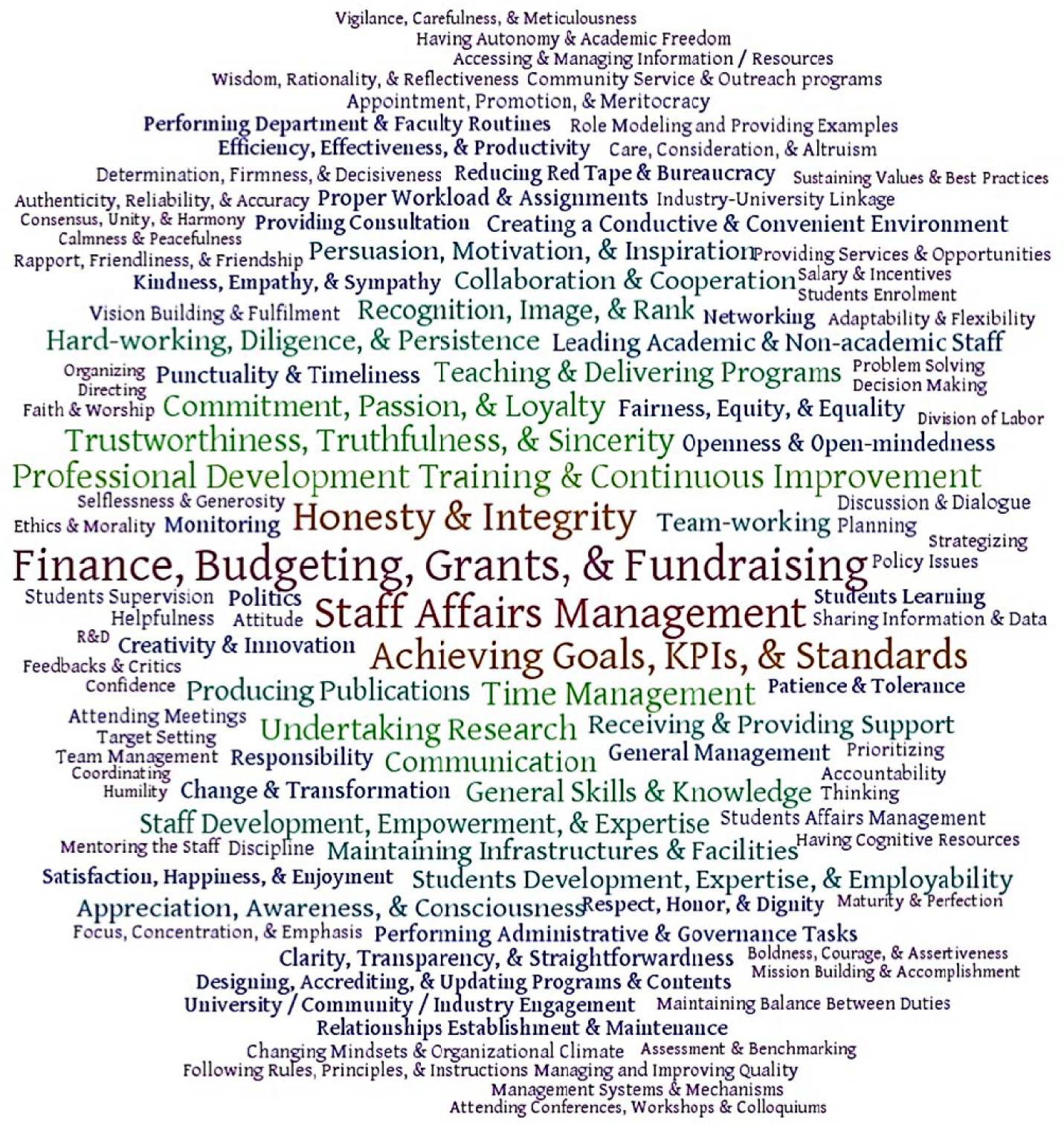
The word cloud of Malaysian HE issues.
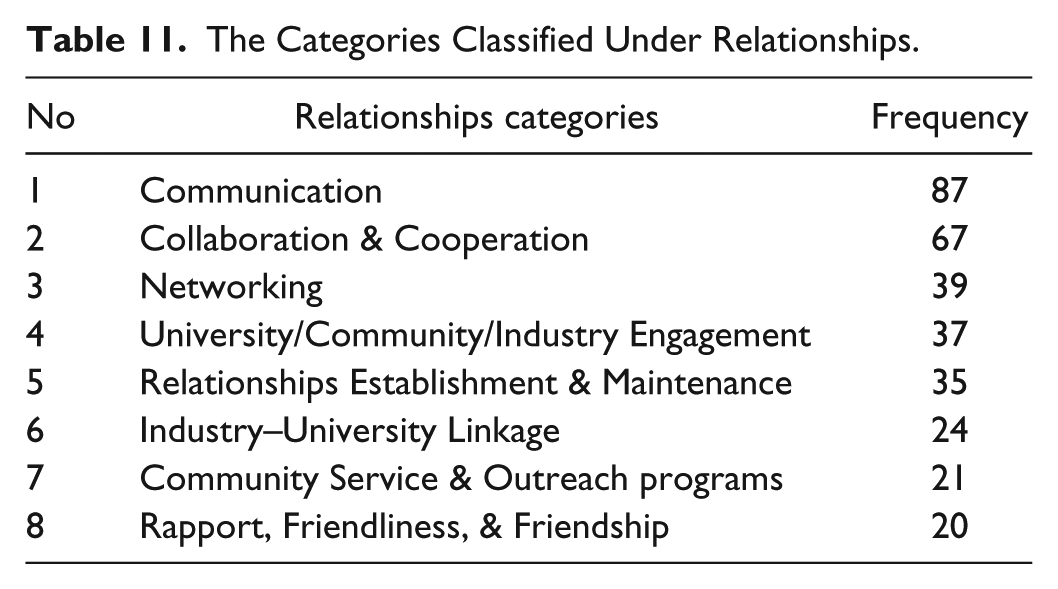
These categories were focused from a different angle as well. In fact, they were evaluated from a thematic perspective (Creswell, 2012) to identify the mega-categories containing similar concepts. This examination revealed that all the 112 categories could be classified into five mega-categories, namely, Academic Core Activities, Change & Leadership, Management, Relationships, and Work Values. Tables 8 to 12 present the mega-categories with their assigned categories and their frequencies for the entire Malaysian HE System.
The Categories Classified Under Academic Core Activities.

The Categories Classified Under Change & Leadership.

The Categories Classified Under Management.

Note. KPIs = Key Performance Indicators.
The Categories Classified Under Relationships.
The Categories Classified Under Work Values.

Finally, all the 112 categories were evaluated from another extra perspective. To this end, the four tables of priorities, values, challenges, and solutions in each of the four contexts, namely, entire HE System, Public Research & Comprehensive HEIs, Public Focused HEIs, and Private Focused HEIs were evaluated to detect common issues in each context.
The results displayed in Table 13 indicated that five issues under HE System, three issues under Public Research & Comprehensive HEIs, three issues under Public Focused HEIs, and five issues under Private Focused HEIs categories were common in the tables of priorities, values, challenges, and solutions. In fact, focusing on each context, while any of these issues was a priority and a value, the incompetency, inefficacy, or shortage of them was a challenge, and improving or promoting any of them had been viewed as a solution to the challenges faced by Malaysian academic leaders. This, as the unique contribution of this research in comparison with similar studies, suggested the consideration of these issues by the Malaysian HE policy makers in developing and updating professional development programs as well as making new policies to ensure a quality provision of HE in Malaysian universities. It is noteworthy that “Time Management” and “Persuasion, Motivation, & Inspiration” were common in three sectors. Also, “General Skills & Knowledge” and “Leading Academic & Nonacademic Staff” were common issues in two sectors. Finally, the issues including “Appreciation, Awareness, & Consciousness,” “Recognition, Image, & Rank,” “Professional Development Training & Continuous Improvement,” “Finance, Budgeting, Grants, & Fundraising,” “Communication,” “Creating a Conductive & Convenient Environment,” and “Achieving Goals, KPIs, & Standards” were the major issues in just one sector.
Main Areas of Focus in Malaysian HE and Its Sectors.
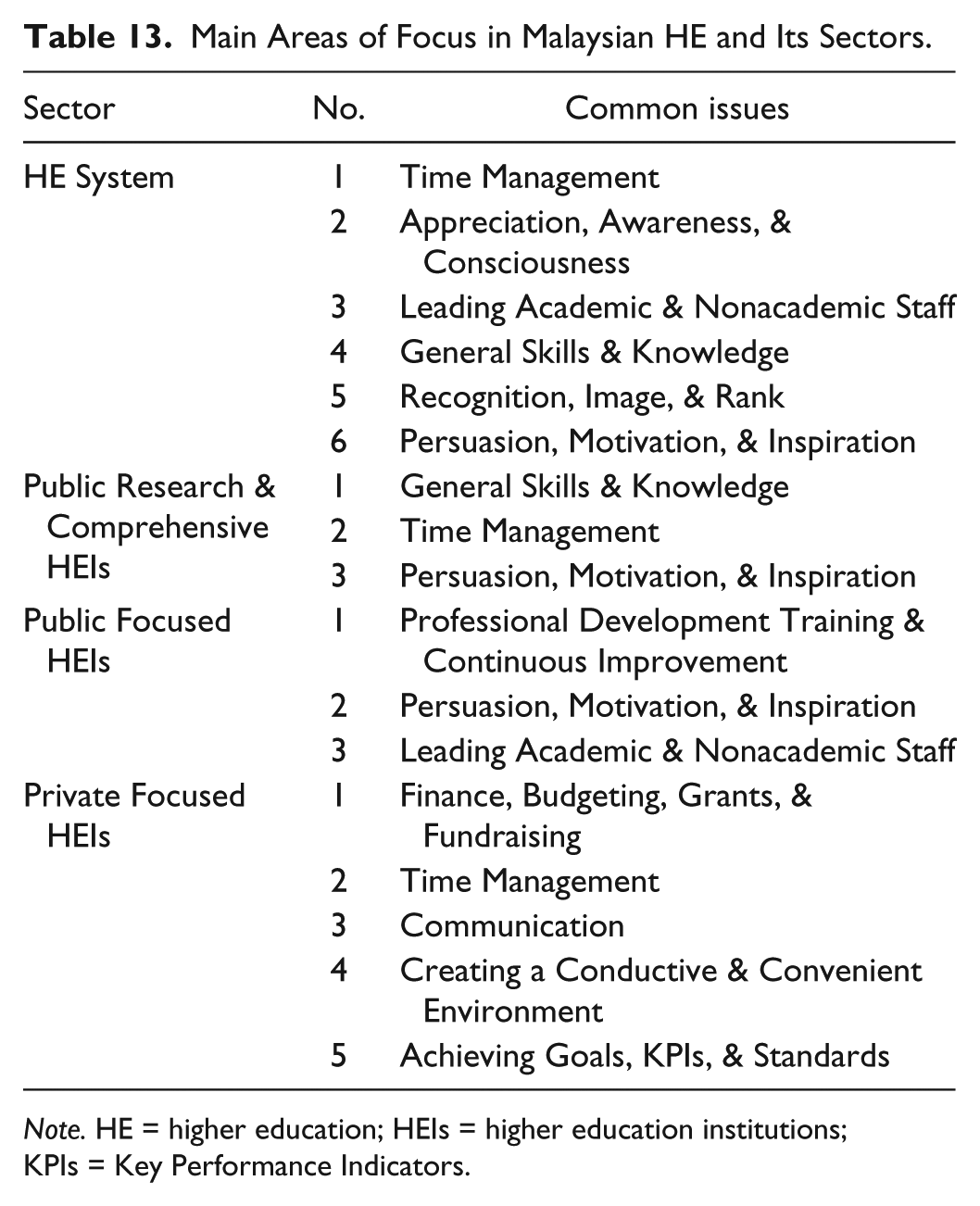
Note. HE = higher education; HEIs = higher education institutions; KPIs = Key Performance Indicators.
Limitations
Even though all the considerations in terms of preciseness of the classification of the records were adhered to, there were still possibilities that some user errors have occurred during data screening and analysis. In addition, no similar qualitative inquiry at this scale was identified to make comparisons between the findings of this research with those studies. Finally, due to the huge volume of the records in the database of responses, quantitative content analysis was employed to quantitatively represent the most important elements in the messages communicated by the respondents. In other words, more advanced methods need to be used to provide more insightful meanings from the collected data.
Implications and Recommendations
From a practical perspective, some opportunities for policy makers in the Ministry of HE Malaysia and AKEPT have been provided through this study to have a clearer picture of the current issues in Malaysian HE. As a matter of fact, policy makers can focus on the key issues in Malaysian HE. Especially, AKEPT is benefited from the results of this study in a more practical vein for a few reasons. First, the contents of the current academic leadership training programs may be updated based on the results of this study which consequently help AKEPT to hit this core objective. Second, the findings of this research work were in alignment with one of the missions of AKEPT regarding transformations in HE at national level. Third, the target population in this study and the target group of AKEPT was similar which was another encouraging practical point to be noted. In addition, through data collection procedure, the immediate responses of almost 250 Malaysian academic leaders from 25 public and private universities were captured to identify the main priorities, values, challenges, and solutions in Malaysian HE. Hence, unlike similar studies, not only the challenges but also priorities, values, and solutions were focused in this research.
Undertaking this research work also did provide some recommendations for future research:
i. Replication of this research work in other Malaysian educational sectors and comparing the results of this research with those studies.
ii. Replication of the study in leading countries in terms of providing HE in Asia-Pacific region.
iii. Replication of the study in other educational sectors in Asia-pacific countries.
iv. Replicating the study in other countries with the intention of positioning themselves as educational hubs such as Bahrain, Qatar, and United Arab Emirates in Middle East as well as Singapore and Hong Kong in East Asia.
v. Applying more advanced qualitative data analysis approaches to provide a better understanding about the issues in Malaysian academic context.
Footnotes
Acknowledgements
The authors would like to appreciate the editor-in-chief and the editorial staff of SAGE Open, and the three anonymous reviewers who greatly improved the quality of this article with their insightful comments. Additionally, the authors are grateful to the respondents in this study who kindly shared their ideas and thoughts with the research team. And last but not least, special appreciation goes to Prof. Dr. Morshidi Sirat, Prof. Dr. Turiman Suandi, Ms. Zeynab Khodaei, Ms. Malihe Ghasemi, and Ms. Zarina Waheed for their invaluable contribution and support.
Appendix A
Appendix B
Appendix C
Appendix D
Declaration of Conflicting Interests
The author(s) declared no potential conflicts of interest with respect to the research, authorship, and/or publication of this article.
Funding
The author(s) disclosed receipt of the following financial support for the research, authorship, and/or publication of this article: This study was carried out under the LIMEO Program (RP020A-15HNE) supported by University of Malaya.
